Dissertation submitted in partial fulfillment of the requirement for the award of the Degree of
MASTER OF PHARMACY IN
PHARMACEUTICS By
REG NO: 26113902
Under the guidance of
Dr.P.Bharathi Dhasan M.Pharm., Ph.D.,
DEPARTMENT OF PHARMACEUTICS
ARULMIGU KALASALINGAM COLLEGE OF PHARMACY,
ANAND NAGAR,
KRISHNANKOIL-626 126,
VIRUDHUNAGAR DISTRICT, TAMILNADU
This is to Certify that the dissertation entitled “FORMULATION DEVELOPMENT AND EVALUATION OF IBUPROFEN LYSINE IMMEDIATE
RELEASE TABLETS BY DIRECT COMPRESSION METHOD” submitted by Reg.No.
26113902 was carried out in the Department of Pharmaceutics, Arulmigu Kalasalingam College of Pharmacy, Anand Nagar, Krishnankoil-626 126, which is affiliated to The Tamilnadu Dr. M.G.R. Medical University, Chennai, under the supervision and guidance of Dr. P. Bharathi Dhasan M.Pharm., Ph.D., Dept of Pharmaceutics for the partial fulfillment of degree of Master of Pharmacy in Pharmaceutics.
Place: Krishnankoil. Dr. M.PALANIVELU., M.Pharm., Ph.D.,
Date: Principal,
Arulmigu Kalasalingam College of Pharmacy,
Anand Nagar, Krishnankoil-626 126,
Virudhunagar, District,
Tamilnadu.
CERTIFICATE
This is to Certify that the dissertation entitled “FORMULATION DEVELOPMENT AND EVALUATION OF IBUPROFEN LYSINE IMMEDIATE
RELEASE TABLETS BY DIRECT COMPRESSION METHOD” submitted by
Mr.T.ARUN PRAKASH (Reg. no: 26113902) to The Tamilnadu Dr.M.G.R.Medical University, Chennai, in Partial fulfillment for the award of “MASTER OF PHARMACY” in Pharmaceutics at Arulmigu Kalasalingam College of Pharmacy, Anand Nagar, Krishnankoil-626 126, which is affiliated to The Tamilnadu Dr. M.G.R. Medical University, Chennai, is a bonafide work carried out by him under my guidance and supervision during the academic year 2012-2013.
Place: Krishnankoil. Dr.P.Bharathi dhasan ., M.Pharm., Ph.D.,
Date: HOD, Department of Pharmaceutics.
ArulmiguKalasalingamCollege of Pharmacy.
Anand Nagar, Krishnankoil-626 126
Virudhunagar District.
Tamilnadu.
This is to certify that the dissertation work entitled “FORMULATION DEVELOPMENT AND EVALUATION OF IBUPROFEN LYSINE IMMEDIATE
RELEASE TABLETS BY DIRECT COMPRESSION METHOD” submitted by Reg. No:
26113902 to “The Tamil Nadu Dr. M.G.R. Medical University,” Chennai, in partial fulfillment of the requirements for the award of degree of MASTER OF PHARMACY in PHARMACEUTICS were evaluated by.
Place: Krishnankoil
Date :
Centre: Arulmigu Kalasalingam College of Pharmacy,
Anand Nagar, Krishnankoil-626126,
Virudhunagar District, Tamilnadu.
Examiners:
1.
ACKNOWLEDGEMENT
He gives me an immense pleasure that I take this opportunity to express
my sincere thanks to “Kalvivallal” Thiru. T.Kalasalingam, B.com., Chairman
Arulmigu kalasalingam College of Pharmacy and I express my sincere thanks to
Dr.Palanivelu M.Pharm., Ph.D., Principal, Arulmigu kalasalingam College of
Pharmacy, Krishnankoil, Srivilliputhur for his valuable advice, encouragement
and support during my project work.
I express my wholehearted gratitude to my esteemed teacher and guide,
Dr.P.Bharathi dhasan ., M.Pharm., Ph.D., HOD, Department of
Pharmaceutics , for his valuable guidance, kind advice, and support during my
project work.
I owe my deep debt of gratitude to our esteemed and beloved staff.
Mr.G.Vinothapooshan, M.Pharm., Ph.D., Professor, Mr.V.Sivakumar
M.Pharm., Ph.D., Assistant Professor, Dr.Jeya Ananthi, M.Pharm., (Ph.D).,
Assistant professor, Department of Pharmaceutics and Mr.D.Sridharan,
M.Pharm., Assistant professor, Department of Pharmaceutical analysis,
Arulmigu Kalasalingam College of Pharmacy, Krishnankoil, Srivilliputhur
for their support, timely help and suggestions.
My sincere thanks to all other staff of Arulmigu kalasalingam college of
Pharmacy, Krishnankoil, Srivilliputhur, who directly or indirectly gave a
helping hand to me while carrying out this study.
My special thanks to the library staff for providing library facilities.
I specially convey my gratitude and warm thanks to Dr. D.Sampath
kumar, Head of the Research and development, Mr. R.Selvakumar, General
Manager, formulation division, Shasun pharmaceuticals, puducherry for their
I am very thankful and grateful to Mr.R.Raju, Manager- Formulation
R&D, and, Mr.Subrankulu sarker Asst.Manager-formulation R&D, Shasun
pharmaceuticals ltd, puducherry, who suggested me to take this work. They
guided me throughout this research work.
I am very thankful to, Mr.Anand senthilvel, Mr.N.Ilayaraja and
Mr.Kesavalu, Asst.Manager-formulation R&D, Shasun pharmaceuticals ltd,
puducherry
I sincerely thank to, Mr.Parthiban, Mr.Sharan for their valuable help
during my project work.
I would like to express my profound sense of gratitude to Mr. Kathiravan,
Mr.Santhosh, Mr.Anki Reddy, Mr.Parivallal, Mr.prabakaran, Mr.Suresh,
Mr.Nagaraj, and Miss.P.Anusha, officer Formulation Development for their
valuable suggestions and kind advice for the success of my project work.
I would like to express my thanks to Mr.Lakshman, manager, QC,
Shasun pharmaceuticals who gave me a wonderful opportunity in shasun
pharmaceuticals for thesis work.
I express my heartful gratitude to my classmates kamal, Ananth, Ganesh,
pethanan, Rajarathinam, Manikandan, Karthik, sherin and priyadharsini, and
my friends in shasun, Shahul , Selvakumar, Sajesh, Rehna, Rani, and all my
juniors who helped me directly and indirectly for the successful completion of
my project work. It would not be completed if I do not convey my heartful
thanks to my brothers & family members, for their encouragement and moral
I express my heart full thanks to chemicals store and all lab technicians
of Arulmigu kalasalingam college of Pharmacy, Krishnankoil, for their support
and encouragement during the course of my work.
Above all I dedicate myself before the unfailing presence of GOD and
constant love and encouragement given to me by my beloved Father, Mother,
Brothers and my sister-in-law remaining family members who deserves the
Chapter CONTENTS Page No
1. INTRODUCTION
1
2. LITERATURE REVIEW 8
3. AIM AND PLAN OF WORK 15
4. MATERIALS AND METHODS
4.1 List of equipments used 4.2 List of materials used 4.3 Drug profile
4.4 Excipient profile
15
5.
EXPERIMENTAL INVESTIGATIONS
5.1 Preformulation studies 5.2 Manufacturing methodology 5.3 Evaluation procedure 5.4 Dissolution studies
5.5 stability studies
29
6. RESULTS AND DISCUSSION 47
7. CONCLUSION 89
8. SUMMARY 90
9. BIBLIOGRAPHY
AR - Analytical grade
BP - British Pharmacopoeia
°C - Degree Celsius
Conc. - Concentration
DEC - Drug Excipients Compatibility
CRC - Child resistant closure
g - gram
EP - European Pharmacopoeia
F - Formulation
F1 - Dis -similarity factor
F2 - Similarity factor
HPLC - High Performance Liquid Chromatography
ICH - International Conference on Harmonization
IR - Immediate release
JP - Japanese Pharmacopoeia
mg - Milligram
mL - Millilitre
mM - Millimole
mins - Minutes
ND - Not detectable
NLT - Not less than
PH -
Negative logarithm of hydrogen ion
q.s. - Quantity sufficient
RH - Relative Humidity
RLD - Reference Listed drug
Rpm - Revolutions per minute
USP - United States Pharmacopoeia
Wt - Weight
w/w - Weight by Weight
1. INTRODUCTION
1.1 ORAL DRUG DELIVERY SYSTEMS
Streubel et al., (2010) reported oral drug delivery has been known for decades as the most widely utilized administered route among all the routes that have
been employed for dosage forms. The reasons that the oral route achieved such
popularity due to it is safety, convenience, it does not need assistance, non
invasive, often painless, the medicament need not be sterile and also is cheaper.
Both solid dosage form as well as liquid dosage form given orally. The various
dosage forms administered orally, the tablet is one of the most preferred dosage
forms because of its ease of manufacturing, convenience in administration,
accurate dosing, stability compared with oral liquids and because it is more
tamperproof than capsules
1.2 Immediate release dosage form
Rajpoot et al., (2011) develop the immediate release solid oral dosage forms are classified as either having rapid or slow dissolution rates.
Immediate release dosage forms are those for which ≥85% of labeled amount
dissolves within 30 min. For immediate release tablets, the only barrier to drug
release is simple disintegration or erosion stage, which is generally
accomplished in less than one hour.
Oral route of drug administration is perhaps the most appealing route for the
delivery of drugs. Of the various dosage forms administered orally, the tablet is
one of the most preferred dosage forms. The bioavailability of drug is dependent
The gastrointestinal tract provides sufficient fluid to facilitate disintegration of
the dosage form and dissolution of the drug. The large surface area of gastric
mucosa favors the drug absorption. Therefore, the oral route has continued to be
the most appealing route for drug delivery despite the advancements made in
the new drug delivery systems. Banker and Anderson stated that at least 90% of
all drugs used to produce systemic effect are administered orally.
Immediate release tablets have received much attention in recent years, as they
are preferred by pediatrics and geriatric patients. Bioavailability of a drug
depends in absorption of the drug, which is affected by solubility of the drug in
gastrointestinal fluid and permeability of the drug across gastrointestinal
membrane. The drugs solubility mainly depends on physical & chemical
characteristics of the drug. However, the rate of drug dissolution is greatly
influenced by disintegration of the tablet.
The disintegration test is an official test and hence a batch of tablet must meet
the stated requirements of disintegration. Disintegrants, an important excipients
of the tablet formulation, are always added to tablet to induce breakup of tablet
when it comes in contact with aqueous fluid and this process of desegregation
of constituent particles before the drug dissolution occurs, is known as
disintegration process and excipients which induce this process are known as
disintegrants.
The objectives behind addition of disintegrants are to increase surface area of
the tablet fragments and to overcome cohesive forces that keep particles
together in a tablet.
Ansel et al., (1999) An ideal dosage regimen in the drug therapy of any disease is the one, which immediately attains the desired therapeutic concentration of
drug in plasma (or at the site of action) and maintains it constant for the entire
dosage form in particular dose and at a particular frequency. Thus drug may be
administered by variety of routes in a variety of dosage form.
Martin et al., (2003) Drugs are more frequently taken by oral administration. Although a few drugs taken are intended to be dissolved with in the mouth, the
vast majority of drugs taken are swallowed. Compared with alternate routes
the oral route of drug administration is the most popular and has been
successfully used for the conventional delivery of drug. It is most natural,
uncomplicated, convenient, safe means of administering drugs, greater
flexibility in dosage form design, ease of production and low cost
1.3.TABLET
Gabrielsson et al., (2002) reported current market, tablet is most widely used dosage form because of ease of administration and convenient for industry to
manufacturer. In pharmaceutical industries, manufacturing of tablets are
usually focused on the optimization of the excipients mixture composition to
obtain a product that meet established standard.
Parmar (2009)The tablet dosage form is a versatile drug delivery system. Different types of tablet formulations are available, which could be
broadly classified based on: (1) route of administration such as
tablets for oral delivery, sublingual delivery, buccal delivery, rectal delivery or
vaginal delivery, and (2) formulation characteristics such as immediate release
tablets, effervescent tablets, melt- in-mouth or fast dissolving tablets, delayed
release or extended release tablets. In all the cases, the general manufacturing
process, machinery used for preparation of tablets and materials used are
1.4 DIRECT COMPRESSION:
Rane et al., (2009) Direct compression has taken the centre stage in tablet manufacturing because the process avoids many of the problems
associated with granulation methods. It is a simple, economical
process and because heat or moisture is not required, it is suitable
for unstable compounds. However, the success of the direct
compression process is determined to a greater degree by the
excipients chosen because they impart flow and
compression characteristics to the powder blend.
Buwalda et al., (1997) Starch is a versatile, cheap and readily available as found wide application in tableting as a binder, disintegrant,
diluent, lubricant and glidant. The native form of starch possesses poor
flow and compression properties making it unsuitable for
direct compression. researchers have made attempts to improve on the
flowability and compressibility of starch by modification in
order to make it adaptable for direct compression. -
NON STEROIDAL ANTI-INFLAMMATORY DRUGS
Non-steroidal inflammatory drugs usually abbreviated toNSAIDs these
are a class of drugs that provide analgesic and antipyretic effects and in higher
doses it produces anti-inflammatory effect. The term “non-steroidal”
CLASSIFICATION:
NSAID’s can be classified based on their chemical structure or
mechanism of action older NSAIDs were known long before their mechanism
of action was elucidated and were for this reason classified by chemical
structure or origin newer substances are more often classified by mechanism of
action.
1) SALICYLATES
1) Aspirin (acetyl salicyclic acid)
2) Diflunisal
3) Salsalate
2) PROPIONIC ACID DERIVATIVES:
1) Ibuprofen
2) Dexibufrofen
3) Naproxen
3) Fenoprofen
4) Ketoprofen
5) Dexketoprofen
7) Loxoprofen
3) Acitic acid derivatives
1) Indomethacin
2) Sulidac
3) Ketrolac
4) Diclofenac
4) Enolic acid (Oxicam)derivatives
1) Piroxicam
2) Meloxicam
3) Droxicam
5) Fenamic acid derivatives (Fenamates)
1) Mefanamic acid
2) Meclofenamic acid
3) Flufenamic acid
4) Tolfenamic acid
6) Selective cox-2 inhibitors, Coxibs):
2) Rofecoxib
3) Valdecoxib
4) Parecoxib
5) Firocoxib
7) Sulphanilamides
1) Nimesulide
8) Others
1) licofelone
2) Lysine clonixinate
9)Naturals:
1) Hyperforin
LITERATURE REVIEW
Martin et al., (1990)investigated lysine salt of d,l -2-(4-isobutylphenyI)-propionic acid (ibuprofen lysine) was administered as a single oral dose of 500
mg by means of commercially available coated tablets Drug tolerability was
excellent for the oral administration of ibuprofen lysine as well as for the
intravenous treatments with ibuprofen free acid. Only mild and transient
adverse drug reactions such as mild burning or dragging sensation during
injection or mild redness at the site of injection were reported.
Tadeuswz et al., (1993) studied lack of significant differences between the AUC values from suppository and the intravenous studies with similar doses
implies complete absorption of ibuprofen from all the suppositories Ibuprofen
lysinate was absorbed significantly more readily than the free acid from
suppositories. The lysinate suppository with a lipophilic surfactant had a higher
absorption rate constant than that with a hydrophilic surfactant. The ka values
did not significantly differ for a twofold difference in dose. Equations were
developed to calculate true AUC and area under the moment curve (AUMC)
values when A exceeds B, and to transform C versus t plots to the origin with
A' = A = B.
Donald et al., (1995) reported single-dose, double-blind, parallelgroup, single-site study compared ibuprofen lysine 400 mg with acetaminophen 1000
mg and placebo in 240 patients with moderate-to-severe postoperative dental
pain. The relative onset of analgesic response, overall analgesic efficacy,
duration of effect, and safety were assessed over a 6-hour postdose period.
Analgesic efficacy was assessed by patient self-rating of pain intensity, pain
relief, time to meaningful pain relief, need for additional analgesic medication,
and patient global evaluation. Ibuprofen lysine had a significantly faster onset of
Inken Stoye (1998) studied a contribution to the investigation of molecular association of phospholipids and amphiphilic substances like, e.g.
non-steroidal anti-inflammatory drugs. Our research focussed on
physico-chemical characterization of ternary systems containing ibuprofen lysinate,
lecithin and water. The influence of the resulting microstructures on drug
release and permeation through excised human stratum corneum was also
investigated.. A special emphasis was laid upon the storage-induced
transformation of liposomal dispersions into mixed micellar solutions and its
influence on drug release and permeation. A model for the transformation
process is presented Because of the association of ibuprofen lysinate molecules
with phospholipid molecules within the liposomal and the mixed micellar
system the share of free ibuprofen lysinate monomers, which can pass through
the dialysis membrane in the release experiment, is markedly reduced.
Glowka (2000) Studies were performed on the effect of ibuprofen racemate ionization extent on the pharmacokinetics of its enantiomers following
administration in suppositories to rabbits. The suppositories, containing 146.3
mg ibuprofen in acidic form (IBP) or 250 mg ibuprofen lysinate (IBPL),
equivalent to the above IBP dose, were prepared using lipophilic Witepsol H-15
as a base and administered to rabbits in a crossover design. Compared with IBP,
administration of IBPL was followed by faster absorption and elimination of R
and S enantiomers. However, significant differences at α = 0.05 were observed
only at the stage of elimination. AUC was markedly higher following
administration of suppositories containing IBP than following suppositories
with IBPL and this pertained to both R and S enantiomers..
Jörn Lötsch et al., (2001) investigated the pharmacokinetic equivalence of two different formulations of ibuprofen lysinate with special focus on the
expected effects.Ibuprofen is one of the most frequently used over-the-counter
ibuprofen. This contrasts with several reports that a dose of 400 mg racemic
ibuprofen is probably more appropriate to produce the desired analgesic effects .
It is therefore reasonable to develop ibuprofen formulations with tablet doses of
400 mg. The present study was designed to compare the stereoselective
pharmacokinetics of such a newly developed 400 mg tablet formulation with
those of a standard formulation of 200 mg tablets.
Matthias et al., (2005) studied bioequivalence between a 400-mg ibuprofen extrudate and lysinate formulation, and to evaluate the relative
bioavailability of the extrudate tablet compared to a regular ibuprofen tablet,
based on Cmax and AUC0-∞.. The rate of absorption at fasted state was
considerably faster following administration of the ibuprofen extrudate and the
ibuprofen lysinate tablet than for regular ibuprofen. However, the overall extent
of absorption was not different, and a food effect could be demonstrated for all
3 formulations.
Jacob et al., (2007) Patent ductus arteriosus (PDA) is the failure of the ductus that arises from the distal dorsal aortic arch to close during the first few
days of life. The treatment options for PDA include “watchful waiting,”
pharmacologic therapy with cyclooxygenase (COX) inhibitors (COX-1 and
COX-2), such as indomethacin or intravenous (IV) ibuprofen lysine, and
surgery when medical interventions have proved ineffective. The clinical trials
evaluating the utilization of IV ibuprofen lysine focus on either preventing the
persistence of a PDA or treating the PDA in premature infants in whom the
ductus does not close within 48 hours of birth. Although the role of COX
inhibitors in prophylaxis of PDA has been studied, it has not been clearly
delineated. Treatment of PDA in preterm low birth weight infants from the
second day of life on with IV ibuprofen lysine has been studied in 4 major and 3
smaller clinical trials. Overall, in 7 studies with 492 patients, the closure rate of
indomethacin. In addition, neonates treated with IV ibuprofen lysine had
significantly better creatinine clearance, urine output, serum creatinine, and
blood urea nitrogen (BUN) profiles than indomethacin-treated patients. Overall,
IV ibuprofen lysine is as effective as indomethacin for closure of PDA, yet is
associated with a better safety profile with fewer negative side effects when
compared to indomethacin.
Pai et al., (2008) Approximately 70-80% of newborns less than 28 weeks' gestational age require pharmacologic and/or surgical intervention to close a
hemodynamically significant patent ductus arteriosus (PDA). Indomethacin has
been the pharmacologic treatment of choice and has also been used
prophylactically in very premature neonates to prevent PDA. The drug,
however, is associated with renal and gastrointestinal adverse effects. In July
2006, intravenous ibuprofen lysine became available in the United States for
treatment of hemodynamically significant PDA. The mechanism of action for
both indomethacin and ibuprofen lysine is through inhibition of prostaglandin
synthesis, resulting in ductal constriction. Both drugs appear to be equally
efficacious in closing echocardiographically confirmed PDA. Ibuprofen lysine
has demonstrated significantly less effects on cerebral, renal, and mesenteric
blood flow in premature neonates when compared with indomethacin. A
transient but significant increase in serum creatinine concentration, decrease in
urine output, and increase in frequency of oliguria were observed with
indomethacin when compared with ibuprofen lysine. However, the rate of
reopening of the ductus after pharmacologic closure and the need for rescue
therapy were not different between the two drugs. In addition, no differences
were noted in other outcomes such as frequency of intraventricular hemorrhage,
necrotizing enterocolitis, or chronic lung disease, as well as in duration of
mechanical ventilation and length of hospital stay. When administered
nor provide any neurodevelopmental benefits. In addition, ibuprofen lysine has
not been adequately studied in neonates of 27 weeks' gestational age or younger.
Ibuprofen lysine is as efficacious as indomethacin in treating hemodynamically
significant PDA in neonates greater than 27 weeks' gestational age.
Holt et al., (2008) To study the physical compatibility of ibuprofen lysine injection (NeoProfen, Ovation Pharmaceuticals Inc., Deerfield, IL) with
medications commonly used in the premature neonatal population during
simulated Y-site administration. Commonly used intravenous medications in
preterm infants were evaluated for physical compatibility with ibuprofen lysine
injection. A 20-mL sample of ibuprofen lysine drug product solution was mixed
with a 20-mL sample of each of the 34 medications at concentrations used
clinically. The mixtures were stored at room temperature and each sample was
evaluated for turbidity and physical appearance at time 0 (immediately after
preparation) and at 4 hours after preparation.
Holt et al., (2008) To study the physical compatibility of ibuprofen lysine injection (NeoProfen, Ovation Pharmaceuticals Inc., Deerfield, IL) with
medications commonly used in the premature neonatal population during
simulated Y-site administration. Commonly used intravenous medications in
preterm infants were evaluated for physical compatibility with ibuprofen lysine
injection. A 20-mL sample of ibuprofen lysine drug product solution was mixed
with a 20-mL sample of each of the 34 medications at concentrations used
clinically. The mixtures were stored at room temperature and each sample was
evaluated for turbidity and physical appearance at time 0 (immediately after
preparation) and at 4 hours after preparation.
Ambat et al., (2008) studied the influence of IBU on B–A binding was measured by saturation index and horseradish peroxidase assays. B–A solutions
of 5 and 10 mg per 100 ml. Drug concentrations used were 142.5, 200 and 285
mg l-1 for IBU and 100 and 200 mg l-1 for acetyl salicylic acid (ASA). Similar
tests were performed on premature newborn sera with bilirubin concentrations
of 5 to 10 mg per 100 ml.Displacement of bilirubin was demonstrated only at
high IBU concentration and high B:A ratio. However, free bilirubin levels were
not shown to increase with increasing IBU concentration
Sheffield et al., ((2009) Ibuprofen might have advantages over indomethacin, when used to effectuate closure of a neonate’s patent ductus
arteriosus (PDA). Several previous studies indicate that platelet plug formation
is impaired after administration of indomethacin, On the basis of our present
studies, we speculate that ibuprofen lysine administration to neonates with a
PDA, when used according to the manufacturer’s recommendations, has little
adverse effect on platelet plug formation. This information might be a factor to
consider when deciding whether to select indomethacin or ibuprofen for PDA
closure.
Luke et al., (2012) reported Prostaglandins are utilized to maintain the patency of the ductus arteriosus until surgical ligation is performed. When
surgical ligation is not indicated, prostaglandin inhibitors. Ibuprofen was
initially thought to have less adverse effects, such as a decreased incidence of
oliguria, gastrointestinal (GI) toxicity, and cerebral hypoperfusion. The use of
ibuprofen has been shown to increase the incidence of pulmonary hypertension.
Patrizia Santi et al., (2003) studied in vitro the post-iontophoresis transport of ibuprofen lysine across rabbit ear skin, from ibuprofen lysine water
solutions. The results showed a significantly higher cathodal transport compared
to passive flux. Anodal iontophoresis also increased ibuprofen permeation, even
though the drug is negatively charged. The application of an electric current for
contact with the skin, produced much higher post-iontophoresis fluxes of
ibuprofen than passive diffusion.
Lambert et al., Template bleeding time before and at various intervals
after ibuprofen lysine dosing of 20 neonatal intensive care unit (NICU) patients.
Each bleeding time measured is shown by an 'X'. Lines connect the bleeding
times performed before the first dose of ibuprofen with those performed at
AIM
To develop a bioequivalent, robust, stable and cost effective formulation
of immediate release ibuprofen lysine Tablets 342 & 684mg equivalent in
performance to Reference product by direct compression method.
Objective
The objective of the present study is to:
To develop a formulation of immediate release tablets of ibuprofen lysine
of strengths 342mg and 684mg which shall be bioequivalent to
Reference product 342mg and 684mg respectively.
To develop a best processing method using different grades of excipients.
To develop and evaluate the in-vitro dissolution release of the prepared
tablets and to compare with the Reference product.
To carry out the stability studies of the final formulated product as per the
ICH guidelines.
PLAN OF WORK Literature review
Drug & excipient profile
Preformulation Studies
• Evaluation of drug substances
• Drug-Excipients Compatibility Studies • selection of compatible excipients. Materials and equipments used
Formulation trails
Compression of immediate release tablets
• Direct Compression (DC grade) Evaluation of innovator and test product
Bulk density
Particle size distribution
Angle of repose
Weight variation
Thickness
Hardness
Friability
Disintegration
Assay
Dissolution
Related Substances
Stability evaluation
Weight variation, Thickness, Hardness, Friability, Dissolution and Disintegration.
MATERIALS & METHODS
5.1 Materials used
The following materials are used for the formulation of Ibuprofen lysine
tablets
Table No 1:List of materials used for formulation of Ibuprofen lysine tablets
Sl.no
Name of the ingredients
Grade Function Source
1 Ibuprofen lysine USP Non steroidal anti
inflammatory agent
Shasun
2
Sodium starch glycollate USP/NF Tablet disintegrant.
DMV
Fonterra
Excipients 3 Povidone K30 Ph.Eur Binder Shasun
4 Magnesium stearate USP/NF Lubricant Nitika
5 Opadry white IH Film coating agent Colorcon
6 Purified water USP Vehicle In house
The following materials are used for the formulation Ibuprofen lysine Tablets
Table No: 2 List of equipments used for formulation Ibuprofen lysine Tablets
S.No Equipments Manufacturer
1. Microscope Nikon
2. Digital Vernier Caliper North Lab
3. pH Meter Eutech
4. Electronic Weighing Scale - 220 g, 320 g, Sartorious
5. Multicheck (Hardeness, Thickness and
Dimension) Erweka
6. Friabilator Electrolab
7. Electromagnetic Sieve shaker Electrolab
8. Tapped volumeter Erweka, Germany
9. Disintegrator Electrolab
10. Dissolution apparatus Electrolab, Mumbai
11. Mechanical Stirrer Remi, Mumbai
12. Hot air Oven Thermolab
13. Compression Machine -8 station Erweka 14. Coating machine - Conventional Ideal Cures 15. Induction sealer Sigma, Chennai 16. UV visible spectrophotometer Shimadzu, Japan
17. HPLC Waters, Karnataka
18. Stability chamber- 40°C/75%RH Thermolab, Maharashtra
DRUG PROFILE
Name : Ibuprofen Lysine
Drug Class : Non steroidal anti-inflammatory drug
BCS Class : Class I (High solubility and High Permeability)
Chemical Name : Lysine salt of 2(4-isobutylphenyl)propionic acid or
(2S)-2,6-diaminohexanoic acid; 2-[4-(2-methylpropyl)
phenyl] propanoic acid
Chemical nature : Ibuprofen Lysinate is weakly Acid
Chemical structure:
Ionization at different pH:
S.No pH % of ionization
1 1 0
2 2 0
3 3 0
4 4 0
5 5 0
6 6 0
7 7 0
8 8 3
9 9 25
Site of absorption : unionized at all pH values; absorption takes place in
entire GIT.
Molecular Formula : C13H18O2.C6H14N2O2
CAS No : 57469-76-8
Physical Characterization:
a. Appearance: White, crystalline powder or colourless crystals.
b. Solubility : It is soluble in water (1%w/v), freely soluble in acetone, in methanol and in methylene chloride. It dissolves in dilute solutions
of alkali hydroxides and carbonates
c. pH of 1 % W/V aqueous solution: 6.0 - 8.0
d. Melting point : 178 - 182 °C
e. Polymorphism : No polymorphism
f. Chirality : one chiral centre and thus two stereoisomers exist.
g. Lipophilicity characteristics (Log P): 3.97
Mechanism of action:
Ibuprofen lysine is the lysine salt of ibuprofen. Ibuprofen is a
propionic acid derivative NSAID that has demonstrated its efficacy by
inhibition of prostaglandin synthesis. In humans, ibuprofen reduces
inflammatory pain, swellings and fever. Furthermore, ibuprofen
Pharmacokinetic Parameters:
Absorption
Most pharmacokinetic data obtained following the
administration of ibuprofen acid also apply to ibuprofen
lysine.
Ibuprofen is well absorbed from the gastrointestinal tract.
Ibuprofen is extensively bound to plasma proteins. Peak
serum concentration occurs 1 - 2 hours after administration.
However, ibuprofen is more rapidly absorbed from the
gastrointestinal tract following the administration of
Ibuprofen Lysine 400 mg Tablets, with peak serum
concentration occurring approximately 38 minutes after
administration
Food Effects
Food does not affect the extent of absorption of Ibuprofen,
however, the maximum concentration (Cmax) is reduced and
the time to maximum concentration (tmax) is prolonged if
Ibuprofen is taken with food.
Distributio n
Population Vd of racemic ibuprofen for premature infants at
birth is 320 mL/kg.
Metabolis m and Distributio n
Ibuprofen is metabolised in the liver to two major
metabolites with primary excretion via the kidneys, either as
such or as major conjugates, together with a negligible
amount of unchanged ibuprofen. Excretion by the kidney is
both rapid and complete.
Eliminatio
n Elimination half-life is approximately 2 hours. No significant
differences in pharmacokinetic profile are observed in the
in adults. Interindividual variability in Cl and Vd are 55%
and 14%, respectively
Indication:
• Aseptic Necrosis
• Back Pain
• Costochondritis
• Cystic Fibrosis
• Dysautonomia
• Fever
• Frozen Shoulder
• Gout, Acute
• Headache
• Muscle Pain
• Osteoarthritis
• Pain
• Patent Ductus Arteriosus
• Period Pain
• Rheumatoid Arthritis
• Sciatica
• Temporomandibular Joint
Disorder
Overdose
Ibuprofen overdose has become common since it was licensed for OTC
use. Many overdose experiences are reported in the medical literature, although
the frequency of life-threatening complications from ibuprofen overdose is low.
Human response in cases of overdose ranges from absence of symptoms to fatal
outcome despite intensive-care treatment. Most symptoms are an excess of the
pharmacological action of ibuprofen, and include abdominal pain, nausea,
more severe symptoms, such as gastrointestinal bleeding, seizures, metabolic
acidosis, hyperkalaemia, hypotension, bradycardia, tachycardia, atrial
fibrillation, coma, hepatic dysfunction, acute renal failure, cyanosis, respiratory
depression, and cardiac arrest have been reported. The severity of symptoms
varies with the ingested dose and the time elapsed; however, individual
sensitivity also plays an important role. Generally, the symptoms observed with
an overdose of ibuprofen are similar to the symptoms caused by overdoses of
other NSAIDs.
Adverse effects
Common adverse effects include: nausea, dyspepsia, gastrointestinal
ulceration/bleeding, raised liver enzymes, diarrhea, constipation, epistaxis,
headache, dizziness, priapism, rash, salt and fluid retention, and hypertension. A
study from 2010 has shown regular use of NSAIDs was associated with an
increase in hearing loss.
SODIUM STARCH GLYCOLATE
Nonproprietary Names
• BP: Sodium starch glycollate
• PhEur: Carboxymethylamylum natricum • USPNF: Sodium starch glycolate
Synonyms
Carboxy methyl starch, sodium salt; starch carboxy methyl ether, sodium salt;
Chemical Name
Functional Category
Tablet disintegrants.
Applications in Pharmaceutical Formulation or Technology
Sodium starch glycolate is used in oral pharmaceuticals as a disintegrant in
tablet formulations.
Description
Sodium starch glycolate is a white to off-white, odorless, tasteless, free-flowing
powder. Sparingly soluble in ethanol (95%) and practically insoluble in water.
Stability and Storage Conditions
It is stable and should be stored in a well-closed container in order to protect it
from wide variations of humidity and temperature, which may cause caking.
Incompatibilities
Sodium starch glycolate is incompatible with ascorbic acid.
Safety
Sodium starch glycolate oral ingestion of large quantities may be harmful.
POVIDONE
Nonproprietary Names
JP: Povidone
PhEur: Povidonum
USP: Povidone
Synonyms
poly [1-(2-oxo-1-pyrrolidinyl)ethylene]; polyvidone; polyvinylpyrrolidone;
PVP; 1-vinyl-2-pyrrolidinone polymer.
Chemical Name
1-Ethenyl-2-pyrrolidinone homopolymer
Empirical Formula
(C6H9NO) n
Functional Category
Disintegrant, dissolution aid, suspending agent and tablet binder.
Applications in Pharmaceutical Formulation or Technology
In tableting, Povidone is used as binders in wet-granulation processes and as
coating agents.
Description
Povidone occurs as a fine, white to creamy-white colored, odorless or almost
odorless, hygroscopic powder and freely soluble in acids, chloroform, methanol,
Stability and Storage Conditions
The powder is hygroscopic; it should be stored in an airtight container in a cool,
dry place.
Incompatibilities
Povidone is compatible in solution with a wide range of inorganic salts, natural
and synthetic resins, and other chemicals.
Safety
Povidone may be regarded as nontoxic since it is not absorbed from the
gastrointestinal tract or mucous membranes.
MAGNESIUM STEARATE
Nonproprietary Names
• BP: Magnesium stearate • JP: Magnesium stearate • PhEur: Magnesii stearas • USPNF: Magnesium stearate
Synonyms
Magnesium octadecanoate, octadecanoic acid, magnesium salt, stearic acid,
magnesium salt.
Chemical Name
Empirical Formula
C36H70MgO4
Functional Category
Tablet lubricant.
Applications in Pharmaceutical Formulation or Technology
Magnesium stearate is widely used as a lubricant.
Description
It is a very fine, light white, precipitated powder of low bulk density, having a
faint odor of stearic acid with a characteristic taste and greasy to the touch and
readily adheres to the skin. Practically insoluble in ethanol, ether and water;
slightly soluble in warm benzene.
Stability and Storage Conditions
Magnesium stearate is stable and should be stored in a well-closed container in
a cool, dry place.
Incompatibilities
Incompatible with strong acids, alkalis, iron salts and strong oxidizing
materials.
Safety
Oral consumption of large quantities may produce a laxative effect or mucosal
OPADRY WHITE
Material description:
White powder
Ingredients:
i. Titanium dioxide
ii. Polyethylene glycol/ Macrogol
iii. Hypromellose
[image:38.595.81.516.489.620.2]iv. Elemental Iron content:0.0%
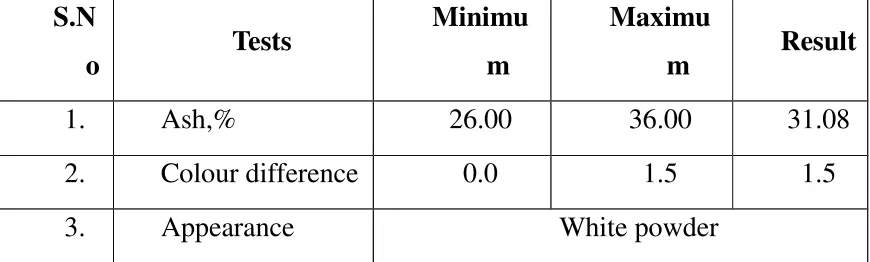
Table No: 3 Test of opadry white
S.N
o Tests
Minimu m
Maximu
m Result
1. Ash,% 26.00 36.00 31.08
2. Colour difference 0.0 1.5 1.5
3. Appearance White powder
EXPERIMENTAL INVESTIGATIONS
Preformulation studies:
API Characterization
Pre-formulation studies were performed on the drug which includes
solubility, Bulk density, Tapped density, Compatibility.
2 Solubility
Solubility is the property of a solid, liquid, or gaseous chemical substance
called solute to dissolve in a liquid solvent to form a homogeneous solution of
the solute of the solute in the solvent. The solubility of a substance
fundamentally depends on the used solvent as well as on temperature and
pressure. The specified quantity of sample (1gm) was added into different
quantity of solvent (methanol, alcohol, chloroform, water, acetone, ethyl
acetate) in room temperature.
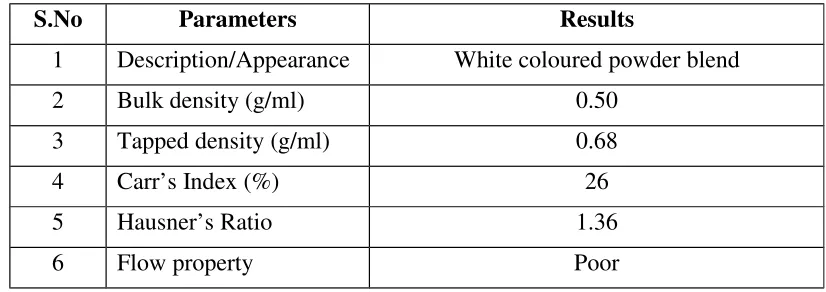
Bulk density:
Bulk density is the ratio of the weight of the powder to the bulk volume it
occupies. it is expressed in gm/ml. Weighed quantity of granules was transferred
into a 50 ml measuring cylinder without tapping, during transfer the volume
occupied by granules was measured. Bulk density was measured by using
formula.
P= m/Vo
Where,
Pi = Bulk density
m = Mass of the blend,
Tapped Density:
Weighed quantity of granules was taken into graduated cylinder, volume
occupied by granules was noted down. Then cylinder was subjected to 500 taps
in tapped density tester (Electro Lab USP II), the % Volume variation was
calculated by following formula.
Pt = m/Vi
Where,
Pt = Tapped density
M = Mass of the blend,
Vi= Tapped volume
Carr’s compressibility index:
Compressibility is the ability of powder to decrease in volume under
pressure. Using untapped density and tapped density the percentage
compressibility of granules were determined, which is given as Carr’s
compressibility index.
CI=Vi-V0 / Vi × 100
Where,
CI = Compressibility index
Vo = Bulk density
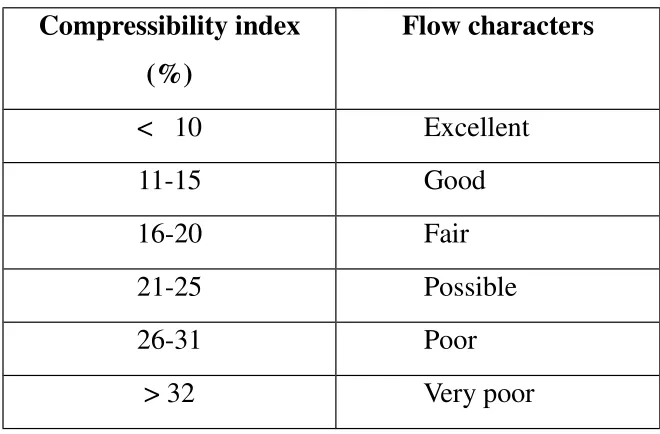
Table: 4 Compressibility index
Hausner’s Ratio:
It is measurement of frictional resistance of the drug. It was determined by the
ratio of tapped density and bulk density.
Hausner’s Ratio = Vo/Vi
Where,
Vo = Bulk density
[image:41.595.132.462.111.328.2]Vi = Tapped density
Table No: 5 Hausner’s ratio
Dept. of pharmaceutics, Arulmigu Kalasalingam College of Pharmacy
31Compressibility index (%)
Flow characters
< 10 Excellent
11-15 Good
16-20 Fair
21-25 Possible
26-31 Poor
> 32 Very poor
Flow characters Hausner’s ratio
Excellent 1.11
Good 1.12 – 1.18
Fair 1.19 – 1.25
Possible 1.26 – 1.34
Poor 1.35 – 1.45
Physical Appearance:
The API was observed for its colour and physical state
Particle size distribution (PSD):
PSD is determined by stacking the sieves on top of one another in ascending
degree of coarseness (#20, #40, #60, #80, #100) and then placing the 100 g of
test sample on the top sieve (20#).The nest of sieves is subjected to 10 minutes
period of agitation and then the weight retained on each sieve is accurately
determined and expressed in terms of percentage
Drug excipients compatibility studies by HPLC
The successful formulation of a stable and effective solid dosage form depends
on the careful selection of the excipients that are added. The commonly used
excipients are mixed with the API in the different ratios and subjected to
accelerated condition (3 months in 40°C / 75 % RH) and at stress condition (1
month in 50°C / 90 % RH) the sample are monitored for any change in physical
state, colour, odour, loss on drying and related substances. Any excipients
Selection of excipients
Excipients are selected based on the excipients of reference product apart from
the reference product, other excipients are selected based on the possible use of
them.
Stability study:
Sample preparation
The mixtures of the drug and excipients are prepared by placing the accurately
weighed amounts of the drug and excipients in polybag and mixed till
homogenous mixture is achieved. Then these mixtures are filled in vials and
closed with bromo butyl rubber stoppers & crimped with tear off clear lacquer
aluminum seals. These samples are charged at 50°C/90% RH and 40°C/75%
RH conditions.
Table No: 6 Storage condition and sampling interval
S.N
O
Storage condition Samples
packed in
Sampling
interval 1 Accelerated
condition
( 40°C/75% RH)
Type 1 glass
vials
1M, 2M and
3M
2 Stressed condition
( 50 C/90% RH )
Type 1 glass
vials
I5 days and
1M
Formulation development:
The development was started with direct compression process using the
directly compressible grade excipients.
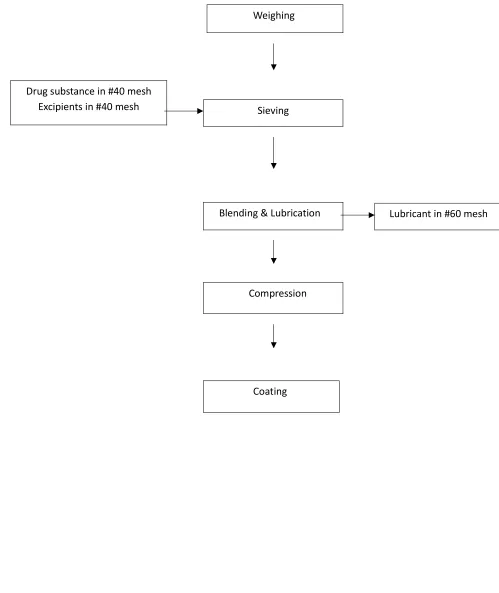
Figure No: 1 Process Flow Diagram of direct compression
Weighing
Drug substance in #40 mesh
Excipients in #40 mesh Sieving
Lubricant in #60 mesh Blending & Lubrication
Compression
Formulation trials by direct compression technique Procedure for direct compression process
1.The desired quantities were weighed & dispensed.
2. Drug substance and Excipients were sifted through #40mesh, Magnesium
stearate was sifted through #60mesh.
3. Drug substance with excipients was blended in polybagfor 5 min.
4. Lubricant were added in polybagwith the above blend and blended for 3
min.
5. Evaluations of blend.
6. The blend was compressed in the 8-station compression machine Erweka
TR-D8 with suitable toolings.
Table No:7 Composition of ibuprofen lysine 342mg strength (F1,F2,F3, F4, F5 and F6 trials)
Ingredients (mg/tab)
Mg/tablet
F1 F2 F3 F4
F5 (Reproducibi lity Batch) F6 (Scale up batch) Ibuprofen
lysine 342 342 342 342 342
342
Povidone K 30 7 17 10 10.000 10 10
Sodium starch
glycolate 25 25 36 31.000 31
31
Magnesium
stearate 6 6 7 12.000 12
12
Core tablet
weight (mg)
370 380 395
395 395
395
Opadry white * * * 11.85 11.85 11.85
Purified Water * * * q.s q.s q.s Total weight
(mg)
* * * 406.85
406.85 406.85
Batch size 750g
m
750
gm
750 gm 750gm
1500gm 3000g m
Ingredients (mg/tab) Mg/tablet F7 F8 F9 (Reproducibility Batch) F10 (Scale up batch)
Ibuprofen lysine 684 684 684 684
Povidone K 30 30 20 20 20
Sodium starch
glycolate 55
62.00
0 62.000 62.000
Magnesium
stearate 21
24.00
0 24.000 24.000
Core tablet weight
(mg)
790
790 790 790
Opadry white * 23.7 23.7 23.7
Purified Water * q.s q.s q.s
Total weight (mg) * 813.7 813.7 813.7
Batch size 750gm 750g
m 1500gm
3000gm
Manufacturing process – Direct compression
The following steps are involved in the manufacturing of ibuprofen lysine
tablets
1. Dispensing of all ingredients
2. Sifting of all ingredients
4. Compression
5. Coating
1.Dispensing :
In this step the API and other excipients were dispensed as per the
quantity mentioned table. The API and all excipient were taken in
individual self seal cover.
2.Shifting:
• Ibuprofen lysine & povidone were co-sifted through #40mesh • Sodium starch glycollate were passed through # 40 mesh. • Magnesium stearate passed through the # 60 mesh.
3.Blending:
Equipment : V. Blender
Process :
• Ibuprofen lysine , povidone k30 and Sodium starch glycollate were
loaded inV.blender for 5 minutes at slow speed.
• Magnesium stearate is added for 3 minutes at slow speed
4.Compression
Make :Erweka TR-D8 (8 Station)
Punch description For 342mg For 684mg
Lower punch plain
5.Coating:
Table No: Coating parameters for ibuprofen lysine Tablets 25mg
S.N o
Parameters Set parameters
1 Nozzle diameter of spray gun 1.0 mm
2 Distance between the tablet bed and spray nozzle
15 cm
3 Peristaltic pump 1.0 RPM
4 Tablet bed temperature 41oC - 43oC
5 Inlet air temperature 65oC
6 Atomizing air pressure 2.0 Kg/cm2
7 RPM of the coating pan 10-20 RPM
Preparation of Film coating solution:
The film coating solution was prepared by simple solution method. It was
prepared by opadry white (Polyvinyl alcohol, Titanium dioxide, polyethylene
glycol and Talc.) dissolved in weighed quantity of purified water. This was
stirred for 45 minutes until get a uniform mixture was obtained. Then it was
Coating procedure:
The compressed tablets were loaded in pan, and start to dry warming for 15
mins at slow speed. Then take 50 numbers of warmed tablets, and note
down the average weight of the tablets. Solid dispersion is 12% and coating
is done until tablets attain weight build up is 3%.
Evaluation of tablets
Evaluation of physical characteristics :
The formulated tablets were evaluated for the following physicochemical
parameters,
Thickness:
Thickness mainly depends on die filling, physical properties of material to be
compressed under compression force. There is bound to be a small variation in
the thickness of individual tablet in a batch. But it should not be apparent to the
unaided eye. The thickness and diameter were measured by using vernier
calipers.
Hardness:
Tablet requires certain amount of strength or hardness, measured by
Monsanto hardness tester. Ten tablets were randomly picked from each
formulation and evaluated for hardness during manufacturing and is expressed
in N.
Friability:
Friability was performed by using Roche friabilator, normally pre
weighed ten tablets were placed in the plastic chamber of friabilator. This was
inches with each revolution. Tablets are then dusted and reweighed. Loss of
less than 1% in weight is considered to be acceptable.
F(%) =
Initial wt .Final weig h t
Initial wt
Weight variation test:
Twenty tablets were selected randomly and weighed individually. Calculate
average weight and compare the individual tablet weight to the average. Not
more than two of the individual weights deviate from the average weight by
more than the percentage shown in table and none deviate by more than twice
the percentage.
Disintegration test:
The disintegration time was measured by using usp disintegration test
apparatus six tablets were placed in the tube and the basket was kept in 1 litre
beaker of purified water maintained at 37 0C the basket containing tablets move up and down through a distance of 5 to 6cm at a frequency of 28 to 32 cycles
per minute .the specific time tablet is disintegrate completely was noted.
Dissolution studies:
Dissolution by HPLC:
Potassium dihydrogen
orthophosphate
: AR Grade
Acetonitrile : HPLC Grade
Glacial acetic acid : AR Grade
Sodium hydroxide : AR Grade
Triethylamine : AR Grade
Water : Purified water/ Milli-Q /HPLC water
Dissolution Medium Preparation:
Dissolve 68.0 g of potassium dihydrogen orthophosphate and 9.0 g of sodium
hydroxide in 10000 mL of purified water and mix. Check and adjust to the pH
to 6.8 ± 0.05
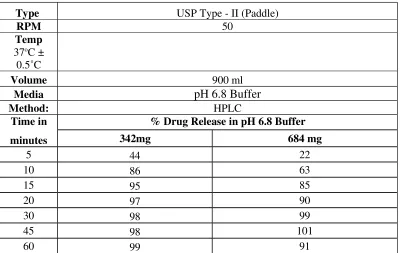
Dissolution Parameters:
Apparatus : USP Type II (Paddle)
Medium : pH 6.8 Phosphate buffer
Volume : 900 mL
Rotational speed : 50 RPM
Temperature : 37.0 ± 0.5°C
Time : 5, 10, 15, 20, 30, 45 & 60 minutes or as required.
Preparation of mobile phase:
Mix 600 mL of acetonitrile, 400 mL of HPLC water, 1mL of glacial acetic acid
and 0.2 mL of triethylamine, filter through 0.45µm membrane filter and degas.
Column : Hypersil BDS C18 150 x 4.6 mm, 5 µm
Flow rate : 1.0 mL/min
Column temperature : Ambient
Wavelength : 220 nm
Injection volume : 5 µL
Pump mode : Isocratic
Run time : 12 minutes
Preparation of solutions:
Preparation of standard solution for 342 mg:
Weigh accurately about 47.5 mg of Ibuprofen Lysine reference/working
standard into a 25 mL volumetric flask. add 10 mL of water and sonicate to
dissolve and make up the volume up to the mark with water and mix.
Then dilute 5 mL of solution to 25 mL volumetric flask with dissolution
medium (380 µg/mL of Ibuprofen Lysine).
Preparation of standard solution for 684 mg:
Weigh accurately about 47.5 mg of Ibuprofen Lysine reference/working
standard into a 25 mL volumetric flask. add 10 mL of water and sonicate to
dissolve and make up the volume up to the mark with water and mix.
Then dilute 10 mL of solution to 25 mL volumetric flask with dissolution
medium (760 µg/mL of Ibuprofen Lysine).
Preparation of sample solution:
Set the parameters of dissolution apparatus as per test method procedure. Place
previously weighed six tablets in each of the six dissolution vessels and start the
Area of Standard solution - 1
Area of Standard solution – 2 (First injection)
Weight of Standard solution - 2
Weight of Standard solution - 1
the dissolution vessel. Filter the solution through 0.45 µm nylon membrane
filter discarding the first few mL of filtrate.
Procedure:
Inject the following solutions and record the chromatogram. The retention time
of Ibuprofen Lysine is about 4.9 minutes.
Table No: 9
S. No
Solutions No. of
Injections
1 Blank (dissolution medium) 1
2 Standard solution 1
4 Sample solution 1
Evaluation of system suitability:
1. The relative standard deviation for five replicate standard 2 areas should not
be more
than 2.0%
2. The tailing factor for Ibuprofen Lysine peak should not be more than 2.0.
3. The theoretical plates for Ibuprofen Lysine peak should not be less than 5000.
Calculation:
2. % Drug release:
For 342 mg:
Asam Std Wt. 5 900 P
% drug release = --- x --- x ---x ---x --- x 100
Astd 25 25 LC 100
Where,
Asam : Area of Ibuprofen Lysine peak in the sample chromatogram
AStd : Average area of Ibuprofen Lysine peak in the standard -2
chromatogram
Std Wt. : Weight of Ibuprofen Lysine reference / working standard taken in
mg
LC : Label claim in mg
P : Percentage potency of Ibuprofen Lysine reference / working standard
on as is basis
For 684 mg:
Asam Std Wt. 10 900 P
% drug release = --- x --- x ---x ---x --- x 100
Astd 25 25 LC 100
Where,
AStd : Average area of Ibuprofen Lysine peak in the standard -2
chromatogram
Std Wt. : Weight of Ibuprofen Lysine reference / working standard taken in
mg
LC : Label claim in mg
P : Percentage potency of Ibuprofen Lysine reference / working standard
on as is basis
Content uniformity:
Assay by HPLC:
Reagents/Chemicals:
Mono chloro Acetic acid : AR grade
Ammonium Hydroxide : GR grade
Acetonitrile : HPLC grade
Water : HPLC grade
Chromatographic conditions:
Column : Hypersil ODS, 150x4.6mm, 5µm
Part No : 30105-154630
Column oven temperature : 25°C
Flow rate : 1.0ml/min
Injection volume : 5.0µL
Run time : 10 minutes
Pump mode : Isocratic
Preparation of mobile phase:
Dissolve 4.0g of mono chloro acetic acid in 400ml of water and adjust the pH
to 3.00 ± 0.05 with ammonium hydroxide. Add 600ml of acetonitrile filter and
degas.
Diluent:
Mixed water and acetonitrile in the ratio of 50:50%v/v.
Preparation of solutions:
Standard solution
Weigh accurately about 50.0 mg of Ibuprofen Lysine In-house reference
standard into a 50 ml volumetric flask, add 30 ml of diluents and sonicate to
dissolve and make up the volume up to the mark with diluents and mix.
Then dilute 5 ml of solution to 50ml volumetric flask with diluent (Conc:
100ppm)
Sample preparation:
Weigh 20 tablets and crush in a mortar to get a find powder. Accurately weigh
and transfer powder equivalent to 500mg of Ibuprofen Lysine into a 250ml
intermittent shaking, add about 75 ml of acetonitrile and sonicae for 20 minutes,
cool the solution to room temperature and make the volume up to the mark with
acetonitrile and mix. Filter the solution through 0.45µm nylon filter. Dilute 5ml
of the filtrate to 100ml volumetric flask with diluent (Conc: 100ppm).
Procedure:
Inject the blank, standard and sample solution in the sequence as given in the
below table
Table No: 10
S.No
.
Solution No of Injections
1 Blank 1
2 Standard solution-1 1 3 Sample solution 2
Calculations:
Calculate the % content of Ibuprofen Lysine in the tablets by using the
following Formula
AT Ws 5 250 100 Avg.wt
= --- x--- x --- x --- x --- x --- x P
AS 50 50 Wt 5 LC
Where,
AT = Average area of Ibuprofen Lysine in the chromatogram of
sample solution.
AS = Average area of Ibuprofen Lysine in the chromatogram standard
solution-2
Ws = Weight in mg of Ibuprofen Lysine In-house reference standard
Wt = Weight of sample taken in mg
LC = Label claim in mg
P = % Purity of Ibuprofen Lysine In-house reference standard
Stability studies:
As per in vitro release formulation F6, F10 was found to be desirable than
other formulation. Hence it was chosen for stability studies. The tablets were
packed in PVC/PVDC blisters and kept for 15 days and 1 month at
50ºC/90%RH and for 1M, 2M and 3M at 40C/75%RH in a stability chamber at
the interval of mentioned period, tablets were withdrawn and evaluated for
physical properties like weight variation, thickness, hardness, and invitro drug
RESULTS AND DISCUSSION
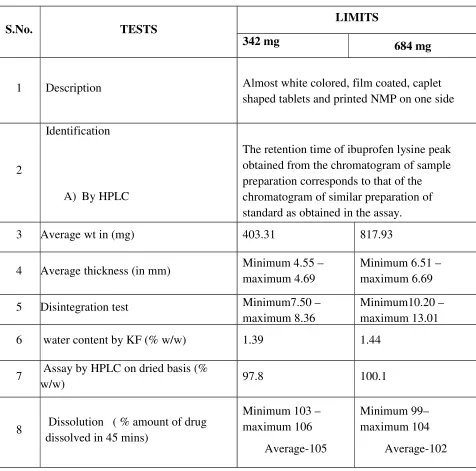
Table No:11 Evaluation of RLD
S.No. TESTS
LIMITS
342 mg 684 mg
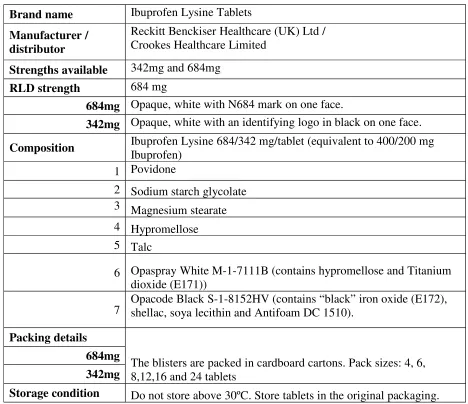
1 Description Almost white colored, film coated, caplet shaped tablets and printed NMP on one side
2
Identification
A) By HPLC
The retention time of ibuprofen lysine peak obtained from the chromatogram of sample preparation corresponds to that of the chromatogram of similar preparation of standard as obtained in the assay.
3 Average wt in (mg) 403.31 817.93
4 Average thickness (in mm) Minimum 4.55 – maximum 4.69
Minimum 6.51 – maximum 6.69
5 Disintegration test Minimum7.50 – maximum 8.36
Minimum10.20 – maximum 13.01
6 water content by KF (% w/w) 1.39 1.44
7 Assay by HPLC on dried basis (%
w/w) 97.8 100.1
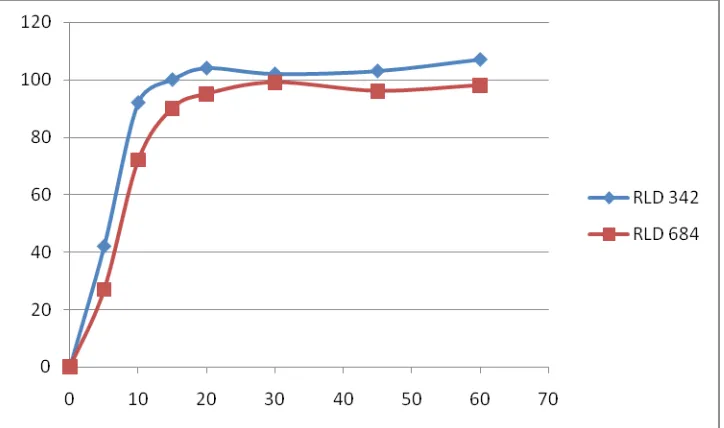
8 Dissolution ( % amount of drug dissolved in 45 mins)
Minimum 103 – maximum 106
Average-105
Minimum 99– maximum 104
9
Related substances by HPLC(% w/w)
2-[3-(2-methylpropyl) phenyl] propanoic
Acid (impurity A)
2-(-n-butylphenyl) propionic acid (impurity B)
(2RS)-2-hydroxy-2-[4-(2- methyl propyl) phenyl] propanoic acid.
0.02
0.01
0.02
0.03
0.01
0.06
10 Highest unknown 0.02 0.02