promoting access to White Rose research papers
White Rose Research Online [email protected]
Universities of Leeds, Sheffield and York
http://eprints.whiterose.ac.uk/
This is an author produced version of a paper published in Journal of Visual Communication and Image Representation.
White Rose Research Online URL for this paper:
Published paper
Shao, Ling, Wang, Jingnan, Kirenko, Ihor and de Haan, Gerard (2011) Quality Adaptive Least Squares Trained Filters for Video Compression Artifacts Removal Using a No-reference Block Visibility Metric. Journal of Visual Communication and Image Representation, 22 (1). pp. 23-32.
Quality Adaptive Least Squares Trained Filters for Video
Compression Artifacts Removal Using a No-reference Block
Visibility Metric
Ling Shao*, Jingnan Wang†, Ihor Kirenko‡, Gerard de Haan‡
* Department of Electronic & Electrical Engineering, The University of Sheffield, UK † EECS Department, Northwestern University, USA
‡ Philips Research Laboratories, Eindhoven, The Netherlands
Abstract
Compression artifacts removal is a challenging problem because videos can be compressed at
different qualities. In this paper, a least squares approach that is self-adaptive to the visual
quality of the input sequence is proposed. For compression artifacts, the visual quality of an
image is measured by a no-reference block visibility metric. According to the blockiness
visibility of an input image, an appropriate set of filter coefficients that are trained beforehand
is selected for optimally removing coding artifacts and reconstructing object details. The
performance of the proposed algorithm is evaluated on a variety of sequences compressed at
different qualities in comparison to several other deblocking techniques. The proposed method
outperforms the others significantly both objectively and subjectively.
1.
Introduction
Due to the bandwidth limit of the broadcasting channels and the capacity limit of the storage
media, video materials are always compressed with various compression standards, such as
MPEG-2 and MPEG-4. These block transform based codecs divide the image or video frame
into non-overlapping blocks (usually with the size of 8 x 8 pixels), and apply discrete cosine
transform (DCT) on them. The DCT coefficients of neighboring blocks are thus quantized
independently. At high or medium compression rates, the coarse quantization will result in
artifact reduction techniques are used to remove various artifacts. Among the coding artifacts,
blockiness which appears as discontinuities along block boundaries is the most annoying.
Therefore, an in-loop deblocking filter is specified for H.264/AVC to reduce blocking artifacts
using coding parameters inside the encoder. However, JPEG compressed images and MPEG-2
compressed videos will remain ubiquitous, which makes post-processing aimed at the
elimination of coding artifacts still a critical and indispensable solution.
Most coding artifact reduction techniques based on post-processing, e.g. [1-6], are designed
according to heuristic tuning and testing, which takes a lot of time and is not always effective.
Recently, classification-based least squares trained filters (TF), initially designed for image
resolution upscaling [7], have been proposed for optimally removing digital coding artifacts [8,
9]. The momentary filter coefficients, during artifact reduction, depend on the local content of
the image, which can be classified into classes based on the image characteristics in the filter
aperture. To obtain the optimized filter coefficients, a training process should be performed in
advance. The training process employs the combination of original images and the degraded
versions of those original images as the training material and uses the Least Squares (LS)
criterion to get the optimal coefficients, which is computationally intensive due to the large
number of classes. Fortunately, the training process only needs to be performed off-line and
once. The method introduced in [8] produces promising results, when the quality of the test
sequence is similar to that of the source sequences used during training. It is because a fixed
level of compression is adopted for degrading the original images. In this paper, we propose to
train the algorithm on a range of compression levels and to select the most suitable set of filter
coefficients for the test sequence. To do that, a quality (or blockiness) metric is required to
The main contribution of the paper is the use of the no-reference blockiness visibility metric
for the least squares trained filters which makes the algorithm capable of dealing with various
qualities of input sequences.
In the following, we first briefly introduce the classification based least squares filters in
Section 2. Section 3 analyzes the properties of the algorithm on coding artifact reduction, when
the original images are degraded with different qualities and using different compression
methods. The new trained filters that are adaptive to the visual quality of the input sequence,
which is indicated by a block visibility metric, are proposed in Section 4. We evaluate the
performance of the proposed algorithm in contrast to the original trained filters and other
adaptive filters. Finally, we draw our conclusion in Section 5.
2. Trained Filters
2.1 Introduction of Trained Filters
The Least Squares algorithm is composed of two parts: the training process and the filtering
process. To obtain the momentary filter coefficients, a training process should be performed in
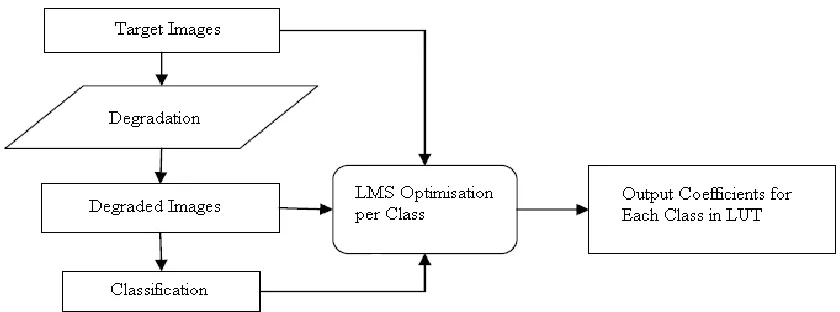
advance. Figure 1 shows the training process of the trained filters. Original images are first
degraded according to the specification of the application. The training process employs the
original video sequences and corresponding degraded video sequences as the training material
and uses the Least Squares criterion to get the optimal coefficients, which is computational
intensive due to the large number of classes. Fortunately, it needs to be performed only once.
There are various ways to degrade the original high quality sequences. Generally speaking, the
degradation during the training process is the inverse of the enhancement that one expects
during the filtering process. In this paper, two kinds of degradation methods are applied, that is
degraded images. In the degraded images, each pixel and the pixels in its vicinity are
characterized using a specific classification method. All the pixels and their neighborhoods
belonging to a specific class and their corresponding pixels in the original images are
accumulated, and the optimal coefficients are obtained by making the Mean Square Error (MSE)
[image:5.612.92.512.214.370.2]minimized statistically.
Figure 1: Training process of the trained filters.
Let FD,c, FR,c be the apertures of the degraded images and the reference images for a particular
class c, respectively. Then the filtered pixel FF,c can be obtained by the desired optimal
coefficients as follows:
, , 1
( ) ( , ) n
F c c D c
i
F w i F i j
(1)where w i ic( ), [1... ]n are the desired coefficients, n is the number of pixels in the aperture, and
j indicates a particular aperture belonging to class c. The summed square error between the
filtered pixels and the reference pixels is:
2
2 2
, , , ,
1 1 1
( ) ( ) ( ) ( , )
Nc Nc n
R c F c R c c D c
j j i
e F F F j w i F i j
where Nc represents the number of training samples belonging to class c. To minimize e2, the
first derivative of e2 to w k kc( ), [1... ]n should be equal to zero.
2
, , ,
1 1
2 ( , ) ( ) ( ) ( , ) 0
( )
Nc n
D c R c c D c
c j i
e
F k j F j w i F i j
w k
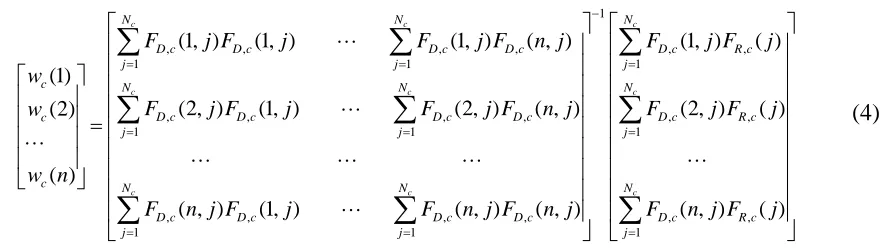
(3)By solving the above equation using Gaussian elimination, we will get the optimal coefficients
as follows: , , , , 1 1 , , , , 1 1
(1, ) (1, ) (1, ) ( , ) (1)
(2, ) (1, ) (2, ) ( , ) (2) ( ) c c c c N N
D c D c D c D c
j j
c N N
D c D c D c D c
c
j j
c
F j F j F j F n j w
F j F j F j F n j w w n
1 , , 1 , , 1 , , , , , ,1 1 1
(1, ) ( )
(2, ) ( )
( , ) (1, ) ( , ) ( , ) ( , ) ( ) c
c
c c c
N
D c R c
j
N
D c R c
j
N N N
D c D c D c D c D c R c
j j j
F j F j
F j F j
F n j F j F n j F n j F n j F j
(4)The LS optimized coefficients for each class are then stored in a look-up table (LUT) for future
use.
Figure 2 shows the filtering process of the algorithm using the optimized coefficients. For
each pixel to be filtered, the neighboring pixels are classified in the same manner as during
training. The coefficients are retrieved from the LUT based on the classification. The pixels are
[image:6.612.101.542.236.360.2]then filtered using the optimized coefficients.
2.2 Pixel Classification Methods
2.2.1 Adaptive Dynamic Range Coding Based Classification
As stated in the previous section, the momentary filter coefficients, during filtering, depend on
the local characteristics of the image, which can be classified based on the pattern of the image
region and structure information is always important for either low-pass filtering or high-pass
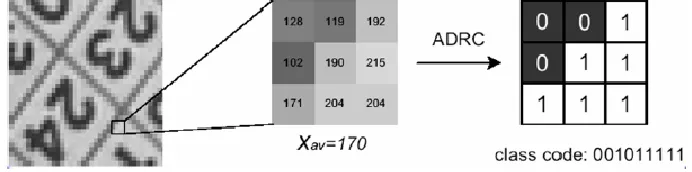
filtering. Adaptive Dynamic Range Coding (ADRC) [10] is proposed as a powerful method for
representing the structure of a region because of its high efficiency and simplicity. The ADRC
code of each pixel xi in an observation aperture is defined as: ADRC (xi) =0, if V (xi) ≤ Vav ; 1,
otherwise, where V(xi) is the value of pixel xi , and Vav is the average of all the pixel values in
[image:7.612.133.479.358.444.2]the aperture. Figure 3 shows a diagram of the ADRC code on a 3x3 block.
Figure 3: The ADRC code of a 3x3 block.
2.2.2 Improved ADRC Based Classification Methods
Obviously, only using structure for classification is not sufficient, because the structure of
coding artifacts could be exactly the same as that of object details. To obtain better performance,
several additional criteria have been proposed [8]. For example, considering that high contrast
structures and low contrast structures should be treated differently, dynamic range (DR) can be
added to ADRC. DR is simply the absolute difference between the maximum and minimum
pixel values of the image region. Several other ancillary classification methods are in use, such
uniform regions. The entropy value is calculated on the probability density functions of the
pixel intensity distribution. The local entropy of a region can be defined as follows:
2
1
( ) log ( ) N
R R
i
H P i P i
(5)Where i indicates the bin index, PR (i) is the probability of pixels having a value in the range of
bin i and R is a local region inside which the entropy is calculated.
Another measure is called Mean Absolute Gradient (MAG) for determining the complexity of
a region. MAG is defined as follows:
1
1 1
(0) ( )
1
N
i
MAG F F i N
(6)where F(i) denotes the intensity value of a pixel in a region, F(0) is the intensity of the pixel in
the center, and N is the number of pixels in the region. Standard Deviation (STD) is employed
as another complexity metric for a local region.
Structure information using ADRC coupled with one of the complexity measures described
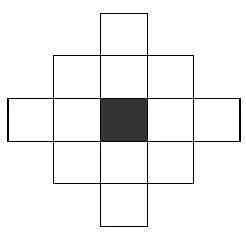
above will be used for classification. For all the above complexity measures, a 13 pixel
diamond-shaped aperture, as depicted in Figure 4, is used for both classification and filtering.
Therefore, 12 bits are needed for the ADRC code, because 1 bit can be saved using
bit-inversion. And, 2 more bits are used for representing the complexity of a region. So, in total 14
[image:8.612.244.367.568.684.2]bits are used for classification.
All these four complexity measures have similar behavior yet with subtle differences on
detailed regions. According to performance evaluation in [8], MAG performs the best for
sharpness enhancement and STD is the most effective for coding artifact reduction. In this
paper, the implementation of trained filters is based on the classification of ADRC plus STD,
which we consider the best for coding artifact reduction.
3. Analysis of Trained Filters
3.1 Influence of Degradation
Least squares trained filters have been successfully applied on coding artifact reduction [8, 9].
Apart from the classification method, the choice of degradation in the training process also
plays a vital role. In this section, we take a close look at the influence of different degradation
levels on the performance of the algorithm. We divide the experiment into two parts. In the first
part, we use JPEG compression to degrade the original high quality sequences to a wide range
of quality levels: from quality 10 to 90 with a step size of 10. The training set contains 25
different sequences, with a large variation of content, including natural-content-based
sequences, artificial animated sequences and some film clips, about 2000 frames in total. For
each training quality, we get a LUT. Then we apply each LUT separately to a series of test
sequences which also have a large variation of quality. Figure 5 depicts snapshots of the three
test sequences we use for our experiment. All the test sequences are excluded from the training
set. In the second part of the experiment, the main steps remain the same. Instead of JPEG
compression, we use MPEG-2 compression for degradation. Default setting is applied for
MPEG-2 except that the bit rates are ranged from 0.5M bit/s to 4M bit/s. Apparently, other
sequences. However, those new compression methods already have an in-loop de-blocker to
effectively reduce coding artifacts using coding parameters inside the encoder. The purpose of
degradation is to simulate sufficient coding artifacts which will be encountered during the
filtering process. Therefore, earlier compression standards which produce more artifacts are
preferred. Compression artifacts are not the major problem of the latest codecs like H.264/AVC
[image:10.612.85.507.236.353.2]anyway.
Figure 5: Snapshot of the test sequences: Bicycle, Girlsea and Soccer.
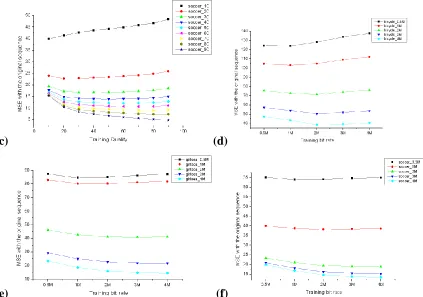
Figure 6 illustrates performance of trained filters on test sequences with different qualities
either compressed by JPEG or MPEG-2, when the LUTs are obtained by varied training
qualities.
(c) (d)
(e) (f)
Figure 6: Illustration of the influence of different training degradation levels on the output performance. (a)-(c) illustrate different training quality levels vs. MSE scores for the Bicycle, Girlsea and Soccer sequences respectively. (d)- (f) illustrate different training bit rates vs. MSE scores for the Bicycle, Girlsea and Soccer sequences respectively.
Despite minor differences in MSE behaviors, three test sequences share some common trends.
Some observations of the experiment are made as follows:
1. Test sequences with extremely good or bad quality are very sensitive to the choice of
degradation during training. For example, for the bicycle sequence compressed with
JPEG quality 10, it shows an MSE score of 70.699 when adopting the LUT trained with
severe degradation but an MSE score of 99.812 when using the LUT trained with slight
degradation. In the latter case, trained filters contribute little improvement to the test
sequence. Similarly, for the bicycle sequence compressed with JPEG quality 90, it
shows an MSE score of 3.121 when a LUT trained with slight degradation is applied
[image:11.612.80.503.74.371.2]It is suggested that for high quality input, inappropriate choice of degradation level
might blur fine details and thus produce unsatisfying output.
2. Test sequences with moderate quality keep a stable output behavior when LUTs trained
with different degradation levels are used. However, we can still easily see from the
graphs that the algorithm achieves best performance when the quality of degraded
images during training is the closest to that of the test sequence.
However, in most cases, the quality of an input sequence is unknown. So it is difficult to
choose the matched LUT beforehand. As a compromise, we use a mixture of uniformly
distributed training degradation levels: from quality 10 to quality 90. As expected, it shows
better results on the average. In particular, it eliminates the most unmatched cases, which
improve the worst case performance. Let us take the Bicycle sequence as an example, the worst
MSE score is 99.812 but is improved to 79.513 if we use a mixture of degradation levels in the
training process.
3.2 Influence of Compression Methods
In this section, we explore the correlation between the type of compression methods used
during the training process and the performance of trained filters. Perceptually, we consider that
for the Soccer sequence JPEG quality 50 is comparable with MPEG-2 bit rate 1M and JPEG
quality 80 is comparable with MPEG-2 bit rate 3M. For MPEG-2, a standard implementation
with default setting is adopted. Figure 7 depicts the results on the Soccer sequence. Figure 7(a)
shows the result of training on JPEG quality 50 and applying on the Soccer sequence
compressed at different qualities by either JPEG or MPEG-2; while Figure 7(b) illustrates the
codecs at different qualities. Figures 7(c) and 7(d) are similar but trained on training sequences
compressed at higher qualities.
(a) (b)
[image:13.612.82.488.128.444.2](c) (d)
Figure 7: Illustration of the influence of JPEG or MPEG-2 compression used during the training process. (a)-(b) show the MSE scores, where the training quality for JPEG is 50 and the training bit rate for MPEG-2 is 1M bits/s respectively. (c)-(d) show the MSE scores, where the training quality for JPEG is 80 and the training bit rate for MPEG-2 is 3M bits/s respectively.
For most cases, JPEG compression shows slightly better performance. The same conclusion
can be made on other sequences. These slight differences might arise from the fact that JPEG
compression is coded without reference to other pictures in a video sequence. Each frame in
JPEG compression is treated independently. So when we set a degradation level for JPEG, the
case of MPEG, a hybrid coding scheme that uses both temporal prediction and spatial
transformation, i.e., inter- and intra-frame coding, is adopted. Three types of pictures are
defined. And only I frames are compressed with intra-frame coding, which behaves in a similar
way as the JPEG compression. But the other two types of frames, i.e. B frames and P frames,
have a less predictable quality level. For example, the B frames and P frames of two sequences
compressed with MPEG-2 using the same bit rate might differ greatly in quality. Furthermore,
MPEG-2 standard is flexible with its tolerance about the sequence combination of these three
types of frames. Thus in general, the quality of a sequence can be more easily controlled by
JPEG than by MPEG-2. As a result, JPEG compression is adopted as the degradation method
during training in the following sections.
4. Quality Adaptive Trained Filters
From the analysis in the previous section, we understand that the most optimal results can be
realized when a LUT whose degradation level during training matches with quality of the input
video frame is selected. Careless choice of LUTs might either blur details in high quality
images or preserve coding artifacts in low quality images. Thus, a quality control mechanism is
required for the trained filters. During training, several LUTs of filter coefficients are produced
by using different degradation levels. During filtering, a LUT is selected automatically for each
video frame based on its visual quality.
4.1 Block Visibility Metric
Since blocking artifact is the most annoying among all the artifacts, a block visibility metric is
adopted for measuring the visual quality of an image. This metric is a simplified version of the
discontinuities and is coherent with subjective perception, while automatically accounting for
texture masking effects in a straightforward and computationally efficient manner. Refer to [11,
12] for detailed evaluation of its coherence with subjective perception. The main idea behind
the method is that the visibility of block edges does not solely depend on the magnitude of the
gradient at the block discontinuity, but it is determined by the magnitude of the block gradient
with respect to its neighbors. In other words, block edges are visible whenever the gradient at
the edges significantly differs from the gradients in its immediate vicinity. Take the vertical
block edges as an example and the horizontal edges can be achieved in a similar way. Consider
an image I with element Iij, where i and j denote the line and pixel positions, respectively. The
absolute horizontal gradient DH can then be computed by
D i jH( , ) I i( 1, )j I i j( , ) (7) and we simply add up all horizontal gradient for each pixel to S(non-block) and when the pixel
position is a multiple of 8 we add it to S(block). Finally, the block grid visibility metric Q is
defined as the ratio of the mean accumulated value at the block edge positions and then the
mean accumulated value at the non-block edge positions:
( )
( )
S block Q
S non block
(8)
For the three test sequences, we obtain the Q values in Table 1 when they are compressed with
different qualities or bit rates.
Input File Q Input File Q Input File Q
Bicycle_80 1.074225 Girlsea_80 1.167921 Soccer_80 1.289903 Bicycle_90 1.034740 Girlsea_90 1.085089 Soccer_90 1.151064 Bicycle_org 0.982146 Girlsea_org 0.979959 Soccer_org 1.000588
Input File Q Input File Q Input File Q
[image:16.612.87.528.72.187.2]Bicycle_1M 2.216744 Girlsea_1M 2.710936 Soccer_1M 1.597243 Bicycle_2M 1.838917 Girlsea_2M 2.040262 Soccer_2M 1.325788 Bicycle_3M 1.643554 Girlsea_3M 1.693213 Soccer_3M 1.268037 Bicycle_4M 1.535949 Girlsea_4M 1.511518 Soccer_4M 1.234463
Table 1: Measurements of Q value.
The conspicuous advantages of the block visibility metric are its mathematical simplicity and
efficiency and its coherence with visual perception. However, there is a fact that the blocking
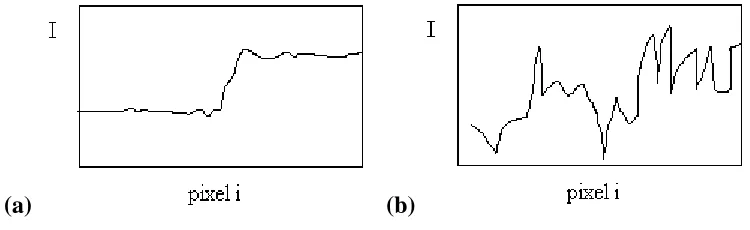
artifacts are more annoying in flat areas, whereas they are effectively masked in textured area.
This fact is illustrated in Figure 8, which shows luminance profiles across block edges for a
relatively flat and a textured area. The gradient at block edge is identical in both scenarios.
Nevertheless, the discontinuity can be easily identified in Figure 8(a), whereas it is effectively
masked by the surrounding activity in Figure 8(b).
(a) (b)
Figure 8: Luminance profiles across a block edge for flat and textured areas.
For each sequence, Q values follow strict monotonicity. The larger the Q value, the more
severe the degradation of the sequence is. Since it is a blockiness visibility metric, Q value
varies across three test sequences, i.e. it is content-dependent. For example, for the same MPEG
compression bit rate 1Mbit/s, Q value of the Girlsea sequence arises to 2.710936 but that of the
[image:16.612.116.491.397.512.2]i.e. the blockiness in the Soccer sequence has been masked by a large area of repetitive grass
content, thus gives a relatively low Q value. To make the Q value less content-dependent, we
then attempt to set up a threshold for calculation. Take the threshold of 5 as an example. If the
luminance gradient of a certain pixel is larger than 5, we just clip it and take 5 as its luminance
gradient. We also test other thresholds between 3 and 6, but there are no conspicuous
differences. This step is reasonable because some of the luminance gradient arises from the
transition in the sequence content, not because of the blockiness. And in most cases, this kind of
content transition contributes much more than the real blockiness, which is obviously
something we should avoid during calculation. Table 2 shows the Q values with clipping of the
gradient. Compared with numbers in Table 1, we can see that the Q values are less content
dependent and more stable.
Input File Q Input File Q Input File Q
Bicycle_1M 1.683782 Girlsea_1M 1.880105 Soccer_1M 1.529288 Bicycle_2M 1.373136 Girlsea_2M 1.511507 Soccer_2M 1.328376 Bicycle_3M 1.326298 Girlsea_3M 1.413591 Soccer_3M 1.293156 Bicycle_4M 1.299642 Girlsea_4M 1.353929 Soccer_4M 1.173852
Table 2: Calculated Q values with fixed threshold of 5.
Based on the above analysis, we decide to use four different levels of JPEG degradation.
These include two extreme cases: quality 10 and quality 90 degradation. When Q value of input
sequence is larger than 1.83, we use the LUT trained on quality 10 degradation. When Q value
is between 1.53 and 1.83, we adopt the LUT trained on quality 20 degradation. When Q value is
between 1.25 and 1.53, the LUT trained on quality 50 degradation is applied. The reason we use
only one LUT for this relatively large range of quality levels is that they are less sensitive to the
smaller than 1.25, the LUT trained on quality 90 degradation is utilized. These thresholds are
obtained based on extensive testing and tuning. Machine learning techniques, such as Adaboost
[9], can be also programmed to output more optimized threshold values.
4.2 Trained Filters Controlled by the Block Visibility Metric
The schematic diagrams of the training and filtering processes of the quality adaptive trained
filters are shown in Figure 9.
(a)
[image:18.612.74.529.283.601.2](b)
We evaluate our quality controlled trained filters with three other post-processing methods [2,
14, 1] for compression artifacts removal. The results of trained filters based on mixed training
using degradation levels uniformly distributed from quality 10 to quality 90 are also included
for comparison. Three more test sequences as shown in Figure 10 are used for evaluation. All
the test sequences are encoded and decoded by MPEG-2 using the default setting. Table 3
shows the resolutions and frame numbers of the test sequences. The MSE scores between
original uncompressed sequences and filtered outcomes of the compressed sequences are shown
in Table 4. The filtering is only applied on luminance and MSE scores are also only calculated
[image:19.612.94.522.319.434.2]on luminance.
[image:19.612.68.544.493.623.2]Figure 10: Snapshot of three more test sequences: Porschefence, Nemo and Vanessa.
Table 3: Specification of the test sequences.
Sequence Resolution Number of frames
Bicycle 720x576 200
Girlsea 720x576 50
Soccer 720x576 98
Porschefence 720x576 100
Vanessa 720x572 90
Nemo 720x480 512
Table 4: MSE scores of different methods.
Input file Quality
controlled trained filters
Trained filters - mixed
training
Ref [2] Ref [14] Ref [1]
[image:19.612.97.535.668.720.2]Bicycle_2M.yuv 71.416 74.116 88.879 94.526 95.884 Bicycle_3M.yuv 50.343 51.964 68.191 69.517 70.143 Bicycle_4M.yuv 38.466 39.400 56.063 54.873 55.352 Girlsea_1M.yuv 79.115 81.674 82.621 86.656 86.634 Girlsea_2M.yuv 41.141 41.813 41.369 44.879 44.898 Girlsea_3M.yuv 21.824 22.365 22.583 24.358 24.194 Girlsea_4M.yuv 14.221 14.554 15.643 16.263 16.128 Soccer_1M.yuv 38.862 39.359 40.243 41.297 41.137 Soccer_2M.yuv 18.986 19.130 20.442 20.254 20.178 Soccer_3M.yuv 15.277 15.510 16.688 16.105 16.084 Soccer_4M.yuv 13.105 13.634 14.709 11.439 13.892 Porschefence_1M.yuv 107.429 111.974 115.505 122.428 121.984 Porschefence_2M.yuv 100.013 104.175 107.487 114.490 114.152 Porschefence_3M.yuv 54.396 54.516 60.735 62.758 62.673 Porschefence_4M.yuv 32.019 33.428 39.866 39.411 39.036 Vanessa_1M.yuv 113.048 116.749 116.314 126.095 124.230 Vanessa_2M.yuv 104.498 107.611 107.187 116.804 115.115 Vanessa_3M.yuv 62.880 63.473 65.402 71.741 71.202 Vanessa_4M.yuv 37.833 38.272 41.052 44.891 44.323 Nemo_1M.yuv 97.264 98.860 101.229 104.060 103.172 Nemo_2M.yuv 53.578 55.084 56.708 59.521 59.151 Nemo_3M.yuv 29.312 29.734 31.812 33.346 33.110 Nemo_4M.yuv 18.689 19.874 22.011 22.435 22.247
(c) (d)
(e) (f)
Figure 11: Processed results of the Bicycle sequence: (a) Unprocessed, (b) Quality adaptive trained filters, (c) Trained filters – mixed training, (d) Ref [2], (e) Ref [14], (f) Ref [1].
We can easily see from Table 3 that the proposed quality controlled trained filters yield
satisfying performance. It outperforms the three available de-blocking filters especially in some
[image:21.612.79.536.68.546.2]Besides, compared with the trained filters with mixed degradation, quality controlled trained
filters always show some positive improvement.
For subjective evaluation, Figure 11 shows the results of the five algorithms on the Bicycle
sequence compressed by MPEG-2 at the bit rate of 1Mbit/s. The proposed quality adaptive
trained filters can remove various artifacts and preserve object details better than the other
methods. To show some quantitative perception related results, the Structural SIMilarity (SSIM)
[15] scores of all the test sequences are listed in Table 5. The quality controlled trained filters
[image:22.612.81.535.316.647.2]outperform the three existing methods on all sequences.
Table 5: SSIM scores of different methods.
Input file Quality
controlled trained filters
Trained filters - mixed
training
Ref [2] Ref [14] Ref [1]
Bicycle_1M.yuv 0.3031 0.3035 0.3039 0.2589 0.2756 Bicycle_2M.yuv 0.3334 0.3321 0.3322 0.2785 0.2852 Bicycle_3M.yuv 0.3487 0.3467 0.3372 0.2876 0.3134 Bicycle_4M.yuv 0.3791 0.3624 0.3536 0.2907 0.3372 Girlsea_1M.yuv 0.4261 0.4251 0.4170 0.3589 0.3761 Girlsea_2M.yuv 0.4643 0.4562 0.4435 0.3701 0.3953 Girlsea_3M.yuv 0.4863 0.4777 0.4636 0.3877 0.4074 Girlsea_4M.yuv 0.4998 0.4846 0.4745 0.4035 0.4456 Soccer_1M.yuv 0.3860 0.3789 0.3698 0.3342 0.3512 Soccer_2M.yuv 0.4001 0.3991 0.3999 0.3546 0.3662 Soccer_3M.yuv 0.4153 0.4070 0.4032 0.3754 0.3824 Soccer_4M.yuv 0.4345 0.4324 0.4279 0.3908 0.3989 Porschefence_1M.yuv 0.2851 0.2789 0.2699 0.2345 0.2462 Porschefence_2M.yuv 0.2924 0.2894 0.2747 0.2563 0.2641 Porschefence_3M.yuv 0.3254 0.3119 0.3012 0.2675 0.2767 Porschefence_4M.yuv 0.3459 0.3426 0.3324 0.2990 0.2960 Vanessa_1M.yuv 0.4356 0.4292 0.4056 0.3873 0.3936 Vanessa_2M.yuv 0.4434 0.4594 0.4361 0.4091 0.4289 Vanessa_3M.yuv 0.4776 0.4636 0.4525 0.4094 0.4535 Vanessa_4M.yuv 0.4824 0.4724 0.4741 0.4207 0.4671 Nemo_1M.yuv 0.2730 0.2641 0.2679 0.2463 0.2545 Nemo_2M.yuv 0.2947 0.2790 0.2741 0.2563 0.2662 Nemo_3M.yuv 0.3253 0.3220 0.3154 0.2782 0.2873 Nemo_4M.yuv 0.3425 0.3433 0.3292 0.2943 0.3036
In this paper, we develop the classification based least square trained filters for compression
artifacts removal using the quality control mechanism. The quality metric we adopt shows
robust behavior in blockiness visibility measurement. For an input sequence with unknown
quality, the proposed algorithm can choose the most suitable LUT for filtering based on the
block visibility metric. The inclusion of the quality control mechanism coupled with the
effectiveness of the blockiness metric enables the least squares trained filters to be a decent
choice for deblocking images and videos of various qualities.
In future work, a local quality/blockiness metric will be designed to further improve the local
adaptability of the algorithm.
References
[1] L. Shao and I. Kirenko, “Coding artifact reduction based on local entropy analysis”, IEEE
Trans. Consumer Electronics, Vol. 53(2), pp. 691-696, May 2007.
[2] S. D. Kim, J. Yi, H. M. Kim and J. B. Ra, “A deblocking filter with two separate modes in
block-based video coding”, IEEE Trans. Circuits and System for Video Technology, Vol. 9,
pp.156-160, 1999.
[3] Y. Luo and R. K. Ward, “Removing the blocking artifacts of block-based DCT compressed
images”, IEEE Trans. Image Processing, Vol. 12(7), pp. 838-842, July 2003.
[4] L. Shao, I. Kirenko, A. Leitao and P. Mydlowski, “Motion-compensated Techniques for
Enhancement of Low Quality Compressed Videos”, In Proceedings of the 34th
IEEE
International Conference on Acoustics, Speech, and Signal Processing, Taibei, Taiwan, April
[5] I. Kirenko, L. Shao, R. Muijs, “Enhancement of Compressed Video Signals Using a Local
Blockiness Metric”, In Proceedings of the 33rd
IEEE International Conference on Acoustics,
Speech, and Signal Processing, Las Vegas, USA, March-April 2008.
[6] I. Kirenko and L. Shao, “Adaptive Repair of Compressed Video Signals Using Local
Objective Metrics of Blocking Artifacts”, In Proceedings of the 14th
IEEE International
Conference on Image Processing, San Antonio, Texas, USA, September 2007.
[7] T. Kondo, Y. Node, T. Fujiwara and Y. Okumura, “Picture conversion apparatus, picture
conversion method, learning apparatus and learning method”, US-patent 6,323,905, Nov. 2001.
[8] L. Shao, H. Zhang and G. de Haan, “An overview and performance evaluation of
classification based least squares trained filters”, IEEE Trans. Image Processing, Vol. 17(10),
pp. 1772-1782, October 2008.
[9] L. Shao, H. Hu and G. de Haan, “Coding Artifacts Robust Resolution Up-conversion”, In
Proceedings of the 14th IEEE International Conference on Image Processing, San Antonio,
Texas, USA, September 2007.
[10] T. Kondo and K. Kawaguchi, “Adaptive dynamic range encoding method and apparatus”,
US-patent 5,444,487, Aug. 1995.
[11] H. R. Wu and M. Yuen, “A Generalized Block-edge Impairment Metric for Video
Coding,” IEEE Signal Processing Letters, vol. 70, no. 3, pp. 247-278, Nov. 1998.
[12] R. Muijs and I. Kirenko, “A No-Reference Blocking Artifact Measure for Adaptive Video
Processing,” in Proc. 13th European Signal Processing Conference, Turkey, 2005.
[13] Y. Freund and R. E. Schapire, “A decision-theoretic generalization of on-line learning and
an application to boosting”, Journal of Computer and System Sciences, Vol. 55(1), pp. 119-139,
[14] C. Damkat, “Post-processing techniques for compression artifact removal in block coded
video and images”, Technical Report, Department of Electrical Engineering, Technische
Universiteit Eindhoven, 2004,
[15] Z. Wang, A. C. Bovik, H. R. Sheikh and E. P. Simoncelli, “Image quality assessment:
From error visibility to structural similarity”, IEEE Transactions on Image Processing, Vol.