7628
ANALYSIS OF ACCOUNTING INFORMATION SYSTEMS
WITH NON-LINEAR SEM-PLS
MOCH BISYRI EFFENDI
1Department of Accounting, STIE Perbanas, Surabaya, Indonesia
E-mail: [email protected]
ABSTRACT
The purpose of this research is to analyse the impact of accounting information system, quality of accounting information system and service quality dimension of accounting information system to customer satisfaction of mobile banking application user (E-satisfaction). The population in this study are conventional bank customers located in Surabaya, Indonesia. The samples are bank customers who use mobile banking based applications. The method of analysis in this study using non-linear Equation Modeling Partial Least Square (NL-SEMPLS) with the help of WarpPls 5.0 software. NL-SEMPLS analysis is divided into 2 stages, namely, outer model and inner model. Outer model is used to analyse the validity and reliability of the indicator of the latent variable, while the Inner model is used to analyse the significance of the path / test of influence between the latent variables. The results showed that Reliable (RE), Responsiveness (RES), Assurance (AS) and Empathy (E) were able to measure the quality of accounting information system services. The best indicator to measure the quality of accounting information system services is Responsiveness (RES). The results showed that the accounting information system, the quality of accounting information system and the quality of accounting information system services affect the customer satisfaction of mobile banking application users (E-satisfaction). The most influential factor on customer satisfaction of mobile banking application user (E-satisfaction) is Quality of Information System Services (QISS) that is Responsiveness (RES). It can be concluded that customer satisfaction of mobile banking application user (E-satisfaction) is the effectivity of mobile banking applications that can provide quick and precise response when conducting transactions (RES2).
Key Word : Accounting Information System, E-Satisfaction, Mobile Banking, SEM-PLS
1. INTRODUCTION
Information technology has become a very important component for business and organizational success. Technology plays an important role in improving the quality of services provided by business units [1]. The arrival and adoption of the internet in the industry has eliminated the distance constraints, not least the banking industry as one of the services in the banking world. Factors such as competitive costs, customer service also influence banks to evaluate their technology and assess electronic trading strategies as well as internet banking [2]. Information technology supports the operational success of a financial institution and banking such as banks . In this case, it is definitely in the hands of a reliable information system that can be accessed easily by its customers. For now to conduct customer transactions a bank is done through the ATM. Therefore with the current technological
advances that use the internet so many banks are launching internet banking products.
7629 regulations. Seeing the importance of the role of information, the system is very helpful to achieve the success of business goals. According [4] in Accounting System & Information states that "information is a resource that must be well designed". To get informasikeuangan good then needed a good information system also. According [5] preparation of this system is useful for:
1. Provide information for new business activities.
2. Improving the results of existing systems of quality, accuracy and structure.
3. Improve the system of accounting control and internal examination ..
4. Reduce the cost of maintaining the records and preparation of financial statements. AIS in the banking world are expanding very rapidly which leads to improved service levels for customers. Service is very important because they are dealing directly with customers. [6] in his research on factors affecting accounting information system conducted with samples at commercial banks and government in Surabaya and sidoarjo explained that user involvement factor in developing accounting information system, personal technique ability, organization size, the formalization of system development, and the location of the information systems department have no effect on the AIS and only top management support has an effect on the AIS.
Transactions in the economy there is an interaction between sellers and buyers to strengthen long-term relationships between sellers and buyers as well as internet banking transactions, the bank seeks to establish and maintain long-term relationships or ties with its customers. In internet banking, there is a physical separation between banks with their customers and no physical interaction between the banks and customers. Internet banking system is part of e-commerce. E-commerce is a business process practice through internet network technology, so business transactions no longer use paper as a means of 4 transaction mechanism. In the world of e-commerce banking is not only related to the sale and purchase process, but also to check the balance of customers in a bank [7]. [8] suggests an information system can be said to be good, if system quality and information quality are also considered.
E-banking is a service and a bank product directly to customers through electronic interactive communication sauran commonly called E-Channel. Ebanking itself is one of the information systems used by users for the benefit of users[3]. Banks managed by the provincial government see this situation as an opportunity to improve the quality of services to their products. Internet banking in jatim bank has another name that is sms banking. Similar to internet banking, sms banking also uses the internet to make it easier for customers to access information about balances and products from banks. Internet Banking is actually a single entity with e-banking that equally uses telecommunication networks to access data required by service users. Internet Banking provides benefits for both the customer and the bank. For customers, internet banking offers ease and speed in conducting banking transactions. The advantage of providing internet banking services for banks is that it can be a solution for building infrastructure compared to opening ATM outlets. But Internet Banking also opens opportunities to open crime opportunities using Internet banking. The security and privacy concerns of personal and financial data in internet banking are often noted by customers before they decide to use internet banking [9].
The limitations of the internet banking makes providers to continue to evaluate the quality of services provided, in an effort to improve customer satisfaction that results in profitability that is achieved through the cost savings that can be done with internet banking [10]. From the survey results, it is known that 70% -80% of interent banking users in Indonesia come from four major cities where these cities are the cities with the most transactions using internet banking. The four cities are Jakarta, Surabaya, Bandung and Jogyakarta. Sometimes the attitude of customers who do not want to use internet banking raises its own problems for banks such as, the bank does not know the satisfaction of customers who use internet banking so that the bank must multiply ATMs, branch offices and registration form to conduct transactions. The bank must incur additional costs to open ATM services and open new offices inefficient in bank operations.
7630 diemsni in the use of e-commerce are Assurance (assurance), Tangibles (measurable evidence),
Empathy (empathy), Responsible
(responsiveness). [9] suggest three dimensions that cause customers to use internet banking, fun, freedom, security. The Customer may use this banking service anywhere and anytime for twenty four hours non-stop for seven days. These three dimensions are measured to determine the safety and security of these banking services.
2. LITERATURE REVIEW
Accounting information system
[1] states the system is a set of interconnected parts that perform one or more processes to achieve a specific goal objective. [5] states the system is a network created according to an integrated pattern to carry out the main activities of the company. [12] states the system is a series of two or more interconnected components that interact to achieve a goal.
According [13], information is a machine that makes managers walk. In the absence of a continuous flow of information, management will become powerless to do something. According [14], information has an economic value at the time of supporting the decision of resource allocation, thereby endukung system to achieve the goal. According [4] accounting information is essentially financial which enables managers to do three main issues, namely:
1. Plan effectively and focus on what storage is planned
2. Directing day-to-day operations
3. Achieving the best preservation in relation to the operational problems facing the organization.
Accounting Information System is a collection of human resources and equipment set to transform data into Information, [14] The information system can be any regular combination of people, hardware, software, network communications and data resources are collected. People depend on information systems to communicate with each other using various types of physical devices (hardware), commands and procedures for information processing (software), communication channels (network), and stored data [15] . Information systems may also be technically defined as interconnected component units that collect (or retrieve), process, store, distribute information to support decision making and control within the organization [16]. [17] stated that the information system is a system in which an organization that meets the needs of peneglolahan daily transactions, support operations, are managerial and strategic activities of an organization and provide certain external parties with the necessary reports.
[image:3.612.89.524.529.615.2]A well-informed infromation system can be described by a parsimony model, the parsimony model is a model proposed by [8] and this model is often called the D & L IS success model. Here's a picture of the success model of information systems:
Figure 1. Infromation System Model
Mobile banking (M-Banking) means banking facilities through mobile communications such as mobile phones. With the provision of facilities that are almost the same as an ATM except to take cash money. M-Banking has an understanding that is a banking facility through mobile communication such as mobile phones. With the provision of facilities that are almost the
same as the ATM except to take cash. With the existence of M-Banking, the banks try to facilitate the access of its customers in conducting transactions. With the M-Banking service, customers of banks that already have ana service of course need to go to the ATM or the Bank office. Almost all banks in Indonesia have provided M-Banking facilities either SIMtolkit Users
Satisfaction
System Quality
Quality Information
Individual Impact
7631 (Menu Data Service) or sms plain (sms manual) or known as sms banking. The meaning of the term SMS Banking is a service provided by the Bank using SMS means to conduct financial transactions and financial information requests, such as check balances, account mutations and etc. M-Banking advantage is accessible by all users of mobile phones with GSM type.With wide range of GSM signals ,service [18].
Quality Accounting Information System There are several definitions about the quality of accounting information systems put forward by many experts, such as [19.20] defines an accounting information system that is a set of interconnected parts and together achieve a specific and objective application system, an
information system must have
interconnectedness, integration and objective centers within the organization. [21] defines the information system is an entity consisting of two or more components that are interconnected and interact to achieve a goal. The basic idea of quality is not meeting a number of criteria set by the company / agency, on the contrary the quality is meeting the criteria set by the customer[22]. The quality of the accounting information system is a characteristic of the inherent information about the application system itself which the quality of the information system refers to how well the hardware, software and policy procedures of the information system can provide the user needs information [8]. Some researchers have used several measurement indicators to measure the quality of an accounting information system. So from the existing explanation it can be concluded that the quality of accounting information system is a quality characteristic that consists of an accounting information system so as to produce accurate and efficient information [8,23,24]. According [8] the quality of information systems is divided into three dimensions, namely: Fleksibility.
1. Flexibility of an information system indicates that the applied system has good quality. The flexibility in question is ability information systems in making changes that relate to meeting the needs of users. 2. Easy to use is System information can be
said to qualify if the system designed to meet user satisfaction through the ease of use of the information system.
3. Reliability System A quality information system is a reliable information system.If the system is reliable then the information system is feasible to use. Reliability of information systems in this context is the system information retention of the errors and errors.
Quality of Information System Services Services are intangible activities or benefits the company provides with a view to satisfying the needs of its customers when they spend money. services are becoming a significant part of improving the economies of Asian countries to 40% of GDP. In the banking business that is actually sold services. Customer service according [25, 26,27] is any action or activity which can be offered by one party to other party, which is basically intangible and does not cause any ownership, so that service in banking can be interpreted bank activity in order to fulfill requirement and desire of customer so in the end expected to create satisfaction for the customer itself. [28] states: The quality that a consumer perceives in a service is a function of the magnitude and direction of the gap between expected service and perceived service ". [28] divides the quality of service into 5 dimensions, namely tangible, reliable, responsiveness, assurance, empathy. Here's an explanation of each dimension:
1. Tangible is a display of physical facilities from facilities, equipment and personnel. Direct evidence in Philip kotler [26] reveals that direct evidence is "the physical facilities and equipment and the appearance of professional employees".
2. Reliable is the ability to deliver promised services with reliable and accurate. The reliability in [23] is "the company's ability to deliver accurately and reliably promised services, performance must be in line with customer expectations that mean punctuality, equal service, to all customers without error, sympathetic attitude, and with high accuracy ".
7632 4. Assurance is a convincing service in the
form of mastery of science related to the field as well as friendly. [26] assurance is "the knowledge and decency of the employees, and the ability to gain trust and confidence".
5. Empathy is the meaning of caring, able to listen and can communicate well, and understand the condition of the consumer. [26] defines empathy as the level of personal attention to customers "
Although the five dimensions that can be used to see the satisfaction of users of information systems, but internet banking that uses the virtual world can only use the four dimensions are: Reliability, responsiveness, assurance, and empathy [26,24].
User Satisfaction
Consumer satisfaction is one of the core philosophies of marketing concepts. Therefore, a good marketing program should be able to influence and encourage consumer's buying behavior and decisions on products or services, by offering ease of service and assurance to be provided by the Company [30] Companies are required to be customized, which means more responsive to its customers and more able to attract customers. Quality of service and customer satisfaction is important because consumer confidence in the purchase of services is a construct that determines the possibility of repurchase from consumers and ultimately will affect the success of a Company [31]. Customer satisfaction is one factor to measure success for every development and implementation of information application system in a company. The image of good service quality is not based on the viewpoint or perception of service providers, but rather based on customer perceptions. According [26,32] "satisfaction is a person's feelings of pleasure that results from comparing a product's perceived performance (or outcome) to expectations". So satisfaction is the feeling of pleasure or disappointment of a person arising from comparing perceived perceived performance of the product to their expectations
Influence of Accounting Information System on Satisfaction of Mobile Banking Application Users
Based on Information Systems Success Model [8], accounting information systems are used as measures to measure user satisfaction. Quality accounting information is the quality of output in the form of information generated by the accounting information system used [4]. If the resulting information is not qualified, it will negatively affect user satisfaction. In realizing quality information, the value of information for the user is determined on the basis of its reliability. The purpose of information in general is to direct the user to the appropriate action. This happens because information must have various characteristics of quality information. When consistent information quality characteristics exist, information will have reliability and value to its users. Otherwise unreliable information will have no value. It is a useless resource usage.
Research [33] which proves that the quality of accounting information has a positive effect on user satisfaction accounting information system. [34] research emphasized that the quality of accounting information shows the output of accounting information systems related to the value, benefits, and relevance of accounting information systems generated for users of accounting information systems. [8,17] states the higher the quality of accounting information perceived by users, the more satisfied the users of the system. The higher the quality of information generated by an information system, will further increase user satisfaction. User satisfaction is the user's response to the use of the output of an information system. In measuring an information system's success, one of the measuring tools is the user (end-user satisfaction).
H1: There is an effect of Accounting Information Systems Mobile Banking User Satisfaction Information.
Effect of quality of Information System on Satisfaction of Mobile Banking Application User
7633 use an e-commerce facility with poor quality (system crash), then it can be concluded that the user is not satisfied. In the research of [24,35] system quality in success model has a significant effect on user satisfaction of information system. Based on Information System Success Model [8] system quality is used to measure the quality of information systems, both software and hardware. The quality of the system is the performance of the system that refers to how well the hardware, software, policy, procedures of the information system can provide the user needs information. [20] states the quality of the system as characteristic of the desired system characteristics of the information system itself. [8] also stated that the higher the quality of the system perceived by users, the more satisfied the users on the quality of the system. [13] suggest that the quality of the system and the quality of information becomes a critical determinant of overall user satisfaction. From the above description can be formulated the second hypothesis that is
H2: There is Influence of quality of Information System to Satisfaction User of Mobile Banking Application
Quality of service Information System on Satisfaction of Mobile Banking Application Users
[28] states: "The quality that a consumer perceives in a service is a fungtion of the magnitude and direction of the gap berween expected service and perceived service" The statement forces service providers to provide maximum service and in accordance with expectations, expectations desired by consumers or users of information systems. [28] divides the quality of service into five dimensions, namely tangible, realible, responsiveness, assurance, empathy. Here is an explanation of each dimension:
1. Tangible is a display of physical facilities from facilities, equipment and personnel. Direct evidence in Philip kotler [26] reveals that direct evidence is "the physical facilities and equipment and the appearance of professional employees".
2. Reliable is the ability to deliver promised services with reliable and accurate. The reliability in [23] is "the company's ability
to deliver accurately and reliably promised services, performance must be in line with customer expectations that mean punctuality, equal service, to all customers without error, sympathetic attitude, and with high accuracy ".
3. Responsiveness is eager in helping customers and providing prompt and precise service. According to [23,29] the responsiveness is "a willingness to help and provide prompt and responsive service to the customer, with clear information delivery .Letting consumers wait without a clear reason causes a negative perception in quality service".
4. Assurance is a convincing service in the form of mastery of science related to the field as well as friendly. [26] assurance is "the knowledge and decency of the employees, and the ability to gain trust and confidence".
5. Empathy is the meaning of caring, able to listen and can communicate well, and understand the condition of the consumer. [26] defines empathy as the level of personal attention to customers "
7634
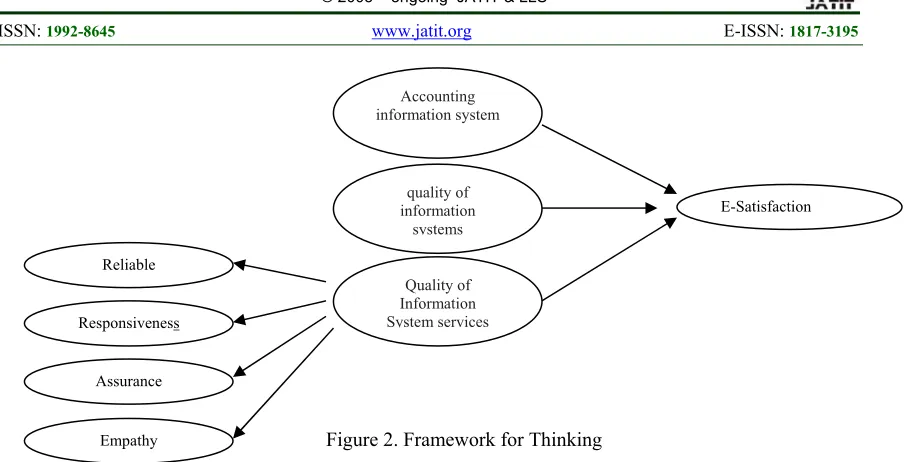
Figure 2. Framework for Thinking
3. RESEARCH METHOD
The purpose of this research is to know the impact of accounting information system, quality of accounting information system and service quality of information system to customer satisfaction of mobile banking application user. The population in this study is 450 conventional bank customers located in Surabaya and surrounding areas. The samples used are bank customers who use mobile banking based applications. The method of analysis in this study using non-linear Equation Modeling Partial Least Square (NL-SEMPLS) with the help of WarpPls 5.0 software. Analysis (NL-SEMPLS is divided into 2 stages, ie, outer model and inner model.) Outer model is used to see the validity and reliability of the indicator to the latent variable, while the Inner model is used to see the significance of the path / influence test between the latent variables.
The Outer model in this study is divided into 2, ie, explanatory factor analysis (EFA) is used if the indicator that measures the latent variable is formative and the confirmatory factor analysis (CFA) is used if the indicator measuring the latent variable is reflective .. In this study all indicators that measure the latent variable is reflective so to see the outer model using confirmatori factor analyse. Confirmatori factor analyse is divided into 3 stages namely convergen validity, discriminat validity and reability validity. Convergent validity is met if the loading value of the indicator factor measuring the latent variable is more than 0.4
and the average variance extracted (AVE) value is more than 0.5. discriminat validity is met if the AVE root value is higher than the correlation value between the latent variables. Reability validity is met if the value of composite reliability (CR) and cronbach alpha (CA) is more than 0.7. Explanatory factor analysis, an indicator is valid if the value of loading factor indicator that measures latent variables> 0.4 and significance value <0.05 while the indicator is said to be reliable if the value of composite reliability (CR) and cronbach alpha> 0.7.
Inner model in this research is used to see significance of path / influence test between latent variables and magnitude of influence of exogenous variable to endogenous variable. a path in say signfikan if the value of Tstatistik count more than 1.96 and the magnitude of the effect of exogenous variables on endogenous variables are seen based on the R-square value. According to Chin (1998), R-square results. above 0.67 indicates that the model is categorized well and it can be concluded that the effect of exogenous variables on strong endogenous variables. R-square result of 0.33 to 0.67 indicates that the model is categorized as moderate and it can be concluded that the effect of exogenous variable on the endogenous variable is strong enough. While the R2 result of 0.33 indicates that the model is categorized as weak and it can be concluded that the effect of exogenous variables on endogenous variables is weak.
Accounting information system
Quality of Information System services
E-Satisfaction
Responsiveness
Assurance
Empathy Reliable
quality of information
7635 The variable in this research is divided into 2, namely exogenous and endogenous variables. Exogenous variables in this study are accounting information systems, information system quality and quality of information system servants. while endogenous variable in this research is mobile banking user satisfaction. Exogenous variable in this research is divided into 2, that is, first order
[image:8.612.81.528.214.716.2]and second order. Exogenous variables that are first order is accounting information system, information system quality. The second order exogenous variables are the quality of information system servants measured using Reliable (RE), Responsiveness (RES), Assurance (AS) and Empathy (E).
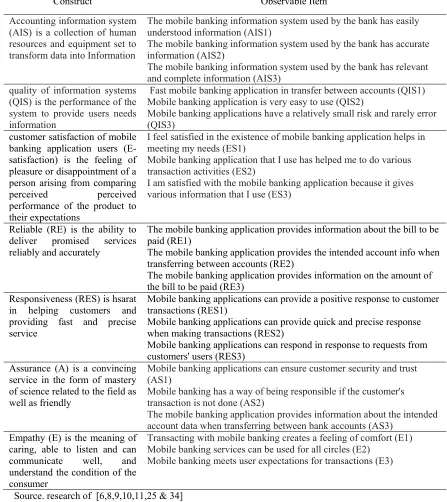
Table 1. Construct and Observable Item
Construct Observable Item
Accounting information system (AIS) is a collection of human resources and equipment set to transform data into Information
The mobile banking information system used by the bank has easily understood information (AIS1)
The mobile banking information system used by the bank has accurate information (AIS2)
The mobile banking information system used by the bank has relevant and complete information (AIS3)
quality of information systems (QIS) is the performance of the system to provide users needs information
Fast mobile banking application in transfer between accounts (QIS1) Mobile banking application is very easy to use (QIS2)
Mobile banking applications have a relatively small risk and rarely error (QIS3)
customer satisfaction of mobile banking application users (E-satisfaction) is the feeling of pleasure or disappointment of a person arising from comparing
perceived perceived
performance of the product to their expectations
I feel satisfied in the existence of mobile banking application helps in meeting my needs (ES1)
Mobile banking application that I use has helped me to do various transaction activities (ES2)
I am satisfied with the mobile banking application because it gives various information that I use (ES3)
Reliable (RE) is the ability to deliver promised services reliably and accurately
The mobile banking application provides information about the bill to be paid (RE1)
The mobile banking application provides the intended account info when transferring between accounts (RE2)
The mobile banking application provides information on the amount of the bill to be paid (RE3)
Responsiveness (RES) is hsarat in helping customers and providing fast and precise service
Mobile banking applications can provide a positive response to customer transactions (RES1)
Mobile banking applications can provide quick and precise response when making transactions (RES2)
Mobile banking applications can respond in response to requests from customers' users (RES3)
Assurance (A) is a convincing service in the form of mastery of science related to the field as well as friendly
Mobile banking applications can ensure customer security and trust (AS1)
Mobile banking has a way of being responsible if the customer's transaction is not done (AS2)
The mobile banking application provides information about the intended account data when transferring between bank accounts (AS3)
Empathy (E) is the meaning of caring, able to listen and can communicate well, and understand the condition of the consumer
Transacting with mobile banking creates a feeling of comfort (E1) Mobile banking services can be used for all circles (E2)
Mobile banking meets user expectations for transactions (E3)
7636
4. DATA ANALYSIS AND DISCUSSION
The data obtained in this study as much as 437 data from 450 questionnaires scattered, from 437 data obtained in tabulation and in screning data. then in get 407 data that can be used based on the completeness of the data and in accordance with the desired option researchers (data meet minimum requirements). After screning the next data in doing data analysis based on the framework and research hypothesis by using non linear SEM-PLS method using WARP-PLS 5.0 assistance. The result of data analysis is divided into 2 yatiu outer model and inner model, where outer model is divided into 2 stages namely first order and second order, while inner model see influence test between latent variables.
A. Outer Model - Confirmatory Factor
Analysis
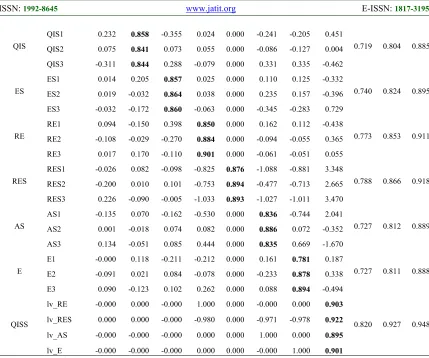
Outer model in this research using confirmatory factor analysis (CFA) method. Confirmatory factor analysis is used to determine the validity and reliability of indicators against latent variables. Outer model in this research is divided into 2 namely, first order and second order. CFA First order accounting information system variables inform that all accounting system indicator of information system able to measure well variable accounting system information, it is shown in table 2 and table 3 that is, all value loading factor more than 0,4 and value of AVE more than 0 , 5 (Convergen validity is met). The AVE root value is greater than the correlation value between the latent variable and the loading value of the indicator factor that measures the latent variable greater than the other indicator (Dicriminant validity is met). Value of cronbach alpha and composite reliability accounting information system more than 0.7 (realibility validity fulfilled). The most able indicators to reflect the accounting information system variables are AIS 2, namely the mobile banking information system used by the bank has accurate information.
CFA First order variable quality information system informs that all indicators of quality information system are able to measure well variable quality information system, it is shown in table 2 and table 3 that is, all value loading factor more than 0,4 and AVE value more than 0 , 5 (Convergen validity is met). The AVE root value is greater than the correlation value between the latent variable and the loading value of the indicator factor that measures the latent variable greater than the other indicator (Dicriminant validity is met). Value of cronbach alpha and composite reliability accounting information system more than 0.7 (realibility validity fulfilled). The most able indicator to reflect the variables of accounting system information is QIS 1 is the application of mobile banking fast in the transfer between accounts
[image:9.612.90.526.657.744.2]CFA second order variable Quality of Information System services informs that all indicators of Quality of Information System services (Reliable, Responsiveness, Assurance and Empathy) are able to measure well the Quality of Information System Services variable, it is shown in table 2 and table 3 that is, all value loading factor more than 0.4 and AVE value more than 0,5 (Convergen validity fulfilled). The AVE root value is greater than the correlation value between the latent variable and the loading value of the indicator factor that measures the latent variable greater than the other indicator (Dicriminant validity is met). Value of cronbach alpha and composite reliability accounting information system more than 0.7 (realibility validity fulfilled). The most able indicator to reflect the variable Quality of Information System services is Responsiveness (RES) is the desire to help customers and provide fast and precise service, the most influential RES2 indicator is RES2 so it can be concluded that the indicator capable of reflecting variable Quality of Information System services namely, mobile banking applications can provide quick and precise response when making transactions.
Table 2. Loading Factor, AVE, Composite Reliability, Croncbach Alpha
Variable Indicator Loading Factor AVE CA CR
AIS SQ US RE RES AS E QCP
AIS
AIS1 0.827 0.082 -0.075 0.037 0.000 0.150 -0.032 -0.220
0.714 0.799 0.882 AIS2 0.869 0.107 -0.125 0.287 0.000 0.225 0.204 -0.453
7637 QIS
QIS1 0.232 0.858 -0.355 0.024 0.000 -0.241 -0.205 0.451
0.719 0.804 0.885 QIS2 0.075 0.841 0.073 0.055 0.000 -0.086 -0.127 0.004
QIS3 -0.311 0.844 0.288 -0.079 0.000 0.331 0.335 -0.462
ES
ES1 0.014 0.205 0.857 0.025 0.000 0.110 0.125 -0.332
0.740 0.824 0.895 ES2 0.019 -0.032 0.864 0.038 0.000 0.235 0.157 -0.396
ES3 -0.032 -0.172 0.860 -0.063 0.000 -0.345 -0.283 0.729
RE
RE1 0.094 -0.150 0.398 0.850 0.000 0.162 0.112 -0.438
0.773 0.853 0.911 RE2 -0.108 -0.029 -0.270 0.884 0.000 -0.094 -0.055 0.365
RE3 0.017 0.170 -0.110 0.901 0.000 -0.061 -0.051 0.055
RES
RES1 -0.026 0.082 -0.098 -0.825 0.876 -1.088 -0.881 3.348
0.788 0.866 0.918 RES2 -0.200 0.010 0.101 -0.753 0.894 -0.477 -0.713 2.665
RES3 0.226 -0.090 -0.005 -1.033 0.893 -1.027 -1.011 3.470
AS
AS1 -0.135 0.070 -0.162 -0.530 0.000 0.836 -0.744 2.041
0.727 0.812 0.889 AS2 0.001 -0.018 0.074 0.082 0.000 0.886 0.072 -0.352
AS3 0.134 -0.051 0.085 0.444 0.000 0.835 0.669 -1.670
E
E1 -0.000 0.118 -0.211 -0.212 0.000 0.161 0.781 0.187
0.727 0.811 0.888 E2 -0.091 0.021 0.084 -0.078 0.000 -0.233 0.878 0.338
E3 0.090 -0.123 0.102 0.262 0.000 0.088 0.894 -0.494
QISS
lv_RE -0.000 0.000 -0.000 1.000 0.000 -0.000 0.000 0.903
0.820 0.927 0.948 lv_RES 0.000 0.000 -0.000 -0.980 0.000 -0.971 -0.978 0.922
lv_AS -0.000 -0.000 -0.000 0.000 0.000 1.000 0.000 0.895
[image:10.612.92.521.70.428.2]lv_E -0.000 -0.000 -0.000 0.000 0.000 -0.000 1.000 0.901 Source. Process by Warp-PLS 5.0
Table 3.Correlations Among l.vs. with sq. rts. of AVEs
Variabel Correlations among l.vs. with sq. rts. of AVEs
AIS SQ US RE RES AS E QCP
AIS 0.845 0.700 0.735 0.719 0.731 0.727 0.757 0.810
SQ 0.700 0.848 0.810 0.776 0.775 0.710 0.768 0.837 US 0.735 0.810 0.860 0.818 0.766 0.729 0.736 0.842 RE 0.719 0.776 0.818 0.879 0.792 0.716 0.764 0.903 RES 0.731 0.775 0.766 0.792 0.888 0.784 0.758 0.922 AS 0.727 0.710 0.729 0.716 0.784 0.853 0.745 0.895 E 0.757 0.768 0.736 0.764 0.758 0.745 0.853 0.901 QCP 0.810 0.837 0.842 0.903 0.922 0.895 0.901 0.905
Source. Process by Warp-PLS 5.0
Inner Model
Inner model on non-linear analysis SEM-PLS is divided into 3 stages. the first stage is to determine the equation of the structural model of the frame of thought, this stage can see the magnitude of the effect of exogenous variables
7638
[image:11.612.109.462.125.276.2]can conclude whether the hypothesis already in form is acceptable or rejected.
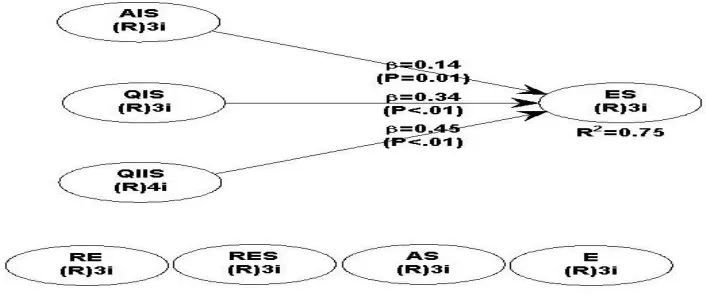
Figure 3. Structural Equation Modelling Source. Process by Warp-PLS 5.0
Model
Based on figure 1, Models are formed as ES = 0,14 AIS + O,34 QIS + 0,45 QIIS Where
ES : E-Satisfaction
AIS : Accounting information system
QIS : Quality of information systems
QIIS : Quality of Information System services
Based on the model that is formed it can be interpreted that the relationship of Accounting information system to customer satisfaction of mobile banking users (e-Satisfaction) is positive with regression coefficient of 0.14 which means that each increase of one unit of Accounting information system (AIS) unit will increase the value mobile banking user satisfaction (e-Satisfaction) of 0.14 and vice versa. the relationship of Quality of information systems to the satisfaction of customers of mobile banking (e-Satisfaction) customers is positive with regression coefficient of 0.34 which means that every increase of one unit of Quality of information systems (QIS) will raise the value of customer satisfaction of mobile banking user (e -Satisfaction) of 0.34 and vice versa. the relationship of Quality of Information System Services (QIIS) to customer satisfaction of mobile banking user (e-Satisfaction) is positive with regression coefficient of 0.45 which means that every increase of one unit of Quality of Information System Services (QISS) will raise
the value of customer satisfaction mobile banking (e-Satisfaction) users of 0.45 and vice versa.
Coefficient of Determination
Testing the coefficient of determination using R-squared (R2) is a way to measure the level of Goodness of Fit (GOF) of a structural model. The R-squared (R2) value is used to assess how much of the latent independent latent variables affect latent dependent variables. Figure 1 shows that the magnitude of R-squared = 0.75, this result indicates that the influence of Accounting Information System (QIS), Quality of Information Systems (QIS), on the satisfaction of customer of mobile banking (e- Satisfaction) of 75%. The value of R-squared = 0.75 also shows that the model is able to explain well the relationship of Accounting Information System (AIS), Quality of Information Systems (QIS), Quality of Information System Services (QIIS) to customer satisfaction of mobile banking user (e -Satisfaction).
Influence Testing
7639 dependent variable is the endogenous latent variable. Significant value can be obtained with bootstrapping procedure developed by Geisser & Stone. The independent variable affects the dependent variable if the value of Pvalue <alpha or Tstatistic value> Ttable. In this research the fault tolerance is 5%, so it can be concluded that the independent variable has an effect on the
[image:12.612.115.489.205.261.2]dependent variable if the value of Pvalue <0.05 or the value of Tstatistik> 1.96. Further significance test can also be called hypothesis test, test whether the hypothesis of a study received or rejected. A hypothesis is received if the value of Pvalue <0.05 or the value of Tstatistik> 1.96.
Tabel 3. Hypothesis Testing
Variable Path Coeficient Pvalue Conclusion
AIS on ES 0,14 <0.01 Affected
QIS on ES 0,34 <0.01 Affected
QIIS on ES 0,45 <0.01 Affected
Source. Process by Warp-PLS 5.0
H1: There is influence of Accounting
information system on e-Satisfaction
The results of the first hypothesis testing informed that the value of the Accounting Information System (AIS), the path coefficient toward mobile banking user satisfaction (e-Satisfaction) was 0.14 with a Pvalue of less than 0.01 <0.05. These results indicate that the Accounting Information System (AIS) is the positive influences of mobile banking user satisfaction (e-Satisfaction) (Hypothesis 1 is accepted) and the influence of Accounting information system on customer satisfaction of mobile banking user (e-Satisfaction) is positive, which means that any change in accounting information system improvement will influence the improvement of customer satisfaction of mobile banking user (e-Satisfaction) and vice versa. When viewed from indicators that measure accounting information systems, the best indicator that reflects the accounting information system is AIS 2, namely mobile banking information system used by the bank has accurate information - information. The above results conclude that mobile subscribers of mobile banking (e-Satisfaction) customer satisfaction due to the mobile banking information system used by the bank has accurate information.
H2: There is influence of Quality of information
systems on e-Satisfaction
The results of the first hypothesis testing informed that the value of Quality of information systems (QIS), the path coefficient toward mobile banking user satisfaction (e-Satisfaction) was 0.34 with a Pvalue of less than 0.01 <0.05. These results indicate that the quality of information
systems (QIS) is the success of the customer satisfaction of mobile banking customers (Hypothesis 2 is accepted) and the influence of Quality of information systems on customer satisfaction of mobile banking users (e-Satisfaction) positive, which means that any change in customer satisfaction
of mobile banking user (e-Satisfaction) and vice versa. When viewed from indicators that measure Quality of information systems, the best indicator to reflect Quality of information systems is QIS1, which is a fast mobile banking application for transfer between accounts (QIS1). The above results conclude that mobile subscribers' satisfaction of mobile banking (e-Satisfaction) customers is due to fast mobile banking application in transfer between accounts.
H3: There is influence of Quality of Information
System services on e-Satisfaction
The results of the first hypothesis testing informed that the value of Quality of Information
System services (QIIS), the path coefficient
toward mobile banking user satisfaction
(e-Satisfaction) was 0.14 with a Pvalue of less than
0.01 <0.05. These results indicate that the
Quality of Information System services (QIIS)
significantly influences mobile banking user satisfaction (e-Satisfaction) (Hypothesis 3 is accepted) and the influence of Quality of
Information System services on mobile banking
user satisfaction (e-Satisfaction)is positive, which means that any change in Quality of
Information System services improvement will
7640 user satisfaction (e-Satisfaction) and vice versa. When viewed from indicators that measure Quality of Information System services, the best indicator that reflects Quality of Information System services is Responsiveness (RES) on RES 2 indicator that is mobile banking application can give fast and accurate response
when doing transaction. The above results conclude that mobile subscribers of mobile banking (e-Satisfaction) customer satisfaction because mobile banking application can give fast and accurate response when doing transaction.
5. CONCLUSION
The results of the research inform that the data obtained in this study as many as 437 data from 450 questionnaires scattered, from 437 data obtained in tabulation and in screning data. then in get 407 data that can be used based on the completeness of the data and in accordance with the desired option researchers (data meet minimum requirements). Outer model testing shows that Reliable (RE), Responsiveness (RES), Assurance (AS) and Empathy (E) indicators are able to measure well the variables of service quality of accounting information system. The best indicator to measure the quality of accounting information system services is Responsiveness (RES). The measurement of outer model of accounting information system (AIS) shows that all indicators are able to measure well the accounting information system (AIS) variable, the best indicator to measure the variables of accounting information system (AIS) is AIS 2 that is mobile banking information system used by the bank has accurate information. The results of outer measurements of the quality of information systems (QIS) indicate that all indicators are able to measure well the quality of information systems (QIS) variable, the best indicator to measure the variable quality of information systems (QIS) is QIS 1, the fast mobile banking application in transferring between accounts. Inner model measurement shows Accounting information system, accounting information system quality and service quality of accounting information system influence to customer satisfaction of mobile banking application user (E-satisfaction). The most influential factor on customer satisfaction of mobile banking application user (E-satisfaction) is Quality of Information System Services (QISS) that is Responsiveness (RES) on RES 2 indicator that can be concluded that customer satisfaction of mobile banking application user (E-satisfaction) most of the effectivity of mobile banking applications can provide quick and precise response when conducting transactions (RES2). Based on the limitation of this study is Respondents who researched only bank customers in Surabaya that use mobile banking based
applications. For the next researcher for the next researcher the researcher suggest to expand the existing sample, then add the variable not only about satisfaction but also customer loyalty of application user base on mobile banking.
REFRENCES:
[1] Khan, M.S. and Mahapatra, S.S "Service quality evaluation in internet banking: an empirical study in India", International Journal Indian Culture and Business Management, 2009, Vol.2(1), pp. 30-46. [2] Parvin, A., "Mobile banking operation in
Bangladesh: prediction of future", Journal of
Internet Banking and Commerce, 2013, Vol.
18 (1).
[3] Kumbhar, V. M. "Factors Affecting the Customer Satisfaction in E- Banking: Some Evidences from Indian Banks", Management Research and Practice, 2011, Vol.3 (4), pp. 1-14.
[4] Nabizadeh, Mohammadali, S and Omrani, S.A, "Effective Factors on Accounting Information System Alignment; A Step Towards Organizational Performance Improvement", International Journal of Scientific and Research Publications, 2014, Vol 4 (9).
[5] Mulyadi, R., 'Kualitas Jasa Sistem Informasi dan Kepuasan Para Penggunanya", Jumal Bisnis dan Akuntansi. 1999, Vol. 1(2), pp. 120-133.
[6] Almilia, L.S & Briliantien, I, “Faktor- Faktor yang mempengaruhi Kinerja Sistem Informasi Akuntansi pada Bank Umum Pemerintahan di Wilayah Surabaya dan Sidoarjo”, Jurnal Akuntansi, 2007, Vol. 10(1).
[7] McKnight, D. H., Choudhury, V. and Kacmar, C, "Developing and validating trust measures for e-commerce: An integrative typology",
Information Systems Research, 2002,
Vol.13(3), pp.334-359.
7641
Journal Management Information System,
2003, Vol.19(4), pp. 9-10.
[9]Awamleh & Fernandes, "Internet Banking: An Empirical Investigation into the Extent of Adoption by Banks and the Determinants of Customer Satisfaction in the United Arab Emirates", Journal of Internet banking and commerce, 2015, Vol.10 (1).
[10] Zeithaml, V.A., Bitner, M.J. and Gremler, D., "Services Marketing: Integrating Customer Focus across the Firm", 2006, New York: McGraw-Hill.
[11]Vaezi, R., Mills, A., Chin, W. and Zafar, H., "User Satisfaction Research in Information Systems: Historical Roots and Approaches", Communications of the Association for Information Systems, 2016, Vol. 38 (27), pp. 501-532.
[12] Romney, M.B. and Steinbart, p.j., "Sistem informasi akuntansi", 2009, Jakarta, Salemba Empat.
[13] Xu, J.D., Benbasat, I. and Cenfetelli, R.T., "Integrating service quality with system and information quality: an empirical test in the E-service context", 2013, MIS Quarterly, Vol. 37 (3), pp. 777-794.
[14] Bodnar, G, H and Hopwood, W.S. (Amir Abadi Jusup dan Rudi M. Tambunan, penerjemah), Sistem Informasi Akuntansi, 2001, Salemba Empat, Jakarta.
[15] O’Brien, J.A., Pengantar Sistem Informasi, 2006, Edisi kedua belas. Jakarta:Salemba Empat.
[16] Meharia, P., "Assurance on the reliability of mobile payment system and its effects on use: An empirical examination", Journal of Accounting &Management Information Systems, 2012, Vol.11(1), pp. 97-111.
[17] DeLone, W. H. & McLean, E. R, "Measuring e-Commerce success: applying the DeLone & McLean information systems success model, International Journal of Electronic Commerce, 2004, vol. 9(1), pp. 31-47.
[18]Kahandawa, K. and Wijayanayake, J., "Impact of Mobile Banking Services on Customer Satisfaction: A Study on Sri Lankan State Commercial Bank", International Journal of Computer and Information Technology, 2014. Vol. 3, pp. 546-552.
[19] Ombati, R.B., Magutu, S.M., Nyamwange, N.K. & Nyaoga, P.O., "Technology and
Service Quality in the Banking Industry: Importance and performance of various factors considered in Electronic Banking services", African Journal of Business &
Management, 2011, Vol.1, 151 – 164.
[20]Aghdaie, S. F., and Faghani, F. "Mobile Banking Service Quality and Customer Satisfaction (Application of SERVQUAL Model)", International Journal of Managemnet and Business Research, 2012, Vol. 2(4), pp. 351-361.
[21]Rao, A.R. & Bergen, M.E., "Price premium variations as a consequence of buyers' lack of information", Journal of Consumer Research, 1992,vol. 19 ( 3), pp. 412-423.
[22]Al-Sayyed, N.M., Suifan, T.S., and Alawneh., A.R., " Exploring the Effect of Perceived Service Quality on Customers Satisfaction: A Study of Banking Sector in Jordan", Journal of Management Research, 2015, Vol. 7 (1). [23]Aghdaie, S.F.A., and Faghani, F., "Mobile
Banking Service Quality and Customer Satisfaction (Application of SERVQUAL Model)", International Journal Management Business Research., 2012, Vol. 2 (4), pp. 351- 361.
[24]Fang,Y.H., Chiu, C.M., and Wang, E.T.G., "Understanding customers' satisfaction and repurchase intentions: An integration of IS success model, trust, and justice", Internet Research, 2011, Vol 21 (4), pp. 479-503. [25]Jepleting, A., Oscar, S., and Bureti, P', "
Effects of Mobile Banking on Customer", International Journal of Innovation Research in Management, 2013, Vol. 3(2), pp. 29–40. [26] Kotler, Philip, "Marketing Management
12e", Pearson International Edition. New Jersey 07458.
[27] Zhao, L., Lu, Y., Zhang, L. and Chau, P. Y. K., "Assessing the effects of service quality and justice on customer satisfaction and the continuance intention of mobile value-added services: An empirical test of a multidimensional model", Decision Support Systems, 2012, Vol. 52(3), pp. 654-656. [28] Saleem, Z., dan Rashid, K., "Relationship
between Customer Satisfaction and Mobile Banking Adoption in Pakistan", International Journal of Trade, Economics and Finance, 2011, Vol. 2(6), pp. 537–544.
7642 Morocco", Studies in Business and Economics, 2012, Vol. 7(1), pp. 62-72.
[30]Saleem, Z and Rashid, K., "Relationship between customer satisfaction and mobile banking adoption in Pakistan", International
Journal of Trade, Economics and Finance,
2011, Vol. 2 (6), pp. 537.
[31]Zhengwei, M., and Zhao, J., "Evidence on E-Banking Customer Satisfaction in the China Commercial Bank Sector", Journal of SoftWare, 2012, Vol. 7(4), pp. 927–933. [32]Liza, F.Y., "Factors Influencing the Adoption
of Mobile Banking: Perspective Bangladesh", Global Disclosure of Economics and Business, 2014, Vol.3, pp. 92-112.
[33]Seranmadevi, R. and Saravanaraj, M. G., "An Empirical Study on Quality of Internet Banking Services in Indian", European Journal of Economics, Finance and Administrative Sciences, 2012, Vol.25, pp. 65-67.
[34]Behjati, S., Nahich, M., and Haman, S., "International Between E-service Quality and E-satisfaction and Loyalty", European
Journal of Business and Management, 2012.
Vol. 4(9), pp. 75–85.
[35]Kadir, H. A., Rahmani, N., and Masina, R., "Impacts of service quality on customer satisfaction:Study of Online banking and ATM services in Malaysia", International
Journal of Trade, Economics and Finance,