White Rose Research Online [email protected]
Universities of Leeds, Sheffield and York
http://eprints.whiterose.ac.uk/
This is the Author's Accepted version of an article published in the Journal of Educational Psychology
White Rose Research Online URL for this paper: http://eprints.whiterose.ac.uk/id/eprint/78370
Published article:
Cain, K and Nash, HM (2011)The influence of connectives on young readers' processing and comprehension of text.Journal of Educational Psychology, 103 (2). 429 - 441. ISSN 0022-0663
The influence of connectives on young readers’ processing and comprehension of text
Kate Cain*
Department of Psychology
Lancaster University
UK
Hannah M. Nash
Department of Psychology
University of York
* corresponding author, [email protected]
This article may not exactly replicate the final version published in the APA journal.
It is not the copy of record. Publisher website:
http://www.apa.org/pubs/journals/edu/index.aspx
Full reference:
Cain, K., & Nash, H. (2011). The influence of connectives on young readers’
Abstract
Connectives are cohesive devices that signal the relations between clauses and are
critical to the construction of a coherent representation of a text’s meaning. We
investigated young readers’ knowledge, processing, and comprehension of temporal,
causal, and adversative connectives using off-line and on-line tasks. In a cloze task,
10-year-olds were more accurate than 8-year-olds on temporal and adversative
connectives, but both age groups differed from adult levels of performance
(Experiment 1). When required to rate the ‘sense’ of two-clause sentences linked by
connectives, 10-year-olds and adults were better at discriminating between clauses
linked by appropriate and inappropriate connectives than were 8-year-olds. The
10-year-olds differed from adults only on the temporal connectives (Experiment 2). In
contrast, on-line reading time measures indicated that 8-year-olds’ processing of text
is influenced by connectives as they read, in much the same way as 10-year-olds’.
Both age groups read text more quickly when target two-clause sentences were linked
by an appropriate connective compared to texts in which a connective was neutral
(and),inappropriate to the meaning conveyed by the two clauses, or not present
(Experiments 3 and 4). These findings indicate that although knowledge and
comprehension of connectives is still developing in young readers, connectives aid
text processing in typically developing readers.
The influence of connectives on young readers’
processing and comprehension of text
The product of successful reading comprehension is a coherent representation of the
text’s meaning, referred to as a situation model (Kintsch, 1998) or mental model
(Johnson-Laird, 1980). In order to establish coherence, the reader must relate
different events in the text, a process regarded as the “the cornerstone of
comprehension” (Graesser, McNamara, & Louwerse, 2003). Connectives (or
conjunctions - Halliday & Hasan, 1976) are cohesive devices, such asbecause,but,
andafter, that can aid this process for skilled readers by signaling the nature of the
relation between events (Costermans & Fayol, 1997; Degand & Sanders, 2002;
Sanders & Noordman, 2000). We report four experiments that investigated the
influence of connectives on young readers’ processing and understanding of text, to
determine whether connectives help or hinder young readers to establish coherence
when reading.
Different groups of connectives signal specific types of coherence relation
between events and therefore convey different instructions about how to integrate this
information (Gernsbacher, 1997). Temporal connectives such asbeforeandafter
indicate the sequence of events in time: consider the different meanings and
implications of ‘Chris left the barbecue before/after it started to rain’. Causal
connectives such asbecauseorsosignal cause-effect relations and help readers to
understand why things occurred: compare ‘Charlie was late for work because/so he
took the bus.’ Adversative connectives such asbutandalthoughare used to provide
information that is contrary to expectations, as shown by: ‘The engagement ring was
expensive but/although the diamond was small’.
when reading. The presence of an appropriate connective between two clauses leads
to faster reading times, better memory, higher ratings of textual coherence, and
facilitates inference making when the relation between events is not explicitly stated
(Caron, Micko, & Thuring, 1988; Ferstl & von Cramon, 2001; Millis, Golding, &
Barker, 1995; Murray, 1997). Furthermore, adult readers use this information soon
after reading the connective (Traxler, Bybee, & Pickering, 1997). Given that
connectives benefit skilled readers, the expectation is that they will also be helpful to
developing readers, provided they understand their meanings.
The age at which young readers successfully comprehend and interpret
connectives is particularly relevant to the recently introduced Common Core State
Standards for reading, adopted by several states in the USA (CCGSI & NGA, 2010).
Within this framework, the ability to read and understand complex texts
independently is considered crucial for college and career readiness. To develop the
necessary skills for this, it is essential that children are able to read and understand
texts of increasing complexity as they progress through school. To ensure that readers
are given materials of suitable complexity for their ability or grade level, and also that
readers’ ability is accurately estimated by reading comprehension tests, appropriate
measures of text complexity are critical.
Text complexity can be assessed with readability formulae, such as
Flesch-Kincaid Grade Level, Dale-Chall Readability Formula, and the Lexile system. These
typically use word length or frequency and sentence length as proxies for semantic
and syntactic complexity, to calculate the difficulty level of a given text. According to
these formulae, a text with sentences that include clauses linked by connectives will
be rated as more difficult to read than one in which the connectives are removed and
This method of computing text complexity may be appropriate if young
readers are not able to interpret the information provided by connectives, but it will
not be appropriate if young readers benefit from the presence of connectives and are
able to use them to guide their comprehension. Indeed, a different approach to text
readability is adopted by the Coh-Metrix system, which rates the cohesiveness of a
text (Graesser, McNamara, Louwerse, & Cai, 2004). A highly cohesive text signals
the relations between words, sentences, and ideas through devices such as repetition
and connectives. It is clear that we need to know the age at which young readers
benefit from connectives (as well as other cohesive devices) to develop appropriate
measures of text complexity.
The majority of developmental studies have focused on production, rather than
comprehension, of connectives. Children produce a range of connectives by about 5
years of age (Kail & Weissenborn, 1991; Spooren & Sanders, 2008). Acquisition of
these connectives follows a developmental pattern. Connectives to express additive
relations, such asand, are generally acquired first, followed by connectives to express
temporal, causal, and finally adversative relations (Bloom, Lahey, Hood, Lifter, &
Fiess, 1980). The order of acquisition is related to the cognitive complexity of the
specific coherence relation, guided by parameters such as polarity and the strength of
the relation, e.g., additive vs causal (Evers-Vermeul & Sanders, 2009; Spooren &
Sanders, 2008).
The early appearance of connectives in speech suggests that young readers
will benefit from connectives. However, appropriate use of connectives (Peterson,
1986) and indeed understanding of them (Irwin & Pulver, 1984) continues to develop
for several years after they first appear in children’s speech. Even some adult readers
(McClure & Geva, 1983).
Most studies of children’s comprehension of connectives have examined
whether or not the presence of a connective in general aids understanding (e.g.,
(Bridge & Winograd, 1982; Geva & Ryan, 1985). Where performance between
connectives that signal different types of coherence relations has been compared,
differences are evident. Using a cloze procedure, Cain, Patson and Andrews (2005)
found that 10-year-olds were more likely than 8-year-olds to choose the correct
connective to signal temporal, causal, and adversative coherence relations, but they
found no age differences for additive relations. Similarly, in a study of 9-year-old
English language learners, Crosson, Lesaux, and Martiniello (2008) found that
performance for temporal, causal, and adversative relations was poorer than for
additive ones.
The data from off-line comprehension tasks indicate that knowledge of
connectives is still developing in young readers. This supports the notion that the
presence of connectives in text does not necessarily help understanding and that a text
rated as cohesive will not necessarily be better understood by young readers than one
that is less cohesive. In contrast, data from a reading time study of connectives
indicates that from eight years of age, children benefit from connectives and read a
segment of text more quickly when it is preceded by a connective relative to no
connective present (Mouchon, Fayol, & Gaonac'h, 1995). That study investigated just
two connectives,mais(but) andsoudain(suddenly), so it remains to be seen whether
children process and benefit from a range of connectives that signal different types of
coherence relation, as they are reading.
If it is indeed the case that young readers do not benefit from connectives, it
particular connective. The data from off-line cloze tasks supports this interpretation,
although these studies are limited by the small numbers of items used to assess
comprehension of each connective (e.g., Cain et al., 2005; Crosson et al., 2008). An
alternative explanation is that young readers are knowledgeable about the meanings of
different connectives but fail to benefit because they do not always attend to them. In
support of this, an off-line comprehension study found that children who were poor
readers benefitted from the inclusion of connectives only when they were highlighted
in the text (Geva & Ryan, 1985).
As noted, connectives play a central role in theories of skilled text processing
and are an important indicator of text cohesiveness. To date, we do not know the
extent to which connectives influence reading comprehension in school-age children
and, therefore, how their presence should be weighted when computing a text’s
complexity. Indeed, the nature of the task may influence whether or not young readers
are found to benefit from connectives. A more detailed understanding of connective
processing and comprehension is needed to further our understanding of the
development of reading comprehension more generally, and to design curricula so
that instruction and materials are suitable for the skills and knowledge of that age
group.
The current research
Our research was designed to address the main question: Do connectives help or
hinder young readers? Specifically, we addressed three research questions. Do young
readers understand the different types of coherence relations expressed by different
connectives? Does the presence of an appropriate connective help children to
establish the coherence relations between events? Do connectives have an impact as
addressed by investigating developmental patterns in young readers’ performance on
tasks that assessed the processing and comprehension of sentence pairs and short texts
containing connectives that specified temporal, causal, and adversative coherence
relations. We compared 10- and 8-year-olds because these age groups have been
found to differ in connective competence in previous research (Cain et al., 2005).
On-line tasks measure processing as it occurs in real time, whereas off-On-line tasks measure
the product of this processing. We report four experiments using both types of
measure to provide a comprehensive picture of competence.
Experiment 1
The aim of Experiment 1 was to determine whether or not young readers show
the same knowledge of the meaning conveyed by different types of connectives as
adults. This work extended that of Cain et al. (2005) who embedded cloze sentences
in extended text (passages of 779 and 836 words in length). Here we used a sentence
cloze task that had relatively low memory and processing demands. If young readers’
knowledge of particular connectives is still developing, they will be less likely to
select the appropriate connective to link two short sentences compared to skilled adult
readers. If differences follow the same pattern as those reported in production
research, performance should be poorest for adversative connectives.
Method
Participants.Three groups participated: 17 undergraduate and postgraduate
university students (aged between 20 and 39 years, 4 males, 13 females), 50 children
in Year 5 (UK Primary school, 30 boys, 20 girls) aged 9-10 years (hereafter
10-year-olds), and 46 children in Year 3 (17 boys, 29 girls) aged 7-8 years (hereafter
participation. Their performance was close to ceiling and is reported to demonstrate
levels of performance by skilled readers.
For this and all other work reported in this paper, the procedures received
ethical approval from the departmental ethics committee, in line with the guidelines of
the British Psychological Society. Written consent was obtained from schools and
parents for the children and from the individual adult participants. Children gave oral
consent for each session. Different children and adults participated in the different
experiments reported in this paper.
Materials.Seventy-two sentences written with vocabulary suitable for
children in the youngest age group were constructed. Each sentence comprised two
clauses written to convey a coherent semantic relation. The target connectives that
joined the two clauses were selected to signal different coherence relations: temporal
(before, after), causal (so, because), and adversative (but, although), with 12
sentences for each. These connectives were selected because they have been used in
previous work with young readers (Johnston & Welsh, 2000; Stevenson & Pollitt,
1987). The first clause of the sentence always contained a noun (subject), a verb, and
a second noun (object). For each of the six connectives, there were six sentences in
which the second clause referred to the subject of the first clause and six in which it
referred to the object. The mean length of the sentence was 10.46 words and second
clauses that referred to objects were shorter than those that referred to subjects (3.31
vs 4.11 words). Examples are provided in the Appendix.
Three connectives served as the choices to complete the blank in each
sentence: the appropriate connective, an inappropriately placed connective (a
connective that indicated a different relation to the one conveyed by the sentence
native English speakers. The mean number of correct selections was 11.47 (out of 12).
Five items were identified as problematic and modified to make the target connective
more acceptable and the nontarget connective less acceptable in the judgment of the
authors. Cronbach’s alpha for the final set of items confirmed adequate internal
consistency for the three types of coherence relations:s = .79, .78, and .87 for
temporal, causal, and adversative, respectively.
Procedure.Three lists were created, each presented the options for a given
item in a different order (first, second, or third). The item order was
pseudo-randomised to create two versions of each list. Adults were tested in small groups in a
quiet room and completed the task in one session lasting approximately 15 minutes.
Children completed the task in two separate sessions in a quiet room within their
school. The task was presented in a booklet and children were instructed to:“Read
each sentence carefully and then choose the word that best fills the gap.”The
experimenter went through some examples with participants before they completed
the experimental items on their own.
Results
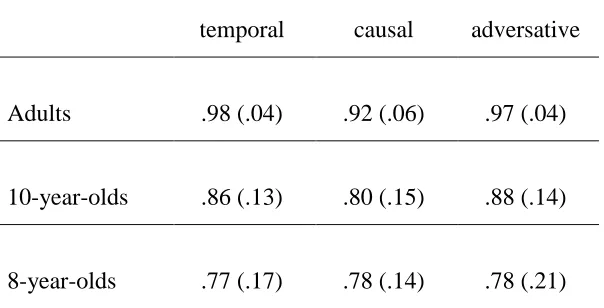
The proportions of correct target selections are reported in Table 1. For temporal and
adversative connectives there were clear differences in performance between the three
age groups: adults > 10-year-olds > 8-year-olds. For the causal connectives, adults
obtained the highest scores, but the 10-year-olds obtained similar scores to the
8-year-olds (80% and 78% correct, respectively).
The data for the proportion correct responses were arcsin transformed before a
mixed analysis of variance was performed, in which age group (10 years, 8 years) was
a between-subjects factor and type of coherence relation (temporal, causal,
participants were treated as a random factor and in the other, items were treated as a
random factor. We report2p(the proportion of the effect and error variance that is
attributable to the effect) as the measure of effect size for all significant effects and
interactions. Throughout this paper, significant interactions were explored with simple
main effects analysis and posthoc Tukey comparisons (= .05), as recommended by
Roberts and Russo (1999).
TABLE 1 AROUND HERE
In general, the 10-year-olds were more accurate than the 8-year-olds (F1(1, 94)
= 7.91,p< .01,2p = .08;F2(1, 69) = 6.32,p< .01,2p = .16) and accuracy was
higher for temporal and adversative connectives than for causal connectives (F1(2,
188) = 8.75,p< .001,2p = .09; not significant by items,F2(1, 69) < 1.0, ns). There
was a significant interaction between age and type of coherence relation (F1(2, 188) =
5.71,p< .01,2p = .06;F2(2, 69) = 56.69,p< .01,2p = .45). Simple effects analysis
revealed significantly more accurate performance by the 10-year-olds for temporal
and adversative connectives (allFs > 7.50,ps < .01), but no difference between the
two age groups for causal connectives (Fs < 1.0). Looking at performance within each
age group, accuracy was comparable for each type of coherence relation (Fs < 1.0).
The majority of non-target responses involved the selection ofand. The total
proportions ofandselections were temporal = .62; causal = .76; adversative = .68,
collapsed over age group. These data are based on different number of responses for
each connective, different choices of nontarget connective, and often very small
numbers. Thus, further analysis was not considered informative.
Discussion
Performance on the cloze task was high, demonstrating that young readers are often
demands are minimal and they have time to reflect on the correct selection of a
connective in the context of a single sentence. In general, the older children were
more likely to select the correct connective than younger children and these
differences were significant for temporal and adversative connectives. This finding
suggests that 10-year-olds have a better understanding of these connectives than
8-year-olds.
Performance for causal connectives was, in general, poorer than performance
for adversative connectives. This pattern of data is different to that found in
production studies (but it supports Cain et al.’s (2005) finding of relatively good
performance for adversative connectives). Analysis of errors indicated a strong
preference for the selection ofand, which is a general or less-specific connective that
can be used to express temporal, causal and adversative relations, as well as additive
ones (Knott & Sanders, 1998; Peterson & McCabe, 1987). Becauseandmatches the
temporal order of events when the target link isso,it is an appropriate choice, which
may have led to an underestimation of actual competence for causal connectives for
all age groups. In contrast, the inclusion ofandmay have overestimated performance
on adversative connectives because it is a less appropriate alternative. Analyses of
children’s speech shows thatandis used less frequently to express adversative than
temporal and causal relations (Peterson & McCabe, 1987). Both groups of children
were more likely than the adults to selectand, suggesting that they have a poorer
knowledge of the information provided by the specific connectives.
Experiment 2
Adults perceive a sentence following an inappropriately placed connective as a less
sensible or coherent continuation relative to one following an appropriate connective
inappropriately placed connective affected young readers’ sense of coherence using a
sense rating task. Sense judgment paradigms have been used with both typically and
atypically developing readers in this age range in previous reading comprehension
research (Baker, 1984; Barnes, Faulkner, Wilkinson, & Dennis, 2004; Oakhill, Hartt,
& Samols, 2005).
Method
Participants.Three groups participated: 20 undergraduate and postgraduate
students (10 males and 10 females), 60 10-year-olds (21 boys, 39 girls), and 64
8-year-olds (24 boys, 42 girls). All were native speakers of British English. The adults
were paid for their participation.
Materials and design.The materials were the same seventy-two sentences
used in Experiment 1. Two versions of each sentence were constructed. In one, the
two clauses were linked by an appropriate connective and, in the other, the connective
was inappropriate according to the judgments of adults in pilot work. Two lists were
created, each with 72 sentences comprising 36 appropriate items (12 for each
coherence relation) and 36 inappropriate items (12 for each coherence relation). See
Appendix for examples. Each participant completed only one list.
The task was presented in a booklet. By each item, there was a rating scale of
5 empty circles. Underneath each circle was a label: ‘yes’, ‘a bit’ ‘not sure’, ‘not
really’, and ‘no’. The instructions were printed on the first page and read out to
children:“Read each sentence carefully and then ask yourself ‘Does this sentence
make sense’? If it definitely does make sense, tick ‘yes’. If it makes a bit of sense tick
‘a bit’. If you are not sure whether it makes sense or not tick ‘not sure’. If it does not
really makes sense tick ‘not really’. If it definitely does not make sense tick ‘no’.”
examples with the experimenter, with one example fitting each rating except ‘not
sure’. In the children’s booklets the question was restated at the top of each page.
Children were tested in their classroom as a group and completed the work in two
sessions. Adults were tested in small groups and completed the work in a single
session.
Results
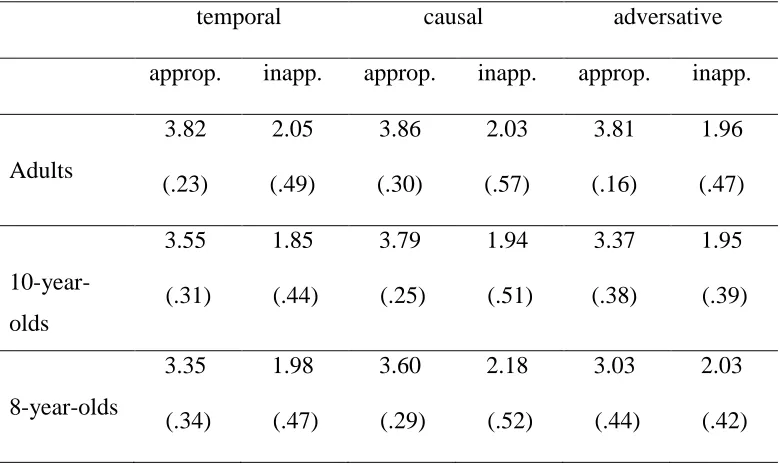
Each age group awarded higher ratings in the appropriate than in the inappropriate
condition (mean sense ratings in Table 2). In addition, the adults awarded the highest
ratings in the appropriate condition, followed by the 10-year-olds and then the
8-year-olds. We explored the accuracy of responses by calculatingd', to measure the ability
to discriminate between appropriate and inappropriately placed connectives, and
estimated response bias (i.e., willingness to say ‘yes’) by calculating the criterionc.
To do this, we first created a 2 (appropriate, inappropriate) x 2 (makes sense, does not
make sense) contingency table. No participants used the ‘definitely does not make
sense’ ratings so the ratings were clustered with 1 (yes definitely) and 2 (a bit)
grouped as ‘makes sense’ and 3 (not sure) and 4 (not really) grouped as ‘does not
make sense’. Using this grouping, the number of hits (appropriate items judged to
make sense) and false alarms (inappropriate items judged to make sense) were derived
and used to calculated'andc. The data distributions were within acceptable limits for
normality.
TABLE 2 AROUND HERE
FIGURE 1 AROUND HERE
Thed'scores are illustrated in Figure 1. A larger value indicates better
discrimination between the appropriate and inappropriate items. These scores were
coherence relation as factors. In general, the adults and 10-year-olds showed more
accurate discrimination between appropriate and inappropriately placed connectives
than the 8-year-olds (F(2, 141) = 13.42,p< .001,2p = .16), and discrimination was
strongest for causal coherence relations (F(2, 282) = 14.76,p< .001,2p = .10). There
was also a significant interaction between age group and coherence relation (F(4,282)
= 6.33,p< .001,2p = .08).
Analysis of the interaction revealed differences between the age groups for
each type of coherence relation (allFs > 3.40,ps< .05). The adults and the
10-year-olds did not differ from each other in their discrimination for any coherence relations
(allps > . 20). In contrast, the adults were significantly better than the 8-year-olds at
discriminating between appropriate and inappropriately placed connectives (ps < .05)
and the 10-year-olds showed better discrimination than the 8-year-olds for causal and
adversative connectives (ps< .05), but not for temporal connectives (p> .40). In
addition to the differences between age groups, each age group differed in their ability
to discriminate between the appropriate and inappropriately placed connectives for the
three types of coherence relation (allFs > 3.75,ps< .05). For adults, thed'score for
temporal connectives was significantly lower than that obtained for causal
connectives. For 10-year-olds, thed'score for temporal connectives was significantly
lower than that obtained for both causal and adversative connectives. For the
8-year-olds, there were significant differences between thed'scores in the following order:
causal > temporal > adversative (ps < .05).
The criterion scores were analyzed in a two-way ANOVA with age group and
type of coherence relation as factors. A larger value indicates that stronger evidence is
required before responding that a signal is present (i.e., a higher rate of hits to
connectives). The pattern of performance was different to that found in the analysis of
d'.The adults (M=.68) and 10-year-olds (M=.73) obtained higher values than the
8-year-olds (M=.53), but the main effect of age group did not reach conventional levels
of significance (F(2, 141) = 2.61,p= .08). Further, the three types of coherence
relations did not differ from each other (F(2, 282) < 1). However, there was a
significant interaction between group and coherence relation (F(4,282) = 3.21,p<
.015,2p = .04).
Analysis of the interaction revealed one significant difference between age
groups: the 10-year-olds required a higher criterion than the 8-year-olds (p< .05)
when making decisions about adversative connectives. In addition, there was a
tendency for the adults and the 10-year-olds to require stronger evidence than the
8-year-olds before making a decision about causal connectives (ps = .07 and .08).
Separate analyses for each age group revealed that the adults did not set different
criterion levels for different types of coherence relations (F< 1.0). In contrast, the
10-year-olds required a higher criterion for adversative than for temporal connectives
(Ms = .87 and .65, in order,p< .05), and the 8-year-olds required a higher criterion
for temporal than for causal connectives, (Ms = .60 and .42 in order,p< .05).
Discussion
Readers as young as 8 years were sensitive to the function of a range of coherence
relations, judging clauses linked by an inappropriately placed connective to make less
sense than those linked by an appropriate connective. This effect was apparent for the
three different types of coherence relation. Thus, similar to adults (e.g., Murray, 1997)
young readers interpret different connectives according to the specific type of
Thed'scores revealed developmental differences in the ability to differentiate
appropriate from inappropriately placed connectives. The 10-year-olds performed at a
similar level to the adults for causal and adversative connectives. In contrast, the
8-year-olds were poorer than the adults at discriminating appropriate from inappropriate
uses of all coherence relations, and were poorer than the 10-year-olds on causal and
adversative connectives. For temporal connectives, the performance of the
10-year-olds fell in between that of the 8-year-10-year-olds and adults, but the 10-year-10-year-olds did not
differ from either group. These data indicate that the 10-year-olds’ knowledge of
connectives is similar to adults’, whereas the 8-year-olds’ is still developing.
Although, in general, there was no evidence for differences between adults and
children in their willingness to say yes to particular types of coherence relation, the
10-year-olds adopted a higher threshold for adversative connectives compared with
8-year-olds. In sum, these data suggest that 10-year-olds have reached adult levels of
competence for causal and adversative connectives, whereas 8-year-olds’ knowledge
of these two types of coherence relation lags that of 10-year-olds.
Experiment 3
The first two experiments found differences between 10- and 8-year-olds in their
knowledge of connectives that signal different types of coherence relation.
Experiment 3 explored the on-line processing of connectives, to determine whether or
not young readers process connectives as they read and whether their sense of the
coherence of the text is influenced by the presence of connectives. Children aged 10
and 8 read short texts containing target sentences, which were two-clauses linked
either by an appropriate connective, an inappropriately placed connective, orand.
They judged whether or not the sentence made sense. On the basis of the results of
connectives in general. Therefore, they should judge more of the texts linked by an
appropriate connective to make sense than those linked by an inappropriately placed
connective. The effect of link should be qualified by interactions with age group and
type of coherence relation because the 10-year-olds were more accurate than the
8-year-olds on causal and adversative connectives in Experiment 2. Finally, if young
readers take advantage of the information signaled by a connective as they are
reading, reading times should be quickest for texts that include an appropriate
connective and slowest for texts that include an inappropriately placed connective.
Method
Participants.Two groups participated: 46 10-year-olds (17 boys, 29 girls)
and 46 8-year-olds (29 boys, 17 girls).
Materials and design.Six sentences for each of the six connectives (before,
after, so, because, but, although) were selected from the original 12 sentences used in
Experiment 2. The sentences chosen were those that received the highest sense ratings
in that study (when presented in the appropriate condition). Three versions of each
sentence were created, which differed only in the linking term: appropriate
connective, inappropriately placed connective, orand. In order to maintain a balance
of the connectives used in the inappropriate condition, five of these items contained a
different connective to that used in Experiment 2.
A story frame was written for each target sentence, which consisted of a
sentence before, which introduced the subject of the connective sentence, and a
sentence after the connective sentence, which referred to the subject and/or object of
the connective sentence. An example is provided in the Appendix.
Three lists of materials were created, containing six stories for each of the six
inappropriately placed connective and two containingand. This resulted in 12 items
for each type of coherence relation (temporal, causal, adversative). The stories were
rotated across condition, across the three lists. Each participant received one of these
lists. In addition, 12 filler stories were written, in which the middle (second) sentence
contained an element that did not fit with the rest of the story, resulting in 12
additional stories in each list that did not make sense. An example is provided in the
Appendix. The same fillers were used for each list.
Procedure.Each child was tested individually in a quiet room. The texts were
presented on a laptop computer using E-Prime software (Schneider, Eschmann, &
Zuccolotto, 2002). Before the experimental items were administered, participants
completed four practice stories, two of which made sense and two that did not. The
experimenter modeled the first practice trial. The texts were presented one sentence at
a time. After reading the first sentence, participants advanced to each successive
sentence using the central button on a response box. After the final sentence, the
following text appeared (in red ink): “Did the story make sense?” Participants
responded by pressing the yes or no buttons, which were either side of the central
response button, with the yes button used for their dominant hand. After the practice
items, the instructions were repeated and the 36 test stories were then presented in a
random order. Between each trial, there was a ‘pause’ screen, which was advanced by
the experimenter (using the computer key board). The reading time for each sentence
and the response time and accuracy to the sense question were measured.
Results
One male 8-year-old made ‘yes’ judgments to all texts including the nonsense filler
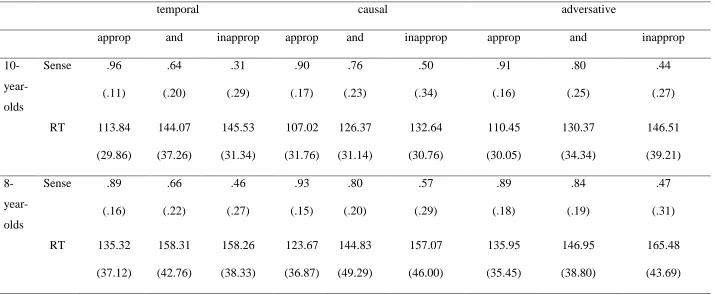
Analysis of sense judgments.The full set of means by condition is reported
in Table 3. Each age group accepted a greater proportion of appropriate items as
sensible and was least likely to judge inappropriate items as sensible, for each type of
coherence relation. Acceptability for items linked byandfell between these two
conditions, and was lowest for temporal connectives. The judgment data (raw scores)
were within acceptable limits for normality and were treated as the dependent variable
in two analyses of variance (in one, subjects were treated as a random variable, in the
other, items were treated as a random variable) with the following factors: age (10
years, 8 years), coherence relation (temporal, causal, adversative) and link
(appropriate, and, inappropriate).
Not all of the main effects were significant in both analyses. In general, the
10-year-olds accepted slightly fewer texts than the 8-year-olds (F1(1, 89) = 1.73,p
=.19;F2(1, 33) = 4.90,p< .05,2p=.13) and texts with a target causal connective
(collapsed over link) were more likely to be accepted than those with either target
temporal or adversative connectives (F1(2, 178) = 19.49,p< .001,2p=.18;F2(2, 33)
= 2.33,p= .11,2p=.12). In both analyses, texts linked by an appropriate connective
were more likely to be judged to make sense than those linked by eitherandor an
inappropriately placed connective (F1(2,178) = 203.48,p< .001,2p=.69,F2(2, 66)
= 101.89,p< .001,2p=.76).
Of specific interest was the predicted interaction between coherence relation
and link, which was significant (F1(4,356) = 8.87,p< .001,2p= .09,F2(4, 66) =
2.51,p= .050,2p=.13). For each type of coherence relation, texts with an
inappropriately placed connective were less likely to be judged as making sense than
texts with an appropriate connective orand(allps < .05). Texts with an appropriate
(bothps < .05) for the temporal connectives only. When looking at the three types of
link (appropriate, inappropriate,and), different patterns were evident. For texts with
an appropriate connective, there were no differences between the acceptability of the
three types of coherence relation (Fs < 1). For texts in either the inappropriate orand
condition, the acceptability depended on the target coherence relation (Fs> 9.00,ps <
.001). For texts containing an inappropriately placed connective, the adversative
connectives were more likely to be judged as making sense than the temporal or
causal connectives (ps < .05), which did not differ. For the items linked byand,sense
judgments were in the order of: causal > temporal > adversative (ps < .05).
The predicted interaction between age and link tended towards significance by
subjects (F1(2, 178) = 2.52,p=.08) and was significant by-items (F2(1, 33) = 3.54,p
< .05,2p=.10). Both age groups were most likely to judge the items linked by an
appropriately placed connective as making sense and least likely to judge those linked
by an inappropriate connective as making sense: appropriate > and > inappropriate (ps
< .05). The two age groups did not differ in their acceptance of materials linked either
by an appropriate connective or byand(ps > .20). However, the 10-year-olds were
less likely to incorrectly judge items in the inappropriate condition as sensible
compared to the 8-year-olds (p< .01). None of the other interactions with age group
reached conventional levels of significance (allFs < 1.88,ps > .11.
TABLE 3 AROUND HERE
Analysis of (ms per character) reading times.As suggested by Trueswell,
Tanenhaus and Garnsey (1994), the reading times of the sentences were transformed
to millisecond per character reading time to take sentence length differences into
account. All datapoints more than 2.5 standard deviations about a participant’s mean
resulted in the replacement of less than 1.5% of datapoints. The distribution of each
condition was found to be within acceptable limits. The mean reading times for the
critical two clauses in sentence 2 are reported in Table 3.
Two analyses of variance (one with subjects and one with items as the random
variable) were conducted with the following factors: age group (10 years, 8 years),
coherence relation (temporal, causal, adversative), link (appropriate connective, no
connective, inappropriate connective), and part of text (sentence 1, sentence 2,
sentence 3). The 10-year-olds read more quickly than the 8-year-olds (F1(1,89) =
10.60,p< .005,2p= .10;F2(1, 33) = 317.68,p< .001,2p=.91). The reading time
for causal connectives (M=135.9) was faster than that obtained for temporal (M=
139.4) or adversative connectives (M=137.2), but this was significant only in the
by-subjects analysis (F1(2,178) = 6.43,p< .01,2p= .07;F2< 1). In general, texts in the
appropriate condition were read most quickly and those in the inappropriate condition
were read most slowly (F1(2,178) = 40.88,p< .001,2p= .32;F2(2, 66) = 17.46,p<
.001,2p=.34). Reading times were longest for the first sentence (F1(2,178) = 32.27,
p< .001,2p= .27;F2(2, 66) = 10.37,p< .001,2p=.24).
FIGURE 2 AROUND HERE
The predicted two-way interaction involving link and part of text was
significant in both analyses (F1(4,356) = 25.35,p< .001,2p= .22,F2(4,132) = 19.24,
p< .001,2p=.37). This is depicted in Figure 2. Sentence 1 reading times were
comparable for each type of link (ps > .20). The reading times for sentences 2 and 3
were influenced by the type of link. For sentence 2, texts linked by an appropriate
connective were read more quickly than those linked byandand those linked by an
inappropriately placed connective (ps < .05). For sentence 3, the reading times in the
condition (ps < .05). Examining each type of link, there were differences in the
reading speed of different sentences. Reading times in the appropriate condition were
significantly faster for sentences 2 and 3 relative to sentence 1 (ps < .001), but the
difference in reading times between sentences 2 and 3 did not reach conventional
levels of significance (p= .06). In contrast, reading times were longer for sentence 2
than for sentence 3 in both theandand the inappropriate conditions (ps < .05).
There was an unpredicted significant interaction between coherence relation
and sentence in the by-subjects analysis (F1(4,356) = 7.97,p< .001,2p= .08), which
did not approach significance in the by-items analysis (F1 < 1). The interaction in the
by-subjects analysis arose because sentence 2 was read more quickly than sentence 1
in the causal connective condition (p< .001), a pattern that was not evident for other
types of coherence relations. Because the by-items analysis was not significant, the
individual item means were inspected. Of note, reading patterns for adversative
connective items differed and they did not all mirror the pattern found in the main
analysis. For five of these items, reading times were faster in sentence 2 than in
sentence 1. No other interactions reached significance (allFs < 2.3,ps > .05).
Discussion
Both the sense and reading time data demonstrate that young readers’ processing and
comprehension of text is influenced by the connective used to link two clauses. The
sense judgments showed that texts containing inappropriately placed connectives
were less acceptable than sentences linked by eitherandor appropriate connectives
for each type of coherence relation. Further, for causal and adversative items, the use
ofanddid result in significantly lower sense judgments. Similar to Experiment 2,
10-year-olds were more likely to reject texts with inappropriately placed connectives than
coherence relations. In Experiment 3, this pattern was evident for all types of
coherence relation.
Reading times for the crucial sentence containing the connective were
significantly shorter in the condition with the appropriate connective relative to the
other conditions. These data suggest that the presence of an appropriate connective
may facilitate processing of text, because the connective signals the relation between
two clauses and, therefore, how to integrate their meanings. An alternative
explanation is that the presence of either a neutral (and) or inappropriately placed
connective disrupted processing. For all types of coherence relation, longer reading
times were evident in these conditions.
Longer reading times for sentences linked byandmay be indicative of the
time spent computing the appropriate relation between two clauses, which is implied
but not stated. Alternatively, the longer reading time may arise if the presence ofand
blocks possible causal interpretations, e.g., “John started to cry because/and George
hit him”. An examination of our materials did not identify any positions in the
materials whenandcould have blocked the causal reading. Longer reading times for
sentences linked by an inappropriately placed connective may have a different source.
Readers may try to ‘repair’ their failure to comprehend when the text that comes after
the connective cannot be integrated with the situation model that the reader is
constructing.
The longer reading times for sentences containing an inappropriately placed
connective seen in sentences 2 and 3 support the ‘disruption’ explanation, as do the
sense judgments. The mean sense ratings obtained forandindicated that these
sentences were judged to be coherent by the majority of readers. Further, these ratings
these data suggest that when clauses are connected byand, young readers are able to
compute their relationship and integrate their meanings, albeit with a processing cost.
The longer reading times and lower acceptance for texts in the inappropriate
condition, indicate that these texts caused the readers some difficulty and that the
integration problem was often not resolved. Although the younger children had longer
reading times in general, age group was not involved in any significant interactions in
the reading time analysis, indicating that both groups were affected similarly by the
different coherence relations. This is in contrast to the findings of the off-line sense
measure (and Experiments 1 and 2), where differences between 10- and 8-year-olds
were apparent.
The predicted interactions were significant in both analyses. Exploration of the
unpredicted interaction between coherence relation and part of text indicated that the
reading pattern of some connectives did not mirror that of others of the same type.
The means in this interaction were collapsed over type of link. The absence of a
significant interaction in the by-items analysis indicates that we need to consider how
the benefits of (or disruption caused by) a given connective vary according to the
context and the strength of the semantic relation conveyed by the two clauses.
Experiment 4
The sense judgment task and the inclusion of inappropriately placed connectives in
the previous experiment may have focused readers’ attention on the relation between
clauses and resulted in strategic reading. Experiment 4 compared reading times for
critical two-clause sentences linked either by an appropriate connective or no
connective, followed by questions to tap memory for details of the text to encourage
reading for meaning. The aim was to minimize strategic processing and to investigate
findings of Experiment 3, young readers readily benefit from appropriate connectives
when reading, which should lead to reduced reading times for the second clause in the
presence of the appropriate connective and better comprehension scores in the
appropriate condition.
Method
Participants.Two groups participated: 24 10-year-olds (9 boys, 15 girls) and
24 8-year-olds (6 boys, 18 girls).
Materials and design.The texts used in Experiment 3 were modified. There
were two versions of each of the 36 texts: one in which the two clauses of sentence 2
were explicitly related by an appropriate connective, and one in which the two clauses
were presented as separate sentences without a connective. For ease of exposition, we
refer to these segments as clause 1 and 2 for both conditions. The critical two-clause
sentence was presented in two frames. The first contained the first clause and the final
word was the connective (in the connective condition), the second contained the
second clause. Two memory questions (one with a ‘yes’ response, the other with a
‘no’ response) were written for each text. Two lists were created, each containing 18
texts (3 for each connective) with an appropriate connective and 18 texts with no
connective. Each participant completed one of these lists.
Procedure.Each child was tested individually in a quiet room. The texts were
presented on a computer laptop screen using a procedure similar to Experiment 3.
Before the experimental items were administered, participants completed four practice
stories. The reading time for each sentence and response times and accuracy to the
questions were measured.
Responses to questions.The total number of correct responses to the
comprehension questions was high. The 10-year-olds obtained an average score of
5.71 (SD=.27) and the 8-year-olds an average score of 5.47 (SD=.38) (maximum
possible score of 6). Because of the ceiling levels of performance these data were not
subjected to statistical analysis.
Analysis of (ms per character) reading times.Datapoints were treated using the
same procedure described for Experiment 3, which resulted in the replacement of less
than 1.5% of datapoints. The distribution of each condition was found to be within
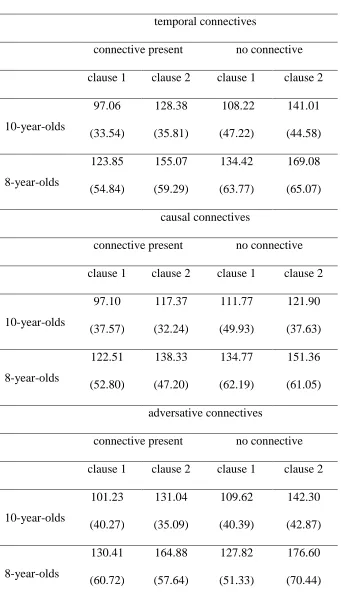
acceptable limits. The mean reading times for the critical two clauses in sentence 2
are reported in Table 4. For each age group, reading times were longer when no
connective was present for both clauses, with a greater difference between conditions
for the second clause.
The reading time data were analyzed in two analyses of variance with the
following factors: age (10 years, 8 years), type of coherence relation (temporal,
causal, adversative), presence of connective (appropriate connective, no connective),
and part of text (sentence 1, sentence 2 clause 1, sentence 2 clause 2, sentence 3). In
one analysis, subjects were treated as a random variable and, in the other, items were
treated as a random variable. Data for all trials were analyzed because of the high
performance on the comprehension questions.
TABLE 4 AROUND HERE
The four main effects were significant. As in Experiment 3, the 10-year-olds
read more quickly than the 8-year-olds (F1(1,46) = 4.04,p= .05,2p=.08;F2(1,33) =
530.23,p< .001,2p=.94) and reading times were quickest for causal connectives in
the by-subjects analysis (F1(2,92) = 14.74,p< .001,2p= .24;F2(2,33) = 1.62,p>
= 9.69,p< .01,2p= .17;F2(1,46) = 8.33,p< .01,2p= .20). Finally, participants
spent longer reading the first sentence and the second clause of the second sentence
than other parts of text (F1(3,138) = 109.14,p< .001,2p= .70;F2(3,99) = 32.19,p<
.001,2p= .49).
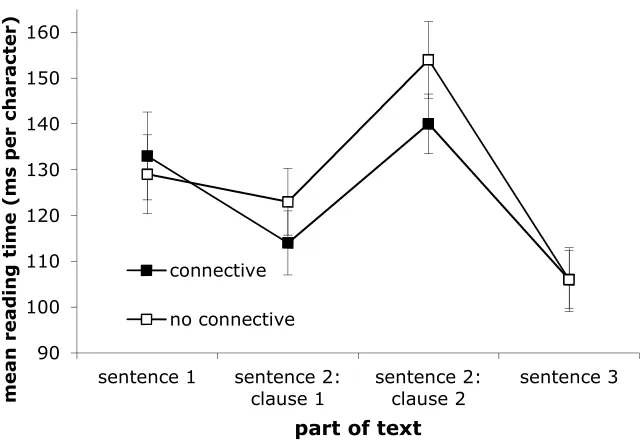
As predicted, there was a significant two-way interaction between connective
presence and part of text (F1(3,138) = 7.14,p< .001,2p= .13,F2(3,99) = 9.97,p<
.001,2p= .23), which is depicted in Figure 3. The presence of a connective did not
influence reading times for sentences 1 and 3 (ps > .30). In contrast, reading times
were significantly quicker for clauses 1 and 2 of the second sentence when the
connective was present (ps < .001). The presence of a connective also influenced
reading times for the sentences within each condition. When the connective was
present, the first clause of sentence 2 was read more quickly than sentence 1 (ps <
.01), but this difference was not significant in the no connective condition (ps > .10).
FIGURE 3 AROUND HERE
There were two unpredicted interactions, which reached significance in one
analysis but not the other. The first involved part of text and year group and was
significant in the by-items analysis only (F2(3,99) = 4.64,p< .01,2p= .12). It arose
because the 10-year-olds were quicker to read the first sentence and set up their text
representation. The second involved coherence relation and part of text (F1(6,276) =
9.36,p< .001,2p= .17) and was not significant in the by-items analysis. In general,
the difference in reading times between clauses 1 and 2 was smaller in the causal
condition, than in the temporal and adversative conditions, and clause 2 was read
more quickly in the causal condition than in the other two conditions. Because the
interaction was not significant in the by-items analysis, individual item means were
items, reading times were quicker for the second clause. Reasons for this pattern are
discussed below. No other interactions reached conventional levels of significance (all
Fs < 2.5,ps > .05).
Discussion
As predicted, the presence of an appropriate connective facilitated processing of
two-clause sentences embedded in short texts. Further, age differences appeared to be
largely quantitative rather than qualitative, due to the absence of significant
interactions with age (the exception being the time taken to read and represent the
information in the first sentence). The faster reading times for the first clause when
the connective was present (at the end of the clause) has at least possible two origins.
First, when the connective was present, readers may have pressed the button to read
on, because a continuation was signaled. Second, when no connective was present
(and the clause was a complete sentence), the longer reading time may be indicative
of sentence wrap-up effects (Just, Carpenter, & Woolley, 1982). The second clause in
each text was identical. Neither sentence wrap up costs nor the presence of a
connective can explain the shorter reading times for this clause when it followed a
connective. Therefore, the most plausible conclusion is that appropriate connectives
facilitated text processing.
The unpredicted interaction between coherence relation and part of sentence
warrants consideration. The means were collapsed over the presence of a connective.
Thus, the general pattern suggests that the causal items were easier to process,
regardless of connective presence. Another possibility is that absence of a causal
connective did not result in the same processing cost as the absence of a temporal or
adversative connective. The latter explanation is supported by a wealth of research
narratives from an early age (van den Broek, 1997). Thus, one possibility is that
readers expect to find causality in narratives and readily infer such relations. Because
the interaction was not significant by items, we need to be cautious in our
interpretation, because the sentence context in which the connective is present (or
absent) may have influenced processing as well.
General Discussion
The interpretation and use of connectives when reading is crucial to the
construction of a coherent situation model of a text, the hallmark of successful
comprehension. These experiments found a mixed picture of competence in young
readers’ processing and comprehension of connectives that signal different coherence
relations. The off-line measures indicate that young readers’ explicit knowledge of
connectives has not reached adult levels. Experiments 1 and 2 showed that
olds often reach adult levels of performance, whereas 8-year-olds differ from
10-year-olds in their ability to select appropriate connectives to join two clauses and to
discriminate appropriate and inappropriate uses. Thus, although we have clear
evidence that young readers have reasonable knowledge about connectives that signal
a range of coherence relations and are sensitive to whether a connective is used
appropriately to link two events, their competence is still developing. The on-line
measures suggest that readers as young as 8 years can use the information provided by
connectives as they read. They process two-clause sentences more quickly when they
contain an appropriate connective and take longer to process a sentence when the
connective is either neutral (e.g.,and) or when there is no connective, and also when
the connective is inappropriately placed, i.e., it does not match the meaning conveyed
still developing, they behave similarly to adult readers and appear to use connectives
as processing signals as they read (e.g., Mouchon et al., 1995).
This work adds to the growing body of research on cohesion and coherence in
text comprehension, and the important role for connectives in the construction of an
integrated and accurate meaning-based representation of a text (Gernsbacher, 1997;
Graesser et al., 2007; Sanders & Noordman, 2000; Segal, Duchan, & Scott, 1991).
Our findings demonstrate that young readers do not automatically process sensible
relations between clauses when a connective is not present, because we found specific
benefits for the presence of appropriate connectives. Further, we have shown that text
integration does not benefit from the presence of a connective per se: the use ofand
led to longer reading times relative to the presence of an appropriate connective for all
types of connectives, and also lower acceptability, as measured by sense judgments.
The presence ofandmight indicate that there is some general link between two
clauses, but the specific connective resulted in quicker reading times in our
experiments. In addition, the presence of an appropriate connective resulted in faster
processing relative to when no connective was present.
These findings highlight the importance of strategically placed connectives in
texts for young readers. They suggest that, in contrast to the conclusions of text
readability formulae, a longer sentence in which the link between two clauses is
explicitly signaled may be easier to understand than two short separate sentences, if
the individual has reached a certain level of knowledge of the specific connective.
Thus, appropriate and informative connectives appear to help, not hinder, young
readers to process and understand written text. Connectives, as well as other markers
of text cohesion, should inform calculations of text complexity to identify suitable
Developmental differences in connective knowledge were apparent in this
research and previous studies that have used off-line measures (e.g., (Cain et al.,
2005; McClure & Geva, 1983). These findings suggest that the potential benefits from
connectives in text are not the same for all readers and are dependent on knowledge.
Our first two experiments allowed time for participants to reflect on each sentence
and enabled a considered selection of the appropriate connective or rating of sense.
Experiment 3 involved a sense judgment when the text was no longer available for
scrutiny, which did not require a speeded response. The metalinguistic skills involved
in these tasks are still developing in young readers (Gombert, 1992). This might
underlie the poorer performance by 8-year-olds, although it is important to note that
their level of performance indicated a reasonable degree of knowledge of all the
connectives used. Cloze measures are frequently used in the classroom to assess
competence. Educators should be mindful that use of such tasks might underestimate
a child’s ability to process the relation signaled by a connective.
More pronounced developmental differences might be apparent with different
texts and tasks. All of our sentences and texts had a narrative theme. Previous work
has highlighted the specific role of connectives and other cohesive devices in
comprehension for learning. Sanders and colleagues have shown that, for adult
readers, connectives influence both processing and comprehension of expository text,
indicating that these markers may be important for acquiring new information from
text (Degand & Sanders, 2002; Kamalski, Sanders, & Lentz, 2008; Sanders &
Noordman, 2000). Readers with less prior knowledge benefit more from the presence
of connectives and other devices that signal relations between information (Kamalski
et al., 2008; McNamara & Kintsch, 1996). When reading to learn from information
readers are better able to use connectives to fully understand the relation between
different facts and events in a text. In relation to further exploration of the
development of connective comprehension, clearly reading time paradigms are not
suitable for pre-readers or beginner readers. Other methods such as timed sense
judgments using aurally presented text could offer an insight into how early in
development children use connectives automatically when processing and
comprehending spoken language.
Further, differences between age groups and different types of coherence
relation may be stronger in other classroom tasks, in which children have to make
metacognitive judgments about which connective to use, such as written language
production. For that reason, we would anticipate greater age effects in writing tasks,
where the (child) author has to select the appropriate connective to establish
coherence. Such issues should be addressed in future research with young readers.
Some limitations should be noted. Clearly our experimenter-generated
sentences, sentence-pairs and short texts differ from the naturalistic, longer, texts that
children encounter in everyday reading situations. For that reason, we run the risk of
describing the impact of connectives on less cognitively demanding reading than that
required for understanding the books that children engage with in school or in their
leisure time. However, our carefully constructed and controlled texts have enabled us
to demonstrate how even young readers can benefit from connectives when reading
for meaning. This general finding suggests that connectives should inform
assessments of text complexity.
Although we included two connectives for each type of coherence relation, we
did not examine these separately. It may be important to do this in future research for
performance, in addition to the type of coherence relation it signals (Crosson et al.,
2009). Although the six connectives used in this study differed in word frequency,
examination of performance for each connective indicated that performance
differences were not always in line with frequency differences. Second, within the
group of connectives that express a particular type of coherence relation, different
connectives signal different orders of temporality, causality, or contrast, as outlined in
the introduction. It may be more important to consider comprehension of specific
connectives rather than types of coherence relation, because the connectives within a
particular classification signal different relations between events (Murray, 1997),
differ in frequency, and also cognitive complexity (Evers-Vermeul & Sanders, 2009;
Spooren & Sanders, 2008). For example, production studies indicate that acquisition
is influenced by the cognitive complexity of the specific coherence relation. Future
work should explore how these factors influence young readers’ comprehension.
In sum, this is the only systematic investigation to date of young readers’
processing and comprehension of a range of connectives. These findings have
important implications for our understanding of the development of reading
comprehension in general and for the design of curricula and educational texts. We
have demonstrated that young readers possess an adequate understanding of a range
of connectives and are able to take advantage of information provided by connectives
as they read. However, their explicit understanding appears to lag their ability to
benefit from these signals whilst reading, which may influence other tasks such as
written text production. These findings point to an important role for connectives in
the construction of coherent situation models of text from an early age and
demonstrate that connectives help (not hinder) young children to process and establish
educational texts, and should be taken into account when evaluating the complexity of
Acknowledgements
This work was funded by ESRC grant: RES-062-23-0133, awarded to the first author.
The authors would like to thank the teachers and children of the following schools in
Lancaster and Morecambe who participated in this work: St Peter’s Church of
England Primary; Cockerham Parochial Church of England Primary; Dolphinhome
Church of England; Garstang St Thomas’ Church of England Primary; Morecambe
and Heysham Grosvenor Park School; and Slyne-with-Hest, St Luke’s Church of
England Primary School. Thanks also to four reviewers for their constructive
Table 1
Experiment 1. Mean Proportion Correct (and Standard Deviations) by Age and Type
of Coherence Relation
temporal causal adversative
Adults .98 (.04) .92 (.06) .97 (.04)
10-year-olds .86 (.13) .80 (.15) .88 (.14)
Table 2
Experiment 2. Mean Sense Ratings (and Standard Deviations) by Age, Type of
Coherence Relation, and Link
temporal causal adversative
approp. inapp. approp. inapp. approp. inapp.
Adults 3.82 (.23) 2.05 (.49) 3.86 (.30) 2.03 (.57) 3.81 (.16) 1.96 (.47) 10-year-olds 3.55 (.31) 1.85 (.44) 3.79 (.25) 1.94 (.51) 3.37 (.38) 1.95 (.39) 8-year-olds 3.35 (.34) 1.98 (.47) 3.60 (.29) 2.18 (.52) 3.03 (.44) 2.03 (.42)
Note.approp. = appropriate; inapp. = inappropriate. Maximum possible score for
Table 3.
Experiment 3. Proportion ‘Makes Sense’ Judgments, Mean Reading Times in ms per Character for Sentence Two (and Standard Deviations) by
Age, Type of Coherence Relation, and Link
temporal causal adversative
approp and inapprop approp and inapprop approp and inapprop
10- year-olds Sense .96 (.11) .64 (.20) .31 (.29) .90 (.17) .76 (.23) .50 (.34) .91 (.16) .80 (.25) .44 (.27) RT 113.84 (29.86) 144.07 (37.26) 145.53 (31.34) 107.02 (31.76) 126.37 (31.14) 132.64 (30.76) 110.45 (30.05) 130.37 (34.34) 146.51 (39.21) 8- year-olds Sense .89 (.16) .66 (.22) .46 (.27) .93 (.15) .80 (.20) .57 (.29) .89 (.18) .84 (.19) .47 (.31) RT 135.32 (37.12) 158.31 (42.76) 158.26 (38.33) 123.67 (36.87) 144.83 (49.29) 157.07 (46.00) 135.95 (35.45) 146.95 (38.80) 165.48 (43.69)
Table 4
Experiment 4. Mean Reading Times in ms per Character for Sentence Two (and
Standard Deviations) by Age, Type of Coherence Relation, and Link
temporal connectives
connective present no connective
clause 1 clause 2 clause 1 clause 2
10-year-olds 97.06 (33.54) 128.38 (35.81) 108.22 (47.22) 141.01 (44.58) 8-year-olds 123.85 (54.84) 155.07 (59.29) 134.42 (63.77) 169.08 (65.07) causal connectives
connective present no connective
clause 1 clause 2 clause 1 clause 2
10-year-olds 97.10 (37.57) 117.37 (32.24) 111.77 (49.93) 121.90 (37.63) 8-year-olds 122.51 (52.80) 138.33 (47.20) 134.77 (62.19) 151.36 (61.05) adversative connectives
connective present no connective
clause 1 clause 2 clause 1 clause 2
Figure 1.Experiment 2. Meand'scores by age group and type of coherence relation
(with standard error bars).
0 0.5 1 1.5 2 2.5 3
temporal causal adversative
m
e
a
n
d
'
sc
o
re
type of coherence relation
Figure 2.Experiment 3. Interaction between link and sentence (with standard error
bars).
80 90 100 110 120 130 140 150 160
sentence 1 sentence 2 sentence 3
re
a
d
in
g
ti
m
e
(m
s
p
e
r
ch
a
ra
ct
e
r)
part of sentence
and
appropriate
Figure 3.Experiment 4. Interaction between presence of connective and part of
sentence (with standard error bars).
90 100 110 120 130 140 150 160
sentence 1 sentence 2:
clause 1 sentence 2:clause 2 sentence 3
m
e
a
n
re
a
d
in
g
ti
m
e
(m
s
p
e
r
ch
a
ra
ct
e
r)
part of text connective