Analysis of ISO 14001 implementation and
program
performance
assessment
ratings
company
(PROPER)
environmental
management in. Power Plants with gap analysis
tools
Esaul Wairon 1,*, Bambang Purwanggono1, Naniek Utami Handayani1
1Industrial Engineering Department, Faculty of Engineering, Diponegoro University, Jl. Prof.
Soedarto, Tembalang, Semarang, Indonesia
Abstract. In various studies revealed that the ISO 14001 Environmental Management System into an integrated environmental management system that is considered capable of improving environmental performance and financial performance. This study aims to analyze the application of ISO 14001 Environmental Management System certification on environmental performance and company performance. The sample in this study was one of the power plants in Indonesia that was ISO 14001 certified in 2015. This study used annual data from the period 2013 to 2014. The main method used was the Gap Analysis Tool. , The results using a checklist show that, in general, the clause requirements have an average value of 50% - 74% the organization still has to fix the SML for preparation of ISO 14001-2015 the inspection process and the clause have an average value, 32% clause, the planning clause has an average value of 77%, the management review has an average value 57% and the overall average value in accordance with ISO 14001-2015 requirements is 55%. based on the characteristics of the sample company, the company needs to improve its inspection and management review so that it can improve the operational management of the environment better.
Keywords : Implementation of ISO 14001, GAP Analysis, Data Proper.
1.
Introduction
Indonesia is a developing country with a high industrial activity sepertti Jakarta, Tangerang, Surabaya, Pekanbaru and Bandung have a concentration of pollutants SO2, PM10, PM2,5, which is very high compared to other cities Exposure to pollution can cause harm in terms of both comfort and economy due to disruption of public health, even to result in death (Z. Aprilasani, C. A. Said, T. EB et al ,. Nakazawa et al) [1].” There needs to be awareness of the businesses on the importance of the interaction between the economy and the
*
environment, as well as the transition from the familiar neoclassical economics have come to understand ecological economy that takes into account the environment and ecosystem services, so that sustainable development can be achieved (Perrings, 1987; Common and Stagl, 2005; Miller and Spoolman, 2016)[2].”, ISO 14001 Environmental Management System (EMS ISO 14001) issued by the International Organization for Standardization (ISO) in 1996 in Geneva, Switzerland. This system is believed to help create an integrated mechanism in improving environmental performance on an ongoing basis is applied to the activities of daily production (Kitazawa and Sarkis, 2000)[3].” The problem that exists is that not all companies are willing and able to implement the EMS ISO 14001. In addition to the voluntary, some studies reveal that the ISO 14001 EMS certification entails substantial costs depend on the characteristics and facilities of each company which includes investment costs and the cost of regular audits (Bansal and Bogner, 2002)[4].” In 2015, more than 300,000 companies in the world certified ISO 14001 EMS. The high participation in the implementation of EMS ISO 14001 is believed to be due to SML ISO 14001 provides benefits such as: the cost efficiency and resources, expand market opportunities, improve their reputation and profitability, reduce coercive government, avoid conflict and improve stakeholder satisfaction Research has been done about the effect of EMS ISO 14001 on environmental performance improvements have been carried out such as: reduction of emissions and waste, 3R, konvservasi water and energy, environmental risk reduction in the energy and gas companies surveyed by (Morrow and Rondinelli 2012) [5].”; reduction of emissions in the coatings industry in China were invented by (Zeng et al, J. Fresner 1988)[6].” reduction in SO2, and NO2 and dust in the cement industry in Vietnam expressed by (Q. Anh Nguyen, L. Hens 2015)[7].” based on the performance of shares in companies in the United States. Research related to the effect of EMS ISO 14001 and the company's performance in Indonesia, among others carried out by (S. Handayani.,2012)[8].” found that the SML ISO 14001 helps companies achieve better PROPER; (M.Sueb, M. Nety and I. Keraf.,2015)[9].”observed that the application of ISO 14001 EMS improve the performance of wastewater treatment facilities in Semarang; (C. G Old, Banjarnahor 2014)[10].” found an increase PROPER as well, The target pressing business that pollute the environment. In the development of command and control approach that is characterized by supervision to ensure compliance with the rules has been disputed effectiveness. There has been a change in the understanding of the characteristics of the environmental challenges facing the world today. The problem of waste disposal and emissions on a large scale have successfully controlled or regulations for the control was complete. The focus of the problem has moved from the issue of obedience to the issue of continuous improvement (continuous improvement), resource use, energy efficiency, and product quality, Legitimacy theory reveals that the company has a contract with the public to conduct business activities based on the values of justice, and how companies respond to various interest groups to legitimize the actions of the company (Sayekti, Wondabio,.A. Prastiwi,2009)[11].”.
2. Literature
2.1 Elements of PROPER
the implementation of an environmental management system Evaluation PROPER announced by the Ministry of Environment (MoE) in report form PROPER with symbols of color, namely (a) gold as the best ratings for the company dutifully consistent run production processes are environmentally friendly and ethical and accountable to the public, (b) green for companies with better environmental management than required, (c) the blue to companies that have made efforts to manage the environment, (d) the red for the company that is not in accordance with the regulations, and (e) in black for companies that violate the rules and negligence act to the detriment of the environment (PROPER, 2015). PROPER assessment criteria consists of two categories, namely: (1) the assessment criteria of obedience, related to environmental documents and reporting, control of marine pollution as well as air and water, management of hazardous and toxic substances (B3), and the potential for damage to land. (2) more than the required criteria (beyond compliance), which adjusted is more dynamic with technological developments and global environmental issues. Aspects assessed include SML application, energy efficiency measures and reduced emissions, 3R efforts B3 and non B3 waste, water conservation and reduction of pollutant load of wastewater, protection of biodiversity, and community development programs,Living environment. PROPER performance ratings generally divided into 5 colors with the following definitions, as shown in Table 1.
Table 1. Color table Rank
(Source: Proper Documents Publications, 2014)
conservation and resource utilization, as well as the social activities of the company. (Rakhiemah & Agustia, 2009)[12].”
2.2
Elements of ISO 14001-2015
ISO 14001 was developed from the concept of Total Quality Management (TQM) principled on the activity of the PDCA (Plan - Do - Check - Action), periodically Assessing the overall environmental management system to ensure its continuing suitability, adequacy, effectiveness of environmental management systems to the changes. In principle, the six principles of ISO 14001 - Environmental Management System above can be divided into 17 elements.
Table2. Principles and Elements of ISO 14001-2015 Model stages ISO 14001 Elements of ISO 14001 4.2 Environmental policy 4.2.1 Environmental policy
4.3 Plenning 4.3.1 Environmental aspects
4.3.2 Requirements and other legislation 4.3.3 Goals and programs
4.4 Implementation and Operation
4.4.1 The role of responsibility resources, customer
4.4.2 Competence of training and awareness 4.4.3 Communication
4.4.4 Documentation 4.4.5 Document control 4.4.6 Operational control
4.4.7 Alertness and emergency response 4.5 Examination 4.5.1 Monitoring and measurement
4.5.2 Evaluation of structuring
4.5.3 Nonconformity of corrective and preventive measures
4.5.4 Recording control 4.5.5 Internal audit 4.6 Management review 4.6.1 Management review
(Source: Documents clause-iso-14001-2015)
2.3 Gap Analysis
Gap Analysisdefined by the IT infrastruture Library (ITIL) is an activity that compares two kinds of data that identifies the differences Gap Analysis is generally in a set area, topic or category, thus making efficient Gap Analysis to determine which sectors or fields that need to be made anew. Gap Analysis to be effective as a checklist that created tersruktur and in accordance with the topic. The checklist will cover all terms and conditions be created in the hierarchy in pengkajianya. This will involve general question and provide an overview of the topics or categories that will be judged, questions checklist created a complete, detailed and makes an assessment of each individual requirement another for ensure its flexibility (picard, et al, 2016). Here are the steps to perform Gap Analysis:
Table3. Analysis score gap
scores Understanding
1 If the organization or company does not understand what is required and does not do so.
2
If the organization or company does not understand the importance of the activity, then it does not.
3
If the organization or company does not understand the importance of the activity, then it does not.
4 If the organization or company is engaged in an activity but not consistent.
5 If the organization or company is doing well (consistently done).
(Source: Initiatives et al, 2015)
2.3.2 Rate Gap
Gap assessment aims to see how big the gap that exist in the company. Percentage value is obtained by summing the scores per variable. The smaller the gap that exist, the better. To measure the readiness of the percentage value that produced showed the readiness of companies to implement ISO 14001-2015.
Table 4. Range GAP
Score Understanding
75% - 100% organisasi are ready to complete SML ISO 14001-2015 and certify
50% - 74% the organization still has to fix the SML for preparation of ISO 14001-2015 1% - 49% organization or company is in need of repair far from SML ISO 14002-2015
(Source: purwanggono, 2000)
3. Research Methodology
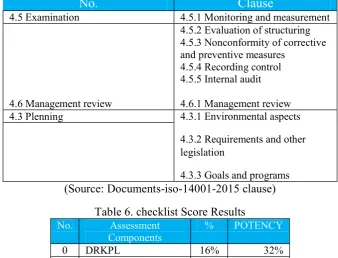
This study was conducted in March and April 2018 at PT. Generator which is located in the city of Semarang. This study was conducted using a case study on the implementation of an Environmental Management System ISO 14001: 2015 in PT. Generator. the method used is primary data retrieval is done to gather information necessary for consideration in the gap analysis. The primary data is done with a questionnaire as a tool for data collection. The questionnaire posed in this study is a questionnaire taken from the clauses SML 14001; 2015 parameters observed in the Environmental Management System (EMS) 14001: 2015 PT. Generator, which 4.3.Plenning clause 4.5 Examination, 4.6 Management review. Clause includes seven (7) components in the Table 5.
-Lyrics not carry out this activity Score = This situation is related to the fact Upon completion of the assessment,
a. Score: '0'. PT. Power does not have EMS implementation, or the implementation of any portion does not have the key elements of SML as the ability to implement all the programs and targets to be met to fulfill the standard requirements SML.
b. Score: '1'.PT. Power has had SML implementation, but not yet fulfilled all the requirements according to standards is below standard ISO 14001; 2015.
[image:6.595.127.466.237.495.2]c. Score 2 PT. Power has determined and documented most of the implementation of the EMS in accordance with ISO 14001; 2015.
Table 5. Research Variables
No.
Clause
4.5 Examination 4.5.1 Monitoring and measurement
4.6 Management review
4.5.2 Evaluation of structuring 4.5.3 Nonconformity of corrective and preventive measures
4.5.4 Recording control 4.5.5 Internal audit
4.6.1 Management review 4.3 Plenning 4.3.1 Environmental aspects
4.3.2 Requirements and other legislation
4.3.3 Goals and programs
(Source: Documents-iso-14001-2015 clause)
Table 6. checklist Score Results
No. Assessment
Components
% POTENCY
0 DRKPL 16% 32%
1 Environmental management system
60%
90% Energy Efficiency 41%
64% Reduced Emissions 6%
42% Water Conservation 12%
42% B3-NB3 0%
47% TO-HEART 8%
71% 2 ComDev 0,125
63%
(Source: Documents PROPER)
4. Result and Analysis
[image:6.595.174.421.448.687.2]From the resulting data Environmental Management Performance Summary Document (DRKPL) below criteria will be undertaken and have not been applied seen 414% of the total 720.5% and 133% potency which is owned by PT. The power plant to continue improving environmental monitoring Risk Management.
Table 7. Drop Criteria PROPER Aspects of the assessment
Max
value Value
potential Value
% implemen
tasi
Energy Efficiency 100% 40.5% 100% 2 Decrease in Emissions 100% 40.5% 63.5% 2 3 R Waste B3 49% 0% 34% 1 3R Non B3 Solid Waste 0% 44% 30% 1 Water Efficiency and Load
Decrease 100% 42% 12%
1
Water Efficiency 100% 42% 12% 1 Decrease of Water Pollution
Load 99% 42% 5.5%
2
Protection of Biodiversity 12.5% 0% 62.5% 1 Community empowerment 100% 8% 69% 2 Environmental Management
System (EMS) 60% 0% 100%
1
TOTAL Value DRKPL 720.5% 133% 414% 14 %
(Source: the calculation results)
In the clause. 4.6 Management review shows that the percentage of Evaluation of structuring reaches 90% in this case the company is able to meet the proper standards in management review and for clause 4.3. planning reaches 71% and Goals and programs reach 97% so the company in this case has a green rating in implementing its environmental management.
Table8. Checklist Score Results
Clause %
4.5 Examination 32% 4.6 Management
review 57% 4.3 Plenning 77% Total Mean 55%
Table9. Analysis of Implementation of ISO 14001 and Operations Recapitulation Clause
Clause Point Clause %
4.5 Examination 4.5.1 Monitoring and measurement 32% 4.5.2 Evaluation of structuring 90% 4.6 Management
Readiness level 57%
4.3 Plenning 4.3.1 Environmental aspects 71% 4.3.2 Requirements and other legislation 63% 4.3.3 Goals and programs 97%
Readiness level 77%
(Source: the calculation results)
5. Conclusion
Based on research that has been done, then the conclusion can be drawn from the results of the gap analysis, using ISO 14001 satdard checklist in which there are some similarities with the standard of the whole PT. Power Plant Indonesia has the readiness to certify 90% Evaluation of structuring, Then views of the readiness of each clause, ranging from a general requirement clause, health & safety policy, planning, implementation and operation, checking and management review the average value of high readiness. Where in any points of the clause indicates that the company PT. Power Plant Indonesia ready to Maintain Environmental Management.
Acknowledgement
In this Researcher authors would like to thank Dr. Naniek Utami Handayani, ST., MT and Dr Ir Bambang Purwanggono, M. Eng guide you and give good feedback and can be carried out this research. as well as those who have provided input both from outside and from the inside so that it can settle this study.
References
1. Z. Aprilasani, C. A. Said, T. EB et al ,. Nakazawa et al, "The Effect Sertifikasih Environmental Management System ISO 14001 On performance of the company" Scientific Journal of Management, Volume VII, (2017).[1].”
2. C. G Old, Banjarnahor, "Analysis of Application of ISO 14001 Environmental Management System PT.Indonesia Semarang Power", Thesis, University of Diponegoro in Semarang (2014).
3. Bansal, Bogner. "Deciding on ISO 14001: Economics, Institutions, and Context"Long Range Planning, vol 35 (2002).
4. Crocker, Tschirhart, Perrings, Settle et al., Tilman et al., Wätzold et al., "Economic Valuation of Ecosystems" (2016).
5. Zeng, J. Fresner "Cleaner production as a means for effective environmental management"Journal of Cleaner Production vol 06, page 171-179 (1988).
6. Kitazawa S., and J. Sarkis, "The relationship between ISO 14001 and continuous source reduction programs" International Journal of Operations & Production Management, Vol. 20 (2000).
7. C.Comoglio, S. Botta ,. Morrow, Rondinelli "environmental performances improvement: a survey on ISO 14001 certified companies in the automotive sector" Journal of Cleaner Production 20 (2012).
9. S. Handayani., "Management of Industrial Limba" Volume 19 Journal of Management "(2015).
10. M.Sueb, M. Nety and I. Keraf., "Relation of ISO 14001 Environmental Management System and Financial Performance"Vol 3, No 1 (2012).