Aberrant error processing in
relation to symptom severity in
obsessive–compulsive disorder:
A multimodal neuroimaging study
The Harvard community has made this
article openly available. Please share how
this access benefits you. Your story matters
Citation
Agam, Yigal, Jennifer L. Greenberg, Marlisa Isom, Martha J.
Falkenstein, Eric Jenike, Sabine Wilhelm, and Dara S. Manoach.
2014. “Aberrant error processing in relation to symptom severity in
obsessive–compulsive disorder: A multimodal neuroimaging study.”
NeuroImage : Clinical 5 (1): 141-151. doi:10.1016/j.nicl.2014.06.002.
http://dx.doi.org/10.1016/j.nicl.2014.06.002.
Published Version
doi:10.1016/j.nicl.2014.06.002
Citable link
http://nrs.harvard.edu/urn-3:HUL.InstRepos:12717514
Terms of Use
This article was downloaded from Harvard University’s DASH
repository, and is made available under the terms and conditions
applicable to Other Posted Material, as set forth at
http://
Aberrant error processing in relation to symptom severity in
obsessive
–
compulsive disorder: A multimodal neuroimaging study
Yigal Agam
a,b, Jennifer L. Greenberg
a, Marlisa Isom
a, Martha J. Falkenstein
a, Eric Jenike
a,
Sabine Wilhelm
a, Dara S. Manoach
a,b,⁎
a
Department of Psychiatry, Massachusetts General Hospital, Harvard Medical School, Boston, MA, USA b
Athinoula A. Martinos Center for Biomedical Imaging, Harvard Medical School, Charlestown, MA, USA
a b s t r a c t
a r t i c l e i n f o
Article history:
Received 2 December 2013 Received in revised form 2 June 2014 Accepted 7 June 2014
Available online 17 June 2014
Keywords:
OCD ERN
Anterior cingulate Default network Error processing Multimodal neuroimaging
Background:Obsessive–compulsive disorder (OCD) is characterized by maladaptive repetitive behaviors that persist despite feedback. Using multimodal neuroimaging, we tested the hypothesis that this behavioral rigidity reflects impaired use of behavioral outcomes (here, errors) to adaptively adjust responses. We measured both neural responses to errors and adjustments in the subsequent trial to determine whether abnormalities correlate with symptom severity. Since error processing depends on communication between the anterior and the poste-rior cingulate cortex, we also examined the integrity of the cingulum bundle with diffusion tensor imaging.
Methods:Participants performed the same antisaccade task during functional MRI and electroencephalography sessions. We measured error-related activation of the anterior cingulate cortex (ACC) and the error-related neg-ativity (ERN). We also examined post-error adjustments, indexed by changes in activation of the default network in trials surrounding errors.
Results:OCD patients showed intact error-related ACC activation and ERN, but abnormal adjustments in the post-vs. pre-error trial. Relative to controls, who responded to errors by deactivating the default network, OCD pa-tients showedincreaseddefault network activation including in the rostral ACC (rACC). Greater rACC activation in the post-error trial correlated with more severe compulsions. Patients also showed increased fractional anisot-ropy (FA) in the white matter underlying rACC.
Conclusions:Impaired use of behavioral outcomes to adaptively adjust neural responses may contribute to symp-toms in OCD. The rACC locus of abnormal adjustment and relations with sympsymp-toms suggests difficulty suppress-ing emotional responses to aversive, unexpected events (e.g., errors). Increased structural connectivity of this paralimbic default network region may contribute to this impairment.
© 2014 The Authors. Published by Elsevier Inc. This is an open access article under the CC BY-NC-ND license (http://creativecommons.org/licenses/by-nc-nd/3.0/).
1. Introduction
Obsessive–compulsive disorder (OCD) is characterized by stereo-typed and repetitive behaviors that persist despite feedback. These be-haviors serve to reduce distress, but are often excessive and not realistically connected to the feared outcome they are intended to prevent. For example, an individual with OCD may feel compelled to re-peatedly check that the door is locked despite having just locked the door,‘knowing’that the door is locked, and wanting to stop. In this sce-nario, the distressing feeling that the door is not locked persists despite clear evidence to the contrary and compels repetitive checking. Such re-petitive, maladaptive behaviors may reflect impaired use of feedback about outcomes (e.g., a locked door) to adjust emotional (e.g., distress) and behavioral (e.g., checking) responses. Here, we used multimodal
neuroimaging to test the hypothesis that impaired use of outcomes– in this study, errors–to adaptively adjust future responses characterizes OCD and contributes to symptoms. Since error processing involves (i) recognizing that an error has occurred and (ii) adjusting future re-sponses and since deficits in either of these abilities could contribute to rigid, repetitive behavior, we examined the neural and behavioral markers of each.
We used an antisaccade paradigm to study error processing. Antisaccades require inhibition of the prepotent response of looking to-wards a suddenly appearing stimulus and the substitution of a gaze in the opposite direction. Antisaccade errors (i.e., looking towards the stimulus) reliably elicit neural and behavioral error markers (Agam et al., 2011; Belopolsky and Kramer, 2006; Endrass et al., 2007; Klein et al., 2007; Nieuwenhuis et al., 2001; Polli et al., 2005). Wefirst inves-tigated whether individuals with OCD show intact error detection as indexed by error self-correction and two extensively characterized and highly reliable neural error markers: the error-related negativity (ERN) as measured by electroencephalography (EEG) and functional ⁎ Corresponding author at: Psychiatric Neuroimaging, Massachusetts General Hospital,
149 13th Street, Room 1.111, Charlestown, MA 02129, USA.
E-mail address:[email protected](D.S. Manoach).
http://dx.doi.org/10.1016/j.nicl.2014.06.002
2213-1582/© 2014 The Authors. Published by Elsevier Inc. This is an open access article under the CC BY-NC-ND license (http://creativecommons.org/licenses/by-nc-nd/3.0/).
Contents lists available atScienceDirect
NeuroImage: Clinical
MRI (fMRI) activation of the anterior cingulate cortex (ACC). These error markers have been theorized to index error-based reinforcement learn-ing (Holroyd and Coles, 2002), mismatch or conflict monitoring (Carter and van Veen, 2007; Falkenstein et al., 2000; Yeung et al., 2004), in-creased cognitive control (Kerns et al., 2004) and the emotional re-sponse to errors (Proudfit et al., 2013). Prior studies of OCD have demonstrated an exaggerated ERN (Carrasco et al., 2013; Endrass et al., 2008, 2010; Gehring et al., 2000; Johannes et al., 2001; but see Nieuwenhuis et al., 2005; Ruchsow et al., 2005; Xiao et al., 2011), in-creased rostral ACC (rACC) and/or dorsal ACC (dACC) activation follow-ing errors (Fitzgerald et al., 2005, 2010; Maltby et al., 2005; Stern et al., 2011; Ursu et al., 2003), and inappropriate error signaling on correct tri-als in some (Maltby et al., 2005; Ursu et al., 2003), but not all studies (Fitzgerald et al., 2005; Gehring et al., 2000). We expected to replicate priorfindings that exaggerated error signaling correlates with symptom severity in OCD (Fitzgerald et al., 2005; Gehring et al., 2000; Ursu et al., 2003). This would support the theory that inappropriate and exaggerat-ed error signaling leads to a pervasive sense of incompleteness and self-doubt and triggers compulsions to repeat behaviors (Maltby et al., 2005; Pitman, 1987).
Second, we investigated whether patients with OCD use errors to ad-just future responses. To this end we examined post-error slowing (PES; Rabbitt, 1966), or the slowing of responses in trials that follow errors, and its neural correlates. Over trials, responses speed up until an error is committed (i.e., pre-error speeding;Gehring and Fencsik, 2001; Ridderinkhof et al., 2003) and following errors, responses slow down, presumably to reduce the probability of another error. (PES does not al-ways lead to better performance, however, alternative accounts of its function exist (for review see,Danielmeier and Ullsperger, 2011) in-cluding that it reflects an orienting response to infrequent events (Notebaert et al., 2009).) These adjustments of reaction time (RT) are paralleled by changes in activity of the brain's default network (Agam et al., 2013). The default network, which is thought to mediate self-referential and affective processing, is typically deactivated during ef-fortful cognitive performance, presumably reflecting reduced focus on the internal milieu (Buckner et al., 2008). During trials immediately pre-ceding errors (Agam et al., 2013; Eichele et al., 2008; Li et al., 2007) and during error trials (Agam et al., 2013; Polli et al., 2005), there is a relative failure of this task-induced deactivation, suggesting that interference from internally directed thought culminates in an error. In trials that fol-low errors, task-induced deactivation is re-instated (Eichele et al., 2008), suggesting a shift in focus from the internal milieu back to the task-at-hand (Agam et al., 2013). Such dynamic modulations of atten-tion and performance in response to outcomes are fundamental to adaptive,flexible behavior and we hypothesized that individuals with OCD would show abnormal post-error adjustments. We compared RT in correct trials immediately preceding an error and correct trials imme-diately following an error (i.e., PES), and the corresponding pattern of default network activation, as we have done in our prior work (Agam et al., 2011, 2013). Use of only pre-error and post-error correct trials maximizes sensitivity to changes in performance and activation based on error history because it minimizes contamination by globalfl uctua-tions in performance over time that affect comparisons that include all correct trials that follow a correct response (Dutilh et al., 2012). We ex-pected that abnormal adjustments in the trial after an error in OCD would correlate with symptom severity.
We also examined error positivity or Pe (van Veen and Carter, 2002), an event-related potential occurring approximately 300–500 ms fol-lowing an error (for review see,Overbeek et al., 2005). The Pe is less consistently observed than the ERN and is thought to index error aware-ness (Endrass et al., 2007; Nieuwenhuis et al., 2001; Wessel et al., 2011) and/or the subjective appraisal of errors (van Veen and Carter, 2002) and has been associated with PES (Nieuwenhuis et al., 2001).
Finally, we examined the microstructural integrity of the cingulum bundle using diffusion tensor imaging (DTI) measures of fractional anisotropy (FA). The cingulum bundle contains direct white matter
connections between the ACC and the posterior cingulate cortex (PCC) (Schmahmann et al., 2007), and recent evidence suggests that these regions work together to mediate error processing (Agam et al., 2011). The rACC and PCC are also key anatomical components of the de-fault network, whose activation corresponds with PES (Agam et al., 2013) and may mediate post-error adjustments. We investigated whether abnormal cingulate cortex function in OCD is accompanied by abnormal structural connectivity.
In summary, we expected OCD to be characterized by exaggerated and inappropriate error signaling and aberrant neural and behavioral adjustments following errors. Further, we expected that these abnor-malities would predict symptom severity and have an anatomic corre-late in the microstructural integrity of the cingulum bundle.
2. Methods
2.1. Participants
Sixty patients from the Obsessive–Compulsive and Related Disor-ders Program at Massachusetts General Hospital were enrolled. Twenty-seven met the following inclusion criteria and were referred for scanning: OCD based on a Structured Clinical Interview for DSM-IV (First et al., 1997); Yale–Brown Obsessive Compulsive Scale (Y-BOCS; Goodman et al., 1989a,b) total scoreN16; no co-morbid Axis I disorder with the exception of anxiety disorders and depression; and unmedicat-ed or on stable munmedicat-edications for at least 8 weeks. Twenty-one of the 27 OCD patients referred for scanning completed the study. These partici-pants had Y-BOCS scores of 11 ± 3 (mean ± SD) obsessions, 12 ± 3 compulsions, and 23 ± 5 total. Table S1 provides co-morbidity and medications.
Twenty healthy control participants, screened to exclude a personal history of mental illness (SCID—Non-patient Edition;First et al., 2002) and a family history of anxiety disorder, were recruited from the com-munity by poster and website advertisements.
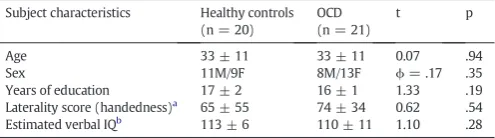
All participants were screened to exclude substance abuse or depen-dence within the preceding six months and any independent condition that might affect brain function. OCD patients were characterized with the Beck Depression Inventory-II (BDI-II,Beck, 1996) and Beck Anxiety Index (BAI;Beck et al., 1988; Table S1). Thefinal groups of 21 OCD pa-tients and 20 controls did not differ significantly in age, sex, years of ed-ucation, handedness based on the modified Edinburgh Handedness Inventory (Oldfield, 1971; White and Ashton, 1976), or estimated ver-bal IQ based on the Wide Range Achievement Test-III Reading portion (Wilkinson, 1993) (Table 1). The study was approved by the Partners Human Research Committee and all participants gave written informed consent.
[image:3.595.305.553.639.708.2]All participants were included in DTI analyses. To obtain reliable es-timates of differences in activation, only participants with a minimum of ten usable error trials (Olvet and Hajcak, 2009; Pontifex et al., 2010)
Table 1
Means, standard deviations, and group comparisons of demographic data. The Phi value is the result of a Fisher's exact test. The z value is the result of a nonparametric Mann–
Whitney U comparison.
Subject characteristics Healthy controls (n = 20)
OCD (n = 21)
t p Age 33 ± 11 33 ± 11 0.07 .94 Sex 11M/9F 8M/13F ϕ= .17 .35 Years of education 17 ± 2 16 ± 1 1.33 .19 Laterality score (handedness)a
65 ± 55 74 ± 34 0.62 .54 Estimated verbal IQb
113 ± 6 110 ± 11 1.10 .28
aLaterality scores of−100 and +100 denote exclusive use of left or right hand,
respec-tively.
b
were included in comparisons of error with correct trials (fMRI: n = 19 OCD, n = 15 controls; EEG: n = 19 OCD, n = 16 controls), and only par-ticipants with a minimum of ten usable pairs of correct pre- and post-error trials were included in fMRI analyses of post-post-error adjustments (n = 17 OCD, n = 14 controls).
2.2. Antisaccade paradigm
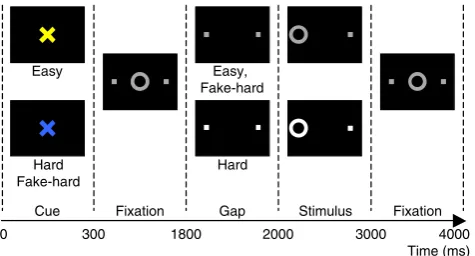
The antisaccade paradigm is described inFig. 1. The task was pro-grammed in MATLAB Psychtoolbox (Mathworks, Natick, MA) and consisted of three types of antisaccade trials: hard (40%), easy (50%), and fake-hard (10%). Hard trials introduced a distraction during the gap, a 3 dB luminance increase of the peripheral squares that mark the location of stimulus appearance. Fake-hard trials started with a cue indi-cating a hard trial, but were otherwise identical to easy trials (i.e., there was no luminance change). They were included as a control condition to allow us to examine the effects of a hard vs. easy cue on fMRI activation unconfounded by the change in luminance that characterizes hard tri-als. As this was not the goal of the present study, error and correct trials were combined across trial types for analysis.
Antisaccade trials were balanced for right and left stimuli. Randomly interleaved with the saccadic trials werefixation epochs lasting 2, 4, or 6 s, which provided a baseline and introduced“temporal jitter”to opti-mize the analysis of rapid presentation event-related fMRI data (Buckner et al., 1998; Burock and Dale, 2000; Miezin et al., 2000). The schedule of events was determined using a technique that optimizes the statistical efficiency of event-related designs (Dale, 1999). Each task run lasted 5 min 16 s and generated an average of 64 antisaccade trials and 20fixation epochs.
Prior to scanning, participants practiced in a mock MRI scanner, were encouraged to respond as quickly and accurately as possible, and were told that in addition to the base rate of pay, they would receive 5¢ for each correct response. Participants performed six task runs during fMRI and eight runs during EEG. The ISCAN fMRI Remote Eye Tracking Laboratory (ISCAN, Burlington, MA) recorded eye position during fMRI using a 120 Hz video camera. During EEG, eye movements were moni-tored using two pairs of bipolar EOG electrodes, one vertical (above
and below the left eye) and one horizontal. Horizontal EOG activity re-corded during a brief calibration allowed an estimate of gaze position for scoring antisaccades (Endrass et al., 2005, 2007).
Eye movement data were scored in MATLAB (Mathworks, Natick, MA) using a partially automated program. Saccades were identified as horizontal eye movements with velocities exceeding 47°/s. The onset of a saccade was defined as the point at which the velocity of the eye first exceeded 31°/s. Trials with initial saccades in the direction of the stimulus were scored as errors. Reaction time (RT) was defined as the onset time of the initial saccade relative to the appearance of the stimu-lus. Post-error slowing (PES) was defined as the RT difference between correct trials immediately following an error trial and correct trials im-mediately preceding an error trial. Self-correction latency was defined as the latency between the onset of the initial erroneous saccade and the onset of the corrective saccade. Error rates were logit-transformed before analysis to normalize their distribution. Group differences in error rates, rate of error self-correction, RT and PES were assessed using between-group t-tests. PES in each group was assessed using a one-sample t-test.
2.3. MRI acquisition
Images were acquired with a 3 T Siemens Trio whole body high-speed imaging device equipped for echo planar imaging (EPI) (Siemens Medical Systems, Erlangen, Germany) and a 12-channel head coil. From each participant we acquired a structural scan, six functional scans and a DTI scan.
A high-resolution structural scan was acquired in the sagittal plane using a 3D RF-spoiled magnetization prepared rapid gradient echo (MP-RAGE) sequence (TR/TE/flip = 2530 ms/3.39 ms/7°, FOV = 256 mm, 176 1.33 × 1 mm in-plane sagittal slices, 1.33 mm thickness). Functional images were collected using a gradient echo T2* weighted sequence (TR/TE/flip = 2000 ms/30 ms/90°, 32 contiguous horizontal slices parallel to the inter-commissural plane, voxel size: 3.1 × 3.1 × 3.7 mm, interleaved). The functional sequences included prospective acquisition correction (PACE) for head motion (Thesen et al., 2000). Single-shot echo planar imaging DTI was acquired using a twice refocused spin echo sequence with the following parameters: TR/TE = 7980/84 ms; b = 700 s/mm2; 10 T2 images acquired with b = 0; 60
dif-fusion directions; 128 × 128 matrix; 2 × 2 mm in-plane resolution; 64 axial oblique (AC–PC) slices; 2 mm (0 mm gap) slice thickness; scan duration 9 min, 44 s.
2.4. fMRI data analysis
2.4.1. Surface-based projection
fMRI analyses were conducted on each participant's inflated cortical surfaces reconstructed from the MP-RAGE scan using FreeSurfer (http:// surfer.nmr.mgh.harvard.edu) segmentation, surface reconstruction, and inflation algorithms (Dale et al., 1999; Fischl et al., 1999). Functional and structural scans were spatially normalized to a template brain consisting of the averaged cortical surface of an independent sample of 40 adults (Buckner Laboratory, Washington University, St. Louis, MO) using FreeSurfer's surface-based spherical coordinate system that employs a non-rigid alignment algorithm that explicitly aligns cortical folding patterns and is relatively robust to inter-individual differences in the gyral and sulcal anatomy of the cingulate cortex. Cortical activa-tion was localized using automated surface-based parcellaactiva-tion software (Fischl et al., 2004).
To facilitate comparison with other studies, approximate Talairach coordinates were derived by mapping surface-based coordinates back to the original structural volume for each of the individuals whose brains were used to create the template brain, registering the volumes to the Montreal Neurological Institute (MNI305) atlas (Collins et al., 1994) and averaging the corresponding MNI305 coordinates. These coordinates were transformed to standard Talairach space using an Easy
Hard Fake-hard
Easy, Fake-hard
Hard
0 Cue
300 1800
Fixation Gap Stimulus Fixation
2000 3000
[image:4.595.50.288.467.595.2]Time (ms) 4000
Fig. 1.Antisaccade paradigm. Schematic and timeline of the three conditions: easy, hard, and fake-hard. Each trial lasted 4 s and began with an instructional cue (300 ms), either a blue or yellow“X”that indicated whether the trial was hard or easy. The mapping of cue color to trial type was counterbalanced across participants. The cue was horizontally
algorithm developed by Matthew Brett (http://imaging.mrc-cbu.cam. ac.uk/imaging/MniTalairach).
2.4.2. Functional data analysis
In addition to on-line motion correction (PACE), functional scans were retrospectively corrected for motion using AFNI (Cox and Jesmanowicz, 1999), intensity normalized, and smoothed using a 3D 8 mm FWHM Gaussian kernel. Functional images were aligned to the MP-RAGE scan for each participant. Residual head motion for each par-ticipant was calculated as the total displacement in millimeters in the x, y, and z directions and the total angular rotation in three directions (pitch, roll and yaw) from the initial head position for each run as deter-mined by the AFNI motion correction algorithm. Displacement and rota-tion values were averaged for the six runs of the task and compared between groups.
Finite impulse response (FIR) estimates (Burock and Dale, 2000; Miezin et al., 2000) of the event-related hemodynamic responses were calculated for each trial type (i.e., pre-error and post-error, error and correct) for each participant. This involved using a linear model to provide unbiased estimates of the average signal intensity at each time point for each trial type without making a priori assumptions about the shape of the hemodynamic response. Estimates were comput-ed at 12 time points with an interval of 2 s (corresponding to the TR) ranging from 4 s prior to the start of a trial to 18 s after the start. Tempo-ral correlations in the noise were accounted for by prewhitening using a global estimate of the residual error autocorrelation function truncated at 30 s (Burock and Dale, 2000).
To test the hypothesis of exaggerated error signaling in OCD, we compared activation for correct and error trials at 6 s: the time point of maximum error-related activity in a prior antisaccade study (Polli et al., 2005). To test the hypothesis of impaired post-error adjustment in OCD, we compared activation during the preparatory period of post- and pre-error trials at 4 s: the time of peak preparatory ocular motor activity in prior studies (Manoach et al., 2007; Polli et al., 2005). Group comparisons used t-tests at each vertex. To examine correlations between activation and symptom severity in OCD, we regressed activa-tion on Y-BOCS scores.
To correct for multiple comparisons, 10,000 Monte Carlo simulations of synthesized white Gaussian noise were run using the smoothing, re-sampling, and averaging parameters of the surface-based functional analysis to determine the likelihood that a cluster of a certain size would be found by chance for a given threshold (p≤.05) on the cortical surface and to provide cluster-wise probability (CWP) values.
2.4.3. Region of interest (ROI) definitions
For error vs. correct comparisons the rACC and dACC were defined using automated surface-based parcellation software (Fischl et al., 2004) that delineated the cingulate cortex and divided it into rACC, dACC, and PCC (Desikan et al., 2006).
For analysis of post-error adjustments a default network ROI was de-fined using seed-based functional connectivity analysis of the functional data of all participants. A seed in the PCC was defined, based on prior studies (Andrews-Hanna et al., 2007; Van Dijk et al., 2010), as a 4 mm radius sphere centered at MNI coordinates x = 0, y =−53, z = 26. Pre-processing of the functional data of all participants involved: 1) reg-istering the motion-corrected fMRI scans to the Montreal Neurological Institute (MNI152) atlas using FSL (FMRIB Software Library,www. fmrib.ox.ac.uk/fsl); 2) spatial smoothing using a Gaussian kernel of 6 mm full-width at half maximum; 3) temporalfiltering (0.009 Hz to 0.08 Hz); and 4) removal of spurious or nonspecific sources of variance by regression of the following variables: (a) the six movement parame-ters computed by rigid body translation and rotation in preprocessing, (b) the mean whole brain signal, (c) the mean signal within the lateral ventricles, and (d) the mean signal within a deep white matter ROI. The first temporal derivatives of these regressors were included in the linear model to account for the time-shifted versions of spurious variance.
Regression of each of these signals was computed simultaneously and the residual time course was retained for the correlation analysis. Func-tional connectivity maps were created by computing the Pearson corre-lation of the signal averaged across the voxels in the PCC seed region with that of every other voxel in the brain. Correlation maps for each in-dividual were converted to a map of z-scores using Fisher's z transforms. Determination of functional connectivity in the averaged group data was based on t-tests of the z-scores at each voxel. The default network was defined as vertices with positive connectivity that exceeded a Bonferroni corrected (for all gray matter voxels based on segmentation) threshold of p≤3.3∗10−7, which set the overall probability to .05
(Table S2). The functional connectivity analysis was conducted in the volume and the resulting statistical map was projected onto the cortical surfaces (Fig. S1).
2.5. EEG acquisition and analysis
EEG was acquired using a 70-channel electrode cap. Electrode im-pedances were brought below 20 kΩat the start of each recording ses-sion. All signals were identicallyfiltered to 0.1–200 Hz bandpass and digitized at 600 Hz. After excluding noisy EEG channels by visual inspec-tion of the raw data, EEG data were re-referenced to the grand average. Each participant's continuous EEG data were low-passfiltered at 40 Hz. Trials with eye blinks were defined by a difference between the maxi-mum and minimaxi-mum voltage of 150μV or greater at the vertical EOG channel and excluded from analysis.
EEG data, time-locked to saccadic onset, were baseline-corrected by subtracting the mean signal during the 100 ms preceding the saccade from the 500 ms that followed the saccade. Data for each of two trial types (all correct antisaccades and all errors) were averaged for each participant. Instead of using data from either FCz of Cz alone, the ERN was derived from the average signal across the following 10/20 loca-tions: FC1, FCz, FC2, C1, Cz, C2, CP1, CPz, and CP2 for each participant to avoid participant exclusion for bad channels. On average, participants had 7/9 usable electrodes. Unusable data was seen infive control and nine OCD participants at Cz and infive control and two OCD participants at FCz. The peak ERN for the combined group of control and OCD partic-ipants was identified within the 200 ms following saccadic initiation as the point of maximal difference for the error vs. correct waveforms (which occurred at 140 ms). The peak ERN for each participant was identified as the point of maximal difference within 50 ms on either side of the group peak. The Pe was derived using the same set of elec-trodes as the ERN (Overbeek et al., 2005) and because a clear peak was absent in many participants (particularly those with OCD), Pe was defined as the mean difference in the error vs. correct waveforms be-tween 300 and 500 ms following the initial saccade.
2.6. DTI analysis
Raw diffusion data were corrected for head motion and residual eddy current distortion by registering all images to thefirst acquired T2 (b = 0) image, using the FLIRT tool (Jenkinson and Smith, 2001) with a 12-df global affine transformation, available through the FSL. The diffusion tensor and FA volumes were reconstructed using the stan-dard least-squaresfit to the log diffusion signal (Basser et al., 1994). FA volumes were registered to the high-resolution structural (T1) volumes for each participant using the T2 (b = 0) volume as an intermediary. Inter-participant registration of individual FA maps to the Montreal Neurological Institute (MNI305) atlas was performed using each participant's T1 structural image, and the resulting transformation was applied to individual FA volumes. The MNI-normalized FA volumes were smoothed with a 3D Gaussian kernel with 6-mm full-width at half-maximum (FWHM).
cingulum bundle was based on Monte Carlo simulations of synthesized white Gaussian noise using the smoothing, resampling, and averaging parameters of the DTI analysis to set the overall threshold to p ≤.05.
3. Results
[image:6.595.45.563.569.691.2]3.1. Antisaccade performance
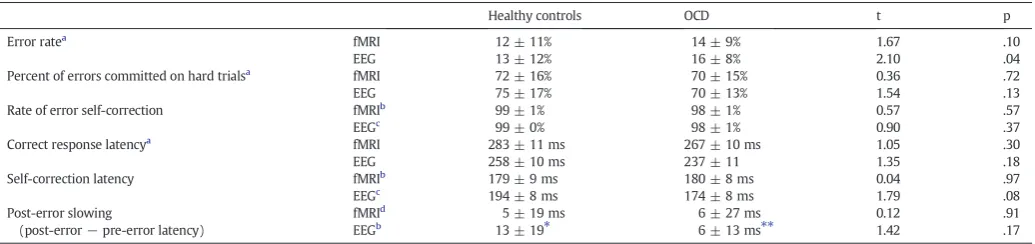
Table 2summarizes behavioral results. OCD patients made more er-rors than controls (trend in fMRI, significant in EEG). The groups did not differ significantly in the proportion of errors committed on hard trials, the proportion of self-corrected errors or the latency of correct re-sponses. OCD patients showed a trend to have faster corrective saccades than controls during EEG. In the EEG data, controls showed significant PES, OCD patients showed a trend, and the groups did not differ signif-icantly. Neither group showed significant PES in the fMRI data. Given the size of PES (13 ms on average for controls measured by EOG), the faster sampling rate of EOG (600 Hz) compared to the fMRI video cam-era (120 Hz) may have been necessary to detect PES. In OCD, neither error rate nor PES correlated with Y-BOCS scores.
3.2. Error markers
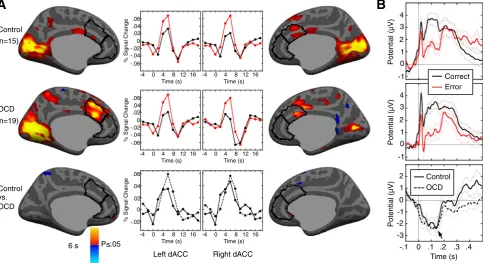
OCD and control groups did not differ in residual head motion during fMRI (displacement: control 1.9 ± 0.8 mm, OCD: 2.0 ± 0.5 mm, t(37) = 0.28, p = .78; rotation: control 0.8 ± 0.5°, OCD 0.7 ± 0.35°, t(37) =1.02, p = .31). Both groups showed significant error-related dACC activation and did not differ significantly (Fig. 2A,Table 3A). Similarly, both groups showed a significant ERN (control: t(15) = 7.73, pb10−5; OCD:
t(18) = 6.10, pb10−5) that did not significantly differ in peak amplitude
(control: 3.59 ± 1.85μV; OCD: 3.89 ± 2.77μV; t(33) = 0.43, p = .67; Fig. 2B) or latency (control: 137 ± 29 ms; OCD: 126 ± 28 ms; t(33) = 1.12, p = .27). The ERN was derived using the average signal across nine electrodes. Considering the data from either Cz or FCz alone or their average, the ERN did not differ significantly between groups and was qualitatively similar to the results averaged over all nine electrodes. In the averaged group data, the ERN peaked ~140 ms, which is within the range of other ERN studies that measured theonsetof movement with EMG or saccadic measurements (e.g.,Gehring and Fencsik, 2001; Gehring et al., 1993; Nieuwenhuis et al., 2001), rather than its outcome (e.g., button presses), which results in shorter ERN latency (seeAgam et al., 2011for review;Carter and van Veen, 2007; Gehring et al., 2012). In both groups, the ERN was maximal at electrode CPz (Fig. S2). Finally, the Pe showed a trend to be reduced in OCD patients relative to control
participants (F(1,33) = 3.98, p = .06;Fig. 2). There were no significant correlations of error-related activation in the ACC, ERN peak amplitude, or Pe with Y-BOCS scores in OCD.
3.3. Post-error adjustments
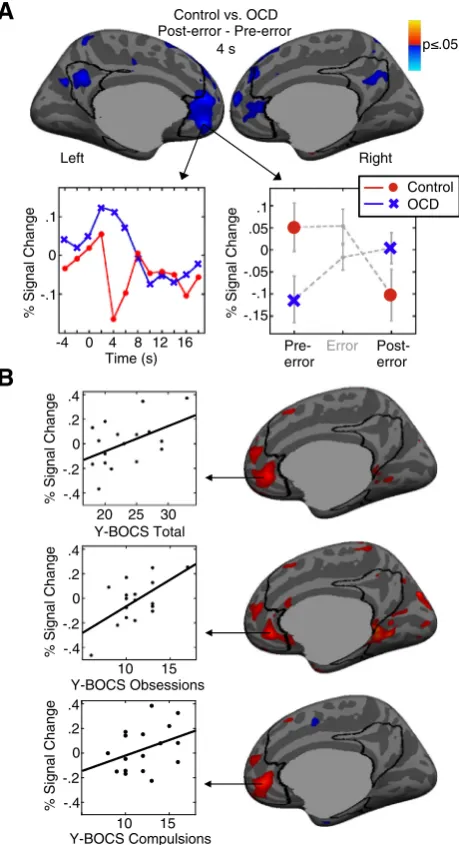
Control participants showed the expected pattern of default net-work activation: a failure of task-induced deactivation in the pre-error trial and a reinstatement of significant task-induced deactivation fol-lowing an error (Fig. 3A,Table 3B). OCD participants showed an oppo-site pattern: significant task-induced deactivation in the pre-error trial and a relative failure of task-induced deactivation after the error. This pattern of post-error adjustment (post- vs. pre-error trials) significantly differed between groups in the left rACC and PCC nodes of the default network. OCD patients also showed significantly greater activation of the left PCC than controls in the post-error trial vs.fixation. Greater ac-tivation of the right rACC in post-error trials in OCD correlated with more severe compulsions and total Y-BOCS scores (Fig. 3B;Table 3B).
3.4. DTI
Relative to control participants, OCD patients showed increased FA in the cingulum bundle (Fig. 4). The peak of the group difference corresponded to the right rACC region in which post-error activation correlated with symptoms (MNI coordinates: x = 6, y = 30, z =−4; clusterwise probability (CWP) = 0.001). No other regions showed group differences that surpassed correction for multiple comparisons in the entire brain. FA in the cingulum bundle did not correlate with Y-BOCS scores, error-related dACC activation, ERN, or post-error adjustment.
3.5. Control analyses
3.5.1. Effects of EEG saccadic artifacts on the ERN
As in prior antisaccade studies (Endrass et al., 2005, 2007; Nieuwenhuis et al., 2001), the horizontal EOG for saccades to the left and right were almost identical in amplitude but of opposite polarity (Fig. S3A). Because there were an equal number of stimuli to the right and left and the proportion of errors to the right and left did not differ within individuals (control: t(15) = 1.09, p = .29; OCD: t(18) = 0.51, p = .62), the effects of the horizontal component of the eye movements are effectively eliminated in the averaged correct and error waveforms. The remaining vertical component of the saccadic artifact peaks at 19 ms and has the same polarity for left and right (Fig. 2B). It con-sists of a positive deflection that returns to baseline ~ 100 ms before
Table 2
Means, standard deviations, and group comparisons of task performance.
Healthy controls OCD t p Error ratea
fMRI 12 ± 11% 14 ± 9% 1.67 .10 EEG 13 ± 12% 16 ± 8% 2.10 .04 Percent of errors committed on hard trialsa fMRI 72 ± 16% 70 ± 15% 0.36 .72
EEG 75 ± 17% 70 ± 13% 1.54 .13 Rate of error self-correction fMRIb
99 ± 1% 98 ± 1% 0.57 .57 EEGc
99 ± 0% 98 ± 1% 0.90 .37 Correct response latencya
fMRI 283 ± 11 ms 267 ± 10 ms 1.05 .30 EEG 258 ± 10 ms 237 ± 11 1.35 .18 Self-correction latency fMRIb 179 ± 9 ms 180 ± 8 ms 0.04 .97
EEGc 194 ± 8 ms 174 ± 8 ms 1.79 .08
Post-error slowing
(post-error−pre-error latency)
fMRId
5 ± 19 ms 6 ± 27 ms 0.12 .91 EEGb
13 ± 19⁎ 6 ± 13 ms⁎⁎ 1.42 .17
a
Based on 20 control and 21 OCD participants (i.e., the entire sample prior to exclusion based on the number of usable error trials).
b Based on 15 control and 19 OCD participants. c Based on 18 control and 19 OCD participants. d
Based on 14 control and 17 OCD participants.
⁎ Within-group paired comparison of post and pre-error latency: t(14) = 2.67, p = .02.
the peak of the ERN and is mostly eliminated when the correct and error waveforms are subtracted to derive the ERN. It therefore does not contribute to the ERN. Nor does artifact from corrective sac-cades on error trials substantially affect the ERN. At the same EEG lo-cations used to measure the ERN, we quantified the effect of the corrective saccade (Fig. S3B). The slope of the resulting signal, time-locked to saccadic onset, is smaller that that of the ERN and is similar for OCD and control groups. In addition, corrective saccades are jittered in time relative to the error, which reduces their effect. Finally, on average, corrective saccades are initiated later than the peak ERN (controls: 54 ± 33 ms; OCD: 34 ± 35 ms Fig. S3C).
3.5.2. Comparison of the correct EEG waveform in OCD vs. controls A two-way ANOVA with factors trial type (correct, error) and group (control, OCD) on the average potentials between 90 and 190 ms after the response (i.e., the time window used for defining individual ERN peaks), using the same set of nine electrodes as the ERN analysis, showed the expected strong main effect of trial type (F(1,33) = 22.05, pb10−4), but no effect of group (F(1,33) = 0.33, p = .57) and no
inter-action of group with trial type (F(1,33) = 0.20, p = .65). Neither cor-rect (t(33) = 0.17, p = .87) nor error (t(33) = 0.76, p = .45) waveforms differed between groups indicating that our non-replication of thefinding of an exaggerated ERN in OCD (e.g.,Gehring et al., 2000) was not due to an abnormally high amplitude correct waveform.
3.5.3. Effects of group differences in error rate on the ERN, dACC activation and neural indices of post-error adjustment
Error rates often inversely correlate with ERN and dACC activa-tion (Holroyd and Coles, 2002; Polli et al., 2008; Santesso et al., 2006). Regression of activation (or ERN) on error rate with a group by error rate interaction showed that this was true in the present
study for left and right dACC activation (left: r(32) =−0.39, p = .02; right: r(32) =−0.47; p = .005) and that there were no group differences in the slopes of these relations (p’s≥.75). Error rate was not significantly correlated with the ERN (r(33) =−0.10, p = .55) and there was no group difference in slopes (p = .71). While OCD par-ticipants made more errors than controls, this difference was eliminat-ed after participants were excludeliminat-ed from the functional analyses baseliminat-ed on having made an insufficient number of errors (fMRI: control 15 ± 11%, OCD 14 ± 9%, t(32) = 0.11, p = .91; EEG: control 16 ± 11%, OCD 16 ± 8%, t(33) = 0.79, p = .44) and therefore does not account for the non-replication offindings of exaggerated error markers in OCD. A vertex-wise regression of post-error adjustment (contrast between post- vs. pre-error trials) on error rate with a group by error rate interaction term did not reveal significant relations within the default network ROI or the entire cortical surface and this did not differ by group.
3.5.4. Contributions of medication, depression, and anxiety to ERN and dACC activation
Seven OCD participants took various antidepressant medications, and one also took memantine (Table S1). Medicated patients did not significantly differ from medication-free patients in error-related dACC activation (left: t(17) = 0.72, p = .48; right: t(17) = 1.03, p = .32). Nor did post- vs. pre-error adjustments in default network activation differ significantly between medicated and unmedicated patients (t(15) = 0.41, p = .69; Fig. S4A). ERN amplitude was higher in medicated patients (Fig. S4B), but this did not reach significance (t(17) = 1.68, p = .11).
BDI-II and BAI symptom rating scale scores in OCD participants did not significantly correlate with either error-related dACC activation or error-related changes in the default network (i.e., there were no sig-nificant clusters). Nor did the ERN correlate with these ratings (BDI-II:
Control
OCD
Control vs. OCD
0 .1 .2 .3 .4 -.1
Time (s) 0
1 2
-1
-2
-3
Error Correct
OCD Control 2
3 4
1
0
-1 2 3 4
1
0
-1
Potential (µV)
Potential (µV)
Potential (µV)
A
B
(n=15)
(n=19)
Left dACC Right dACC P .05
% Signal Change
0 .04
-.04 -.02
-.06 .02 .06
% Signal Change
0 .04
-.04 -.02
-.06 .02 .06
Time (s) 0
-4 4 8 12 16
Time (s) 0
-4 4 8 12 16
Time (s) 0
-4 4 8 12 16
Time (s) 0
-4 4 8 12 16
Time (s) 0
-4 4 8 12 16
Time (s) 0
-4 4 8 12 16
% Signal Change
0 .04
-.02 .02 .06
[image:7.595.53.538.56.319.2]6 s
r(17) =−0.27, p = .26; BAI: r(17) =−0.02, p = .94). Thesefindings suggest that neither medication nor the presence of anxious or depres-sive symptoms substantially affected ourfindings.
4. Discussion
OCD participants showed aberrant use of errors to adaptively adjust neural responses despite intact neural and behavioral indices of error detection (the ERN, error-related dACC activation and the rate of error self-correction). Control participants showed the expected pattern of adjustments based on prior work: a failure to deactivate the default net-work in pre-error and error trials (Agam et al., 2013; Eichele et al., 2008; Li et al., 2007; Polli et al., 2005) and a reinstatement of task-induced de-activation in post-error trials (Eichele et al., 2008). This pattern suggests
[image:8.595.49.560.92.565.2]that the error and pre-error trial are characterized by interference from self-referential thought and that the error prompts a shift in focus back to the task-at-hand in the subsequent trial. In contrast, OCD patients showed the opposite pattern, increased default network activation in the post-error compared to the pre-error trial and differed significantly from controls in this regard. This pattern suggests that rather than responding to errors by turning attention away from the internal milieu and back to the task-at-hand (Agam et al., 2013), the error prompted greater self-referential thought. Thisfinding is consistent with previous reports that OCD participants show increased default network activa-tion, specifically in the ventromedial prefrontal cortex, on error trials (Stern et al., 2011) and increased functional connectivity of the default network with the fronto-parietal attention network (Stern et al., 2012). Thesefindings support the hypothesis that OCD is characterized Table 3
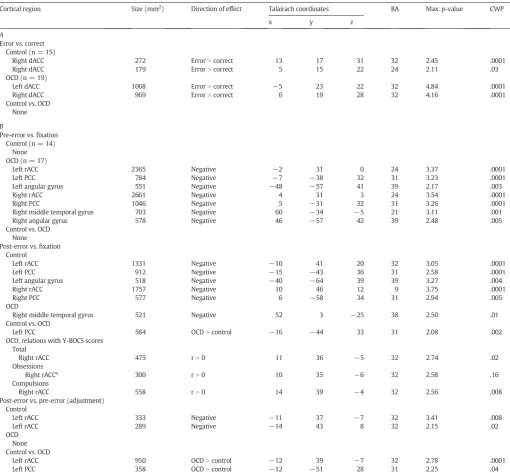
Maxima and locations of significant clusters of activation. p-Values (−base−10 log) are provided for the most significant vertex. A. Error-related fMRI activation in the ACC ROIs. Clusterwise probabilities (CWPs) are based on correction within the entire ACC. B. Default network activation in trials surrounding errors and correlations with Y-BOCS scores. CWPs are based on correction within the default network ROI. BA = Brodmann Area.
Cortical region Size (mm2
) Direction of effect Talairach coordinates BA Max. p-value CWP x y z
A
Error vs. correct Control (n = 15)
Right dACC 272 ErrorNcorrect 13 17 31 32 2.45 .0001 Right dACC 179 ErrorNcorrect 5 15 22 24 2.11 .03 OCD (n = 19)
Left dACC 1068 ErrorNcorrect −5 23 22 32 4.84 .0001 Right dACC 969 ErrorNcorrect 6 19 28 32 4.16 .0001 Control vs. OCD
None
B
Pre-error vs.fixation Control (n = 14)
None OCD (n = 17)
Left rACC 2365 Negative −2 31 0 24 3.37 .0001 Left PCC 784 Negative −7 −38 32 31 3.23 .0001 Left angular gyrus 551 Negative −48 −57 41 39 2.17 .003 Right rACC 2661 Negative 4 31 3 24 3.54 .0001 Right PCC 1046 Negative 5 −31 32 31 3.26 .0001 Right middle temporal gyrus 703 Negative 60 −34 −5 21 3.11 .001 Right angular gyrus 578 Negative 46 −57 42 39 2.48 .005 Control vs. OCD
None Post-error vs.fixation
Control
Left rACC 1331 Negative −10 41 20 32 3.05 .0001 Left PCC 912 Negative −15 −43 36 31 2.58 .0001 Left angular gyrus 518 Negative −40 −64 39 39 3.27 .004 Right rACC 1757 Negative 10 46 12 9 3.75 .0001 Right PCC 577 Negative 6 −58 34 31 2.94 .005 OCD
Right middle temporal gyrus 521 Negative 52 3 −25 38 2.50 .01 Control vs. OCD
Left PCC 584 OCDNcontrol −16 −44 33 31 2.08 .002 OCD, relations with Y-BOCS scores
Total
Right rACC 475 rN0 11 36 −5 32 2.74 .02 Obsessions
Right rACCa
300 rN0 10 35 −6 32 2.58 .16 Compulsions
Right rACC 558 rN0 14 39 −4 32 2.56 .008 Post-error vs. pre-error (adjustment)
Control
Left rACC 333 Negative −11 37 −7 32 3.41 .008 Left rACC 289 Negative −14 43 8 32 2.15 .02 OCD
None Control vs. OCD
Left rACC 950 OCDNcontrol −12 39 −7 32 2.78 .0001 Left PCC 358 OCDNcontrol −12 −51 28 31 2.25 .04
a
by difficulty disengaging from evaluative processes when errors occur, which interferes with redirecting attention to the task-at-hand. The presentfinding of increased FA of rACC white matter in OCD, suggestive of increased default network structural connectivity, complements the findings of increased default network functional connectivity, although the target regions of the presumed increased rACC structural connectiv-ity are unknown. Finally, the correlation of greater post-error activation of the rACC node of the default network with the severity of compulsions
in OCD suggests that maladaptive neural responses to behavioral out-comes contribute to symptoms.
The severity of compulsions in OCD correlated with increased rACC activation in the post-error trial, but not with the post- vs. pre-error ad-justment as predicted. Thus, this result should be considered prelimi-nary. This correlation raises the possibility that more severely affected patients are simply more internally focused throughout the task and not just after an error. This is unlikely since default network activation in neither pre-error trials nor averaged across all correct trials correlat-ed with symptoms, even without the cluster-wise correction for multi-ple comparisons. This relation may reflect that more symptomatic individuals dwell more on aversive and unexpected outcomes such as errors, or that aberrant neural responses to behavioral outcomes con-tribute to compulsive behavior. Alternatively, both aberrant adjust-ments to errors and compulsion severity may be influenced by a third factor, such as increased structural connectivity of the rACC as indexed by increased FA in the underlying white matter, which could either be a trait or reflect experience-dependent plasticity (Scholz et al., 2009). The cross-sectional correlative data of the present study does not allow us to resolve these important issues.
We also expected aberrant neural adjustments to errors to lead to abnormal behavioral adjustments and poorer performance. Neural ad-justments did not correlate with PES or error rate. In the EEG latency data, controls showed significant PES, OCD patients showed a trend, and although the magnitude of PES in controls was more than twice that of OCD patients, the group difference did not reach significance. PES has been shown to be relatively small or absent on tasks with longer stimulus-to-response intervals as is the case in the present study (Danielmeier and Ullsperger, 2011; Jentzsch and Dudschig, 2009). Prior studies of OCD are inconsistent showing increased (Fitzgerald et al., 2005), intact (Endrass et al., 2008, 2010; Grundler et al., 2009; Hajcak and Simons, 2002; Santesso et al., 2006), and reduced (Liu et al., 2012) PES. With regard to antisaccade performance, considering the entire sample (i.e., before exclusion based on error-rate) OCD pa-tients had a higher error rate than controls, consistent with some (Lennertz et al., 2012; Rosenberg et al., 1997; Tien et al., 1992) but not all (Jaafari et al., 2011; Spengler et al., 2006) studies and with other ev-idence of impaired response inhibition in OCD (Chamberlain et al., 2005; Menzies et al., 2007). Neural responses are likely to be more sensitive and specific indices of adjustments to errors than behavior.
Ourfindings of intact ERN and error-related dACC activation in OCD are discrepant with some prior work showing exaggerated error re-sponses. Recent meta-analyses (Mathews et al., 2012; Moser et al., 2013) suggest that whether an exaggerated ERN is found depends on the task used and the type of symptoms present. Many prior studies usedflanker tasks, and we cannot exclude the possibility that the dis-crepancies seen in the present study stem from the different movement modality or task requirements of antisaccades or that in both groups p .05
B
% Signal Change
0 .2
-.2 .4
-.4
Y-BOCS Total 30 25 20
Y-BOCS Obsessions 15 10
Y-BOCS Compulsions 15 10 0 .2
-.2 .4
-.4
0 .2
-.2 .4
-.4
% Signal Change
% Signal Change
Left Right
Pre-error
Post-error -.15
-.1 0 -.05 .05 .1
Error
% Signal Change
Control vs. OCD Post-error - Pre-error
A
% Signal Change
0
-.1 .1
Time (s) 0 4
-4 8 12 16
4 s
[image:9.595.45.275.55.478.2]Control OCD
Fig. 3.Preparatory fMRI activation of the default network and its relation to symptom se-verity. Pseudocolor statistical maps of activation at 4 s are displayed on inflated medial cortical surfaces. The default network ROI is outlined in black. Gray masks cover subcorti-cal regions in which activation is displaced in surface-based analyses. A: Preparatory fMRI activation in the group comparison of the post-error vs. pre-error contrast at 4 s. Blue in-dicates regions showing greater activation for OCD than controls in the post- vs. pre-error trial. The left graph shows the differences in hemodynamic responses for post-error minus pre-error trials for each group at the vertex with the maximum group difference in the post- vs. error contrast. The right graph shows the means and standard errors for pre-paratory activation at this same vertex in the pre-error trial, error trial, and post-error trial. B: Relations between activation on post-error trials and Y-BOCS total, obsession, and com-pulsion scores. The scatter plots correspond to the maximum vertices in the correlation. In accord with recent practice in fMRI research, r-values from the maximum vertices are not reported since these are based on the present data and may therefore inflate the true cor-relation by adding the effect of random variability (e.g.,Kriegeskorte et al., 2009; Vul and
Pashler, 2012; Vul et al., 2009). The correlation with obsessions did not meet the
cluster-wise probability threshold for significance.
p .05 Control > OCD
R! L!
[image:9.595.306.549.56.181.2]y=30! x=6!
virtually all errors were self-corrected. Reviews of the literature (Agam et al., 2011; Holroyd and Coles, 2002), however, indicate that the ERN and dACC activation are‘generic’indices of error processing that are present for errors in a range of contexts including errors committed with the feet (Holroyd et al., 1998), eyes, and hands in a variety of tasks. A prior study that compared ERNs generated by button presses and saccades found them to be similar in morphology, amplitude and scalp topography (Van 't Ent and Apkarian, 1999). In addition, in our prior antisaccade study, the ERN was compatible with those described in the literature with regard to scalp distribution, latency, and morphol-ogy (Agam et al., 2011). Thus, it is unlikely that antisaccades produce a fundamentally different ERN than other tasks used to study error pro-cessing. The presentfindings are consistent with the meta-analyses in suggesting thatfindings of exaggerated error markers in OCD may be task-dependent (Mathews et al., 2012; Moser et al., 2013). A caveat to this explanation of the discrepancies in ourfinding of a normal ERN is that in the meta-analysis of Matthews and colleagues, increased ERNs in OCD were seen for response conflict tasks, of which the antisaccade is an example, and, consistent with recent study (Riesel et al., 2014), are also seen across all symptom dimensions, except hoarding, which was not present in our sample.
A related concern is that the discrepancies may arise as a function of a deficit in volitional saccade generation in OCD. OCD patients and their syndromally-unaffectedfirst-degree relatives have been shown to have longer latencies of volitional saccades (Kloft et al., 2013). In the present study, the latency to generate correct volitional antisaccades was actual-ly non-significantly shorter for OCD than control participants suggesting intact generation of volitional saccades, despite the deficit in response inhibition (i.e., increased antisaccade error rate in the OCD sample prior to exclusion). Given that the latency for correct antisaccades and the neural markers of antisaccade errors were intact in OCD, it is unlike-ly that a deficit in generating volitional saccades accounts for ourfi nd-ings of intact ERN and error-related dACC activation in the context of a specific impairment in post-error neural adjustments.
Another potential source of inconsistency with the literature is that the ERN is variably defined based solely on error trials or on the differ-ence between error and correct trials. If the waveform for correct trials is also more negative, as is sometimes seen in OCD (Endrass et al., 2008, 2010; Hajcak and Simons, 2002), difference waveforms are less likely to differentiate between groups. This was not the case in the pres-ent study since neither the correct nor the error waveforms differed in OCD. In the present study, we derived the ERN using the average signal across nine electrodes instead of using data from either FCz or Cz alone to avoid excluding participants based on bad channels. While we cannot exclude the possibility that missing data from either FCz or Cz in some participants affected our results, when the data from either Cz or FCz was considered alone or when their average was considered, the ERN did not differ significantly between groups and was qualitatively similar to the results from the data averaged over nine electrodes.
Methodological differences may have also contributed to the appar-ent discrepancy with priorfindings of enhanced error-related ACC acti-vation in OCD (Fitzgerald et al., 2005, 2010; Maltby et al., 2005; Stern et al., 2011; Ursu et al., 2003). Prior studies used analysis techniques that assume a shape to the hemodynamic response. A single assumed model is unlikely to be valid across all brain regions and stimulus types (Duann et al., 2002) and inaccurate models may misattribute activation to adjacent events (Manoach et al., 2003). For this reason, it is possible that increased ACC activation on error trials in prior studies reflects greater activation of the default network prior to error commis-sion (Polli et al., 2005) rather than an exaggerated response to the error. In the present study, the relatively long cue-to-target interval of each trial and the use of FIR models, which make no a priori assumptions about the shape of the hemodynamic response, allow more accurate modeling of preparatory vs. error-related activation.
Other potential sources of discrepantfindings include medication use in the OCD patients and sample size. In the present study, the subset
of medicated OCD patients did not differ in dACC activation, but showed a non-significantly higher ERN, as was also seen in an earlier study that showed a normal ERN in OCD (Nieuwenhuis et al., 2005). Medications are unlikely to account for previousfindings of exaggerated ERNs in OCD, however, since this has been reported in OCD patients regardless of medication use (Endrass et al., 2008; Stern et al., 2010) and in syndromally-unaffectedfirst-degree relatives of OCD patients (Riesel et al., 2011). Nor is the non-replication likely to reflect a lack of power due to the relatively small sample size. The between-group effect sizes of the present study are so small (0.24 in the left dACC, 0.10 in the right dACC, and 0.09 for the ERN) that samples of well over 100 partic-ipants per group would be required to detect group differences with 80% power.
The relatively small sample size may have limited our power to eval-uate the Pe, which is less well-characterized than the ERN and less con-sistently observed. The Pe showed a trend to be reduced in the present study of OCD, but not in prior work (Endrass et al., 2008, 2010; Ruchsow et al., 2005). Unlike the ERN, which is present regardless of whether er-rors are perceived, the Pe is present only for perceived erer-rors and is thought to index error awareness (Endrass et al., 2007; Nieuwenhuis et al., 2001). While the literature lacks a clear consensus about its func-tion (Overbeek et al., 2005), the Pe has also been associated with short-term performance adjustments such as PES (Nieuwenhuis et al., 2001). Given that in the present study the Pe reduction was not expected, did not reach statistical significance and did not correlate with PES, we are reluctant to speculate about how an abnormal Pe in OCD may relate to our mainfindings of aberrant neural adjustments to errors in the default network.
Finally, we expected to replicate correlations of increased error signal-ing with symptom severity in OCD (Fitzgerald et al., 2005; Gehring et al., 2000; Ursu et al., 2003). Neither ERN amplitude nor error-related dACC activation correlated with symptoms. These nullfindings are consistent with a prior study that reported no relations of ERN with symptom sever-ity in OCD (Riesel et al., 2011). This study also found an increased ERN in syndromally-unaffectedfirst-degree relatives leading the authors to sug-gest that overactive error monitoring is an endophenotype of OCD that is independent of the presence of clinical symptoms. In the present study, we instead found that increased rACC activation in trials that followed er-rors correlated with the severity of compulsions. As this is thefirst report of abnormal post-error neural adjustments, there is no evidence bearing on whether this represents a state or trait marker.
In summary, the presentfindings demonstrate aberrant neural ad-justments to errors in OCD. This suggests an impairment in adaptively and dynamically responding to outcomes. Moreover, greater default network activation following an error correlated with the severity of compulsions. The rACC locus of the aberrant adjustment and relations with symptoms suggests difficulty suppressing emotional evaluative responses to aversive and unexpected outcomes such as errors. This may preclude more adaptive responses that would redirect attention to the task-at-hand and minimize the probability of error recurrence. Increased FA in rACC white matter suggests increased structural connectivity of this paralimbic default network region as an anatomic correlate of abnormal adjustment.
Supplementary data to this article can be found online athttp://dx. doi.org/10.1016/j.nicl.2014.06.002.
Acknowledgments
The authors are grateful to Dr. Mark Vangel for statistical consultation.
Funding
study including data collection, management, analysis, and interpreta-tion or in the preparainterpreta-tion, review, or approval of the manuscript.
Financial disclosures
Dr. Wilhelm receives research funding from the National Institutes of Health (R01MH091078); royalties from Oxford University Press, New Harbinger Publications, and Guilford Publications; and support in the form of free medication and matching placebo from Forest Laborato-ries for a clinical trial funded by the National Institutes of Health; and has received speaking honoraria from various academic institutions. The other authors have no conflicts of interest to disclose.
References
Agam, Y., Hamalainen, M.S., Lee, A.K., Dyckman, K.A., Friedman, J.S., Isom, M., Makris, N., Manoach, D.S., 2011.Multimodal neuroimaging dissociates hemodynamic and elec-trophysiological correlates of error processing. Proc. Natl. Acad. Sci. U. S. A. 108,
17556–17561.
Agam, Y., Carey, C., Barton, J.J., Dyckman, K.A., Lee, A.K., Vangel, M., Manoach, D.S., 2013.
Network dynamics underlying speed–accuracy trade-offs in response to errors.
PLoS ONE 8, e73692.
Andrews-Hanna, J.R., Snyder, A.Z., Vincent, J.L., Lustig, C., Head, D., Raichle, M.E., Buckner, R.L., 2007.Disruption of large-scale brain systems in advanced aging. Neuron 56,
924–935.
Basser, P.J., Mattiello, J., LeBihan, D., 1994.MR diffusion tensor spectroscopy and imaging.
Biophys. J. 66, 259–267.
Beck, A.T., 1996.BDI-II, Beck Depression Inventory: Manual. The Psychological Corpora-tion, San Antonio, TX,.
Beck, A.T., Epstein, N., Brown, G., Steer, R.A., 1988.An inventory for measuring clinical
anxiety: psychometric properties. J. Consult. Clin. Psychol. 56, 893–897.
Belopolsky, A.V., Kramer, A.F., 2006.Error-processing of oculomotor capture. Brain Res.
1081, 171–178.
Buckner, R.L., Goodman, J., Burock, M., Rotte, M., Koutstaal, W., Schacter, D., Rosen, B., Dale, A.M., 1998.Functional–anatomic correlates of object priming in humans
revealed by rapid presentation event-related fMRI. Neuron 20, 285–296.
Buckner, R.L., Andrews-Hanna, J.R., Schacter, D.L., 2008.The brain's default network:
anat-omy, function, and relevance to disease. Ann. N. Y. Acad. Sci. 1124, 1–38.
Burock, M.A., Dale, A.M., 2000.Estimation and detection of event-related fMRI signals
with temporally correlated noise: a statistically efficient and unbiased approach.
Hum. Brain Mapp. 11, 249–260.
Carrasco, M., Harbin, S.M., Nienhuis, J.K., Fitzgerald, K.D., Gehring, W.J., Hanna, G.L., 2013.
Increased error-related brain activity in youth with obsessive–compulsive disorder
and unaffected siblings. Depress. Anxiety 30, 39–46.
Carter, C.S., van Veen, V., 2007.Anterior cingulate cortex and conflict detection: an update
of theory and data. Cogn. Affect. Behav. Neurosci. 7, 367–379.
Chamberlain, S.R., Blackwell, A.D., Fineberg, N.A., Robbins, T.W., Sahakian, B.J., 2005.The neuropsychology of obsessive compulsive disorder: the importance of failures in cog-nitive and behavioural inhibition as candidate endophenotypic markers. Neurosci.
Biobehav. Rev. 29, 399–419.
Collins, D.L., Neelin, P., Peters, T.M., Evans, A.C., 1994.Automatic 3D intersubject registra-tion of MR volumetric data in standardized Talairach space. J. Comput. Assist. Tomogr.
18, 192–205.
Cox, R.W., Jesmanowicz, A., 1999.Real-time 3D image registration for functional MRI.
Magn. Reson. Med. 42, 1014–1018.
Dale, A.M., 1999.Optimal experimental design for event-related fMRI. Hum. Brain Mapp.
8, 109–140.
Dale, A.M., Fischl, B., Sereno, M.I., 1999.Cortical surface-based analysis. I. Segmentation
and surface reconstruction. Neuroimage 9, 179–194.
Danielmeier, C., Ullsperger, M., 2011.Post-error adjustments. Front. Psychol. 2, 233.
Desikan, R.S., Segonne, F., Fischl, B., Quinn, B.T., Dickerson, B.C., Blacker, D., Buckner, R.L., Dale, A.M., Maguire, R.P., Hyman, B.T., Albert, M.S., Killiany, R.J., 2006.An automated labeling system for subdividing the human cerebral cortex on MRI scans into gyral
based regions of interest. Neuroimage 31, 968–980.
Duann, J.R., Jung, T.P., Kuo, W.J., Yeh, T.C., Makeig, S., Hsieh, J.C., Sejnowski, T.J., 2002.Single-trial variability in event-related BOLD signals. Neuroimage 15,
823–835.
Dutilh, G., van Ravenzwaaij, D., Nieuwenhuis, S., van der Maas, H.L.J., Forstmann, B.U., Wagenmakers, E.-J., 2012.How to measure post-error slowing: a confound and a
simple solution. J. Math. Psychol. 56, 208–216.
Eichele, T., Debener, S., Calhoun, V.D., Specht, K., Engel, A.K., Hugdahl, K., von Cramon, D.Y., Ullsperger, M., 2008.Prediction of human errors by maladaptive changes in
event-related brain networks. Proc. Natl. Acad. Sci. U. S. A. 105, 6173–6178.
Eickhoff, S.B., Stephan, K.E., Mohlberg, H., Grefkes, C., Fink, G.R., Amunts, K., Zilles, K., 2005.
A new SPM toolbox for combining probabilistic cytoarchitectonic maps and
function-al imaging data. Neuroimage 25, 1325–1335.
Endrass, T., Franke, C., Kathmann, N., 2005.Error awareness in a saccade countermanding
task. J. Psychophysiol. 19, 275–280.
Endrass, T., Reuter, B., Kathmann, N., 2007.ERP correlates of conscious error recognition:
aware and unaware errors in an antisaccade task. Eur. J. Neurosci. 26, 1714–1720.
Endrass, T., Klawohn, J., Schuster, F., Kathmann, N., 2008.Overactive performance
moni-toring in obsessive–compulsive disorder: ERP evidence from correct and erroneous
reactions. Neuropsychologia 46, 1877–1887.
Endrass, T., Schuermann, B., Kaufmann, C., Spielberg, R., Kniesche, R., Kathmann, N., 2010.
Performance monitoring and error significance in patients with obsessive–compulsive
disorder. Biol. Psychol. 84, 257–263.
Falkenstein, M., Hoormann, J., Christ, S., Hohnsbein, J., 2000.ERP components on reaction
errors and their functional significance: a tutorial. Biol. Psychol. 51, 87–107.
First, M.B., Spitzer, R.L., Gibbon, M., Williams, J.B.W., 1997.Structured Clinical Interview for DSM-IV Axis I Disorders, Research Version, Patient Edition with Psychotic Screen (SCID-I/P W/PSY SCREEN). Biometrics Research, New York State Psychiatric Institute, New York,.
First, M.B., Spitzer, R.L., Gibbon, M., Williams, J.B.W., 2002.Structured Clinical Interview for DSM-IV-TR Axis I Disorders, Research Version, Nonpatient Edition. Biometrics Research, New York State Psychiatric Institute, New York,.
Fischl, B., Sereno, M.I., Dale, A.M., 1999.Cortical surface-based analysis. II: inflation,fl
at-tening, and a surface-based coordinate system. Neuroimage 9, 195–207.
Fischl, B., van der Kouwe, A., Destrieux, C., Halgren, E., Segonne, F., Salat, D.H., Busa, E., Seidman, L.J., Goldstein, J., Kennedy, D., Caviness, V., Makris, N., Rosen, B., Dale, A.M., 2004.Automatically parcellating the human cerebral cortex. Cereb. Cortex 14,
11–22.
Fitzgerald, K.D., Welsh, R.C., Gehring, W.J., Abelson, J.L., Himle, J.A., Liberzon, I., Taylor, S.F., 2005.Error-related hyperactivity of the anterior cingulate cortex in obsessive–
compulsive disorder. Biol. Psychiatry 57, 287–294.
Fitzgerald, K.D., Perkins, S.C., Angstadt, M., Johnson, T., Stern, E.R., Welsh, R.C., Taylor, S.F., 2010.The development of performance-monitoring function in the posterior medial
frontal cortex. Neuroimage 49, 3463–3473.
Gehring, W.J., Fencsik, D.E., 2001.Functions of the medial frontal cortex in the processing
of conflict and errors. J. Neurosci. 21, 9430–9437.
Gehring, W.J., Goss, B., Coles, M.G., Meyer, D.E., Donchin, E., 1993.A neural system for
error detection and compensation. Psychol. Sci. 4, 385–390.
Gehring, W.J., Himle, J., Nisenson, L.G., 2000.Action-monitoring dysfunction in obsessive–
compulsive disorder. Psychol. Sci. 11, 1–6.
Gehring, W.J., Liu, Y., Orr, J.M., Carp, J., 2012.The error-related negativity (ERN/Ne). In: Luck, S.J., Kappenman, E. (Eds.), Oxford Handbook of Event-related Potential
Compo-nents. Oxford University Press, NY, pp. 231–291.
Goodman, W.K., Price, L.H., Rasmussen, S.A., Mazure, C., Delgado, P., Heninger, G.R., Charney, D.S., 1989a.The Yale–Brown Obsessive Compulsive Scale. II. Validity. Arch.
Gen. Psychiatry 46, 1012–1016.
Goodman, W.K., Price, L.H., Rasmussen, S.A., Mazure, C., Fleischmann, R.L., Hill, C.L., Heninger, G.R., Charney, D.S., 1989b.The Yale–Brown Obsessive Compulsive Scale. I.
Development, use, and reliability. Arch. Gen. Psychiatry 46, 1006–1011.
Grundler, T.O., Cavanagh, J.F., Figueroa, C.M., Frank, M.J., Allen, J.J., 2009.Task-related
dis-sociation in ERN amplitude as a function of obsessive–compulsive symptoms.
Neuropsychologia 47, 1978–1987.
Hajcak, G., Simons, R.F., 2002.Error-related brain activity in obsessive–compulsive
under-graduates. Psychiatry Res. 110, 63–72.
Holroyd, C.B., Coles, M.G., 2002.The neural basis of human error processing: reinforcement
learning, dopamine, and the error-related negativity. Psychol. Rev. 109, 679–709.
Holroyd, C.B., Dien, J., Coles, M.G., 1998.Error-related scalp potentials elicited by hand and foot movements: evidence for an output-independent error-processing system in
humans. Neurosci. Lett. 242, 65–68.
Jaafari, N., Rigalleau, F., Rachid, F., Delamillieure, P., Millet, B., Olie, J.P., Gil, R., Rotge, J.Y., Vibert, N., 2011.A critical review of the contribution of eye movement recordings to the neuropsychology of obsessive compulsive disorder. Acta Psychiatr. Scand.
124, 87–101.
Jenkinson, M., Smith, S., 2001.A global optimisation method for robust affine registration
of brain images. Med. Image Anal. 5, 143–156.
Jentzsch, I., Dudschig, C., 2009.Why do we slow down after an error? Mechanisms
under-lying the effects of posterior slowing. Q. J. Exp. Psychol. 62, 209–218.
Johannes, S., Wieringa, B.M., Nager, W., Rada, D., Dengler, R., Emrich, H.M., Munte, T.F., Dietrich, D.E., 2001.Discrepant target detection and action monitoring in
obses-sive–compulsive disorder. Psychiatry Res. 108, 101–110.
Kerns, J.G., Cohen, J.D., MacDonald III, A.W., Cho, R.Y., Stenger, V.A., Carter, C.S., 2004.
An-terior cingulate conflict monitoring and adjustments in control. Science 303,
1023–1026.
Klein, T.A., Endrass, T., Kathmann, N., Neumann, J., von Cramon, D.Y., Ullsperger, M., 2007.
Neural correlates of error awareness. Neuroimage 34, 1774–1781.
Kloft, L., Reuter, B., Riesel, A., Kathmann, N., 2013.Impaired volitional saccade control:first
evidence for a new candidate endophenotype in obsessive–compulsive disorder. Eur.
Arch. Psychiatry Clin. Neurosci. 263, 215–222.
Kriegeskorte, N., Simmons, W.K., Bellgowan, P.S., Baker, C.I., 2009.Circular analysis in
sys-tems neuroscience: the dangers of double dipping. Nat. Neurosci. 12, 535–540.
Lennertz, L., Rampacher, F., Vogeley, A., Schulze-Rauschenbach, S., Pukrop, R., Ruhrmann, S., Klosterkotter, J., Maier, W., Falkai, P., Wagner, M., 2012.Antisaccade performance
in patients with obsessive–compulsive disorder and unaffected relatives: further
evidence for impaired response inhibition as a candidate endophenotype. Eur. Arch.
Psychiatry Clin. Neurosci. 262, 625–634.
Li, C.S., Yan, P., Bergquist, K.L., Sinha, R., 2007.Greater activation of the“default”brain
regions predicts stop signal errors. Neuroimage 38, 640–648.
Liu, Y., Gehring, W.J., Weissman, D.H., Taylor, S.F., Fitzgerald, K.D., 2012.Trial-by-trial
adjustments of cognitive control following errors and response conflict are altered
in pediatric obsessive compulsive disorder. Front. Psychiatry 3, 41.
Maltby, N., Tolin, D.F., Worhunsky, P., O'Keefe, T.M., Kiehl, K.A., 2005.Dysfunctional action
monitoring hyperactivates frontal–striatal circuits in obsessive–compulsive disorder: