Faculty of Engineering, Science and Mathematics
School of Electronics and Computer Science
A progress report submitted for continuation towards a PhD
Supervisor: Prof. Wendy Hall
Examiner: Dr. Terry Payne
Evolving Smart Environments
by Ben Deitch
ABSTRACT
FACULTY OF ENGINEERING, SCIENCE AND MATHEMATICS SCHOOL OF ELECTRONICS AND COMPUTER SCIENCE
A progress report submitted for continuation towards a PhD
Evolving Smart Environments
by Ben Deitch
Current research in the field of smart environments includes the assumption of the
presence of infrastructure from the smart environment’s inception. However, due to economic constraints, it is likely that many smart environments will instead
have to evolve as the devices forming their infrastructure are slowly introduced
over a period of time. In this document the problem area of evolving smart
environments is discussed, together with background work in pervasive computing
and some related areas. Two initial experiments, more generally related to the
area of smart environments, are then described. Finally, an approach based on
semantic service composition and substitution, intended to answer some of the
issues involved in enabling an evolving smart environment, is presented together
1 Introduction 3
1.1 Research Aims . . . 4
2 Background Work 7 2.1 Pervasive Computing . . . 7
2.2 Agent-based Computing . . . 9
2.2.1 Definition . . . 9
2.2.2 Agent-oriented engineering . . . 10
2.3 Semantic Technologies . . . 12
2.3.1 Semantic web languages . . . 13
2.3.2 The semantic web in pervasive computing . . . 15
3 Investigatory Prototypes 19 3.1 Managing Intrusiveness in a Meeting Room Scenario . . . 19
3.1.1 Implementation . . . 21
3.1.2 Results . . . 22
3.2 Laboratory-based User Location Monitoring System . . . 22
3.2.1 Implementation . . . 23
3.2.2 Results . . . 24
4 Conclusions 26 4.1 Future Work . . . 27
4.1.1 Ubiquitous Resource Locator . . . 28
4.1.1.1 Aims. . . 29
4.1.1.2 Design and evaluation . . . 29
4.1.1.3 System implementation . . . 31
Introduction
Current research in pervasive computing deals largely with the area of smart
envir-onments. A smart environment is a region of physical space that is instrumented
with computing technology, such as sensors and actuators, which is intended to
provide non-intrusive support to the occupants of the environment as they work
to accomplish their tasks.
Research in this area is consistently based around the assumption that the
techno-logy infrastructure forming a smart environment is installed in its entirety before
the system is used.
A more realistic approach accepts that due to various constraints, not least
eco-nomic constraints, the adoption of pervasive computing and smart environment
technology will likely be piecemeal and distributed over significant time. In such
cases there will not be a smart environment immediately; items of pervasive
com-puting technology, or smart devices, will gradually be introduced into a physical
space over time.
In order to fulfill the promise of pervasive computing, and to attempt to provide
a cohesive smart environment, these devices will have to automatically cooperate,
possibly across different generations of technology, to provide functionality that
makes best use of all their abilities in combination.
However, it is not enough for devices to simply reconfigure to incorporate the new
functionality each time another device is added; Users will have become used to
the behaviour of their current combined devices; they may well have spent time
adjusting the behaviour of devices to their preferences.
Therefore it is necessary for the current configuration to inform the automatic
creation of the new configuration. Thus, each configuration of devices can be seen
as a step to the next configuration produced by the addition of a new device.
In this way the system formed of the combination of devices can be said to be
‘evolving’; in the remainder of this document this type of system is referred to as
an ’Evolving Smart Environment’ or ESE.
1.1
Research Aims
There are a number of non-trivial research challenges that must be met in order
to enable us to build ESEs. These challenges are presented below, formulated as a
number of questions; followed by a more focused discussion on the specific problem
of evolving functionality.
1. How can an ESE recognize the features of new smart devices?
2. How can an ESE utilize the features of new smart devices to provide
com-bined functionality?
3. How can new smart devices be automatically configured as they are added
to the ESE?
4. How can an ESE handle the addition and removal of smart devices gracefully
without failure? (i.e. how can an ESE devolve as well as evolve?)
5. How can the behaviour of the ESE be predictable to the non-expert user as
new smart devices are added and removed?
6. How can smart devices added over a long time period, with possibly
signi-ficant variations in technical sophistication, interoperate effectively?
Clearly, considering a number of these challenges is beyond the scope of this
doc-ument (and beyond the scope of a single PhD). It is therefore necessary to focus
on a more specific problem within this area: functional evolution.
When considering the functional evolution of a smart environment it is useful to
model it simply. We consider the environment to be formed of two sets: the set of
smart devices that form the environment, and the set of tasks that can be achieved
the tasks that the occupants might wish to accomplish and also tasks that the
environment itself might be doing automatically.
We thus describe the functional evolution of a smart environment via the set of
tasks achievable in that environment. If new tasks are added to the set then we
consider that environment to have evolved. Similarly (and perhaps more
signific-antly) if some of the tasks already available are improved in some way then the
environment is, again, considered to have evolved. It is important to note that,
although this functional evolution is envisioned as occurring mainly when new
devices are added, the smart environment may improve its task set independently
of changes in the set of devices.
There are a number of deeper research issues raised on consideration of this model of an evolving smart environment:
There is clearly a difference between descriptions of tasks that occupants of a
smart environment may wish to accomplish and the actual atomic functions or services provided by the devices in that environment. A way needs to be found to
map from an abstract high-level description of a task down to the actual device
functions that must be used.
We describe the evolution of a smart environment in terms of the set of tasks
increasing or elements of the set improving in some way. This description poses
two further problems: Firstly, how should the set be increased? And secondly,
how can tasks already present be improved?
The problem of providing new composite functionality from a set of devices is
itself a challenge. This new functionality can perhaps be classed as coming from
two distinct sources: A source external to the ESE or a source within the ESE.
Sources external to the ESE could be such things as an external repository of task
plans, perhaps provided by the device manufacturers themselves. Other sources
could be shared repositories populated by the users themselves; as they form their
own new task compositions these could then be shared with a user community. Then there is also the fact that the occupants of the ESE would want to create
there own private task compositions. The ability to share tasks and provide generic
plans is also reliant on a mapping between abstract high-level descriptions of tasks
and the actual functions of the devices. Other issues involved in allowing users
to create their own task compositions are related to ease-of-use for the users;
what kind of interfaces are needed to allow the comprehension of the possible task
Internal sources for new task compositions come from the ESE itself. These could
be something as naive as random concatenation of compatible tasks in order to
generate new tasks which would then be filtered, either by the ESE or perhaps by
its occupants. Alternatively, more advanced techniques based on machine learning
could provide a more direct evolution of functionality based on things such as user
modeling.
Looking at the problem of improving tasks already extant in the task set leads to
three further questions:
How should tasks be described so that they can be improved upon? Not only do
the tasks need to be described in some human readable form, in order that users
can understand what functionality is being offered by the environment, but if the
tasks are to be improved in an automatic process then an appropriate description
is needed to facilitate this process.
How can we define what is an improvement? Very specific criteria would need to
exist to determine if a task has been improved rather than simply changed. These
criteria could be based on low abstraction level considerations such as resource
usage levels and exception handling robustness. Perhaps more useful criteria would
come from higher abstraction level considerations, for example: requiring less
control from users in order to complete the task, or providing better adaptation
to general user preferences.
How can these criteria then be used to guide the improvement process? Once
criteria for determining if a task has been improved have been established, it
is then necessary to provide a way for these criteria to guide the improvement
process. This in turn can be seen to guide the evolution of the ESE to some extent. Perhaps if the occupants of the ESE can prioritize or otherwise rank
the improvement criteria they can control the evolutionary process in a more
understandable manner.
The author believes this problem area to be addressable using an approach based
on semantic web services and task composition and substitution. The details of
Background Work
2.1
Pervasive Computing
The field of Pervasive Computing has not yet been defined conclusively in that
there is not a commonly agreed-upon, comprehensive definition that could be
quoted here. This lack of a definitive description of the field is reflected in the fact
that it is still referred to in the literature under different titles, such as Ambient
Computing and Ubiquitous Computing. This document is not intended to join the
debate as to whether or not these terms are synonymous and is thereby restricted to using the term Pervasive Computing (PerComp) which is defined within this
document as:
The use of a number of computing devices, usually embedded in the
environment and interconnected via one or more networks, to provide
services to users in a non-intrusive manner.
Further to this definition there are some basic characteristics of PerComp which,
while perhaps not definitive of the field, give an idea of the many challenges
in-volved:
• Abundance
PerComp potentially deals with very large numbers of devices. One ex-ample is Smart Dust (Kahn et al. 2000) which refers to the use of sensing
devices eventually intended to be so small, inexpensive and numerous that
they can be scattered in an environment like dust. Users are another
po-tentially abundant factor in PerComp systems. For example, it is quite
con-ceivable that a PerComp service environment in an airport terminal would
need to be able to deal with large numbers of people making concurrent
demands on its resources. Further to this, where a PerComp system is
at-tempting to provide services to a large number of users, there could well be
an abundance of data as the system might have to process high volumes of information associated with each of the users.
• Heterogeneity
Perhaps one of the more interesting challenges in PerComp is handling
the heterogeneity that can be present in many aspects of a PerComp system. Devices involved can range from small, simple sensor nodes up to large server
systems. The networks that may be utilised can similarly range from short
range, ad-hoc radio communication (e.g. Bluetooth) to global networks such
as the Internet. Whilst these levels of heterogeneity may be found in
in-dividual PerComp systems, even greater differences can be experienced by
mobile devices traveling through multiple PerComp environments, in order
to provide consistent levels of service to the user such mobile devices would
have to handle widely varying levels of resource availability and resource
types in each environment.
• Intelligence
Intelligent systems, using tools borrowed from AI, can be found in
Per-Comp in many areas and in a variety of levels of complexity. An important
example would be the processing of contextual information using rule-based
approaches originally found in expert systems. This is significant as many of the features of pervasive computing systems (such as tailoring information
and interaction requests to a user’s current location and task context) rely
on such context processing, although rule-based approaches are not the only
option in this case. Another area in PerComp that can gain from advanced
autonomic behaviour is system self-configuration. Problems considered in
distributed AI (such as Agent-based Communities) have much in common
with some PerComp systems such as those that involve a large, changing
number of distinct components that should interoperate automatically.
• Environment-based Applications
Unlike most examples of current computing where the activities of the
is on the user and their environment. From the definition of PerComp given
above, where it is stated that devices are usually embedded in the
envir-onment, it follows that such devices provide services relevant to that
en-vironment (otherwise there is little reason to embed them there in the first
place). One environment that can be considered an example of PerComp
is the modern car. In a reasonably advanced modern car a combination
of sensors, computing power and carefully designed user interfaces provide services of information and control to the user in a non-intrusive manner
intended to aid the main task (driving the car). Similarly, we can see the
potential for other environments to be augmented in order to aid users in
performing their tasks, perhaps especially those tasks specific to a certain
environment. An example could be a smart meeting room. Such a
meet-ing room might provide useful information such as the expected arrival time
of delayed participants or notification of external events that are relevant to
the topic of the meeting. Support for collaboration amongst the participants
such as a distributed white board or automatic note taking facilities might also be present. These applications are based within the environment
im-proving or adding to the facilities in that environment. Such environments
are often referred to as ‘Smart Environments’ or ‘Smart Spaces’ (Coen 1998).
2.2
Agent-based Computing
2.2.1
Definition
Wooldridge (2002) presents the following definition of an agent:
“Anagent is a computer system that is situated in someenvironment,
and that is capable of autonomous action in this environment in order
to meet its design objectives.”1
There are two important points to note from this definition. Firstly, the fact that
an agent is “situated in some environment” indicates that the agent can sense, to
some greater or lesser extent, its environmental conditions (which can be seen as
part of its context). A further implication is that the agent may well have the
ability to effect changes in its environment, suggesting the possibility of a two-way
relationship between an agent and its environment. The second important point
is that an agent is capable of autonomous action. Agents are often implemented
with some kind of reasoning mechanism, in fact the field began with research
into distributed artificial intelligence systems. However it is not required that an
agent make use of AI style reasoning to be called an agent. Agents that do utilize
some form of symbolic or other high-level reasoning are said to be ‘strong’ agents,
whereas those agents that do not make explicit use of AI techniques are called ‘weak’ agents (Dale & Mamdani 2001).
As an addendum to Wooldridge’s definition of an agent, many researchers consider
a key element in the definition of an agent to be that it operates under a distinct
thread of control. This is an important factor when considering the distributed
systems constructed from multiple agents, referred to as ‘Multi-agent Systems’.
2.2.2
Agent-oriented engineering
When multi-agent system solutions are applied to problems the practice is
re-ferred to as agent oriented software engineering. Jennings (2001) talks of several
key characteristics of the agent oriented paradigm. The suitability of the agent
paradigm for use in pervasive computing can be discussed by considering each
characteristic in turn:
• Organization Models
The individual agents in a multi-agent system can be organized in a wide variety of ways. Standard distributed computing models can be applied
(such as the Master-Slave or Task Graph models) as well as more complicated
organizations that rely on the fact that each agent is autonomous. More
im-portantly; organizations in multi-agent systems can be dynamic. This means
that they might be created and dispersed automatically by the agents as the
need arises. This ability to dynamically reconfigure has obvious applications
in pervasive computing environments. The more advanced organisational
models provide a way to model pervasive environments where systems with
different priorities will need to work together to provide a common service infrastructure.
• Distributed Computation
There are two ways in which the distributed computation model
first, it is decentralized with multiple loci of control. This is useful when
trying to answer the need in pervasive computing for multiple devices or
subsystems to be responsible for themselves yet still able to interoperate
effectively. Secondly, the communication models used in agent-based
com-puting are usually specified at a high level of abstraction (Moreau 2002).
This allows communication to pass across different technologies more easily
which would obviously be a boon in pervasive computing where networks will be formed from many and varied sytems.
• Encapsulation
As with object-oriented engineering, encapsulation figures largely in the
field of agent-oriented engineering. The reduction in engineering complexity
that this offers is not unique, however the advantage that the agent approach brings is the ability to intelligently decide at runtime what data to expose
to which consumers. This is useful when dealing with privacy in the field
of pervasive computing. Consider the example of a user moving through a
public smart space. The various services offered by the space require some
knowledge of the user and his preferences, however the user wants to control
access to his personal profile data and reveal only as much as is needed and
only if the benefit is sufficient to justify the access. This type of scenario is
particularly suited to agent-based computing.
• Autonomy
Agent-based computing offers a range of autonomic behavior.
Multi-agent systems can include simple auto-configuration and advanced artificial
intelligence mechanisms. The autonomic models possible with such systems are both flexible and powerful. In pervasive computing there is a need for
more than simple auto-configuration and self-management. The level of
complexity that autonomic elements of a pervasive system must deal with is
increased by a number of factors: The lifetime of components in a pervasive
system may well be considerably longer than components in current systems
which will be replaced more often. Physical access is not guaranteed and
therefore systems must deal with cumulative failures over time, gracefully
providing useful functionality for as long as possible. Due to the progressively
interconnected nature of pervasive systems as new systems are added, each
system must be able to handle changing environments that were not foreseen at design time. In fact, the basic nature of the system as a whole may go
must be able to adapt to best service these changing needs. Agent-based
computing offers a cohesive approach to these complex demands.
• Semantically Aware
Agents must understand each other in order to interoperate. The
ap-proach taken to facilitate such operation usually involves describing data
ontologically i.e. providing a common semantic framework that agents can
use to communicate the meaning of pieces of information. Pervasive
comput-ing shares this need for the communication of data together with its semantic
meaning. Therefore, approaches already explored in agent-based computing
can be usefully applied.
In summary, the agent-oriented engineering paradigm offers many benefits and
interesting approaches to the problems that must be solved in pervasive computing.
2.3
Semantic Technologies
Semantic technologies seek to bridge the gap between human understanding of
data, i.e. semantics, and machine understanding of data, i.e. syntax. Helping
a computer to ‘understand’ the information it is processing is a problem that is
present in many areas; from classical artificial intelligence to mobile computing
and the internet.
“Most of the Web’s content today is designed for humans to read, not
for computer programs to manipulate meaningfully. Computers can
adeptly parse Web pages for layout and routine processing — here a
header, there a link to another page — but in general, computers have no reliable way to process the semantics: this is the home page of the
Hartman and Strauss Physio Clinic, this link goes to Dr. Hartman’s
curriculum vitae.” (Berners-Lee et al. 2001)
While much of the work on semantic technologies is focused around the Semantic
Web (Berners-Lee et al. 2001), the need to specify semantics using a generic
ap-proach is also shared by other research areas in computer science. In the past if
different systems needed to share data or tasks then the relevant semantics of the
data needed to be defined and shared a priori. The way in which such semantics
Semantic technologies offer the ability for the semantics of data to be formally
defined in such a way that the data can be easily shared together with its
mean-ing. This does more than allow us to easily design systems that interoperate, it
introduces the potential for the dynamic introduction of new semantics to a system
at runtime.
2.3.1
Semantic web languages
A number of languages figure largely in the field, each was designed primarily for
use with the semantic web but now they are becoming increasingly useful in other areas:
• RDF (Resource Description Framework)
This language is defined in a W3C recommendation. The W3C provide
a primer document that is regularly updated to reflect the latest version of
RDF. In the introduction to this document the following description is given
for RDF:
“The Resource Description Framework (RDF) is a language for
representing information about resources in the World Wide Web.
It is particularly intended for representing metadata about Web
resources, such as the title, author, and modification date of a Web
page, copyright and licensing information about a Web document,
or the availability schedule for some shared resource. However, by generalizing the concept of a “Web resource”, RDF can also
be used to represent information about things that can be
iden-tified on the Web, even when they cannot be directly retrieved
on the Web. Examples include information about items available
from on-line shopping facilities (e.g., information about
specifica-tions, prices, and availability), or the description of a Web user’s
preferences for information delivery.” (W3C 2004b)
An important point to note in this description is the fact that RDF can be used to describe resources that are not directly part of the web. These
resources may not even be digital in nature, RDF could just as easily be
used to describe a pet cat as it could be used to describe a piece of website
• DAML+OIL (DARPA Agent Markup Language, Ontology Inference Layer)
RDF is used to describe resources however it is not advanced enough on its own to describe the meaning of information sufficiently formally or in
such a way that reasoning engines can be applied. Some form of ontology
language is necessary. Here we use the word ‘ontology’ to refer to a set
of building blocks used to form a conceptual representation of a knowledge
domain. DAML+OIL is one such language.
DAML+OIL evolved from a merger of DAML-ONT (an earlier DAML
on-tology language) and a description logic called the Onon-tology Inference Layer
(OIL). The two main aims of DAML+OIL were to provide an easily
com-prehensible ontology language that was backwards compatible with current
web languages, and to ensure that the language had a strong formal
under-pinning. (McGuinness et al. 2002)
To achieve the first stated aim DAML+OIL was defined in RDF/XML (a
version of RDF that is serialized into XML). The second aim was
accom-plished by using formal description logic as a base for the language design,
as well as providing an equivalence-preserving translation from DAML+OIL
into first order logic.
• OWL (Web Ontology Language)
OWL is also defined in a W3C recommendation. In the language
over-view the following description is given:
“The OWL Web Ontology Language is designed for use by
applica-tions that need to process the content of information instead of just
presenting information to humans. OWL facilitates greater ma-chine interpretability of Web content than that supported by XML,
RDF, and RDF Schema (RDF-S) by providing additional
vocabu-lary along with a formal semantics. OWL has three
increasingly-expressive sublanguages: OWL Lite, OWL DL, and OWL Full.”
(W3C 2004a)
DAML+OIL was used as the starting point for OWL, which is now
gener-ally considered to have superseded DAML+OIL. OWL is also expressed in
RDF/XML. As mentioned in the W3C’s description, OWL has three sub-languages. Going from OWL Lite to OWL Full, each language gains in
2.3.2
The semantic web in pervasive computing
As stated earlier, the semantic web is the driving focus behind these languages
and the automated reasoning tools that accompany them. However the ability
to machine-process the meaning of data is a boon to many other fields as well.
There are some compelling reasons to make use of ontology languages in pervasive
computing.
Ontology languages offer benefits to pervasive computing systems mainly in the
area of interoperability. The advantages of a semantic approach can be considered
under the following headings:
• Data Utility
Pervasive computing shares the advantage that is common to any field
that makes use of semantic technologies: data utility. What this refers to is
the increase in the usefulness of data when its meaning can be communicated
in machine readable form as easily as the data itself.
• Standards
As with data utility, the benefit of shared standards is not unique to
pervasive computing. However it is important to note that standards can be
a double-edged sword. In a relatively new field such as pervasive
comput-ing, solidification via standards can restrict the development of new ideas
and new approaches. Whilst the W3C has settled on one main ontological
language (OWL) and its underlying fabric (RDF) there is still a great deal
of openness within these confines. Inherent in OWL, and even semantic
technology as a whole, is the idea that ontologies should be easily extensible
without necessary alteration to the originals. The use of Uniform Resource Identifiers (URI’s) throughout these languages enables easy cross-utilization
of ontologies and concepts contained therein. Thus far a consensus approach
has been used by the semantic community to agree upon certain ’base’
on-tologies that express core concepts such as time and space. This enables a
much faster pace of development than if such ontologies were fixed in the
standards process, although the consensus approach is clearly open to abuses
and potential conflicts.
Hendler (2001) suggests that the reasoning and logic engines associated
with semantic technologies should be considered distinct from the ontologies
structures provides the possibility that standards can be found for the
pro-cessing of semantic data as well as its representation. Such standards would
benefit pervasive computing by moving towards a common toolkit for the
construction of pervasive system components.
• Semantic Service Description
Semantic descriptions of services and devices allow more advanced
dis-covery that could be essential for the flexible and dynamic nature of pervasive
systems. A language that provides this and more is the Ontology Web
Lan-guage for Services (OWL-S) (Martin et al. 2004). OWL-S offers a semantic
description layer for web services that is not provided with the more
low-level service-syntax oriented Web Services Description Language (WSDL).
It is part of a body of work that attempts to develop languages and archi-tectures to provide richer semantic specification of web services. This body
of work is referred to as Semantic Web Services.
“OWL-S (formerly DAML-S) is an OWL ontology with three
in-terrelated subontologies, known as the profile, process model, and
grounding. In brief, the profile is used to express what a service
does, for purposes of advertising, constructing service requests,
and matchmaking; the process model describes how it works, to
enable invocation, enactment, composition, monitoring and recov-ery; and the grounding maps the constructs of the process model
onto detailed specifications of message formats, protocols, and so
forth (normally expressed in WSDL).” (Martin et al. 2004)
An important point to note from the description above is that OWL-S
provides a grounding to map the constructs of the process model onto WSDL.
This is particularly interesting as it essentially means that OWL-S can
provide a semantic wrapper around the web service method invocations.
Whilst this would obviously incur overheads in addition to those normally found with web services, it offers the potential for designing distributed
sys-tems at the abstraction level of semantics rather than technical functionality.
The inherent flexibility, extensibility and possible autonomy in this model
indicate it is worth exploring for possible applications in pervasive
comput-ing. Further to this, current research into automatic service composition
goes toward providing an intelligent adaptive infrastructure for pervasive
Semantic technologies have already played a key role in pervasive computing
pro-jects. Some examples follow:
In the University of Maryland, Baltimore, Chen et al. (2003) have been building
a context broker architecture (CoBrA) for smart spaces that utilizes ontologies.
This design is based on a central agent that is responsible for gathering, processing
and sharing context information with the other elements of the system.
The broker system addresses bottleneck issues by replacing a single central con-text broker with a ’broker federation’ in large-scale cases, where each broker is
responsible for subsections of an overall space (such as buildings in a university
campus). However there is still an issue with a single broker agent being
respons-ible for all context in a certain area. Whilst the broker federation does reduce
bottlenecks it does not guarantee scalability, more importantly the broker agent
must be assumed to be trustworthy enough to be allowed access to all relevant
context information. A peer-to-peer approach where users’ agents are
respons-ible for sharing and coordinating context information may offer solutions to these problems.
The (CoBrA) system relies heavily on ontologies, “helping the context broker to
share contextual knowledge with other agents and enabling it to reason about
context” (Chen et al. 2003). The ontologies were defined in OWL. Whilst this
use of ontologies does go some way to providing an open system it still suffers from the fact that the ontologies used are highly specific to CoBrA and its use
cases. Adding new components to this system might therefore be easier than if
the context information was presented as Java classes (for example) but there is
still a requirement that components be built specifically for CoBrA. However this
lack of generality is recognized by the authors: “It may be necessary to re-organize
the class hierarchy if the ontology is reused to support a different context-aware
application.” (Chen et al. 2003) In their discussion of future work the authors
state their intention to move to consensus ontologies such as DAML-Time and DAML-Space.
What is most interesting about the CoBrA project is the development of a
pro-totype ontological inference engine called F-OWL, implemented using Flora-2, an
object-oriented knowledge base language and application development platform. The authors assert that the benefits of F-OWL include more efficient execution
through its use of cache tables of previous results and a syntax more in common
The MyCampus project at Carnegie Mellon University (Sadehet al.2002) also
re-lies heavily on semantic technologies. The authors state: “The power and
scalab-ility of the environment directly derives from a set of ontologies for describing
contextual attributes, user preferences and web services, making it possible to
easily accommodate new task-specific agents and new Web services.” Their work
builds directly on the DAML-S work previously done at Carnegie Mellon
Investigatory Prototypes
3.1
Managing Intrusiveness in a Meeting Room
Scenario
Pervasive computing devices are becoming increasingly common. Devices like
laptops, mobile phones, video phones, smart white-boards and public displays
are making it possible for people to be contacted easily and receive notifications
in more situations than ever before. These interruptions can impact on both individual and group tasks.
Having said that interruptions have an impact it is important to note that not
all interruptions are ’bad’ i.e. harmful to the task at hand. Interruptions can be
classified as either intrusive ortask support. (Ramchurn et al. 2004)
Intrusive interruptions are those where the user or the group has their stream
of consciousness forced from one focus to another, whereas an interruption that
supports the current task requires less of a focus shift and adds new helpful
in-formation. Obviously a message is not just simply intrusive or not, but can in fact have varying levels of intrusiveness depending on the context of the recipient.
Determining the intrusiveness of a message involves the preferences of the user
and also, if that user is part of a group, the preferences of the group. This last
point is intuitively evident in cases where the receiving device has the potential to
disturb the entire groups focus. Thus, when designing a system to manage these
interruptions, it is necessary to consider the more complex problem of reconciling
an individuals preferences with the preferences of the group.
Agent-oriented engineering offers an ideal model for dealing with what is
essen-tially a distributed problem involving possibly conflicting interests. In this
exper-iment we explore this problem via the scenario of a meeting in a smart meeting
room. This meeting room contains tools such as a shared public display and a
wireless network. Each user is represented by an agent that is aware of their
in-dividual preferences. The interests of the group are represented by a server agent
responsible for that meeting room. The server agent coordinates the display of any incoming messages to those users in the meeting room. A cost is associated
with each device that the message may be displayed on. This cost is proportional
to the intrusiveness of that device. For example, an email client on a user’s laptop
that silently shows a text notification is much less intrusive (and thereby cheaper)
than a mobile phone whose ringing could well disturb the entire group. In order
to display a message a user’s agent must pay the cost to the server agent from an
initial budget set by the server agent at the beginning of the meeting.
A user’s preferences are recorded in their agent as a utility function:
U(Sender, Subject) → u. This function determines the utility returned to an agent’s budget upon displaying a message that satisfies these preferences. Each
agent seeks to maximise its utility. In order to represent the interests of the group
as well as those of its owner, an agent must negotiate with the other users’ agents
prior to paying for the display of the message. The agents negotiate on the sub-ject and sender of the message. Where more than one agent has an interest in
displaying the message (i.e. would receive some utility) they can combine their
budgets in order to display the message on a more expensive device (such as the
public display) which would be accessible to all interested users.
The preferences of the group are also represented through the use of an ‘intrus-iveness dial’ which allows the users to scale the cost of devices according to the
state of the meeting. During a time in the meeting when the group is deep in
dis-cussion this dial would be turned up to increase the cost of displaying messages,
thereby reducing the number of interruptions. During a break in the meeting,
the dial could then be turned all the way down, allowing all messages (including
previously queued messages) to be received.
In order to demonstrate the feasibility of this approach a simulation was
construc-ted to test the hypothesis that the intrusiveness of incoming messages could be
3.1.1
Implementation
The architecture of the simulation implementation is shown in figure3.1.
User A Devices
JabberD 1.4
Server Component
Controller Component
Scripting Component
Public Display Component Psi Client
(Email) Psi Client
(Pager)
User B Devices
Psi Client (Email) Psi Client
[image:22.595.118.514.153.408.2](Pager)
Figure 3.1: Architecture of meeting room system simulation
The system was built on the Jabber platform (JSF 2004). Jabber is an open-source
instant messaging system that is based on XML messages and the Extensible
Messaging and Presence Protocol (XMPP) (IETF 2004). At the core of the system
was the JabberD Jabber server (JabberD 2004) which was used to route XML
packets between the other components.
The Server component housed all the agents. This component was responsible for
performing the agent negotiation and thereby determining the destination for each
re-routed message.
The Controller component presented the interface between the users and the
sys-tem. The representation of the intrusiveness dial is part of the GUI presented by
this component.
The Scripting component was a tool used for the evaluation of this system. This
component simulated incoming messages from a variety of sources sent to a range
The Public Display component simply displayed any messages that it received on
a publicly visible screen.
Finally each users devices were represented by Jabber clients. The Jabber client,
“Psi” (Psi 2004), was chosen because it is highly configurable and could be set to
represent less intrusive devices (like an email client) and more intrusive devices
(such as a pager), by adjusting the audio and visual notifications given for incoming
messages.
3.1.2
Results
The evaluation of the experiment was based on a comparison against a baseline of
using no interruption management system. Our hypothesis was that this system
would successfully reduce the number of intrusions while still allowing messages to be received that were either of sufficient importance to a user or relevant to the
task at hand. In successive execution runs of the simulation, we found this to be
the case. Therefore, the experiment was successful in that it demonstrated how a
multi-agent system based approach could offer a solution to this problem.
The system as implemented did suffer from two important drawbacks related to privacy. Firstly, when the agents were negotiating, the full content of a message
would be given. This is obviously far from ideal. Secondly, should an incoming
message be highly valued by a number of agents then it would almost certainly be
shown on the public display. No accounting is made for a users privacy concerns
over the contents of such a message.
An obvious area for future work related to this experiment would be to implement
a working system instead of just a simulation. Then, such issues as scalability and
decidability could more realistically be explored.
3.2
Laboratory-based User Location Monitoring
System
This experiment was designed to explore the issues involved in building a system
that would allow new components, which operated in radically different ways from
requiring any changes to the existing components. This aim derives directly from
the conditions for an evolving smart home stated in section 1.4 “Research Goals”.
It was hypothesized that using a semantic language for inter-component
commu-nication could allow new kinds of components to be integrated easily as long as
some common semantic base existed between the components. The scenario chosen
to provide a focus for the development of the components was a laboratory-based
user location monitoring system. There is a variety of approaches to the problem
of acquiring location information for users inside a building. Examples range from
sensing user location via a transceiver badge to inferring location from calendar
appointments. This scenario thereby provided a choice of possible components,
i.e. locating methods, that could be developed for the experiment.
3.2.1
Implementation
For the sake of simplicity the infrastructure was based on the Elvin message passing
system. Elvin provides efficient content-based message routing via a system of
pro-ducers and consumers that seemed ideal for the purpose of the experiment. It was
decided that a Bluetooth-based sensing system should be the initial component.
Bluetooth technology is both cheap and well understood and Bluetooth-enabled
personal devices (to act as the transponders) are relatively common.
The sensing system is based on a number of Bluetooth-enabled computers which
detect the presence of other mobile devices that are Bluetooth-enabled and then
report this information as Elvin notifications. This has the advantage of using
currently existing computers with Bluetooth capabilities rather than building or
purchasing new sensing devices.
In order to allow reuse on as many operating system platforms as possible, the
sensing code was written in JAVA using the JSR-82 Bluetooth API
specifica-tion (JCP 2004). This specificaspecifica-tion is fairly recent and the number of available
implementations is limited. There is currently no fully working implementation for
the Apple Macintosh platform and Windows implementations that are available are limited to a subset of Bluetooth chipsets. However, a reliable implementation
is available for Linux. It is assumed that new versions of the API will be released
Elvin Server Bluetooth Sensor
Bluetooth Sensor
Bluetooth Sensor
Bluetooth Sensor Elvin
Messages
Elvin Messages
Elvin Messages
Elvin Messages
Location Information
Server Elvin
Messages
Mobile User with Bluetooth Enabled Device
Figure 3.2: Architecture of bluetooth-based location monitoring system
3.2.2
Results
Currently the experiment is still under development. The initial attempt to build
perhaps been a mistake, much time has been taken up with the minutiae of
engin-eering such a system. This has drawn the focus of work away from the essential
task of testing the hypothesis. In order to redress this issue it has been decided
that the experimentation will continue via a model of a smart environment.
Mod-eling the environment, the devices and the users within the environment, will allow
both a wider range and better control of experimental variables. Importantly, this
approach will also lead to more time being spent on the aspects of device interop-erability and integration rather than the practical engineering problems involved
in building an actual implementation. The step of implementing a real system
Conclusions
The majority of current research that deals with smart environments operates on
the assumption that the main components of the environment, such as
commu-nication infrastructure, sensors and user interface devices, are fairly unchanged
during the lifetime of the environment, or at least the lifetime of any experiment.
However, there are a number of reasons why this approach to developing pervasive
computing environments is not entirely suitable. Perhaps the most important is that there is a significant economic cost involved in installing the equipment for a
smart environment, which many users (both domestic and commercial) may find
difficult to justify. Users may also be uncomfortable with the changes involved in
moving from an environment with no technology to one which is fully ‘kitted out’
with smart devices. This may seem like too radical a change for some. Also, in
environments such as a domestic home, many smart devices are extended versions
of standard devices, an example might be the internet-enabled fridge. In such a
case it is intuitively obvious that users are not likely to simply replace all their
home equipment with new, smart versions. It is much more likely that devices will
gradually be replaced as they grow old or perhaps as the home owners are given new devices, as presents for example. In general, the majority of smart
environ-ments are likely to gradually evolve from low-tech environenviron-ments as economic and
usability constraints allow.
It is assumed then, that smart devices are often likely to be introduced into
en-vironments individually or in small groups. These devices will perhaps provide
their own user interfaces and self-contained smart functionality rather than rely
on the presence of other smart devices. There is a danger in this scenario, as
more devices are introduced that may or may not integrate with some subset
of the devices already present in the environment, that ‘islands’ of smart
func-tionality could develop. Rather than be able to interact with the environment
as one cohesive entity, users would have to deal with each smart island
separ-ately. This has two major drawbacks: Firstly, usability suffers greatly as users are
forced to learn multiple interfaces and perhaps deal with several different interface
paradigms. Secondly, as the functionality of each smart island is distinct from the
others there may be redundant duplication and most importantly, opportunities to provide more comprehensive and intelligent functionality would be lost due to
the lack of integration.
This problem can be considered from two distinct perspectives. From the user’s
perspective the problem is one of providing a coherent common interface and
integrated behaviour. From the device perspective the problem is one of interop-erability and cooperation. These problems are exacerbated by the need to provide
a solution that deals gracefully with occasional but significant changes over time in
the device membership of the smart environment. It is not enough just to provide
a user with a coherent interface and integrated behaviour but also, as new devices
are added, the possible evolution of both the interface and the entire system’s
behaviour should be consistent and predictable to the user.
The first experiment described in this document, a multi-agent approach to
man-aging intrusiveness, demonstrated that a distributed AI model can be successfully
used to manage and coordinate multiple devices. This would suggest that
agent-based computing may be a useful way of tackling the problem of presenting a
coherent common interface across the devices in a smart environment.
The second experiment is still in its initial stages, the bluetooth detection code
written thus far will be integrated into the experiment as described in the next
section “Future Work”.
4.1
Future Work
My future work aims to move towards a solution to the problem, stated in the
introduction, concerning evolving functionality via task improvement.
Beginning with the simple model of an ESE as a set of devices and a set of tasks
achievable with those devices, the model is further refined by a more detailed
A task is defined inductively as being formed from either an atomic service
presen-ted by one of the devices, or any concatenation of atomic services or tasks.
The improvement of a task is then achieved via the substitution of a number of its
component tasks (or perhaps the replacement of the task in its entirety) for other
tasks, considered to be ‘better’, according to the improvement criteria.
Obviously, this definition is still quite simple; it does not cater for control flow
between component tasks other than a simple sequential approach. Further future work would be in considering how such substitutions could be performed in more
complex compositions built with looping and conditional constructs.
The specific problems that must be addressed for this approach to work are re-lated to the description of the tasks and atomic services, such that they may be
composed and substituted automatically. There is already significant research,
ad-dressing the problem of describing and composing services, in the area of semantic
web services.
It is proposed that utilising the semantic web services ontology set “OWL-S”
would enable the description, and automatic composition and substitution, of the
tasks forming the functionality of an ESE. OWL-S also provides a mechanism for
relating the higher abstract descriptions of tasks to the specific functions of devices.
It does this in two ways: Firstly, It provides a process modeling ontology that can
be used to map from task compositions down to individual services. Secondly,
OWL-S includes a grounding ontology that allows for the automatic invocation of
the device services from the process model.
In order to demonstrate that this approach is valid an experiment is proposed
below, based on the problem of building an ubiquitous resource locator system
that improves its functionality as new services are introduced via the addition of
devices.
4.1.1
Ubiquitous Resource Locator
4.1.1.1 Aims
This experiment is intended to show how it might be possible to create an ad-hoc
pervasive infrastructure that automatically evolves new or improved functionality
as more devices are added.
In the process of implementing a prototype, it is hoped that current shortfalls in
the technologies available will be highlighted, thus providing directions for possible
further research.
4.1.1.2 Design and evaluation
It was decided that the scope of the experiment should be limited to a specific
application as a vehicle for development of the prototype. This restriction of the
application area allows for quicker development of the prototype and facilitates
the evaluation of the experiment.
The application chosen was a document recommender system. Such a system
should recommend documents to a user based on their preferences and context.
Choosing this application allows us to specify quantifiable measures of the system’s
performance that may then be used to evaluate the experiment and indicate how
much the systems functionality has evolved.
It should be noted that this experiment is not intended to explore the problem
area of document recommender systems and as such, it should not be considered
within this research area.
The evaluation of the experiment will be based solely on quantifiable metrics as
opposed to more qualitative user tests which fall within the field of HCI, an area
that is beyond the scope of this experiment.
Evaluation should consider two aspects of the experiment: firstly, how the overall
functionality of the system evolves and secondly, how a system formed from the
ad-hoc collaboration of multiple devices performs with respect to standard metrics
such as speed and robustness.
In order to evaluate the document recommender functionality it will first be
neces-sary to define the relevant metrics. These will cover aspects such as the suitability
Evaluating the systems performance will be done using standard approaches such
as measuring the time taken to execute searches for documents and evaluating
robustness by examining the systems behaviour as devices are added and removed.
The prototype system will be based around a number of devices, such as a smart
phone or PDA, a laptop and a desktop computer. No assumption is made as to
the presence (or interconnectivity) of devices. Each device has access to different
resources. The desktop computer might have access to a large internet-based
document store (perhaps via a search service such as Google) but may not have
access to context information for the user. The PDA has more information about
the users context (via a GPS receiver and the users diary) but does not have
any documents stored locally. The desktop machine may be a shared computer
such that the user cannot use it as an interface device however the users laptop is a suitable interface device which can be utilized by the combined system. The
document recommender system should be able to make the best use of all the
resources available across the devices present.
In order to demonstrate evolving functionality the system should
opportunistic-ally utilize the available resources (in the form of the computing devices that are
present) in order to provide increasingly improved performance or perhaps even
new functionality. In the case of a document recommender system this evolution
can be shown in three main areas: the quantity and quality of available
docu-ments, the relevance of recommended documents to the user and their context,
the display of information to the user (both the document lists and the documents
themselves). Other possible avenues for demonstrating new functionality could
in-clude offering services such as sharing document lists with other users who may be
present, or automatically downloading and printing chosen documents if a printer is discovered. The following scenario illustrates how the system might behave.
Bill is traveling to work by train. With him he has his PDA (on which is stored his
diary) and his laptop. In order to prepare for an important meeting that day he is researching related issues by reading some documents he has already downloaded
to his laptop. The document recommender system components are running on
both the PDA and the laptop, the system understands that Bill is currently reading
documents and matches the subject of those documents with the meeting subject
in his diary. In order to support his task, Bill is automatically presented with a list
of documents on his laptop that may be relevant to the meeting, this list includes
some of his own work that he had forgotten and also highlights some slides in a
is also running some document recommender services, is recognized by his laptop
and his PDA. The devices coordinate and the desktop runs further searches for
relevant literature on the company’s documentation server. The desktop also has
access to the shared company diaries and is thereby able to add information about
other participants in the meeting to the context model being used to search for
documents. It discovers a document written by one of the other participants in the
meeting that is relevant. The fact that the document is both relevant and written by a participant gives it a very high relevance score. However, Bill is having a
coffee before the meeting and is not currently using his laptop or his desktop. The
system therefore makes use of the notification functionality of his PDA to inform
Bill of the new document, presenting the title and a short synopsis. Bill sees the
notification and decides that the document would indeed by useful to see before
the meeting so he returns to his desk where the document is shown on the desktop
machine’s screen. He decides that he’d rather have it with him in printed form
but he does not have a printer so he takes his laptop to the next office where it
automatically discovers the printer there and offers him the option of printing the document (which it has automatically downloaded from the desktop computer).
Bill has a chance to glance through the document on his way to the meeting and
as a result is better informed about the position of one of the other participants
-he adjusts his strategy accordingly and successfully negotiates his position at t-he
meeting.
In the above scenario the system demonstrates evolution both through improving
functionality (the new resources of the desktop computer being used to extend
and better inform the search for documents) and via new functionality (allowing
Bill to print the document via the printer in the meeting room).
4.1.1.3 System implementation
The devices involved in the experiment are as follows:
1. Sony Ericsson P900 Smart phone
2. Apple 15” PowerBook Laptop Computer
3. Apple G5 PowerMac Desktop Computer
These devices will interconnect across three different networking technologies. The
smart phone will communicate via Bluetooth, the laptop via 802.11b wireless-LAN
and the desktop will be connected to the Internet via the university wired Ethernet
network whilst also acting as a bridge to the wireless-LAN network. The
Windows-based computer will provide Bluetooth connectivity services to the smart phone,
allowing it to communicate with the system via the wired Ethernet network.
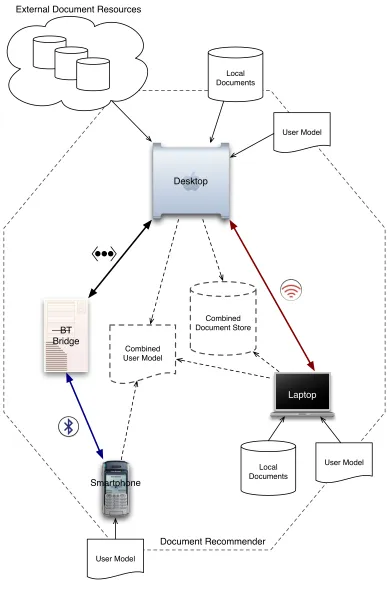
Figure 4.1 shows the intended design of the system. The four main devices are
shown together with the network connectivity arcs between each one. The three
user devices; the smart phone, the desktop and the laptop each have a user model
(this may be user preference information or context information). The laptop and
the desktop may have documents stored locally and the desktop may also have
access to external document stores, perhaps on the Internet. The document recom-mender system as a whole behaves as if it had access to one combined document
store and one combined set of user information.
A timetable of intended future work follows:
Date Target
December Implement underlying network layer
January Continue implementation of network layer
Construct domain-specific ontologies
February Construct set of task descriptions in OWL-S
Implement task execution engine
March Implement task substitution system
April Gather experimental results
May First draft of mini-thesis
June Continue work on mini-thesis
User Model
User Model Local
Documents
BT Bridge
Combined User Model
Combined Document Store
User Model Local
Documents
External Document Resources
Document Recommender
Laptop
Smartphone
[image:34.595.131.518.115.705.2]Desktop
Ankolekar A, Burstein M, Hobbs J R, Lassila O, Martin D, McDermott D,
McIlraith S A, Narayanan S, Paolucci M, Payne T & Sycara K (2002).
DAML-S: Web Service Description for the Semantic Web, inI Horrocks & J Hendler,
eds, The Semantic Web - ISWC 2002: First International Semantic Web
Conference, Springer-Verlag, p. 348.
Berners-Lee T, Hendler J & Lassila O (2001). The Semantic Web, Scientific American .
Chen H, Finin T & Joshi A (2003). An Ontology for Context-Aware Pervasive
Computing Environments, Special Issue on Ontologies for Distributed
Sys-tems, Knowledge Engineering Review .
Chen H, Tolia S, Sayers C, Finin T & Joshi A (2001). Creating Context-Aware
Software Agents, First GSFC/JPL Workshop on Radical Agent Concepts .
Coen M H (1998). Design Principles for Intelligent Environments, in Proceedings of the Fifteenth National Conference on Artificial Intelligence (AAAI-98).
Dale J & Mamdani E (2001). Open Standards for Interoperating Agent-Based
Systems, Software Focus 2(1), 1–8.
Gandon F L & Sadeh N M (2004). Semantic Web Technologies to Reconcile
Privacy and Context Awareness, Web Semantics Journal 1(3).
Heflin J & Hendler J (2001). A Portrait of the Semantic Web in Action, IEEE
Intelligent Systems 16(2), 54–59.
Hendler J (2001). Agents and the Semantic Web, IEEE Intelligent Systems 16(2), 30–37.
IETF (2004), ‘Extensible Messaging and Presence Protocol (xmpp) Charter’.
URL: http://www.ietf.org/html.charters/xmpp-charter.html
JabberD (2004), ‘jabberd project’.
URL: http://jabberd.jabberstudio.org/
JCP (2004), ‘The Java Community Process(SM) Program - JSRs: Java
Specific-ation Requests - detail JSR 82’.
URL: http://www.jcp.org/en/jsr/detail?id=82
Jennings N R (2000). On agent-based software engineering, Artificial Intelligence 117(2), 277–296.
Jennings N R (2001). An agent-based approach for building complex software
systems, Communications of the ACM 44(4), 35–41.
JSF (2004), ‘Jabber: Open Instant Messaging and a Whole Lot More, Powered
by XMPP’.
URL: http://www.jabber.org/
Kahn J M, Katz R H & Pister K S J (2000). Emerging Challenges: Mobile
Networking for “Smart Dust”, Journal of Communications and Networks 2(3), 188–196.
Lassila O, van Harmelen F, Horrocks I, Hendler J & McGuinness D L (2001). The
semantic Web and its languages, IEEE Intelligent Systems 15(6), 67–73.
Martin D, Paolucci M, McIlraith S, Burstein M, McDermott D, McGuinnes D,
Parsia B, Payne T, Sabou M, Solaki M, Srinivasan N & Sycara K (2004).
Bringing Semantics to Web Services: The OWL-S Approach,in Proceedings of
the First International Workshop on Semantic Web Services and Web Process
Composition (SWSWPC 2004), San Diego, California, USA.
McGuinness D L, Fikes R, Hendler J & Stein L A (2002). DAML+OIL: An
Onto-logy Language for the Semantic Web,IEEE Intelligent Systems17(5), 72–80.
Moreau L (2002). Agents for the Grid: a Comparison with Web Services (Part I:
Transport Layer), in K L H. E. Bal & A Reinefeld, eds, Second IEEE/ACM
International Symposium on Cluster Computing and the Grid (CCGRID
2002), IEEE Computer Society, IEEE Computer Society, pp. 220–228.
Pinsdorf U, Peters J, Hoffmann M & Gupta P (2002). Context-Aware Services based on Secure Mobile Agents, in N Rozic & D Begusic, eds, 10th
Interna-tional Conference on Software, Telecommunications & Computer Networks
Technology Republic of Croatia and University of Split, University of Split,
R. Boskovica, HR-21000 Split, Croatia, pp. 366–370.
Psi (2004), ‘Psi Jabber Client:: home’.
URL: http://psi.affinix.com/
Ramchurn S D, Deitch B, Thompson M K, Roure D C D, Jennings N R & Luck M
(2004). Minimising Intrusiveness in Pervasive Computing Environments using Multi-Agent Negotiation, in Proceedings of the First Annual International
Conference on Mobile and Ubiquitous Systems, Boston, Massachusetts.
Rom´an M, Hess C, Cerqueira R, Ranganathan A, Campbell R H & Nahrstedt
K (2002). A Middleware Infrastructure for Active Spaces, IEEE Pervasive
Computing .
Sadeh N M, Chan E & Van L (2002). MyCampus: An Agent-Based Environment
for Context-Aware Mobile Services, in AAMAS - First International Joint
Conference on Autonomous Agents and Multi-Agent Systems, ACM Press, Bologna, Italy.
Sashima A & Kurumatani K (2002). Seamless Context-Aware Information
As-sists Based on Multiagent Cooperation,in Proc. of The second International
Workshop on Agent-based Approaches in Economic and Social Complex
Sys-tems, pp. 39–46.
W3C (2004a), ‘OWL Web Ontology Language Overview’.
URL: http://www.w3.org/TR/owl-features/
W3C (2004b), ‘RDF Primer’.
URL: http://www.w3.org/TR/rdf-primer/
Weiser M (1993). Some Computer Science Issues in Ubiquitous Computing,
Com-munications of the ACM 36(7), 74–84.
Wooldridge M (2002). An Introduction to MultiAgent Systems, John Wiley &