9 783737 604628
ISBN 978-3-7376-0462-8kassel university
press
A Joint Meeting of the EUCARPIA Section
Organic and Low - Input Agriculture,
ECO - PB, DIVERSify, INSUSFAR, HealthyMinorCereals,
LIVESEED, ReMIX and Wheatamix
University of Kassel,
19
th– 21
stFebruary 2018
Witzenhausen
Abstract Booklet
SYMPOSIUM ON BREEDING
FOR DIVERSIFICATION
A Joint Meeting of the EUCARPIA Section, Organic and Low-Input Agriculture, ECO-PB, LIVESEED, INSUSFAR, DIVERSify, HealthyMinorCereals, ReMIX, and Wheatamix
University of Kassel, 19th–21st February 2018,
Witzenhausen, Germany
Editors
Jelena Baćanović-Šišić Dominic Dennenmoser
Maria R. Finckh
kassel
university
Scientific Committee
Prof. Dr. G. Backes, University of Kassel, Germany
Dr. J. P. Baresel, Technical University of Munich (TUM), Germany
Dr. Jérôme Enjalbert, Institut National de la Recherche Agronomique (INRA), France Prof. Dr. M.R. Finckh, University of Kassel, Germany
Prof. Dr. Lars Kiær, University of Copenhagen, Denmark
Prof. Dr. Edith Lammerts van Bueren, Louis Bolk Institute, The Netherlands Dr. Isabelle Litrico, Institut National de la Recherche Agronomique (INRA), France Dr. Monika Messmer, Research Institute of Organic Agriculture (FiBL), Switzerland
Local Organisers
Prof. Dr. Gunter Backes, University of Kassel, Germany Dr. Jelena Baćanović-Šišić, University of Kassel, Germany
Dr. Jörg Peter Baresel, Technical University of Munich (TUM), Germany Dominic Dennenmoser (M. Sc.), University of Kassel, Germany
Prof. Dr. Maria Finckh, University of Kassel, Germany
Bibliografische Information Der Deutschen Bibliothek
Die Deutsche Bibliothek verzeichnet diese Publikation in der Deutschen Nationalbib-liografie; detaillierte bibliografische Daten sind im Internet über http://dnb.dnb.de abrufbar
ISBN 978-3-7376-0462-8 (print) ISBN 978-3-7376-0463-5 (e-book)
DOI: http://dx.medra.org/10.19211/KUP9783737604635 URN: http://nbn-resolving.de/urn:nbn:de:0002-404632
© 2018, kassel university press GmbH, Kassel www.upress.uni-kassel.de
Recommended citation:
Contents
Foreword . . . vii The projects that teamed up for this symposium . . . ix Symposium Program . . . xv
Breeding for intra-species diversity 1
T1 Trait plasticity and G×E challenges when breeding for mixture-ideotypes– L. P. Kiær, and N. R. Boesen . . . 3 T2 Wheatamix: Increasing within-field wheat diversity to foster the
mul-tifunctionality and sustainability of wheat production in the Parisian basin– J. Enjalbert, V. Allard, B. Andrieu, et al. . . . 7
T3 Disease resistance of spelt wheat—results from the HealthyMinorCere-als project– V. Dumalasová, H. Buerstmayr, C. Cuendet, et al. . . . 10
T4 INSUSFAR: Innovative approaches to optimise genetic diversity for sustainable farming systems of the future. Inter-specific diversity of wheat for increased resilience and high yields and system specific adaptability– J. P. Baresel, G. Backes, J. Baćanović-Šišić, et al. . . . 13
T5 On-farm management as a tool to maintain diversity and to select superior genotypes– B. Horneburg, M. Ruland, B. Wedemeyer-Kremer, et al. . 16
P1 Modeling competition for light in wheat mixtures– E. Blanc, L. Thiaville, J. Enjalbert, et al. . . . 19
P2 Participatory approaches: Developing blending rules to design locally adapted cultivar mixtures– J. Borg, J. Enjalbert, and A. Gauffreteau . . . . 22
P3 Network for the dynamic management of winter barely genetic re-sources– L. Bülow, M. Nachtigall, and L. Frese . . . 25
P4 Estimation of mixing ability for variety mixtures: Statistical models and experimental results– E. Forst, J. Enjalbert, V. Allard, et al. . . . 27
P5 Application of molecular markers for plant breeding and variety inves-tigation and diversification– O. Kolesnyk, and A. Venger . . . 30
P7 Yield stability of barley mixtures and populations– I. Ločmele, L. Legzdiņa, Z. Gaile, et al. . . . 36
P8 Evolutionary-participatory breeding generates wheat populations adapted for organic agriculture in Italy– M. Petitti, R. Bocci, B. Bussi, et al. . . . . 39
P9 Future proofing decentralised evolutionary wheat populations’ seed systems in Italy using a climate analogues approach: The example of Tuscany– M. Petitti, R. Bocci, B. Bussi, et al. . . . 42
P10 Mixing susceptible and resistant wheat cultivars with contrasted stem height can reduce progression of disease dispersed by rain-splash– T. Vidal, A. L. Boixel, C. Gigot, et al. . . . 45
P11 Management histories of wheat composite cross populations (CCPs) drive yield in two tillage systems– J. H. Schmidt, O. Weedon, and M. R. Finckh 48
P12 A participatory approach to breeding for diverse and adapted wheat mixtures on farm– G. van Frank, P. Riviere, and I. Goldringer. . . 51
P13 Molecular-genetic polymorphism of glycinin encoding genes in Ukrainian and Serbian soybean varieties– A. Venger, O. Kolesnyk, and N. Volvkova . 54
P14 Intra-specific diversity of wheat composite cross populations (CCPs) maintains yield in a low input system – O. Weedon, J. H. Schmidt, and M. R. Finckh . . . 56
Breeding for inter-species diversity annual crops 59
T6 Learning from nature: A below-ground perspective on plant-plant interactions in diverse grassland communities– L. Mommer . . . 61
T7 Participatory designing of Pigeon pea (Cajanus cajan (L.) Millsp.) ideotypes for adaptation to various cropping systems in Benin– M. A. T. Ayenan, and A. Danquah . . . 64
T8 Breeding for mixed cropping and Anthracnose resistance of lupins– C. M. Arncken, P. Hohmann, and M. Messmer . . . 67
T9 Breeding for mixtures in organic farming systems: Are the traits of pure wheat cultivars predictive of their behaviour in wheat-pea mixtures?– N. Moutier, C. Fintz, F. Boissinot, et al. . . . 70
P16 Effects of organic and conventional management for five years on early seedling traits of three winter wheat composite cross populations– A. V. Vijaya Bhaskar, A. Jäkel, J. P. Baresel, et al. . . . 75
P17 Overview SRUC related research on breeding for diversity– P. Hoebe, S. Hoad, H. Creissen, et al. . . . 78
P18 Assembling rules for the control ofAscochytablight in winter wheat/pea mixtures– S. Jumel, C. Langrume, A. Moussart, et al. . . . 79
P19 Effects of agrobiodiversity on pest control inVicia fabaL.– S. Pappagallo, J. Brandmeier, and C. Scherber. . . 82
P20 Winter faba bean as target species in mixed-cropping with winter wheat– D. Siebrecht-Schöll , R. Martsch, and W. Link. . . 84
P21 Effect on durum wheat and quality parameters of mixed intercropping with faba bean– S. Tavoletti, S. Cocco, and G. Corti. . . 87
Breeding for inter-species diversity perennial crops/agroforestry 91
T10 Integrating diversification in short food and energy chains– M. S. Wolfe 93
T11 Breeding for forage mixtures: Synthesis and prospects from theoretical and empirical approaches– C. Firmat . . . 97
T12 Traditional agroforestry systems and options of crop-tree combinations, with focus on conservation of native species– A. L. Cadena-González, and T. Butschard . . . 99
Documentation of diversity breeding 101
T13 Documentation of diversity breeding: The Information system RO-BUSTUM– L. Bülow, S. Unger, and L. Frese . . . 103
General concepts for breeding on improved diversity 105
T14 Interspecific competition experiments aimed to define breeding strate-gies– P. Annicchiarico . . . 107
T16 The relation of intragenotypic, intra- and inter-specific competition and related canopy architecture traits– S. Knapp, M. Parzefall, and J. P. Baresel . . . 111
T17 The cropping system matters—contrasting responses of winter faba bean genotypes to drought stress– A. Lingner, K. Dittert, and B. Pfeiffer . 115
T18 HealthyMinorCereals: An integrated approach to diversify the genetic base, improve stress resistance, agronomic management and nutri-tional / processing qualitiy of minor cereal crops for human nutrition in Europe– D. Janovská, M. Hutař, V. Chour, et al. . . . 118
P22 Marketing of a genetically diverse wheat (ORC Wakelyns population): Lessons learnt and routes forward– C. Bickler, A. Costanzo, and B. Pearce 122
P23 High-throughput sorting of coloured wheat grains– S. Knapp, O. Hancer, and E. Tengstrand . . . 125
P24 Modulation of three-dimensional structure and research of folding-analoges of AMB A 6 allergen of Ambrosia artemisiifolia– A. Venger, O. Kolesnyk, S. Pasternak, et al. . . . 127
Foreword
The knowledge that diversity in agroecosystems increases stability and resilience is age old and the beginning of breeding for diversity go back to the early 20th
century. Species-rich systems often show higher productivity than monocultures, reduced pest and disease severity, improved resource capture, and greater resilience to environmental fluctuations. However, it is only since the 1980s that some work on within-crop diversification other than the use of mixtures and multi-lines has regained momentum. Since the beginning of this century, there has been an increasing interest in the scientific community in Europe and worldwide in the opportunities in breeding for diversity. Starting with some more or less well financed national projects on population breeding in the UK, France and the USA, often accompanied by participatory breeding, the number of national and international projects addressing issues of breeding for diversity has increased in the last two decades.
One culmination of the recent efforts is the EU Commission implementing decision 150 of March 2014 ‘on the organisation of a temporary experiment providing for certain derogations for the marketing of populations of the plant species wheat, barley, oats and maize pursuant to Council directive 66/402/EEC’1. In
the directive, rules are set as to what populations are. For example, at least five genotypes have to be crossed pairwise and the progeny bulked and exposed to natural selection (Vollenweider and Spieß 2018). In addition, rules are set with respect to the amount that may be marketed and there are requirements of traceability.
The possibility to make use of populations legally and the recognition of the need for diversity at all levels has resulted in a significant increase in research efforts. Throughout Europe several current projects have emerged that are working towards breeding for diversity or for greater diversification of agroecosystems. For this first EUCARPIA Section Organic & Low-input Agriculture symposium on Breeding for Diversification, four current EU, one French, and one German project that are engaged in related activities have teamed up. These six projects all have different specific aims and deal with various crops and they are presented in brief below. The overall common view is that for agricultural systems of the future, increased diversity at all levels, from the microorganisms up to the landscape will be crucial in order to be able to reduce inputs and to stabilise—and potentially even increase—overall system productivity.
We are very happy that in this symposium researchers from a multitude of countries around the world are coming together in order to discuss issues about breeding for intra- and inter-specific diversity as well for annuals as for perennials. The submitted abstracts show that the activities are far wider than just the cereals
that are covered by the EU directive and that there will be a need to expand the activities on the legal side.
We hope that this symposium and the following EUCARPIA/EC-PB session on practical organic breeding as well as the LIVESEED/EUCARPIA/ECO-PB workshop on new concepts and strategies on 21stFebruary. will help to bring together some of
the many persons interested in breeding for diversity and to show the many different aspects that have to be considered depending on crop, aims, and the social systems concerned. Diversity in approaches and solutions is needed as this is the principle of diversification that there is no one size fits all approach.
We wish you a wonderful symposium with many interesting and inspiring inter-actions from concepts to practical applications and also on a very personal level. Inspiration in Science as everywhere in life is a personal and interactive process and we hope that we have been able to create a space for this.
G. Backes, J. P. Baresel, J. Enjalbert, M. R. Finckh, L. P. Kiær, E. Lammerts van Bueren, I. Litrico, M. Messmer
References
The projects that teamed up for this symposium
LIVESEED with the full title ‘Improving the per-formance of organic agriculture by boosting or-ganic seed and plant breeding efforts across Europe’ (www.liveseed.eu) is based on the concept that culti-vars adapted to organic systems are key for realising the full potential of organic agriculture in Europe. The LIVESEED project (2017–2021) is coordinated by IFOAM EU with FiBL for sci-entific coordination and consists of 35 partners and 14 third linked parties from 18 European countries. This project receives funding from the European Union’s Horizon 2020 research and innovation program under grant agreement No 727230 and by the Swiss State Secretariat for Education, Research and Innovation under contract number 17.00090.
LIVESEED will help to establish a level playing field in the organic seed market across Europe, improve the competitiveness of the organic seed and breeding sector, and encourage greater use of organic seeds by farmers. LIVESEED will improve guidelines for cultivar testing and strategies for ensuring seed health. It will develop innovative breeding approaches suited to organic farming. Finally, it will investigate socio-economic aspects relating to the use and production of organic seed and their interaction with relevant (EU) regulations.
By connecting several networks LIVESEED will combine co-construction and exchange of knowledge integrating biological, technical, legal, organisational, financial and political aspects as well as market development to facilitate fast upscaling and outreach of various tailor made socio-technical, evidence based, innovation tracks. LIVESEED will generate (i) a tool box of measures and interventions tomatch production and demand of organic seed, (ii) validated options for competent authorities to reduce the number of derogation for untreated conventional seed, (iii) technical solutions for national databases of organic seed including an interface to a European wide router database to ease data entry for seed producers, (iv) in depth analysis of formal and informal seed chains, (v) various business models including checklists for setting up new multiplication and breeding initiatives, (vi) technical factsheet on the best practice of seed production for major crops including vegetative plant propagation material, and (vii) an organic seed quality strategy including quality control of farm saved seeds and efficiency of seed exchange networks.
and molecular breeding approaches, (iii) identifying trade-offs between resilience traits and sensoric and nutritional quality, (iv) developing breeding schemes for heterogeneous cultivars and species mixtures, and (v) elaborating different financing models. Considering the plant as a mega organism, including the above and below ground associated microorganism, has the potential to evoke a paradigm shift in plant breeding, and will be elucidated in case studies.
INSUSFAR stands for ‘Innovative approaches to optimise genetic diversity for sustainable farming systems of the fu-ture’. It is a cooperative research project, funded by the German Ministry for Education and Research (BMBF, 2015–2020) in the frame of the funding initiative ”Innovative Pflanzenzüchtung im Anbausystem” (IPAS, Plant Breeding innovations in the Farming System). The Project is being performed jointly by the Technical University of Munich, The University of Kassel and the Julius-Kühn-Institut (www.insusfar.de).
Sustainable agricultural systems will need an excellent capacity for self-regulation and self-regeneration to allow for overall reduced external inputs while maintain-ing or increasmaintain-ing overall system output includmaintain-ing delivery of ecological services. Biodiversity at all levels is a major system component allowing for efficient self-regulation. However, there is a lack of knowledge about the optimum level of diversity needed for high yield and yield stability, while at the same time achieving maximum self-regulation and self-regeneration to reduce the necessary inputs in a given agricultural system.
DIVERSify (2017-2021), ‘Designing InnoVative plant teams for Ecosystem Resilience and agricul-tural Sustainability’ (www.plant-teams.eu) is a four-year project funded by the European Union’s Horizon 2020 research and innovation programme under grant agreement No. 727284. The multi-disciplinary con-sortium consists of 23 beneficiary partners, involving scientists, participatory farmers, advisors, breeders, and technology providers. These are located across diverse pedo-climatic conditions in Europe, and including international partners in Kenya, Palestine and the dry regions (Lebanon, Morocco).
The project aims to develop a novel system for sustainable food production, combining stakeholder expertise, scientific knowledge and farm technology to enhance the productivity, stability and resilience of legume-cereal and species-rich grassland mixtures (combined: ‘plant teams’). A novel approach is taken, using ecological theory to explore the associations between plant trait diversity and beneficial mechanisms within these agroecosystems.
Building on knowledge and best practice of innovative practitioners, field trials and modelling are used to optimise trait diversity and identify variety and species com-binations that optimise agronomic, environmental and socio-economic performance parameters under conventional and reduced input management across Europe and beyond. Promising plant teams will be demonstrated and validated on field-scale by participatory farmers in diverse pedo-climatic conditions, along with potential new technology. Project outputs include an open data infrastructure on crop plant traits and plant team performance, a decision aid for agronomists and farming practitioners to select suitable plant teams for the current and future climatic conditions in their region, adaptations and/or re-purposing of farm implements for agritechnologists and farmers for plant team management (including PAT), as well as novel tools and concepts to support breeders and crop scientists in plant team optimisation.
HealthyMinorCereals is an acronym for ‘An integrated approach to diversify the genetic base, improve stress resistance, agronomic management and nutritional / processing quality of minor cereal crops for human nu-trition in Europe’. It is an FP7 cooperative project involving sixteen partici-pants from ten European/Associated countries: Austria, Czech Republic, Estonia, Germany, Greece, Hungary, Poland, Switzerland, Turkey and the United King-dom.
conditions. This both lead to a reduction of diversity within these crops as well as well as on the level of the distribution of crops in the cultivated area, resulting in low resilience to the changing climatic conditions. The higher variance of yield from year to year is the consequence of this development. On the other hand, minor cereals have retained their ability to grow under more stressful and low-input conditions. Furthermore, they have a higher concentration of micronutrients and other interesting features for a healthy diet.
The main objective of the project is enhancing the exploitation of five of the so-called ’minor cereal’ species—spelt, rye, oat, einkorn, and emmer. On the genetic level, the available germplasm of spelt, rye, oat, einkorn, and emmer, as well as of wheat wild relatives, are analysed for genetic structure and diversity in order to better exploitation of these resources. On the phenotypic level, comprehensive phenotyping for yield, resistance to important fungal diseases, nutrient use efficiency and quality is carried out in multi-locus field trials. Further, the content of micronutrients, phenolic and antioxidant content, as well as harmful / anti-nutritive components, are analysed in a large set of genotypes of different minor cereals. On the level of processing, milling is optimised; food preparation methods and novel products are developed for higher consumer acceptance, processability and stability. In order to analyse and improve the use of minor cereals and the acceptance of the respective products, demonstration fields for farmers, market analyses and other dissemination activities are part of the project.
ReMIX (EU H2020: 2017-2021) stands for ‘Redesigning European cropping sys-tems based on species MIXtures’ (www. remix-intercrops.eu). The goal is to exploit the benefits of species mixtures (cereal and legume) to design productive, diversified, resilient and environmentally friendly agro-ecological crop-ping systems less dependent on external inputs than current systems and acceptable to farmers and actors in the agri-food chain. Species mixtures enhance water and nutrient use efficiency and improve the control of pests, diseases and weeds, while increasing crop productivity and resilience to biotic and abiotic stresses, including those triggered by climate change.
WHEATAMIX stands for ‘Studying Wheat cultivar Mixtures to assess the impact of within-crop genetic diversity on the multi-functionality and resilience of cropping sys-tems under global change’. The project is based on a highly multidisciplinary approach, involving geneticists, agronomists, ecophysiol-ogists, ecolecophysiol-ogists, economists and management scientists, with a consortium composed of 10 French research labs, as well as key stakeholders (6 Chambres d’Agriculture, farmers: www.inra.fr/wheatamix).
Increasing within-field diversity through the use of cultivar mixtures is a timely option, testified by some significant ‘success stories’ in the past, and recent bibliographic reviews. Yet, cultivar mixtures are poorly developed worldwide. In this context, the Wheatamix project studies the interest of mixing wheat genotypes to reinforce the sustainability, resilience, and multi-functionality of agriculture. Analysing the interactions among genotypes and with the environment, Wheatamix develops new blending and breeding methods to obtain performing mixtures. Complementary experimental approaches are being deployed: (i) a diversity experiment to quantify the effects of wheat diversity on ecosystem services; (ii) replicates of the same diversity experiment in 4 sites across France under low and high inputs, to test diversity effects under a wide range of soil and climate conditions; (iii) a network of 30 farms, encompassing agro-climatic variability in the Paris basin, to compare the ecological and techno-economic performance of blends and monocultures; (iii) a socio-economic study based on interviews of the wheat supply chain, to characterise the organisational and economic impact of this practice.
Symposium Program
Monday 19. February 2018
13.00–14.00: Registration for Symposium
14.00–16.45: Breeding for intra-species diversity
14.00: Welcome to the Symposium 14.05–14.15: Beat Boller for EUCARPIA
14.15–14.55: Lars Kiær, University of Copenhagen (DK): Trait plasticity and G×Echallenges when breeding for mixture-ideotypes
14.55–15.15: Enjalbert et al.: WHEATAMIX: increasing within-field wheat diversity to foster the multi-functionality and sustainability of wheat production in the Parisian
15.15–15.45: Coffee break
15.45–16.05: Dumalasová et al.: Disease resistance of spelt wheat–results from the HealthyMinorCereals project
16.05–16.25: Baresel et al.: INSUSFAR: Innovative approaches to optimise genetic diversity for sustainable farming systems of the future. Intra-specific diversity of wheat for increased resilience and high yields and system specific adaptability
16.25–16.45: Horneburg et al.: On-farm management as a tool to maintain diversity and to select superior genotypes
16.45–18.00: Guided poster session on intra-species diversity
18.00–20.00: Diner and social gathering
Tuesday 20. February 2018
9.00–11.30: Breeding for inter-species diversity annual crops
9.00–9.40: Liesje Mommer, Wageningen University (NL): Lessons for agriculture: below-ground insights from biodiversity experi-ments
9.40–10.00: Ayenan et al.: Participatory designing of pigeon pea (Cajanus cajan(l.) Millsp.) ideotypes for adaptation to various cropping systems in Benin
10.20–10.40: Moutier et al.: Breeding for mixtures in organic farming sys-tems: are the traits of pure wheat cultivars predictive of their behaviour in wheat-pea mixtures?
10.40–11.30: Coffee and guided poster session on inter-species diversity
11.30–12.15: Documentation of diversity breeding
Bülow et al.: Documentation of diversity breeding: The Infor-mation system ROBUSTUM
12.15–13.15: Lunch
13.15–14.55: Breeding for inter-species diversity perennial crops / agrof̈orestry
13.15–13.55: Martin Wolfe, Wakelyns Agroforestry (UK): Maximising di-versification at the agricultural end of short food and energy chains
13.55–14.35: Cyril Firmat, INRA Lusignan (FR): Breeding for mixtures: va-rieties of approaches, opportunities and limitations
14.35–14.55: Cadena González et al.: Traditional agroforestry systems and options of crop-tree combinations, with focus on conservation of native species
14.55–15.25: Coffee break
15.25–18.00: General concepts for breeding on improved diversity
15.25–16.05: Paolo Annicchiarico, Centro di Zootecnia e Acquacoltura (CREA-ZA) Lodi (IT): Interspecific competition experiments aimed to define breeding strategies
16.05–16.45: Jacob Weiner, University of Copenhagen (DK): The concept of ideotypes in a crop mixtures context
16.45–17.05: Knapp et al.: The relation of intra-genotypic, intra- and inter-specific competition and related canopy architecture traits
17.05–17.25: Lingner et al.: The cropping system matters—contrasting re-sponses of winter faba bean genotypes to drought stress
17.25–17.45: Janovská et al.: An integrated approach to diversify the genetic base, improve stress resistance, agronomic management and nutritional/processing quality of minor cereal crops for human nutrition in Europe
17.45–18.00: Edith Lammerts van Bueren summarising the Symposium
Wednesday 21. February 2018
9.00–17.00: Organic breeder’s day
9.00–10.30: Open EUCARPIA/ECO-PB Session on Practical organic breeders presentation (invited speakers only)
10.30–11.00: Coffee break
11.00–12.00: Open EUCARPIA/ECO-PB Session on Practical organic breeders presentation (invited speakers only)
12.00–13.00: Lunch
13.00–14.00: Introduction to the concept of systems-based breeding by Edith Lammerts van Bueren
14.00–14.20: Group work to apply concept on your own breeding activities
14.20–15.20: World Café (3 × 20 min)
15.20–15.40: Coffee break
15.40–16.10: Presentation World Café results
Trait plasticity and G×E challenges when
breeding for mixture-ideotypes
L. P. Kiær*, N. R. Boesen
Department of Plant and Environmental Sciences, University of Copenhagen, Denmark
Introduction
Plant traits are increasingly being utilised for designing crop mixtures that enhance benefits and services such as improved resource use efficiency, pest and pathogen management and yield stability. Recent efforts to devise mixture ideotypes, as-sembly rules and mixture breeding design (e. g. Litrico and Violle 2015) are good examples. Being inspired partly by philosophies and findings of the widely successful large-scale biodiversity experiments (e. g. Scherber et al. 2010), these trait-based approaches aim to embrace plant community complexity at levels beyond the assignment of general genotypic traits for mixing ability and competitiveness. To be successful, they should ultimately be able to predict and optimise ecological interactions between contrasting crop components under given environmental conditions based on a diverse array of phenotypic traits (Kiær et al. 2012; Mille et al. 2006).
Studies using the morphological, physiological and phenological properties of genotypes to design specific crop diversity have mainly obtained this information from monoculture trials and experiments. Yet, it is extremely well-documented that most plant traits are characterized by a certain level of plasticity in response to the perceived environment. The phenotypic plasticity that enables plants to adapt to a range of growing conditions also shapes their ecological niche in the community (Berg and Ellers 2010), and ultimately, govern the yield stability of agricultural crops (Lazzaro et al. 2017). Although past breeding may have somewhat reduced the plasticity of modern temperate crop varieties (Gage et al. 2017), significant levels of crop trait plasticity are reported on a regular basis (e. g. Kumar et al. 2017), also in response to mixing (Zuh et al. 2016).
Material and Methods
grain legume-cereal intercrops in low-input and conventionally managed field trials. Mixed-effects models were used to test for trait plasticity (factor: diversity level) and its dependence on neighbour identity (interaction factor: neighbour variety) and management (interaction factor: input level).
Results and Discussion
The level of plasticity differed considerably among traits, species and mixture types. As an example, plant traits of both species in a pea-barley intercrop changed significantly when grown in a mixture. Pea plants responded by having shorter stems, lower biomass, thicker leaves (smaller specific leaf area), and fewer reproductive nodes, but higher total biomass of reproductive organs (close-to-significant). Barley plants grew taller, produced more tillers and consequently more heads and higher leaf biomass, as well as a higher chlorophyll content. The mixing response of the two species differed for a majority of traits, whereas varieties within each species generally responded similarly to mixing. Some significant neighbour effects were found as well. Comparisons between high- and low-input treatments will be made. The results suggest that trait plasticity in response to mixing is larger in legumes than in cereals. Our findings support that plasticity in key diversified traits can contribute to complex Genotype × Genotype × Environment × Management interactions. This challenges the framework used to design and breed for optimal phenotype combinations in the field, pointing to several implications. First, a better understanding of crop trait plasticity in general, and in crop mixtures specifically, is vital in order to define appropriate evaluation methods when breeding for mixtures. Second, the much-desired benefits and services from growing crop mixtures may not be optimal based on monoculture information alone. Third, the finding of ‘neighbour effects’ suggests that breeding strategies and assembly rules used to obtain mixture-ideotypes must consider various sources of trait plasticity; even genotypes bred within a mixture are likely to interact and perform differently in a different neighbourhood.
Fourth, the complex responses and interactions between mixing partners suggests that it is unlikely to identify genetic markers contributing substantially to general ‘mix-ability’.
conspecifics?’, and ‘Should trait plasticity considerations have direct influence on fundamental management decisions such as fertilisation, sowing density and genotype proportions?’.
Acknowledgments
This work was financially supported by the European Union’s Horizon 2020 research and innovation programme under grant agreement No. 727284, and by the Danish Green Development and Demonstration Programme under grant No. 34009-14-0800.
References
Berg, M. P. & Ellers, J. (2010). Trait plasticity in species interactions: A driving force of community dynamics.Evolutionary Ecology,23(3), 617–629. doi:10.1007/s10682-009-9347-8. (Cit. on p. 3)
Gage, J. L., Jarquin, D., Romay, C., Lorenz, A., Buckler, E. S., Kaeppler, S., Alkhalifah, N., Bohn, M., A, D., Campbell, Edwards, J., Ertl, D., Flint-Garcia, S., Gardiner, J., Good, B., Hirsch, C. N., Holland, J., Hooker, D. C., Knoll, J., Kolkman, J., Kruger, G., Lauter, N., Lawrence-Dill, C. J., Lee, E., Lynch, J., Murray, S. C., Nelson, R., Petzoldt, J., Rocheford, T., Schnable, J., Schnable, P. S., Scully, B., Smith, M., Springer, N. M., Srinivasan, S., Walton, R., Weldekidan, T., Wisser, R. J., Xu, W., Yu, J., & de Leon, N. (2017). The effect of artificial selection on phenotypic plasticity in maize. Nature Communications, 8, 1348. doi:10.1038/s41467-017-01450-2. (Cit. on p. 3)
Kiær, L. P., Skovgaard, I. M., & Østergård, H. (2012). Effects of inter-varietal diversity, biotic stresses and environmental productivity on grain yield of spring barley variety mixtures.Euphytica,185, 123–138. doi:10.1007/s10681-012-0640-1. (Cit. on p. 3) Kumar, U., Laza, M. R., Soulié, J.-C., Pasco, R., Mendez, K. V., & Dingkuhn, M. (2017). Analysis and simulation of phenotypic plasticity for traits contributing to yield potential in twelve rice genotypes. Field Crops Research, 202, 94–107. doi:10.1016/j.fcr.2016.04.037. (Cit. on p. 3)
Lazzaro, M., Costanzo, A., Farag, D. H., & Bàrberi, P. (2017). Grain yield and competitive ability against weeds in modern and heritage common wheat cultivars are differently influenced by sowing density.Italian Journal of Agronomy,12(4), 901. doi:10.4081/ ija.2017.901. (Cit. on p. 3)
Litrico, I. & Violle, C. (2015). Diversity in pant breeding: A new conceptual framework.
Trends in Plant Science, 20(10), 604–613. doi:10.1016/j.tplants.2015.07.007. (Cit. on p. 3)
Scherber, C., Eisenhauer, N., Weisser, W. W., Schmid, B., Voigt, W., Fischer, M., Schulze, E.-D., Roscher, C., Weigelt, A., Allan, E., Beßler, H., Bonkowski, M., Buchmann, N., Buscot, F., Clement, L. W., Ebeling, A., Engels, C., Halle, S., Kertscher, I., Klein, A.-M., Koller, R., König, S., Kowalski, E., Kummer, V., Kuu, A., Lange, M., Lauterbach, D., Middelhoff, C., Migunova, V. D., Milcu, A., Müller, R., Partsch, S., Petermann, J. S., Renker, C., Rottstock, T., Sabais, A., Scheu, S., Schumacher, J., Temperton, V. M., & Tscharntke, T. (2010). Bottom-up effects of plant diversity on multitrophic interactions in a biodiversity experiment.Nature, 468, 553–556. doi:10.1038/nature09492. (Cit. on p. 3)
Wheatamix: Increasing within-field wheat
diversity to foster the multifunctionality and
sustainability of wheat production in the
Parisian basin
J. Enjalbert1*, V. Allard2, B. Andrieu3, S. Barot4, L. Bentze5, J. Borg1, A.
Cantarel6, F. Coleno7, C. de Vallavieille-Pope8, D. Descoureaux9, D. Dezette10,
M. Feret11, A. Fugeray-Scarbel12, N. Garlic1, A. Gauffreteau13, J. D. Gilet14, I.
Goldringer1, C. Goussault9, M. Hannachi7, G. Houivet11, P. Hinsinger10, M.
Hugoni6, S. Jouanne1, M. H. Jeuffroy13, C. Kerbiriou5, P. Labarthe7, J. C. Lata4,
X. Le Roux6, C. Lecarpentier1, M. Leconte8, L. Lejars15, B. Lemain14, S.
Lemarié12, F. Leny16, I. Le Viol5, P. Lusley3, E. Milicourtois4, C. Montagnier5, A.
Niboyet4, B. Omon16, S. Piaud17, S. Pin1, T. Pommier6, E. Porcher5, S.
Saint-Jean3, S. Salmon5, D. Tropée1, A. Vergnes5, T. Vidal3
1 Génétique Quantitative et Evolution – Le Moulon, INRA, Univ. Paris-Sud, CNRS, AgroParisTech, Université Paris-Saclay, Gif-sur-Yvette
2 UMR Génétique Diversité et Ecophysiologie des Céréales - 5 chemin de Beaulieu 63100 Clermont-Ferrand
3 UMR Environnement et Grandes Cultures - Route de la Ferme, 78850 Thiverval-Grignon 4 UMR IEES-Paris (IRD, CNRS, UPEC), 7 quai Saint Bernard, 75005 Paris
5 UMR Centre d’Ecologie et de Sciences de la Conservation – MNHN, 61 rue Buffon 75005 Paris
6 Ecologie Microbienne de Lyon - Univ. Lyon 1 43 Bd du 11 Novembre 1918, 69622 Villeurbanne
7 7UMR Sciences Action Développement Activités Produits Territoires - Bât. EGER BP01 78850 Thiverval-Grignon
8 UMR Biologie et Gestion des Risques en Agriculture - Bât. BIOGER CPP avenue Lucien Brétignières BP0178850 Thiverval-Grignon
9 Chambre d’Agriculture du Loir-et-Cher-11 Rue Louis Joseph Philippe 41000 Blois 10 UMR EcoSol Campus SupAgro, 2 place Viala 34060 Montpellier
11 Chambre d’Agriculture de l’Indre-24 Rue des Ingrains 36000 Châteauroux 12 UMR Laboratoire d’Economie Appliquée de Grenoble (UMR 1215) – Univ. Pierre
Mendès France BP47 38040 Grenoble Cedex 09
13 UMR Agronomie (UMR 0211)-Bât. EGER avenue Lucien Brétignières 78850 Thiverval-Grignon
14 FDGEDA du Cher-2701 Route d’Orléans 18230 St Doulchard, Paris
15 Chambre d’Agriculture du Loiret-21 Bis Rue des Hauts Champs 45380 Chapelle St Mesmin
16 Chambre d’Agriculture de l’Eure-5 rue de la Petite Cité BP 882 27008 Evreux 17 Chambre d’Agriculture de Seine et Marne-418 rue Aristide Briand 77350
Le-Mée-Sur-Seine
Introduction
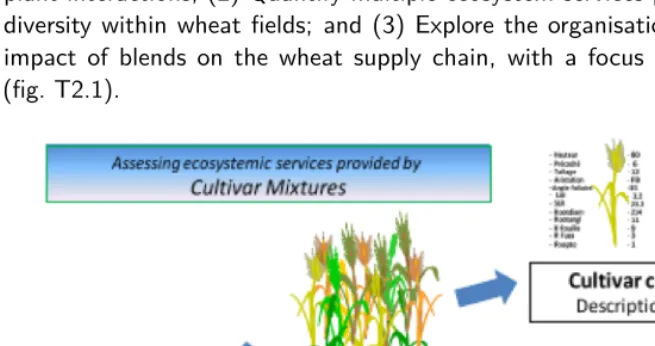
[image:27.595.100.428.352.525.2]Among the major changes needed to increase agricultural sustainability, one key lever is to better mobilise crop genetic diversity. Increasing within field diversity through the use of cultivar mixtures is a timely option, testified by some significant ‘success stories’ in the past, and recent bibliographic reviews. Yet, cultivar mixtures are poorly developed worldwide. In this context, Wheatamix project studies the interest of mixing wheat genotypes to reinforce the sustainability, resilience, and multi-functionality of agriculture. Analysing the interactions among genotypes and with the environment, Wheatamix aims to better understand the impact of intra-specific diversity on various ecosystemic services, and to develop new blending and breeding methods to obtain performing mixtures. Wheatamix is based on a highly multidisciplinary approach, involving geneticists, agronomists, ecophysiologists, ecologists, economists and management scientists, as well as key stakeholders (Chambres d’Agriculture, farmers). It is based on three complementary research axes: (1) Characterise key morphological / ecophysiological traits and genetic variability of wheat genotypes to test how trait variability affects plant to plant interactions; (2) Quantify multiple ecosystem services provided by variety diversity within wheat fields; and (3) Explore the organisational and economic impact of blends on the wheat supply chain, with a focus on the Paris basin (fig. T2.1).
Figure T2.1:The three main research axes developed by the Wheatamix project.
Material and Methods
sites across France under low and high inputs, to test diversity effects under a wide range of soil and climate conditions; (iii) a network of 50 farms, encompassing agro-climatic variability in the Paris basin, allowing to co-design mixtures and to compare the performances of blends and monocultures; (iv) interviews of a representative panel of actors (from breeders to millers) to study the organisational and economic impact of mixtures on the wheat supply chain.
Results and Discussion
Wheatamix experiments revealed different ecosystem services provided by genetic diversity (yield stability and better nitrogen use; foliar diseases control; aphid pre-dation, or soil nitrification). The project contributed to important methodological issues when analysing: (i) synergies and compromises between ecosystem services; (ii) the role of varietal diversity on multi-service delivery; (iii) link between key varietal traits and basket of services produced. Finally, the Wheatamix project exemplifies the original outcomes provided by highly pluridisciplinary approaches, especially crucial when addressing agroecological issues.
Acknowledgements
This work was funded by the ANR WHEATAMIX project, grant ANR-13-AGRO-0008 of the French National Research Agency, and by INRA Metaprogram EcoServ (SolFaMi project), by ANR Labex BASC, and by the Région Ile-de-France (PICRI 2015-2017).
References
Barot, S., Allard, V., Cantarel, A., Enjalbert, J., Gauffreteau, A., Goldringer, I., Lata, J.-C., Le Roux, X., Niboyet, A., & Porcher, E. (2017). Designing mixtures of varieties for multifunctional agriculture with the help of ecology.Agronomy for Sustainable Development,37, 13. doi:10.1007/s13593-017-0418-x
Disease resistance of spelt wheat—results from
the HealthyMinorCereals project
V. Dumalasová1*, H. Buerstmayr2, C. Cuendet3, F. Dell’Avo4, B. Eshonkulov2, H.
Grausgruber5, R. Koppel6, A. E. Muellner2, V. Weyermann3, A. E.
Muellner1
1 Crop Research Institute, Praha 6 – Ruzyně, Czech Republic 2 BOKU, Vienna, Department IFA Tulln, Tulln/Donau, Austria
3 Getreidezüchtung Peter Kunz Deutschland gGmbH, Meissner, Germany 4 Getreidezüchtung Peter Kunz, Feldbach, Switzerland
5 BOKU, Vienna, Department of Crop Sciences, Tulln/Donau, Austria 6 Estonian Crop Research Institute, Jõgeva, Estonia
Introduction
Nowadays only three major species make up the majority of cereal food and feed. With this low diversity in cereal production there is a much greater likelihood of production limitations from biotic stresses. Disease resistance is an important and effective component of sustainable cereal production, because it minimises the need for pesticide application and problems associated with pesticide resistance and environmental pollution. The minor species spelt wheat (Triticum spelta L.) was investigated for disease resistance traits as a first step of utilising ex-situ germplasm collections of spelt wheat in today’s agriculture.
Material and Methods
A panel of 80 genotypes of winter spelt wheat was established within the framework of the FP7 project HealthyMinorCereals and evaluated for the resistance to yellow rustPuccinia striiformis Westend., common bunt Tilletia caries (D. C.) Tul. & C. Tul. (syn. T. tritici (Bjerk.) G. Winter andT. laevis J. G. Kühn (syn. T. foetida
(Wallr.) Liro., and Fusariumhead blight (FHB) Fusarium graminearumSchwabe,
F. culmorum (Wm.G. Sm.) Sacc.
Resistance to yellow rust was evaluated in experiments artificially infected with currently appearing races, and in trials with natural infection. The visual symp-toms on plants were evaluated according to the methods of Bundessortenamt (Beschreibende Sortenliste 2012).
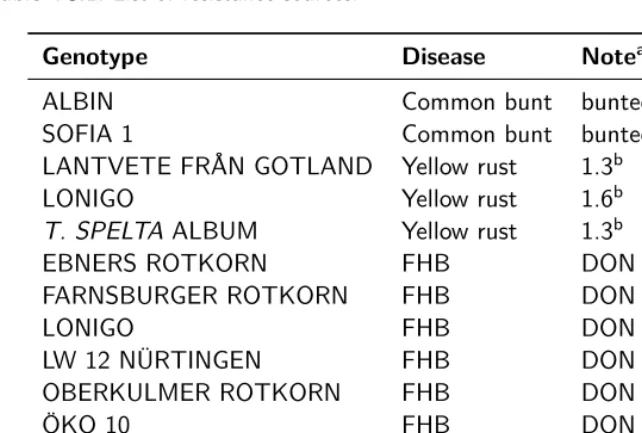
Genotype Disease Notea
ALBIN Common bunt bunted ears 0.64 % SOFIA 1 Common bunt bunted ears 0.34 % LANTVETE FRÅN GOTLAND Yellow rust 1.3b
LONIGO Yellow rust 1.6b
T. SPELTA ALBUM Yellow rust 1.3b
EBNERS ROTKORN FHB DON 3.0 mg kg−1
FARNSBURGER ROTKORN FHB DON 2.8 mg kg−1
LONIGO FHB DON 2.3 mg kg−1
LW 12 NÜRTINGEN FHB DON 2.6 mg kg−1
OBERKULMER ROTKORN FHB DON 3.1 mg kg−1
ÖKO 10 FHB DON 3.1 mg kg−1
RINIKER WEISSKORN FHB DON 2.8 mg kg−1
TOESS 6D FHB DON 3.4 mg kg−1
T. SPELTA KROMERIZ FHB DON 2.9 mg kg−1
a DON results are preliminary;bScale 1–9, 1: resistant, 9: susceptible.
10 % spikes infected) or susceptible reaction (11 to 100 % spikes infected) was determined in June / July.
Fusarium head blight symptoms were evaluated in three terms after artificial infection with F. culmorum or F. graminearum. The resistance was evaluated also in condition of natural infection after maize as a preceding crop and reduced tillage. Grain samples were analysed for deoxynivanol (DON) content by ELISA method.
Results and Discussion
The list of resistance sources is shown in the table T3.1. On the basis of the results from the Czech Republic, Austria and Switzerland the varieties ‘Albin’ and ‘Sofia 1’ showed the highest resistance to common bunt.
The evaluation of resistance to yellow rust was affected by the current natural occurrence of physiological races. In 2015, wheat throughout Europe was heavily attacked by yellow rust. ‘Holstenkorn’, ‘Lantvete från Gotland’, ‘Lonigo’ and ‘T. spelta album’ showed a high resistance level during the epidemic. In the following years the resistance was confirmed in ‘Lantvete från Gotland’, ‘Lonigo’ and ‘T. spelta album’.
[image:30.595.75.396.78.294.2]was found in ‘Ebners Rotkorn’, ‘Farnsburger Rotkorn’, ‘Lonigo’, ‘LW 12 Nürtin-gen’, ‘Oberkulmer Rotkorn’, ‘Öko 10’, ‘Riniker Weisskorn’, ‘Toess 6D’, ‘T. spelta
Kromeriz’.
A combined resistance to common bunt, leaf rust, stem rust, and a moderate resis-tance against FHB and dwarf bunt was observed in ‘Sofia 1’.
Acknowledgements
INSUSFAR: Innovative approaches to optimise
genetic diversity for sustainable farming systems
of the future. Inter-specific diversity of wheat
for increased resilience and high yields and
system specific adaptability
J. P. Baresel1*, G. Backes2, J. Baćanović-Šišić2, L. Bülow3, L. Frese3, A. V.
Vijaya Bhaskar4, M. R. Finckh4, S. Knapp1, D. Möller5, H. J. Reents1, J. H.
Schmidt4, T. Siegmeier5, R. Simon1, S. Unger3, O. Weedon4
1 Technical University of Munich, Chair of Plant Nutrition, Freising, Germany.
2 University of Kassel, Faculty of Organic Agricultural Sciences, Department of Organic Plant Breeding and Agrobiodiversity, Witzenhausen, Germany.
3 Julius-Kühn-Institut (JKI), Institute for Breeding Research on Agricultural Crops, Quedlinburg, Germany
4 University of Kassel, Faculty of Organic Agricultural Sciences, Department of Ecological Plant Protection, Witzenhausen, Germany.
5 University of Kassel, Faculty of Organic Agricultural Sciences, Department of Farm management, Witzenhausen, Germany.
6 Technical University of Munich, Chair for Organic Agriculture and Agronomy, Freising, Germany.
Introduction
Results and Discussion
A meta-analysis of the results of official varietal trials in (‘Landessortenversuche’) as was performed in order to assess the role of plant breeding in yield development in the past 20 Years, considering different types of environment and input levels. The analysis revealed increasing yield instability, mainly due to resistance breakdown in the past decades.
Genetic diversity within crop species, e. g. within bulk populations, is a potent means to increase resilience with respect to environmental variation including pathogen pressure (Brumlop et al. 2017, 2013). Depending on the parental genetics, both yields and quality have been shown to be stable in populations over time (Brumlop et al., 2017). However, there are open questions e.g. how breeding progress can be integrated into population breeding. In the frame of INSUSFAR, composite crosses with various parental compositions and that were exposed to widely differing environments by varying the cultivation histories and systems are being examined comprising extensive on-farm-testing. Comparisons of 8 composite cross populations (CCPs) with their parent varieties showed, that both yield, protein content and baking quality were equal or tended to be superior, but never inferior to the varieties they were based on.
Even in the F15 and F16, under organic conditions, yields and quality were similar
or superior to the most recent varieties despite the fact that the populations had been generated from varieties, that almost all had been released more than 30 years ago. On the other hand, yields of single lines extracted randomly from one of these populations were considerably poorer than that of the population itself and were severely affected by the new yellow rust races (Puccinia striiformis) and other pathogens. Thus, the diversity within the populations contributed considerably to the stability of their performance, and to reduce economic risks. In addition, it should be useful to integrate modern materials into the CCPs in order to make the populations participate from the current breeding progress. This work is in progress within INSUSFAR.
An important issue when aiming at making use of populations in practical agriculture and breeding programs is the documentation of the often complex population histories. The information system ‘ROBUSTUM’ has been developed in the frame of the INSUSFAR project by the Julius-Kühn-Institute and is now in the testing stage. It is suitable for documentation of all aspects of the history of populations.
have to be considered. INSUSFAR will continue with further field and on-farm testing, in-depth economic and ecological impact analysis. In addition, solutions concerning organisation, intellectual property rights and legal aspects for the transfer into practical agriculture will be explored.
References
Brumlop, S., Pfeiffer, T., & Finckh, M. R. (2017). Evolutionary effects on morphology and agronomic performance of three winter wheat composite cross populations maintained for six years under organic and conventional conditions.Organic Farming,
3(1), 34–50. doi:10.12924/of2017.03010034. (Cit. on p. 14)
On-farm management as a tool to maintain
diversity and to select superior genotypes
B. Horneburg*, M. Ruland, B. Wedemeyer-Kremer, H. C. Becker
Division of Plant Breeding, University of Göttingen, Germany * [email protected]
Introduction
On-farm management of plant genetic resources allows for evolutionary adaptation to site-specific conditions by natural selection. However, knowledge about the development of genetic diversity by on-farm management at multiple sites is still scarce. Lentil (Lens culinarisMedik.) is an autogamous species with an outcrossing rate of 0–5 % (Horneburg 2006). In a long-term experiment, three old cultivars were exposed to ten generations of natural selection at three farms under rain fed conditions in Central and Northern Germany. Two of the farms were on organic poor or marginal soils (Schönhagen, shallow clay; Tangsehl, sand), the third on a conventional fertile soil (Reinshof, loess). Significant changes in agronomic, morphological, and phenological traits had occurred already after four years of natural selection (Horneburg 2003). Aims of the study were: (i) to monitor temporal and regional changes in population structure during ten generations of natural selection, (ii) to evaluate if site-specific adaptation (‘home field advantage’) occurred and (iii) to explore the potential of on-farm management to select superior genotypes.
Material and Methods
Three old lentil cultivars, originally obtained from the genebank IPK Gatersleben, were used for this study. Performance tests of the populations in generation 0, 5, and 10 were carried out in 2015 and 2016 in 5 m2 field plots at all three farms in
a split-plot design with cultivar as main plot and with 4 replications. 100 single plant progenies per population in generations 0 and 10 were tested in mini-plots in a partially replicated block design at Reinshof. 147 SNP molecular markers were used for genotyping. Phenotyping included agronomic, morphological, and phenological traits.
Results and Discussion
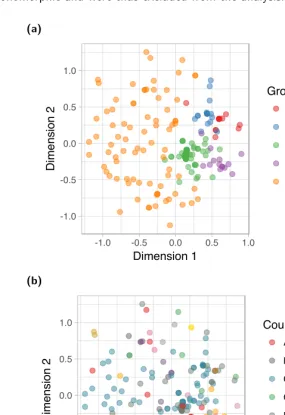
and later flowering. These data were supported by genotyping and phenotyping of single plant progenies: Variation within generation 0 of Pisarecka Perla goes back to three main genotypes, which differ significantly in seed weight and flowering time (fig. T5.2). In generation 10, the population selected at Reinshof was highly dominated by genotype A. At Tangsehl, genotype B was favoured by natural selection. Within-population variability was relatively high at Tangsehl, also due to recombination. Across all locations, the genetic variation within this cultivar was maintained. Schwarze and Gestreifte Linse exhibited a very low genetic variability and were maintained at all three farms without changing their characteristic seed weight significantly (fig. T5.1a).
(a) 20 30 40 50 60
0 5 10
Se ed w ei gh t [ m g] Pisarecka Perla Schwarze Linse Gestreifte Linse Rc
S b
Ta (b)
1 2 3
0 5 10
Be gi n of fl ow er in g [1 -4]
T b
S a
R a
[image:36.595.64.407.199.333.2]R S T R T S
Figure T5.1:Seed weight (a) and begin of flowering (b) for generations 0, 5 and 10 at Reinshof (R), Schönhagen (S) and Tangsehl (T)
[image:36.595.131.341.416.619.2]However, the observed changes did not lead to a significant site-specific adaptation in terms of yield, a so called ‘home field advantage’. Across cultivars and locations, an increased yield of generation 10 was observed but it failed to become statistically significant.
The Pisarecka Perla population selected at Tangsehl, the most stress-prone envi-ronment, had a yield advantage at all three farms. This may indicate, that on-farm management is not only able to maintain genotypic and phenotypic diversity but can also be used to select for superior genotypes.
Acknowledgements
Many thanks to our colleagues on farm. The authors are grateful for funding by the DFG and the Software AG Foundation.
References
Horneburg, B. (2006). Outcrossing in lentil (Lens culinaris Medik.) depends on cultivar, location, and year and varies within cultivars.Plant Breeding, 125(6), 638–640. doi:10.1111/j.1439-0523.2006.01290.x. (Cit. on p. 16)
Modeling competition for light in wheat
mixtures
E. Blanc1*, L. Thiaville, J. Enjalbert, C. Lecarpentier
Génétique Quantitative et Evolution – Le Moulon, INRA, Univ. Paris-Sud, CNRS, AgroParisTech, Université Paris-Saclay, Gif-sur-Yvette, France
Introduction
Over the past 50 years, homogenisation has been the dominant paradigm of agriculture in industrialised countries, associating the cultivation of genetically homogeneous populations with the intensive use of inputs to limit stresses (Tilman 2001). However, it is imperative to reduce the health and environmental impact of agricultural practices, while stabilising the production of crops, despite the great stochasticity of environmental conditions induced by climate change. Agroecology, which relies on the mobilisation of ecological regulations in agroecosystems, allows the development of a new, more sustainable, model of agriculture (Gliessman 2006). Despite its poor use in modern agriculture, the within-field genetic diversity (cultivar mixtures and composite populations) should play an important role in the context of agroecology, contributing to the adaptation and resilience of low input cropping systems, more prone to abiotic stresses.
Material and Methods
WALTer is a 3D functional-structural plant model aiming at simulating the devel-opment of winter wheat (Triticum aestivum L.) from sowing to flowering. WALTer simulates the competition for light within the canopy through the representation of the tillering process. The self adaptation of tillering is modelled by two simple rules: tillering cessation due to an early neighbour perception, and tiller regression due to shading. WALTer has been previously validated (Lecarpentier 2017) for its ability to predict tillering dynamics of wheat cultivars grown in pure stands, for a wide range of sowing densities.
In this study, WALTer was used to simulate binary mixtures at three sowing densities (160, 250, 350 plants m−2), in which the only difference between cultivars was
their height at maturity (tillering ability and leaf number, surface and angle were identical). Seven cultivars were simulated with plant height ranging from 40 cm to 160 cm (20 cm steps). They were associated in all possible combinations leading to seven monoculture and 21 binary mixtures and with height differences ranging from 0 to 120 cm. Three outputs of the model were investigated: (i) the cumulated amount of PAR intercepted (PARi) per plant over the cycle, (ii) the tillering dynamics and (iii) the dynamics of Green Area Index (ratio between the total leaf + stem + spike surfaces, and the soil surface covered by the plant). For each density, the over-yielding of the three model outputs previously selected, computed as the performance of the mixture compared to the mean of its components grown in monoculture, was computed to evaluate mixture performance. The plasticity of the three outputs was also studied through the ratio of the performances of a component observed in mixture and in pure stand.
Results and Discussion
As expected, simulations results have shown that the height of the competitor of a given variety has a significant effect on its performance. These competitive effects were always larger for light interception than for tillering or plot vegetative development and this was true for traits at the level of single genotypes or averaged over the whole plot. Indeed, plasticity curves were characterised by an important asymmetry, especially for light interception (PARi). The higher the cultivar is in the mixture, the more it will produce ears and intercept PAR. This trend was in general agreement with experimental data available in the bibliography. Interestingly, the simulations have highlighted the non-additive properties of mixtures with height differentials, as the over-interception of PAR by the highest genotype was always more important than the under-interception by the shortest.
Acknowledgements
This work is supported by the ”IDI 2017” project funded by the IDEX Paris-Saclay, ANR-11-IDEX-0003-02 and by the ANR WHEATAMIX project, grant ANR-13-AGRO-0008 of the French National Research Agency.
References
de Vallavieille-Pope, C. (2004). Management of disease resistance diversity of cultivars of a species in single fields: Controlling epidemics.Comptes Rendus Biologies,327(7), 711–620. doi:10.1016/j.crvi.2003.11.014. (Cit. on p. 19)
Gliessman, S. R. (2006).Agroecology: The ecology of sustainable food systems (2nd ed.). CRC Press. (Cit. on p. 19).
Lecarpentier, C. (2017). Plasticité de l’architecture aérienne du blé en réponse à la compétition pour la lumière au sein de cultures pures ou d’associations variétales: Caractérisation expérimentale et développement d’un modèle 3d (PhD thesis, Univerity of Paris-Saclay). (Cit. on p. 20).
Tilman, D. (2001). Forecasting agriculturally driven global environmental change.Science,
292(5515), 281–284. doi:10.1126/science.1057544. (Cit. on p. 19)
Participatory approaches: Developing blending
rules to design locally adapted cultivar mixtures
J. Borg1*, J. Enjalbert1, A. Gauffreteau2
1 Génétique Quantitative et Evolution – Le Moulon, INRA, Univ. Paris-Sud, CNRS, AgroParisTech, Université Paris-Saclay, Gif-sur-Yvette, France
2 Agronomie, INRA, AgroParisTech, Université Paris-Saclay, Thiverval-Grignon, France
Introduction
In the context of climate change and pesticides reduction, the use of cultivated di-versity is identified as an important lever to develop sustainable agriculture. Among the crop diversification options, intra-specific diversity within the field is more and more used by farmers (Borg et al. in press). Compensation, complementarity and competition between varieties into mixtures (Barot et al. 2017) confers better resilience to biotic and abiotic stresses and contributes to yield stability (Kiær et al. 2009).
However, despite available scientific knowledge on mixtures, this practice is im-peded by the lack of blending rules. Translating existing knowledge in practical rules is a prerequisite for helping farmers and advisory services to design cultivar mixtures.
The WHEATAMIX project aims at better evaluating the possible roles of wheat mixtures to reinforce the multi-functionality and resilience of cropping systems under global change. Here we describe how we developed a variety mixture co-design and evaluation with farmers, advisory services and scientists.
Material and Methods
evaluation. (iii) The field evaluation of mixtures. The performance of mixtures and their components in pure stands were assessed in both farmers’ plots and more classical repeated trials carried out by chambers of agriculture during three years (2014–2017), in around 50 sites in the Paris region with highly contrasted conditions. Mixtures were compared to their components for yield, quality, and diseases resistances.
Results and Discussion
Step i) Interviews of farmers growing mixtures revealed three main motivations: (1) secure yield, (2) reduce inputs (mainly fungicides) and (3) simplify wheat crop management within the farm. These items diverge from the ones studied in scientific papers, which focus firstly on the over-yielding (yield gain of a mixture compared to the mean of its components in pure) rather than production stability.
Step ii) During the first workshop, researchers proposed innovative varietal blend-ing rules, such as couplblend-ing height and resistance criteria to enhance pathogen regulation. The second workshop with agricultural advisors assessed the technical feasibility of the association rules proposed by the researchers. For example, intro-ducing diversity in plant eight has been discarded in some areas, as it implies to lower the cutting of the harvester which slows down the harvest and is risky in stony soils. The last workshop with farmers allowed the design of 160 mixtures, and remarkably, with little replications in the network.
Step iii) The assessment of the 160 mixtures over a three years period shows that the yield of the mixture is higher than the average yield of the pure varieties in 70 % of the cases. This difference is more important when cropping conditions are hard as in 2016 where strong diseases’ pressure has strongly impacted yield. In this year the median over-yielding reached 4.6 % compared with 1.5 % and 0.3 % in 2015 and 2017 respectively. There are no differences between mixtures and pure varieties in terms of protein content. These results are in full accordance with the literature (Borg et al. 2017).We also compared the performance of each mixture to the one of a variety chosen by the farmer at the sowing time. The yield of the mixture was higher than the one of the chosen variety in 54 % of the cases, but is systematically higher in 2016 showing clearly that mixtures minimise the risk of yield loss due to poor varietal choice in unpredictable cropping conditions.
This participatory ideotyping highlights the need to better understand the interac-tions between varieties in a mixture to refine blending rules, and provide relevant performance criteria for the evaluation of variety mixtures.
Acknowledgements
Lemain, F. Le Ny, M. Perraudin, G. Houivet, M. Feret, S. Courtois, D. Descoureaux, L. Lejars, S. Quentin, S. Piaud for their collaboration in this work, and also M. H. Jeuffroy, P. Saulas, S. Saint-Jean, E.Forst, I. Goldringer, and C. Pope for their participation to the workhops.
References
Barot, S., Allard, V., Cantarel, A., Enjalbert, J., Gauffreteau, A., Goldringer, I., Lata, J.-C., Le Roux, X., Niboyet, A., & Porcher, E. (2017). Designing mixtures of varieties for multifunctional agriculture with the help of ecology.Agronomy for Sustainable Development,37, 13. doi:10.1007/s13593-017-0418-x. (Cit. on p. 22)
Borg, J., Kiær, L. P., Lecarpentier, C., Goldringer, I., Gauffreteau, A., Saint-Jean, S., Barot, S., & Enjalbert, J. (in press). Unfolding the potential of wheat cultivar mixtures: A meta-analysis perspective and identification of knowledge gaps.Field Crop Research. doi:10.1016/j.fcr.2017.09.006. (Cit. on p. 22)
Durel, C. & Gauffreteau, A. (2014). Une démarche théorique de conception d’idéotypes. In D. Philippe & Q.-T. Bénédicte (Eds.),Conception d’idéotypes de plantes pour une agriculture durable, October 22–25, 2012. Collection Ecole-chercheurs INRA-CIRAD, 1. Seillac, France. Paris: INRA-CIRAD and FormaSciences. (Cit. on p. 22). Kiær, L., Skovgaard, I., & Østergård, H. (2009). Grain yield increase in cereal variety
Network for the dynamic management of winter
barely genetic resources
L. Bülow*, M. Nachtigall, L. Frese
Julius Kühn-Institut (JKI), Federal Research Centre for Cultivated Plants, Institute for Breeding Research on Agricultural Crops, Quedlinburg, Germany
Introduction
Genebanks apply static ex situ management systems to conserve plant genetic resources for food and agriculture. By doing so, genebanks facilitate users’ access to germplasm and related data. While genebanks maintain accessions, i. e. a spatial and temporal part of the evolutionary process, dynamic management strategies aim at promoting the continued adaptation of crops to changing environmental conditions (Bretting and Duvick 1997). An effective and efficient approach for a dynamic management system with wheat was described by (Goldringer et al. 2001) and is being developed by the INRA at Le Moulon (France) towards an on-farm management system involving farmers (Enjalbert et al. 2011). The transfer of this approach to barley was recommended by the German Federal Ministry of Food and Agricultural in its expert program for plant genetic resources. The Julius Kühn-Institut was subsequently requested to develop an institutional network for the dynamic management of winter barley genetic resources. Populations and sub-populations are cultivated at different locations and exhibit a wide genetic variation within and between populations, adapted to regional agricultural conditions, and with potential for future adaptation to climate changes.
Material and Methods
Results and Discussion
In order to promote the development of differently adapted germplasm, 12 ecogeo-graphically contrasting locations within Germany were selected to form a network for the dynamic management of winter barley genetic resources. These include 3 locations under organic management practices. Since 2016, sub-populations of the material have been continuously cultivated under high and low input conditions at these locations. Adaptation of winter barley sub-populations to different climatic, soil and agricultural input conditions will be monitored over a period of 6 to 8 years. Based on samples taken in each year, changes in the allele frequencies within and between locations will be monitored at the DNA level. Simultaneously, ROBUSTUM has been developed as an information system for the consistent docu-mentation of varieties and lines, crossing schemes, composition of (sub)populations, cultivation conditions, characterisation and evaluation data, and for subsequent data analysis. The complex pedigree of the initial winter barley population has already been recorded within ROBUSTUM. All data as well as plant genetic resources developed by the network will be publicly available according to the rules of the Multilateral System of the International Treaty.
References
Bretting, P. & Duvick, D. (1997). Dynamic conservation of plant genetic resources.
Advances in Agronomy,61, 1–51. doi:10.1016/S0065-2113(08)60661-6. (Cit. on p. 25)
Cavanagh, C., Morell, M., Mackay, I., & Powell, W. (2008). From mutations to magic: Resources for gene discovery, validation and delivery in crop plants.Current Opinion in Plant Biology,11(2), 215–221. doi:10.1016/j.pbi.2008.01.002. (Cit. on p. 25) Enjalbert, J., Dawson, J. C., Paillard, S., Rhoné, B., Rousselle, Y., Thomas, M., &
Goldringer, I. (2011). Dynamic management of crop diversity: From an experimental approach to on-farm conservation.Comptes Rendus Biologies,334(5–6), 458–468. doi:10.1016/j.crvi.2011.03.005. (Cit. on p. 25)