Collaborative design education with industry:
Student perspective by reflection
Nathan Kotlarewski, ARC Centre for Forest Value, University of Tasmania, Launceston, Australia, [email protected]
Louise Wallis, School of Architecture and Design, University of Tasmania, Launceston, Australia, [email protected]
Michael Lee, Centre for Sustainable Architecture with Wood, University of Tasmania, Launceston, Australia, [email protected]
Gregory Nolan, Centre for Sustainable Architecture with Wood, University of Tasmania, Launceston, Australia, [email protected]
Megan Last, Neville Smith Forest Products, Launceston, Australia,
Abstract
This study suggests that student reflection on academic and industry collaborative projects
can enhance student’s understanding on the design process to solve live industry problems. It contributes to the body of design literature to support students learning of explicit and
implicit knowledge (Boling et al., 2016; Land et al., 2016; Salama, 2015). A 2017 learning- by-making (LBM) unit in the School of Architecture and Design, at the University of Tasmania, Australia, developed a unit for students to collaborate with Neville Smith Forest Products Pty. Ltd. (NSFP). NSFP is a local Tasmanian timber product manufacturer who currently stockpiles out-of-grade timber that has limited market applications. Undergraduate design students from second and third year Furniture, Interior and Architecture degrees collaborated with NSFP to value-add to their out-of-grade resource in the LBM unit. A series of design challenges, observations of industry practice and access to out-of-grade timber from NSFP exposed students to live industry problems and provided them the opportunity to build professional design skills. Students reflected on the collaborative LBM unit in a reflection journal, which was used to provide evidence of their learning experiences. The collaborative environment between academia and industry allowed students to acquire an understanding of timber product manufacturing that helped them develop empathy towards the industry problem and influence the development of new products. This study presents how student reflections influenced a change in their design process as they progressed through sequential design challenges to address an industry problem by adopting Valkenburg and Dorst (1998) reflective learning framework.
Keywords: Academic-Industry collaboration, learning-by-making, live project, design process, reflection.
In February 2017, a summer semester LBM unit was offered to School of Architecture and Design students for them to collaborate with Neville Smith Forest Products Pty. Ltd. (NSFP)–a Tasmanian oak hardwood timber product manufacturer who supplies local,
domestic and international appearance markets. NSFP currently manufactures a diverse range of Tasmanian oak products and flooring profiles for interior applications. Their current manufacturing process produces a series of Australian standard graded timber products, as well as out-of-grade products that fail to comply with Australian Standard 2796.2 (2006). This material has limited secondary product applications thus generating a stockpile of low value timber with little market demand. A brief was developed for students to design, develop and prototype new products utilising NSFP current stockpile of out-of-grade timber. The aim was to value-add to the resource and thus provide new market opportunities for NSFP. The NSFP design challenge presented in this study provided students with a live industry problem that gave them experience in identifying an opportunity to develop new products and to recognise the expectations that industry has for commercialisation.
Literature Review
Current literature claims pedagogical design exercises that present opportunities and experiences to students such as industry project-based learning or live projects are key threshold concepts for students to transition from student designers towards competent and confident design professionals (Boling et al., 2016; Burnham et al., 2015; Blumenfeld et al., 1991; Hokstad et al., 2016; Osmond & Turner, 2010; Salama, 2015).
A characteristic of the assessment and activities associates with the transitional moments where students appear to progress through the threshold concept, appear to be problem-based, experimental, related to work and ‘real-world’ design activities and often involve group work; in other words there is a focus on ‘doing as learning’ (Osmond & Turner, 2010).
There is no denying that real-world design activities differ from typical academic studio- based activities given the difference in industry and academic approach to design projects and design processes (Hokstad et al., 2016; Kim, 2016; Kotlarewski et al., 2016; Salama, 2015). In circumstances where industry seeks to engage with design and designers, the intention is to create value that can help gain a competitive advantage (Fonseca, 2016; Gemser & Leenders, 2001).
Where possible, it is argued that student exposure to real-world design activities is a key
experience and opportunity that can assist student’s transition through threshold concept
learning (Burnham et al., 2015; Land et al., 2005; Land, Meyer & Flanagan, 2016; Meyer & Land, 2005; Meyer & Land, 2006). It is common for students to become frustrated, lose confidence or stuck in a cycle of the unknown early in design exercises. It may be better for students to experience such difficulties in a controlled environment earlier in their degree to learn how to overcome such difficulties and therefore learn how to approach challenges in future learning and employment opportunities. Student reflection upon these difficulties, opportunities and experiences in a reflection journal is an integral learning activity that
demonstrates evidence of student learning (Ellmers, 2006; Moon, 2004; O’Connell & Dyment,
2006; Clifford, 2002; Webster, 2004).
final design artefact. This is significant in that the student assumes responsibility for identifying important moments of the design process there by encouraging them to be independent learners (Ellmers, 2006).
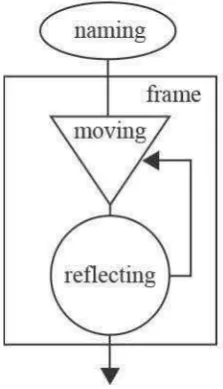
A study by Valkenburg and Dorst (1998) was influenced by the work of Schön (1983). They
[image:3.595.240.352.198.393.2]indicate Schön’s (1983) work has proven itself useful for describing design activities and focus their attention to describing reflective practice in team designing in figure 1. They illustrate four different activities that design teams exercise as the mechanism of reflective practice.
Figure 1 The mechanism of reflective practice; the four design activities and their interpla y (Valkenburg & Dorst, 1998)
The four activities, naming (identifying important parts of the design task), frame (focusing on the context), moving (generating ideas), and reflecting (explicit documentation of actions) are presented as a flow diagram. Valkenburg and Dorst (1998) use this flow diagram in their study to present reflective practice in team designing, compare two case studies and quantify the time spent by design teams in each activity. Mapping the mechanism of reflective practice was applied to this LBM study to indicate the transformative learning experience that
students gained from the industry project-based unit. The overall mapping of the student reflective practice is illustrated and presented in the discussion on this study.
Research Methods
Observations of students and reviewing student reflections were used to substantiate transformative learning in the LBM unit. These research methods provided evidence that students were developing their ability to approach design challenges both explicitly through critical analysis of their key learnings and tacitly through making, as an individual and a group member. The LBM unit presented in this study ran intensively over 10 days, consisting of 13 students divided in five groups.
observations of the students design process and design skills where noted and recorded as photographs by the lecturer. Students were also encouraged to record and document their design process and product developments—typically as photographs and sketches—
throughout the design challenge. This evidence was later compiled in student’s reflection
journals to highlight critical thinking and key learnings.
The second design challenge—ran on day two—was another short three hour activity, again bound by a set of rules to design and prototype a scaled timber product using timber off-cuts. Before the second design challenge started, students were given a tour of NSFP mill to observe the manufacturing process of timber products. The exposure to manufacturing constraints was intended to add another variable to the student learning experience to assist the development of their design process and timber product. It was expected that the tour of the mill would highlight key industry constraints such as production lines, resource
management and product handling.
The third design challenge ran from day three to day 10. This design challenge gave students more time to move through the design process and develop more products with timber that NSFP specifically supplied. This challenge presented a live industry problem to the students as they had to meet a dead-line, consider implementing the product into NSFP production line and develop a range of products with the specific timber supplied.
The gradual increase in responsibility of students was intended to build student design competencies and prevent overwhelming the students with a live industry problem at the commencement of the LBM unit. The controlled exposure to design activities was used to review their explicit individual journal reflections and to observe evidence of these
developments in students tacit knowledge in response to the industry brief, as well as their learning.
Discussion
The opportunity and exposure to industry that students gained from the LBM unit helped them develop valuable insights that assisted individual reflection and the development of tacit knowledge on the underlying industry problem, the design process and their design skills. Outcomes from these key areas helped students develop design competencies that assisted their approach to the design challenges in the LBM unit.
Design challenges one and two encouraged students to be creative, try something new, fail quickly, reflect on the outcome and then further develop the idea. This process was both sequential and iterative. The first design challenge was a product design cardboard activity conducted on day one. Students had three hours to design, prototype, develop and reflect on their process, product, and group collaboration. The design challenge was broad yet
constrained by rules, giving the students the freedom to design any product—in groups of two and one group of three—at 1:4 scale, using only cardboard. The restriction to cardboard only, was to challenge students to develop a product that was aesthetically pleasing,
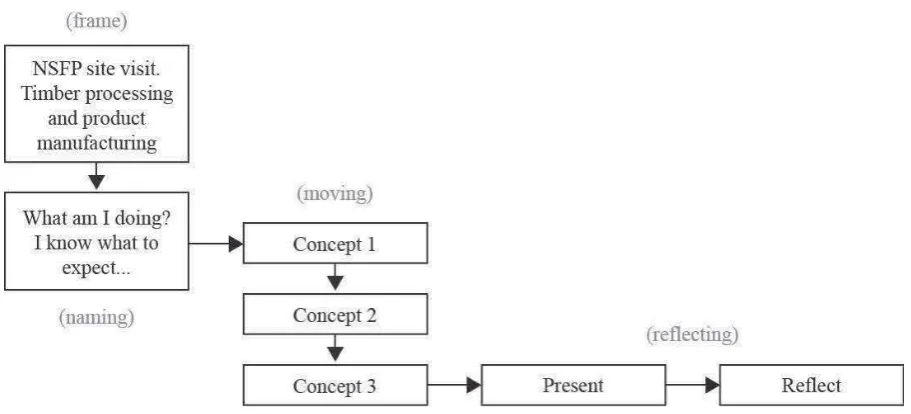
Figure 2 : Student reflective process use to address cardboard design challenge
As observed during the first design challenge and shown in figure 2 students were inevitably confronted with the cardboard design challenge and became confused. In–line with
Valkenburg and Dorst (1998), students approached the design challenge by first identifying the important aspects of the activity (naming): what am I doing? They then began framing the context of the design challenge: to design and develop a product out of cardboard. A lack of understanding the relevance of the cardboard design challenge limited student confidence and added to the task frustration that led students to fail to let go of the first concept they produced (moving): generating an idea. At the end of the challenge, students presented their product and reflected on the journey (reflecting). Initial reflections of the design challenge as anecdotal evidence was: What was the intention of the challenge? Why are we designing a product with cardboard when the unit is about timber product
development? In response to the first design challenge, students identified their lack of exploration and conservative approach was a constraint to developing a cardboard product that taught them something new by making. Explicit student reflections later highlighted:
Today helped me realise the importance of failing early and not becoming attached to the point that it prevents further innovation and critical thinking.
Too much time was spent finalising the design, therefore when it came to making/testing we were rushed for time and had little time for corrections.
It is possible to over plan. Continuing to design without trial is a pitfall.
Figure 3 : Student reflective process use to address timber design challenge
An obvious difference existed between the first and second design challenge. Students were given background knowledge of NSFP timber processing and product manufacturing through the site visit and were aware of the expectation to generate a series of concepts. This change
in structure allowed the students to “frame” the context of the project before “naming”.
Students immediately began generating ideas (moving). Observations noted that students were better equipped with experience and expectations from the first design challenge. Students even combined concepts to develop hybrid products that incorporated a series of features and functions. The experience attained from the previous design challenge through reflection gave the students the courage to try something new and accept that the first concept that they produced was likely to be discarded and forgotten or developed into another concept generation. In relation to the timber design challenge students noted:
Great process of design development today. The product field opened up many more
‘potential use’ opportunity’s rather than narrowing the options (as it felt like I did on day 1). I believe I can already feel an increase in design flow and critical thinking since yesterday’s cardboard challenge.
Making/experimenting with our own ideas in the first prototypes we were able to bring our knowledge together. By bringing my idea about using the high feature knots for natural light and hangings, we were able to build on this for prototype two. From todays design challenge and the visit to NSFP I started to realise [that] the natural aesthetics [of] these high feature products have a future in interior lining [products].
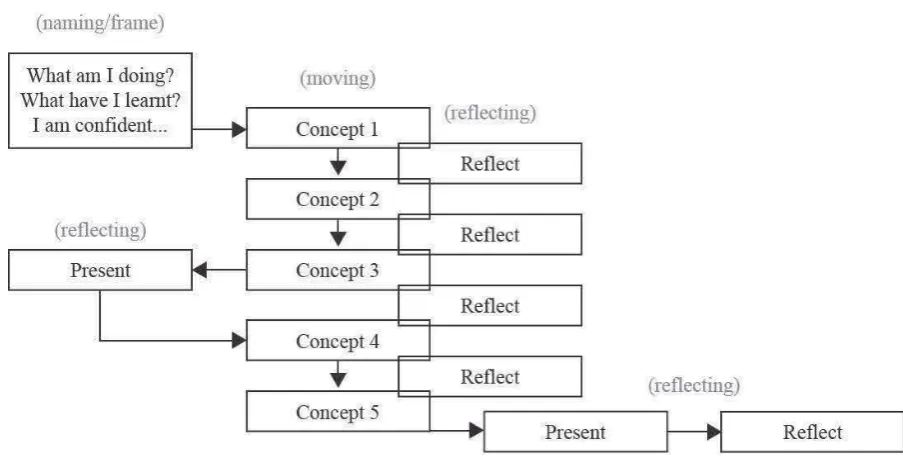
By day three, students had a better understanding of the type of process and product developments that were expected. Each group of students created a return brief that
highlighted their perspective of NSFP, the industry problem, opportunities they considered worthy of exploration and how they proposed to address them (framing and naming). Again, students immediately began exploring concepts by making (moving). Observations noted students typically spent a day developing each concept. Between concepts students would confidently and naturally reflect on the product and process. This reflection was later
Figure 4 : Student reflective process use to address the NSFP design challenge.
Since the first design challenge the students expanded their design skills and ability to critically reflect on their process and product development. They were more confident with their concept execution and presented their work professionally to NSFP. More time was spent making and reflecting during the third NSFP design challenge as the students had learnt what the expectations of the academic studio outcome should resemble and what industry collaborators desired. The progression through figure 2-4 demonstrated that the students increased their ability to develop concepts beyond the initial ideation stage and were able to reflect on their practice. The act of reflection allowed students to justify their process and product developments confidently which assisted with their concept
deliverance to NSFP. Final student reflections highlighted:
I have truly enjoyed the process of learning by making over the course of 10 days. I believe my ability to develop, analyse and critique both myself and other student’s designs has progressed greatly.
It felt good to produce something that would work in a commercial situation as opposed to only seeking budget solutions.
Overall, the unit has me thinking so differently about how I go about my [future] work.
I personally found this unit worked really well from a collaborative point of view.
At the conclusion of the design challenges, NSFP representatives were present during the student presentations. While the focus of this study is not the student product outcomes, the use of tangible products proved useful to demonstrate student creativity and the LBM process to NSFP. This was an opportunity for students to engage in their groups with NSFP for feedback. This was also an opportunity to demonstrate the capacity of student skills to NSFP. This constructive reinforcement of industry engagement was important for the students to build a relationship with NSFP and to build student confidence in the lead up to the main NSFP design challenge. The same could be said for the experience gained from industry with design students, as they typically do not engage with designers. Research Contribution
enhanced student willingness to explore innovative timber design outcomes by using a product design and development process to solve a live industry problem. Initial design challenges that were simple in nature yet challenging enough to demonstrate the design process and the importance of understanding and addressing the design problem were critical to prepare the students for the main project. By resolving the design process through modelling and making, students had a better success with the tectonics as they are not removed from the abstract world of paper or digital modelling (Burnham et al, 2015; Hokstad et al., 2016; Salama, 2015; Wallis, 2007). Furthermore, student exposure to real-world practice in an industrial context substantiated this, as did involving key industry partners in student presentations and reflections. From the first to third design challenge,
student’s confidence and their ability to
make informed decisions without guidance from studio lecturer increased.
Students gradually become self-motivated and driven to develop their ideas by prototyping and actively reflecting on their work. In addition to studio observations, explicit reflections in student journals provided evidence of transformative learning. The act of making
followed by the act writing allowed students to better identify what they had achieved, what did not work and why, and justified how well they had address the industry and design problem. The reflection journal ultimately outlined the process that the students employed to development, prototype and refine their design outcomes. Reflections on sequential learning outcomes from design challenge one, through to three also helped the students prepare for the next design challenge and to address the unit outcomes.
Future studies
This study reinforces the design literature that collaborative student learning environments between industry and academia can assist students build design competencies and
therefore prepare them for industry employment. However, previous LBM studies by Wallis (2005) and Moon (2004) on reflective learning suggest difficulties are experienced in transferring knowledge to another educational context or workplace. This indicates the need for further research and developing ways that allow students to develop greater independence from educational contexts. Another limitation in this study was not all students explicitly communicated their new knowledge attained from the LBM unit in their written reflections. This suggests that while the opportunity was presented through the LBM unit, it may not always be immediately enacted by students who know how or why to reflect on these events. Other mediums of capturing student transformative learning could be explored such as daily video reflections and time-lapse of development work in studios and workshops. It would also be beneficial to conduct future studies with the same students prior to their graduation to see how they continued to develop their approach to industry projects as they gained more
experience throughout their degree. There is also an opportunity to consider what impact student exposure to a global industry in two different context has on their professional development. Furthermore, incorporating and testing different methods to engage students in reflecting—taking into account the vexed issue of the influence of assessment—could be explored.
Conclusion
confidence to approach design opportunities in the real-world. In this study, students generally improved their process and approach to design challenges as they progressed through the three design challenges presented. Key to this improvement was individual reflections by the students that highlighted new knowledge attained from the experiences. Student reflections documented in journals and observations of students in the LBM unit demonstrated evidence of design developments and an increase in design competence as students became more independent and self-motivated to develop products to satisfy an industry problem. This was illustrated by incorporating Valkenburg and Dorst (1998)
mechanism of reflective practice against student’s transformative learning process
development. Industry collaboration also added to the students learning process as industry typically grounded the students work to ensure the outcomes were feasible and
commercially relevant to the business. The authors of this study hope the findings in this research to be useful for developing student learning experiences and may help prepare students for industry employment after their studies.
References
Australian Standard 2796.2 (2006). Timber-Hardwood-Sawn and milled products Part 2: Grade description. Standards Australia, NSW, Australia.
Blumenfeld, P. C., Soloway, E., Marx, R. W., Krajcik, J. S., Guzdial, M., & Palincsar, A. (1991). Motivating Project-Based Learning: Sustaining the Doing, Supporting the Learning. Educational Psychologist, 26(3-4), 369-398. doi:10.1080/00461520.1991.9653139
Boling, E., Schwier, R., Gray, C., Smith, K., & Campbell, K. (Eds.). (2016). Studio teaching in higher education: selected design cases. New York: Routledge.
Burnham, R., Wallis, L., Clayton, I., and Green, R. (2015). Learning-by-making: transformative learning in design. Proceedings of the 8th International Conference and Exhibition of the Association of Architecture Schools of Australasia, 2-3 October 2015, Christchurch, New Zealand, pp. 138-145.
Carpenter, W. (Ed.). (2011). Design Build Studio. Decatur, Georgia: Lightroom.
Clifford, V. (2002). Does the use of Journals as a Form of Assessment put into Practice Principles of Feminist Pedagogy?, Gender and Education, 14:2, 109-121, doi: 10.1080/09540250220133978
Fonseca Braga, M. (2016). The value of design: an issue of vision, creativity and interpretation. Proceedings of DRS 2016, Design Research Society 50th
Anniversary Conference. Brighton, UK, 27–30 June 2016.
Gemser, G., & Leenders, M. A. A. M. (2001). How integrating industrial design in the product development process impacts on company performance. Journal of
Product Innovation Management, 18(1), 28-38. doi:10.1111/1540-5885.1810028
Hokstad, L. M., Rødne, G., Braaten, B. O., Wellinger, S. and Shetelig, F. (2016) Transformative Learning in Architectural Education: Re-Thinking Architecture and the Education of Architecture, in: Threshold Concepts in Practice, Land, R., Meyer, J.H.F. & Flanagan, M.T. (Eds.). Sense Publishers, Rotterdam/Boston/Taipei, Chapter 24, 321-333,
Kim, K. (2016). How Companies adopt different Design approaches. Proceedings of DRS 2016, Design Research Society 50th Anniversary Conference. Brighton, UK, 27– 30 June 2016.
product development. Proceedings of DRS 2016, Design Research Society 50th Anniversary Conference. Brighton, UK, 27–30 June 2016.
Land, R., Cousin, G., Meyer, J. H., & Davies, P. (2005). Threshold concepts and troublesome knowledge (3): implications for course design and evaluation. Improving student learning diversity and inclusivity, 4, 53-64.
Land, R., Meyer, J. H., & Flanagan, M. T. (Eds.). (2016). Threshold Concepts in Practice (68). Springer.
Meyer, J. H. F., & Land, R. (2005). Threshold concepts and troublesome knowledge (2): Epistemological considerations and a conceptual framework for teaching and learning. Higher Education, 49(3), 373-388. doi:10.1007/s10734-004-6779-5
Meyer, J. H. F., & Land, R. (2006). Threshold concepts and troublesome knowledge: an introduction. In Overcoming Barriers to Student Understanding edited by J. Meyer, and & R. Land, 3-18. London: Routledge.
Moon, J. (2004). A Handbook of Reflective and Experiential Learning. London: Routledge Falmer.
Osmond, J., & Turner, A. (2010). The Threshold Concept Journey in Design: from identification to application. Threshold concepts and transformational learning, 347-364.
O’Connell, T., & Dyment, J., (2006) Reflections on using journals in higher education:
a focus group discussion with faculty, Assessment & Evaluation in Higher Education, 31:6, 671-691, doi: 10.1080/02602930600760884
Salama, A. M. (2015). Spatial Design Education: New Directions for Pedagogy in Architecture and Beyond. Surrey: Ashgate.
Schon, D. (1983). The reflective practitioner. Basic Books. New York.
Wallis, L. (2007). Building the studio environment. In A. Salama & N. Wilkinson (Eds.), Design Studio Pedagogy: Horizons for the Future (pp. 201- 218). Gateshead: The Urban International Press.
Wallis, L. (2005). Learning-by-Making: Design-build case study at the University of Tasmania. (Unpublished Masters of Design Research), University of Tasmania, Launceston.
Webster, H. (2004). The Design Diary: Promoting Reflective Practice in the Design Studio Monitoring Architectural Design Education in European Schools of Architecture (17).
Valkenburg, R., & Dorst, K. (1998). The reflective practice of design teams. Design Studies, 19(3), 249-271. doi:http://dx.doi.org/10.1016/S0142-694X(98)00011-8
Author Biography
Dr Nathan Kotlarewski
Dr Louise Wallis
Louise is Lecturer at the School of Architecture & Design at the University of Tasmania. She is active contributor to design learning and teaching research in architectural education as evidenced by her roles in national teaching grants (2006, 2009 & 2011) in Australia. Her published work focuses on influence of Higher Education Institutions on architectural studio models, instruction methods and the effectiveness of design/build studios.
Michael Lee
Michael is a Senior Technical Officer for the Centre for Sustainable Architecture with Wood (CSAW) at the School of Architecture & Design, University of Tasmania. He has years of experience in the timber industry, predominantly in senior testing, technical and project management positions. Michael coordinates the daily running of technical aspects of CSAW's Tasmanian Timber Promotion Board and provides a vital link to the timber industry, general public, designers and architects.
Associate Professor Gregory Nolan
Gregory is an Associate Professor at the University of Tasmania's School of Architecture and Design, and is the Director of the University's Centre for Sustainable Architecture with Wood (CSAW). He has published in books, journal articles, and conference publications, all with a key focus in sustainable design, environmental aspects of construction and building performance, as well as the broader use of renewable materials in the built environment.
Gregory is an experienced research manager and has directed and conducted numerous industry funded projects.
Megan Last
Megan is a marketing professional, who at the time of the LBM unit was the Marketing and Product Development Manager at NSFP. She currently runs her own timber company working with industry to develop new products and markets connected to out-of-grade