Logics of Communication and Change
Johan van Benthem
aJan van Eijck
bBarteld Kooi
c aILLC, University of Amsterdam, Plantage Muidergracht 24, 1018 TV Amsterdam, The Netherlands & Philosophy Department, Stanford University bCWI, P.O. Box 94079, 1090 GB Amsterdam, The Netherlands & Uil-OTS, Trans10, 3512 JK, Utrecht, The Netherlands
cDepartment of Philosophy, University of Groningen, Oude Boteringestraat 52, 9712 GL, Groningen, The Netherlands
Abstract
Current dynamic epistemic logics for analyzing effects of informational events often become cumbersome and opaque when common knowledge is added for groups of agents. Still, postconditions involving common knowledge are essential to success-ful multi-agent communication. We propose new systems that extend the epistemic base language with a new notion of ‘relativized common knowledge’, in such a way that the resulting full dynamic logic of information flow allows for a compositional analysis of all epistemic postconditions via perspicuous ‘reduction axioms’. We also show how such systems can deal with factual alteration, rather than just information change, making them cover a much wider range of realistic events. After a warm-up stage of analyzing logics for public announcements, our main technical results are expressivity and completeness theorems for a much richer logic that we call LCC. This is a dynamic epistemic logic whose static base is propositional dynamic logic (PDL), interpreted epistemically. This system is capable of expressing all model-shifting operations with finite action models, while providing a compositional anal-ysis for a wide range of informational events. This makes LCC a serious candidate for a standard in dynamic epistemic logic, as we illustrate by analyzing some com-plex communication scenarios, including sending successive emails with both ‘cc’ and ‘bcc’ lines, and other private announcements to subgroups. Our proofs involve standard modal techniques, combined with a new application of Kleene’s Theorem on finite automata, as well as new Ehrenfeucht games of model comparison.
Key words: epistemic logic, update, dynamic logic, common knowledge, reduction axioms, product update, finite automata, Kleene’s Theorem
Email addresses: [email protected] (Johan van Benthem), [email protected]
1 Introduction
Epistemic logic deals with what agents consider possible given their current information. This includes knowledge about facts, but alsohigher-order infor-mation about information that other agents have. A prime example iscommon knowledge. A formula ϕ is common knowledge if everybody knows ϕ,
every-body knows that everyevery-body knows that ϕ, and so on. Common belief is an
important related notion. Indeed, although this paper is mainly written in ‘knowledge’ terminology, everything we say also holds, with minor technical modifications, when describing agents’beliefs, including common belief.
Dynamic epistemic logics analyze changes in both basic and higher-order in-formation. One of the main attractions of such systems is their transparent analysis of effects of communicative actions in the format of an equivalence be-tween epistemic postconditions and preconditions. A typical example concerns knowledge of an agent after and before a public announcement:
[ϕ]2aψ ↔(ϕ→2a[ϕ]ψ).
This axiom says that after the announcement that ϕ agent a knows that ψ
iff ϕimplies that agenta knows that after ϕis announced ψ will be true. We call such principles reduction axioms, because the announcement operator is ‘pushed through’ the epistemic operator, in such manner that on the right hand side the complexity of the formula in the scope of the announcement is less that the complexity of the formula in the scope of the announcement on the left hand side. This reduction axiom describes the interaction between the announcement operator and the epistemic operator. If there is a reduc-tion axiom for each logical operator in the language, such a set of axioms make logical systems particularly straightforward. For instance, the logic of public announcements without common knowledge has an easy completeness proof by way of a translation that follows the reduction axioms. Formulas with announcements are translated to provably equivalent ones without an-nouncements, and completeness follows from the known completeness of the epistemic base logic. Thus, the dynamic logic of the announcement operator is fully characterized by the reduction axioms.
they exist. Finally, more locally, specific reduction axioms also express inter-esting assumptions about the interplay of events and knowledge. E.g., it has often been observed that the above one for public announcement embodies a form of ‘Perfect Recall’: the event of announcement does not add or delete uncertainty lines for agents among those worlds which they consider possible.
In this light, there is a problem with common knowledge forgroups in societies of communicating agents. Understanding group knowledge as it is gained or lost, is at the heart of analyzing epistemic update. But existing dynamic epis-temic logics have no compositional reduction axioms for achieving common knowledge, and this infelicity has been there from the start. Now, the seminal paper [1] does treat common knowledge per se, but not on a reductive pattern, and its completeness proof is correspondingly messy. Indeed, reduction axioms are not available, as the logic with epistemic updates is more expressive than the logic without them. We think this is an infelicity of design, and our main aim in this paper is to show how compositional analysis is feasible by some judicious language extension, restoring the proper harmony between the static and dynamic features of the system.
In Section 2 we first look at examples of the general kinds of information change that we are interested in. These include public announcement, but also communication involving privacy and partial observation, and indeed, observation of any sort of event that carries information. We also include real physical actions changing the world. Before we give a system that deals with all these phenomena, we first look at a pilot case that illustrates many issues in a simpler setting, the logic PAL of public announcements. Section 3 gives a new and complete set of reduction axioms for public announcement logic with common knowledge, obtained by strengthening the base language with an operator of relativized common knowledge, as first proposed in [3]. More-over, since languages with model-shifting operators like [ϕ] are of independent logical interest, we develop the model theory of PAL a bit further, using new game techniques for epistemic languages with fixed-point operators for com-mon knowledge to investigate its expressive power. Section 4, the heart of this paper, then proposes a new dynamic epistemic LCC dealing with the general case of updating with finite structures of events, generalizing the standard reference [1] to include a much wider range of epistemic assertions, as well as factual change. What the section demonstrates, in particular, is thatPDL(the well-known system of propositional dynamic logic), when interpreted epistem-ically, can serve as a basis for a rich and expressive logic of communication that allows for smooth compositional analysis of common knowledge after epistemic updates. To avoid confusion with PDL in its non-epistemic uses for analyzing actions, we will call our version here LCC.
variant of propositional dynamic logic called ‘automata PDL’. The new tech-niques used in the present paper (cf. [11]) work directly in epistemic PDL, using the idea behind Kleene’s Theorem for regular languages and finite au-tomata to find the relevant reduction axioms inductively by means of ‘program transformations’. This analysis does not just yield the meta-theorems of com-pleteness and decidability that we are after. It can also be used in practice to actually compute valid axioms analyzing common knowledge following specific communicative or informational events. Section 5 analyzes some of our earlier communication types in just this fashion, obviating the need for earlier labori-ous calculations ‘by hand’ (cf. [27]). Finally, Section 6 draws conclusions, and indicates directions for further research.
The broader context for this paper are earlier systems of dynamic epistemic logic, with [26], [14], and [1] as key examples of progressively stronger systems, while [8] is a source of inspiring examples. Reduction axioms were already used to prove completeness for dynamic epistemic logics in [14] and [1]. Another major influence is the work of [13] on common knowledge in computational settings, using a more general temporal-epistemic framework allowing also for global protocol information about communicative processes. Connections between the two approaches are found, e.g., in [21]. Further references to the literature on epistemic actions and to many challenging open problems in the general landscape of update logics can be found in [5].
Even though the main thrust of this paper may seem technical, our proposal is much more than just a trick for smoothing completeness proofs, or for find-ing a new model-theoretic play-ground. It also addresses a significant design issue of independent interest: what is the most convenient and transparent epistemic language for describing information flow for groups of agents in a compositional manner? Our main logicLCCin Section 4 is meant as a serious proposal for a standard.
2 Modelling Effects of Communication and Change
Epistemic update logics are about the effects of general communication, and indeed, they describe the logic of observing any kind of information-bearing event. But in practice, it is helpful to look at more constrained scenarios. A
good source of examples are basic actions in card games. Game moves then
Moreover, scenarios involving the interplay of information and ignorance are not just logician’s puzzles for their own sake: managing the right mixtures of information and ignorance is absolutely essential to human intelligence, and to the functioning of civilized societies.
In this section we list some examples involving combinations of epistemic and actual change that we think any full-fledged dynamic-epistemic logic should be able to deal with. The simplest scenario here is public announcement of some fact P, which merely requires elimination of all worlds in the current
model whereP does not hold. But general communication can be much more
complex — just think of whispers in a lecture theatre. This requires updates of the initial information model beyond mere elimination of worlds. Some updates even make the current model bigger, as alternatives can multiply. Since all these actions involve groups of agents, understanding both individual and common knowledge following certain events is clearly essential.
Card Showing A simple card showing situation goes as follows. Alice, Bob and Carol each hold one of the cardsp q, r. The actual deal is: Alice holds p, Bob holdsq, Carol holdsr. Assuming all players looked at their own cards, but have kept them hidden from the others, this situation is modelled as follows (xyzrepresents the situation where Alice holdsx, Bob holdsyand Carol holds
z, xyz—a—x0y0z0 represents the fact that Alice cannot distinguish xyz from
x0y0z0, andxyz∗ indicates that xyz is the situation that actually is the case):
rpq qpr
pqr∗ prq
rqp qrp a
a
a
b b
b c
c c
Now assume Alice shows her card p to the whole group. This public event
eliminates all worlds from the initial model that conflict with the new infor-mation. Thus, out of the six given worlds only two remain: pqr and prq. In the resulting model, Bob and Carol know all the cards, while Alice only knows
that she has p— and both these facts are common knowledge. Now consider
p ∗
q r
c
c c
According to this picture, the card that Alice shows to Bob is card p, but for all Carol knows, it might have beenqorr. In actual fact it cannot ber, as that is the card which Carol holds and has just inspected, but this information is not part of the update action. Note that the events depicted cannot occur in just any world. Alice can only show cardpwhen she actually holdsp, she can showq when she actually holdsq and she can showr when she actually holds
r. The latter information is encoded in so-called preconditions, and indeed, the fundamental reason why occurrences of events carry information for us is that we know their preconditions.
Now for the update from the preceding event. Intuitively, we want a new information model arising from the initial one that the agents were in plus the update model containing the relevant actions. The new worlds are then old worlds plus the most recent event attached. Moreover, our intuitions tell us what the desired result of this update should look like, viz.:
rpq qpr
pqr∗ prq
rqp qrp a
a
a c
c c
Card Inspection Next, consider acts of observation. Suppose the three cards are dealt to Alice, Bob and Carol, but are still face down on the table. The following picture describes an update model for Alice’s inspecting her own card and discovering it to be p, with the others just looking on.
p ∗
q r
bc
bc bc
p ∗
q r
a
a a
In all these cases we have clear intuitions about what the outcomes of the up-dates should be, and these underlie the technical proposals made in Section 4.
Card Exchange Next, we add a case where real physical action takes place, which is not purely informational. Suppose in the initial situation, where Alice holdsp, Bob holdsqand Carol holdsr, Alice and Bob exchange cards, without showing the cards to Carol. To model this, we need an update that also changes the state of the world. For that, we need to change the valuation for atomic facts. This may be done by using ‘substitutions’ which reset the truth values of those atomic statements that are affected by the action:
c pq
qp
{pq 7→qp }
{qp 7→pq }
Note that the diagram now indicates both the earlierpreconditions for events or actions, andpostconditions for their successful execution. Here is the result of applying this update model in the initial situation, where all players have looked at their cards and the actual deal is pqr:
pqr qpr∗
c
So far, we have looked at card examples, where actions are meant to be com-municative, with some intentional agent. But it is important to realize that dynamic epistemic logic can also serve as a system for analyzing arbitrary observations of events that carry some information to observers, whether in-tended or not. That is, it is a logic of perception as much as of communication, and it is useful for modelling the essence of what goes on in very common ev-eryday actions. We conclude with two illustrations in the latter mode.
we specify different actions depending on the state of the window. If it is open, nothing needs to be done; if it is closed, then open it. This much is standard dynamic logic, as used in describing transition systems in computer science. But now we are in a setting where agents may have different ‘epistemic access’ to what is taking place. E.g., assuming the relevant event is invisible to all (Alice, Bob and Carol), it can be modelled as follows:
abc o
¬o
∅
{o7→ >}
Again, we see both pre- and postconditions, with the latter depending on the former. Note that this action can make agents ‘out of touch with reality’, perhaps through laziness in observation. Such a mismatch can also result from being actively misled. If the window is opened in secret, its update model looks as follows (o denotes an open window; o 7→ > is the substitution making o
true).
abc abc abc
o ∅ ¬o {o7→ >} > ∅
Further variations on this update model are possible. E.g., the window is in fact opened, while everyone is told that it was already open. Here is the corresponding update:
abc abc
o
¬o
∅
{o 7→ >}
> {o7→ ¬o}
If the fiddling (and its result) are kept secret, the corresponding update model looks like the above opening, but now with the new substitution.
Remark: Two Limitations The preceding examples suggest that we can view an update model with several event as a disjunction of instructions under conditions, i.e., as a kind of structured program ‘if the window is open then do A or if the window is ajar, then do B, or, if the window is wide open, then do C . . . .’ This suggests a set-up where update models are built from simple actions by means of the regular operations of choice, sequence and iteration — and perhaps even concurrent composition of events. We will not pursue this approach here. Indeed, natural though it is, it transcends the boundaries of our analysis. E.g., Miller and Moss [23] show that just adding finite iteration ∗of announcements already leads to an undecidable dynamic logic, not effectively reducible to its decidable base.
Another boundary that we will not cross is the atomic form of our postcondi-tions for world-changing acpostcondi-tions. In more general scenarios, captured by logics with operators in the spirit of ‘See To It That ϕ’, one may want to define some action as having some complex epistemic effect described by arbitrary
ϕ, such as ‘make sure that only courageous people know the true state of af-fairs’. Modeling complex postconditions raises some delicate technical issues, orthogonal to our main concerns here.
3 Logics of Public Announcement
Many of the issues we want to deal with in the full-fledged logic of epistemic updates are also present in the logic of the simplest form of communicative action: public announcement logic. The corresponding update idea that an-nouncing a propositionϕremoves all worlds where ϕdoes not hold goes back far into the mists of logical folklore, and it has been stated explicitly since the 1970s by Stalnaker, Heim, and others. The same idea also served as a high-light in the work on epistemic logic in computer science (cf. [13]). Its first implementation as a dynamic-epistemic logic seems due to Plaza [26].
semantics, and we will provide further motivation below. The resulting epis-temic logic with relativized common knowledge is expressive enough to allow a reduction axiom for common knowledge. A proof system is defined in Sec-tion 3.3, and shown to be complete in SecSec-tion 3.4. The system is extended with reduction axioms for public announcements in Section 3.5. The existence of reduction axioms for public announcements and relativized common knowl-edge suggests that this new logic is more expressive than the epistemic logics with public announcements proposed elsewhere in the literature. Hence it is interesting to investigate the expressive power of this new logic with charac-teristic model comparison games. These games are provided in Section 3.6. This technique is then used to investigate the expressive power of relativized common knowledge in Section 3.7, settling all issues of system comparison in this area. Finally, complexity issues are briefly discussed in Section 3.8.
Once again, our systems work for agents’ beliefs as well as knowledge in more constrained models. In our informal explanations, we will use either notion, as seems best for getting points across.
3.1 Language and Semantics of PAL
A public announcement is an epistemic event where all agents are told simul-taneously and transparently that a certain formula holds right now. This is modeled by a modal operator [ϕ]. A formula of the form [ϕ]ψ is read as ‘ψ
holds after the announcement ofϕ’. If we also add an operatorCBϕto express
that ϕ is common knowledge among agents B, we get public announcement
logic with common knowledge (PAL-C). The languages PAL and PAL-C are
interpreted in standard models for epistemic logic.
Definition 1 (Epistemic Models) Let a finite set of propositional variables
P and a finite set of agents N be given. An epistemic model is a triple M = (W, R, V) such that
• W 6=∅ is a set of possible worlds,
• R:N →℘(W ×W) assigns an accessibility relation R(a) to each agent a,
• V :P →℘(W) assigns a set of worlds to each propositional variable.
In epistemic logic the relations R(a) are usually equivalence relations. In this paper we treat the general modal case without such constraints — making ‘knowledge’ more like belief, as observed earlier. But our results also apply to the special modal S5-case of equivalence relations. The semantics are defined with respect to models with a distinguished ‘actual world’: M, w.
proposi-tions, negaproposi-tions, and conjunctions we take the usual definition. The definitions for the other operators run as follows:
M, w |=2aϕ iff M, v |=ϕ for all v such that (w, v)∈R(a)
M, w |= [ϕ]ψ iff M, w |=ϕimplies M|ϕ, w |=ψ
M, w |=CBϕiff M, v |=ϕ for all v such that (w, v)∈R(B)+
where R(B) = S
a∈BR(a), and R(B)+ is its transitive closure. The updated
model M|ϕ= (W0, R0, V0)is defined by restricting M to those worlds where ϕ
holds. Let
[[ϕ]] ={v ∈W|M, v |=ϕ}.
Now W0 = [[ϕ]], R0(a) =R(a)∩(W ×[[ϕ]]), and V0(p) = V(p)∩[[ϕ]].
Here, mostly for convenience, we chose to define common knowledge as a transitive closure, as in [13]. In [22], common knowledge is defined as the reflexive transitive closure. Our results will work either way, with minimal adaptations.
A completeness proof for public announcement logic without an operator for common knowledge (PAL) is straightforward.
Definition 3 (Proof System for PAL) The proof system forPALis that for multi-modal S5 epistemic logic plus the following reduction axioms:
Atoms `[ϕ]p↔(ϕ→p)
Partial Functionality `[ϕ]¬ψ ↔(ϕ→ ¬[ϕ]ψ) Distribution `[ϕ](ψ∧χ)↔([ϕ]ψ∧[ϕ]χ) Knowledge Announcement `[ϕ]2aψ ↔(ϕ→2a[ϕ]ψ
as well as the following rules of inference:
(Announcement generalization) From `ψ, infer `[ϕ]ψ.
The formulas on the left of these equivalences are of the form [ϕ]ψ. InAtoms
the announcement operator no longer occurs on the right-hand side. In the other reduction axioms formulas within the scope of an announcement are of higher complexity on the left than on the right. Note that theDistribution
axiom is the well known K-axiom from modal logic. When applied successively, these axioms turn every formula of the dynamic language into an equivalent static one, thus showing the earlier ‘harmony’ between the static and dynamic parts of the total system.
the static part has a more general thrust worth pointing out. What it says is that knowing the current knowledge of agents in some models suffices, in principle, for knowing the effects of nay announcement actions that could oc-cur. Thus, in the terminology of [6], the static language is rich enough to pre-encode all dynamic effects. This is a powerful idea which also occurs in conditional logic, and in reasoning with conditional probabilities. One way of understanding our next topic is as a move towards achieving pre-encoding for common knowledge, too. Here is why this requires work. For public announce-ment logic with a common knowledge operator (PAL-C), a completeness proof via reduction axioms is impossible. There is no such axiom for formulas of the form [ϕ]CBψ, given the results in [1].
3.2 Relativized Common Knowledge: EL-RC
Even so, the semantic intuitions for achieving common knowledge by an-nouncement are clear. If ϕ is true in the old model, then every B-path in the new model ends in aψ world. This means that in the old model everyB -path that consists exclusively of ϕ-worlds ends in a [ϕ]ψ world. To facilitate this, we introduce a new operatorCB(ϕ, ψ), which expresses that
every B-path which consists exclusively ofϕ-worlds ends in a ψ world.
We call this notion relativized common knowledge. A natural language
para-phrase might be ‘if ϕ is announced it becomes common knowledge among
B that ψ was the case before the announcement.’ A shorter paraphrase of
CB(ϕ, ψ) that we will use henceforth is ‘ψ is ϕ-relative common knowledge
among groupB.’ Henceforth we consider only suchϕ-relative orϕ-conditional common knowledge of agents, just as one does in logics of doxastic condition-als, whereA =⇒ B means something like “if I were to learn thatA, I would
believe that B.” Yet another helpful analogy may be with the well-known
‘Until’ of temporal logic. A temporal sentence ‘ϕ until ψ’ is true iff there is some point in the future where ψ holds and ϕ is true up to that point. All these readings show that the new notion has some concrete intuition behind it. Its other virtue, as we shall see presently, is mathematical elegance.
Definition 4 (Language and Semantics of EL-RC) The language of EL-RCis that ofEL, together with the operator for relativized common knowledge, with semantics given by:
M, w |=CB(ϕ, ψ)
iff
where (R(B)∩(W ×[[ϕ]]))+ is the transitive closure of R(B)∩(W ×[[ϕ]]).
Note thatϕ-relative common knowledge isnot what results from a public up-date withϕ. E.g., [p]CB3a¬pisnot equivalent toCB(p,3a¬p), for [p]CB3a¬p
is always false, andCB(p,3a¬p) holds in models where every B path through
p worlds ends in a world with an a successor with ¬p. In Section 3.7 we will show thatCB(p,3a¬p) cannot be expressed in PAL-C.
The semantics of the other operators is standard. Ordinary common knowledge can be defined with the new notion: CBϕ≡CB(>, ϕ).
3.3 Proof System for EL-RC
Relativized common knowledge still resembles common knowledge, and so we need just a slight adaptation of the usual axioms.
Definition 5 (Proof System for EL-RC) The proof system for EL-RC has these axioms:
Tautologies All instantiations of propositional tautologies
2 Distribution `2a(ϕ→ψ)→(2aϕ→2aψ)
C Distribution `CB(ϕ, ψ→χ)→(CB(ϕ, ψ)→CB(ϕ, χ))
Mix`CB(ϕ, ψ)↔EB(ϕ→(ψ∧CB(ϕ, ψ)))
Induction `(EB(ϕ→ψ)∧CB(ϕ, ψ →EB(ϕ→ψ)))→CB(ϕ, ψ)
and the following rules of inference:
(Modus Ponens) From `ϕ and `ϕ→ψ infer `ψ.
(2 Necessitation) From `ϕ infer `2aϕ.
(C Necessitation) From `ϕinfer `CB(ψ, ϕ).
In the Mix and the Induction axiom, the notation EBϕ is an abbreviation
of V
a∈B2aϕ (everybody believes, or knows, ϕ).
These axioms are all sound on the intended interpretation. In particular, un-derstanding the validity of the relativized versions Mix and Induction pro-vides the main idea of our analysis.
Remark It may also be helpful to write CB(ϕ, ψ) as a sentence in
propo-sitional dynamic logic PDL: [(S
a∈Ba; ?ϕ)+]ψ. Our proof system essentially
follows the usual PDL-axioms for this formula. This technical observation is the key to our more general system LCC in Section 4 below.
3.4 Completeness for EL-RC
To prove completeness for our extended static languageEL-RC, we follow [16], [13]. The argument is standard, and our main new point is just that the usual proof in the literature actually yields information about a richer language than is commonly realized.
For a start, we take maximally consistent sets with respect to finite fragments of the language that form a canonical model for that fragment. In particular, for any given formulaϕwe work with a finite fragment called theclosure ofϕ. This is the appropriate analogue of the Fisher-Ladner closure from the PDL literature (see [16]).
Definition 6 (Closure) The closure of ϕ is the minimal set Φ such that
(1) ϕ∈Φ,
(2) Φ is closed under taking subformulas,
(3) If ψ ∈Φ and ψ is not a negation, then ¬ψ ∈Φ,
(4) If CB(ψ, χ)∈Φ, then 2a(ψ →(χ∧CB(ψ, χ))) ∈Φ for all a∈B.
Definition 7 (Canonical Model) The canonical model Mϕ for ϕ is the
triple (Wϕ, Rϕ, Vϕ) where
• Wϕ ={Γ⊆Φ|Γ is maximally consistent in Φ}; • (Γ,∆)∈Rϕ(a) iff ψ ∈∆ for all ψ with 2aψ ∈Γ; • Vϕ(p) ={Γ|p∈Γ}.
Next, we show that a formula in such a finite set is true in the canonical model where that set is taken to be a world, and vice versa.
Lemma 8 (Truth Lemma) For all ψ ∈Φ, ψ ∈Γ iff Mϕ,Γ|=ψ.
Proof By induction on ψ. The cases for propositional variables, negations, conjunction, and individual epistemic operators are straightforward. Therefore we focus on the case for relativized common knowledge.
From left to right. Suppose CB(ψ, χ)∈Γ. If there is no ∆ such that (Γ,∆)∈
(R(B)∩(Wϕ×[[ψ]]))+, then (Mϕ,Γ)|=CB(ψ, χ) holds trivially.
have to show that ∆ |= χ, but we show something stronger, namely that ∆ |= χ and CB(ψ, χ) ∈ ∆. This is done by induction on the length of the
path from Γ to ∆. The base case is a path of length 1. From our assumption it follows that ψ ∈ ∆. Our assumption that CB(ψ, χ) ∈ Γ implies that `
δΓ→2a(ψ →(χ∧CB(ψ, χ))) by the Mixaxiom. The formulaχ is also in Φ.
Thereforeχ∈ ∆. By applying the induction hypothesis we get (Mϕ,∆)|=χ.
We already assumed that CB(ψ, χ) ∈ Φ, therefore also CB(ψ, χ) ∈ ∆. So we
are done with the base case.
Now suppose that the path to ∆ is of lengthn+ 1. There must be a path from Γ of length n to a Θ in (R(B)∩(Wϕ×[[ψ]]))+ such that (Θ,∆) ∈ R(a) for
some a ∈ N and (Mϕ,∆) |= ψ. By the induction hypothesis CB(ψ, χ) ∈ Θ.
Now we can apply the same reasoning as in the base case to conclude that (Mϕ,∆)|=χ and CB(ψ, χ)∈∆.
From right to left. Suppose (Mϕ,Γ)|=CB(ψ, χ). Now consider the set Λ:
Λ ={δ∆|(Γ,∆)∈(R(B)∩(Wϕ×[[ψ]]))+}
LetδΛ =W∆∈Λδ∆ We have to show that
`δΛ →EB(ψ →δΛ) (1)
Observe that if Λ is empty, then it follows trivially, because an empty disjunc-tion is equivalent to a contradicdisjunc-tion.
Otherwise note that for every a ∈ B, for every ∆ ∈ Λ and every ∆0 ∈ Λ
(where Λ is the complement of Λ) either ψ 6∈ ∆0, or there is a formula ϕ ∆∆0
such that 2aϕ∆∆0 ∈∆ and ϕ∆∆0 6∈∆0. From this it follows in both cases that `δΛ →EB(ψ → ¬δΛ)
It can also be shown that`δΛ∨δΛ, and therefore we get (1). By necessitation
we get
`CB(ψ, δΛ →EB(ψ →δΛ))
By applying the induction axiom we can deduce
`EB(ψ →δΛ)→CB(ψ, δΛ)
Given that `δΛ →χ, we get
`EB(ψ →δΛ)→CB(ψ, χ)
It is also the case that `δΓ →EB(ψ →δΛ). Therefore CB(ψ, χ)∈Γ.
The completeness theorem follows in a straightforward way from this lemma.
Proof Let 6`ϕ, i.e.¬ϕis consistent. One easily finds a maximally consistent set Γ in the closure of¬ϕwith¬ϕ∈Γ, as only finitely many formulas matter. By the Truth Lemma,M¬ϕ,Γ|=¬ϕ, i.e., M¬ϕ,Γ6|=ϕ.
The soundness of the proof system can easily be shown by induction on the length of proofs, and we do not provide its straightforward details here.
3.5 Reduction Axioms for PAL-RC
Next, letPAL-RCbe the dynamic epistemic logic with both relativized common
knowledge and public announcements. Its semantics combines those for PAL
and EL-RC. We want to find a reduction axiom for [ϕ]CB(ψ, χ), the formula
that expresses that after public announcement of ϕ, every ψ path leads to a χ world. Note that [ϕ]CB(ψ, χ) holds exactly in those worlds where every
ϕ∧[ϕ]ψ path ends in a world where [ϕ]χ is true. This observation yields the following proof system for PAL-RC:
Definition 10 (Proof System for PAL-RC) The proof system for PAL-RC
is that for EL-RC plus the reduction axioms for PAL, together with C-Red:
[ϕ]CB(ψ, χ)↔(ϕ→CB(ϕ∧[ϕ]ψ,[ϕ]χ)) (common knowledge reduction)
as well as an inference rule of necessitation for all announcement modalities.
It turns out that PAL-RCis no more expressive than EL-RC by a direct trans-lation, where the translation clause for [ϕ]CB(ψ, χ) relies on the above insight:
Definition 11 (Translation from PAL-RC to EL-RC) The functiont takes a formula from the language of PAL-RC and yields a formula in the language of EL-RC.
t(p) = p
t(¬ϕ) = ¬t(ϕ)
t(ϕ∧ψ) = t(ϕ)∧t(ψ)
t(2aϕ) =2at(ϕ)
t(CB(ϕ, ψ)) = CB(t(ϕ), t(ψ))
t([ϕ]p) = t(ϕ)→p
t([ϕ]¬ψ) = t(ϕ)→ ¬t([ϕ]ψ)
t([ϕ](ψ∧χ)) = t([ϕ]ψ)∧t([ϕ]χ)
t([ϕ]2aψ) = t(ϕ)→2at([ϕ]ψ)
t([ϕ]CB(ψ, χ)) = CB(t(ϕ)∧t([ϕ]ψ), t([ϕ]χ))
t([ϕ][ψ]χ) = t([ϕ]t([ψ]χ))
terminates, we can define a notion of complexity on formulas such that the complexity of the formulas is smaller on the right hand side. We have added the final axiom here for its independent interest, even though it is not strictly necessary for this procedure. As observed in [4], it describes the effect of se-quential composition of announcements, something which can also be stated as an independently valid law of public announcement saying that the effect of first announcingϕand thenψ is the same as announcing one single assertion, viz. the conjunctionϕ∧[ϕ]ψ. Standard programming styles for performing the reduction (cf. [9]) do include the final clause in any case. As to its admissi-bility, note that, when the last clause is called, the innermost application will yield a formula of lesser complexity. The following theorems can be proved by induction on this complexity measure.
Theorem 12 (Translation Correctness) For each dynamic-epistemic for-mula ϕ of PAL-RC and each semantic model M, w,
M, w |=ϕ iff M, w|=t(ϕ).
Theorem 13 (‘PAL-RC = EL-RC’) The languages PAL-RC and EL-RC have equal expressive power.
Theorem 14 (Completeness for PAL-RC) |=ϕ iff `ϕ.
Proof The proof system for EL-RC is complete (Theorem 9), and every for-mula in PAL-RC is provably equivalent to its translation in EL-RC, given the
reduction axioms.
3.6 Model Comparison Games for EL-RC
The notion of relativized common knowledge is of independent interest, just as irreducibly binary general quantifiers (such asMost A are B) lead to natural completions of logics with only unary quantifiers. It is important to investi-gate the relation between the logic of epistemic logic with relativized common knowledge with public announcement logic with common knowledge. We pro-vide some more information through characteristic games. Model comparison games for languages with individual modalities are well-known, but dealing with common knowledge: i.e., arbitrary finite iterations, requires some nice twists. These games will be used in the next section to investigate the expres-sivity ofEL-RC relative to PAL-C.
Definition 15 (The EL-RC Game) Let two epistemic models M = (W, R, V) and M0 = (W0, R0, V0) be given. Starting from each w ∈ W and w0 ∈W0,
the n-roundEL-RCgame between Spoiler and Duplicator is given as follows. If
Du-plicator wins. Otherwise Spoiler can initiate one of the following two scenarios in each round:
2a-move Spoiler chooses a point x in one model which is an a-successor of
the currentw or w0. Duplicator responds with a matching successory in the other model. The output is x, y.
RCB-move Spoiler chooses a B-path x0. . . xk in either of the models with
x0 the current w or w0. Duplicator responds with a B-path y0. . . ym in the
other model, with y0 =w0. Then Spoiler can (a) make the end points xk, ym
the output of this round, or (b) he can choose a world yi (with i > 0)
on Duplicator’s path, and Duplicator must respond by choosing a matching world xj (with j >0) on Spoilers path, and xj, yi becomes the output.
The game continues with the new output states. If these differ in their atomic properties, Spoiler wins — otherwise, a player loses whenever he cannot per-form a move while it is his turn. If Spoiler has not won after all n rounds, Duplicator wins the whole game.
Definition 16 (Modal Depth) The modal depth of a formula is defined by:
d(⊥) = d(p) = 1
d(¬ϕ) =d(ϕ)
d(ϕ∧ψ) = max(d(ϕ), d(ψ))
d(2aϕ) =d(ϕ) + 1
d(CB(ϕ, ψ)) = max(d(ϕ), d(ψ)) + 1
If two models M, w and M0, w0 have the same theory up to depth n, we write
M, w ≡nM0, w0.
The following result holds for all logical languages that we use in this paper. Recall that our stock of propositional letters is finite.
Lemma 17 (Propositional finiteness) For every n, up to modal depth n, there are only finitely logically non-equivalent propositions.
Theorem 18 (Adequacy of the EL-RC Game) Duplicator has a winning strategy for the n-round game from M, w, M0, w0 iff M, w≡n M0, w0.
Proof The proof is by induction onn. The base case is obvious, and all induc-tive cases are also standard in modal logic, except that for relativized common knowledge. As usual, perspicuity is increased somewhat by using the dual ex-istential modality ˆCB(ϕ, ψ). From left to right the proof is straightforward.
Duplicator in the (n+ 1)-round game can be described as follows. If Spoiler makes an opening move of type [2a-move], then the usual modal argument
works. Next, suppose that Spoiler opens with a finite sequence in one of the models: say M, without loss of generality. By the Lemma 17, we know that there is only a finite number of complete descriptions of points up to logical depthn, and each pointsin the sequence satisfies one of these: say ∆(s, n). In particular, the end pointv satisfies ∆(v, n). Let ∆(n) be the disjunction of all formulas ∆(s, n) occurring on the path. Then, the initial worldw satisfies the following formula of modal depthn+1: ˆCB(∆(n),∆(v, n)). By our assumption,
we also have M0, w0 |= ˆC
B(∆(n),∆(v, n)). But any sequence witnessing this
by the truth definition is a response that Duplicator can use for her winning strategy. Whatever Spoiler does in the rest of this round, Duplicator always
has a matching point that is n-equivalent in the language.
Thus, games for EL-RC are straightforward. But it is also of interest to look
at the language PAL-C. Here, the shift modality [ϕ] passing to definable
sub-models requires a new type of move, not found in ordinary Ehrenfeucht games, where players can decide to change the current model. The following descrip-tion of what happens is ‘modular’: a model changing move can be added to model comparison games for ordinary epistemic logic (perhaps with common
knowledge), or for our EL-RC game. By way of explanation: we let Spoiler
propose a model shift. Players first discuss the ‘quality’ of that shift, and Duplicator can win if it is deficient; otherwise, the shift really takes place, and play continues within the new models. This involves a somewhat unusual sequential composition of games, but perhaps one of independent interest.
Definition 19 (The PAL-C Game) Let the setting be the same as for the
n-round game in Definition 15. Now Spoiler can initiate one of the following scenario’s each round
2a-move Spoiler chooses a point x in one model which is an a-successor of
the current w or w0, and Duplicator responds with a matching successor y
in the other model. The output of this move is x, y.
CB-move Spoiler chooses a point x in one model which is reachable by aB
-path from w or w0, and Duplicator responds by choosing a matching world
y in the other model. The output of this move is x, y.
[ϕ]-move Spoiler chooses a number r < n, and sets S ⊆ W and S0 ⊆ W0,
with the current w ∈ S and likewise w0 ∈ S0. Stage 1: Duplicator chooses
statessinS∪S0,sin S∪S0 (whereSis the complement ofS). Then Spoiler
and Duplicator play the r-round game for these worlds. If Duplicator wins this subgame, she wins the n-round game. Stage 2: Otherwise, the game continues in the relativized modelsM|S, w and M0|S0, w0 overn−r rounds.
Theorem 20 (Adequacy of the PAL-RC Game) Duplicator has a winning strategy for the n-round game on M, w and M0, w0 iff M, w ≡n M0, w0 in
PAL-RC.
Proof We only discuss the inductive case demonstrating the match between announcement modalities and model-changing steps. From left to right, the proof is straightforward.
From right to left. Suppose that M, w and M0, w0 are equivalent up to modal
depthn+1. We need to show that Duplicator has a winning strategy. Consider any opening choice of S, S0 and r < n+ 1 made by Spoiler. Case 1: Suppose there are two points s, s that are equivalent up to depth r. By the induction hypothesis, this is the case if and only if Duplicator has a winning strategy for the r-round game starting from these worlds and so has a winning strategy in Stage 1. Case 2: Duplicator has no such winning strategy, which means that Spoiler has one — or equivalently by the inductive hypothesis, every pair s, s
is distinguished by some formula ϕss of depth at most r which is true in s
and false in s. Observe that δs =Vs∈S∪S0ϕss is true in s and false in S∪S0.
Note that there can be infinitely many worlds involved in the comparison, but finitely many different formulas will suffice by the Lemma 17, which also holds for this extended language. Further, the formula ∆S =Ws∈Sδs is true inSand
false in S∪S0. A formula ∆
S0 is found likewise, and we let ∆ be ∆S0 ∨∆S.
It is easy to see that ∆ is of depth r and defines S inM and S0 inM0. Now we use the given language equivalence between M, w and M0, w0 with respect
to all depth (n+ 1)-formulas h∆iψ where ψ runs over all formulas of depth (n+ 1)−r. We can conclude that M|∆, w and M0|∆, w0 are equivalent up to depth (n + 1)−r, and hence Duplicator has a winning strategy for the remaining game, by the inductive hypothesis. So in this case Duplicator has
a winning strategy in Stage 2.
In the next section we will use this game to show thatEL-RCis more expressive thanPAL-C. For now, we will give an example of how this game can be played.
Definition 21 Let the model M(n) = (W, R, V) be defined by
• W ={x∈N|0≤x≤n}
• R={(x, x−1)|1≤x≤n} • V(p) =W
These models are simply lines of worlds. They can all be seen as submodels of the entire line of natural numbers (where W =N). The idea is that Spoiler
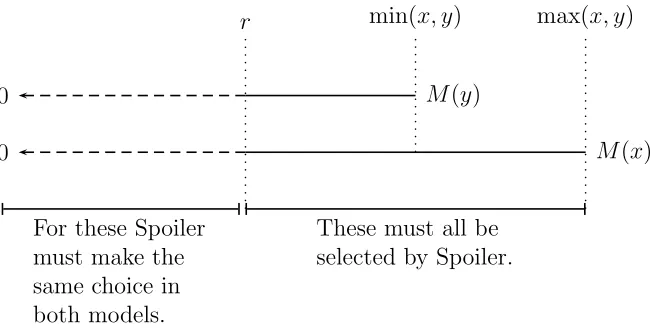
0
0 M(y)
min(x, y)
r max(x, y)
These must all be selected by Spoiler. For these Spoiler
must make the same choice in both models.
[image:21.595.131.456.81.245.2]M(x)
Fig. 1. Illustration of the proof of Lemma 22.
a [ϕ]-move will not help Spoiler. Such a move will shorten the lines, but that will cost as many rounds as it shortens them, so Spoiler still loses if they are long enough. The following Lemma captures this idea.
Lemma 22 For all m, n, and all x≤m andy≤n Duplicator has a winning for the PAL-C game for M(m), x and M(n), y with at most min(x, y) rounds.
Proof If x=y, the proof is trivial. We proceed by induction on the number
of rounds. Suppose the number of rounds is 0. Then x and y only have to
agree on propositional variables. They must agree, since pis true everywhere.
Suppose that the number of rounds isk+1 (i.e. min(x, y) =k+1). Duplicator’s strategy is the following. If Spoiler chooses to play a2-move, he moves tox−1 (or toy−1). Duplicator responds by choosingy−1 (orx−1). Duplicator has a winning strategy for the resulting subgame by the induction hypothesis.
Suppose Spoiler chooses to play aC-move. If Spoiler chooses az <min(x, y), then Duplicator also choosesz. Otherwise, Duplicator takes just one step (the minimum she is required to do). Duplicator has a winning strategy for the resulting subgame by the induction hypothesis.
Suppose Spoiler chooses to play a [ϕ]-move. Spoiler chooses a number of rounds
r and some S and S0. Observe that for all z < min(x, y) it must be the case that z ∈ S iff z ∈ S0. Otherwise, Duplicator has a winning strategy by the
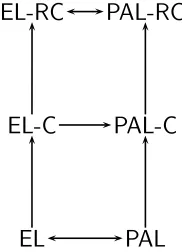
EL PAL EL-C PAL-C EL-RC PAL-RC
Fig. 2. Expressive power of static and dynamic epistemic logics.
3.7 Expressivity Results
In this section we investigate the expressive power of the logics under con-sideration here. Reduction axioms and the accompanying translation tell us that two logics have equal expressive power. But our inability to find a com-positional translation from one logic to another does not imply that those logics have different expressive power. Here are some known facts. Epistemic logic with common knowledge is more expressive than epistemic logic with-out common knowledge. In [1] it was shown that public announcement logic with common knowledge is more expressive than epistemic logic with common knowledge. This can also be shown using the results on PDL in [15]. In this section we show that relativized common knowledge logic is more expressive than public announcement logic with common knowledge. The landscape of expressive power is summarized in Figure 2. All arrows are strict.
In general one logic L is more expressive than another logic L0 (L0 −→ L in Figure 2) if there is a formula in the language of L which is not equivalent to any formula in the language of L0 (and every formula in the language of
L0 is equivalent to some formula in the language of L). So, in order to show thatEL-RCis more expressive thanPAL-Cwe need to find a formula in EL-RC
which is not equivalent to any formula in PAL-C. The formula
C(p,¬2p)
fits this purpose. This will be shown in Theorem 27.
We can show that this formula cannot be expressed in PAL-C by using model
comparison games. We will show that for any number of rounds there are two models such that Duplicator has a winning strategy for the model comparison game, but C(p,¬2p) is true in one of these models and false in the other.
In Definition 25 we provide the models thatEL-RCcan distinguish, butPAL-C
PAL-C. We deal with these submodels first in the next definition and lemma.
Definition 23 Let the model M(m, n) = (W, R, V) where 0 < n ≤ m be defined by
• W ={sx |0≤x≤m} ∪ {tx |n≤x≤m} ∪ {u}
• R={(sx, sx−1)|1≤x≤m} ∪ {(tx, tx−1)|n+ 1≤x≤m} ∪ {(w, u)|w ∈
W \ {u}} ∪ {(u, sm),(u, tm)} • V(p) =W \ {u}
The picture below represents M(2,1).
s2
s1
s0
t2
t1
u
Let us call these models ‘hourglasses’. The idea is that Spoiler cannot dis-tinguish the top line from the bottom line of these models if they are long enough. Note that apart fromu this model consists of two lines. So if Spoiler plays 2-moves on these lines, Duplicator’s strategy is the same as for the line models described above. If he moves to u, Duplicator also moves to u, and surely Duplicator cannot lose the subsequent game in that case. In these models aC-move is very bad for Spoiler, since all worlds are connected by the reflexive transitive closure of R. A [ϕ]-move will either yield two lines which are too long, or it will be a smaller hourglass model, which will still be too large, since the [ϕ]-move reduces the number of available moves. The Lemma below captures this idea.
In what follows, wx is a variable ranging over sx and tx. And if tx does not
exist it refers to sx.
Lemma 24 For all m, n and all x≤m andy≤m Duplicator has a winning strategy for the public announcement game for M(m, n), wx and M(m, n), wy
with at most min(x, y)−n rounds.
Proof We prove the case when wx = sx and wy = ty (the other cases are
completely analogous) by induction. Suppose the number of rounds is 0. Then
sx and ty only have to agree on propositional variables. They do agree, since
p is true in both.
Suppose that the number of rounds is k+ 1. Duplicator’s winning strategy is the following. If Spoiler chooses to play a 2-move, he moves to sx−1 (or to
ty−1), or tou. In the last case Duplicator responds by also choosingu, and has
thety−1(orsx−1). Duplicator has a winning strategy for the resulting subgame
by the inductive hypothesis.
Suppose Spoiler plays aC-move. If Spoiler moves tow, then Duplicator moves to the samew, and has a winning strategy for the resulting subgame.
Suppose Spoiler chooses to play a [ϕ]-move. Spoiler chooses a number of rounds
r and some S. Since there is only one model, Spoiler only chooses one subset of W. Moreover for allz ≥min(x, y)−n−r it must be the case thatwz ∈S.
Otherwise, Duplicator has a winning strategy by the induction hypothesis for
sx and wz. In Stage 2 the result will be two models bisimilar to models to
which the inductive hypothesis applies, or to which Lemma 22 applies.
Lastly consider the following class of models.
Definition 25 Let the model M+(m, n) = (W, R, V) where 0 < n ≤ m be
defined by
• W ={sx |n≤x≤m} ∪ {tx |0≤x≤m} ∪ {v, u}
• R= {(sx, sx−1)|n+ 1 ≤x≤m} ∪ {(tx, tx−1)|1≤x≤m}∪
{(w, u)|w ∈W \ {v, u}} ∪ {(t0, v)} ∪ {(u, sm),(u, tm)} • V(p) =W \ {u}
The picture below represents M+(2,0).
s2
s1
s0
t2
t1
t0
u
v
In these ‘hourglasses with an appendage’, the idea is that Duplicator cannot distinguish the top line from the bottom line of these models when they are long enough. Apart fromv, the model is just like a hourglass. So the only new option for Spoiler is to force one of the current worlds to v, and the other to another world. Then Spoiler chooses a2-move and takes a step from the non-v
world and Duplicator is stuck at v. However if the model is large enoughv is too far away. Again aC-move does not help Spoiler, because it can be matched exactly by Duplicator. Reducing the model with a [ϕ]-move will yield either a hourglass (with or without an appendage) or two lines, for which Spoiler does not have a winning strategy. This idea leads to the following Lemma.
Lemma 26 For all m, n and all x≤m andy≤m Duplicator has a winning strategy for the public announcement game for M+(m, n), wx and M+(m, n),
Proof The proof is analogous to the proof of Lemma 24.
This Lemma now yields to the following theorem.
Theorem 27 EL-RC is more expressive than PAL-C.
Proof SupposePAL-Cis just as expressive as EL-RC. Then there is a formula
ϕ ∈ PAL-C with ϕ ≡ C(p,¬2p). Suppose d(ϕ) = n. In that case we would
haveM+(n,0), sn |=ϕandM+(n,0), tn 6|=ϕ, contradicting Lemma 26. Hence,
EL-RC is more expressive.
3.8 Complexity Results
Update logics are about processes that manipulate information, and hence they raise natural questions of complexity, as a counterpoint to the expres-sive power of communication and observation scenarios. In particular, all of the usual complexity questions concerning a logical system make sense.Model checking asks where a given formula is true in a model, and this is obviously crucial to computing updates. Satisfiability testing asks when a given formula has a model, which corresponds to consistency of conversational scenarios in our dynamic epistemic setting. Or, stating the issue in terms ofvalidity: when will a given epistemic update always produce some global specified effect? Finally, just as in basic modal logic, there is a non-trivial issue of model com-parison: when do two given models satisfy the same formulas in our language, i.e., when are two group information states ‘the same’ for our purposes? As usual, this is related with checking forbisimulation, or in a more finely-grained version, the existence of winning strategies for Duplicator in the above model comparison games.
Now technically, the translation of Definition 11 combined with known al-gorithms for model checking, satisfiability, validity, or model comparison for epistemic logic yield similar algorithms for public announcement logic. But, in a worst case, the length of the translation of a formula is exponential in the length of the formula. E.g., the translation of ϕ occurs three times in that of [ϕ]CB(ψ, χ). Therefore, a direct complexity analysis is worth-while.
We provide two results plus some references.
Lemma 28 Deciding whether a finite model M, w satisfies ϕ ∈ EL-RC is
computable in polynomial time in the length of ϕand the size of M.
Proof The argument is an easy adaptation of the usual proof for PDL or common knowledge with common knowledge: see [16, p.202] and [13, p.91].
This algorithm does not suffice for the case with public announcements. The truth values of ϕand ψ in the given model do not fix that of [ϕ]ψ. We must also know the value ofψ in the model restricted to ϕworlds.
Lemma 29 Deciding whether a finite model M, w satisfies ϕ ∈ PAL-RC is
computable in polynomial time in the length of ϕand the size of M.
Proof Again there are at most|ϕ|subformulas ofϕ. Now we make a binary tree of these formulas which splits with formulas of the form [ψ]χ. On the left subtree all subformulas ofψ occur, on the right all those ofχ. This tree can be constructed in timeO(|ϕ|). Labeling the model is done by processing this tree from bottom to top from left to right. The only new case is when we encounter a formula [ψ]χ. In that case we have already processed the left subtree for ψ. Now we first label those worlds where ψ does not hold as worlds where [ψ]χ
holds, then we process the right subtree under [ψ]χ where we restrict the model to worlds labeled as ψ-worlds. After this process we label those worlds that were labeled with χ as worlds where [ψ]χ holds and the remaining as worlds where it does not hold. We can see by induction on formula complexity that this algorithm is correct.
Also by induction on ϕ, this algorithm takes time O(|ϕ| ×kMk2). The only
difficult step is labeling the model with [ψ]χ. By the induction hypothesis, restricting the model to ψ takes time O(| ψ | ×kMk2). We simply remove
(temporarily) all worlds labelled ¬ϕ and all arrows pointing to such worlds. Again by the induction hypothesis, checkingχ in this new model takesO(|ψ| ×kMk2) steps. The rest of the process takes kMk steps. So, this step takes
over-all time O(|[ψ]χ| ×kMk2).
Moving on from model checking, the satisfiability and the validity problem of epistemic logic with common knowledge are both known to be EXPTIME-complete. In fact, this is true for almost any logic that contains a transi-tive closure modality. Satisfiability and validity for PDL are also EXPTIME-complete. Now there is a linear time translation of the language of EL-RC to that of PDL. Therefore the satisfiability and validity problems for EL-RC are
also EXPTIME-complete. For PAL-RC and even PAL-C, however, the
com-plexity of satisfiability and validity is not settled by this. Lutz [20] shows that satisfiability inPALis PSPACE-complete, using a polynomial-time translation from dynamic-epistemic to purely epistemic formulas. The latter is unlike the translation underpinning our reduction axioms, in that it is not
meaning-preserving. The same method probably extends to PAL-C and PAL-RC.
This completes our in-depth analysis of a redesigned dynamic logic of public announcement. Having shown the interest of such a system, we now consider more powerful versions, covering a much wider range of phenomena.
4 A New Logic of Communication and Change
The examples in the Section 2 set a high ambition level for a dynamic epis-temic logic updating with events involving both communication and actual change. As we explained, systems of this general sort were proposed in [1,2], but without reduction axioms for common knowledge. We now proceed to a version which can deal with common knowledge, generalizing the composi-tional methodology for epistemic logic with announcements of Section 3.
In Section 4.1 we introduce update models and specify their execution on
epistemic models in terms of ‘product update’. The only difference with the references above is our addition of fact-changing actions by substitutions. In Section 4.2 we review propositional dynamic logic (PDL) under its epis-temic/doxastic interpretation, written henceforth asE-PDL. In Section 4.3 we
then present our dynamic epistemic logic of communication and change LCC
as an extension of E-PDLwith dynamic modalities for update models. In
Sec-tion 4.4 we show that LCC is in harmony with E-PDL through a semantic
analysis of epistemic postconditions, and in Section 4.5 we present a proof system for LCC in terms of reduction axioms based on this insight [11,10].
From a technical perspective, the proofs to follow are not just simple general-izations of those for public announcements. In [18] a correspondence between
update models and finite automata is used to obtain reduction axioms in
a dynamic epistemic logic based on so-called ‘automata PDL’, a variant of
E-PDL. Our main new idea here is that this can be stream-lined by analyzing the automata inductively inside E-PDL itself [11], using the well-known proof of Kleene’s theorem, stating that languages generated by nondeterministic finite automata are regular [17]. The main theorems to follow use an induc-tive ‘program transformation’ approach to epistemic updates whose structure resembles that of Kleene’s translation from finite automata to regular expres-sions. This technique for deriving compositional reduction axioms may be of independent interest beyond the present setting.
4.1 Update Models and their Execution
possible events and agents’ abilities to distinguish between these. In [1] this observation is used as the engine for general update of epistemic models un-der epistemic actions. In particular, individual events come withpreconditions holding only at those worlds where they can occur.
Of course, events normally do not just signal information, they also change the world in more concrete ways. Before describing the update mechanism, we en-rich our dynamic models with postconditions for events that really change the world. For this purpose we use ‘substitutions’ that effect changes in valuations at given worlds, serving as postconditions for events to occur.
Definition 30 (Substitutions) substitutions are functions of type →
that distribute over all language constructs, and that map all but a finite number of basic propositions to themselves. substitutions can be represented as sets of bindings
{p1 7→ϕ1, . . . , pn7→ϕn}
where all the pi are different . If σ is a substitution, then the set {p ∈
P | σ(p) 6= p} is called its domain, notation dom(σ). Use for the identity substitution. Let SUB be the set of all substitutions.
Definition 31 (Epistemic Models under a Substitution) If M = (W, V, R) is an epistemic model and σ is a substitution (for an appropriate epistemic language ), then Vσ
M is the valuation given by λp ·[[σ(p)]]M. In
other words, Vσ
M assigns to w the set of worlds w in which σ(p) is true. For
M = (W, V, R), callMσ the model given by (W, Vσ M, R).
Definition 32 (Update Models) An update model for a finite set of agents
N with a language is a quadruple U= (E,R,pre,sub) where
• E={e0, . . . ,en−1} is a finite non-empty set of events,
• R:N →℘(E2) assigns an accessibility relation R(a) to each agent a∈N.
• pre:E→ assigns a precondition to each event,
• sub:E →SUB assigns a substitution to each event.
A pair U,e is an update model with a distinguished actual event e∈E.
In these definitions, can be any language that can be interpreted in the
models of Definition 1. Note that an ‘action model’ in the sense of [1] is a special update model in our sense, wheresubassigns the identity substitution
Remark: Information Change and Real Change Note that the world-changing feature is modular here. Readers only interested in epistemic infor-mation flow can think of models in the original dynamic epistemic style. All of our major results hold in this special case, and proofs proceed by merely skipping base steps or inductive steps involving the substitutions.
Executing an update is now modeled by the followingproduct construction.
Definition 33 (Update Execution) Given a static epistemic model M = (W, R, V), a world w ∈W, an update model U= (E,R,pre,sub)and an action state e ∈ E with M, w |= pre(e), we say that the result of executing U,e in
M, w is the model M ◦U,(w,e) = (W0, R0, V0),(w,e) where
• W0 ={(v,f)|M, v |=pre(f)},
• R0(a) ={((v,f),(u,g))|(v, u)∈R(a) and (f,g)∈R(a)},
• V0(p) ={(v,f)|M, v |=sub(f)(p)}
Once again, Definitions 32 (with all substitutions set equal to) and 33 provide a semantics for the logic of epistemic actions LEA of [1]. The basic epistemic language LEA can then be extended with dynamic modalities [U,e]ϕ, where
a U is any finite update model for LEA. These say that ‘every execution of
U,eyields a model where ϕholds’:
M, w |= [U,e]ϕiff M, w|=pre(e) implies that M ◦U,(w,e)|=ϕ
In [1] an axiomatic system forLEAis presented with a, somewhat complicated, completeness proof, without reduction axioms for common knowledge. Our analysis to follow will improve on this.
To see what is needed, observe that, again, the semantic intuition about the crucial case M, w |= [U,e]CBϕ is clear. It says that, if there is a B-path
w0, . . . , wn(withw0 =w) in the static model and a matchingB-pathe0, . . . ,en
(with e0 = e) in the update model with M, wi |= pre(ei) for all i ≤ n, then
M, wn |= ϕ. To express all this in the initial static model, it turns out to
be convenient to choose a representation of complex epistemic assertions that meshes well with update models.
4.2 Epistemic PDL
The language of propositional dynamic logic and all further information about its semantics and proof theory may be found in [16], which also has references to the history of this calculus, and its original motivations in computer science. We briefly recall some major notions and results.
Definition 34 (PDL, Language) Let a set of propositional variables P and a set of relational atoms N be given, with p ranging over P and a over N. The language of PDL is given by:
ϕ::=> |p| ¬ϕ|ϕ1 ∧ϕ2 |[π]ϕ
π::=a|?ϕ|π1;π2 |π1∪π2 |π∗
We employ the usual abbreviations:⊥is shorthand for¬>,ϕ1∨ϕ2is shorthand
for¬(¬ϕ1∧ ¬ϕ2),ϕ1 →ϕ2 is shorthand for¬(ϕ1∧ϕ2),ϕ1 ↔ϕ2 is shorthand
for (ϕ1 →ϕ2)∧(ϕ2 →ϕ1), and hπiϕ is shorthand for¬[π]¬ϕ.
Definition 35 (PDL, Semantics) The semantics of PDL overP, N is given in models M = (W, R, V) for signature P, N. Formulas of PDL are inter-preted as subsets ofW, relational atoms a as binary relations on W (with the interpretation of relational atoms a given as R(a)), as follows:
[[>]]M=W
[[p]]M=V(p) [[¬ϕ]]M=W\[[ϕ]]M [[ϕ1∧ϕ2]]M= [[ϕ1]]M ∩[[ϕ2]]M
[[ [π]ϕ]]M={w∈W | ∀v if (w, v)∈[[π]]M then v ∈[[ϕ]]M}
[[a]]M=R(a)
[[?ϕ]]M={(w, w)∈W ×W |w ∈[[ϕ]]M}
[[π1;π2]]M= [[π1]]M ◦[[π2]]M
[[π1∪π2]]M= [[π1]]M ∪[[π2]]M
[[π∗]]M= ([[π]]M)∗
Here ([[π]]M)∗ is the reflexive transitive closure of binary relation [[π]]M. If
w ∈W then we use M, w |=ϕ for w ∈[[ϕ]]M, and we say that ϕis true at w.
These definitions specify how formulas ofPDLcan be used to make assertions about PDL models. E.g., the formula hai> says that the current state has an
R(a)-successor. Truth of hai>in a model says that R(a) is serial.
Note that ? is an operation for mapping formulas to programs. Programs of the form ?ϕ are called tests; they are interpreted as the identity relation, restricted to the states s satisfying the formulaϕ.
Ifσ ={p1 7→ϕ1, . . . , pn7→ϕn} is aPDL substitution, we use ϕσ forσ(ϕ) and
πσ for σ(π). We can spell outϕσ and πσ, as follows:
>σ =>
pσ =σ(p)
(¬ϕ)σ =¬ϕσ
(ϕ1∧ϕ2)σ =ϕσ1 ∧ϕσ2
([π]ϕ)σ = [πσ]ϕσ
aσ = a
(?ϕ)σ = ?ϕσ
(π1;π2)σ = π1σ;πσ2
(π1∪π2)σ = π1σ∪π2σ
(π∗)σ = (πσ)∗.
The following holds by simultaneous induction on the structure of formulas and programs:
Lemma 36 (Substitution) For all PDL models M, all PDL formulas σ, all
PDL programs π, all PDL substitutions σ:
M, w |=ϕσ iff Mσ, w |=ϕ.
(w, w0)∈[[πσ]]M iff (w, w0)∈[[π]]Mσ
.
This is just the beginning of a more general model-theory for PDL, which is bisimulation-based just like basic modal logic.
One striking feature of PDL is that its set of validities is decidable, with a perspicuous axiomatization. We display it here, just to fix thoughts — but no details will be used in what follows.
Theorem 37 The following axioms and inference rules are complete forPDL:
(K) ` [π](ϕ→ψ)→([π]ϕ→[π]ψ) (test) ` [?ϕ1]ϕ2 ↔(ϕ1 →ϕ2)
(sequence) ` [π1;π2]ϕ↔[π1][π2]ϕ
(choice) ` [π1∪π2]ϕ↔[π1]ϕ∧[π2]ϕ
(mix) ` [π∗]ϕ↔ϕ∧[π][π∗]ϕ
and the following rules of inference:
(Modus Ponens) From `ϕ1 and `ϕ1 →ϕ2, infer `ϕ2.
(Modal Generalisation) From `ϕ, infer `[π]ϕ.
In the rest of this paper, we are going to use PDL for a very special purpose, viz. as a rich epistemic language. This may be confusing at first sight, since the objects in our update models are events, and hence one might naturally think of a propositional dynamic logic for sequences of these. The latter use would be close to describing operational structure on update models viewed asprograms, which we noted in Section 2, but then decided to forego. We ask the reader to firmly resist this association henceforth, and focus instead on the following epistemic perspective ([24,28]). To make the distinction even clearer, we will often refer to propositional dynamic logic in this epistemic guise as
E-PDL.
Atomic relations will be epistemic accessibilities of single agents. Compositions like b1;b2 then express the ‘levels of knowledge’ of Parikh: if ϕexpresses that
b1 wants b2 to pick up the children, then [b1;b2]ϕ states that b1 knows that
b2 knows what is expected of him (a precondition for being at ease about
the arrangement). Next, if B ⊆ N and B is finite, we use B as shorthand
for b1∪b2∪ · · ·. Under this convention, the general knowledge operator EBϕ
takes the shape [B]ϕ, while the common knowledge operatorCBϕappears as
[B∗]ϕ, i.e., [B]ϕ expresses that it is general knowledge among agents B that
ϕ, and [B∗]ϕexpresses that it is common knowledge among agentsB that ϕ.
In the special case where B = ∅, B turns out equivalent to ?⊥, the program
that always fails. In the same vein, common belief among agents B that ϕ
can be expressed as [B;B∗]ϕ. ButE-PDL is much richer than these notions, in
that it also allows for much more complex combinations of agent accessibility relations, corresponding to some pretty baroque ‘generalized agents’. We have found no practical use for these at present, but they are the price that we cheerfully pay for having a language living in expressive harmony with its dynamic superstructure — as will be described now.
4.3 LCC, a Dynamic Logic of Communication and Change
Now we have all the ingredients for the definition of the logic of communication and change.
Definition 38 (LCC, Language) The language LCC is the result of adding
a clause [U,e]ϕfor update execution to the language of E-PDL, where U is an update model for LCC.
se-mantics of PDL, with the meaning of [U,e]ϕ in M = (W, R, V) given by:
[[[U,e]ϕ]]M ={w ∈W |if M, w |=pre(e) then (w,e)∈[[ϕ]]M◦U }.
We have to check that the definition of execution of update models is well behaved. The following theorems state that it is, in the sense that it preserves epistemic model bisimulation and update model bisimulation (the correspond-ing theorems for LEA are proved in [1]).
Theorem 40 For all PDL models M, w and N, v and all formulas ϕ∈ LCC
If M, w↔N, v then w ∈[[ϕ]]M iff v ∈[[ϕ]]N
This theorem must be proved simultaneously with the following result.
Theorem 41 For all PDL models M, w and N, v, all update models U,e:
If M, w↔N, v then M ◦U,(w,e)↔N ◦U,(v, a).
Proof We prove both results simultaneously by induction on formulasϕand the preconditions of the relevant update models.
• Proof of Theorem 40: the base case for propositional variables and the cases for negation, conjunction, and program modalities is standard. The only interesting case is for formulas of the form [U,e]ϕ. Suppose w ∈[[[U,e]ϕ]]M.
Therefore w ∈[[pre(e)]]M implies (w,e)∈[[ϕ]]M◦U
. By the induction hypoth-esisw ∈[[pre(e)]]M iffv ∈[[pre(e)]]N andM◦U,(w,e)↔N◦U,(v,e). Then, by
applying the induction hypothesis to M◦U,(w, a) andN◦U,(v,e), we infer
v ∈[[pre(e)]]N implies (v,e)∈[[ϕ]]N◦U
. By the semantics this is equivalent to
v ∈[[[U,e]ϕ]]N. The other way around is completely analogous.
• Proof of Theorem 41: LetB be a bisimulation witnessingM, w↔N, v. Then the relation C betweenWM ×EU and WN ×EU defined by
(w,e)C(v,f) iffwBv and e=f
is a bisimulation.
The induction hypothesis guarantees that (w,e) exists iff (v,f) exists. Suppose (w,e)C(v,f). Then wBv and e = f. The only non-trivial check is the check for sameness of valuation. By wBv, w and v satisfy VM(w) =
VN(v). Bye= f, e and f have the same substitution σ. By the fact that w
and v are bisimilar, by the induction hypothesis we have thatw ∈[[ϕ]]M iff
v ∈ [[ϕ]]N. Thus, by V
M(w) = VN(s) and the definition of VMσ and VNσ, we
get VMσ(w) =VNσ(v).