Theses Thesis/Dissertation Collections
9-15-2016
Accounting for the Language Variance in Executive
Function
Jessica Contreras
Follow this and additional works at:http://scholarworks.rit.edu/theses
This Thesis is brought to you for free and open access by the Thesis/Dissertation Collections at RIT Scholar Works. It has been accepted for inclusion in Theses by an authorized administrator of RIT Scholar Works. For more information, please [email protected].
Recommended Citation
Department of Psychology, College of Liberal Arts
Rochester Institute of Technology
Accounting for the Language Variance in Executive Function
by
Jessica Contreras
A thesis in
Experimental Psychology
Submitted in Partial Fulfillment of the Requirements for the degree of
Master of Science
We approve the thesis of Jessica Contreras:
______________________________________________________________________________
Dr. Peter C. Hauser Date
Professor, Rochester Institute of Technology
Co-Chair of the Thesis Committee
______________________________________________________________________________
Dr. Tina Sutton Date
Assistant Professor, Rochester Institute of Technology
Faculty Advisor and Co-Chair of the Thesis Committee
______________________________________________________________________________
Dr. Karen Emmorey Date
Professor, San Diego State University
Acknowledgements
I would like to thank my entire committee for their time, dedication, and intellectual contribution to my project. If it was not for their support this project could not have been possible. I would also like to attribute a special thanks to Visual Language and Visual Learning (VL2) for their grant that made this research possible.
On a personal note, I would like to thank those near and dear to me who have shaped my
resilience that has gotten me to this point. The constant believers and supporters who were there during the hard times while cheering me on with the belief that deaf can/you can.
Dr. Peter C. Hauser, there are truly no words to thank you for being an amazing mentor. All of the time you have invested and everything you have taught me is something that I will never forget. I cannot wait to make you proud as I continue on my next step in my journey to become a researcher. Years down the road if there is one person I can thank that got me to where I am today it would be you as you were a constant supporter, teacher, and friend. For that I am thankful that I was able to learn from you in the six years you dedicated to my academic and personal growth.
Dr. Karen Emmorey, thank you so much for having me as an intern in your lab. You are an amazing researcher and I look up to you as well as all of your work. Thank you for the time you took to help me develop my thesis project and the ideas your entire team contributed. The experience of working in your lab was a great one, and to see how successful your lab runs certainly adds more fire to my desire to succeed.
Abstract
Language is considered an important precursor for executive function (EF) development, with
advantages shown for bilinguals. The current study explored the impact of early bilingual
language experience (spoken and sign language) on executive functions. Participants were deaf
college students with cochlear implants. Participants language experiences were diverse. They
varied in American Sign Language (ASL) and English proficiency, reported various ages for sign
language acquisition, and reported different ages of implantation. Results indicate that age of
acquisition, age of implantation, and English and ASL proficiency have no effect on these
participants’ performance on the Color Trails Test, a measure of EF. Future recommendations
would be to use a more robust measure of EF to detect differences among deaf individuals.
Keywords: Bilingualism, Executive Function, Bimodal Bilingualism, American Sign Language,
Contents
Abstract 5
Introduction 8
The Role of Language in EF Development in Hearing Populations
Monolinguals and Executive Functioning 9
Bilinguals and Executive Functioning 10
Bimodal Bilinguals and Executive Functioning 13
The Role of Language in EF Development in Deaf Populations
Early Language Experience with Deaf Parents 14
Deaf Bimodal Bilinguals and EF 15
Early Language Experience with Cochlear Implants 16 Types of Language used by Deaf Individuals with Cochlear Implants 18 Deaf Monolinguals with Cochlear Implants and EF 19
Current Study 21
Hypotheses 22
Method 23
Participants Materials Procedure
Results 27
Discussion 30
Limitations 36
Conclusion 37
List of Tables
Table 1 Correlation Matrix 44
Accounting for the Language Variance in Executive Function
Executive functions (EF) are a set of cognitive processes responsible for goal-oriented
behavior and learning (Diamond, 2013). These processes include inhibitory control, working
memory, and cognitive flexibility. Together, they formulate higher-level executive functions
such as reasoning, problem solving, and planning. Inhibition is one’s ability to direct their
attention to important stimuli while ignoring irrelevant stimuli. Working memory requires an
individual to be able to remember information long enough to manipulate the information.
Working memory goes beyond short-term memory because the information has to be re-arranged
cognitively rather than just being able to memorize pieces of information. Cognitive flexibility is
ones’ ability to freely and appropriately adapt to changed circumstances with different demands.
Executive functioning processes are not specific to one part of the brain, but rather collectively
work together to facilitate behavior regulation and learning (Diamond, 2013).
The development of EF is dependent upon one’s environment, genetics, biology, and
experience. Executive functions develop rapidly from birth but experience a decline around
puberty and stabilize around the age of 25 (Blakemore & Choudhury, 2006). This is explained by
the synaptic pruning that occurs within the brain as connections that are not frequently used are
pruned in order to strengthen connections more frequently used. Executive functions have been
found to be important in numerous aspects of life, but appear to have a strong impact on
school-age children. A study conducted with elementary school-school-aged children showed that children with
better EF skills are able to grasp numeracy and literacy concepts in kindergarten (Blair & Razza,
2007). Children with better EF skills are able to control their attention and exhibit better
that is necessary for learning. While we know that EF processes are important for academics,
recent research has focused on finding the variables associated with EF development.
A study by Szameitat, Schubert, Müller, and von Cramon (2002) examined specific areas
of the brain that showed executive function activity, studying individuals as they performed
dual-tasks under a Functional Magnetic Resonance Imaging (fMRI) machine. The results revealed
activity in the dorsolateral prefrontal cortex. Szameitat et al. (2002) indicated that dual-tasks
represent the challenges we face when presented with two different paradigms requiring the use
of higher cognitive processes (EF). Thus, when subjects are presented with a dual-task paradigm,
they will begin to rely on EF to mediate the decision-making process to accommodate the rules
of both tasks. This will then increase the neural activities in the prefrontal cortex; the area
utilized when EF is required.
Research has also indicated that the environment plays a role in the development of
executive function. Hackman and Farah (2009), completed a review of multiple studies that
investigated the impact of socioeconomic status (SES) on EF. Their findings indicated poor
language outcomes are associated with those who have low SES, and individuals who have high
SES display twice the vocabulary size. The literature also shows that individuals who have low
SES display worse working memory skills and poor inhibition.
The Role of Language in EF Development in Hearing Populations
Monolinguals and Executive Functioning
Some researchers have begun to look at language as a possible mediating factor of EF
development. The literature seems sparse when it comes to explanations regarding why language
may be an underlying factor for EF development. Hungerford and Gonyo (2007) have suggested
mediated through our ability to reason with ourselves internally while navigating our day to day
life. For example, those with stronger language skills are perhaps better able to plan and
organize, contributing to stronger EF development.
Aphasia is a specific communication disorder that impacts one’s ability to understand and
perceive language (Klein, 2000). While these individuals have the tools for language, there
appears to be some underlying disruption to the processes that allow them to process or produce
language. Individuals who have aphasia often exhibit worse EF skills when compared to those
who do not have aphasia (Fridriksson, Nettles, & Davis, 2006). So if one’s language skills are
impacted it may also impact their cognitive abilities. The findings seem to indicate that language
may be an underlying indicator of one’s EF skills. Those who have Aphasia show decreased EF
development-indicating language mediates our ability to maximize our cognitive processes.
Spoken language abilities have an impact on the development of cognition specifically for
individuals who struggle in one language (Klein, 2000).
Bilinguals and Executive Functioning
Research in executive function has found that those with dual language experience show
cognitive benefits compared to individuals who are proficient in one language, or individuals
who exhibit language weaknesses (Bialystok, 2005; Fridriksson et al., 2006). Bialystok (2005)
showed that individuals with better language skills show better EF skills as well; furthermore,
individuals who know two spoken languages have even better cognitive functioning.
Investigators who studied a population of Spanish-English bilingual children also found
evidence for enhanced executive functioning (Carlson & Meltzoff, 2008). They collected data
from approximately 50 kindergarten children who were bilingual, monolingual, or an immersion
day and Spanish or Japanese the other half of the day. The bilingual group differed from the
immersion group by their parents language status—bilinguals grew up in a home exposed to both
Spanish and English. Thus, the bilinguals were exposed to two languages from birth and the
immersion group were exposed to a second language at a later age. Their results showed that
when controlling for age, verbal ability, and socioeconomic status, bilinguals showed advantages
in inhibition. Interestingly enough, the bilinguals scored significantly lower on the vocabulary
assessments. When learning multiple languages early in life the child is not yet proficient until a
later age. This finding is similar to studies completed by Bialystok whose research interests are
bilinguals, language, and executive functioning.
Bialystok and Feng (2009) designed a two-part study investigating children and adults,
by comparing individuals who were proficient in one language (English) to individuals proficient
in two spoken languages (English and another language) on an executive function task. The
bilingual children were raised in homes speaking Cantonese, Arabic, Korean, Spanish, Farsi,
Tagalog, or Tamil, while attending school taught in English. Results indicated that the bilingual
children had vocabulary weaknesses compared to monolinguals, but possible advantages on
performance in a cognitive function task specifically cognitive control. The bilingual children
displayed better cognitive control, specifically inhibition, when compared to monolingual
children. The adult study featured a population of college students that were monolinguals or
bilinguals (spoke another language on a daily basis along with English). The bilinguals, again,
scored lower on a vocabulary assessment; however, when compared with monolinguals, those
with better verbal abilities did better on the inhibition tasks. Those who had better language skills
(proficiency in two languages) were able to recall a greater number of word lists even when
enhancing inhibition abilities. Bilinguals who know two spoken languages must inhibit one when
speaking the other.
More recent studies that look at the effect of bilingualism on executive function have
attempted to better measure language proficiency. Rosselli, Ardila, Lawani, and Velez-uribe
(2015), argue that individuals can be balanced bilinguals or low proficiency bilinguals, meaning
proficient in two languages or proficient in one language with low proficiency in the other,
respectively. Their study attempted to better understand the difference in executive functioning
among balanced bilinguals and low proficiency bilinguals. One hundred and fourteen
Spanish/English speaking undergraduate students between the ages of 18-45 years old
participated in the study. The researchers screened all participants to ensure they had no history
of learning disabilities, other language experience (outside of Spanish/English), and performance
on both verbal/nonverbal tasks. Subjects who were bilingual were assigned to one of three
groups based upon their language skills: balanced high proficiency, balanced low proficiency,
and low proficiency proficiency by using a median split. Subjects who were monolingual were
split into high proficiency and low proficiency groups. Results indicated that language
proficiency did not correlate with better EF skills using assorted verbal/nonverbal tasks for both
monolinguals and bilinguals. They further showed that non-verbal IQ was a better predictor of
cognitive functioning than language proficiency. Currently, there is no agreed upon way to
evaluate bilingual skills. Rosselli’s method of using a median split was used for the current study
in an attempt to understand varying bilingual proficiency and the impact on EF skills.
Currently, the literature is ambiguous regarding whether bilingual language skills have an
effect on EF development. The current study will attempt to further understand language skills in
Balanced Bilinguals (high sign/spoken proficiency), (2) Spoken Dominant Bilinguals (low
sign/high Spoken proficiency), (3) Sign Dominant Bilinguals (high sign/low spoken proficiency),
and (4) Low proficiency Bilinguals (low sign/low spoken proficiency).
Bimodal Bilinguals and Executive Functioning
The impact of modality – whether a language is spoken or signed – on cognitive
functioning is not well understood. In order to investigate how cognitive function may be
impacted by language through two senses, vision and sound, Emmorey, Luk, Pyers, and
Bialystok (2008), studied bimodal bilinguals who knew a spoken and signed language. The
bimodal bilinguals were college-aged individuals who grew up in a home with one or two
parents who are deaf and use American Sign Language (ASL) as their primary language, thus
they grew up speaking English and signing ASL. On a nonverbal cognitive functioning task, the
bimodal bilinguals were compared to a group of bilingual individuals who grew up speaking
English and Spanish, and a control group of individuals who knew only one language. Using a
flanker task they modified from a previous study, the researchers examined specific processes
such as inhibition, monitoring processes, and task switching through reaction time. Their results
indicated that the bimodal bilinguals did not show better processes and performed the same as
monolinguals. However, similar to previous literature, individuals who knew two spoken
languages showed cognitive advantages. This lends support to the idea that the bilingual
advantage applies to those whose two languages share the same modality. One possible
explanation is that bilinguals who know two spoken must switch between languages, whereas
bimodal bilinguals are able to blend two languages simultaneously. The possible
switching/inhibiting between languages may be an explanation of the enhanced functioning
To date the study conducted by Emmorey et al. (2008) is the only one assessing executive
control in bimodal bilinguals. More work is needed for clarification on whether knowing
languages in two modalities plays a role in EF in signing populations, or if cognitive benefits
only exist when both languages are in the same modality. Currently, what we know indicates that
bilingualism has cognitive benefits only within spoken language and those benefits do not extend
to bimodal bilinguals. Additionally, studies could seek to explain the role of sign language in
executive function development within deaf individuals.
The Role of Language in EF Development in Deaf Populations
Early Language Experience with Deaf parents
Gallaudet Research Institute data from 2009-2010 indicate that approximately 16% of
hearing parents of deaf children communicate in sign language. Gallaudet Research Institute
findings are reported on their website
(https://research.gallaudet.edu/Demographics/2010_National_Summary.pdf) and are only
representative of the people that actually completed their survey. Mitchell & Karchmer (2004)
analyzed the reports of over 30,000 deaf students between the ages of 6-19 and showed that
approximately 96% are born to hearing parents. Looking specifically into native signers’
language development, Hauser, Lukomski, and Hillman (2008) suggested that those who are
exposed to sign language from birth reached language milestones at the same age as hearing
peers. For example, deaf mothers attention-getting strategies facilitate visual attention skills that
are later important for language development. Individuals who are profoundly deaf show typical
development in language through a visual modality, but there is also other research investigating
the correlation of exposure to sign language and cognitive benefits with the stipulation that
Deaf Bimodal Bilinguals and Executive Functioning
Crume and Singleton (2008) looked at behavior relation skills of a group of deaf children
in a classroom. They compared children who had deaf parents (native early signers) to children
who had hearing parents (late signers) presuming that deaf children born with deaf parents would
have access to sign language from birth, whereas deaf children with hearing parents would have
delayed language exposure. This study used classroom observation and counted the number of
prompts each child received which measured overt behavior regulation. Each prompt was used to
direct the child’s attention to the person who was talking at the moment whether it was the
teacher, or a peer. The prompts were broken down into two categories: attention-getting (when
the teacher asked the child to look at the teacher) and attention-directing (when the teacher asked
the child to look at their peer who was talking). They found native signers showed better
behavior regulation skills and required less prompts than the late signers, indicating that early
language exposure correlates with cognitive skills in primary school settings, specifically for
deaf individuals born into signing families.
Dye and Hauser (2014) attempted to measure performance in specific components of
executive functioning in deaf children who have been exposed to sign language from birth (Deaf
native early signers). They were compared to a control group, which consisted of hearing
monolingual children. They administered a Continuous Performance Task (CPT) measuring the
ability of sustaining attention and selective attention. Their findings indicated that deaf and
hearing children showed no differences in a sustained attention task. Their research further
demonstrate that older deaf children who receive language from birth, despite lack of audio
input, are able to perform the same as their hearing peers on the selective attention task. Selective
that due to hearing loss, their visual system may compensate by expanding their visual field
perhaps in a way that may be seen as “distractible,” when in fact it may be useful. Past research
has indicated that deaf individuals experience a wider peripheral vision, which may be indicative
of brain plasticity that occurs based upon one’s experiences (Dye, Hauser, & Bavelier, 2009).
Again, this area has yet to be further explored, as this is the only study conducted on native
signers and executive function, though there is other research examining deaf individuals who
have cochlear implants.
Early Language Experience with Cochlear Implants
A cochlear implant (CI) offers individuals an implantation that allows access to sound, by
bypassing the auditory system through an external microphone that transmits to an internal
processor (Gates & Miyamoto, 2003). Researchers have sought to better understand how a
cochlear implant enhances language development in deaf individuals. One study compared deaf
individuals who received cochlear implants to individuals with hearing aids (HA), alongside a
control group consisting of hearing age-matched controls (Figueras, Edwards, & Langdon,
2008). The sample consisted of a total of 69 children between the ages of 8-12. A majority of the
deaf children (those with hearing aids and cochlear implants) used only spoken English as their
means of communication and not sign language. Results indicated that the language scores in the
deaf groups (CI and HA) were significantly below the hearing control group. There was no
difference between the CI and HA groups in language skills.
Svirsky, Robbins, Kirk, Pisoni, and Miyamoto (2000) investigated language development
using a longitudinal design with a sample of 70 deaf children with and without cochlear
implants. For the children with cochlear implants, they were assessed 4 months prior to receiving
implantation. Results reflected that prior to implantation all deaf children showed language
abilities that were below average when compared to hearing normative data used to develop the
language assessments. When closely comparing the data for language abilities for individuals
who received implants to those who did not receive implants, those who received implants
showed better language development at all time periods after implantation. Language abilities
were synonymous with speech development. However, one must keep in mind that since
language is already delayed these gains were only seen after implantation, and pre-implantation
experience had an overall impact on language development milestones. The study explained that
all children with better hearing developed speech better, perhaps the interpretation should have
been that those who hear better will develop more speech abilities.
Miyamoto, Hay-Mccutcheon, Iler Kirk, Houston, & Bergeson-Dana (2008) focused on
answering the question of whether age of implantation makes a difference in language skills in
deaf individuals. Participants included 91 deaf individuals who received a cochlear implant
either before the age of 1, from 1-2 years old, or from 2-3 years old. They compared their
performance on a language measure and found that overall a majority of the children fell below
the average language skills when compared to normative means developed based upon hearing
children. Their data also indicated that individuals who were implanted after the age of 2
performed worse on language measures than those who were implanted prior to the age of 2.
Individuals who were implanted before the age of 1 showed the best language outcomes
compared to the other two groups, suggesting that earlier implantation is correlated with better
language development.
A recent meta-analysis conducted by Lund (2015) found that deaf children with cochlear
peers. The meta-analysis totaled 52 studies that included children from the ages 4-9 and used
spoken English as their primary language. Their findings indicated that despite hearing assistive
devices deaf children with cochlear implants did not develop expressive or receptive vocabulary
knowledge normally (when compared to hearing peers). Furthermore, the results suggested that
age when implanted, duration of implantation, or age at testing did not appear to be significant
factors. From the above studies, we come to understand that having a cochlear implant does not
necessarily promote language development.
Type of Language used by Deaf Individuals with Cochlear Implants
Researchers have measured the type of language that deaf individuals with cochlear
implants use. Hyde and Punch (2011) used a mixed method approach in answering the question
of language choices in deaf children with cochlear implants in Australia. They combined
information gathered from parents and teachers of the deaf children along with interview data
from the children themselves. Of the parent data collected, it was noted that nearly 100% of the
parents were hearing with only one deaf parent. The mean implantation age of the group
according to parents was approximately 3 years old. According to parent report, less than 20% of
the children communicated with their parents using sign language; a majority of them
communicated through spoken English. In most cases, when sign language was combined with
speech, few parents communicated with their child solely through sign language. When
questioning teachers regarding language used in the school setting, statistics showed over 50% of
the language used was spoken English with less than 20% using a combination of spoken
English and Australian Sign Language (Auslan). Thus, based on this study, it seems the use of
Deaf Monolinguals with Cochlear Implants and Executive Functioning
Figueras et al. (2008) examined executive functioning in individuals with CI’s. The
population consisted of deaf individuals with cochlear implants or hearing aids in comparison to
hearing age-matched controls. Their executive functioning measures covered skills that were
closely linked to language such as planning, set shifting, working memory, and impulse control.
In their results, the deaf group consisting of individuals with cochlear implants or hearing aids
showed no difference from each other and were therefore combined to analyze executive
functioning in comparison to the hearing group. Once combined, the deaf population showed
deficits in impulse control, inhibition, and cognitive shifting. These results suggest that having
limited access to language through sound may have a negative impact on the development of EF
skills. Again it should be noted that the majority of this population used spoken English as their
main source of communication.
Beer, Kronenberger, and Pisoni (2011) were also interested in language skills in
association with cognitive functioning for individuals who are born deaf, receive cochlear
implants, and have no exposure sign language. Beer et al. (2011) compared deaf non-signing
cochlear implanted children to individuals who speak one language, which was their control
group. Parents completed the Behavior Rating Inventory of Executive Function (BRIEF).
Findings indicated differences between the deaf individual and control group. Specifically, the
parents of deaf non-signing individuals with cochlear implants reported more problems in their
child’s ability to inhibit irrelevant stimuli, utilize working memory, and overall behavioral
regulation index (consisting of a composite score made up of several EF abilities). High scores
above 60 are indicative of problems in specific components of EF abilities, whereas scores below
samples standard scores were below the significantly elevated range (scores below 60) placing
them within the normal range. One should take into account that the hearing control group in this
study performed below the average displaying exceptionally high executive functioning
behaviors. Furthermore, when looking at the deaf individuals’ language measures in correlation
with EF, it was found that individuals who performed better on the language measures also
displayed better EF skills. The language measures were not administered to the control group, so
these findings are limited to deaf non-signing individuals with cochlear implants.
Conway, Pisoni, Anaya, Karpicke, and Henning (2011) investigated the impact of
experience (sense and language) on executive functioning by comparing deaf children with
cochlear implants to typically-developing hearing peers using a sequential learning task designed
by Cleary, Pisoni, and Geers (2001). Their stimuli consisted of squares that were colored and the
student had to replicate the exact order of presentation. The stimulus was given in two parts
unbeknownst to subjects that consisted of a learning phase and a test phase; also the stimulus was
designed to generate learning sets based on grammatical and ungrammatical test sequences
(Cleary et al., 2001). The ungrammatical test sequences consisted of a novel sequence that was
not consistent with grammar, whereas the grammatical test sequences were generated based on
underlying artificial grammar in which particular colors can occur in sequence. No grammatical
test sequences were present in the learning phase as this was designed to assess competency of
the task at hand. The test phase contained a mixture of grammatical and ungrammatical test
sequences. Results for the learning phase indicated no group differences and showed
comprehension of the task. This is important to ensure that the children understood the task at
hand and were able to accurately replicate visual sequences. However during the test phase, the
sequences. Not only did the hearing peers outperform the deaf individuals; they also showed
better performance in the grammatical test sequences in comparison to the ungrammatical test
sequences. This indicates that hearing individuals were able to improve when the test sequences
followed grammatical sequences, whereas deaf individuals with cochlear implants were unable
to do so. When looking at the results for the deaf individuals, they showed no improvement in
either the grammatical or ungrammatical test sequences, overall performing worse than their
hearing peers. The researchers believe these results indicate that deaf individuals performed
worse on this task due to their inability to hear. They suggest sound serves as a scaffolding for
understanding sequential series of events and without access to sound this can have a negative
impact on EF.
Overall, when looking closely at the literature related to deaf individuals with cochlear
implants they underperform in executive functioning compared to typically developing hearing
peers. Although, when taking a closer look at the population used all the children with cochlear
implants were not exposed to sign language. The current study attempts to further understand the
differences that each modality-sound versus signed language makes to overall executive
functioning skills in college-aged adults.
Current Study
The literature review showed that competency in one language correlated with EF and
bilinguals who speak two languages showed enhanced cognitive benefits. However, when
attempting to further understand the implications of bimodal bilinguals, specifically in deaf
individuals, there seemed to be conflicting information. This study aimed to understand how
early language experience in two modalities (signed and spoken) accounts for the variance in
work investigated deaf individuals with cochlear implants with various language experiences
(sign and spoken). The dependent variables were social economic status, age of exposure to sign
language, sign language proficiency, age of implantation, and spoken language proficiency. All
individuals, regardless of experience, completed language assessments in spoken English and
American Sign Language to determine if the subjects were balanced bilinguals, sign dominant,
or spoken language dominant.
Hypotheses
Predicting which dependent variable will contribute the most to cognitive functioning is
difficult. Studies indicate a cognitive benefit for spoken bilinguals, but not bimodal bilinguals.
Studies focusing on deaf populations show no cognitive benefits for those with cochlear
implants, but for deaf individuals who grow up in a home using sign language. As such, we were
cautious to approach all variables equally. These variables include: socioeconomic status, age of
exposure to sign language, sign language proficiency, age of implantation, and spoken language
proficiency. Our prediction was that all of the variables will contribute to some extent to
executive functioning. The two main research questions are: (1) does age of implantation and age
of exposure to sign language have an impact on EF performance? and (2) does English and sign
proficiency have an impact on EF performance? The following hypotheses were made:
1. Social economic status will have an impact on EF performance, such that high SES will
correlate with better EF performance.
2. Age of implantation will have an impact on EF performance, such that earlier implanted
adults will have better EF performance.
3. Age of acquisition will have an impact on EF performance, such that those who learned
4. American Sign Language proficiency will have an impact on EF performance, such that
those who are proficient in ASL will have better EF performance.
5. English proficiency will have an impact on EF performance, such that those who are
proficient in English will have better EF performance.
Method
Participants
Participants were recruited from the Rochester Institute of Technology via flyers, emails,
business cards, and Facebook. All participants in the study were paid $20 for their time. This
research study recruited 39 subjects who were born deaf and received cochlear implants.
Participants had no known neurological, learning, or vision difficulties through self-report and
were born in the United States. Participants were between the ages of 18-32 with a mean age of
22 years (SD= 2.805). The study sample consisted of 69% females and 31% males.
Approximately 71% of the participants were white whereas the remaining subjects were African
American, Hispanic, Asian, or other. Four participants were removed from this study for being
under the influence, not being born in the United States, or for not completing the entire study
(they did not show up a second time to complete one or more tasks).
Participants were given language measures meant to assess their American Sign
Language and English proficiency. Median scores were used to split them into high or low in
each language. Individuals who scored high in both ASL and English were placed into the
balanced bilingual group. Individuals who scored high in ASL and low in English were
categorized as sign dominant, whereas those who scored low in ASL and high in English were
categorized as spoken dominant. Finally, individuals who scored low in both ASL and English
Materials
A background questionnaire was administered to every subject. The questionnaire asked
participants about their experience with assistive devices and communication. The questions of
interest were “What age did you receive your implant,”; and “At what age, were you exposed to
American Sign Language?” The background questionnaire also included the Hollingshead
self-report scale that asks about parents’ education and occupation status. Each component
corresponds with a score and are indicative of social economic status.
The Kaufman-Brief Intelligence Test (K-BIT; Kaufman, 1990) contains a portion that
assesses nonverbal intelligence. Scores obtained on this assessment are able to be adapted into
standard scores of each participants’ cognitive functioning. Standard scores 85 and below are
considered to be below average functioning, whereas 115 and above are considered to be above
average.
All participants took two language assessments, which are designed to measure their
skills in American Sign Language and English. Video data was collected for the American Sign
Language assessment and English assessment that were later scored by a research assistant.
American Sign Language skills were assessed through the American Sign Language-Sentence
Reproduction Test (ASL-SRT; Hauser, Paludneviene, Supalla, & Bavelier, 2009). The
assessment consists of 20 sentences designed to measure one’s sign proficiency through
comprehension and production. Individuals viewed a sentence signed and then were given a
chance to reproduce the sentence accurately. Twenty sentences were administered and
participants were given one point for every sentence reproduced correctly. Participants’ English
was measured by subtest four of the Test of Adolescent and Adult Language-3rd Edition
grammar, subjects were asked to repeat a sentence they heard as accurately as possible. TOAL-3
subtest four consists of 30 sentences and subjects receive a score of one for each correct
sentence.
The sentence repetition task (SRT) was used as a measure of language skill. The use of
SRT has been argued against due to the idea that rather than assessing language skills they tap
into working memory skills. Klem et al. (2015) studied this claim to see whether or not sentence
repetition tasks actually are dependent upon working memory. Their longitudinal study included
216 children from Norway with no learning disabilities or sensory impairments. All children
were native speakers of Norwegian. Each participant was given three measures- sentence
reproduction test, vocabulary assessment, and grammatical knowledge assessment. Their
approach argued that if SRT measured working memory systems, then results should also serve
as a predictor of growth in other language skills. If the SRT in fact does not draw upon working
memory systems and serves as broad measure of language skills, then performance should
correlate strongly with a unitary language factor, such as vocabulary and grammatical
knowledge.
Findings indicated that sentence reproduction tasks are a complex linguistic measure
reflecting language abilities on multiple levels. Results indicated SRT scores did not predict
growth in language skills. Rather, SRT results correlated strongly with other measures of
language abilities. The dynamic process of the reproduction tasks draws upon ones’ ability to
comprehend spoken items and correct sentence production. The drawback of using SRT is results
are not diagnostic since they measure broad language skills. For example, if an individual has
low vocabulary knowledge and has never been exposed to an item their ability to remember and
However, further understanding of the SRT measures allows us to use this as a broad measure of
language abilities and to identify individuals who struggle with language impairments.
The Color Trails Test (CTT; D’Elia, Satz, Uchiyama, & White, 1996) is a two-part
assessment of speed and accuracy of overall executive functioning. Subjects were asked to
complete both parts connecting the dots in order from 1-25 as quickly as possible and to avoid
making errors. In the second part, subjects had to alternate colors (pink/yellow) while marking
the ascending numbers. Reaction time was measured in both conditions and converted to
standard scores.
The Color Trails Test (CTT) is based upon the Trail Making Test in an attempt to reduce
potential confounding effects on performance such as language differences, illiteracy, reading
disabilities, or educational experience. Williams et al. (1995) examined 200 children with
neurological disorder, language or learning disabilities, and learning and/or language disabilities
in conjunction with ADHD using the CTT. Results indicated that the CTT was sensitive to
differences in executive functioning despite neuropsychological functioning. Thus, the CTT was
chosen as a broad measure of executive functioning to be used in this study to eliminate language
confounds.
Procedure
Participants were scheduled based upon first come first serve basis, and testing took
approximately one hour. After signing a consent form, each participant completed a background
questionnaire. Upon the completion of the background questionnaire, all subjects completed the
language, cognitive functioning, and intelligence measures. The assessments were randomly
B, C, D) prior to administration to control for ordered effects. All scoring took place after the
testing session.
Results
Since this study used a precautionary approach, correlations were used to see if there
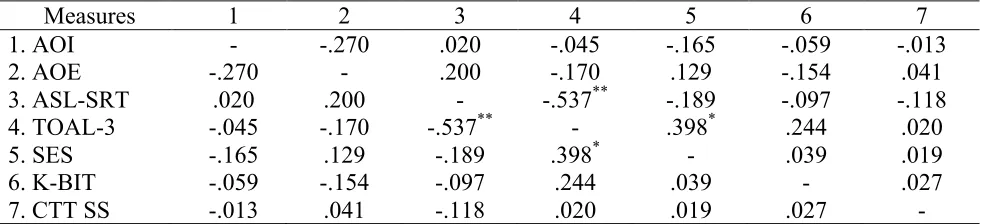
were any connections between the variables and performance on the CTT (see Table 1). There
were two significant correlations that appeared. There was a moderate negative correlation
between signing and spoken proficiency. Those who signed well did not speak well and vice
versa. Within this sample, there was a weak positive correlation between SES and spoken
English skills. Those with higher SES (parents education and occupation) had better speaking
skills and those with lower SES had worse speaking skills. Looking at SES, there was no
correlation with EF skills (see Table 1). Those with lower or higher SES did not show a
difference in executive functioning skills.
To determine if those with early implantation performed better than those with late
implantation on CTT, a repeated measures ANOVA was computed with CTT Trail as the
repeated measure (Trail 1, Trail 2) and Group (Early/Late) as the between subject measure. The
median of the samples age of implantation was seven years of age. Those who were in the early
implantation group received implants before the age of seven and those who were in the late
implantation group received implants after the age of seven. Seventeen were in the early
implantation group and 18 were in the late implantation group. There were no significant
differences between the two groups based on their CTT performance, F(1, 33) = .448, p = .508
for Trail 1. The early implantation group had the average standard score of 95.57 (SD = 14.16)
the early implantation group had the average standard score of 93.43 (SD =12.82) and the late
implantation group had the average standard score of 95.50 (SD = 16.27).
To determine if those with early exposure to ASL performed better than those with late
exposure to ASL on the CTT, a repeated measures ANOVA was computed with CTT Trail as the
repeated measure (Trail 1, Trail 2) and Group (Early/Late) as the between subject measure. The
median age of exposure was three years of age. Those who learned sign before the age of three
were in the early sign exposure group and those who learned sign after the age of three were in
the late sign exposure group. Sixteen were in the early sign exposure group and nineteen were in
the late sign exposure group. There were no significant differences between the two groups
based on their CTT performance, F(1, 33) = .027, p = .871. For Trail 1, the early sign exposure
group had a mean standard score of 93.40 (SD = 12.42) and the late sign exposure group had a
mean standard score of 92.08 (SD = 15.25). For Trail 2, the early sign exposure group had a
mean standard score of 94.40 (SD = 16.40) and the late sign exposure group had a mean standard
score of 94.20 (SD = 13.45).
To determine if the Balanced Bilinguals performed differently than the Sign Dominant or
Spoken Dominant groups, a repeated measures ANOVA was computed with CTT Trail as the
repeated measure (Trail 1, Trail 2) with Group (Low Proficiency Bilinguals, Sign Dominant,
Spoken Dominant, Balanced Bilinguals) as the between subject measure. No significant
differences were found between groups on the CTT, F(1, 31) = .616, p. = .610. For Trail 1 and 2,
each mean score is presented in mean standard scores. For Trail 1, the low proficiency group had
a mean standard score of 92.00 (SD = 21.47), the spoken proficiency group had a mean standard
score of 92.08 (SD = 11.91), the sign proficiency group had a mean standard score of 88.82 (SD
For Trail 2, the low proficiency group had a mean standard score of M = 93.71 (SD = 17.11), the
spoken proficiency group had a mean standard score of 96.23 (SD = 12.11), the sign proficiency
group had a mean standard score of 91.82 (SD = 16.50), and the balanced proficiency group had
a mean standard score of 95.50 (SD = 11.56). Group means and SD on each variable (Age of
Implantation, Age of Acquisition, Sign Proficiency, and Spoken Language Proficiency) are
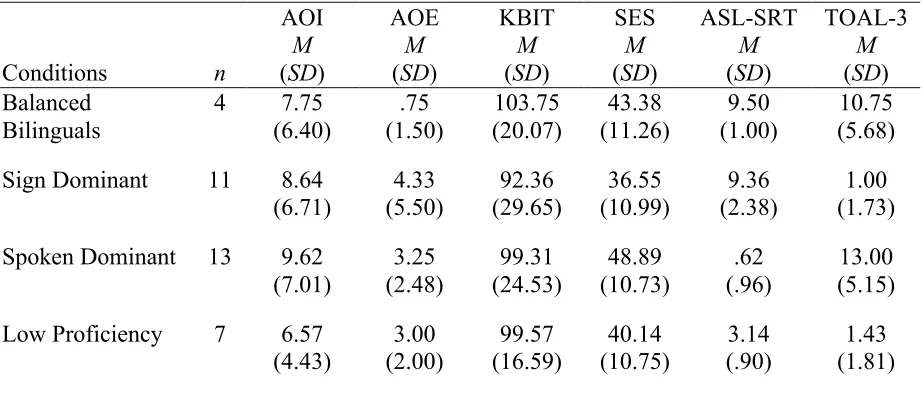
presented in Table 2 along with sample size for each group.
To determine if the strong ASL signers performed better than the weak ASL signers on
CTT, a repeated measures ANOVA was computed with CTT Trail as the repeated measure (Trail
1, Trail 2) and Group (High/Low) as the between subject measure. The median of the samples
ASL-SRT scores (Median = 4.0) was used to create the two groups. Those who scored lower
than four on the ASL-SRT were placed in the low signers group and those who scored higher
than four were placed in the high signers group. Eighteen were in the high signers group and
seventeen were in the low signers group. There were no significant differences between the two
groups based on their CTT performance, F(1, 33) = .035, p = .852. For Trail 1, the high signers
had a mean standard score 93.00 (SD = 13.38) and the low signers had a mean standard score of
92.05 (SD = 15.33). For Trail 2, high signers had a mean standard score of 92.80 (SD = 15.03)
and low signers had a mean standard score of 95.35 (SD = 13.66).
To determine if the strong English speakers performed better than the weak English
speakers on CTT, a repeated measures ANOVA was computed with CTT Trail as the repeated
measure (Trail 1, Trail 2) and Group (High, Low) as the between subject measure. The median
of the samples TOAL3 scores (Median = 4.0) was used to create the two groups. Those who
scored below four on the TOAL3 were placed in the low speakers group and those who scored
fifteen were in the low speakers group. There were no significant differences between the two
groups based on their CTT performance, F(1, 33) = 1.037, p = .316. For Trail 1, high speakers
had a mean standard score of 95.00 (SD = 11.92) and low speakers had a mean standard score of
90.06 (SD = 16.26). For Trail 2, high speakers had a mean standard score of 96.06 (SD = 11.63)
and low speakers had a mean standard score of 92.56 (SD = 16.26).
Discussion
The current study sought to better understand the impact of language specifically in two
modalities in deaf individuals with cochlear implants. The two main research questions were: (1)
does age of implantation and age of exposure to sign language have an impact on EF
performance? and (2) does English and sign proficiency have an impact on EF performance?
Results indicated that there was no significant impact on EF for either of the main research
questions. Individuals who were implanted early did not show an EF advantage. Individuals who
learned sign language early did not show an EF advantage either. Individuals who were
proficient in spoken English and/or American Sign Language also did not show an EF
advantage. None of the five variables of interest (socioeconomic status, age of implantation, age
of exposure, sign proficiency, and spoken proficiency) correlated with executive function
performance. These variables showed no impact on executive function overall.
Attempting to understand how SES does not make an impact in deaf and hard of hearing
adults is difficult; however, it is important to note that the sample size in this study is very small,
consisting of only 35 subjects. When observing the effects of SES, this study found no
significant contribution to EF development. In hearing children, past studies have shown
socioeconomic status is strongly correlated with language development and EF development
however, this does not appear to hold true for the deaf and hard of hearing adults with cochlear
implants in this sample. One possible explanation for SES not correlating with EF performance
may be a result of early intervention services. Early intervention services may compensate for
low SES eliminating this as a mediating factor in development for deaf individuals. The Early
Hearing Detection and Intervention Act requires a mandatory screening of all babies at the age of
one month and confirmation whether the child is deaf or hard of hearing by the age of three
months By the time the deaf or hard of hearing child is six months old they are eligible for early
intervention programs.
Additionally, there may be other factors that play a role in language and EF development
in deaf children, such as maternal sensitivity (responsiveness to child communication) and
facilitative language techniques (DesJardin & Eisenberg, 2007; Pressman, Pipp-Siegel,
Yoshinaga-Itano, & Deas, 1999). Parents in both of these studies completed questionnaires
regarding how they responded and facilitated language development with their child with
cochlear implants. Children showed better language learning with parents who were more warm
and used expansion versus those children with parents who did not use those techniques. This
study did not include other measures of language development skills outside of asking when a
cochlear implant was received and when they were exposed to sign language. These variables
were not considered in the present study and may be a possible consideration for future studies.
Lund (2015) showed in his meta-analysis that spoken language outcomes of those with
cochlear implants were widely varied with few successes, and a majority of studies failing to
report positive language outcomes. In his study, he included over 52 publications looking at the
better or worse outcomes. Overall, the literature on cochlear implants are still conflicted and the
current study findings suggest there may be other factors that have not been considered.
Deaf adults who received cochlear implants early in life did not differ in EF skills from
those who received a cochlear implant later in life. The mean age of this group was seven years
(prior to seven was considered early and after seven was considered late). The results of this
study add to the literature that age of implantation in deaf individuals does not have an impact on
EF. However, it should be strongly cautioned that the limited sample size of college-aged adults
should be considered when interpreting the results. In addition, the age of seven was used as the
cutoff in the current study, and is considered past the critical period. There is no clear way based
upon the previous literature to split the groups and the present study was a replication of one
conducted with bilingual hearing adults in which a median split was used. All students in this
study were admitted into college and the sample is not representative of deaf individuals with
cochlear implants on a large scale. In the current study, we did not include a hearing or bilingual
control group thus we are unable to determine if those who were implanted early or late showed
a deficit in EF skills, as found in other studies (Beer, et al., 2011; Cleary et al., 2001; Conway et
al., 2011; Figueras et al., 2008).
Another possibility may be due to the CTT not being sensitive enough to measure an
effect of EF differences between spoken and signing populations. As mentioned earlier, the CTT
is a broad measure of EF skills and includes various components. The purpose of use in this
study was to do an exploratory study to see if language skills contribute to EF skills on a broad
level. If for example, the CTT showed a significant difference then later studies could follow up
to identify specific EF components language may or may not influence. This was done in caution
have detected if the language is correlated with one specific component of EF. Perhaps use of
specific EF measure would have been better, but given the vast literature on EF there are
multiple ways to measure this skill; however, when considering deaf populations there is sparse
literature on how to best measure this and what role language, specifically, a signed language
may play in EF development.
Age of exposure to sign language also did not show an impact on EF skills-those who
were exposed to sign early and late did not differ in their EF performance. The mean age of
exposure was seven years of age. All deaf college aged students in this study had hearing
parents. Thus, it is difficult to understand the quality of sign language input given the questions
asked—(e.g. what age were you exposed to sign language?). Some studies allude to the role of
sign language in hearing families as a possible negative impact on environment. Knoors and
Marcshark (2012) indicated that using sign language can hinder family dynamics. Also, it seems
that learning sign language can be difficult for some family members, especially those who are
older. There were no deaf of deaf college aged adults used in this study as controls, which means
it is difficult to further understand the age of exposure in deaf with cochlear implants in
comparison.
Spoken language skills in deaf adults with cochlear implants also did not show an impact
on EF performance. Those who spoke well showed no difference when compared to those who
did not speak well in performance on the CTT. The median score was four was used to classify
individuals as high or low in spoken language proficiency. This was quite low when
understanding the scale goes up to 30 correct. One must also keep in mind that this measure was
a broad approach to measuring spoken language proficiency, as it required comprehension and
there are no studies that indicate the reliability and validity of using this type of measure with
deaf individuals with cochlear implants. Another factor to consider would be determining the
normal average for deaf individuals with cochlear implants. Do they perform differently than a
hearing individual? Or is it measuring ability to hear rather than spoken language abilities. In
previous studies specific measures of spoken language abilities are used, unlike the broad
measure used in this study. It is difficult to make further conclusions or understand the impact
spoken language skills have on EF performance in deaf individuals with cochlear implants.
An analysis was done for High/Low proficiency in ASL. Results indicated no difference
in performance on the CTT based upon sign language skills. One must also keep in mind that
four out of twenty on the ASL-SRT measure appears to be quite low (less than 20% correct).
There are no current norms on how deaf adults should perform on the ASL-SRT as this test is
quite new and released only a few years ago. Perhaps all of the signers in this study could be
considered weak because they scored very low, but at this point it is hard to understand what
difference signing skills plays in EF development. The only possible difference from this study
and others was that this sample of deaf individuals with cochlear implants did not came from
deaf signing families (Dye et al., 2009; Dye & Hauser, 2014). This could have been an
influencing factor and one wonders if we would have seen a difference if we had included the
even smaller population of deaf individuals who are born with deaf parents and receive a
cochlear implant. Though, there is no current literature indicating the number of deaf individuals
born to deaf parents who received a cochlear implants, one can deduce that since approximately
5-10% of deaf children have deaf parents, the sample of those who receive implants would be
One significant finding in this study was that those who spoke well did not sign well and
those who signed well did not speak well. This is quite interesting because it showed that deaf
individuals with cochlear implants were dominant in spoken English or ASL. In this study, we
had difficulty recruiting individuals who performed well in both spoken and American Sign
Language measures. One possible explanation for this difference in the current sample of deaf
individuals with a CI may be due to strong opinions regarding the use of sign language while
trying to teach deaf children with spoken language. Some medical professionals, researchers, and
audiologists fear that learning sign language will impede spoken language success (Smith &
Wolfe, 2013). The thought being if you learned sign language then this would interfere or hinder
one’s ability to learn spoken language. This type of encouragement is based the idea of
promoting spoken language success.
Assessing individuals based upon their language skills in signing and spoken English
proficiency indicated no differences. There were no differences between those who signed or
spoke, nor those who were fluent in both. Lastly, there was no difference between individuals
who displayed low proficiency in sign and spoken English. The method of splitting the sample
into groups based on their language proficiency was replicated from Rosselli et al., (2015). In
their study, they did not find differences between language groups as well. One should take into
consideration that Rossellis’ study had far more participants– 125 versus only 35 within the
present study.
Overall, none of the variables predicted performance on the CTT measurement. Currently
this fits with a previous study by Emmorey and colleagues (2008), which found that bilingual
advantages do not extend to hearing adults who are proficient in a signed and spoken language.
previous findings that deaf individuals who have cochlear implants do not show better cognitive
performance than hearing individuals (Cleary et al. 2001; Conway et al., 2011). The main
difference is that this study attempted to look at those exposed to sign language and spoken
English to see if differences in EF could be attributed to language skills; however, no
significance was found. Perhaps if there were more individuals who had participated in this study
the results would have been different.
Limitations
This study showed that the CTT may not be a sensitive measure for the current research
question. Future recommendations would be to use a more robust measure such as the one used
by Bialystok (2005) that would be sensitive to group differences. Bialystok (2005) used a flanker
task and this may be sensitive enough to detect differences in executive function performance.
The flanker task measures specific components such as inhibition and cognitive flexibility. The
measure used in this study was broad and included several components of EF. Focusing on a
specific component may be beneficial because it can help us specify which components of EF
are related to language.
Additionally, the sample in this study had very few balanced bilinguals (those who sign
and speak well). Careful recruitment should be a focus in future studies to ensure that each group
is well represented. A factor of interest would be to find deaf individuals with cochlear implants
who are born to deaf signing parents—perhaps this would make a difference in further
understanding the impact of early sign language experience on executive function.
Background measures should include a question related to early intervention. This may or
may not be a factor to consider, however it may be worthwhile to investigate as this is a type of
exists for hearing children. As mentioned earlier there may be maternal sensitivity and
facilitative language techniques may also play a role beyond SES within deaf children with
cochlear implants. Future studies may include more intensive background questionnaires to see
what type of language learning environments deaf adults with cochlear implants were raised
within to see if this may correlate with language development and/or EF.
A majority of the students recruited in this sample were proficient in either sign or
spoken language—which may have impacted the results. This study did not include a control
group, which limits the amount of interpretation regarding language proficiency. Perhaps use of
children of deaf adults (CODA’s) would be a useful control group because this population grows
up with exposure to sign and speech. This would help with generalization for future studies.
Conclusion
The above findings appear to indicate there are other factors playing a role in deaf EF
development. Language exposure and skills do not correlate with EF development in either
spoken or sign language. Modality appears to not make a difference. These findings are
important to consider as they add to the literature of language abilities specifically in an auditory
and visual modality. Lastly, SES did not appear to have an impact on EF development. This in
itself is quite interesting as to date there are no studies examining the impact of SES in deaf
children/adults. Further understanding of this issue would definitely be useful as this can lend
some insight on the impact of early intervention services for children at a broader level rather
than just those who are deaf. Future studies should include questions asking about early
intervention services and attempt to see if there are any other factors that should be included to
study EF development. The importance of these findings adds to the literature that currently
language impacts EF development can allow us to develop specific interventions on a broader
level. Using the deaf population adds a unique factor of how modality may or may not play a
References
Beer, J., Kronenberger, W. G., & Pisoni, D. B. (2011). Executive function in everyday life:
Implications for young cochlear implant users. Cochlear Implants International, 12(s1),
89-91.
Bialystok, E. (2005). Consequences of bilingualism for cognitive development. In Kroll, J. &
Groot, A. M. (Eds.), Handbook of Bilingualism Psycholinguistic Approaches (pp.
417-432). Oxford: Oxford University Press.
Bialystok, E., & Feng, X. (2009). Language proficiency and executive control in proactive
interference: Evidence from monolingual and bilingual children and adults. Brain and
Language, 109(2-3), 93–100.
Blair, C., & Razza, R. P. (2007). Relating effortful control, executive function, and false belief
understanding to emerging math and literacy ability in kindergarten. Child Development,
78(2), 647-663.
Blakemore, S. J., & Choudhury, S. (2006). Development of the adolescent brain: Implications for
executive function and social cognition. Journal of Child Psychology and Psychiatry,
47(3/4), 296-312.
Carlson, S. M., & Meltzoff, A. N. (2008). Bilingual experience and executive functioning in
young children. Developmental Science, 11(2), 282–298.
Cleary, M., Pisoni, D. B., & Geers, A. E. (2001). Some measures of verbal and spatial working
memory in eight-and nine-year-old hearing-impaired children with cochlear implants.
Ear and Hearing, 22(5), 395-411.
Conway, C. M., Pisoni, D. B., Anaya, E. M., Karpicke, J., & Henning, S. C. (2011). Implicit
69–82.
Crume, P., & Singleton, J. (2008). Teacher practices for promoting visual engagement of deaf
children in a bilingual school. Presentation at the Association of College Educators of the
Deaf/Hard of Hearing, Monterey, CA.
D’Elia, L. F., Satz, P., Uchiyama, C. L., & White, T. (1996). Color Trails Test. Lutz, Florida:
Psychological Assessment Resources, Inc.
DesJardin, J. L., & Eisenberg, L. S. (2007). Maternal contributions: Supporting language
development in young children with cochlear implants. Ear and hearing, 28(4), 456-469.
Diamond, A. (2013). Executive functions. Annual Review of Psychology, (64), 135-168. doi:
10.1146/annurev-psych-113011-143750.
Dye, M. W., & Hauser, P. C. (2014). Sustained attention, selective attention and cognitive
control in deaf and hearing children. Hearing Research, 309, 94-102.
Dye, M. W., Hauser, P. C., & Bavelier, D. (2009). Is visual selective attention in deaf individuals
enhanced or deficient? The case of the useful field of view. PLoS One, 4(5), e5640.
Emmorey, K., Luk, G., Pyers, J. E., & Bialystok, E. (2008). The source of enhanced cognitive
control in bilinguals evidence from bimodal bilinguals. Psychological Science, 19(12),
1201-1206.
Figueras, B., Edwards, L., & Langdon, D. (2008). Executive function and language in deaf
children. Journal of Deaf Studies and Deaf Education, 13(3), 362-377.
Fridriksson, J., Nettles, C., & Davis, M. (2006). Functional communication and executive
function in aphasia. Clinical Linguistics andPhonetics, 20, 401-410.
Gates, G. A., & Miyamoto, R. T. (2003). Cochlear implants. New England Journal of Medicine,
Hackman, D. A., & Farah, M. J. (2009). Socioeconomic status and the developing brain. Trends
in Cognitive Sciences, 13(2), 65-73.
Hammill, D. D., Brown, V. L., Larsen, S. C., & Wiederholt, J. L. (1994). Test of Adolescent and
Adult Language. Austin, Texas: Pro-Ed.
Hauser, P. C., Lukomski, J., & Hillman, T. (2008). Development of deaf and hard-of-hearing
students’ executive function. In Marschark, M. Editor & Hauser, P. C. Editor (1st Eds.),
Deaf cognition: Foundations and Outcomes (pp. 286-308). New York, NY: Oxford
University Press.
Hauser, P. C., Paludneviciene, R., Supalla, T., & Bavelier, D. (2009). American Sign Language:
Sentence reproduction test. In Colloquium presented at the University of New Mexico,
Albuquerque.
Hungerford, S. & Gonyo, K. (2007). Relationships between executive functions and language
variables. Paper presented at the American Speech Language Hearing Association
Conference, 2007, Boston, MA.
Hyde, M., & Punch, R. (2011). The modes of communication used by children with cochlear
implants and role of sign in their lives. American Annals of the Deaf, 155(5), 535-549.
Kaufman, A. S. (1990). K-BIT: Kaufman Brief Intelligence Test. Circle Pines, MN: American
Guidance Service.
Klein, S. B. (2000). Biological Psychology. New Jersey: Prentice-Hall, Inc.
Klem, M., Melby‐Lervåg, M., Hagtvet, B., Lyster, S. A. H., Gustafsson, J. E., & Hulme, C.
(2015). Sentence repetition is a measure of children's language skills rather than working