On: 26 February 2015, At: 02:28 Publisher: Taylor & Francis
Informa Ltd Registered in England and Wales Registered Number: 1072954 Registered office: Mortimer House, 37-41 Mortimer Street, London W1T 3JH, UK
Journal of Engineering Design
Publication details, including instructions for authors and subscription information:
http://www.tandfonline.com/loi/cjen20
Creation dependencies of evolutionary
artefact and design process knowledge
Wenjuan Wang a , Alex Duffy a , Iain Boyle a & Robert Whitfield a
a
Design, Manufacture, and Engineering Management , University of Strathclyde , 75 Montrose Street, Glasgow , G1 1XJ , UK Published online: 27 Aug 2013.
To cite this article: Wenjuan Wang , Alex Duffy , Iain Boyle & Robert Whitfield (2013) Creation dependencies of evolutionary artefact and design process knowledge, Journal of Engineering Design,
24:9, 681-710, DOI: 10.1080/09544828.2013.825103
To link to this article: http://dx.doi.org/10.1080/09544828.2013.825103
PLEASE SCROLL DOWN FOR ARTICLE
Taylor & Francis makes every effort to ensure the accuracy of all the information (the “Content”) contained in the publications on our platform. However, Taylor & Francis, our agents, and our licensors make no representations or warranties whatsoever as to the accuracy, completeness, or suitability for any purpose of the Content. Any opinions and views expressed in this publication are the opinions and views of the authors, and are not the views of or endorsed by Taylor & Francis. The accuracy of the Content should not be relied upon and should be independently verified with primary sources of information. Taylor and Francis shall not be liable for any losses, actions, claims, proceedings, demands, costs, expenses, damages, and other liabilities whatsoever or howsoever caused arising directly or indirectly in connection with, in relation to or arising out of the use of the Content.
Vol. 24, No. 9, 681–710, http://dx.doi.org/10.1080/09544828.2013.825103
Creation dependencies of evolutionary artefact and design
process knowledge
Wenjuan Wang*, Alex Duffy, Iain Boyle and Robert Whitfield
Design, Manufacture, and Engineering Management, University of Strathclyde, 75 Montrose Street, Glasgow G1 1XJ, UK
(Received 29 November 2011; final version received 10 July 2013)
As design progresses, artefact and process knowledge often evolve together. However, there is very limited knowledge on the true nature of the dependencies between these two elements of knowledge. This paper presents the first attempt to clearly define ‘creation’ dependencies, which cause a change in design knowl-edge. Three data analyses were used to identify the dependencies: two were in-depth protocol analyses of a single student product design project and a senior ship designer’s daily work, and a third was a quantitative questionnaire analysis involving seven experienced complex system designers from industry. The analyses revealed a set of 52 previously unknown creation dependencies between artefact and design process knowl-edge with commonality found in only 5, with additional dependencies being identified that were specific to the design being studied. Different frequencies of dependency occurrence and particular dependency loops were identified. In addition, the importance and role of domain knowledge were explicitly revealed. The described research highlights the need for further work to provide a more comprehensive definition of the nature of evolutionary artefact and design process knowledge dependencies. Identification of these dependencies offers a significant opportunity to develop tools and techniques with an enhanced ability to support ‘what–if’ analyses during design.
Keywords: creation dependency; artefact knowledge; design process knowledge
1. Introduction
Designing is considered to be one of the significant intelligent activities undertaken by humans due to its complexity (Gero and McNeill 1998). Engineering design generally begins with incomplete knowledge, which can be regarded as an ambiguous requirement or idea for an artefact. The design then evolves as it progresses from initial conceptual design through to detailed design. While the former produces concepts for the whole or different parts of an artefact;1the latter gives a precise
and detailed description of the artefact (Pahl and Beitz 1996). It is a knowledge-intensive process in which considerable knowledge is used and generated by designers. For example, in aerospace design, approximately 40,000 documents can be produced for a single aero engine design (Ahmed and Wallace 2006).
Given its importance within society, design has been the subject of considerable research in recent decades that has been ultimately directed towards improving society’s ability to perform design and create useful products, systems, and services within an ever-changing world. One of the outputs of this research has been the development of different design models and approaches
*Corresponding author. Email: [email protected]
© 2013 Taylor & Francis
of how design can be performed, including for example Pugh’s model of total design (Pugh 1991) and Pahl et al.’s (2007) model of engineering design. While similarities exist between these differ-ent models (e.g. in terms of the basic phases that comprise the design process), their differences (e.g. the techniques employed within them) illustrate the variety that can exist in terms of how designers ‘design’, and thus raising the question of what affects the design process. As design pro-gresses, knowledge of the artefact being designed evolves from a conceptualisation to a detailed representation for the realisation of an artefact. However, knowledge of the design process also evolves through ever-changing and unforeseen design activities. That is, the artefact and design process knowledge both co-evolve during design development, formulating an inter-dependency, and yet we know very little of the inter-dependencies that exist or their nature. In this paper, if one design knowledge element causes the creation or modification of the other, it is considered that a creation dependency exists between them. There are of course many different types and interpre-tations of inter-dependencies that can exist. For instance, ‘employment’ involving the use of or referral to existing knowledge elements, ‘modification’ involving changes to existing knowledge elements, ‘inconsistency’ where two knowledge elements are inconsistent with each other, and ‘redundancy’ where one knowledge element makes another redundant. While these fall outside the scope of this paper, some examples are presented in the coupling of evolutionary artefact and design process knowledge (Wang 2008).
Both product and complex systems design are knowledge-intensive activities that involve com-plex inter-dependencies between different types of design knowledge. If designers could foresee the dependencies that will occur during the design activity, it could increase their understanding of the impact of design decisions and provide additional decision-making support through facil-itating what–if scenarios. Fundamentally, gaining an insight into the artefact and design process dependencies is the foundation to providing a more holistic decision support environment that addresses not only the technical (design/artefact) aspects but also the process/activity aspects of design. That is, with such insights, we could build tools, support systems, and mechanisms to help designers make technical or project-based decisions founded on a more comprehensive understanding of the implications of each.
As will be presented in Section 2, while research has been directed towards modelling design and the knowledge used within it, insufficient attention has been paid to the specific study of evo-lutionary artefact and design process knowledge and in particular the dependencies between these two knowledge types. Therefore, there is a need to conduct further research into the nature of the inter-dependencies between artefact and design process knowledge. The research described in this paper seeks to redress this gap through identifying the most common and generic creation depen-dencies using three different data sources (two protocol studies and one questionnaire analysis) that included different types of designer, artefact, designer experience, and design complexity. Section 2 provides a brief review of research efforts directed towards identifying artefact and design process dependencies, highlighting the need for the research presented in the subsequent sections of the paper. Section 3 details the three studies adopted to identify these dependencies. The observed results are presented in Section 4 for the protocol analyses and Section 5 for the quantitative questionnaire analysis. Section 6 presents a comparison and discussion of these results together with their implications for future design research and Section 7 concludes the paper by highlighting the key outputs of the work.
2. Critical review of artefact and design process dependencies
Artefact knowledge, in general, contains knowledge relating to the artefact’s function, behaviour, structure, design motivation, requirements, constraints, and causal relationships. Design process knowledge describes the activities, design goals, inputs, outputs, context, and design issues within
the design process (Wang 2008). The artefact is considered to be closely related to the design process (Brazier, Van Langen, and Treur 1998; Zhang 1999; Pavkovic, Bojcetic, and Marjanovic 2002; Brissaud, Garro, and Poveda 2003; Robin et al. 2005; Huang and Gu 2006; Baxter et al. 2007; Giess et al. 2007; Sosa 2007; Wynn and Clarkson 2008) and both of them evolve during design development. As design progresses, different types of artefact and design process knowledge, such as requirements, function, structure, activity, and resource knowledge emerge, are modified or deleted. The evolutions of artefact and design process knowledge are interrelated, thus there is a dependency between them.
The dependencies involving artefact and design process knowledge that occur during design can vary both in terms of the types of knowledge element and the nature of the dependency involved. Research concerning the dependencies between artefact and design process knowledge can be roughly categorised into four groups as between (1) general artefact and specific process knowledge, (2) specific artefact and general process knowledge, (3) general artefact and general design process knowledge, and (4) specific artefact and specific process knowledge. Tables 1 and 2 summarise the research that was considered most appropriate within these categories, that is related to dependencies between the artefact and design process knowledge, and list the artefact and process knowledge elements.
With regard to the first two groups, general artefact knowledge was considered as part of the design context (Gorti and Sriram 1996; Reymen et al. 2006). It is operated on by the design activity (Brazier et al. 1994; Zhang 1999; Reymen et al. 2006), constitutes specific design goals (Gorti and Sriram 1996), and raises issues for design (Blessing 1994). General design process knowledge is closely related to the design requirements, which are used as a control throughout for the design process (Brazier, Van Langen, and Treur 1998; Huang and Gu 2006).
Within the third group of general artefact and general design process knowledge dependencies, research has identified the existence of this close relationship and tried to model the dependen-cies. Some research has modelled them in abstract terms (Zhang 1999; Huang and Gu 2006; Baxter et al. 2007). For example, knowledge evolution through interactions between the artefact and design process (Zhang 1999), the development mode proposed by Huang and Gu (2006) that integrates the artefact and design process, and the knowledge reuse framework (integrat-ing artefact and design process knowledge) proposed by Baxter et al. (2007). However, greater detail regarding artefact and design process knowledge dependencies has been presented else-where (Brazier, Van Langen, and Treur 1998; Pavkovic, Bojcetic, and Marjanovic 2002; Wynn and Clarkson 2008). For example, the generic model of design proposed by Brazier, Van Langen, and Treur (1998) linked requirements, artefact, and design process knowledge through informa-tion links. Pavkovic, Bojcetic, and Marjanovic (2002) built a relainforma-tion network featuring different types of relationships (dependency, generalisation, association, and realisation) between different artefact and design process knowledge elements. Samples of such relationships were those exist-ing between designers (a type of resource) and activities, requirements and product components (structure), and requirements and activities. Similarly, Wynn and Clarkson (2008) presented a link-age meta-model featuring elements across different domains and their relationships. Despite such research, a detailed description of the dependencies between artefact and design process knowl-edge elements was still not presented, e.g. the dependencies between the design requirements (design artefact) and design output (design process).
The fourth grouping of dependencies is those that occur between specific artefact and process knowledge. Most of the research in this area has focused on how activity, goal, and context knowl-edge elements are related to artefact knowlknowl-edge elements. Activity knowlknowl-edge has been closely related to most artefact knowledge elements, e.g. the motivations (Varejao et al. 2000), require-ments (Blessing 1994; Brazier et al. 1994; Varejao et al. 2000; Klein 2000; Pavkovic, Bojcetic, and Marjanovic 2002; Almefelt et al. 2006), function (Gero 1990; Iwasaki and Chandrasekaran 1992; Blessing 1994; de Roode 1998; Varejao et al. 2000; Gero and Kannengiesser 2004), behaviour
W. Wa n g et al.
Table 1. Research related to relationships between artefact and design process.
Artefact
Specific artefact knowledge types
Process General artefact Motivation Requirements Function Behaviour Structure Constraints Causal relationships
General process Hubka and Eder (1988), Pahl and Beitz (1996), Pavkovic, Bojcetic, and Marjanovic (2002), Baxter et al. (2007), Giess et al. (2007), Huang and Gu (2006), Wynn and Clarkson (2008), Brazier et al. (1994), Varejao et al. (2000), and Gero and Kannengiesser (2004)
Hubka and Eder (1988) and Gero (1990)
Specific process knowledge types
Activity Gero and McNeill (1998), Pavkovic, Bojcetic, and Marjanovic (2002), and Iwasaki and Chandrasekaran (1992)
Zhang (1999) Gero and McNeill (1998), Zhang (1999), Pahl and Beitz (1996), Robin et al. (2005), Qian and Gero (1996), Deng, Tor, and Britton (1999), and Almefelt et al. (2006)
Zhang (1999), Ahmed and Wallace (2006), Pugh (1991), Pahl et al. (2007), Sosa (2007), Qian and Gero (1996), Blessing (1994), and Almefelt et al. (2006)
Zhang (1999), Ahmed and Wallace (2006), Pugh (1991), and Pahl et al. (2007)
Zhang (1999), Pugh (1991), Pahl et al. (2007), Brazier, Van Langen, and Treur (1998), Robin et al. (2005), Sosa (2007), Qian and Gero (1996), Blessing (1994), and Almefelt et al. (2006)
Pugh (1991) and Brazier, Van Langen, and Treur (1998)
Goal Klein (2000) de Roode (1998) de Roode (1998) de Roode (1998)
Input Gorti and Sriram (1996)
Output Resource
Context Iwasaki and Chan-drasekaran (1992), and de Roode (1998)
Robin et al. (2005) and Huang and Gu (2006)
Brissaud, Garro, and Poveda (2003) and Robin et al. (2005)
Brissaud, Garro, and Poveda (2003) and Robin et al. (2005)
Robin et al. (2005) de Roode (1998)
Issues Qian and Gero (1996) Reymen et al. (2006) Sim and Duffy (2004)
Table 2. A list of research related to coupling.
Ref. No. Research
[1] Design tasks specification (Brazier et al. 1994)
[2] Strategic knowledge (Brazier, Van Langen, and Treur 1998) [3] Ontological framework (Varejao et al. 2000)
[4] Relation network (Pavkovic, Bojcetic, and Marjanovic 2002) [5] Situated FBS (Gero and Kannengiesser 2004)
[6] Design prototype (Gero 1990)
[7] Bridging function and behaviour (Iwasaki and Chandrasekaran 1992) [8] FBS paths (Qian and Gero 1996)
[9] FEBS (Deng, Tor, and Britton 1999) [10] MOKA (Klein 2000)
[11] Structures mapping (de Roode 1998) [12] CWK evolution support (Zhang 1999)
[13] Rationale capture and support (Brissaud, Garro, and Poveda 2003) [14] Interactions between factors influencing design system (Robin et al. 2005) [15] Design knowledge reuse using process modelling (Baxter et al. 2007) [16] Support design learning (Giess et al. 2007)
[17] Aligning process product and organisational architectures (Sosa 2007)
[18] Development mode based on integration product and process (Huang and Gu 2006) [19] Linkage meta-modelling (Wynn and Clarkson 2008)
[20] Development based on information feedback (Huang and Gu 2006) [21] Domain-independent design model (Reymen et al. 2006) [22] Design matrix (Blessing 1994)
[23] Requirements management (Almefelt et al. 2006) [24] Learning in design (Sim and Duffy 2004) [25] CONGEN (Gorti and Sriram 1996)
[26] Factors influencing design requirement (Darlington and Culley 2000) [27] Ideal decision support system (Ullman 2001)
[28] Integrated-collaborative decision making framework (Li and Zhao 2009) [29] ISF (Ahmad, Wynn, and Clarkson 2013)
[30] Intellectual property and design solution (Koh 2013) [31] Theory of Technical Systems (Hubka and Eder 1988)
(Gero 1990; Iwasaki and Chandrasekaran 1992; Varejao et al. 2000; Gero and Kannengiesser 2004), structure (Gero 1990; Iwasaki and Chandrasekaran 1992; Blessing 1994; Qian and Gero 1996; de Roode 1998; Klein 2000; Varejao et al. 2000; Gero and Kannengiesser 2004), and causal relationship elements. Instead of activities, tasks are sometimes used to model the design pro-cess. In the information structure framework (ISF) (Ahmad, Wynn, and Clarkson 2013), tasks are linked to requirements, function and components to indicate the change propagation between these different elements. In addition, goal knowledge was considered by Gorti and Sriram (1996) to create or modify artefact knowledge elements including function, behavior, and structure. The context is considered to contain both the artefact and design process knowledge. That means it contains the requirements, function, behaviour, structure, and constraints (Gorti and Sriram 1996; Deng, Tor, and Britton 1999; Darlington and Culley 2000; Klein 2000). Moreover, in addition to being related to general artefact knowledge, design issue knowledge (Ullman 2001) was consid-ered to be related to the requirements. Overall, however, the dependency descriptions lack clarity on the types of dependencies. As the empty cells in Table 1 illustrate, a comprehensive view of the dependencies between specific artefact and design process knowledge, which, according to Robin et al. (2005) trigger the evolution of design knowledge, is lacking.
Synthesising research on artefact and design process knowledge dependencies, considerable research work has focused on identifying the different types of knowledge that can exist within design with reference to the design artefact being designed and the process by which it is designed. However, there is a lack of knowledge with regard to the dependencies that can exist between specific design artefact and process knowledge elements.
The importance of increasing knowledge of artefact–process dependencies is that it offers a significant opportunity to develop approaches, tools, and techniques to provide increased levels of support during design. As design progresses, new artefact and process knowledge are created. Developing greater knowledge of these dependencies can provide the basis for developing support that could enable designers to identify and manage them more effectively. A design decision may not only have a beneficial impact on the design artefact (an artefact–artefact knowledge dependency), it may also have a negative impact on the design process (an artefact–process knowledge dependency). Thus, improving knowledge of dependencies across the artefact–process boundary is expected to offer designers the opportunity to make more balanced design decisions through enabling consideration of the impacts of their decisions on both the design artefact and the process. The remainder of this paper, therefore, describes research work performed to identify the different dependencies that can exist between design artefact and process knowledge elements.
3. Scope, research questions, and methods
The scope of the work detailed in the remainder of this paper is restricted to investigating the creation dependencies that can exist between engineering artefact and design process knowledge. The research has been conducted in the context of technical system design (Hubka and Eder 1988), e.g. mechanical design. Other design sectors, such as industrial and chemical design, are not the concern of the research.
The following two research questions formed the focus of the work:
RQ1: What creation dependencies exist between the design process and artefact knowledge elements? As the process and artefact both have different types of knowledge, the work described in this paper aims to identify specific dependencies between them.
RQ2: How do the knowledge elements and their dependencies compare between product and systems design? A system is typically composed of multiple sub-systems, main components, components and parts, and the design and design process are normally more complex than they are for products. Identifying different dependencies could potentially benefit future design support for a particular type of design.
Through a literature review, an initial set of knowledge elements that might occur during design was identified and is detailed in Section 3.3. To obtain answers to the first question, three different data analyses were used. The first two were protocol analyses of a student product design project and a senior ship designer’s daily work. The third was a quantitative questionnaire analysis using data obtained from experienced system designers from industry. Both were specifically targeted at identifying artefact and design process knowledge creation dependencies. Thereafter, the results of these two questions were compared to identify similarities and differences between the creation dependencies in product and system artefacts (RQ2). The remainder of this section outlines the structure of the protocol and questionnaire analyses in Sections 3.1 and 3.2, respectively. Section 3.3 defines the basic language used to express the elements in each analysis.
3.1. Protocol analysis of a student design project and a senior ship designer’s daily work
One frequently used method to understand complex cognitive processes is to explore the subjects’ internal states by verbal methods (Adelson 1989), which is termed ‘protocol analysis’ (Ericsson and Simon 1993). While designing is a complex cognitive endeavour, protocol analysis can be used as an effective method to reveal the thinking of human designers. It has, therefore, been adopted by a number of researchers to understand various aspects of designing (Gero and McNeill 1998), such as the design activity (Cross, Christiaans, and Dorst 1996), design artefact function evolution (Takeda et al. 1996), design decisions (Akin and Lin 1995), and learning in design (Sim and Duffy 2000; Wu and Duffy 2002).
Figure 1. The modular pedestrian barrier system and the locktab mechanism.
In order to obtain a comprehensive understanding of the creation dependencies between artefact and design process knowledge, two protocol analyses were performed, each using a different data source. The first was based on a single student product design project and the second on a senior ship designer’s daily design work. The student design project was completed by a fifth-year stu-dent during the final year of their MEng (Master of Engineering) in Product Design Engineering. The protocol analysis covered the task clarification, conceptual design, and embodiment design stages of the design process, which were completed over a nine-month period. The student was assigned an experienced engineering design supervisor, who met with the student regularly over this period. During these meetings, the student provided a progress report to the supervisor sum-marising the activities that had been carried out since the last meeting, the progress of the artefact design, and the problems encountered during the design process. The supervisor’s role was to provide guidance throughout the project by providing comments and suggestions regarding both the artefact and design process. Consequently, the analysis reflected both the student’s and the supervisor’s involvement in the design project. The product under design was a modular pedestrian barrier system (Figure 1). A ‘Locktab mechanism’ was designed in which a circular cross section post could be slotted into a sustainable ground fixing system and secured with a key (locktab). The subsequent design was granted a British patent (Crawford 2008).
Twelve meetings, which lasted a total of 284 minutes, were subject to audio recording and subsequently transcribed verbatim to produce raw protocols. These protocols were then subject to analysis using Gero’s protocol analysis approach (1998) in which they were:
• Segmented according to specific topics discussed during the meeting.
• Scrutinised to identify the design process and artefact knowledge elements evident in each segment using the coding scheme described in Section 3.3.
• Analysed to determine the creation dependencies that existed between the identified knowledge elements.
In addition to the student design project, a second protocol analysis was performed using the same approach, but based on data describing a half day’s design work of a senior ship designer with more than 10 years of working experience. The protocol was recorded while the designer was carrying out design for a complex system (warship) in a company (whose name has been withheld for reasons of confidentiality) that provides consultancy services in the design and supervision of construction of high speed naval crafts and warships. The protocol captured data from the design configuration stage of the warship design, and was 2 hours and 45 minutes in length.
Table 3. Profile of the designers who participated in the workshops.
Ref. No. Company Project focus Project duration Design experience
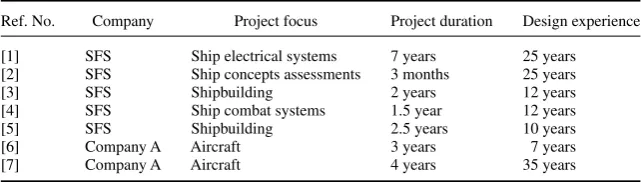
[1] SFS Ship electrical systems 7 years 25 years [2] SFS Ship concepts assessments 3 months 25 years
[3] SFS Shipbuilding 2 years 12 years
[4] SFS Ship combat systems 1.5 year 12 years
[5] SFS Shipbuilding 2.5 years 10 years
[6] Company A Aircraft 3 years 7 years
[7] Company A Aircraft 4 years 35 years
3.2. Questionnaire analysis of complex systems design
The third analysis used to identify artefact and process knowledge elements and their dependencies was a quantitative questionnaire analysis involving experienced system designers from industry. Two workshops were organised in two multinational companies (BAE Systems Surface Fleet Solutions Limited (SFS) and Company A2), whose primary business areas are the design and
development of ship and aircraft systems, respectively. During the workshops, the participants were asked to complete a questionnaire that contained two distinct sections. In the first section, the participants were required to identify design artefact and process knowledge elements that occurred during complex system design, based on their experience from a particular system design project in which they had been involved. These elements were selected from the coding elements detailed in Section 3.3. For the second part of the questionnaire, the participants had to identify, again using their experience from a system design project in which they had been involved, the creation dependencies that existed between the knowledge elements they had previously identified. Prior to filling out the questionnaire, the coding scheme used to describe knowledge elements and their dependencies was explained to the participants. In total, seven designers of varying degrees of experience and domain expertise were involved in the workshops, as summarised in Table 3.
3.3. Coding scheme
To support the creation dependency analysis between design artefacts and processes, a coding scheme was used to represent artefact and process knowledge. An initial set of knowledge elements that might occur during design was identified through conducting a literature review. During the protocol analysis, the protocols were examined to validate and also identify more elements that were present and their dependencies. During the questionnaire analysis the knowledge elements were explicitly presented to the participants and they were asked to identify knowledge elements and dependencies based upon their own experience. Section 3.3.1 details the coding of design artefact knowledge and Section 3.3.2 that of design process knowledge.
3.3.1. Artefact knowledge coding
Based on the literature review, artefact knowledge was coded according to the following three characteristics:
• The artefact knowledge space to which it belonged.
• The type of knowledge it represented.
• Its scope.
With regard to knowledge artefact spaces, Gero and Kannengiesser’s classification (2004) was used in which expected, external (referred to as instantiated for the remainder of the paper), and interpreted artefact knowledge spaces3exist:
• The expected design artefact knowledge space (ES) is composed of designers’ expectations towards a designed artefact, such as the components it will contain, how it will function, and its behaviour.
• The instantiated design artefact knowledge space (IsS) contains the design artefact knowledge that has been specified by designers and could be realised in a future implementation.
• The interpreted design artefact knowledge space (ItS) exists in designers’ minds and is built up from their interpretation of the artefact being designed.
With regard to the type of artefact knowledge, this was primarily coded using Gero and Kan-nengiesser’s (2004) categorisations of function, behaviour, and structure. The function of an artefact is its intention or purpose (Hybs and Gero 1992; Qian and Gero 1996; Deng, Tor, and Britton 1999), the behaviour describes what the artefact does and how it achieves its functions (Gorti et al. 1998), and the structure of an artefact details the components of which it is comprised, their attributes and their configuration (Gero 1990; Takeda et al. 1996). Each of these types of knowledge can occur in different knowledge spaces as follows:
• Expected function (Fe) in ES, which is a human being’s anticipation with regards to artefact
function.
• Interpreted function (Fit) in ItS, which is a human being’s understanding of what an observed
artefact could function as in a particular environment.
• Expected behaviour (Be) in ES, which is the expected behaviour of an artefact deployed in a
particular environment.
• Instantiated behaviour (Bis) in IsS, which is the exhibited behaviour of an instantiated artefact. • Interpreted behaviour (Bit) in ItS, which is the designer’s interpretation of an artefact’s behaviour
observed in a particular environment.
• Expected structure (Se) in ES, which is the designer’s expectation of the components and
configuration of an artefact.
• Instantiated structure (Sis) in IsS, which is the specified structure of the artefact at a particular
point in time, and which is consistent regardless of a human being’s interpretation of it.
Four other artefact knowledge types were adopted within the coding mechanism:
• Design motivations (M), which stimulate a design and can emanate for example from the customer (Smithers 1998; Varejao et al. 2000) or the designer.
• Design requirements (Rq), which formalise the motivation and should be satisfied by designers in the design solution (Varejao et al. 2000; Chakrabarti, Morgenstern, and Knaab 2004).
• Constraints (Ct), which are restrictions on an acceptable design solution (Suh 1990) and are an intrinsic feature of the ‘constrained activity’ that is design (Gero 1990).
• Causal relationships (CR), which provide and make explicit the dependencies between the variables in the functional, behavioural, and structural knowledge (Gero 1990).
Scope of artefact knowledge (Zhang 1999; Meehan, Duffy, and Whitfield 2007) was coded according to whether it was:
• Domain knowledge (DK) that is the knowledge of past designs or general knowledge in a domain. It is relevant to the artefact, but is independent of the artefact’s existence in any form, such as ‘active’ resources, e.g. traditional engineering knowledge such as solid-state mechanics and fluid dynamics, or ‘passive’ resources such as past design exemplars.
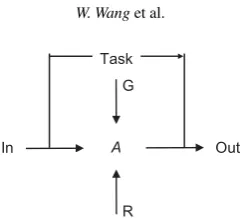
A Out G
R In
[image:11.493.186.307.49.158.2]Task
Figure 2. Design activity, adapted from Duffy (2005).
• Working knowledge (WK) that was specific to the artefact on which the designer is currently working.
3.3.2. Design process knowledge elements
Design process knowledge was coded according to:
• Its scope, where all process knowledge was considered as working knowledge given it was specific to the artefact being designed.
• The type of design process knowledge.
With regard to the type of design process knowledge, coding was primarily based on Duffy’s model of the design activity (Duffy 2005) (Figure 2), where a task is taken to be an undertaking specified a priori and is distinct from an activity. Specifically, the types of knowledge adopted within the coding scheme were:
• Design activity knowledge (A), which is knowledge of the operations enacted on artefact elements during which a knowledge transformation towards the design goal is made (Sim and Duffy 2003, 202).
• Input activity knowledge (In), which is the knowledge present prior to the activity and which is subject to transformation during activity execution.
• Output activity knowledge (Out), which is the knowledge present as a result of the transforma-tion during activity executransforma-tion.
• Goal knowledge (G), which is knowledge that directs and constrains the design activity.
• Resource knowledge (R), which is knowledge that acts on the input knowledge to produce the output through transforming the input knowledge, and that can contain domain knowledge.
• Context knowledge (C), which is knowledge describing the set of knowledge factors influencing the design artefact (Brissaud, Garro, and Poveda 2003; Reymen et al. 2006).
• Design issues (I), which formulate the design problem to be solved by designers (Ullman 2001). Design goals are set to solve these issues, which are achieved by executing design activities. Thus, design issues are closely related to the design context, goals, and activities.
To code the design knowledge elements, the current working knowledge elements were then represented with the aforementioned abbreviations following ‘WKA−’ or ‘WKP−’, depending
on whether they were artefact or process elements. For example, WKA−Se refers to expected
current working artefact structural knowledge. Domain artefact knowledge elements were then represented with the aforementioned abbreviations following ‘DKA−’. For example, DKA−Sis
refers to instantiated domain artefact structural knowledge. A list of nomenclature used in this paper is appended as appendix.
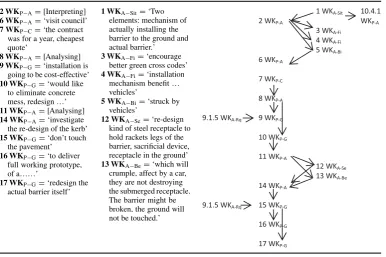
Table 4. Creation dependency examples from the protocol analysis of the student design.
2 WKP−A= [Interpreting]
6 WKP−A=‘visit council’
7 WKP−C=‘the contract
was for a year, cheapest quote’
8 WKP−A= [Analysing]
9 WKP−G=‘installation is
going to be cost-effective’
10 WKP−G=‘would like
to eliminate concrete mess, redesign …’
11 WKP−A= [Analysing]
14 WKP−A=‘investigate
the re-design of the kerb’
15 WKP−G=‘don’t touch
the pavement’
16 WKP−G=‘to deliver
full working prototype, of a……’
17 WKP−G=‘redesign the
actual barrier itself’
1 WKA−Sit=‘Two
elements: mechanism of actually installing the barrier to the ground and actual barrier.’
3 WKA−Fi=‘encourage
better green cross codes’
4 WKA−Fi=‘installation
mechanism benefit … vehicles’
5 WKA−Bi=‘struck by
vehicles’
12 WKA−Se=‘re-design
kind of steel receptacle to hold rackets legs of the barrier, sacrificial device, receptacle in the ground’
13 WKA−Be=‘which will
crumple, affect by a car, they are not destroying the submerged receptacle. The barrier might be broken, the ground will not be touched.’
4. Protocol analysis results
Creation dependencies were identified from both protocols. In the student project, when the student designer was analysing the design, she proposed to re-design the kerb’s steel receptacle and barrier legs to be sacrificed if hit by a vehicle. Two types of knowledge elements were identified here: the design activity ‘Detailing analysing’ and an expected artefact structure element relating to the receptacle and the barrier legs. The detailing activity caused the creation of the expected structure, which implies a creation dependency existing between them.
Examples of analysing 1 of the 136 segments of the student protocol are shown in Table 4, and two segments of the senior designer’s protocol are shown in Table 5. The protocol in Table 4 was when the student was in the conceptual design phase and considering the desired functionalities of the design. In Table 5, the protocol reflects when the senior designer was considering the positioning of a particular gun. The first two columns list the design knowledge elements identified. While the fourth column shows the creation dependencies identified between the elements in the segment, the third and fifth columns show the creation dependencies identified between the elements in this segment and the elements in protocols before and after this segment.
This section presents the results from the protocol analysis. Initially, the rationalisation of the raw set of creation dependencies identified from the analysis of the student design project is detailed in Section 4.1. The creation dependencies identified from the senior designer’s design are analysed and presented in Section 4.2. Then, notable observations from the protocol analysis regarding creation dependencies are presented in Section 4.3.
4.1. Rationalised creation dependencies from the student design project
Through the protocol analysis of the student product design project, 51 types and 731 occurrences of creation dependencies were identified. The number of times these dependencies occurred varied
Table 5. Creation dependency examples from protocol analysis of senior ship designer’s design.
WKP−I=‘Unfortunately that would
place the gun quite a long way for-ward which from a ship-motion point of view would not be quite clever’
WKP−A= [Analysing]
WKA−Sis=‘the forward most
com-partment was 5 m long.’
WKP−I=‘limiting the target
acqui-sition area’
WKA−Se=‘so if the gun is placed a
little bit further aft it might improve matters’
WKP−G=‘seek a compromise, to
look at everything in the boat to move things around’
WKP−A=‘copy a fair proportion of
these details into the other drawing’
DKA−Sis=‘in this arrangement we
got a few design features that may well benefit us in the new vessel proposal’
WKA−Sis=‘it’s there’
from 1 to 141. A further look at the creation dependencies showed that some of them could be generalised through either their causal or caused elements being categorised in a subset of a higher level element. For example, both expected (WKA−Se)and instantiated (WKA−Sis) current working
artefact structural knowledge can be generalised as current working artefact structural knowledge (WKA−S), and they are the only two types of WKA−S. Hence creation dependencies WKA−Se→
WKP−Gand WKA−Sis→WKP−Gcould be synthesised to WKA−S→WKP−G. Another example
could be found among four creation dependencies that triggered the creation of current work-ing design activity (WKP−A), with the domain artefact general knowledge (DKA−G), interpreted
function (DKA−Fit), instantiated structure (DKA−Sis), and interpreted behaviour (DKA−Bit) as their
causal elements. These four dependencies can be generalised into DKA→WKP−A, because their
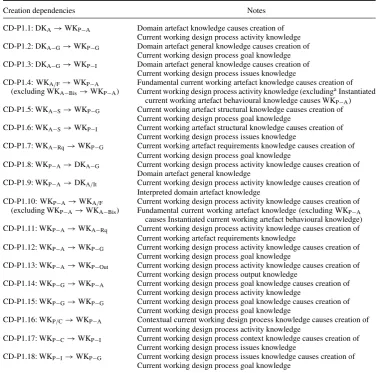
causal elements cover the four domain artefact knowledge elements discussed in Section 3.3. Overall, of the 51 types, 18 creation dependencies between the artefact and design process knowledge were generalised. These are listed in Table 6 and are identified with sequence numbers following CD-P1, which denotes the creation dependency identified from the protocol analysis of the first transcription, i.e. the student design project.
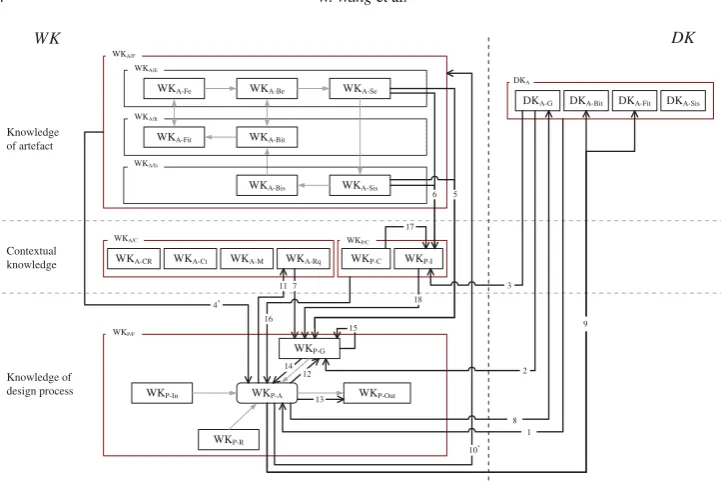
The 18 dependencies are depicted in Figure 3 by black open arrows. The dependencies are marked by their sequence number, e.g. 1 and 2. In Figure 3, the knowledge elements are categorised into five groups: fundamental current working knowledge of the artefact (WKA/F) and design
process (WKP/F), contextual current working knowledge of the artefact (WKA/C), design process
(WKP/C), and domain knowledge of the artefact (DKA). The light grey arrows in Figure 3 are the
causal relationships of the artefact and the relationships of the design process (Wang, Duffy, and Haffey 2007).
4.2. Creation dependencies identified from the senior designer’s design
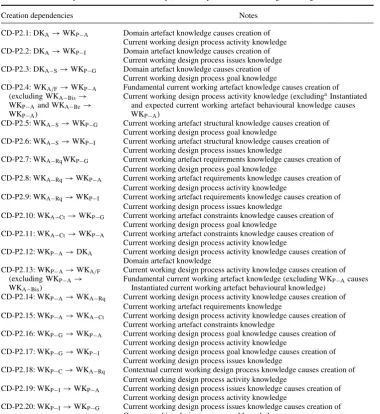
Through the protocol analysis of the senior designer’s design, 33 types and 382 occurrences of creation dependencies were identified. The number of times these dependencies occurred varied from 1 to 68. Similar to the analysis in the student project, a further look at the creation dependencies showed that some of them could be generalised through either their causal or caused elements being categorised in a subset of a higher level element. Generalising in this way resulted in the identification of 20 creation dependencies between the artefact and design process knowledge elements. These are listed in Table 7 and are identified with Arabic numerals following CD-P2, which denotes the creation dependency identified from the protocol analysis of the second transcription, i.e. the senior ship designer’s work.
The 20 dependencies are depicted in Figure 4 by using black open arrows. The dependencies are marked by their sequence number, e.g. 1 and 2.
Table 6. Creation dependencies derived from the protocol analysis of the student design.
Creation dependencies Notes
CD-P1.1: DKA→WKP−A Domain artefact knowledge causes creation of
Current working design process activity knowledge CD-P1.2: DKA−G→WKP−G Domain artefact general knowledge causes creation of
Current working design process goal knowledge CD-P1.3: DKA−G→WKP−I Domain artefact general knowledge causes creation of
Current working design process issues knowledge CD-P1.4: WKA/F→WKP−A
(excluding WKA−Bis→WKP−A)
Fundamental current working artefact knowledge causes creation of Current working design process activity knowledge (excludingaInstantiated
current working artefact behavioural knowledge causes WKP−A)
CD-P1.5: WKA−S→WKP−G Current working artefact structural knowledge causes creation of
Current working design process goal knowledge
CD-P1.6: WKA−S→WKP−I Current working artefact structural knowledge causes creation of
Current working design process issues knowledge
CD-P1.7: WKA−Rq→WKP−G Current working artefact requirements knowledge causes creation of
Current working design process goal knowledge
CD-P1.8: WKP−A→DKA−G Current working design process activity knowledge causes creation of
Domain artefact general knowledge
CD-P1.9: WKP−A→DKA/It Current working design process activity knowledge causes creation of
Interpreted domain artefact knowledge CD-P1.10: WKP−A→WKA/F
(excluding WKP−A→WKA−Bis)
Current working design process activity knowledge causes creation of Fundamental current working artefact knowledge (excluding WKP−A
causes Instantiated current working artefact behavioural knowledge) CD-P1.11: WKP−A→WKA−Rq Current working design process activity knowledge causes creation of
Current working artefact requirements knowledge
CD-P1.12: WKP−A→WKP−G Current working design process activity knowledge causes creation of
Current working design process goal knowledge
CD-P1.13: WKP−A→WKP−Out Current working design process activity knowledge causes creation of
Current working design process output knowledge
CD-P1.14: WKP−G→WKP−A Current working design process goal knowledge causes creation of
Current working design process activity knowledge
CD-P1.15: WKP−G→WKP−G Current working design process goal knowledge causes creation of
Current working design process goal knowledge
CD-P1.16: WKP/C→WKP−A Contextual current working design process knowledge causes creation of
Current working design process activity knowledge
CD-P1.17: WKP−C→WKP−I Current working design process context knowledge causes creation of
Current working design process issues knowledge
CD-P1.18: WKP−I→WKP−G Current working design process issues knowledge causes creation of
Current working design process goal knowledge
aGeneralised dependency that does not include the specific dependency stated, given that it was not observed.
4.3. Observations from the results
Three particular findings stand out with regard to the results derived from the protocol analysis. Specifically, loop dependencies were identified, dependencies were found to have different occur-rence times, and the importance of domain knowledge for both novice designers and experienced designers was highlighted. They are described in Sections 4.3.1–4.3.3, respectively.
4.3.1. Dependency loops
Closer observation of Figures 3 and 4 shows that creation dependencies can form dependency loops involving artefact and design process knowledge elements. The number of creation dependencies constituting the loop can be two or more. For instance, dependencies 4 and 10 in Figure 3 and dependencies 4 and 13 in Figure 4 linking current working fundamental artefact knowledge WKA/F
and current working design activity knowledge WKP−Aconstitute a two-node loop (Figure 5(a)).
Taking an example from the ship design project that was the focus of the second protocol analysis,
WKA-Fe WKA-Be WKA-Se
WKA-Fit WKA-Bit
WKA-Bis WKA-Sis
WKA-CR WKA-Ct WKA-M WKA-Rq WKP-C WKP-I
WKP-G
WKP-In WKP-Out
WKP-R
DKA-G DKA-Bit DKA-Fit DKA-Sis
WK DK
Knowledge of artefact
Contextual knowledge
Knowledge of
design process WKP-A
1 2 3
4*
6 5
7
WKA/C WKP/C
WKA/F
WKP/F
DKA
WKA/E
WKA/It
WKA/Is
9
10*
11
13 14
15 16
17
18
12
[image:15.493.65.426.57.299.2]8
Figure 3. Creation dependencies – based on the protocol analysis of student design project. Note:∗Dependencies 4 and 10 do not include WKA−Bis.
the designer proposed to make the engine room a little bit longer than was necessary. Here, ‘pro-posed’ is a design activity (WKP−A, a type of ‘generating activity’ (Sim and Duffy 2003)), and ‘the
engine room a little bit longer’is the expected structure, a chunk of fundamental artefact knowledge (WKA/F). This then triggered the decision (WKP−A) made by the designer that the shaft, running
from the engine’s flexible coupling to the bulkhead, would be longer than in the previous arrange-ment (WKA/F), which is instantiated structure, another chunk of fundamental artefact knowledge.
Moreover, dependencies 6, 18, 14, and 10 in Figure 3, and dependencies 6, 20, 16, and 13 in Figure 4 linking current working artefact structural knowledge WKA−S, current working design
issues knowledge WKP−I, current working design goal knowledge WKP−G, and current working
design activity knowledge WKP−Aconstitute a four-node loop (Figure 5(b)). For example, during
the configuration of the gearbox and engine, the ship designer noticed that the nominal clearance of 40 mm could not be considered to be sufficient for fluctuation. Thus, an expected artefact structure knowledge element (the nominal clearance of 40 mm, WKA−Se) caused a process issue
knowledge element (could not be considered to be sufficient for fluctuation, WKP−I). Then a
design goal (WKP−G) was raised to review the shaft angle installation that created a design
activity (WKP−A) to raise the gearbox and engine by sliding and extending the shaft away from the
propeller (WKA−Se). These loops indicate the iterative evolutionary nature of design knowledge.
The loops could continue to direct the evolution of different types of design knowledge, until a plausible design meets the requirements.
4.3.2. Frequency of dependency occurrence
As stated in Sections 4.1 and 4.2, the number of times each dependency occurred varied from 1 to 141 in the protocol analysis of the student design project, and 1–68 in that of the senior designer’s work. Figure 6 shows the number of occurrences of the dependencies from the student design project protocol analysis. It illustrates that some dependencies are more common than others thereby implying that some design knowledge elements might dominate the evolution of
Table 7. Creation dependencies derived from the protocol analysis of the senior designer’s design.
Creation dependencies Notes
CD-P2.1: DKA→WKP−A Domain artefact knowledge causes creation of
Current working design process activity knowledge CD-P2.2: DKA→WKP−I Domain artefact knowledge causes creation of
Current working design process issues knowledge CD-P2.3: DKA−S→WKP−G Domain artefact knowledge causes creation of
Current working design process goal knowledge CD-P2.4: WKA/F→WKP−A
(excluding WKA−Bis→
WKP−Aand WKA−Be→
WKP−A)
Fundamental current working artefact knowledge causes creation of Current working design process activity knowledge (excludingaInstantiated
and expected current working artefact behavioural knowledge causes WKP−A)
CD-P2.5: WKA−S→WKP−G Current working artefact structural knowledge causes creation of
Current working design process goal knowledge
CD-P2.6: WKA−S→WKP−I Current working artefact structural knowledge causes creation of
Current working design process issues knowledge
CD-P2.7: WKA−RqWKP−G Current working artefact requirements knowledge causes creation of
Current working design process goal knowledge
CD-P2.8: WKA−Rq→WKP−A Current working artefact requirements knowledge causes creation of
Current working design process activity knowledge
CD-P2.9: WKA−Rq→WKP−I Current working artefact requirements knowledge causes creation of
Current working design process issues knowledge
CD-P2.10: WKA−Ct→WKP−G Current working artefact constraints knowledge causes creation of
Current working design process goal knowledge
CD-P2.11: WKA−Ct→WKP−A Current working artefact constraints knowledge causes creation of
Current working design process activity knowledge
CD-P2.12: WKP−A→DKA Current working design process activity knowledge causes creation of
Domain artefact knowledge CD-P2.13: WKP−A→WKA/F
(excluding WKP−A→
WKA−Bis)
Current working design process activity knowledge causes creation of Fundamental current working artefact knowledge (excluding WKP−Acauses
Instantiated current working artefact behavioural knowledge) CD-P2.14: WKP−A→WKA−Rq Current working design process activity knowledge causes creation of
Current working artefact requirements knowledge
CD-P2.15: WKP−A→WKA−Ct Current working design process activity knowledge causes creation of
Current working artefact constraints knowledge
CD-P2.16: WKP−G→WKP−A Current working design process goal knowledge causes creation of
Current working design process activity knowledge
CD-P2.17: WKP−G→WKP−I Current working design process goal knowledge causes creation of
Current working design process issues knowledge
CD-P2.18: WKP−C→WKA−Rq Contextual current working design process knowledge causes creation of
Current working design process activity knowledge
CD-P2.19: WKP−I→WKP−A Current working design process issues knowledge causes creation of
Current working design process activity knowledge
CD-P2.20: WKP−I→WKP−G Current working design process issues knowledge causes creation of
Current working design process goal knowledge
aGeneralised dependency that does not include the specific dependency stated, given that it was not observed.
design knowledge. For example, current working design process activity knowledge elements are either the causal or caused elements of the top five creation dependencies, which themselves account for more than half of all the creation dependencies. This highlights the importance of design activity knowledge in design and illustrates that activity is fundamental to the creation and transformation of knowledge, which can take the form of new requirements and solutions. In addition, 303 occurrences of creation dependencies are between design activity and fundamental artefact knowledge elements. Of these, 204 are between design activity and expected current working artefact structural knowledge elements. Such high occurrence numbers indicate that novice designers produce more expected current working artefact structural knowledge than other types of fundamental artefact knowledge elements. This shows that novice designers, due to a
WKA-Fe WKA-Be WKA-Se
WKA-Fit WKA-Bit
WKA-Bis WKA-Sis
WKA-CR WKA-Ct WKA-M WKA-Rq WKP-C WKP-I
WKP-G
WKP-In WKP-Out
WKP-R
DKA-S
WK DK
Knowledge of artefact
Contextual knowledge
Knowledge of
design process WKP-A
1
2
4*
6
5
WKA/C WKP/C
WKA/F
WKP/F
DKA
WKA/E
WKA/It
WKA/Is
3
13*
14
16 18
20
8 7
9
11 15
10
12
17
[image:17.493.65.428.72.305.2]19
Figure 4. Creation dependencies – based on the protocol analysis of a senior designer’s design. Note:∗Dependency 4 does not include WKA−Bisand WKA−Be; Dependency 10 does not include WKA−Bis.
WKA/F
WKP-A
WKA-Se
WKP-I
WKP-G
WKP-A
5.1 5.2
Figure 5. Dependency loops.
lack of design experience, may need to try a number of different structures before finding one that is plausible.
4.3.3. The importance of domain knowledge
In the 18 synthesised creation dependencies identified from the analysis of the student design project, five of them involved domain knowledge, which not only triggered but also were triggered by design activities. The protocol analysis of the senior designer’s design work revealed that 3 out of 20 dependencies involved domain knowledge, and that 25 occurrences of domain knowledge were triggered by design activity. There are two possibilities by which domain knowledge can appear in a design process: it can either be used as reference knowledge or generated by design-ers as new knowledge contributing to the domain. In the student design project, it was found that the student frequently used domain knowledge, but did not create new domain knowledge. In the senior designer’s design work, it was found that domain knowledge from past designs was used frequently in the current design, for example, by copying a configuration. In addition, the senior designer created a chunk of domain knowledge by copying some details from the current design into another drawing, for later use in a new vessel proposal. The dependencies
[image:17.493.116.368.350.424.2]Figure 6. Raw creation dependencies’ occurrence in student product design.
Note: Due to space limitations and to enhance readability, only a few dependency names are listed. (Refer to the appendix for abbreviations.)
identified show the importance of domain knowledge for both novice designers and experienced designers.
5. Complex systems design questionnaire results
As outlined in Section 3, in order to have a wider set of results to compare against those derived from the two protocol analyses, a quantitative questionnaire analysis involving experienced system designers from two multinational companies was carried out. The raw set of creation dependencies identified from the questionnaire were rationalised as described in Section 5.1. Then, notable observations from the questionnaire analysis regarding creation dependencies are presented in Section 5.2.
5.1. Rationalised creation dependencies
The results of the analysis performed on the questionnaires completed by the complex system designers during the two workshops described in Section 3.2 revealed the occurrence of 48 raw creation dependencies. The number of each dependency’s occurrence was counted and ranged from 1 to 5, i.e. some dependencies were identified by 5 designers, while some were identified by 1 designer. Figure 7 presents the creation dependencies identified by 1 designer during the second workshop.
Figure 7. Raw creation dependencies’ occurrence in student product design.
Further analysis revealed that there existed unnecessary redundancies among the responses given by the designers. For example, dependency: expected current working artefact knowledge caused creation of current working design process input knowledge (WKA/E→WKP−In) and
dependency: expected current working artefact structure knowledge caused creation of current working design process input knowledge (WKA−Se →WKP−In) could be combined to WKA/E→
WKP−In. This was because expected current working artefact structure knowledge is a subset of
expected current working artefact knowledge. Therefore, in a similar vein to the protocol analysis, the dependencies identified from the questionnaires were subjected to synthesis.
As a result, the 48 raw dependencies were generalised to the 32 synthesised creation dependen-cies listed in Table 8. They are identified with Arabic numerals following CD-Q, which signifies that they are a creation dependency identified from the Questionnaire analysis.
To illustrate, the 32 creation dependencies are depicted in Figure 8.
5.2. Observations from the results
Two particular features stand out with regard to these results: recurring dependencies (Section 5.2.1) and the wide variety of dependencies that can occur within complex systems design (Section 5.2.2).
5.2.1. Recurring dependencies
Considering initially the recurring dependencies that were identified from the workshop outputs, five primary dependencies were identified by three or more participants, as listed in Table 9.
Of particular note from the identified primary dependencies is that from a process perspective, current working design process input knowledge is repeated on four occasions. For three of those occasions, artefact working knowledge acts as the causing element. This highlights the impor-tance of artefact knowledge being used as an input to activities within the design process, thus re-enforcing the idea described in Section 3.3 of design as a transformational activity in which
Table 8. Creation dependencies derived from the questionnaire analysis.
Creation dependencies Notes
CD-Q.1 DKA→WKA/F Domain artefact knowledge causes creation of
Fundamental current working artefact knowledge CD-Q.2 DKA→WKA−CR Domain artefact knowledge causes creation of
Current working artefact causal relationships knowledge CD-Q.3 DKA→WKA−M Domain artefact knowledge causes creation of
Current working artefact motivations knowledge CD-Q.4 DKA→WKP−In Domain artefact knowledge causes creation of
Current working design process input knowledge CD-Q.5 DKA→WKP−R Domain artefact knowledge causes creation of
Current working design process resource knowledge CD-Q.6 DKA→WKP−C Domain artefact knowledge causes creation of
Current working design process context knowledge CD-Q.7 DKA−G→WKP−I Domain artefact general knowledge causes creation of
Current working design process issues knowledge
CD-Q.8 WKA/E→WKP−In Expected current working artefact knowledge causes creation of
Current working design process input knowledge
CD-Q.9 WKA/E→WKP−R Expected current working artefact knowledge causes creation of
Current working design process resource knowledge
CD-Q.10 WKA/E→WKP−G Expected current working artefact knowledge causes creation of
Current working design process goal knowledge
CD-Q.11 WKA/It→WKP−A Interpreted current working artefact knowledge causes creation of
Current working design process activity knowledge
CD-Q.12 WKA/It→WKP−Out Interpreted current working artefact knowledge causes creation of
Current working design process output knowledge
CD-Q.13 WKA/Is→WKP−A Instantiated current working artefact knowledge causes creation of
Current working design process activity knowledge
CD-Q.14 WKA/Is→WKP−In Instantiated current working artefact knowledge causes creation of
Current working design process input knowledge
CD-Q.15 WKA/Is→WKP−Out Instantiated current working artefact knowledge causes creation of
Current working design process output knowledge
CD-Q.16 WKA/C→WKP−In Contextual current working artefact knowledge causes creation of
Current working design process input knowledge
CD-Q.17 WKA−Ct→WKA/It Current working artefact constraints knowledge causes creation of
Interpreted current working artefact knowledge
CD-Q.18 WKA−Ct→WKA−Rq Current working artefact constraints knowledge causes creation of
Current working artefact requirements knowledge
CD-Q.19 WKA−Ct→WKP−R Current working artefact constraints knowledge causes creation of
Current working design process resource knowledge
CD-Q.20 WKA−M→WKA−Rq Current working artefact motivations knowledge causes creation of
Current working artefact requirements knowledge
CD-Q.21 WKA−M→WKP−A Current working artefact motivations knowledge causes creation of
Current working design process activity knowledge
CD-Q.22 WKA−M→WKP−G Current working artefact motivations knowledge causes creation of
Current working design process goal knowledge
CD-Q.23 WKA−M→WKP−Out Current working artefact motivations knowledge causes creation of
Current working design process output knowledge
CD-Q.24 WKA−Rq→WKA−Fe Current working artefact requirements knowledge causes creation of
Expected current working artefact functional knowledge
CD-Q.25 WKA−Rq→WKP−G Current working artefact requirements knowledge causes creation of
Current working design process goal knowledge
CD-Q.26 WKP−C→WKA/It Current working design process context knowledge causes creation of
Interpreted current working artefact knowledge
CD-Q.27 WKP/C→WKP−G Contextual current working design process knowledge causes creation of
Current working design process goal knowledge
CD-Q.28 WKP−I→WKP−A Current working design process issues knowledge causes creation of
Current working design process activity knowledge
CD-Q.29 WKP−I→WKP−Out Current working design process issues knowledge causes creation of
Current working design process output knowledge
CD-Q.30 WKP−I→DKA Current working design process issues knowledge causes creation of
Domain artefact knowledge
(Continued)
Table 8. Continued.
Creation dependencies Notes
CD-Q.31 WKP/C→WKP−In Contextual current working design process knowledge causes creation of
Current working design process input knowledge
CD-Q.32 WKP/C→WKP−R Contextual current working design process knowledge causes creation of
Current working design process resource knowledge
WKA-Fe WKA-Be WKA-Se
WKA-Fit WKA-Bit
WKA-Bis WKA-Sis
WKA-CR WKA-Ct WKA-M WKA-Rq WKP-C WKP-I
WKP-G
WKP-In WKP-Out
WKP-R
DKA-G DKA-B DKA-F DKA-S
WK DK Knowledge of artefact Contextual knowledge Knowledge of
design process WKP-A
7
2
25
WKA/C WKP/C
WKA/F WKP/F DKA WKA/E WKA/It WKA/Is 18 11 13 27 1 3 4 5 6 9 10 8 14 12 15 16 17
19 20 21 24
22 23
28 29 30
31
32
[image:21.493.62.426.107.400.2]26
[image:21.493.63.440.449.567.2]Figure 8. Creation dependencies – based on the questionnaire analysis.
Table 9. Primary dependencies identified.
Dependency Detail No. of recurrences
DKA→WKP−In Domain artefact knowledge→Current working design process
inputs knowledge
4
WKA/E→WKP−In Expected current working artefact knowledge→Current working
design process input knowledge
4
WKA/C→WKP−In Contextual current working artefact knowledge→Current working
design process input knowledge
5
WKP/C→WKP−In Contextual current working design process knowledge→Current
working design process input knowledge
3
WKP/C→WKP−R Contextual current working design process knowledge→Current
working design process resource knowledge
4
knowledge is supplied as an input and subjected to some form of transformation to produce a new piece of knowledge that takes the designer closer to the achievement of the design goals. Further-more, the additional dependency listing domain artefact knowledge illustrates the importance of domain knowledge within the design process, which corroborates the finding from the protocol analyses stated in Section 4.3. This highlights the value that domain knowledge has during design and the demands that are placed on the designers themselves in terms of the knowledge that they hold. Complex systems design is a specialist, knowledge-intensive activity and requires those
who undertake it to hold in their possession complex systems domain knowledge to support the design process.
5.2.2. Variety of dependencies
A second feature emanating from the questionnaire analysis was the identification of a significant number of dependencies that had a low frequency of occurrence across different design projects. Seventy-five per cent of the raw dependencies were identified on no more than one occasion across all questionnaires. As outlined in Section 3.2, the projects used by the designers involved in the workshops were varied in terms of their particular domain, e.g. designer one’s project was a ship’s electrical system design, whereas designer four used a ship combat system design project as the basis for responding to the questionnaire. The design artefact and design process dependencies identified from the questionnaire cross working and domain boundaries and include artefact functional, behavioural, and structural knowledge elements from the instantiated, expected, and interpreted design spaces. This diversity of dependency types across different design projects, together with their low frequency of occurrence, suggests that there are dependencies that are domain and/or complex system specific. These domain and/or system-specific dependencies are in addition to the recurring dependency set described in Section 5.2.1.
6. Comparison and discussion
The results from the three analyses provide clear evidence of the quantity and variety of creation dependencies that can exist between design artefact and process knowledge elements. Section 6.1 synthesises these observations to provide greater clarity on the artifact–process dependencies, leading to definition of areas for future research that are described in Section 6.2.
6.1. Comparison of the results from protocol analysis and questionnaire analysis
Comparing the results from the three analyses, two observations stand out with regard to the identified dependencies: a core common set of dependencies was identified, and in addition to a core set of common dependencies (Section 6.1.1), other dependencies can exist that can vary for different types of project (Section 6.1.2).
6.1.1. Common creation dependencies
The common creation dependencies between the two protocol analyses are listed in Table 10. Among the 18 creation dependencies identified from the student design and the 20 dependencies identified from the senior designer’s design, 10 of them were or partly identified as common creation dependencies.
Seven common creation dependencies were identified between the protocol analysis of the student design and questionnaire analysis, as highlighted in Table 11. Among the 18 creation dependencies identified from the protocol analysis of the student design, 6 of them were fully or partially identified from the questionnaire. Among the 32 creation dependencies identified from the questionnaire, 7 creation dependencies were identified from the protocol analysis of the student design.
Seven common creation dependencies were identified from the protocol analysis of the senior designer’s design work and the questionnaire analysis, as highlighted in Table 12. Among the