RESEARCH NOTE
Construct validity, test–retest reliability
and internal consistency of the Thai version
of the disabilities of the arm, shoulder and hand
questionnaire (DASH-TH) in patients with carpal
tunnel syndrome
Montana Buntragulpoontawee
1, Suphatha Phutrit
1, Siam Tongprasert
1, Tinakon Wongpakaran
2and Jeeranan Khunachiva
1*Abstract
Objective: This study evaluated additional psychometric properties of the Thai version of the disabilities of the arm, shoulder and hand questionnaire (DASH-TH) which included, test–retest reliability, construct validity, internal consist-ency of in patients with carpal tunnel syndrome. As for determining construct validity, the Thai EuroQOL question-naire (EQ-5D-5L) was also administered in order to examine convergent and divergent validity.
Results: Fifty patients completed both questionnaires. The DASH-TH showed excellent test–retest reliability (intra-class correlation coefficient = 0.811) and internal consistency (Cronbach’s alpha = 0.911). The exploratory factor analysis yielded a six-factor solution while the confirmatory factor analysis denoted that the hypothesized model adequately fit the data with a comparative fit index of 0.967 and a Tucker–Lewis index of 0.964. The related subscales between the DASH-TH and the Thai EQ-5D-5L were significantly correlated, indicating the DASH-TH’s convergent and discriminant validity. The DASH-TH demonstrated good reliability, internal consistency construct validity, and multidi-mensionality, in assessing the upper extremity function in carpal tunnel syndrome patients.
Keywords: DASH-TH, Reliability, Validity, Internal consistency, Carpal tunnel syndrome, Factor structure
© The Author(s) 2018. This article is distributed under the terms of the Creative Commons Attribution 4.0 International License (http://creat iveco mmons .org/licen ses/by/4.0/), which permits unrestricted use, distribution, and reproduction in any medium, provided you give appropriate credit to the original author(s) and the source, provide a link to the Creative Commons license, and indicate if changes were made. The Creative Commons Public Domain Dedication waiver (http://creat iveco mmons .org/ publi cdoma in/zero/1.0/) applies to the data made available in this article, unless otherwise stated.
Introduction
Carpal tunnel syndrome (CTS) or median neuropathy at the wrist commonly presents with numbness, dyses-thesia and weakness of the hand(s), resulting in signifi-cantly limited functioning. It has been described as the most commonly diagnosed entrapment neuropathy in clinical practice, with a clinically and electrophysiologi-cally confirmed CTS prevalence of 2.7% [1]. To assess the functional impact of CTS in the clinic, many clini-cal questionnaires have been developed, for example, a
self-administered questionnaire by Levine (1993) and the Boston questionnaire [2, 3]. In 2008, Kumnerdee and Uphatham translated the Boston questionnaire into Thai and tested only its internal consistency [4]. In addition to the CTS-specific outcome measurement tools, the disabilities of the arm, shoulder and hand (DASH) outcome measure demonstrated compatibil-ity with the Boston questionnaire and was previously translated into Thai (DASH-TH) with good content validity and high internal consistency. The DASH’s primary clinical advantage is that it serves as a single, reliable instrument that can assess any or all joints in the upper extremities, rather than requiring a specific instrument for each joint or diagnosis. The DASH-TH is clearly preferable; however, the psychometric
Open Access
*Correspondence: [email protected]
1 Department of Rehabilitation Medicine, Faculty of Medicine, Chiang Mai
University, Chiang Mai 50200, Thailand
properties of the Thai version remain unexplored [5,
6]. This study evaluated the construct validity, internal consistency, and test–retest reliability of the DASH-TH in CTS patients.
Main text
Methods
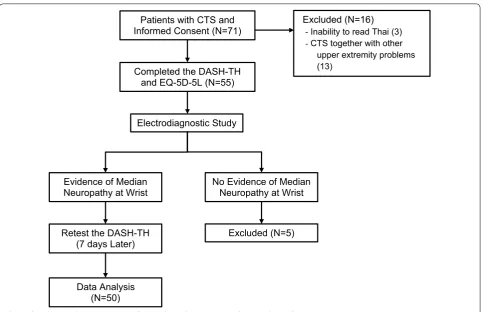
CTS patients between 18 and 80 years of age from the general rehabilitation out-patient clinic at Maha-raj Nakorn Chiang Mai Hospital were considered for inclusion in this study. All participants completed at least elementary school grade six and could read and understand Thai. Patients were excluded if they had other upper extremity problems, TBI, mood disorder, or no electrodiagnostic evidence of CTS. Study infor-mation was provided by the study team and informed consent was obtained. Demographic information was collected from the eligible patients, who then answered the DASH-TH and the Thai EQ-5D-5L. An electrodiag-nostic (EDx) appointment was made 1 week later, but no treatment was provided at that time. Once the CTS diagnosis was confirmed by EDx, the patient remained
in the study and completed the DASH-TH a second time (Fig. 1).
DASH questionnaire
The DASH questionnaire consists of 30 self-reported dis-ability and symptom questions. Since no a priori model of the DASH [7] exists, we hypothesized, based on item characteristics, that the DASH included five subscales, consisting of common activities (20 items, items 1–12 and 16–23), self-care activities (3 items, items 13–15), pain symptoms (2 items, items 24–25), other symp-toms such as numbness, joint stiffness, weakness, and sleep problems (4 items, items 26–29) and psychological effects (1 item, item 30). Examples of these DASH items included: “turn a key”, “change a light bulb overhead”, and “use a knife to cut food”. The scores ranged from 0 to 100 with higher scores indicating greater disability [6].
EQ‑5D‑5L
The EQ-5D-5L is a common, generic instrument for eval-uating health outcomes. It has been translated into Thai with all psychometric properties being evaluated [8–10]. The score was calculated using a Thai valuation set of the EQ-5D-5L [8], which was divided into two sections. The
Patients with CTS and Informed Consent (N=71)
Completed the DASH-TH and EQ-5D-5L (N=55)
Electrodiagnostic Study
Evidence of Median
Neuropathy at Wrist No Evidence of Median Neuropathy at Wrist
Retest the DASH-TH
(7 days Later) Excluded (N=5)
Data Analysis (N=50)
Excluded (N=16) - Inability to read Thai (3) - CTS together with other
upper extremity problems (13)
[image:2.595.58.542.401.713.2]first section contained five dimensions: mobility, usual activities, self-care activities, pain symptoms and anxiety/ depression. The index values ranged from − 1 to 1, with higher values indicating better health. The second part evaluated health conditions using a direct measurement, the visual analogue scale (VAS), ranging from the worst health condition (0) to the best possible health condition (100).
Data analysis was performed using IBM SPSS 22 for Windows (IBM Corporation, Armonk, NY, USA). Descriptive variables are presented as percentages, means, standard deviations (SD) and ranges. The Shap-iro–Wilk test was used to assess data distribution.
Construct validity
Exploratory factor analysis (EFA) was used to investigate construct validity by factor structure. Since the response was a categorical variable, polychoric correlation with matrix with weighted least square parameter estima-tion was used Mplus 7.4 software (Muthén & Muthén, Los Angeles, CA, USA). Due to the small sample size, 40 samples consisting of CTS and common upper extremity musculoskeletal disorders from our previous study were added to have sufficient data for the factorial analysis [6].
Confirmatory factor analysis (CFA) was performed for a hypothesized five-model structure to compare the extent of fit indices with various models yielded by EFA. We used the following fit indices: a comparative fit index (CFI) of ≥ 0.95, a non-normed fit index (NFI) or a Tucker–Lewis index (TLI) of ≥ 0.9, and a root-mean-square error of approximation (RMSEA) of ≤ 0.6. Values as high as 0.08 [11–13], a weighted root mean square residual (WRMR) < 0.9 [14] and a χ2/df result of < 3
indi-cated a reasonable fit [15].
Construct validity was also examined by convergent and divergent validity assessment, both measuring Spear-man’s rank correlation coefficient (r) of related and differ-ent dimensions between the EQ-5D and DASH subscales. Two hypotheses were examined: (1) The same dimen-sions of the DASH-TH and EQ-5D-5L questionnaires are associated, including normal activities, self-care activities and pain symptoms. (2) Different dimensions are unasso-ciated or weakly assounasso-ciated, including self-care activities on the DASH-TH and mobility on the Thai EQ-5D-5L.
The correlation strength was determined as follows: absent or weak (r < 0.25), moderate (0.25 < r < 0.50), good (0.50 < r < 0.75), and excellent (r > 0.75) [16].
Internal consistency
Internal consistency of the DASH-TH was assessed using Cronbach’s alpha coefficient with the acceptable value being 0.70–0.95 [17].
Test–retest reliability
Test–retest reliability of the DASH-TH was assessed after 7 days by an intraclass correlation coefficient (ICC). The coefficient can range from 0 to 1, and a coefficient > 0.7 indicates good reliability [17].
Results
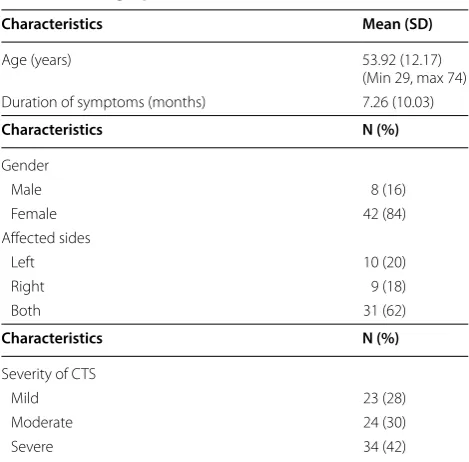
Seventy-one patients with clinically suspected CTS participated in the study. Twenty-one patients were excluded, with 50 patients (male 8, female 42) remaining (Fig. 1). Of the total 81 CTS hands, 34 hands (42%) were severely affected by grading the carpal tunnel syndrome severity using the electrodiagnostic reports of Sucher BM (Table 1) [18].
The range score for the initial DASH-TH was 8.30– 67.50 with an average score of 27.96 (SD = 13.90). The re-test DASH-TH score ranged from 7.00 to 64.2 with an average score of 27.38 (SD = 15.21). Both had similar average scores, and no patients had a maximum (ceiling) or minimum (floor) score. The EQ-5D-5L index values ranged from 0.097 to 1, and the average value was 0.575 (SD = 0.167). The EQ-VAS values ranged from 50 to 100, and the average score was 72.10 (SD = 13.48). One patient scored 100, which is the highest possible score on both the EQ-5D-5L and EQ-VAS. All patients completed both questionnaires independently without help.
Despite the relatively small number of subjects, the Kaiser–Meyer–Olkin measure (KMO) coefficient of 0.86, indicated an adequate sample size for conducting the fac-tor analysis.
A factor analytic study was unfit for the one-factor model, while yielding the best model fit with a six-factor solution (Chi square 390.704, df = 270, RMSEA = 0.070 [0.054, 0.085], CFI = 0.993, TLI = 0.989, SRMR = 0.042). Our hypothesized five-factor model had a fair level of fit indices; however, they were less fit than the six-factor model (Table 2). Exploratory factor analysis using eigen-values > 1 extracted greater than seven factors. Several cross-loading items were loaded on the same factor, e.g. item 1 (open a tight or new jar) and item 22 (interference in social activities); item 8 (garden or do yard work) and item 23 (limited in your work or other regular daily activ-ities). The one-factor model was a poor fit for the sam-ple, while the six-factor solution was the best model for the data (Chi square 390.704, df = 270, RMSEA = 0.070 [0.054, 0.085], CFI = 0.993, TLI = 0.989, SRMR = 0.042).
Confirmatory factor analysis for the hypothesized five-factor model had a fair level of fit indices.
were weak to moderately correlated, such as usual activi-ties on the DASH-TH and mobility on the EQ-5D-5L (r = 0.265). These results (Additional file 1) support the hypothesis. The correlation coefficients between the total scores on the DASH-TH and EQ5D-TH and the EQ VAS were 0.572 and 0.672 (all p < 0.01), respectively.
The internal consistency was high (Cronbach’s alpha coefficient = 0.911), and test–retest reliability was excel-lent, as the ICC was 0.811, 95% Cl 0.668–0.893.
Discussion
The DASH is a self-reported outcome measure for assess-ing disability resultassess-ing from upper extremity disorders. In 2013, the DASH was translated into Thai (DASH-TH),
and its psychometric properties, content validity, and internal consistency were tested. To further evaluate the DASH-TH properties, this study tested the construct validity and test–retest reliability in CTS patients.
Most of the CTS patients were female (84%), which is consistent with studies from Korea (89%), Japan (89%) and England (72%) [5, 19, 20].
Similar to previous studies, the DASH-TH is not con-firmed to be a unidimensional model; thus, other DASH versions were created [21–23]. This was expected, as the scale appeared to be designed for addressing multi-domains, i.e. daily (usual) activities, symptoms, social functions, and psychological issues; therefore, it is unlikely that all items measure a single construct.
CFA is sample-dependent; therefore, it tends to have better results with a larger sample size. The sample data may fit better to the hypothesized five-factor model if a larger sample size is adopted instead of the six-factor model.
In addition, internal consistency was re-tested for com-parison with the previous DASH-TH study (Cronbach’s alpha = 0.94) [6]. Cronbach’s alpha remained high (0.91), even when limited to CTS patients, implying wide appli-cability among various upper extremity disorders.
The correlation between DASH-TH and the Thai EQ-5D-5L was -0.572, which was slightly lower than the value obtained by Slobogean et al. [24] in Canada (2010) (r =− 0.75), who studied a larger group of 61 patients with humeral fractures. Nevertheless, a significant mod-erate-to-good correlation was found between similar dimensions of the DASH-TH and EQ-5D-5L, for exam-ple, usual activities, self-care activities and pain, reflect-ing good convergent validity. Different dimensions were either weakly or not correlated, reflecting good divergent validity.
Test–retest reliability of the DASH-TH was also high (ICC = 0.811), which was consistent with studies in the
Table 1 Demographic characteristics
N number of hands
Characteristics Mean (SD)
Age (years) 53.92 (12.17)
(Min 29, max 74) Duration of symptoms (months) 7.26 (10.03)
Characteristics N (%)
Gender
Male 8 (16)
Female 42 (84)
Affected sides
Left 10 (20)
Right 9 (18)
Both 31 (62)
Characteristics N (%)
Severity of CTS
Mild 23 (28)
Moderate 24 (30)
Severe 34 (42)
Table 2 Comparing fit statistics among models (N = 90)
Df degree of freedom, RMSEA root-mean-square error of approximation, CFI comparative fit index, SRMR standardized root-mean-square residual, TLI Tucker–Lewis index, WRMR weighted root mean square residual
a CFA 5 domain: factor 1, 1–16; factor 2, 17–21; factor 3, 22–23; factor 4, 24–28; factor 5, 29–30
b This value was calculated by WRMR Fit indices Hypothesized-5
factora Six-factor Five-factor Four-factor Three-factor Two-factor One-factor
Chi square 976.995 390.704 518.185 685.468 840.903 1228.741 1266.713
Df 395 270 295 321 348 376 405
RMSEA 0.128 (0.118
0.138) 0.070 (0.054 0.085) 0.092 (0.079 0.105) 0.112 (0.101 0.124) 0.125 (0.115 0.136) 0.159 (0.115 0.169) 0.206 (0.193 0.219)
CFI 0.967 0.993 0.987 0.979 0.972 0.952 0.840
TLI 0.964 0.989 0.981 0.972 0.965 0.944 0.828
SRMR/
WRMR 0.968
[image:4.595.56.291.97.328.2] [image:4.595.57.539.562.682.2]CTS population by Greenslade 2004 (ICC = 0.9) in Eng-land, Imaeda et al. in Japan in 2005 (ICC = 0.82), and Lee et al. in Korea in 2008 (ICC = 0.91) [5, 25, 26]. All test– retest studies used a 1–2-week window, which was the preferred duration as it was too short for the symptoms to change, but long enough that the patient was unlikely to remember their initial answers [17].
Conclusion
The DASH-TH was shown to be a reliable and valid tool for assessing and following CTS patients’ symptoms, functions, and abilities. It appeared to have factor struc-ture as hypothesized, and the external validations of the scales sufficiently demonstrated the ability to measure upper arm disability. Furthermore, the DASH-TH offers greater clinical utility because it measures comprehensive functioning for any diseases or upper extremity regions, providing practicality in a busy clinical setting where using each disease or region-specific outcome measure would be cumbersome.
Limitations
One limitation of this study was the small sample size. Although a sample size of 50 patients was sufficient to evaluate convergent and divergent validity, the reli-ability of each item using item response theory, e.g. Rasch analysis or other IRT models, should be further examined using a larger sample size. Another impor-tant aspect of the DASH-TH questionnaire property is its responsiveness, which should be investigated in future studies. Although the DASH can be applied to many sample characteristics, the mixed sample used in the present analysis may impact its factorial valid-ity because there may be differential items functioning between the two samples. Therefore, the factor analysis results should be interpreted cautiously.
Abbreviations
CTS: carpal tunnel syndrome; DASH: disabilities of the arm, shoulder and hand; ICC: intraclass correlation coefficient; EFA: exploratory factor analysis; CFA: con-firmatory factor analysis; EDx: electrodiagnostic; SD: standard deviations; CFI: comparative Fit Index; NFI: non-normed fit index; TLI: Tucker–Lewis index; Df: degree of freedom; RMSEA: root-mean-square error of approximation; WRMR: weighted root mean square residual.
Additional file
Additional file 1. Correlation Coefficients (r) Between DASH-TH and Thai EQ-5D-5L. Correlation analysis was performed in order to assess conver-gent and 370 diverconver-gent validity of EQ-5D subscales and DASH subscales. Significant correlations 371 were found between similar dimensions such as, usual activities, self-care, and pain 372 whereas different dimensions had weak to moderate correlation.
Authors’ contributions
MB, SP, ST, TW, JK participated in the conception and design of the study. SP, ST, JK performed data collection. SP, TW performed the statistical analysis. MB, TW drafted the manuscript. All authors made substantial contribution to the interpretation of data and revised the manuscript for important intellectual content. All authors read and approved the final manuscript.
Author details
1 Department of Rehabilitation Medicine, Faculty of Medicine, Chiang Mai
University, Chiang Mai 50200, Thailand. 2 Department of Psychiatry, Faculty
of Medicine, Chiang Mai University, Chiang Mai, Thailand.
Acknowledgements
Not applicable.
Competing interests
The authors declare that they have no competing interests.
Availability of data and materials
The datasets used and/or analyzed during the current study are available from the corresponding author on reasonable request.
Consent for publication
Not applicable.
Ethics approval and consent to participate
This study was approved by the Research Ethics Committee of the Faculty of Medicine, Chiang Mai University. Study number: REH-2557-02381.
Written informed consent was obtained from each study participant.
Funding
There was no funding for the research.
Publisher’s Note
Springer Nature remains neutral with regard to jurisdictional claims in pub-lished maps and institutional affiliations.
Received: 25 October 2017 Accepted: 21 March 2018
References
1. Atroshi I, Gummesson C, Johnsson R, Ornstein E, Ranstam J, Rosen I. Prevalence of carpal tunnel syndrome in a general population. JAMA. 1999;282(2):153–8.
2. Kamath V, Stothard J. A clinical questionnaire for the diagnosis of carpal tunnel syndrome. J Hand Surg Br. 2003;28(5):455–9.
3. Levine DW, Simmons BP, Koris MJ, Daltroy LH, Hohl GG, Fossel AH, et al. A self-administered questionnaire for the assessment of severity of symp-toms and functional status in carpal tunnel syndrome. J Bone Joint Surg Am. 1993;75(11):1585–92.
4. Upatham S, Kumnerddee W. Reliability of Thai version Boston question-naire. J Med Assoc Thai. 2008;91(8):1250–6.
5. Greenslade JR, Mehta RL, Belward P, Warwick DJ. Dash and Boston questionnaire assessment of carpal tunnel syndrome outcome: what is the responsiveness of an outcome questionnaire? J Hand Surg Br. 2004;29(2):159–64.
6. Tongprasert S, Rapipong J, Buntragulpoontawee M. The cross-cultural adaptation of the DASH questionnaire in Thai (DASH-TH). J Hand Ther. 2014;27(1):49–54.
7. Hudak PL, Amadio PC, Bombardier C. Development of an upper extrem-ity outcome measure: the DASH (disabilities of the arm, shoulder and hand) [corrected]. The upper extremity collaborative group (UECG). Am J Ind Med. 1996;29(6):602–8.
• We accept pre-submission inquiries
• Our selector tool helps you to find the most relevant journal
• We provide round the clock customer support
• Convenient online submission
• Thorough peer review
• Inclusion in PubMed and all major indexing services
• Maximum visibility for your research
Submit your manuscript at www.biomedcentral.com/submit
Submit your next manuscript to BioMed Central
and we will help you at every step:
9. Pattanaphesaj J, Thavorncharoensap M. Measurement properties of the EQ-5D-5L compared to EQ-5D-3L in the Thai diabetes patients. Health Qual Life Outcomes. 2015;13:14.
10. Sakthong P, Sonsa-Ardjit N, Sukarnjanaset P, Munpan W. Psychometric properties of the EQ-5D-5L in Thai patients with chronic diseases. Qual Life Res. 2015;24(12):3015–22.
11. Hu L, Bentler PM. Evaluating model fit. In: Hoyle RH, editor. Structural equation modeling: concepts, issues and applications. California: Sage; 1995. p. 76–99.
12. Hu L, Bentler PM. Fit indices in covariance structure modeling: sensitiv-ity to under parameterized model misspecification. Psychol Methods. 1998;3(4):424–53.
13. Hu L, Bentler PM. Cut off criteria for fit indexes in covariance structure analysis: conventional ccriteria versus new alternatives. Struct Equ Model. 1999;6(1):1–55.
14. Muthѐn LK, Muthѐn BO. Mplus statiscal analysis with latent variables user’s guide. 7th ed. Los Angeles: Muthѐn & Muthѐn; 2012.
15. Kline RB. Principles and practice of structural equation modeling. 1st ed. New York: The Guildford Press; 1998.
16. Portney LG, Watkins MP. Foundations of clinical researh: application to practice. New Jersey: Pearson Prentice Hall; 2009.
17. Terwee CB, Bot SD, de Boer MR, van der Windt DA, Knol DL, Dekker J, et al. Quality criteria were proposed for measurement properties of health status questionnaires. J Clin Epidemiol. 2007;60(1):34–42.
18. Sucher BM. Grading severity of carpal tunnel syndrome in electro-diagnostic reports: why grading is recommended. Muscle Nerve. 2013;48(3):331–3.
19. Iwatsuki K, Nishikawa K, Chaki M, Sato A, Morita A, Hirata H. Compara-tive responsiveness of the Hand 20 and the DASH-JSSH questionnaires
to clinical changes after carpal tunnel release. J Hand Surg Eur. 2014;39(2):145–51.
20. Jeon SH, Lee JH, Chung MS, Baek GH, Oh JH, Lee YH, et al. Responsiveness of the Korean version of the disabilities of the arm, shoulder and hand questionnaire (K-DASH) after carpal tunnel release. Clin Orthop Surg. 2011;3(2):147–51.
21. Dalton E, Lannin NA, Laver K, Ross L, Asfhord S, McClusky A, et al. Validity, reliability and ease of use of the disabilities of arm, shoulder and hand questionnaire in adults following stroke. Disabil Rehabil. 2017;39(24):2504–11.
22. Gabel CP, Yelland M, Melloh M, Burkett B. A modified QuickDASH-9 provides a valid outcome instrument for upper limb function. BMC Musculoskelet Disord. 2009;10:161.
23. Lehman LA, Woodbury M, Velozo CA. Examination of the factor structure of the disabilities of the arm, shoulder, and hand questionnaire. Am J Occup Ther. 2011;65(2):169–78.
24. Slobogean GP, Noonan VK, O’Brien PJ. The reliability and validity of the disabilities of arm, shoulder, and hand, EuroQol-5D, health utilities index, and short form-6D outcome instruments in patients with proximal humeral fractures. J Shoulder Elbow Surg. 2010;19(3):342–8. 25. Imaeda T, Toh S, Nakao Y, Nishida J, Hirata H, Ijichi M, et al. Validation
of the Japanese society for surgery of the hand version of the dis-ability of the arm, shoulder, and hand questionnaire. J Orthop Sci. 2005;10(4):353–9.