
S H O R T R E P O R T
Open Access
A molecular phylogeny of Hypnales (Bryophyta)
inferred from ITS2 sequence-structure data
Benjamin Merget, Matthias Wolf
*Abstract
Background:Hypnales comprise over 50% of all pleurocarpous mosses. They provide a young radiation complicating phylogenetic analyses. To resolve the hypnalean phylogeny, it is necessary to use a phylogenetic marker providing highly variable features to resolve species on the one hand and conserved features enabling a backbone analysis on the other. Therefore we used highly variable internal transcribed spacer 2 (ITS2) sequences and conserved secondary structures, as deposited with the ITS2 Database, simultaneously.
Findings:We built an accurate and in parts robustly resolved large scale phylogeny for 1,634 currently available hypnalean ITS2 sequence-structure pairs.
Conclusions:Profile Neighbor-Joining revealed a possible hypnalean backbone, indicating that most of the hypnalean taxa classified as different moss families are polyphyletic assemblages awaiting taxonomic changes.
Background
Pleurocarpous mosses, which are mainly found in tropi-cal forests, account for more than 50% of all moss spe-cies [1,2]. Brotherus in 1925 used morphological characters to partition the pleurocarpous into three orders. These were Leucodontales (= Isobryales), Hoo-keriales and Hypnobryales (= Hypnales) [3]. Later mole-cular analyses showed that the order Leucodontales, which was mainly defined by reduced peristomes, is polyphyletic due to convergent evolution [1,4]. The cur-rent concept divides the pleurocarpous mosses into: (1) the subclass Hypnidae (consisting of (i) The Ptychom-niales with roughly 100 species, (ii) the Hookeriales with roughly 750 species and (iii) the Hypnobryales or Hyp-nales containing about 4,400 species), (2) the hypnoden-droid pleurocarps (consisting of Hypnodendraceae, Racopilaceae, Cyrtopodaceae, Pterobryellaceae and Spiridentaceae) and (3) the rhizogonian mosses (Rhizo-goniaceae, as well as several other species). The hypno-dendroid pleurocarps and rhizogonian mosses, however, also include non-pleurocarpous mosses [2,5,6]. Hypnales comprise over 50% of all pleurocarpous mosses. This study analyzed the internal transcribed spacer 2 (ITS2) sequence-structure pairs from 35 hypnalean families
encompassing a total of 1,634 species in order to test the hypothesis that the ITS2 sequence-structure can be used to determine the phylogeny of Hypnales and to resolve especially its phylogenetic backbone. A rapid radiation in the early history of pleurocarpous mosses has resulted in low molecular diversity generally, but particularly in the order Hypnales [5,7]. This has com-plicated the phylogenetic inferences from DNA sequence data due to the small evolutionary distances generated by phylogenetic signals [8]. The more variable the DNA marker, therefore, the better the resolution for low level phylogenies. The ITS2 is a spacer region between two conserved core genes, 5.8 S and 28 S ribo-somal DNA. Since it does not code for a core gene, the ITS2 tolerates a higher mutation rate, which results in a more variable DNA sequence. The ITS2 sequence has been used to resolve moss phylogenies at the genus or species level [9,10]. But while the ITS2 DNA sequence is poorly conserved, the ITS2 secondary structure is strongly conserved, consisting of four helices with the third being the longest [11]. This conserved aspect of the ITS2 region has been exploited by several research-ers to reveal deep phylogenies [2,12-14]. Two new com-puter programs, 4SALE [15,16] and ProfDistS [17-20] use both the variable and conserved characteristics of the ITS2 and in the process make the ITS2 the marker of choice for shallow and deep phylogeny * Correspondence: [email protected]
Department of Bioinformatics, Biocenter, University of Würzburg, Am Hubland, 97074 Würzburg, Germany
analyses [21,22]. These programs allow the user to gen-erate multiple sequence-structure alignments and Profile Neighbor-Joining trees using sequence and structure data simultaneously. Programs 4SALE and ProfDistS were therefore used in this study to generate a large scale phylogenetic analysis of 1,634 complete and cor-rectly annotated hypnalean ITS2 sequence-structure pairs, which were currently available at the ITS2 Data-base [11-14,23,24].
Phylogeny of Hypnales Large scale approach
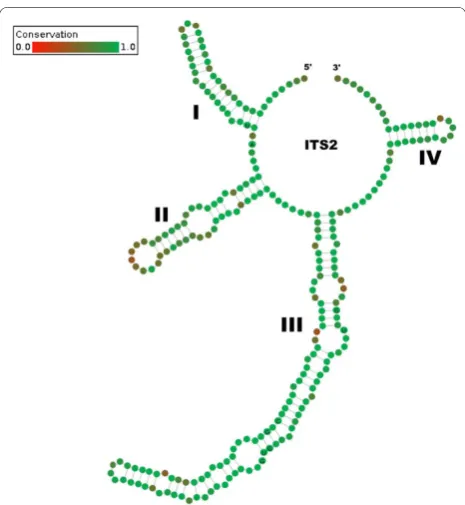
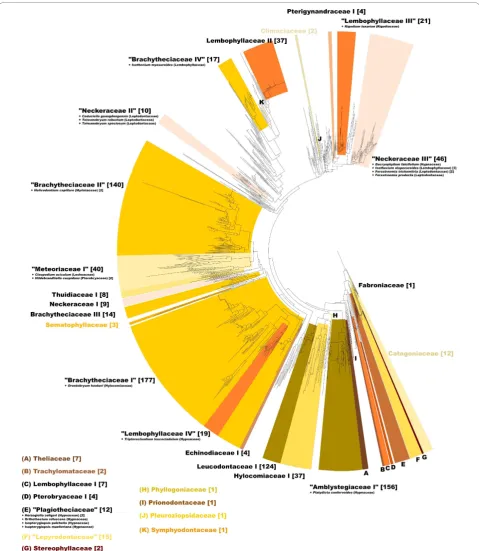
The alignment and editing tool 4SALE [15,16] generated a 51% consensus ITS2 secondary structure from all 1,634 sequence-structure pairs. The ITS2 consensus sec-ondary structure consisted of the expected conserved four helices with the third being the longest (Figure 1). Every single base pair is 90% conserved over the whole alignment. This is evidence for the correctness of the 4SALE [15,16] alignment of over 1,500 sequence-structure pairs. Furthermore it underlines the strong preservation of the ITS2 secondary structure which allowed us to proceed on this basis. Using an ITS2 spe-cific rate matrix, we calculated a phylogenetic tree of all 1,634 sequence-structure pairs with ProfDistS [17-20] (Figure 2, Additional file 1, Figure S1). Twentyfour of the 35 examined hypnalean families could be grouped to
32 clades, 11 of the examined families could be grouped to monophyla. Zooming in, a part of the subtree of the clade“Meteoriaceae I”was exemplarily compared to the 50% majority rule consensus tree as shown in Quandt et al. [25] and below. Both trees yielded similar results, validating the large scale approach (Figure 3). Another proof of the validity of the large scale approach is the clade“Neckeraceae II”, consisting of 13 taxa. This clade shows remarkable similarities to analyses of Olsson et al. [26]. Both analyses show a distinct separation
into two clades each, in particular Pinnatella and
Taiwanobryum.
After setting the highlighted clades in Figure 2 as prede-fined profiles for ProfDistS [17-20] with Cartoon2Profile a Profile Neighbor-Joining tree using 100 bootstrap replicates was computed. The remaining sequences lying in the non-monophyletic rests of the distance tree, were not considered to confine this computation to only the backbone of the Hypnales (see below), and how it is supported regarding the ITS2 sequence-structure align-ment (Figure 4).
Meteoriaceae
Quandt et al. [25] provided a detailed survey about the
Meteoriaceae focusing on the genera Meteoriumand
Papillaria. A maximum likelihood tree of their research (hereinafter referred to as Meteoriaceae Q) is now to be
compared to the subtree “Meteoriaceae I” (Figure 3).
Both trees illustrate the same characteristic division into clade P and clade M. Internally clade M differs in solely
a few details: The Meteoriaceae Q handleMeteorium
buchaniiandMeteorium polytrichumtogether as a sister toMeteorium subpolytrichum andMeteorium papillar-ioides. In“Meteoriaceae I”, however,Meteorium polytri-chumitself is a sister toMeteorium subpolytrichumand
Meteorium papillarioides. The three together stand as a sister group toMeteorium buchanii. Furthermore Papil-laria nigrescensand Papillaria deppeibuild a monophy-lum withMeteorium illecebrumas a sister. Within clade P of “Meteoriaceae I” Papillaria crocea, Papillaria zelo-flexicaulis, Cryptopapillaria penicillataand Papillaria africanashow an exactly reverse descent as in
Meteoria-ceae Q. Moreover, in MeteoriaMeteoria-ceae QPapillaria nitens
[image:2.595.57.290.429.682.2]is a sister to the complete remaining clade P and not only to the Papillaria africana clade. Nevertheless the facts that (1) the “Meteoriaceae I” strongly resemble published results [25] and (2) the ITS2 consensus sec-ondary structure of all 1,634 sequence-structures shows the specific ITS2 characteristics, underlines that the ITS2 sequence-structure analyses were applicable to the analyzed taxonomic levels. A Neighbor-Joining analysis of the “Meteoriaceae I"-only alignment (also based on sequences and secondary structures simultaneously, data not shown) showed a few disagreements with the Figure 151% consensus ITS2 secondary structure. The four
helices are numerated from I to IV. 100% conserved positions are indicated by an A, G, T or U within the green node. Each single bond is 90% conserved over the whole alignment.
Merget and WolfBMC Research Notes2010,3:320 http://www.biomedcentral.com/1756-0500/3/320
subtree “Meteoriaceae I” of the hypnalean NJ tree
(Figure 2). Regarding clade M Chrysocladium retrorsum
is no longer the only most basal taxon, but is joined by
Papillaria deppei. Within clade PPapillaria africanais now directly related toPapillaria nitens.
Backbone
Morphological convergence is widespread among the pleurocarps. This is one reason for the difficulties in moss systematics. Among the order of Hypnales several families (Hypnaceae, Neckeraceae, Leptodontaceae, Anomodontaceae, Hylocomiaceae, Amblystegiaceae, Bra-chytheciaceae, Lembophyllaceae, Meteoriaceae and Les-keaceae) were recently revealed as polyphyletic [9,27]. This discovery shows several matches with the distance tree as shown in Figure 2. The Anomodontaceae were indeed non-monophyletic. The Brachytheciaceae are divided into two major and two minor clades (without considering the few sequences spread in the unhigh-lighted areas). The two major clades consist of 198 and 142 sequence-structure pairs, respectively. Furthermore, the Lembophyllaceae split up into three clades. One of these three clades ("Lembophyllaceae III”) contains the only Rigodiaceae (Rigodium toxarion) of our taxon sam-pling. These findings strongly reflect the results of Quandt et al. in 2009 [28]. Along the history of moss
classification Rigodium was placed in several diffrent
families. In 1909 Brotherus originally rankedRigodium
among the Brachytheciaceae [29], later in 1925 among the Lembopyllaceae [3]. Due to short leaf cells and the similarity to Thuidiaceae in its habit Robinson [30]
returned Rigodium to the Brachytheciaceae, dispite the
lack of paraphyllia and distinct leaf papillae [28].
Whereas Buck [31] counted Rigodium among the
Thuidiaceae, Crum [32] constituted the Rigodiaceae, which were accepted by Zomlefer [28,33].
Considering the distance tree (Figure 2) and Olsson et al. [9] there is now no doubt about the polyphyly of Hypnaceae and Leskeaceae, which are widespread over the whole tree. Therefore it is possible for a clade to contain a single hypnacean or leskeacean sequence, either because this species actually belongs into this group or because of failures in sequencing and/or anno-tation. Most families with 12 sequences or less could successfully be clustered as a monophylum (Climacia-ceae [2], Thelia(Climacia-ceae [7], Trachylomata(Climacia-ceae [2], Semato-phyllaceae [3], StereoSemato-phyllaceae [2] and Catagoniaceae [12]). There is evidence for the Thuidiaceae being a non-monophyletic group [34]. Despite one large thuidia-cean clade with 8 taxa, this assumption could be con-firmed, for there were several thuidacean sequences which showed no immediate relation to the Thuidaceae as shown in Figure 2.
While the distance tree could reveal phylogenetic rela-tionships within families, Profile Neighbor-Joining suc-cessfully allowed us to gain information about the backbone of the hypnalean phylogeny (Figure 4). The Priodantaceae and Theliaceae build a monophylum in 84% of the calculated bootstrap replicates. The mono-phylum Climaciaceae + Pleuroziopsidaceae (99%) could already be observed in the distance tree (ignoring seven sequence-structure pairs of the close-by non-monophyletic rest). Now the monophyly can be confirmed by high boot-strap values.
Moreover, there is no doubt that the “
Brachythecia-ceae IV”are a sister to Lembophyllaceae II +
Symphyo-dontaceae with “Brachytheciaceae I” (including
Lembophyllaceae II) being a sister to this clade. Although “Brachytheciaceae III” and “II” meet during the PNJ process, they are still only distantly related to
“Brachytheciaceae I”and“IV”and thus are polyphyletic. Also the three Neckeraceae clades do not meet during the PNJ, which could be a hint for the actual polyphyly, as outlined by Olsson et al. [9]. Despite the Lepyrodon-taceae could successfully be grouped as a monophylum with a bootstrap support of 76%, provided that the Stereophyllaceae were included, the clade shows the same characteristics as in the distance tree (Figure 2). The Stereophyllaceae split the Lepyrodontaceae into two
subgroups, making them paraphyletic. The“
Hylocomia-ceae I” and “Leucodontaceae I” build a monophylum
with a bootstrap support of 81%.
[image:4.595.57.290.87.269.2]By rooting the phylogenetic trees at Fabroniaceae we use the same root as Ignatov et al. [35]. Unlike our large scale ITS2 sequence-structure approach, Igantov et al. [35] used a compilation of sequence data of several markers for 144 sequences. Nevertheless, several families show similar relations. The most basal clade O1 Figure 3 Zoom in “Meteoriaceae I”. Beige asterisks mark
sequences that are not available in Quandt et al. [25]. Beige branches depict the tree as shown in Quandt et al. [25]. Merget and WolfBMC Research Notes2010,3:320 http://www.biomedcentral.com/1756-0500/3/320
consisting of Fabroniaceae, Stereophyllaceae, Plagiothe-ciaceae and several Hypnaceae is similar to our trees (Figure 2). The Clade O1 is gradually followed by Thui-diaceae, Amblystegiaceae and Sematophyllaceae, appear-ing in the main clade M1 of Ignatov et al. [35].
[image:5.595.58.541.88.629.2]The main clade M2 and the trees of our analyses (Figure 2) have several taxa in common (Calliergonaceae, Hylo-comiaceae, Neckeraceae and Brachytheciaceae) and thus confirm the suitability of the ITS2 marker for large scale phylogeny.
Taxonomic implications
To describe the clades of the hypnalean backbone (Figure 4) as monophyletic several clades need to experience taxonomic changes in further studies. The Lepyrodonta-ceae, which are paraphyletic in the distance tree and in the backbone tree as well, can become a monophylum, if the Stereophyllaceae are integrated. Also the Rigodiaceae,
which are located within the “Lembophyllaceae III”,
could actually belong to this group making it monophy-letic. Furthermore the“Lembophyllaceae IV”are inte-grated into the Brachytheciaceae I. Eventually, the remaining clades become monophyletic, when (1) all sequences within the unhighlighted rest of the distance tree (Figure 2) are not considered and (2) scattered sequences within a family are now belong to the particu-lar one. With PNJ 963 of 1,634 sequence-structure pairs could be grouped to 30 monophyla.
Conclusion
The large scale analysis of Hypnales (Bryophyta) inferred from internal transcribed spacer 2 sequence-structure data successfully accomplished one step towards the deciphering of the taxonomy of pleurocarpous mosses. The use of not only ITS2 sequences, but also structural data is a plausible method, for it provides the feature of calculating evolutionary distances both at the level of highly variable sequences and at the level of conserved structures. Although further studies are needed and asked for to confirm the phylogenetic backbone of the Hypnales, the results of this survey show evidence for the actual polyphyly of many classic pleurocarpous families, still awaiting taxonomic changes. Now it is desirable, that Bryologists revisit specific groups within Hypnales in the context of our large scale analysis. Back to back research considering morphological characters of mosses on a small scale contrasting our approach in mega-systematics is absolutely necessary in establishing a taxonomy of Hypnales. Furthermore, novel methods, like the transfer of the sequence-structure and profile approaches to a Maximum Likelihood algorithm, could provide a great leap towards the true hypnalean phylo-geny in the future.
Material and methods Taxon sampling
1,730 hypnalean ITS2-sequences including their sec-ondary structures were retrieved from the ITS2 Data-base [11-13,23,24] (retrieved on 12-20-2009, Additional file 2). A first filter searched for sequences with ≥98% sequence identity, which are yet classified within differ-ent families regarding the NCBI taxonomy database [36,37]. Ninetytwo sequences were deleted. 1,638 ITS2 sequence-structure pairs remained for further processing.
Sequence-structure alignment and phylogenetic analyses
An automatic multiple sequence-structure alignment (MSA) was calculated with ClustalW [38] as implemen-ted in 4SALE (A tool for Synchronous RNA Sequence and Secondary Structure Alignment and Editing) [15,16]. 4SALE provides the unique function of aligning sequences while simultaneously considering the second-ary structure of each sequence. Using an ITS2 specific similarity matrix [15] 4SALE translates the sequence-structures into a mock protein with an alphabet of 12 letters (4 nucleotides multiplied by 3 possible states of being involved in the secondary structure [pair opening, pair closing, unpaired]). Based on the MSA a single dis-tance based tree was calculated by ProfDistS [17-20] using an ITS2 specific General Time Reversible Substi-tution Model (GTR) [20]. Like 4SALE ProfDistS also considers the secondary structures of the used sequences. Now a second filter used a perl script which calculates the mean of all branch lengths and dismisses every sequence and every two-sequences-clade that is above a variable threshold (perl script available on request). The threshold was set to 50, which means that each sequence and two-sequences-clade with a branch length higher than 50 multiplied by the mean of all branch lengths was removed. Four sequences were clas-sified as artifacts and deleted. The MSA, distance- and tree calculation were repeated with the filtered set of sequences, now containing 1,634 sequence-structure pairs (Additional file 3). Due to the large number of sequence-structure pairs, we took advantage of the Pro-file Neighbor-Joining (PNJ) function of ProfDistS. Clades obtained from the distance tree corresponding to the classic hypnalean taxonomy and containing at least 10 sequences were chosen as profiles. Moreover clades were converted into profiles if they contained less than 10 sequences, but still the majority of all sequences of a particular family, e.g. Sematophyllaceae, with only three sequences. By using 33 predefined profiles, it was possi-ble to perform a full PNJ analysis using 100 bootstrap replicates. During each iteration of ProfDistS (1) nodes with a bootstrap value of 75 or more and (2) nodes con-taining sequences that are 90% identical are clustered as an additional profile. Thus it is possible that a node which was below the threshold during the last iteration now slides above the threshold, resulting in a super-pro-file. This process stops when no new profiles can be built. ProfDistS used an ITS2 specific rate matrix for the distance calculation [20]. A clade which is supposed to be a predefined profile can be marked as a cartoon in FigTree [39]. The perl script Cartoon2Profile http:// profdist.bioapps.biozentrum.uni-wuerzburg.de/cgi-bin/ index.php?section=cart2prof searches for every cartoon in a FigTree NEXUS file and converts the information into a ProfDistS compatible profile file.
Merget and WolfBMC Research Notes2010,3:320 http://www.biomedcentral.com/1756-0500/3/320
A further sequence-structure alignment was generated containing only clade M and P of the“Meteoriaceae I”. The alignment was processed by ProfDistS [17-20] using the ITS2 specific GTR [20].
All tree files (including the large distance tree, Addi-tional file 4) were visualized with FigTree [39]. All figures were further processed with Inkscape [40].
Additional material
Additional file 1: Figure S1. The large distance tree (Figure 2) as a high quality png image.
Additional file 2: Used sequence-structure pairs. Hypnales.xfasta contains 1,730 hypnalean sequence-structure pairs.
Additional file 3: Used sequence-structure pairs (filtered). Hypnales_filtered.xfasta contains the filtered set of sequence-structure pairs used for the final analyses including 1,634 sequence-structure pairs.
Additional file 4: Distance tree file. The large distance tree (Figure 2) as tree file in Newick format.
Acknowledgements
We cordially acknowledge Jörg Schultz and Tobias Müller (University of Würzburg, Germany) for valuable discussions, as well as Tracie M. Jenkins (University of Georgia, USA) and Stefanie Merget for proofreading the manuscript.
Authors’contributions
BM carried out the phylogenetic studies and drafted the manuscript under supervision of MW. MW conceived of the study and participated in drafting the manuscript. All authors read and approved the final manuscript.
Competing interests
The authors declare that they have no competing interests.
Received: 28 June 2010 Accepted: 25 November 2010 Published: 25 November 2010
References
1. Shaw J, Renzaglia K:Phylogeny and diversification of bryophytes.
American Journal of Botany2004,91(10):1557.
2. Troitsky A, Ignatov M, Bobrova V, Milyutina I:Contribution of
genosystematics to current concepts of phylogeny and classification of bryophytes.Biochemistry (Moscow)2007,72(12):1368-1376.
3. Brotherus V:Musci.InDie Natuerlichen PflanzenfamilienEdited by: Engler A 1925,11:1-522.
4. Tsubota H, Arikawa T, Akiyama H, De Luna E, Gonzalez D, Higuchi M, Deguchi H:Molecular phylogeny of hypnobryalean mosses as inferred from a large-scale dataset of chloroplast rbcL, with special reference to the Hypnaceae and possibly related families.Hikobia2002,13:645-665. 5. Shaw A, Cox C, Goffinet B, Buck W, Boles S:Phylogenetic evidence of a rapid radiation of pleurocarpous mosses (Bryophyta).Evolution2003, 57(10):2226-2241.
6. O’Brien T:The Phylogenetic Distribution of Pleurocarpous Mosses: Evidence from cpDNA Sequences.Pleurocarpous mosses: systematics and evolution2007, 19-40.
7. Buck W, Goffinet B:Morphology and classification of mosses.Bryophyte biology2000,3:71-123.
8. Wahrmund U, Quandt D, Knoop V:The phylogeny of mosses-Addressing open issues with a new mitochondrial locus: Group I intron cobi420.
Molecular Phylogenetics and Evolution2010,54(2):417-426. 9. Olsson S, Buchbender V, Enroth J, Hedenäs L, Huttunen S, Quandt D:
Phylogenetic analyses reveal high levels of polyphyly among pleurocarpous lineages as well as novel clades.The Bryologist2009, 112(3):447-466.
10. Vanderpoorten A, Goffinet B, Quandt D:Utility of the internal transcribed spacers of the 18S-5.8 S-26 S nuclear ribosomal DNA in land plant systematics with special emphasis on Bryophytes.Plant genome: biodiversity and evolution2006,2:385-407.
11. Schultz J, Maisel S, Gerlach D, Müller T, Wolf M:A common core of secondary structure of the internal transcribed spacer 2 (ITS2) throughout the Eukaryota.RNA2005,11(4):361-364.
12. Koetschan C, Förster F, Keller A, Schleicher T, Ruderisch B, Schwarz R, Muller T, Wolf M, Schultz J:The ITS2 Database III - sequences and structures for phylogeny.Nucleic Acids Res2010,38:D275-9.
13. Schultz J, Müller T, Achtziger M, Seibel P, Dandekar T, Wolf M:The internal transcribed spacer 2 database-a web server for (not only) low level phylogenetic analyses.Nucleic Acids Res2006,34:W704-707. 14. Keller A, Schleicher T, Schultz J, Müller T, Dandekar T, Wolf M:5.8S-28 S
rRNA interaction and HMM-based ITS2 annotation.Gene2009, 430(1-2):50-57.
15. Seibel P, Müller T, Dandekar T, Schultz J, Wolf M:4 SALE - A tool for synchronous RNA sequence and secondary structure alignment and editing.BMC Bioinformatics2006,7:498.
16. Seibel P, Müller T, Dandekar T, Wolf M:Synchronous visual analysis and editing of RNA sequence and secondary structure alignments using 4 SALE.BMC Research Notes2008,1:91.
17. Friedrich J, Dandekar T, Wolf M, Müller T:ProfDist: a tool for the construction of large phylogenetic trees based on profile distances.
Bioinformatics2005,21(9):2108.
18. Müller T, Rahmann S, Dandekar T, Wolf M:Accurate and robust phylogeny estimation based on profile distances: a study of the Chlorophyceae (Chlorophyta).BMC Evolutionary Biology2004,4:20.
19. Rahmann S, Muller T, Dandekar T, Wolf M:Efficient and robust analysis of large phylogenetic datasets.Advanced Data Mining Techonolgies in Bioinformatics, Hsu, HH (ed.), Idea Group Publising, Hershey USA2006, 104-117.
20. Wolf M, Ruderisch B, Dandekar T, Schultz J, Müller T:ProfDistS:(profile-) distance based phylogeny on sequence-structure alignments.
Bioinformatics2008,24(20):2401.
21. Keller A, Förster F, Müller T, Dandekar T, Schultz J, Wolf M:Including RNA Secondary Structures improves Accuracy and Robustness in Reconstruction of Phylogenetic Trees.Biology Direct2010,5:4. 22. Schultz J, Wolf M:ITS2 sequence-structure analysis in phylogenetics: A
how-to manual for molecular systematics.Molecular Phylogenetics and Evolution2009,52(2):520-523.
23. Selig C, Wolf M, Müller T, Dandekar T, Schultz J:The ITS2 Database II: homology modelling RNA structure for molecular systematics.Nucleic Acids Res2008,36(Sp. Iss. SI):D377-380.
24. Wolf M, Achtziger M, Schultz J, Dandekar T, Müller T:Homology modeling revealed more than 20,000 rRNA internal transcribed spacer 2 (ITS2) secondary structures.RNA2005,11(11):1616-1623.
25. Quandt D, Huttunen S, Streimann H, Frahm J, Frey W:Molecular phylogenetics of the Meteoriaceae s. str.: focusing on the genera Meteorium and Papillaria.Molecular Phylogenetics and Evolution2004, 32(2):435-461.
26. Olsson S, Buchbender V, Enroth J, Heden”as L, Huttunen S, Quandt D: Phylogenetic relationships in the‘Pinnatella’clade of the moss family Neckeraceae (Bryophyta).Organisms Diversity & Evolution2010, 10(2):107-122.
27. Buck W, Go net B, Shaw A:Testing morphological concepts of orders of pleurocarpous mosses (Bryophyta) using phylogenetic reconstructions based on trnL-trnF and rps4 sequences.Molecular Phylogenetics and Evolution2000,16(2):180-198.
28. Quandt D, Huttunen S, Tangney R, Stech M:Back to the future? Molecules take us back to the 1925 classification of the Lembophyllaceae (Bryopsida).Systematic Botany2009,34(3):443-454.
29. Brotherus V:Musci.InDie Natuerlichen PflanzenfamilienEdited by: Engler A, Prantl K 1909,1(3).
30. Robinson H:The mosses of Juan Fernandez Islands.Smithsonian Contributions to Botany1975,27:1-88.
31. Buck W:A generic revision of the Entodontaceae.Journal of the Hattori Botanical Laboratory1980,48:71-159.
33. Zomlefer W:A revision of Rigodium (Musci: Rigodiaceae).Bryologist1993, 1-72.
34. García-Avila D, De Luna E, Newton A:Phylogenetic relationships of the Thuidiaceae and the non-monophyly of the Thuidiaceae and the Leskeaceae based on rbcL, rps4 and the rps4-trnS intergenic spacer.The Bryologist2009,112:80-93.
35. Ignatov M, Gardiner A, Bobrova V, Milyutina I, Huttunen S, Troitsky A:On the Relationships of Mosses of the Order Hypnales, with Special Reference to Taxa Traditionally Classified in the Leskeaceae.
Pleurocarpous mosses: systematics and evolution2007, 177-213. 36. Benson D, Boguski M, Lipman D, Ostell J, Ouellette B, Rapp B, Wheeler D:
GenBank.Nucleic Acids Research1999,27:12.
37. Sayers E, Barrett T, Benson D,et al:Database resources of the National Center for Biotechnology Information.Nucleic Acids Research2010,38: D5-16.
38. Larkin M, Blackshields G, Brown N, Chenna R, McGettigan P, McWilliam H, Valentin F, Wallace I, Wilm A, Lopez R,et al:Clustal W and Clustal X version 2.0.Bioinformatics2007,23(21):2947.
39. Rambaut A, Drummond A:FigTree v1.3.1.Institute of Evolutionary Biology, University of Edinburgh, Edinburgh, United Kingdom2010 [http://tree.bio.ed. ac.uk/software/figtree/].
40. Inkscape. 2010 [http://www.inkscape.org/].
doi:10.1186/1756-0500-3-320
Cite this article as:Merget and Wolf:A molecular phylogeny of Hypnales (Bryophyta) inferred from ITS2 sequence-structure data.BMC Research Notes20103:320.
Submit your next manuscript to BioMed Central and take full advantage of:
• Convenient online submission
• Thorough peer review
• No space constraints or color figure charges
• Immediate publication on acceptance
• Inclusion in PubMed, CAS, Scopus and Google Scholar • Research which is freely available for redistribution
Submit your manuscript at www.biomedcentral.com/submit
Merget and WolfBMC Research Notes2010,3:320 http://www.biomedcentral.com/1756-0500/3/320
![Figure 3 Zoom insequences that are not available in Quandt et al. [25]. Beige “Meteoriaceae I”](https://thumb-us.123doks.com/thumbv2/123dok_us/8258609.277260/4.595.57.290.87.269/figure-zoom-insequences-available-quandt-et-beige-meteoriaceae.webp)

