R E S E A R C H A R T I C L E
Open Access
Taking note: A qualitative study of
implementing a scribing practice in
team-based primary care clinics
Jennifer M. Van Tiem
1,2*, Kenda R. Stewart Steffensmeier
1,2, Bonnie J. Wakefield
1,2,4, Greg L. Stewart
1,2,3,
Nancy A. Zemblidge
1,2, Melissa J. A. Steffen
1,2and Jane Moeckli
2Abstract
Background:Though much is known about the benefits attributed to medical scribes documenting patient visits (e.g., reducing documentation time for the provider, increasing patient-care time, expanding the roles of licensed and non-licensed personnel), little attention has been paid to how care workers enact scribing as a part of their existing practice. The purpose of this study was to perform an ethnographic process evaluation of an innovative medical scribing practice with primary care teams in Veterans Health Administration (VHA) clinics across the United States. The aim of our study was to understand barriers and facilitators to implementing a scribing practice in primary care.
Methods:At three to six months after medical scribing was introduced, we used semi-structured interviews and direct observations during site visits to five sites to describe the intervention, understand if the intervention was implemented as planned, and to record the experience of the teams who implemented the intervention. This manuscript only reports on semi-structured interview data collected from providers and scribes. Initial matrix analysis based on categories outlined in the evaluation plan informed subsequent deductive coding using the social-shaping theory Normalization Process Theory.
Results:Through illustrating the slow accumulation of interactions and knowledge that fostered cautious momentum of teams working to normalize scribing practice in VHA primary care clinics, we show how the practice had 1) an organizing effect, as it centered a shared goal (the creation of the note) between the provider, scribe, and patient, and 2) a generative effect, as it facilitated care workers developing relationships that were both interpersonally and inter-professionally valuable. Based on our findings, we suggest that a scribing practice emphasizes the complementarity of existing professional roles, which thus leverage the interactional possibilities already present in the primary care team. Scribing, as a skill, forged moments of interprofessional fit. Scribing, in practice, created opportunities for interpersonal connection.
Conclusions:Our research suggests that individuals will notice different benefits to scribing based on their professional expectations and organizational roles related to documenting patient visits.
Keywords:Medical scribes, Normalization process theory, Primary care, Qualitative methods, Team-based care
Background
Medical scribing and its burgeoning infrastructure in the United States–scribing companies, training and certify-ing organizations, advocacy groups–comprise an indus-try with a predicted 100,000 practicing scribes by 2020
[1]. The aim of medical scribing is to improve healthcare delivery and outcomes by adding a care worker to the healthcare team to document patient-provider encoun-ters in the electronic medical record under clinician supervision [1]. Scribes could be personnel who function solely as scribes (e.g., “documentation specialists”), but they could also be team members, like medical assis-tants, who take on scribing as an extension of their existing duties [2–4]. There are nascent standards for scribe training championed by the American College of Medical Scribe Specialists; however, it is still common
© This is a U.S. Government work and not under copyright protection in the US; foreign copyright protection may apply. 2019
Open AccessThis article is distributed under the terms of the Creative Commons Attribution 4.0 International License (http:// creativecommons.org/licenses/by/4.0/), which permits unrestricted use, distribution, and reproduction in any medium, provided you give appropriate credit to the original author(s) and the source, provide a link to the Creative Commons license, and indicate if changes were made. The Creative Commons Public Domain Dedication waiver (http://creativecommons.org/ publicdomain/zero/1.0/) applies to the data made available in this article, unless otherwise stated.
* Correspondence:[email protected]
1VISN 23 Patient Aligned Care Team Demonstration Lab, Iowa City VA Health Care System, 601 Hwy 6 West, Building 42, Iowa City, Iowa 52246, USA 2CADRE, the Center for Comprehensive Access and Delivery Research and Evaluation, Iowa City VA Health Care System, 601 Hwy 6 West, Building 42, Iowa City, Iowa 52246, USA
that individuals who function as scribes are not certified as such, and have instead achieved variable levels of edu-cation, from a high school degree to a licensure in voca-tional/practical nursing [5]. Despite variable training, “scribes are personnel specifically hired to chart patient-clinician encounters in real time, from the beginning of the encounter to the end”[6].
Early literature examines the impact of medical scribes in emergency departments and specialty clinics [7–10], while more recent studies follow the progression of scribes in primary care settings [11–17]. Beneficial outcomes attributed to scribing include: reducing documentation time, improving note quality, improving workload capture [13, 17–21], increasing patient and provider satisfaction, and improving provider work life by reducing burnout [7,
9–12,14–17,22,23]. Though much is known about
bene-fits attributed to medical scribes, little attention has been paid to the work clinicians do to implement and maintain a scribing practice. Because the recent increase in scribing is driven largely by attempts to ease burnout associated with the use of electronic health records [4], more ethno-graphic knowledge is needed about what scribing entails in practice. The aim of this manuscript is to describe med-ical scribing and the work involved to implement a scrib-ing practice by presentscrib-ing findscrib-ings from an ethnographic process evaluation that was designed to identify barriers and facilitators to introducing scribing into primary care teams in Veterans Health Administration (VHA) clinics.
Over the past decade in the United States, the VHA has striven to transform the delivery of primary care ser-vices through the implementation of a patient-centered medical home initiative [24–30]. Called Patient-Aligned Care Teams (PACTs) in VHA, PACTs are comprised of one or more small teams that bring a single provider, Registered Nurse (RN), Licensed Practical Nurse (LPN), and clerk together to coordinate the care of a panel of approximately 1200 Veteran patients [31, 32]. PACT is advocated as an approach to team-based care that ex-pands the roles of non-provider support staff, and in so doing helps overcome negative trends such as provider staffing shortages and provider burnout [3, 33–37]. To enhance both the provider and patient experience of pri-mary care, VHA Pripri-mary Care Services engaged in a proof of concept scribe program intended to improve patient-provider communication and reduce provider documentation time. We conducted an ethnographic process evaluation [38, 39] of this program, called the Health Advocate Demonstration Project, as it was imple-mented at different clinics over the course of 2 years.
As part of the Health Advocate Demonstration Project, teams hired licensed and non-licensed personnel to fill the scribe role. Scribes were asked to document a patient’s his-tory of present illness, review of systems, physical exam, lab results, treatment plans, and discharge information.
Scribes were also encouraged to track laboratory and imaging tests, communicate lab findings to the provider, and complete medical documentation as instructed by the provider. In these ways, scribing in VHA primary care clinics was typical of scribing more broadly. The aim of the ethnographic process evaluation of the Health Advocate Demonstration Project was to document the barriers and facilitators to implementing a scribing practice in primary care clinics, as well as to develop an understanding of team members’ perceptions of the practice, the impacts of the practice on team function and workflow, patient and pro-vider satisfaction, and more broadly the quality of patient-provider communication. Our findings address the need to better understand the role and significance of scribes on health care practice [6] and build on more recently published qualitative descriptions of primary care workers’ perspectives on scribing [15,16].
Using ethnographic data collection methods and Normalization Process Theory as our analytic framework, this manuscript reports on the slow accumulation of inter-actions and knowledge that fostered cautious momentum of primary care teams working to normalize scribing prac-tice. Normalization Process Theory (NPT) is a model of implementation that encourages paying attention to the mundane social processes that change to support the im-plementation of an innovation. It was originally developed to understand the implementation of“complex healthcare interventions” and has since been employed in over 100 studies to understand the feasibility of healthcare interven-tions [40, 41]. We used a construct of NPT, “collective action,” to follow how care workers in VHA primary care clinics mobilized the necessary skills and resources to im-plement a scribing practice [42–47]. By illustrating these incremental changes involved in introducing a scribe in VHA primary care clinics, we show how this innovative practice had 1) an organizing effect, as it centered a shared goal (the creation of the note) between the provider, scribe, and patient, and 2) a generative effect, as it facilitated rela-tionships among care workers that were both interperson-ally and inter-professioninterperson-ally valuable.
Methods
Aim
VHA Patient Care Services and received a Quality Improve-ment designation and determination of non-Human Sub-jects Research from the University of Iowa Institutional Review Board (IRB #201609852).
Design
Our evaluation team, composed of experts in anthropology, nursing, and public health, conducted the process evalu-ation of the Health Advocate Demonstrevalu-ation Project using a rapid ethnographic approach [38,39,48], collecting data at different time points before and after launch (September 2016–June 2018). We participated in and took notes during bi-weekly calls led by Patient Care Services for sites partici-pating in the Health Advocate Demonstration Project. Dur-ing these calls, representatives from Patient Care Services and site-level facilitators asked and answered questions about the implementation of the project as sites encoun-tered barriers to their progress. We conducted baseline tele-phone focus groups with site-level facilitators at all 13 sites that planned to implement the scribing intervention. We re-corded how they were preparing to implement the interven-tion, including what resources they were marshalling. Finally, because site-level facilitators may or may not have been providers or scribes implementing the intervention, we conducted five site visits during which we used semi-structured interviews and direct observations to describe the intervention, understand if the intervention was implemented as planned, and to record the experience of the teams who implemented the intervention. The timeline of our ethnographic process evaluation (January 2017–April 2018) coincided with the implementation of the Health Ad-vocate Demonstration Project (September 2016–August 2018). This manuscript only reports on semi-structured interview data collected from providers and scribes who implemented a scribing practice during the site visit phase of our evaluation.
Setting & characteristics of participants
Of the 13 sites that planned to implement the Health Advocate Demonstration Project, only six launched and sustained a scribing practice during the site visit phase of our evaluation (August 2017–March 2018). Most sites accepted into the Health Advocate Demonstration Pro-ject were unable to start-up a scribing practice during the term of the evaluation (September 2016–June 2018) because of organizational barriers, such as leadership buy-in, turnover, provider buy-in, hiring, and the avail-ability of equipment and space. Due to timing and budgetary constraints, we conducted a site visit at five of the six sites that launched and sustained a scribing prac-tice. Because we were focused on provider-staff commu-nication, we report here only on data where we were able to talk with members from both groups. Thus, the data reported here are only from sites where we
performed site visits. When we were on site, no one de-clined to speak with us. We visited three VHA Medical Centers and two VHA Outpatient Clinics that housed 8 individual PACT teams. Table 1 organizes details about these 8 teams.
Data collection
Data include interviews with providers and scribes from the five sites where we conducted site visits. An outline of our semi-structured interview guide used with providers and scribes is included in Additional file 1. Semi-struc-tured interviews were conducted by JVT, KSS, MS, and BW. We audio-recorded each interview on encrypted voice recorders and JVT, KSS, and NAZ transcribed the interviews. All interview materials were uploaded into a structured codebook in Microsoft Word (Additional file2) in preparation for a matrix analysis [49]. These forms were populated with interview data and then uploaded to MAXQDA v18 [50] for additional deductive analysis.
Data analysis
Initial matrix analysis [49] of all transcripts was carried out by JVT and KSS based on categories outlined in the evaluation plan (e.g. site, role, facilitators, barriers, team function, impact of the model). Interview data from each PACT team were transcribed directly into a structured codebook (Additional file 2) and saved as Microsoft Word files. Decisions about coding were made twice: first when initially sorting the data into categories while tran-scribing the interview, and then second, when writing up a site visit report to give back to the site. JVT and KSS tran-scribed and coded separately initially, then reviewed the documents for each team together, and finally wrote the site visit reports together. Through completion of five site visit reports, JVT and KSS noticed patterns related to how the providers and scribes built their scribing practice to-gether. Using the“Structured Text”function of MAXQDA v18, JVT then uploaded each of the forms populated with interview data into MAXQDA v18 for additional analysis using Normalization Process Theory (NPT).
site visits with VHA primary care providers and scribes. We expected that the construct of collective action, as an analytical lens, would help us develop specific descriptions of the skills and resources required to successfully imple-ment a scribing practice.
Results
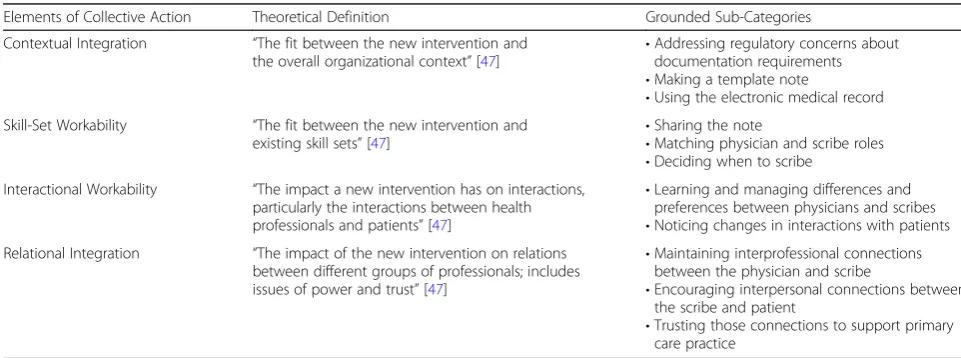
The following results sections reports only on the analysis of semi-structured interviews (n= 18) with provider and scribe teams. Table2 summarizes the inductively defined sub-categories associated with each element of collective action. Broadly, sub-categories associated with contextual and relational integration addressed work done at the sys-tem level to institutionalize the program, as well as work between staff and patients to build and maintain work and care relationships. Sub-categories associated with skill-set and interactional workability addressed work by staff at the individual level defining, delegating, and learning roles, as well as navigating interactions.
Scribing had an organizing effect
The work of creating the template for documenting pa-tient encounters in the electronic medical record helped
providers and scribes learn and negotiate how to complete the note with each other. Primary care pro-viders and scribes were acutely aware that the note was a legal document and needed to adhere to The Joint Commission guidelines. Clinical staff also acknowledged documentation standards of VHA, including attending to national VHA priority reminders, meeting peer review requirements, and formatting the note for coding and billing. Some primary care providers and scribes worked with information technology specialists to develop note templates that addressed documentation requirements while also meeting the provider’s preferences for the note, including how to organize sections of the note and what information to include in each section.
[image:4.595.58.541.98.234.2]Creating the note template acculturated the scribe to note-taking through an iterative process that involved reviewing the provider’s prior notes and working with the provider to divide responsibility for generating the distinct parts of new notes (e.g., Review of Systems, Physical Exam, History of Present Illness, Assessment and Plan). Scribes and providers had to negotiate what the scribe recorded (e.g., history, assessment) and how that was recorded (e.g., summary, verbatim, shorthand)
Table 1Characteristics of Visited Teams
Team Medical Center or Outpatient Clinic Location Team Compositiona Providera Scribea Launch Date Site Visit
1 Medical Center West MD, RNCM, LPN1, LPN2 MD LPN1 Dec 2016 Aug 2017
2 Outpatient Clinic Midwest DO, RNCM, LPN, MSA DO LPN Apr 2017 Dec 2017
3a Medical Center East NP, RN, LPN NP LPN May 2017 Sept 2017
3b MD1, MD2, MD3, LPN1, LPN2,
LPN3, RN, RN2, MSA
MD1, MD2 LPN1 Jul 2017 Sept 2017
3c MD, LPN1, LPN2, RN MD LPN1 Jul 2017 Sept 2017
4 Medical Center West NP, RNCM, LPN, CNA, MSA NP CNA Sept 2017 Mar 2018
5a Outpatient Clinic Midwest DO, RNCM, LPN1, LPN2, MSA DO LPN1, LPN2 Nov 2017 Mar 2018
5b MD, RNCM, LPN, MSA MD LPN Nov 2017 Mar 2018
a
Please see List of Abbreviations
Table 2Elements of Collective Action, their Theoretical Definition, and their Grounded Usage
Elements of Collective Action Theoretical Definition Grounded Sub-Categories
Contextual Integration “The fit between the new intervention and
the overall organizational context”[47] •
Addressing regulatory concerns about documentation requirements •Making a template note
•Using the electronic medical record Skill-Set Workability “The fit between the new intervention and
existing skill sets”[47]
•Sharing the note
•Matching physician and scribe roles •Deciding when to scribe
Interactional Workability “The impact a new intervention has on interactions, particularly the interactions between health professionals and patients”[47]
•Learning and managing differences and preferences between physicians and scribes •Noticing changes in interactions with patients Relational Integration “The impact of the new intervention on relations
between different groups of professionals; includes issues of power and trust”[47]
•Maintaining interprofessional connections between the physician and scribe
•Encouraging interpersonal connections between the scribe and patient
[image:4.595.55.536.552.731.2]to create an integrated note. When asked how she knew that the scribe was ready to take more responsibility in creating the note, one provider reflected,
“Because she was hitting the highlights she was learning what I was looking for, and what I thought was really important to include in the note, and what to emphasize and how to organize it…”(NP, Site 3a)
Sharing the note looked different for each provider-scribe team. Providers and provider-scribes had to work to figure out how to share a voice with each other, as well as the patient, in the note. Some providers were concerned about the note continuing to sound like it was written in their voice. From the provider’s point of view, one provider noted how, “You don’t want to make [the notes] too wordy and boggy that people aren’t going to read them, but I need them to relay my point”(DO Site 2). Scribes, on the other hand, were learning to balance the provider’s voice with the patient’s words. A scribe reflected,
“It’s hard to figure out what is subjective versus what is actual, like [what the provider’s] trying to put in there. So, if [the patient is] saying you know,‘I have right hip pain because I broke my hip,’ …it’s just, sometimes difficult to get it in there in their words.” (CNA Site 4)
In managing these uncertainties, teams often chose to pilot their scribing practice with acute appointments, “… just because it’s just more direct and it’s more simple to learn…the importance of what we need to get into the note”(LPN Site 5b). Teams would then slowly incorporate annual visits and new patient visits into their scribing prac-tice. In deliberately deciding how, when, and where the scribe would enter the process of making the note, pro-viders were acutely aware of how they benefitted from a more fully integrated scribing practice. One provider noted that in moments when scribing went well, she was able to, “spend more face-to-face time with the patient, getting to know them,” and have“more meaningful time writing the assessment and plan,” with the scribe already“having that supporting document be done” (MD Site 5b, participant’s emphasis).
Scribing had a generative effect
With an eye to institutional and organizational require-ments for the note (e.g., a legal document, an archival rec-ord, a catalogue of information, etc.), providers and scribes not only delegated note-taking tasks based on roles and skills, but they also learned and managed each other’s con-versational differences, writing styles, and organizational habits. As they continued to make deliberate efforts to understand each other and generate a coherent note, they
noticed changes in their interactions with each other. One provider-scribe team reflected how,
Scribe:
“We definitely talk different. You know, he wants it in hiswords and that’s where sometimes it is hard because I’m not a provider, I don’t talk like a provider, but I’m learning how to type like a provider.
[Interviewer: What does it mean to talk like a provider?] Medical terms, umm, total knee
replacement, that’s not a medical term, you know… So, what he’ll do, is he’ll say to the patient‘total knee replacement,’but he wants in hisnote, the medical term. So, he’ll do it in layman’s terms for the patient because,Iwould need that, but he wants his note to sound professional.”(CNA Site 4, participant’s emphasis)
Provider:
“So, the scribe herself is a sharp person but, she’s not well educated…and one of the things I’ve done is just have her put words in the review of systems…put‘back pain,’you know, do that, and then when I go back down I can go into the review and just put‘He had back pain with blah blah blah…’But she does have a standard… thing on her template…and I had to learn how to like talk to her too, but addressing the patient,‘Oh your lungs are clear. Your heart sounds…You have a murmur.’And that seems to help her.”(NP Site 4)
Scribe:
“Yeah, so you know I’ve learned to google a lot [for medical terms] while I’m in there…[and] I still, before every patient I go through and look at what [the provider has] done before. And I copy and paste, not like his note from last year, but I put stuff that I know he’s gonna ask…so when I’m on my note, I can see what he’s looking at.”(CNA Site 4)
Sharing the note and sharing the work of creating the note unfolded into interprofessional connections between the provider and scribe and interpersonal connections be-tween the scribe and patient. The interprofessional connec-tions between the provider and scribe built into mutuality. Mutuality between the provider and scribe opened the door to a kind of leveling between the provider and patient. In the context of an appointment, one provider-scribe team described how,
Scribe:
“Like [the provider will] say,‘Do you have any questions while I’m going through stuff with the patient, please stop me and ask me’you know, as part of my scribing. So, I feel very comfortable, like if I didn’t hear something, or I have a question about something, I feel comfortable stopping and asking her and she’s more than willing to answer it for me. In turn, sometimes she’ll say to me,‘Is there anything that I forgot to ask them that you can think of, you know as part of their history that I might have forgotten.’There’s been times when I’ll say,‘Well we didn’t ask this question,’and she’s like,‘Oh yeah! Thanks for reminding me.’”(LPN Site 2)
Provider:
“I think in the long run, as we continue to work together, it’s almost intuitive, what I’m thinking, and the next question I’m going to ask. And I’m gracious when she says,‘Oh remember, we talked about this last time, are you going to ask him about this, or ask her about this?’”(DO Site 2)
Working collaboratively to figure out how they would scribe allowed the provider to re-engage the patient. Though pitched as a practical solution to the problem of snowballing documentation responsibilities, the effort to embed scribing in PACT teams highlighted the promise of team-based care to be patient-centered by creating opportunities for meaningful work for providers and scribes, and potentially more engaged encounters with patients. In answering the question,“What did you hope to gain or achieve by participating in the pilot,”one pro-vider responded,
“Being able to be more present with my patients. I love the electronic medical record in many ways, [but] I don’t like that my view is here [at the computer] and not with patients, because just that little bit of eye contact makes a huge difference. Even if I might be intently looking for something, patients interpret that
as‘You’d rather look at a screen.’My goal was to make patients feel‘I’m here for you, I’m present for you, I’m choosing to come here.’…I prefer to have more face to face time because I find that patients talk to me more. I’ll get the‘Oh by the ways,’[like] ‘I’ve been having chest pain when I walk my dog.’I’ve found that it’s helped a lot because now I can be eye-to-eye with patients again.”(DO Site 2)
Discussion
Though current literature suggests that introducing scrib-ing does influence outcomes that can be measured and de-scribed quantitatively (e.g., provider burnout, patient satisfaction), our qualitative methods afforded us the op-portunity to pay attention to the slow accumulation of in-teractions (i.e., how to write the note) and knowledge (i.e., what goes in the note), and thus track how teams negoti-ated as they worked to enact a scribing practice. Scribing had an organizing effect because it necessitated the formalization of a note template that facilitated providers’ and scribes’ability to convey information to one another, to share meaning about what was conveyed, and to integrate the clinical, financial, and legal requirements of the note. Scribing had a generative effect because, in trying to share meaning, the provider and scribe made affordances for each other’s personal and professional differences. Scribing thus generated a mutuality that might not have existed be-fore. That connection allowed the provider to shift her per-spective from the computer to the patient, and in so doing, re-engage the patient in the encounter. However, providers and scribes noted the success of a scribing intervention dif-ferently. Providers noticed iterative interactions with scribes around concrete activities related to note-taking, as well as revelatory conversations with patients that uncovered more “oh by the ways.”Comparatively, scribes were encouraged by blossoming mutuality with the provider, specifically sharing a sense of being jointly invested in the success of each other as care workers.
emerges from changes in care practices that emphasize the complementarity of existing professional roles, which thus leverage the interactional possibilities already present in the primary care team. Scribing, as a skill, forged mo-ments of interprofessional fit. Scribing, in practice, created opportunities for interpersonal connection.
Limitations
When we started the data analysis, our goal was to create individual reports for sites, as well as an amalgamated final report for VHA Patient Care Services, our operational partner. We used a matrix analysis to quickly identify bar-riers and facilitators to implementation; if our intention had not been to generate meaningful reports, and quickly, our method of initial data analysis might have been differ-ent. Normalization Process Theory helped us structure our qualitative findings in a way that illuminated the slow work of implementation, how collective action facilitated incre-mental changes. We focused on teams that successfully initiated a scribing practice, paying attention to teams that were unsuccessful might provide illuminating counter-ex-amples to those we discuss in this paper. Talking with these other teams might help inform the spread of scribing to a wider array of teams. Additionally, the scope of the article was limited to provider and scribe perspectives in VHA primary care clinics in the United States, which did not allow us to explore the global reach of scribing as a practice, the generalizability to non-VHA primary clinics, or the unique perspectives of Veteran patients. Finally, we were not able to check the content of the note against the patient’s perspective on what information was significant and should have been included in the note; Veterans do have the capability of downloading and reviewing notes in their medical record through MyHealtheVet (the VHA pa-tient portal), but the ability to incorporate that process was outside the scope of our evaluation.
Conclusions
Moving forward, our research suggests that individuals will notice different benefits to scribing, based on their professional expectations and organizational roles related to documenting patient visits. Providers might notice the value of spending less time on documentation and spend-ing more time face-to-face with their patients. Scribes might notice being trusted and valued as peers. Quantita-tive measures capable of capturing these characteristics could provide indications of a successful scribing practice in a larger trial. Additional practical recommendations re-lated to the collective action needed to implement a suc-cessful scribing practice include:
Develop a note template for the scribe, which can be
provider- or clinic-specific, and may need to address local customs or rules.
Develop a clear scope of practice for the scribe
when working in outpatient clinics.
Establish a training plan to include using the
electronic medical record, medical terminology, and scribing protocol.
Ensure an“orientation period”to allow the scribe to
establish relationships with the provider and the primary care team members.
Plan for coverage during periods of vacation, sick
days, and turnover.
Additional files
Additional file 1:Semi-Structured Interview Guide used with Providers and Scribes. List of interview questions. (DOCX 14 kb)
Additional file 2:Structured codebook for 6-month site visit data. Blank codebook that lists only codes based on our ethnographic process evaluation aims. (DOCX 17 kb)
Abbreviations
CNA:Certified Nursing Assistant; DO: Doctor of Osteopathic Medicine; LPN: Licensed Practical Nurse; MD: Doctor of Medicine; MSA: Medical Support Assistant; NP: Nurse Practitioner; NPT: Normalization Process Theory; PACT: Patient-Aligned Care Team; RN: Registered Nurse; RNCM: Registered Nurse Care Manager; VHA: Veterans Health Administration
Acknowledgements
This material is based upon work supported by the Department of Veterans Affairs, Veterans Health Administration, Office of Research and Development. This work received financial support from the VISN 23 Patient Aligned Care Team Demonstration Lab, Iowa City VA Health Care System, Iowa City, IA, which is funded by the VHA Office of Patient Care Services. Additional support comes from the Center for Access & Delivery Research and Evaluation (CADRE), Department of Veterans Affairs, Iowa City VA Health Care System, Iowa City, IA (Award CIN 13-412).The views expressed in this article are those of the authors and do not necessarily reflect the position or policy of the Department of Veterans Affairs or the United States Government.
Authors’contributions
We have 7 authors. We worked as a research team. Our lab is led by GS and the PI for this project was BW. As such, they provided substantial
contributions to the conception and design for data collection; they also revised the paper for important intellectual content. The research team for this project consisted of JV, KS, NZ, and MS. As such, they provided substantial contributions to the design of data collection and acquisition of data, as well as providing revisions to early drafts of the article. JM contributed to the interpretation of the data through conceptual framing and theoretical expertise during the analysis. All authors contributed to the analysis and interpretation of data at various stages, though the analysis for this paper was led by JV. Every author participated in the revising and drafting of this final manuscript and approved this version for submission for publication. Every author agrees to be accountable for all aspects of the work. All authors read and approved the final manuscript.
Funding
Availability of data and materials
The authors declare that the data supporting the findings of this study are available within the article.
Ethics approval and consent to participate
The University of Iowa Institutional Review Board determined this study (201609852 Health Advocate Expansion) to be non-Human Subjects Re-search. Our IRB does not require written documentation of consent for activ-ities determined to be non-Human Subjects Research. Accordingly, we obtained verbal consent at the time of interview but did not record written documentation of consent.
Consent for publication
Not applicable.
Competing interests
The authors declare that they have no competing interests.
Author details
1VISN 23 Patient Aligned Care Team Demonstration Lab, Iowa City VA Health Care System, 601 Hwy 6 West, Building 42, Iowa City, Iowa 52246, USA. 2
CADRE, the Center for Comprehensive Access and Delivery Research and Evaluation, Iowa City VA Health Care System, 601 Hwy 6 West, Building 42, Iowa City, Iowa 52246, USA.3Tippie College of Business, University of Iowa, 21 E Market St, Iowa City, Iowa 52242, USA.4Sinclair School of Nursing, University of Missouri, S313 School of Nursing, University of Missouri, Columbia, MO 65211, USA.
Received: 1 March 2019 Accepted: 17 July 2019
References
1. Gellert GA, Ramirez R, Webster SL. The rise of the medical scribe industry: implications for the advancement of electronic health records. JAMA. 2015; 313(13):1315–6.
2. Chapman SA, Blash LK. New roles for medical assistants in innovative primary care practices. Health Serv Res. 2017;52(Suppl 1):383–406. 3. Bodenheimer T, Willard-Grace R, Ghorob A. Expanding the roles of medical
assistants: who does what in primary care? JAMA Intern Med. 2014;174(7):1025–6. 4. Martel ML, Imdieke BH, Holm KM, Poplau S, Heegaard WG, Pryor JL, et al.
Developing a medical scribe program at an academic hospital: the Hennepin County Medical Center experience. Jt Comm J Qual Patient Saf. 2018. 5. Baugh R, Jones JE, Trott K, Takyi VE, JT A. Medical scribes. Medical Practice
Management. 2012;28(3):195–7.
6. Shultz CG, Holmstrom HL. The use of medical scribes in health care settings: a systematic review and future directions. J Am Board Fam Med. 2015;28(3): 371–81.
7. Allen B, Banapoor B, Weeks EC, Payton T. An assessment of emergency department throughput and provider satisfaction after the implementation of a scribe program. Advances in Emergency Medicine. 2014;2014:1–7. 8. Arya R, Salovich DM, Ohman-Strickland P, Merlin MA. Impact of scribes on
performance indicators in the emergency department. Acad Emerg Med. 2010;17(5):490–4.
9. Bank AJ, Obetz C, Konrardy A, Khan A, Pillai KM, McKinley BJ, et al. Impact of scribes on patient interaction, productivity, and revenue in a cardiology clinic: a prospective study. Clinicoecon Outcomes Res. 2013;5:399–406. 10. Koshy S, Feustel PJ, Hong M, Kogan BA. Scribes in an ambulatory urology
practice: patient and physician satisfaction. J Urol. 2010;184(1):258–62. 11. Contratto E, Romp K, Estrada CA, Agne A, Willett LL. Physician order entry
clerical support improves physician satisfaction and productivity. South Med J. 2017;110(5):363–8.
12. Gidwani R, Nguyen C, Kofoed A, Carragee C, Rydel T, Nelligan I, et al. Impact of scribes on physician satisfaction, patient satisfaction, and charting efficiency: A randomized controlled trial. Ann Fam Med. 2017;15(5):427–33. 13. Imdieke BH, Martel ML. Integration of medical scribes in the primary care
setting: improving satisfaction. J Ambul Care Manage. 2017;40(1):17–25. 14. Reuben D, Knudsen J, Senelick W, Glazier E, Koretz B. The effect of a
physician partner program on physician efficiency and patient satisfaction. JAMA Intern Med. 2014;174(7):1188–90.
15. Sattler A, Rydel T, Nguyen C, Lin S. One year of family Physicians’ observations on working with medical scribes. J Am Board Fam Med. 2018; 31(1):49–56.
16. Yan C, Rose S, Rothberg MB, Mercer MB, Goodman K, Misra-Hebert AD. Physician, scribe, and patient perspectives on clinical scribes in primary care. J Gen Intern Med. 2016;31(9):990–5.
17. Mishra P, Kiang JC, Grant RW. Association of Medical Scribes in Primary Care With Physician Workflow and Patient Experience. JAMA Intern Med. 2018. 18. Hegstrom L, Leslie J, Hutchinson E, Pereira L, Tran S, Caughey A. Medical
scribes: are scribe programs cost effective in an outpatient MFM setting? American Journal of Obstetrics & Gynecology. 2013(Jan):S240. 19. Schiff GD, Zucker L. Medical scribes: salvation for primary care or
workaround for poor EMR usability? J Gen Intern Med. 2016;31(9):979–81. 20. Marshall J, Verdick C, Tanaka M, Frederick R, Hevesy G, Wang H, et al.
Implementation of medical scribes in an academic emergency department: effect on emergency department throughput, clinical productivity, and emergency physician professional fees. Ann Emerg Med. 2012;60(4S):S105. 21. Misra-Hebert AD, Amah L, Rabovsky A, Morrison S, Cantave M, Hu B, et al.
Medical scribes: how do their notes stack up? The Journal of Family Practice. 2016;65(3):155–9.
22. Bastani A, Shaqiri B, Palomba K, Bananno D, Anderson W. An ED scribe program is able to improve throughput time and patient satisfaction. Am J Emerg Med. 2014;32(5):399–402.
23. Hess JJ, Akhter M, Ackerman J, Wallenstein J, Ander D, Keadey M, et al. Prospective evaluation of a scribe Program's impacts on provider experience, patient flow, productivity, and teaching in an academic emergency medicine practice. Ann Emerg Med. 2013;62(4):S1.
24. Crabtree BF, Nutting PA, Miller WL, Stange KC, Stewart EE, Jaen CR. Summary of the National Demonstration Project and recommendations for the patient-centered medical home. Ann Fam Med. 2010;8 Suppl 1:S80–S90; S2. 25. Stange KC, Nutting PA, Miller WL, Jaen CR, Crabtree B, Flocke SA, et al.
Defining and measuring the patient-centered medical home. J Gen Intern Med. 2010;25(6):601–12.
26. True G, Butler AE, Lamparska BG, Lempa ML, Shea JA, Asch DA, et al. Open access in the patient-centered medical home: lessons from the veterans health administration. J Gen Intern Med. 2013;28(4):539–45.
27. Yano EM, Bair MJ, Carrasquillo O, Krein SL, Rubenstein LV. Patient aligned care teams (PACT): VA's journey to implement patient-centered medical homes. J Gen Intern Med. 2014;29(Suppl 2):S547–9.
28. Solimeo SL, Hein M, Paez M, Ono S, Lampman M, Stewart GL. Medical homes require more than an EMR and aligned incentives. Am J Manag Care. 2013;19:132–40.
29. Solimeo SL, Stewart KR, Stewart GL, Rosenthal G. Implementing a patient centered medical home in the veterans health administration: perspectives of primary care providers. Healthc (Amst). 2014;2(4):245–50.
30. True G, Stewart GL, Lampman M, Pelak M, Solimeo SL. Teamwork and delegation in medical homes: primary care staff perspectives in the veterans health administration. J Gen Intern Med. 2014;29(Suppl 2):S632–9. 31. Petzel RA. VHA HANDBOOK 1101.10.Pdf>. In: administration VH, editor.
Washington, DC: Department of Veterans Affairs; 2014.
32. Solimeo SL, Ono S, Stewart KR, Lampman M, Rosenthal G, Stewart GL. Gatekeepers as care providers: the care work of patient-centered medical home clerical staff. Med Anthropol Q. 2017;31(1):97–114.
33. Bodenheimer T, Sinsky C. From triple to quadruple aim: care of the patient requires care of the provider. Ann Fam Med. 2014;12(6):573–6.
34. Linzer M, Poplau S. Building a sustainable primary care workforce: where do we go from Here? J Am Board Fam Med. 2017;30(2):127–9.
35. Shanafelt TD, Hasan O, Dyrbye LN, Sinsky C, Satele D, Sloan J, et al. Changes in burnout and satisfaction with work-life balance in physicians and the general US working population between 2011 and 2014. Mayo Clin Proc. 2015;90(12):1600–13.
36. Bodenheimer TS, Smith MD. Primary care: proposed solutions to the physician shortage without training more physicians. Health Aff (Millwood). 2013;32(11):1881–6.
37. Bauer L, Bodenheimer T. Expanded roles of registered nurses in primary care delivery of the future. Nurs Outlook. 2017;65(5):624–32.
38. Hulscher M, Laurant M, Grol R. Process evaluation on quality improvement interventions. Qual Saf Health Care. 2003;12:40–6.
40. May C, Finch T, Mair F, Ballini L, Dowrick C, Eccles M, et al. Understanding the implementation of complex interventions in health care: the normalization process model. BMC Health Serv Res. 2007;7:148. 41. May CR, Cummings A, Girling M, Bracher M, Mair FS, May CM, et al. Using
normalization process theory in feasibility studies and process evaluations of complex healthcare interventions: a systematic review. Implement Sci. 2018;13(1):80.
42. May C, Finch T. Implementing, embedding, and integrating practices: an outline of normalization process theory. Sociology. 2009;43(3):535–54. 43. May C. Towards a general theory of implementation. Implementation
Science. 2013;8:18.
44. May C, Rapley, T., Mair, F.S., Treweek, S., Murray, E., Ballini, L., Macfarlane, A., Girling, M. and Finch, T.L. Normalization Process Theory On-line Users’ Manual, Toolkit and NoMAD instrument 2015 [Available from:http://www. normalizationprocess.org/.
45. May C. Agency and implementation: understanding the embedding of healthcare innovations in practice. Soc Sci Med. 2013;78:26–33. 46. May CR, Mair F, Finch T, MacFarlane A, Dowrick C, Treweek S, et al.
Development of a theory of implementation and integration: normalization process theory. Implement Sci. 2009;4:29.
47. Holtrop JS, Potworowski G, Fitzpatrick L, Kowalk A, Green LA. Effect of care management program structure on implementation: a normalization process theory analysis. BMC Health Serv Res. 2016;16(a):386.
48. BeeBe J. Rapid Qualitative Inquiry: A Field Guide to Team-Based Assessment. 2nd ed: Rowman & Littlefield; 2014.
49. Averill J. Matrix analysis as a complementary analytic strategy in qualitative inquiry. Qual Health Res. 2002;12(6):855–66.
50. VERBI Software. MAXQDA Software for qualitative data analysis. Berlin, Germany: Sozialforschung GmbH; 1998-2018.
Publisher’s Note