University of Southern Queensland Faculty of Engineering & Surveying
Biometric Analysis for Remote Examination System
A dissertation submitted by
J. Hockey
in fulfilment of the requirements of
ENG4112 Research Project
toward the degree of
Bachelor of Electrical and Electronic Engineering
Abstract
Tertiary study is considered by many to be a necessary step in not only increasing knowledge, but also for employability and receiving promotions. Accessing Universities, particularly through on campus study can be problematic for those working full time or raising a family. The University of Southern Queensland promotes external studies and although they provide for the most part flexibility examinations are rigid. The ability to complete exams remotely may be an ideal solution; however security and exam integrity must be maintained. This dissertation considers the possibility of using biometric verification as a way of ensuring security.
While many biometric techniques are considered only facial recognition adheres to all of the specifications of a remote examination system. Over the past twenty years facial verification has been a subject of interest, particularly in the area of security. Numerous algorithms have been proposed, stemming primarily from linear and multi-linear algebra.
The Eigenface algorithm based on Principal Component Analysis was implemented to determine if accuracy rates required by a remote examination system could be achieved. The tests were conducted on the XM2VTS database as well as a small test database composed of images similar to those expected during a remote examination.
The algorithm was implemented using MATLAB and results show that Eigenfaces was able to achieve results of 78.8% accuracy, with an imposter error as low as 19.36%. The tests conducted also conclude that pre-processing techniques, in particular face detection and cropping will increase verification rates of the algorithm.
ii
University of Southern Queensland Faculty of Engineering and Surveying
ENG4111/2 Research Project
Limitations of Use
The Council of the University of Southern Queensland, its Faculty of Engineering and Surveying, and the staff of the University of Southern Queensland, do not accept any responsibility for the truth, accuracy or completeness of material contained within or associated with this dissertation.
Persons using all or any part of this material do so at their own risk, and not at the risk of the Council of the University of Southern Queensland, its Faculty of Engineering and Surveying or the staff of the University of Southern Queensland.
This dissertation reports an educational exercise and has no purpose or validity beyond this exercise. The sole purpose of the course pair entitled \Research Project" is to contribute to the overall education within the student's chosen degree program. This document, the associated hardware, software, drawings, and other material set out in the associated appendices should not be used for any other purpose: if they are so used, it is entirely at the risk of the user.
Prof F Bullen
Dean
iii
Certification of Dissertation
I certify that the ideas, designs and experimental work, results, analyses and conclusions set out in this dissertation are entirely my own effort, except where otherwise indicated and acknowledged.
I further certify that the work is original and has not been previously submitted for assessment in any other course or institution, except where specifically stated.
JOSHUA HOCKEY 0050086081
Signature
Acknowledgements
I would like to acknowledge the help I received throughout the course of preparing and completing this dissertation. I am appreciative of the support my supervisor, Associate Professor John Leis, has offered; firstly for suggesting the project and secondly for helping with the initial formulation of the project. To my lovely wife Kara, and my two wonderful children, Noah and Savannah, for supporting me through my final year. To my mother, Lorraine Hockey, and father, Bruce Hockey, for suggestions and contributions to the project.
J. Hockey
University of Southern Queensland
Contents
List of Figures ... xi
List of Tables ... xiv
Chapter 1 Introduction ... 1
1.1 Aims and Objectives of the Project ... 2
1.2 Outline of the Dissertation ... 3
Chapter 2 ... Background Information ... 5
2.1 Introduction ... 5
2.2 Current Examination Modes ... 6
2.3 Remote Examination ... 8
2.4 Open Examinations ... 9
2.5 Closed or restricted examinations ... 10
2.6 Penalties ... 10
2.7 System Requirements for a Remote Examination System ... 11
2.7.1 Student Verification ... 12
2.7.2 Means of completing an Exam ... 12
Contents vi
2.7.4 Monitoring collaboration ... 13
2.7.5 Revoking exams if failure to comply with Instructions ... 13
2.7.6 One Exam per Day ... 14
2.7.7 CMA ... 14
2.8 Chapter Summary ... 15
Chapter 3 ... Ensuring Correct Student Completion of Exam ... 16
3.1 Introduction ... 16
3.2 Current Exam Security ... 17
3.3 Knowledge Verification ... 17
3.4 Possession Verification ... 17
3.5 Biometric Verification ... 18
3.6 Biometrics for remote examinations ... 19
3.6.1 Biometric Specifications ... 19
3.7 Chapter Summary ... 21
Chapter 4 ... Biometric Authentication Methods ... 22
4.1 Introduction ... 22
4.2 Biometric Authentication Terminology ... 23
4.2.1 Enrolment ... 23
4.2.2 Authentication ... 23
4.2.3 Discrimination ... 25
Contents vii
4.2.5 Ascertainability ... 26
4.2.6 Data acquisition and Performance ... 26
4.2.7 Biometric Elements required for a remote System ... 26
4.3 Active Biometric Authentication ... 27
4.3.1 DNA ... 27
4.3.2 Voice Biometrics ... 28
4.3.3 Handwriting Biometrics ... 29
4.3.4 Gait Biometrics ... 30
4.3.5 Keystroke Biometrics ... 31
4.4 Passive Biometric Authentication ... 32
4.4.1 Finger Print Biometrics ... 32
4.4.2 Hand/ Palm Biometrics ... 34
4.4.3 Iris Biometrics ... 35
4.4.4 Retinal Biometrics ... 36
4.4.5 Ear Biometrics ... 36
4.4.6 Facial Biometrics ... 37
4.5 Appropriate Biometrics for Remote Examination System ... 39
4.6 Chapter Summary ... 41
Chapter 5 ... Facial Recognition Algorithms ... 42
5.1 Introduction ... 42
5.2 Video Based Algorithms ... 43
5.3 Principal Component Analysis/ EigenFaces ... 44
5.3.1 Classifying the images ... 47
Contents viii
5.4.1 How ICA works ... 50
5.4.2 Whitening ... 51
5.5 Fisherfaces ... 54
5.6 3D Models ... 58
5.7 Gabor Wavelet ... 62
5.8 Tensorfaces ... 64
5.9 Hidden Markov Model ... 66
5.10 Chapter Summary ... 69
Chapter 6 ... Facial Verification Evaluation Procedure ... 70
6.1 Introduction ... 70
6.2 Evaluation Databases and Protocols ... 71
6.2.1 XM2VTS database and protocol ... 72
6.2.2 Test Database ... 75
6.3 Remote verification System ... 76
6.4 Gaussian Curves ... 77
6.5 Chapter Summary ... 81
Chapter 7 ... Algorithm Implementation ... 82
7.1 Introduction ... 82
7.2 Eigenface Implementation in Matlab ... 83
7.2.1 Eigenface Matlab Script ... 83
Contents ix
7.2.3 MATLAB Results Script ... 85
7.3 Pre-Processing techniques ... 86
7.3.1 Converting Images to Grey scale ... 86
7.3.2 Light Normalisation ... 86
7.3.3 Face Detection ... 87
7.3.4 Resizing Images ... 88
7.4 Testing Methodology ... 89
7.5 Chapter Summary ... 90
Chapter 8 ... Facial Verification Results ... 91
8.1 Introduction ... 91
8.2 Verification Rates on XM2VTS database ... 92
8.2.1 Verification Rates without Pre-processing ... 92
8.2.2 Effect of Normalisation ... 97
8.2.3 Effect of Image Size ... 98
8.2.4 Effect of Face Detection ... 100
8.2.5 Effect of all Pre-processing techniques combined ... 102
8.2.6 Effects of Face Detection and Resizing images ... 103
8.3 Verification Rates on Test Database ... 104
8.4 Chapter Summary ... 108
Chapter 9 ...Face Verification challenges based on analysis of results ... 109
Contents x
9.2 Backgrounds ... 109
9.3 Illumination ... 110
9.4 Pose ... 111
9.5 Face location and alignment ... 111
9.6 Enrolment ... 112
9.7 Chapter Summary ... 113
Chapter 10 ... Conclusion ... 114
10.1 Achievement of Project Objectives ... 114
10.2 Project Limitations ... 116
10.3 Future Work ... 117
10.4 Final Remarks ... 118
References ... 119
Appendix A Project Specification ... 128
Appendix B Eigenface MATLAB Script ... 130
Appendix C Pre- Processing Scripts ... 140
Appendix D Results Script ... 146
List of Figures
Figure 5.1: The same person seen under varying lighting conditions. ... 54
Figure 5.2: Graph showing Fisher's Linear Discriminant (FLD) compared to Principal Component Analysis (PCA) for a 2 class problem where data for each class lies near a linear subspace ... 57
Figure 5.3: Texture mapping on the same facial structure to change the appearance of the 2D facial image to make the same face look like George Bush or Osama Bin Laden. ... 59
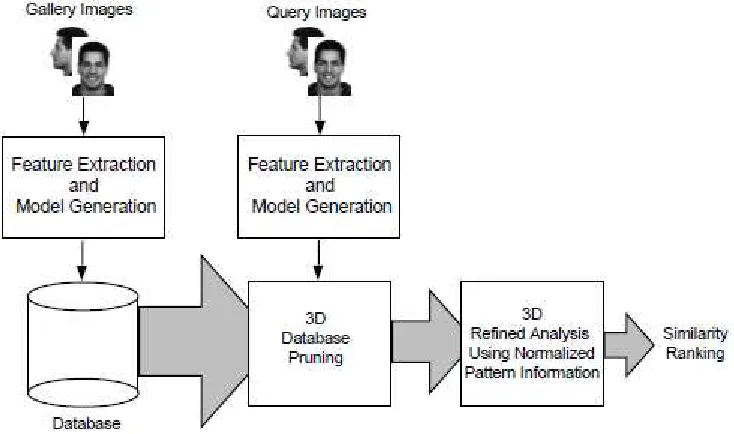
Figure 5.4: Implementation of frontal and profile view into a 3D system. ... 60
Figure 5.5: Fiducial points used to align images for 3D reconstruction. ... 61
List of Figures xii
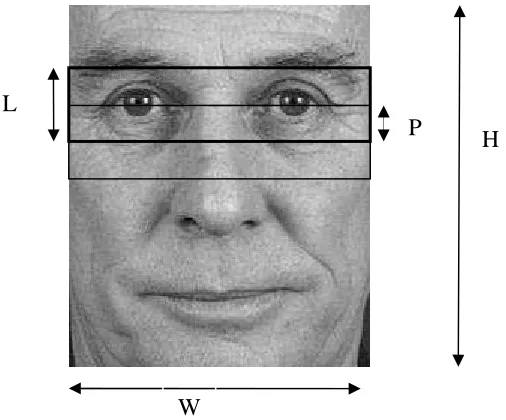
Figure 5.7: Image showing the height (H), width (W), block height (L) and overlap (P) used in HMM ... 68
Figure 6.1: Facial changes during the image capturing period ... 72
Figure 6.2: Visual display of evaluation protocol 2 ... 74
Figure 6.3: Visual display of Evaluation Protocol 1 ... 74
Figure 6.4: Class 1 images for test database ... 75
Figure 6.5: Class 2 images for test database ... 75
Figure 6.6: Class 3 images for test database ... 76
Figure 6.7: Curves demonstrating 0% client and imposter error ... 78
Figure 6.8: Gaussian curves demonstrating a shift in the mean in comparison to Figure 6.4 ... 79
Figure 6.9: Gaussian Curves showing the effect of changing the standard deviation in comparison to Figure 6.4 ... 79
Figure 6.10: Graphs showing the difference in the cross over of curves based on the discrimination of the algorithm. ... 80
Figure 8.1: Example of images provided in the XM2VTS database ... 92
Figure 8.2: Effect of decreasing the threshold on images with no pre-processing, using Evaluation protocol 1 ... 94
Figure 8.3: Example Gaussian curves showing a small threshold value ... 94
Figure 8.4: Example Gaussian curves showing a mid- range threshold value ... 95
Figure 8.5: Example Gaussian curves showing a large threshold value ... 95
List of Figures xiii
Figure 8.7: Example Gaussian curves with infinitely small threshold for evaluation protocol 2 ... 96
Figure 8.8: Histogram equalisation (top) in comparison to the original image (bottom) ... 97
Figure 8.9: Comparison of image sizes. The original image (left) has been reduced to a quarter of its original size. The 114 × 91 image (right) has not been resized ... 99
Figure 8.10: Sample Gaussian curve for Face Detection results ... 101
Figure 8.12: Example of Face Detection completely occluding a Face ... 102
List of Tables
Table 2.1: Common Guidelines for all Examinations ... 9
Table 2.2: Open Examination Procedures ... 10
Table 4.1: Biometric Element Priorities for Remote System ... 27
Table 4.2: Pros and Cons of DNA Biometrics ... 28
Table 4.3: Pros and Cons of Voice Recognition ... 29
Table 4.4: Pros and Cons for Handwriting Biometrics ... 30
Table 4.5: Pros and Cons for Gait Biometrics ... 31
Table 4.6: Pros and Cons for Keystroke biometrics ... 32
Table 4.7: Fingerprint verification pros and cons ... 33
List of Tables xv
Table 4.9: Pros and Cons of iris biometrics ... 35
Table 4.10: Pros and Cons of Ear Biometrics ... 37
Table 4.11: Pros and Cons of Facial Biometrics ... 38
Table 4.12: Comparison between Biometric Systems and the requirements of the remote examination system ... 40
Table 6.1: Configuration 1 of the XM2VTS evaluation protocol... 73
Table 6.2: Configuration 2 of the XM2VTS evaluation protocol... 73
Table 7.1: Example of the raw results from the Eigenfaces Algorithm ... 84
Table 8.1: Evaluation Protocol 1 Verification rates without Pre-processing ... 93
Table 8.2: Evaluation Protocol 2 Verification rates without pre-processing ... 93
Table 8.3: Comparison between no processing and histogram pre-processing ... 98
Table 8.4: Comparison of memory requirements for different size images ... 98
Table 8.5: Comparison between results with no pre-processing and various image sizes ... 99
Table 8.6: Comparison of results between face detection and no pre-processing using a threshold of 0.03 ... 100
Table 8.7: Face detection results using a threshold of 0.005 & 0.001 ... 101
Table 8.8: Results when all pre-processing techniques are used for each size ... 103
Table 8.9: Results when using Face Detection and Resizing pre-processing techniques ... 104
Table 8.10: Verification rates on test database without pre-processing ... 105
List of Tables xvi Table 8.12: Verification rates on test database with varying image size ... 106 Table 8.13: Verification rates on test database using light normalisation and varying
Chapter 1
Introduction
Universities are tertiary institutes which provide higher level education and qualifications to those who are able to successfully complete all of the requirements for a particular degree. The most certain way to determine if the student has satisfied the competency requirements for a given profession is to test the students understanding and knowledge of each course by way of mid-semester and end of semester exams. Exams are completed under strict supervision, and rigid guidelines are adhered to at approved examination centres. The students undertaking the exams are carefully monitored to ensure that they complete the exam questions independently. After all, tertiary institutions have an ethical responsibility to the community to ensure that their graduates have indeed satisfactorily completed all requirements and have obtained the necessary knowledge for a professional qualification.
While final semester exams have been completed in the same manner for many years the question is being posed:
1.1 Aims and Objectives of the Project 2 “Is it possible to provide greater flexibility in examination procedures while maintaining integrity?”
Biometrics has been suggested as a possible solution to one part of a very complex situation. In particular a suitable biometric method must be found which is able to meet the security requirements and physical requirements of a remote examination system. If a suitable method can be implemented it may provide greater flexibility for students studying externally.
1.1
Aims and Objectives of the Project
This project was designed to conduct research into the feasibility of implementing remote examinations for distance education students at the University of Southern Queensland (USQ). The purpose is twofold, firstly to conduct an analysis of the current methods used by USQ and the system requirements that would be necessary in a remote examination system; secondly to conduct research into a biometric technique which would be suitable for a remote examination system and to implement and test a suitable algorithm.
The goals of the project are to:
1. Research background information on biometric analysis options.
2. Analyse current USQ examination requirements and provide system specifications that would need to be implemented for a remote examination system.
3. Research current algorithms for a chosen biometric system and determine their suitability within the context of a remote identification system. 4. Implement a biometric analysis algorithms using MATLAB
5. Evaluate the raw algorithm by developing a test database which includes biometric information of a subject gathered under various conditions, similar to those expected during a remote examination.
1.2 Outline of the Dissertation 3 Full details of the project specifications are provided in Appendix A.
1.2
Outline of the Dissertation
Chapter 2 provides background information on the current USQ examination
procedures and requirements. It also provides an outline of the system requirements necessary for a remote examination system to be successful.
Chapter 3 details the necessity for a remote verification system to firstly be able
to ensure that the correct student is undertaking the exam. There are three methods that are outlined which include knowledge verification, possession verification and biometric verification. Each is addressed in turn to determine the most suitable way of achieving security within a remote examination system. Finally the specifications for a biometric verification technique are discussed in the context of a remote exam.
Chapter 4 introduces both biometric authentication terminology and biometric
authentication techniques. The terminology is discussed in detail to give an understanding of the field of biometrics and the requirements of a system to be successful. The biometric techniques are divided into active and passive techniques and are discussed within the context of the specifications for a remote verification system.
Chapter 5 discusses the many facial recognition techniques which have been
implemented and tested. The algorithms are discussed in a mathematical context aiming to understand how a facial recognition problem can be solved by a computer. The facial recognition problem is essentially about pattern recognition and hence finding a way to encode and compare images. The effectiveness of each algorithm is considered by its ability to fulfil the requirements of the remote verification system.
Chapter 6 discusses the various databases which will be used to test the facial
1.2 Outline of the Dissertation 4 difference between the test databases and real world application of the remote verification system.
Chapter 7 introduces the use of MATLAB for the implementation of the Eigen
face algorithm. The primary focus is to discuss how the algorithm was implemented and the scripts that are involved with running the algorithm. This includes the pre-processing techniques used in order to enhance the accuracy of the algorithm. It also provides the methodology used during testing.
Chapter 8 discusses the results which were obtained during the testing phase for
both databases.
Chapter 9 looks at the challenges for a facial recognition system in a real world
application. It discusses the need for enrolment, as well as the necessity to deal with problems associated with lighting, pose, expression, alignment of the face, time variation and detecting fake faces.
Chapter 10 concludes the dissertation by looking at the achievements, project
Chapter 2
2
Background Information
2.1
Introduction
Higher-level education is valuable for career development, however, studying is not always practical for daily life. The underlying philosophy of The University of Southern Queensland (USQ) flexible learning is ‘life happens’ and that it should not impact on the opportunity for one to study at a tertiary level. For this reason USQ prides itself on the flexibility with which its courses can be taken and completed.
2.2 Current Examination Modes 6 Therefore catering for students studying by distance and developing new ways of making their studies flexible is a priority for USQ.
There are, however, two study requirements that students are unable to undertake in the comfort of their home, residential schools and examinations (USQ, 2011). Residential schools are intensive courses that are completed during USQ holiday periods and give external students the opportunity to engage with lecturers face-to-face. These classes are held at a USQ campus and require students to travel to attend. Examinations are held at the end of each semester and require that all students attend a formal examination centre. Exam centres have been set up by the University across Australia and in many countries overseas. If you live within 100km of an examination centre University policy states that you must complete your exams at that centre (USQ, 2011). Although students are encouraged to attend residential schools, many faculties do not require compulsory attendance in order to successfully complete the degree. Therefore for many students the only inflexible aspect to their studies is undertaking examinations and determining a more flexible mode for completing examinations would be extremely beneficial for distance students.
2.2
Current Examination Modes
2.2 Current Examination Modes 7
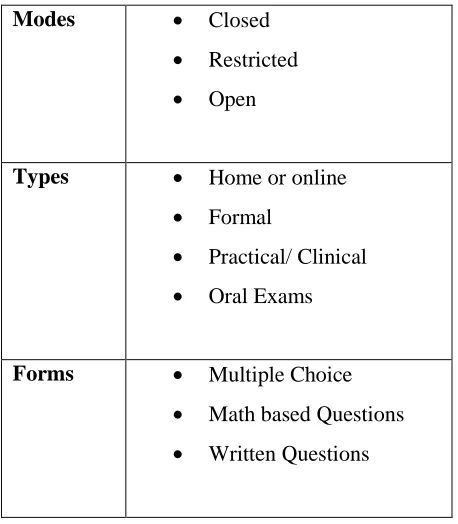
Table 2.0: Exam Modes, Types and Forms
Modes • Closed
• Restricted • Open
Types • Home or online
• Formal
• Practical/ Clinical • Oral Exams
Forms • Multiple Choice
• Math based Questions • Written Questions
The mode and format of the examination is dependent on which particular course is being undertaken. Closed examinations are those where the candidate is restricted to bringing only writing instruments into the examination room. Restricted exams allow candidates to bring other equipment that is specified in the examination paper (i.e. calculator). Open exams are those where candidates can bring any written material into the examination room. All three examination modes require that students at no time have access to any electronic device, except a calculator where specified.
All formal examination writing is to be completed on official University examination booklets provided by USQ. All booklets, whether used or unused, must be returned to the examination supervisor at the end of the examination period. The examination booklets completed by external students are collected at each recognised exam centre and mailed to USQ for marking.
2.3 Remote Examination 8 match the ID photo and student name with the student taking the examination. If these items match it is concluded that the correct person is undertaking the exam. If the supervisor believes that either of these areas has not been satisfied then the examination paper may be revoked.
University policy states that examinations must be produced and printed five weeks before the start of the exam period for external courses. During this five week period exams are kept under security to ensure that the integrity of the examination is maintained. All students completing a course must complete the examination at the same time to ensure that information cannot be passed on to other students
2.3
Remote Examination
2.3 Remote Examination 9
Table 2.1: Common Guidelines for all Examinations
Exam Form Examination Guidelines
Open
Closed
Restricted
• Only the student whose name is on the examination booklet can complete the exam
• No Collaborating with other students
• No electronic device can be accessed by any student in an exam
• 10 minutes perusal time
• No writing on exam booklet during perusal time • Writing on the exam sheet is permitted during perusal • All exams shall be 2 hours in length
• Students must leave photographic evidence on display throughout the test
• All students enrolled in the course will complete the exam at the same time
• Students will not take more than two examinations per day • Adjustments to exam policies can made for students with
disabilities
• Examination may be discontinued if a student fails to comply with a supervisors instructions
• Students may leave the examination room for a toilet break if they are accompanied by a supervisor
• Students must not leave an examination room once they have entered, without being accompanied by a supervisor • Students must remain silent once they have entered the
examination room
2.4
Open Examinations
2.6 Penalties 10
Table 2.2: Open Examination Procedures
Exam Form Examination Guidelines
Open • Access to printed or written material
• Access to a calculator
Information on open examinations can be found at < http://www.usq.edu.au/learningcentre/alsonline/assessment/exam/openexam>
2.5
Closed or restricted examinations
Restricted exams allow students to have access to instruments that are deemed necessary to successfully complete the examination; these are specified by the lecturer of the course. In particular the use of a pre-approved calculator is permitted throughout the exam. The calculator will be checked by the supervisor and the make and model placed on the top of the examination booklet.
Closed examinations only allow students to bring writing and drawing materials into the examination room. Students are not permitted the use of a calculator or other instruments to successfully complete these exams.
2.6
Penalties
2.7 System Requirements 11 be serious academic misconduct they may discontinue their program and stop them from participating in any further higher education programs.
2.7
System Requirements for a Remote Examination
System
Humans are very good at monitoring and processing multiple amounts of data as well as differentiating between many types of inputs. They have an innate ability to recognise and identify people with an extremely high level of certainty. This is evidenced by their ability to understand and recognise body language, determine behaviours and motives behind lip and eye movement as well as the ability to enforce instructions. Humans can easily alter the implementation of rules based on circumstances and an interpretation of what the instruction intended to achieve. One human is able to monitor many subjects while ensuring a high level of accuracy. Thus, humans are the most reliable source of accuracy when monitoring important activities, such as in examinations where instructions need to be implemented dogmatically. Humans are able to enforce the examination guidelines outlined in section 2.3 – 2.5, thus the integrity of the exam is maintained and therefore the correct scores are given to students based on their understanding of the content.
The guidelines state that only the student whose name appears on the examination paper is able to complete it. Humans possess very complicated yet reliable recognition capability that allows them to match faces. By ensuring that students have a current USQ student identification card, supervisors are able to conclude if the correct person is taking the exam. Likewise student collaboration, use of correct equipment and monitoring toilet breaks can all be accomplished effortlessly by a human supervisor.
2.7 System Requirements 12 The following sections outline the overall system requirements in order for the remote examination system to be successful. This is not a discussion of solutions to each of the problems, but rather an evaluation of considerations for determining if a remote examination system is plausible.
2.7.1
Student Verification
As mentioned previously verification is the foundation that all other security protocols are built on. This section is explored further in Section 3.
2.7.2
Means of completing an Exam
Currently, students are required to complete their end of semester exams by hand in written form, however this poses a problem when students are completing their exams remotely. In particular, how is the strict time limit adhered to if students are writing on a sheet of paper which they must subsequently mail to USQ? For this reason it is proposed that students complete their examinations online via computer. While this may provide the ability to the University to monitor student access simultaneously, other problems are created which include:
• How do students submit rough workings?
• How do students enter formulae for mathematics?
• Will examinations need to be changed to cater for such problems?
• Will this affect the integrity of the exam?
Although these problems must be addressed the problem of security is of primary importance when completing an examination via an internet connected personal computer.
2.7.3
Monitoring access to materials
2.7 System Requirements 13 Therefore, the system must be able to ensure that during closed examinations, students are unable to use internet, phones, other sources of information stored on a hard drive including books or study guides. The system must be able to monitor these sufficiently to ensure exam integrity.
2.7.4
Monitoring collaboration
Collaboration with other people during examinations is strictly forbidden by USQ. This problem is multidimensional and encompasses many mediums for student collaboration. During an examination the system must prohibit students from talking to others, ensure that multiple students are not sitting in the same room, as well as ensuring that the exam cannot be copied and emailed to students who have not yet completed the exam.
The system must also monitor students’ right to have a toilet break if they desire during an examination. Presently, supervisors will accompany students to the toilet and back to the examination room. Will this be possible during a remote examination, or are students forced to remain at their personal computer? What are the ethical issues surrounding such a delicate problem?
These considerations must be satisfied if a remote system is to be implemented.
2.7.5
Revoking exams if failure to comply with Instructions
A human supervisor is able to make complex decisions based on multiple inputs and circumstances to determine if a student has breached University policy and as such should have their examinations revoked. To fulfil this criterion considerations include:
1. Does the system lock people out from completing an examination if the computer system says that they fail to comply?
2.7 System Requirements 14 The disciplinary action taken can be determined only by the degree of certainty provided by the system.
2.7.6
One Exam per Day
Presently, students are only allowed to complete one examination per day. At the USQ examination centre the examinations are held at 8:30am and 2:30pm. This ensures that a minimum time period of eighteen hours has elapsed before students complete another examination. Therefore procedures need be put in place that prevents students from completing more than one examination within a minimum of eighteen hours.
2.7.7
CMA
2.8 Chapter Summary 15
2.8
Chapter Summary
Many USQ students study their degrees via flexible learning pathways. They are an integral part of the university and as a result USQ constantly reviews methods of teaching to improve their distance education. Although studying externally provides a degree of freedom there are still areas that require students to travel and complete assessment at appointed time. This is true particularly of final semester exams where students must complete the exam at the allotted time and at an exam official centre.
Examinations come in many forms and require students to prove their knowledge whilst complying with the guidelines set out for the particular exam. At the present time human supervisors are used to ensure that the student completing the examination is the correct individual and that all students comply with the guidelines. Human supervisors are competent to complete these tasks efficiently with a high degree of certainty.
Chapter 3
3
Ensuring Correct Student
Completion of Exam
3.1
Introduction
3.4 Possession Verification 17 Essentially ensuring that the correct person completes the examination is a matter of security. It is often said that security is composed of three elements: knowledge, possession and biometric verification. Therefore the remainder of this dissertation will focus on how this security can be achieved.
3.2
Current Exam Security
At the present time security for entrance into an examination is based on possession and biometric verification and is monitored by human supervisors.
3.3
Knowledge Verification
Knowledge-centred security systems are based on the concept that a certain phrase or code can only be possessed by one who has clearance to access. The system depends on the assumption that the phrase remains a secret and is not discovered by a foreign entity. For many years multi-user computer systems have employed knowledge based security as the primary means of identifying correct user access. For the purpose of a remote examination system knowledge verification alone will not give a high level of confidence that the person attempting the examination is indeed the correct person, due to its inherent flaws. However since the examination will be accessed through the UConnect web interface, which requires students to enter their username and password, knowledge verification will be the first level of verification.
3.4
Possession Verification
3.5 Biometric Verification 18 only authorized persons will have physical access to the device needed to gain access (2006). The major problem is that of transferability; the ability for the possession to be taken or given to another. For the purposes of a remote examination where certainty for verification is desired, possession based verification does not provide a high enough level of security.
3.5
Biometric Verification
3.6 Biometrics for remote examinations 19
3.6
Biometrics for remote examinations
In order for biometrics to be reliably and seamlessly used for remote examinations, certain constraints must be placed on the system, ensuring that the form of biometrics used satisfies the required specifications.
For effective use the specifications required by the biometric technique include:
• Non-invasive
• Does not disrupt examination flow
• Operates in semi-real-time
• Common Acquisition Equipment
• Operates remotely and
• Ethical Operation
3.6.1
Biometric Specifications
Each biometric identification system has its own unique specification based on the requirements and implementation of the system. In this case the biometric verification system will be used in a remote examination system and as such has specific requirements as discussed in section 3.6.
3.6.1.1 Non-Invasive
The biometric technique used in a remote verification system should not require the student to remove bodily elements (such as hair), discharge bodily fluids (e.g. saliva) or use forced bodily entrance (e.g. blood sample). The acquisition device should not require the encapsulation of any body part, nor require the student to remove any piece of clothing that would be deemed to be invasive or inappropriate.
3.6.1.2 Does not disrupt examination flow
3.6 Biometrics for remote examinations 20 performing verification of the student throughout the examination without the need for the student to perform any specific movements, actions or speaking that would cause them to lose concentration or hinder them momentarily from completing the exam.
3.6.1.3 Operates in semi-real-time
Although the technique does not require instantaneous data processing as is required in real-time systems, the system should be capable of performing multiple biometric verification analysis throughout the examination period.
3.6.1.4 Common Acquisition Equipment
As the system is being used for students, the data acquisition equipment should not be costly specialised equipment that may be difficult to acquire. The hardware requirements of the system should be equipment that is accessible to all students regardless of class or location of study.
3.6.1.5 Operates remotely
3.7 Chapter Summary 21
3.7
Chapter Summary
Chapter 4
4
Biometric Authentication
Methods
4.1
Introduction
Biometric authentication methods are placed into two broad categories: 1. Biological Construction and;
2. Learned characteristics.
4.2 Biometric Authentication Terminology 23 Although these classifications describe what ‘type’ of biometric authentication method is used, in practice it is often easier to categorise methods by the ‘way’ the biometric information is extracted and read. For this reason the methods will be classified as either ‘active authentication’ or ‘passive authentication’. As the names suggest active refers to the need for the subject to perform an action in order to read and analyse the biometric information, whereas passive can be performed with minimal effort required from the subject.
The following sections will look at the current methods used in biometric authentication and will compare them with the needs and requirements for the remote examination system.
4.2
Biometric Authentication Terminology
Before the methods of biometric authentication can be examined, it is important to understand how such systems are judged and the elements that are necessary to make them operational. These include: enrolment, authentication, variability, discrimination, ascertainability, data acquisition and performance.
4.2.1
Enrolment
In order for biometric analysis to take place the subject must be ‘enrolled’ in the system. A sample of the subject’s biometrics are recorded and stored, essentially registering them into the system, allowing for later comparison. If a subject is not enrolled, then a biometric analysis of that subject will return void since no match will be found within the system.
4.2.2
Authentication
Authentication occurs when the biometric analysis returns a positive result and is often broken into two categories, identification and verification.
4.2 Biometric Authentication Terminology 24 “Who am I?”
The identification system can then answer the question: “You are (someone)”.
Identification is deemed to be a closed system, as all the identities of all people in the group are known. It is a matter of comparing the image against all images in the database and determining which image is the closest match. In a perfect system the result would always return the correct response; however due to many variables the estimate of the system may be incorrect. Therefore the performance measure of an identification system is determined simply by its error rate, EID:
E
ID= n
err/n
totwhere nerr is the number of trials that produce errors and ntot is the total number of
trials.
Verification on the other hand attempts to determine if the person (client) is who they claim to be. It asks the question:
“Am I who I say I am?” There are only two possible ways the system can answer:
“Yes” or “No”
The person presents themselves to the system along with their claimed identity. The facial verification system compares the information input with that of the information within the database. The system then responds based on whether the result is within the tolerance or not. This lends itself to two error statistics:
1. False Rejections rate (EFR) 2. False Acceptance rate (EFA)
4.2 Biometric Authentication Terminology 25 probability that the system will allow access to someone who does not have permission. The error rates are calculated as:
EFR = nfalse/ntot
where nfalse is the number of false trial returns and ntot is the total number of trials.
Likewise EFA is determined by:
EFA = nFA/nimposter
where nFA is the number of trials that returned false acceptance and nimposter is the
number of imposter images presented to the system (Weaver 2006).
In a remote verification system the concern is only with recognising that the client is who they say they are.
4.2.3
Discrimination
Not all biometric systems are equal. While some are able to tell the difference (discriminate) between all subjects others may produce false discrimination; this is referred to as discriminatory power. It is a mark of the uniqueness of the biometric information gathered and used for comparison.
This adds further complexity to an already complex problem. While authentication is concerned with the accuracy and precision of the algorithms, discrimination is a measure of how different the biometric information is between subjects.
Authentication and discrimination are not independent concepts but rather they work in tandem. If discriminatory power is low the authentication must be exceptional to minimise errors and vice versa.
4.2.4
Variability
4.2 Biometric Authentication Terminology 26 facial recognition performed on a baby enrolled six months earlier may not return a positive result due to the high level of variability. In contrast the facial features of young adults and middle aged persons do not change rapidly and therefore perform better with time.
4.2.5
Ascertainability
Ascertainability refers to the ease with which biometric traits can be gathered. As an example, handwriting biometrics requires the subject to complete a written test which can then be taken for analysis, making it difficult to ascertain. Facial biometrics on the other hand can be captured with simple devices, without the knowledge of the subject, making it easy to ascertain.
4.2.6
Data acquisition and Performance
Data acquisition follows from ascertainability and refers to the transformation of the raw biometric trait into information that can be used for further digital processing. Performance is a time based characteristic that takes into account the time taken to acquire information, pre-processing and processing time. Performance is essentially a measure of how quickly the biometric method can return a result.
4.2.7
Biometric Elements required for a remote System
4.3 Active Biometric Authentication 27
Table 4.1: Biometric Element Priorities for Remote System
Priority Requirement Element
1 Information easily stored in a database Enrolment*
2 Non-invasive and does not affect exam
flow
Ascertainability
3 Identify the Student Authentication
4 Semi real-time capabilities Data acquisition and
Performance
5 Ability to determine between similar
students
Discrimination
6 Re-enrolment can easily take place Variability
*Note: Enrolment has been listed as priority 1, since all methods require enrolment.
Each of the following biometric methods will be measured against the information provided in Table 4.1 to determine their suitability for the remote examination biometric authentication system.
4.3
Active Biometric Authentication
Although it could be assumed that active biometric methods would not fulfil the requirements of being non-invasive and non-disruptive, they have been investigated to ensure that a suitable option was not overlooked due to poor assumptions. The active methods that are currently being used in biometric authentication are deoxyribonucleic acid (DNA), voice, handwriting, keystroke and gait biometrics.
4.3.1
DNA
4.3 Active Biometric Authentication 28 at present is in crime scene forensics. Other areas of use have not been heavily investigated due to three primary issues.
1. DNA material is easily stolen: DNA material, in the form of hair, can be taken unsuspectingly or intentionally given to another with minimum effort. Although the accuracy of DNA biometrics may be high, security is low.
2. Difficulties in automation: The current technology for gathering and interpreting information requires expert analysis through cumbersome chemical procedures.
3. Privacy: DNA analysis gives access to one’s genetic susceptibilities which could be used to discriminate against individuals or for other forms of abuse. (Anil K et al. 1999)
[image:45.595.123.530.430.528.2]This method is not viable for remote examination purposes due to its complex nature as well as its inherent ethical issues.
Table 4.2: Pros and Cons of DNA Biometrics
Pros Cons
• Unique information • Biometric Information easy stolen • Automation not currently possible • Ethical issues
• Requires expert analysis
4.3.2
Voice Biometrics
4.3 Active Biometric Authentication 29 voice is unique to individuals led to the focus of speaker verification and voice identification (Klevans 1997).
Voice verification consists primarily of two aspects: feature extraction and pattern recognition. The purpose of feature extraction is to determine the characteristic traits of the speech signal. The voice is recorded through use of a microphone and is processed by a computer. Pattern recognition determines within probabilistic limits, how closely the sample features match a sample on file (Klevans 1997). The first type of voice recognition was ‘voiceprint analysis’. This method creates a speech spectrogram- a graphical representation of the voice. Time is displayed on the “x” axis, frequency on the “y” axis and the spectral energy is displayed as shades at any point. The information is then compared to determine if the speakers are indeed the same person (Ramli et al. 2007). Other methods of analysis include frequency representation using Fast Fourier transform and LPC coefficients.
Table 4.3: Pros and Cons of Voice Recognition
Pros Cons
• Unique Information
• Able to determine other significant factors other than just identity
• Information is difficult to gather • Requires cooperation from user • Requires large samples for good
verification
4.3.3
Handwriting Biometrics
4.3 Active Biometric Authentication 30 also determine the identity of a person based on a piece of writing where the text is unknown.
Baker, Said and Tan (1998) have shown that due to the textural differences in handwriting, texture analysis techniques can be used for verification. From a sample of handwriting the writing is scanned using extra heavy lighting and divided into sample blocks. Some of the blocks are used as training samples while the others are used as test samples. Features are extracted from the handwriting images using various filtering techniques. Baker, Said and Tan (1998) found that Garbor filtering produced accuracies as high as 95.4%. Handwriting biometric techniques are in their elemental stages of development in comparison to other biometric techniques.
Table 4.4: Pros and Cons for Handwriting Biometrics
Pros Cons
• Has had successful results • Does not operate in real time • Requires either a scanner or special
computer equipment to capture
handwriting
• Requires large amounts of samples for enrolment and testing
4.3.4
Gait Biometrics
Gait biometrics is the procedure by which an individual is identified by means of their walking patterns (Bazin & Nixon 2005).
4.3 Active Biometric Authentication 31 The research is divided into two areas, three dimensional (3-D) and two dimensional (2-D) approaches. 3-D approaches determine the identity by looking at the movement of the limb in space. The information is gathered via several cameras and the images are subsequently reconstructed into a 3-D image. 2-D gait biometrics only requires one camera, which is usually placed to capture the lateral view and extracts only explicit features describing the gait. Each method is well documented and has their individual benefits: 2-D has simplicity and speed, 3-D robustness and accuracy (Bazin & Nixon 2005).
Table 4.5: Pros and Cons for Gait Biometrics
Pros Cons
• Completely unobtrusive • Requires students to walk • Requires several cameras • Implemented in 2D or 3D
4.3.5
Keystroke Biometrics
Keystroke biometrics aim to use the uniqueness of an individual’s typing characteristics for identity authentication. It is believed that the dynamic physiological behaviours of individuals differ sufficiently to allow for an increase to traditional password security (Peacock et al. 2004). The concept of identifying personnel through keystroke biometrics did not occur with the advent of the personal computer or the type writer but stems back to the early 19th century. At this time telegraph operators were able to identify one another by listening to the distinctive tapping of their colleagues Morse code (Leggett et al. 1991).
4.4 Passive Biometric Authentication 32 Peacock et al (2004) shows that research suggests that the average failure rate of one third of keystroke authentication systems is around 2%. This is considered to be acceptable for this type of system. Enrolling is difficult as it requires the user to enter keystrokes in order to train the system which can require as many as 5,000 keystrokes. Depending on the quality of the users input it is possible that failure to enrol may occur.
Table 4.6: Pros and Cons for Keystroke biometrics
Pros Cons
• Can use log on information to determine identify
• Does not require any other hardware (cost effective)
• Transparent
• Average failure rate for 1/3 of systems is 2%
• Requires large amounts of samples for training and testing
• Failure to enrol is possible
4.4
Passive Biometric Authentication
Passive systems require little or no action from the user in order to gather biometric information. This does not mean that the method of gathering information is not invasive or disruptive to a user, which is one of the requirements for the system. The passive methods that will be examined include: finger print, hand/ palm print, iris and retinal, ear and facial biometrics.
4.4.1
Finger Print Biometrics
4.4 Passive Biometric Authentication 33 requirements of the 21st century (Jain & Lin 1996). Automating the processing requires transforming the fingerprint into a digital form that can then be used in a verification system. Many scanners on the market today provide excellent digital fingerprint images; however the scanner is only a way of enrolling subjects and gathering biometric information.
Extraction of the details from the fingerprint and analysis still needs to be performed before authentication takes place. There are two broad ways this can be performed: minutiae-based approach or image based approach. (Sanjekar & Dhabe 2010)
Fingerprint technology has the advantage of requiring a small storage space for the biometric template, for a large database this can be significant.However it is noted that matching minutia patterns can be computationally expensive (Arivazhagan et al. 2007). Image based approaches endeavour to extract the information from the raw data to limit unnecessary pre-processing, therefore making it more efficient. Jain, et al., (1996) note that on average verification from a user input takes eight seconds to complete.
The effectiveness of automated fingerprint authentication is well documented and provides a successful way to determine user verification.
Table 4.7: Fingerprint verification pros and cons
Pros Cons
• Small storage space • Quick processing time • High Discrimination
4.4 Passive Biometric Authentication 34
4.4.2
Hand/ Palm Biometrics
Hand based authentication systems use the geometric features of the hand and palm to verify users. While each human hand varies in finger length, width, thickness, curvatures and the relative locations of these, it is not as discriminative as fingerprint or iris (Amayeh et al. 2007). Since the system is not highly discriminative, it is better used in applications for verification rather than identification. The system requires a hand geometry scanner which uses a charge coupled device (CCD) camera, infrared LED’s with mirrors to capture a silhouette of the hand. The hand scanner reads the shape of the hand while the mirrors allow the width of the hand to be captured. The process does not capture any surface details as a fingerprint scanner would but rather a black and white image of the shape of the hand (Singh et al. 2009). The system requires about one minute for enrolment and is able to give verification within 6-10 seconds. The system is robust, only requiring users to ensure that their fingers remained spread during the image acquisition resulting in 99.75% correct recognition if twenty-eight dimensions were used (Parashar et al. 2008). The major disadvantage is the large size of the capturing device.
Table 4.8: Pros and Cons for Hand/ Palm Biometrics
Pros Cons
• High Level of verification • Quick enrolment time • Quick processing time
• Isn’t adversely affected by environment
• Small storage requirements
• Large device size
• Only useful for verification
4.4 Passive Biometric Authentication 35
4.4.3
Iris Biometrics
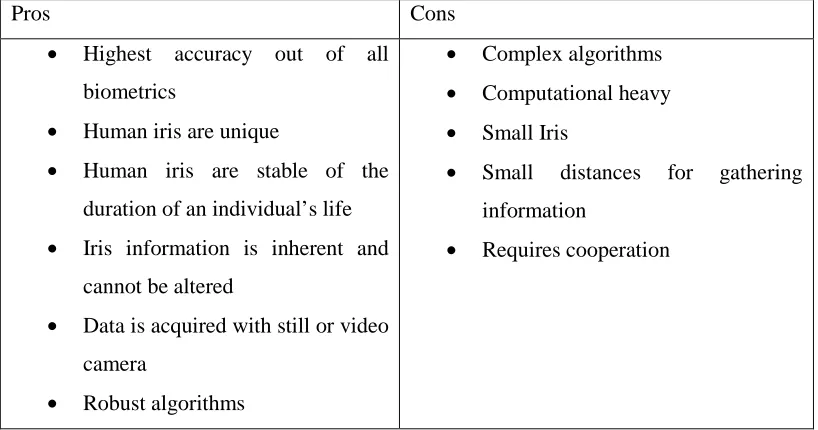
[image:52.595.122.531.511.726.2]Iris and retinal biometrics are two distinct areas of research which have no correlation to each other apart from the fact they both concern the eye. Therefore they will be discussed separately giving due credit to each as a way of identifying a person through the unique characteristics of different parts of the same eye. Iris recognition uses the highly differentiated detail of the coloured area of the human eye to distinguish one individual from another (Rejman-Greene 2002). It is not only the uniqueness of the iris that makes this technique possible but also the inability to change the iris (Yu et al. 2008). Research shows that iris recognition can have accuracy as high as 99.946%, with statistics concluding it has the lowest error rate in all biometrics (Lin & Lu 2010). The technique requires capturing an iris image either through still or video camera and then pre-processing the image so that other parts of the eye such as eyelid and eyelashes are removed. Before information extraction can begin the pupil is found and boundary points added to the inner iris so that normalisation of the iris can take place. After iris normalisation the extraction and coding of information occurs by implementing complex algorithms and transforms.
Table 4.9: Pros and Cons of iris biometrics
Pros Cons
• Highest accuracy out of all biometrics
• Human iris are unique
• Human iris are stable of the duration of an individual’s life • Iris information is inherent and
cannot be altered
• Data is acquired with still or video camera
• Robust algorithms
• Complex algorithms • Computational heavy • Small Iris
• Small distances for gathering information
4.4 Passive Biometric Authentication 36 Although the algorithms are difficult, the means of finding the iris and normalising is simple due to the inherent nature of the eye (iris is on a white background with a dark pupil as its centre). This eliminates some of the obstacles caused by variation in lighting. The main disadvantage is the size of the iris and therefore taking measurements at a distance can be problematic. The maximum reported distance for successful iris recognition is 46cm (Burge & Burger 2000).
4.4.4
Retinal Biometrics
Retinal biometrics requires capturing a picture of the eye while being illuminated with an infrared light. The photograph produced shows the blood vessel on the back end of the eye ball. These patterns are unique and can be processed and compared to enrolment photos to determine the individual’s identity (Rejman-Greene 2002). The technique requires large equipment which is costly and is therefore not suitable for a large scale automated system.
4.4.5
Ear Biometrics
4.4 Passive Biometric Authentication 37 The recognition system requires ear detection, feature extraction and verification. The process allows for the image to be captured in 2-D; however this causes problems with ear extraction pre-processing and rotation. The strict range of motion for right ear recognition is a right rotation of 20 degrees and left rotation of 10 degrees (Yuan & Mu 2007). The use of 3-D ear biometrics has become an area of recent interest and research. A benefit of ear recognition is the increased distance at which recognition can take place. In research conducted by Yan and Bowyer (n.d) subjects sat 1.5m away from the data acquisition device.
There are many ways of extracting information from the ear including feature points, using curved segments to form Voronoi diagrams, treating the ear as an array to form a Gaussian force field or using the long axis as the basis for curve fitting of the outer ear contour.
Table 4.10: Pros and Cons of Ear Biometrics
Pros Cons
• Greater distance for data acquisition
• Different algorithms and data extraction methods
• Excludes problems occurred in facial recognition
• Ears may not be unique
• Ears may be completely covered • Small degree of freedom for data
acquisition
4.4.6
Facial Biometrics
4.4 Passive Biometric Authentication 38 human face it is possible to use techniques such as ‘average half face’ to limit the amount of information that is needed to be stored. Research shows that it is possible for face recognition to produce 100% accuracy (Ramesha et al. 2009). A downfall to this technique is that there are many issues that automated face recognition biometrics needs to overcome including illumination, background, scale, and change in skin colour (i.e. skin irritations, warm or cold, blemishes, and makeup), growth or removal of hair, pose and expression and self-occlusion (Guodong et al. 2010). Despite these complications, facial recognition has received much attention and many of these problems have been solved.
Table 4.11: Pros and Cons of Facial Biometrics
Pros Cons
• 100% Accuracy Possible • Well documented
• Low cost and readily available equipment (webcam)
• Passive and unobtrusive
• Many Problems:
o Illumination
o Background
o Scale
o Change in skin colour
o Hair growth/ removal
o Expression
o Self-occlusion • Biometric Information can be
4.5 Appropriate Biometrics 39
4.5
Appropriate Biometrics for Remote Examination
System
Through a process of elimination the most suitable technique can be selected for the remote examination system.
4.5 Appropriate Biometrics 40
Table 4.12: Comparison between Biometric Systems and the requirements of the remote examination system
Requirement
Type of
Biometric
System
Non-Invasive
Non-Disruptive
Real-time capabilities
Common Acquisition Equipment
Remote Operation
DNA
Voice • • • •
Handwriting •
Gait • • •
Keystroke • • • •
Fingerprint • •
Hand
Geometry •
Iris • •
Retinal
Ear • • • •
4.6 Chapter Summary 41
4.6
Chapter Summary
Chapter 4 introduces the concepts of biometrics including the terminology and current methods used for identity verification. The terminology is considered such that each term is considered with respect to the needs of the remote verification system. Enrolment is the fundamental requirement of all biometric systems and was therefore assigned the greatest priority. The remote examination system must also be able to ascertain biometric information without being invasive and limiting examination flow as well as correctly authenticating students. These were considered of greater importance than the performance and discrimination of the system and therefore carried greater weighting in the decision. Variability is considered less important as re-enrolment can easily take place throughout a semester.
Chapter 5
5
Facial Recognition Algorithms
5.1
Introduction
There are many papers which compare thoroughly the accuracy of facial recognition algorithms and how to overcome inherent problems. The purpose of this project is not to implement and test different algorithms but rather document the current algorithms and find one that will be suitable to serve as a platform for a remote, real time system.
5.2 Video Based Algorithms 43
5.2
Video Based Algorithms
Facial recognition can be performed on either static images or time-varying images (video). In recent years video based face recognition systems have received great attention. This may be due to the desire for heightened security in public places, such as airports, particularly in light of the events of 9/11. Harguess, et al., (2009) believe that while this may be the primary reason, the other is that video can provide many frames of a subject’s face instead of only a few.
In the past there have been problems associated with video based recognition. Two of the major problems are discussed by Zhao, et al., (2003):
1. Problems associated with real-time systems. Taping may occur outside which increases the amount of uncontrollable variables such as rain, fog, low light etc. Video increases the likelihood of pose variation and occlusion.
2. Video quality is low; therefore, facial images are small. Small faces cannot be used for facial recognition since they do not contain enough distinguishable information.
With the increase in technology over the past ten years resolution is no longer considered to be a primary concern for video based face recognition. However studies conducted by Changbo, et al., (2009) recognise that the un-resolved challenging problems are still illumination, pose and occlusion.
Although Zhou, et al., (2003) recognise the complexities surrounding video based systems they also highlight the areas that make video systems superior to static face recognition systems. These include:
• Abundance of image data. Many frames per second can be captured with video cameras; therefore good frames can be selected to perform analysis.
5.3 Principal Component Analysis 44
• Real-time. Images can be collected through surveillance cameras without the need for subject cooperation. This provides a myriad of applications. It is important to highlight the ability for video systems to provide:
1. Head Detection and 2. Head Tracking
This concept helps to ensure that a face is present in the frame and that the head is positioned in such a way that facial recognition can be performed. Many researchers have used simple geometric shapes to model the head such as cylinders, ellipsoid or other 3D shapes (Wooju & Daijin 2007). These techniques provide simple head detection and head tracking techniques.
5.3
Principal Component Analysis/ EigenFaces
The current standard for facial recognition algorithms, against which all other algorithms are compared, is Principal Component Analysis (PCA). When this technique is used for the expressed purpose of facial recognition it is often given the term ‘eigenfaces’, as it produces eigenvectors of face images (Moon & Phillips 2001).
5.3 Principal Component Analysis 45
(e1,…., eN-1) and eigenvalues (λ1, …, λN-1). The eigenvectors are normalised so as
to be orthonormal and the eigenvalues ordered such that λi > λi+1 (Moon &
Phillips 2001).
Mathematically the goal of PCA is to find the eigenvectors of the covariance matrix of the set of facial images. The eigenvectors are ordered such that they account for the degree of variation within the image set. They are essentially the features of each individual image that characterise the variation between the images. From the variations captured in each eigenvector it is possible to use a linear combination of any of the derived eigenvectors to exactly represent any facial image within the set of images. However since the variation within a training set may be very large, eigenvectors accounting for minuté differences between images, most of which do not increase the accuracy of the recognition process, can be discarded. For this reason it is possible to use only the eigenvectors within a set of images that account for the most significant variations. This reduces computational complex while maintaining the ability to represent each facial image accurately. The eigenvectors or ‘eigenfaces’ that are chosen span an M-dimensional subspace, termed “face space”, of all possible images.
Using 8-bit grayscale images taking a two-dimensional array form I(x,y), an image may be viewed as a vector of dimensions N2, such that a typical image of 256 by 256 can be described as a vector of 65, 536, or equivalently a point in 65,536 dimensional space. All images within the set are subsequent