Int. J. Electrochem. Sci., 6 (2011) 6503 - 6513
International Journal of
ELECTROCHEMICAL
SCIENCE
www.electrochemsci.org
Simultaneous Voltammetric Determination of Norepinephrine
and Acetaminophen at the Surface of a Modified Carbon
Nanotube Paste Electrode
Hadi Mahmoudi Moghaddam,1,2, Hadi Beitollahi3,*
1
Pharmaceutics Research Center, Kerman University of Medical Sciences, Kerman, Iran
2
School of Public Health and Environmental Health Research Center, Kerman University of Medical Sciences, Kerman, Iran
3
Environment Department, Research Institute of Environmental Sciences, International Center for Science, High Technology & Environmental Sciences, Kerman, Iran
*
E-mail: [email protected]
Received: 30 August 2011 / Accepted: 17 October 2011 / Published: 1 December 2011
A modified carbon nanotube paste electrode was used for the sensitive and selective voltammetric determination of norepinephrine (NE). The mediated oxidation of NE at the modified electrode was investigated by cyclic voltammetry (CV). Under the optimum conditions, the calibration curve for NE was obtained in the range of 0.03-500.0 μΜ with a detection limit (3σ) of 22.0 nM using differential pulse voltammetry (DPV). DPV was used for simultaneous determination of NE and acetaminophen (AC) at the modified electrode, and quantitation of NE and AC in some real samples by the standard addition method.
Keywords: Noreponephrine, Acetaminophen; Carbon Nanotubes; Modified Carbon paste Electrode; Voltammetry
1. INTRODUCTION
Carbon nanotubes have attracted much attention during the past decade [7] due to their unique mechanical, chemical and electrical properties [8]. Carbon nanotubes (CNT) with diameters in the range of 5–40 nm and up to several microns in length can now be produced in macro quantities [9]. According to their atomic structure, carbon nanotubes behave electrically as a metal or as a semiconductor [10-15].
They have many significant properties and can be used as attractive novel materials in electrochemical fields [16-22]. The subtle electronic properties suggest that carbon nanotubes should have the ability to mediate electron transfer reactions with an electroactive species in solution when used as an electrode. The reactivities of CNT in solution have been demonstrated, resulting in specific reactive (oxidative) sites on the CNT surfaces. Thus, an important application of CNT is that they can be used as the electrode material in CNT paste electrodes or CNT modified glassy carbon electrodes [23-27] to investigate the electrochemical properties of biomolecules.
Norepinephrine (NE) is a very important catecholamine neurotransmitter in the mammalian central nervous system [28]. Along with epinephrine, NE also underlies the fight-or-flight response, directly increasing heart rate, triggering the release of glucose from energy stores and increasing blood flow to skeletal muscle [29].
However, extreme abnormalities of NE concentration levels lead to several diseases such as nueroblastoma, ganglioneuroblastoma, ganglioneuroma, paraganglioma, diabetes mellitus ketoacidosis and Parkinson’s diseases [30]. The selective detection of NE from its major interferents AC, is a problem of critical importance not only in the fields of biomedical chemistry and neurochemistry but also in diagnostic and pathological researches.
Therefore, it is very important to develop sensitive, selective and reliable methods for the direct determination of trace NE. Various methods have been employed for the determination of NE including high performance liquid chromatography [31], electrochemical [32], gas chromatography [33], ion chromatography [34] and spectrophotometry [35]. Among the different methods, the determination of NE by electrochemical method has several advantages such as high sensitivity, selectivity, easy and less time consumption.
At unmodified electrodes, selective determination of NE in the presence of AC is not possible because the oxidation potentials of AC is very close to the oxidation potential of NE. To overcome these problems, various chemically modified electrodes have been used for the determination of NE [36-40].
AC is a widely used anti-pyretic and analgesic drug with actions similar to aspirin. It is an effective and safe agent for the relief of mild to moderate pain associated with headache, arthritis and postoperative pain. Its ready access has resulted in its increased use in attempted suicide [41].
Hence, it is very important to establish a rapid, sensitive and reliable method for the determination of AC. Current methods for the analysis of AC include spectrophotometric [42], chromatographic [43], mass spectrometry [44] and electrochemical approaches [45–49].
ferrocene dicarboxylic acid (FCDCNPE) and investigate its performance for the electrocatalytic determination of NE in aqueous solutions. We also evaluate the analytical performance of the modified electrode for quantification of NE in the presence of AC.
2. EXPERIMENTAL
2.1. Apparatus and chemicals
The electrochemical measurements were performed with an Autolab potentiostat/galvanostat (PGSTAT-302 N, Eco Chemie, The Netherlands), and Metrohm 797 VA Computrace Model. A conventional three electrode cell was used at 25 ± 1 °C. An Ag/AgCl/KCl (3.0 M) electrode, a platinum wire, and the FCDCNPE were used as the reference, auxiliary and working electrodes, respectively. A Metrohm 691 pH/Ion Meter was used for pH measurements.
All solutions were freshly prepared with double distilled water. NE, AC, FCD and all other reagents were of analytical grade from Merck (Darmstadt, Germany). Graphite powder and paraffin oil (DC 350, density = 0.88 g cm-3) as the binding agent (both from Merck) were used for preparing the pastes. Multiwalled carbon nanotubes (purity more than 95%) with o.d. between 10 and 20 nm, i.d. between 5 and 10 nm, and tube length from 10 to 30 μm were prepared from Nanostructured & Amorphous Materials, Inc. The buffer solutions were prepared from orthophosphoric acid and its salts in the pH range of 2.0-11.0.
2.2. Preparation of the electrode
The FCDCNPEs were prepared by hand mixing 0.01 g of FCD with 0.89 g graphite powder and 0.1 g CNTs with a mortar and pestle. Then, ~ 0.7 mL of paraffin was added to the above mixture and mixed for 20 min until a uniformly-wetted paste was obtained. The paste was then packed into the end of a glass tube (ca. 3.4 mm i.d. and 10 cm long). A copper wire inserted into the carbon paste provided the electrical contact. When necessary, a new surface was obtained by pushing an excess of the paste out of the tube and polishing with a weighing paper.
2.3. Procedure of real Samples Preparation
The NE injection and AC oral solutions were diluted 1000 times with water; then, different volume of the diluted solution was transferred into a 10 mL volumetric flask and diluted to the mark with phosphate buffer (pH 5.0).
3. RESULTS AND DISCUSSION
3.1. Electrochemical Behavior of FCDCNPE
results show well-defined and reproducible anodic and cathodic peaks related to ferrocene dicarboxylic acid / ferricenium dicarboxylic acid (Fc/Fc+) redox system, which show a quasireversible behavior in an aqueous medium [4]. The electrode capability for the generation of a reproducible surface was examined by cyclic voltammetric data obtained in optimum solution pH 7.0 from five separately prepared FCDCNPE. The calculated RSD for various parameters accepted as the criteria for a satisfactory surface reproducibility (about 1 – 4%), which is virtually the same as that expected for the renewal or ordinary carbon paste surface [4]. However we regenerated the surface of FCDCNPE before each experiment according to our previous results [4].
3.2. Electrocatalytic oxidation of NE at a FCDCNPE
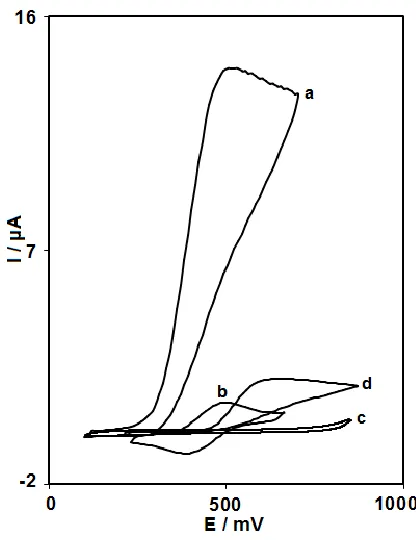
The utility of the modified electrode for oxidation of NE was evaluated by cyclic voltammetry. The cyclic voltammetric responses of a bare carbon-paste electrode in 0.1M phosphate buffer (pH 5.0), without and with NE, are shown in Fig. 1 (curves c and d, respectively).
Figure 1. Cyclic voltammograms of FCDCNPE at 10 mV s-1 in 0.1M phosphate buffer (pH 5.0): (a) In the presence and (b) in the absence of 200.0 μM NE; (c) and (d) for an unmodified carbonpaste electrode in the absence and presence of 200.0 μM NE, respectively.
[image:4.596.192.400.351.621.2][image:5.596.119.472.129.422.2]
comparing the current in Fig. 1 (curve b, without NE) with the one in the presence of NE in Fig. 1 (curve a).
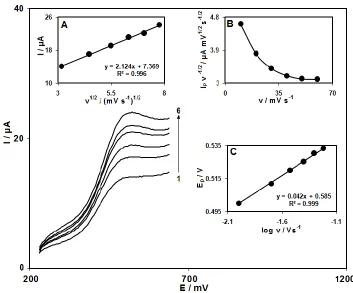
Figure 2. Linear sweep voltammograms of FCDCNPE in 0.1 M phosphate buffer solution (pH 5.0) containing 200.0 μM NE at various scan rates; From inner to outer scan rates of 10, 20, 30, 40, 50 and 60 mV s-1, respectively. Insets: Variation of (A) anodic peak current vs. ν1/2; (B) normalized current (Ip/ν1/2) vs. ν; (C) anodic peak potential vs. log v.
It is apparent that the anodic current associated with the surface-attached materials is significantly less than that obtained in the solution containing NE. At the surface of a bare electrode, NE was oxidized around 600 mV. As can be seen, the electroactivity of NE on the modified electrode was significant (Figs. 1 curve a), with strongly defined peak potential, around 500 mV vs. Ag/AgCl/KCl (3.0 M) electrode. Thus, a decrease in overpotential and enhancement of peak current for NE oxidation are achieved with the modified electrode. Such a behavior is indicative of an EC´ mechanism [53].
The effect of scan rate on the electrocatalytic oxidation of NE at the FCDCNPE was investigated by linear sweep voltammetry (Fig. 2). As can be observed in Fig. 2, the oxidation peak potential shifted to more positive potentials with increasing scan rate, confirming the kinetic limitation in the electrochemical reaction. Also, a plot of peak height (Ip) vs. the square root of scan rate (ν1/2)
was found to be linear in the range of 10–60 mV s-1, suggesting that, at sufficient overpotential, the process is diffusion rather than surface controlled. A plot of the scan rate-normalized current (Ip/ν1/2)
The Tafel slope (b) can be obtained from the slope of Ep vs. log v using Eq. (1) [54]:
Ep = b/2 log v + constant (1)
The Tafel slope was found to be 85.6 mV (Fig. 2, inset C), which indicates that a one-electron transfer process is the rate limiting step assuming a transfer coefficient (ɑ) is about 0.31.
3.3. Chronoamperometric measurements
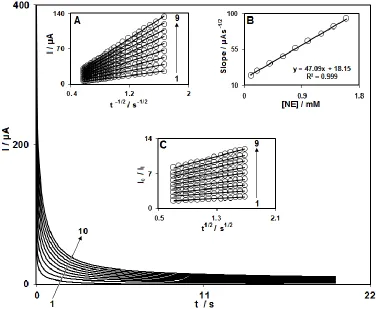
Chronoamperometric measurements of NE at FCDCNPE were carried out by setting the working electrode potential at 0.6 V vs. Ag/AgCl/KCl (3.0 M) for the various concentration of NE in buffered aqueous solutions (pH 5.0) (Fig.3).
Figure 3. (A) Chronoamperograms obtained at FCDCNPE in 0.1 M phosphate buffer solution (pH 5.0) for different concentration of NE. The numbers 1–10 correspond to 0.0, 0.1, 0.2, 0.4, 0.6, 0.8, 1.0, 1.2, 1.4 and 1.6 mM of NE. Insets: (A) Plots of I vs. t-1/2 obtained from chronoamperograms 2–10. (B) Plot of the slope of the straight lines against NE concentration; (C) dependence of Icat/Il on t1/2 derived from the data of chronoamperograms 1-10.
[image:6.596.109.485.306.615.2]
Cottrell equation [54]. Experimental plots of I vs. t-1/2 were employed, with the best fits for different concentrations of NE (Fig. 3A). The slopes of the resulting straight lines were then plotted vs. NE concentration (Fig. 4B). From the resulting slope and Cottrell equation the mean value of the D was found to be 2.3 ×10⁻⁵ cm2/s.
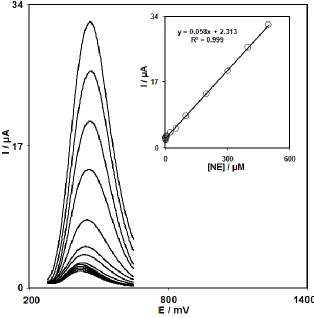
Figure 4. Differential pulse voltammograms of FCDCNPE in 0.1 M phosphate buffer solution (pH 5.0) containing different concentrations of NE. From inner to outer correspond to 0.03, 0.1, 0.5, 1.0, 5.0, 10.0, 25.0, 50.0, 100.0, 200.0, 300.0, 400.0 and 500.0 μM of NE. Inset show the plots of the electrocatalytic peak current as a function of NE concentration in the range of 0.03 to 500.0 μM.
Chronoamperometry can also be employed to evaluate the catalytic rate constant, k, for the reaction between NE and the FCDCNPE according to the method of Galus [55]:
IC / IL = γ 1/2[π1/2 erf (γ 1/2) + exp (-γ) /γ 1/2] (2)
where IC is the catalytic current of NE at the FCDCNPE, IL is the limited current in the absence
of NE and γ = kCbt is the argument of the error function (Cb is the bulk concentration of NE). In cases
[image:7.596.139.453.167.485.2]
IC / IL = π1/2 γ1/2 = π1/2 (kCbt)1/2 (3)
where t is the time elapsed. The above equation can be used to calculate the rate constant, k, of the catalytic process from the slope of IC/IL vs. t1/2 at a given NE concentration. From the values of the
slopes, the average value of k was found to be 2.99×10 3 M-1 s-1.
3.4. Calibration plot and limit of detection
The electrocatalytic peak current of NE oxidation at the surface of the modified electrode can be used for determination of NE in solution. Therefore, DPV experiments were performed using modified electrode in phosphate buffer solution containing various concentration of NE. The results show the electrocatalytic peak current of NE oxidation at the surface of modified electrode was linearly dependent on the NE concentrations. The mediated oxidation peak currents of NE at the surface of a modified electrode were proportional to the concentration of the NE within the ranges 0.03-500.0 μΜ in the DPV. The detection limits (3σ) was 22.0 nM.
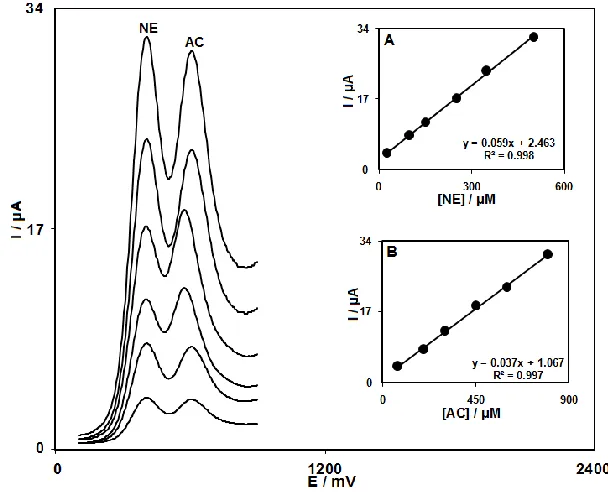
3.5. Simultaneous determination of NE and AC
Figure 5. DPVs of FCDCNPEin 0.1 M phosphate buffer solution (pH 5.0) containing different concentrations of NE+AC in μM, from inner to outer: 25.0+75.0, 100.0+200.0, 150.0+300.0, 250.0+450.0, 350.0+600.0 and 500.0+800.0 respectively. Insets (A) and (B) are plots of Ip vs.
NE and AC concentrations, respectively.
[image:8.596.143.447.385.631.2]
recording the DPVs. The voltammetric results showed well-defined anodic peaks at potentials of 415 and 625 mV, corresponding to the oxidation of NE and AC, respectively, indicating that simultaneous determination of these compounds is feasible at the FCDCNPE as shown in Fig. 5.
The sensitivity of the modified electrode towards the oxidation of NE was found to be 0.059 µA/ µM. This is very close to the value obtained in the absence of AC (0.058 µA/ µM, see Section 3.4), indicating that the oxidation processes of these compounds at the FCDCNPE are independent and therefore, simultaneous determination of their mixtures is possible without significant interferences.
3.6. Real sample analysis
3.6.1 Determination of NE and AC in pharmaceutical preparations
In order to evaluate the analytical applicability of the proposed method, also it was applied to the determination of NE and AC in NE ampoule and AC oral solution respectively. Based on the repeated differential pulse voltammetric responses (n=5) of the diluted analytes and the samples that were spiked with specified concentration of NE and AC, measurements were made for determination of NE and AC concentrations in the pharmaceutical preparations. The results are listed in table1.
Table 1. The application of FCDCNPE for simultaneous determination of NE and AC. All concentrations are in μM (n=5).
Sample Original
content
Added Found Recovery
(%)
RSD (%)
NE AC NE AC NE AC NE AC NE AC
NE ampoule
5.0 - - 25.0 4.9 25.4 98.0 101.6 3.1 1.7
5.0 - 5.0 30.0 10.1 29.3 101.0 97.7 2.4 2.7
5.0 - 10.0 35.0 15.5 34.8 103.3 99.4 1.9 3.4
Oral solution of AC
- 30.0 10.0 - 9.8 31.1 98.0 103.7 1.4 2.3
- 30.0 20.0 10.0 20.2 39.1 101.0 97.7 2.6 3.2
- 30.0 30.0 20.0 29.1 50.3 97.0 100.6 3.3 1.5
Table 2. Comparison of the total values of NE and AC of some pharmaceutical preparations obtained using FCDCNPE with declared values in the lable of the samples (n=5).
Samples Declared value Found value RSD%
NE ampoule (mg mL-1) 1.0 1.1 2.5
The reliability of the proposed modified electrode was also evaluated by comparing the obtained results with those declared in the label of the pharmaceutical preparations (Table 2). The results in table 1 show the relative standard derivations (RSD%) and the recovery rates of the spiked samples are acceptable. Also, the data in table 2 indicate that the results obtained by utilizing FCDCNPE are in good agreement with those declared in the label of the preparations. Thus, the modified electrode can be efficiently used for individual or simultaneous determination of NE and AC in pharmaceutical preparations.
4. CONCLUSIONS
In the present study, a ferrocene dicarboxylic acid modified carbon nanotube paste electrode was used for the determination of NE in the presence of AC. The CV and DPV investigations showed effective electrocatalytic activity of the modified electrode in lowering the anodic over potential for the oxidation of NE and complete resolution of its anodic wave from AC. The detected potential differences of 210 mV between NE–AC, is large enough to allow simultaneous determination of NE and AC in mixtures without significant interferences.
References
1. D. Salinas-Torres, F. Huerta, F. Montilla, E. Morallón, Electrochim. Acta 56 (2011) 2464. 2. J. B. Raoof, R. Ojani, H. Beitollahi, R. Hossienzadeh, Electroanalysis 18 (2006) 1193. 3. U. Chandra, B.E. Kumara Swamy, O. Gilbert, M. Pandurangachar, B.S. Sherigara, Int. J.
Electrochem. Sci. 4 (2009) 1479.
4. J.B. Raoof, R. Ojani, H. Beitollahi, Electroanalysis 19 (2007) 1822. 5. J.B. Raoof, R. Ojani, H. Beitollahi, Int. J. Electrochem. Sci. 2 (2007) 534. 6. J.B. Raoof, R. Ojani, H. Beitollahi, R. Hosseinzadeh, Anal. Sci. 2006 (22) 1213. 7. S. Iijima, Nature 354 (1991) 56.
8. H. Beitollahi, J.B. Raoof, R. Hosseinzadeh, Electroanalysis 23 (2011) 1934.
9. N. Rastakhiz, A. Kariminik, V. Soltani-Nejad, S. Roodsaz, Int. J. Electrochem. Sci. 5 (2010) 1203. 10.J. Zhang, X. Tan, D. Zhao, S. Tan, Z. Huang, Y. Mi, Z. Huang, Electrochim. Acta 55 (2010) 2522. 11.H. Beitollahi, I. Sheikhshoaie, Anal. Methods 3 (2011) 1810.
12.M. Zidan, W.T. Tan, Z. Zainal, A. Halim Abdullah, J. K. Goh, Int. J. Electrochem. Sci. 5 (2010) 501.
13.H. Beitollahi, I. Sheikhshoaie, Electrochim. Acta, 56 (2011) 10259. 14.L. Zheng, J.F. Song, Sens. Actuators B 135 (2009) 650.
15.H. Yaghoubian, H. Karimi-Maleh, M.A. Khalilzadeh, F. Karimi, Int. J. Electrochem. Sci. 4 (2009) 993.
16.M.R. Akhgar, M. Salari, H. Zamani, A. Changizi, H. Hosseini-Mahdiabad1, Int. J. Electrochem. Sci. 5 (2010) 782.
17.S. Kumar Vashist, D. Zheng, K. Al-Rubeaan, J. H.T. Luong, F.S. Sheu, Biotechnol. Adv. 29 (2011) 169.
19.A.R. Taheri, A. Mohadesi, D. Afzali, H. Karimi-Maleh, H. Mahmoudi Moghaddam, H. Zamani, Z. rezayati zad, Int. J. Electrochem. Sci. 6 (2011) 171.
20.C.B. Jacobs, M. J. Peairs, B. J. Venton, Anal. Chim. Acta 662 (2010) 105. 21.H. Beitollahi, J.B. Raoof, R. Hosseinzadeh, Anal. Sci. 27 (2011) 991.
22.H. Yaghoubian, H. Beitollah, V. Soltani-Nejad, A. Mohadesi, D. Afzali, H. Zamani, S. Roodsaz, Int. J. Electrochem. Sci. 6 (2011) 1307.
23.M. Fouladgar, M.R. Hadjmohammadi, M.A. Khalilzadeh, P. Biparva, N. Teymoori, H. Beitollah, Int. J. Electrochem. Sci. 6 (2011) 1355.
24.A.Mohadesi, H. Beitollahi, M.A. Karimi, Chin. Chem. Lett. 2011, in press. 25.R.J. Vikas, Colloids Surf. B 87 (2011) 423.
26.A.A. Ensafi, E. Khoddami, H. Karimi-Maleh, Int. J. Electrochem. Sci. 6 (2011) 2596. 27.G.P. Keeley, M.E.G. Lyons, Int. J. Electrochem. Sci. 4 (2009) 794.
28.Beijing Medical University, Biochemistry, People’s Sanitary Press, Beijing, 1978. 29.Merck Index, 11th ed., Merck, New York, 1996.
30.K.S. Rommelfanger, D. Weinshenker, Biochem. Pharmacol. 74 (2007) 177.
31.V. Carrera, E. Sabater, E. Vilanova, M.A. Sogorb, J. Chromatogr. B 847 (2007) 88. 32.H. Jeong, H. Kim, S. Jeon, Microchim. J. 78 (2004) 181.
33.P.S. Doshi, D.J. Edwards, J. Chromatogr. A 210 (1981) 505.
34.C.L. Guan, J. Quyang, Q.L. Li, B.H. Liu, W.R.G. Baeyens, Talanta 50 (2000) 1197. 35.F.B. Salem, Talanta 34 (1987) 810.
36.H. Beitollahia, I. Sheikhshoaie, J. Electroanal. Chem.661 (2011) 336.
37.H. Yaghoubian, V. Soltani-Nejad, S. Roodsaz, Int. J. Electrochem. Sci. 5 (2010) 1411. 38.H. Beitollahi, H. Karimi-Maleh, H. Khabazzadeh, Anal. Chem. 80 (2008) 9848.
39.M. Mazloum-Ardakani, H. Beitollahi, M. K. Amini, F. Mirkhalaf, M. Abdollahi-Alibeik, Sens. Actuators B 151 (2010) 243.
40.H. Dong, S. Wang, A. Liu, J.J. Galligan, G.M. Swain, M.D. Hawley, J. Electroanal. Chem. 632 (2009) 20.
41.M. Boopathi, M.S. Won, Y.B. Shim, Anal. Chim. Acta 512 (2004) 191.
42.A.B. Moreira, H.P.M. Oliveira, T.D.Z. Atvars, Anal. Chim. Acta 539 (2005) 257.
43.M.V. Vertzoni, H.A.Archontaki, P.Galanopoulou, J. Pharm. Biomed. Anal. 32 (2003) 487. 44.J.M. Conley, S.J. Symes, S.A. Kindelberger, S.M. Richards J. Chromatogr. A 1185 (2008) 206. 45.P. Fanjul-Bolado, P.J. Lamas-Ardisana, D. Hernández-Santos, A. Costa- García, Anal. Chim. Acta
638 (2009) 133.
46.H. Beitollahi, J.B. Raoof, R. Hosseinzadeh, Talanta 85 (2011) 2128.
47.M. Behpour, S. M. Ghoreishi, E. Honarmand, Int. J. Electrochem. Sci. 5 (2010) 1922. 48.Z. Xu, Q. Yue, Z. Zhuang, D. Xiao, Microchim. Acta 164 (2009) 387.
49.W.Y. Su, S.H. Cheng, Electroanalysis 22 (2010) 707. 50.S. Daya, S. Anoopkumar-Dukie, Life Sci. 67 (2000) 235.
51.S.X.M. Li, K.W. Perry, D.T. Wong, Neuropharmacology 42 (2002) 181.
52.H. Maharaj, D.S. Maharaj, K.S. Saravanan, K.P. Mohanakumar, S. Daya, Metab. Brain Dis. 19 (2004) 71.
53.A.J. Bard, L.R. Faulkner, Electrochemical Methods: Fundamentals and Applications, second ed., Wiley, New York, 2001.
54.J.A. Harrison, Z.A. Khan, J. Electroanal. Chem. 28 (1970) 131.
55.Z. Galus, Fundamentals of Electrochemical Analysis. Ellis Horwood, NewYork, 1976.