Rochester Institute of Technology
RIT Scholar Works
Theses
Thesis/Dissertation Collections
5-2015
A Model-based Design Framework for
Application-specific Heterogeneous Systems
Samuel Skalicky
Follow this and additional works at:
http://scholarworks.rit.edu/theses
Recommended Citation
A Model-based Design Framework for
Application-specific Heterogeneous Systems
Samuel Skalicky
A dissertation submitted in partial fulfillment
of the requirements for the Degree of
Doctor of Philosophy
in
Computing and Information Sciences
from the B. Thomas Golisano College of
Computing and Information Sciences
Rochester Institute of Technology
Rochester, NY
B. Thomas Golisano College of Computing and Information Sciences
Rochester Institute of Technology
Rochester, NY
Certificate of Approval
Doctor of Philosophy
The requirements for conferral of the degree of
PhD in Computing and Information Sciences to Samuel Skalicky
have been met, the submission examined and approved
by the dissertation committee and PhD Program Director.
Approved by:
Dr. Pengcheng Shi, PhD Program Director
This dissertation has been examined and approved by the following
Examination Committee members:
Dr. Sonia Lopez Alarcon, Advisor
Assistant Professor, RIT Department of Computer Engineering
Dr. Marcin Lukowiak, Committee Member
Associate Professor, RIT Department of Computer Engineering
Dr. Matthew Fluet, Committee Member
Associate Professor, RIT Department of Computer Science
Dr. Stanisław Radziszowski, Committee Member
Professor, RIT Department of Computer Science
Acknowledgments
I like to say that I decided to work towards a PhD because I was finishing my undergraduate degree
on Co-op and at the time I thought — sure, I can go back to school — not realizing at the time what I
was getting myself into. So many people have contributed to my success, and I am incredibly grateful to
all of them. Since everyone I mention here in this section contributed to my success in very different and
immeasurable ways, i’ll mention them all chronologically rather than in some ‘order of importance’.
Looking back, as an undergraduate student with tunnel-vision I would first like to thank Dr. Andreas
Savakis for opening my eyes to the possibility of graduate studies, which was the impetus of my even
considering going for a PhD. It seems like somebody was looking out for me from the beginning, after being
introduced to FPGAs on Co-op i found out that a class on Electronic Design Automation was offered by Dr.
Marcin Lukowiak. And at every turn, when I needed to start looking in a different direction Dr. Lukowiak
was always offering some class that fit the bill. Instead of just getting the exact material I needed when I
needed it, I gained a long time friend and mentor who always keeps me in-czech. Thanks for everything!
As if that was not enough, I happened to take a class with Dr. Sonia Lopez Alarcon who, among all
the others in that class, took a special interest in me and later on became my advisor in this PhD journey.
I am grateful that, as I grew out of my old-self and into the new person I am now, Sonia constantly stuck
with me through it all. I was one of those students that thought the liberal arts requirements in engineering
were unnecessary, and then started writing research papers and wished I had done more but the Comma
Queen brought me up to speed. Our research focused has constantly shifted from FPGAs, to GPUs, to
Matlab, compilers, scheduling, and ending up in high-level synthesis. Thanks Sonia for always been ready
for anything and supportive of where ever the results take us throughout this whirlwind adventure!
Taking classes as a PhD student I met professors from various disciplines, two of which were gracious
enough to become part of my dissertation committee. Thanks to Dr. Stanisław Radziszowski, I learned
more of the theoretical and mathematical background and gained the appreciation for understanding that
point of view. Later i took a class with Dr. Matthew Fluet who graciously met with me and took the time
to bring me up to speed given my different background. Thanks to his support I gained the understanding
that I really was not building a framework, but a compiler on a larger scale and treating it as such I was
me down the rabbit-hole of graph scheduling, guide me through concrete proofs, and all the while keeping
the big picture in mind. Thanks to both of your for all that you have done!
In the uncertain world of graduate studies (and PhD in particular) Dr. Pengcheng Shi always knows how
to keep students interested, focused, and taught the skills we didnt know we would need until we actually
needed them. Thanks Dr. Shi for opening my eyes and helping me become much more independent. I am
thankful to many of my fellow PhD students Azar Dehaghani, Lei Hu, Harish Rao, Shannon Pattison, Biru
Cui, Ricardo Figueroa, Hongda Mao, Haitao Du, and Ruslan Dautov for the conversations and support they
gave over the years. My lab mates also provided much needed comradery and include Cory Merkel, Ganesh
Khedkar, James Letendre, Mark Hogan, Alex Karantza, Matthew Ryan, and Tyler Kwolek among others.
Although he was not a lab mate or a fellow PhD student, Christopher Wood was a much needed ‘partner in
crime’ throughout my PhD studies. Although his focus vastly differed from my goals, he was always happy
just to listen and comment, and occasionally jump in and help with research and paper writing. Thanks
guys!
In my final stages of my PhD studies I got the opportunity to expand my research into the embedded
systems domain at the University of Southern California Information Sciences Institute under the direction of
Dr. Andrew Schmidt. In this short time, Andy spent much time both inside and outside the normal confines
of the workplace and provided a beneficial perspective for my research, finally joining as a dissertation
committee member. Working with Andy was a real pleasure, although in my final days working at USC/ISI
I was told that they had never seen anyone work their mentor so hard. I am incredibly grateful to him and
all of the USC/ISI colleagues for their meaningful discussion and support. Thank you Andy for all that you
have done, and for just being who you are!
When it came time to attend conferences and present research, many provided support financially. Thanks
Sonia for making this reimbursement process easier, and for going to bat for me. Thanks Dr. Shanchieh
Yang, Dr. Hector Flores, and Dr. Pengcheng Shi for your support over the years. And lastly, thanks to Sun
for letting me spend our vacation money to go to conferences and accompanying me to some of them.
I would also like to thank my family and friends for supporting me (or putting up with me depending on
the day) throughout. Thanks to my parents for supporting me and being the best landlord, its going to be
hard to find a replacement. Thanks for reading all of my papers, agreeing with me even when you knew I
was wrong (and helping me understand later), and just being who you are. Thanks Atit for putting up with
my ridiculous schedule, sticking around even when I ignored you (and your calls) to work on research, and
I must be the luckiest guy in the world, to have such a supportive and encouraging wife. Thanks Sun for
encouraging me to start this PhD, for sticking with me even when you were bored and lonely, and for being
a great role model. I certainly would not have been able to do this without you, there were many days that
were difficult but you helped me make it through. Now that we have both graduated, I am excited to step
into this new world with you.
I hope that I can give back to you all that you have given me.
A Model-based Design Framework for
Application-specific Heterogeneous Systems
Samuel Skalicky
Supervised by Dr. Sonia Lopez Alarcon
Abstract
The increasing heterogeneity of computing systems enables higher performance and power efficiency.
However, these improvements come at the cost of increasing the overall complexity of designing such systems.
These complexities include constructing implementations for various types of processors, setting up and
configuring communication protocols, and efficiently scheduling the computational work. The process for
developing such systems is iterative and time consuming, with no well-defined performance goal. Current
performance estimation approaches use source code implementations that require experienced developers
and time to produce.
We present a framework to aid in the design of heterogeneous systems and the performance tuning of
applications. Our framework supports system construction: integrating custom hardware accelerators with
existing cores into processors, integrating processors into cohesive systems, and mapping computations to
processors to achieve overall application performance and efficient hardware usage. It also facilitates effective
design space exploration using processor models (for both existing and future processors) that do not require
source code implementations to estimate performance.
We evaluate our framework using a variety of applications and implement them in systems ranging from
low power embedded systems-on-chip (SoC) to high performance systems consisting of
commercial-off-the-shelf (COTS) components. We show how the design process is improved, reducing the number of design
독특한 다른 응용 프로그램을 위한
모델 기반 설계 체계
새뮤얼 스컬리키
지도교수 소냐 로페즈 알라콘 박사
초록
서로다른 컴퓨터 시스템의 증가는 높은 성능 및 전력 효율을 가능하게한다. 그러나, 이러한 개선은
시스템 설계의 전체 복잡도를 증가시키는 요인이 된다. 이러한 복잡성은 각각의 프로세서에 따라 다른
명령어를 만들고, 통신 프로토콜을 설정 및 구성하며, 효율적으로 연산 작업을 스케줄링하는 일들은 포함한다.
이러한 시스템을 개발하기위한 과정은 반복적이며 시간이 많이 드는, 성능적인 목표가 잘 정해 져 있지 않는
과정이다. 현재 소스코드 를 구현해 성능을 추정하는 일들은 경험있는 개발자와 시간을 필요로 한다.
우리는 각 다른 시스템의 디자인 및 응용 프로그램의 성능을 향상시키도록 도와주는 설계를 제시한다.
우리의 설계는 시스템을 만드는 것을 지원한다 : 특별히 주문제작된 하드웨어를 원래 있는 코어와 통합
시키는것, 성능 향상과 효과적인 하드웨어 사용을 위한 프로세서 맵핑 등을 지원한다. 이 프레임워크는
성능을 추정하기 위해 소스코드 구현을 필요로 하지 않는 프로세서 모델을 사용하여 효과적인 설계 공간
탐색을 촉진 한다.
우리의 설계를 평가 하기위해 낮은 전력을 필요로 하는 내장형 시스템온칩 부터 고도의 성능을 내는
상용제품 까지 다양한 응용 프로그램을 이용 했다. 우리는 디자인 반복과 불필요한 소스 코드 개발을
Table of Contents
List of Figures xii
List of Tables xiv
List of Listings xv
Chapter 1: Introduction 1
1.1 Motivation . . . 2
1.2 Thesis Statement and Contributions . . . 3
1.3 Methodology . . . 4
1.4 Dissertation Structure . . . 5
Chapter 2: Literature Review 6 2.1 Foundational Works . . . 6
2.1.1 Performance Evaluations . . . 6
2.1.2 Processor Models . . . 7
2.1.3 Processor Simulators . . . 9
2.1.4 Scheduling in Heterogeneous Systems . . . 9
2.1.5 Compilers in Heterogeneous Systems . . . 10
2.2 Related Work . . . 11
2.2.1 Heterogeneous System Simulators . . . 12
2.2.2 Design Frameworks & Implementation Strategies . . . 12
2.2.3 Distributed Heterogeneous System Implementations . . . 13
2.2.4 Single Chip Heterogeneous Multicore Processors . . . 14
Chapter 3: Background Information 15 3.1 Applications and Systems . . . 15
3.2 Application Representations and Graphs . . . 17
3.3 Compiler Basics . . . 20
3.4 Redsharc Foundations . . . 21
3.4.1 Network Infrastructure . . . 22
3.4.2 Kernel Development . . . 23
3.4.3 Build Infrastructure . . . 24
3.4.4 Runtime Operation . . . 25
Chapter 4: Model-based Framework 26 4.1 Phase 1: Analyze . . . 27
4.2 Phase 2: Estimate and Schedule . . . 27
4.3 Phase 3: Simulate . . . 28
4.4 Phase 4: Generate . . . 28
5.1 Identifying Kernels . . . 31
5.1.1 Operation Clustering . . . 32
5.1.2 Application Decomposition . . . 32
5.2 Matlabcompiler . . . 33
5.2.1 Lexer . . . 34
5.2.2 Parser . . . 35
5.2.3 Dynamic Analysis . . . 39
5.3 Producing Application DFGs . . . 39
Chapter 6: Scheduling 41 6.1 Graph-based Processor Modeling Methodology . . . 41
6.1.1 Reduced Graph Representation . . . 43
6.1.2 Schedule Length Estimation on Identical Cores . . . 48
6.1.3 Schedule Length Estimation on Different Cores . . . 67
6.2 System Modeling Methodology . . . 80
6.2.1 Background . . . 81
6.2.2 Methodology . . . 84
6.2.3 Medical Imaging Application . . . 87
6.2.4 Scheduling Experiments and Results . . . 87
6.2.5 System Modeling Summary . . . 95
Chapter 7: Code Generation 97 7.1 Fixed Configuration Systems . . . 97
7.1.1 Application Support . . . 98
7.1.2 FPGA Interfacing and Hardware Support . . . 101
7.1.3 Application Performance Experiments . . . 103
7.1.4 Fixed Configuration Systems Summary . . . 114
7.2 Configurable Systems . . . 114
7.2.1 Developer Roles . . . 116
7.2.2 Kernel Development with Redsharc . . . 117
7.2.3 System Development with Redsharc . . . 118
7.2.4 Build Infrastructure . . . 121
7.2.5 System Runtime Operation . . . 124
7.2.6 Example Applications in Redsharc . . . 125
7.2.7 Configurable Systems Summary . . . 130
Chapter 8: Conclusions and Future Work 131
List of Figures
Figure 1.1 CPU, GPU, FPGA Design Space Chart . . . 3
Figure 3.1 Application and System deconstruction hierarchy . . . 16
Figure 3.2 Breakdown of graph representations used . . . 17
Figure 3.3 Example kernel graph characteristics . . . 18
Figure 3.4 Various storage representations of a kernel graph . . . 19
Figure 3.5 Example stages of the compilation process . . . 20
Figure 3.6 Example Redsharc MPSoC system. . . 22
Figure 3.7 Redsharc hardware kernel interface . . . 24
Figure 3.8 Redsharc simulation environment . . . 24
Figure 4.1 Framework flow high level view . . . 26
Figure 4.2 Detailed Analyze phase diagram . . . 27
Figure 4.3 Detailed Simulation phase diagram . . . 28
Figure 4.4 Detailed Generate phase diagram . . . 29
Figure 5.1 Application implementation and parallelization flow. . . 31
Figure 5.2 Example operation graph showing clusters of operations forming three kernels. . . 32
Figure 5.3 Example application graph showing the kernels that are present. . . 33
Figure 5.4 High level overview of the compiler flow . . . 34
Figure 5.5 Compilation process example . . . 36
Figure 6.1 Reduced graph examples . . . 43
Figure 6.2 Memory footprints of adjacency representations . . . 46
Figure 6.3 Memory footprints of incidence versus reduced . . . 46
Figure 6.4 Example bipartite graphs . . . 47
Figure 6.5 Example graphs with different distributions . . . 54
Figure 6.6 Sample case for exposed calculation error . . . 59
Figure 6.7 Results for dot product operation DFGs. . . 63
Figure 6.8 Results for matrix-vector multiplication DFGs. . . 64
Figure 6.9 Results for matrix-matrix multiplication DFGs. . . 64
Figure 6.10 Results for random graphs. . . 66
Figure 6.11 Example pipelined architecture design . . . 68
Figure 6.12 Example graph and architecture representations . . . 68
Figure 6.13 Comparison of graph representations . . . 70
Figure 6.14 Memory footprint comparison to reduced representation . . . 71
Figure 6.15 Initial pipelined architecture design. . . 73
Figure 6.16 Improved pipelined architecture design. . . 74
Figure 6.17 Original dot product design from [124] . . . 75
Figure 6.18 Matrix-vector multiply results . . . 76
Figure 6.19 Matrix-matrix multiply results . . . 76
Figure 6.21 Matrix inversion results . . . 79
Figure 6.22 Heterogeneous system modeling diagram . . . 83
Figure 6.23 Hardware system connection diagram . . . 86
Figure 6.24 NTEPI algoritham flow diagram . . . 88
Figure 6.25 Performance of kernels used in NTEPI . . . 88
Figure 6.26 Design space diagram subset for NTEPI . . . 89
Figure 6.27 Performance of various scheduling policies . . . 90
Figure 6.28 Normalized performance of three best policies . . . 92
Figure 6.29 λdelay of the various scheduling policies . . . 94
Figure 7.1 Code generation flow for heterogeneousMatlabscripts. . . 99
Figure 7.2 Application implementation and parallelization flow. . . 100
Figure 7.3 NTEPI processing flow . . . 103
Figure 7.4 NTEPI kernel DFG . . . 104
Figure 7.5 Shallow Water kernel DFG . . . 105
Figure 7.6 AMD Hardware system configuration diagram . . . 107
Figure 7.7 Transfer bandwidths for CPU/GPU and CPU/FPGA as a function of payload size. . 108
Figure 7.8 MatlabMPI bandwidth experiments . . . 109
Figure 7.9 NTEPI performance results . . . 112
Figure 7.10 Shallow water performance results . . . 113
Figure 7.11 Example Redsharc MPSoC system. . . 115
Figure 7.12 Shifting development focus with Redsharc . . . 116
Figure 7.13 Redsharc hardware processor interface . . . 118
Figure 7.14 Redsharc API connection diagram . . . 119
Figure 7.15 Redsharc networks configurations and connectivity . . . 119
Figure 7.16 Redsharc build framework flow diagram . . . 122
Figure 7.17 Redsharc build tool flow . . . 123
List of Tables
Table 3.1 Examples of Redsharc software kernel API calls. . . 23
Table 6.1 Calculating memory footprint of various graph representations . . . 45
Table 6.2 Scheduling variable summary . . . 51
Table 6.3 Common unary and binary operation types for most programming models . . . 70
Table 6.4 Summary of estimation results . . . 74
Table 6.5 Processor specifications . . . 86
Table 7.1 MatlabFPGA Interface Functions . . . 102
Table 7.2 Processor Specifications . . . 106
Table 7.3 Redsharc System API . . . 121
List of Listings
Listing 5.1 Small selection of theMatlablanguage tokens implemented . . . 35
Listing 5.2 Small selecion of Matlabgrammar rules . . . 37
Listing 7.1 Software Kernel 4 Implementation . . . 127
Chapter 1
Introduction
At the beginning of the VLSI era, processor performance improvements came from advancements in the
semiconductor fabrication process that enabled higher clock frequencies. With higher frequencies, processors
were able to execute more instructions per second. In 1974 Robert Dennard predicted that the power used
by a processor is proportional to the area or size of the chip, since both voltage and current will be reduced
for smaller transistor sizes [33]. This held true for many years until the ubiquitouspower wall was identified
in 2004 [83], where the voltage and current could not be reduced, leading to larger power needs as transistors
got smaller. Thispower wall signified the end of Dennard’s scaling law.
Since increasing the frequency of the processor was not possible, architecture designers opted for packing
more processors onto the same chip running at a lower frequency. This began themulticore erawhere the core
count steadily increased as smaller semiconductor fabrication processes were achieved. As time progressed,
different types of cores began to be designed into a single chip. When specific cores are not in use they
can be powered off for better efficiency, giving rise to the termdark silicon to refer to the parts of the chip
that are not being used. This paradigm allows more compute resources to be designed into a chip than can
possibly be powered all at the same time.
With the end of Dennard scaling, Multicore Scaling was supposed to be the way forward but it too ended
[38]. We are currently in the era of Dark Silicon wherearea is free and power is not, and where unconventional
cores offer a new way forward [28]. Computing systems are becoming increasingly heterogeneous to optimize
for performance, power, and cost [93]. Similarly, the programming models have evolved from sequential
streams of instructions to a threading model, allowing developers to take advantage of an increasing number
threads to interleave instructions executed by a single processor core is called simultaneous multithreading
(SMT) and enables an even larger number of threads to execute in parallel.
1.1
Motivation
Thanks to the availability of area on chip, additional specialized cores have been designed to take advantage
of data level parallelism in ways such as single instruction multiple data (SIMD) where a single thread will
issue an instruction that operates on multiple data values simultaneously. Or in the case of GPUs, single
instruction multiple thread (SIMT) where multiple threads issue the same instruction to each core. Whereas
SIMD adds additional functional units for parallelism, SIMT enables many more cores to be implemented
by reducing the amount of control logic and therefore requiring that every core execute the same instruction.
Custom general purpose architectures have become more prevalent thanks to the widespread use of FPGAs,
but also custom special purpose cores have been added to general purpose processors for tasks such as
encryption, image processing, signal processing and many others. The heterogeneous hardware/software
codesign for systems of such processors has been a longstanding problem [32, 60] with increasing complexity
and difficulty.
Some non-trivial steps in the implementation flow include (1) exploiting task parallelism, (2) customizing
the data parallelism within tasks, (3) interfacing cores in a processor and processors in a system, and
(4) scheduling tasks effectively over the heterogeneous configuration [60]. Of these, (1,2,4) rely on the
ability to map computations to processors. Given categories of computations, such as those defined as the
Berkeley Dwarfs [7], there may be a mapping between categories and processor types. We investigated
this possibility by choosing computations from one category, Dense Linear Algebra, and analyzed their
performance on various processor types: CPU, GPU and FPGA. We selected dot product, matrix-vector
and matrix-matrix multiplication to analyze the effect of increasing data parallelism, and matrix inversion
and Cholesky decomposition to analyze the impact of control flow complexity. We profiled the performance of
each computation executed on every processor type for a range of data sizes. We compared the performance
results to determine the best implementation for every combination of: kernel type, processor type, data size,
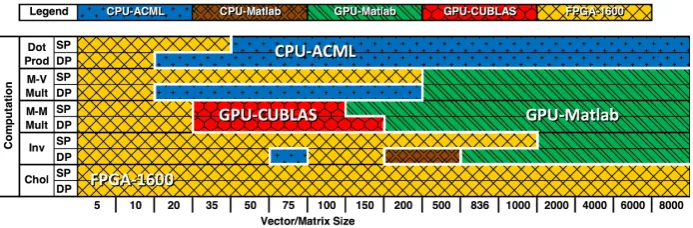
precision, and library implementation. Figure 1.1 shows the results of this comparison on data sizes from 5 (5
element vectors, 5x5 or 25 element matrices) to 8000 (8000 element vectors, 8000x8000 or 64,000,000 element
matrices). By reading this chart we can understand that for the matrix-vector multiply kernel operating on
Figure 1.1: Design space for the highest performing architectures. The different regions represent the architecture with the best performance at any computation and data size for both single (SP) and double precision (DP) floating point.
of 20 and 200 the fastest is the CPU using the AMD Core Math Library (ACML), and for data sizes larger
than 200 using the GPU withMatlab’s implementation is the fastest.
These results show that even within a single category, there may be some computations that are best
executed on one type of processor and others that are best for a different type of processor. In the category
of Dense Linear Algebra for example, computations such as dot product and Cholesky decomposition have
very different computational needs and require different architectural features within a processor to achieve
high performance. Moreover, in order to accurately map computations to processors, we will need to consider
a variety of factors to determine the best processor. In addition, empirically exploring the design space and
actually trying out every possible corner case is not a feasible strategy.
1.2
Thesis Statement and Contributions
Although many of the problems of implementing heterogeneous systems have been identified early on [60],
many still persist and plague the development of current systems [32]. In our work we seek to improve the
hardware/software design process of heterogeneous systems and enable improved performance and efficiency
of compute intensive applications. We explore the organization of computations in an application, and their
execution on processors in a computing system.
Thesis Statement:
An application can be parallelized and implemented in a heterogeneous system and achieve high
performance by identifying the computations and estimating their performance for different
pro-cessor types. We facilitate this difficult process by specifying the interfaces of each implementation
step (analyze, estimate, schedule, simulate, and generate) and construct a cohesive framework
The research objectives and contributions are:
• A coarse kernel granularity at the level of linear algebra computations
• A method to estimate performance without source code or detailed processor designs
• An evaluation of scheduling policies for improving overall application performance
• An automated and streamlined design space exploration for types and quantity of processors
• An implementation generator for both: coarse grain systems of interconnected processors
(workstations or clusters) and fine grain systems of integrated on-chip processors (commonly
referred to as multiprocessor system-on-chip, or MPSoC)
• An end-to-end framework for the implementation of applications in heterogeneous systems.
1.3
Methodology
As stated earlier, although various approaches have been proposed to the problems addressed in this
dis-sertation there has been little work attempting to combine these solutions into a cohesive development
environment. Scheduling policies have been developed but not evaluated for heterogeneous systems.
Di-rectly evaluating performance on hardware is very expensive and time consuming. Moreover, to use each
of the previous solutions they would need to be integrated with a model of the system to estimate the
performance of an application on a heterogeneous system.
We developed a model-based framework that aids the design of distributed hardware/software solutions
on a heterogeneous system. Our framework takes into account the relationships between computations
and input data sizes, as well as processors and implementations to optimize application performance. The
differentiated capabilities of general purpose CPU, GPU, and FPGA processors satisfy each of the different
types of computations normally found in compute-intensive applications. We propose that performance can
be estimated without any hardware specific implementation and present a high-level graph-based processor
modeling methodology. By correlating a graph representation of a computation to the architectural features
of a processor, we can quickly approximate its execution time without any source code or architecture
design information. Using this approach, we can easily construct a schedule of computation-to-hardware
assignments and estimate application performance.
We propose that the degree of heterogeneity dictates the preferred scheduling strategy in heterogeneous
on a heterogeneous set of processors. Previous work included scheduling policies [53][69] such as static
or dynamic strategies for specific applications. We present a system model to analyze various scheduling
policies and determine the best for constraints such as performance, efficiency, or power. We investigate
systems comprised of processors from both commercially available off-the-shelf components (COTS) and
custom multiprocessor system-on-chips (MPSoCs). By solving the problems posed above, future on-chip
heterogeneous systems will also be able to perform faster and more efficiently. These on-chip heterogeneous
systems are already being developed [30][49][103]. Having analysis tools will be critical to aid in the software
design to take advantage of such future hardware.
Finally, we propose a tool flow that integrates existing tools and provides an end-to-end application
development environment from initial algorithm to final implementation in a parallel heterogeneous system.
Tool suites for developing such heterogeneous systems either from device vendors (such as Nvidia, Xilinx,
etc.) or from academic initiatives (such as Redsharc [102]) enable easy integration or construction. But
in order to use them the developer must have a pre-existing design already chosen. Yet, coming up with
a design is a difficult proposition given the size of the design space, including: types of processors
(CPU-like as hard or soft, accelerators - GPU or custom on FPGA), quantity of processors, and assignments of
computations-to-processors. Our model-based framework seeks to fill the gaps in existing tools to provide a
modeling environment to aid in determining the composition of the system, customized for each application.
1.4
Dissertation Structure
The rest of this dissertation is organized as follows. Chapter 2 discusses the foundational work that our
research is based on, and the other similar and ongoing efforts related to our objectives. We present the
relevant background information to support our technical descriptions of the research in Chapter 3. The
model-based framework is described in detail next in Chapter 4. Our front-end compilation approach is
presented in Chapter 5. Then, in Chapter 6 we constrain the general scheduling problem for the two
levels encountered in this work. At a low level, scheduling operations within a processor to estimate the
performance of a kernel is presented in Section 6.1. We describe our high level approach to simulate the
operation of the system by scheduling kernels to processors in Section 6.2. Then a study on parallel code
generation is presented in Chapter 7 specifically for fixed configurations of processors in Section 7.1, and
configurable on-chip systems in Section 7.2. Finally, our conclusions and possible future work is described
Chapter 2
Literature Review
In this chapter we describe both the previous work that is the foundation of our work and the other similar
efforts that are related to our objectives and contributions.
2.1
Foundational Works
Our proposed work is based on existing knowledge and advancement in the many areas of computing.
Sec-tion 2.1.1 presents the first step in the process of performance improvement: benchmarking and performance
evaluations of applications on different processor architectures. A survey of processor models for estimating
performance of a computational workload is presented in Section 2.1.2. Following this, some existing
proces-sor simulators are presented in Section 2.1.3. Our work also benefits from the research in scheduling policies
for heterogeneous systems which is briefly described in Section 2.1.4. Lastly, the compilers and compilation
strategies previously presented for heterogeneous systems are described in Section 2.1.5.
2.1.1 Performance Evaluations
The idea that one hardware platform provides better performance than another is not new. The performance
of various processing architectures have been evaluated for many computations. CPU, GPU, and FPGA
implementations of a Low-Density Parity-Check decoder were compared by Falcaoet al. [39] for data sizes
8000x4000 and 1024x512. They concluded that for the smaller data size the FPGA was faster and the GPU
Sotiropouloset al. designed an FPGA matrix-matrix multiplication architecture [105] and compared its
performance to a standard CPU implementation. This comparison was only for specifically sized matrices
and did not discuss the implementation in the CPU. Their results showed that the FPGA can outperform the
CPU with a speedup of up to 557x. A comparison of matrix decomposition by Yanget al. [120] evaluated the
performance on CPUs, GPUs, and FPGAs. The results for data sizes ranging from 256 to 1024 demonstrated
that the FPGA was faster than GPU followed by the CPU for both single and double precision floating point.
Higher level functions such as 2D filtering by Llamocca et al. [72] and an implementation of Bayesian
networks by Fletcher et al. [40] were evaluated using GPU and FPGA architectures. But when making
the comparisons, the authors implemented the algorithms solely in one architecture and therefore, chose
one particular processor over another. They did not discuss the best implementations for the computations
in these higher level functions, only the best implementation for the whole algorithm. Grozea et al. [47]
evaluated a sorting algorithm on CPUs, GPUs, and FPGAs to speed up the performance of network intrusion
detection systems. Their results showed the highest performance architecture was CPU, followed by FPGA
and then GPU.
In all of the work mentioned above, none provide a clear way to utilize the results to improve the
performance of a CPU, GPU, FPGA heterogeneous system. Moreover, empirically evaluating performance
by actually executing the application can be very slow and presents portability issues for different types of
processors. Another approach to evaluating performance is to use processor-specific models.
2.1.2 Processor Models
Processor models are analytical tools used to better understand a particular architecture and how to
ef-ficiently utilize it. Many models operate using architecture specific programming languages or compiled
instructions but others use a higher level representation of the workload. We present previous approaches
to modeling each specific CPU, GPU, and FPGA architecture.
CPU Modelshave been designed by many researchers for different purposes. One such model is from
the Performance Modeling and Characterization (PMaC) framework designed for larger supercomputing
performance modeling by Snavelyet al. [104]. Although the framework is not designed for CPU simulation,
it contains an accurate CPU processor performance model. This model contains three distinct parts: a
Machine Access Pattern Signature (MAPS), PMaC’s Efficient Binary Instrumentation Toolkit for Linux
(PEBIL) [66], and the PMaC Convolver. The MAPS is used to obtain a model for the machine’s memory
used to determine how much of the advertised FLOPS performance can be sustained. PEBIL is used to
capture information about the behavior of the computation such as memory operations and floating point
computations. Finally, the PMaC Convolver combines these two pieces of information to determine the
execution time required to complete the computation. Other work by Nakamura et al. [79] presents a
mathematical model for an integer-only processor using a small subset of instructions. Padhariya et al.
[82] presented a model based on calculations correlating the number of floating point operations per second
(FLOPS) the processor can compute with the number of floating point operations in the program. The
verification of this model only used simple applications with polynomial behavior.
GPU Models have evolved over the years as the architectures have been improved. One early model
was designed by Honget al. [54]. They attempted to estimate the cost of memory operations and assumed
that the compute instructions could be overlapped by memory accesses. Although this was a good model for
early GPU architectures, it does not accurately represent the performance of the newer platforms due to the
inclusion of caching schemes. A follow up work by Simet al. [97] incorporated memory and instruction level
parallelism (MLP & ILP) into the model. This new model more accurately calculates the overlap of memory
and compute instructions including caching (texture, constant, and global’s L1 & L2) and special function
units. This MLP & ILP model uses the Nvidia Compute Visual Profiler to gather hardware performance
information such as register, cache, and DRAM usage. The Ocelot instruction analyzer collects instruction
mixture information (special function unit, sync, and floating point) about the computation that’s being
executed. Finally, the ILP and MLP are calculated using static analysis tools that analyze the generated
binary files by evaluating the instruction scheduling and register allocation.
FPGA Models have been designed by Holland et al. [52] to estimate the performance of FPGA
architectures for design space exploration prior to architecture design. They presented a method to analyze
the amenability of an algorithm for implementation in an FPGA. They further expanded the model for
multi-FPGA systems in [51]. Their goal was to predict the performance without any architectural design
details of the algorithm. In their verification, they presented modeling error rates up to 15% compared to
their baseline performance. To improve upon the existing models, we designed an FPGA model for pipelined
architectures [101]. This work incorporated the number of pipelines, memory bandwidth, and other design
factors to accurately predict the performance of a computation. Rather than using an architecture specific
language such as VHDL or Verilog, our model uses only operational workload information such types and
In summary, processor models use some analytical relationship between the workload and the architecture
to estimate performance. Another approach is to accurately simulate the specific architectural functionality
at a much lower level. Using this approach is referred to asprocessor simulationand is discussed next.
2.1.3 Processor Simulators
Measuring the performance of a particular computation in real hardware is an expensive and time consuming
operation. Simulators are designed to provide accurate low level detailed operation of a particular hardware
platform to aid in the design or tuning of architectural features. Compared to processor models, simulators
always require either architecture specific code or compiled instructions and generally operate at a much
lower and more detailed level. Another option for evaluating the performance of a processor architecture
is to use a simulation tool. Many such tools exist for CPU [8][16][115][121][122], GPU [9], and FPGA [48]
hardware platforms. However, these simulators are meant to provide much more detail about the operation
of the architecture. Although simulators could be used to estimate performance of kernels, they provide
much more detail than is needed resulting in long simulation times. As such, we use processor performance
models in our work.
Once the performance of a kernel is estimated, that information is used to determine the mapping between
kernels and processors to achieve overall high performance and efficiency. This is described in the following
section.
2.1.4 Scheduling in Heterogeneous Systems
Scheduling policies for mapping tasks from a directed acyclic graph (DAG) to heterogeneous processors have
been studied and found to be NP-complete for finding the optimal schedule [63]. Many works have presented
heuristic scheduling approaches in lieu of an optimal policy for the sake of usability [94][12][71][29][18][23].
However, the execution times of the tasks on the different processors only vary by up to ±3x. This small
performance range is not enough to be applicable to very heterogeneous systems such as those evaluated in
our work. Beaumontet al. [12] analyzed HEFT and other policies on specific dataflow graph (DFG) types
and found that HEFT performed best, yet required more data transfers than their policy. Liu et al. [71]
presented an iterative list scheduling policy that can provide shorter schedules than the HEFT policy. Other
policies by Cirouet al. [29] and Boereset al. [18] were also created with heterogeneous systems in mind, yet
were only evaluated using systems of processors with the same hardware platforms rather than very different
Scheduling of tasks in heterogeneous systems has been heavily researched, but usually only with systems
containing abstract processors, or processors that were very similar rather than distinct CPU, GPU, or
FPGA processors. Topcuoglu et al. [112] presented the highly regarded heterogeneous earliest finish time
(HEFT) policy but do not mention the heterogeneity of their system. Arabnejad et al. [6] presented the
predict earliest finish time(PEFT) policy that used a novel optimistic cost table and produced makespans
of 20% less than HEFT using an abstract system where each platform had a heterogeneity value between 0
(similar) and 2 (very different). The mapping between an abstract system and real world processors is not
mentioned. Liuet al. [70] presented the priority rule basedserial scheduling(SS) policy and evaluated it in a
system with uniformly distributed random task compute times. Wuet al. [117] presented theadaptive greedy
(AG) policy and evaluated it in a heterogeneous system of CPU+GPU workstations but used exponentially
distributed random task compute times. Braun et al. [20] presented eleven scheduling policies including
opportunistic load balancing (OLB) and minimum execution time (MET) and evaluated them in a system
with uniformly distributed random task compute times. However OLB does not consider the execution
time of each task on the given hardware platform before making assignments, making it not applicable to
heterogeneous systems. The shortest process next (SPN) policy was suggested by Khokhar et al. [60] for
use in heterogeneous systems and improves upon OLB by choosing the next task to assign based upon the
shortest execution time of a task on any of the available hardware platforms.
Scheduling is normally a part of the compilation process of taking the implementation of an application
and producing the executable binary. The next section describes some relevant compilers for heterogeneous
systems.
2.1.5 Compilers in Heterogeneous Systems
Banerjee et al. [10] presented their MATCH compiler for heterogeneous reconfigurable systems consisting
of CPUs, DSPs, and FPGAs. Their focus was on code generation (ie. cross compiling from Matlab to the
native language used) for each of the specific processors. They considered the entire workload when mapping
the computational work to processors. Other similar works investigate different compiler design and analyses
for other heterogeneous systems [84]. Ratnalikar et al. [87] presented an approach using a macro
dataflow-style where the application is broken into coarser grain macro dataflow operations. We follow a similar
approach of decomposing the application into coarse grain kernels. But they only considered generating C++
implementations using other libraries for systems of identical CPUs rather than heterogeneous processors
Shei et al. [94] presented an approach for automatically optimizing the computational workload among
a system with CPU and GPU processors. They empirically collected runtime performance for each kernel
across an extensive range of data sizes for use in mapping kernels to processors and then curve fitting the
data to produce an equation representative of the design space. In terms of determining the configuration
of processors in the system, in many cases it is impractical to actually execute a kernel on every type of
processor (at any data size) to facilitate scheduling and mapping. Therefore, we use processor models to
estimate performance for each kernel and data size as needed quickly and efficiently.
In this work, we consider applications composed of kernels that can be assigned to a single processor
for execution. In many cases this is ideal, as the kernels are data-parallel and can be mapped to processor
architecture that match their control flow. However in some cases the data sizes that these kernels operate
on can be very large, to the point that the data must be partitioned among multiple processors. Teo et al.
[110] and Travininet al. [113] present approach for distributed array processing and Majetiet al. [76] present
an approach for automatic data layout and distribution among heterogeneous architectures. Although we
do not consider integrating these approaches in this work, it is a possible future extension.
2.2 Related Work
General purpose computing research has focused on symmetrical multi-processor architectures to improve
performance. Conversely, embedded systems research has been pushing towards heterogeneous systems
and applying new techniques to match specific tasks to specialized architectures. However, using the right
architecture for the right task requires using different toolchains or programming models for each architecture.
Moreover, Caoet al. [24] showed that the resulting software is not portable to different toolchains or other
architectures. Carbonet al. [25] propose a virtualization technique to abstract out the specific architectural
details required for programming. Using their approach, they achieved an average performance improvement
of 15% using a separate low power, low performance core for management tasks such as garbage collection,
just-in-time compilation, and interpretation and up to 5x speedup for memory management.
Our work combines a framework with a system simulator to improve knowledge and understanding of
heterogeneous systems and enable the future of computing for heterogeneous single chip multicore
proces-sors. Next, we describe related efforts for heterogeneous system simulators, design frameworks, and some
2.2.1 Heterogeneous System Simulators
Simulators have been developed for heterogeneous CPU+GPU systems by Sinhaet al. [99], and CPU+FPGA
systems by Fummiet al. [42]. Both simulate existing implemented code to evaluate the performance without
actually running the software. Although they give an estimated execution time, they do not help with
the implementation flow or making design decisions. A simulator for adaptive applications computed in
heterogeneous systems was designed by Hong et al. [53] that included a scheduler to handle the various
computations in each of the processors. But their framework relies on an inaccurate evaluation of execution
time using FLOPS instead of processor models as discussed in their work and does not assist in moving from
simulation to implementation. Instead all of the work setting up the simulation would have to be redone for
the implementation. Hardware simulators are designed to provide accurate low level detailed operation of a
particular hardware platform to aid in the design or tuning of architectural features. Yet this level of detail
is more than is required to estimate the performance and efficiency of heterogeneous systems.
A simulator for evaluating the various scheduling, architectures, and parameters of an abstract
hetero-geneous system to assess the performance of an application was designed by Brancoet al. [19]. Contrary to
the one-to-one computation-to-hardware scheduling we are interested in, their work focused on scheduling
tasks that require one or more resources in order to be processed. They concluded through the simulation of
various applications that all resources need to be accounted for when scheduling in order to make the best
possible decisions, especially when diverse types of resources are used.
2.2.2 Design Frameworks & Implementation Strategies
Design flows for implementing multiprocessor systems have been created to suit a variety of different system
configurations. One such design flow by Castrillon et al. [68] focuses on systems composed of similar
processors like RISC CPUs and DSPs that are both able to use similar source code. They take the initial
source code and optimize it for the specific type of processor that will be used. They also have an end-to-end
flow [26] from initial application implementation, to kernel extraction, including mapping and scheduling to
produce a multiprocessor system implementation. However, they choose an operation clustering approach
for kernel extraction and rely on the ability of the processor toolchains to be able to use a similar base
language (C/C++) which is not portable to CPU, GPU, FPGA systems [96].
Another heterogeneous system framework by Maassen et al. [75] distributes tasks to different
than taking advantage of the computational abilities of each processor as we do in our work, their focus is
more on distributing work and handling tasks that are able to execute only on specific systems (like only on
a GPU, for example).
Cross-compiling using a language such as OpenCL may simplify programming for heterogeneous
archi-tectures, but lacks the performance of code written in the preferred language for each processor. Shagrithaya
et al. [92] attempted to solve this by identifying specific constructs (types of computations or functions) in
OpenCL and map them to optimized routines in the preferred language for each processor.
Grigoras et al. [45] created an aspect driven compilation framework that can assign different parts of
an application to different processors. These aspects must be custom designed to recognize and modify
source code constructs (such as loops) through a process called weaving. Kirchgessneret al. [61] designed a
framework to allow HDL designs to be portable between various FPGA platforms from any FPGA vendor
(Xilinx, Altera, etc.). Their application-centric methodology focuses on mapping specific constructs such as
FIFOs and other interfaces into existing designs for any platform.
2.2.3 Distributed Heterogeneous System Implementations
Li et al. [69] designed a CPU+GPU distributed system to speedup the pairwise alignment of biological
sequences. Their system contained a range of low to high end GPUs and used a dynamic scheduling policy
based on a producer-consumer model. The central dispatcher contains a pool of independent tasks and
integrates the completed solutions from each node into a final result. This solution achieves a speedup
greater than 4x and can continue to scale with more nodes. Another system designed by Shen et al. [95]
combines CPUs with FPGA accelerators into a single system. They show that the performance of the system
for a distributed matrix multiplication application scales linearly with increases in number of CPU+FPGA
nodes. This system also has the capability to monitor and adjust the clock frequency of the CPU and
FPGA dynamically for power and thermal management constraints. Intaet al. [57] presented an abstract
discussion of CPU+GPU+FPGA systems using commercial off-the-shelf (COTS) processors. They analyzed
the performance of applications by breaking them up into low level operations (scalar add, multiply, square,
etc.) and assigning them to GPU or FPGA accelerators. However they do not take into account the
capabilities of the CPU to also assist in the computational ability of the system. Instead they use the CPU
2.2.4 Single Chip Heterogeneous Multicore Processors
Currently, our research targets commodity platforms (CPU, GPU, and FPGA) combined into a single system
that can be easily added to desktop workstations. However the future combination of such architectures will
be incorporated into single chip heterogeneous multicore processors. Current work by Cong et al. [30]
proposed a loosely coupled set of accelerators combined into an accelerator-rich chip multiprocessor (CMP).
Although they mention accelerators in general, their work focuses on coarse-grain reconfigurable arrays and
does not mention GPU-like large quantity of parallel compute cores. Another similar work by Hariyama
et al. [49] presented an overall architecture similar to the GPU using customized cores. They utilize the
FPGA as a means to build their design containing customized CPU cores and SIMD architecture accelerator
cores. However, they do not consider reconfigurable accelerator cores to fully take advantage of the FPGA’s
capabilities. As such, their CMP design can be characterized as a CPU+GPU system.
A reconfigurable coprocessor design by Brunelli et al. [21] addresses the issue of adding an FPGA-like
architecture to a processor on a single chip. Their design only mentions a single reconfigurable core, but the
main communication bus could be used to incorporate additional cores. A reconfigurable DSP was designed
and fabricated by Zhanget al. [123] to enable flexible implementation of baseband wireless functions. Not
only did they incorporate FPGA compute units, they also designed a reconfigurable interconnect network
to maximize bandwidth between the various cores in order to improve overall performance.
Commercially, heterogeneous processors are becoming readily available such as Stellarton from Intel that
combines an Atom processor with an Altera FPGA in the same package or the Zynq from Xilinx combining
multiple ARM Cortex processors, a Mali GPU, with reconfigurable fabric on a single chip. Intel and AMD
both now have very capable GPUs integrated into the silicon with their CPUs. Now that these systems are
available, simplified implementation strategies that achieve high performance such as the one proposed in
Chapter 3
Background Information
In this chapter we present background information that supports the technical descriptions of the research
presented in later chapters. The work presented in this dissertation is very multidisciplinary, crossing domains
from computer science graph theory to scheduling in industrial engineering and even low level architecture
design from computer engineering. Some of the following information may be viewed as obvious common
knowledge to some, while to others it may provide a non-obvious or sometimes-neglected perspective. In
Section 3.1 we describe the state of the application and system design space, specifically how we break
problems down into smaller more manageable ones. In Section 3.2 we describe an application’s workload
representation using graphs and associated terminology definition, some of which is unique to our work.
Then in Section 3.3 we briefly present the various parts and functionality of a compiler. Lastly, we describe
the foundational elements of Redsharc that were completed prior to our work in Section 3.4.
3.1
Applications and Systems
In our work, we investigate heterogeneous systems of interconnected processors (ie. workstations or clusters)
and systems of integrated on-chip processors (commonly referred to as multiprocessor system-on-chip, or
MPSoC). With the decreasing feature size in semiconductor fabrication, additional specialized cores such as
custom general purpose architectures or custom special purpose cores are now commonplace. When these
are combined at the silicon level in the fabrication of a processor they are referred to ascores(ie. multi-core
processor). When each is fabricated separately and combined at the board level, they are referred to as
(a) System breakdown: a system contains processors, where each processor contains many individual func-tional units.
(b) Application breakdown: an application contains coarse grain kernels, where each kernel contains many individual operations.
Figure 3.1: Domain decomposition. The application and system are broken down into their core components.
used interchangeably. Regardless of the level of integration (cores on-chip in a processor, or processors in a
system), each can be further broken down into functional units (that perform operations such as addition,
multiplication, etc.) as shown in Figure 3.1a.
Programming specialized cores (for encryption, video encoding, etc.) has raised the level of abstraction
frominstruction-basedtokernel-based. Akernelis a cohesive set of computational work that is executed by a
processor, also known as ataskorunit of computation. Ideally, the amount of computational work in a kernel
is chosen such that it takes advantage of the compute capabilities of a processor and reduces the amount
inter-processor communication. For disambiguation, in this work the termkernel is different than the core
of an operating system (OS) commonly referred to as the OS kernel. Given the special purpose cores that
execute a single type of kernel or readily available high performance libraries of kernel implementations, in
many cases the developer only needs to provide the set of data inputs and a single instruction, that denotes
the type of kernel to execute, to the core. This single instruction is all that is needed by the core to execute
the entire kernel. We propose that this kernel-based programming model apply to heterogeneous systems to
raise the level of abstraction. Compared to the granularities chosen in [45, 69, 75], low level operations require
too many data transfers and high level algorithms require too much computation and may not fully utilize
the capabilities of the core. By breaking an application down into coarse grain kernels, which contain the
individual operations as shown in Figure 3.1b, the design problems are split into smaller more manageable
ones. For example, the problem of assigning parts of an application to different processors is simplified at
the coarse grain kernel level. The performance of the application is then able to be estimated by analyzing
Figure 3.2: Graph breakdown: an application is represented as a graph of its kernels. Each kernel is represented as a graph of its operations.
3.2
Application Representations and Graphs
An application like medical imaging or face recognition can be represented as a set of kernels. Each kernel
produces results that may be used as inputs for other kernels. These data dependencies between kernels
form a dataflow graph (DFG) representing the workload of an application, called the kernel DFG. Each
kernel is composed of a set of scalar operations that represent the computational work of the kernel. The
data dependencies between the operations of a kernel form a graph representing the workload of the kernel,
called theoperation DFG. This hierarchy is shown in Figure 3.2.
Kernels and operations are the granularities of work used in this dissertation. Directly, one unit of work
(ie. a kernel or operation) may have a relationship to another that implies the production of a result that is
then consumed. During execution, when one unit of work must precede another this relationship is called a
precedence constraint ordependency. In general, the term precedence indicates an ordering that one comes
before another. Thus in many cases the types of graphs used in scheduling are referred to asdirected graphs,
meaning the dependencies indicate direction from one to another. Without direction, it would be unclear
which is producing the result and which is consuming it. Another important concept is the formation of
dependencies such that it forms a circular chain, called a cycle. This dependency cycle would indicate that
every unit of work is dependent on the previous and the first is dependent on the last. In reality, graphs with
a cycle do not represent real workloads therefore we use graphs without cycles, calledacyclic graphs. The
graphs we use in this work are referred to as directed acyclic graphs for both operation graphs and kernel
graphs.
Now let’s clarify what the term graph implies. A graph is a representation (or visualization) of tasks
and their dependencies. We refer to each task in graph terminology as a node, and the dependencies as
edges. A graph Gis represented as G= (V, E), where V is the set of vertices (nodes) and E is the set of
(a) An example graph before scheduling with levelsL1
toL4, width of 5, and∞-spanof 4.
(b) EpochsE1 toE5 after scheduling with 3 coresP1
toP3, and 3-spanof 5.
Figure 3.3: Characteristics of an example graph in the minimized configuration before scheduling (a) and after scheduling (b).
(u, v)∈E represents a data dependency between two operations. Within the graph, alevel is defined as a
set of independent operations that do not have any dependencies to any other operations in the same set.
Each operation must have a dependency to at least one operation in the previous level (unless the operation
is in the first level in which case there will be no incoming dependencies). Moreover, given that operations
on variables can either be unary or binary there must be only one or two incoming dependencies. But there
are no restrictions on the number of outgoing dependencies of an operation. The result of an operation can
be the input of every operation in the subsequent level, or it can be a final result that is not used in any
other operation. Thewidthof the graph is the maximum number of operations in any level, which represents
the maximum amount of parallelism present at any point throughout the algorithm. Figure 3.3a shows an
example graph with 4 levels denotedL1 toL4.
We define theminimized configuration of a graph to be such that all edges must go from a operation in
levelLi to another operation in a later levelLi+j, and all operations are arranged such that an operation in
levelLicannot be placed in levelLi−1due to dependencies. For example, the graph in Figure 3.3a is shown
in the minimized configuration. The conversion to this reduced representation has the same computational
complexity as a depth first search or downward ranking,O(|V|+|E|).
Given a graph, there are a variety of ways to store the node and edge information including: adjacency
matrix, adjacency list, and incidence list. An adjacency matrix stores the complete connectivity of nodes in
the graph, specifically whether an edge exists between any two nodes or not. Figure 3.4b shows the adjacency
matrix representation of the graph in Figure 3.4a. Notice that node 10 does not have any outgoing edges to
any other nodes, thus there are zeros in each column ofrow10. However, node 10 does have three incoming
edges from nodes 7,8 and 9. This is represented by the value of 1 incol10inrow7,row8androw9. Outgoing
(a) Example Graph (b) Adjacency Matrix (c) Adjacency List (d) Incidence List Figure 3.4: Example graph (a) and various representations or storage approaches (b-d).
The adjacency matrix takes up a significant amount of storage space since it stores whether an edge
exists for any possible position (between any two nodes). However, the adjacency list representation only
stores information about edges that actually exist. Figure 3.4c shows the adjacency list representation of
the graph in Figure 3.4a. For each node, the adjacency list representation stores a list of the other nodes
that are adjacent to it. You can see thatrow10 is an empty list since node 10 does not have any outgoing
edges. Butrow1 contains 2, 3, 4, 5 and 6 to indicate the edges from node 1 to those other nodes. Notice
that in this representation we cannot easily determine the incoming edges of a particular node. Similarly,
the incidence list only stores the specific edge information but does not keep a list for every node. Figure
3.4d shows the incidence list representation of the graph in Figure 3.4a. Notice that the edge from node 1
to node 2 is represented as (1,2) inrow1. This representation explicitly stores every edge in the graph.
The general scheduling problem can be represented in standard scheduling notation as(P |Cmax)[109],
where P represents the number of identical parallel processors andCmax identifies that the objective is to
find a schedule which minimizes the maximum completion time (ie. how fast the entire workload can be
executed). This problem is known to be strongly NP-hard [43]. More difficult variations of this problem
include adding precedence constraints (ie. data dependencies)(P |prec|Cmax), and using unrelated parallel
processors (R) with precedence constraints(R| prec|Cmax).
The span, or schedule length, of a graph is the number of levels in the graph and, given an infinite
number of processors, is also called the critical path or infinite-span(∞-span). After scheduling the graph
onto a given number of processors thespan is known as thespecific span, p-span wherepis the number of
processors, and is equal to the number of epochs. Figure 3.3b shows a detailed schedule for the example
graph onto a processor containing 3 processing elementsP1 to P3. This schedule has 5epochsdenoted E1
in time (ie. same clock cycle). The operations in each epochmay be from different levels, but none of the
operations have dependencies between other operations in the sameepoch.
3.3
Compiler Basics
In general, a compiler has a front-end and a back-end. The front-end includes the processes from initial
source code analysis to generating an intermediate representation. The back-end includes the optimization
and generation processes. Initially, a program is treated as a stream of characters read from the file (Figure
3.5a). The stream of characters (Figure 3.5b) is analyzed and converted into a stream of tokens (Figure 3.5c).
This process is called alexical analysis, and the tool that executes this process is called alexer (other terms
include: tokenizer, scanner, etc.). These tokens can be symbols such as: +,-, or * that indicate operations
or they can be keywords such as “for” or “while” or even identifiers such as “var1” that refer to specific
variables. Errors produced from this process are due to unknown symbols, or groups of characters that do
not form a valid token.
Then the stream of tokens is processed (calledparsing) by a set of rules for a particular language, called
thegrammar(Figure 3.5d). Errors produced during this process include groups of tokens that are not “legal”
according to the grammar rules. Other than performing this rule check, the parser also converts the stream of
tokens to asyntax treethat is provided to the next process. The semantic analysis performs a type-checking
to validate that variable types are used appropriately (according to the language specification). The last
process in the front-end is generation of an intermediate (or abstract) representation of the original program
(a) Source code from File (b) Characters scanned (c) Tokens parsed
as shown in Figure 3.5e. This representation is merely used as an intermediary step prior to generation of
machine-specific code/instructions.
In the back-end, optimizations are made to the intermediate representation that are tailored (or tuned)
for a specific type of machine that the program will eventually run on. This is why compilers are unique to
the type of hardware that the program will run on. In particular, using a compiler with optimizations for a
different machine architecture (even if they are both x86 CPUs, for example) will result in under-performing
programs. The last step is to take this optimized representation and translate it into the final machine
code/instructions. Also, in this last part the specific register assignment is performed. This is also tailored
to the specific type of machine, using one with a larger number of registers may not increase performance
unless the compiler is tailored for that architecture.
3.4
Redsharc Foundations
Prior to the work in this dissertation, Redsharc was created to aid in the development of hardware/software
systems on reconfigurable devices. In this section we present the previous work that was done by others.
Later, in Section 7.2 we present our developments on top of the existing work described below.
The reconfigurable data-stream hardware/software architecture (Redsharc) is a programming model and
network-on-chip infrastructure to simplify development of MPSoCs. Redsharc provides an abstract
applica-tion programming interface (API) that allows programmers to develop systems of simultaneously executing
kernels, in software and hardware, that communicate over a seamless interface [62]. Redsharc incorporates
two on-chip networks that directly implement the API to support high-performance systems with numerous
hardware kernels.
Redsharc is based on the Stream Virtual Machine API (SVM) [78], an intermediate language between
high level str