This is a repository copy of Lower estimates near the origin for functional calculus on operator semigroups.
White Rose Research Online URL for this paper: http://eprints.whiterose.ac.uk/88015/
Version: Accepted Version
Article:
Chalendar, I, Esterle, J and Partington, JR (2015) Lower estimates near the origin for functional calculus on operator semigroups. Journal of Functional Analysis, 269 (6). pp. 1620-1635. ISSN 0022-1236
https://doi.org/10.1016/j.jfa.2015.07.005
© 2015, Elsevier. Licensed under the Creative Commons Attribution-NonCommercial-NoDerivatives 4.0 International http://creativecommons.org/licenses/by-nc-nd/4.0/
Reuse
Unless indicated otherwise, fulltext items are protected by copyright with all rights reserved. The copyright exception in section 29 of the Copyright, Designs and Patents Act 1988 allows the making of a single copy solely for the purpose of non-commercial research or private study within the limits of fair dealing. The publisher or other rights-holder may allow further reproduction and re-use of this version - refer to the White Rose Research Online record for this item. Where records identify the publisher as the copyright holder, users can verify any specific terms of use on the publisher’s website.
Takedown
If you consider content in White Rose Research Online to be in breach of UK law, please notify us by
Lower estimates near the origin for functional
calculus on operator semigroups
I. Chalendar
∗, J. Esterle
†and J.R. Partington
‡April 9, 2015
Abstract
This paper provides sharp lower estimates near the origin for the functional calculus F(−uA) of a generator A of an operator
semi-group defined on the (strictly) positive real line; hereF is given as the
Laplace transform of a measure or distribution. The results are linked to the existence of an identity element or an exhaustive sequence of idempotents in the Banach algebra generated by the semigroup. Both the quasinilpotent and non-quasinilpotent cases are considered, and sharp results are proved extending many in the literature.
Mathematics Subject Classification (2000): Primary: 47D03, 46J40,
46H30 Secondary: 30A42, 47A60
Keywords: strongly continuous semigroup, functional calculus, Laplace
transform, maximum principle.
1
Introduction
This article is concerned with estimates forF(−uA) whereAis the generator of a strongly continuous semigroup (T(t))t>0 on a Banach space. HereF is an
∗I. C. J., UFR de Math´ematiques, Universit´e Lyon 1, 43 bld. du 11/11/1918, 69622 Villeurbanne Cedex, France. [email protected].
†I.M.B., UMR 5251, Universit´e de Bordeaux, 351 cours de la Lib´eration, 33405 Talence Cedex, France. [email protected].
‡School of Mathematics, University of Leeds, Leeds LS2 9JT, U.K.
entire function with F(0) = 0, given as the Laplace transform of a measure or distribution; the functional calculus defining F(−uA) is given by means of an integral.
This can be seen as providing a wide generalization of results in [1, 4, 6], for example, where quantities such as∥T(t)−T(2t)∥(or its spectral radius) are estimated near the origin. For example, if ∥T(t)−T(2t)∥ < 1/4 on an interval (0, t0), then, roughly speaking, (T(t))t>0 has a bounded infinitesimal
generator (see [1]).
There are two cases to consider, namely, the quasinilpotent and non-quasinilpotent cases, and the techniques used are based on strong maximum principles for analytic functions.
In Section 2, the case of quasinilpotent semigroups is considered. Then in Section 3 the non-quasinilpotent case is analysed, providing conditions to obtain either an identity in the closed algebra generated by the semigroup or else an exhaustive sequence (Pn)n≥1 of idempotents such that (PnT(t))t has a bounded generator. Here, the sharpness of the estimates is shown in Remark 3.5.
Notation:
We write C+={z ∈C: Rez >0}, and similarly forC−.
LetD(a, R) denote the complex disc{|z−a|< R}.
For a Jordan curve Γ⊂C, we write int Γ (the interior of Γ) for the open
set of points in C about which the winding number of Γ is non-zero.
ForS ⊂C let Mc(S) denote the space of regular Borel measures having
2
Quasinilpotent semigroups
Suppose that (T(t))t>0is a nontrivial strongly continuous semigroup of
quasi-nilpotent operators acting on a Banach space (X,∥.∥). Then we writeX0 =
[∪
t>0T(t)X
]−∥.∥
(closure in norm), and define a norm
∥x∥1 = sup
t≥0
∥T(t)x∥, where T(0)x=x,
on the subspace X1 :={x∈ X0 :∥x∥1 <∞}, which is a Banach space under
the norm ∥.∥1. Further, we write
e
X1 :=
[ ∪
t>0
T(t)X
]−∥.∥1
⊂ X1. (1)
The following result follows immediately from the main result of [5]. It will be used to reduce the case of a quasinilpotent semigroup to that of a contractive quasinilpotent semigroup.
Theorem 2.1 Let (T(t))t>0 be a nontrivial strongly continuous semigroup
of quasinilpotent operators acting on a Banach space (X,∥.∥). Then with
(X1e,∥.∥1)defined as in (1) the semigroup(T(t)|Xe1)t>0is a strongly continuous
semigroup of quasinilpotent contractions. Moreover for all operators R in the commutant {T(t) :t >0}′ we have ∥R
|Xe1∥1 ≤ ∥R∥.
2.1
Some complex function theory
Theorem 2.2 Let f :C+ →C be a continuous bounded nonconstant
func-tion, holomorphic on C+, such that f([0,∞)) ⊂ R, f(0) = 0, and with
limx→∞,x∈Rf(x) = 0.
Suppose that α > 0 is such that f(α) ≥ |f(x)| for all x ∈ [0,∞). Then there exista1, a2 ∈C+,a0 ∈(α, a1)anda3 ∈iRwithImaj >0forj = 1,2,3,
and Ima2 = Ima3, and a simple piecewise linear Jordan curve Γ1 joining a1
to a2 in the upper right half-plane {z ∈ C : Rez > 0,Imz > 0} and δ > 0
(i) |f(z)| ≥ f(α) +δ|z −α|m for all z ∈ [α, a
1], where m (even) is the
smallest positive integer with f(m)(α)̸= 0;
(ii) |f(z)|>|f(a0)| for all z ∈Γ1∪[a2, a3].
Proof : Since f is holomorphic in C+, we have, by Taylor’s theorem,
constants M > 0 andη >0 such that
f(z)−f(α)−
(z−α)m
m! f
(m)(α)
≤M|z−α|m+1,
whenever |z −α| < η. By choosing a1 with |a1 −α| sufficiently small and
with argument such that (a1−α)m < 0 (e.g. arg(a1−α) =π/m), we have
condition (i) and hence|f(a1)|>|f(α)|=f(α); we may then choose a point
a0 ∈[α, a1] with
|f(α)|<|f(a0)|<|f(a1)|.
Let U = {z ∈ C+ : |f(z)| > |f(a0)|}. Since a1 ∈ U, this is a nonempty
open set; we let V denote the connected component of U containing a1.
We claim that ∂V ∩iR ̸= ∅. Indeed, note that if z ∈ ∂V ∩C+, then
|f(z)| ≤ |f(a0)|, as otherwise if|f(z)|>|f(a0)|, then by the continuity of|f|
a neighbourhood of z is contained in V. But we cannot have |f(z)| ≤ |f(a0)|
on the whole of ∂V, as then by the strong maximum principle (see, e.g. [7, Thm. 9.4]) this inequality would hold for all z ∈V including a1.
So there existsa3 ∈∂V ∩iRwith Ima3 >0 and|f(a3)|>|f(a0)|. By the
continuity of |f|, there exists β >0 such that |f(z)|>|f(a0)|for all z ∈C+
with |z−a3|< β. It follows that there is a pointa2 ∈C+ with Ima2 = Ima3
and (a3, a2]⊂V.
SinceV is open and connected, it is path-connected, and so we may joina1
toa2by a polygonal path inV. We may also guarantee that it is simple (does
not cross itself): the only difficulty arises if it crosses itself on the arc (a0, a1),
when we may replacea1by the crossing point closest toa0, or if it crosses itself
on the line (a2, a3), when we may replacea2by the crossing point closest toa3.
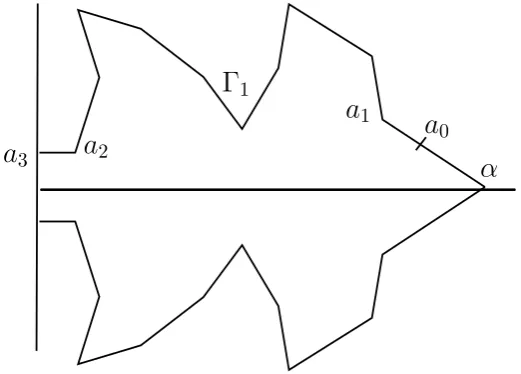
The curve constructed in the proof of Theorem 2.2 may be seen as the upper part of Figure 1.
α
a
0a
1a
2a
3 [image:6.595.176.437.171.358.2]Γ
1Figure 1: The curve constructed in the proof of Theorem 2.5
We shall also require the following easy result.
Lemma 2.3 Let f ∈H(C) with f(0) = 0, f nonconstant. Then there is an
r >0 such that for all u∈C\ {0}, with |u|< r, we have
sup |z|≤ r
|u|
|f(zu)|<sup x≥0
|f(xu)|.
Proof : Choose R >0 such that f(z)̸= 0 for all z with |z|=R. Let δ= inf{|f(z)|:|z|=R}so thatδ >0. Now taker >0 such that sup|z|≤r|f(z)|< δ, using the continuity of f and the fact that f(0) = 0.
Then supx>0|f(xu)| ≥δ for all u ∈ C\ {0}, and the conclusion follows.
2.2
The main result
Recall that if (T(t))t>0 is a uniformly bounded strongly continuous semigroup
with generator A, then
(A+λI)−1 =−
∫ ∞
0
eλtT(t)dt,
for allλ∈Cwith Reλ <0. Here the integral is taken in the sense of Bochner
with respect to the strong operator topology. If, in addition, (T(t))t>0 is quasinilpotent, then
(A+λI)−1 =−
∫ ∞
0
eλtT(t)dt,
for all λ∈C.
Similarly, if µ∈Mc(0,∞) with Laplace transform
F(s) :=Lµ(s) = ∫ ∞
0
e−sξdµ(ξ), (2)
and (T(t))t>0 is a strongly continuous semigroup of bounded operators on X, then we have a functional calculus for its generator A, defined by
F(−A) = ∫ ∞
0
T(ξ)dµ(ξ),
in the sense of the strong operator topology; i.e.,
F(−A)x= ∫ ∞
0
T(ξ)x dµ(ξ), (x∈ X),
which exists as a Bochner integral.
Lemma 2.4 Letµ∈Mc(0,∞)and(T(t))t>0 a strongly continuous
quasinilpo-tent semigroup of contractions. Set F =Lµ. Then we have for Reλ≥0,
(F(−A)−F(λ)I)(A+λI)−1≤
∫ ∞
0
Proof : We have
F(−A)(A+λI)−1 = −
(∫ ∞
0
T(t)dµ(t)
) (∫ ∞
0
eλsT(s)ds
) = − ∫ ∞ 0 e−λt [∫ ∞ 0
eλ(s+t)T(s+t)ds
]
dµ(t)
= − ∫ ∞ 0 e−λt [∫ ∞ t
eλvT(v)dv
]
dµ(t),
where v =s+t. This in turn equals
− ∫ ∞ 0 e−λt [∫ ∞ 0
eλvT(v)dv
]
dµ(t) + ∫ ∞
0
e−λt
[∫ t
0
eλvT(v)dv
]
dµ(t)
= F(λ)(A+λI)−1+ ∫ ∞
0
[∫ t
0
eλ(v−t)T(v)dv
]
dµ(t).
For Reλ ≥0, we have ∫ t 0
eλ(v−t)T(v)dv
≤t,
and so the conclusion follows.
The following theorem applies to several examples studied recently in [1, 3, 4, 6]; these include µ= δ1−δ2, the difference of two Dirac measures,
where F(s) := Lµ(s) = e−s −e−2s and F(−sA) = T(s)− T(2s). More importantly, the theorem applies to many other examples, such as dµ(t) = (χ[1,2]−χ[2,3])(t)dt and µ=δ1−3δ2+δ3+δ4, which are not accessible with
the methods of [1, 3, 4, 6].
Theorem 2.5 Let µ ∈ Mc(0,∞) be a nontrivial real measure such that ∫ ∞
0
dµ(t) = 0, and let(T(t))t>0 be a nontrivial strongly continuous
quasinilpo-tent semigroup of bounded operators on a Banach space X. Set F = Lµ.
Then there is an η >0 such that
∥F(−sA)∥>max
Proof : It follows from Theorem 2.1 that we may assume without loss of generality that (T(t))t>0 is a strongly continuous quasinilpotent semigroup
of contractions. Let α > 0 be such that |F(x)| ≤ |F(α)| for all x ≥ 0, and let s >0. By considering−µinstead of µ, if necessary, we may suppose that
F(α)>0.
By Lemma 2.4 applied to the semigroup (T(st))t>0, for Reλ ≥ 0 we
obtain
F(−sA)(sA+λI)−1≥F(λ)(sA+λI)−1−
∫ ∞
0
t d|µ|(t).
It follows that
∥F(−sA)∥ ≥ |F(λ)| − 1
∥(sA+λI)−1∥
∫ ∞
0
t d|µ|(t)
for s >0 and Reλ ≥0.
Suppose that there exists s ∈ (0,1) such that ∥F(−sA)∥ ≤ F(α), and consider the simple Jordan curve
Γ := [α, a1]∪Γ1∪[a2, a3]∪[a3, a3]∪[a3, a2]∪Γ1∪[a1, α],
where Γ1, a1, a2, a3 are defined as in Theorem 2.2, taking f =F (see Figure
1).
We now make various estimates of∥(sA+λI)−1∥ forλ on three different
parts of Γ.
1) For λ∈[α, a1]∪[a1, α] we have
F(α)≥ ∥F(−sA)∥ ≥ |F(λ)| − 1
∥(sA+λI)−1∥
∫ ∞
0
t d|µ|(t)
≥ F(α) +δ|λ−α|m− 1
∥(sA+λI)−1∥
∫ ∞
0
t d|µ|(t).
Hence we obtain
(sA+λI)−1≤ 1
δ|λ−α|m ∫ ∞
0
2) For λ∈Γ1∪[a2, a3]∪[a3, a2]∪Γ1 we have
F(α)≥ ∥F(−sA)∥ ≥ |F(λ)| − 1
∥(sA+λI)−1∥
∫ ∞
0
t d|µ|(t)
≥ |F(a0)| −
1
∥(sA+λI)−1∥
∫ ∞
0
t d|µ|(t).
It follows that
(sA+λI)−1≤ 1
|F(a0)| −F(α)
∫ ∞
0
t d|µ|(t). (4)
3) For x∈R,
(A+ixI)−1 =
− ∫ ∞ 0
T(t)eixtdt ≤ ∫ ∞ 0
∥T(t)∥dt <∞,
since (T(t))t>0 is quasinilpotent and contractive. Therefore
(sA+λI)−1= 1
s (
A+ λ
sI
)−1
≤ 1 s ∫ ∞ 0
∥T(t)∥dt (5)
for all λ ∈[a3, a3].
We can now provide estimates for the quantity (λ−α)m(A+ λ sI
)−1
for λ on Γ. Let R= maxλ∈Γ|λ−α|.
By (3)
(λ−α) m
(
A+ λ
sI
)−1
≤ s δ ∫ ∞ 0
t d|µ|(t)
for all λ∈[α, a1]∪[a1, α].
By (4)
(λ−α) m
(
A+ λ
sI
)−1
≤
sRm
|F(a0)| −F(α)
∫ ∞
0
t d|µ|(t)
By (5)
(λ−α) m
(
A+λ
sI
)−1
≤R m ∫ ∞ 0
∥T(t)∥dt
for all λ∈[a3, a3].
Since 0< s≤1, for all z ∈Γ∪int Γ we have
(
A+z
sI
)−1
≤ |z−Mα|m,
by the maximum modulus principle, where
M = max (
Rm ∫ ∞
0
∥T(t)∥dt, R
m
|F(a0)| −F(α)
∫ ∞
0
t d|µ|(t),1 δ
∫ ∞
0
t d|µ|(t) )
.
Since by hypothesisF(0) = 0, there is an r∈(0, α) such that
sup |z|≤r
|F(z)|< F(α).
Since D(0, r)∩Γ∩C+=∅, we have D(0, r)∩C+⊂Γ∪int Γ.
Now ifz ∈D(0, r) with Rez > 0, we have|z−α| ≥ α−r, and thus we
have
(
A+ z
sI
)−1
≤
M
|z−α|m ≤
M
(α−r)m. Also
sup
Rez≤0
(A+zI)−1≤
∫ ∞
0
∥T(t)∥dt <∞.
Now, since by Liouville’s theorem the function z 7→ (A+zI)−1 is un-bounded on C, it follows that for all u >0 sufficiently small the inequality
(
A+ z
uI
)−1
≤
M
(α−r)m
fails to hold for some z ∈D(0, r)∩C+, depending on u.
It follows that there is anη >0 such that
If µ∈Mc(0,∞) is now a complex measure, then we write Fe(z) = F(z), which is also an entire function, indeed, the Laplace transform of µ.
Corollary 2.6 Let µ ∈ Mc(0,∞) be a nontrivial complex measure such
that
∫ ∞
0
dµ(t) = 0, and let (T(t))t>0 be a nontrivial strongly continuous
quasinilpotent semigroup of bounded operators on a Banach space X. Set
F =Lµ. Then there is anη >0 such that
∥F(−sA)Fe(−sA)∥>max x≥0 |F(x)|
2 for 0< s≤η.
Proof : The result follows on applying Theorem 2.5 to the real measure
ν :=µ∗µ, whose Laplace transform satisfies
Lν(s) =F(s)Fe(s).
We now give similar results for smoother semigroups: let p > 0 be an integer, and write U(p) for the class of semigroups (T(t))
t>0 such that the
mapping t 7→ T(t) is p times continuous differentiable with respect to the norm topology. Let E(p) denote the class of distributions of order p with
compact support in (0,∞). For ϕ ∈ E(p) its action on a Cp function f may be specified in terms of measures µ0, . . . .µp, namely,
⟨f, ϕ⟩= p ∑
j=0
∫ ∞
0
f(j)(t)dµj(t).
The Laplace transform of ϕ is given by
F(z) :=Lϕ(z) = p ∑
j=0
∫ ∞
0
(−z)je−ztdµ j(t).
We write Gj =Lµj and Fj(z) = (−z)jGj(z) for each j. Likewise
F(−A) = p ∑
j=0
AjG
j(−A) = p ∑
j=0
∫ ∞
0
AjT(t)dµ
j(t). (6)
Lemma 2.7 Let p ≥ 1 and ϕ ∈ E(p), and let (T(t))
t>0 be a quasinilpotent U(p) semigroup of contractions. SetF =Lϕ. Then we have for Reλ≥0,
(F(−A)−F(λ)I)A−p(A+λI)−1 ≤
p ∑
m=0
cm∥Am−p∥ + p ∑
m=0
dm (m−1
∑
k=0
|λ|k∥Am−1−k−p∥ )
,
where
cm = ∫ ∞
0
t d|µm|(t) and dm = ∫ ∞
0
d|µm|(t)
for m = 0,1, . . . , p.
Proof : Write B := (F(−A)−F(λ)I)A−p(A+λI)−1. Then by (6) we
have
B = p ∑
m=0
A−p(AmG
m(−A)−(−λ)mGm(λ)I)(A+λI)−1.
This can be rewritten as
p ∑
m=0
Am−p(Gm(−A)−Gm(λ))(A+λI)−1
+ p ∑
m=0
Gm(λ)A−p(Am−(−λ)mI)(A+λI)−1.
Thus
B = p ∑
m=0
Am−p(Gm(−A)−Gm(λ))(A+λI)−1
+ p ∑
m=0
Gm(λ) [m−1
∑
k=0
Am−1−k(−λ)k ]
A−p.
Theorem 2.8 Let p >1 and ϕ∈ E(p) be a nontrivial real distribution given
by measures µ0, . . . , µp such that ∫∞
0 dµ0(t) = 0, and let (T(t))t>0 be a
non-trivial quasinilpotent U(p) semigroup of bounded operators on a Banach space X. Set F =Lϕ. Then there is an η >0 such that
∥F(−sA)∥>max
x≥0 |F(x)| for 0< s≤η.
Proof : The proof is very similar to the proof of Theorem 2.5, but using Lemma 2.7, so we indicate the changes necessary. It will be convenient to take 0< s≤1 and to write
K =K(s, λ) = p ∑
m=0
cm∥(sA)m−p∥+ p ∑
m=0
dm (m−1
∑
k=0
|λ|k∥(sA)m−1−k−p∥ )
,
noting the dependence on s and λ. With the notation of the proof of Theo-rem 2.5 we have three key estimates:
1) For λ∈[α, a1]∪[a1, α] we have
F(α)≥ ∥F(−sA)∥ ≥ |F(λ)| − K
∥(sA+λI)−1(sA)−p∥
≥ F(α) +δ|λ−α|m− K
∥(sA+λI)−1(sA)−p∥. Hence we obtain
(sA+λI)−1(sA)−p≤ K
δ|λ−α|m. (7) 2) For λ∈Γ1∪[a2, a3]∪[a3, a2]∪Γ1 we have
F(α)≥ ∥F(−sA)∥ ≥ |F(λ)| − K
∥(sA+λI)−1(sA)−p∥
≥ |F(a0)| −
K
∥(sA+λI)−1(sA)−p∥.
It follows that
(sA+λI)−1(sA)−p≤ K |F(a0)| −F(α)
3) For x∈R,
(A+ixI)−1A−p = − ∫ ∞ 0
T(t)eixtdtA−p
≤ ∥A−1∥p ∫ ∞
0
∥T(t)∥dt <∞,
since (T(t))t>0 is quasinilpotent and contractive. Therefore
(sA+λI)−1(sA)−p≤ 1
sp+1∥A
−1∥p ∫ ∞
0
∥T(t)∥dt (9)
for all λ ∈[a3, a3].
We estimate(λ−α)m(A+λ sI
)−1
A−p
forλ on Γ. LetR = maxλ∈Γ|λ−α|. By (7)
(λ−α) m
(
A+ λ
sI
)−1
A−p ≤
Ksp+1
δ
for all λ∈[α, a1]∪[a1, α].
By (8)
(λ−α) m
(
A+λ
sI
)−1
A−p ≤
Ksp+1Rm
|F(a0)| −F(α)
for all λ ∈Γ1∪[a2, a3]∪[a3, a2]∪Γ1.
By (9)
(λ−α) m
(
A+ λ
sI
)−1
A−p ≤R
m∥A−1∥p ∫ ∞
0
∥T(t)∥dt
for all λ ∈[a3, a3].
Since 0< s≤1, for all z ∈Γ∪int Γ with|z| ≤r we have
(
A+z
sI
)−1
A−p ≤ M
|z−α|m ≤
M
by the maximum modulus principle, where
M = sup
0<s≤1
z∈Γ∪int Γ
max (
K(s, z)sp+1
δ ,
K(s, z)sp+1Rm
|F(a0)| −F(α)
, Rm∥A−1∥p ∫ ∞
0
∥T(t)∥dt
)
,
which is finite.
With this new choice of M, the proof is now concluded as for the proof of Theorem 2.5, using the observation that ∥(A+zI)−1A−p∥ is unbounded on C, and obtaining a contradiction from (10).
3
The non-quasinilpotent case
Let (T(t))t>0 be a semigroup of non-quasinilpotent operators, and let AT denote the closed (commutative) algebra generated by the semigroup. We write AbT for the maximal ideal space of AT. Recall that this is compact if and only if AT/Rad(AT) is unital; otherwise it is locally compact, and the function ba:χ7→χ(a) is continuous on AbT for every a∈ AT.
Recall that AT is said to have an exhaustive sequence of idempotents (Pn)n≥1 ifPn2 =PnPn+1 =Pn for alln and for everyχ∈AbT there is apsuch that χ(Pn) = 1 for all n ≥p.
The following result is part of the folklore of the subject, and it is partly contained in [4, Lem. 3.1] and [1, Lem. 3.1]. It enables us to regard A itself as an element of C(AbT) by defining an appropriate value χ(A) = −aχ for each χ∈AbT.
Lemma 3.1 For a strongly continuous and eventually norm-continuous semi-group (T(t))t>0 and a nontrivial character χ∈AbT there is a unique aχ ∈C
such that χ(T(t)) = e−taχ for all t > 0. Moreover, the mapping χ 7→ a
χ is
continuous, and χ(F(−uA)) =F(uaχ) in the case that F =Lµ, as in (2).
Proof : The existence ofaχis given in [4], and its uniqueness is clear since the values of e−taχ for t >0 determine a
For the continuity, note that
χ(T(1)) =e−aχ
and
χ
(
eλ ∫ ∞
1
T(t)e−λtdt
)
= 1
aχ+λ
e−aχ
if λ is taken sufficiently large that the integral converges. Thus if we have a net χα → χ then e−aχα → e−aχ and a 1
χα+λe
−aχα → 1
aχ+λe
−aχ, which easily
implies that aχα →aχ.
The final observation follows from an easy argument using Bochner inte-grals.
The following result will also be required.
Lemma 3.2 Let (T(t))t>0 be a non-quasinilpotent and eventually
norm-con-tinuous semigroup in a Banach algebra, with infinitesimal generator A; let
AT be the subalgebra generated by the semigroup and Λ ={aχ:χ∈AbT}, as
in Lemma 3.1. Then the following conditions are equivalent:
(i) AT has an exhaustive sequence of idempotents.
(ii) For each integer m ≥1 the set Λm :={λ∈Λ : Reλ ≤m} is contained
in a compact relatively open subset of Λ.
Proof : (i) ⇒ (ii) : Let θ : χ → aχ be the homeomorphism given by Lemma 3.1. Now K := θ−1(Λ
m) is a closed subset of the compact space b
AT ∪ {0}, since Reaχ ≤ m if and only if |χ(T(1))| ≥ e−m. Hence K is compact. If (i) holds, then for each χ∈AbT, then there is an nχ >0 be such that χ(Pn) = 1 forn ≥nχ. So
(
{χ∈AbT :χ(Pn) = 1} )
n is an open cover of
K. By compactness, there is an N such that χ(PN) = 1 for all χ ∈ K, so
(ii) ⇒ (i) : Conversely, if (ii) holds, then for each m ≥ 1, the set Λm is contained in a compact relatively open set Ωm ⊂ Λ. So θ−1(Ωm) ⊂ AT is compact and open; hence by Shilov’s idempotent theorem [2, Thm. 2.4.33] there is an idempotent Pm in AT such that χ(Pm) = 1 for χ∈θ−1(Ωm) and 0 otherwise. Now (Pm)m≥1 is an exhaustive sequence of idempotents in AT.
Theorem 3.3 Let (T(t))t>0 be a nontrivial strongly continuous and
even-tually norm-continuous non-quasinilpotent semigroup on a Banach space X,
with generator A. Let F = Lµ, where µ∈ Mc(0,∞) is a real measure such
that ∫0∞dµ= 0. If there exists (uk)k⊂(0,∞) with uk→0 such that
ρ(F(−ukA))<sup x>0
|F(x)|, (11)
then the algebra AT possesses an exhaustive sequence of idempotents(Pn)n≥1
such that each semigroup (PnT(t))t>0 has a bounded generator.
If, further,∥F(−ukA)∥<supx>0|F(x)|, then
∪
n≥1PnAT is dense inAT.
Proof : For m ≥1 let Λm ={aχ : Reaχ ≤m}, where χ(T(t)) =e−aχt as in Lemma 3.1.
LetK :=θ−1(Λ
m), which is a compact set, as seen in the proof of Lemma
3.2. Hence, Λm =θ(K) is compact, sinceθ:χ7→aχ is continuous by Lemma 3.1.
Therefore, there is an Rm >0 such that Λm ⊂D(0, Rm). Note that, by the definition of Λm, we have
Λ∩C−= Λ∩C−⊂D(0, Rm).
By hypothesis there exists a uk >0 such that
|uk|<
r Rm
,
where r >0 is given by Lemma 2.3 and
ρ(F(−ukA))<sup x>0
It follows that Λm ⊂D(0, Rm)⊂D(0, r/|uk|) and
|F(ukaχ)|<sup x>0
|F(ukx)|
for all aχ∈Λm. Let αk be such that supx>0|F(xuk)|=|F(αkuk)|.
By Theorem 2.2 there exists a curve Γk,0 in {z : Rez ≥ 0,Imz > 0}
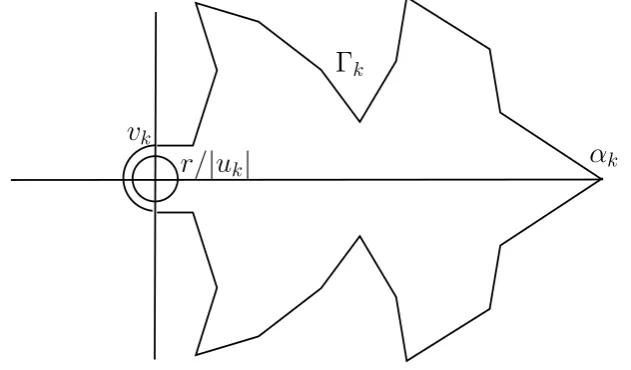
joining αk ∈R+ tovk ∈iR+ with |vk|> Rm on which |F(ukz)| ≥ |F(αkuk)|. Let Γk = Γk,0∪ {z ∈C: Rez <0, |z|=|vk|} ∪Γk,0 (see Figure 2).
α
kΓ
kv
k [image:19.595.152.468.274.459.2]r/
|
u
k|
Figure 2: Diagram for the proof of Theorem 3.3
Then Λ∩Γk =∅since|F(ukaχ)|=|χ(F(−ukA))|<|F(ukαk)|foraχ ∈Λ and |F(ukz)| > |F(ukαk)| for z ∈ Γk,0 ∪Γk,0, so Λ∩(Γk,0 ∪Γk,0) = ∅. Also
Λ∩C− = Λm∩C− so Λ∩ {z ∈C−:|z|=|vk|}=∅.
Now Λm = Λ∩int Γk, which is compact (since Λ∩Γk =∅) and relatively open in Λ, so we may now apply Lemma 3.2 to deduce that AT has an ex-haustive sequence of idempotents.
inPAT for some, and hence for all,t >0, and then limt→0+∥P−P T(t)∥= 0,
since the semigroup is eventually continuous.
For the last observation, it follows from Theorem 2.5 that π(T(t)) = 0 for every t > 0, where π : AT → AT/∪n≥1PnAT denotes the canonical surjection.
Remark 3.4 A similar result holds for complex measures µ ∈ Mc(0,∞);
namely, we replace
ρ(F(−ukA))<sup x>0
|F(x)|,
by the symmetrised version
ρ(F(−ukA)Fe(−ukA))<sup x>0
|F(x)|2,
as in Corollary 2.6.
Remark 3.5 The following example is given in [1], and shows that Theo-rem 3.3 is sharp. Indeed, consider C0[0,1], the Banach algebra of all
con-tinuous complex-valued functions on [0,1] that vanish at0, equipped with the supremum norm, and the semigroup(S(t))t>0defined byx7→xtforx∈[0,1].
We see that
F(−uA) = ∫ ∞
0
S(uξ)dµ(ξ) = ∫ ∞
0
xuξdµ(ξ),
and for s >0 we have
F(s) = ∫ ∞
0
e−sξdµ(ξ).
Thus we obtain equality in (11), choosing xu = e−s0
, where s0 is defined by |F(s0)|= sups>0|F(s)|. Note that the norm and spectral radius are equal in
Acknowledgements
This work was partially supported by the ANR project ANR-09-BLAN-0058-01, the London Mathematical Society (Scheme 2), and the Institut Camille Jordan. The authors are grateful to the referee for a careful reading of the paper and some valuable comments.
References
[1] Z. Bendaoud, I. Chalendar, J. Esterle, and J. R. Partington. Distances between elements of a semigroup and estimates for derivatives. Acta Math. Sin. (Engl. Ser.), 26(12):2239–2254, 2010.
[2] H. G. Dales. Banach algebras and automatic continuity, volume 24 of
London Mathematical Society Monographs. New Series. The Clarendon
Press Oxford University Press, New York, 2000. Oxford Science Publica-tions.
[3] J. Esterle. Distance near the origin between elements of a strongly con-tinuous semigroup. Ark. Mat., 43(2):365–382, 2005.
[4] J. Esterle and A. Mokhtari. Distance entre ´el´ements d’un semi-groupe dans une alg`ebre de Banach. J. Funct. Anal., 195(1):167–189, 2002.
[5] W. Feller. On the generation of unbounded semi-groups of bounded linear operators. Ann. of Math. (2), 58:166–174, 1953.
[6] N. Kalton, S. Montgomery-Smith, K. Oleszkiewicz, and Y. Tomilov. Power-bounded operators and related norm estimates. J. London Math. Soc. (2), 70(2):463–478, 2004.
[7] E. H. Lieb and M. Loss. Analysis, volume 14 of Graduate Studies in