5-59
Trends in Computers:
Automatic Control and Data Processing
Published by the
PROCEEDINGS of the
Western Computer Conference
Los Angeles, Calif.
February
11and
12, 1954Sponsored Jointly
By:
American Institute of
Electrical Engineers
Institute of Radio Engineers
Association for Computing
Machinery
APRIL
1954•
AMERICAN INSTITUTE OF ELECTRICAL ENGINEERS
33 West 39th Street, New York
18,N. Y.
NATIONAL JOINT COMPUTER CONFERENCE COMMITTEE
A. I. E. E.
I. R. E.
A. C. M.Representing AlEE
S. H. Dodd • • • • • • • • • • • • Massachusetts Institute of Technology G. G. Hoberg, Research Activity •• • • Burroughs Adding Machine Company G. D. McCann, Jr. • • • • • • • • • • California Institute of Technology J. C. McPherson • • • • • • International Business Machines Corporation
M. M. Astrahan • • •
.
w.
L. Martin· ·
• J. D. Noe.
•·
J. R. Weiner, ChainnanF. L. Alt.
.
·
•·
.
• E.o.
AndrewsD. H. Lehmer • •
·
L. N. Ridenour •·
·
·
• •
• •
·
Representing IRE
• • • • • IBM Engineering Laboratory • • • • Telecomputing Corporation Stanford Research Institute
· . ·
.
.
Eckert-Mauchly Computer Corporation Representing ACM•
.
•·
•·
. ·
• National Bureau of Standards· ·
·
· .
·
• Bell Telephone Laboratories • •· ·
• University of California at Berkeley·
·
·
.International Telemeter Corporation Ex-Officio RepresentativesF. J. Maginniss, AlEE • • • • • • • • • • • • • General Electric CompaQY J. H. Howard, IRE • • • • •• Burroughs Research Laboratory
s.
B. Williams, ACM • • • • • • • • • • • • • • • • • • • • • Consultant Headquarters Representatives2
WESTERN CCMPUTER CONFERENCE
Steering Committee Conference Manager
Ragnar Thorensen • • • • • • • • • • • • • Magnavox Research Laboratories Joint Computer C~~ittee Members
Representing A.I.E.E.
G. D. McCann • • • • • • • • • • • • • California Institute of Technology Representing I.R.E •
William L. Martin • • •
·
. . .
.
.
.
.
JerreD.
Noe • • • • •.
.
.
.
.
.
.
.
.
• Telecomputing Corporation Stanford Research Institute
Derrick
H.
LehmerLouis N. Ridenour
·
· .
.
.
.
Representing A.C.M.
• • • • University of California at Berkeley • • • • • • International Telemeter Corporation
Local Representatives Los Angeles
H.
Harold Sarkissian • • • • • • • • • • • computer Research CorporationJohn W. Haanstra • •
San Francisco
.
.
.
.
International Business Machines Corporation Local Arrangements CommitteeExhibits William R. Arsenault, Chainnan
Norman F. Foretz, Manager • • •
•• - •• Magnavox Research Laboratories • • • • • • Magnavox Research Laboratories Hotel Arrangements
Robert Woodring, Chainnan • • • • • • • • • • Telecomputing Corporation Publications
Sibyl M. Rock, Chairman • • • •• Consolidated Engineering Corporation Publicity
Herbert Weightman, Chairman • • • • • • • Bill Waddell • • • • • • • • • • • • • •
• Weightman and Associates • • • • • • Librascope, Inc. Registration
Raymond Davis, Chairman • • • • • • • • • • • • • • • • Librascope, Inc.
Lawrence W. Baldwin
Treasurer
.
.
.
.
.
• • • International Telemeter Corporation Technical Program CommitteeChairman
Sidney S. Green
.
.
. .
.
International Telemeter Corporation Session ChairmenHarry E. Burke, Jr. • • • • • • • • Consolidated Engineering Corporation Richard G. Canning • • • • • University of California at Los Angeles John M. Salzer • • • • • • • Hughes Research and Development Laboratories Roger L. Sisson • • • • • • • • • • • .Computer Research Corporation
In Charge of Discussion Groups
L i s t o f E x h i b i t o r s
AUDIO PRODUCTS CORPORATION
·
. .
.
· .
. .
.
.
.
Los Angeles, CaliforniaBECKMAN INSTRUMENTS INC.
Berkeley Scientific Division
·
.
. . .
.
• Richmond, CaliforniaBOEING AIRPLANE COMPANY
Industrial Products Division • • • • • • • • Seattle, Washington
BURROUGHS CORPORATION
Electronic Instruments Division • • • • • • Philadelphia, Pennsylvania
·
. .
.
• .San Gabriel, CaliforniaCLARY MULTIPLIER CORPORATION.
COMPUTER RESEARCH CORPORATION
OF CALIFORNIA • • • • • • • '.
·
.
. .
.
.Hawthorne, CaliforniaCONSOLIDATED ENGINEERING CORPORATION and
ElectroDATA CORPORATION • • • • • • • • • • • • Pasadena, California
ELECTRO-PULSE, INC. • •
· · ·
•·
•·
ELECTRONIC ASSOCIATES, INC.
·
•·
· ·
ELECTRONIC ENGINEERING C<l1PANY
OF CALIFORNIA
.
'.
. · .
·
• • •·
·
•FRIDEN CALCULATING MACHINE AGENCY • •
G. M. GIANNINI & COMPANY, INC.
HUGHES AIRCRAFT COMPANY • • •
·
.
·
.
.
.
· · · ·
·
Culver City, California·
• • Long Branch, New Jersey·
·
•·
• Los Angeles, California • • • •·
Los Angeles, California• • • • • • • Pasadena, California
·
.
.
.
• • Cul ver City, CaliforniaINTERNATIONAL BUSINESS MACHINES CORPORATION • • • • • New York, New York
LIBRASC
OPE ,
INC • • • • • • • • • • • •·
.
.
• • • • Glendale, CaliforniaLOGISTICS RESEARCH, INC • • • • • • • •
· .
.
.
Redondo Beach, CaliforniaNON-LINEARSYS·TEMS • -~ •
· .
.
.
.
·
.
.
• • • • • DelMar,
California P.C .A. ELECTRONICS, INC.·
. ·
.
·
.
.
• • •·
.
Santa Moniea, CaliforniaJ.
B.
REA
COMPANY, INC. • • • • • • • • • • • • Santa Monica, CaliforniaImlINGTON RAND INC. • • • • •
• • • • New
York, New YorkRUTHERFORD ELECTRONICS COMPANY •
•
• •· .
.
.
.
Culver City, CaliforniaTELECCl1PUTING CORPORATION • •
·
.
. .
.
• • .Burbank, California4.
Foreword
The Western Computer Conference and Exhibit, sponsored joint-ly by AlEE, IRE, and ACl'l, was held at the Ambassador Hotel in Los Angeles, February 11 and 12, 1954. This was the second Western meeting initiated by the Joint Computer Conference Committee. The
theme of the Conference was "Trends in Computers: Automatic Con-trol and Data Processing.1t
The three phases of the Conference -- exhibits, scheduled pa-pers, and informal discussion groups -- were all well attended by the more than 1,000 registrants. A number of unregistered visi-tors also toured the exhibits. Twenty-three booths displayed ma-jor equipment, all relating to the theme. Two teclmical sessions ran in parallel each afternoon of the conference, and the twenty papers presented covered a variety of equipment and systems useful in scientific, engineering, and business fields. The full text of these papers is presented in this Proceedings. The discussions which followed the presentations, however, are not. The decision to omit summaries of discussions and questions was based on two considerations: first, editing and compiling a sufficiently accu-rate and detailed report of a discussion to be of real value to the reader almost invariably delays seriously the publication of the Proceedings; second, representatives of a number of companies indicated that they could participate more freely if no transcrip-tion were made. For the same reasons, the five Discussion Grqup sessions were not recorded, nor were summaries written. A note listing topics and names of panel members, and describing the general organization of the groups is included on the following page, however, because of the enthusiastic reception accorded these sessions.
The registration fee entitles each registrant to one copy of the Proceedings. Additional copies may be obtained from any of the sponsoring societies:
American Institute of Electrical Engineers 33 West 39th Street New York, New York
Dis c u s s i o n G r 0 ups
Five Discussion Groups met at the same time on the morning of February 12 to consider the following topics:
1.
Unit
Control in Retail OperationsChainnan - RICHARD G. CANNING •• University of California at Los Angeles OLIVER w~ITBY • • • • • • • • • • • • • • Stanford Research Institute RAYNOND DAVIS • • • • • • • • • • • • • • Librascope, Inc.
HARRY D. HUSKEY • • • • • • • Institute for N1.nTlerical Analysis, NBS
I\lIYliON J. MENDELSON • • • • • • • • • Computer Research Corporation 2. Numerical Control of Petroleum and Chewical Processes
Chainnan - SIBYL M. ROCK • • •
WILLI»l CAR¥lACK • • • • • • • • HARRY BROUGH • • • • • • • • •
HENRY NOEBELS • • • • • • •
• •
• •
Consolidated Engineering Corporation • Fluor Corporation, Ltd.
. .
.
• • .Shell Chemical Company·
.
.
.
.
• .Beckman Instruments Inc.3.
Numerical Control of Machine Tools Chainnan - J. O. McDONOUGHJOHN L. BOWER • • • • • •
• • • • Massachusetts Institute of Teclmology R. LOw'ELL HAND • • • • • • •
C. H. STEVENSON • • • • • •
• • • • • • North American Aviation, Inc. •• Lockheed Aircraft Corporation • • • • • • • • .Douglas Aircraft Company
4.
Maintenance Requirements for Business Computers5.
Chairman - FRANK C. CARLIN •• • • • • • • Lockheed Aircraft Corporation ROGER
L.
SISSON • • • • • • • • • • • • • • Computer Research Corporation HONTGOHERY PHISTER •• • • .Hughes Research and Development Laboratories PAULJ.
ASHENFELTER • • • • • • • • • • • • • • • • • Remington Rand Inc. Mathematical Methods in Management ProgrammingChairman - HARRY MARKOw"ITZ • • • • i"IICHAEL CREAl,lER • •
.
.
• • •.
.
.
.
.
.
Rand Corporation
• • • • Lockheed Aircraft CO~·!Joration
• • • • .Rand Corporation • .General Electric Company
ALAN S. HANNE • • • • •
H. R.
J.
GROSCH • • •HERBERT F. MITCHELL • • •
.
.
.
• Remington Rand Inc.The Discussion Groups were organized in a somewhat unorthodox fashion, with emphasis on participation by the audience rather than on presentation of prepared material or discussion among panel members.
The first step toward this objective was to eliminate any reporting of what was said. Those who were not prepared to speak for publication but were free to express their ideas informally were thus able to contribute. The sec-ond step was to allot only a small part of the time - in some cases about an
6
PROCEEDINGS OF THE WESTERN COMPUTER CONFEFENCE Tab 1 e 0 f Con ten t s
Welcoming Address. • • • • • • ••• • • • • • • • • • • • • • • • • •
D. H.
LehmerKeynote and Luncheon Addresses
Will Electronic Principles Make Possible a Business Revolution • • •
W. W.
McDowell Trends in Electronic Business Data Systems Development. • • • • Dean E. 'VooldridgeSESSION I Automatic Control Systems
An Experimental Digital Flight Control System • Maier Nargolis and Eric Weiss The DIGITAC Airborne Control System • • • • • • • • • D. W. Burbeck,
E. E.
Bolles,'\JT. E. Frady, and E. M. Grabbe Application of Operational Digital Techniques
to
Industrial Control • • • • • • •Bernard M •. Gordon
A
Digital-Analog Machine Tool Control System • • • • • • • • • • • Har~w.
Mergler Experiments With a Digital Computer in a Simple Control System. • • • • • • • • •T.J. Burns, J.D. Cloud, and J.M. Salzer
SESSION II Data Processing Systems
The Automatic Handling of Business Data • • • • • • • • • • • • • • .Oliver Whitby Business Data Processing: A Case study
Introduction • • • • • • • • • • • • • • • • • • • • • • • Richard G. Canning Ready-to-'Wear Unit Control Procedure •
.
.
.
.
• • . • S.J.
ShafferT"'t _ _ _ _ _ ...l "T"\_ • • .!!_
· t
·
.
Uni t Contr-ol Systt:U1S Engineering • • •
A Solution for Automatic Unit Control. The System in Operation. • • • • • • •
• • • • • • • • • • • • nJ3.3lllUllU J..)o. v ~i:) • •
• • • • • • • • • • • .Harr,y D. Huskey • • • • • • • • • • MYTon J. Mendelson
SESSION III Automatic Control Equipment
Approaches to Design Problems in Conversion Equipment • • • •• A. K. Susskind Mul ti-Channel Analog-Digital Conversion System for D-C Voltages • • W. S. Shockency A High-Speed Multichannel Analog-Digital Converter. • • • • • • .James M. Mitchell A Shaft-to-Digital Encoder • • • • • • • B. M. Gordon, M. A. Meyer, and R.N. Nicola Real-Time Digital Differential Analyzer (nDARTn) • • • • • • • • • Loren P. Meissner
SESSION IV Data Processing Equipment The IBM Magnetic Drum Calculator T-ype 650 - Engineering and Design
Considerations • • • • • • • • • • •• • • • • • • • • • • .E. S. Hughes, Jr. Design Features of Remington Rand Speed Tally • • • • • • • • • John L. Hill Production Control With the Elecom 125 • • • • • • • • • • • Norman Grieser A Centralized Data Processing System. • • • • • • • • • • • • • • Jerome J. Dover A Merchandise Control System • • • •• • • • • • • • • • • • • .William L. Martin
·
.
·
.
·
.
• •
• •
WELCOMING ADDRESS
D. H. Lehmer
University of California Berkeley, California
I have been asked to .extend a word of welcome to all participants in this, the fourth West Coast Conference devoted solely to electronic computers. It is
my pleasant task also to congratulate those who have worked so hard to make this conference possible.
As you know, this two-day meeting is sponsored by three national organiza-tions, the AlEE, IRE, and A(]1 via the Joint Computer Conference Committee. This is the second such conference undertaken by this committee to be held in the West. The previous conference, held a year ago in Los Angeles, was so success-ful in every way that the Steering Committee ran very little risk in sponsoring a similar program.
The main objective of such a conference is the dissemination of informa-tion and this general objective is approached from three direcinforma-tions. First of all, we have the papers being presented, which have not only the audio output of today and tomorrow but also the printed .output in the form of the Proceedings of this conference. Those of you who have seen the Proceedings of the computer conference a year ago know what an absorbing and interesting volume it is. Secondly, we have tomorrow morning five different discussion groups meeting. These bring to light certain facts and principles that are not included in the
regular papers and give a chance for the interplay of conflicting ideas in the indeterminate middle ground of machine development. Lastly, we have the exhibits, in which the more tangible aspects of computing are displayed. All three ap-proaches are intended to allow the designer and the user of computing equiI!Jlent each to present his own point of view and to learn something from .his fellow conferee.
The topic of this conference, Trends in Computers: Automatic Control and Data Process:i.Ilg, reflects the fact that the computer art has progressed a great deal in the past few years. The topic a few years ago would have been just "com-puters." Our next speaker, Mr. McDowell, is going to set the stage for the con-ference in his keynote address and I will not discuss the topic more than just
to say that it brings to this conference not just the old guard in the computer
fieler but--a;-large nmfberof new~omerg,,-wose -1ntere-stts--stim-mat-ed. b-y the-new-applications that are being made of modern cOOlputers. It is perhaps not un-important to say in welcome to these newcomers a few words as a sort of back-drop to the stage setting. I realize that the term "old guardtt is often used
today in a derogator.y way but nevertheless I will run the risk of such an identification in presenting one or two ideas based on living the history of computing machines of the past decade.
If there is one thing that we can learn from the history of the past ten years it is that progress was made chiefly by the interchange of ideas. Those projects which stubbornly stuck to their original concepts prospered less than those whose ideas came from several sources. The veri table exponential growth of computing is due to the lessons learned from the pioneering projects. I
8
the critical years. This fact was due largely to the economic situation. Until
recently, the driving force in the computer field has been the U. S. Government.
Much of the know-how we possess today in the computer field first appeared in
government reports, which were made freely available in almost all cases. This
enlightened policy (which is also being implemented by today's conference) is now in some danger. Wi th the gradual withdrawal of government support and at the
same time the acquisition of new fields such as those discussed in this
confer-ence there arises the very real danger that channels of information will be closed for reasons of ftcorporate security". Even in the present conference there has been some of this trouble forced upon the Program Committee. I feel that the restriction of information will have a levelling off effect upon what has in the past been an exponential curve. This problem is at least as serious as that of the smooth transition from the governmental support· and pump-priming (to use a very old phrase now coming back) to full-blown commercial and indus-trial exploitation.
A third problem is one of which those of us who are engineers rather than mathematicians are perhaps not cognizant. In the past decade the mathematician has played a peculiar role in machine development. His interest in sol ring
physical problems has been the driving force to the design and construction of
many a machine or even machine component. The new look in the direction of data
processing is not an inviting one to the well-trained mathematician.
With no offense meant, there is a world of difference between a C.P.A. and
a Ph.D. in Mathematics. There are some interesting mathematical problems in
the fields of operations analysis and programming but these are not very wide fields as mathematical fields go. And so it seems to me that" with the elimina-tion of mathematical interest in the wider extension of the computer we again run the risk of levelling off from another angle.
With these perhaps too somber backdrops I leave the more essential stage set ting to our next speaker.
Again in behalf of the Joint Computer Conference Committee my best thanks
WILL ELECTRONIC PRINCIPLES
MAKE POSSIBLE A BUSINESS REVOLUTION
w.
W. McDowellDirector of Engineering
International Business Machines Corporation
I am very appreciative of the opportunity which your committee has af-forded to me to speak to this great audience of scientists, engineers and bus-iness people attending the 1954 Western Computer Conference. You gentlemen have accomplished much in a relatively short time. You will accomplish even more in the future.
Your work is one with which I am obviously closely associated. It is one that is very dear to my heart. I am a firm believer in the fact - as Dr. Huntoon
said last year, "You ain't seen nothing yet" in the field of automatic and semi-automatic machine s for the control of factory and office.
Your committee deserves great commendation for the program. which they have arranged for this conference - Automatic Control and Data Processing. To the lay per son I suspect the se are though~ of as two distinct subjects, which for the most part must be dealt with separately. To most people, automatic control implie s something that deals with engineering or manufacturing problems, while the other deals primarily with accounting and statistical information - the prob-lems which are present in an office. To date, I suppose that in a very broad
sense this is true, but I wonder if they are not much more closely allied than many of us might realize.
You are all, of course, well aware that an automatic control system may
which will be presented today on flight control systems will point out this need. On the other hand, so-called data processing systems often result in some form of automatic control. ·We will later hear a paper from Dr. Oliver Whitby, which
will descriiles-om.€fof tne deVice-a whicnare- required-in
ordertomaK:edata-proc-essing systems more automatic from the standpoint of the control of a business.
We will hear more at this conference about automatic control of machine tools. In the developments which have been accomplished to date, with which I am. familiar, the automatic control applie s to the cutting element on the machine
tool. An operator must change the tool when it becomes dull. I am in no sense
belittling the development in this area, but merely pointing out that the automatic part of it extends only to a certain point.
Is this example of the machine tool so much different - from the standpoint
of automation - than a data processing system, w~ich is programmed to perform
a complex production control problem? In this instance the machine
10
to state, I believe, that the machine has performed a very difficult automatic control problem.
In other words, I am thoroughly convinced that automatic control and data processing really go ha.."ld in hand, that you ordinarily do not have one without the other, that in developing an effective system they both playa very important and essential part. The two have now become so entwined that in the future it will be difficult to logically separate them.
It is for these reasons that I feel the agenda for this conference is so appro-priate.
As I stated earlier, tremendous strides have been made in the application of computers and electronic equipment to industry and business. Time will not permit mentioning of all of the papers which will be given at this conference, but the fact that you are able to talk with authority about so many control and data proce s sing systems as applied to busine s s and industry is in itself proof of the
strides which have been made. There will be much more done as time goes on. Each year business machines will become more and more complete and perform in a more efficient manner.
In general, and for probably obvious reasons, the machines which have been developed to date have proceeded on the basis of adapting electronic prin-ciples to form a new machine concept which tries to duplicate the results now being obtained. Thus, when a study is made to see what an electronic business machine may do in the way of providing improved efficiencies the only basis on which a study can be made, either on the part of management of the business, or on the part of an engineer, is on the data and concepts currently available and the procedures currently followed.
In most instances, business management is able to present a very clear cut and convincing picture of exactly what functions and results are required. Their Methods people, as a result of studying procedures for many years, are well ac-quainted, based on their concept of the needs of business, with exactly what a new machine should do. Many of the rules and procedures were evolved as a result of an extremely detailed and careful analysis of the basic problem, but many many others were formed by traditio:q, on what apparently had happened in the past, or on opinion as to the essentials for a particular business.
This situation is, I think, bound to be present in any large, well-established organization. I am not suggesting this in any critical manner, but as an inevitable product of growth in any busine s s.. I am. certain that it exists in IBM.
This approach to the application of electronic principle s to busine s s problems has produced and will continue to produce astounding results.
And yet, because of the versatility of electronics it is not obvious why such should be the case. Why are so many of the complex business problems apparently incapable of being effectively solved by the electronic business ma ... chine?
I think that one of the principal reasons may be that we are trying to ask a scientific machine to solve a non- scientific problem. We are trying to ask the machine to operate under a set of rules which, in many instances, are not consistent with its logical nature. We are saying that these are the rules of business, now you make the machine - adhere to them.
In contrast to this, one cannot help but wonder, however, how much more might be accomplished were it possible to find some means of scientifically
studying and analyzing busines s needs on the saIIle scientific basis as the IIla-chines and the components within the maIIla-chines have been studied and developed. It is obviously a very complex subject, particularly since all businesses deal with customer s of one type or another, and customer s cannot be patterned as can machine tools. On the other hand, there is just beginning to be a feeling within industry that business procedures can be dealt with in a far more
sci-entific manner than has been done in the past.
You are all familiar with the developments which have taken place, for instance, in oil refining, or in automotive production. Both of these opera-tions evolved around a new scientific concept for getting results. They were far reaching and play an important part in our economy today.
Very little of this sort of thing has been done on the office side of busi-ness, probably because management has been unable to visualize a plan which would justify the investment costso Also, business problems are undoubtedly far more involved than those of the automotive production line.
Yet, as businesses grow larger, the problem of handling office routines and management controls is becoming more and more difficult. More and more clerical people are added each year, and as they increase in numbers, the prob-lems of communication, organization and control increase geometrically. The m.nre .peop1e-w-huar.e--adde~-them.oJ.'"ecom.plexInu..st-he -the cnn:b."-ols-1o---Con1rol them.
I wonder if the time has not come when it is essential that some means be found to incorporate into a business the same type of radical and bold new approach which was demonstrated in the automobile production line, or in the oil refinery. I have a very strong feeling that something of this sort can be done, and further, that when a plan is evolved, the electronic principles which you have or know about will make it possible to develop the machines which will really fit the plan. I do not feel, however, that this can be done by the development engineers and scientists alone.
of business to look at its problem.s and way of doing business in the sam.e sci-entific m.anner as that used by the m.en developing the m.achines.
What I am. really trying to suggest is that a new kind of partnership is needed -- a partnership between the developm.ent engineer and the business engineer. Perhaps the latter should be thought of as a business research en-gineer, a m.an who has the ability to analyze in a scientific m.anner the pro-cedures and inter-relationships which are essential in order to conduct a successful business.
This thought is not new, but I wonder if we are giving it the proper em.-phasis. It is certainly som.ewhat akin to "operations research" which we are beginning to hear about. I think it is also akin to the thought which Dr. Hobson presented to this conference last year when he said, and I quote:
"It is a curious fact that, while trem.endous advances have been m.ade within industry to increase the efficiency of op-erations in the m.ajor functional areas - production, re-search, m.arketing, etc., - equivalent advances have not been made in the techniques for handling the routine facts of business operations. The volum.e of factual data m.ounts -the need for factual analysis grow s greater - -the demand for precisions continues unabated. But, by and large, m.anage-ment had had to m.eet the problem. with the same IIlechanical aids used by a growing arIIlY of adm.inistrative and clerical eIIlployees. The 'clerical problem.' is becom.ing a m.atter of great concern in industry. This situation gives a sense of urgency to the widening applications of high- speed electronic equipm.ent on industry's data handl~ng problem.s and their inforIIlation processing system.s. The possibilities appear to be trem.endous - the result far-reaching. If the rate of progress continues for sorn.e tiIIle in the future as it has since World War II, it is conceivable that future business
historians will know this period as the beginning of the
'ad-ministrative revolution.' If the trend continues, a new
fac-tor in the m.anagem.ent equation will IIlost certainly have been created. "
Perhaps, also the theory of garn.es has a place in this thing I am talking about. Again I do not know enough about it to chart any clear cour se. I do know, however, that when we have been faced with what appear s to be an
in-surm.ountable problem. that we have always found the IIleans of chopping our way through it.
Let me give you an example of the sort of thing I am ialking about -oversimplified, but none the less illustrative.
We have in IBM what might be considered a rather complex production control problem. As would naturally be expected, we are using our punch card equipment to provide as nearly as possible an automatic solution to this problem. Because of the numbers of parts which we must control and the changes which inevitably occur during the course of a production cycle, we must use what we consider rather clumsy methods in performing our day-by-day planning operation. When we developed the 701 Electronic Calculator, which, as many of you know, is quite a powerful and fast machine, we went to work to try to program our production control problem on it.
To our amazement, we found that we were unable to evolve a satisfac-tory set of formulas which would perrnit us to obtain an overall machine so-lution. There is no question in any of our minds that if we secur-e the right type of people and continue to work on this problem, a procedure can be found, but it is very probable that the solution will affect much more than just this particular job. It may well result in changes in our method of handling orders, our basic planning operation, the numbers of machine tools which are available, inventory policies, etc. Furthermore, when we get through we may find that the 701 is not properly balanced for this data processing application.
The same type of analysis can be made on costs, budgeting, order con-trol, purchasing, planning and many others. In most instances, each applica-tion cannot be considered by itself. Its relaapplica-tionships and effect on related activities must also be carefully thought out. The solutions from the point of view about which I speak are tough, but I am thoroughly convinced solutions can be found.
The same might be said with respect to customer relations. Because we are dealing with personalities it cannot be as positive or scientific. There is every reason to believe, however, that with proper study and scientific anal-ysis an improved relationship with customers can be found - one that would be m.oxe <fH cj ent and WOll ld --I' ead j l¥_:fiL m.achine_~lutions _____ ~~arnple_oL a _new __
concept of customer relations is the "super market. II I am not suggesting
that all groceries should be super markets, but that there are ways to make significant advances in efficiencies and, at the same time, be susceptible to better machine solutions.
It was not so many years ago that airplane design was carried out without much reliance on scientific computation. Not too much was known about the factors which would lead to the safest and most efficient airplane. I suspect that even if a giant calculator had been available twenty year s ago, it would have remained idle because no one knew enough about the behaviour of
airplane design.
Canit this same sort of thing - with enough thought and study - exist in the concept of a business?
For the most part businesses do not have people who are scientifically trained to take this approach. Methods people within industry are doing a marvelous job and their services are indispensable but, unfortunately, most of them are not trained to deal with problems of this sort.
To do this work, a new type of scientist is required. Probably a basic engineering education is desirable, and in addition an excellent grasp of mathe-matics. He must be research minded. Large numbers are necessary. Such men are not available today and, therefore, must be trained. A number of universities have recognized this need, and I understand are in the process of developing cour ses which will assist in the training of people who can intelli-gently deal with this problem.
This program will cost a lot of money, but if business management can be convinced that an approach of this sort may result in real savings, the money will be found. Business management does not question the spending of many millions of dollars in research and development of new devices and products. Only a few years ago, however, this concept was not so widely held. Here, as with product research, the benefits must be shown.
I appreciate that the value of this type of research is hard to pinpoint. It is extremely difficult to understand. At the present time, the results which can be expected may be nebulous. It is a long range affair. Everything else, however, that we in this country, at least, have approached in a scientific man-ner has paid off handsomely. Again, is there any reason to believe that this type of research problem cannot also payoff handsomely?
The reason why I particularly wanted to speak tQ this group on this sub-ject is that you can playa major role in explaining the need for this kind of research. You are, in one way or another J constantly in contact with busi-ness throughout the country. If you believe at all in this concept and its im-portance, you are in an excellent position to tell the story. You can show management how vital this step is. If you can sell the idea it will have a double-barreled effect on the work in which you scientists and engineers are primarily interested. First, it will help to make more businesses aware of the pos sibilities of more efficient solutions to their problems. Second, and the more important and the one which will payoff the biggest dividends -through this scientific analysis will evolve m.ethods which will be more com~
patible with the techniques which you have for the building of business ma-chines.
scientific balance between all phas es of the problem will inevitably lead to the most efficient results.
Is it not far more likely that this same overall scientific approach will also in the case of business machines, provide the most efficient and significant solution?
This whole c.oncept may be considered by many to be in the class of the wildest of dreams. For my own part, however, I believe that the same systematic scientific analysis of business problems will yield the same b-eneficial results that have been achieved in industry, science, medicine and many other fields.
Those of you who do feel, with me, that there is something here, can do, I believe, a tr emendous amount of good by talking about it t.o your as-sociates in the scientific and business world and find a way together to tackle this problem head on. Its bigness and the lack of trained men should not be discouraging. Once we are convinced of its merit, the means will be found to accomplish it.
16
TRENDS IN ELECTRONIC BUSINESS DATA SYSTEMS DEVELOPMENT
Dean Eo Wooldridge
The Ramo- Wooldridge Corporation Los Angeles, California
Mr. Chairman, Ladies and Gentlemen.
When I began a week or ten days ago to think seriously about pre-paring for this talk, I carne up with the conclusion that it is probably consi-derably !TIore difficult now than it was a few years ago for a luncheon speaker to prepare a talk on the application of modern electronic techniques to busi-ness and industry. It seems to me, relatively speaking, only yesterday that anyone of us who found himself in the position of giving a luncheon talk to an audience such as this could be pretty certain of attracting and holding the audience's attention if he only took time the preceding evening to make a few
simple calculations to permit the recital during the talk of how much faster electronic equipment could add 2 and 2 and get 4 than a good human mathe-matician with a pencil and paper. Then it seems to me that, as soon as this luncheon-talk thesis was worn out, we found ourselves in another era in which the popular subject for luncheon talks was quite different, but still easy from the point of view of the speake r.
The topic for the second era of speech-making grew naturally out of the over-selling we had done in the first era. In this period our speeches usually started something like this: "Ladies and Gentlemen. In recent months you have heard from other speakers of the exciting discoveries and inventions that lie just over the horizon. Well, I'm sorry to tell you, but you have been misled by overenthusiastic visionaries who don't appreciate the practical problems. The sober fact of the matter is that these fantastic new develop-ments probably won't occur at all. If they do occur, they are at least twenty year s away. Now, let me tell you why. fI
Well, I don't intend to be entirely facetious in these remarks. If it was a mistake to employ such thesis in luncheon talks, then I must admit that I participated in the mistake, because my own public and semipublic remarks on this general subject were at least partially in accordance with the developing styles as I have defined them. Actually, I think that it was natural for us to be fascinated by the bright and attractive horizons we could see
to design apparatus and make it work caused us to realize that there were some serious problems standing in our way, it was again natural for us to concentrate our remarks on this aspect of the situation for a time.
However, for today's talk to this group, it would be completely out of order for me to choose either the bright-promise or the view-with-alarm thesis that I have just described. In the first place, it is now early 1954, and there has been a lot of water over the dam in the last several years. In the second place, today I am speaking to a group of professionals in the business. All of you, I am sure, share with me a firm faith in the potential of this field, so it would be wasting your time and mine to tell you about that. I think, too, that those in this room probably know better than anyone else what the practical problems are that remain standing in your way. Conse-quently' it has seemed to me necessary to choose an entirely different topic. My topic; as a matter of fact~ is going to be fairly limited. My remaining remarks will be applicable to only one of the many aspects of the whole field of electronic business-data systems, although it is one which in my mind, at least, is an important feature of the field. I am going to talk about th~~ tems analysis part of the job that has to be done in the application of the newer electronic techniques to business data handling problems. By systems analysis, I mean the processes through which we must go in order to perform a suitable marriage between the requirements of the business establishm.ent and the
techniques of the electronics engineer so that the procedures and equipment that are devised will solve the problems of the business establishm.ent rather than a set of imaginary problems which the engineer thinks the business establishment should try to solveo Sometimes, as we all know, these are quite different
things.
Now, I must freely admit at the outset that, with respect to this matter of systems analysis, I have a prejudice. My prejudice i~_..!h~l...E.!.0~'!~!Y
--~,-it is not going to be very 'well done ~= that both the quantity and t..~e quality of th'e"tilenf-iIid- effort that are put into this aspect of the busines s data systems field are going to fall rather far short of what they ought to be. I've arrived at that prejudice by meaI?-_~._of~bfiervati~ns that I have had an opportunity to Inake-during recentyears---tn--anothe-r-fiettt, which,'-however, -is-'-shnilar--enough to the field of electronic busines s data systems that the experience developed there should have some applicability here. The field to which I refer is that
of el~ctronic .~'y:ste:rns :(<?..!_.E1ilitary_~pli ... cation. Military electronic systems
compare favorably with electronic business data systems with respect to the difficulty of the problems that must be solved, and the complexity of the equip-ment that must be developed. In addition, the evolutionary developequip-ment of
this field is appreciably ahead of that of major electronic business data systems, in the sense that there has now been time for a number of major military
electronic systems to be developed, to be manufactured, to be put in the field, and to fail to work very well. I can say, without the slightest fear of being proven wrong, that by and large the quality of the systems analysis that has
18
g()-r:.~ __ in to we apons ~s tem s devel QP~!..!?-~.!_!?~~n . c.!~.ep.~~!? tiE~gk",':,,:.':':_~. ~~~.~g
'slome of the organizations that are known to possess high=caliber scientists arid engineers. There appears to be an illusory sense of simplicity about systems analysis that at times fools even the best engineers and scientists.
The typical situation is that at the beginning of a major project an analytical approach is indeed brought to bear to attempt to determine what the influence of the tactical problem is upon the characteristics of the major subsystems that have to go together to solve it, but when the scientists and engineers are really only about half way through with the systems analysis that needs to be done, they develop a feeling that they completely understand the problem, and they divert their attention to the invention and development of new com.ponents and devices. As a result, when the military system finally comes out, a little bit of hindsight which somebody generally exerts at that
I time reveals that it could have been ever so much more effective with respect
\ to the tactical job that it was designed for, if only there had been a little more
j
continuing attention paid to the systems analytie.al portion of the task before the program was so thoroughly committed to hardware development.This is the source of my prejudice with respect to systems analysis. As I have said, I believe that the mistakes that have been made in the military field are apt to carryover into the business field. Indeed, I have a feeling that the business data systems field is more susceptible to such mistakes and that, in fact, all of the ingredients are here present to permit us to develop some awfully fine equipment that will bring a trem.en-dous efficiency to the performance of precisely the wrong tasks. The prob-lem is more complicated than in the military case, for two or three reasons. In the first place, it is generally easier to specify the objective in the instance of a military weapons system. The things that we attempt to do in warfare are pretty primitive. We can describe most military weapons systems by saying that they must consist of means for seeing an enemy and observing what he is doing, making calculations on the data that are achieved in this way, and finally using these calculations to provide some kind of navigating or guidance instructions for a vehicle that is sent out after the enemy and caused to explode in the vicinity of the target.
But it is pretty difficult to describe as simply as this the function that must be performed by the typical electronic business data system. Here we must deal with complex requirements that have been developed for many
years -- sometimes several hundreds of years - by large numbers of people
who have been engaged in one phase or another of business and industry.
that the scientists and engineers, who engage in trying to devise apparatus and procedures for such purposes, have generally not had much experience or interest in business as such. They don't really know the language, and they get into trouble because the language sounds too much like that which they do know, which help s them to come to the conclusion, more prema-turely than in the military systems case, that they understand the business problem before they really do. As a result they are apt to design equipment for solving what they imagine to be the problems of the business rather than the problems the business really has.
Having tried to establish as carefully as pos sible what my prej-udice is and how I came by it, I now come to the obvious next step -- looking into the state of the art as it exists today to see if I can find evidence to prove that my suspicion is correct, and that mistakes in the systems analytical direction are being made in the field that we are talking about today. It's never really very hard to find proof for your own point of view, if you start out by being prejudiced and then simply sort out the evidence accordingly. Consequently, I have indeed been able to turn up a number of examples of the kinds of mistake to which I'm referring that are being made today and prob-ably will be made tomorrow. The examples I shall give will be simple ones, but I think they will illustrate the kinds of pitfall about which I have been talking that, I believe, will clutter up the paths for all of us who engage in the development of electronic business data systems.
Here's one example. Most of us who have been engaged in this business for a number of years have had occasions to make analyses of existing business data or accounting systems in an attempt to prove that some of the electronic techniques we espouse can be put together to do the job better and :more efficiently. Som.e of these existing systenls nlake use of a punched card as the fundamental unit of storage information. A common mistake, in the analysis of a punched card system with a view toward the
replacement by electronic techniques, is to assume that the amount of
Another exam.ple of im.perfect systems planning also has to do with the analysis of an existing data-handling system for possible replacement by newer techniques. One of the characteristics of many current business data
systems is that, while most of the transactions of the business can be properly mechanized, there remains perhaps 5 or 10 per cent of all of the business transactions that do not lend theITlselves to the kind of mechanization that is available. As a result these exceptional cases are not m.echanized but are handled by the im.provisation and employrn.ent of judgment by hum.an clerks and operators. Even though the percentage of such transactions is small, it is not unusual to find that their handling accounts for as m.uch as 50 per cent of the operational cost of the entire business data system.. Nevertheless, I know of at least one analysis of such a data system, for possible replacement by newer techniques, where the procedure was to layout a design of an elec-tronic system. that would simply duplicate exactly the functions and procedures of the current data system., without attempting to m.echanize the exceptional transactions. This in spite of the fact that, as was shown later by a competing analysis, a more careful design of the prograrnm.ing procedures and apparatus would have perrnitted the exceptional cases as well as the usual caSes to be handled autornatically. When this increased versatility of the newer electronic technique s was ignored, the very be st the electronic systern could do, even though the equipm.ent were to cost nothing, and require no rnaintenance or hurnan operators, would be to decrease the operational cost of the data-hand-ling by a factor of 2. By paying proper attention to the handdata-hand-ling of the 5 or 10 per cent of exceptional transactions, currently responsible for 50 per cent of the cost of the system, the designer had a vastly improved potential for in-creasing the over -all efficiency and economy of the new system.
Another exarnple of a kind of problem to which the systems analyst should pay more careful attention than I expect him to has to do with the prep-aration of reports. The prepprep-aration of reports is not the simplest function of a business data system. Therefore, the frequency of the reports and the kind and detail of inforrnation they contain deserve the most careful attention of the
system designer. It is important, in laying out the new system, that the sched-ule and procedure s employed in the preparation of the reports be properly adapted to the actual needs of the business. If you ask the business executive about his requirements, the chances are that he will tell you he needs sorne-thing like the kind of report service he is now getting. However, if you inves-tigate rnore carefully, you may find that the present service is in part
This example of reports permits me to comment on one aspect of the systems analysis problem in electronic business data handling that I am sure is quite similar to a corresponding aspect of systems analysis for a weapons program. Perhaps the best way I can make the point is to state that, in the weapons systems field, a company doesn't do well if it doesn't learn very early that it is a bad mistake to assume that the customer really knows what he wants. Inasmuch as the concern that I represent is engaged in business with the military and hopes to continue, I must hasten to amplify this statement.
The military customer usually does know what he wants when it comes to a tactical or military description of his requirements. The difficulty arises when an attempt is made to do a job of translation, still within the military, from the tactical description of the need to a set of technical specifications. The military people may not have complete up-to-date information on the newer techniques that are available, and they may not completely understand the old ones. So the first thing that a competent contractor does when he gets a set of specifications from his military customer is to get off in a corner with his own best analytical talent and see whether these specifications really represent what he believes the military tactical requirements to call for. Nine times out of ten there are discrepancies, and the contractor, if he knows his business, goes back to his military customer and works out changes in the
specifications to properly reflect the actual military requirements. I think that we have the same kind of problem in the business data systems field. The matter of reports was a good example. As I suggested, the business executive, if asked, would probably specify schedules and types of reports similar to those he has been getting, whereas his actual needs might be quite different. This doesn't mean that the executive is not an intelligent man, but most of us get accustomed to thinking in rather superficial terms about many of the operational details of our regular activities; sometimes it is not natural or easy to analyze carefully our basic requirements.
we accept too literally the definition of requirements given us by the business customer. Some of us have on one occasion or another looked over the operations of a department store, with a view toward installing electronic techniques by means of whi ch-inventory- controrand- charge ac-coutrting-coutdoe concurren1iy mechanized, thereby making it possible for the store to operate more efficiently, with fewer white-collar workers. Here we quickly encountered a problem that is common to so many business data system studies -- that of getting the input data into the system. Hence, we find ourselves thinking about point-of-sale recorders of some form, by means of which a customer transaction can be entered into the machine automatically at the time that the transaction occurs. At this point we may very well run into a difficulty - an assertion on the part
22
we can employ, for it greatly restricts such approaches as the use of key-boards or coded sales tabs by the clerks for entering transactions into the storage systemo The pertinence of this example is that, in the course of our own investigations, we have encountered at least one highly-placed; expe-rienced, successful executive in a major department store who assures us that this assertion about the necessity for keeping signed sales slips in the
record is nonsense - that there exists no such basic requirement. I don't
know t..1,.e right answer to the question, but, if I were going very far in the direction of designing equipment for use in department stores, I'd make it a point to find outo
Another example corne s from the insurance busine s s. In one nationally-known, successful insurance company that we once considered for automation techniques, we were told that it is essential to maintain histor-ical records of the policyholders I transactions for a number of years into the
past, so that, say, Mrs. Jones could find out how much interest she had paid on an insurance loan back in 1945. In another equally prominent, nationally-known insurance company, however, we were told that not only was this not a requirement, but that this company kept its records for only one year, and had gone so far as to have successfully tested the practice in the courts. An item like this could make a tremendous difference to the designer of elec-tronic data systems.
I have probably belabored the subject long enough. I have been talking about a prejudice of mine, and have actively tried to substantiate that prejudice. I trust you realize that, if you have accepted my points of view, you are now left on the horns of a dilemma. According to my predictions, the mistake many of us will make will be to assume prematurely that we understand the business problems we are trying to solve, and therefore design, and put together apparatus and procedures that won't quite handle the actual problems. But after we have made this mistake once or twice, if we
still have jobs, and if our company is still in existence, there's the danger of over -reaction, of assuming that the customer really knows what he wants and designing equipment accordingly. As a result, our system may again fail to sell because a cleverer competitor, who has delved deeper into the business man's statement of his requirements and discovered that they are not quite what he thinks they are, has turned up with a simpler and more efficient system.
AN EXPERIMENrAL DIGITAL FLIGHr CONTROL SYerEM
Maier Margolis - J. B. Rea Company, Inc., Santa Monica, California
Eric Weiss - Dynalysis, Inc., Los Angeles, California
Introduction
Development of aircraft with large ranges in speed and altitude bas re-sulted in a need for autopilot systems with optimum control characteristics
over a wide range of conditions and with very high accuracy and resolution.
In designing a digital flight controller to pilot a highly maneuverable air-craft whose flight conditions are constantly changing, an investigation bas been made into the necessary and desirable control characteristics. This paper describes the control equations resulting from this investigation as
well as the special purpose breadboard model computer which is being tested
and analyzed in conjunction with an analog flight simulator (see Figure 1).
The breadboard model computer-controller bas been built tor the sole
pur-pose of proving that digital flight controlling is possible and advantageous over conventional analog methods. No effort bas been made to package the unit or to nake it flyable. Even though the machine has a fixed program, it is
flexible enough
to
permit considerable freedom in choice of control equationsand parameters for research study, as will be described later in the text.
The flight controller Will direct the aircraft in three modes of
oper-ation: (1) Altitude control, (2) Attitude control, (3) Pitch rate control.
These modes of operation must have good stability and fast response (Technical
Report, Project 1, Phase 1 under Air Force contract AF 33(616)-273 entitled
I1Prelim1nary Investigation
If,
classified Confidential, describes the necessarycontrol and stability criteria for a linear system). An increase in the speed
of response is provided through programming a nonlinear control function. At the same time the airframe must be guarded against excessive maneuvers that might bring the airframe into unsaf'e stall or structural load conditions. Therefore, limiting the airframe nan.euvers so as not to exceed safe stall and load limits bas been provided. These non1.inear controls, so difficult to per-form in analog computing systems, lend themselves directly to a digital control
system. The fire control command Signals to the flight control system are
usually exceedingly noisy. Therefore, the last nine pieces of data are digi-tally weighted and added to provide a smoothed input. Investigations show that digital smoothing by-m.ean& of -We!ght!ngH-d-i.~Nte- readings i-8--mGl'"e-Hadvantageous
than comparative analog filtering methods.
Development of Control Equations
When the digital flight controller is functioning to naintain pitch rate
control, the error signal c0ITml3.Ilding a c~e in control surf'ace position
be-comes (definition of symbols will be found in the Appendix):
l:l
=
1
=
k (aD -e9 )
0
where
A
= K9
(e
D-9
0 )
(1)
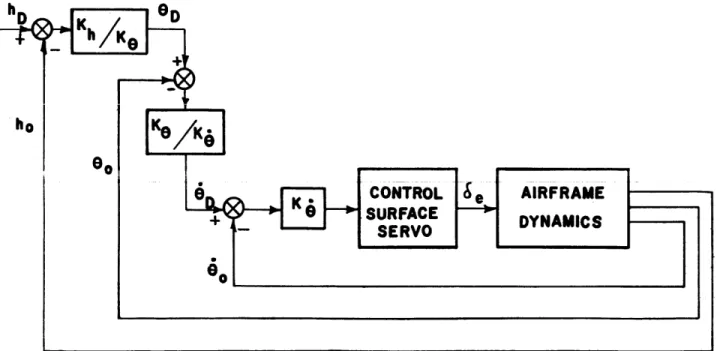
Pitch rate control is furnished by the inner or primary loop of the basic control system illustrated in Figure 2. When operating in the pitch rate con-trol mode, the comrnand is
aD
and the outer loops are broken at the attitudee
error input. The pitch rate. command signal
e
D will be provided by the
fire-control computer; a discussion of the smoothing necessary on tr~s signal will
be found later in this paper.
When the digital flight controller is operating to maintain attitude con-trol,
(4)
where
Attitude control is furnished by the primary loop plus the position
feed-back
e
as illustrated in Figure 2. When operating in the attitude controla
mode, the command is
e
D and the outer loop is broken at the altitude error
in-put. The error in attitude multiplied by the proper gain
Ke/Ke
becomes the newdesired pitch rate.
When the flight controller is operating to maintain altitude,
(6)
Altitude control is furnished by the entire system as illustrated in
Figure 2. The comnand as shown is
hu.
Since 6 is used in nonlinear controland in maneuver limiting, it is essential that 6 becomes zero in the steady
state. For this reason the term
-kf
e
is intentionally omitted from ;), ande 0
will be introduced in equation
8.
The equations for the three modes of operation my be combined into one equation for convenience:
where
CY
stands for altitude control(?) stands for att1tucte control -..:::;/
The symbols ~ ,
® '
and®
have the value 1 if the particular controlapplies, and have the value 0 if the control does not apply. Equation 7 can
be shown to reduce to equation
(1),
(3),
or(5)
as the mode of control changes.In order to maintain a steady-state flight path, integral (or trim) con-trol must be provided. The desired concon-trol surface position then becomes
~ (8)
0d :: 6 + kl2
J
Mt -k.feeo
®
t_oo
where
® ::
1 for altitude control and® ::
0 for attitude and pitch ratecon-to
trol. The integral term k12
J
tilt will provide the trim control necessary tot-oo
fly the aircraft along a steady-state flight path. The term -kfeeo
®
main-tains the proper damping during altitude control and is necessary since the rate gyro signal does not provide the required sensitivity.
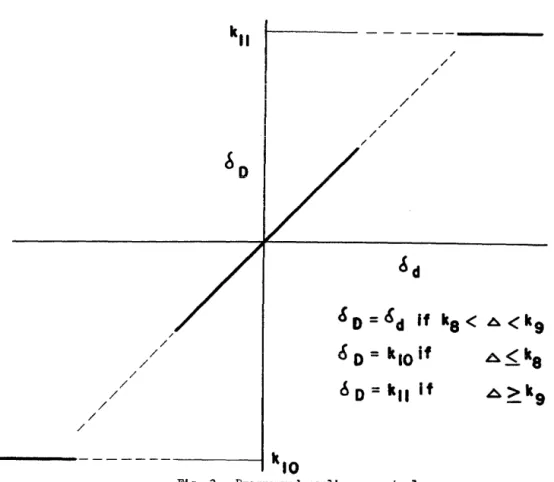
The nonlinear control function which the digital flight controller will provide to improve the speed of response of the aircraft while still
main-taining the desired damping will be programmed as follows (see Figure
3):
0D :: 0d if' k8< 6"'k9
°D :: klO if k8~6
on ::
ku
if 6~k9As can be seen from equation
7,
~ defines the transient error, whichu1timat~ly determines the desired c,ontrol surface position . As used in
e~ua-t-iGnS-{-9h tlG-}, and·fl± h . .t,he- magnituae. -ef- 8-4eteflflines whefr the-~ linear control action is desirable.
(9)
(10)
(11)
At the same time this programming and computing is taking place to de-termine the proper control surface pOSition, the necessary limiting to keep the
aircraft maneuver within safe stall and load bounds is being calculated. The
basis for the stall limiting scheme is to make certain that the lift available will always keep the plane aloft; accordingly