1411
A Review of IT Outsourcing Trends in 2005: An Australian study
Michael S Lane Department of Information Systems,
Faculty of Business University of Southern Queensland
[email protected] Glen Van der Vyver Department of Information Systems,
Faculty of Business University of Southern Queensland
Abstract
IT outsourcing is a well established business practice but is still challenging for organisations due to the difficulty in managing the complexity of ICT and the relationship between the client organisation and the outsourcing vendor. There has been a lack of large scale studies on IT outsourcing which focused on the Australian context and considered a range of organisations including SMEs. This paper reports on the current state of play of IT outsourcing in Australia for small, medium and large organisations. The findings of the quantitative survey show that IT outsourcing is a relatively well established practice in a number of industry sectors which have been traditionally reliant on IT/ICT. Organisations are quite selective about what IT functions are outsourced and how much of their total IT budget is spent on IT outsourcing. The findings show that majority of organisations are involved in partnership type relationships with their outsourcing vendors and that many of the relationships are well established. Finally, the findings suggest that a partnership type relationship is a strong indicator of the overall success of an IT outsourcing relationship.
Keywords: IT outsourcing, Partnership style relationship, Transaction style relationship, Selective IT outsourcing, IT functions, SMEs
1. Introduction
This paper reports on the descriptive findings of a comprehensive national study of IT outsourcing in relation to current trends in IT outsourcing in the Australian context for a broad range of industries and organisations. The type of IT outsourcing relationship is also examined using descriptive and inferential statistics.
The structure of this paper is as follows. First research questions investigated in this study are outlined, Then, the methodology used to collect and analyse data in relation to the research questions addressed in this paper is described and justified. Then the results of the data analysis are discussed. Finally some conclusions are drawn about the key findings of this research. The implications of the key findings for existing knowledge and practice in IT outsourcing are discussed and some suggestions are made for future research in IT outsourcing.
2. Research Questions
The following research questions were investigated in the Australian 1. What are main types of IT functions being outsourced?
2. When IT outsourcing is being practiced, how extensive is the practice in terms of IT budget spend?
4. What is the main type of IT outsourcing relationship (contractual versus partnership style) being maintained?
5. How does the type of IT outsourcing relationship impact on the overall success of the IT outsourcing relationship?
3. Methodology
In order to investigate the research questions described in the previous section, this quantitative study utilises a cross-sectional survey to collect data from a range of small, medium and large Australian organisations. The data collected included information about the current state of IT outsourcing in the Australian context and the extent to which (on a continuum from largely transactional through to largely partnership), the relationship that an organisation has with its main outsourcing vendor impacts on IT outsourcing success.
Eighteen hundred organisations were randomly selected from the Business Who’s Who of Australia Database for the sample in this study. A questionnaire was sent to the senior IT executive of each selected organisation. The IT executives were given a time frame of three weeks to respond to the questionnaire, before another follow-up survey was sent. The mail survey was sent out to 1800 organisations and three weeks later, a follow up mail out of the survey was sent to the same group of organisations. Descriptive and inferential statistics were used to analyse the data.
4. Discussion of Data Analysis Results
4.1 Demographics of participating organisations outsourcing IT
1413 Accom mo dation, Cafes , R estuara nts Edu
cation Mining Perso nal and
oth er serv
ices Pro
perty a nd b
usin ess se
rvices Ag
ricu lture, fo
res try, fish
ing Comm
unic ation s
ervice s Ele
ctric ity, gas
, w ate r su pply W hole sale tra
de He
alth an d com
mu nity se
rvices Constr uction Tra nsp ort a
nd stora ge Re
tail trad e
Fin ance a
nd in sura
nce Go
vernme nt adm
inis tration a
nd defe nce Other Ma nufactu ring Industry sector 0 5 10 15 20 25 Percent
1.18 1.18 1.18 1.18 1.18 2.35 2.35
3.53 3.53 4.71
5.88 7.06
8.24 9.41
[image:3.595.89.492.125.385.2]12.94 12.94 21.18
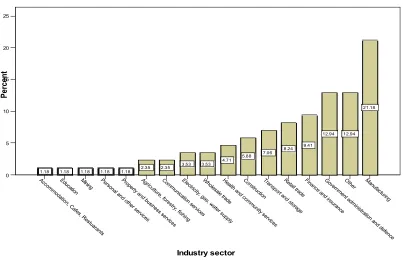
Figure 1 Distribtion of respondent organisation involved IT outsourcing by Industry sector
We also looked at the size of the respondent organisations in terms of the number of employees. Table 3 presents the distribution of the respondent organisations in terms of the number of employers.
Table 3 Respondent organisation size by number of employees
Frequency Percent Valid Percent Cumulative Percent
1000 to <
10000 13 14.9 15.3 15.3
500 to < 1000 9 10.3 10.6 25.9
200 to < 500 18 20.7 21.2 47.1
100 to < 200 23 26.4 27.1 74.1
10 to < 100 22 25.3 25.9 100.0
Valid
Total 85 97.7 100.0
Missing System 2 2.3
Total 87 100.0
[image:3.595.71.464.531.672.2]4.2 Descriptive statistics about the participating organisations and their main IT outsourcing vendor
4.2.1 Length of IT outsourcing relationship
[image:4.595.71.476.192.346.2]The length of the relationship with their main IT outsourcing vendor for the respondent organisations is reported in Table 4 as a frequency distribution across the duration of the relationship in years.
Table 4 Length of IT outsourcing relationship
Frequency Percent Valid Percent Cumulative Percent
< 1 year 6 6.9 7.0 7.0
1 to < 3 years 21 24.1 24.4 31.4
3 to < 5 years 22 25.3 25.6 57.0
5 to < 8 years 21 24.1 24.4 81.4
8 to < 10 years 4 4.6 4.7 86.0
10 years and
above 12 13.8 14.0 100.0
Valid
Total 86 98.9 100.0
Missing System 1 1.1
Total 87 100.0
The results from Table 4 indicate that IT outsourcing has become a well established business practice with Australian organisations. Although the results are sightly skewed towards shorter term relationships of less than 5 years (57 percent in total), 43 percent of the respondent organisations have been involved in an IT outsourcing relationship for 5 or more years. This is an interesting finding because the current literature suggests that organisations are moving towards shorter contractual arrangements with their IT outsourcing vendors (DiamondCluster 2004)
4.2.2 Percentage of IT budget spent on IT outsourcing
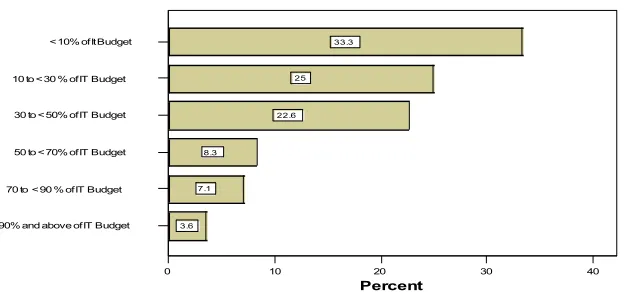
Figure 2 shows that spending on IT outsourcing for the respondent organisations is predominately less than 30 percent of the total IT budget spend for an organisation.
90% and above of IT Budget 70 to < 90 % of IT Budget
50 to < 70% of IT Budget 30 to < 50% of IT Budget 10 to < 30 % of IT Budget < 10% of It Budget
0 10 20 30 40
Percent
3.6 7.1
8.3
22.6 25
[image:4.595.80.392.536.682.2]33.3
Figure 2 Percentage of IT Budget spent on IT outsourcing
1415
[image:5.595.71.495.114.366.2]4.2.3 Types of IT Functions outsourced
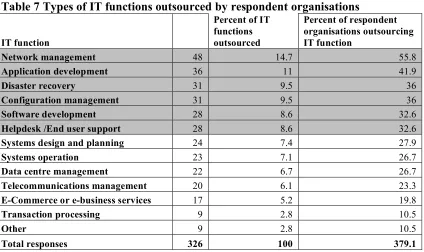
Table 7 Types of IT functions outsourced by respondent organisations
IT function
Percent of IT functions outsourced
Percent of respondent organisations outsourcing IT function
Network management 48 14.7 55.8
Application development 36 11 41.9
Disaster recovery 31 9.5 36
Configuration management 31 9.5 36
Software development 28 8.6 32.6
Helpdesk /End user support 28 8.6 32.6
Systems design and planning 24 7.4 27.9
Systems operation 23 7.1 26.7
Data centre management 22 6.7 26.7
Telecommunications management 20 6.1 23.3
E-Commerce or e-business services 17 5.2 19.8
Transaction processing 9 2.8 10.5
Other 9 2.8 10.5
Total responses 326 100 379.1
Table 7 shows that network management, application development, disaster recovery, software development and helpdesk and end user support are the most commonly outsourced IT functions being outsourced by at least 30 percent of the respondent organisations. These results also show that organisations are selective in what IT functions are outsourced but there is a wide range of IT functions being outsourced.
4.2.4 Type of Relationship and Overall Success of IT Outsourcing Relationship
Figure 3 shows that respondent organisations are predominately involved in partnership type relationship with their main outsourcing vendor and only a very small percentage (4.7) of the respondent organisations are involved in a purely transactional type relationship with their main outsourcing vendor.
Largely transactional
Somewhat transactional
In between transactional and partnership
largely partnership
somewhat partnership 0
10 20 30 40
Percent
4.7 5.9
18.8
30.6
[image:5.595.90.351.569.695.2]40
Figure 4 shows that over 60 percent of respondent organisations have high level of satisfaction with the overall success of their IT outsourcing relationship with their main outsourcing vendor. Only 7 percent of the respondent organisations were unhappy with their IT outsourcing relationship with their main outsourcing vendor. This findings confirms that a client organisation in a partnership type relationship with their main IT outsourcing vendor are more likely to be satisfied with and involved in a successful relationship.
Poor Very high Satisfactory High
\
0 10 20 30 40
Percent
7.4
23.5
29.6
[image:6.595.86.326.181.329.2]39.5
Figure 4 Overall Success of IT Outsourcing Relationship with main vendor
Finally, we report on a simple regression model ran to determine the extent to which influence of the type of relationship on continuum from largely transactional to largely partnership impacts on overall success of IT outsourcing relationship.
Table 9 Coefficients(a)
Unstandardized Coefficients
Standardized
Coefficients T Sig. Correlations Collinearity Statistics
B
Std.
Error Beta
Zero-order Partial Part Tolerance VIF
(Constant) 1.929 .335 5.761 .000
Transactional/Partnership
Relationship .476 .083 .549 5.770 .000 .549 .549 .549 1.000 1.000
a Dependent Variable: Overall S uccess of IT Outsourcing Relationship
Table 9 shows from the beta coefficient (0.549), that the independent variable Type of Relationship (Transactional or Partnership) significantly affects the independent variable Overall Success of IT Outsourcing Relationship at the one percent significance level as indicated by the significant T-value of 5.770. Overall the results of simple regression analysis suggest that a partnership type relationship is a strong indicator of the overall success of an IT outsourcing relationship.
5. Conclusions and Implications
1417
The majority of respondent organisations were found to be involved in a partnership type relationship with their main outsourcing vendor and were relatively satisfied with the relationship with their main IT outsourcing vendor. The length of the relationships indicated that majority of the organisations were involved medium to long term stable relationships
However, most organisations are still quite cautious and selective about outsourcing IT with the majority of the respondent organisations spending less than 30 percent of their total IT budget on IT outsourcing. Furthermore, organisations are selective in what types of IT functions are outsourced and the findings of this study confirm the findings of previous studies in terms of the types of IT functions which are the most likely candidates for IT outsourcing.
The results of simple regression analysis indicate a partnership type relationship is a strong indicator of a successful relationship with the outsourcing vendor.
Overall, this paper has provided some valuable insights into the current state of IT outsourcing in the Australian context and the findings suggest that IT outsourcing is becoming a well established practice for a wide range of organisations from a variety of industry sectors which are heavily reliant on ICT. Furthermore, the findings reported in this paper confirmed that a partnership type relationship is a strong indicator of the overall success of an IT outsourcing relationship.
6. References
DiamondCluster 2004, 2004 Global IT Outsourcing Study, viewed 25 September 2004 <http://www.diamondcluster.com/press/News/Others/2004%20Global%20IT%20Out sourcing%20Study_single.pdf>.
Grover 1996, 'The effect of service quality and partnership on the outsourcing of information system functions', Journal of Management Information Systems, vol. 12, no. 4, pp. 89-116.