
This is a repository copy of
Catalytic depolymerization of alkali lignin in subcritical water:
Influence of formic acid and Pd/C catalyst on the yields of liquid monomeric aromatic
products
.
White Rose Research Online URL for this paper:
http://eprints.whiterose.ac.uk/85226/
Version: Accepted Version
Article:
Onwudili, JA and Williams, PT (2014) Catalytic depolymerization of alkali lignin in
subcritical water: Influence of formic acid and Pd/C catalyst on the yields of liquid
monomeric aromatic products. Green Chemistry, 16 (11). 4740 - 4748. ISSN 1463-9262
https://doi.org/10.1039/c4gc00854e
[email protected]
https://eprints.whiterose.ac.uk/
Reuse
Unless indicated otherwise, fulltext items are protected by copyright with all rights reserved. The copyright
exception in section 29 of the Copyright, Designs and Patents Act 1988 allows the making of a single copy
solely for the purpose of non-commercial research or private study within the limits of fair dealing. The
publisher or other rights-holder may allow further reproduction and re-use of this version - refer to the White
Rose Research Online record for this item. Where records identify the publisher as the copyright holder,
users can verify any specific terms of use on the publisher’s website.
Takedown
If you consider content in White Rose Research Online to be in breach of UK law, please notify us by
Journal Name
Publishing
ARTICLE
Cite this: DOI: 10.1039/x0xx00000x
Received 00th January 2012, Accepted 00th January 2012
DOI: 10.1039/x0xx00000x
www.rsc.org/
Catalytic depolymerization of alkali lignin in
subcritical water; influence of formic acid and Pd/C
catalyst on the yields of liquid monomeric aromatic
products
Jude A. Onwudilia and Paul T. Williams
Alkali lignin was subjected to depolymerization in subcritical water at 265 °C, 6.5 MPa for reaction times between 1 - 6 h in a batch reactor and in the presence of formic acid (FA) and Pd/C catalyst. The oil products were extracted into diethyl ether and contained >90% of single -ring phenolic compounds. The reaction of lignin in subcritical water alone yielded 22.3 wt% oil containing 56% guaiacol as the main product. A maximum oil yield of 33.1 wt% was obtained when the lignin was reacted in the presence of formic acid alone. In the presence of FA, catechol became the predominant compound, with more than 80% of the ether extract after 6 h. The conversion of guaiacol to catechol in the presence of formic acid suggested the hydrolysis of O-CH3 ether bonds. In addition, the yields of alkyl guaiacols increased in the presence of FA. The use of 5 wt% Pd/C catalyst with FA slightly decreased the yields of oil products but led to compounds indicative of hydrogenolysis of aryl -O ether bonds as well as hydrogenation of C=C bonds.
1.0 A Introduction
Lignin makes up to 30wt% of lignocellulosic biomass and nearly 40% of its energy content, hence its conversion and utilization will contribute to the efficiency, sustainability and viability of the lignocellulosic biorefinery industry. Besides, based on the structure of lignin, it is potentially a likely renewable source of aromatic chemicals. This is probably driving the increasing research on the valorization of lignin for chemical and liquid fuel production around the world in recent years [1-8]. In this regard, different thermochemical methods of depolymerizing lignin into high-value aromatic chemicals are being investigated, including fast pyrolysis, wet oxidation and hydrothermal processing. One of the challenges of thermochemical processing of lignin is the rampant re-polymerization of products of dere-polymerization, which are themselves highly reactive under reaction conditions. This often results in extensive char formation, leading to poor yields of aromatic chemicals. A number of processes have been investigated to minimize char formation including the use of ionic liquids [9] and capping agents such as boric acid [10] and phenol [8, 11-12] as well as the use of organic solvents as depolymerization media [5, 13]. The application of ionic liquids and organic solvents as the reaction
medium for lignin depolymerization has been reported to give high conversion rates, with good yields of aromatic chemicals. However, there are issues regarding the recovery of these solvents and the use of fossil-based solvents which may impact on the sustainability of the process.
ARTICLE Journal Name
yields of monomeric aromatic products are still at around 20% [14]. As a result, hydrothermal lignin conversion is now being investigated with or without metal-based catalysts, with water alone or with organic co-solvents, particularly ethanol. For instance, Wahyudiono et al., [15] obtained up to 35 wt% of monomeric phenols with catechol as the major product during the decomposition of lignin in near- and supercritical water from 350 - 400 °C. The authors found that changes in water density affected the yields and composition of the phenolic compounds with increasing reaction times in a batch reactor. Pinkowska et al. [6] reported a maximum combined yield of 11.23 wt% for guaiacol, catechol, phenol and cresol isomers at 280 °C (zero holding time) in the absence of any catalysts. Zakzeski et al. [16] obtained 17 wt% yield of monomeric aromatic oxygenates such as guaiacols during liquid-phase reforming of Organosolv lignin in a water/ethanol mixture at 225 °C, 58bar with Pt/Al2O3 catalyst. They further hydrotreated the liquid products to obtain 6% aromatic and cyclic hydrocarbons.
The use of biomass-derived simple carboxylic acids for hydrothermal lignin conversion has also been receiving attention. Formic and acetic acids can be produced from biomass and lignin under certain hydrothermal conditions [16-18] and using them for lignin processing into valuable products will improve sustainability. Besides, formic acid can easily be reformed into hydrogen [19] required for the hydrogenolysis and/or hydrodeoxygenation of lignin into valuable chemicals [20]. Xu et al. [20], used formic acid (FA) for the depolymerization and hydrodeoxygenation of Organosolv lignin obtained from switch grass in the presence of 20 wt% Pt/C catalysts at 280 °C. They obtained 21 wt% yields of seven monomeric phenols after 4 h of reaction and concluded that reaction time was critical to lignin conversion under the investigated conditions.
In this present study, alkali lignin has been subjected to subcritical water depolymerization reactions with the application of formic acid (FA) as capping agent and hydrogen source and 5 wt% palladium supported on carbon (Pd/C) as hydrodeoxygenation (HDO) catalyst at 265 °C, 6.5MPa. Pd/C has been used in literature for hydrodeoxygenation of bio-oils and oxygenates in alcohols [21] and a recent publications showed that Pd/C can be effective for deoxygenation of triglycerides in subcritical water with external hydrogen supply [22]. At first, the hydrothermal reaction of FA was investigated at the given reaction conditions to determine the influence of reaction time and the presence of Pd/C catalyst on its ultimate conversion according to the equation (1) [19];
HCOOH CO2 + H2 --- (1)
Thereafter, the separate and combined influence of the FA and Pd/C on the yields and variety of liquid depolymerization products from the lignin sample was investigated. This work was aimed at preliminary understanding of the interactions between the lignin and the additives which influenced the yields of liquid products under the hydrothermal conditions studied. Hence, detailed analyses of the liquid products from each test have been carried out in this regard. The liquid products here refer to contents of the liquid residual extracted into diethyl ether solvent.
3.0 Results and Discussion
3.1. Hydrothermal reactions of formic acid
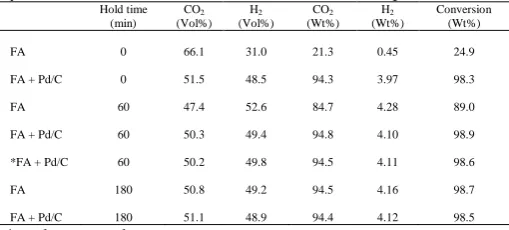
It was important to understand the hydrothermal reactions of formic acid with or without the Pd/C in order to understand its activities in lignin conversion. The results of the hydrothermal reactions of 1.0 g of FA at 265 °C, with reaction time from zero to 3 h, both in the presence and absence of Pd/C are presented in Table 1. The results show that both reaction times and Pd/C catalyst influenced the
hydrothermal conversion of formic acid into hydrogen and carbon dioxide according to Equation (1) [19];.
Equation (1) shows that the standard enthalpy change ( H°298K) for the hydrothermal reaction of formic acid is +32.1 kJ mol-1. This indicates that the position of equilibrium would shift to favour the yield of products with increase in temperature.
Table 1: Yields of hydrogen and CO2 in relation to time during hydrothermal reactions of formic acid at 265 °C, 6.5Mpa
Hold time (min)
CO2
(Vol%)
H2
(Vol%)
CO2
(Wt%)
H2
(Wt%)
Conversion (Wt%)
FA 0 66.1 31.0 21.3 0.45 24.9
FA + Pd/C 0 51.5 48.5 94.3 3.97 98.3
FA 60 47.4 52.6 84.7 4.28 89.0
FA + Pd/C 60 50.3 49.4 94.8 4.10 98.9
*FA + Pd/C 60 50.2 49.8 94.5 4.11 98.6
FA 180 50.8 49.2 94.5 4.16 98.7
FA + Pd/C 180 51.1 48.9 94.4 4.12 98.5
*catalyst re-used once
The yields of CO2 and hydrogen have been used to estimate the conversion of FA during these reactions, since literature and this work show that complete reaction of FA would yield about 50 vol% each of CO2 and H2. Therefore, barring experimental errors, and some dissolution of gases (especially CO2) in the aqueous residuals, the experimental yields of both gases can be directly used to compute FA conversion. As shown in Table 1, the decomposition of FA increased with time, with only 24.9% conversion when the reaction was stopped immediately the reaction temperature was reached [zero min hold time). However, after 1 h hold time at the reaction temperature, the conversion reached 89%, followed by complete conversion after 3 h of reacting FA alone.
On the other hand, the presence of Pd/C led to complete conversion of FA even at zero minute reaction time. The results in Table 1 also show that yields of gases in the presence of Pd/C at 0 min, 1 h and 3 h reaction times, respectively were similar, indicating that the Pd/C catalyst catalyzed FA conversion in subcritical water but did not consume any hydrogen produced from it. The solid catalyst was separated by filteration, dried and weighed. Up to 99.3 wt% of the calatyst was recovered indicating little losses during these reactions. The recovered catalyst for the 1 h run was re-used with results showing similar gas yields. More future work will be carried out on the structural stability of the Pd/C catalyst under hydrothermal conditions. Considering that it took 12 min to heat the reactor to 265 °C, the results from the reactions at zero min holding time can be used to estimate the specific rate of conversion of the formic acid without and with the Pd/C;
Specific rate of FA conversion (mol h-1) =
Clearly, without the Pd/C the specific rate of FA conversion was 0.024 mol h-1, while in the presence of the catalyst, the specific rate increased 4.5 times to 0.108 mol h-1. Hence, the Pd/C has very high catalytic effect on FA conversion and this may affect the depolymerization of lignin with these additives.
3.2. Product yields from lignin depolymerization
[image:3.595.303.558.143.258.2]percentage yields of products were calculated based on the amount of lignin and FA used, where applicable, since the preceding section 3.1 showed that FA reacted to produce H2 and CO2 under the test conditions. In some tests, particularly those involving FA, gave mass balances much greater 100%, suggesting the participation of water as a reactant during those reactions [23]. The excess masses were mainly due to the yields of CO2, which increased with reaction time. Only test with lignin and Pd/c gave mass balances below 100% possibly due to low gas formation, indicating that much of the reaction was carbonization. A test with only Pd/C (without lignin and FA) was carried out for 6 h and neither gas nor liquid products were obtained, instead 98.5 wt% of the catalyst was recovered.
In Table 2, liquid products refers the the combined yields of oil (ether-extractable liquid products) and water-soluble products. The water-soluble products were in the form of semi-solids, which only appeared when the aqueous residuals had been shaken with diethyl ether during liquid-liquid extraction. They extracted into the ether but remained as dissolved solids and could easily re-dissolve in water. These were separated from the ether phase by filtration, air-dried and weighed. The extracted aqueous phases were clear andnearly colourless after 6 h but at lower reaction time. Particularly after 1 h, the extracted aqueous phases had colours raning from ligh to dark brown.
[image:4.595.42.296.330.527.2]
Table 2: Product yields from lignin depolymization with additivies at 265 °C, 6.5MPa from 1- 6 h hold time
Sample Hold
time (h)
Liquid
(wt%) Solid residue (wt%)
Gas (wt%)
% Balance
Lignin 1.0 68.2 30.6 5.56 104.4
Lignin 3.0 61.6 35.9 9.12 106.6
Lignin
6.0 33.3 56.0 17.0 106.3
Lignin/FA 1.0 61.6 1.44 58.6 120.9
Lignin/FA
3.0 52.3 2.16 73.2 126.6
Lignin/FA 6.0 41.1 2.57 92.9 135.3
Lignin/Pd/C 1.0 41.3 54.4 0.84 96.5
Lignin/Pd/C 3.0 36.1 57.3 1.25 94.7
Lignin/Pd/C 6.0 35.6 59.1 2.20 96.9
Lignin/FA-Pd/C 1.0 45.8 16.3 62.8 124.9
Lignin/FA-Pd/C 3.0 38.5 18.3 83.4 140.2
Lignin/FA-Pd/C 6.0 31.6 22.9 91.7 146.2
Pd/C 6.0 - 98.5 - 98.5
The reactions of lignin alone at 265 °C, 6.5 MPa for 1 – 6 h reaction hold times were first studied for reference. In this tests, the yields of liquid products decreased while the yields of solid residues and gas increased with increasing reaction time. The formation of solid residue was evidence of the rapid polymerization of lignin and possibly, its degradation products to form char. The highest gas yield of 17 wt% was obtained after reacting for 6 h and the gas comprised mainly carbon dioxide (83.4 vol%), methane (10.2 vol%) and hydrogen (5.84 vol%). The high yield of methane suggested the cracking of C-C linkagea in lignin. While the yield of liquid products decreased, the proportion of ether-extractable oils in the liquid products increased with reaction time, indicating the possible refining of the liquid products by heat. On the basis of the lignin feed, extracted oil was 5.23 wt% after 1 h, increased to 13.2 wt% after 3 h and finally to 22.3 wt% after 6 h. The yields of the main components in the oil products are presented and discussed in Section 3.4.
3.2.1. Effect of FA
From the preceding section, 89% of FA was converted after 1 h of reaction hold time at 265 °C, 6.5 MPa, therefore experiments were carried out with lignin and formic acid from 1- 6 h reaction hold times under the same conditions. The amounts of char/solid residue recovered from these increased slightly with reaction times from 1.43 wt% after 1 h to 2.51 wt% after 6h. As the hydrothermal reaction of FA in Section 3.1 did not produce any solid resdue, any solid residue obtained during the reaction of lignin and FA was therefore to attributed to lignin. Compared to the reaction of lignin alone, the presence of FA decreased the yield of solid residue by up to 97%., showing that FA helped in solubilizing lignin, so that the water-soluble products could contain both depolymerized and unreacted lignin. Wahyudiono et al. [15] obtained much higher char yields during hydrothermal depolymerization of alkali lignin even for 4 h, suggesting that the presence of formic acid substantially reduced char formation. This indicated the ability of formic acid to act as a capping agent to prevent or delay re-polymerization of products. Hence, nearly 98 wt% conversion of the original lignin mainly into liquid and gas products, was obtained in these tests, which agreed with some reported results in literature [24].
The yield of oil products increased with time and was highest after 6 h. Again based on the dry weight of lignin, oil yields more than doubled from 15.3 wt% to 33.1 wt% between 1 h and 6 h, which compares well to the work of Xu et al. [20], who used formic acid and Pt/C for lignin depolymerization, although at a slightly higher temperature of 280 °C. In the opposite direction, the yield of water-soluble products decreased with time, showing that some of the water soluble products were being converted into char and extractable oil products.
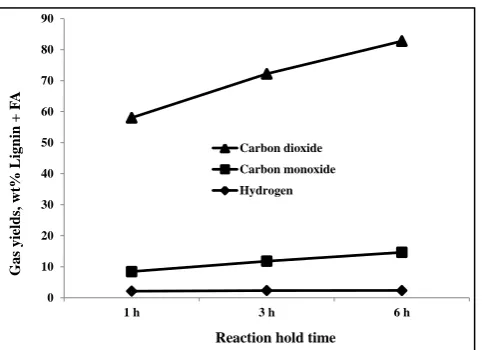
The gas products from these tests mainly composed of CO2, CO and hydrogen. The trends in the yields of gases are presented in Fig. 1 A large proportion of the yields of CO2 and H2 must have arisen from the hydrothermal reaction of formic acid [19]. However, there was a consistent increase in the yields of the three gases with increasing reaction hold time, indicating possible reforming of the lignin. The yield of hydrogen was consistently ≈ 2 wt% of the gas product.
Figure 1: Gas yields from the depolymerization of lignin with FA only
After 1 h and 3 h, hydrogen yields were 0.03 and 0.035 g, respectively, which were lower than its theoretical yield ( 0.0434 g) from FA based on Equation 1, suggesting hydrogen utilization during lignin depolymerization. Hydrogen consumption was
0 10 20 30 40 50 60 70 80 90
1 h 3 h 6 h
G
as
yie
ld
s,
w
t%
Li
gni
n
+ F
A
Reaction hold time
Carbon dioxide
Carbon monoxide
[image:4.595.305.548.472.647.2]ARTICLE Journal Name
possibly via the participation of FA in lignin hydrolysis as well as in other possible reactions requiring hydrogen, such as hydrogenation and hydrogenolysis. However, after reacting for 6 h, the yield of hydrogen was 0.048g, which was 10.6% more than its theoretical yield. This may indicate hydrogen production from the reforming of small organic molecules such as methanol that could form from the hydrolysis of O-CH3 ether bonds.
3.2.3. Effect of Pd/C
The use of Pd/C alone during lignin depolymerization produced the lowest yields of gas and the highest yields of solid residues. CO2 was the only gas detected even after 3 h, and after 6 h the gas composition changed slightly to 97 vol% CO2, 0.37 vol% H2 and 2.23 vol% methane. Yet the total gas yield was only 2.20 wt% of lignin feed after 6 h. Apparently, Pd/C catalyzed the polymerization of lignin to form char, so that the oil products obtained was only 0.21 wt% after 1 h and increased to just 5.10 wt% after reacting for 6 h.
3.2.4. Effect of combining formic acid and Pd/C catalyst
When Pd/C and formic acid were combined for lignin depolymerization, oil yield was much higher than with Pd/C alone but was lower than when formic acid alone was used, still indicating that Pd/C influenced the formation of char. Oil yield increased from 7.60 wt at 1 h to 25.7 wt% after 6 h reaction time. Gas yields were much higher compared to the reaction of lignin in the presence of FA alone. Hence, there was evidence of the participation of Pd/C in the yields and compositions of the gas products. Fig. 2 shows that there was a consistent decrease in CO yields as well which may indicate its conversion to hydrogen via water-gas shift (WGS) reaction. Compared to the reaction lignin with FA alone, which produced increasing yields of CO, reaching 12 wt% at 6 h, these results thus show that the presnce of Pd/C influenced WGS reaction.
Figure 2: Gas yields from lignin depolymerization with FA in the presence of Pd/C
The yields of CO2 was much higher, reaching 87 wt% after 6 h, also suggesting the possible reforming of lignin and its decomposition products with increasing hold time. The yield of hydrogen was was never up to its thoeretical value from the decomposition of FA. Hydrogen yield was 0.03 g and 0.032 g at 1 h and 3 h, respectively but increased to 0.044 g after reacting for 6 h. Although, hydrogen yield still increased, but it was lower than the yield obtained during the reaction of lignin with FA alone. Hence, it could be suggested that much more hydrogen consumption occured during the depolymerization process in the presence of Pd/C than with formic acid alone. In addition, although, Pd/C has been shown to catalyze FA decomposition, the presence of lignin may alter the catalytic
effect of Pd/C due to competition for active sites by both FA and lignin.
3.4. Detailed analysis of the oil products
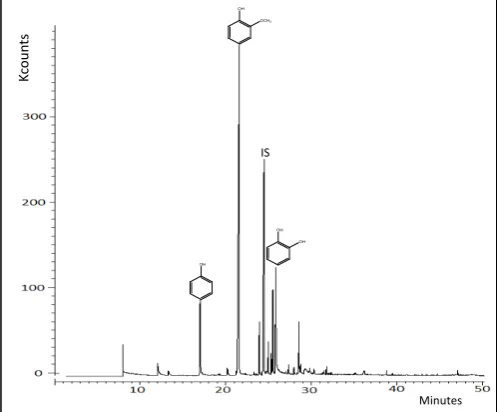
A clearer picture of the predominant reaction pathway for the effect of FA could be seen from compositional analysis of the oil. In this section, the yields of oils and their components have been calculated on the basis of the dry weight of lignin feed (1.0 g). The major compounds in the ether extracts were guaiacol, 1,2-benzenediol (catechol), methylguaiacol, ethylguaiacol and propylguaiacol. In addition, minor compounds identified from the GC/MS/MS analysis included phenol, dimethoxybenzene, dimethoxytoluene, eugenol, 2,3,6-trimethylguaiacol, vanillin and 2',4'-dihydroxy-3'-methylpropiophenone. Indeed the oil products had a pleasant smell as a result of the presence of some of these compounds which are commonly used in flavourings. Figures 3 and 4 show the annotated GC/MS/MS chromatogram for the ether extractable oil from the uncatalyzed and catalyzed (FA and Pd/C) lignin depolymerization tests.
Figure 3: GC/MS/MS chromatogram of oil product from lignin depolymerization without any additives
Figure 4: GC/MS/MS chromatogram of oil product from lignin depolymerization with formic acid and Pd/C
The yields of the major components of the oil products obtained from the depolymerization of lignin after from 1 h to 6 h reaction
0 10 20 30 40 50 60 70 80 90 100
1 h 3 h 6 h
G as yie ld s, w t% Li gni n + F A
Reaction hold time
Carbon dioxide Carbon monoxide Hydrogen IS K co u n ts Minutes OH OCH 3 OH IS OH OH OCH3 OH OCH3 OH 1 2 3 4 5 6 7 BHT 9 1 2 3 5 6 9 7 CH 3 OH CH3 OCH 3
H3CO
4 8 H 3CO OH O H 10 11 OH O H O H3C
[image:5.595.304.553.250.456.2] [image:5.595.43.292.403.563.2] [image:5.595.302.554.500.664.2]time are shown in Figure 5. In all cases, these compounds made up more than 90% of the oil products. In the absence of any additives, lignin depolymerization in subcritical water produced only 3.02 wt% of ether-extractable oil after 1 h hold time. This increased to 13.9 wt% after 3 h and finally to 22.3 wt% oil after 6 h. Guaiacol was consistently the dominant product and after 6 h, the oil comprised of 56% guaiacol, 25% catechol and 8% phenol and 5% alkyl guaiacols. This corresponded to a guaiacol/catechol yield ratio of 2.2.
Figure 5: Yields of aromatic compounds during lignin depolymerization in relation to reaction hold time [A] lignin alone; [B] lignin with FA [C] lignin with FA and Pd/C
With formic acid as depolymerization additive, the yield of oil was 15.1 wt% after 1 h, which increased to nearly 22 wt% after 3 hours. Up to 3 h reaction time, guaiacol was dominant but with increasing catechol yields, so that at 3 h the yields of gaiacol and catechol were
almost at par at a ratio of 1.3 in favour of guaiacol. The oil yield increased to 33.1 wt% after 6 h of reaction and by this time, catechol became the dominant product. This time the oil was composed of mainly of 12% guaiacol and 51 % catechol, giving a guaiacol/catechol yield ratio of 1:4.3. In addition, the percentage of phenol was about 2% with 22% of alkyl guaiacols in the oil, while
2,4’-dihydroxypropiophenone, vanillin and ethyl vanillin made up about 8%.
The oil yields during the reaction of lignin with Pd/C alone was the lowest in this work as mentioned earlier. Pd/C mainly served to carbonize the lignin, producing char rather than oil or gas. The oils contained guaiacol as the major compound with more than 80 % of each oil yield.
While, it was earlier observed that Pd/C catalyzed the decomposition of FA, these results showed that the catalysis of Pd/C on FA may have been inhibited by the presence of lignin. In this sence, the presence of lignin could block some active sites in Pd/C, preventing the immediate catalytic decomposition of FA. However, the oil yields from lignin in the presence of FA and Pd/C were consistently lower compared with those obtained with lignin and FA alone. The oil yields on lignin feed-basis increased from 7.60 wt% after 1 h to 20.7 wt% after 3h and then to 25.7 wt% after 6 h. Hence, the rate of depolymerization increased dramatically between 1 h and 3 h but increased at slower rate from 3h up to 6 h. With the combination of FA and Pd/C, the pattern of product yields similar to when only FA was used, was obtained. Therefore , results in Figures 5[B] and 5 [C] suggest that the rate of guaiacol conversion to catechol only increased between 3 – 6 h. This may indicate that the hydrogen produced from FA became more active in the presence of Pd/C. The yield ratio of guaiacol/catechol after 3 h was 1:1.28. After 6 h reaction time, the yield ratio of catechol and guaiacol was in favour of catechol at 1: 4.6.
From the results, it is apparent that the presence of formic acid altered the reaction pathway in favour of catechol over guaiacol after a long reaction hold time. This agrees with the recent work of Forchheim et al. [25] who studied the kinetic modelling of hydrothermal lignin depolymerization. They found that, the yields of catechols increased with increasing temperature and residence time. It would appear that the active reaction pathway involving formic acid was via hydrolytic cleavage of the O-CH3 ether linkage to produce catechol. The alternative mechanism of hydrogenolysis using in-situ produced hydrogen from formic acid would invariably lead to methane formation if the O–CH3 bond was cleaved or to substantial phenol formation on cleaving the aryl - OCH3 bond. Little or no methane was observed during the reactions of the alkali lignin in the presence of formic acid.
However, the increase in the yield of alkylguaiacols suggests that the mechanism of lignin depolymerization alone and with FA may also involve hydrogenolysis or cracking of C-C bonds along the propane units in lignin. However, the higher yields of these compounds in the presence of FA at longer reaction times suggests possible significant contributions from hydrogenolysis. This is underscored by the improved yield in oil, indicating that formic acid also influenced the overall depolymerization process. The decrease in the total yield of oil in the presence of Pd/C and FA may be explained by the influence of the catalyst on the conversion of FA as shown in Table 1 and the promotion of re-polymerization reactions by Pd/C. The faster rate of conversion of FA may prevent its hydrolytic ability in depolymerizing the lignin. It may also decrease its capping ability to prevent repolymerization of products. In essence, the hydrolytic depolymerization of the lignin by FA would occur as long as FA
0 2 4 6 8 10 12 14
1 Hour 3 Hours 6 Hours
Ar om at ics Y ield s, w t% L ign in f ee d
Reaction Hold Time
Anisole/Phenol Guaiacol 1,2-Benzenediol Methylguaiacol Ethylguaiacol Propylguaiacol 0 2 4 6 8 10 12 14
1 Hour 3 Hours 6 Hours
A rom at ic s Y ie ld , w t% Li gni n F ee d
Reaction Hold Time
Anisole/Phenol Guaiacol 1,2-Benzenediol Methylguaiacol Ethylguaiacol Propylguaiacol 0 2 4 6 8 10 12 14 16 18 20
1 Hour 3 Hours 6 Hours
Ar om atic Y ield s, w t% L ig n in f ee d
Reaction Hold Time
[image:6.595.45.293.141.635.2]ARTICLE Journal Name
remained and could provide H+ ions. Hence, its hydrolytic ability would stop as soon as it is converted to hydrogen and CO2. It would therefore mean that lignin conversion to water-soluble products resulted from hydrolysis, and this was followed by the conversion of the water-soluble products to oil products. The conversion of the water-soluble products was time-dependent as shown by results of increased oil yield with reaction time. The formation of alkyl guaiacols suggests that during the reaction, the hydrogen gas produced was able to participate in the conversion of the water-soluble products to oil products even without a hydrogenation catalyst. These results indicate that substantial hydrothermal depolymerization of lignin can be achieved via hydrolysis but the use of hydrothermally reactive additives that can also generate in-situ hydrogen for HDO of liquid products would require careful reactor design. This will be necessary to allow them sufficient time to act as depolymerization agents before acting as hydrogen donors for HDO.
3.5. Hydrothermal reactions of guaiacol
[image:7.595.305.546.113.285.2]To further understand the reaction schemes of the two additives with guaiacol five sets of experiments were carried out for 6 h reaction time. From the reactions of lignin, 6 h reaction time gave the highest yields of oil and highest yields of catechol in the presence of FA. Hence, a reference experiment was carried out with 1.0 g of guaiacol for 6 h, in the absence of any additives. In this test, 97% of the original guaiacol was recovered. Only small amounts of phenol and dimethoxybenzene (ca. 0.2 wt% each) were identified but no catechol was found. Then the same amount of guaiacol was reacted with formic acid for 6 h and this yielded 82.5 wt% of catechol and 15.3 wt% guaiacol. Further, the combination of formic acid and Pd/C was used to investigate the reaction of guaiacol from 1 - 6 h as presented in Figure 6. Results show that guaiacol was highly resistance to degradation after 1 h of reaction even in the prersence of these addtivies, so that 95 wt% guaiacol was recovered. It was only after 3 h of reacting that the formation of catechol was observed. However, the yield of catechol again increased dramatically after 6 h of reaction, so that the yield of oil was 65.7 wt% yield of catechol, 24.9 wt% of the original guaiacol and 3.01 wt% yield of phenol after 6 h. The others in the
Figure 6: Yield of aromatic compounds in relation to time from the hydrothermal reaction of guaiacol in the presence of FA and Pd/C
The production of phenol indicates the cleavage of aryl-O bond via hydrogenolysis possibly catalysed by Pd/C using the in-situ generated hydrogen. Moreover, the high yield of catechol also suggests the cleavage of O-CH3 bond via acid catalysed hydrolysis.
These results therefore suggest that while formic acid favoured hydrolysis of the O-CH3 ether linkage, the Pd/C catalyst appeared to favour hydrogenolysis to form phenol and possibly methanol, which would be a substantial component of the aqueous residuals or could be reformed to hydrogen
Figure 7: GC/MS/MS chromatograms of oil products from the hydrothermal reactions of (a) guaiacol alone; (b) guaiacol with formic acid and Pd/C (6h hold time)
Figure 7 shows the two chromatograms of these reactions. It can be seen from Figure 4b that the presence of Pd/C also influenced the formation of hydrodeoxygenation products. Examples of these
included 1,1’-bicyclohexyl, 2-propenyl cyclohexane and cyclohexyl benzene. However, their yield was only 0.13 wt after 1 h and increased to 1.72 wt% after 6 h. Though the yields of these hydrogenation products were low, their presence indicates the possibility of catalytic hydrogenation or hydrodeoxygenation of oxygenates such as guaiacol.
4.0. Conclusion
The results presented here show the possibility of alkali lignin depolymerization under acidic conditions using a carboxylic acid that can be derived from biomass. The yields of monomeric phenolic compounds are considerable compared with what is presently possible in literature. The presence of formic acid influenced both the extent of depolymerization and the composition of the oil products. Without any additive/catalyst, lignin depolymerized in subcritical water to produce mainly guaiacol. However, in the presence of formic acid, catechol became the predominant phenolic compound possibly due to hydrolysis of the O-CH3 ether bond in guaiacol. In addition, Pd/C appeared to catalyse the hydrogenolysis of the aryl-O ether bond resulting in significant yield of phenol from guaiacol also promoted char formation. The continued presence of significant amount of water-soluble products after 6 h indicates that the reaction time could further be manipulated and the use of appropriate catalysts can improve yields. Moreover, there are many varaibles still to be considered in future research including the use of different lignin samples based on sources and methods of isolation, use of different operating conditions of temperature, pressure and reaction time as well as the application of different catalysts/additives for hydrothermal lignin conversion.
5.0. Experimental
0 10 20 30 40 50 60 70 80 90 100
1 Hour 3Hours 6 Hours
Y
ield
s,
Wt%
G
u
aiacol
Reaction Hold Time
Anisole/Phenol
Guaiacol
1,2-Benzenediol
Others
IS IS
a
[image:7.595.42.292.464.638.2]Samples of alkali lignin (low sulfonate grade), formic acid (99% purity), diethyl ether (solvent) and Pd/C (5 wt %) were obtained from Sigma-Aldrich UK and used as received. The proximate composition of the alkali lignin was; 3.23% moisture, 3.57% ash, 60.6% volatiles and 32.6% fixed carbon; while the elemental analysis results gave 61.7% carbon, 5.11% hydrogen, 31.3% oxygen, 1.22% nitrogen and 0.67% sulfur. The reactor used was a stainless steel batch reactor with 500 ml volume capacity and can reach a maximum temperature and pressure of 500 °C and 30MPa, respectively [26].
In each experiment, 1.0 g of alkali lignin was added into the reactor along with 60 ml of deionized water. This amount of the lignin sample completely dissolved in the water. The volume of water was chosen to give a pressure of 6.5MPa at the chosen reaction temperature of 265 °C. When required, 1.0 g of formic acid and 0.5 g of Pd/C were added either separately or in pre-determined combinations. The reactor vessel was closed and purged for 10 minutes with nitrogen gas at a flow rate of 1 ml min-1. The reactor was then heated to 265 °C in 12 min and held at this temperature for 1- 6 h. At the end of the heating, the reactor was quickly withdrawn from the heated and cooled to room temperature with a large fan within one hour. The liquid products were extracted with diethyl ether and analyzed using a was a Varian CP-3800 gas chromatograph coupled with a Varian Saturn 2200 mass spectrometer (GC/MS/MS) (Please see Supplementary Information for details). The weight of solid residue was determined after drying in an oven at 105 °C and for the experiments involving Pd/C, temperature programmed oxidation (TPO) method was used to determine the amount of solid residue produced.
5.1. Analysis of Products
Gas analysis
On cooling, the gas samples (especially when formic acid has been used) were sampled for offline analysis. The analytical protocol used for gas products analysis has been widely published [27-28]. Briefly, the gas samples were analysed using three packed column gas chromatographs. The permanent gases, hydrogen, oxygen, nitrogen and carbon monoxide, were separated on a molecular sieve column and analysed using a Varian CP-3380 gas chromatograph with a Thermal Conductivity Detector (GC/TCD). Hydrocarbon gases, C1 to C4, were separated on a Haysesp column and analysed using a second Varian CP-3380 gas chromatograph with a Flame Ionisation Detector (GC/FID). Carbon dioxide was analysed using a third gas chromatograph fitted with a TCD. The results obtained from the GCs were given as a volume percent and were converted into masses of each gas using the ideal gas equation.
After gas analysis, the reactor was opened to sample the contents (liquid and solids) into a beaker and weighed. The reactor contents were transferred into a clean glass bottle, followed by rinsing with 30 ml of diethyl ether as solvent and re-weighed. The mixtures were filtered under vacuum to separate the solids from the liquids. The solids retained on the filter paper were dried in an oven at 105 °C for 2 h and weighed. The weight of solid residue was subtracted from the weight of the reactor contents to obtain the weight of the liquid products (less weight of solvent used).
In all cases, the liquid products were partitioned by liquid-liquid extraction technique in a separating funnel with the organic layer separated into diethyl ether. The addition of two drops of hydrochloric acid (1.0 M) helped to ensure complete separation of the distinctive phases. The aqueous phases were subsequently extracted twice more with 15 ml of diethyl ether. For extended reaction times, the aqueous phases were largely clear while the ether phases were unclear and required centrifugation to separate the clear
liquid from a dark brown semi-solid product, most of which dissolved when shaken with water. Figure below shows the typical samples of the aqueous phase (a), the clear ether phase (b) and (c) the ether phase with semi-solid fractions that are also water-soluble. The clear portion had a colour range between light yellow to brown. The weight of the oil fraction were determined after vacuum evaporation and used to determine the weight of water-soluble products. The ether extracts were combined and dried over anhydrous sodium sulfate prior to analysis by GC/MS/MS.
Figure 7: Picture showing the different fractions of the liquid products; (a) extracted aqueous phase, (b) clear ether extract and, (c) water-soluble fraction from ether extract
The equipment used was a Varian CP-3800 gas chromatograph coupled with a Varian Saturn 2200 mass spectrometer (GC/MS/MS) fitted with a 30 m DB-5 equivalent column. For the GC/MS/MS
analysis, 2 l of the diethyl ether extract were injected into the GC
injector port at a temperature of 290 ºC; the oven programme temperature was 35 ºC for 8 min, then ramped to 120 ºC at 5 ºC min -1
heating rate, held for 1 min and ramped at 4 °C/min to 210 °C and finally ramped at 20 °C/min to 280 °C (total analysis time of 55.5 min). The transfer temperature line was at 280 ºC, manifold at 120 ºC and the ion trap temperature was held at 200 ºC. The ion trap was initially switched off for 8 min to allow the elution of the solvent prior to data acquisition to safeguard the life of the trap. The compounds present in the extracts were quantified by internal standard method with 2-hydoxyacetophenone as internal standard (IS). List of compounds and the properties used for their quantitative analysis are shown in the Electronic Supoplementary Information .
Keywords: Lignin, hydrothermal depolymerization, hydrolysis, hydrogenolysis, catalysis
a
Corresponding Author
Jude A. Onwudili ([email protected])
[image:8.595.308.545.154.279.2]ARTICLE Journal Name
6.0. References
[1] M. Kleinert and T. Barth, Chem. Eng. Technol. 2008, 31(5) 736– 745
[2] M. Kleinert, J.R. Gasson, T. Barth, J. Anal. Appl. Pyrolysis
2009, 85, 108–117
[3] C.A. Mullen, A.A. Boateng, Fuel Process. Technol. 2010, 91, 1446–1458.
[4] D.J. Nowakowski, A.V. Bridgwater, D.C. Elliott, D. Meier, P. Wild, J. Anal. Appl. Pyrolysis 2010. 88, 53–72.
[5] R. J. A. Gosselink, W. Teunissen, J. E. G. van Dam et al., Biores. Technol. 2012, 106, 173–177
[6] H. Pin´ kowska, P. Wolak, A. Złocin´ska, Chem. Eng. J. 2012, 187 410– 414
[7] Q. Song, F. Wang, and J. Xu, Chem. Comm. 2012, 48(56). 7019–77021
[8] A. Toledano, L. Serrano, J. Labidi, Fuel 2014, 116, 617–624
[9] B. J. Cox and J. G. Ekerdt, Biores. Technol., 2012, 118, 584–588
[10] V.M. Roberts, V. Stein, T. Reiner, A. Lemonidou, X. Li, J.A. Lercher, Chem Eur J. 2011, 17, 5939–48.
[11] M. Saisu, T. Sato, M. Watanabe, T. Adschiri, K. Arai, Energy Fuels 2003, 17, 922-928
[12] K. Okuda, M. Umetsu, S. Takami, T. Adschiri, Fuel Process Technol. 2004, 85, 803–13.
[13] Q. Song, F. Wang, J. Cai et al., Energy Environ. Sci. 2013, 6(3) 994–1007, 2013
[14] J. E. Miller, L. Evans, A. Littlewolf, and D. E. Trudell, Fuel
1999, 78(11), 1363–1366,
[15] Wahyudiono, M. Sasaki, M. Goto, Chem. Eng. Proc. 2008, 47, 1609–1619
[16] J. Zakzeski, A. L. Jongerius, P. C. A. Bruijninc, B. M. Weckhuysen ChemSusChem 2012, 5(8), 1602-1609
[17] F. Jin, Z. Zhou, A. Kishita, H. Enomoto, J. Mater. Sci. 2006, 41, 1495-1500.
[18] J. Yun , F. Jin, A. Kishita , K. Tohji, H. Enomoto J. Physics: Conference Series 2010, 215, 012126
[19] N. Akiya, P. E. Savage, AIChE J. 1998, 44(2), 405-415
[20] W.Y. Xu, S.J. Miller, P.K. Agrawal, C.W. Jones, ChemSusChem 2012, 5, 667–675.
[21] T.H. Parsell, B. C. Owen, I. Klein, T.M. Jarrell, C.L. Marcum, L.J. Haupert, L.M. Amundson, H.I. Kentt¨amaa, F. Ribeiro, J.T. Miller, M.M. Abu-Omar, Chem. Sci., 2013, 4, 806-813
[22] S.A.W. Hollak, M.A. Ariëns, K.P. de Jong, D.S. van Es, ChemSusChem, 2014, 7(4)1057–1062,
[23] T. Yoshida, Y. Oshima, Y. Matsumura, Biomass and Bioenergy, 26 (2004) 71-78.
[24] J. R. Gasson, D. Forchheim, T. Sutter, U. Hornung, A. Kruse, T. Barth, Ind. Eng. Chem. Res. 2012, 51, 10595−10606
[25] D. Forchheim, U. Hornung, A. Kruse, T. Sutter, Waste and Biomass Valorization, 2014 DOI 10.1007/s12649-014-9307-6
[26] R. Muangrat, J.A. Onwudili, P.T. Williams, Int. J. Hydrogen Energy 2012, 37(3), 2248-2259
[27] J.A. Onwudili, P.T. Williams, RSC Advances 2013, 3, 12432-12442
![Figure 5: Yields of aromatic compounds during lignin depolymerization in relation to reaction hold time [A] lignin alone; [B] lignin with FA [C] lignin with FA and Pd/C](https://thumb-us.123doks.com/thumbv2/123dok_us/7953211.197537/6.595.45.293.141.635/figure-yields-aromatic-compounds-depolymerization-relation-reaction-lignin.webp)


