DIFFUSTON IN CALCIUM OXIDE
M . Marsha 11, BSc. (Hons).
Physics Department
Australian National University
Thesis submitted for the Degree of Doctor of Philosophy in the Australian National University
Except where otherwise indicated all* the material in this thesis is my own original work.
Acknowledgements
I should like to thank my supervisors, Drs. A.J. Mortlock and R.J. McDonald, for their guidance and
encouragement during the course of the work. I would
like to acknowledge helpful discussions with Messrs. B.C. Harding and D.M. Price, and technical assistance from Mr. D.M. Price, and the members of the workshop who made some of the equipment used.
Abstract
The diffusion of Ni(63), S r (90) and Y (90) in single-crystal CaO was investigated over the following temperature ranges using standard techniques:
Ni(63): 980-1700°C. (air), 1650-1850°C. (vacuum).
Sr(90): 970-1740°C. (air).
Y (90): 1450-1750°C. (air).
The enthalpies of various reactions were calculated by the original Mott-Littleton method to assist in the determination of the charge on the diffusing ions and of the main non-impurity factors controlling the observed diffusion.
Most measured diffusion co-efficients are believed to represent equilibrium lattice diffusion and the discussion of the size effect etc.
assumed this. However a ’’short-circuit" component perhaps caused by
damage produced during the preparation of the crystal surface for a run
was observed after short annealings at 1115°C. and 1220°C.; the parameters
were similar to those found for "short-circuit" Ca diffusion. A possible
decrease in the activation energy of Ni large-penetration diffusion below 1100°C. might possibly be due to the same kind of damage, which would anneal out more slowly at lower temperatures.
The Arrhenius plots for the lattice diffusion co-efficients measured in air gave the following equations:
D(Ni) = (2.9+^*2) xlO
-4
exp(-2.39±.08eV/kT) cm2/sec in 1090-1700°C.D(Sr) = (3.4+2'^) xio"4 exp(-2.58±.08eV/kT) cm2/sec in 1090-1740°C.
The scatter in the data for yttrium diffusion is too great for a least-squares
-13 2
fit to be meaningful. D(Y) varies from about 10 cm /sec at 1450°C. to
lO"11 cm2/sec at 1750°C.
The activation energies for Ni and Sr diffusion in CaO differ by only 0.2±0.2eV whereas the activation energies for Ni and Sr diffusion in MgO
differ by 0.8±0.2eV. These results may be explained by thinking of the size
effect on the correlation enthalpy etc. as counterbalancing the size effect
on the migration enthalpy; the cancellation is complete when the diffusing
iii
size difference is great. Some empirical relations between the diffusion
rates of ions of different sizes are given.
D (Sr^+)/D (Y^+) varies between about 10 and 40 in 1450-1750°C., whereas D(Ni^+)/D(Sr^+) varies between 2 and 5 in 1090-'1700°C. Thus in this case a 50% change in the charge of the diffusing ion affects the diffusion rate much
more than a 50% change in ionic radius. Together with other evidence this
suggests that the effect of a change in the charge of the diffusing ion on the diffusion rate is greater than the effect of a comparable change in the size
of the diffusing ion. Explanations of the observed charge effects are listed
and it is compared with those in NiO and MgO.
The rate of Ni diffusion in vacuo, 10 ^ to 10 ^ cm^/sec in 1650-1850°C.,
is much faster than in air at these temperatures. Among other possibilities
this enhancement could be due to dissolution of the tracer only occurring near regions of rapid diffusion, the effects of hydration damage or a real
enhancement of the lattice diffusion co-efficient in vacuo. If the last
possibility be correct, Ni must be diffusing via interstitials in vacuo. (The diffusion rate via interstitials will, if anything, decrease with increasing ambient pressure while that via vacancies will, if anything,
increase with increasing ambient pressure. Accordingly even if interstitials
control Ni diffusion in vacuo, they need not necessarily control Ni diffusion in air.)
It is tentatively concluded that the lattice diffusion rates in air measured in this study are controlled by aliovalent ions present in concen trations greater than their solubility limits or by an equilibrium between
the crystal and atmospheric water vapour. In the latter case the reaction
iv
TABLE OF CONTENTS
PAGE
ACKNOWLEDGEMENTS i
ABSTRACT ii:
LIST OF TABLES ix
LIST OF FIGURES ix
CHAPTER I: THEORY AND PREVIOUS WORK 1
1.1. Introduction 1
1.2. The Laws of Diffusion and the Diffusion Co-efficient 2
1.3. The Atomic Approach. Mechanisms of Diffusion 3
1.3.1. General Expressions for the Diffusion Co-efficient 3
1.3.2. Mechanisms of Diffusion - General 5
1.3.3. Interstitial Mechanism 5
1.3.4. Vacancy Pair Mechanism 6
1.3.5. The Vacancy Mechanism 9
1.3.6. The Interstitialcy Mechanism 9
1.3.7. Short-circuit Path Diffusion 9
1.4. The Vacancy Mechanism 10
1.4.1. Formulae for the Diffusion Co-efficient 10
1.4.2. The Dependence of the Vacancy Concentration on Various
Factors - Governing Equations 12
1.4.3. The Dependence of the Vacancy Concentration
on Various Factors - Results 14
1.4.4. The Temperature-dependence of the Diffusion Co-efficient 20
Summary ' 21
1.5. Survey of Work in Other Compounds 21
1.5.1. The Effect of Atmosphere on Diffusion in Oxides 21
1.5.2. The Effect of Ionic Size on Diffusion in Halides
V
1.5.3. The Charge Effect in Halides and Oxides 27 1.5.4. Short-circuit Path Diffusion in Halides and Oxides 27 1.5.5. Comparisons between Theoretical and Experimental
Diffusion Parameters 28
Summary 28
1.6. Previous Work on Diffusion in Calcium Oxide 29 1.6.1. Lattice Self-Diffusion (Impurity Dominated) 29
1.6.2. Lattice Self-Diffusion (Intrinsic) 31
1.6.3. What is the Non-impurity Vacancy-controlling Factor? 31
1.6.4. Miscellaneous Results 33
Summary 34
1.7. - Aims of this Study 34
Summary 35
List of References 36
CHAPTER II: EXPERIMENTAL DETAILS 38
11.1. Materials 38
Summary - 40
11.2. Grinding and Polishing the Crystals 40
11.2.1. Reaction with the Atmosphere 40
11.2.2. Rough Grinding 40
11.2.3. Polishing 41
Summary
11.3. Depositing Nickel on the Crystals 42
11.3.1. Introduction and Description of the Tracer Used 42 11.3.2. Determination of the Amount to be Deposited 42 II. 3.3. Depositing the Tracer and Subsequent Pre-annealing Procedures 43
Summary 44
11.4. Depositing Strontium and Yttrium on the Crystals 44
vi
11.4.2. The Determination of the Amount to be Deposited 45 11.4.3. Depositing and Pre-diffusion Run Procedure for
Strontium Runs . 45
11.4.4. Depositing and Pre-diffusion Run Procedure for
Yttrium Runs 45
Summary 46
II.5. Annealing the Crystals 46
11.5.1. Preparations for Annealing Crystals in Air 46 11.5.2. Temperature Measurement and Furnaces Used for
Runs in Air 47
11.5.3. Other Procedures Carried Out at the Beginning and
End of a Run in Air 48
11.5.4. Calculation of the Run Time and Temperature (All Runs) 4$ 11.5.5. Runs in Vacuo-Procedures Before and After the Run Itself 49 11.5.6. Temperature and Pressure Measurement and the Furnace
Used for Runs in Vacuo 49
Summary 1. Runs in Air 50
2. Runs in Vacuo 50
11.6. Methods of Analysing the Crystals and Theoretical
Relations Used in Them 50
11.6.1. Solutions of Fick’s Laws Used 50
11.6.2. Sectioning 52
11.6.3. Autoradiography 53
11.6.4. Surface Activity 56
Summary 56
11.7. Sectioning-Experimental Details and Particular Procedures
for Various Isotopes 56
11.7.1. Determining the Thickness Removed 56
11.7.2. Ni(63) Runs: Counting of the Activity and Analysis
of the Results 59
11.7.3. S r (90) Runs: Counting of the Activity and Analysis
of the Results 59
11.7.4. Y (90) Runs: Counting of the Activity and Analysis
of the Results 60
vii
II.8. A u toradiography 62
11.8.1. Brief Description of Procedure 62
11.8.2. The Problem of Grooving: Description and Effects
on Procedure 63
Summary 64
Appendix I. To find how closely the genera] solution for a uniform source approaches the instantaneous
source solution at very long times 65
A p p endix II. T h e Justification of the Autoradiography Analysis
Procedure 67
List of References 68
Additional Note 70
CHAPTER III: RESULTS 71
111.1. Discussion and Estimation of Uncertainties 71
111 . 1.1. Temperature Measurements 71
111.1.2. Annealing Time Measurements 71
1 1 1 . 1.3. Diffusion Co-efficients: Sectioning 71
1 11.1.4. Diffusion Co-efficients: Autoradiography 73
III.2. Results: Nickel 74
111.2.1. Large-Penetration Data 74
111.2.2. Small-Penetration Data 79
111.2.3. Surface Diffusion 81
111.3. Results: Strontium 81
111.4. Results: Yttrium 85
111.5. Summary of Results 87
List of References 89
CHAPTER IV: THEORETICAL CALCULATIONS 90
vi ii
IV.2. T he Interionic Potential and Calculation Procedure 91
IV. 3.. Formulae for Energies: Results and a Discussion of
Their Validity 92
IV. 3.1. Schottky Defects. 92
* IV. 3.2. Equilibria with Oxygen in the Atmosphere 92
IV.3.3. Equilibrium with Water Vapour in the Atmosphere 9S
IV. 4. Conclusions 96
List of References 97
CHAPTER V: DISCUSSION 98
V . l. Deviations from the Profile Form Expected for Bulk
Diffusion; Short-circuit Diffusion 98
V.1.1. Deviations Caused by Incorrect Determination of the
Profile 98
V . l . 2. Deviations Caused by Inadequacies in the Analysis Leading to the Expected Form of the Diffusion
Profile 101
V.1.3. ’'Short-circuit" Diffusion 103
V.2. The Effect of Ion Size on Diffusion 105
V.3. The Effect of Ion Charge on Diffusion 108
V.4. The Effect of Atmosphere-on Diffusion 109
V.5. Probable Diffusion Mechanisms 111
List of References 118
CHAPTER VI: CONCLUSIONS 119
List of References 122
ix
LIST OF TABLES
PAGE
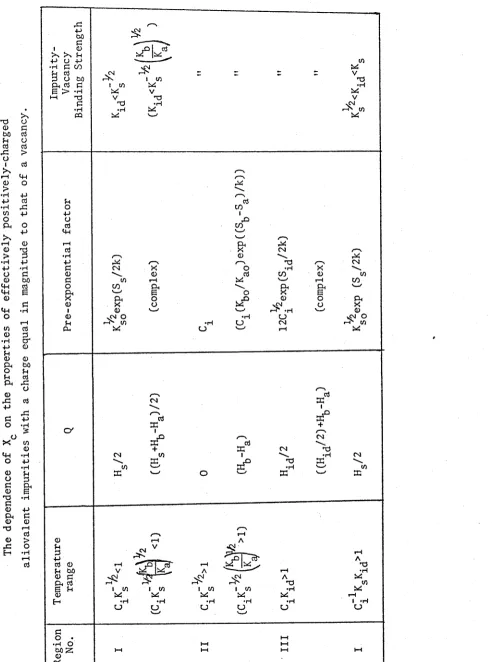
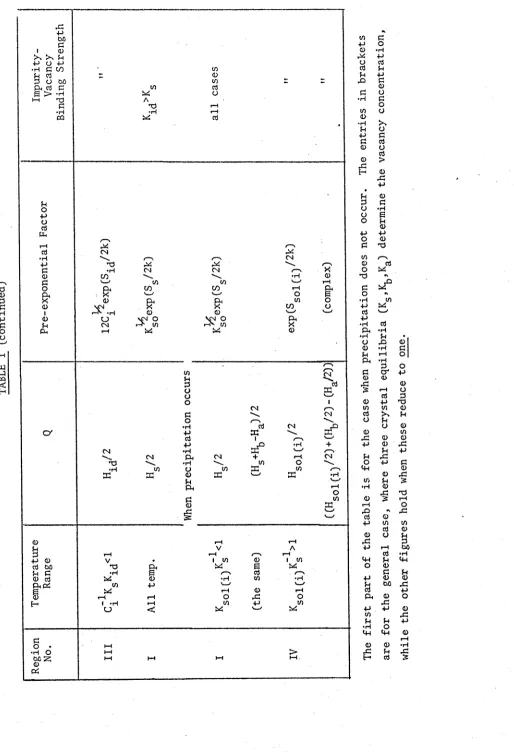
TABLE I. The dependence of on the
properties of effectively positively-charged aliovalent impurities with a charge equal in
magnitude to that of a vacancy. 16
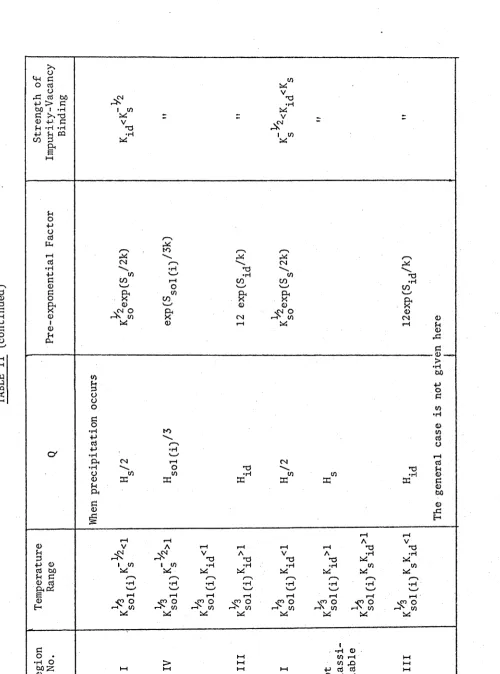
TABLE II. The dependence of Xc on the properties of
aliovalent impurities with half the charge of
those of Table I. 18
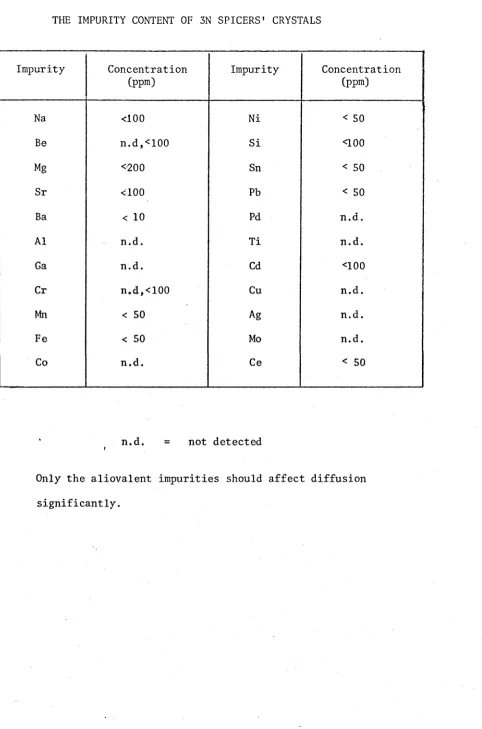
TABLE III. The impurity content of 3N Spicer's crystals 39
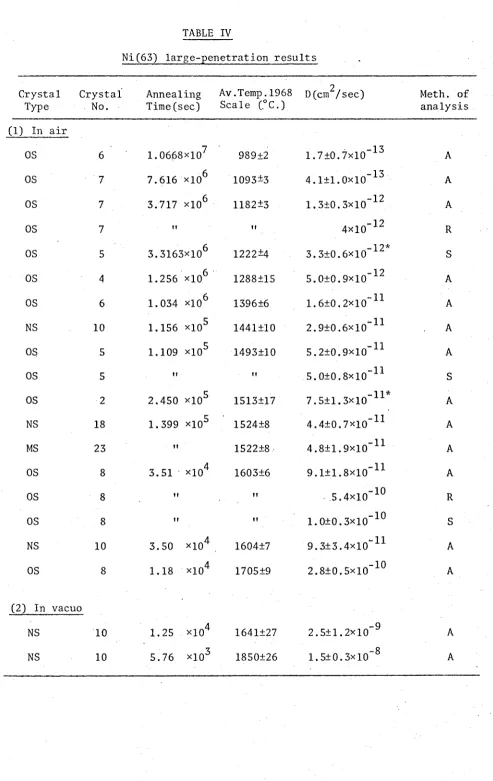
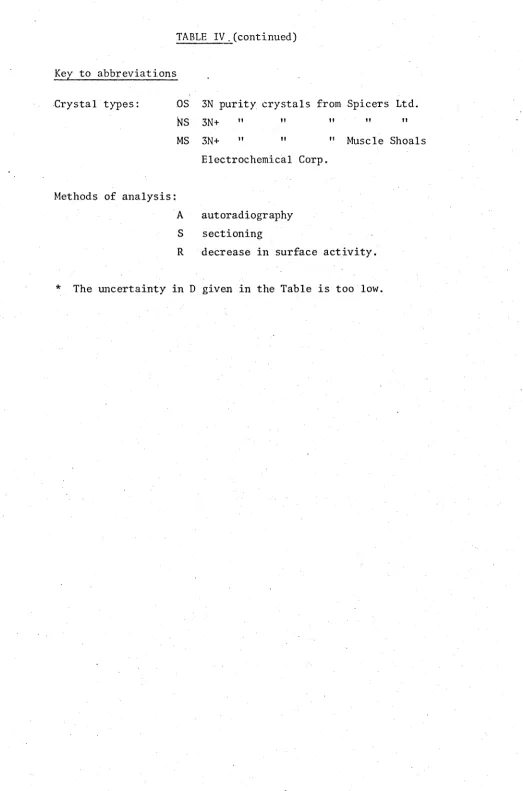
TABLE IV. Ni(63) large-penetration results 75
TABLE V. S r (90) low-zirconium runs in air 82
TABLE VI. Y(90) low-zirconium runs in air 86
TABLE VII. Results - theoretical calculations 94
LIST OF FIGURES
No. of Preceding
Page.
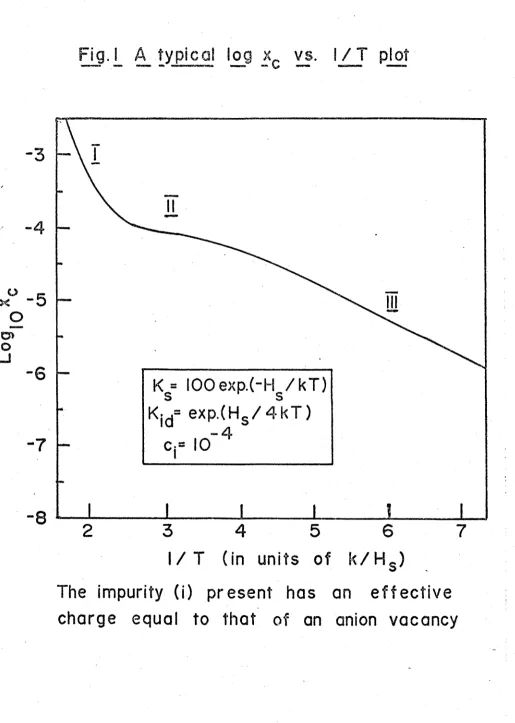
FIG. 1. A typical log Xc vs. 1/T plot 15
FIG. 2. The effect of size on the activation energy for
impurity diffusion in MgO and A ^ O ^ 26
FIG. 3. The effect of size on the diffusion co-efficient
of impurities diffusing in NaCl and KC1 (Group
IA cations and Ag+) 26
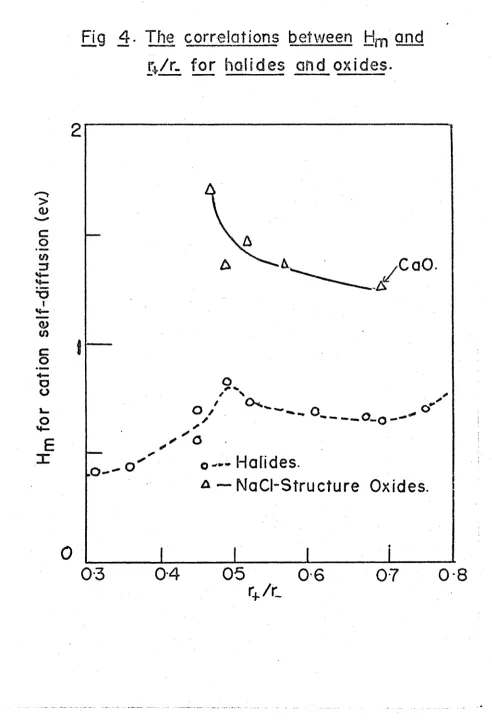
FIG. 4. A comparison of the correlation between and
r /r for halides and oxides
X
LIST OF FIGURES (continued)
FIG. 5. Absorption curve for the Ni(63) tracer
FIG. 6. Absorption curve for the Sr (90) tracer
FIG. 7. LnP(x2 ) vs. x^ for an undiffused Ni(63) deposit
FIG. 8. The autoradiographic profile for a diffused Ni(63) deposit. (a) The recorder scan.
(b) LnP(x2) vs. x^ plot.
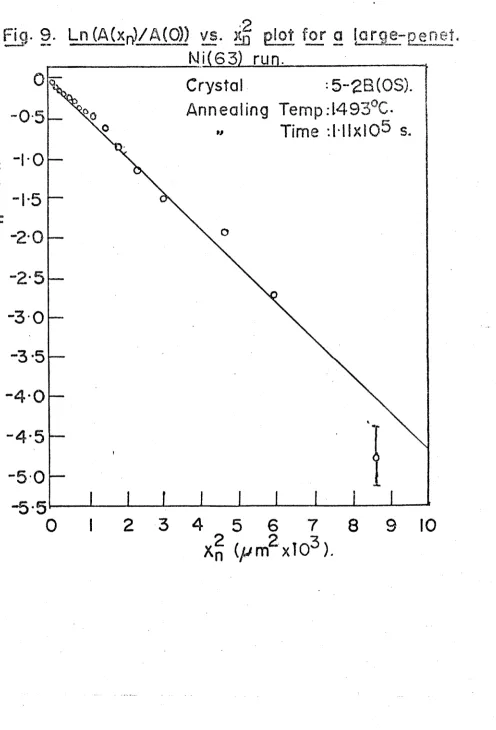
FIG. 9. Ln(A(xn)/A(0)) vs. x^ plot for a large-penetration Ni(63) run
FIG. 10. Ni(63) diffusion in CaO. Large-penetration runs.
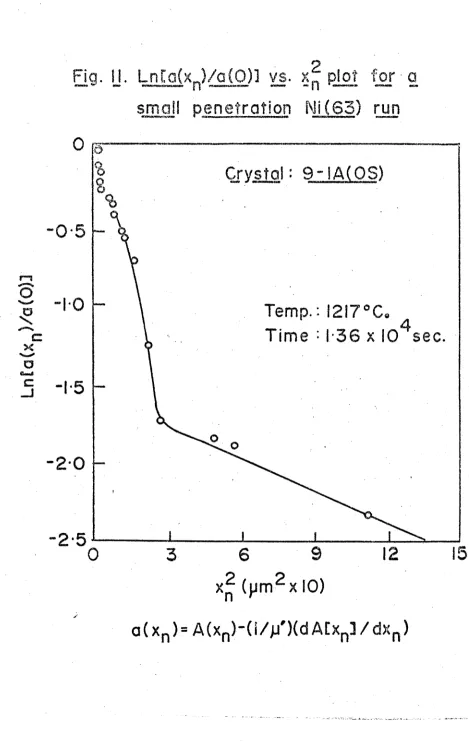
FIG. 11. Ln(a(x )/a(0)) vs. x^ plot for the 1217°C. small penetration Ni(63) run
FIG. 12. Erfc 1 (A(xn)/A(0)) vs. x^ plot for a Sr(90) run
FIG. 13. Sr (90) diffusion in CaO
FIG. 14. Erfc ^(A(xn)/A(0)) vs. x^ plot for a Y(90) run
FIG. 15. Y(90) diffusion in CaO
42
44
55
62
77
78
80
81
84
85
1
CHAPTER I
THEORY AND PREVIOUS WORK
1.1. INTRODUCTION
In many inhomogeneous systems of the various states of matter, it is found that the concentration of a constituent changes with time, usually tending to a particular value at each point. These changes in concentration are due to some random-like transport process, not to bulk flow. This matter transport is called diffusion.
Diffusion in solids is studied because:
(1) Rates of diffusion are important in many practical properties of materials. For example, they are related to sintering and reaction rates
(Lindner (1949)). The diffusion of impurities may seriously affect the structural properties of a material.
(2) The observed diffusion is a sum of many random movements of individual atoms (or ions). Thus diffusion measurements are a macroscopic way of finding out what goes on in the crystal on an atomic scale.
The diffusion properties of metals are now comparatively well understood. Alkali halides, which are also quite simple to study, and some non-polar
semi-conductors have also been extensively surveyed. (For alkali and silver halides, see the review articles by Lidiard (1957), Sliptitz and Teltow (1967) and Barr and Lidiard (1970).)
The group IIA oxides are a natural next stage, because in several ways they constitute an intermediate group.
(1) They are intermediate between alkali halides and important, but complex, compounds such as the silicates.
(2) They are intermediate between purely ionic and purely covalent compounds. CaO has certain general advantages over the other IIA oxides, apart from the particular reasons fcr studying it given in Section 1.7 below.
(1) It is easier to handle experimentally than SrO or BaO.
(2) It has a lower melting-point than MgO or BeO, so that., other things being equal, it is possible to make measurements closer to the melting-point.
2
1.2. THE LAWS OF DIFFUSION AND THE DIFFUSION CO-EFFICIENT
The laws of diffusion involve relations between the fluxes of the constituents of the system and the driving forces, which include the gradients of the chemical potentials (D. Lazarus, (1960), p.75).
For the equations below,
J is the vector (j^, j , jz), where jx is the amount of the constituent crossing unit area normal to the x-direction in unit time, etc., and
c is the concentration of the constituent, a function of position and time. In all the experiments that were done:
(1) The condition of equilibrium (no change in concentration with time at each point of the system) was grad c=0 for all constituents.
(2) The driving forces were proportional to concentration gradients. Under such conditions, the diffusion flux of each constituent can be expressed by Fick's First Law in a natural way. (For the first condition, see Shewmon
(1963), p.122, and for the second Manning (1968), p.19-20.) The Law states (Carslaw and Jaeger (1959) p.28):
J is proportional to grad c. (1.1)
The negative of the constant of proportionality is called the diffusion co-efficient, symbolized by D. It is characteristic of the system and the constituent so that the results of diffusion experiments are usually expressed as measurements of the diffusion co-efficient. In general it is a function of time, temperature, position and the concentration gradients in the system; for systems of cubic or higher symmetry, such as CaO, it is a scalar.
Most diffusion experiments measure not the flux, but the change in the concentration vs. position function after a known diffusion time, so that (1.1) cannot be used to determine the diffusion co-efficient. A
suitable equation, Fick's Second Law, is obtained by combining the continuity equation div J + 3c/3t = 0 with (1.1) and the definition of the diffusion co-efficient to give
3c/3t = div (Dgradc)• (1.2)
For a diffusion co-efficient independent of position, (1.2) becomes
3c/3t = D(32c/3x2 + 32c/3y2 + 32c/3z2) (1.3) The diffusion co-efficient is found by comparing the experimental results with an appropriate function derived from the solution of (1.3) satisfying the
laboratory initial and boundary conditions, (see II.6).
is that it measures the rate of change of a kind of average displacement of the diffusing material. Starting with (1.1) and the definition of the diffusion co-efficient one may show that in a homogeneous medium of cubic or higher symmetry
D = Lim
t sma11 6t (1.4)
2
where t is the time during which diffusion has been occurring and (R ) is the mean square displacement of the diffusing material. This equation is true whether the diffusant is made up of atoms or not. For the sake of concreteness the usual proofs of (1.4) (see Adda and Philibert (1966)p . 370 et seq.) assume that the diffusing material is made up of atoms but this assumption is u n necessary; by working in terms of probability functions and defining averages directly as integrals one can prove (1.4) without any reference to atoms.
Summary
Fick's First Law was stated and the diffusion co-efficient D defined from it. The equation used to calculate D from the experimental data obtained in this study was derived from Fick's First Law. An equation giving the physical significance of D in simple cases was stated.
1.3. THE ATOMIC APPROACH. MECHANISMS OF DIFFUSION 1.3.1 General Expressions for the Diffusion Co-efficient
The equations so far have not involved the atomic nature of the system. More detailed equations that apply to CaO can be obtained by considering the particular properties of a crystalline solid.
In a solid, the equilibrium sites for an atom (or ion) are usually separated by relatively high energy barriers. Thus an atom must have much more than its average energy to be far from an equilibrium position, and so will only spend a small fraction of the time in this situation. The movement of an atom through the crystal, which must be occurring if diffusion be
observed, is therefore a series of motions from one equilibrium site to a neighbouring one, each move taking place in a time much less than the time the atom spends making small vibrations about any one equilibrium position. Thus the atom "jumps" from one equilibrium site to the next.
d e s c r i b e d s i m p l y i n t e r m s o f jump f r e q u e n c i e s e t c . D c a n , t h r o u g h t h e mean
s q u a r e d i s p l a c e m e n t o f t h e d i f f u s i n g a t o m s , be l i k e w i s e r e l a t e d t o jump
f r e q u e n c i e s . The mean s q u a r e d i s p l a c e m e n t w i l l now be c a l c u l a t e d .
An at om o f some p a r t i c u l a r k i n d moving t h r o u g h t h e c r y s t a l , w i l l , a f t e r
n j u mp s, h a v e a v e c t o r d i s p l a c e m e n t R f r om i t s o r i g i n a l p o s i t i o n g i v e n by
R n
n E i = l
( 1 . 5 )
The s q u a r e o f t h e d i s p l a c e m e n t i s g i v e n by
R .R
n n
n n
(E r ) . (E r . )
i = l — j = l — n n-1 n - j
E I r . I 2 + 2 E E r . . r . .
• , ' i 1 . , . , 1 1 + 3
i = l — 3 = 1 3 = 1 ---j L ~
(1.6)
( 1 . 7 )
I n s i m p l e l a t t i c e s , s u c h a s t h a t o f CaO, a l l t h e jumps a r e o f t h e same l e n g t h ,
(1.8)
n - 1 n - j
From ( 1 . 7 ) R .R = n r 2+ 2 r 2 E E c o s 0 .
n n . . . .
--- i = l i = l
wh er e 0. . . i s t h e a n g l e b e t w e e n t h e i t h and ( i + j ) t h jump
^ y + 3
n - 1 n - j
F i n a l l y , |R U = n r 2 [ l + ( 2 / n ) . E E cos©. . . ]
- Ü j = l i = l 1 , 1 3
( 1 . 9 )
T h i s may now b e a v e r a g e d o v e r a l l t h e at oms o f t h i s k i n d t h a t a r e p r e s e n t . I f
t h e d i r e c t i o n o f e a c h jump i s n o t a f f e c t e d by t h o s e b e f o r e i t , w i l l be
r and om, and (Rr 2) , t h e mean s q u a r e d i s p l a c e m e n t , r e d u c e s t o ( n ) r 2 f o r
s u f f i c i e n t l y l a r g e n ; h o w e v e r , i n many d i f f u s i o n mechanis ms jumps a r e
c o r r e l a t e d w i t h e a c h o t h e r , so t h a t (R 2) w i l l b e s m a l l e r t h a n i t s v a l u e n
(R 2) . i f t h e y we re n o t . T h i s i s u s u a l l y e x p r e s s e d by means o f t h e
n random
c o r r e l a t i o n f a c t o r f :
£ = Lira (Rn 2) a c t u a l / f Rn 25random
n-x»
n - 1 n - j
= Lim [1+ (— E E c o s 0 . . . ) ]
n-x* n j = l i = l 1 , 1 3
(See Shewmon ( 1 9 6 3 ) , p . 4 9 , 1 0 2 ) .
Thus (R 2) = ( n ) r 2f
n
= m t r 2f
(1.10)
(1.11)
(1.12)
wh er e m i s t h e a v e r a g e jump f r e q u e n c y o f t h e s p e c i e s , t i s t h e d i f f u s i o n t i m e .
5
D = (1/6) 03 r 2f (1.13)
This equation relates D directly to atomic properties. The diffusing substance
may just be a different isotope of a host species; deductions can then be made
from the diffusion co-efficient about the unobservable motion of all the ions
or atoms of that species. It can easily be generalized if the atoms jump by
different mechanisms, as long as t be sufficiently long for the diffusing
species to jump sufficiently often in the various ways. Denoting each kind
of jump by a suffix, if there are n kinds of jumps, n
D = £ (1/6) w r. 2f. (1.14)
i=l
(Manning (1968), p.59-60; see also Hart (1957)).
Note that like (1.4), (1.13) etc^ only hold when the diffusing medium
is homogeneous. This is called tracer diffusion, and will generally be
assumed below.
1.5.2. Mechanisms of Diffusion - General
The relation of w, f and r to temperature and atomic properties
depends on the mechanism of diffusion, the solvent and the diffusing species. Diffusion measurements can usually only narrow down the range of possible mechanisms, but once the mechanism is known, the changes in the enthalpies and entropies involved in the jump can be found.
Real crystals are rarely perfect over more than lOnm or so, but contain structural defects, some of which are in thermal equilibrium (e.g. vacancies)
while others are merely difficult to anneal out (e.g. dislocations). Ions
always either migrate as structural defects or have their migration assisted
by them; different mechanisms involve different defects.
Likely mechanisms in CaO will now be discussed (for cation self or
impurity diffusion). The general model assumed for CaO is the ionic one
usually used for the alkali halides; because of the smaller band gap,
electronic defects are more important than in that case. Note that several
mechanisms can apply simultaneously.
1.5.5. Interstitial Mechanism
Ions at interstitial sites can migrate from one to the next by "pushing
through" the barrier ions. For tracer diffusion, the jumps are uncorrelated,
and f=l. In CaO, r=a/2 (a being the lattice parameter).
6
graph of the potential part of the energy of the crystal as a function of the position of a particular interstitial ion would show "troughs" at the
equilibrium sites, with "hills" between them. During an ion jump from one interstitial site to the next, the crystal will pass through a series of intermediate states of higher (potential) energy; the configuration around the interstitial ion when the potential part of the energy is a maximum is called the saddle-point configuration.
The most rigorous and informative calculation of to is by Glyde (1967). He showed that the jump frequency to a given site is given by:
= v exp (-V+/kT) (1*15)
where v is a frequency defined in terms of calculable force constants. For the Einstein model, it reduces to the Einstein frequency; in general it will be lower than the Einstein (or Debye) frequencies.
V + is the increase in the "crystal potential" as the configuration changes from the equilibrium to the saddle point. It is customary to write it (following earlier treatments) in the form H^-TS where
H is the migration enthalpy change (i.e. the change in crystal
enthalpy as the configuration alters to that at the saddle point), is the corresponding entropy change,
T is the absolute temperature, (also in (1.15); k is Boltzmann’s constant).
He showed this was not correct, but Eqn. (1.15) can still be written formally in this way. (Also, the calculation assumes no co-operative effects and a thermodynamic equilibrium situation at the saddle-point configuration, so that even if V + be calculated, to will not be accurately reproduced.)
Therefore, the jump frequency to any neighbouring interstitial site is given by
to = 6v exp(S^/k) exp(-Hm /kT) (1.16)
and D = (1/4) a 2 vexp (S^/k)exp(-H^/kT) (1.17)
1.5.4. Vacancy Pair Mechanism
Some cation-anion vacancy pairs in nearest-neighbour positions are usually found in ionic crystals in thermodynamic equilibrium. A cation which is a nearest neighbour of the anion vacancy, and a next nearest
7
energetically much less likely, because of the Coulomb attraction between the vacancies.)
The jump distance r is a/ in CaO. Successive jumps are correlated; if the diffusing ion be an isotope of the same element as the host ions, f can be obtained from formulae given by Nelson et al. (1970).
In the interstitial mechanism, the number of sites to which an ion could jump was simply the number of neighbouring sites. But here a
structural defect is assisting diffusion, so that a cation must be "adjacent" to a pair before it can jump by this mechanism. Thus w depends on two
variable probabilities:
(1) The probability that a pair will be adjacent to the diffusing cation. (a) If the cation does not attract or repel vacancy-pairs, the probability of finding a pair at a particular position will be the fraction of sites occupied by pairs; in CaO there are four sites "adjacent" to each cation site, so that the required probability will be four times this fraction.
For pure crystals, the fraction can easily be calculated by minimizing the Gibbs free energy of the crystal. (See Shewmon (1963), p.54 for a similar calculation for Schottky defects.)
In an NaCl lattice (which is the structure of CaO) the fraction is
6exp(S /k)exp(-H /kT) (1.18)
where H ^ is the enthalpy of formation of a pair, S is the entropy of formation of a pair. For temperatures greater than the Debye temperature,
S is kZ ln(v /v.) where v are the normal-mode frequencies of a.
Pr all P 1 P
freq.
perfect crystal, and are the corresponding frequencies of a crystal con taining a vacancy pair, (Vineyard (1954)).
For impure crystals, direct minimizing of the free energy is compli cated. (See Lidiard (1960) for a similar example.) Impure crystals can contain vacancy-pairs bound to impurity ions as well as the concentration of pairs found in pure crystals. These are usually bound by "size" forces, which will only cause strong attractions for impurity ions that are practically insoluble anyway, so that they make little difference.
Thus the required probability p is given by
= 24exp (Spr /k) exp (-H^/kT) in all cases.
s
(b) D i f f u s i n g i o n s w i l l u s u a l l y be a t t r a c t e d o r r e p e l l e d by
v a c a n c y p a i r s ; t h i s w i l l a l t e r t h e p r o b a b i l i t y o f f i n d i n g them n e a r a
p a i r . F o l l o w i n g L i d i a r d ' s (1955) t r e a t m e n t o f i m p u r i t y - s i n g l e v a c a n c y
a s s o c i a t i o n , and making t h e same a s s u m p t i o n s , t h e p r o b a b i l i t y p o f f i n d i n g
t h e d i f f u s i n g i o n " a d j a c e n t " t o a p a i r i s g i v e n by
Kb (v)
p =
---1+Kb (v)
(1.20)
(See a l s o L i d i a r d ( 1 9 5 7 ) , p . 2 9 9 , f o r t h e a c t u a l f o r m u l a . )
(v) i s t h e mole f r a c t i o n o f p a i r s n o t " a d j a c e n t " t o a n y i m p u r i t y
w hi ch a t t r a c t s o r r e p e l s the m.
i s t h e e q u i l i b r i u m c o n s t a n t f o r t h e q u a s i - c h e m i c a l r e a c t i o n
f r e e d i f f u s i n g i o n + p a i r ^ a s s o c i a t e . ( 1 . 2 1 )
By a n a l o g y w i t h L i d i a r d ’ s (1954) c a l c u l a t i o n s f o r v a c a n c y - c a t i o n a s s o c i a t e s
n e g l e c t i n g l o n g - r a n g e i n t e r a c t i o n s ,
Kb (T) = 4 exp (Gb / k T ) = 4exp ( - S b / k ) exp G y k T ) ( 1 . 2 2 )
where Gb i s t h e work done a t c o n s t a n t t e m p e r a t u r e and p r e s s u r e by a p a i r i n
moving fr om i n f i n i t y t o t h e " a d j a c e n t " p o s i t i o n . F o r a t t r a c t i v e i n t e r a c t i o n s ,
Gb i s p o s i t i v e , f o r r e p u l s i v e i t i s n e g a t i v e . Sb an d 1^ a r e t h e e n t r o p y and
e n t h a l p y o f b i n d i n g r e s p e c t i v e l y .
(v) i s g i v e n by ( 1 . 1 8 ) .
( I t w i l l b e n o t e d t h a t p d oe s n o t r e d u c e t o ( 1 . 1 9 ) ab ov e when Gb =0. T h i s i s
b e c a u s e ( 1 . 2 2 ) e t c . a r e o n l y c o r r e c t t o f i r s t o r d e r i n ( v ) . See Howard
and L i d i a r d ( 1 9 6 4 ) , p . 1 9 3 , 2 1 6 . )
For r e p u l s i v e i n t e r a c t i o n s , o r weak a t t r a c t i v e ones a t s u f f i c i e n t l y
h i g h t e m p e r a t u r e s , ( 1 . 2 0 ) r e d u c e s t o
P = ^ ( v ) ( 1 . 2 3 )
and so p = 2 4 e x p ( ( S p r - S b ) / k ) exp ( - (Hp r -Hb ) / k T ) ( 1 . 2 4 )
(2) The p r o b a b i l i t y t h a t t h e c a t i o n w i l l jump i n t o t h e c a t i o n v a c a n c y
" a d j a c e n t " t o i t . T h i s w i l l be g i v e n by an e x p r e s s i o n o f t h e same for m a s
( 1 . 1 6 ) , u n d e r t h e same a p p r o x i m a t i o n s .
w = v ex p( S / k ) e xp ( - H / k T ) . ( 1 . 2 5 )
m in
P r o v i d e d t h e c o n c e n t r a t i o n o f bound p a i r s i s n e g l i g i b l e , to i s t h e p r o d u c t o f
3
1.3.5. The Vacancy Mechanism
This group of mechanisms is generally considered the most important in these substances. It is discussed in the next full section.
1.3.6. The Interstitialcy Mechanism
In this case the diffusion process is cyclic:
(1) The diffusing ion, on a lattice site, exchanges with an interstitial ion.
(2) The diffusing ion, now an interstitial, "pushes" an ion out of a lattice site, and takes its place.
In this case the defect both assists and takes part in the diffusion. Because it is charged, the general theory closely follows that for the vacancy mechanism, which is discussed at length later. The main difference is that there are in this case several kinds of exchange with different correlation factors and jump frequencies, even for solvent isotope diffusion in a pure crystal. (See Shewmon’s (1963) discussion of diffusion in silver halides*)
This mechanism will be favoured over the vacancy mechanism by a high concentration of Frenkel defects (interstitial + vacancy). Lidiard (1957) p.265 discusses the conditions for this.
The last four mechanisms are the main ones in line defect-free regions of the crystal. • They are actually extreme cases; when strongly-relaxed vacancies are involved, it may be difficult to classify the mechanism, (see Shewmon (1963), p.46).
1.3.7. Short-Circuit Path Diffusion
In dislocations, grain-boundaries etc. the order of the lattice is partially destroyed. The equations given elsewhere will not necessarily apply, even if the same defects take part in the diffusion. For ionic crystals, two models have been suggested for diffusion near dislocations when it does differ from that in the rest of the crystal. (Gibbs (1969) believes they act simultaneously.)
(1) The dislocation acts as a "pipe" of high diffusivity, a few atomic distances wide (Turnbull and Hoffman (1954)). Detailed mechanisms and appropriate equations have been suggested by Love (1964).
10
(Eshelby et al. (1958)). These vacancies may enhance diffusion. Low-angle grain-boundaries behave similarly (Turnbull and Hoffman (1954)). Usually
ions will diffuse partially by dislocation mechanisms, and partially by others. However, they often do not make sufficient jumps of the two types for D to be given by (1.14). Various models for the concentration profile, which apply to any region of high diffusivity embedded in a low diffusivity matrix, have been suggested (see Adda and Philibert, (1966), Vol. 2, Chapter XII, Section 2).
Summary: Formulae for various likely mechanisms of diffusion were discussed.
1.4. THE VACANCY MECHANISM
A cation can jump into an isolated cation vacancy in the same way as into the vacancy of a pair, but the formula for D in the former case is much more complicated. This is because a vacancy, unlike the pair, involves only one of the ionic species, i.e. it is ''unbalanced". Two complications arise from this "unbalance".
(1) The vacancy will usually have an effective charge, so that aliovalent ions can be strongly bound to it by Coulomb attraction. Such ions can also have a reasonable solubility, and so form large numbers of bound vacancies, whereas other ions, as was discussed under the vacancy-pair mechanism, cannot do so. Thus cations, in contrast to the situation for the pair mechanism, are split into two classes, the main terms in the formula for D in terms of free and bound vacancy concentrations being different for each class.
(2) The vacancy concentrations themselves depend on factors other than the thermodynamic equilibrium in the pure crystal.
The complications will be considered in turn. To simplify matters, it is assumed that:
(i) The "background" aliovalent impurities in the crystals, those present before diffusion begins, are uniformly distributed over the diffusion zone so that the crystal is initially homogeneous.
(ii) A vacancy has at most one bound aliovalent ion as a next nearest neighbour. This is not true as precipitation is approached (Symmons et al.
(1965)), and may not hold rigorously for ions with only half the effective charge of the vacancy.
1.4,1. Formulae for the Diffusion Co-efficient
II
for which some are impurity ions. The cation jump frequency will be different for each kind of vacancy, so that the diffusion will be the sum of several contributions from:
(1) Unbound vacancies.
(2) Next-nearest neighbour complexes which remain intact during the diffusion jump. (There may be several sorts of these; the dissociation and association jumps can be neglected usually.)
Then, using (1.14),
D (l/12)a2
rW fK, x
b c
1+K, X
b c
+
1
3
w.f.K. X. 3 3 .ic j c 1+K. X.
3 c 3C J
(1.26)
Here w is the jump frequency for free vacancy-assisted migration to a particular site.
is the free vacancy-diffusing ion binding constant analogous to that in (1.20).
f is the correlation factor for jumps into free vacancies. (See Lidiard (1955) for a general expression for it; for impurity ions it is temperature- dependent .)
X is the mole fraction of unassociated cation vacancies, c
X_.c is the mole fraction of vacancies bound to aliovalent impurity ions of type j (each type of ion, excepting the diffusant, is assigned a suffix).
w_., f , K_.c are the quantities for vacancies bound to impurity ions of type j that correspond to w, f, for free vacancies. (Since the complex is assumed to remain intact, ^jc = 4exp(G^c/kT) under the assumptions of Lidiard (1955); f. has been calculated for a special case by Compaan and Haven (1956).)
As for the vacancy-pair mechanism, l + K^Xc , l + K ^ X ^ c are approximately 1 except for strongly-bound diffusing ions or very low temperatures. In most practical situations, there will only be one or two kinds of strongly-bound impurity, and the sum over j can be replaced by a single term, involving and X^, say.
12
a *12 w f K, (X + MX, ) ________ b v c_____ kc
12(l + Kb (Xc + MXk ))
(1.27)
The important extreme cases are:
(1) M = 1. Lidiard (1957) thought this was likely for solvent ions in NaCl; it will also probably apply to weakly bound divalent cations in CaO, for the same reason.
(2) M is large.
(3) M = 0. This will apply to strongly-bound aliovalent ions, since in diffusing, they will rarely encounter vacancies with weakly-bound ions
associated with them (whereas weakly-bound ions may encounter, at low temperatures only vacancies that are associated with strongly-bound ions). The correlation factor f was calculated, in general, and in useful special cases, by Lidiard
(1955). Non-tracer diffusion is very important in this case (see Lidiard (1955, 1957) and Friauf (1969)).
1.4.2. The Dependence of the Vacancy Concentration on Various Factors-Governing Equations.
Apart from impurities, the cation vacancy concentration is in general influenced by all the defect-equilibria in the crystal. These fall into two classes:
(1) Thermodynamic equilibria involving internal defects only. In alkali halides the most important are those between (a) unbound cation and anion vacancies (Schottky defects) and (b) unbound vacancies and interstitials of the same effective charge (Frenkel defects). The relations between the equilibrium concentrations of the defects involved in these two cases are derived by Lidiard (1957) p.259-60. In CaO, however, equilibria between species which are similar to these defects, but involve electrons or holes, may be more important.
(2) Reactions of crystal species with the atmosphere. The mass action equilibrium relations for possible reactions with oxygen and water vapour are given by Shewmon (1963) p.158 and Petersen et al. (1966) respectively.
All of these relations can be expressed as "solubility-products" of two internal defects, with an equilibrium constant of the form
Ke = Keoexp (s e/k )exP(-He/kT) (1.28)
15
The two classes of equilibria differ in the form of Ke :
(1) K for class (1) will only depend on the atmosphere if the defects involved are bound to species with atmosphere-dependent concentrations.
(2) Se will usually be negative for class (2) (Moore (1952)) but usually positive for class (1). (Lidiard (1957) p.263; he gives expressions for
for Schottky and Frenkel defects.)
To compare the importance of different solubility products, it is necessary in general to allow for their different forms by comparing
appropriate powers or roots of (multiplied by concentrations, if necessary). At a particular temperature, solubility products usually differ greatly- in importance, because small differences in He lead to large differences in exp(-He/kT). Taking this into account, the cation vacancy concentration will in general depend on three solubility products.
(1) The solubility product with the largest function of K (K ). e a
(2) The solubility product involving cation vacancies not bound to impurities with the largest appropriate function of ^e (^s).
(3) The solubility product involving unbound cation vacancies and one of the species in (1). (K^).
The situation can become very complicated if the relative magnitudes of the product constants alter with temperature; this will be assumed not to occur.
If (1) involves a cation vacancy concentration, only one solubility product is required. (Take Ke=Ks in this case.) This situation is the simplest and most common (e.g., it is found in the alkali halides), so that it will be analysed in detail. Only the formulae, not the general trend, will differ in the more complicated case, and they are inserted occasionally.
Because it is common (e.g. it will apply to Schottky and Frenkel defects in CaO) and simple, the form of the solubility-product assumed (in the general case for all three of the solubility-products) is:
X X = K (1.29)
c a s
where X£ is the concentration, expressed as a mole fraction, of cation vacancies of the appropriate charge-type not bound to impurity ions.
X is the concentration of the complementary defect not bound to impurity
cl
ions.
14
The e q u a t i o n s e x p r e s s i n g t h e d e p e n d e n c e o f t h e c a t i o n v a c a n c y c o n
c e n t r a t i o n on i m p u r i t y - f a c t o r s f o l l o w .
(1) The t o t a l e f f e c t i v e c h a r g e ( i . e . , t h e d i f f e r e n c e b e t w e e n t h e c h a r g e
o f a s p e c i e s and t h a t o f t h e h o s t i o n i t r e p l a c e s ) o f t h e d i s s o l v e d i m p u r i t y
i o n s and r e l e v a n t d e f e c t s must v a n i s h .
(2) A l i o v a l e n t i m p u r i t y i o n s c a n be bound t o c h a r g e d c r y s t a l - d e f e c t s .
x i d / c i = Ki d V f 1+Ki d V w - 30)
wher e X ^ i s t h e mole f r a c t i o n o f i m p u r i t y i - d e f e c t d c o m p l e x e s ,
CL i s t h e t o t a l mole f r a c t i o n o f d i s s o l v e d i m p u r i t y o f t y p e i ,
K.^ i s d e f i n e d a n a l o g o u s l y t o a b o ve ( e . g . ( 1 . 2 0 ) ) .
For b i n d i n g t o c a t i o n v a c a n c i e s i n a l k a l i h a l i d e s , i s o f t e n p o s i t i v e
( B a r r and L i d i a r d ( 1 9 7 0 ) ) .
X^ i s t h e mo le f r a c t i o n o f d e f e c t n o t bound t o i m p u r i t i e s .
T h i s e q u a t i o n o n l y h o l d s w i t h t h e same a p p r o x i m a t i o n s a s t h o s e e a r l i e r .
(3) An e x t r a e q u a t i o n i s r e q u i r e d t o g i v e CL when t h e c o n c e n t r a t i o n o f
u n a s s o c i a t e d i m p u r i t y i e x c e e d s i t s s o l u b i l i t y . F o r i m p u r i t y w i t h e f f e c t i v e
c h a r g e e q u a l t o t h a t o f t h e a p p r o p r i a t e f r e e d e f e c t , i t h a s b e e n t a k e n a s
( c f . L i d i a r d (1957) p . 2 9 4 ) :
W V = Ks o l ( i ) = exP C+Ss o l ( i ) /10 exP ( ' Hs o l ( i ) / kT ) f 1 - 3 «
where i s t h e e n t h a l p y o f s o l u t i o n e t c .
E q u a t i o n s ( 1 . 3 0 ) and ( 1 . 3 1 ) a r e g i v e n i n s i m p l i f i e d f o r m s , w hi ch a r e
r e a s o n a b l e i n p r a c t i c e .
1 . 4 . 3 . The Depend en ce o f t h e V acancy C o n c e n t r a t i o n on V a r i o u s F a c t o r s - R e s u l t s .
To co mp ar e e x p e r i m e n t a l r e s u l t s w i t h t h e t h e o r e t i c a l c o n c l u s i o n s o f
d i f f u s i o n t h e o r y , i t i s c o n v e n i e n t t o p l o t t h e l o g a r i t h m o f t h e q u a n t i t y o f
i n t e r e s t a s o r d i n a t e a g a i n s t t h e r e c i p r o c a l o f t h e a b s o l u t e t e m p e r a t u r e ( 1/ T)
a s a b s c i s s a . T h i s i s c a l l e d a n A r r h e n i u s p l o t . R eg a r d e d a s a smooth c u r v e ,
t h e A r r h e n i u s p l o t may be c h a r a c t e r i z e d a t an y 1/T v a l u e b y t h e a c t i v a t i o n
e n e r g y Q, w h i c h i s t h e s l o p e o f t h e c u r v e a t t h a t 1/T v a l u e m u l t i p l i e d by
- k , and by t h e p r e - e x p o n e n t i a l f a c t o r , which i s t h e i n t e r c e p t on t h e a x i s o f
o r d i n a t e s o f t h e t a n g e n t t o t h e c u r v e a t t h a t 1/T v a l u e .
The logXc v s . 1/T p l o t s o b t a i n e d by s o l v i n g t h e e q u a t i o n s o f I I . 4 . 2 .
15
( F i g . 1 ) , i . e . , a number o f r e g i o n s o f a p p r o x i m a t e l y c o n s t a n t Q and p r e
e x p o n e n t i a l f a c t o r . One c a n show t h a t i n e a c h r e g i o n d i f f u s i o n i s c o n t r o l l e d
by a s i m p l e c o m b i n a t i o n o f some o f t h e p o s s i b l e d i f f u s i o n - c o n t r o l l i n g f a c t o r s ;
Q and t h e p r e - e x p o n e n t i a l f a c t o r f o r t h e r e g i o n c a n be e x p r e s s e d i n t e r m s o f
t h e c h a r a c t e r i s t i c p a r a m e t e r s o f t h e s e d om i n a n t f a c t o r s . ( Smal l t e r m s
a r i s i n g fr om t h e o t h e r p o s s i b l e f a c t o r s c a n be i g n o r e d . )
A p l o t u s u a l l y c o n s i s t s o f a t most f o u r k i n d s o f r e g i o n ( D r e y f u s and
Nowick ( 1 9 6 2 ) ) :
( I ) The i n t r i n s i c r e g i o n , wh er e t h e v a c a n c y c o n c e n t r a t i o n s do n o t depend
s i g n i f i c a n t l y on t h e a l i o v a l e n t i m p u r i t y c o n t e n t .
I n t h e o t h e r r e g i o n s , ( I I , I I I , IV r e s p e c t i v e l y ) , t h e v a c a n c y c o n c e n
t r a t i o n s a r e e n t i r e l y g o v e r n e d by a l i o v a l e n t i m p u r i t i e s :
( I I ) The e x t r i n s i c r e g i o n , wh er e t h e r e i s l i t t l e v a c a n c y - i m p u r i t y b i n d i n g .
( I I I ) The a s s o c i a t i o n r e g i o n , wh er e t h e v a c a n c i e s a r e u s u a l l y bound t o t h e
a l i o v a l e n t i m p u r i t y i o n s .
(IV) The p r e c i p i t a t i o n r e g i o n , wher e some o f t h e a l i o v a l e n t i m p u r i t y h a s
p r e c i p i t a t e d o u t .
G e n e r a l l y t h e r e g i o n s w i l l t r a n s f o r m g r a d u a l l y i n t o one a n o t h e r a s t h e
t e m p e r a t u r e c h a n g e s , b u t t h e r e w i l l o f t e n be a s h a r p b r e a k b e t w e e n I I o r
I I I and IV.
T a b l e I g i v e s t h e a p p r o x i m a t e a c t i v a t i o n e n e r g y , p r e - e x p o n e n t i a l f a c t o r
and t e m p e r a t u r e r a n g e i n t e r m s o f e q u i l i b r i u m c o n s t a n t s f o r t h e v a r i o u s
r e g i o n s when t h e c r y s t a l c o n t a i n s a s i n g l e k i n d o f a l i o v a l e n t i m p u r i t y i o n ,
w i t h :
(1) A p o s i t i v e e f f e c t i v e c h a r g e , e q u a l i n m a g n i t u d e t o t h a t o f a v a c a n c y .
(2) A f r a c t i o n a l m o l a r c o n c e n t r a t i o n C^.
The number and c h a r a c t e r i s t i c s o f t h e r e g i o n s d e p e nd on:
(1) The s t r e n g t h o f t h e i m p u r i t y - v a c a n c y b i n d i n g . ( T h i s i s g i v e n i n t h e
r i g h t - h a n d c o l u m n . )
(2) Whet her some o f t h e i m p u r i t y h a s p r e c i p i t a t e d o r n o t . ( P r o v i d e d i s
i m p u r i t y c o n t r o l l e d , t h e r e w i l l be some i m p u r i t y p r e c i p i t a t e d when C. e x c e e d s
Ks o l ( i ) ^ Ki d Ks o l ( i ) + 1 ) ^
T a b l e I I g i v e s t h e same q u a n t i t i e s when t h e i m p u r i t y h a s h a l f t h i s
Fig. 1 A t ypical log x
vs. I / 1 plot
K = IOOexp.(-H / k T )
Kjd= exp.(Hs / 4 k T )
-
4
c,= 10
l / T (in units of k / H s )
The impurity (i) present has an e f f e c t i v e
charge equal to that of an anion vacancy
[image:28.560.26.541.38.761.2]-T A B L E I T h e d e p e n d e n c e o f X o n th e p r o p e r ti e s o f e f f e c ti v e ly p o s it iv e ly -c h a r g e d a li o v a le n t im p u r it ie s w it h a c h a rg e e q u a l in m a g n it u d e to th a t o f a v a c a n c
■p o
• H P i
2 O I to
Ph c\j
I to
I *H
[image:29.560.46.538.61.723.2]T A B L E I (c o n ti n u e d )
] 7
•H G CO
o
P 0 G bti
P G
0 G
I " H
•H O
[image:30.560.28.542.60.812.2]T h e d e p e n d e n c e o f X c o n t h e p r o p e r t i e s o f a l i o v a l e n t i m p u r i t y i o n s w i t h h a l f t h e c h a r g e o f t h o s e o f T a b l e I 18 o
M-i P O ctj
O W
X ö C
P !> *h
bd I
P P
0 P
4 -H CD
P P
CO P
CP £ t—t P O P o P tu •H P p 0 p 0 CP X 0 1 0 p CP 0 p p p ci P 0 0 to P oJ CP DC £ 0 H P O •H •
bo O 0 2; DC m PC V •H PC 10 PC V T3 •H PC V I to
PC PC CM ,<N CP X 0 o tO PC "Ö •H CO V__ / CP X 0 CM PC CM CP X 0 .CM O
T3 •H r-H v Iw PC •H u A Im PC •H CJ V T3 •H PC •H CP A T3 •H PC •H CJ V 'p •H PC •H u A •H PC •H CJ A T3 •H PC CO PC —i I »H
u
>
I—)
I
•H 0
to I— I
tn o
P rt cd
O *"H "H
2; o Pi
T
A
B
L
E
I
I
(
c
o
n
t
i
n
u
e
d
)
19
P C
•H >H
04 o
I w
• H <1)
•H O
p oja
[image:32.560.40.540.49.723.2]20
The regions for an aliovalent impurity ion with a negative effective charge will have similar temperature ranges. Xc in such a case is always given by Kg divided by for an aliovalent impurity with a positive effective charge of equal magnitude and with the same (to a different defect).
Usually there will be several kinds of aliovalent impurity present. The effects are not additive (C.ondit and Hashimoto (1967)), but the plot will be similar in general form to that found when the crystal contains only one kind of aliovalent impurity with a total effective charge equal to the net effective charge of the impurities present. etc. deduced from the plot will be some sort of average of those of the various impurities present.
Apart from X (M=0 in (1.27)), the dependence of X +X, , corresponding to M=1 in (1.27), on the various factors is the most interesting. (This is because if Ni, Sr and Ca diffuse by a vacancy mechanism in CaO, they will be weakly bound to vacancies; provided that the theory of this section can be applied to CaO, M in (1.27) will be approximately one for these diffusants.)
In this case region III disappears altogether so that the parameters for diffusion controlled by a non-precipitating impurity are always equal to the region II parameters. The behaviour when the impurity is precipitating depends on the effective charge of the dominant impurity:
(1) In the Table I case, X^ is small, and the results will be similar to those for X .
(2) If the charge corresponds to the Table II case, X^ at sufficiently low temperatures; Q will then be H S 0 2
exponential factor will be exp ( ( S ^ + S g ^ ^ ) /k) .
will become dominant -H. and the
pre-1.4.4. The Temperature-Dependence of the Diffusion Co-efficient.
(1) The simplest and most common formulae will hold when K^(Xc+MX^) (see (1.27)) is much less than 1. This condition is always satisfied by self diffusion and the diffusion of impurities that repel cation vacancies, and usually satisfied by the diffusion of ions that weakly attract vacancies
(i.e. k^<Ks /2 and or K/^C_^ 2 according as the effective charge of the background impurity ion is half of, or equal in magnitude to, that of a vacancy).
The parameters of the log D vs. 1/T plot are:
21
(b) The p r e - e x p o n e n t i a l f a c t o r i s t h e p r o d u c t o f t h e p r e - e x p o n e n t i a l
— 2 — —
f a c t o r o f t h e a p p r o p r i a t e v a c a n c y c o n c e n t r a t i o n and v a " e x p ( (S - S ^ ) / k ) x
e x p ( I n 3 f + k 3 1 n f / 9 ( 1 / T ) ) w her e S , a r e t h e e n t r o p i e s fr om w,K^ r e s p e c t i v e l y .
(2) For o t h e r i o n s , t h e r e a r e c i r c u m s t a n c e s i n w h ic h K^(X +MX^) c a n a p p r o a c h
1. F o r CaO, t h i s c l a s s i s r e s t r i c t e d t o i o n s o f p o s i t i v e e f f e c t i v e c h a r g e
( t r i v a l e n t and q u a d r i v a l e n t i o n s ) w i t h a v e r y h i g h b i n d i n g e n e r g y ; a t
t e m p e r a t u r e s wh er e K^Xc i s g r e a t e r t h a n 1, a s p e c i a l b a c k g r o u n d i m p u r i t y -
in de p en de nt . r e g i o n w i l l o c c u r w i t h an a c t i v a t i o n e n e r g y o f H - k 3 1 n f / 9( 1/ T) and
a p r e - e x p o n e n t i a l f a c t o r o f ( i / 1 2 ) \ a " e x p ( S / k ) e x p ( l n f + k 9 1 n f / 3 ( 1 / T ) # O t h e r w i s e
t h e r e s u l t s w i l l be t h e same a s f o r (1) a b o v e .
T h e s e f o r m u l a e , t o g e t h e r w i t h t h o s e f o r t h e v a c a n c y c o n c e n t r a t i o n
g i v e n a b o v e , p e r m i t i n t e r p r e t a t i o n o f t h e d i f f u s i o n c o - e f f i c i e n t s f o u n d f o r
t h e v a c a n c y mechanis m i n t e r m s o f t h e v a r i o u s a t o m i c p a r a m e t e r s .
Summary
The v a c a n c y me chanis m i s d i f f e r e n t fr om many o t h e r s , b e c a u s e o f t h e
p o s s i b i l i t y o f i m p u r i t y e f f e c t s on t h e v a c a n c y c o n c e n t r a t i o n s . The f o r m u l a
f o r t h e d i f f u s i o n c o - e f f i c i e n t i n t e r m s o f t h e s e c o n c e n t r a t i o n s was s t a t e d .
The e q u a t i o n s g i v i n g t h e c o n c e n t r a t i o n s i n t e r m s o f a t o m i c p a r a m e t e r s and
t h e t e m p e r a t u r e wer e d i s c u s s e d . A p p r o x i m a t e e x p r e s s i o n s f o r t h e c o n c e n t r a t i o n
i n t e r m s o f a t o m i c p a r a m e t e r s i n v a r i o u s t e m p e r a t u r e r a n g e s wer e g i v e n i n
T a b l e s I , I I and s u b s e q u e n t d i s c u s s i o n . F i n a l l y , u s i n g t h e e a r l i e r f o r m u l a e
f o r D, t h e t e m p e r a t u r e - d e p e n d e n c e o f D f o r t h e two main t y p e s o f i o n s was
f o u n d .
1 . 5 . SURVEY OF WORK IN OTHER COMPOUNDS
The mechanism and d i f f u s i o n p a r a m e t e r s h a v i n g b e e n o b t a i n e d , t h e y
s h o u l d be compared w i t h t h o s e o b t a i n e d f o r o t h e r h o s t c r y s t a l s and d i f f u s i n g
s u b s t a n c e s , and w i t h t h e o r e t i c a l p r e d i c t i o n s . T h i s s e c t i o n g i v e s t h e i n f o r m a
t i o n f o r making v a r i o u s c o m p a r i s o n s b e t w e e n t h e r e s u l t s o b t a i n e d h e r e and
e a r l i e r work w i t h h o s t c r y s t a l s o t h e r t h a n CaO. The v a r i o u s p o i n t s a r e d i s
c u s s e d i n s e p a r a t e s e c t i o n s ; t h e v a c a n c y mechanism i s u s u a l l y as sumed,
b e c a u s e i t seems t o h o l d f o r most i o n s i n s u b s t a n c e s s i m i l a r t o CaO.
1 . 5 . 1 . The E f f e c t o f A t mo s ph er e on D i f f u s i o n i n O x id es
O xi des s i m i l a r t o CaO, wher e a v a c a n c y mechanism seems t o a p p l y , f a l l
i n t o two c l a s s e s , d e p e n d i n g on t h e n o n - i m p u r i t y f a c t o r s g o v e r n i n g d i f f u s i o n .
(1) I n MgO ( M i t o f f ( 1 9 5 9 ) ) , BeO ( C l i n e and Newkirk ( 1 9 6 8 ) ) , and p r o b a b l y
22
equilibria controlling the vacancy concentration in the absence of impurities are independent of the composition of the atmosphere. Thus at high tempera tures both the activation energy and pre-exponential factor of the diffusion co-efficient are high, and independent of atmosphere.
(2) In NiO (O’Keefe et al. (1961) and Volpe (1968), among others), as well as FeO and CoO, the vacancy concentrations are controlled by reactions with the atmosphere. Indeed, in these cases, the vacancy concentration from this equilibrium is so high that impurity effects can usually be ignored. The dominance of the atmosphere-reaction can be explained theoretically by
making calculations of the appropriate energies using the method of Mott and Littleton (1938) (Dickens et al. (1968)). The calculations show that the dominance of the atmosphere reactions is caused mainly by the relatively
low value of the third ionization potential in these cases. Note that, apart from this, diffusion properties are similar to those of (1).
At present the class to which CaO belongs is uncertain (see 1.6.3). The class of an oxide is important; this is partially, anyway, a property of the cation as such, so that the class to which an oxide belongs will be a guide to the class of more complicated compounds of the same cation (e.g. silicates).
1.5.2. The Effect of Ionic Size on Diffusion in Halides and Oxides
The study of the effect on a diffusion parameter of changing some crystal or diffusant property, keeping others constant, can also be useful. Such comparisons can
(a) predict unknown parameters for other crystals or diffusing substances, (b) allow further comparisons between groups of compounds,
(c) suggest or confirm theoretical explanations.
The effects of ion size on D,Q and the pre-exponential factor have been studied most extensively in alkali halides, so that these can provide ^ a basis of comparison for the ionic oxides. However, the effects in the latter may also illuminate the situation in the halides; in spite of the work done, the theoretical explanation for the observed size effects on enthalpies in alkali halides is not clear (see Murin et al. (1957)). The activation energy size effects in alkali halides will be discussed first, then possible ex planations will be considered and comparisons made with the oxides; next pre-exponential factor size effects will be taken up.
23
correlation, i.e. one in which the experimental points all lie close to the curve of best fit, is obtained by plotting the cation migration enthalpy of any NaCl structure alkali halide against r /r , r and r being the radii of the cation and anion respectively. (The data were taken from Barr and Lidiard (1970) and Lehfeldt (1933).) The rather sparse theoretical calcula tions made by Tosi and Doyama (1966) and Rao and Rao (1968) agree with experi ment as far as trends with r /r are concerned.
+
-(2) In a given halide, the activation energy in region I for the diffusion of a monovalent impurity should depend on its ionic radius. (The migration enthalpy data is too sparse to be used.) Accurate experiments have been done for cations in NaCl (Beniere et al. (1959)), isolated cations in KC1 and RbCl (Arai and Mullen (1966) and Petersen et al. (1969)), and anions in AgCl
(Batra et al. (1969); these also diffuse by a vacancy mechanism). Less convincing experiments were done for cations in NaCl and KC1 (Chemla (1959)), anions in NaCl and KC1 (Beaumont et al. (1961)), Na in CsCl (Klotsman et al.
(1969)), and Li in KC1 (Hanson (1968)).
The expectation mentioned was not fulfilled. Wherever diffusion
occurred by a vacancy-type mechanism, the activation energy was characteristic of the halide, changing only slightly with impurity ion radius, except, some times, for small ions such as Li+ . It is not certain whether this applies to
*4* *4*
non-alkali metal ions; it seems to be true for Ag , but not for Cu . The theoretical calculations of Tosi and Doyama (1966), and the approximate work of Mullen (1966) reinforce the intuitive idea that there ought to be a
pronounced size effect.
Diffusing Experimental Region Theoretical Reference for Species I Activation Energy (Hs/2)+Hm (eV)
(Tosi et al.)
Experimental Q
Na+ in NaCl 1.975±.003 1.82 Beniere et al. (1969)
Rb+ in NaCl 1.977±.003 2.32 M
Na+ in RbCl 2.06 ±.02 1.27 Petersen et al. (1969) Rb+ in RbCl 1.99 ±.02 2.07 Arai and Mullen (1966) Note that the theoretical calculations agree quite well with the self diffusion results, but not with those for impurity diffusion.
24
How can the discrepancy be explained?
(1) As far as monovalent ions are concerned, the activation energy in Region I is not (Hs/2)+H , but (Hs/2)+Hm -Hb -k31nf/3 (1/T); Hb and
k31nf/3(l/T) will usually only vanish for host ion diffusion (see 1 .3.4., 1 .4.1). The theoretical expression for 31nf/3(l/T) (Le Claire (1962)) shows that:
(a) If (impurity) H^fhost ion self diffusion)
H^(host ion self diffusion) then 31nf/3(l/T) (impurity)
(b) If H (impurity)
then 31nf/3(l/T) (impurity) > 0
Hu will behave in the same way if H increases with ionic size,
b 7 m
Thus the difference between the activation energies of the impurity and host ions will be less than the difference between their H (and,
con-m
sequently, (Hs/2)+Hm ) values. This effect will therefore "damp down" any
size effect in H , and explains why the theoretical calculations of ((Hg/2)+H ) disagreed with the activation energies found for impurity ions.
If this effect be allowed for, will the discrepancy between theoretical (and intuitive) and experimental size effects for H disappear? Theoretical calculations of 31nf/3(l/T) will not decide this; the equations are such that total activation energy depends little on H^. Some experimental evidence
is available.
(a) 31nf/3(l/T) has been measured for Na+ diffusing in RbCl by Petersen et al. (1969), and can be deduced for K+ in RbCl using Lidiard’s theory (1960) from the results of Arai and Mullen (1966). was calculated approximately in these cases by Tosi and Doyama (1966). The deduced values of decrease with decreasing ionic size, but still much less than theory predicts.
(b) For divalent cations, the migration enthalpy can be measured directly and it is found that H for large ions still shows no size effect. This
m
cannot be caused by the charge effect overpowering the size effect, because H for small ions shows a marked size effect. Therefore the size effect
m
seems to be smaller than would be expected from calculations for monovalent ions and from intuition.
Thus other explanations must be considered to supplement this one. (2) For small ions, another explanation is certainly necessary.