RESEARCH ARTICLE
An economic evaluation alongside
a randomized controlled trial evaluating
an individually tailored lifestyle intervention
compared with usual care in people
with Familial Hypercholesterolemia
Karen Broekhuizen
1*, Marieke F van Wier
2, Lando L J Koppes
3, Johannes Brug
4, Willem van Mechelen
1,
Judith E Bosmans
2and Mireille N M van Poppel
1Abstract
Background: Cost-effectiveness analyses provide insight in the use of lifestyle interventions. To evaluate the cost-effectiveness of a lifestyle intervention compared to usual care in people with Familial Hypercholesterolemia, 340 people with FH were randomized to the intervention or control group. LDL cholesterol, quality of life and costs were measured at 0 and 12 months. Cost-effectiveness analyses were performed from a healthcare perspective using boot-strapping techniques.
Results: Non-significant decreases in LDL cholesterol and quality of life were found. The mean between-group differ-ence in costs was €−237 (95% CI −1,386 to 130). The incremental cost-effectiveness ratios were 1,729 per 1 mmol/l LDL cholesterol and 145,899 per QALY gained. Assumed that the small non-significant decrease in LDL cholesterol is attributed to the intervention, the probability of cost-effectiveness of the intervention compared to usual care was 91% per 1 mmol/l LDL cholesterol reduction and 75% per QALY gained at a ceiling ratio of €20,000.
Conclusions: The intervention is not cost-effective. Trial registration: NTR1899, date 07-07-2009.
Keywords: Cost-benefit analysis, Counselling, Cardiovascular disease, Cholesterol, Sedentary lifestyle
© 2015 Broekhuizen et al. This article is distributed under the terms of the Creative Commons Attribution 4.0 International License (http://creativecommons.org/licenses/by/4.0/), which permits unrestricted use, distribution, and reproduction in any medium, provided you give appropriate credit to the original author(s) and the source, provide a link to the Creative Commons license, and indicate if changes were made. The Creative Commons Public Domain Dedication waiver (http://creativecommons. org/publicdomain/zero/1.0/) applies to the data made available in this article, unless otherwise stated.
Background
In the Netherlands, approximately one in every 500 peo-ple is affected with Familial Hypercholesterolemia (FH) [1], which is a genetic disorder of the lipoprotein metabo-lism, associated with elevated plasma concentrations of LDL-C [2]. Elevated serum LDL-C and FH are associ-ated with an increased risk of early cardiovascular disease (CVD) [3]. Since 1994, already 23,668 of the estimated 40,000 mutation carriers have been found and genetically
diagnosed through the cascade screening program of the Dutch Foundation for Tracing Hereditary Hypercholes-terolemia (in Dutch: StOEH) [4].
CVD is a major contributor to the global burden of dis-ease, as it decreases quality of life and accounts for 20% of disability-adjusted life years (DALYs) lost in developed countries [5]. CVD also constitutes a large economic bur-den, as approximately 10% of the European health budget is spent on CVD [6]. Moreover, productivity losses due to premature death and illness of CVD patients of working age and costs due to informal care for people with CVD also contribute greatly to the societal economic burden (21% of the total costs of CVD) [6]. Results of primary prevention trials in high-risk persons and secondary
Open Access
*Correspondence: [email protected]
1 Department of Public and Occupational Health, EMGO+ Institute
for Health and Care Research, VU University Medical Center, Amsterdam, The Netherlands
prevention trials in CVD patients show that substantial reductions in CVD risk can be achieved through lifestyle changes [7–9]. Given the burden of CVD and the lim-ited resources available for health care, information on the cost-effectiveness of available intervention strategies to reduce CVD risk is important. The aim of this study is to assess the cost-effectiveness and the cost-utility of an individually tailored lifestyle intervention compared with usual care in people with FH after 12 months from a health care perspective.
Methods
Design of the study
An economic evaluation was conducted from a health-care perspective alongside a randomized controlled trial (RCT). Details on the design of the project and the inter-vention content have been published elsewhere [10]. The study design and informed consent procedure were approved by the Medical Ethics Committee of the VU University Medical Center and all participants provided written informed consent. The trial has been registered at dutchtrialregister.nl as NTR1899.
Study population and setting
Participants diagnosed with the heterozygous type of FH from January 1st 2007 to April 15th 2009, aged 18–70 years and with a LDL-C level >75th percen-tile (age and gender specific) were recruited from the national cascade screening program of the StOEH [4]. Access to internet, sufficient fluency in Dutch and resi-dency <150 km radius from Amsterdam were additional eligibility criteria. Conservatively, it was expected that the primary outcome LDL-C could be lowered by 35%. With an alpha of 0.05, 200 participants in the inter-vention and 200 in the control group and an expected drop-out of 20%, power to statistically detect an inter-vention effect of 9% was 90%. Participants were ran-domly assigned to either the control group (n = 159) or the intervention group (n = 181) through a strati-fied computerized blinded randomisation procedure using Microsoft© Office Access 2003 software. Partici-pants were stratified according to cholesterol lowering medication use (yes/no), assuming that medication use implicates treatment by a general practitioner and/or medical specialist, who could have already given advice on lifestyle behavior. In addition, we expected that the potential decrease in LDL-C because of the interven-tion would be smaller if a participant already used medication. Family members from the same house-hold were clustered and subsequently randomized as a cluster to prevent contamination due to spill over of communication about the intervention among family members.
Intervention and control
The intervention consisted of a combination of tailored web-based advice (PRO-FIT*advice) and one face-to-face counselling session complemented with telephone booster sessions (PRO-FIT*coach) [10]. The goal of the intervention was to improve awareness of the CVD risk, by increasing knowledge about CVD risk based on cur-rent lifestyle behavior, cues to action and change in risk perception, and to lower LDL-C levels and adopt and maintain a healthier lifestyle, regarding physical activity, saturated fat intake, fruit and vegetables intake, smoking and compliance to statin therapy [10].
Briefly, participants were encouraged to visit a web link referring to the project website, where generic CVD risk information was presented, containing information on CVD risk behaviors and their contribution to overall CVD risk, as well as information on the changeability of these behaviors and cues on how to change behav-iors. Thereafter, participants could log on to a personal
PRO-FIT*advice account, consisting of six advice mod-ules on smoking, physical activity, saturated fat intake, fruit intake, vegetables intake and compliance to statin therapy. On-screen personalized feedback was tailored to personal performance level (current lifestyle behavior), awareness of one’s own performance, as well as personal motivation to change, outcome expectations, attitude and self-efficacy.
Subsequently, one face-to-face counselling session was provided to each participant by a lifestyle coach at the participants’ home with a duration of 45 min. The assessment(s) and advice(s) within the participant’s personal PRO-FIT*advice account were discussed, and ambivalence and barriers related to the recommended behavior changes were explored using Motivational Interviewing (MI) techniques [11]. In the following 9 months, the lifestyle coach offered one to five booster telephone sessions of 15 min per participant, to encour-age the participant’s behavioral changes and to provide further brief MI to encourage the planned behavioral changes.
The control group received care as usual, which means that they received no extra intervention besides the care they already received: at least one visit to the general practitioner and/or medical specialist a year and the use of cholesterol-lowering medication (approximately 70% of the participants).
Study measures
Clinical outcomes
(EQ-5D) was used to assess quality of life at baseline and at 12 months [12]. To estimate the utility of health states described by the participants, the Dutch tariff was used [13]. Quality adjusted life years (QALYs) were calculated by multiplying the utilities with the amount of time a participant spent in a particular health state. Transitions between health states were linearly interpolated.
Cost measures
Data were collected from a healthcare perspective, i.e. only healthcare-related costs were included in the eco-nomic evaluation. Prices were adjusted for the year 2010, the year in which most data were collected, using con-sumer price indices [14].
Information on healthcare utilization and prescribed medication associated with FH and/or CVD was obtained through a 12-month retrospective question-naire. Healthcare utilization consisted of costs of primary care (including general practitioner and therapist care) and secondary care (including medical specialist care and hospitalization associated with FH and/or CVD), and were valued with Dutch standard costs [15]. If these were not available, prices according to professional organiza-tions were used. The costs of prescribed medication were calculated using prices charged by the Royal Dutch Soci-ety for Pharmacy [16].
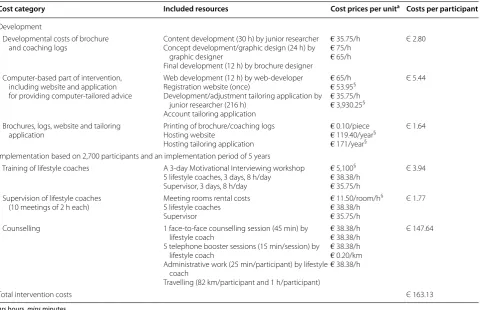
Intervention costs were estimated using a bottom-up micro-costing approach, i.e. detailed data were col-lected regarding the quantity of resources consumed per patient as well as their unit prices. Costing was based on the assumption that the intervention would be imple-mented for a 5-year period by an academic medical center. According to StOEH data, approximately 2,700 people would be eligible and willing to participate during this period [4]. Consequently, five lifestyle coaches would be needed for the coaching component of the interven-tion. Variable costs per participant depended on the number of counselling sessions received and were cal-culated using annual salaries of the lifestyle coaches with added taxes and benefits. Intervention costs addition-ally included costs of the development and implementa-tion of materials, training and supervision of the lifestyle coaches, and the development and implementation of the PRO-FIT*advice web-environment.
Statistical analyses
Missing healthcare costs, QALY data and LDL-C levels were multiply imputed in SPSS 17 creating ten different data sets [17–19]. Data were imputed separately for the intervention and control group. The imputational model included important demographics and prognostic variables associated with the missing data: age, gender, LDL-C lev-els and body mass index (BMI) at baseline and follow-up,
intervention costs, primary care (general practitioner and therapist) costs, secondary care (outpatient visits and hos-pital admission) costs and medication costs, and utilities at baseline and follow-up. Pooled estimates of effects and costs were estimated according to Rubin’s rules [20].
Main analyses were according to the intention to treat principle and based on the imputed data. Differences in baseline characteristics between the intervention and con-trol group and between cases with missing data and cases with complete data were tested using linear and logistic regression analysis. The effects on clinical outcomes at 12 months were analysed using linear regression analyses, adjusted for baseline values. Mean cost differences between the intervention and control group were calculated for pri-mary and secondary care, medication, and total costs. The Approximate Bootstrap Confidence algorithm with 5,000 bootstrap samples was used to estimate 95% confidence intervals surrounding the cost differences [21]. Incremental cost-effectiveness ratios (ICERs) were calculated by divid-ing the difference in total costs between the intervention and control group by the difference in clinical outcomes adjusted for baseline values. The ICER indicates the addi-tional investments needed for the intervention group to gain one extra unit in health effect, i.e. 1 mmol/l LDL-C and 1 QALY, in comparison with usual care. The bootstrapped cost–effect pairs were graphically presented in a cost-effec-tiveness plane, to show the uncertainty around the ICER. Cost-effectiveness acceptability curves (CEACs) were also estimated. CEACs show the ‘willingness to pay’ for a unit of health effect extra (i.e. ceiling ratio) on the x-axis and the corresponding probability that the intervention is cost-effective at that ceiling ratio on the y-axis. All analyses were done in R (version 2.10.1) [22].
To assess the robustness of the results, three sensitivity analyses were performed. First, a cost-effectiveness anal-ysis (CEA) taking only complete cases into account was conducted (CEA2). Second, a CEA was performed using the actual costs of the PRO-FIT intervention within the PRO-FIT trial (including 340 participants, two lifestyle coaches, implemented in a 1-year period) (CEA3). Third, a CEA was conducted in which the hospital admission costs were excluded from the total costs (CEA4).
Results
Participant flow and baseline characteristics
characteristics are given in Table 1. A significant dif-ference in baseline BMI between intervention and con-trol group was found (mean difference = −1.10; 95% CI: −2.16 to −0.05) in the imputed and complete cases dataset. As a consequence, baseline BMI values were included in all analyses of cost-effectiveness regarding LDL-C and QALYs.
Intervention compliance
[image:4.595.60.538.87.592.2]at least one out of six advice modules. Nearly all partici-pants (99%) received the face-to-face counselling session and on average, 4.2 telephone booster calls were con-ducted with 181 participants.
Clinical outcomes
After 12 months, LDL-C had decreased in both groups and by 0.14 mmol/l more in the intervention group. The intervention group had 0.002 QALYs less than the con-trol group. These between-group differences for LDL-C and QALYs were small and statistically non-significant (see Table 2).
Costs
Intervention costs are presented in Table 3 and mainly consisted of the costs of counselling (91%). Pooled mean costs and cost differences between the intervention and control group are presented in Table 4. Around one-third of total costs in both groups consisted of medication costs. Primary care costs were statistically significantly lower in the intervention group in comparison with the control group. Secondary care costs in the control group were considerably higher than in the intervention group due to one extended hospitalization in this group. How-ever, the difference in secondary costs was not statisti-cally significant. Overall healthcare-related costs were €237 lower in the intervention group but this difference was not statistically significant (−1,386 to 130).
Cost‑effectiveness
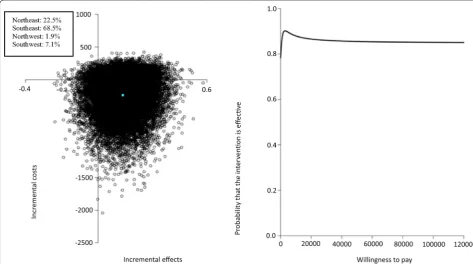
Assuming that the non-significant difference in LDL-C between intervention and control group can be attrib-uted to the intervention, the main analysis showed that the pooled ICER for LDL-C was €1,729 (see Table 5), indicating that a 1 mmol/l decrease in LDL-C concentra-tion extra as a result of the PRO-FIT intervenconcentra-tion saves €1,729, compared to usual care. The cost-effectiveness plane for LDL-C (Fig. 2a) showed that 68% of the boot-strapped cost-effectiveness pairs were located in the southeast quadrant, the quadrant in which the inter-vention is dominant over usual care. The CEAC curve (Fig. 2b) showed that if a decision maker is willing to pay €4,000 for 1 mmol/l LDL-C reduction, the probability that the PRO-FIT intervention is cost-effective is 93%, but thereafter reduces to a maximum of 91%.
Cost‑utility
The ICER of €145,899 per QALY indicates that 1 QALY lost as a result of the PRO-FIT intervention saves the healthcare sector €145,899, compared to usual care (see Table 5).
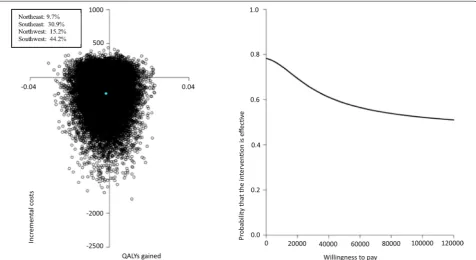
In the cost-effectiveness plane (Fig. 3a), most cost-util-ity pairs (44%) were located in the southwest quadrant, the quadrant in which less QALYs are gained at lower costs in the intervention group compared with usual care. The CEAC (Fig. 3b) indicated that the probability of cost-utility of the PRO-FIT intervention compared to usual care ranged from approximately 75% at a ceiling ratio of €0 per QALY gained to 55% at a ceiling ratio of €120,000 per QALY gained.
Sensitivity analyses
Results of the sensitivity analyses based on complete cases (CEA2) and based on the actual intervention costs of the PRO-FIT intervention (CEA3) were similar to the results from the main analyses (see Table 5). The CEA that excluded hospital admission costs led to smaller cost differences and costs were lower in the control group.
Discussion and conclusions
[image:5.595.57.291.126.215.2]The results of this study show that the PRO-FIT inter-vention was not cost-effective in comparison with Table 1 Baseline characteristics of people with Familial
Hypercholesterolemia in control and intervention group after multiple imputation
Significant differences between control and intervention group (P < 0.05) are printed in italics font.
a Assessed by the EuroQol-5D; N sample size, SD standard deviation, BMI body mass index, SEM standard error of the mean.
Control group
N = 159 Intervention group N = 181
Gender, N (% female) 90 (57) 104 (57)
Mean age in years (SEM) 46.0 (1.0) 44.7 (1.0) Mean BMI in kg/m2 (SEM) 27.1 (0.4) 26.0 (0.3)
Statin use, N (% yes) 110 (69) 123 (68) EQ-5D utility score (SEM)a 0.9 (0.01) 0.9 (0.01)
Table 2 Pooled intervention effects on LDL-C and QALYs after 12 months
Effects were calculated after multiple imputation and with adjustment for baseline values.
LDL-C low-density lipoprotein cholesterol, QALY quality adjusted life year, SEM standard error of the mean; the maximum QALY that can be achieved in one year is 1 unit.
Pooled effects (pooled mean (SEM)) Control group N = 159 Intervention group N = 181 Intervention versus control
Baseline Follow‑up Baseline Follow‑up Mean difference (95% CI)
LDL-C (mmol/l) 3.7 (0.1) 3.6 (0.1) 3.7 (0.1) 3.5 (0.1) −0.14 (−0.34 to 0.07)
[image:5.595.54.541.636.698.2]usual care. No statistically significant differences were found in LDL-C, QALYs and health care costs after 12 months. Our study is the first to evaluate the cost-effectiveness of a lifestyle intervention compared to usual care in a FH sample. Other studies concluded that lifestyle interventions are cost-effective in reduc-ing the long-term risk of type 2 diabetes and CVD [23]. However, our findings show no value in the addition of lifestyle advice to treatment with statins, which has
already been shown to be cost-effective in people with FH [24].
All further discussion and interpretation of the present results regarding cost-effectiveness should obviously be regarded with caution, since we cannot conclude that the non-significant decrease in LDL-C and related gain in QALYs were coincidental or caused by the intervention. For the sake of this economic evaluation, the found dif-ferences compared to the usual care were regarded as real Table 4 Pooled mean differences in healthcare-related costs per participant in Euros between baseline and 12-months follow-up
SEM standard error of the mean, NA not available; costs are given in 2010 Euros; mean differences were calculated after multiple imputations. a Prescribed statins.
Pooled costs [pooled mean (SEM)] Control group Intervention group Mean cost difference (%CI)
PRO-FIT intervention 0 163 163 (NA)
Primary care 86 (17) 44 (8) −43 (−86 to −11)
Secondary care 461 (289) 121 (51) −340 (−1,406 to 24)
Medicationa 284 (29) 266 (23) −17 (−91 to 54)
Total costs 831 (297) 594 (60) −237 (−1,386 to 130)
Table 3 Overview of costs of the PRO-FIT intervention in Euros per participant
hrs hours, mins minutes.
a Salary costs were derived from the Collective Labour Agreement for Dutch Academic Medical Centers (CAO UMC) 2010 (for junior researcher, lifestyle coach and supervisor), or by price offers from web developers, graphic/brochure designers.
§ Costing was based on invoices/price offers.
Cost category Included resources Cost prices per unita Costs per participant
Development
Developmental costs of brochure
and coaching logs Content development (30 h) by junior researcherConcept development/graphic design (24 h) by graphic designer
Final development (12 h) by brochure designer
€ 35.75/h € 75/h € 65/h
Є 2.80
Computer-based part of intervention, including website and application for providing computer-tailored advice
Web development (12 h) by web-developer Registration website (once)
Development/adjustment tailoring application by junior researcher (216 h)
Account tailoring application
€ 65/h € 53.95§
€ 35.75/h € 3,930.25§
Є 5.44
Brochures, logs, website and tailoring
application Printing of brochure/coaching logsHosting website Hosting tailoring application
€ 0.10/piece € 119.40/year§
€ 171/year§
Є 1.64
Implementation based on 2,700 participants and an implementation period of 5 years
Training of lifestyle coaches A 3-day Motivational Interviewing workshop 5 lifestyle coaches, 3 days, 8 h/day Supervisor, 3 days, 8 h/day
€ 5,100§
€ 38.38/h € 35.75/h
Є 3.94
Supervision of lifestyle coaches
(10 meetings of 2 h each) Meeting rooms rental costs5 lifestyle coaches Supervisor
€ 11.50/room/h§
€ 38.38/h € 35.75/h
Є 1.77
Counselling 1 face-to-face counselling session (45 min) by lifestyle coach
5 telephone booster sessions (15 min/session) by lifestyle coach
Administrative work (25 min/participant) by lifestyle coach
Travelling (82 km/participant and 1 h/participant)
€ 38.38/h € 38.38/h € 38.38/h € 0.20/km € 38.38/h
Є 147.64
[image:6.595.59.540.102.412.2] [image:6.595.59.541.490.569.2]and attributable to the intervention. Having conducted a CEA for an intervention for which no evidence of effect was found as compared to usual care seems to have limited value. Though, conducting CEAs while significant effects are lacking is of great importance, e.g. for systematic reviews on the cost-effectiveness of interventions. These reviews are often hampered by a publication bias, since CEAs are generally only conducted if an intervention was significantly effective and are therefore overrepresented [25, 26]. Further, this study examines the joint distribution of costs and effects. This is relevant because even if costs
and effects show no significant differences, the joint dis-tribution could indicate that a treatment is cost-effective in comparison with control for some ceiling ratios [27]. In addition to the economic evaluation, the transparent over-sight of the intervention costs and healthcare-related costs that we provided is relevant for policy-makers and future researchers planning a similar RCT.
Intervention costs were computed as if the interven-tion was implemented with full compliance. Taking into account the actual compliance during the trial would not lead to a substantial difference in intervention costs, as Table 5 Results for cost-effectiveness and cost-utility analyses
Sample size Cost difference in Euros
(95% CI) Effect difference (95% CI) ICER Distribution cost‑effectivess plane (%NE/SE/SW/NW)
I C
Main analysis (CEA1) 181 159 LDL-C −237 (−1,386 to 130) −0.14 (−0.34 to 0.07) 1,729 22.5/68.5/7.1/1.9 181 159 QALY −237 (−1,386 to 130) −0.002 (−0.02 to 0.01) 145,899 9.7/30.9/44.2/15.2 Complete case analysis
(CEA2) 118157 100136 LDL-CQALY −−364 (301 (−−1,680 to 109)2,030 to 238) −−0.003 (0.14 (−−0.03 to 0.03)0.37 to 0.08) 100,3472,012 4.6/8.0/55.7/31.76.5/25.4/52.5/15.6 Intervention costs as in RCT
(CEA3) 181181 159159 LDL-CQALY −−88 (88 (−−1,248 to 277)1,248 to 277) −−0.002 (0.14 (−−0.02 to 0.01)0.34 to 0.07) 54,426645 39.4/51.6/5.5/3.617.1/23.4/33.8/25.7 Hospital admission costs
excluded (CEA4) 181181 159159 LDL-CQALY 94 (94 (−−6 to 193)6 to 193) −−0.002 (0.14 (−−0.02 to 0.01)0.34 to 0.07) −−33,676690 88.5/2.4/0.5/8.538.9/1.2/1.7/58.2
[image:7.595.58.538.103.238.2] [image:7.595.57.531.426.690.2]the proportion of participants that received face-to-face counselling was 99%. However, the intervention costs in this study were based on five telephone booster calls, whereas on average 4.2 were conducted during the trial. Consequently, the actual intervention costs are only slightly less (€155.46 instead of €163.13).
Secondary care costs in the control group were consid-erably higher than in the intervention group and this con-tributed most to the difference in total healthcare-related costs between the groups. Further analysis showed that this was caused by higher mean hospital admission costs associated with FH and/or CVD in the control group than in the intervention group. A sensitivity analysis excluding hospital admission costs showed that, in con-trast to the main CEA analysis, costs in the intervention group were higher than in the control group, but this dif-ference was not statistically significant and the interven-tion was still not considered cost-effective.
Limitations of this economic evaluation should be taken into consideration. At first, the evaluation was performed from a healthcare perspective, while Dutch guidelines recommend adapting a societal perspective. We chose this perspective since our central aim was to lower LDL-C with lifestyle changes, and no effects on productivity costs due to the intervention in the follow-up period were expected. Second, information on healthcare utilization
and prescribed medication was obtained through a 12-month retrospective questionnaire. Shorter recall periods reduce the chance of recall bias, though more fre-quent measurements with a shorter recall period could have increased the chance of missing data, compared with one measurement with a recall period of 12 months [28]. Third, whereas intervention costs were complete, data on healthcare-related resource use and LDL-C/QALYs were missing for 36 and 14% of the participants, respectively. To account for these missing data, multiple imputation techniques were used. Multiple imputation is preferred over complete case analysis [28], since a complete-case analysis is inefficient, as the sample size is smaller and it ignores observed cost and/or effect data in the excluded participants. The advantage of using multiple imputation is that the uncertainty associated with imputing missing values is also taken into account in the pooled estimates. Overall, it is likely that the effect of lifestyle improvements is likely to lead to CVD risk reduction at the longer term (>12 months). Inclusion of more long-term follow-up measurements would clarify intervention effects on CVD risk and hard outcomes (e.g. CVD/death) and would allow a more thorough cost-effectiveness analysis.
[image:8.595.60.537.89.349.2]effects found in the study, the conclusions should be regarded with caution.
Abbreviations
FH: Familial Hypercholesterolemia; LDL-C: low-density lipoprotein choles-terol; CI: confidence interval; QALY: quality adjusted life years; DALY: disability adjusted life years; CVD: cardiovascular disorders; StOEH: Stichting Opsporing Erfelijke Hypercholesterolemie; RCT: randomized controlled trial; MI: motiva-tional interviewing; BMI: body mass index; ICER: incremental cost-effectiveness ratio; CEAC: cost-effectiveness acceptability curve; CEA: cost-effectiveness analysis.
Authors’ contributions
KB carried out the PRO-FIT study and analysed the intervention effects on clinical outcomes. MvP, LK, JB and WvM provided support in the design of the study. Cost-effectiveness analyses were performed by MvW. JB provided sup-port in the cost-effectiveness analyses. KB wrote the manuscript. All authors read and approved the final manuscript.
Author details
1 Department of Public and Occupational Health, EMGO+ Institute for Health
and Care Research, VU University Medical Center, Amsterdam, The Nether-lands. 2 Department of Health Economics and Health Technology Assessment,
Faculty of Earth and Life Sciences, Institute of Health Sciences, VU Univer-sity, Amsterdam, The Netherlands. 3 TNO, Division Work and Employment,
Hoofddorp, The Netherlands. 4 Department of Epidemiology and Biostatistics,
EMGO+ Institute for Health and Care Research, VU University Medical Center, Amsterdam, The Netherlands.
Acknowledgements
This project was financed by ZonMw (Netherlands Organisation for Health, Research and Development). The publication of this manuscript was funded by the Open Access Fund of The Netherlands Organisation for Scientific Research (NWO).
Compliance with ethical guidelines
Competing interests
The authors declare that they have no competing interests.
Received: 5 February 2015 Accepted: 16 July 2015
References
1. Goldstein J, Hobbs H, Brown M (2001) Familial hypercholesterolemia. In: Scriver C, Beaudet A, Sly WS, Valle D (eds) The metabolic and molecular bases of inherited disease. McGraw-Hill, New York (NY), pp 2863–2913 2. Fauci AS, Braunwald E, Kasper DL, Hauser SL, Jameson JL, Loscalzo J
(2008) Harrison’s principles of internal medicine, 17th edn. McGraw-Hill Medical Publishing Division, New York (NY)
3. Scientific Steering Committee on behalf of the Simon Broome Register Group (1991) Risk of fatal coronary heart disease in familial hypercholes-terolaemia. BMJ 303:893–896
4. Stichting Opsporing Erfelijke Hypercholesterolemie StOEH (Foundation for Tracing Hereditary Hypercholesterolemia) (2010) Annual Report 2009, StOEH, 2010, Amsterdam, the Netherlands
5. Guilbert JJ (2003) The world health report 2. Educ Health 16:230 6. Allender S, Scarborough P, Peto V, Rayner M (2008) European
cardiovascu-lar statistics. European Heart Network, Brussels
7. Blokstra A, van Dis I, Verschuren WM (2010) Efficacy of multifactorial lifestyle interventions in patients with established cardiovascular diseases and high risk groups. Eur J Cardiovasc Nurs 11:97–104
8. Kromhout D, Menotti A, Kesteloot H, Sans S (2002) Prevention of coronary heart disease by diet and lifestyle: evidence from prospective cross-cultural, cohort, and intervention studies. Circulation 105:893–898 9. Lin JS, O’Connor E, Evans CV, Senger CA, Rowland MG, Groom HC (2014)
Behavioral counseling to promote a healthy lifestyle in persons with car-diovascular risk factors: a systematic review for the US Preventive Services Task Force. Ann Intern Med 161(8):568–578
10. Broekhuizen K, van Poppel MNM, Koppes LL, Brug J, van Mechelen W (2010) A tailored lifestyle intervention to reduce the cardiovascular disease risk of individuals with Familial Hypercholesterolemia: design of the PRO-FIT randomised controlled trial. BMC Public Health 10:69 11. Rubak S, Sandbaek A, Lauritzen T, Christensen B (2005) Motivational
interviewing: a systematic review and meta-analysis. Br J Gen Pract 55:305–312
12. Brooks R (1996) EuroQol: the current state of play. Health Policy 37:53–72 13. Lamers LM, Stalmeier PF, McDonnell J, Krabbe PF, van Busschbach JJ
(2005) Measuring the quality of life in economic evaluations: the Dutch EQ-5D tariff. Ned Tijdschr Geneeskd 149:1574–1578
14. Statistics Netherlands (2012) Prices, consumer prices. http://statline.cbs. nl. Accessability verified May 21, 2012
15. Oostenbrink J, Bouwmans CKM, Rutten F (2004) Handleiding voor kostenonderzoek: Methoden en standaard kostprijzen voor economische evaluaties in de gezondheidszorg. Dutch Health Care Insurance Board, Diemen, the Netherlands
16. Royal Dutch Society for pharmacy (2006) Z-index. G-standard, The Hague, The Netherlands
17. Azur MJ, Stuart EA, Frangakis C, Leaf PJ (2011) Multiple imputation by chained equations: what is it and how does it work? Int J Methods Psy-chiatr Res 20:40–49
18. van Buuren S (2007) Multiple imputation of discrete and continuous data by fully conditional specification. Stat Methods Med Res 16:219–242 19. National Institute for Health and Clinical Excellence (2004) Guide to the
methods of technology appraisal. NICE, London
20. Rubin D (1987) Multiple imputation for nonresponse in surveys. Wiley, New York (NY)
21. Burton A, Billingham LJ, Bryan S (2007) Cost-effectiveness in clinical trials: using multiple imputation to deal with incomplete cost data. Clin Trials 4:154–161
22. R Development Core Team (2008) R: a language and environment for statistical computing. R Foundation for Statistical Computing, Vienna, Austria
23. Saha S, Gerdtham UG, Johansson P (2010) Economic evaluation of life-style interventions for preventing diabetes and cardiovascular diseases. Int J Environ Res Public Health 7:3150–3195
24. Nherera L, Calvert NW, Demott K, Humphries SE, Neil HA, Minhas R et al (2010) Cost-effectiveness analysis of the use of a high-intensity statin compared to a low-intensity statin in the management of patients with familial hypercholesterolaemia. Curr Med Res Opin 26:529–536 25. Van Dongen JM, Proper KI, van Wier MF, van der Beek AJ, Bongers PM, van
Mechelen W et al. (2012) A systematic review on the cost-effectiveness of worksite physical activity and/or nutrition programs. Scand J Work Environ Health 38:393–408
26. Bell CM, Urbach DR, Ray JG, Bayoumi A, Rosen A (2006) Bias in published cost-effectiveness studies: a systematic review. BMJ 332:699–703 27. Petrou S, Gray A (2011) Economic evaluation alongside randomised
controlled trials: design, conduct, analysis, and reporting. BMJ 342:1548 28. Schafer JL, Graham JW (2002) Missing data: our view of the state of the