Test of Hypotheses for
Linear Regression Models with
Non-Sample Prior Information
A Dissertation Submitted by
Budi Pratikno
B.Sc., M.Stat.Sci.
For the award of
Doctor of Philosophy
October, 2012
Classical inferences about population parameters are usually drawn from the sample
data alone. This applies to methods used in parameter estimation and hypothesis
testing. Inferences about population parameters could be improved using non-sample
prior information (NSPI) on the value of another related parameter. However, any
NSPI on the value of any parameter is likely to be uncertain (or unsure). The NSPI
can be classified as (i) unknown (unspecified), (ii) known (specified), and (iii)
uncer-tain if the suspected value is unsure. For the three different scenarios, three different
statistical tests: (i) unrestricted test (UT), (ii) restricted test (RT) and (iii)
pre-liminary test test (PTT) are defined. The current research is to test the intercept
parameter(s) when NSPI is available on the slope parameter(s). The test statistics,
their sampling distributions, and power functions of the tests are derived. Comparison
of power functions of the tests are used to recommend a best test. In this thesis, we
test (1) the intercept of the simple regression model (SRM) when there is NSPI on the
slope, (2) the intercept vector of the multivariate simple regression model (MSRM)
when there is NSPI on the slope vector, (3) a subset of regression parameters of the
multiple regression model (MRM) when NSPI is available on another subset of the
regression parameters, and (4) the equality of the intercepts for p(≥ 2) lines of the parallel regression model (PRM) when there is NSPI on the slopes.
For each of the above four regression models, the following steps are carried out:
(1) derived the test statistics of the UT, RT and PTT for both known and unknown
variance, (2) derived the sampling distributions of the test statistics of the UT, RT and
PTT, (3) derived and compared the power function and the size of the UT, RT and
PTT. For known variance, under a sequence of an alternative hypothesis, the sampling
distributions of the UT and RT of the simple regression model follows a normal
distribution. However, the PTT follows a bivariate normal distribution. For unknown
t distribution. For the multivariate simple regression, multiple regression and parallel regression models, the sampling distribution of the UT and RT follows a univariate
noncentralF distribution under the alternative hypothesis. However, the PTT follows a correlated bivariate noncentralF distribution. For the four regression models above, there is a correlation between the UT and PT but there is no such correlation between
the RT and PT. To evaluate the power function of the PTT the probability integral of
the bivariate normal, bivariate Student’s t and bivariate noncentral F distributions are used. For the computations of the power function of the PTT of the MSRM,
MRM and PRM require the cumulative distribution function (cdf) of a correlated
bivariate noncentral F (BNCF) distribution. But the correlated BNCF distribution is not available in the literature, and hence we derive the probability density function
(pdf) and cdf of the BNCF distribution. The R package is used for all computations
and graphical analyses.
The statistical criteria that are used to compare the performance of the UT, RT
and PTT are the size and power of the tests. A test that minimizes the size and
maximizes the power is preferred over any other tests. In reality, the size of a test is
fixed, and then the choice of the best test is based on its maximum power.
The study shows that the power of the RT is always higher than that of the UT
and PTT, and the power of the PTT lies between the power of the RT and UT. The
size of the UT is smaller than that of the RT and PTT. Among the three tests, the UT
has the lowest power and lowest size. In terms of power it is the worst and in terms
of size it is the best. The RT has maximum power and size. The PTT has smaller
size than the RT and the RT has larger power than the PTT. The PTT protects
against maximum size of the RT and minimum power of the UT. Thus the the PTT
attains a reasonable dominance over the UT and RT for all regression models when
the suspected value of the slope parameter(s) suggested by the NSPI is not too far
away from that under the null hypothesis.
I certify that the ideas, mathematical derivation of the formulas, findings, analyses
and conclusions reported in this dissertation are the result of my own work, except
where otherwise acknowledged. I also certify that the thesis is original and has not
been previously submitted for any other award to any other university, except where
otherwise acknowledged.
... ...
Signature of Candidate Date
ENDORSEMENT
... ...
Signature of Principal Supervisor Date
... ...
Signature of Associate Supervisor Date
First of all, I would like to express my deepest gratitude to almighty Allah, whose
divine support helped me to complete this dissertation, Alhamdulillah.
I heartily thank my principal supervisor, Professor Shahjahan Khan for proposing
the research topic, providing technical support and professional guidance, monitoring
work progress, allocating generous time and extending personal care during my study
at the University of Southern Queensland (USQ). You have provided me with
unbe-lievable support in all respects throughout my candidature, especially for introducing
the research area, about which I had absolutely no idea before I met you. I have never
seen you unrespectful to answer any of my questions, even to the most stupid ones.
I could not have finished this thesis without your continuous guidance, mentorship
and help. I find no words to express my gratitude to you.
I must also thank my associate supervisor Dr Rachel King, A/Prof Stijn Dekeyser,
Head of Mathematics and Computing Department and Dr Tek Maraseni Deputy
Director Australian Centre for Sustainable Catchments (ACSC) for their support.
I express my gratitude to all staff of the Department of Mathematics and
Comput-ing and The LearnComput-ing Centre for cordial help and co-operation. I extend my special
thanks to the Department of Mathematics and Computing for providing me with a
part-time marking position. I thankfully acknowledge the excellent support of the
Office of Research and Higher Degrees (ORHD).
I would like to express my gratitude to the Jenderal Soedirman University
(Un-soed), Purwokerto, Indonesia for granting me study leave to study at University of
Southern Queensland. I must also thank Professor Edy Yuwono, Rector of Unsoed,
Dr Purnama Sukardi, Dean of Faculty of Science and Technology Unsoed and
Di-rectorate General Higher Education of Indonesia (DIKTI), Indonesian Government
Sponsorship for encouraging me to complete the study.
To my parents- It would not have been possible for me to reach this stage if you
did not sacrifice so much even though you are being sick for a long time. Thanks
God, you blessed me with such lovely parents.
Finally, to Rohana Arifianti, Asyidqyana Irsyadita and Syahida Chairunisa, it
could not be possible to complete this dissertation in due time without your support
and encouragement.
BCF bivariate central F
BNCC bivariate noncentral chi-square BNCF bivariate noncentral F
cdf cumulative distribution function d.f. degrees of freedom
LR likelihood ratio LRT likelihood ratio test LSE least-square estimator
MLE maximum likelihood estimator
MLUE maximum likelihood unrestricted estimator MRM multiple regression model
MSRM multivariate simple regression model NSPI non-sample prior information
pdf probability density function PRM parallel regression model PT preliminary test
PTE preliminary test estimator PTT preliminary test test RE restricted estimator RT restricted test
SRM simple regression model UE unrestricted estimator UT unrestricted test
Contents
1 Overview 1
1.1 Introduction . . . 1
1.2 Main Contributions of the Thesis . . . 5
1.3 Thesis Outlines . . . 6
2 Literature Review, the Bivariate Noncentral F Distribution and Methodology of Analysis 8 2.1 Literature Review . . . 8
2.1.1 The Preliminary Test Estimation . . . 8
2.1.2 The Pre-test Test . . . 11
2.2 The Bivariate CentralF Distribution . . . 11
2.3 The Bivariate Noncentral F Distribution . . . 12
2.3.1 The Singly Bivariate Noncentral F Distribution . . . 13
2.3.2 The Doubly Bivariate Noncentral F Distribution . . . 17
2.4 The Methodology of Analysis . . . 23
2.4.1 The UT, RT, PT and PTT . . . 23
2.4.2 The Power Function and Size of the Tests . . . 25
2.4.3 The R Package, Data and Comparison of Tests . . . 27
3 The Simple Regression Model 29 3.1 Introduction . . . 29
3.2 Testing of the Intercept for Known σ2 . . . . 31
3.2.1 The Proposed Tests . . . 31
3.2.2 Sampling Distribution of Test Statistics . . . 33
3.2.3 Power Function and Size of Tests . . . 34
3.2.5 A Simulation Example . . . 37
3.2.6 Comparison of the Tests . . . 41
3.2.7 Conclusion . . . 42
3.3 Testing of the Intercept for Unknown σ2 . . . . 43
3.3.1 Proposed Tests . . . 43
3.3.2 Sampling Distribution of Test Statistics . . . 44
3.3.3 Power Function and Size of Tests . . . 45
3.3.4 Analytical Comparison of the Tests . . . 47
3.3.5 A Simulation Example . . . 48
3.3.6 Comparison of the Tests . . . 55
3.3.7 Conclusion . . . 56
4 The Multivariate Simple Regression Model 58 4.1 Introduction . . . 58
4.2 The Proposed Tests . . . 62
4.3 Sampling Distribution of Test Statistics . . . 64
4.4 Power Function and Size of Tests . . . 66
4.4.1 The Power of the Tests . . . 66
4.4.2 The Size of the Tests . . . 68
4.5 Analytical Comparison of the Tests . . . 69
4.5.1 The Power of the Tests . . . 69
4.5.2 The Size of the Tests . . . 70
4.6 A Simulation Example . . . 70
4.7 Comparison of the Tests . . . 72
4.8 Conclusion . . . 75
5 The Multiple Regression Model 76 5.1 Introduction . . . 76
5.2 The Proposed Tests . . . 79
5.3 Sampling Distribution of Test Statistics . . . 82
5.4 Power Function and Size of Tests . . . 83
5.4.1 The Power of the Tests . . . 83
5.5 A Simulation Example . . . 86
5.6 Comparison of the Tests . . . 89
5.7 Conclusion . . . 90
6 The Parallel Regression Model 91 6.1 Introduction . . . 91
6.2 The Proposed Tests . . . 94
6.3 Sampling Distribution of Test Statistics . . . 96
6.4 Power Function and Size of Tests . . . 98
6.5 A Simulation Example . . . 100
6.6 Comparison of the Tests . . . 101
6.7 Conclusion . . . 103
7 Discussions, Conclusions and Future Research 105 7.1 Discussions and Conclusions . . . 105
7.2 Limitations and Future Directions . . . 108
References 109 Appendices 117 Appendix A R codes 118 A.1 Figure 2.1. The cdf of the singly BNCF distribution . . . 118
A.2 Figure 2.2. The cdf of the doubly BNCF distribution . . . 122
A.3 Figure 3.1. The power againstλ1 of the SRM for known σ2 . . . 124
A.4 Figure 3.2. The size againstλ1 of the SRM for known σ2 . . . 127
A.5 Figure 3.3. The power of the PTT and size againstρ&λ2 of the SRM for knownσ2 . . . . 130
A.6 Figures 3.4, 3.5 and 3.6. The power againstλ1 of the SRM for unknown σ2 . . . 135
A.7 Figure 3.7. The power of the PTT and size against λ2 and ρ of the SRM for unknown σ2 . . . . 139
A.8 Figure 3.8. The size againstλ2 and ρ of the SRM for unknown σ2 . . 151
A.10 Figure 4.1. The power againstϕ1 of the MSRM . . . 157
A.11 Figure 4.2. The size againstϕ1 of the MSRM . . . 163
A.12 Figure 5.1. The power againstζ1 of the MRM . . . 168
A.13 Figure 5.2. The size againstζ1 of the MRM . . . 174
A.14 Figure 6.1. The power againstδ1 of the PRM . . . 181
A.15 Figure 6.2. The size againstδ1 of the PRM . . . 188
Appendix B List of Publications and Seminars 193 B.1 Publications . . . 193
B.2 Seminars . . . 193
Appendix C Curriculum Vitae 195
List of Figures
2.1 The cdf of the singly bivariate noncentral F distribution. . . 16 2.2 The cdf of the doubly bivariate noncentral F distribution. . . 22
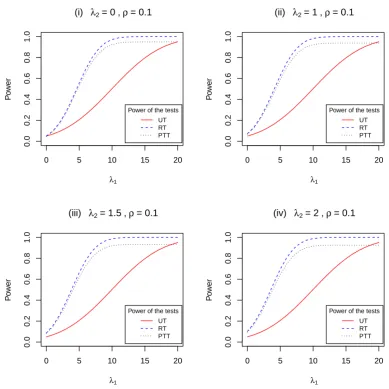
3.1 Power of the UT, RT and PTT against λ1 with ρ = 0.1 and λ2 =
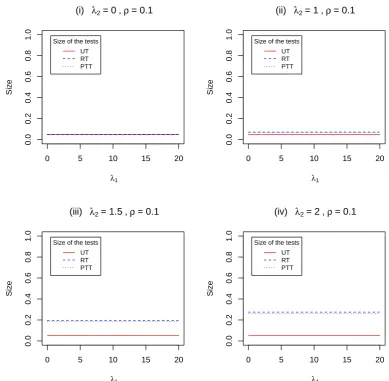
0,1,1.5,2. . . 38 3.2 Size of the UT, RT and PTT against λ1 with λ2 = 0,1,1.5,2. . . 39
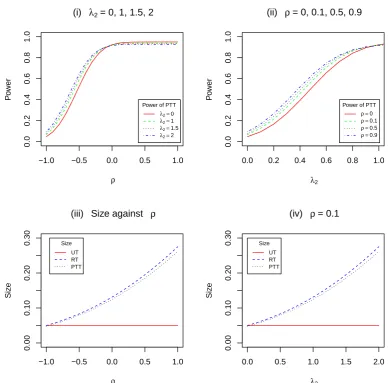
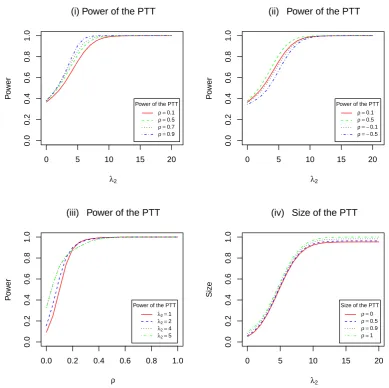
3.3 Power of the PTT and size against ρ and λ2. . . 40
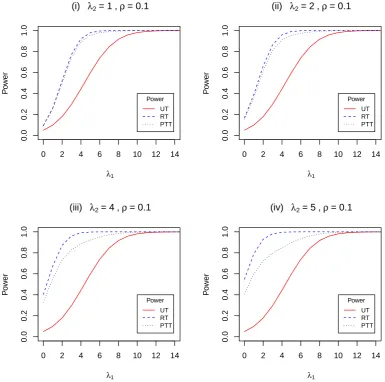
3.4 The power of the UT, RT and PTT against λ1 with ρ = 0.1 and
λ2 = 1, 2, 4, 5. . . 49
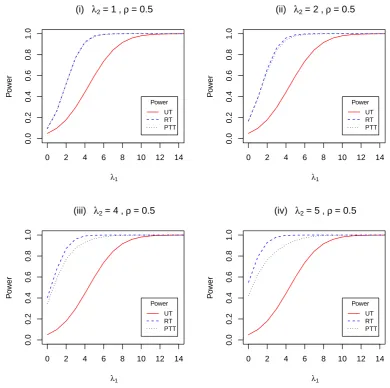
3.5 Power of the UT, RT and PTT against λ1 with ρ = 0.5 and λ2 =
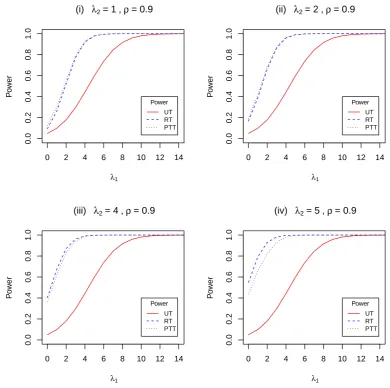
1, 2, 4, 5. . . 50 3.6 Power of the UT, RT and PTT against λ1 with ρ = 0.9 and λ2 =
1, 2, 4, 5. . . 51 3.7 Power and size of the PTT against λ2, and the power of the PTT
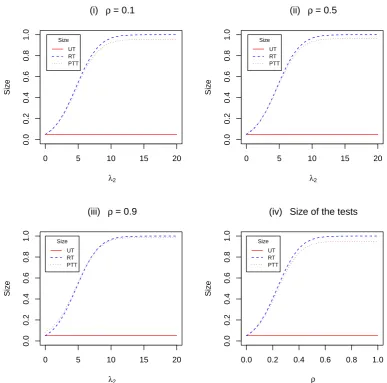
against ρ. . . 52 3.8 Size of the UT, RT and PTT against λ2 for selected ρ= 0.1, 0.5, 0.9,
and size against ρ. . . 53 3.9 Size of the UT, RT and PTT againstλ1 for selected values λ2 = 1,2,4,5. 54
4.1 Power of the tests againstϕ1for selected values ofρ, degrees of freedom
and noncentrality parameters. . . 72
4.2 Size of the tests against ϕ1 for selected values of ρ and ϕ2. . . . 73
5.1 Power function of the UT, RT and PTT against ζ1 for some selected
ρ, ζ2, degrees of freedom and noncentrality parameters. . . 87
5.2 Size of the UT, RT and PTT againstζ1 for some selectedρ,ζ2, degrees
of freedom and noncentrality parameters. . . 88
ρ, degrees of freedom and noncentrality parameters. . . 101 6.2 Size of the UT, RT and PTT against δ1 for some selected ρ and δ2. . 102
Chapter 1
Overview
1.1
Introduction
As a common practice, classical inferences about population parameters are always
drawn from the sample data alone. This applies to methods used in parameter
es-timation and hypothesis testing. Inferences about population parameters could be
improved using non-sample prior information (NSPI) from trusted sources (cf
Ban-croft, 1944). Such information, which is usually available from previous studies or
expert knowledge or experience of the researchers, is un-related to the sample data.
It is expected that the inclusion of NSPI in addition to the sample data improves
the quality of the estimator and the performance of the test. However, any NSPI
on the value of any parameter is likely to be uncertain (or unsure). In this case,
the information can be articulated in the form of a null hypothesis. An appropriate
statistical test on this null hypothesis will be useful to eliminate the uncertainty on
the suspected information. Then the outcome of the preliminary testing (pre-testing)
on the uncertain NSPI is used in the hypothesis testing or estimation. This approach
is likely to improve the quality of the estimator and the performance of the statistical
test (see Khan and Saleh, 2001; Saleh, 2006, p. 1; Yunus, 2010; Yunus and Khan,
2011a).
The NSPI can be classified as (i) unknown (unspecified) if NSPI on the value of
the parameter(s) is unavailable, (ii) known (certain or specified) if the exact value of
the parameter(s)is available, and (iii) uncertain if the suspected value is unsure (that
is, suspected to be a fixed quantity). For the three different scenarios, three different
estimators, namely the (i) unrestricted estimator (UE), (ii) restricted estimator (RE)
and (iii) preliminary test estimator (PTE) are defined in the literature (see,e.g., Judge
and Bock, 1978; Saleh, 2006, p. 58). Khan (2003), and Khan and Hoque (2003)
provide the UE, RE, and PTE for different linear models. For the testing purpose,
three different statistical tests, namely the (i) unrestricted test (UT), (ii) restricted
test (RT) and (iii) pre-test test (PTT) are defined along the same line as the three
different estimators. The UE and UT use the sample data alone but the RE and RT
do not use the sample data alone. The PTE and PTT use both the NSPI and the
sample data. The PTE is a choice between the UE and RE, whereas the PTT is a
choice between the UT and RT. The choice depends on the outcome of the pre-testing
on the uncertain NSPI value. Note that by definition the test statistics of the PT and
UT are correlated but that of the PT and RT are uncorrelated, indeed independent.
Many authors have contributed to this area to the estimation of parameter(s) in
the presence of uncertain NSPI. Bancroft (1944, 1964, 1965) and Han and Bancroft
(1968) introduced a preliminary test estimation of parameters to estimate the
param-eters of a model with uncertain prior information. Later, Sclove et al. (1972), Stein
(1981), Maatta and Casella (1990), Bhoj and Ahsanullah (1994), Khan (2003, 2005,
2006a, 2006b, 2008), Khan and Saleh (1995, 1997, 2001, 2005, 2008), Khan et al.
(2002a, 2002b, 2005), Khan and Hoque (2003), and Saleh (2006, p. 55) covered
vari-ous work in the area of improved estimation using NSPI. But there is a very limited
number of studies on the testing of parameters in the presence of uncertain NSPI.
Although Tamura (1965), Saleh and Sen (1978, 1982), Yunus and Khan (2008, 2011a,
methods, the problem has not been addressed in the parametric context. Some
au-thors have studied the UE, RE and PTE for parametric cases (for instance Bechhofer
(1951), Bozivich et al. (1956), Bancroft (1964) and Saleh (2006)), but nor the tests.
The current research is to test the intercept parameter(s) when NSPI is available
on the slope parameter(s) of various linear models. The test statistics, their sampling
distributions, and power function of the tests are derived. Comparison of power
function of the tests are used to recommend a best test. In this thesis, we test
1. the intercept of thesimple regression model (SRM) when there is NSPI on the
slope,
2. the intercept vector of the multivariate simple regression model (MSRM) when
there is NSPI on the slope vector,
3. a subset of regression parameters of themultiple regression model (MRM) when
NSPI is available on another subset of the regression parameters, and
4. the equality of the intercepts for p(≥ 2) lines of the parallel regression model
(PRM) when there is NSPI on the slopes.
For each of the above four regression models, the following tasks are carried out:
1. derive the test statistics of the UT, RT and PTT for both known and unknown
variance,
2. derive the sampling distribution of the test statistics of the UT, RT and PTT,
and
3. derive and compare the power function and the size of the UT, RT and PTT.
For known variance, under a sequence of the alternative hypotheses, the sampling
follow normal distributions. However, the test statistic of the PTT follows a
bivari-ate normal distribution. For unknown variance, the sampling distribution of the test
statistics of the UT and RT of the simple regression model follow Student’st
distribu-tion but that of the PTT follows a correlated bivariate Student’s t distribution. For
the MSRM, MRM and PRM, the sampling distribution of the test statistics of the
UT and RT follow a univariate noncentral F distribution under alternative
hypoth-esis. However, the test statistic of the PTT follows a correlated bivariate noncentral
F (BNCF) distribution. For the above four regression models, there is a correlation
between the UT and PT but there is no correlation between the RT and PT. To
evaluate the power function of the PTT the probability integral of the bivariate
nor-mal, bivariate Student’s t and BNCF distributions are used. However, the bivariate
probability integrals of the above three distributions are very complicated.
Compu-tational formulas to evaluate the probability density function (pdf) and cumulative
distribution function (cdf) of the distributions are provided. The R package is used
for all computations and graphical analyses.
The computations of the power function of the PTT of the regression models
(MSRM, MRM and PRM) require the cdf of a correlated BNCF distribution. But
the correlated BNCF distribution is not available in the literature, and hence we
derive the pdf and cdf of the BNCF distribution. The pdf and cdf of the doubly
BNCF distribution are derived by mixing correlated bivariate noncentral chi-square
(BNCC) and central chi-square distributions. Whereas, the pdf and cdf of the singly
BNCF distribution are obtained by compounding the Poisson distribution with the
bivariate centralF (BCF) distribution. For the computation the probability integral
of the bivariate Student’s t distribution, we refer to the pdf of the multivariate t
distribution given by Kotz and Nadarajah (2004, p. 1).
and PTT are the size and power of the tests. A statistical test that has a minimum
size is preferable because it ensures a smaller probability of a type I error. Also, if
more than one statistical tests have the same power, the test that has a minimum
size is preferable. Furthermore, a test (or among the tests of the same size) that has
maximum power is preferred over any other tests because it guarantees the highest
probability of rejecting any false null hypothesis. A test that minimizes the size and
maximizes the power is preferred over any other tests. In reality, the size of a test
is fixed, and then the choice of the best test is based on the criterion of maximum
power.
The study shows that the power of the RT is always higher than that of the UT
and PTT, and the power of the PTT lies between the power of the RT and UT. The
size of the UT is smaller than that of the RT and PTT. Among the three tests, the UT
has the lowest power and lowest size. In terms of power it is the worst and in terms
of size it is the best. The RT has maximum power and size. The PTT has smaller
size than the RT and the RT has larger power than the PTT. The PTT protects
against maximum size of the RT and minimum power of the UT. Thus, PTT attains
a reasonable dominance over the other two tests for all four regression models when
the suspected value of the parameter(s) suggested by the NSPI is not too far away
from its true value.
1.2
Main Contributions of the Thesis
The main contributions of the dissertation are as follow.
1. To use the uncertain NSPI in addition to the sample data to improve the
per-formance of the test.
• To test the intercept when NSPI is available on the value of the slope for
the simple regression model.
• To test the intercept when NSPI is available on the value of the slope for
the multivariate simple regression model.
• To test a subset of regression parameters when NSPI on another subset of
regression parameters is available for the multiple regression model.
• To test the equality of the two intercepts when NSPI on the equality of
the two slopes is available for the parallel regression model.
3. To determine the sampling distribution of the test statistics of the UT, RT and
PTT for the four different regression models.
4. To derive the power functions of the UT, RT and PTT for the four different
regression models.
5. To compare the power functions and the sizes of the UT, RT and PTT for the
four different regression models.
6. To search for an optimum test that minimizes the size and maximizes the power
and recommend the best performing test with maximum power (for fixed size).
For the SRM, we consider two cases for known and unknown variance, but for the
other models only the case of unknown variance/covariance is considered.
1.3
Thesis Outlines
The thesis consists of seven chapters, an overview is presented in Chapter 1.
Chap-ter 2 describes a liChap-terature review of previous works, some related distributions, the
bivariate noncentralF distribution and methodology of analysis. Testing of the
inter-cept for both cases of known and unknown variance by the UT, RT and PTT in the
in Chapter 3. Chapter 4 is devoted to testing the intercept by the UT, RT and PTT
for the multivariate simple regression model. Testing of a subset of regression
parame-ters by the UT, RT and PTT for the multiple regression model is provided in Chapter
5. Chapter 6 describes testing of the equality of the two intercepts by the UT, RT and
PTT for the parallel regression model. In each chapter, the study discusses the test
statistics, their distributions, power function of the tests and comparison of power of
the UT, RT and PTT. An illustrative example is given using simulated data. The
graphical representation of the power and size of the tests are also provided. Finally
the power function and size of the UT, RT and PTT are compared. The conclusion
Chapter 2
Literature Review, the Bivariate
Noncentral
F
Distribution and
Methodology of Analysis
2.1
Literature Review
2.1.1
The Preliminary Test Estimation
From Section 1.1, we see the use of prior information in the parameter estimation
or hypothesis test may improve the quality of the estimator or the performance of
the test. However, such a prior information is usually uncertain. This has warranted
the preliminary testing on the suspected value of the parameter(s) to remove the
uncertainty. The outcome of the pre-test is then incorporated into the procedure of
estimation or test on another parameter (cf Yunus, 2010).
Judge and Bock (1978), Khan and Saleh (2001), and Saleh (2006) have discussed
detail about the theory of pre-test in the area of parameter estimation including UE,
RE and PTE. There are a large number of published articles on the PTE given by
Saleh (2006); Khan (1998); Khan and Saleh (2001); Kabir and Khan (2009), among
others, whereas the idea of the PTE is introduced by Bancroft (1944, 1964). Later,
Bancroft (1965) implemented the idea of PTE in the ANOVA to study the effect of
pre-testing on the estimation of variance.
To understand the concept of the PTE, we can refer to the problem of estimating
the population mean (µ) of any population based on a set of sample data when
it is apriori suspected that µ = µ0. Let X1,· · ·, Xn be a random sample from
N(µ, σ2). Then the sample mean X = 1
n
∑n
i=1Xi is an unrestricted estimator (UE)
ofµ. Similarly the sample varianceS2 = n−11∑ni=1(Xi−X
)2
is an unbiased estimator
of σ2. Based on the exclusive sample data, µU E =X. If the uncertain NSPI on µ is
given by µ0, then the restricted estimator (RE) of the mean is defined as µRE =µ0.
Note µ0 does not depend on the sample data. To remove the uncertainty in the
suspected values of µ a statistical test is performed. In this case we test H0 :µ=µ0
versus Ha:µ̸=µ0 using the test statistic
t= X−µ0
S/√n
which follows a Student’s t distribution with (n−1) degrees of freedom. Then the
pre-test estimator (PTE) of µis defined as
b
µP T E =µU EI(t0 ≥tα2,n−1) +µREI(t0 < tα2,n−1),
where α is the level of significance and t0 is the observed value of the t statistic and
I(B) is the indicator function of the set B. Clearly PTE depends on the value of α
and it is either the UE or RE depending on the outcome of the pre-test on the NSPI.
The PTE can also be explained for the SRM,
Yi =β0+β1Xi +ei,
where the error variableei fori= 1,2,· · · , nare i.i.dN(0, σ2) (Wackerly et al., 2008,
p.581). If β0 and β1 be the unknown intercept and slope parameters, respectively,
with β1 =β10 (suspected), then the UE, RE and PTE are given as:
(i) the UE ofβ0 is the least square estimator (LSE) or maximum likelihood estimator
(MLE), βe0
U E
= Y −βe1X, where βe1 is the maximum likelihood estimator or,
equivalently, least square estimator of β1,X = 1n
∑n
i=1Xi and Y = 1
n
∑n
(ii) the RE of β0 is βb0
RE
=Y −β10X, and
(iii) if the NSPI on β1 is uncertain, the uncertainty is removed by testing H0∗ :β1 =
β10 with the test statistic,
T2 = (βe1−β10)
2∑n
i=1(Xi−X) 2
SE(βe1)
,
where T2 ∼ F
1,n−2 under H0∗. Based on the rejection or acceptance of H0∗, the PTE
of the intercept β0 is a choice between the UE and RE. The PTE of β0 is
e
β0
P T E
=βb0I(T2 < Fα,1,n−2) +βe0I(T2 ≥Fα,1,n−2),
where Fα,1,n−2 is the α-level upper critical value of a central F distribution with
(1, n−2) degrees of freedom. Hoque et al. (2009) explained that the PTE outperforms
the UE if the uncertain NSPI about the value of the slope is not too far from its true
value under the linex loss function. The PTE was also studied for other regression
models such as the MSRM (Sen and Saleh, 1979; Ahmed, 1992; Khan, 2005, 2006a)
and PRM ( Akritas et al., 1984; Lambert et al., 1985a; Khan, 2003). So far, a
lot of authors have covered various works in the area of improved estimation using
NSPI, but only a limited number of authors have studied the UT, RT and PTT
for parametric setup. However, studies of the PTE found that there is no uniform
domination among the UE, RE and PTE, and the PTE is an extreme choice between
the UE and RE. The question remains whether the UT, RT and PTT for parametric
regression models possesses the same kind of properties.
In the analysis of regression model, estimation of parameters and hypothesis
test-ing of parameters are two important aspects. Researchers are interested in estimattest-ing
both the slope and the intercept parameters. However the estimation of the intercept
parameter is more complicated than estimating the slope, as the former depends on
mod-els are assumed to be normal. For normal modmod-els, the maximum likelihood estimator
is identical to the least square estimator.
2.1.2
The Pre-test Test
There is a limited number of studies on the testing of parameters in the presence of
uncertain NSPI for the regression models. There are few articles found in the
liter-ature that use pre-test in the analysis of variance (Bechhofer, 1951; Bozivich et al.,
1956; Paull, 1950 among others). Ohtani and Toyoda (1985, 1986) considered the
problem of testing the linear hypothesis of regression coefficients after pre-testing the
disturbance variance on the parametric linear regression model. Ohtani (1998), and
Ohtani and Giles (1993) extended the ideas related to this parametric problems. In
the same spirit, Lambert et al. (1985b) studied the performance of the UT, RT and
PTT on the parallelism model. Then, Yunus (2010), and Yunus and Khan (2011a,
2011b) studied the theory of pre-test in the area of hypothesis testing including the
UT, RT and PTT in the nonparametric context. So far, there is no study on the
performance of the power function of the PTT using the BNCF distribution for
mul-tivariate parametric regression models, namely the MSRM, MRM and PRM.
2.2
The Bivariate Central
F
Distribution
The BCF distribution is discussed in Krishnaiah (1964), Amos and Bulgren (1972),
Schuurmann et al. (1975), and El-Bassiouny and Jones (2009). Following Krishnaiah
(1964) for Xi =Fi ∼Fν1,ν2 with i= 1,2 and correlation coefficientρ, the pdf and cdf
of the BCF distribution are defined, respectively, as
f(x1, x2) = (
νν2/2
2 (1−ρ2)(ν1+ν2)/2
Γ(ν1/2)Γ(ν2/2) )
×∑∞
j=0 (
ρ2jΓ(ν1+ (ν2/2) + 2j)
j!Γ((ν1/2) +j) )
νν1+2j 1
×
(
(x1x2)(ν1/2)+j−1
[ν2(1−ρ2) +ν1(x1+x2)]ν1+(ν2/2)+2j )
P(X1 < d, X2 < d) = (
(1−ρ2)ν1/2
Γ(ν1/2)Γ(ν2/2)
)∑∞
j=0 (
ρ2jΓ(ν
1+ (ν2/2) + 2j)
j!Γ((ν1/2) +j) )
Lj,
(2.2.2)
where
Lj =
∫ h
0
∫ h
0
(x1x2)(ν1/2)+j−1dx1dx2
(1 +x1+x2)ν1+(ν2/2)+2j
,
with h = dν1
ν2(1−ρ2). An approximation to the value of the cdf of the BCF distribution
is also found in Amos and Bulgren (1972).
Krishnaiah (1964, 1965), and Krishnaiah and Armitage (1965) studied the
multi-variate central F distribution. Hewett and Bulgren (1971) studied about prediction
interval for failure times in certain life testing experiments using the multivariate
central F distribution. Later, Schuurmann et al. (1975) presented a statistical table
for the critical values of some selected multivariate central F distributions.
2.3
The Bivariate Noncentral
F
Distribution
Following Johnson et al. (1995, p. 480), we note that thedoublynoncentralF variable
with (ν1, ν2) degrees of freedom and noncentrality parameters λ1 andλ2 is defined as
Fν′′
1,ν2(λ1, λ2) =
χ′2
ν1(λ1)/ν1
χ′2
ν2(λ2)/ν2
, (2.3.1)
where the two noncentral chi-square distributions are independent. In many
applica-tions λ2 = 0, which arises when there is a central χ2 variable in the denominator of
Fν′′1,ν2. This is called a singly noncentral (or simply noncentral) F variable with (ν1,
ν2) degrees of freedom and noncentrality parameter λ1. The case for λ1 = 0, λ2 ̸= 0,
is not considered here, but note that
Fv′′
1,v2(0, λ2) =
1
Fv′1,v2(λ2)
, E
[
Fv′
1,v2(λ1)
]
= v2(v1+λ1)
v1(v2−2)
, v2 >2, and
V ar
[
Fv′1,v2(λ1) ]
= 2
(
v2
v1
)2(
(v1+λ1)2+ (v1+ 2λ1)(v2−2)
(v2−4)(v2−2)2
)
Moreover, Johnson et al. (1995, p. 499) described
G′′ν1,ν2(λ1, λ2) =
χ′ν21(λ1)
χ′2
ν2(λ2)
(2.3.2)
as a mixture of Gν1+2j,ν2+2k distribution in proportion of
(
e−λ1/2(λ1 2 )j j! ) × (
e−λ2/2(λ2 2
)k
k!
)
,
representing product of two independent Poisson distributions. The details of the
probability density function and cumulative density function of G′′ are also found in Johnson et al. (1995, p. 500). Some discussions on the approximation of the
noncentral F distribution are found in Mudholkar et al. (1976). An approximation
to the multivariate noncentral F distribution is found in Tiku (1966).
2.3.1
The Singly Bivariate Noncentral
F
Distribution
Following Krishnaiah (1964) and Johnson et al. (1995, p. 499), for Xi =Fi ∼ Fν1,ν2
with i= 1,2, andR ∼ Pois(λ) the singly BNCF variable is given as
∞
∑
r=0 (
e−λ/2(λ
2 )r
r!
)
×Fνr,ν2, (2.3.3)
where νr = ν1 + 2r. Furthermore, the pdf of the singly BNCF distribution with
noncentrality parameter λ is given by the pdf
f(x1, x2, νr, ν2, λ) =
∞
∑
r=0 (
e−λ/2(λ
2 )r
r!
)
f1(x1, x2, νr, ν2), (2.3.4)
where f1(x1, x2, νr, ν2) is the pdf of a BCF distribution with νr and ν2 degrees of
freedom, that is,
f1(x1, x2, νr, ν2) = (
νν2/2
2 (1−ρ2)(νr+ν2)/2
Γ(νr/2)Γ(ν2/2)
) ∞
∑
j=0 (
ρ2jΓ(νr+ (ν2/2) + 2j)
j!Γ((νr/2) +j)
)
×(ννr+2j
r
) ( (x1x2)(νr/2)+j−1
[ν2(1−ρ2) +νr(x1+x2)]νr+(ν2/2)+2j )
.
Then the cdf of the singly BNCF distribution is defined as
P(.) =P(X1 < d, X2 < d, νr, ν2, λ) =
∞
∑
r=0 (
e−λ/2(λ
2 )r
r!
)
×P2(X1 < d, X2 < d, νr, ν2),
(2.3.6)
where
P2(X1 < d, X2 < d, νr, ν2) = (
(1−ρ2)νr/2
Γ(νr/2)Γ(ν2/2) )
× ∞
∑
j=0 (
ρ2jΓ(ν
r+ (ν2/2) + 2j)
j!Γ((νr/2) +j)
)
Ljr
(2.3.7)
in which Ljr is defined as
Ljr =
∫ hr
0 ∫ hr
0
(x1x2)(νr/2)+j−1dx1dx2
(1 +x1+x2)νr+(ν2/2)+2j
with hr = ν2(1dν−rρ2).
For the computation of the value of the cdf of the singly BNCF distribution, R
codes are used. To make the computation easy, we rewrite the formula of the cdf of
P(.) =
∞
∑
r=0 (
e−λ/2(λ
2 )r
r!
) (
(1−ρ2)νr/2
Γ(νr/2)Γ(ν2/2) ) × ∞ ∑ j=0 (
ρ2jΓ(ν
r+ (ν2/2) + 2j)
j!Γ((νr/2) +j)
) Ljr = ∞ ∑ r=0 Tr [(
Γ(νr+ν2/2)
0!Γ(νr/2)
)
L0r+
(
ρ2Γ(νr+ν2/2 + 2)
1!Γ(νr/2 + 1)
)
L1r+· · ·
]
=
∞
∑
r=0
Tr[H0rL0r+H1rL1r+H2rL2r+· · ·]
=
∞
∑
r=0
TrH0rL0r+TrH1rL1r+TrH2rL2r+ · · · ·
= [T0H00L00+T0H10L10+T0H20L20 + · · · ·] +
[T1H01L01+T1H11L11+T1H21L21 + · · · ·] +
[T2H02L02+T2H12L12+T2H22L22 + · · · ·] + · · ·, (2.3.8)
where
Tr =
(
e−λ/2(λ2)r r!
) (
(1−ρ2)νr/2
Γ(νr/2)Γ(ν2/2) )
,
H0r =
1Γ(νr+ (ν2/2))
0!Γ((νr/2))
, H1r =
ρ2Γ(νr+ (ν2/2) + 2)
1!Γ((νr/2) + 1)
,
H2r =
ρ4Γ(ν
r+ (ν2/2) + 4)
2!Γ((νr/2) + 2)
, · · · ,
and P0 is defined as
P0 =
∞
∑
r=0
TrH0rL0r=T0H00L00+T1H01L01+T2H02L02+· · · ,for j = 0,
=
(
e−λ/2
0! ×
(1−ρ2)ν1/2
Γ(ν1/2)Γ(ν2/2) ) (
1Γ(ν1+ν2/2)
0!Γ(ν1/2) )
L00 + (
e−λ/2(λ
2 )
1 ×
(1−ρ2)ν1+2/2
Γ((ν1+ 2)/2)Γ(ν2/2) ) (
1Γ(ν1+ 2 + (ν2/2))
0!Γ((ν1+ 2)/2) )
L01
+· · · · . (2.3.9)
Similarly, we obtain the expressions for
P1 =
∞
∑
r=0
TrH1rL1r, P2 =
∞
∑
r=0
Finally we obtain
P(.) = P0+P1+P2+P3+ · · · ·=
∞
∑
j=0
Pj.
0.0 0.5 1.0 1.5 2.0 2.5 3.0
0.0 0.2 0.4 0.6 0.8 1.0
(i) ν1= 5, ν2= 20, ρ = 0.5
d
cdf
λ = 1
λ = 2
λ = 4
λ = 6
0.0 0.5 1.0 1.5 2.0 2.5 3.0
0.0 0.2 0.4 0.6 0.8 1.0
(ii) ν1= 20, ν2= 5, ρ = 0.5
d
cdf
λ = 1
λ = 2
λ = 4
λ = 6
0.0 0.5 1.0 1.5 2.0 2.5 3.0
0.0 0.2 0.4 0.6 0.8 1.0
(iii) ν1= 5, ν2= 20, ρ = −0.5
d
cdf
λ = 1
λ = 2
λ = 4
λ = 6
0.0 0.5 1.0 1.5 2.0 2.5 3.0
0.0 0.2 0.4 0.6 0.8 1.0
(iv) ν1= 20, ν2= 5, ρ = −0.5
d
cdf
λ = 1
λ = 2
λ = 4
[image:28.595.104.517.171.591.2]λ = 6
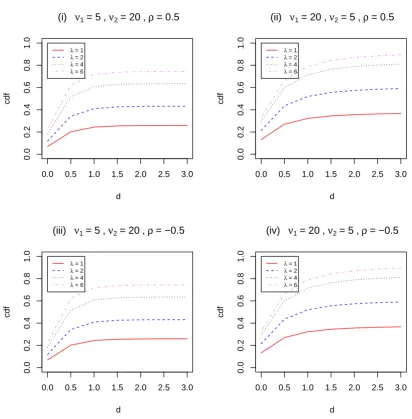
Figure 2.1: The cdf of the singly bivariate noncentral F distribution.
The graph of the cdf of the singly BNCF distributions is presented in Figure 2.1.
This figure shows that the value of the cdf of the singly BNCF distribution increases
as the value of any of the parameters, degrees of freedom ν1 (for fixed ν2), λ, and d,
also depends on ρ. For both ρ < 0.5 and ρ > 0.5, the curves of the cdf of the singly
BNCF distribution are lower than that for ρ = 0.5. For ρ = −0.5 and ρ = 0.5,
the graph of the cdf of the singly BNCF distribution is identical. The R codes that
produce Figures 2.1 are provided in Appendix A.1.
2.3.2
The Doubly Bivariate Noncentral
F
Distribution
The doubly BNCF distribution is defined by compounding the pdf of the BNCC
distribution of X1 and X2 with m degrees of freedom and noncentrality parameters
θ1 and θ2, and central chi-square distribution of Z with n degrees of freedom (see
Yunus and Khan, 2011c, and Amos and Bulgren, 1972). The pdf of the correlated
BNCC variables X1 and X2 is given by
g(x1, x2) =
∞
∑
j=0
∞
∑
r1=0 ∞
∑
r2=0
[
ρ2j(1−ρ2)m/2Γ(m/2 +j)]
×
(x1)m/2+j+r1−1e− (x1) 2(1−ρ2)
[2(1−ρ2)]m/2+j+r1Γ(m/2 +j +r 1) ×
e−θ1/2(θ 1/2)r1
r1!
×
(x2)m/2+j+r2−1e
− (x2)
2(1−ρ2)
[2(1−ρ2)]m/2+j+r2Γ(m/2 +j +r 2)
× e−θ2/2(θ2/2)r2
r2!
,
(2.3.10)
and the pdf of a central chi-square variable Z with n degrees of freedom is
f(z) = z
(n/2)−1e−z/2
2n/2Γ(n/2) , z >0, (2.3.11)
whereZ is independent ofX1 andX2. Then using transformation of variable method
for multivariable case (see for instance, Wackerly et al. 2008, p. 325), we obtain the
joint pdf of y= [y1, y2]
′
and z variables as
where y1 = nxmz1, y2 = nxmz2 and the Jacobian of the transformation (x1, x2, z) →
(y1, y2, z), is given by
det. ∂x1 ∂y1 ∂x1 ∂y2 ∂x1 ∂z ∂x2 ∂y1 ∂x2 ∂y2 ∂x2 ∂z ∂z ∂y1 ∂z ∂y2 ∂z ∂z
=det.
m nz 0
m ny1
0 mnz mny2
0 0 1
= (m nz )2 . (2.3.13)
Therefore, the joint pdf of y and z is given by
f(y, z) =
∞
∑
j=0
∞
∑
r1=0 ∞
∑
r2=0
[
ρ2j(1−ρ2)m/2Γ(m/2 +j)]
×
(mny1z)
m/2+j+r1−1e− (mn y1z) 2(1−ρ2)
[2(1−ρ2)]m/2+j+r1Γ(m/2 +j+r 1)
×e−θ1/2(θ1/2)r1
r1!
×
(mny2z)
m/2+j+r2−1e− (mn y2z) 2(1−ρ2)
[2(1−ρ2)]m/2+j+r2Γ(m/2 +j+r 2)
×e−θ2/2(θ2/2)r2
r2!
× z(n/2)−1e−z/2
2n/2Γ(n/2) ×
(m
nz
)2
. (2.3.14)
Then the joint pdf of (Y1, Y2), where
Yi =
Xi/m
Z/n , for i = 1,2, (2.3.15)
is obtained as
f(y) = f(y1, y2) = ∫
z
that is,
f(y1, y2) =
(m
n
)2[(1−ρ2)m/2
2n/2Γ(n/2) ]
×∑∞
j=0
∞
∑
r1=0 ∞
∑
r2=0
[
ρ2jΓ(m/2 +j)] (e
−θ1/2(θ 1/2)r1
r1!
) (
e−θ2/2(θ 2/2)r2
r2!
)
×
[
(mny1)m/2+j+r1−1
[2(1−ρ2)]m/2+j+r1Γ(m/2 +j+r 1)
]
×
[
(mny2)m/2+j+r2−1
[2(1−ρ2)]m/2+j+r2Γ(m/2 +j+r 2)
]
×
∫ ∞
0
zm+n/2+2j+r1+r2−1e−z/2 ((m/n)y
1 1−ρ2 +
(m/n)y2
1−ρ2 +1
)
dz
=
(m
n
)2[(1−ρ2)m/2
2n/2Γ(n/2) ] × ∞ ∑ j=0 ∞ ∑
r1=0 ∞
∑
r2=0
[
ρ2jΓ(m/2 +j)] (e
−θ1/2(θ 1/2)r1
r1!
) (
e−θ2/2(θ 2/2)r2
r2!
)
×
(m
n
)m+2j+r1+r2−2[
ym/2+j+r1−1
1 y
m/2+j+r2−1 2
]
[2(1−ρ2)]m+2j+r1+r2Γ(m/2 +j+r
1)Γ(m/2 +j+r2)
×
(
2
wy
)qrj
Γ(qrj)
=
(m
n
)m[(1−ρ2)m+2n
Γ(n/2)
] ∞
∑
j=0
∞
∑
r1=0 ∞
∑
r2=0
[
ρ2j
(m
n
)2j
Γ(m/2 +j)
]
×
[(
e−θ1/2(θ 1/2)r1
r1!
) ( (m
n
)r1
Γ(m/2 +j+r1) ) (
ym/2+j+r1−1 1
)]
×
[(
e−θ2/2(θ 2/2)r2
r2!
) ( (m
n
)r2
Γ(m/2 +j+r2) ) (
ym/2+j+r2−1 2
)]
× Γ(qrj)
[
(1−ρ2) + m
ny1+ m
ny2
]−(qrj)
, (2.3.17)
where wy = (m/n1−ρ)2y1 +
(m/n)y2
1−ρ2 + 1 and qrj = m+n/2 + 2j +r1+r2. The cdf of the
doubly BNCF distribution is then defined as
P(Y1 < a, Y2 < b) =
∫ a
0
∫ b
0
f(y1, y2)dy1dy2, (2.3.18)
The above cdf can be expressed as
P(Y1 ≤a, Y2 ≤b) =
∫ ∞
0
f(z)
∫ bmy n 0 ∫ amy n 0
g(x1, x2)dx1dx2dz, (2.3.19)
whereg(x1, x2) is the pdf of a BNCC distribution which is given in Equation (2.3.10),
f(z) is the pdf of the central chi-square variable which is given in Equation (2.3.11),
and Yi fori= 1,2, are given in Equation (2.3.15).
Equation (2.3.19) can be written as
P(Y1 ≤a, Y2 ≤b) = (1−ρ2)
m
2 ∞
∑
r1=0 ∞
∑
r2=0 ∞
∑
j=0
(m2)j
j! ρ
2jI
2( ˜αj,˜c, β)
×e−θ1/2(θ1/2)r1
r1!
e−θ2/2(θ 2/2)r2
r2!
, (2.3.20)
where
I2( ˜αj,˜c, β) =
∫ ∞
0
e−zzβ−1
Γ(β)
γ(α1, c1z)
Γ(α1)
γ(α2, c2z)
Γ(α2)
dz (2.3.21)
and
β = n
2, c˜=
(
am n(1−ρ2),
bm n(1−ρ2)
)
, α˜j =
(m
2 +j+r1,
m
2 +j +r2
)
.
(2.3.22)
Here, γ(α, x) =∫0xe−ttα−1dt, and Γ(α) = ∫0∞e−ttα−1dt.
Amos and Bulgren (1972) used various representations ofγ(α1, c1z) andγ(α2, c2z)
and derived the series form of I2( ˜αj,˜c, β) in terms of regularized beta functions. In
this paper we use the I2 as given by Amos and Bulgren (1972), that is,
I2( ˜αj,c, β˜ ) = Iu(α1, β)−
(1−u)β
α1
Γ(β+α1)
Γ(β)Γ(α1)
× ∞
∑
r=0
(β+α1)r
(1 +α1)r
ur+α1I
1−y(r+β+α1, α2), (2.3.23)
with
and
∫ ∞
0
e−zzβ−1
Γ(β)
γ(α, cz)
Γ(α) dz = Iz(α, β) and
∫ ∞
0
e−zzβ−1
Γ(β)
Γ(α, cz)
Γ(α) dz = I1−z(β, α)
are the regularized beta functions, with α > 0, β > 0, x = c/(1 +c), and 1−x =
1/(1 +c).
The infinite series is truncated aftert1+ 1, t2+ 1 andt3+ 1 terms and thus giving
a bound on the truncation error, say rt. For any finite a and b,
kj = (1−ρ2)
m
2 ∞
∑
j=0
(m2)j
j! ρ
2jI
2( ˆαj,c, βˆ ),
the mass of a bivariate central F distribution and
sri =
e−θi/2(θ
i/2)ri
ri!
, i= 1,2,
the mass of a Poisson distribution,
rt1,t2,t3 = ∞
∑
j=t1+1 ∞
∑
r1=t2+1 ∞
∑
r2=t3+1
kjsr1sr2 = 1−
t1
∑
i=0
t2
∑
r1=0
t3
∑
r2=0
kjsr1sr2.
The stopping value of t1, t2 and t3 that are used depends on machine and software
precision. In practice, rt is computed successively and iteration stops when rt−1 =rt
0 1 2 3 4 0.0 0.2 0.4 0.6 0.8 1.0 d Cdf
(i) The cdf for m=10, n=20
θ1=1, θ2=1.5,
ρ =0
ρ =0.1
ρ =0.3
ρ =0.5
ρ =0.9
0 1 2 3 4
0.0 0.2 0.4 0.6 0.8 1.0 d Cdf
(ii) The cdf for m=10, n=20, ρ=0.5,
θj=1.5, j, k=1,2, j≠k
θk=0 θk=1 θk=2 θk=3 θk=4
0 1 2 3 4
0.0 0.2 0.4 0.6 0.8 1.0 d Cdf
(iii) The cdf for m=10, θ1=1.5,
θ2=1, ρ=0.5,
n=5 n=10 n=15 n=20 n=25
0 1 2 3 4
0.0 0.2 0.4 0.6 0.8 1.0 d Cdf
(iv) The cdf for n=10, θ1=1.5,
θ2=1, ρ=0.5,
[image:34.595.130.491.70.433.2]m=5 m=10 m=15 m=20 m=25
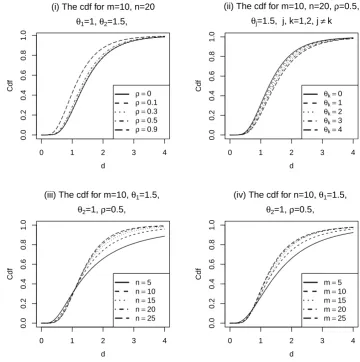
Figure 2.2: The cdf of thedoubly bivariate noncentral F distribution.
The values of the cdf of thedoubly BNCF distribution are computed for arbitrary
degrees of freedom (m, n), noncentrality parameter (θ1, θ2), and correlation coefficient
(ρ). The graph of the cdf of the doubly BNCF distribution is presented in Figure
2.2. The cdf of the BNCF distribution is computed using Equation (2.3.20). Figure
2.2 shows the cdf of the doubly BNCF distribution depends on the values of the
noncentrality parameters (θ1,θ2), degrees of freedom (m, n), correlation coefficient (ρ)
and upper limit (d). For the Figure 2.2, we observe that the shape of the curve of the
cdf is sigmoid. Also, the value of the cdf approaches 1 quicker for a larger correlation
and larger degrees of freedom (m, n) (see Figures 2.2(iii) and 2.2(iv)).
The R codes used to plot the cdf of the BNCF distribution in Figure 2.2 are
provided in Appendix A.2.
2.4
The Methodology of Analysis
For each of the four regression models, we define the test statistic for the UT, RT
and PTT, derive the sampling distribution of the test statistics and power function
of the tests, present a simulation example, compare the power function and size of
the tests, and recommend a test that minimizes the size and maximizes the power.
2.4.1
The UT, RT, PT and PTT
Consider the problem of testing intercept in the SRM, H0 :β0 = β00 (a fixed value)
againstHa:β0 > β00, when there is uncertain NSPI available on the value slope (β1).
In this situation, three different scenarios on β1 are considered, namely unspecified,
specified and uncertain. We then define three different statistical tests, namely, the
(i) unrestricted test (UT), (ii) restricted test (RT) and (iii) pre-test test (PTT). For
the UT, let ϕU T be the test function for testing H
0. For the RT, let ϕRT be the
test function for testing H0. Whereas for the PTT, let ϕP T T be the test function for
testing H0 following a pre-test (PT) on the slope. Then, for the PT, let ϕP T be the
test function for testing H0∗ : β1 = β10 against Ha∗ : β1 > β10, and it is essential for
the PTT on β0. The PTT is a choice between the UT and RT. If H0∗ is rejected in
PT, then the UT is used to test H0, otherwise the RT is used. The details on the
The Unrestricted Test (UT)
If the slope (β1) is unspecified, the test functions is ϕU T. Let, TU T be test statistic
to test H0, then chose a value of α1 (0< α1 <1) such that,
P [TU T > ℓU Tn,α
1 |H0 :β0 =β00
]
=α1, (2.4.1)
where ℓU T
n,α1 is the critical value of T
U T at the α
1 level of significance. If ταi is the
upper 100αi quantile and Φ(.) is the cumulative distribution function of the standard
normal distribution, then
Φ(ταi) = 1−αi, (2.4.2)
where 0< αi <1, i= 1, 2, 3. Thus, 1−α1 can be written as
1−α1 =P [
TU T ≤ℓU Tn,α
1
]
. (2.4.3)
Hence, for the test functionϕU T =I(TU T > ℓU T
n,α1), the power function of UT becomes
πU T(β0) = E(ϕU T |β0) =P(TU T > ℓU Tn,α1 |β0). (2.4.4)
The Restricted Test (RT)
If β1 =β10 (specified), then the test function is ϕRT. Let the proposed test statistic
to test H0 :β0 =β00 against Ha :β0 > β00, whenβ1 =β10 be TRT. Then, we find
P[TRT > ℓRTn,α2 |H0 :β0 =β00, β1 =β10 ]
=α2, (2.4.5)
where ℓRTn,α2 is the critical value ofTRT at the α2 level of significance. We then obtain
1−α2 =P [
TRT ≤ℓRTn,α
2
]
. (2.4.6)
Thus, for the test function ϕRT =I(TRT > ℓRT
n,α2), the power function of RT is
The Pre-test (PT)
Ifβ1 is uncertain, letϕP T be the test function for testing the hypothesisH0∗ :β1 =β10
against Ha∗ :β1 > β10. Let the proposed test statistic be TP T. Under H0∗, we find
P [TP T > ℓP Tn,α3 |H0∗ :β1 =β10 ]
=α3, (2.4.8)
Similarly, we find
1−α3 =P [
TP T ≤ℓP Tn,α
3
]
, (2.4.9)
whereℓP T
n,α3 is the critical value of theT
P T at theα
3 level of significance. Furthermore,
for the test function ϕP T =I(TP T > ℓP T
n,α3), the power function of the PT is given by
πP T(β0) = E(ϕP T |β0) =P(TP T > ℓP Tn,α3 |β0). (2.4.10)
The Pre-test Test (PTT)
To formulate a test function of the PTT for testing the hypothesis H0 : β0 = β00
against Ha : β0 > β00 after pre-testing (PT) on the suspected value of the slope, we
write ϕP T T as
ϕP T T =I[(TP T ≤ℓP Tn,α3, TRT > ℓRTn,α2) or (TPT > ℓPTn,α3,TUT > ℓUTn,α1)]. (2.4.11)
Then the power function of the PTT, denoted by πP T T(β
0) =E(ϕP T T |β0), is given
as
πP T T(β0) =P (
TP T ≤ℓP Tn,α
3, T
RT > ℓRT n,α2 |β0
)
+P (TP T > ℓP Tn,α
3, T
U T > ℓU T n,α1 |β0
)
.
(2.4.12)
2.4.2
The Power Function and Size of the Tests
The goodness of a test is measured by the probability of the type I error (α) and the
probability of the type II error (β). Whereas, to evaluate the performance of a test,
test will lead to the rejection of the H0 : θ = θ0 against an alternative hypotheses
Ha : θ ̸= θ0 when the actual parameter value is different from θ0. Generally, the
power of a test can be written as
π(θ) =P(Wis inRRwhen the parameter value isθ),
where W is the value of the test statistic andRR is the rejection region for the test.
With regard to the rejection region, so
π(θa) = P(rejecting H0whenθ =θa),
where θa is a value of θ under Ha. Note that a good test ideally has power near 1
under Ha and near 0 under H0 (Casella and Berger, 2002, p. 383).
The following example is to describe the power function and size of a test. Let
Xi, i = 1,2, ..., n be independent and each of them follows a Bernoulli distribution
with parameter θ. Then for n = 10 trials, Y = ∑nj=1=10Xj follows a binomial
dis-tribution with n = 10 and p = θ, and denoted as Y ∼ Bin(n, θ). We want to test
H0 : θ = 0.5 against Ha : θ = 0.4, with RR = {(x1,· · ·, x10) : Y ≤ 3}. The power
function of the test defined by RR (under Ha) is given as
π(θ) = P(Reject H0 |θ) = 3 ∑
y=0 (
10
y
)
θy(1−θ)10−y
= (1−θ)7(84θ3+ 28θ2+ 7θ+ 1). (2.4.13)
The size of the test is the value of power function under H0, that is,
α = P(Type I error) = π(θ |H0 :θ=θ0) = P(Reject H0 |H0 is true)
= P(Y ≤3|θ = 0.5) = (1−θ)7[84(θ)3+ 28(θ)2+ 7(θ) + 1]|H0 :θ = 0.5
= (1−0.5)7(84(0.5)3+ 28(0.5)2+ 7(0.5) + 1) = 0.1719 (2.4.14)
is true) is given by
β = P(Type II error) = P(Accept H0 |Ha is true)
= P(Y >3|θ = 0.4)
= 1−((1−θ)7(84(θ)3+ 28(θ)2+ 7(θ) + 1))|Ha=θ=0.4= 0.618 (2.4.15)
Generally, the power function of the UT, RT, PT and PTT are produced using
Equa-tions (2.4.4), (2.4.7), (2.4.10) and (2.4.12). For the simulation example, the power
(π(θ)), size (α) and probability of type II error (β) are produced using Equations
(2.4.13), (2.4.14) and (2.4.15). The above computation in Equations (2.4.13) and
(2.4.14) proves that the size and power of the test are obtained from the power
func-tion of the test (see Pinto et al., 2003; Saleh and Sen, 1982, 1983). The size (α)
is commonly chosen and set as the probability of type I error (see Wackerly et al.,
2008, p. 491, and De Veaux et al., 2009, p. 544). The size of the test as the nominal
value under the null hypothesis is constant and the power of the test depends on the
parameter θ. Furthermore, a test that maximizes the power function and minimize