Qualitative Health Research 2016, Vol. 26(8) 1151 –1161 © The Author(s) 2015 Reprints and permissions: sagepub.com/journalsPermissions.nav DOI: 10.1177/1049732315616623 qhr.sagepub.com
Methods
Introduction
Concept maps are defined as tools to assist individuals in visualizing the journeying nature of a concept’s develop-ment (Butler-Kisber & Poldma, 2010; Hunter, Lusardi, Zucker, Jacelon, & Chandler, 2002). It allows for a visual representation of movement from the foundational ten-ants of an idea to its end product and future developments (Gallenstein, 2005; Hunter et al., 2002). Concept map-ping uncovers the natural complexities embedded in learning and provides a visual representation of how these nuances communicate with one another. This article explores the history of concept mapping and highlights its importance as an educational and research method. It will elaborate on the benefits of moving toward a more qualitative representation of concept mapping and will propose a new framework for the map’s construction, analysis and interpretation.
History of Concept Mapping
Concept mapping is a visual method that was created by Novak (1990a; 1990b) in an attempt to understand changes in children’s knowledge of science. Concept maps are described as “graphical tools for organizing and representing knowledge” (Novak & Cañas, 2008). Rooted in education, concept mapping has been utilized in the fields of nursing and allied health care to enhance critical
thinking skills and meaningful learning (Aberdeen, Leggat, & Barraclough, 2010; Burke et al., 2005; Miller-Kuhaneck, Bortone, & Frost, 2007; Passmore, 2013). Traditionally, concept maps include concepts that are usually enclosed in a circle or box arranged in a hierarchi-cal fashion with the most general concept at the top of the map and the more detailed descriptions below (Eppler, 2006; Moon, Hoffman, Novak, & Cañas, 2011; Passmore, 2013). Relationships are represented by unidirectional or bidirectional arrows between concepts with linking words or phrases that form a meaningful statement (Moon, Hoffman, Novak, & Canas, 2011; Novak & Cañas, 2008; Passmore, 2013). The focus question acts as a point of reference from which the concept map is generated. It can pertain to some situation or event that the researcher is trying to better understand and creates the context for the concept map (Moon et al., 2011; Novak, 1990b; 2010; Novak & Cañas, 2008). Mapping research findings can help to build a logical chain of evidence as well as
1James Cook University, Townsville, Queensland, Australia 2University of Western Ontario, London, Ontario, Canada
Corresponding Author:
Jessie Wilson, James Cook University, Discipline of Occupational Therapy College of Healthcare Sciences, Townsville, Queensland 4811, Australia.
Email: [email protected]
Concept Mapping: A Dynamic,
Individualized and Qualitative Method for
Eliciting Meaning
Jessie Wilson
1, Angie Mandich
2, and Lilian Magalhães
2Abstract
The purpose of this theoretical article is to explore the use of concept mapping as a qualitative research method that is represented as a form of multimodal communication. This framework strives to move mapping beyond quantitative analysis by inserting art and humanness into the process. This proposed framework provides a means to highlight the ways in which people learn, understand, and interpret the world around them. Three categories for understanding have been identified by the authors to help individuals create, interpret, and understand qualitative concept maps. These categories include the following: Voice: Tri-directional Voice and Mutual Absorption; Detail in the Parts & Recognition of the Whole: Uniqueness, Aesthetic Distance and Emplacement; and Sensory Experience: Intellectual + Emotional Investment and Humanness. Each of these categories is interconnected, and informs each other in a dialectical way, therefore creating a piece of visual data with which the participant, researcher and audience can interact.
Keywords
conceptual and theoretical coherence (Butler-Kisber & Poldma, 2010; Hunter et al., 2002).
Epistemological and Methodological
Foundations
Concept mapping is informed by Ausubel’s (1963, 1968) Assimilation Theory, which suggests that meaningful learning occurs when there is an assimilation of new con-cepts into one’s existing knowledge base or “cognitive structures.” (Ausubel, Novak & Hanesian, 1978) To ensure meaningful learning, the topic must be conceptu-ally clear and presented with examples that are relatable to the learner’s prior knowledge (Moon et al., 2011; Novak, 1990a). The learner must also have a foundation of basic understanding related to the topic and finally, the learner must choose to learn in a meaningful way (Akinsanya & Williams, 2004; Chiou, 2008; Novak, 1990a). “Meaningful learning is the foundation of human constructivism which is both a psychological and episte-mological phenomenon” (Novak, 1990a, p. 32).
The epistemological foundations of concept mapping arise from the constructivist paradigm and are closely linked with Vee Diagrams or Vee Heuristic developed by Novak’s colleague Gowin (1970, 1981). Gowin’s Vee diagrams were created to illustrate the methodological and conceptual elements that interact in the process of new knowledge construction (Gowin, 1970, 1981; Gowin & Alvarez, 2005; Novak, 1990a; Novak & Cañas, 2006, 2008). Vee diagrams help individuals comprehend the structure and meaning of the knowledge that they seek to understand (Gowin & Alvarez, 2005; Novak & Gowin, 1984). They are arranged in a “V” and highlight the underlying conceptual, theoretical and methodologi-cal assumptions that are required to construct new knowledge informed by the focus question (Gowin & Alvarez, 2005; Novak, 1990b; 2010; Novak & Cañas, 2008).
Concept mapping and Vee diagrams are founded on the understanding that knowledge is constructed among individuals. The constructivism paradigm views mean-ing as constructed by individuals interactmean-ing and engag-ing with the world they are interpretengag-ing (Creswell, 2014; Crotty, 2003). Meaning is therefore seen as subjective, as are the concept maps that are created in response to understanding a particular question or phenomenon. Concept maps are subjective representations of one’s understanding of a concept and are most useful to the person who creates them (Conceicao & Taylor, 2007; Miller-Kuhaneck et al., 2007). Concept mapping encour-ages the construction of knowledge in a meaningful way by facilitating the creative interaction between the indi-viduals, their current cognitive structures and new information.
Evaluation of Concept Maps
Historically the evaluation of concept maps has com-pared one map with another. It evaluates the “correct-ness” of a map by finding commonalities and quantifying the number of concepts presented and their relationship to one another (Davies, 2011; Eppler, 2006; Novak & Cañas, 2008). Novak and Gowin (1984) developed a scoring protocol for analyzing concept maps that evalu-ates an individual’s map based on quantitative measure-ments. The number and the arrangement of concepts and the validity of their linking phrases are pivotal markers in how well an individual is learning and/or understanding a phenomenon (Chiou, 2008; Conceicao & Taylor, 2007; Kinchin, Hay, & Adams, 2000). A potential barrier to evaluating a concept map solely through a quantitative approach limits the descriptive richness and narrows the opportunity to highlight the insights of the participant and researcher (Kinchin, 2013; Trafimow, 2014). In addition, comparing maps and counting concepts attempts to gen-eralize how individuals learn and disregards the meaning behind the creation of the map. Establishing a hierarchy among concepts and instituting validity between linkages may cause the researcher to overlook important ideas embedded within the map and minimizes the significance of the individual’s perspective (Hay, 2007; Kinchin, 2013; Kinchin et al., 2000). A body of literature is start-ing to emerge that explores the use of concept maps as a qualitative research methodology. Through highlighting the individualized process of concept mapping, it offers the opportunity to emphasize the humanness and com-plexity that is inherently embedded within health care research.
Developing a New Framework
Multimodality and Art
Accompanying the steps and processes associated with constructing a sound concept map is an element of cre-ativity. The manner in which an individual constructs his or her concept map gives clues to his or her values, beliefs and overall approach to research and learning (Butler-Kisber & Poldma, 2010; Wheeldon & Faubert, 2009). Concept maps allow the researcher to interact with the data, uncover new relationships and view the information from a different perspective.
& van Leeuwen, 2001, Pink, 2011b; Rose, 2012). This approach to communication allows for the exploration of theories derived from arts-based disciplines to create new pathways of understanding qualitative data. Eisner (2008) suggests that art is another form of discourse and can be rec-ognized as a specialized form of knowledge. Art as a form of discourse articulates cultural values and beliefs, sheds light on society structures and allows self-expression beyond the restrictions of textual language (Eisner, 2008; Nead, 1988; Pink, 2011b; Rose, 2012).
This article seeks to explore concept mapping as a qualitative research method that is represented as a form of multimodal communication. This framework strives to move mapping beyond its structure and quantification that has been previously discussed in its historical begin-nings and seeks to insert art and humanness into the pro-cess. The intention is to provide another way to illuminate the ways in which people learn, understand and interpret the world around them.
Throughout the development of the proposed frame-work, the researchers were aware of the necessity to have it strongly rooted in a qualitative methodology. Methodologies encompass both philosophy and methods (Carter & Little, 2007; Finlay & Ballinger, 2006) and lay the foundation for the development of a cohesive research project (Howell, 2013). It is therefore necessary to explic-itly state the epistemological underpinnings of the frame-work as it guides the production of the concept mapping method. The proposed concept mapping framework is derived from the constructivist–interpretivist paradigm which recognizes that the construction of knowledge has multiple meanings and subjective realities (Creswell, 2014; Denzin, 1994; Finlay & Ballinger, 2006). The understanding derived from this form of concept map-ping is within the interpretivist traditionand highlights the way in which “our perceptions and experiences are socially, culturally, historically and linguistically pro-duced” (Finlay & Ballinger, 2006, p.19).
In this proposed framework, the researchers are embedded within the phenomenon they are studying and are informing and are informed by the participant(s) and the mapping process itself. Reflexivity is therefore an important skill that needs to be implemented throughout the mapping process. It allows researchers to provide a transparent methodological account of the co-construc-tion of knowledge during the research process and deep-ens their understanding of how they collect, select and interpret data based on their previous understandings, personal values and beliefs (Creswell, 2014; Denzin, 1994; Finlay, 2002; Finlay & Ballinger, 2006).
Categories of Understanding
The proposed framework was informed by the work of Bresler (2006), Pink (2009) and Rose (2012). Each of
these researchers offers unique insights into various arts-based qualitative research methodologies and they illuminate significant aspects of visual methodologies that have informed this proposed framework. The work of Bresler (2006) blends the use of artistic experience with qualitative research throughout the data collection, data analysis and writing process. This illuminates the interconnected nature of arts-based inquiry throughout the qualitative research study (Bresler, 2006). The work of Bresler (2006) also highlights the tri-directional voice embedded within arts-based and qualitative research. This concept offers a unique perspective on the impor-tance of qualitative arts-based inquiry on the participant’s understanding of themselves beyond conveying meaning to the researcher. The work of Pink (2009) was integrated into the concept mapping framework because of her focus on the sensory experience of qualitative research. Pink (2009) argues that a multisensory approach is necessary in learning about, understanding and meaningfully repre-senting complex topics in health care research. The work of Rose (2012) situates visual data as having the same value as information obtained from written text and numerical calculations. In addition, Rose (2012) provides strategies for interpretation of visual materials that are explicitly linked to strong theoretically and methodologi-cal sound foundations in qualitative research. Refer to Table 1 for the key concepts elicited from the work of Bresler (2006), Pink (2009) and Rose (2012).
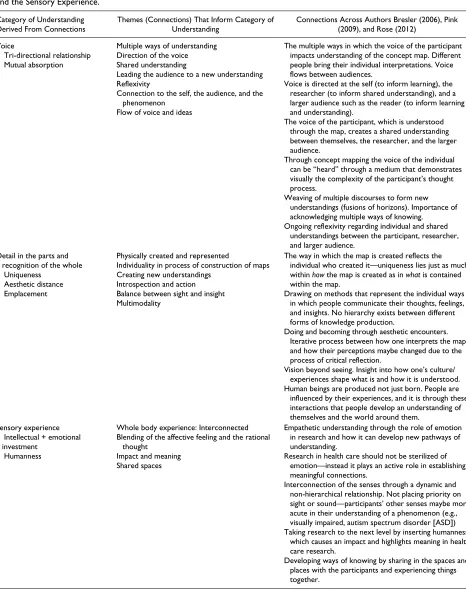
It is important to acknowledge the dialectical rela-tionship between the work of these three authors. The commonalities and connections between their work were used to expound the categories for constructing, analyzing, and interpreting qualitative concept map-ping. These categories were identified through multiple readings of their books and research papers by the three researchers searching for common themes. These themes were independently recorded by each researcher, then further discussed and agreed upon collectively. Refer to Table 2 for the connections uncovering the cat-egories for understanding. The themes and their associ-ated descriptions attended to criteria for worth and rigor in qualitative research through demonstrating multivo-cality, transparency, self-reflexivity, thick description and aesthetic merit (Tracy, 2013). The collective themes were highlighted and assimilated into the following cat-egories for understanding that form the foundation of this proposed framework. The three categories include:
1. Voice: Tri-directional Voice and Mutual Absorption;
2. Detail in the Parts & Recognition of the Whole: Uniqueness, Aesthetic Distance, and Emplacement; and
These categories are not isolated from one another but instead they are interconnected and inform each other through a symbiotic relationship. The conceptualization of soft boundaries allows for the flow of ideas among these domains and mimics the relationship between research and art-making (Bresler, 2006; Irwin & de Cosson, 2004). This proposed framework highlights the importance of arts-based inquiry and regards artistic practices as significant forms of scholarly inquiry (Bresler, 2006; Finley & Knowles, 1995; Fox & Geichman, 2001; Sullivan, 2005). Therefore, a blend of arts-based and qualitative research creates a new platform for the exploration of concept mapping and its use in health care research.
Voice
The voice of the participant should be of primary impor-tance during the concept mapping process. How the par-ticipant finds his or her voice and shares his or her story is a unique and individualized process (Banks, 2009; Bresler, 2006; Rose, 2012). There are many elements of a partici-pant’s voice that need to be considered when constructing, analyzing and interpreting a concept map. The researcher, participant and audience voice can be interchangeable depending on the intent of the mapping experience.
Tri-directional voice. The tri-directional voice refers to the dialogical relationship that evolves between the individual,
the concept map and the audience (Bresler, 2006). In visual methodologies, audiencing is referred to as the process by which an image’s meanings are interpreted and understood by individuals in various contexts (Banks, 2009; Rose, 2012). In this proposed framework, the researchers extend the audiencing inward and recognize the individual as a part of their own audience. This is because the communi-cation (or voice) that develops within the individual facili-tates a change of self and promotes learning (Bresler, 2006; Dewey, 1934; Drew & Guillemin, 2014). Concept map-ping is a medium through which people come to under-stand more about an event and about themselves. This change of self re-shapes the meaning of the phenomenon that is being studied, and offers the participants an oppor-tunity to “re-see” the significance the experience and the mapping process offer them (Bresler, 2006; Butler-Kisber & Poldma, 2010; Dewey, 1934). Through this process of “re-seeing,” participants develop an artistic expression of self-discovery (the concept map) and their voice resonates on both an individual and a social level.
[image:4.585.51.514.81.340.2]Mutual absorption. Mutual absorption is the process of intense dialogue between the audience and the visual method (Armstrong, 2000; Lapum, Ruttonsha, Church, Yau, & David, 2012; Rose, 2012). It is characterized by a deep open-ended relationship where the audience is engaged with the concept map. This engagement occurs when they attempt to understand the perspectives of the participants, which are expressed through the map while Table 1. Key Concepts Elicited From the Work of Bresler (2006), Pink (2009), and Rose (2012).
Bresler (2006) Pink (2009) Rose (2012)
Tri-directional relationship Connection to phenomenon Connection to self
Connection to audience (p. 53) Soft boundaries and flow of ideas and
concepts (p. 53)
Doing and Becoming through esthetic encounters (p. 54)
Empathetic understanding through research role of emotion in research and a blending of the affective and the rational (p. 54)
Aesthetic distance
Voice and a fusion of horizons (p. 55, 57)
Taking research to the next level (p. 57)
Researcher is a part of the learning process/change (p. 59)
Links to arts-based practices and ways of knowing
Voice and the message of the participant Interconnection of the senses in
a dynamic and non-hierarchical relationship (p. 2)
Developing ways of knowing by sharing in spaces and places with the participants and experiencing things together (p. 2)
Opening up opportunities for multiple ways of knowing (p. 8)
Drawing on a family of methods (p. 9) Collaborative process between the
researcher and the participant (p. 10) Weaving of creative discourses and
then effecting the way that people understand the world around them (p. 12)
Focus on everyday practice such as housework, laundry, gardening etc. (p. 15)
Body as a place of knowing through the senses (p. 24)
Human beings are produced not just born: greatly influenced by their experiences (p. 141)
Discourse can be in the form of art work and other multi-modal works (p. 142)
One’s culture influences the artwork/ visual methods that are produced (p. 142)
Vision and visuality; balance between what the eye actually physically sees and what our culture/experiences etc.
have shape what we do see (p. 2)
multimodality in images and the importance of written text, photographs, drawings, multi-media representations etc. in informing understanding and knowledge production (p. 11)
Site of audiencing: different people will understand and interpret different meanings from the image (p. 22)
Table 2. Connections Uncovering the Categories of Understanding: Voice; Detail in the Parts and Recognition of the Whole and the Sensory Experience.
Category of Understanding
Derived From Connections Themes (Connections) That Inform Category of Understanding Connections Across Authors Bresler (2006), Pink (2009), and Rose (2012)
Voice
Tri-directional relationship Mutual absorption
Multiple ways of understanding Direction of the voice Shared understanding
Leading the audience to a new understanding Reflexivity
Connection to the self, the audience, and the phenomenon
Flow of voice and ideas
The multiple ways in which the voice of the participant impacts understanding of the concept map. Different people bring their individual interpretations. Voice flows between audiences.
Voice is directed at the self (to inform learning), the researcher (to inform shared understanding), and a larger audience such as the reader (to inform learning and understanding).
The voice of the participant, which is understood through the map, creates a shared understanding between themselves, the researcher, and the larger audience.
Through concept mapping the voice of the individual can be “heard” through a medium that demonstrates visually the complexity of the participant’s thought process.
Weaving of multiple discourses to form new understandings (fusions of horizons). Importance of acknowledging multiple ways of knowing.
Ongoing reflexivity regarding individual and shared understandings between the participant, researcher, and larger audience.
Detail in the parts and recognition of the whole Uniqueness
Aesthetic distance Emplacement
Physically created and represented
Individuality in process of construction of maps Creating new understandings
Introspection and action Balance between sight and insight Multimodality
The way in which the map is created reflects the individual who created it—uniqueness lies just as much within how the map is created as in what is contained within the map.
Drawing on methods that represent the individual ways in which people communicate their thoughts, feelings, and insights. No hierarchy exists between different forms of knowledge production.
Doing and becoming through aesthetic encounters. Iterative process between how one interprets the map, and how their perceptions maybe changed due to the process of critical reflection.
Vision beyond seeing. Insight into how one’s culture/ experiences shape what is and how it is understood. Human beings are produced not just born. People are
influenced by their experiences, and it is through these interactions that people develop an understanding of themselves and the world around them.
Sensory experience Intellectual + emotional
investment Humanness
Whole body experience: Interconnected Blending of the affective feeling and the rational
thought Impact and meaning Shared spaces
Empathetic understanding through the role of emotion in research and how it can develop new pathways of understanding.
Research in health care should not be sterilized of emotion—instead it plays an active role in establishing meaningful connections.
Interconnection of the senses through a dynamic and non-hierarchical relationship. Not placing priority on sight or sound—participants’ other senses maybe more acute in their understanding of a phenomenon (e.g., visually impaired, autism spectrum disorder [ASD]) Taking research to the next level by inserting humanness,
which causes an impact and highlights meaning in health care research.
Developing ways of knowing by sharing in the spaces and places with the participants and experiencing things together.
Source. Bresler (2006), Pink (2009). Rose (2012).
being aware of their own personal values and beliefs. The perspectives of the audience and the participants may be very different from one another (Armstrong, 2000; Bre-sler, 2006; Drew & Guillemin, 2014). Gadamer (1992) describes this process as the discovery of others’ hori-zons. It is the process of acknowledging and respecting other people’s ideas through an interactive and open-ended dialogue that enables the expansion of the one’s self.
Throughout this process, the audience needs to recog-nize and acknowledge their own subjectivities that have developed through past experiences, their culture, their values and beliefs (Pink, 2009, 2013). This reflexivity allows the audience to position themselves along a con-tinuum of understanding in respect to the participants’ perspectives producing “horizons of understanding” (Bresler, 2006; Finlay, 2012; Gadamer, 1992, p.306-307). This space acknowledges the similarities and differences between the audience and the participants’ viewpoints, and facilitates the “fusion of horizons” between the research participant’s voice (message) and the intended audience’s understanding (Bresler, 2006; Finlay, 2012; Gadamer, 1992, p.306-307).
A concept map is a visual image that facilitates an interactive relationship with its audience. Following pathways and connections allows the audience to become absorbed in the map and in turn, the map becomes absorbed into the audience (Armstrong, 2000; Lapum et al., 2012; Rose, 2012). This mutual exchange of infor-mation strengthens the methodological underpinnings of this framework, which recognizes that knowledge is interpretive and co-constructed. Through this reciprocal relationship, new knowledge is formed and with commu-nicative sharing, it can become a part of cultural knowl-edge (Baker, Quennerstedt, & Annerstedt, 2015; Bresler, 2006).
Images are interwoven in our cultures, societies and personal narratives; therefore, it is important to recognize that concept maps can have various meanings in different contexts (Drew & Guillemin, 2014; Pink, 2009, 2013). How the audience (including the individual) sees and interprets the map through their own cultural lens affects the meaning(s) that they absorb and pass on to others. Qualitative concept maps encourage mutual absorption in turn facilitating the exchange of knowledge that is unique and individually meaningful.
Detail in the Parts and Recognition of the
Whole
This framework emphasizes the need for researchers to recognize and appreciate the details of concept maps, while respecting how each map contributes to a larger body of knowledge (Bresler, 2006, Drew & Guillemin, 2014; Rose, 2012). It takes conscious effort on the part
of the researcher to look at each element of the partici-pant’s map and refrain from habitually scanning over details. Concurrently, the researcher must take a step back and find common themes embedded within the maps, and link the visual data together to achieve a higher level of understanding (Armstrong, 2000; Bresler, 2006; Pink, 2013).
Uniqueness. As individuals interact and construct the world around them, they develop their own unique and personalized understanding of various phenomena (Den-zin, 1994; Finlay & Ballinger, 2006). The manner in which one person interprets a situation can be very differ-ent from how another individual ascertains meaning from the same event. This variability is embraced and cele-brated in qualitative concept mapping. As researchers, we attempt to understand phenomenon based on the mean-ings that people bring to them (Creswell, 2014; Denzin & Lincoln, 2005; Finlay & Ballinger, 2006). Uniqueness is embedded within the details of an individual’s concept map. These details encourage a connection between the voice of the participant and the audience. For example, “the story of Anne Frank reaches us in ways that the num-ber ‘six million’ does not. A focus on the individual allows for a noticing, a perception, and a connection” (Bresler, 2006, p. 57). This dialogic connection with the uniqueness of a participant’s concept map encourages the researcher to move beyond his or her preconceptions and expand his or her conventional interpretations, thereby, generating new and meaningful knowledge (Bresler, 2006; Butler-Kisber & Poldma, 2010; Corbin & Strauss, 2008).
Emplacement. The sensuous interaction between the body, the mind, and the environment of both the researcher and the participant in the creation of meaning is defined as emplacement (Howes, 2005; Hurdley & Dicks, 2011; Pink, 2009). Pink (2009) describes emplacement as a concept that advances the concept of embodiment by rec-ognizing the body as a part of the environment. “The body provides us not simply with embodied knowing and skills that we use to act on or in that environment, but that the body itself is simultaneously physically transformed as part of this process” (Pink, 2011a, p. 347).
Through the mapping process, the individual may experience physical changes related to the creation, anal-ysis and interpretation of a map. Cognitive changes can be evident in learning and through the development of new pathways of understanding. Physical and emotional expressions of self can occur through the development of a concept map that connects experiences that are sensi-tive or challenging. It is through acknowledging these interactions during the mapping process that one can deepen his or her understanding of how someone creates a concept map and utilizes it as a part of his or her learn-ing and/or reflexive experience.
Sensory Experience
Concept maps elicit visual data for analysis and interpre-tation, however, the authors propose that concept maps offer an opportunity for the participants and the research-ers to use their multiple senses throughout the mapping process. The use of all the senses is fundamental to how we learn and understand the world around us (Case-Smith, Law, Missiuna, Pollock, & Stewart, 2010; Pink, 2009, 2011b). The senses are seen as interconnected and concept maps are created as a piece of visual data for the participant and the audience to interact with. In creating and analyzing maps, individuals physically engage with the mediums the maps are created through, they may lis-ten to music that acts as a catalyst for creative thought, or eat the salty snack that they always reach for when trying to work through a difficult task. It is the fundamental understanding that people experience their world through the integration of sight, smell, taste and hearing; and these multiple senses play an integral role in how they perceive the world around them (Pink, 2009). Acknowledging the importance of the sensory experience in the construction of knowledge opens new pathways of exploration and understanding in qualitative research (Ingold, 2000; Pink, 2006, 2009; 2011b, 2012).
Intellectual and emotional investment. Throughout the pro-cess of creating, analyzing and interpreting qualitative concept maps, there is an interconnection between the intellectual and emotional elements of an individual.
Emotions are constructed of various sensorial experi-ences. Emotional learning or emotional intelligence embraces emotional awareness in relation to the self and others (Akerjordek & Severinsson, 2007; Gilbert, 2010; Matthews, Zeidner, & Roberts, 2012). It fosters a deeper understanding of personal identity and facilitates optimal learning and development. Emotional intelligence is based on self-awareness, motivation, self-regulation, empathy and adeptness in relationships (Akerjordek & Severinsson, 2007; Goleman, 1995; Matthews et al., 2012). It is a powerful and interactive relationship between cognitive understanding and emotional engage-ment that brings meaning and relevance to qualitative concept mapping. This marriage between the analytical and the creative process creates a rich space where new learning can occur. Sullivan (2005) describes how the sci-ence of sight and the creativity of the eye mirror the rela-tionship between the practices of the scientist and those of the artist. Concept mapping allows the individual to adopt the roles of both the scientist who is an analytical problem solver and the artist who expresses the self through creative mediums. Concept mapping is an out-ward response to an event that is experienced internally (Drever, 2002; Kinchin, 2013; Pink, 2009), that draws on both intelligence and emotion with the purpose of pro-ducing meaningful learning.
In qualitative research the researcher is seen as “a cen-tral figure who influences, and perhaps actively con-structs, the collection, selection and interpretation of data” (Finlay & Ballinger, 2006, p. 6). Researcher subjec-tivity is seen as an opportunity rather than a problem (Finlay, 2002; Trafimow, 2014) and celebrates the co-construction of knowledge among the participants, researchers and the audience (Bott, 2010; Trafimow, 2014). Subjectivity involves the linking of intellect and emotion. It helps to shape perceptions and interpretations and enhances the way in which the mapping process reso-nates with the participant, the researcher and the audience (Bresler, 2006; Pink, 2009). It can be seen as enabling and facilitating a mutual process of emotional attunement and the sharing of subjectivities (Coburn, 2001; Pink, 2012). These points of conjunction that occur between the researcher, the participant and the audience bring a sense of “human sameness” (Coburn, 2001, p. 306) through the intellectual and emotional experiences of life events.
the acknowledgment of one’s equal right to contribute to the generation of knowledge (Ben-Ari & Enosh, 2013; Karnieli-Miller, Strier, & Pessach, 2009). It is through the development of a respectful and understanding connec-tion between the researcher and the participant that the element of humanness behind the concept map can be truly appreciated (Ben-Ari & Enosh, 2013; Karnieli-Miller et al., 2009). Humanness brings life, appreciation and expressiveness to qualitative research, and is an essential element in the sensorial experience of concept mapping.
Due to the visual nature of the data collected in con-cept mapping, the interpretation of the audience beyond that of the researcher and the participant must also be considered. The seeing of an image always takes place in a social context that influences its impact (Drew & Guillemin, 2014; Pink, 2012; Rose, 2012). It is important to recognize that not all audiences will be able to respond to the way of seeing that is invited by the participant (Pink, 2012, 2013; Rose, 2012). It is the multimodal nature of qualitative concept maps that can help emplace the image and bring a sense of humanness to the process that can be helpful in illuminating the voice of the partici-pant (Clark, 2011; Pink, 2011b; Rose, 2012).
Four criteria defined by Bogdan and Taylor (1989, p. 138) can be useful in embedding humanness in concept mapping, and they include attributing thinking to the other, seeing uniqueness in the other, viewing the other as reciprocating, and defining a social place for the other. These perspectives enable the audience to connect and find sameness in the experiences of the participant and themselves (Bogdan & Taylor, 1989; Russell & Diaz, 2013). Humanness is therefore strongly tied to the notions of aesthetic distance and empathetic understanding. It acknowledges and celebrates the human connection behind qualitative research and bridges the distance between the understanding of audience and the partici-pant message (Cerbone, 2010; Gadamer, 1988; Russell & Diaz, 2013).
Future Directions
Through this article, the authors have provided a brief history of concept mapping and articulated its ties to tra-ditional quantitative analysis. Qualitative concept map-ping was then highlighted as a multimodal and creative form of visual data. It can provide a rich understanding of a participant’s learning experience and the subjective meanings related to a phenomenon. Qualitative concept mapping can be utilized in allied health research as a part of the intervention process and as a way to elicit personal and socio-cultural understandings of the participant’s engagement in an intervention. It can be used as a medium to share professional decision-making processes that can
enhance inter-professional education (Aberdeen et al., 2010; Miller-Kuhaneck et al., 2007; Passmore, 2013) and offer health professionals the opportunity to illuminate the complexities in the physical, social, cultural and envi-ronmental elements of health embedded within the human experience. This article has offered a new framework to expand the use of concept mapping in qualitative research from an arts-based approach. Adapted from the work of Bresler (2006), Rose (2012) and Pink (2009), the authors have outlined three criteria to consider when construct-ing, analyzing and interpreting qualitative concept maps. These criteria include the following:
1. Voice: Tri-directionalVoiceandMutual Absorption; 2. Detail in the Parts & Recognition of the Whole:
Uniqueness,AestheticDistance,and Emplacement; and
3. Sensory Experience: Intellectual and Emotional Investment, and Humanness.
Each of these criteria is interdependent and informs each other through a dialectical relationship. The com-plexity and interconnectedness of this framework mirrors the intricacy of qualitative concept mapping.
Future research needs to explore how this proposed framework would be applied in qualitative research studies. The arts-based approach of the framework has the potential to add valuable insights into how people understand the world around them from the integration of multiple sensory experiences. It can provide insight into how different people understand the context in which they live and how their sensory experience of place impacts their health and well-being (Case-Smith et al., 2010; Pink, 2009). Future research could explore how people learn and integrate new information through the use of multiple senses and how this framework can offer an opportunity for those nuances to be highlighted. Further discussion needs to be generated around what it would look like to engage with these categories during the mapping process and throughout data analysis from both the researcher and participant perspectives. Extending the description of categories would facilitate the application of this method in research studies and in the development of professional and inter-professional learning. This article is the beginning of the discussion around acknowledging concept mapping as a multi-modal art form that fosters new connections and under-standings between the participants, the researchers and the audience.
Declaration of Conflicting Interests
Funding
The authors received no financial support for the research, authorship, and/or publication of this article.
References
Aberdeen, S. M., Leggat, S. G., & Barraclough, S. (2010). Concept mapping a process to promote staff learning and problem-solving in residential dementia care. Dementia,
9(1), 129–151. doi:10.1177/1471301209354022
Akerjordek, K., & Severinsson, E. (2007). Emotional intel-ligence: A review of the literature with specification on empirical and epistemological perspectives. Journal of Clinical Nursing, 16, 1405–1416. doi:10.1111/j.1365-2702.2006.01749.x
Akinsanya, C., & Williams, M. (2004). Concept mapping for meaningful learning. Nurse Educator Today, 24, 41–46. doi:10.1016/S0260-6917(03)00120-5
Armstrong, J. (2000). Move closer: An intimate philosophy of art. New York: Farrar, Straus and Giroux.
Ausubel, D. P. (1963). The psychology of meaningful verbal learning. New York: Grune and Stratton.
Ausubel, D. P. (1968). Educational psychology: A cognitive view. New York: Hold, Rinehart and Winston.
Ausubel, D. P., Novak, J. D., & Hanesian, H. (1978).
Educational psychology: A cognitive view (2nd ed.). New York: Holt, Rinehart and Winston.
Banks, M. (2009). Using visual data in qualitative research. Thousand Oaks, CA: Sage.
Ben-Ari, A., & Enosh, G. (2013). Power relations and reciproc-ity dialectics of knowledge construction. Qualitative Health Research, 23, 422–429. doi:10.1177/1049732312470030 Bogdan, R., & Taylor, S. J. (1989). Relationships with severely
disabled people: The social construction of humanness.
Social Problems, 36, 135–148. Retrieved from http://www. jstor.org.elibrary.jcu.edu.au/stable/800804
Bott, E. (2010). Favorites and others: Reflexivity and the shaping of subjectivities and data in qualitative research. Qualitative Research, 10, 159–173. doi:10.1177/1468794109356736 Bresler, L. (2006). Toward connectedness: Aesthetically
based research. Studies in Art Education, 48(1), 52–69. Retrieved from http://www.jstor.org.elibrary.jcu.edu.au/ stable/25475805
Bullough, E. (1912). Psychical distance as a factor in art and an aesthetic principal. British Journal of Psychology, 5, 87–118. doi:10.1111/j.2044-8295.1912.tb00057.x
Butler-Kisber, L., & Poldma, T. (2010). The power of visual approaches in qualitative inquiry: The use of collage mak-ing and concept mappmak-ing in experiential research. Journal of Research Practice, 6(2), 1–16. Retrieved from http://jrp. icaap.org/index.php/jrp/article/view/197/196
Burke, J. G., O’Campo, P., Peak, G. L., Gielen, A. C., McDonnell, K. A., & Trochim, W. M. K. (2005). An intro-duction to concept mapping as a participatory public health research method. Qualitative Health Research, 15, 1392– 1410. doi:10.1177/1049732305278876
Carter, S. M., & Little, M. (2007). Justifying knowledge, justify-ing method, takjustify-ing action: Epistemologies, methodologies, and methods in qualitative research. Qualitative Health Research, 17, 1316–1328. doi:10.1177/1049732307306927
Case-Smith, J., Law, M., Missiuna, C., Pollock, N., & Stewart, D. (2010). Foundations for occupational therapy prac-tice with children. In J. Case-Smith & J. O’Brien (Eds.),
Occupational therapy for children (6th ed., pp. 22–55). St. Louis, MO: Mosby.
Cerbone, D. R. (2010). Understanding phenomenology. Durham, UK: Acumen Publishing.
Chiou, C. C. (2008). The effect of concept mapping on stu-dents’ learning achievements and interests. Innovations in Education and Teaching International, 45, 375–387. doi:10.1080/14703290802377240
Clark, A. (2011). Multimodal map making with young children: Exploring ethnographic and participa-tory methods. Qualitative Research, 11, 311–330. doi:10.1177/1468794111400532
Coburn, W. J. (2001). Subjectivity, emotional resonance, and the sense of the real. Psychoanalytic Psychology, 18, 303– 319. doi:10.1037/0736-9735.18.2.303
Conceicao, S. C. O., & Taylor, L. D. (2007). Using a construc-tivist approach with online concept maps: Relationship between theory and nursing education. Nursing Education Perspectives, 28, 268–275. Retrieved from http://search. proquest.com.elibrary.jcu.edu.au/docview/236644724?acc ountid=16285
Corbin, A., & Strauss, J. (2008). Basics of qualitative research: Techniques and procedures for developing grounded the-ory (3rd ed.). Thousand Oaks, CA: Sage.
Creswell, J. W. (2014). Research design: Qualitative, quantita-tive, and mixed methods approaches (4th ed.). Thousand Oaks, CA: Sage.
Crotty, M. (2003). The foundations of social research. Thousand Oaks, CA: Sage.
Cupchick, G. C. (2002). The evolution of psychical distance as an aesthetic concept. Culture & Psychology, 8, 155–187. doi:10.1177/1354067X02008002437
Davies, M. (2011). Concept mapping, mind mapping and argument mapping: What are the differences and do they matter? Higher Education, 62, 279–301. doi:10.1007/ s10734-010-9387-6
Denzin, N. K. (1994). The art and politics of interpretation. In N. K. Denzin & Y. S. Lincoln (Eds.), Handbook of quali-tative research (pp. 500–515). Thousand Oaks, CA: Sage. Denzin, N. K., & Lincoln, Y. S. (2005). The Sage handbook of
qualitative research. Thousand Oaks, CA: Sage.
Dewey, J. (1934). Art as experience. New York: Perigee Books. Drever, J. L. (2002). Soundscape composition: The conver-gence of ethnography and acousmatic music. Organized Sound: An International Journal of Music Technology,
7(1), 21–27. doi:10.1017/S1355771802001048
Drew, S., & Guillemin, M. (2014). From photographs to find-ings: Visual meaning-making and interpretive engagement in the analysis of participant generated images. Visual Studies, 29, 54–67. doi:10.1080/1472586X.2014.862994 Eisner, E. (2008). Art and knowledge. In J. G. Knowles & A.
L. Cole (Eds.), Arts in qualitative research perspectives, methodologies, examples, and issues (pp. 3–12). Thousand Oaks, CA: Sage.
shar-ing. Information Visualization, 5, 202–210. doi:10.1057/ palgrave.ivs.9500131
Finlay, L. (2002). Negotiating the swamp: The opportunity and challenge of reflexivity in qualitative research. Qualitative Research, 2, 209–230. doi:10.1177/146879410200200205 Finlay, L. (2012). Unfolding the phenomenological
research process: Iterative stages of “seeing afresh.”
Journal of Humanistic Psychology, 53, 172–201.
doi:10.1177/0022167812453877
Finlay, L., & Ballinger, C. (2006). Qualitative research for allied health professionals: Challenging choices. West Sussex. UK: John Wiley.
Finley, S., & Knowles, J. G. (1995). Researcher as artist/ artist as researcher. Qualitative Inquiry, 1, 100–142. doi:10.1177/107780049500100107
Fox, T. G., & Geichman, J. (2001). Creating research ques-tions from strategies and perspectives of contemporary art. Curriculum Inquiry, 31, 33–49. Retrieved from http:// www.jstor.org/stable/3202292
Gadamer, H. G. (1992). Truth and method (J. Weinsheimer & D. G. Marshall, Trans., 2nd Rev. ed.). New York, NY: Crossroad. Gair, S. (2012). Feeling their stories: Contemplating empa-thy, insider/outsider positionings, and enriching qualita-tive research. Qualitative Health Research, 22, 134–142. doi:10.1177/1049732311420580
Gallenstein, N. L. (2005). Never too young for a concept map. Science and Children, 43(1), 44–47. Retrieved from http://search.proquest.com.elibrary.jcu.edu.au/ docview/233389384?pq-origsite=summon
Gilbert, K. R. (2010). Emotional nature of qualitative research. Portland, OR: Ringgold.
Goleman, D. (1995). Emotional intelligence why it can matter more than IQ. New York: Bantam Books.
Gowin, D. B. (1970). The structure of knowledge. Educational Theory, 20, 319–328. doi:10.1111/j.1741-5446.1970. tb00475.x
Gowin, D. B. (1981). Educating. Ithaca, NY: Cornell University Press.
Gowin, D. B., & Alvarez, M. C. (2005). The art of educating with V diagrams. New York: Cambridge.
Hay, D. B. (2007). Using concept maps to measure deep, surface and non-learning outcomes. Studies in Higher Education,
32, 39–57. doi:10.1080/03075070601099432
Howell, K. E. (2013). An introduction to the philosophy of methodology. Thousand Oaks, CA: Sage.
Howes, D. (2005). Empire of the senses: The sensual culture reader. Oxford, UK: Berg.
Hunter, A., Lusardi, P., Zucker, D., Jacelon, C., & Chandler, G. (2002). Making meaning: The creative component in quali-tative research. Qualitative Health Research, 12, 388–398. doi:10.1177/104973202129119964
Hurdley, R., & Dicks, B. (2011). In-between working in the “third space” of sensory and multimodal methodology. Qualitative Research, 11, 277–292. doi:10.1177/1468794111399837 Ingold, T. (2000). The perception of the environment. London:
Routledge.
Irwin, R. L., & de Cosson, A. (2004). A/r/tography: Rendering
self through arts-based living. Vancouver: Pacific
Educational Press.
Karnieli-Miller, O., Strier, R., & Pessach, L. (2009). Power relationships in qualitative research. Qualitative Health Research, 19, 279–289. doi:10.1177/1049732308329306 Keen, S. (2006). A theory of narrative empathy. Narrative,
14, 207–236. Retrieved from http://muse.jhu.edu/ login?auth=0&;type=summary&url=/journals/narrative/ v014/14.3keen.pdf
Kinchin, I. M. (2013). Concept mapping and the fundamen-tal problem of moving between knowledge structures.
Journal for Educators, Teachers and Trainers, 4(1), 96–106. Retrieved from http://www.ugr.es/~jett/pdf/ vol04%281%29_08_jett_kinchin.pdf
Kinchin, I. M., Hay, D., & Adams, A. (2000). How a quali-tative approach to concept mapping analysis can be used to aid learning by illustrating patterns of concep-tual development. Educational Research, 42, 43–57. doi:10.1080/001318800363908
Kress, G., & van Leeuwen, T. (2001). Multimodal discourse: The modes and media of contemporary communication. New York: Oxford University Press.
Lapum, J., Ruttonsha, P., Church, K., Yau, T., & David, A. M. (2012). Employing the arts in research as an analyti-cal tool and dissemination method: Interpreting experience through the aesthetic. Qualitative Inquiry, 18, 100–115. doi:10.1177/1077800411427852
Matthews, G., Zeidner, M., & Roberts, R. D. (2012). Emotional intelligence 101. New York: Springer.
Miller-Kuhaneck, H., Bortone, J. M., & Frost, L. (2007). Concept mapping 101. Education Special Interest Section Quarterly/ American Occupational Therapy Association,
17(2), 1–4. Retrieved from http://search.proquest.com.eli-brary.jcu.edu.au/docview/233250297?accountid=16285 Moon, B. M., Hoffman, R. R., Novak, J. D., & Canas, A. J.
(2011). Applied concept mapping capturing, analyzing and organizing knowledge. Boca Raton, FL: Taylor & Francis. Nead, L. (1988). Myths of sexuality: Representations of women
in Victorian Britain. Oxford, UK: Blackwell.
Novak, J. D. (1990a). Concept mapping: A useful tool for sci-ence education. Journal of Research in Science Teaching,
27, 937–949. doi:10.1002/tea.3660271003
Novak, J. D. (1990b). Concept maps and Vee diagrams: Two metacognitive tools to facilitate meaningful learning.
Instructional Science, 19, 29–52. doi:10.1007/BF00377984 Novak, J. D. (2010). Learning, creating and using knowledge:
Concept maps as facilitative tools in schools and corpora-tions. Journal of e-Learning and Knowledge Society, 6(3), 21–30.
Novak, J. D., & Cañas, A. J. (2006). The origins of the con-cept mapping tool and the continuing evolution of the tool. Information Visualization Journal, 5, 175–184. doi:10.1057/palgrave.ivs.9500126
Novak, J. D., & Cañas, A. J. (2008). The theory underly-ing concept maps and how to construct and use them:
Technical report. Pensacola: IHMC Florida Institute
for Human and Machine Cognition. Retrieved from http://cmap.ihmc.us/Publications/ResearchPapers/ TheoryUnderlyingConceptMaps.pdf
Passmore, G. (2013). Concept mapping: A meaningful learn-ing tool to promote conceptual understandlearn-ing and clinical reasoning. In M. J. Bradshaw & A. J. Lowenstein (Eds.),
Innovative teaching strategies in nursing and related health professionals (6th ed., pp. 397–417), Burlington, MA: Jones & Bartlett Learning.
Pink, S. (2006). The future of visual anthropology: Engaging the senses. Oxford, UK: Routledge.
Pink, S. (2009). Doing sensory ethnography. Thousand Oaks, CA: Sage.
Pink, S. (2011a). From embodiment to emplacement: Re-thinking competing bodies, senses and spatialities.
Sport, Education and Society, 16, 343–355. doi:10.1080/1 3573322.2011.565965
Pink, S. (2011b). Multimodality, multisensoriality and eth-nographic knowing: Social semiotics and the phenom-enology of perception. Qualitative Research, 11, 261–270. doi:10.1177/1468794111399835
Pink, S. (2012). Situating everyday life: Practices and places. Thousand Oaks, CA: Sage.
Pink, S. (2013). Doing visual ethnography (3rd ed.). Thousand Oaks, CA: Sage.
Rose, G. (2012). Visual methodologies an introduction to the interpretation of visual materials (3rd ed.). London: Sage.
Russell, A. C., & Diaz, N. D. (2013). Photography in social work research: Using visual image to humanize findings. Qualitative Social Work, 12, 433–453. doi:10.1177/1473325011431859 Sullivan, G. (2005). Art practice as research: Inquiry in the
visual arts. Thousand Oaks, CA: Sage.
Taylor, L. A., & Littleton-Kearney, M. (2011). Concept map-ping a distinctive educational approach to foster critical thinking. Nurse Educator, 36(2), 84–88. doi:10.1097/ NNE.0b013e31820b5308
Tracy, L. (2013). Qualitative research methods. West Sussex. UK: John Wiley.
Trafimow, D. (2014). Considering quantitative and qualitative issues together. Qualitative Research in Psychology, 11, 15–24. doi:10.1080/14780887.2012.743202
Weber, M. (1949). “Objectivity” in social science. In E. A. Shils & H.A. Finch (Trans. & Eds.). Methodology of social sci-ences (pp. 66–71). Glencoe, IL: The Free Press.
Wheeldon, J., & Faubert, J. (2009). Framing experience: Concept maps, mind maps, and data collection in qualita-tive research. International Journal of Qualitative Methods,
8(3), 68–83. Retrieved from http://ejournals.library.ual-berta.ca/index.php/IJQM/article/view/1765/5591
Author Biographies
Jessie Wilson, MSc OT, PhD, is a lecturer at James Cook University in the College of Healthcare Sciences in the Discipline of Occupational Therapy in Townsville, Queensland, Australia.
Angie Mandich,PhD, is an associate professor in the School of Occupational Therapy in the University of Western Ontario in London, Ontario, Canada.