Mapping Semantic Knowledge for Unsupervised Text
Categorisation
Xiohui Tao
1Yuefeng Li
2Ji Zhang
1Jianming Yong
31 Centre for Systems Biology, University of Southern Queensland, Australia, Email:{xtao, ji.zhang}@usq.edu.au
2Science and Engineering Faculty, Queensland University of Technology, Australia Email:[email protected]
3 School of Information Systems, University of Southern Queensland, Australia, Email:[email protected]
Abstract
Text categorisation is challenging, due to the com-plex structure with heterogeneous, changing topics in documents. The performance of text categorisation relies on the quality of samples, effectiveness of doc-ument features, and the topic coverage of categories, depending on the employing strategies; supervised or unsupervised; single labelled or multi-labelled. At-tempting to deal with these reliability issues in text categorisation, we propose an unsupervised multi-labelled text categorisation approach that maps the local knowledge in documents to global knowledge in a world ontology to optimise categorisation result. The conceptual framework of the approach consists of three modules; pattern mining for feature extraction; feature-subject mapping for categorisation; concept generalisation for optimised categorisation. The ap-proach has been promisingly evaluated by compared with typical text categorisation methods, based on the ground truth encoded by human experts. Keywords: Text Categorisation, Knowledge Mapping, Ontology
1 Introduction
Aiming to promote information accessibility and data analytic capability, machine learning techniques have been deeply studied and extensively used to solve problems in areas such as information gathering (Tao et al. 2011, 2008), information security (Sun et al. 2011, 2012), knowledge discovery (Zhong et al. 2012) and sentiment analysis (Tjondronegoro et al. 2011), etc. Text categorisation aims to categorise a stream of documents into a set of categories. The semantically meaningful categories can help users to access to the documents in demand even in a large collection. The efficient access leads to further development in many disciplines, such as digital libraries, text mining, and knowledge engineering.
Text categorisation could be with supervised or unsupervised strategy. With a set of samples labelled with accurate categories, the supervised strategy cat-egorises an incoming stream of documents by finding their common features with the samples. The perfor-mance relies on (i) the accuracy of categories assigned
Copyright c2013, Australian Computer Society, Inc. This pa-per appeared at the 24th Australasian Database Conference (ADC2013), Adelaide, Australia. Conferences in Research and Practice in Information Technology (CRPIT), Vol. 37, Hua Wang and Rui Zhangs, Ed. Reproduction for academic, not-for-profit purposes permitted provided this text is included.
to the samples. The common features shared by the samples and target documents would lead to only the wrong direction if the labelled categories on samples are wrong; (ii) the effectiveness of feature extraction algorithms. If a poor algorithm was employed, non-descriptive and non-discriminative features would be extracted and map the documents with wrong sam-ples. On the other hand, an effective algorithm might extract descriptive and discriminative features and help in categorisation to reduce noise, which is usu-ally caused by sense ambiguities, sparsity, and high dimensionality of the documents (Hu et al. 2009); (iii) the topic coverage of categories. An ambiguous cate-gory could be assigned to a document if their semantic spaces just overlay on the boundary and no better, ac-curate category could be found. Sometimes although a set of categories with comprehensive topic coverage is available, the large number of classes would easily introduce much noise to the results (Gabrilovich & Markovitch 2005). Text categorisation could also be unsupervised when sample documents with labelled categories are in absence. The “cold start” is a real world sample of the problem. Recommender systems cannot make adequate suggestion to user tagging if no (or not a sufficient number of) good sample tags are seen on the product. Recommender systems em-ploying unsupervised strategy then learn an annota-tion model from the informaannota-tion associated with the product and recommend the annotated features to the user as the possible tags (categories). Unsuper-vised categorisation strategy attempts to address the sample absence problem by analysing local features extracted from documents. With unsupervised strat-egy, the feature extraction issue and category cover-age issue would still make large impact to text cate-gorisation performance, though samples are no longer in use. Unsupervised categorisation strategy is highly useful, as in the real world qualified samples cannot be easily guaranteed. However, unsupervised strategy is more challenging. The accuracy of categorisation becomes hard to assure when no experience can be borrowed from existing samples.
but also other category candidates. However, when choosing only the top candidate, others are neglected, no matter how close they are to the top candidate in term of either indexing value or semantic meaning. If a set of equally (or almost equally) qualified categories is encountered, the single label techniques would force the applications to choose only one of them. As a result, only partial information in the document is recognised. Aiming at addressing the drawback, the multi-label techniques are developed. Still employing the index model, the multi-label techniques incorpo-rate a threshold to draw a borderline and choose a set of category candidates that fall into the qualified space. The multi-label strategy is more natural, be-cause it recognises multi-facets of a document. The multi-label strategy is also highly applicable. In many circumstances multi-labels are required for example, categorising library catalogues into multiple subject headings, especially when dealing with a very large volume of collection (Yang et al. 2009). However, the multi-label strategy has introduced another chal-lenging problem - how to choose a qualified threshold to balance the information gain and information lost in categorisation. A restricted threshold might push away some potentially qualified categories; a relaxing threshold might include noisy categories. Thus, tech-nically the performance of multi-label categorisation is largely affected by the evaluation strategy employed to choose the right threshold.
In this paper, we propose an approach to cate-gorise documents into multiple categories without the requirement of training samples. In order to assure the categorisation result, the approach first analy-ses a document locally and extracts features by us-ing pattern minus-ing techniques, aimus-ing to deal with the effectiveness issue of feature extraction. The ap-proach also incorporates a world ontology contain-ing a large volume of subjects with extensive cover-age of topics. Taking the advantcover-age, the proposed approach uses the subjects as the category base to address the topic coverage issue. A set of poten-tially qualified subjects are chosen from the ontol-ogy, by a method introduced to map the document features (local knowledge) to the ontological subjects (global knowledge). Finally, the approach investi-gates the semantic relations and ontological structure to generalise the mapping knowledge for optimised category assignment. The knowledge generalisation aims at balancing the information gain and loss in multi-label categorisation. The approach thus, con-sists of three modules; pattern mining for feature ex-traction; feature-subject mapping for categorisation; concept generalisation for optimised categorisation. The world ontology is encoded from the Library of Congress Subject Headings (LCSH), which represents the natural growth and distribution of human intel-lectual work (Chan 2005). The proposed approach has been experimentally evaluated using a large li-brary catalogue, by compared with typical categorisa-tion approaches. The presented work makes following contributions:
• An unsupervised knowledge mapping approach that assigns documents into multiple categories; • A knowledge generalisation method that takes into account the semantic relations and structure of concepts;
• An exploration of exploiting the Library of Congress Subject Heading to promote accessibil-ity to the textual world;
• An extensive empirical experiment that evalu-ated the knowledge mapping approach using the
real world data.
The paper is organized as follows. Section 2 dis-cusses the related work; Section 3 provides the defini-tions for the world ontology and the research prob-lem; Section 4 presents the conceptual framework for the design of the proposed method. After that, Section 5 introduces the proposed categorisation ap-proach. The experiment design is described in Sec-tion 6, and the results are discussed in SecSec-tion 7. Fi-nally, Section 8 gives the conclusions and future work.
2 Related Work
Unsupervised text categorisation classifies documents into categories with absence of any pre-labelled sam-ples for training. Without labelled samsam-ples, Yang et al. (Yang et al. 2010) have formalised a categorisa-tion model by analysing the correlating auxiliary cat-egories. Similarly, the work presented in the paper does not rely on any pre-labelled samples for training. Instead, it tries to map the local concepts underlying from the document to the global concepts specified in a world ontology, and uses the global concepts as the suggesting categories. The strategy of exploit-ing global knowledge for text categorisation was also studied by Yan et al. (Yan et al. 2009). In the work, they examined the concept relations in Wikipedia, which is a global ontology with a large volume of concepts, and integrated linguistic analysis with word distribution statistics to improve the performance of semantic relation extraction. Comparing with Yan et al. (Yan et al. 2009), the work in this paper has a different aim of facilitating the development of multi-labelled categorisation, and in practice exploits a dif-ferent global ontology encoded from the Library of Congress Subject Headings, which is a more formal, human intellectual work under continuous growth and revision in the past century. Cai et al. (Cai et al. 2010) also proposed an unsupervised approach to evaluate and improve the quality of local concepts extracted from documents. The work presented in this paper also incorporates feature extraction for local concepts, and further investigates the local concepts by map-ping them with global concepts in an ontology to im-prove categorisation performance.
Multi-label categorisation has been studied by Yang et al. (Yang et al. 2009), who adopted active learning algorithms for categorisation. Our work, however, exploits a mapping method to bridge lo-cal features to global concepts and an algorithm to investigate their semantic relations. Cai et al. (Cai et al. 2010) proposed a Multi-Cluster Feature Selec-tion (MCFS) method for unsupervised feature selec-tion and contributed to image clustering. Our work is also on unsupervised and adopts feature selection strategy. However, the work focuses on text categori-sation and exploits a large category base provided by a world ontology.
exploited to assist text analysis. Camous et al. (Ca-mous et al. 2007) also counted ontological structure as a valuable source. Using the Medical Subject Head-ings (MeSH) ontology, they introduced a domain-independent method to observe inter-concept rela-tionships in the ontological structure and categorise documents into the MeSH subjects. Also through do-main ontologies, Hernandez et al. (Hernandez et al. 2007) proposed to model context in documents by means of domain ontologies, aiming to better access user information needs. These work focuses on spe-cific domains. As a result, the work may improve the precision of categorisation but has also limited the extensibility to other domains. In comparison, our work uses the LCSH, a world knowledge ontol-ogy that has extensive coverage of topics, and has no limit in any specific domains. Another world knowl-edge ontology, Wikipedia, is employed by Wang and Domeniconi (Wang & Domeniconi 2008) and Hu et al. (Hu et al. 2009). Independently, they derived background knowledge from Wikipedia to represent documents and attempted to deal with the sparsity and high dimensionality problems in text categorisa-tion. Also adopting on Wikipedia, Kiran et al. (Kiran et al. 2010) attempted to cluster documents by finding a score based on the analysis of Wikipedia categories. However, comparing to Wikipedia with loose control of contributions, the LCSH ontology is believed more reliable, since it is developed by well trained category specialists, gone through continuous development for over a century (Chan 2005, Tao et al. 2011).
Feature extraction and selection techniques find informative, discriminative features to facilitate text categorisation. Related work includes Cai et al. (Cai et al. 2010), who exploited feature selection for un-supervised multi-clustering of images, with poten-tial to extend the contribution to text categorisation. Forman and Kirshenbaum (Forman & Kirshenbaum 2008) introduced a fast method to extract text fea-ture for categorisation. The work very much relies on text tokenisation and neglects the semantic concepts underlying from text; whereas semantic concepts are the focus in our work. Feature selection is also used by Yu et al. (Yu et al. 2010) to cluster documents via Dirichlet Process Mixture Model. In comparison, our work is different in sourcing global knowledge de-fined and specified in a world ontology, which helps to refine the result of feature extraction and selection. Malik and Kender (Malik & Kender 2008) proposed a pattern-based categorisation algorithm called “Demo-cratic Classifier”. Their work relies on the quality of training samples and cannot deal with the unsuper-vised problem. Having a common argument of that most of information on documents can be captured in phrases (or sub-strings), Hofmann et al. (Hofmann et al. 2009) studies the impact of document structure; Bekkerman and Matan (Bekkerman & Gavish 2011) investigate text categorisation independently. Their key phrases and sub-strings are in fact, sequential pat-terns. Furthermore, closed frequent patterns are used by Kiran et al. (Kiran et al. 2010) to help measure the distance between documents and clusters. Similarly, our work also extracts features by closed sequential frequent patterns, but again, with further investiga-tion based on the mapping of local features to global ontological concepts.
3 Definitions
Text documents have some properties that make cat-egorisation difficult. The structure and format are usually complex; the topics are heterogeneous and
change with time. An efficient text categorisation ap-proach needs to be able to handle these properties. Suggested by (Tao et al. 2011), an effective strategy is using world knowledge ontologies to guide the anal-ysis of documents. Ontologies are formal descriptions and specifications of conceptualisation. By nature on-tologies are a powerful instrument that can help to clarify and then solve complex, heterogeneous seman-tic problems.
The world knowledge ontology in this work is con-structed based on the LCSH, as suggested by Tao et al. (Tao et al. 2011). The LCSH was developed for organising and retrieving information from a large volume of library collections. As pointed out by Chan (Chan 2005), the LCSH has many superiori-ties that can be taken to deal with the problems in text analysis:
• The LCSH system is an ideal world knowledge base covering an exhaustive range of topics. (Competent to deal with the complexity and het-erogeneity issue);
• The LCSH represents the natural growth and dis-tribution of human intellectual work. For over a hundred years, the knowledge contained in the LCSH has undergone continuous revision an en-richment. (Competent to deal with the topic change issue);
• The LCSH has the most comprehensive non-specialised controlled vocabulary in English. (Supplying an extensive category base for cat-egorisation.)
The LCSH is also superior to other world knowledge ontologies. Tao et al. (Tao et al. 2011) compared the LCSH with the Library of Congress Classification, the Dewey Decimal Classification, and Yahoo! categori-sation, and found that the LCSH is superior in topics, structure, and semantic relations. In many respects, the LCSH has become a de facto standard for subject cataloguing and indexing1, and is used as a means for knowledge management systems (Chan 2005).
The concepts in the LCSH world ontology are calledsubjects. They are encoded from subject head-ings in the LCSH authorities. Subjects can be for-malized:
Definition 1 Let S be a set of subjects,
an element s ∈ S is a 4-tuple s :=
hlabel, neighbour, ancestor, descendanti, where
• label is the subject heading ofsin the LCSH au-thorities, and label(s) = {t1, t2, . . . , tn} where t
is a term;
• neighbour is a function returning the subjects that have direct links to sin the LCSH authori-ties andneighbour(s)⊂S;
• ancestoris a function returning the subjects that have higher level of abstraction than s and link tosdirectly or indirectly in the LCSH authorities and ancestor(s)⊂S;
• descendant is a function returning the subjects that are more specific than s and link to s di-rectly or indidi-rectly in the LCSH authorities and
descendant(s)⊂S. 2
The semantic relations of subjects are encoded from the references defined in the LCSH authorities for subject headings, such asBroader Term,Used for, and Related to. Theancestor(s) function in Defini-tion 1 returns the Broader Term subjects ofs(they are broader in semantics and thus, more general than s); the descendant(s) returns the subjects that are Used for sand the subjects whoseBroader Term iss (sis broader in semantics and thus, more general than these subjects); the neighbour(s) returns theRelated to subjects ofs.
With Definition 1, the world knowledge ontology is defined:
Definition 2 Let O be a world knowledge ontology. Oconsists of a set of subjects linked by their semantic relations, and can be formally defined as a 3-tuple O:=hS,R,HS
Ri. 2
where Ris a set of relations specifying the
relation-ships of subjects, as described previously; HSR is the
taxonomical structure constructed by subjects in S
linked by the relations inR.
The study is to classify an unstructured document to a number of categories defined and specified in a world ontology. The study is limited to only English documents and focused on only the document con-tent. To illustrate the research problem, we use a sample document, which is retrieved from the on-line catalogue of University of Melbourne Library2. The catalogue item forms a text document, which is com-posed by the catalogue title and content summary3:
Economic espionage and industrial spying. Dimensions of economic espionage and the criminalization of trade secret theft – Tran-sition to an information society – increasing interconnections and interdependence – In-ternational dimensions of business and com-merce – Competitiveness and legal collection versus espionage and economic crime – Ten-sions between security and openness – The new rule for keeping secrets - the Economic Espionage Act – Multinational conspiracy or natural evolution of market economy.
By accessing to the catalogue item, a list of librarian manually-assigned subjects can be observed:
Business intelligence; Trade secrets; puter crimes; Intellectual property; Com-mercial crimes.
These title, summary, and subjects depict the ulti-mate goal we pursue in this work: given an unstruc-tured document (e.g., the title and summary in the sample catalogue item), we are to categorise it into an indexed set of categories (subjects) specified in the world ontology (e.g., the listed subjects in the sample catalogue item). Ideally, the extracted sub-jects should be the same as these linguist manually-assigned subjects, because they are the result of hu-man intellectual work. However, at this stage such a goal is unrealistic. Therefore, finding similar assign-ment of subjects with human work is the pursuing goal in this work.
With the research aim and scope, the research problem in this study can be formalized as the fol-lowing function:
2The catalogue item can be accessed by searching the title of “Economic Espionage and Industrial Spying” via http://cat.lib.unimelb.edu.au/search/t
3In this presented work we equally considered a document’s title and summary as the content of the document. Treating them with different priorities will be investigated in our future work.
Definition 3 Let Ω ={i1, i2, . . . , in} be a finite and
non-empty set of documents. Given ani ∈Ω, map-pings need to be created for a set of subjectsS ⊆S:
η : Ω→2S, η(i) ={s∈ S|str(i, s)≥min str}
and also for its reverse mappingη−1:
η−1:S →2Ω, η−1(s) ={i∈Ω|str(i, s)≥min str} where str(i, s) is the strength describing the validity rate ofsto categorisei, and min str is the threshold for the extent of qualified semantic space. 2
4 Conceptual Framework
From Definition 3, given a document i, three ele-ments,s,str(i, s), andmin str, can be observed mak-ing impact to the categorisation results. Therefore, with respect to the elements, the research problem is decomposed into three tasks:
1. Choosing a set of candidate subjects from
the ontology to map to the document;
2. Investigating the relationships of subjects
and the document and measure str(i, s);
3. Evaluating min str to find an adequate
[image:4.595.319.527.345.552.2]threshold.
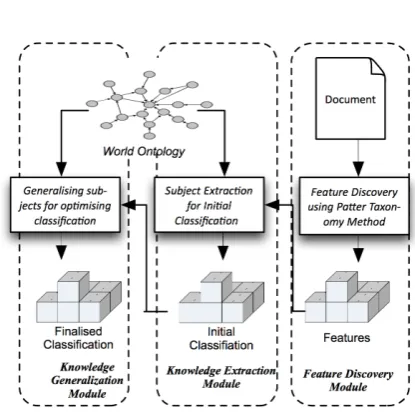
Figure 1: Conceptual Framework
Driven by the tasks, the conceptual framework of the proposed approach is designed consisting of three modules, as illustrated in Fig. 1.
Feature Extraction Module. Pattern
Taxon-omy Method is employed to discover features from the given document, based on the theory of closed frequent sequential patterns. The outcome would be a set of patterns with weights representing the fea-tures of document;
Knowledge Extraction Module. A
extracted, in which each subject is with a value in-dicating the strength of describing or discriminating the semantic content of document;
Knowledge Generalisation Module. The
sub-jects extracted in Knowledge Extraction Module are investigated and generalised. The semantic relations with other subjects in the neighbourhood and the lo-cation in the ontological structure are studied. Fi-nally, an refined indexed list of subjects are gener-alised as the categories assigned to the document.
5 Unsupervised Multi-label Categorisation
5.1 Feature Extraction from Document
Given a document i = {t1, t2, . . . , tm} ∈ Ω, a set
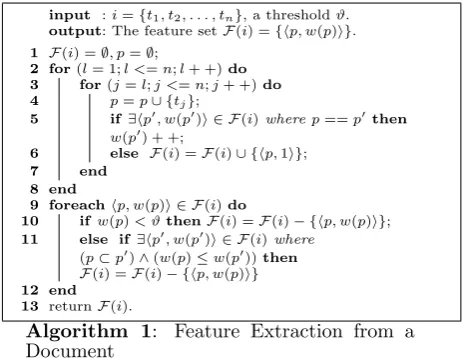
of features is first extracted, and defined by F(i) = {hp, w(p)i}, a set of valid patterns with weights. The patterns are extracted from the document using the closed frequent sequential pattern mining techniques. Pattern-based representation of features is consid-ered superior to traditional lexicon-based representa-tion (Li et al. 2010). Though lexicon features are easy to access by both human-users and computer systems, they usually contain many noisy features due to the sense ambiguity problem natually coming with terms, whereas pattern-based features has less noisy features because the representation considers the context of terms co-occurred in phrases. However, the pattern-based presentation has its own limit caused by the length of patterns. While longer patterns are more informative and discriminative, usually they are less frequent and as a result, have less evidence to rep-resent the document content. In this paper, we de-fine document features as weighted closed frequent sequential patterns. Algorithm 1 presents how the pattern features are discovered from a document.
input :i={t1, t2, . . . , tn}, a thresholdϑ. output: The feature setF(i) ={hp, w(p)i}.
F(i) =∅, p=∅;
1
for(l= 1;l <=n;l+ +)do 2
for(j=l;j <=n;j+ +)do 3
p=p∪ {tj}; 4
if∃hp0, w(p0)i ∈ F(i)wherep==p0then 5
w(p0) + +;
else F(i) =F(i)∪ {hp,1i};
6
end 7
end 8
foreachhp, w(p)i ∈ F(i)do 9
ifw(p)< ϑthenF(i) =F(i)− {hp, w(p)i};
10
else if∃hp0, w(p0)i ∈ F(i)where
11
(p⊂p0)∧(w(p)≤w(p0))then
F(i) =F(i)− {hp, w(p)i}
end 12
returnF(i).
13
Algorithm 1: Feature Extraction from a Document
In practice, we employed the pattern taxonomy model (PTM) developed in by (Li et al. 2010) to dis-cover the closed frequent sequential patterns from the document. The PTM model has been proven superior to other existing pattern mining approaches, such as Probabilistic and Rocchio, as reported in experimen-tal evaluations. (The details of PTM model and its related evaluation can be found in (Li et al. 2010).) Thus, given a document i, F(i) = {hp, w(p)i} is ob-tained, wherew(p) is the frequency ofpin i. Table 1 displays the closed frequent sequential patterns ex-tracted from the sample document presented in Sec-tion 3. Note the pattern discovery was performed with min sup= 2, and based on the text after word stemming and stopword removal.
Table 1: Closed Frequent Sequential Patterns Ex-tracted From the Sample Document
Closed Sequential Pattern Frequency
dimens 2
espionag 4
econom espionag 3
secret 2
econom 4
5.2 Mapping Local Features to Global
Sub-jects
Let T be the term space of S in O and T =
S
s∈Slabel(s). A matrix coordinated by T and S is
defined:
Definition 4 LethS,Tibe the matrix coordinated by TandS, where a mapping exists:
µ:T→2S, µ(t) ={s∈S|t∈label(s)} ⊆S
and its reverse mapping also exists:
µ−1:S→2T, µ−1(s) ={t∈
T|s∈η(t)} ⊆T. 2
By µ : T → 2S, a term t ∈ T maps to a set of
subjectsSt ⊆S. Thus, given the feature setF(i) =
{hp, w(p)i}, a set of subjects can be extracted fromS:
Si=
[
t∈termset(F(i))
µ(t) (1)
whereSi⊆S;µ(t) =∅ ift /∈T.
By µ−1 : S →2T, a subjects ∈ S maps to a set
of terms{t} ⊆T. Hence, with Eq. (1), a set of terms
can be obtained fromµ−1(s) to expandi:
termset(i) = [
s∈Si
µ−1(s) (2)
Note that termset(i) 6= i. There exist some terms {t|t∈termset(i), t /∈i}, these terms are suggested by Si; there also exist some terms{t|t /∈termset(i), t∈
i} because those terms are not in the term space T and thus, map to an empty set of subjects.
BecauseSi is extracted using F(i) ={hp, w(p)i},
considering the weights of feature patterns, we can evaluatet∈termset(i):
w(t) = X
p∈{p|t∈termset(p),p∈F(i)}
w(p) (3)
Considering the distribution of the terms spreading in other subjects, the normalized form of term evalu-ation is defined:
nw(t) =w(t)×log( |Si| sf(t,Si)
) (4)
wheresf(t,Si) =|{s|t∈µ−1(s), s∈ Si}|.
Subjects in Si can finally be evaluated for their
strengths of mappingi, usingnw(t) for allt∈µ−1(s):
str(i, s) = X
t∈µ−1(s)
nw(t) (5)
[image:5.595.60.292.424.603.2]Table 2: Subjects Representing the Sample Document
Subject Strength
Espionage 16.83
Espionage, economic 13.01 Space surveillance 13.01
Dimensions 9.24
Espionage, industry 9.24 Business espionage 8.98 Espionage literature 8.98 Espionage story 8.98
· · · ·
In order to prune away noisy subjects, the thresh-old, min str, is applied to subject extraction. The subjects with str(i, s) ≥ min str are kept; whereas those with str(i, s)< min str are dropped. During the experiments, different values were evaluated for min str. The results revealed that settingmin stras the top fifth str(i, s), a variable rather than a static value, gave the system the best performance. There-fore, the min str was set up dynamically as the top fifth value of str(i, s) for subject selection. Table 2 shows the valid subjects extracted from the LCSH ontology for the sample document in Section 3, using the closed frequent sequential patterns shown in Ta-ble 1. Note that only the top subjects are displayed, because there are a total of 80 subjects survived the pruning process.
5.3 Generalising Subjects for Optimal
Cate-gorisation
The subject set extracted from the ontology (as de-scribed in Section 5.2) suffers from a problem - the subject set is easily oversized. For example, there are 80 subjects selected for the sample document in Sec-tion 3. As a result, the system’s complexity becomes high, and performance becomes difficult to handle, when the category (subject) base has a large volume. The extracted subject set needs to be generalised and optimised for better categorisation.
Some subjects extracted from the ontology are ob-served overlapping in their semantic space. For ex-ample, for the subjects displayed in Table 2, by com-mon sense we know that ‘Espionage’ dominates ‘Espi-onage, economic’, ‘Espi‘Espi-onage, industrial’, and ‘Busi-ness espionage’; that ‘Espionage literature’ dominates ‘Espionage story’. This is caused by the same feature terms occurred in their labels. This observation raises an idea of generalising the initial subject set by prun-ing away overlappprun-ing subjects.
This generalisation is accomplished via investigat-ing the relations existinvestigat-ing between subjects. From Definitions 1 and 2 we know subjects in O have se-mantic relations linking each other. A subjectsmay have ancestor(s), a set of subjects linking tos with higher level of abstraction thans; anddescendant(s), a set of linking subjects more specific than s. Such a taxonomical structure is constructed based on the semantic extent and focus of subjects. Let s1 and s2 be two subjects and s1 ∈ ancestor(s2) (s2 ∈ descendant(s1)). s1 refers to a larger semantic ex-tent than s2 and thus, is more general than s2. On the other hand,s2 is more specific thans1and thus, more focuses on its referring-to concept. Such re-lationships can be revealed from an example of s1 as ‘Auto-mobile’ and s2 ‘Sedan’. ‘Auto-mobile’ con-tains ‘Car’, ‘Truck’, etc, and ‘Car’ contains ‘Sedan’, ‘Hatchback’, etc. ‘Auto-mobile’ covers broader ex-tent than ‘Sedan’; vise versa, ‘Sedan’ is more focused
than ‘Auto-mobile’. Therefore, in the extracted sub-ject set, if one subsub-ject is an descendant of another, the descendant can be removed because its referring-to semantic extent has been covered by its ancesreferring-tor. By removing the descendant subjects, we have no in-formation loss but just focus, for example, replacing ‘Sedan’ by ‘Car’ if they both in the extracted subject set.
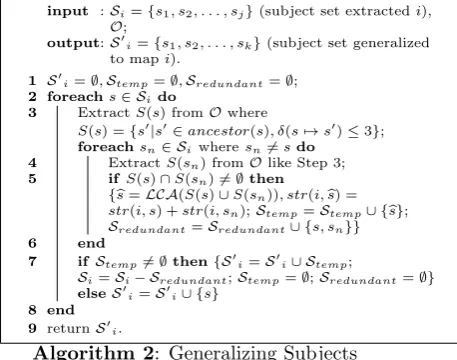
Following the same rule, if some subjects are un-der the same umbrella of an ancestor, they can be re-placed by this common ancestor without information loss, though the common ancestor is not in the ex-tracted subject set. Thus, if ‘Sedan’ and ‘Hatchback’ are in the set, they may be replaced by their com-mon ancestor ‘Car’. We may also use ‘Auto-mobile’ to replace ‘Sedan’ and ‘Truck’, though they are not at the same taxonomic level in the ontology. However, the common ancestor chosen to replace its descendant subjects cannot be too far away from the replaced de-scendants in the taxonomic structure. One extreme example is that we cannot use ‘Thing’ to replace any subjects, as ‘Thing’ is the root and dominates all subjects in the ontology. An ancestor subject being too far from its descendants becomes meaningless to them, because the focus is severely lost. Therefore, we use only the lowest common ancestor (shortened byLCA) to replace its descendant subjects. The low-est common anclow-estor is a proven effective technique to help capture semantic meaning in text. Nguyen and Cao (Nguyen & Cao 2010) exploited a variant of LCA, namely Relevant Lowest Common Ancestor, to capture accurate relevant fragments in XML search. In this work, the LCA refers to the common ances-tor of a set of subjects, with the shortest distance to these subjects in the taxonomic structure of ontology. The LCA dominates these descendant subjects and covers their semantic extent with only limited loss of focus. Replacing these descendant subjects by their LCAgeneralises the semantic content.
input :Si={s1, s2, . . . , sj}(subject set extractedi),
O;
output:S0i={s1, s2, . . . , sk}(subject set generalized
to mapi).
S0
i=∅,Stemp=∅,Sredundant=∅; 1
foreachs∈ Sido 2
ExtractS(s) fromOwhere
3
S(s) ={s0|s0∈ancestor(s), δ(s7→s0)≤3};
foreachsn∈ Si wheresn6=sdo
ExtractS(sn) fromOlike Step 3; 4
ifS(s)∩S(sn)6=∅then 5
{bs=LCA(S(s)∪S(sn)), str(i,sb) =
str(i, s) +str(i, sn);Stemp=Stemp∪ {sb};
Sredundant=Sredundant∪ {s, sn}} end
6
ifStemp6=∅then{S0i=S0i∪ Stemp; 7
Si=Si− Sredundant;Stemp=∅;Sredundant=∅} elseS0
i=S0i∪ {s} end
8
returnS0i. 9
Algorithm 2: Generalizing Subjects
Table 3: Generalized Subjects for the Sample Docu-ment
Subject Strength
Espionage 269.78
Business Intelligence 203.83 Space surveillance 17.96
Spy story 16.27
Dimensions 9.24
of original subjects. As a result, the original, specific information in the document is jeopardised. (In our experiments, δ(s1 7→ s2) ≤ 3 and ≤ 5 were tested under the same environment in order to find a valid distance for tracking the competentLCA. The system achieved a better performance whenδ(s17→s2)≤3. The details of this sensitivity test can be found in Section 7.)
Table 3 presents the subjects generalised from those displayed in Table 2. Again, the min str is set as the top fifth str(i, s) value. Similar subjects, for example, ‘Espionage’, ‘Espionage, economic’, ‘Es-pionage, industrial’, and ‘Business espionage’, have been merged and replaced by theirLCA. ‘Espionage’ and ‘Business Intelligence’; ‘Espionage literature’ and ‘Espionage story’ have been replaced by ‘Spy story’. Consequently, the 80 subjects initially extracted from the ontology (as described in Section 5.2 previously) are generalised to a much shorter list containing only five subjects. This set of subjects is more applicable to the systems, and more competent for the categori-sation of the sample document presented in Section 3.
6 Evaluation
6.1 Experiment Design
Ideally, to categorise a document, the subjects auto-matically generated by the proposed approach should be exactly the same as those specified by specialist li-brarians. Though such a goal is unrealistic, the ideal scenario inspirited the design of our evaluation exper-iments - the proposed method was evaluated, based on the ground truth of manual assignment of subjects and compared with typical categorisation approaches. The experiments were performed using a large corpus obtained from the catalogue of a library employing the LCSH authorities. A sample catalogue item has been presented in Section 3. The text of each item in the catalogue was parsed to form a document. The title and content of catalogue items were used to form the content. The subject headings assigned to the cat-alogue items were manually specified from the LCSH authorities by specialist librarians who were trained to specify subjects for a document without bias (Chan 2005). They provided the ideal ground truth in the experiments to measure the effectiveness of the pro-posed approach, against the automatically generated subjects. By using the catalogue items in a library as the corpus, we could easily obtain a large testing set as well as a perfect ground truth for evaluation. The objective evaluation methodology also assured the so-lidity and reliability of the experimental evaluation for our proposed method.
The testing set was retrieved from the on-line cat-alogue of the University of Melbourne Library4 by using as queries the title of topics (R101-R150) cre-ated by the TREC-11 Filtering Track. These topics were manually designed by linguists for evaluation of
4http://www.library.unimelb.edu.au/
Description Stat.
Documents crawled 227,219 Documents used in experiments 31,902 Shortest document in experiments 30 Longest document in experiments 952 Average length of documents in exps 85
Table 4: Statistics of the Testing Set
information retrieval methods. The retrieved cata-logue items were parsed to keep only title, content, and subjects. The testing set was then generated by pooling the catalogue items retrieved by total 50 top-ics. Text pre-processing techniques, such as stopword removal and word stemming (Porter stemming algo-rithm), were applied to the preparation of testing set for experiments. Table 4 shows the statistics of the testing set. In the experiments, we used only docu-ments with at least 30 terms after stopword removal. Documents shorter than that could hardly provide substantial frequent patterns, as revealed in the ex-periments.
6.2 Baseline Models
Given that the LCSH ontology contains 394,070 sub-jects in our implementation, the category base has a fairly large volume. Hence, we chose two typical multi-class categorisation approaches, Rocchio and kNN, as the baseline models in the experiments.
Rocchio is an efficient classification method using centroid to define the class boundaries. The centroid of a classc is computed as the vector average:
~
µ(c) = 1 |Dc|
X
i∈Dc
~υ(i) (6)
In the experiments, a classc referred to a subjects. The training setDccontained only a single document
i=label(s). The distance between a document and a subject was measured by cosine similarity. The doc-ument was then categorised into the subject classes with the highest cosine value. (Considering that the category base volume is a huge number, using only the top cosine value has already produced a consid-erably large set of subjects.)
Unlike Rocchio, k Nearest Neighbour (kNN) de-termines the decision boundary locally and categories documents into the major categories of its k closest neighbours. When incoming a documentd, from the testing set we extracted the closest neighboursN N(d) that had the highest cosine similarity value with d. Because the testing documents were usually short, a large number of documents were found having the same cosine values. Thus, we setk= 1 to limit the number of considerable neighbours, as well as to en-sure the highest possible accuracy. The distance of a subject s and a document d is then evaluated by aggregating the cosine value of eachd0 ∈ N N(d) to s. Once again,dwas classified into the subjects with the highest cosine similarity value.
6.3 Performance Measuring Methods
Figure 2: Effectiveness Performance on Average
As discussed previously, considering the category base volume, seeking exact-mapping of subjects was unrealistic. Thus, in respect with the text corpus and the ground truth featured by the LCSH, the system performance was evaluated by:
precision=|F T(Stgt)∩F T(Sgrt)| |F T(Stgt)|
(7)
recall= |F T(Stgt)∩F T(Sgrt)| |F T(Sgrt)|
(8)
where F T(S) = S
s∈Sµ−1(s) (see Definition 4); tgt
referred to the target experimental model; grt re-ferred to ground truth subjects.
F1 Measure as another common method used in IR was also employed in our experiments:
F1=
2×precision×recall
precision+recall (9) Precision and recall were evenly considered in F1 Measure. In this evaluation, we usedmicro-F1 Mea-sure, which evaluated each document’s mapping re-sult first and then averaged the evaluation rere-sults for the finalF1Measure value. GreaterF1values indicate better performance.
7 Results and Discussions
7.1 Experimental Results
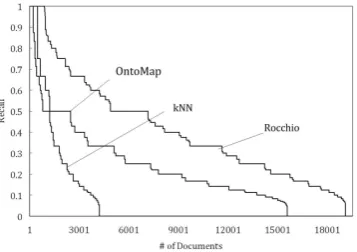
By calling the proposed approach as the OntoMap model, the experiments were to compare the effec-tiveness performance of the OntoMap model to the baselines, Rocchio and kNN models. Their effective-ness performances are depicted in Fig. 3, 4, and 5 for the number of documents with valid effectiveness (>0), where the value axis indicates the effectiveness rate between 0 and 1; the category axis indicates the number of documents whose mappings meet the indi-cating effectiveness rate. As shown in the figure and discussed in Section 6.3, the effectiveness rates are measured by precision, recall, andF1Measure, where P(X) refers to the precision results of experimental model X, R(X) the recall results, andF(X) theF1 Measure results. Their overall average performances are shown in Fig. 2.
[image:8.595.76.274.43.164.2]F1 Measure equally considers both precision and recall in performance measuring. Thus the F1 Mea-sure results can be deemed as an overall effectiveness performance. The average F1 Measure result illus-trated in Fig. 2 reveals that the OntoMap model has achieved a much better overall performance than the two baseline models. The performance is also con-firmed by the detailed results depicted in Fig. 3 - the
Figure 3: Performance Measured byF1 Measure
Figure 4: Performance Measured by Precision
[image:8.595.333.515.44.174.2]F(OntoM ap) line is located at much higher bound level compared to theF(Rocchio) andF(kN N) lines. Precision measures how effective the global and lo-cal knowledge mappings are. In terms of that, the OntoMap model once again has outperformed the baseline models. The average precision results shown in Fig. 2 demonstrates this achievement. The de-tailed precision results depicted in Fig. 4 illustrate the same message that theP(OntoM ap) curve is de-picted much higher than those of the baseline models. Recall measures the rate of global and local knowl-edge mappings covering all dealing-with subjects. The recall performance shows a slightly different re-sult compared to those fromF1Measure and precision performance. The Rocchiomodel achieved the best recall performance, compared to that of the OntoMap model and the kNN model. This message is also il-lustrated in Fig. 5 asR(OntoM ap) lies in the middle ofR(Rocchio) andR(kN N).
[image:8.595.332.515.216.339.2] [image:8.595.336.515.601.727.2]Figure 6: Effectiveness Performance on Average
Figure 7: OntoMap Performance on Documents with Different Lengths
7.2 Discussions
There was a gap between the recall performance of the OntoMap and the Rocchio models. After the inves-tigation conducted into the insight of recall results, we found that the categorisation made by the Roc-chio model was usually a large set of subjects (935 on average), whereas the OntoMap model had results with a much reasonable size of subject sets (16 on average) and the kNN’s had an average size of 106. Due to the nature of recall measurement, more fea-ture term would be covered if the subject size became larger. As a result, the Rocchio mappings with the largest size of subjects achieved the best recall per-formance. The category sets generated by the kNN model had larger size than those of the OntoMap. However, when taking neighbours into consideration, a large number of nosey subjects was also brought into the neighbourhood consideration - the average num-ber of neighbours was 336. This was caused by the extremely high dimension in the category base and short length of documents (average length=85) in ex-periments. As a result, the multi-label categorisation became ineffective because only the documents with top cosine values were chosen to expand and only the subjects with the top similarity values were chosen for categories.
Different values were tested in sensitivity study for choosing a right number of levels to find the lowest common ancestor when generalising subjects for final mappings. (The related discussion can be referred to Section 5.3.) Fig. 6 displays the testing results for finding such a right level. In the same experimental environment, if tracing three levels to find aLCAthe OntoMap model’s overall performance including F1 Measure, precision, and recall was better than that by five levels. In addition, tracing only three lev-els costs less in complexity compared with five levlev-els. Therefore, we chose three levels to restrict the extent of findingLCAs.
We also found that the performance of the On-toMap model was improved when longer documents
were used in the experiments. Figure 7 depicted the improvement made by the OntoMap model by re-stricting documents with a minimum length set from 30 till 150. When the minimum length was set to 30, about 32,000 documents were tested, the perfor-mance was the same as that discussed in Section 7.1; when set to 150, the documents dropped to 2,650, and the performance was much better. Figure 7 reveals that the effectiveness of categorisation increases when the length of considering documents increases. Such an improvement is contributed by the closed frequent sequential patterns discovered for document feature representation (see Section 5.1 for details). When the OntoMap has the best performance with restricting to only documents longer than 150 terms, the average number of closed frequent sequential patterns was 27; when restricting to documents with length>= 90, the average number of patterns dropped to 17; when with all the documents (length>= 30), the average num-ber of discovered patterns dropped to 11. These facts reveal that more meaningful patterns are discovered from long documents with more semantic contents.
8 Conclusions and Future Work
Text categorisation has been widely exploited to as-sist tasks in information retrieval, information organ-ising, text categorisation, and knowledge engineering. Traditionally, text categorisation relies on the quality of training samples with category labels, the infor-mative, discriminative features extracted from docu-ments, and the topic coverage of category base. Some-times qualified training samples may be absent, the problem then becomes unsupervised. When one sin-gle category assigned to the document cannot not fully describe the content, the single label categorisa-tion then becomes a multi-label problem. In this pa-per we have introduced an unsupa-pervised multi-label text categorisation approach exploiting a world on-tology. The ontology is encoded from the Library of Congress Subject Headings and contains a large vol-ume of subjects with extensive topic coverage. The proposed approach uses the subjects as the category base, and maps the local features extracted from the document to a set of global categories. The approach then studies the semantic relations and ontological structure to optimise the categorisation result to the document. The approach has been experimentally evaluated by comparing with typical methods includ-ingRocchioandkN N , using a large real-world cor-pus, based on the ground truth encoded by human experts. The experimental results demonstrated that the OntoMap model outformed baseline models of Rocchio and kNN, in terms of overall effectiveness and precision performance.
[image:9.595.91.256.183.300.2]References
Bekkerman, R. & Gavish, M. (2011), High-precision phrase-based document classification on a modern scale, in ‘Proceedings of the 17th ACM SIGKDD international conference on Knowledge discovery and data mining’, pp. 231–239.
Cai, D., Zhang, C. & He, X. (2010), Unsupervised feature selection for multi-cluster data,in ‘Proceed-ings of the 16th ACM SIGKDD international con-ference on Knowledge discovery and data mining’, pp. 333–342.
Camous, F., Blott, S. & Smeaton, A. F. (2007), Ontology-based medline document classification,in ‘Proceedings of the 1st international conference on Bioinformatics research and development’, pp. 439– 452.
Chan, L. M. (2005), Library of Congress Subject Headings: Principle and Application, Libraries Un-limited.
Cheng, W., Kasneci, G., Graepel, T., Stern, D. & Herbrich, R. (2011), Automated feature generation from structured knowledge, in ‘Proceedings of the 20th ACM international conference on Information and knowledge management’, pp. 1395–1404. Forman, G. & Kirshenbaum, E. (2008), Extremely
fast text feature extraction for classification and indexing, in‘Proceedings of the 17th ACM confer-ence on Information and knowledge management’, pp. 1221–1230.
Gabrilovich, E. & Markovitch, S. (2005), Feature gen-eration for text categorization using world knowl-edge, in ‘Proceedings of The Nineteenth Interna-tional Joint Conference for Artificial Intelligence’, pp. 1048–1053.
Hernandez, N., Mothe, J., Chrisment, C. & Egret, D. (2007), ‘Modeling context through domain ontolo-gies’, Information Retrieval10, 143–172.
Hofmann, K., Tsagkias, M., Meij, E. & de Rijke, M. (2009), The impact of document structure on keyphrase extraction, in ‘Proceedings of the 18th ACM conference on Information and knowledge management’, pp. 1725–1728.
Hu, X., Zhang, X., Lu, C., Park, E. K. & Zhou, X. (2009), Exploiting wikipedia as external knowledge for document clustering,inProceedings of the 15th ACM SIGKDD international conference on Knowl-edge discovery and data mining’, pp. 389–396. Kiran, G. V. R., Shankar, R. & Pudi, V. (2010),
Fre-quent itemset based hierarchical document cluster-ing uscluster-ing wikipedia as external knowledge,in ‘Pro-ceedings of the 14th international conference on Knowledge-based and intelligent information and engineering systems: Part II’, pp. 11–20.
Li, Y., Algarni, A. & Zhong, N. (2010), Mining pos-itive and negative patterns for relevance feature discovery, in ‘Proceedings of 16th ACM SIGKDD Conference on Knowledge Discovery and Data Min-ing’, pp. 753–762.
Malik, H. H. & Kender, J. R. (2008), Classifying high-dimensional text and web data using very short patterns, in ‘Proceedings of the 8th IEEE Inter-national Conference on Data Mining’, pp. 923–928.
Nguyen, K. & Cao, J. (2010), Exploit keyword query semantics and structure of data for effective xml keyword search, in ‘Proceedings of the 21st Australasian Conference on Database Technologies -Volume 104’, pp. 133–140.
Sun, X., Wang, H., Li, J. & Pei, J. (2011), ‘Publishing anonymous survey rating data’, Data Mining and Knowledge Discovery23(3), 379–406.
Sun, X, Wang, H. Li, J. & Zhang, Y. (2012), ‘Satis-fying privacy requirements before data anonymiza-tion’,The Computer Journal55(4), 422–437. Tao, X., Li, Y. & Zhong, N. (2011), ‘A
personal-ized ontology model for web information gather-ing’, IEEE Transactions on Knowledge and Data Engineering,23(4), 496–511.
Tao, X., Li, Y., Zhong, N. & Nayak, R. (2008), ‘A knowledge retrieval model using ontology mining and user profiling’,Integrated Computer-Aided En-gineering15(4), 313–329.
Tjondronegoro, D., Tao, X., Sasongko, J. & Lau, C. H. (2011), Multi-model summarization of key events and top players in sports tournament videos, in‘Proceedings of the IEEE Workshop on Applica-tions of Computer Vision’, pp. 471–478.
Wang, P. & Domeniconi, C. (2008), Building seman-tic kernels for text classification using wikipedia, inProceeding of the 14th ACM SIGKDD interna-tional conference on Knowledge discovery and data mining’, pp. 713–721.
Yan, Y., Okazaki, N., Matsuo, Y., Yang, Z. & Ishizuka, M. (2009), Unsupervised relation extrac-tion by mining wikipedia texts using informaextrac-tion from the web,in‘Proceedings of the Joint Confer-ence of the 47th Annual Meeting of the ACL and the 4th International Joint Conference on Natural Language Volume 2, pp. 1021–1029.
Yang, B., Sun, J.-T., Wang, T. & Chen, Z. (2009), Ef-fective multi-label active learning for text classifica-tion,in‘Proceedings of the 15th ACM SIGKDD in-ternational conference on Knowledge discovery and data mining’, pp. 917–926.
Yang, T., Jin, R., Jain, A. K., Zhou, Y. & Tong, W. (2010), Unsupervised transfer classification: appli-cation to text categorization,in‘Proceedings of the 16th ACM SIGKDD international conference on Knowledge discovery and data mining’, pp. 1159– 1168.
Yu, G., Huang, R. & Wang, Z. (2010), Document clustering via dirichlet process mixture model with feature selection,in‘Proceedings of the 16th ACM SIGKDD international conference on Knowledge discovery and data mining’, pp. 763–772.
Zhong, N., Li, Y. & Wu, S.-T. (2012), ‘Effec-tive Pattern Discovery for Text Mining’, IEEE Transactions on Knowledge and Data Engineering,