Department of Computer Science Ubiquitous Knowledge Processing Lab
Dissertation approved by the Department of Computer Science of the Technische Universität Darmstadt to attain the academic degree Doktor rerum naturalium (Dr. rer. nat.)
Leveraging Lexical-Semantic Knowledge for Text
Classification Tasks
Ing. et Ing. Lucie Flekova
born in Prague, Czech Republic
Submitted: February 28, 2017 Defended: April 24, 2017
1. Reviewer
Prof. Dr. Iryna Gurevych
Department of Computer Science Technische Universität Darmstadt
2. Reviewer
Prof. Dr. Benno Stein
Department of Computer Science and Media Bauhaus Universität Weimar
3. Reviewer
Prof. Dr. Walter Daelemans
CLiPS Research Center University of Antwerp
Darmstadt, 2017 D17
Ing. et Ing. Lucie Flekova
Leveraging Lexical-Semantic Knowledge for Text Classification Tasks
Computer Science, Submitted: February 28, 2017
Reviewers: Prof. Dr. Iryna Gurevych, Prof. Dr. Benno Stein and Prof. Dr. Walter Daelemans
Technische Universität Darmstadt
Ubiquitous Knowledge Processing Lab Department of Computer Science Hochschulstrasse 10
Abstract
This dissertation is concerned with the applicability of knowledge, contained in lexical-semantic resources, to text classification tasks. Lexical-lexical-semantic resources aim at systemati-cally encoding various types of information about the meaning of words and their relations. Text classification is the task of sorting a set of documents into categories from a predefined set, for example, “spam” and “not spam”. With the increasing amount of digitized text, as well as the increased availability of the computing power, the techniques to automate text classification have witnessed a booming interest. The early techniques classified documents using a set of rules, manually defined by experts, e.g. computational linguists. The rise of big data led to the increased popularity of distributional hypothesis [Harris, 1954] - i.e., “a meaning of word comes from its context” - and to the criticism of lexical-semantic resources as too academic for real-world NLP applications [Jorgensen, 1990, Palmer, 2000, Ide and Wilks, 2007]. For long, it was assumed that the lexical-semantic knowledge will not lead to better classification results, as the meaning of every word can be directly learned from the document itself [Resnik, 2006]. In this thesis, we show that this assumption is not valid as a general statement and present several approaches how lexicon-based knowledge will lead to better results. Moreover, we show why these improved results can be expected. One of the first problems in natural language processing is the lexical-semantic ambiguity [Jurafsky and Martin, 2009]. In text classification tasks, the ambiguity problem has often been neglected. For example, to classify a topic of a document containing the word bank, we don’t need to explicitly disambiguate it, if we find the word river or
finance. However, such additional word may not be always present. Conveniently, lexical-semantic resources typically enumerate all senses of a word, letting us choose which word sense is the most plausible in our context. What if we use the knowledge-based sense disambiguation methods in addition to the information provided implicitly by the word context in the document? In this thesis, we evaluate the performance of selected resource-based word sense disambiguation algorithms on a range of document classification tasks (Chapter 3). We note that the lexicographic sense distinctions provided by the lexical-semantic resources are not always optimal for every text classification task, and propose an alternative technique for disambiguation of word meaning in its context for sentiment analysis applications.
The second problem in text classification, and natural language processing in general, is the one with synonymy. The words used in training documents represent only a tiny fraction of the words in the total possible vocabulary. If we learn individual words, or senses, as features in the classification model, our system will not be able to interpret the paraphrases, where the synonymous meaning is conveyed using different expressions. How much would the classification performance improve if the system could determine that two very different words represent the same meaning? In this thesis, we propose to
address the synonymy problem by automatically enriching the training and testing data with conceptual annotations accessible through lexical-semantic resources (Chapter 4). We show that such conceptual information (“supersenses”), in combination with the previous word sense disambiguation step, helps to build more robust classifiers and improves classification performance of multiple tasks (Chapter 5). We further circumvent the sense disambiguation step by training a supersense tagging model directly. Previous evidence suggests that the sense distinctions of expert lexical-semantic resources are far subtler than what is needed for downstream NLP applications [Ide and Wilks, 2007, Jorgensen, 1990], and by disambiguating the concepts directly on a supersense level (e.g., “is theduckan animal or a food?” rather than choosing between its eight WordNet senses), we can reduce the number of errors.
The third problem in text classification is the curse of dimensionality. We want to know not only if each single word predicts certain document class, but which combinations of words predict it and which ones do not. Our need for training data thus grows exponentially with the number of words monitored. Several techniques for dimensionality reduction were proposed, most recently the representation learning, producing continuous word represen-tations in a dense vector space, also known as word embeddings. However, these vectors are again produced on an ambiguous word level, and the valuable piece of information about possible distinct senses of the same word is lost, in favor of the most frequent one(s). In this thesis, we explore if, or how, we can use lexical-semantic resources to regain the sense-level notion of semantic relatedness back while operating within the deep learning paradigm, therefore still being able to access the high-level conceptual information. We propose and evaluate a method to integrate word and supersense embeddings from large sense-disambiguated resources such as Wikipedia. We examine the impact of different training data for the quality of these embeddings, and demonstrate how to employ them in deep learning text classification experiments. Using convolutional and recurrent neural networks, we achieve a significant performance improvement over word embeddings in a range of downstream classification tasks.
The application of methods proposed in this thesis is demonstrated on experiments esti-mating the demographics and personality of a text author, and labeling the text with its subjective charge and sentiment conveyed. We therefore also provide empirical insights into which types of features are informative for these document classification problems, and suggest explanations grounded in psychology and sociology. We further discuss the issues that can occur as human experts are prone to diverse biases when classifying data. To summarize, we could show that lexical-semantic knowledge can improve text classifica-tion tasks by supplying the hierarchy of abstract concepts, which enable better generaliza-tion over words, and that these methods are effective also in combinageneraliza-tion with the deep learning techniques.
Zusammenfassung
Mit dem Aufkommen von großen Datensätzen und fortgeschrittenen Klassifikationsalgo-rithmen wurde für lange Zeit angenommen, dass die Verwendung lexikalisch-semantischen Wissens zu keinen besseren Klassifikationsergebnissen führt. Grundlage dieser Annahme war, dass die Bedeutung von Wörtern direkt aus den verfügbaren Textdokumenten vom gewählten Klassifikationsalgorithmus erlernt werden kann. In der vorliegenden Arbeit wird gezeigt, dass diese Annahme nicht als allgemeine Aussage gelten kann. Insbesondere werden mehrere Ansätze vorgestellt, wie lexikonbasiertes Wissen zu signifikant besseren Ergebnissen führt. Darüber hinaus wird erörtert, unter welchen Bedingungen bessere Ergebnisse zu erwarten sind.
Bei Textklassifikationsaufgaben muss eine Menge von Dokumenten in verschiedene Ka-tegorien automatisch sortiert werden. Mit der zunehmenden Menge an digitalisierten Texten sowie mit der erhöhten Verfügbarkeit von Rechenleistung hat die Forschung und Entwicklung an automatisierten Techniken der Textklassifikation in den vergangenen Jah-ren enorme Fortschritte erzielt. Trotz dieser Fortschritte bleibt die lexikalisch-semantische Ambiguität wichtiges Problem: Ein einzelnes Wort kann mehrere Bedeutungen haben und kann nur unter Berücksichtigung des Kontextes bestimmt werden.
In den bisherigen Ansätzen zu Textklassifikationsaufgaben wurde dieses Mehrdeutigkeits-problem oft mit der Annahme vernachlässigt, dass ein Dokument typischerweise genügend Worte enthält, um die mehrdeutigen Fälle ignorieren zu können. Um beispielsweise das Thema eines Textdokuments zu bestimmen, das das Wort “Bank” enthält, muss der Sinn des Wortes “Bank” nicht bestimmt werden, wenn zusätzlich Wörter wie “Fluss” oder “Finanzen” im Text zu finden sind. Jedoch muss ein solches zusätzliche Wort nicht notwendigerweise vorhanden sein. Zweckmäßigerweise zählen lexikalisch-semantische Ressourcen in der Regel alle Sinne eines Wortes auf und organisieren sie durch konzeptuell-semantische und lexikalische Beziehungen zu einem Netzwerk. Dies eröffnet eine Vielzahl von Optionen, um zu entscheiden, welche Wortbedeutung im gegebenen Fall am plausibelsten ist. Der erste Fragenkomplex, der in dieser Arbeit behandelt wird, lautet: Was sind die Konsequen-zen, wenn die wissensbasierten Disambiguierungsmethoden zusätzlich zu den implizit im Wortkontext des Dokuments enthaltenen Informationen genutzt werden können? Wie sehr würde sich die Klassifikationsleistung verbessern? In dieser Arbeit wird die Auswirkung von Wort-Ambiguitäten auf eine Reihe von Textklassifikationsaufgaben untersucht und die Leistung ausgewählter Ressourcen-basierter Algorithmen zur Erfassung von Worter-klärungen bewertet. Es wird gezeigt, dass die lexikographischen Sinnunterscheidungen, die durch die lexikalisch-semantischen Ressourcen zur Verfügung gestellt werden, nicht für jede Textklassifikationsaufgabe geeignet sind. Daher wurden alternative Techniken zur Begriffsdefinition aus dem Kontext für Anwendungen in der Semantikanalyse entwickelt.
Das zweite Problem in der Textklassifikation ist das Problem der Synonymie. Für jedes Dokument repräsentieren die verwendeten Wörter nur einen kleinen Bruchteil der Wörter aus dem insgesamt möglichen Wortschatz. Wenn wir einzelne Wörter oder Sinne als Merk-male im Klassifikationsmodell verwenden, wird das Klassifikationssystem die Paraphrasen der Trainingswörter nicht interpretieren können. Daher stellt sich die Frage, wie sich die Klassifizierungsleistung verbessern würde, wenn das automatisierte System feststellen könnte, dass zwei sehr unterschiedliche Wörter eine ähnliche Bedeutung teilen? In dieser Arbeit werden mögliche Lösungen untersucht, die mit Hilfe von hierarchischen Relatio-nen ermöglicht werden, welche in lexikalisch-semantischen Ressourcen enthalten sind. In der Arbeit wird ein Ansatz entwickelt, wie das Synonymieproblem durch automati-sches Bereichern der Trainings- und Testdaten mit konzeptuellen Annotationen, die über lexikalische-semantische Ressourcen zugänglich sind, vermindert werden kann. Es wird gezeigt, dass solche konzeptionellen Informationen robustere Klassifizierungsleistungen für eine Vielzahl von Aufgaben ermöglichen.
Das dritte untersuchte Problem bei der Textklassifikation, das eng mit den Obigen zusam-menhängt, betrifft die Dimensionalität der Trainingsdaten. Soll zum Beispiel nicht nur jedes Wort, sondern auch Kombinationen von Wörtern für die Klassifikation verwendet werden, so wächst die Eingabe an den Klassifikator exponentiell. Mehrere Techniken zur Reduktion der Dimensionalität wurden vorgeschlagen. In den vergangenen Jahren setzte sich hier der Ansatz des sogenannten „Word-embeddings“ zunehmend durch. Da die zugehörigen Trainingsvektoren wieder auf einer mehrdeutigen Wortebene statt Sinnebene erzeugt wer-den, geht wertvolle Information über mögliche Bedeutungsunterschiede verloren. In dieser Arbeit wurde ein neuartiger Ansatz entwickelt, mit dem durch lexikalisch-semantische Ressourcen, die semantische Verwandtschaft von Eingabedaten zurückzugewonnen werden konnte. Die Vorteile dieses Ansatzes konnten in verschiedenen Anwendungen demonstriert werden. Insbesondere konnte bewiesen werden, dass dieser Ansatz selbst bei der Verwen-dung von faltenden und wiederkehrenden neuronalen Netzwerken (convolutional and recurrent neural networks) signifikant verbesserte Ergebnisse erzielen kann.
Diese Arbeit zeigt, dass die gezielte Verwendung von lexikalisch-semantischem Wissen bei automatisierten Textklassifikationsaufgaben mittels fortgeschrittener Klassifikationsansätze (z.B. “deep learning”) zu signifikant besseren Ergebnissen führen kann. Dies wird durch die Bereitstellung von Hierarchien abstrakter Konzepte, die eine bessere Verallgemeinerung von Wörtern ermöglichen, erreicht.
Wissenschaftlicher Werdegang der Verfasserin
109/2005 – 09/2009 Studium der Informatik (Bachelor) an der Tschechischen Technischen Universität in Prag.
08/2007 – 05/2008 Studium der Wirtschaftsinformatik an der Technischen Hochschule in Oulu, Finland
06/2009 – 08/2009 Sommerstudenten Programm am Europäischen Kernforschungszen-trum (CERN), Genf.
09/2009 Abschluss - Bachelor of Science (Bc.).
Bachelorarbeit: “Interactive learning application for microeconomics.” Gutachter: Ing. Ivo Koubek
09/2009 – 06/2011 Studium der Informatik (Master) an der Tschechischen Technischen Universität in Prag.
10/2010 – 06/2011 Technical Fellow am Europäischen Kernforschungszentrum (CERN), Genf.
06/2011 Abschluss - Master of Science (Ing.).
Masterarbeit: “Big data processing optimization in high energy physics.”
Gutachter: Ing. Tomas Liska, Ph.D.
09/2005 – 09/2013 Studium an der Wirtschaftswissenschaftlichen Universität Prag. 09/2013 Abschluss - Master of Economics (Ing.).
Masterarbeit: “Legal aspects of international e-commerce on web search”
Gutachter: Prof. JUDr. Martin Bohacek, CSc.
10/2012 – 12/2016 Wissenschaftliche Mitarbeiterin am Ubiquitous Knowledge Process-ing Lab, Technische Universität Darmstadt.
06/2015 – 09/2015 Gastwissenschaftlerin an der University of Pennsylvania, USA. seit 01/2017 Mobility Fellow an der University College London (UCL), Department
of Computer Science.
1Gemäß §20 Abs. 3 der Promotionsordnung der TU Darmstadt
Ehrenwörtliche Erklärung
2Hiermit erkläre ich, die vorgelegte Arbeit zur Erlangung des akademischen Grades “Dr. rer. nat.” mit dem Titel “Leveraging Lexical-Semanitc Knowledge for Text Classification Tasks” selbständig und ausschließlich unter Verwendung der angegebenen Hilfsmittel erstellt zu haben. Ich habe bisher noch keinen Promotionsversuch unternommen.
Darmstadt, den 28.2.2017
Lucie Flekova
2Gemäß §9 Abs. 1 der Promotionsordnung der TU Darmstadt
Acknowledgements
Despite having only one author, this thesis was a large collaborative effort. First and foremost, I want to thank Prof. Dr. Iryna Gurevych for giving me the opportunity to enter this research field, and for her very valuable guidance, feedback, encouragement and support. I also thank Prof. Dr. Benno Stein and Prof. Dr. Walter Daelemans, not only for investing their time into reviewing this thesis, but also for the very inspiring discussions we had in the past. Additionally, I am indebted to my visiting research supervisors Prof. Lyle Ungar and Prof. Ingemar J. Cox for sharing their knowledge and their excitement for our projects. This work has been supported by the Volkswagen Foundation as part of the Lichtenberg Professorship Program under grant No. I/82806 and by the German Research Foundation under grant No. GU 798/14-1. Additional support was provided by the German Federal Ministry of Education and Research (BMBF) as a part of the Software Campus program under the promotional reference 01-S12054 and by the German Institute for Educational Research (DIPF). Hereby I would also like to thank the Software Campus organization team for the opportunities given, and to my industry mentor Christian Döttinger for exposing his impressive people skills and providing refreshing perspectives. This work could advance quickly thanks to the contributions of my research assistants Tahir Sousa, Xuan-Son Vu and Radhika Gaonkar, and the bachelor and master students, all of whom I was happy to support in their starting careers. Dr. Richard Eckart de Castilho, Dr. Johannes Daxenberger and Dr. Oliver Ferschke accelerated this thesis notably with their software frameworks. Additionally, I would like to thank all my current and former colleagues for valuable discussions, ideas, feedback, proof-reading of my early drafts in all those years, and for simply sharing and bearing all the research highs and lows. Thank you, Margot, Christian, Ilja, Emily, Ivan, Tristan, Johannes, Lisa, Silvana, Oliver, Steffen, “et al.”. I am also grateful to other members of the scientific community, who inspired me during my PhD time simply by their enthusiasm, unstoppable curiosity, and pure joy of doing research. This includes, but is not limited to, Dr. Daniel Preo¸tiuc-Pietro, Prof. Chris Biemann, Prof. Dirk Hovy, Prof. Matthias Schott, Prof. Anders Søgaard, Prof. David Bamman and Prof. Torsten Zesch.
Last but not least, I thank my entire family, especially the little Sebastian, Alan, Sandra, and Hanna for making very sure I don’t forget the healthy balance of work and play. Special thanks to my parents for accepting my decision to leave the “good and safe job” for my PhD, and for being just as supportive as they were 12 years ago, when I started to do “the crazy physics stuff”. My thanks belong also to Olga, Ruth, Simone, Vojta and Libbi for being here and caring, and to the “vereins” of Flörsheim for making me feel at home. Yet, above all, I want to thank my partner for trusting in me so much more than I did, and making this possible. This is for you. I might find a different way of spending evenings now.
Contents
1 Introduction 1
1.1 Challenges in text classification tasks . . . 2
1.2 Conceptual model of the interplay of explicit and implicit knowledge . . . . 3
1.3 Thesis organization . . . 6 1.4 Main contributions . . . 7 1.5 Publication record . . . 10 2 Background 13 2.1 Classification . . . 13 2.1.1 Formal definition . . . 15
2.1.2 Supervised classification algorithms . . . 16
2.1.3 Classification tasks . . . 19 2.2 Linguistic preprocessing . . . 22 2.2.1 Segmentation . . . 22 2.2.2 Lemmatization . . . 23 2.2.3 Part-of-speech tagging . . . 23 2.2.4 Syntactic parsing . . . 24 2.2.5 Semantic parsing . . . 24
2.3 Features used in text classification . . . 25
2.3.1 Types of features . . . 25 2.4 Lexical-semantic knowledge . . . 28 2.4.1 Terminology . . . 28 2.4.2 WordNet . . . 29 2.4.3 VerbNet . . . 31 2.4.4 Wikipedia . . . 32
2.4.5 Linked lexical-semantic resources . . . 33
2.5 Lexical semantics in text classification tasks . . . 33
2.6 Chapter summary . . . 36
3 Lexical-semantic Features for Concept Disambiguation 37 3.1 Approaches to WSD . . . 37
3.2 WSD with lexical-semantic resources . . . 38
3.3 Experiments: Resource-based WSD for document classification . . . 42
3.3.1 Working hypothesis . . . 42
3.3.2 Corpora used . . . 42
3.3.3 Experimental setup . . . 46
3.3.4 Results . . . 48
3.3.5 Error analysis . . . 51
3.3.6 Summary of the resource-based WSD experiments . . . 54
3.4 Experiments: Distributional WSD for document classification . . . 55
3.4.1 Background . . . 56
3.4.2 Our method . . . 57
3.4.3 Intrinsic and extrinsic evaluation . . . 62
3.4.4 Summary of the distributional WSD experiments . . . 66
3.5 Chapter summary . . . 67
4 Lexical-semantic Features for Concept Generalization 69 4.1 Approaches to acquiring abstraction over words . . . 69
4.2 Supersenses . . . 74
4.2.1 Annotating supersenses . . . 75
4.3 Supersense embeddings . . . 76
4.3.1 Word embeddings . . . 76
4.3.2 Semantically enhanced word embeddings . . . 77
4.3.3 Supersense embeddings . . . 78
4.3.4 Qualitative analysis . . . 80
4.3.5 Word analogy and word similarity tasks . . . 82
4.4 Supersense tagging experiments . . . 84
4.4.1 Experimental setup . . . 85
4.4.2 Supersense prediction . . . 85
4.5 Constructing supersense embeddings on other corpora . . . 87
4.5.1 Corpora used . . . 87
4.5.2 Differences between corpora . . . 88
4.5.3 New senses of existing words . . . 90
4.5.4 Exploring supersenses via embedding properties . . . 90
4.5.5 Comparison between words, across corpora and to annotations . . . 92
4.6 Chapter summary . . . 92
5 Concept Generalization Experiments 95 5.1 Extraversion experiments . . . 97
5.1.1 Extraversion of human individuals . . . 98
5.1.2 Extraversion of fictional characters . . . 101
5.1.3 Extraversion conclusions . . . 110
5.2 Gender prediction experiments . . . 110
5.2.1 Dataset . . . 111
5.2.2 Gender results and conclusions . . . 111
5.3 Sentiment experiments . . . 112
5.3.1 Datasets . . . 112
5.3.2 Results and error analysis . . . 113
5.3.3 Sentiment and subjectivity tasks conclusions . . . 114
5.4 Chapter summary . . . 114
6 Concept Generalization Deep Learning Experiments 117 6.1 Background . . . 117
6.1.1 Historical context . . . 118
6.1.2 Types of neural network architectures . . . 119
6.1.3 Regularization of neural networks . . . 122
6.1.4 Word embeddings . . . 122
6.1.5 Semantically enhanced word embeddings . . . 124
6.2 Our experiments . . . 125
6.2.1 Network architecture . . . 126
6.2.2 Datasets . . . 128
6.2.3 Related work . . . 128
6.2.4 Results and error analysis . . . 129
6.2.5 Result summary . . . 133
6.3 Chapter summary . . . 133
7 Challenges of Generating Labeled Data 135 7.1 Background and related work . . . 135
7.2 Experiments . . . 138
7.2.1 Effects of the task formulation . . . 139
7.2.2 Effects of the annotator’s assumptions about the data . . . 141
7.2.3 Effects of the annotator’s personal settings . . . 144
7.3 Chapter summary . . . 152
8 Conclusions 153
References 163
1
Introduction
„
Writing is easy. All you do is stare at a blank sheet of paper until drops of blood form on your forehead.—Gene Fowler
We entered a new era of data-driven society. The information around us and about us is being produced and collected at unprecedented levels. It is estimated that we create 2.5 million terabytes of data per day, with 90% of world’s data generated over the last two years [Pathak, 2014]. Since all this data is beneficial only when transformed to actionable knowledge insights, computational processing of unstructured textual information is in-creasingly essential in all spheres of daily life. This is closely related to the research field of word semantics, which focuses on how the meaning can be conveyed from a word. Some of the word semantic knowledge is captured by experts in machine-readable lexical-semantic resources.
In this thesis we study the connection between word semantics and text classification on a broad variety of tasks. Text classification is the task of sorting a set of documents into a set of predefined categories (also known as classes, or labels). A common example of text classification is spam filtering - given a set of e-mails, we train a computational model to decide if a new message is spam or a legitimate correspondence. However, current text classification applications go well beyond this. Computational models have been used to determine the genre and quality of a text, an appropriate audience, suitable age of a prospective reader, or the demographics and personality of the text author. Other applications include for example language identification and predicting the native language of a writer based on her English style. A large area of text classification research and applications is also labeling the text segments with emotions they convey.
With the increasing availability of both the computing power and the digitized text, the techniques to automate text classification have witnessed a booming interest. At the same time, the rise of big data led to the popularity of distributional hypothesis [Harris, 1954] -i.e., “a meaning of word comes from its context” - and to the criticism of lexical-semantic resources as too academic for real-world NLP applications [Jorgensen, 1990, Palmer, 2000, Ide and Wilks, 2007]. For long, it was assumed that the lexical-semantic knowledge will not lead to better classification results, as the meaning of every word can be directly learned from the document itself. In this thesis, we show that this assumption is not valid
as a general statement, and present several approaches how lexicon-based knowledge will lead to better results. Moreover, we show why these improved results can be expected.
1.1
Challenges in text classification tasks
Probably the most apparent issue in processing unstructured text is the lexical-semantic ambiguity [Jurafsky and Martin, 2009], i.e., a word by itself can have multiple meanings, and the meaning of a word in a particular usage can only be disambiguated by examining its context. In text classification tasks, the ambiguity problem has often been neglected, with the prevalent assumption that the document contains enough words to safely ignore the ambiguous ones [Resnik, 2006]. For example, to classify a topic of a document containing the word bank, we don’t need to explicitly disambiguate it, if we find the word river
or finance. However, such additional words may not be always present. Conveniently, lexical-semantic resources typically enumerate all senses of a word, and organize them into a network by means of conceptual-semantic and lexical relations. We can therefore decide from a set of options which word sense is the most plausible in our context. The first question we ask in this thesis is: Which impact does the word sense disambiguation have on document classification and why?How much exactly would the classification performance improve, if we were able to determine the specific meaning of each word in advance? What if we use the knowledge-based sense disambiguation methods in addition to the information provided implicitly by the word context in the document? In this thesis, we quantify the impact of word ambiguity on a range of document classification tasks and evaluate the performance of selected resource-based word sense disambiguation algorithms (Chapter 3). We note that the lexicographic sense distinctions provided by the lexical-semantic resources are not always optimal for every text classification task, and propose an alternative technique for disambiguation of word meaning in its context for sentiment analysis applications.
The second problem in text classification is the synonymy problem, sometimes referred to as the lexical gap. For any document, the words used represent only a tiny fraction of the words in the total possible vocabulary. If we use individual words, or senses, as features in the classification model, our system will not be able to interpret the paraphrases, which have similar meaning, but use different expressions than those, that the system has encountered in the training phase. How much would the classification performance improve if the system could determine that two very different words represent the same meaning? In this thesis, we explore the solutions possible by using the hierarchical relations contained in lexical-semantic resources. We propose to address the synonymy problem by automatically enriching the training and testing data with conceptual annotations accessible through lexical-semantic resources (Chapter 4). The research questions we are asking here are the following: Is it helpful to supply the classifier with additional semantic
information about the content of the document? If so, how? We show that such conceptual information (which we call “supersenses”), in combination with the previous word sense disambiguation step (for example, annotating every occurrence of the worddog
either with the supersenseanimal, or with the supersensefoodin case ofhot dog), helps to build more robust classifiers and improves the classification performance of multiple tasks (Chapter 5). We further circumvent the sense disambiguation step by training a supersense tagging model directly. Previous evidence suggests that the sense distinctions of expert lexicographic resources are far subtler than what is needed for downstream NLP applications [Ide and Wilks, 2007], and by disambiguating the concepts directly on a supersense level, we can reduce the number of errors.
The third problem in text classification, closely related to the one above, is the curse of dimensionality. Imagine we want to see every English word in the training data for our classification model. We want to know not only if each single word predicts a certain document class, but which combinations of words predict it and which ones do not. Our need for training data thus grows exponentially with the number of words monitored. Several techniques for dimensionality reduction were proposed, most recently the repre-sentation learning, producing continuous word reprerepre-sentations in a dense vector space, also known as word embeddings. However, since these vectors are again produced on an ambiguous word level, the valuable piece of information about possible distinct senses of the same word is lost, in favor of the most frequent one(s). Can we use lexical-semantic resources to regain the sense-level notion of semantic relatedness back while operat-ing within the deep learnoperat-ing paradigm?We propose and evaluate a method to integrate supersenses into the deep learning setup by building supersense embeddings (as a parallel to word embeddings) from large sense-disambiguated resources (including, e.g., English Wikipedia). We examine the impact of different training data for the quality of these embeddings (Chapter 4), and demonstrate how to employ them in deep learning text classification experiments. Using convolutional and recurrent neural networks, we achieve a significant classification accuracy improvement in a range of downstream classification tasks (Chapter 6).
1.2
Conceptual model of the interplay of explicit and
implicit knowledge
The potential and the limits of lexical semantic resources have underlying reasons. In this section we take first steps towards modeling the relations between the implicit knowledge in the documents and the explicit knowledge maintained in external resources in terms of the classification bias, towards which the challenges mentioned in the previous section contribute.
The bias of a learning algorithm can be assessed with respect to two dimensions: repre-sentational bias (referring to the size of the hypothesis space, including e.g. the number of features), and procedural bias (referring to the exploration strategy) [Quinlan, 1993]. While a strong representational bias raises a classifier’s generalization capability, and is therefore desired, a strong procedural bias raises the sensitivity of a learning algorithm with respect to the training data, and is to be avoided. At the same time, a too strong representational bias will compromise the correctness due to the construction of a too coarse hypothesis space [Stein et al., 2010]. Representational bias can be characterized along several axes, including strength and correctness [Utgoff, 1986]. A strong representa-tional bias for the hypothesis space implies a small hypothesis space (few features), a weak representational bias implies a large hypothesis space (many features). A representational bias is considered correct if it defines a hypothesis space that includes the target concept, otherwise, it is incorrect. Improving a classifier’s generalization capability means to address its representational bias. This can be achieved by reducing the number of features (increas-ing the bias strength), and replac(increas-ing weak features by discriminative features (increas(increas-ing the bias correctness). The preferred solution with small training corpora is thus using few features with a coarse domain [Stein et al., 2010].
Fig. 1.1: Our model of hypothesized contribution of lexical-semantic features to the generalization of a text classification learning algorithm via representational bias, leading to a desired increase in the bias strength and correctness.
Figure 1.1 illustrates the hypothesized contribution of lexical-semantic features to the generalization of a text classification learning algorithm via representational bias. We expect the word sense disambiguation to increase the bias correctness, i.e., the ability to distinguish between the target classes through making a difference between two senses of the same word feature. At the same, this comes at the expense of the bias strength,
with the larger number of features more likely to overfit a small training corpus. The bias strength can then be increased by grouping the features into a small number of high-level concepts based on the mapping in lexical-semantic resources. By doing this on sense-level, we hope to preserve the higher bias correctness, giving us a comparative advantage over the word-level conceptual approaches (both those implemented via lexicons or through distributional methods).
The application of methods proposed in this thesis is demonstrated on a range of tasks, including experiments estimating the demographics and personality of a text author, and labeling the text with its subjective charge and sentiment conveyed. We therefore also provideempirical insights into which types of features are informative for these document classification problems, and suggest explanations grounded in psychology and sociology. We further discuss the issues that can occur as human experts are prone to diversejudgment biases when classifying data, and offer strategies to avoid those, leading to classification models of higher quality and higher ethical standard [Barocas and Selbst, 2016, Zafar et al., 2015, Hovy and Spruit, 2016] (Chapter 7).
1.3
Thesis organization
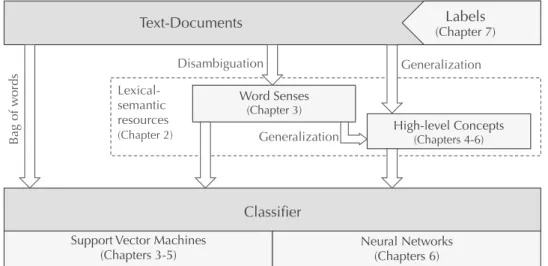
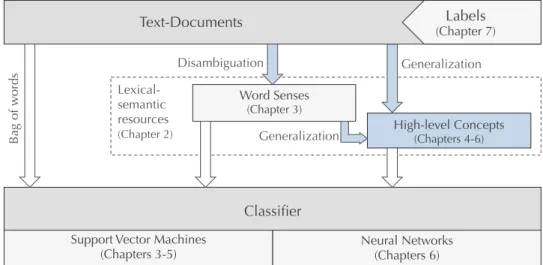
An overview of the components of this thesis, and of the workflows explored to address the above-presented research problems, is displayed in the Figure 1.2. This dissertation is organized in accordance with these workflows as follows:
Classifier Support Vector Machines
(Chapters 3-5) Neural Networks (Chapters 6)
Text-Documents (Chapter 7) Labels
Word Senses (Chapter 3) High-level Concepts (Chapters 4-6) Bag of w ords Disambiguation Generalization Generalization Lexical- semantic resources (Chapter 2)
Fig. 1.2: Overview of the workflows and components explored in this thesis. We first examine the problem of lexical-semantic ambiguity, focusing on word senses. Then we move on to the synonymy problem, exploring strategies to group words to high-level concepts. We show how the first sense disambiguation step can be replaced by high-level concept disambiguation directly. We then analyze the impact of these high-level concept features on the classification performance, both in conventional text classification settings (support vector machines) and in deep learning architectures (convolutional and recurrent neural networks). At the end, we discuss the processes of training data creation and the importance of class label quality.
Chapter 2 provides a brief overview of thelexical-semantic resourcesand supervised
classification methods, reviews the methods and theories which attempted to combine the two in related work, and introduces the terminology used in the following chapters.
Chapter 3 introduces the concept of word senses and the major word sense
disambigua-tion algorithms. Our main research quesdisambigua-tion in this chapter is: Does the word sense disambiguation, and subsequently using sense-level features in the classifier, improve the performance over using word-level features? We present and discuss our experimental results across five datasets. Additionally, we propose an alternative, contextual disambigua-tion algorithm for sentiment-bearing words, and show that our method can be used to improve sentiment polarity lexicons for a new target domain.
Chapter 4 moves from addressing the ambiguity problem towards addressing the
syn-onymy problem in text classification. We explain how we can use lexical-semantic resources
to obtainhigh-level concepts(which we callsupersenses) to help the classifier generalize over individual words in the training corpus. For accessing this information in a lexical-semantic resource, a previous word sense disambiguation step is necessary. We argue that this step is suboptimal given its too fine granularity, and develop an alternative model which enables to annotate supersenses directly from the documents. For this purpose, we introduce the concept of dense vector representations of these high-level concepts, which we callsupersense embeddings, and we investigate their semantic properties, including the impact of the choice of a training corpus, from which these embeddings are built.
Chapter 5 presents experiments, in which we evaluate the utility of concept
generaliza-tion, achieved through the supersense tagging with the annotation model we’ve built in the previous chapter, or through an intermediary word sense disambiguation step. We assess both of these approaches on five text classification tasks, including a novel task of personality prediction of fictional characters, and analyzewhy supersenses contribute to the classificationperformance increase. We also demonstrate how our approach can be extended beyond WordNet, using sense-level links to other resources (in this case VerbNet).
Chapter 6 provides an overview of the neural network approaches to text classification,
and picks up on our supersense vector (embedding) concept from Chapter 4. We propose a
deep learning approachcombining convolutional and recurrent neural networks, which we enrich with supersense embeddings. We conduct a range of document classification experiments, demonstrating that the additional semantic information from supersense embeddings improves the classification performance also in deep learning settings.
Chapter 7 examines the factors which may influence the quality of obtained labels, that
we later use as a ground truth for the classifier training. Specifically, we examine the influence of the formulation of the task, annotator’s prior assumptions about the data, and the personal settings of an annotator, on thequality and possible bias of the obtained labels.
Chapter 8 draws conclusions from the preceding chapters and summarizes both the
findings of our analysis in the defined scenarios and challenges that still remain to be addressed in future work.
1.4
Main contributions
We now give a brief summary of the main contributions of this thesis:
Impact of word sense disambiguation on text classification We addressed the ambi-guity problem in text classification and evaluated the impact of word sense disam-biguation on a range of document classification tasks, replacing the word-based features with the sense-based features. Although the WSD impact on the classification performance on our datasets was inconclusive (see the error analysis and discussion in Chapter 3), the quality of sense annotations was sufficient to use them for accessing other semantic information.
Word polarity disambiguation for sentiment classification We propose an alternative
disambiguation algorithm in the context of sentiment analysis tasks. We show that the distinction between WordNet senses is not sufficient to properly determine the sentiment polarity of a word, as the same sense can be both positive or negative dependent on a given context, and propose a semi-supervised contextual disambigua-tion method benefiting from a large distribudisambigua-tional thesaurus. Our curated sentiment expressions are freely available to the research community. This contribution is presented in Chapter 3 and published in [Flekova et al., 2014a] and [Flekova et al., 2015b].
Impact of adding high-level concepts on text classification We propose to address the
synonymy problem in text classification by annotating nouns and verbs with their high-level semantic concepts (supersenses) obtained from lexical-semantic resources. We conduct experiments across numerous document classification tasks and show that adding this information into the feature set improves the classification results. This contribution is presented in Chapter 5 and partially published in [Flekova and Gurevych, 2015] and [Flekova and Gurevych, 2016].
Supersense tagging model In order to overcome the issues related to fine-grained word
sense disambiguation, which is a necessary preprocessing step to accessing the supersense information in lexical-semantic resources, we propose to train a supersense tagging model directly. We build a model using a multi-layer perceptron architecture and several semantic features, and show that our model performs comparably or better than the state of the art on recently published social media datasets. Our model is open-source, with the code available on our group website. This contribution is presented in Chapter 4 and published in [Flekova and Gurevych, 2016].
Supersense embeddings In order to overcome the dimensionality problem in text
clas-sification, and to enable using supersense annotations in deep learning architectures, we introduce the concept of dense vector representations of supersenses, which we callsupersense embeddings. We investigate their semantic properties, including the impact of the choice of a training corpus, on which these embeddings are built. We are the first to build a joint model of words and supersenses in the same semantic space, which facilitates the qualitative analysis. Our supersense embeddings are
freely available in a generally compatible word2vec format, together with the code to build them. This contribution is presented in Chapter 4 and published in [Flekova and Gurevych, 2016].
Deep learning architecture integrating supersense embeddings We propose a deep
learning approach combining convolutional and recurrent neural networks integrat-ing supersense embeddintegrat-ings thanks to the joint word and supersense embeddintegrat-ing model. We conduct a range of document classification experiments, demonstrating that the additional semantic information from supersense embeddings improves the classification performance also in deep learning settings. Our neural network architecture is open-source and published on the group website. This contribution is presented in Chapter 6 and published in [Flekova and Gurevych, 2016].
Biases in training data construction We draw attention to several factors which may
influence the quality of obtained training labels, therefore impacting the classifier performance regardless which classification model and which semantic features are used. Specifically, we examine the influence of the formulation of the task, annotator’s prior assumptions about the data, and the personal settings of an annotator, on the quality and possible bias of the obtained labels. Our main findings include the presence of stereotypes in judging other people’s demographics, and higher accuracy of annotators scoring higher in Actively Open-minded Thinking [Baron, 1991]. These contributions are discussed in Chapter 7 and published in [Flekova et al., 2016a, Flekova et al., 2016b, Flekova et al., 2015a, Flekova et al., 2014b] and [Carpenter et al., 2016].
Empirical insights Analyzing the performance and classification errors in various settings
of our different models and features used, we also provided empirical insights into the numerous document classification tasks related to author profiling and sentiment analysis. We determined the features predictive for each problem, and interpreted them in context of previous work on these tasks. We also introduce a new task of personality profiling for fictional characters. We evaluate several methods for collecting the gold standard labels for this task, making the resulting data freely available, and we propose and implement a method to semantically process the book texts in order to obtain relevant information for the classification. These empirical contributions can be found across the Chapters 3-7 and across all publications listed below.
1.5
Publication record
We have previously published the research related to this thesis in peer-reviewed journals, conference proceedings, and workshop proceedings of major events in natural language processing and related fields, such as the ACL, EMNLP and WWW conferences and the JLCL and SPSS journals. Chapters building upon these publications are indicated accordingly.
Lucie Flekovaand Iryna Gurevych: ‘Supersense Embeddings: A Unified Model for Supersense Interpretation, Prediction and Utilization’, in:Proceedings of the 54th Annual Meeting of the Association for Computational Linguistics (ACL), vol.1 - Long papers, pp. 2029–2041, Berlin, Germany, August 2016. (Chapters 4, 6)
Lucie Flekova, Salvatore Giorgi, Jordan Carpenter, Daniel Preotiuc-Pietro and Lyle Ungar: ‘Analyzing Biases in Human Perception of User Age and Gender from Text’, in:
Proceedings of the 54th Annual Meeting of the Association for Computational Linguistics (ACL), vol.1 - Long papers, pp. 843–854, Berlin, Germany, August 2016. (Chapter 7)
Lucie Flekova, Daniel Preotiuc-Pietro and Lyle Ungar: ‘Exploring Stylistic Variation with Age and Income on Twitter’, in:Proceedings of the 54th Annual Meeting of the Association for Computational Linguistics (ACL), vol.2 - Short papers, pp. 313–319, Berlin, Germany, August 2016. (Chapter 7)
Jordan Carpenter, Daniel Preotiuc-Pietro,Lucie Flekova, Salvatore Giorgi, Carl Hagan, Margaret L. Kern, Anneke Buffone, Lyle Ungar, and Martin Seligman: ‘Real men don’t say “cute”: Using automatic language analysis to isolate inaccurate aspects of
stereotypes’, in:Social Psychological and Personality Science, SPPS, pp. , 2016. (Chapter 7)
Lucie Flekovaand Iryna Gurevych: ‘Personality Profiling of Fictional Characters using Sense-Level Links between Lexical Resources’, in:Proceedings of the 2015 Conference on Empirical Methods in Natural Language Processing (EMNLP), pp. 1805–1816, Lisbon, Portugal, September 2015. (Chapter 5)
Lucie Flekova, Salvatore Giorgi, Jordan Carpenter, Daniel Preotiuc-Pietro and Lyle Ungar: ‘Analyzing Crowdsourced Assessment of User Traits through Twitter Posts’, in:
Proceedings of the Third AAAI Conference on Human Computation and Crowdsourcing (HCOMP), Online Proceedings, Palo Alto, CA, USA, November 2015. (Chapter 7)
Lucie Flekova, Eugen Ruppert and Daniel Preotiuc-Pietro: ‘Analysing Domain Suitability of a Sentiment Lexicon by Identifying Distributionally Bipolar Words’, in: Association for
Computational Linguistics: Proceedings of the 6th Workshop on Computational Approaches to Subjectivity, Sentiment and Social Media Analysis, pp. 77–84, Lisbon, Portugal, September 2015. (Chapter 3)
Lucie Flekova, Oliver Ferschke, and Iryna Gurevych: ‘UKPDIPF: A Lexical Semantic Approach to Sentiment Polarity Prediction on Twitter Data’, in: In: Preslav Nakov and Torsten Zesch: SemEval-2014 Task 9: Sentiment Analysis in Twitter, Proceedings of the 8th International Workshop on Semantic Evaluation, pp. 704–710, Dublin, Ireland, August 2014. (Chapter 3)
Lucie Flekova, Oliver Ferschke, and Iryna Gurevych: ‘What Makes a Good Biography? Multidimensional Quality Analysis Based on Wikipedia Article Feedback Data’, in:
Proceedings of the 23rd International World Wide Web Conference (WWW 2014), pp. 855–866, Seoul, Korea, April 2014. (Chapter 7)
Lucie Flekovaand Iryna Gurevych: ‘Can We Hide in the Web? Large Scale Simultaneous Age and Gender Author Profiling in Social Media - Notebook for PAN at CLEF 2013’, in:
CLEF 2013 Labs and Workshops - Online Working Notes, Valencia, Spain, September 2013. (Chapter 5)
In parallel with the work discussed in this thesis, several additional research publications, which exceed the scope of this dissertation, were completed. These include:
Lucie Flekova, Tahir Sousa, Margot Mieskes, and Iryna Gurevych: ‘Document-level School Lesson Quality Classification Based on German Transcripts’, in:Journal for Language Technology and Computational Linguistics, vol. 30, no. 1, pp. 99–124. 2015.
Florian Stoffel,Lucie Flekova, Daniel Keim and Iryna Gurevych: ‘Feature-Based Visual Exploration of Text Classification’, in:Proceedings of the Symposium on Visualization in Data Science at IEEE VIS 2015, Online Proceedings, Atlanta, USA, June 2015.
Patrick Lerner, Andras Csanadi, Johannes Daxenberger,Lucie Flekova, Christian Ghanem, Ingo Kollar, Frank Fischer and Iryna Gurevych: ‘A User Interface for the Exploration of Manually and Automatically Coded Scientific Reasoning and Argumentation’, in:
Proceedings of the 12th International Conference of the Learning Sciences, pp. 938–941, Singapore, Rep. of Singapore, June 2016.
Lucie Flekovaand Matthias Schott: ‘Fast Precision Reconstruction of Micropattern Detector Signals via Convolutional Neural Networks’, in:Proceedings of the 22nd International Conference on Computing in High Energy and Nuclear Physics (CHEP), Online Proceedings, San Francisco, USA, October 2016.
2
Background
„
In the beginning the Universe was created. This has made a lot of people very angry and been widely regarded as a bad move.—Douglas Adams
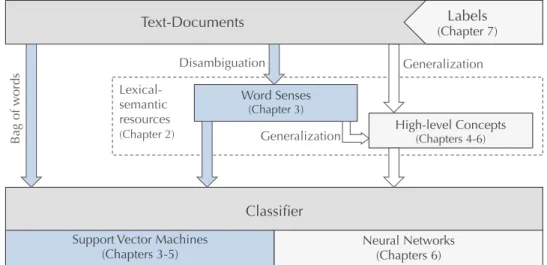
This chapter provides the background knowledge for this thesis. As illustrated on Figure 2.1 in context of the entire dissertation overview, we will mostly clarify the conceptual blocks building the foundation for the workflows in the next chapters. To do so, we will deal with the following questions:
• What is text classification?
• Which classifiers exist and what are typical text classification tasks?
• Which linguistic information can be used to process, and subsequently classify, textual documents?
• What are features in text classification and what types of features exist?
• What is lexical-semantic knowledge and which lexical-semantic resources are avail-able?
• Which previous work has been done in using lexical semantic knowledge in text classification tasks, and which approaches were used to extract this knowledge?
2.1
Classification
Text classification is the task of sorting a set of documents into classes (also known as labels, or categories) from a predefined set. A common example of text classification is spam filtering - given a set of e-mails, training a computational model to decide if a new message is spam or a legitimate correspondence. However, current text classification applications go well beyond this. Computational models have been used to determine the genre of the
Classifier
Support Vector Machines
(Chapters 3-5) Neural Networks (Chapters 6)
Text-Documents (Chapter 7) Labels
Word Senses (Chapter 3) High-level Concepts (Chapters 4-6) Bag of w ords Disambiguation Generalization Generalization Lexical- semantic resources (Chapter 2)
Fig. 2.1: The concepts of this thesis explored in this chapter (highlighted blue).
text, an appropriate audience, suitable age of a prospective reader, or the demographics and personality of the text author. Other applications include language identification and predicting the native language of a writer based on her English-language style. A large area of text classification research and applications is also labeling the text with emotions conveyed.
Within the scope of this thesis, when we use the termtext classification, we refer to the
supervised text classification, i.e., we require that the classifier derives decision rules for new documents from a set of previously (typically manually) classified samples, called training data. Similarly, another set of classified samples, called test data, is used for the evaluation of a classifier. This initial manual classification step is very important for the classification performance, as the errors in it would propagate through the entire learning process, i.e., the classifier would learn to do the same mistakes as the annotators.1 Related challenges
of training and test data construction are discussed in Chapter 7. An alternative to our text classification understanding would be anunsupervised text classification, where the outcomes are based on the computational analysis of a text without the expert providing sample classes. The classification model uses techniques to determine which documents are related and groups them into classes. An expert can specify the grouping method and the desired number of output classes, but otherwise does not aid in the classification process. A major challenge in this approach is that the expert has no explicit information about what the class labels are or what types of documents they contain and why, and has to derive this information by interpreting the result classes herself, which typically requires a significant additional effort.
1The description of labels being always created manually by annotators is simplifying. In the abundance of internet data, there are cases where it is easier to obtain class labels from existing information, e.g. from the assigned stars for the product review sentiment, or from the profiles of social media users for their gender, age, and so on.
2.1.1
Formal definition
A supervised document classification task can be formalized as the task of approximating the unknown target function
φ:D×C →{T rue, F alse}
which characterizes how the decisions about documents would be made by an expert, by a function
f :D×C →{T rue, F alse}
which describes the classification model.
In this function, theC = {c1, ..., cn}is a predefined set of classes (also called labels or categories) andD = {d1, ..., dm}is a set of documents. If φ(dj, ci) = T rue, thendj is called a positive example (or a member) of classci, while ifφ(dj, ci) =F alseit is called a negative example ofci. Typically, no exogenous knowledge about the meaning of the classes is available to the classifier, and the classification shall be accomplished only on the basis of endogenous information, i.e., knowledge extracted from the documents themselves. The classification task is called a single-label classificationif exactly oneci ∈ C must be assigned to eachdj∈D, or amulti-label classificationif any number of categories is allowed for one document.Binary classificationis a special case of single-label classification, where each documentdj ∈Dhas to be assigned either to a given categoryc1or to its complement
¯
c1. A binary classification model is therefore a function
f:D→{T rue, F alse}
Supervised text classification typically includes the following steps, illustrated on Figure 2.2: In the training phase, the documents and their labels are first loaded from the source. The documents are then annotated with additional linguistic information, e.g. lemmas of words, part-of-speech, syntactic and semantic dependencies. Based on the text of the document and the linguistic information added during preprocessing, quantifiable information is extracted to be employed by the machine learning algorithm as a feature vector. Some simple examples of a feature and its value aredog: 0 (indicating that a word ’dog’ is not present in the document) ornouns: 0.389(indicating that 38.9% of all words in the document are nouns) etc. A machine learning algorithm is then applied to train a classifier model based on the extracted features. In the testing phase, the same features are extracted from new documents in a similar manner, and the trained classifier model is used to predict the labels of those new documents. If we want to evaluate the classifier performance, we then compare the model predictions on test data to expert-given labels. However, supplying these labels for the test data is not a necessary input for the classifier prediction.
Label Label Input Input Feature Extractor Feature Extractor Machine Learning Algorithm Classifier Model features features
Training
Testing
Linguistic Annotation Linguistic AnnotationFig. 2.2: Text classification workflow.
2.1.2
Supervised classification algorithms
As already outlined above, the dominant approach to text classification is based on ma-chine learning techniques, which mostly replaced the previous knowledge engineering approaches. Instead of hand-written rules, the classifier identifies the most important features automatically. Furthermore, such approach is more effective in terms of scalability and domain adaptation. Some of the major algorithm families, commonly used for text classification, are:
Bayesian classifiers The idea of Bayesian learning is to build a probabilistic classifier
based on modeling the probabilities of the underlying word features in different classes. A text is then classified based on the posterior probability of the documents belonging to the different classes on the basis of the word presence in the documents. The posterior probability is calculated using the Bayes Theorem:
P(ci|x) = P(
x|ci)P(ci)
P(x)
where P(ci|x) is the posterior probability of a target classcigiven the feature vectorx,
P(ci)is the prior probability of the classci,P(x|ci)is the likelihood which is the probability of the feature given the class, andP(x)is the prior probability of the feature.
The most popular simple probabilistic approach is the Naive Bayes classifier, based on applying Bayes’ theorem with strong (naive) independence assumptions between the features. For example, a fruit may be considered to be anAPPLEif it isredandround, and the classifier assumes that the presence ofredin theAPPLEclass is unrelated to the presence ofround. Naive Bayes remains a popular (baseline) method for text classification. Despite its naive design and apparently oversimplified assumptions, naive Bayes classifier has worked quite well in many complex real-world situations. With appropriate preprocessing, it is competitive in this domain with more advanced methods including support vector machines [Rennie et al., 2003]. Naive Bayes classifiers are highly scalable, requiring a number of parameters scaling linearly with the number of features. With the maximum-likelihood training, linear training time can be achieved, which is as advantage to classifiers using an iterative approximation.
Decision trees Decision trees hierarchically divide the underlying data space using
differ-ent text features. For a given documdiffer-ent, we determine the partition that it is most likely to belong to, and use it for the purposes of classification. In other words, decisions on feature values shape a model, represented as a tree. Typically, decision trees use Entropy (H)and Information Gain (IG) criteria to construct a decision tree. Entropy expresses the purity of a sample. The entropy value is zero if the sample is homogeneous, and one if the sample is equally distributed. The Information Gain represents the decrease in entropy resulting from splitting the training sampleT on a particular value of featuref. In other words, the
entropyH(T,f)after the split is subtracted from the entropyH(T)before the split: IG(T,f) =H(T)−H(T,f)
where the entropy of the sample is defined as:
H(T) =
C ! i=1
−pilog2pi
withpibeing the probability of the classci. The entropy of a split, given the featuref, a discrete set of valuesV(f)that the feature can have, and a training sample subsetTv, where the featuref has the valuev, is then calculated as:
H(T) = !
v∈V(f)
P(Tv)E(Tv)
Due to their tree-like structure, decision tree algorithms tend to produce intuitive models.
Support vector machines The support vector machine (SVM) method has been introduced in text classification by [Joachims, 1998] and subsequently often used in many other text classification works. In geometrical terms, it may be seen as the attempt to find, among all the possible decision surfaces (called hyperplanes) separating the positive from the negative training examples, the one that separates the positives from the negatives by the widest possible margin, i.e. such that the minimal distance between the hyperplane and a training example is maximal.
Formally, we define a hyperplane as a set of feature vectorsxwhich satisfy the condition
w·x+b= 0withwbeing the weight vector andbthe bias. A subset of training examples which are the closest to the actual hyperplane is referred to assupport vectors,xsub. The distancedbetween the support vectors and the hyperplane is then:
d= |w·x+b| ||w||
Finding a hyperplane such that the distance of the support vectors to the hyperplane is maximized can be then defined as a Lagrangian optimization problem overwandb.
SVMs tend to be fairly robust to overfitting and can scale up to considerable dimensionalities, which is perhaps why they have been a very popular choice in natural language processing tasks. We use them in our classification experiments in Sections 3-5.
Neural network classifiers Neural networks are used in a wide variety of domains for the
purpose of classification. Neural network classifiers are, together with SVM, in the category of discriminative classifiers, as opposed to the generative Bayesian classifiers. They are able to process a large number of input signals from the data, which activate layers of interconnected neurons. The layers are made of computational nodes, loosely patterned on a neuron in the human brain, which fires when it encounters sufficient stimuli. Neural networks, especially the recent deep neural networks, have been shown to produce state-of-the-art results for many NLP problems [Collobert et al., 2011, Kim, 2014, Kalchbrenner et al., 2014, Johnson and Zhang, 2014, Nguyen and Grishman, 2015]. We discuss the deep learning approaches in more detail in Chapter 6, where we also apply those in our experiments.
Other Further algorithm families for supervised text classification, frequently used in the
NLP community, include Logistic Regression models and sequence classification models. Other methods are, e.g., nearest neighbor classifiers and genetic algorithm-based classifiers. Techniques to improve existing classifiers include kernel-based algorithms, which extend otherwise linear classifiers to solve non-linear problems by mapping the input space into a higher-dimensional space, and ensemble models, which combine multiple classification models into a single predictor, often producing better results than a single model.
2.1.3
Classification tasks
There is a myriad of document classification problems, where the above mentioned tech-niques can be applied. Below, we introduce the text classification applications adressed in the experiments within this thesis (Chapters 3-6).
Demographic author profiling Studying gender differences has been a popular
psycholog-ical interest over the past decades [Gleser et al., 1959, McMillan et al., 1977]. Traditional studies worked on small datasets, which sometimes led to contradictory results – [Mulac et al., 1990] cf. [Pennebaker et al., 2003]. Over the past years, researchers discovered a wide range of gender differences using large collections of data from social media or books combined with more sophisticated techniques. For example, [Schler et al., 2006] apply machine learning techniques to a corpus of 37,478 blogs from the Blogger platform and find differences in the topics males and females discuss. [Newman et al., 2008] conducted a detailed gender study on 14,324 samples from 70 different corpora (conversation, exams, fiction etc.) and showed that females are more likely to include pronouns, verbs, references to home, family, friends and to various emotions. Males use longer words, more articles, prepositions and numbers. Topical differences include males writing more about current concerns (e.g., money, leisure or sports). We made similar findings on web and social media data in [Flekova and Gurevych, 2013]. More recent author profiling experiments [Rangel et al., 2014, Rangel et al., 2015] revealed that gender can be well predicted from a large spectrum of text features, ranging from emotions, part-of-speech [Johannsen et al., 2015] and abbreviation usage to social network metadata, web traffic [Culotta et al., 2015], apps installed [Seneviratne et al., 2015] or Facebook likes [Kosinski et al., 2013]. [Bamman et al., 2014] also examine individuals whose language does not match their automatically predicted gender. Most of these experiments were based on self-reported gender in social media profiles. Recent results on social media data report a performance of over 90% for gender classification [Sap et al., 2014]. We have recently shown that crowdsourcing the annotations for gender labels is problematic due to human prejudice and stereotypes applied [Flekova et al., 2016a, Flekova and Gurevych, 2013, Flekova et al., 2015a]. Also the relationship between age and language has been extensively studied by both psychologists and computational linguists. [Pennebaker et al., 2003] connect language use with personality, while [Schler et al., 2006] automatically classified blogposts into three classes based on self-reported age using features from the Linguistic Inquiry and Word Count (LIWC) Framework [Pennebaker et al., 2001], online slang and part-of-speech information. [Rosenthal and McKeown, 2011] analysed how both stylistic and lexical cues relate to gender on blogs. On Twitter, [Nguyen et al., 2013] analyzed the relationship between language use and age, modelled as a continuous variable. They found similar language usage trends for both genders, with increasing word and tweet length with age, and an increasing tendency to write more grammatically correct, standardized text.
of-the-art results report a correlation ofr∼0.85with gold labels for age prediction [Sap
et al., 2014]. Recently, [Nguyen et al., 2014] showed that age prediction is more difficult as age increases, specifically over 30 years. We confirm this finding in [Flekova et al., 2016a]. [Hovy and Sogaard, 2015] showed that the author age is a factor that influences the training of part-of-speech taggers. We also investigate the relationship between age and income and find that while many predictive linguistic features are similar, a clear distinction can be made between the two classification models [Flekova et al., 2016b].
Psychological author profiling The Big Five Factor Model of Personality (FFM) has become
standard in psychology over the last 50 years, and has been shown to influence many aspects of task-related individual behavior. The independent Big Five Dimensions of Personality are (1) Extraversion vs. Introversion - being sociable, assertive, playful vs. aloof, reserved, shy, (2) Emotional stability vs. Neuroticism - being calm, unemotional vs. insecure, anxious, (3) Agreeableness - being friendly, cooperative vs. antagonistic, faultfinding, (4) Conscientiousness - being self-disciplined, organized vs. inefficient, careless, (5) Openness to experience - being intellectual, insightful vs. shallow, unimaginative.
Correlations between lexical and stylistic aspects of text and the five FFM personality traits of the author have been found in numerous experiments, with extraversion receiving the most attention [Pennebaker and King, 1999, Dewaele and Furnham, 1999, Gill and Oberlander, 2002, Mehl et al., 2006, Aran and Gatica-Perez, 2013, Lepri et al., 2010]. The LIWC lexicon [Pennebaker et al., 2001] established its position as a powerful means of such analysis.
The first machine learning experiments in this area were conducted by [Argamon et al., 2005], [Oberlander and Nowson, 2006] and [Mairesse et al., 2007]. Researchers predicted the five personality traits of the authors of stream-of-conscientiousness essays, blog posts and recorded conversation snippets. Given balanced datasets, [Mairesse et al., 2007] report binary classification accuracy of 50-56% on extraversion in text and 47-57% in speech, using word ngrams, LIWC, MRC psycholinguistic database [Coltheart, 1981] and prosodic features. Additional improvement is reported when the extraversion is labeled by external judges rather than by self-testing. Extended studies on larger datasets achieve accuracies around 55% [Nowson, 2007, Estival et al., 2007]. More recent work in this area focuses on the personality prediction in social networks [Kosinski et al., 2013, Kosinski et al., 2014] and multimodal personality prediction [Biel and Perez, 2013, Aran and Gatica-Perez, 2013], emphasizing the correlation of network features and audiovisual features with extraversion. These trends inspired the creation of the Workshop on Computational Personality Recognition (for an overview see [Celli et al., 2013, Celli et al., 2014]. We further investigate the task of personality prediction across all of the following chapters of this thesis, with some of the results published in [Flekova and Gurevych, 2015].
Sentiment polarity prediction Sentiment research has tremendously expanded in the past decade, being of the utmost interest for researchers as well as commercial organizations. A good overview of the biggest challenges in this task is provided by [Pang and Lee, 2008]. Most of the experiments divide the data into two or three classes (positive or negative message, or positive/negative/neutral), some attempt to assign a 5-class score (positive/very positive/negative/very negative/neutral).
Initial sentiment classification approaches relied heavily on explicit, manually crafted sentiment lexicons [Kim and Hovy, 2004, Pang and Lee, 2004, Hu and Liu, 2004]. There have been efforts to infer the polarity lexicons automatically. [Turney and Littman, 2003] determined the semantic orientation of a target wordtby comparing its association with two seed sets of manually crafted target words. Others derived the polarity from other lexicons [Baccianella et al., 2010, Mohammad et al., 2009], and adapted lexicons to specific domains, for example using integer linear programming [Choi and Cardie, 2009].
The Movie Review dataset, published by [Pang and Lee, 2005]2, has become a standard
machine learning benchmark task for binary sentence classification. [Socher et al., 2011] address this task with recursive autoencoders and Wikipedia word embeddings, later improving their score using recursive neural network with parse trees [Socher et al., 2012]. Competitive results were achieved also by a sentiment-analysis-specific parser [Dong et al., 2015a], with a fast dropout logistic regression [Wang and Manning, 2013], and with convolutional neural networks [Kim, 2014]. While the state-of-the-art performance has been achieved with deep learning approaches, some researchers emphasize the importance of an in-depth semantic understanding of emotional constructs [Trivedi and Eisenstein, 2013, Cambria et al., 2013, De Marneffe et al., 2010]. Negation and its scope has been studied extensively [Moilanen and Pulman, 2008, Pang and Lee, 2004, Choi and Cardie, 2009]. Other experiments revealed that some nouns can carry sentiment per se (e.g.
chocolate, injury). Recently, several noun