
Int. J. Electrochem. Sci., 13 (2018) 6126 – 6134, doi: 10.20964/2018.06.121
International Journal of
ELECTROCHEMICAL
SCIENCE
www.electrochemsci.orgElectrochemical Determination of Catechol Using
Functionalized Multiwalled Carbon Nanotubes modified Screen
Printed Carbon Electrode
Mettu Mallikarjuna Rao1, Ramki Settu2, Shen-Ming Chen2,*, Periyalagan Alagarsamy1, Tse-Wei Chen2, In-Seok Hong1
1
Department of Chemistry, College of Natural Science, Kongju National University, Republic of Korea.
2
Electroanalysis and Bioelectrochemistry Lab, Department of Chemical Engineering and
Biotechnology, National Taipei University of Technology, No.1, Section 3, Chung-Hsiao East Road, Taipei 106, Taiwan (R.O.C).
*
E-mail: [email protected]
Received: 26 February 2018 / Accepted: 2 April 2018 / Published: 10 May 2018
In this work, a simple, disposable electrochemical sensor based on functionalized Multiwalled carbon nanotubes (f-MWCNT) modified screen printed carbon electrode (SPCE) was developed, which was used for the determination of catechol (CT). Transmission electron microscopy (TEM), Fourier transform infrared spectroscopy (FT-IR), Raman spectroscopy was used to characterize the f-MWCNT. In addition, the f-MWCNT/SPCE displayed excellent electrocatalytic activity towards the electrochemical determination of CT. Under the optimized conditions, the sensing platform showed wide linear responses for CC from 0.08 to 725 µM with detection limits (S/N=3) of 30 nM. Furthermore, f-MWCNT modified electrode was also applied to detect practical samples with satisfactory results.
Keywords: Catechol (CT), electrochemical sensor, screen printed carbon electrode (SPCE), functionalized Multiwalled carbon nanotubes (f-MWCNT)
1. INTRODUCTION
CT as a Group 2B, thinkable human carcinogen [3]. The high exposure of CT can cause downheartedness of the central nervous system (CNS) and a lengthy rise in blood pressure in animals [4]. Hereafter, a consistent and precise finding of CT in ecological samples are more significant. Lately, electrochemical methods are extensively used for the detection of numerous analytes with CT, owing to its low price, rapid response, transportability along with high sensitivity paralleled to presented traditional analytical methods [7,8].
To date, diverse micro and nanomaterials have been effectively used for selective and synchronized determination of CT [9,10]. Especially, the nanomaterials have punctually used for sensitive detection of CT owing to its high surface area and high catalytic activity. For example, carbon nanomaterials, metal oxides, metal and metal alloy nanoparticles have been broadly engaged for electrochemical sensing of CT [11–14]. Amongst the carbon materials, the MWCNT achieves extra attention from present scientists because of their exceptional and physical properties for example electrochemically accessible area, huge surface area, robust adsorption ability, good chemical constancy, substantial mechanical strength and high electrical conductivity [15]. Though the pristine CNTs are unsolvable in water (aqueous) it would be uneasiness for the significant applications such as electrode fabrication. Fascinatingly, the functionalization method has become extra good-looking in current years due to the elimination of impurities from CNT and also improves the solubility as well as electrochemical properties. Utmost meaningfully, functionalization process generates the anchoring sites on CNT which would be more accessible to electrode fabrication. A number of applications have been established based on f-MWCNT such as an electrochemical sensor, photovoltaic, biomedical, catalysis and membranes, electronics and nanocomposites [16-19]. It unlocks the new way to make the nature-mimicking material and device at nano-scale which moving onward their applications in pharmaceuticals and industries.
The present work, authors proposed a simple, sensitive and selective method for the detection of CT based on f-MWCNT/SPCE. As prepared f-MWCNT was studied by several spectrometric methods. It was determined the CT with the limit of detection (LOD) is 30 nM. The selectivity, storage stability and reproducibility of the sensor has been studied and discussed. We also demonstrated the practical applicability of real sample analysis in CT tap water samples based on f-MWCNT modified SPCE and obtained acceptable recoveries
2. EXPERIMENTAL SECTION 2.1. Materials and methods
Pristine carbon nanotube (multi-walled O.D×L 6– 9 nm× 5 µM, >95%) and Dopamine, ascorbic acid, hydroquinone, epinephrine, norepinephrine, Nitric acid (HNO3), sulphuric acid (H2SO4),
and catechol were purchased from Sigma- Aldrich. The supporting electrolyte utilized for all experiments was prepared by using 0.05 M Na2HPO4 and NaH2PO4 solutions in doubly distilled water
and the pH of the solution was adjusted by using 0.1 M NaOH and H2SO4. All other chemicals were of
Cyclic voltammetry (CV) and differential pulse voltammetry (DPV) measurements were carried out by CHI 750a electrochemical work station from CH Instruments. Transmission electron microscopy (TEM) was performed on a TECNAI G2 under an accelerating voltage of 200 kV. FT-IR spectra were recorded by using the model Jasco FT/IR-6600 spectrophotometer. Raman spectrum were recorded using a Raman spectrometer (Dong Woo 500i, Korea) equipped with a charge-coupled detector and Thermo SCIENTIFIC Nicolet iS10 instruments. Electrochemical studies were implemented in a conventional three electrode cell system using SPCE as a working electrode (working area = 0.072 cm2), platinum wire as a counter electrode and saturated Ag/AgCl (saturated KCl) as a reference electrode. All the electrochemical measurements have been executed at room temperature.
2.2 Synthesis of f-MWCNT and preparation modified electrode
f-MWCNT were synthesized by previously reported method [20].The purchased pristine MWCNT was dispersed in a mixture of nitric acid and sulphuric acid with a volume ratio of (1:3) subsequently the mixture solution was refluxed at 80 °C for 24 h. Afterward, the oxidized (Carboxylic acid functionalized MWCNT (MWCNT-COOH)) MWCNT solution was diluted by a huge amount of DD water. Then f-MWCNT was filtered by using No. 1 Whatman filter paper and the product was washed many times with DD water until the concentration of acid-free when the pH of f-MWCNT is near 7. Later, the obtained f-MWCNT were dried in a vacuum oven at 80 °C for 24 h.
The final product of f-MWCNT (1 mg mL-1) was re-dispersed in DD water and ultrasonicated for 5 h to get the homogeneous f-MWCNT solution. Then, about 6 µL of f-MWCNT solution was drop coated on the SPCE surface and the modified SPCE was allowed to dry at room temperature. After that, the dried SPCE was smoothly washed with DD water to remove the inaccurately committed f-MWCNT on the surface of SPCE. The obtained f-f-MWCNT modified SPCE was used for further electrochemical experiments.
3. RESULTS AND DISCUSSION 3.1. Characterization of f-MWCNT
[image:4.596.71.518.72.490.2]
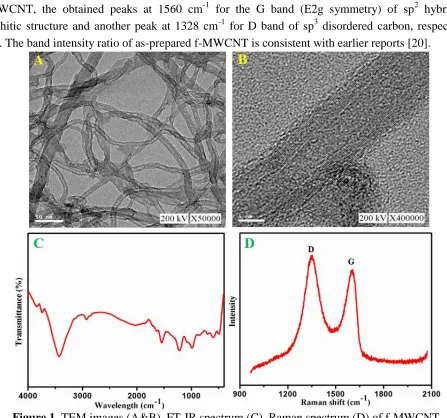
f-MWCNT, the obtained peaks at 1560 cm-1 for the G band (E2g symmetry) of sp2 hybridized graphitic structure and another peak at 1328 cm-1 for D band of sp3 disordered carbon, respectively [22]. The band intensity ratio of as-prepared f-MWCNT is consistent with earlier reports [20].
Figure 1. TEM images (A&B), FT-IR spectrum (C), Raman spectrum (D) of f-MWCNT. 3.2. Electrochemical detection of CT at f-MWCNT modified SPCE
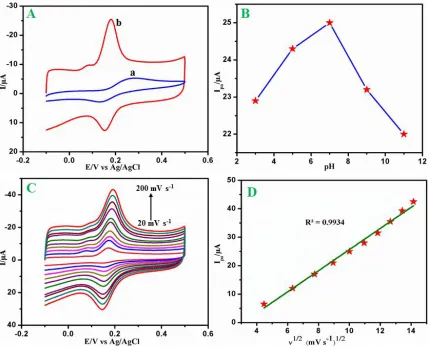
The electrochemical behavior of CT was investigated on different modified electrodes using CV. Fig. 1A shows the CV response of bare SPCE (a) and f-MWCNT modified SPCE (b) in the presence of 500 µM CT containing N2 saturated PBS at scan rate of 50 mV/s. The bare SPCE revealed
Figure 2. (A) CV of bare SPCE (a) and f-MWCNT/SPCE (b) in the presence of 500 µM CT in 0.05 M PB solution (pH 7.0) at a scan rate 50 mVs−1. (B) Plot of oxidation peak current of CT vs. pH. (C) CV responses of f-MWCNT/SPCE at different scan rate from 20 to 200 mV/s in the presence of 500 µM CT in 0.05 M PB solution (pH 7.0). (D) Corresponding calibration plot of current vs. square root of scan rate.
3.3 Effect of pH and scan rate
The effect of solution pH on f-MWCNT/SPCE containing CV investigated with 500 µM of CT and the results are shown in Fig. 2B. Furthermore, the maximum sensitivity of CT was observed at pH 7.0 that of other Hence, pH 7.0 was chosen as an optimum for subsequent experiments. The effect of scan rate on the electrochemical behavior of CT at f-MWCNT/SPCE was investigated by CV. Fig. 2C shows the CV response of f-MWCNT/SPCE in 500 µM CT containing N2 saturated PBS at different
[image:5.596.85.514.69.416.2]
3.4 Amperometric determination of CT
We also evaluated the response efficiency and sensitivity of the as-prepared electrode toward CT detection by using the highly sensitive, precise and reliable amperometric i-t method. Fig. 3A shows the amperometric current-time response of f-MWCNT modified electrode with regular injections of various CT concentrations at uniform time intervals into a constantly stirred (1400 rpm) 0.05 M PB solution (pH 7) under a preselected applied potential of +0.18 V. This can be displayed to the oxidation current increasing rapidly and reaching 97% of the steady state current within 6 s, which indicates the high electron conductivity and excellent electrocatalytic activity of CT on the f-MWCNT modified SPCE. The electrocatalytic oxidation current is directly proportional to the concentration of CT. In addition, the corresponding calibration plot of CT concentration versus amperometric current responses is shown in Fig. 3B. It displays an excellent linear response to the CT concentration in the range from 0.08 to 725 μM with a limit of detection of 30 nM. The obtained electrocatalytic performance of the f-MWCNT modified electrode toward CT detection was compared with previously reported CT sensors, and the results are summarized in Table 1.
Figure 3. (A) Amperometric current response of different amount of CT at f-MWCNT modified electrode, (B) calibration plot of Ipa vs [catechol].
Table 1. Comparison of analytical parameters with previously reported CT sensors with various modified electrodes
Electrode Linear range (µM) LOD (nM) ref
poly-SA/MWCNTs/CPE 3 – 240 160 24
AuNPs/CS@N,S co-doped MWCNTS
1 – 1000 200 25
AuNPs@CNCs 1.0 – 300 98.6 26
S/MWCNTs/PDA/AuNPs/GCE 1.0 – 10 47 27
ER(GO–TT–CNT) 0.5 – 200 11 28
CNNS-CNT 1 – 200 90 29
[image:6.596.65.533.333.527.2] [image:6.596.47.537.635.763.2]
3.5. Selectivity, reproducibility, stability and Practicality of the sensor
The selectivity of the CT sensor is more important especially in the presence of high concentration of hydroquinone (HQ), since it could easily interfere with the oxidation signal of CT due to the similar structural features and chemical activity. In addition, the selectivity of the sensor is more important in the presence of the compounds which are oxidized at close oxidation potential of CT. Hence, we have investigated the selectivity of the sensor in the presence of potentially active compounds such as ascorbic acid (AA), uric acid (UA), epinephrine (EP) and norepinephrine (NEP). The selectivity of the f-MWCNT modified electrode towards CT was evaluated by DPV. The obtained results clear that 100 fold additions of AA, EP, NEP and 50 µM addition of HQ did not affect the response current and peak potential of CT. The results indicate the high selectivity of the fabricated electrode towards the detection of CT.
The reproducibility of the sensor was evaluated for the detection of 500 µM CT by CV and the experimental conditions are similar as of in Fig. 2A. The relative standard deviation of CT by five different electrodes was calculated as 2.92 %, which indicates the appropriate reproducibility of the f-MWCNT modified electrode. The storage stability of the fabricated f-f-MWCNT modified electrode was examined periodically up to 20 days. Prior to the analysis, the modified electrode was stored pH 7 at room temperature, and the oxidation peak current response of 500 µM CT was monitored by CV. The f-MWCNT modified electrode retains 95.6 and 92.9 % of initial current response to CT after 10 and 20 days storage in pH 7. The result indicates the appropriate stability of the modified electrode, which is due to the high chemical stability of the f-MWCNT.
[image:7.596.67.531.561.619.2]The fabricated f-MWCNT modified electrode was further used for the determination of CT in tap water samples using the standard addition method. The obtained recovery results of CT in tap water samples are listed in Table 2. The recovery of CT in tap water samples was found in the ranging from 99.0 to 100.8 %, which authenticates that the appropriate practicality of the developed sensor towards the determination of CT.
Table 2. Determination of CT in water samples using f-MWCNT modified SPCE.
Water samples Added (µM) Found (µM) RR (%)
1 10 9.96 99.6
2 50 49.5 99.0
3 100 100.8 100.8
4. CONCLUSIONS
detection of CT, such as low LOD, high sensitivity, selectivity along with appropriate storage stability. Furthermore, the f-MWCNT showed good practicality for the detection of CT in tap water samples, which authenticates that the fabricated sensor could be used for sensitive and reliable determination of CT in environmental samples.
ACKNOWLEDGMENT
The authors gratefully acknowledge the financial support of the Ministry of Science and Technology, Taiwan through contract nos: MOST106-2113-M-027-003.
References
1. D.M. Zhao, X.H. Zhang, L.J. Feng, and S.F. Wang, Colloids Surf. B 74 (2009) 317. 2. X. Yang, J. Kirsch, J. Fergus, and A. Simonian, Electrochim. Acta 94 (2013) 259.
3. U.S. Department of Health and Human Services. Hazardous Substances Data Bank (HSDB, online database). National Toxicology Information Program, National Library of Medicine, Bethesda, MD, 1993.
4. G.D. Clayton, and F.E. Clayton (Eds.), Patty’s Industrial Hygiene and Toxicology, vol. IIA, 3rd revised ed., John Wiley & Sons, New York, 1981.
5. S.J. Li, Y. Xing, and G.F. Wang, Microchim. Acta 176 (2012) 163. 6. Z. Hong, L. Zhou, J. Li, and J. Tang, Electrochim. Acta 109 (2013) 671.
7. P. Balasubramanian, T.S.T. Balamurugan, S.M. Chen, T.W. Chen, M.A. Ali, F.M. Al-Hemaid, and M.S. Elshikh, J. Electrochem. Soc., 165 (2018) B160.
8. P. Balasubramanian, T.S.T. Balamurugan, S.M. Chen, T.W. Chen, T.W. Tseng, and B.S. Lou, Cellulose, 1-11. https://doi.org/10.1007/s10570-018-1719-1.
9. M. Shen, Z. Zhang, and Y. Ding, Microchem. J. 124 (2016) 209.
10. P.G. Freire, R.H.O. Montes, F.C. Romeiro, S.C.S. Lemos, R.C. Lima, E.M. Richter, and R.A.A. Munoz, Sens. Actuators B 223 (2016) 557.
11. Y.L. Quan, Z.H. Xue, H.C. Shi, X.B. Zhou, J.E. Du, X.H. Liu, and X.Q. Lu, Analyst 137 (2012) 944.
12. H. Du, J. Ye, J. Zhang, X. Huang, and C. Yu, J. Electroanal. Chem. 650 (2011) 209. 13. J. Bai, L.P. Guo, J.C. Ndamanisha, and B. Qi, J. Appl. Electrochem. 39 (2009) 2497. 14. D.W. Li, Y.T. Li, W. Song, and Y.T. Long, Anal. Methods 2 (2010) 837.
15. N. Yang, X.P. Chen, T.L. Ren, P. Zhang, and D.G. Yang, Sens. Actuators B 207 (2015) 690. 16. B. Lopez, and A. Merkoci, Microchim. Acta 179 (2012) 1.
17. M. Valcarcel, S. Cardenas, and B.M. Simonet, Anal. Chem. 79 (2007) 4788. 18. Y. Zhang, Y. Bai, and B. Yan, Drug Discov. Today 15 (2010) 428.
19. L. Hu, D.S. Hecht, and G. Gruner, Chem. Rev. 110 (2010) 5790.
20. R. Karthik, R. Sasikumar, S.M. Chen, J.V. Kumar, A. Elangovan, V. Muthuraj, P. Muthukrishnan, F.M. Al-Hemaid, M.A. Ali, and M.S. Elshikh, J. Colloid Interface Sci 487 (2017 ) 289.
21. P. Balasubramanian, T.S.T. Balamurugan, and S.M. Chen, J. Electrochem. Soc. 164 (2017) B715. 22. P. Balasubramanian, M. Velmurugan, S.M. Chen, and K.Y. Hwa, J. Electroanal. Chem 807 (2017)
128.
23. S. Palanisamy, K. Thangavelu, S.M. Chen, B. Thirumalraj, and X.H. Liu, Sens. Actuators B 233 (2016) 298.
24. Y. Liang, J. Li, and Y. Zhao, Int J Electrochem Sci. 12 (2017) 9512.
26. Y.H. Huang, J.H. Chen, L.J. Ling, Z.B. Su, X. Sun, S.R. Hu, W. Weng, Y. Huang, W.B. Wu, and Y. San He, Analyst, 140 (2015) 7939.
27. Y. Wang, Y. Xiong, J. Qu, J. Qu, and S. Li, Sens. Actuators B 223 (2016) 501.
28. H.S. Han, J.M. You, H. Seol, H. Jeong, and S. Jeon, Sens. Actuators B 194 (2014) 460. 29. H. Zhang, Y. Huang, S. Hu, Q. Huang, C. Wei, W. Zhang, W. Yang, P. Dong, and A. Hao,
Electrochim. Acta 176 (2015) 28.
![Figure 3. (A) Amperometric current response of different amount of CT at f-MWCNT modified electrode, (B) calibration plot of Ipa vs [catechol]](https://thumb-us.123doks.com/thumbv2/123dok_us/1789757.133361/6.596.47.537.635.763/figure-amperometric-response-different-modified-electrode-calibration-catechol.webp)

