Int. J. Electrochem. Sci., 8 (2013) 2440 - 2448
International Journal of
ELECTROCHEMICAL
SCIENCE
www.electrochemsci.orgDepositing Au Nanoparticles onto Graphene Sheets for
Simultaneous Electrochemical Detection Ascorbic Acid,
Dopamine and Uric Acid
Chunyan Wang, Fucheng Ye, Hongfu Wu, Yong Qian*
Key Laboratory of Radioactive Geology and Exploration Technology Fundamental Science for National Defense, East China Institute of Technology, Fuzhou, 344000, PR China
*
E-mail: [email protected]
Received: 7 November 2012 / Accepted: 12 January 2013 / Published: 1 February 2013
Gold nanoparticles (AuNPs) were deposited on the surface of graphene nanosheets (GNS) through a one-step solvothermal approach using ethylene glycol as the solvent and reducing agent. The microstructures of as-prepared GNS and AuNPs/GNS were characterized in detail. The results confirmed that the highly dispersion of AuNPs on the surface of graphene nanosheets could be easily obtained via this simple and facile procedure. In addition, the AuNPs/GNS hybrids exhibited excellent electrochemical activity and highly electrocatalytic activity towards the oxidation of biomolecules such as ascorbic acid (AA), dopamine (DA) and uric acid (UA) because of its unique structure and properties. This new findings demonstrate AuNPs/GNS that is a promising candidate of advanced electrode material in electrochemical sensing and other electrocatalytic applications.
Keywords: Graphene nanosheets; Au nanoparticles; Electrochemical detection
1. INTRODUCTION
graphene. One of the most promising and scalable approaches to obtain graphene is to convert graphene oxide, generated by the oxidization and subsequent exfoliation of graphite, to graphene via chemical reduction or thermal treatment [13, 14]. However, monolayer graphene sheets are preferred to restacking due to the van der Waals interactions during the reduction process. The restacked structure would lead to a dramatic decrease of specific surface area of graphene, which is unfavorable for wide applications of GNS. Many approaches have been developed to solve this problem such as using surfactant to stabilize graphene nanosheets, grafting polymer chains to change the polarity of graphene surface, and decorating graphene surface with nanoparticles to decrease the π-stacking interactions between graphene sheets [15-18]. Recently, the decoration of graphene with nanoparticles could provide larger electrochemically active surface areas for the adsorption of biomolecules and effectively accelerate the electron transfer between electrode and detection molecules, which could lead to a more rapid and sensitive current response [19].
Deposition of nanoparticles, such as MnO2 [20], TiO2 [21], Mn3O4 [22], NiO [23] Co(OH)2
[24], ZnO [25], Pt [26,27], Ag [28,29], Au [30,31],etc., onto GNS has been demonstrated to reveal special features in new hybrids that can be widely utilized in supercapacitors, Li-ion batteries, catalysts, photocatalysts, etc. However, assembling Au nanoparticles in nanostructured materials with electronic and ionic conduction pathways for electrochemical applications still remains a challenge [32, 33].
Herein, we report a one-step solvothermal approach to reduce and disperse AuNPs on the surface of GNS via employing ethylene glycol as the solvent and reducing agent. The microstructures and electrochemical activity of GNS and AuNPs/GNS were investigated by scanning electron microscopy (SEM), X-ray photoelectron spectroscopy (XPS), X-ray diffraction (XRD) and electrochemical measurements. The AuNPs/GNS hybrids exhibited excellent electrochemical and highly electrocatalytic activity towards the oxidation of biomolecules such as ascorbic acid (AA), dopamine (DA) and uric acid (UA) because of its unique structure and properties. Notably, the simple and straightforward synthesis of this procedure is expected to be a widely accepted approach with potential applications in the future.
2. EXPERIMENTAL
2.1 Raw Materials
Graphite powder (99.9995% purity, 100 mesh, briquetting grade) was purchased from Alfa Aesar. HAuCl4•3H2O, KMnO4, NaNO3 and H2SO4 were obtained from Shanghai Chemical Reagents
Company. All chemicals were of analytical grade and solutions were prepared with ultrapure water (>18MΩ).
2.2. Preparation of AuNPs/GNS
[34]. The purified GO (50mg) was dissolved in 50mL of ethylene glycol and sonicated for 1h under ambient condition to give a brown dispersion, Then 5 mL HAuCl4·3H2O (0.05 M) was added dropwise
under vigorous stirring for 10 min. Subsequently, the mixture was transferred into a Teflon-lined stainless steel autoclave (100mL), and reacted at 160oC for 24h. The obtained composite was then centrifuged, washed by absolute ethanol and deionized water several times. The resulting product was dried in a vacuum oven at 60 oC for 24h.
2.3 Characterization
The morphology of AuNPs/GNS composites was investigated using a JEOL, JSM 5800-LV scanning electron microscope (SEM) operated at 5 kV. An X-ray powder diffractometer (XRD, Shimadzu, X-6000, Cu Kα radiation) was used to determine the phase purity and crystallization degree. All electrochemical measurements were performed on a CHI 660 electrochemical workstation (CH Instruments, USA). Cyclic voltammograms (CVs) and Different pulse voltammograms (DPVs) were collected in a three-electrode system (GCE or modified GCE as the working electrode, a Pt wire as counter electrode, and an Ag/AgCl as the reference) at room temperature.
3. RESULTS AND DISCUSSION
3.1. Characterization of the modified electrode surface
Decoration carbon nanotubes (CNTs) with nanoparticles have been studied in some field due to intriguing properties [35]. Comparing to CNTs, graphene possesses similar stable physical properties but larger surface areas, which can be considered as an unrolled CNT [36, 37]. Moreover, The production cost of GNS in large quantities is much lower than that of CNTs because GO can be easily obtained by chemical exfoliation of natural graphites. In addition, There are several advantages for deposition nanoparticles by using GO as a starting material. GO have large surface areas and both sides of nanosheets are accessible. Next, the abundance of functional groups (such as carboxyl, carbonyl, hydroxyl, and epoxide) on the surfaces and edges of GO allows for favorable preparation of hybrids. Finally, GO can be easily converted to graphene via chemical reduction methods, which offers better electrical conductivity.
96 92 88 84 80
84.58 eV
87.78 eV
4f
7/2
4f5/2
D
Intensity
(a.u.)
Binding Energy (eV)
Figure 1. (A) Digital photos of GO (a) and AuNPs/GNS (b) dispersed in water (1mg/mL) respectively, (B, C) Typical SEM image of as-synthesized GO and AuNPs/GNS, (d) XPS spectrum of Au 4f of the as-prepared AuNPs/GNS composites deposited on a glass slide.
The dispersions of as-obtained GO and AuNPs/GNS respectively in water (1mg/mL) are shown in Fig.1A. The homogeneous colloidal suspensions of GO and AuNPs@GNS dispersed in H2O can
keep steadily for three months. It indicated clearly that the dispersion effect in water was very well. Morphologies of the chemically reduced GO powder was characterized by SEM as shown in Fig. 1B, exhibiting a few thin wrinkles onto the surface. The GNS are randomly compact and stacked together, showing uniform laminar morphology like crumpled silk veil waves. It could be ascribed to the presence of functional groups derived during the fabrication process. The direct evidence of the formation of gold nanoparticles on the planes and edges of graphene sheets is given by SEM in Fig. 1C. It can be observed that highly dispersed AuNPs with an average size of 30 nm formed on the graphene naonsheets.
20 40 60 80
Au(311) Au(220)
Au(200) Au(111)
C(002)
Intensity
(a.u.)
[image:4.596.108.491.71.217.2]2 theta (degree)
[image:4.596.175.423.501.706.2]
Obviously, the AuNPs were homogenously distributed on the GNS matrix, constructing a monodispersed AuNPs-decorated GNS assembly. Additionally, The gold nanoparticles possess spherical shape in the nanocomposites, which is possible because the reduction of ethylene glycol ability was enhanced by using solvothermal approach at high temperature, while might cause more nuclei to form in a short time. As a result, the spherical Au nanocrystals were obtained. XPS pattern of the resulting AuNPs/GNS shows significant Au4f signals corresponding to the binding energy of Au (Fig. 1D) and further supports that AuNPs have been effectively assembled on the surface of GNS. The obtained AuNPs/GNS is also characterized by XRD. As shown in Fig. 2, the broad diffraction peak at around 23° which is assigned to the hexagonal graphite structures C (002) , the sharp peaks of the AuNPs-loaded graphene at 37.9°(111), 44.2°(200), 65.6°(220) and 78.1°(311) are characteristic of the crystalline nanodomains of gold, which are consistent with the standard card of cubic Au (JCPDS No. 04-784). Simultaneously it confirms that the HAuCl4 has been reduced to AuNPs by ethylene
glycol.
3.2. Electrochemical reactivity
Research into electrochemical detection of AuNPs -based for analytical and biomedical analysis has attract more and more attention in recent years due to their speed and ease of use in chemical synthesis, their narrow size distribution and their convenient labeling of biomolecules [38]. Cyclic voltammograms (CVs) of the ferrocyanide system are an effective and facile method to monitor the characteristic of the surface of modified electrode. Fe(CN)63−/4− redox probe was selected to study
the electrochemical properties of GNS and AuNPs/GNS deposited on glassy carbon electrode (GCE) respectively. CVs of 5.0 mM K3Fe(CN)6 in KCl solution on bare GCE, GNS/GCE and
AuNPs/GNS/GCE were shown in Fig. 3A. It represented steady-state CVs (second cycle recorded) for the bare and the two modified GC electrodes in 20 mM K3Fe(CN)63− and 1 M KCl at 20 mV/s versus
Ag/AgCl reference electrode. The quasi-reversible oxidation and reduction behavior of ferricyanide ions was observed on the above bare and modified electrodes.
0.0 0.1 0.2 0.3 0.4 0.5
-0.06 -0.03 0.00 0.03 0.06 0.09
bare GCE GNS
A
C
ur
rent
(
m
A)
Potential (V vs Ag/AgCl)
200 400 600 800
0 100 200 300 400 500
AuNPs/GNS
GNS
bare GCE
B
Z"
(
)
Z' ()
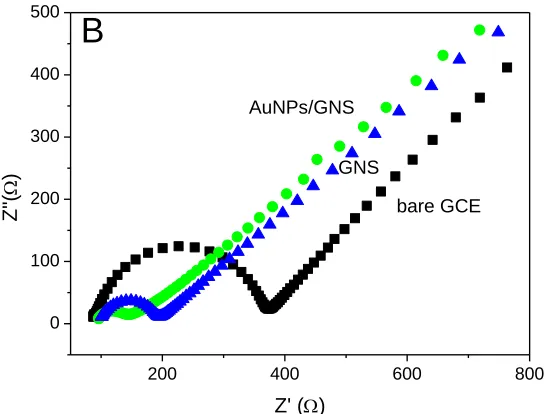
Figure 3. (A) Cyclic voltammograms (CVs) obtained at a bare glass carbon electrode (GCE), G/GCE, and AuNPs@GNS/GCE in 0.1 M KCl solution containing 5.0 mM K3Fe(CN)6 at the scan rate
of 20mVs−1 (B) Nyquist plots obtained at GC electrode (black dot), GNS modified GCE (blue dot) and AuNPs/GNS in 10mM Fe(CN)63-/4- containing 0.1M KCl. The frequency range is from
1Hz to100kHz.
It was observed that after GCE was modified with GNS (blue line), the peak current of Fe(CN)63−/4− increased relative to that bare GCE (black line), indicating that the introduction of the
GNS played an important role in the increase of the electroactive surface area and providing the conducting bridges for the electron-transfer of Fe(CN)63−/4−. In addition, AuNPs/GNS/GCE (green
line) exhibited a higher electrochemical activity than GNS/GCE , indicating that these effects were attributed to increase surface area and surface roughness due to the increased amount of gold nanoparticles.
Electrochemical impedance spectroscopy (EIS) is an efficient and facile tool for studying the interface properties of the capability of electron transfer. The charge-transfer resistance (Rct) at the electrode surface is equal to the semicircle diameter of EIS and can be used to describe the interface properties of the electrode. Thus, the surface and interface properties of the different modified electrodes were further investigated by EIS experiments. Figure 3B indicates the results for the impedance spectrum on bare GCE (black dot), GNS/GCE (blue dot) and AuNPs/GNS/GCE (green dot) in a solution of 10mM Fe(CN)63-/4- containing 0.1M KCl. It can be seen that EIS of the bare GCE is
composed of a semicircle and a straight line featuring a diffusion-limiting step of the Fe (CN)6 4−/3−
[image:6.596.155.427.92.299.2]
higher than that of the bare GCE and GNS/GCE, which is good accord with the above results of the Fig3A.
3.3. Simultaneous electrochemical detection ascorbic acid, dopamine and uric acid in a ternary mixture
-0.2 0.0 0.2 0.4 0.6
0 20 40 60 80
C
u
rre
n
t
(
A)
Potential (V)
AuNPs/GNS GNS bare GCE
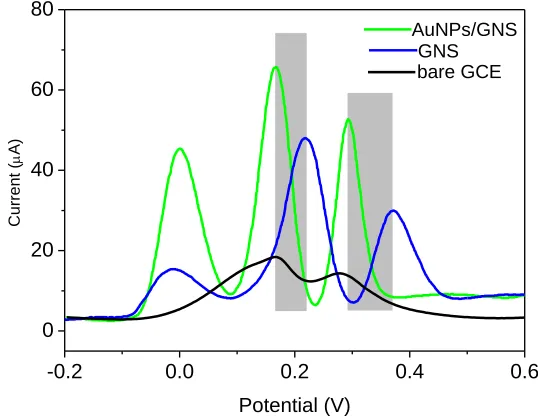
Figure 4. DPVs of 1mM AA, 0.2mM UA and 0.2mM DA at different modified electrodes in bare GCE (black line),GNS (blue line), AuNPs/GNS modified GCE (green line).
The preparation of sensors employing AuNPs loaded on the different electrodes for the determination of small molecules has been performed. DA, UA and AA coexist in the extracellular fluid of the central nervous system and serum. The ability to selectively determine these species has been a major goal of electroanalysis research. Such as AuNP-modified GCE for the detection of dopamine (DA) and uric acid (UA) in the μM range [39], gold nanorods [40] and gold-nanoclusters [41] can be used as a template for the detection of DA, leading to detection limit within the nM range.
Multi-walled carbon nanotube (MWNT)- grafted silica network (silica NW) and AuNPs (MWCNT-g-silicaNW/AuNPs) can detect nanomolar concentrations of DA in the presence of AA [42]. Poly(3-methylthiophene) and AuNPs nanohybrid was proposed for the sensitive determination of DA and UA in the presence of ascorbic acid (AA) [43], but it was not as sensitive as the nanocluster modified electrodes [40,41].
[image:7.596.172.441.182.390.2]
a well-defined oxidation peaks at GNS/GCE (blue line) and AuNPs/GNS/GCE (green line) are recorded. These demonstrate that the GNS and AuNPs/GNS modified GCE are more beneficial to the fast and effective simultaneous electrochemical detection AA, DA and UA. Besides, the peak current of curve AuNPs/GNS/GCE and GNS/GCE is much higher than that of the bare GCE. The enhanced electron transfer kinetics at the AuNPs/GNS/GCE and GNS/GCE might be attributed to the high electrical conductivity of graphene or gold decorated graphene and the plenty of graphitic edges on the electrode surface.
Moreover, compared to GNS/GCE and the modified GCE with different samples in the document [40,41], we noted that negative shift of the oxidation peak potential at the AuNPs/GNS/GCE. It can be seen that the AuNPs/GNS/GCE possesses improved or comparable performance for the simultaneous determination of AA, DA and UA. The separation of the oxidation peak potentials for AA-DA and DA-UA is about 165mV, 128mV respectively. The larger separation of the peak potentials allows selectively determining AA, DA or UA in the presence of the other two species, or simultaneously detecting them in their mixture.
4. CONCLUSIONS
In summary, we have demonstrated a simple and effective approach to the decoration of AuNPs on GNS by using a one-step solvothermal approach using ethylene glycol as the solvent and reducing agent. Simultaneously, a uniform distribution of AuNPs on the surface of GNS without agglomerates can be obtained through this simple and facile route. Moreover the AuNPs/GNS nanocomposites modified electrode exhibited high electrocatalytic activities towards the oxidation of DA, UA and AA by significantly decreasing their oxidation overpotentials and enhancing the peak currents. This electrochemical sensor showed excellent selectivity and high sensitivity. This new findings demonstrate AuNPs/GNS that is a promising candidate of advanced electrode material in electrochemical sensing and other electrocatalytic applications.
ACKNOWLEDGEMENTS
This work was supported by the National Natural Science Foundation of China (No. 21004009), the Foundation of Jiangxi Educational Committee (No. GJJ11487) and Natural Science Foundation of JiangXi Province (20114BAB213010).
References
1. D. Li, M.B. Muller, S. Gilje, R.B. Kaner, G.G. Wallace, Nat. Nanotechnol. 3(2008)101 2. Y. Zhou, Q. Bao, L.A.L. Tang, Y. Zhong, K.P. Loh, Chem. Mater. 21(2009) 2950 3. Y. Qian, S.B. Lu, F.L. Gao, J. Mater. Sci. 46 (2011)3517
4. D.A. Areshkin, C.T. White, Nano Lett. 7 (2007)3253
5. H.L. Wang, Y.Y. Liang, T. Mirfakhrai, Z. Chen, H.S. Casalongue, H.J. Dai, Nano Res. 4 (2011) 729
6. Y. Qian, Int. J. Electrochem. Sci. 7 (2012) 10063
8. K.S. Novoselov, A.K. Geim, S.V. Morozov, D.J iang, Y. Zhang, S.V. Dubonos, I.V. Grigorieva, A.A. Firsov, Science 306 (2004) 666
9. C. Berger, et al. Science 312(2006) 1191
10. D.A. Dikin, S. Stankovich, E.J. Zimney, R.D. Piner, G.H.B. Dommett, G. Evmenenko, S.T. Nguyen, R.S. Ruoff, Nature 448 (2007) 457
11. X.L. Li, X.R. Wang, L. Zhang, S.W. Lee, H.J. Dai, Science 319(2008) 1229
12. X.L. Li, G.Y. Zhang, X.D. Bai, X.M. Sun, X.R. Wang, E.G. Wang, H.J. Dai, Nat. Nanotechnol. 3(2008) 538
13. V.C. Tung, M.J. Allen, Y. Yang, R.B. Kaner, Nat. Nanotechnol. 4 (2008) 25
14. H.C. Schniepp, J.L. Li, M.J. McAllister, H. Sai, M. Herrera-Alonso, D.H. Adamson, R.K. Prud’homme, R. Car, D.A. Saville, I.A. Aksay, J. Phys. Chem. B 110 (2006) 8535
15. Y. Qian, C.Y. Wang, Z.G. Le, Appl. Surf. Sci. 256 (2011) 10758
16. M. Fang, K.G. Wang, H.B. Lu, Y.L. Yang, S. Nutt, J. Mater. Chem. 20(2010) 1982 17. H. He, C. Gao, Chem. Mater. 22 (2010) 5054
18. F.Y. Zhang, Z.H. Wang, Y.Z. Zhang, Z.X. Zheng, C.M. Wang, Y.L. Du, W.C. Ye, Int. J. Electrochem. Sci. 7 (2012) 1968
19. M. Pumera, Chem. Soc. Rev. 39 (2010) 4146
20. S.Chen, J. Zhu, X. Wu, Q. Han, X. Wang, ACS Nano 4 (2009) 2822
21. D. Wang, D. Choi, J. Li, Z. Yang, Z. Nie, R. Kou, D. Hu, C. Wang, L.V. Saraf, J. Zhang, I. A. Aksay, J. Liu, ACS Nano 3 (2009) 907
22. H. Wang, L. Cui, Y. Yang, Y. Cui, H. Dai. J. Am. Chem. Soc. 132 (2010) 13978 23. Z.Y. Ji, J.L. Wu, X.P. Shen, H. Zhou, H.T. Xi, J. Mater. Sci. 46 (2011) 1190 24. S. Chen, J.W. Zhu, X. Wang, J. Phys. Chem. C 114 (2010) 11829
25. J. Wu, X. Shen, L. Jiang, K. Wang, K. Chen, Appl. Surf. Sci. 256 (2010) 2826 26. Y.J. Li, W. Gao, L.J. Ci, C.M. Wang, Carbon 48 (2010) 1124
27. C. Xu, X. Wang, J. Zhu, J. Phys. Chem. C 112 (2008) 19841 28. C. Xu, X. Wang, Small 5 (2009) 2212
29. W.B. Lu, G.H. Chang, Y.L. Luo, F. Liao, X.P. Sun, J. Mater. Sci. 46 (2011) 5260 30. S.H. Yan, S.C. Zhang, Y. Lin, G.R. Liu, J. Phys. Chem. C 115 (2011) 6986 31. 31.Z.Q. Zhang, Y.H. Wu, Langmuir 26 (2010) 9214
32. F.L. Leibowitz, W.X. Zheng, M.M. Maye, C. Zhong, J. Anal. Chem. 71 (1999) 5076 33. J.H. Fendler, Chem. Mater. 8 (1996) 1616
34. N.I. Kovtyukhova, P.J. Ollivier, B.R. Martin, T.E. Mallouk, S.A. Chizhik, E.V. Buzaneva, A.D. Gorchinskiy, Chem. Mater. 11 (1999) 771
35. V. Georgakilas, D. Gournis, V. Tzitzios, L. Pasquato, D.M. Guldi, M. Prato, J. Mater. Chem. 17 (2007) 2679
36. S. Niyogi, E. Bekyarova, M.E. Itkis, J.L. McWilliams, M.A. Hamon, R.C. Haddon, J. Am. Chem. Soc. 128 (2006) 7720
37. D.A. Dikin, S. Stankovich, E.J. Zimney, R.D. Piner, G.H.B. Dommett, G. Evmenenko, S.T. Nguyen, R.S. Ruoff, Nature 448 (2007) 457
38. K. Kerman, M. Saito, S. Yamanura, Y. Takamura, E. Tamiya, Anal.Chem. 27 (2008) 585 39. P. Wang, Y.X. Li, X. Huang, L. Wang, Talanta 73 (2007) 431
40. Z. Jia, J. Liu, Y. Shen, Electrochem. Commun. 9 (2007) 2739 41. J. Li, X.Q. Lin, Sens. Actuat. B 124 (2007) 486