City, University of London Institutional Repository
Citation
:
Adamsky, F., Khayam, S. A., Jager, R. and Rajarajan, M. (2012). Security analysis of the micro transport protocol with a misbehaving receiver. Paper presented at the 2012 International Conference on Cyber-Enabled Distributed Computing and Knowledge Discover, 10 - 12 October 2012, Sanya, China.This is the unspecified version of the paper.
This version of the publication may differ from the final published
version.
Permanent repository link:
http://openaccess.city.ac.uk/1967/Link to published version
:
http://dx.doi.org/10.1109/CyberC.2012.31Copyright and reuse:
City Research Online aims to make research
outputs of City, University of London available to a wider audience.
Copyright and Moral Rights remain with the author(s) and/or copyright
holders. URLs from City Research Online may be freely distributed and
linked to.
Security Analysis of the Micro Transport Protocol with a Misbehaving Receiver
Florian Adamsky∗, Syed Ali Khayam†, Rudolf Jäger‡, Muttukrishnan Rajarajan∗
∗City University London, United Kingdom
Email: {Florian.Adamsky.1, R.Muttukrishnan}@city.ac.uk
†National University of Sciences and Technology, Pakistan
Email: [email protected]
‡Technische Hochschule Mittelhessen University of Applied Sciences, Germany
Email: [email protected]
Abstract—BitTorrent is the most widely used Peer-to-Peer (P2P) protocol and it comprises the largest share of traffic in Europe. To make BitTorrent more Internet Service Provider (ISP) friendly, BitTorrent Inc. invented the Micro Transport Protocol (uTP). It is based on UDP with a novel congestion control called Low Extra Delay Background Transport (LEDBAT). This protocol assumes that the receiver always gives correct feedback, since otherwise this deteriorates throughput or yields to corrupted data. We show through experimental investigation that a misbehaving uTP receiver, which is not interested in data integrity, can increase the bandwidth of the sender by up to five times. This can cause a congestion collapse and steal large share of a victim’s bandwidth. We present three attacks, which increase the bandwidth usage significantly. We have tested these attacks in a real world environment and show its severity both in terms of number of packets and total traffic generated. We also present a countermeasure for protecting against the attacks and evaluate the performance of that defence strategy.
I. INTRODUCTION
With the widespread use of handheld devices the Internet traffic is increasing at an enormous rate. This traffic can be classified in two categories: background and foreground traffic. Background traffic is e.g. oper-ating system (OS) updates, P2P application or backup transfer and does always have a lower priority then foreground traffic. In contrast, foreground traffic is e.g. Email, Voice over IP (VoIP) or web browsing and an extra delay is not acceptable. To separate these traffic categories it is necessary to define static firewall rules.
This approach is inflexible and often leaves big head room which is unused. A better approach is to use a separate transport protocol for background traffic like TCP-LP [1] or TCP-Nice [2]. These protocols can detect foreground traffic and automatically reduce their sending rate. With uTP using LEDBAT there is a new kid on the block.
In December 2008, BitTorrent announced in the developer forum that µTorrent will switch the data transfer from TCP to UDP [3]. Shortly after that announcement, panic started spreading all over the media. The media named it “The Next Internet Melt-down” [4], because of the missing congestion avoid-ance algorithms in UDP. However, they all got it wrong. BitTorrent clarifies that the new uTP will have a novel congestion avoidance algorithm [5]. After that statement the technology information website Ars Technica published an article with the title “µTorrent switch to UDP and why the sky isn’t falling” [6].
To the best of our knowledge, this research work is the first security analysis of the uTP using the LEDBAT congestion control. Since October 2009 the congestion control LEDBAT has a IETF draft [7]. The security considerations from this draft only describes a network, where a malicious node in between, delays packets unnecessarily to lower traffic throughput.
II. BACKGROUND
fact that it uses multiple TCP connections at once, it gets an unfair advantage over other applications. This can be explained by the fact that TCP distributes the available bandwidth evenly across all connections. A BitTorrent user has to restrict the bandwidth by setting a down- and upload limit in his client, to prevent the client to consume all the available bandwidth. This requires knowledge about its own Internet connection and often leaves big head room which is unused. When there is a need for interactive traffic like VoIP or brows-ing the web, it is necessary to adjust the down- and upload limits or pause the complete BitTorrent client. These are the reasons why BitTorrent invented the new uTP, which detects unused head room automatically and adjust its limits.
The uTP [8] is on top of UDP. Since UDP has no congestion control, uTP can implement its own one. Like TCP, uTP controls the flow with a sliding window, verifies data integrity with sequence numbers and initiates a connection with a handshake. Unlike TCP, sequence numbers refer to packets instead of bytes and uTP initiates a connection with a two-way handshake, instead of a three-way. uTP also supports Selective Acknowledgment (SACK) via an extension, which is enabled per default. In contrast to TCP, uTP SACK uses a bitmask where each bit represents a packet in the send window, instead of defining ranges. The relation between a bit and the packet is the acknowledgment number. The first bit in the bitmask represents theack_nr + 2, since theack_nr + 1
packet is assumed to be lost. If a bit is set, this means we got that packet and vice versa. A set bit for a packet which has not been send yet, will be ignored by the sender. The major difference between uTP and TCP is novel congestion control LEDBAT.
A. Low Extra Delay Background Transport (LEDBAT)
uTP presents a novel congestion avoidance algo-rithm: LEDBAT. uTP together with LEDBAT tries to solve the above mentioned problems from TCP by using a modem queue size as a controller. If the queue size of the send buffer is too large, then the sender throttles back. To archive that, LEDBAT [7] uses one way delay measurement as the main congestion algorithm, which we will describe in more detail in Section III-B1. Additional to that value, LEDBAT also uses packet loss and the number of acknowledgments during one window. These measurements make it
pos-sible to detect foreground traffic (e.g. VoIP, HTTP,. . .). If these measurements differ to much from previous values, the sender adjusts its sending rate accordingly. This automatic adjustment gives foreground traffic a higher priority than BitTorrent with uTP and makes manual adjustments unnecessary. However, this only works if both, the sender and the receiver, cooperates with each other.
III. ATTACKANALYSIS
Protocols assumes that the receiver always gives correct feedback. Normally this is correct, since oth-erwise this deteriorates the throughput or yields to corrupted data [9]. An attacker who is not interested in data integrity can give incorrect feedback, to induce the sender to send more and more packets into the network. The next section will describe possible attack scenarios.
A. Attack Scenarios
Regarding of uTP a misbehaving receiver can create the following attack scenarios:
1) Congestion Collapse: If a high bandwidth victim has a node in between which does not have the same bandwidth capacity, then there is a possibility of congestion. The effects of congestions are: packet loss, queuing delay and block of new connection. Normally the congestion control from the transport protocol takes care of that. However, if a malicious peer can trick the congestion control, then it is possible to create congestion on that path. The consequence of congestion is, that other clients have problems to reach the high bandwidth victim which yields to a denial-of-service (DoS) attack. However, it is not only necessary to have a node in between with lower bandwidth capabilities, a Digitial Subscriber Line (DSL) and cable modem is sometimes enough. Normally DSL and cable modems have a send buffer which is disproportional to their maximum send rate [8]. If a misbehaving receiver induce the sender to fill the buffer of its DSL or cable modem with packets, the sender cannot deliver packets to other peers. If there is no DSL/cable modem or a slow node in between, it is still possible to steal bandwidth from that peer.
shown this suffering in our previous research work, where a malicious peer exploit the choking mechanism to get more bandwidth [10]. This attack destabilizes BitTorrent’s clustering behavior [11], which attacks the high bandwidth leechers in a swarm. In the next section we will discuss attacks which can trick the congestion control of uTP.
B. Details about the Attacks
For this evaluation we used the open-source library libUTP 1. This library is written by the developer of BitTorrent and it is used by the following BitTorrent clients: µTorrent, Vuze, Mainline and Transmission. According to the latest client statistics from the P2P research team at the Delft University of Technol-ogy, these clients are comprising a market share of 90.47 % [12]. LibUTP comes with test program for re-ceiving (utp_recv) and sending files (utp_send). While writing this paper, this is the latest version 2 of libUTP.
For the evaluation we used a real world client-server environment. One computer was the sender which had an unmodified version of libUTP. The other computer was the receiver and had a modified version of libUTP. Both computers were running GNU/Linux and were connected via a 100 Mbit/s switch. We introduced 25 ms delay with 10 ms variance which is distributed normally with NetEm [13] on the sender side. We choose these values to loosely simulate a connection where two peers with high speed Internet access (Asymmetric Digitial Subscriber Line (ADSL), ADSL2+) are communicating with each other. For all the tests we used utp_recv and utp_send to initiate a simple file transfer with a 100 MiB file. This test environment was used for the rest of the results presented in this paper
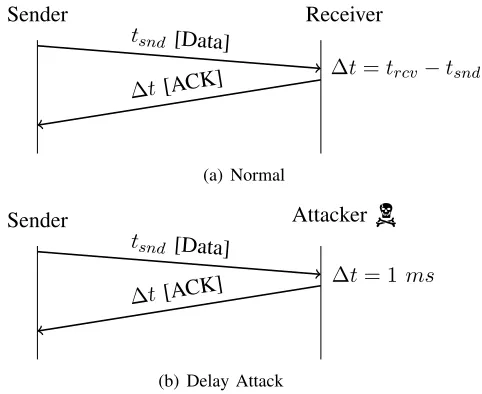
1) Attack 1: Lying about the Delay: According to the Internet-Draft from the IETF the one way delay measurement is only possible with the help of the receiver: “LEDBAT requires that each data segment carries a “timestamp” from the sender, based on which the receiver computes the one-way delay from the sender, and sends this computed value back to the sender” [7]. This one way delay, which we denote as
∆t, is calculated on the receiver side by subtracting the
1
https://github.com/bittorrent/libutp
2
Commit ID:2c678a26e5
timestamp tsnd from the current time of the receiver trcv. The receiver sends ∆t back to the sender, as shown in Figure 2(a).
Sender Receiver
tsnd [Data]
∆t=trcv−tsnd
∆t [ACK]
(a) Normal
Sender Attacker A
tsnd [Data]
∆t= 1 ms
∆t [ACK]
[image:4.612.319.560.128.325.2](b) Delay Attack
Figure 1. One way delay measurement with a normal receiver and an attacker
The value of ∆t is only meaningful as a relative value compared to previous values, because the clocks of the peers are not synchronized. The sender saves all ∆t values in a vector our_hist~ from the last two minutes. Before these values will be included into
~
our_hist, ∆t will be normalized with delay_base, which is the lowest value from our_hist. Normal-~ ization is done to get a measurement of the current buffering delay on the socket [8]. LEDBAT uses equa-tion 1 to decide whether to increase or decrease the send window. LEDBAT increases the send window, when the lowest value in vector our_hist~ is smaller then 100 ms. Otherwise the send window will remain constant or gets decreased.
off_target=
+ if min(our_hist~ )<100ms
= if min(our_hist~ ) = 100ms
− if min(our_hist~ )>100ms (1)
attack started,delay_basewill be 1 ms, since this is the lowest value during the last two minutes. All following
∆tvalues will be normalized withdelay_base. There-fore we can fill the vectorour_hist~ all with zeros. The
delay_factor makes use of the vector our_hist,~ which is partly responsible for the adjustment of the maximal window. Equation 2 shows how the variable
delay_factor gets calculated.
delay_f actor= 100ms−min(our_hist~ )
100 ms (2)
Since all values in our_hist~ are zero, this means that delay_factor is always one, which is the highest value. A positive delay_factor always increases the window from the sender. The sender receives ∆t and increases or decreases its window size max_window according to the pseudo code in Listing 1.
Listing 1. Maximal window calculation according to [8]
scaled_gain =
MAX_CWND_INCREASE_PACKETS_PER_RTT
* delay_factor * window_factor;
max_window += scaled_gain;
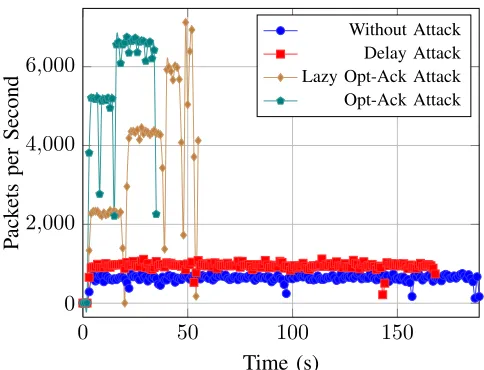
Figure 3 shows packets per second depending on time in seconds. All curves show the bandwidth usage of a file transfer over time. A file transfer with an unmodified receiver has an average value of 632.503 packets/sec. A modified receiver which lies about the one way delay measurement has an average value of 916.507 packets/sec. This shows that the described attack can increase the bandwidth up to around 300 packets/sec. This attack is limited, since its increase in bandwidth yields to an increase in packet loss. The average number of packets that a sender with a normal behaving receiver assumes to be lost is up to 16761.9. A sender who communicates with a misbehaving receiver the average number of packet loss is up to 19031.3. This is an increase of 13.54 %. Every packet loss decreases the send window of the sender. This leads to the next possible attack.
2) Attack 2: Lazy Optimistic Acknowledgment: Like TCP, uTP also uses packet loss as a sign of congestion and decreases its sending rate. In TCP, when a packet is lost, the sending rate will be multiplied by a factor of 0.5. Since this is a much less likely event in uTP, it
0 50 100 150
0 2,000 4,000 6,000
Time (s)
P
ack
ets
per
Second
[image:5.612.317.559.68.253.2]Without Attack Delay Attack Lazy Opt-Ack Attack Opt-Ack Attack
Figure 2. File transfer of a 100 MiB file via uTP under the following network conditions: Bandwidth: 100 Mbit/s, Delay: 25 ms, Variance: 10 ms and Distribution: normal
will only be multiplied by a factor of 0.78 [8]. Again, the sender needs the help of the receiver to realized that a packet is lost. Normally the receiver sends an SACK with the bitmask of which packets are lost or sends a packet with a duplicated Acknowledgment (ACK), to notify the sender.
The receiver sorts all packets by its sequence num-ber, to keep the data integrity. However, a malicious peer can save all packets it receives sequentially. This will prevent a gap in the input buffer which is an indicator of a packet loss.
A SACK packet only will be sent, when there is something wrong with the input buffer. Since the input buffer of the modified receiver is always fine, there is no need to send a SACK packet. To inform the sender about the successful acknowledgment of packets, we always send him a SACK message with the information that we received all packets. The sender never decreases the sending rate, since the receiver is misinforming the sender. This significantly increases the sending rate of the sender. Figure 3 shows that the normal file transfer took about 187 seconds. With this attack the file transfer is complete in about 60 seconds. We also increased the average value up to 3414.365 packets/sec. This corresponds to an increase up to a factor of three. The lazy optimistic ack attack provides the foundation for the next attack.
is to acknowledge in-flight packets. When the sender receives an ACK which fits into the window, it will decrease thecur_windowby the size of the payload from the packet which gets acknowledged. The lower the value of cur_window is, the more packets the sender is able to send. To acknowledge as much as possible, we initiated the bitmask of a SACK packet with UINT_MAX instead of 0. All bits are set to one, which means we pretend that we received all packets. Even packets that the sender has not sent yet. However, until the acknowledgment arrives at the sender, the sender sends new packets which will automatically acknowledged.
The effect is illustrated in Figure 3. The curve of the opt-ack attack takes an average value of 37.6 s. This is one-fifth compared with a file transfer of a nor-mal receiver. The opt-ack attack produces an average value of 5073.7 packets per second. Consequently this means that the opt-ack attack increased the bandwidth consumption up to five times. The next section will discuss the impact of the presented attacks.
C. Impact of these Attacks
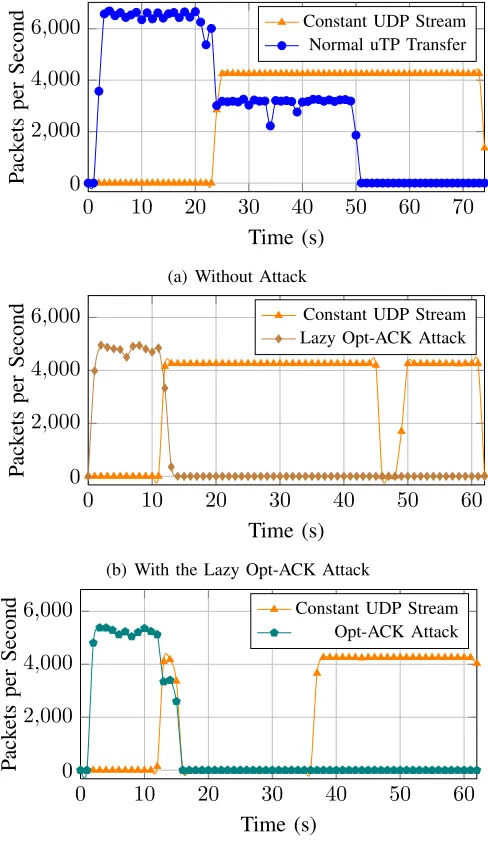
As mentioned in Section III-A, there are two scenar-ios: Steal Bandwidth or Congestion Collapse. Which of the described attacks can create what damage? To respond to this question we started a file transfer of a 300 MiB file via uTP without any delay in our 100 Mbit/s network. Shortly after that, we started a constant UDP stream of 50 Mbit/s with iPerf 3 for 50 seconds. At first we used the unmodified receiver followed by the modified receiver from the attacks.
Figure 5 shows packets per second depending on the time. Figure 5(a) depicts that, when the UDP stream starts, the uTP stream immediately reduces its sending rate to prevent congestion and to give the foreground traffic a higher priority. Because the delay attack only works when there is a delay and the additional bandwidth consumption is not so high, the Figure would look the same as in Figure 5(a). The Figure 5(b) shows the same experiment with the lazy opt-ack attack. The sender does not recognize the packet loss and this yields to a short congestion between 45–55 s. This corresponds to a packet loss from the constant UDP stream of 7 %. Figure 5(c)
3
http://sourceforge.net/projects/iperf/
shows the results from the experiment with the opt-ack attopt-ack. Between the 12th second and 37th second there is no data from both streams. This corresponds to a packet loss from the UDP stream of 42 %. Only when there is a connection timeout from uTP, the constant UDP stream can send data packets to its destination again. The experiment shows that the delay attack can steal additional bandwidth from the sender. With the lazy opt-ack and the opt-ack attack hence it is possible to create congestion. This leads us to the question; what are the limitations of these attacks?
D. Comparison of the proposed Attacks
Figure 6 shows all attacks based on the bandwidth in Mbit/s. All values are average values from ten iter-ations. The first attack increases the bandwidth up to 1 Mbit/s. This attack can steal additional bandwidth. The lazy opt-ack attack yields a three fold increase in bandwidth. Without a notification of the packet loss, the sender cannot reduce the window size. The opt-ack attopt-ack is even more successful and yields a fivefold increase in bandwidth. Both the lazy opt-ack and the opt-ack attack can create congestion.
The limitation of these attacks depend on the send buffer of the sender. For the test program utp_send
this limit is set to 30.000 Bytes. This is the maximum window size of bytes in flight. The average window size of a normal file transfer is up to 17315.7 Bytes.
IV. COUNTERMEASURES
All presented attacks in this paper are hard to detect. This is due to the fact that all attacks differ slightly from a normal behaving receiver. Therefore it is important to have a countermeasure which is efficient and robust to defeat those attacks. In this section we present a countermeasure against the proposed lazy opt-ack and opt-ack attack. We have evaluated the countermeasures and show its severity in terms of performance.
A. Randomly skipped packets
0 10 20 30 40 50 60 70 0
2,000 4,000 6,000
Time (s)
P
ack
ets
per
Second
Constant UDP Stream Normal uTP Transfer
(a) Without Attack
0 10 20 30 40 50 60
0 2,000 4,000 6,000
Time (s)
P
ack
ets
per
Second
Constant UDP Stream Lazy Opt-ACK Attack
(b) With the Lazy Opt-ACK Attack
0 10 20 30 40 50 60
0 2,000 4,000 6,000
Time (s)
P
ack
ets
per
Second
Constant UDP Stream Opt-ACK Attack
(c) With the Opt-ACK Attack
Figure 3. File Transfer of a 300 MiB File via uTP and parallel to that, a constant UDP Stream of 50 Mbit/s under the following network conditions: Bandwidth: 100 Mbit/s half duplex and Delay: 0 ms
retransmit this packet. An attacker who makes use of the lazy opt-ack or opt-ack attack does not have that gap. This means an attacker will acknowledge the randomly skipped packet nevertheless. An attacker betrays itself through that acknowledgment. The sender check if he receives a ACK which he has not sent out yet. Our implementation of this patch used a random value beginning with 500–700 ms. These random time were experimentally determined. After
5 10 15 20 25
5.43 6.2
15.39
23.84
A
v
erage
Bandwidth
Usage
in
Mbit/s
[image:7.612.61.305.71.496.2]wo Attack Delay Lazy Opt-ACK Opt-ACK
Figure 4. Comparison of all attacks based on the produced bandwidth. All values are average values from 10 iterations.
the sender recognized an attack he will immediately reset the connections. The next section will show the performance of this countermeasure.
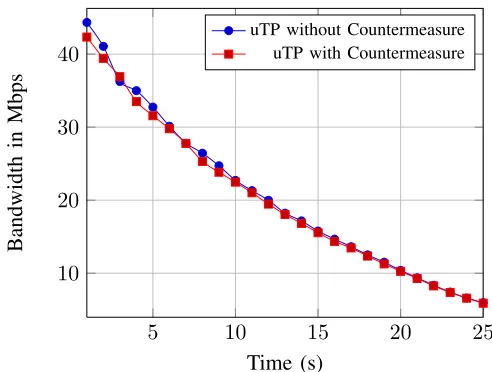
1) Performance Evaluation: To evaluate the perfor-mance lost of the countermeasure where the sender randomly skips packet, we setup the following exper-iment: We wrote a Perl script which automatise the file transfer of a 100 MiB file over uTP. The script increases the delay for every iteration by one with a variance of 10 ms and a normal distribution. Every delay value will be tested ten times and the average value will be taken. We repeated the experiment with a normal sender and with a sender which includes the countermeasures.
Figure 9 shows that the difference between a normal sender and patched sender is minimal. So we took the difference of all values and calculated the average value. The average performance lost of the randomly skipped packets countermeasure is 0.448 Mbps. Appar-ently the longer the delay is, the smaller the difference between the performance of a normal sender and a patched sender. The biggest difference is 2.002 Mbps by 1 ms and the smallest difference is 0.015 Mbps by 24 ms delay.
B. Delay Attack
[image:7.612.329.561.73.267.2]5 10 15 20 25 10
20 30 40
Time (s)
Bandwidth
in
Mbps
[image:8.612.54.300.68.254.2]uTP without Countermeasure uTP with Countermeasure
Figure 5. File Transfer of a 100 MiB File via uTP under the following network conditions: Bandwidth: 100 Mbit/s, Delay: 25 ms, Variance: 10 ms and Distribution: normal
more packets into the network. That is because the congestion control with the one way delay only works with the help of the receiver and there is no guarantee that the receiver tells us the truth. One idea to make the window calculation less depending on the one way delay is to include the Round-Trip Time (RTT) into the calculation from Listing 1. This requires that the coun-termeasure from Section IV-A is included, because the opt-ack attack also reduces the RTT. Therefore a good countermeasure against the delay attack yields to a complete redesign of the LEDBAT congestion control. That is why we don not propose a countermeasure against this attack and point here to further research.
V. RELATEDWORK
In this section we discuss the related work which has influenced and inspired this paper. We have divided the related work in a subsection which concerns about the exploitation of congestion avoidance algorithm’s and a subsection which concerns about performance evaluations of LEDBAT.
A. Exploit Congestion Avoidance Control
Savage et al. [15] used a misbehaving TCP receiver to get better end-to-end performance. They named one of their techniques Optimistic ACKing: The receiver sends ACKs which the sender has not yet been sent. This increases the RTT of the sender and in turn this increases the send rate. Savage et al. showed through
their research work that these techniques can increase end-to-end performance. They mentioned that these techniques can also be used to generate a DoS attack. Sherwood et al. [14] were the first who investigated these techniques from a DoS perspective. They showed that the opt-ack attack can cause widespread damage and destabilize the network. The main difference from Sherwood’s ack attack against TCP and the opt-ack attopt-ack against uTP is, that uTP does not use the RTT to adjust the send rate. However, every valid ack increases the window size of the sender. As a result of this increase the sender can send new data, which increases the bandwidth. They also engineered a defence strategy which does not need any modification of the TCP/IP standard. Unfortunately this patch has not found its way into the Linux kernel [16]. In contrast, our work provide a performance evaluation of their defence strategy to show the real performance lost.
B. LEDBAT Performance
Rossi et al. [17], [18] were the first who evalu-ated LEDBAT under scientific aspects. They tested LEDBAT especially in the terms of fairness against competing TCP flows and protocol efficiency. They showed through experimental evidences that LEDBAT reached some of its design goals e.g., protocol effi-ciency, but they also found some problems regarding the fairness of resources.
Abu and Gordon showed the impact of delay vari-ability on LEDBAT performance caused by router changes [19]. They come to the conclusion that delay variability can cause a negative impact on the through-put.
VI. CONCLUSION ANDFUTUREWORK
does the uTP attacks behave in correlation with Bit-Torrent’s choking algorithm? How will the BitTorrent eco-system react on those attacks.
REFERENCES
[1] A. Kuzmanovic and E. Knightly, “TCP-LP: low-priority service via end-point congestion control,” IEEE/ACM Transactions on Networking, vol. 14, no. 4, pp. 739–752, August 2006.
[2] A. Venkataramani, R. Kokku, and M. Dahlin, “TCP Nice: A mechanism for background transfers,” in 5th Symposium on Operating Systems Design and Imple-mentation (USENIX OSDI). USENIX, 2002, pp. 329– 343.
[3] G. Hazel, “Announcements:µTorrent 1.9 alpha 15380,” uTorrent Forum, Nov 2008. [Online]. Available: http://forum.utorrent.com/viewtopic.php?pid=377209
[4] R. Bennett, “Bittorrent declares War on VoIP, Gamers - The Next Internet Meltdown,” 2008. [Online]. Available: http://www.theregister.co.uk/2008/ 12/01/richard_bennett_utorrent_udp/
[5] I. Lamont, “BitTorrent Calls UDP Report
“Utter Nonsense“,” 2008. [Online].
Avail-able: http://tech.slashdot.org/story/08/12/01/2331257/ bittorrent-calls-udp-report-utter-nonsense
[6] I. van Beijnum, “µTorrent’s switch to UDP
and why the sky isn’t falling,” 2008. [Online]. Available: http://arstechnica.com/old/content/2008/12/ utorrents-switch-to-udp-and-why-the-sky-isnt-falling. ars
[7] S. Shalunov and G. Hazel, “Internet-Draft: Low Extra Delay Background Transport (LEDBAT),” IETF, Tech. Rep., 2011. [Online]. Available: http: //tools.ietf.org/html/draft-ietf-ledbat-congestion-09
[8] A. Norberg, “BEP 0029: uTorrent transport protocol,” BitTorrent, Inc., Tech. Rep., 2010. [Online]. Available: http://bittorrent.org/beps/bep\_0029.html
[9] V. Jacobson, “Congestion Avoidance and Control,” ACM SIGCOMM Computer Communication Review, vol. 18, no. 4, pp. 314–329, August 1988.
[10] F. Adamsky, H. Khan, M. Rajarajan, and
S. A. Khayam, “POSTER: Destabilizing BitTorrent’s Clusters to Attack High Bandwidth Leechers,” inACM Computer and Communications Security 2011, 2011. [Online]. Available: http://florian.adamsky.it/research/ publications/2011/ccsp152a-adamsky.pdf
[11] A. Legout, N. Liogkas, E. Kohler, and L. Zhang, “Clus-tering and sharing incentives in BitTorrent systems,” in Proceedings of the 2007 ACM SIGMETRICS Interna-tional Conference on Measurement and Modeling of Computer Systems. ACM, 2007, pp. 301–312.
[12] E. Van Der Sar, “uTorrent Keeps BitTorrent Lead, BitComet Fades Away,” TorrentFreak, September 2011. [Online]. Available: http://torrentfreak.com/ utorrent-keeps-bittorrent-lead-bitcomet\-fades-away\ -110916/
[13] S. Hemminger, “Network emulation with NetEm,”
in Linux Conf Au. Citeseer, 2005.
[On-line]. Available: http://citeseerx.ist.psu.edu/viewdoc/ download?doi=10.1.1.67.1687&rep=rep1&type=pdf
[14] R. Sherwood, B. Bhattacharjee, and R. Braud, “Misbehaving TCP receivers can cause Internet-wide congestion collapse,” in Proceedings of
the 12th ACM Conference on Computer and
Communications Security. ACM, 2005, pp. 383– 392. [Online]. Available: http://portal.acm.org/citation. cfm?id=1102120.1102170
[15] S. Savage, N. Cardwell, D. Wetherall, and T. Anderson, “TCP congestion control with a misbehaving receiver,” ACM SIGCOMM Computer Communication Review, vol. 29, no. 5, pp. 71–78, October 1999.
[16] S. Hemminger, “Re: fixing opt-ack DoS against TCP-Stack,” Linux-Net Archive, Jan 2007. [Online]. Available: http://lkml.indiana.edu/hypermail/linux/net/ 0701.1/0003.html/
[17] D. Rossi, C. Testa, S. Valenti, and L. Muscariello, “LEDBAT: the new BitTorrent congestion control
protocol,” in Computer Communications and
Networks (ICCCN). IEEE, 2010, pp. 1–6. [Online]. Available: http://ieeexplore.ieee.org/xpls/abs\_all.jsp? arnumber=5560080
[18] D. Rossi, C. Testa, and S. Valenti, “Yes,
we LEDBAT: Playing with the new BitTorrent congestion control algorithm,” in Passive and Active Measurement. Springer, 2010, pp. 31– 40. [Online]. Available: http://www.springerlink.com/ index/M4V0200776L3P52H.pdf