Practical application of penalty-free evolutionary multi-objective
optimisation of water distribution systems
A.G. Seyoum, T.T. Tanyimboh* and C. Siew
Department of Civil and Environmental Engineering, University of Strathclyde Glasgow, UK e-mail: [email protected]
Abstract: Evolutionary algorithms are a commonly applied optimisation approach in water distribution systems. However, the algorithms are time consuming when applied to large optimisation problems. The aim of this paper is to evaluate the application of a penalty-free multi-objective evolutionary optimisation algorithm to solve a real-world network design problem. The optimization model uses pressure-dependent analysis that accounts for the pressure dependency of the nodal flows and thus avoids the need for penalties to address violations of the nodal pressure constraints. The algorithm has been tested previously using benchmark optimisation problems in the literature. In all cases, the algorithm found improved solutions and/or the best solution reported previously in the literature with considerably fewer function evaluations. In this paper, a real-world network with over 250 pipes was considered. The network comprises multiple sources, multiple demand categories, many fire flows and involves extended period simulation. Due to the size and complexity of the optimization problem, a high performance computer that comprises multiple cores was used for the computational solution. Multiple optimisation runs were performed concurrently. Overall, the algorithm performs well; it consistently provides least cost solutions that satisfy the system requirements quickly. The least-cost design obtained was over 40% cheaper than the existing network in terms of the pipe costs.
Key words: Penalty-free multi-objective evolutionary optimisation, water distribution systems, pressure-dependent analysis, genetic algorithm, high performance computing, redundant binary codes
1. INTRODUCTION
Water distribution systems (WDSs) are key components of public infrastructures and it is essential to design and rehabilitate them in a cost effective manner without compromising the required performance and regulatory standards. Evolutionary algorithms (EAs) are a commonly applied optimisation approach. However, the algorithms are time consuming when applied to large optimisation problems such as real world networks with large numbers of pipes and multiple operating conditions. For example, in the optimisation of large water distribution systems, a single optimisation run may involve thousands of hydraulic and water quality simulations (see e.g. Ghebremichael et al. 2008, Seyoum and Tanyimboh 2014a) that may take many days on modern computers such as workstations. Such computational time, however, is usually unacceptable for water utilities applications. One way to address this difficulty is by utilising high performance and parallel computing techniques.
algorithms were proposed previously. Controller-worker is the widely used application of parallel EAs where a single controller processor executes the routine operation of the algorithm and employs the workers to carry out fitness evaluation. It is the most straightforward approach with a potential of improving computational performances significantly (Nowostawski and Poli 1999, Cantú-Paz and Goldberg 2000).
The aim of this paper is to assess a multi-objective evolutionary algorithm introduced by Siew and Tanyimboh (2012b) that is based on the Non-dominated Sorting Genetic Algorithm II (Deb et al. 2002). Evolutionary algorithms for water distribution systems often use penalties to assess the merits of infeasible solutions when solving optimization problems that have constraints. By contrast, the penalty-free multi-objective evolutionary algorithm (PF-MOEA) uses pressure-dependent analysis that accounts for the pressure dependency of the nodal flows and thus avoids the need for penalties to address violations of the minimum node pressure constraints. The pressure-dependent analysis that PF-MOEA uses is the pressure-pressure-dependent extension of EPANET 2 that is known as EPANET-PDX (Siew and Tanyimboh 2012a). EPANET-PDX simulates water distribution systems with insufficient flow and/or pressure more realistically. To assess the optimization algorithm a real-world network design problem was considered. The 251-pipe network comprises multiple sources, multiple demand categories, many fire flows and involves extended period simulation. Due to the size and complexity of the optimisation problem, a high performance computer that comprises multiple cores was used for the computational solution. Multiple optimisation runs were performed concurrently. Overall, the algorithm performs well; it consistently provides least cost solutions that satisfy the system requirements quickly.
2. OPTIMIZATION APPROACH
Evolutionary algorithms by nature start with a randomly generated set of solutions that may include both feasible and infeasible solutions. To address the node pressure constraints, penalty methods have been applied widely (Savic and Walters 1997, Vairavamoorthy and Ali 2000, Broad et. al 2005, Ostfeld and Tubaltzev 2008). The major drawback of the penalty-based approach is that additional case-specific parameters are required whose calibration is generally challenging (Siew and Tanyimboh 2012b, Siew et al. 2014, Saleh and Tanyimboh 2013, Prasad and Park 2004).
In an attempt to alleviate the difficulties on handling the node pressure constraints, Siew and Tanyimboh (2012b) proposed a penalty-free multi-objective evolutionary algorithm (PF-MOEA) that eliminates the use of penalty method. The approach allows all the feasible and infeasible solutions generated to compete in a way that is fundamentally bias-free with respect to constraint violation. PF-MOEA uses pressure-dependent analysis to assess each individual in the population of solutions. Unlike the conventional demand-driven analysis approach, pressure-dependent analysis takes proper account of the relationship between the flow and pressure at a node (Tanyimboh and Templeman 2010, Tsakiris and Spiliotis 2014, Ciaponi et al. 2015). In this way, pressure-dependent analysis addresses the node pressure constraints as an integral part of the hydraulic analysis. PF-MOEA employs the pressure-dependent extension of EPANET 2 that is known as EPANET-PDX (Siew and Tanyimboh 2012a) to carry out pressure-dependent analysis seamlessly.
Minimising the total network cost (capital and operation) and maximising the network hydraulic performance are the two conflicting objectives of PF-MOEA. These conflicting objectives produce a set of non-dominated solutions where no one solution in the set can be considered superior to the others. The objective functions are as follows.
Minimise: F1 =(CR)2 (1)
Maximise: F2 =(DSR)4 (2)
i.e. the ratio of the cost of a particular solution to the cost of the most expensive solution in the whole population within a single generation. DSR is the demand satisfaction ratio i.e. the ratio of the available flow to the required flow and measures the feasibility of a solution. Both objective functions are thus normalised and have values between zero and one. A solution that has a DSR value that is less than one is infeasible and cannot satisfy the demands in full. The objective functions in Eqs. 1 and 2 focus the search around the frontier between feasible and infeasible solutions where optimal solutions are commonly found.
PF-MOEA seamlessly couples the widely used Non-dominated Sorting Genetic Algorithm II (Deb et al. 2002) with the hydraulic analysis model EPANET-PDX (pressure-dependent extension). The decision variables in PF-MOEA are represented using binary coding. Single-point crossover, single-bit mutation and binary tournament selection are the EA operators used in the algorithm.
3. RESULTS AND DISCUSSION
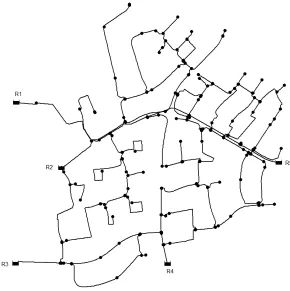
[image:3.595.147.437.396.687.2]The High Performance Computing (HPC) facility at the University of Strathclyde was used to perform multiple serial optimisation runs concurrently. The example is a design optimisation problem where the objective is to obtain the cheapest possible combination of pipe sizes that satisfy all the system requirements. The network is a water supply zone of a network in the UK. The optimization involves extended period simulations that take into account the demand variation in time. The network consists of 251 pipes of various lengths, 228 demand nodes (including the fire hydrants), five variable-head supply nodes, 29 fire hydrants at various locations and three demand categories. The network layout is presented in Figure 1 in which R1 to R5 are the supply nodes. Additional details are available in Seyoum and Tanyimboh (2014a, b).
Figure 1. Layout of the network
results with the existing network, both the network and dynamic operational data that were taken from a calibrated EPANET model were used without making any changes in the original data. Accordingly, the EPS adopted covered a period of 31 hours based on a 1-hour hydraulic time step. At each hour of the EPS period, except at the first and last hours, one fire demand is operational. The Darcy–Weisbach formula for the head-loss due to friction was used for the hydraulic analysis. The pipe roughness coefficients range from 0.01mm to 3mm.
The network was optimised as a new network design problem using PF-MOEA and results were compared with the existing network. The network and pipe unit cost data were supplied by a water utility. Ten commercially available pipe sizes were selected based on the existing network pipe diameters that range from 32 mm to 400 mm. The 10 candidate pipe sizes provide 10251 feasible and infeasible solutions in total. A four-bit binary string was used to represent the discrete candidate pipe sizes. This provided 24 i.e. 16 four-bit combinations of which six were redundant. The
redundant codes were allocated one each to the two smallest and two largest candidate pipes sizes; and one each to the two middle candidate pipe sizes. Alternative approaches for dealing with redundant codes are available in the literature (e.g. Saleh and Tanyimboh 2014). Since the network is composed of 251 pipes, a chromosome that has a 1004-bit binary string represents each design. The crossover and mutation probabilities were 1.0 and 0.005 respectively.
This is a computationally intensive optimisation problem. It was thus solved using a high performance computer (HPC). Twenty PF-MOEA runs were executed in serial mode using the HPC facility at the University of Strathclyde. In serial (sequential) computing, independent optimization runs are performed in different processors concurrently. The high performance computing facility has 276 compute nodes; each has dual Intel Xeon 2.66 GHz CPU (six cores each) and 48 GB RAM running the Linux operating system. The 20 optimization runs were performed using a population size of 200 and PF-MOEA was allowed to progress through 2500 generations i.e. a maximum of 500,000 function evaluations. The initial populations were generated randomly. The minimum-cost solution obtained was £419,900 within 499,000 function evaluations. The average, median and maximum value of the minimum cost were £439,311, £436,129, £478,356 respectively. The standard deviation and coefficient of variation of the minimum cost were £15,074 and 0.034 respectively. A small coefficient of variation demonstrates the consistency of results.
On average, the number of function evaluations and the CPU time to achieve convergence within the specified maximum of 500,000 function evaluations were 493,190 and 6.7 hours respectively. It is worth emphasizing that a single optimization run, with 500,000 function evaluations allowed, which takes approximately 15 days on a workstation (with two quad-core 2.4 GHz CPU and 16 GB RAM) was performed in less than seven hours using the HPC facility. The Pareto-optimal fronts of the 20 runs were combined from which the final set of non-dominated solutions (199 solutions in total) was selected. Figure 2 shows the final set of non-dominated solutions.
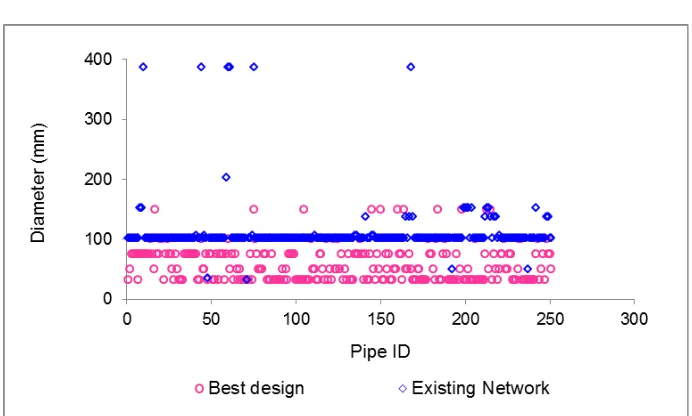
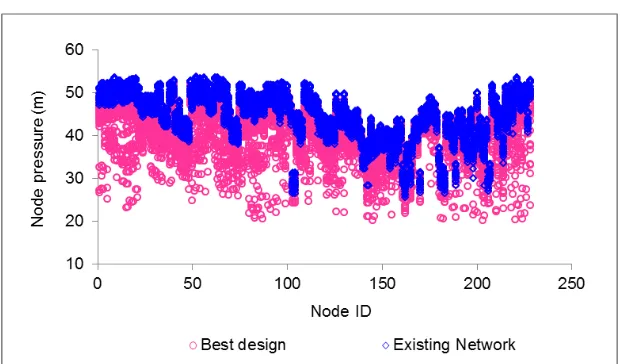
Figure 3 shows the evolution of the cost of the cheapest feasible solution. A rapid cost reduction from £1,682,340 at the start of the optimisation to (£798,653 and 25,200 function evaluations) can be seen. The algorithm converged finally at (£419,900 and 499,000 function evaluations). The optimisation results have been evaluated with reference to the existing network cost of £809,700. On average 45.7% cost reduction was achieved. Also, comparison of the cheapest feasible solution with the existing network shows a cost reduction of 48.1%. The cheapest solution was also simulated using EPANET 2 to re-confirm the feasibility. The pipe diameters and nodal heads of the existing network and the optimized design are compared in Figures 4 and 5 respectively. It can be observed in Figure 4 that the PF-MOEA solution in general consists of smaller pipe sizes compared to the existing network. Conversely, Figure 5 shows that in general the PF-MOEA solution has lower residual pressures than the existing network. It may be noted that the existing network has some pipe sizes that are not commercially available any more. Also, the minimum pressure requirements at all demand nodes and fire hydrants were fulfilled for the entire operating cycle. Figure 5 shows that the pressures at all demand nodes including fire hydrants for all time steps of the EPS are above 20 m. It is worth emphasizing that the pressures at fire hydrants were not close to 3m (the minimum pressure requirement) due to the proximity of the fire hydrants to the demand nodes.
[image:5.595.126.472.522.730.2]Figure 3. Progress of the best optimisation run
Figure 5. Nodal pressures for all time steps of the extended period simulation
4. CONCLUSIONS
This paper assessed a penalty-free multi-objective evolutionary optimization approach for the design optimisation of a real-world network. The approach uses pressure-dependent analysis that accounts for the pressure dependency of the nodal flows and obviates the need for penalties to address violations of the nodal pressure constraints. Results show the algorithm is stable and finds optimal and near-optimal solutions reliably and efficiently. The results also suggest that the evolutionary sampling efficiency is very high. In other words, the number of solutions evolved and analysed on average before finding a near-optimal solution is small in comparison to the total number of feasible and infeasible solutions. Only one solution in every 2×10245 solutions was assessed for the sample network considered here. The optimization algorithm PF-MOEA performed well for the real-world optimisation problem that involves multiple supply sources, multiple demand categories and extended period simulation. The least-cost design obtained was significantly lower in cost compared to the existing network (i.e. 48% reduction approximately). In total 10 million extended period simulations of the network were carried out in PF-MOEA. In all cases, the algorithm performed reliably well. It follows, ipso facto, that the pressure-dependent analysis algorithm EPANET-PDX (Siew and Tanyimboh 2012a) that is embedded in PF-MOEA performed reliably well also. In PF-MOEA, only node pressure constraints were explicitly considered. Given that the algorithm is efficient and robust in finding optimal/near optimal solutions, it would be beneficial to address other constraints to widen the algorithm’s application in real-world optimisation problems.
ACKNOWLEDGEMENTS
This project was carried out in collaboration with Veolia Water UK (now Affinity Water) and funded in part by the UK Engineering and Physical Sciences Research Council (EPSRC grant reference EP/G055564/1), the British Government (Overseas Research Students Awards Scheme) and the University of Strathclyde. The above-mentioned support is acknowledged with thanks. Results were obtained using the ARCHIE-WeSt High Performance Computer funded by the UK EPSRC (www.archie-west.ac.uk); EPSRC grant no. EP/K000586/1.
Supporting data other than sensitive third party data are included in the article.
REFERENCES
Planning and Management 131(3):172-180
Cantu-Paz E, Goldberg DE (2000) Efficient parallel genetic algorithms: theory and practice. Computer methods in applied mechanics and engineering 186(2): 221-238
Ciaponi C, Franchioli L, Murari E, Papiri S (2015) Procedure for defining a pressure-outflow relationship regarding indoor demands in pressure-driven analysis of water distribution networks. Water Resour Manag 29:817–832. doi:10.1007/s11269-014-0845-2 Deb K, Pratap A, Agarwal S, Meyarivan T (2002) A fast and elitist multi-objective genetic algorithm: NSGA-II. Evolutionary
Computation, IEEE Transactions 6(2): 182-197
Ghebremichael K, Gebremeskel A, Trifunovic N, Amy G (2008) Modelling disinfection by-Products: coupling hydraulic and chemical models. Water Science and Technology: Water Supply 8(3): 289-295
Nowostawski M, Poli, R (1999) Parallel genetic algorithm taxonomy. Proceedings of the 3rd International conference on Knowledge-Based Intelligent Information Engineering Systems, Adelaide, Australia, 31 August-1 September 1999
Ostfeld A, Tubaltzev A (2008) Ant colony optimization for least-cost design and operation of pumping water distribution systems. Journal of Water Resources Planning and Management 134(2): 107-118
Prasad TD, Park NS (2004) Multi-objective genetic algorithms for design of water distribution networks. Journal of Water Resources Planning and Management 130(1): 73-82
Saleh SHA, Tanyimboh TT (2013) Coupled topology and pipe size optimisation of water distribution systems. Water Resources Management 27(14):4795-4814
Saleh SHA, Tanyimboh TT (2014) Optimal design of water distribution systems based on entropy and topology. Water Resources Management 28(11):3555-3575
Savic DA, Walters GA (1997) Genetic algorithms for least-cost design of water distribution networks. Journal of Water Resources Planning and Management 123(2):67-77
Seyoum AG, Tanyimboh TT (2014a) Pressure dependent network water quality modelling. Proceedings of ICE: Water Management 167(6): 342-355
Seyoum AG, Tanyimboh TT (2014b) Application of pressure-dependent EPANET extension. Proceedings of the 11th International Conference on Hydroinformatics, New York City, USA, 16-21 August 2014
Siew C, Tanyimboh TT (2012a) Pressure-dependent EPANET extension. Water Resources Management 26(6):1477–1498
Siew C, Tanyimboh TT (2012b) Penalty-free feasibility boundary convergent multi-objective evolutionary algorithm for the optimization of water distribution systems. Water Resources Management 26(15): 4485-4507
Siew C, Tanyimboh TT, Seyoum AG (2014) Assessment of penalty-free multi-objective evolutionary optimization approach for the design and rehabilitation of water distribution systems. Water Resources Management 28(2): 373-389
Trobec R, Vajtersic M, Zinterhof P (2009) Parallel computing: numerics, applications, and trends. Springer
Tanyimboh TT, Templeman AB (2010) Seamless pressure-deficient water distribution system model. J. Water Management 163(8): 389-396. DOI: 10.1680/wama.900013
Tsakiris G, Spiliotis M (2014) A Newton-Raphson analysis of urban water systems based on nodal head-driven outflow. European Journal of Environmental and Civil Engineering 18(8): 882-896
Vairavamoorthy K, Ali M (2000) Optimal design of water distribution systems using genetic algorithms. Computer-Aided Civil and Infrastructure Engineering 15(5): 374-382