R E S E A R C H A R T I C L E
Open Access
Applying the consolidated framework for
implementation research to identify
barriers affecting implementation of an
online frailty tool into primary health care:
a qualitative study
Grace Warner
1,2,4*, Beverley Lawson
1,3,4, Tara Sampalli
1,6, Fred Burge
1,3,4, Rick Gibson
6and Stephanie Wood
5Abstract
Background:Frailty is associated with multi-system deterioration, and typically increases susceptibility to adverse events such as falls. Frailty can be better managed with early screening and intervention, ideally conducted in primary health care (PHC) settings. This study used the Consolidated Framework for Implementation Research (CFIR) as an evaluation framework during the second stage piloting of a novel web-based tool called the Frailty Portal, developed to aid in the screening, identification, and care planning of frail patients in community PHC.
Methods:This qualitative study conducted semi-structured key informant interviews with a purposive sample of
PHC providers (family physicians, nurse practitioners) and key PHC stakeholders who were administrators, decision makers and staff. The CFIR was used to guide data collection and analysis. Framework Analysis was used to determine the relevance of the CFIR constructs to implementing the Frailty Portal.
Results:A total of 17 interviews were conducted. The CFIR-inspired interview questions helped clarify critical aspects of implementation that need to be addressed at multiple levels if the Frailty Portal is to be successfully implemented in PHC. Finding were organized into three themes 1) PHC Practice Context, 2) Intervention attributes affecting implementation, and 3) Targeting providers with frail patients. At the intervention level the Frailty Portal was viewed positively, despite the multi-level challenges to implementing it in PHC practice settings. Provider participants perceived high opportunity costs to using the Frailty Portal due to changes they needed to make to their practice routines. However, those who had older patients, took the time to learn how to use the Frailty Portal, and created processes for sharing tasks with other PHC personnel become proficient at using the Frailty Portal.
Conclusions: Structuring our evaluation around the CFIR was instrumental in identifying multi-level factors
that will affect large-scale adoption of the Frailty Portal in PHC practices. Incorporating CFIR constructs into evaluation instruments can flag factors likely to impede future implementation and impact the effectiveness of innovative practices. Future research is encouraged to identify how best to facilitate changes in PHC practices to address frailty and to use implementation frameworks that honor the complexity of implementing innovations in PHC.
Keywords: Frail elderly, Primary health care, Patient care planning, Web-based frailty portal
* Correspondence:[email protected]
1Dalhousie University, Halifax, NS, Canada 2Healthy Populations Institute, Halifax, NS, Canada
Full list of author information is available at the end of the article
Background
While the word frail is common to many health care settings, the actual diagnosis of frailty is complex due to varied presentations and causes [1]. Frailty is often fined as a physiologic syndrome characterized by de-creased reserve and resistance to stressors, resulting from a cumulative decline across multiple physiologic systems; causing vulnerability to adverse outcomes [2]. It is generally associated with multi-system (e.g., mobility, cognition, function, endurance) deterioration, and typic-ally impacts the geriatric population. Persons experien-cing frailty are highly susceptible to adverse events such as falls, hospitalization, disability, dependence, place-ment in long-term care facilities and death [2, 3]. Since frailty is a robust marker of vulnerability it is important to accurately identify those who are frail, so they can be better managed with early identification and appropriate interventions that reduce adverse events [4,5].
Given the majority of frail persons live in the commu-nity, and providers who work in primary health care (PHC) regularly encounter frail persons in their daily clinical work [6], strengthening PHC for frail adults is crucial. Identification of frail patients in PHC is a pro-active approach to providing care [7] that can im-prove patient understanding of their overall health and engage them and their family in the decision-making process with their health provider regarding preventive strategies [8, 9]. Routine identification of frailty offers opportunities for targeted care including the application of newly developed clinical practice guidelines for frailty [10, 11]. However, routine identification and measure-ment of frailty is not part of standard care and is only now emerging as a concept for primary care [12,13].
To enable frailty screening and interventions to effect-ively and consistently occur in PHC, providers need ap-propriate tools for identifying frailty [14]. Recent advances in technology have enabled easy, timely and relevant access and application of tools at the point of care [15]. The use of technology has evolved as a prac-tical and feasible option for embedding tools to support evidence-informed care, increasing the application of knowledge into practice. To assess and address the needs of frail individuals in the community a web-based tool called the Frailty Portal was created to be used in PHC practices.
Consolidated framework for implementation research As part of the evaluation of the Frailty Portal, barriers and facilitators to implementation were assessed using the Consolidated Framework for Implementation Re-search (CFIR) as an evaluation framework. The CFIR was chosen because it is a relatively new framework, that has synthesized prior research evidence representing a spectrum of disciplines into one consolidated framework
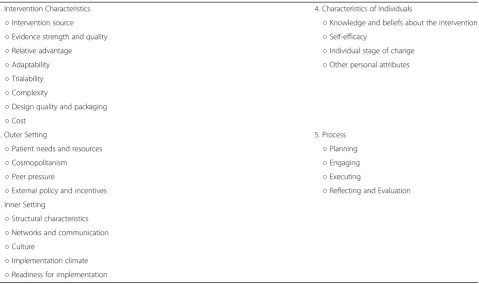
with multiple constructs to create a typology of what af-fects successful implementation of an intervention [16]. It has 39 constructs organized into five major domains found to influence the successful implementation of in-novative programs. The domains assess i) Intervention characteristics (eight constructs), ii) Outer setting (four constructs), iii) Inner setting (14 constructs), iv) Charac-teristics of individuals (five constructs) and, v) Process (eight constructs) [17]. Table1lists all the CFIR domains and constructs.
A recent systematic review by Kirk et al. (2016) [17] examined how studies currently use the CFIR and how it might be used in the future. They found the CFIR had most often been employed in doing a post-hoc analysis on what facilitated or hindered implementation. It has been less frequently used at the pre-implementation stage to identify barriers and facilitators that could affect future implementation [18, 19]. The aim of the study was to use the CFIR as an evaluation framework at the pre-implementation stage to clarify critical barriers and facilitators to implementation that need to be addressed at multiple levels if the Frailty Portal is to be successfully implemented in PHC practices.
Methods
Development of the frailty portal
The Nova Scotia Health Authority PHC (NSHA-PHC) initiated a Frailty Strategy in 2012 to achieve its goal of improving care for its frail population. An objective of the strategy was to assess and address Frailty in PHC. To achieve this objective NSHA-PHC created a web-based tool called the Frailty Portal in collaboration with community partners from other health care sectors such as home care and geriatrics, and community volun-teer agencies that addressed the needs of older adults. The Frailty Portal has two essential components: 1. an assessment phase, and 2. practice visit goals. Within the assessment phase the provider is to first identify con-ceivably frail patients and then screen those identified to determine their level of frailty using a web-based version of the Frailty Assessment for Careplanning Tool (FACT) [20], which is a modification of the Clinical Frailty Scale [21]. The FACT assesses essential domains that contrib-ute to frailty (cognition, mobility, function and social cir-cumstances) and provides a score to measure the patient’s frailty level (thriving to terminally ill). Based on this frailty level, the second component of the Frailty Portal provides practical visit goals, tailored to the pa-tient’s identified frailty level, for use in care plan devel-opment and links to relevant resources for providers, patients and caregivers. Additional detail about the inter-vention has been previously published [22].
were asked to provide their impressions of the required steps for identification and screening of patients using the FACT as well as the overall usability of the web-based tool within community PHC care practice. Based on these suggestions modifications were made to the web-based interface to improve usability of the as-sessment tool and maneuverability within the site. As well a second component was added that provided prac-tical visit goals and a toolkit of currently available resources.
In this article we focus on data gathered during the second piloting of the Frailty Portal in 2015–2016 which followed modifications from the first pilot and the addition of the second component. For this second pilot a broader group of PHC providers that included physi-cians and nurse practitioners were asked to take part. As part of the second pilot a formal half-day education workshop offering detailed information about identifying frailty with hands-on learning using the Frailty Portal tool was provided.
Setting
In Canada, PHC is partially funded through public funds that are allocated by the health authorities within each province. The outer setting for this study is NSHA-PHC, which encompasses urban, sub-urban, and rural service locations. Diverse support services are available in the different locations. At the level of the practice setting,
the CFIR inner setting domain, PHC includes both team-based and individual practices that are remuner-ated through various payment plans, the majority through fee-for-service. In some practice settings PHC providers, the individuals involved in implementing the Frailty Portal, were employees of the NSHA while others were from private practices Although the work of most community-based family physicians is not under the dir-ect responsibility of the NSHA; the NSHA dirdir-ectly en-gages and supports family practices in their work and involves them in health authority driven initiatives. This study was part of a health authority initiative.
The NSHA research ethics board reviewed our protocol and procedures, the study was considered to be a program quality initiative that did not require individual consent from participants. Although consent was not deemed ne-cessary all participants were informed that no personal in-formation would be shared in our summaries, but they would be labeled by PHC role. Also, that any personal in-formation they shared with us would remain confidential and necessary precautions would be taken to ensure their data was kept in a secure password-protected location.
Participants
[image:3.595.60.540.97.381.2]This qualitative descriptive study was one part of a lar-ger convergent mixed methods study. The protocol for the entire study is described in a previous publication [22]. Semi-structured key informant interviews were Table 1CFIR domains and associated constructs
1. Intervention Characteristics 4. Characteristics of Individuals
○Intervention source ○Knowledge and beliefs about the intervention
○Evidence strength and quality ○Self-efficacy
○Relative advantage ○Individual stage of change
○Adaptability ○Other personal attributes
○Trialability ○Complexity
○Design quality and packaging ○Cost
2. Outer Setting 5. Process
○Patient needs and resources ○Planning
○Cosmopolitanism ○Engaging
○Peer pressure ○Executing
○External policy and incentives ○Reflecting and Evaluation
3. Inner Setting
○Structural characteristics ○Networks and communication ○Culture
conducted with a purposive sample of PHC providers and key PHC stakeholders who were administrators, staff, and decision makers. Decision makers were higher level administrators who had the authority to make pol-icy and funding decisions in PHC-NSHA. Potential par-ticipants were identified by NSHA then purposively sampled to provide different perspectives on the history, development and implementation of the Frailty Portal.
Interview guides
The initial interview guides were based on sample inter-views available on http://cfirguide.org/ then tailored to gather specific information about the Frailty Portal inter-vention [18]. Damschroder et al. (2009) [18] recommend that implementation researchers try to pre-identify CFIR constructs they will assess based on the relevancy to the study, then determine what level each construct should be measured. They also recommend that researchers report their decisions and rationales for choosing certain constructs, along with findings for each construct that is ultimately selected. For this study, the CFIR domains aligned with the following entities: Intervention characteristics (of the Frailty Portal); Outer setting (NSHA-PHC); Inner setting (PHC practices); Character-istics of individuals (PHC providers who piloted the Frailty Portal); and, Process (aspects of developing, deliv-ering and evaluating the Frailty Portal). There were CFIR constructs within these domains that the literature sug-gested might be less salient to Frailty Portal implementa-tion success; however, the research team decided to probe all the CFIR domains and constructs in the inter-views because there was no definitive evidence.
The same semi-structured interview guide was used for all stakeholders; however, because stakeholders had varying backgrounds they were first queried whether they had specific knowledge related to a section to deter-mine if the questions were relevant. The interview guide was divided into sections that covered 1) background information on the initial development and first piloting of the Frailty Portal, and 2) an evaluation of the Frailty Portal process and tool based on experiences during the second piloting. The first section provided the re-searchers with supplemental information on the devel-opment of the Frailty Portal. The second section was the focus of our study. If participants felt they could not contribute information to particular questions, they were skipped. Interviews were completed in-person at a loca-tion convenient to the interviewee, or by telephone if distance was prohibitive. All interviews were conducted by the first author, who was an independent qualitative researcher outside of the NSHA trained in qualitative interviewing and analysis. The interviews were recorded using a digital audio recording device for ease of tran-scription and review. Data were transferred from the
device following each interview and transcribed verbatim by an experienced transcriptionist. Following review of the interview transcription the interviews were uploaded into NVivo For Mac 11.2.2 qualitative software for ana-lysis. All interviews were de-identified; a code was given to each interview and personal identifiers were stripped from the data.
Analysis
Descriptive qualitative research, using a Framework Analysis approach [23,24] was used during the study to determine the relevance of the CFIR constructs. Qualita-tive description is used to describe rather than interpret phenomenon through an identified theoretical frame-work, such as phenomenology or grounded theory [25]. In qualitative description, the researcher collects data to understand the area of study then describes this data using everyday terms as they relate to the event or area of study. Content Analysis, the process of making sense of the meanings in the data, was also used during our thematic analysis [26].
was collected, analyzed and interpreted accurately, so it conveyed the experiences of participants, processes asso-ciated with trustworthiness were enacted such as mem-ber checking and reflexivity [27].
Results
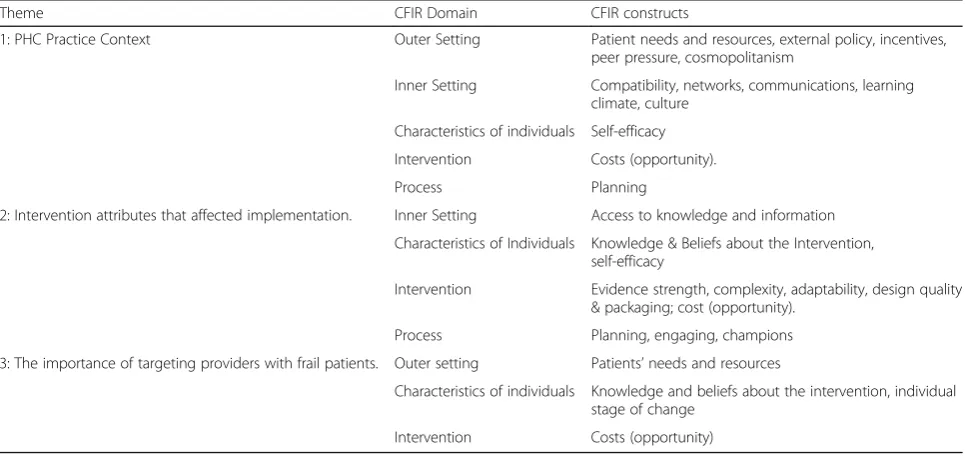
A total of 17 interviews were conducted. PHC stake-holder participants (noted as SH in the quotes) included decision makers (n= 2), health authority administrators (n= 4), and staff (n= 2). PHC providers interviewed (noted as HP in the quotes) were family physicians (n= 6) and nurse practitioners (n= 3). The interviews lasted from 40 min to 1.5 h. Although we considered present-ing our findpresent-ings by CFIR domains, our thematic frame-work indicated the domains overlapped. The complexity of the intervention and implementation processes made it difficult to separate key findings by domain. As such our findings are organized into three themes that reflected participants’experiences with the Frailty Portal but are informed by the CFIR framework; 1) PHC Prac-tice Context, 2) Intervention attributes affecting imple-mentation, and 3) Targeting providers with frail patients. Quotes are provided to illustrate each theme. The CFIR constructs identified in the themes are listed in Table2.
Theme 1: PHC practice context
The PHC Practice Context is affected by several CFIR domains. Most providers identified constraints at the level of the health authority that affected how they set up practice routines, thus identifying outer setting factors such as resources and external policies that put pressure on providers to see a certain number of patients within a given timeframe. Family physicians
felt pressured to see a patient every 15–20 min, this was not conducive to completing the Frailty Portal which took more time. In a fee-for-service environ-ment it would have been helpful to pair the interven-tion with a specific payment mechanism that would compensate providers for longer assessment visits. In the CFIR this would be classified as an incentive at the level of the outer setting.
If you happen to have two physicians doing a couple of frailty assessments taking 45 min each, that drastically reduces your patient capacity. HP3
…we need more resources to be able to really roll it out [to other practices]... HP7
…Is there a [fee] code for the extra time? HP8 (medical lead)
[image:5.595.57.540.505.733.2]Outer setting constraints made the intervention in-compatible with routines used within the inner setting of PHC practices to see patients. Integrating the Frailty Portal into practice routines required time, which was an opportunity cost to the physician. Opportunity costs refers to a situation where the physician loses the potential gain from seeing another patient because they have used that time to complete the Frailty Portal. Providers who took time to complete the Frailty Portal or learned how to inte-grate it into their practice routines became proficient at using the Frailty Portal, had increased self-efficacy with the intervention, and were likely to use the tool more regularly.
Table 2CFiR Domains and Constructs Associated with Qualitative Themes
Theme CFIR Domain CFIR constructs
1: PHC Practice Context Outer Setting Patient needs and resources, external policy, incentives, peer pressure, cosmopolitanism
Inner Setting Compatibility, networks, communications, learning climate, culture
Characteristics of individuals Self-efficacy
Intervention Costs (opportunity).
Process Planning
2: Intervention attributes that affected implementation. Inner Setting Access to knowledge and information
Characteristics of Individuals Knowledge & Beliefs about the Intervention, self-efficacy
Intervention Evidence strength, complexity, adaptability, design quality & packaging; cost (opportunity).
Process Planning, engaging, champions
3: The importance of targeting providers with frail patients. Outer setting Patients’needs and resources
Characteristics of individuals Knowledge and beliefs about the intervention, individual stage of change
…two to five visits with somebody in order to get through the assessment and planning is not a typical structure [for seeing patients].…. HP4
In contrast, the practice context of the PHC nurse practitioners was different from physicians. The nurse practitioners who were interviewed felt the Frailty Portal was compatible with their practice as it aligned with their capacity for longer appointment times and scope of practice regarding chronic condition management (e.g. frailty). As such they were better able to fit the use of the Frailty Portal into their practice routines, however, they still had to ensure other providers in the practice were supportive of their allocating time to implement the Frailty Portal instead of seeing additional patients. This required communication and negotiations with other individuals in the practice.
….the nurse practitioners that are using the Portal. They’ve got a little bit more flexibility…for them to bring a patient in for half an hour, 45 min to do a frailty assessment, no big deal... SH2
It makes perfect sense and it fits right in keeping with what we’re [nurse practitioners] doing…The problem is the time pressure. And it’s not always accepted by the general culture of the clinic. HP6
The PHC practice setting is unique; family physicians do not work in a typical“organizational” structure. They are often independent businesses that are not networked with other practices in the health authority. Not working within a typical organizational structure lowered the ef-fectiveness of using peer pressure or organizational cul-ture to stimulate change. There was no group culcul-ture to support change in PHC practices. PHC physicians who worked in larger teams with access to nurse practi-tioners, or support staff, could share the workload and reduce the time needed to implement the Frailty Portal. Teams were encouraged to work together to develop a plan for identifying potentially frail patients in advance, and schedule appointments for assessing and addressing frailty. These teams were more successful at implement-ing the Frailty Portal.
…the plan had been to send out [a report to provide an incentive to providers saying]… “this is how many assessments have been done by your group, here’s the level of frailty, here’s the average age”,…that really didn’t seem to be an incentive for folks. SH6
If I had her [family practice nurse] probably book even an hour of her time…to do a lot of the [Frailty Portal] questions and getting the information, and…
reviewing some of the [Frailty Portal] care planning with them, [it] would be a good use of time. HP11
Theme 2: Intervention attributes that affected implementation
Providers commented positively on the half-day training session for the Frailty Portal and felt it was informative. The session was co-led by providers viewed as leaders in their practice community who demonstrated their sup-port for the intervention. The supsup-port from practice leaders and the health authority satisfied attendees that the Frailty Portal was evidence-based. However, pro-viders felt the training would have benefited from a follow-up session shortly after the initial training. This follow-up session could address problems that occurred when the Provider first attempted to use the Frailty Portal in their practice setting. Most of the comments were around the difficulty of implementing processes in their practice to do all the steps associated with the Frailty Portal.
The training was excellent. I would have liked more around the planning part because that’s where I really feel like I fell short. HP6
…a two-part [training] session where you are introduced to it [Frailty Portal], you go ahead and try it, and then you’re scheduled to come back…would have been helpful. HP1
of this problem and were actively working to identify ways to integrate the Frailty Portal with existing EMR provider software.
I attempted to get into the Portal a number of times when I had a client in front of me,…and I had difficult logging on. I couldn’t figure out what was going on. HP1
…they feel that what they enter here [in the Frailty Portal] is redundant with what they’re going to enter in their own EMR…. we’re looking at, is there a way that we can send the results…directly to their EMR? SH1
I had a lot of difficulty with logging into the Portal…. she was going to call me back and help me with the username and password. But I never received anything…until I called them back. HP10
Within the FACT, the frailty assessment tool embed-ded in the Frailty Portal, was a separate collateral form which providers were to ask family members to complete. This information was to confirm providers’ as-sessments of frailty. However, providers felt challenged scheduling patient appointments that included family members. This often resulted in the form not being completed. Instead some providers used their own judgement rather than confirming their frailty assess-ment with the family; others realized the importance of getting family input. One provider wondered about priv-acy concerns if they asked family members about the patient.
You know, what does your patient think about you asking their family members about them? HP3
…where we’re trying to assess for frailty, it’s not typical that a caregiver would be part of that…HP4
I’m suspecting that it’s probably better that you do ask somebody in the family who sees them the other 364 days of the year what’s really going on. HP8 (medical lead)
The last stage of the Frailty Portal provided sugges-tions for care plans based on the patient’s frailty level. The care plans occasionally involved referrals to com-munity organizations. When providers had limited knowledge of an organization it was difficult for them to quickly judge the relevance and appropriateness of the referral. Although the Frailty Portal referred providers to the organization’s website for information about the organization, this learning process was time consuming.
…making sure that you’ve referred to all the appropriate places…really puts it all together and it gives you an overall picture of…what you need to do for clients. HP9
…I like some of the links and the resources…But to be able to work through that whole care plan…that you’ve completed that assessment for that person, that’s a big ask...HP2
A final challenge identified was using the Frailty Portal over multiple visits. If a patient’s condition was to change over time the provider may be required to re-assess and develop new care plans without finishing the first one. Some providers mentioned they never completed the “record” for their patient. This lowered their self-efficacy for using the tool.
So…I don’t really get it finished because their care plan is so complex that it’s overwhelming.…I get lost in trying to keep it going. HP11
Basically, it’s when should the chart be closed? SH1
When interview participants were asked, “On a scale of 1-10, with one being very easy and 10 being nearly im-possible, how difficult was the Frailty Portal Initiative to implement?”
Administrators and providers commonly rated the dif-ficulty, or complexity, of the intervention between 6 and 7. The reason for the high rating was usually due to the multiple Frailty Portal components and the necessary changes that needed to be made to practice routines to incorporate it into their practice.
The first nine screens are a one–very easy. It’s that last screen that’s challenging because it’s just information overload. HP6
Maybe six, seven because of the obstacles…for the last care plan page, that I think it is very difficult, very time-consuming and needs training. HP2
Theme 3: The importance of targeting providers with frail patients
We identified that we had a growing problem with our frailty populations.. SH3
So…it sort of fell in a bucket of things we were trying to do…so that we can improve the care of the population and help family doctors do their job better or more efficiently. HP8 (medical lead)
The administrators made the decision to pilot the Frailty Portal with providers who cared for a wide range of patient populations in their practices. The level of provider support for the Frailty Portal varied depending on their patient population. Providers who had a more geriatric patient population believed in the value of using the Frailty Portal and viewed it positively. However, pro-vider interviews showed there was limited motivation for changing current practices, or individual stage of change, to implement the Frailty Portal. The current culture in PHC practice settings did not view the Frailty Portal as a priority compared with other daily tasks and activities they needed to perform.
I’m not saying I shouldn’t do it and it’s not the right thing to do for that patient but you’ve now created another mammoth load of work for me…HP4
I think we could better have tailored…which practices have the patient population to use for this [pilot]. On the other hand, it would be a little bit like preaching to the converted…And it really is the physicians who aren’t as geriatric savvy who could benefit from this tool and using it. HP3
I just think we need to think about why we’re doing it and…the benefits that are coming from investing the time in doing that…you know, there are opportunity costs. HP1
Discussion
The aim of the study was to use the CFIR as an evalu-ation framework at the pre-implementevalu-ation stage of a web-based tool called the Frailty Portal to clarify critical barriers and facilitators to implementation that need to be addressed at multiple levels if the Frailty Portal is to be successfully implemented in PHC practices. Although some of the obstacles to implementation were expected, the CFIR-inspired interview questions helped clarify crit-ical aspects of implementation that need to be addressed if the Frailty Portal is to be successfully integrated into PHC practices.
At the intervention level the Frailty Portal was viewed positively, despite the multi-level challenges to imple-menting it in their practice settings. Similar to findings
in other implementation literature, interventions must be tailored to fit within different practice contexts, and it is important for providers to believe there is a need for the intervention [28]. The study identified key inter-vention characteristics that can be modified to reduce the complexity, increase its adaptability, and reduce pro-vider opportunity costs. For some propro-viders, only slight modifications are needed such as removing barriers to logging onto the server where the tool is housed or pro-viding direction on how to integrate the Frailty Portal into practice routines.
At the provider level, study participants perceived a high opportunity cost to using the Frailty Portal result-ing in an inability to see other patients. These opportun-ity costs were less if their scope of practice included time to address prevention or their practices had a high proportion of older patients. Although it is likely most providers will become faster at completing the Frailty Portal with practice, and their self-efficacy should increase, they first need to commit time to becoming proficient.
Organizational changes (inner setting) that facilitate sharing administrative and assessment responsibilities within the team could reduce providers’ opportunity costs. For example, administrative staff can pre-identify frail patients and set up frailty-specific appointments with patients and their family members. Furthermore, creating networks between PHC practices and trusted community programs could increase team members’ confidence referring patients outside of the health care system. However, the larger issue is the need to cultivate a practice culture that values the need to screen for and address frailty. The findings suggest, and the literature confirms [29] that until that shift in culture occurs it would be beneficial to concentrate on providers who are more likely to use the Frailty Portal, leaving those who are less ready for change to do so at a later time.
on how best to integrate the Frailty Portal into providers’ practice routines, but they were unsuccessful due to pro-viders’ busy schedules and lack of dedicated time for training and education. This is a major barrier to imple-menting innovative tools such as the Frailty Portal.
Our findings may be limited by our choice of partici-pants. Although the number of interviews was small, participants included those who had both experience using the Frailty Portal in a PHC setting and stake-holders who created and helped implement the Frailty Portal. Additional interviews were added when new themes emerged to ensure themes reflected participants’ experiences. Furthermore, findings were presented to participants and other PHC stakeholders to confirm re-searchers’interpretation of the interviews. Presentations also helped clarify aspects of the practice setting that need to be considered when NSHA-PHC initiates imple-mentation of the Frailty Portal in other PHC practices.
Prior research has used the CFIR to identify distin-guishing constructs between high and low implementa-tion success [30]. This was not the intent of our study, but one construct found to be associated with successful implementation was also identified across all three of our themes; opportunity costs. Our findings highlight the interconnectivity of the constructs. High opportunity costs relate to the providers’ perceptions that the inter-vention takes too much time to implement. However, this perception is affected by other domains and con-structs also identified in the study. Opportunity costs are affected by individual providers’beliefs regarding the im-portance of assessing frailty, the inner setting construct identifying the importance of having a learning climate in the practice setting, and outer setting constructs in control of the health authority such as billing codes. The CFIR was useful for not only identifying constructs, but for acknowledging the relationships between constructs.
Similar to other implementation science frameworks [31, 32], the CFIR is better suited to assessing imple-mentation in facilities where individuals work within a clear organizational structure. Within community PHC practices, CFIR constructs such as organizational net-working and communication and peer pressure did not facilitate implementation. PHC providers are often inde-pendent practitioners, so group pressure is virtually non-existent. The field of implementation science has largely developed frameworks for institutional settings, rather than community settings. Despite this drawback, the CFIR framework was easily adapted for PHC settings and helpful for identifying key factors important to suc-cessful implementation.
Finally, there are important reasons for PHC providers to identify and treat frailty; the rising number of older adults [33], the parallel increase in frailty [34], and the need to initiate care proactively before an adverse event
occurs stimulating further decline leading to hospitaliza-tions and possibly long- term institutionalization [4, 5]. PHC providers in our study confirmed they felt it was important to assess and address frailty in their community-based practices. Unfortunately, they also found it challenging to implement the Frailty Portal into practice routines. For some it may have been due to the complexity of the Frailty Portal tool itself, for others it was due to difficulty accessing the online platform. For most providers using the Frailty Portal required a signifi-cant time commitment to assess frailty then enact result-ant care plans. A more easily accessible tool that is less time consuming to administer such as the Clinical Frailty Scale [21] would likely have less barriers to im-plementation; however, it does not link to an actionable care plan so it may not facilitate better patient care. A better option is to integrate the Frailty Portal into the EMR, and to share frailty assessment and care plan velopment with appropriate PHC team members, de-pending on their scope of practice, to reduce individual burden and improve quality of care.
Conclusions
Our study supports prior recommendations for using CFIR [19,35], and more broadly implementation science frameworks [36, 37], to facilitate implementation of complex interventions. Despite the fact that the CFIR is biased toward institutional care and would benefit from modifications to better capture attributes unique to PHC, structuring our evaluation around the CFIR was instrumental in identifying multi-level factors that will affect large-scale adoption of the Frailty Portal in PHC practices. The implementation of the Frailty Portal within community PHC practices is representative of a complex, transformation, health system intervention. Not only are the needs of the patient and their caregiver multifaceted and complex, but the context of primary care practice is as well.
To successfully integrate the Frailty Portal into every-day routines of PHC providers barriers need to be ad-dressed at multiple levels. At the NSHA-PHC outer setting level linking it to the EMR will facilitate pro-viders’initial use of the tool and establishing appropriate fee structures that compensate providers for the add-itional time necessary to assess and address frailty will sustain its long-term use. Furthermore, at the PHC prac-tice level it is better to initially implement the Frailty Portal in primarily geriatric practices. Also practices that have team members who can share administrative and assessment responsibilities with the provider will reduce individual opportunity costs.
is the development of a PHC practice culture that values the need to screen for and address frailty, and considers it part of best practices in PHC. Future re-search is encouraged to identify how best to facilitate changes in PHC practices to address frailty and to use models that honor the complexity of implement-ing innovations that can improve care for frail pa-tients and their caregivers in the community.
Abbreviations
CFIR:Consolidated Framework for Implementation Research framework; EMR: Electronic medical record; FACT: Frailty Assessment for Careplanning Tool; HP: Health providers; NSHA-PHC : Nova Scotia Health Authority PHC; PHC: Primary health care; SH: Stakeholder
Acknowledgements
Victoria Law was hired as the research assistant for the project. She worked in conjunction with GW to conduct the interviews, enter the interview data into NVIVO, create the preliminary codes and conduct the preliminary analysis of the interviews.
Funding
The Canadian Frailty Network (CFN), previously known as TVN, and the Nova Scotia Health Authority provided funding for this research. Only financial support was provided by CFN. The Nova Scotia Health Authority provided financial support and in-kind support by partially supporting the work of the research assistant.
Availability of data and materials
Data supporting the results are available in Dr. Warner’s office at Dalhousie
University. The data that support the findings of this study are available from Dr. Grace Warner but restrictions apply to the availability of these data, which were used under license for the current study, and so are not publicly available. Data are however available from the authors upon reasonable request and with permission of Dr. Grace Warner.
Authors’contributions
GW: Supervised and worked in conjunction with the research assistant to create the semi-structured interview guide, conduct the interviews and analyze the data. The primary contributor to the conceptualization and writing of the manuscript. BL: Worked in conjunction with GW to create the semi-structured interview and help interpret the data. The secondary contributor to the conceptualization and writing of the manuscript. TS: Helped to conceptualize, write and edit the manuscript. FB: Helped to write and edit the manuscript. RG: Helped to write and edit the manuscript. All authors read and approved the final manuscript.
Ethics approval and consent to participate
The Nova Scotia Health Authority research ethics board reviewed our protocol and procedures, the study was considered to be a program quality initiative that did not require individual consent from participants. Although consent was not deemed necessary all participants were informed about how their information would remain confidential, and necessary precautions were taken to ensure that data was kept in secure locations.
Competing interests
The authors declare that they have no competing interests.
Publisher’s Note
Springer Nature remains neutral with regard to jurisdictional claims in published maps and institutional affiliations.
Author details
1Dalhousie University, Halifax, NS, Canada.2Healthy Populations Institute,
Halifax, NS, Canada.3Building Research for Integrated Primary Healthcare (BRIC NS), Nova Scotia Primary & Integrated Health Care Innovations Network, Halifax, NS, Canada.4Primary Care Research Group, Dalhousie
Family Medicine, Halifax, NS, Canada.5Primary Health Care, Nova Scotia
Health Authority, Halifax, NS, Canada.6Department of Family Practice, Nova
Scotia Health Authority, Halifax, NS, Canada.
Received: 8 January 2018 Accepted: 30 April 2018
References
1. Muscedere J, Andrew MK, Bagshaw SM, Estabrooks C, Hogan D,
Holroyd-Leduc J, et al. Screening for frailty in Canada’s health care system: a time for
action. Can J Aging / La Rev Can du Vieil. 2016;35:281–97.https://doi.org/10.
1017/S0714980816000301.
2. Fried LP, Ferrucci L, Darer J, Williamson JD, Anderson G. Untangling the
concepts of disability, frailty, and comorbidity: implications for improved
targeting and care. J Gerontol Ser A Biol Sci Med Sci. 2004;59:M255–63.
https://doi.org/10.1093/gerona/59.3.M255.
3. Fairhall N, Sherrington C, Clemson L, Cameron ID. Do exercise interventions
designed to prevent falls affect participation in life roles? A systematic
review and meta-analysis. Age Ageing. 2011;40:666–74.
4. Buckinx F, Rolland Y, Reginster J-Y, Ricour C, Petermans J, Bruyère O.
Burden of frailty in the elderly population: perspectives for a public
health challenge. Arch Public Heal. 2015;73:19.https://doi.org/10.1186/
s13690-015-0068-x.
5. Stuck AE, Egger M, Minder CE, Beck JC, Hammer A, Minder CE, et al. Home
visits to prevent nursing home admission and functional decline in elderly people: systematic review and meta-regression analysis. JAMA. 2002;287: 1022–8.https://doi.org/10.1001/jama.287.8.1022.
6. Drey M, Wehr H, Wehr G, Uter W, Lang F, Rupprecht R, et al. The frailty
syndrome in general practitioner care. Z Gerontol Geriatr. 2011;44:48–54.
https://doi.org/10.1007/s00391-010-0136-3.
7. Keiren SMG, van KJAL, Schers HJ, Olde Rikkert MGM, Perry M, Melis RJF.
Feasibility evaluation of a stepped procedure to identify community-dwelling frail older people in general practice. A mixed methods study.
Eur J Gen Pract. 2014;20:107–13.https://doi.org/10.3109/13814788.2013.
827167.
8. Braithwaite RS, Fiellin D, Justice AC. The payoff time: a flexible framework to
help clinicians decide when patients with comorbid disease are not likely to
benefit from practice guidelines. Med Care. 2009;47:610–7.https://doi.org/
10.1097/MLR.0b013e31819748d5.
9. Moorhouse P, Mallery LH. Palliative and therapeutic harmonization: a model
for appropriate decision-making in frail older adults. J Am Geriatr Soc. 2012;
60:2326–32.
10. Mallery LH, Ransom T, Steeves B, Cook B, Dunbar P, Moorhouse P.
Evidence-informed guidelines for treating frail older adults with type 2 diabetes: from the diabetes care program of nova scotia (DCPNS) and the palliative and therapeutic harmonization (PATH) program. J Am Med Dir Assoc. 2013;14: 801–8.https://doi.org/10.1016/j.jamda.2013.08.002.
11. Mallery LH, Allen M, Fleming I, Kelly K, Bowles S, Duncan J, et al. Promoting
higher blood pressure targets for frail older adults: a consensus guideline
from Canada. Cleve Clin J Med. 2014;81:427–37.
12. De Lepeleire J, Iliffe S, Mann E, Degryse JM. Frailty: an emerging concept for
general practice. Br J Gen Pract. 2009;59:364–9.
13. Lacas A, Rockwood K. Frailty in primary care: a review of its
conceptualization and implications for practice. BMC Med. 2012;10:4.https://
doi.org/10.1186/1741-7015-10-4.
14. Pialoux T, Goyard J, Lesourd B. Screening tools for frailty in primary health
care: a systematic review. Geriatr Gerontol Int. 2012;12:189–97.https://doi.
org/10.1111/j.1447-0594.2011.00797.x.
15. Collins-Higgins T, Crosson J, Peikes D, McNellis R, Genevro J, Meyers D.
White paper: using health information technology to support quality
improvement in primary care. 2015.https://pcmh.ahrq.gov/sites/default/
files/attachments/
Using%20Health%20IT%20Technology%20to%20Support%20QI.pdf.
16. Damschroder LJ, Aron DC, Keith RE, Kirsh SR, Alexander JA, Lowery JC.
Fostering implementation of health services research findings into practice: a consolidated framework for advancing implementation science.
Implement Sci. 2009;4:50.https://doi.org/10.1186/1748-5908-4-50.
17. Kirk MA, Kelley C, Yankey N, Birken SA, Abadie B, Damschroder L. A
systematic review of the use of the consolidated framework for
implementation research. Implement Sci. 2015;11:72.https://doi.org/10.
18. English M. Designing a theory-informed, contextually appropriate intervention strategy to improve delivery of paediatric services in Kenyan
hospitals. Implement Sci. 2013;8:39.https://doi.org/10.1186/1748-5908-8-39.
19. Robins LS, Jackson JE, Green BB, Korngiebel D, Force RW, Baldwin L-M.
Barriers and facilitators to evidence-based blood pressure control in
community practice. J Am Board Fam Med. 2013;26:539–57.https://doi.org/
10.3122/jabfm.2013.05.130060.
20. Moorhouse P, Mallery L, Landry D, Everett C, Moffatt H. Using the FACT to
screen for frailty- outcomes from the Capital Health renal clinic. Cap Heal Ren Clin. 2015;1.
21. Rockwood K, Song X, MacKnight C, Bergman H, Hogan DB, McDowell I,
et al. A global clinical measure of fitness and frailty in elderly people. CMAJ.
2005;173:489–95.
22. Lawson B, Sampalli T, Wood S, Warner G, Moorhouse P, Gibson R, et al.
Evaluating the implementation and feasibility of a web-based tool to support timely identification and Care for the Frail Population in primary
healthcare settings. Int J Heal Policy Manag. 2017;6:377–82.https://doi.org/
10.15171/ijhpm.2017.32.
23. Srivastava A, Thomson SB. Framework Analysis: a qualitative methodology
for applied policy research. J Adm Gov. 2009;4:72–9.https://doi.org/10.7748/
nr2011.01.18.2.52.c8284.
24. Ritchie J, Spencer L. Qualitative data analysis for applied policy research. In:
Bryman A, Burgess RG, editors. Analyzing qualitative data; 1994. p. 173–94.
25. Sandelowski M. Focus on research methods. Whatever happened to
qualitative description? Res Nurs Health. 2000;23:334–40.
26. Elo S, Kääriäinen M, Kanste O, Pölkki T, Utriainen K, Kyngäs H. Qualitative
content analysis. SAGE Open. 2014;4:215824401452263.https://doi.org/10.
1177/2158244014522633.
27. Depoy E, Gitlin L. Introduction to research: understanding and applying
multiple strategies. Elsevier Health Sciences. 2015;
28. Shaw J, Sidhu K, Kearney C, Keeber M, McKay S. Engaging home health care
providers in a fall prevention best practice initiative. Home Health Care Serv
Q. 2013;32:1–16.
29. Miake-Lye IM, Chuang E, Rodriguez HP, Kominski GF, Yano EM, Shortell SM.
Random or predictable?: adoption patterns of chronic care management
practices in physician organizations. Implement Sci. 2017;12:106.https://doi.
org/10.1186/s13012-017-0639-z.
30. Varsi C, Ekstedt M, Gammon D, Ruland CM. Using the consolidated
framework for implementation research to identify barriers and facilitators for the implementation of an internet-based patient-provider
communication service in five settings: a qualitative study. J Med Internet
Res. 2015;17:1–25.
31. Greenhalgh T, Glenn R, MacFarlane F, Bate P, Kyriakidou O. Diffusion of
innovations in service organizations: systematic review and
recommendations. Milbank Q. 2004;82:581–629.
32. Kitson AL, Rycroft-Malone J, Harvey G, McCormack B, Seers K, Titchen A.
Evaluating the successful implementation of evidence into practice using the PARiHS framework: theoretical and practical challenges. Implement Sci.
2008;3(1).https://doi.org/10.1186/1748-5908-3-1.
33. World Health Organization. Ageing and health. 2018.http://www.who.int/
news-room/fact-sheets/detail/ageing-and-health. Accessed 14 Mar 2018.
34. Canadian Frailty Network. Why Frailty Matters; A Growing Health System
Challenge. 2013.
http://www.cfn-nce.ca/frailty-in-canada/agrowing-health-system-challenge/. Accessed 25 May 2018.
35. Kirk MA, Kelley C, Yankey N, Birken SA, Abadie B, Damschroder L. A
systematic review of the use of the consolidated framework for implementation research. Implementation Science 2015;11:72.
36. Nilsen P. Making sense of implementation theories, models and frameworks.
Implement Sci. 2015;10:53.https://doi.org/10.1186/s13012-015-0242-0.
37. Tabak RG, Khoong EC, Chambers DA, Brownson RC. Bridging research and
practice: models for dissemination and implementation research. Am J Prev