Future Clan:
A Visual Investigation into the Dynamics of Adolescence
and Mothers
by
Gabrielle Falconer
A thesis submitted to the Department of Fine Arts
In conformity with the requirements for
the degree of PhD
University of Tasmania
ii
Abstract
This project is a visual interpretation of my journey of motherhood at the time of my son‟s adolescence. Adolescence encompasses a reshaping of roles and relationships for both mother and son and these shifts are often accompanied by confusion and conflict. The relationship between parent and child is central, and is presented in this submission from the perspective of the mother. The balance between dependency and independence for the adolescent, and a mother‟s response to these oscillations, has been central to the overall project.
There are a number of questions that arise from this personal investigation that have a theoretical underpinning, including; How can portraiture explore the complex realm of selfhood and the subject? and What place does such an intimate exploration of a lived experience have in contemporary art? and Why has this aspect of women‟s lives been so little explored by artists?
I have located this research within the context of artists working in an autobiographical manner focussing on the intimate relationships with their own children. These include Suzanne Valadon, Käthe Kollwitz and Sally Mann. These artists use portraiture to explore the relationship of the child and the maternal gaze and the conflicted role of the mother/artist. The second contextual grouping is artists who have made work specifically about adolescence: Hellen Van Meene, Rineke Dijkstra and Lise Sarfati. These artists deal with the search for identity in which the adolescent is engaged as well as the adolescent‟s relationship to his/her changing physical form and awareness of self-image. These artists are all photographers and work with models who are not related to them.
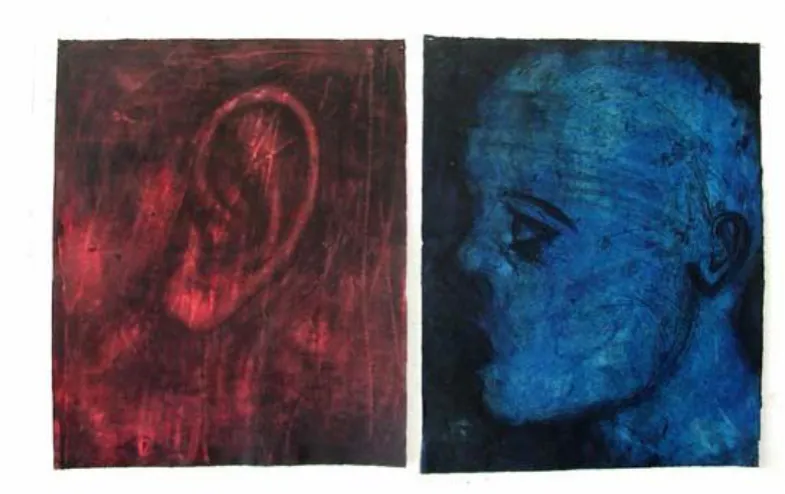
In my final presentation there are five series of prints. The series and their titles do not represent a chronology of events but rather are grouped to reflect discrete psychological states. The printmaking processes of woodcut, collagraph and etching are used, and combined in many cases, to represent these states and reflect an ongoing experimentation. The works use colour, texture and scale as well as an expressive mark making in order to engage with the mother‟s empathetic view of her son.
Acknowledgements
I extend special thanks to my supervisors Milan Milojevic and Llewellyn Negrin for their advice, support and encouragement throughout this project. I would also like to thank John Robinson for his technical assistance in printmaking. Thank you to Jenny Dean for valuable feedback and support and to Amy Jackett and Jenny Dean for their editorial assistance. Thanks are also due to my fellow post˗graduate students at the School of Art, to the lecturers and to Paul Zika, Head of Research.
I am indebted to my mother Sandra Falconer for her support and wisdom that has encouraged me throughout this project.
vi
Copyright statement
This thesis contains no material which has been accepted for a degree or diploma by the University or any other institution, except by way of background information and duly acknowledged in the thesis, and to the best of my knowledge and belief, no material previously published or written by another person except where due acknowledgement is made in the text of the thesis.
This thesis may be made available for loan and limited copying in accordance with the Copyright Act 1968.
Signed:
Table of Contents
Abstract ... ii
Acknowledgements ... v
Introduction ... 1
Background ... 1
Motivation and aims of the project ... 5
Chapter One The Central Argument ... 12
Introduction ... 12
The experience of adolescence from the point of view of the mother ... 12
The conflicted role of the mother/artist ... 18
Selfhood and Portraiture ... 22
Expressionism, printmaking and portraiture ... 26
Chapter Two Context ... 35
Artists and the intimate portrait ... 36
Suzanne Valadon ... 36
Käthe Kollwitz ... 43
Sally Mann ... 49
Artists‟ portrayals of adolescence ... 53
Hellen Van Meene ... 54
Rineke Dijkstra ... 60
Lise Sarfati ... 68
Chapter Three Pursuing the Work... 75
Rage I and Rage II ... 77
Hoodie Series ... 83
Facing In ... 92
Any way the wind blows ... 97
Head Shots ... 103
List of Figures
x
Figure 19: Hellen Van Meene, Untitled, 2002, c˗print ... 555
Figure 20: Hellen Van Meene, Untitled, 1999, c˗print ... 588
Figure 21: Hellen Van Meene, Untitled,2000, c˗print ... 59
Figure 22: Rineke Dijkstra, Kolobrzcg, Poland, July 26th, 1992, 1992, c˗print, 121 x 101cm, The Metropolitan Museum of Art, New York ... 622
Figure 23: Rineke Dijkstra, Julie, Den Haag, Netherlands, Feb, 29th, 1994, 1994, c˗print, 117 x 94.5cm, TATE, London ... 633
Figure 24: Rineke Dijkstra, Forte de Casa, May, 20th, 2000, 2000,c˗print ... 655
Figure 25: Rineke Dijkstra, Olivier, The French Foreign Legion Camp Raffalli, Calvi, Corsica, June 18th, 2001, 2001, c˗print, 125 x 106cm ... 666
Figure 26: Rineke Dijkstra, Almerisa, Asylym Seekers’ Centre, Leiden Leiden, The Netherlands, March 14th, 1994, 1994, c˗print, 35 x 28cm, Museum of Modern Art, New York ... 677
Figure 27: Lise Sarfati, Sloane no 30, 2003, c˗print ... 700
Figure 28: Lise Sarfati, Sasha and Sloane no 21, 2003, c˗print ... 70
Figure 29: Support photograph for Rage I ... 78
Figure 30: Gabrielle Falconer, Rage I, 2009, etching, aquatint, collagraph and emboss, 132 x 360cm ... 79
Figure 31: Peter Booth, Painting, oil on canvas,1977182.5 x 304cm, National gallery of Victoria, Melbourne ... 811
Figure 32: Support photograph for Rage II ... 822
Figure 33: Gabrielle Falconer, Rage II, 2011, etching and aquatint, 133 x 90cm 822 Figure 34: Support photograph for Hoodie I... 844
Figure 35: Gabrielle Falconer, Hoodie I, 2006, etching, aquatint and collagraph, 133 x 90cm ... 855
Figure 36: Ken Curry, Five Male Heads, oil on canvas ... 87
Figure 37: Gabrielle Falconer, Hoodie II, 2010, etching and aquatint, 133 x 90 cm ... 88
Figure 38: Support photograph for Pissed ... 89
Figure 39: Gabrielle Falconer, Pissed, 2010, etching, aquatint and collagraph, 133 x 90cm ... 90
Figure 41: Support photograph for Facing In series ... 933
Figure 42: Gabrielle Falconer, Facing In I, 2008, etching with hand colouring, 58 x 78cm ... 933
Figure 43: Gabrielle Falconer, Facing In II, 2008, etching with hand colouring, 58 x 78cm ... 944
Figure 44: Gabrielle Falconer, Facing In III, 2008, etching and collagraph, 58 x 78cm ... 955
Figure 45: Gabrielle Falconer, Facing In VI(detail), 2008, etching, aquatint 58 x 78cm ... 955
Figure 46: Gabrielle Falconer, Facing In IV, 2008, etching and collagraph, 58 x 78cm ... 955
Figure 47: Gabrielle Falconer, Facing In V, 2009, aquatint and hand colouring, 58 x78cm ... 96
Figure 48: Jim Dine,Woman on Fire in Vienna, 1993,etching with hand colouring, 120.7 x 88.3 cm ... 97
Figure 49: Gabrielle Falconer, Mother and Son, 2009, etching, aquatint and drypoint, 87 x 63cm ... 98
Figure 50: Gabrielle Falconer, Torso, 2009, etching, aquatint and drypoint, 87 x 63cm ... 99
Figure 51: Gabrielle Falconer, On the Couch, 2009, etching, aquatint and drypoint, 87 x 63cm ... 10002
Figure 52: Gabrielle Falconer, Any way the wind blows, 2010, etching and aquatint, 87 59cm ... 10101
Figure 53: Lucian Freud, Girl with a White Dog, 1950-1951, oil on canvas, 95.4 x 120cm, TATE, London ... 10202
Figure 54: Otto Dix, Mealtime in the Trenches, 1924, etching and aquatint, 19.6 x 29cm, National Gallery of Australia, Canberra ... 10303
Figure 55: Gabrielle Falconer,Head Shot I, 2010, woodcut, 120 x 90cm... 103
Figure 56: Gabrielle Falconer, Head Shot II, 2011, woodcut, 120 x 90cm ... 10804
Figure 57: Gabrielle Falconer, Head Shot III, woodcut, 120 x 90cm...104
Figure 58: Gabrielle Falconer, Head Shot IV, V, VI, woodcuts, 120 x 90cm...105
Figure 59: Gabrielle Falconer, Head ShotVII, woodcut, 120 x 90 cm...106
Introduction
This project is a visual interpretation of my journey of motherhood at the time of my son‟s adolescence. This stage of life encompasses a reshaping of roles and relationships for both mother and son and these shifts are often accompanied by confusion and conflict. Ruptures in usual patterns of behaviour challenge the role of mothers during their sons‟ progress through adolescence. The balance between dependency and independence for the adolescent and a mother‟s response to those changes has been central to the overall project. While the subject appearing in most of the images is my son, the works can more properly be seen as portraits of myself as they are primarily about my responses to my son‟s adolescence.
Background
2 Figure 1: Gabrielle Falconer, Untitled, 1995
Figure 2: Gabrielle Falconer, The Boy, 2002
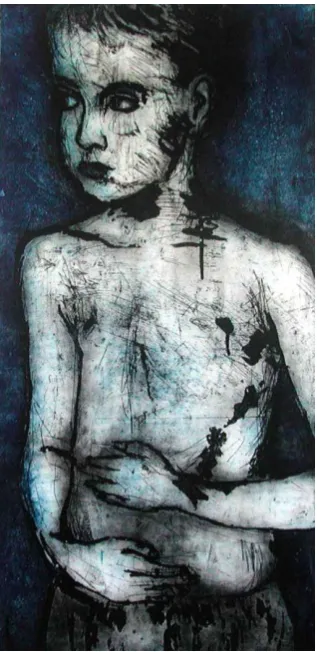
4 surface and extending beyond the picture frame (Figure 2). The works represented early puberty and signified a growing fissure in the relationship between mother and son.
[image:16.595.184.447.182.557.2].
Figure 3: Gabrielle Falconer, The Tender Years, 2003
Motivation and aims of the project
An important development in my process was to expand my printmaking repertoire and explore techniques that were capable of expressing the overwhelming enormity of my son‟s presence in our home and the intensity of our interactions. Initially my artistic references included expressive modernist printmakers such as Edvard Munch, Käthe Kollwitz and Otto Dix and the innovative contemporary printmaking of artists such as Jim Dine, Georg Baselitz and Ken Curry. These artists utilised expressive mark making and the material presence of the printed and painted surface to convey psychological tension. Their processes corresponded directly to their subjects.
I also aimed to find processes that spoke about a violent fracturing. I sought to capture the rawness of human experience through traditional techniques that entail a straining against the limitations of the material surface of metal or wood, capturing an impression of that struggle that closely corresponds to the struggles of parenting. My aim has always been to be fully present in that process. I have sought to represent the complexities and emotions of adolescence without resorting to sentimentality and generalisations. Consequently I have explored my own role as a mother in the process and have made prints that are expressive of the shifts in my own sense of identity.
6 Hardwicke and written by Hardwicke and Nikki Reed, the film's co-star. It is an autobiographical film based on Reed's life at age twelve and thirteen. Another example is Larry Clark who has been creating photographs and films about adolescent experience for many years. He is most well known for his ground breaking series of photographs of adolescents involved in injecting drug use entitled Tulsa of 1971, and his feature film Kids (1995). However it was the controversy surrounding another feature film, Ken Park (2002), which brought him the most notoriety. Clark‟s work focuses on youth sub-cultures and engages questions about masculinity, family relationships, bigotry, violence and more broadly the construction of identity during adolescence in contemporary, suburban, American culture. However, I felt that these works, particularly commercial film, where some resolution is anticipated, did not sufficiently distil the disorientation and dislocation of the mother. Also they failed to capture an embodied experience.
mother‟s perspective and reciprocate the intimate eye of a mother through a series of portraits.
My investigation into motherhood and adolescence demonstrated the scarcity of research by women artists into adolescence as experienced by themselves as mothers. As a fundamental experience for parents it seems unusual that this transforming experience for mothers has been so rarely depicted. It could be that women artists have found solace in escaping the demands of their adolescents and have chosen other subjects as a form of therapy. There could be a propensity to protect themselves and their dependents from inspection by outside observers when things are not „perfect‟ and pretend instead, everything is going well. It could be that our culture‟s emphasis on women as carers and nurturers somehow dampens any discussion of a time when a mother lets go of the nurturing role and stands back from the role of dominance she has had in her child‟s life. However, it is most likely that the omission of acknowledging this significant event is due to us living in a patriarchal society. The relationship between adolescents and their mothers is the preserve of women and has therefore been considered largely irrelevant. A successful female artist can not be seen to be addressing domestic concerns.
anti-8 essentialist stance by early feminists meant that motherhood was seen as a taboo topic. Liss writes:
The mother, however, remained a silent outcast for many feminists who strategically needed to distance themselves from all that was culturally coded as passive, weak, and irrational, sometimes repudiating their own mothers in the process (Liss 2009, p. xv).
She goes further by saying that motherhood was therefore seen as an embarrassment.
An embarrassment is something that impedes, confuses, deranges, and complicates. Motherhood within early feminist struggles and still today interferes with retrograde myths of the avant-garde (Liss 2009, p. xvi).
Although upon first consideration these words and reflections of Liss seem an exaggeration, there is also an undercurrent of embarrassment that I identify with. Throughout this research project there is a particular kind of squeamishness regarding making work about the mothering experience. Reading Liss‟ account affirms the cultural origins of this embarrassment. Motherhood as a cultural institution was rejected by early feminists yet this experience of caring takes up a huge proportion of women‟s time while being vastly underrepresented within visual culture.
Liss outlines how contemporary feminists no longer need to regard motherhood and feminism as mutually exclusive and that therefore:
Liss devises the concept of thinking (m)otherwise and sees this approach as an important revision of past feminist practices and an important social project. She regards ideas of reciprocity and intersubjectivity as key to an understanding of this intersection of the maternal and visual art and theory. Intersubjectivity arises from the mother‟s “watchful maternal gaze” as she engages in the mothering of her child and it is this concept that is implicit in my own attempts at thinking and making visual work, (m)otherwise. Liss describes how this attitude can have implications for understanding outside the mother/child dyad toward a greater understanding of human relations.
Working with a feminist concept of intersubjectivity- how to emphatically be in the place of the other and inside one‟s self, how to care for another and ones‟s self – allows me to challenge patriarchal ideas of dominance over mothers and others (Liss 2009, p. xx).
She also describes groundbreaking feminist works such as the Mother Art projects of the 1970s, Mary Kelly‟s Post Partum Document, Mierle Laderman Ukeles‟s Maintenance Art and Renee Cox‟s contemporary revision of family photographs. These artists have expressed their maternal experience and Liss describes how their art has contributed to our understandings of contemporary women‟s lives. However, there is still a gap in addressing the mother‟s experience of her adolescent child.
It is this lacuna that I seek to address in my work.
10 psychologists such as Eric Erikson and Donald Winnicott. This extends into a discussion of the mother/artist and the complexity of this position. Following this, I reflect on my understandings of the concepts of „selfhood‟ and „portraiture‟ as they relate specifically to artistic production, and in particular, my printmaking practice. I consider aspects of selfhood and portraiture such as fragmentation, self-expression, gender, narrative and the relationship between individual creativity and social context. The physical processes of printmaking and their centrality to the thesis are highlighted in relation to expressionism and portraiture.
Chapter 2 presents a description of the visual art context for my research with separate sections focussing on artists who have made work about their own children and artists who have made work about adolescence. In the first section I analyse and make connections between my own work and the work of Suzanne Valadon, Käthe Kollwitz and Sally Mann. In each case there are different psychological tensions conveyed regarding their relationship with their children and each artist‟s body of work informs my own practice in distinct ways.
Chapter 3 presents a description and explanation of the five series that comprise the visual component of the thesis. This chapter outlines the printmaking processes used and describes their relevance to the conceptual underpinnings of the project. I have included visual documentation of the exhibited prints. In this chapter there are comparisons made with artists discussed in Chapter 2. There is also a description of artists and particular works that have been significant for technical and stylistic reasons. These artists have different conceptual directions to my own work but have been significant in influencing the development of my visual practice.
12
Chapter One
THE CENTRAL ARGUMENT
Introduction
The three areas that have dominated my research are the experience of parenting an adolescent, the transformation of the relationship and the visual expression of this transformation. There are a number of questions that arise from these areas of investigation that have a more theoretical underpinning, including: what are the ethical dilemmas of the mother/artist?‟, how can portraiture explore the complex realm of selfhood and the subject?, what place does such an intimate exploration of a lived experience have in contemporary art? and how can the expressive mark convey the psychological tensions of this relationship?
The experience of adolescence from the point of view of the
mother
This project seeks to make work that not only resonates with other parents of adolescents but also is able to communicate a range of emotions that are experienced by adolescents themselves. The particular type of adolescence important to this research is a male adolescence and how this is perceived by a mother. Rage, experimentation with drugs and alcohol, violence both within and without that relationship and depression are the disturbing and particular experiences that are the context to this project.
It is widely accepted that adolescence is more than a time of physical change but also has important social and psychological implications for the adolescent, their family and society. For this project the psychological changes are paramount and those that are particularly important to my understandings are outlined in the following paragraphs.
According to Erik Erikson, the pioneering developmental psychologist and psychoanalyst, adolescence represents a crisis for the individual and the most important developmental task of adolescence is the formation of a sense of identity (1968). This identity entails a cohesive set of values and personal goals separate from those of the parents‟ He termed this stage „identity versus role confusion‟. Study into the process of formulating this sense of identity has been ongoing and contemporary research emphasises the role of parents, care givers, peers and teachers in this process (White, Speisman & Costos 1985, p. 415).
The psychoanalyst Donald Winnicott theorised in particular about the relationship between adolescents and their parents during this developmental stage (1965). He stresses that adolescence is a time when individuals experience what he terms “the doldrums”, when the struggle between defiant independence and regressive dependence is paramount in the process of individuation.
14
In contrast to traditional conceptualisations of adolescence as a time of breaking the parent-child bond, recent evidence supports a view of this period as one of gradual renegotiation between parents and children from the asymmetrical authority of early and middle childhood toward, potentially, a peerlike mutuality in adulthood (White, Speisman & Costos 1985, p 415).
Rather than the authoritative relationship of a parent in relation to their adolescent, a more reciprocal relational construct is identified. This relates directly to my own experience at this time. Over the course of this research I have realised how important my own behaviour and attitudes toward my son have been to our relationship and his development. In relation to creating visual work, I see that our creative relationship parallels this psychological process as we have gradually negotiated how to work together.
This space of confusion and conflict for the mother I have experienced personally and explored in the research. Psychological states include a potent sense of dislocation, the sense of helplessness as my son has engaged in risk taking, or has withdrawn into himself, and the loss of the innocence of childhood. Yet all this uncertainty is contrasted by the excitement and wonder of watching the phenomenon of the individual emerge. Consequently “ambivalence” is a concept that has been important to my understanding of motherhood at this stage. Rozika Parker describes the relationship between motherhood and ambivalence thus:
The French philosopher and psychoanalyst Julia Kristeva has observed that motherhood makes passions circulate. I would say that it is ambivalence, in particular, that makes passions circulate, as well as firming boundaries, forcing reflection, provoking separation and unification, and thus providing a spur to both individuation for both mother and child (Parker 1995, p. 20).
In Western culture there are no rituals for mothers or fathers to mark this stage of life. Perhaps our closest approximation to an acknowledgement of the huge changes taking place is the celebration of a son or daughter‟s eighteenth birthday. Cutting the Cord: Stories of Children, Love and Loss, edited by Debra Adelaide (1995), is an anthology of personal accounts of mothers‟ experiences of separation from their children. The book is a useful resource in that the contributors describe some of the contradictions and ambiguities that resonate with my own experience. Overall the accounts reveal that the experience can be a life altering event.
16 change is a dominant theme of the writing of these women. Helen Martin‟s description of a kaleidoscope is an interesting visual metaphor describing the tensions of parenting. She writes:
Cutting the cord is a gradual experience of mutual growth. There is no preparation for it and no way to avoid it. We can only go through it in our own time and honour our feelings all the way. The process seems to be one of simultaneously relinquishing the cord and expanding it into something new. I think a kaleidoscope with those bright individual pieces of shaped glass interconnecting to form a mandala, a brilliant pattern of reflected light. Turn it again, and the separate pieces re-form. Another aspect is revealed as the individual component parts shift and shape themselves into a new image. The old pattern has gone. We can endlessly mourn its loss or delight in the change and compelling power of the new picture. So it is with our children (Martin 1998, pp. 286-287).
My perceptions of societal expectations meant I questioned my identity as a single mother and whether I was capable of guiding my son into manhood. The expediency of easy judgements could not encompass the reality or make any meaning of the process in which I found myself. I wanted to make art that would adequately describe this experience as well as challenging the assumptions and stereotypes of media commentators.
In the Heideggerian aesthetic, creation and safekeeping, composition and conservation are absolutely indivisible. Even the most revolutionary work of art, if it is authentic, conserve and give to Being a dwelling and sanctuary such as it can find nowhere else (Hoffmann 1996, p. 8).
Carol Armstrong discusses these ideas specifically in relation to women as artists. I have included this quote as it sums up much of what underlies my work and indeed my feminism. She states:
I think for the figure of the „woman artist‟ to matter at all now, her art must make some of kind of difference, a difference that has to do with the ethics of and in aesthetics . . . the ethical purpose of art is to make you see, think, and feel anew – not “new” in the sense of modernist novelty, but „anew”, in the generative sense, which is to say again but as if for the first time; to move you to those redeeming features of human life, care and curiosity of the noninstrumental kinds; to induce you to respond to the domicile you inhabit- to be receptive to it, to allow it to affect you and be affectionate toward it; to make live what is so often deadened by the doing-time of day-to-day getting-by; even to make you love what is simultaneously the horror, the farce, and the beauty of the flawed world we live in, which would not be if it were not flawed (Armstrong 2006, pp. 13-14).
18
The conflicted role of the mother/artist
In many ways my position as the artist/mother is a privileged position as I have greater access to my subject, and yet I have found that there are certain ethical dilemmas in a mother making work about the tumultuous period of the adolescence of her son. The exposure through visual imagery, particularly portraiture, of another individual‟s struggle involves making judgements about what is necessary to reveal and what should be withheld. This is particularly relevant when the subject is a minor and at a crucial stage of development. I have continually juggled my protective role as a mother with an artist‟s inherent curiosity regarding life‟s ambiguities.
Overall, the process of creating visual and written work that explores this time and exposes both myself and my son, has been challenging. This process is fraught with the danger of revealing an unnatural dependency on one another, experiences of domestic violence and underlying it all is the ever present question of how responsible I am for my son‟s difficult adolescence.
subjectivity. As the child looks toward her own reflection in the mirror, she also faces her mother‟s reflection as she is held in her mother‟s arms. Lacan writes:
The journey from the imaginary wholeness and identification of the „I‟ to the state of being divided and subjected to the social „Umwelt,‟ the journey from the „specular I‟ to the „social I‟ that is, must be facilitated and encouraged by the confirming look of another, maternal, figure who mediates the child‟s entrance into the social (Lacan 1977, p. 156).
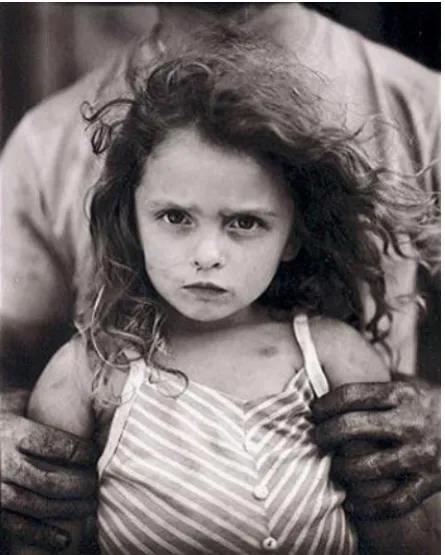
Marianne Hirsch (1997) considers these theories in relation to artist/mother Sally Mann who has also used her own children as the muses in her work over many years. In 1992 Mann became one of America‟s most successful photographers known widely for her intimate, challenging and technically brilliant images of her three children. At the time of her initial success, she was accused by critics of exploiting her children in the process of creating her photographs.
20 Figure 4: Sally Mann, Holding Virginia, 1989
I have asked myself similar questions: what are the implications of this variant of the maternal look for both my child and myself and our interaction? In other words, can taking pictures and presenting my son on the two-dimensional surface of my prints affect his ability to successfully individuate and progress toward independence?
stages with infants described as regulating the engagement and interaction as much as the mother. The separation of mother and child is not seen as a linear model but operates in a more dynamic manner and is renegotiated at different times. This is significant in relation to my earlier description of the oscillation between dependence and independence observed in my own relationship with my son. This discussion of identification and differentiation offers an alternative to the limiting concepts of the mother‟s omnipotence and the child‟s vulnerability and importantly allows for different readings of the role of a mother with a camera.
Hirsch (1997) argues that Sally Mann‟s photographs are not simply an imposition of the maternal gaze on the child but involve a significant degree of reciprocity between mother and child. This is due to the fact that the photographs are taken as the children play rather than being “choreographed” by Sally Mann.
22 to view the image of himself in the camera and delete images or request different poses immediately. Sometimes I was directing him and at times he came up with ideas and would explain to me why he had chosen certain expressions or poses. The element of performance on his part and his commitment to the project cannot be underestimated. In doing so he was behaving more as a collaborator during this stage of the process rather than the exploited and objectified child. The digital camera has blurred the lines between subject and photographer, where at times the one holding the camera acts as mere tripod and it is the subject that is controlling the gaze.
Selfhood and Portraiture
While the process of producing images of my son is collaborative in many respects, at the same time, the portraits of him reveal as much about me as they do about my son. My research into adolescence and motherhood is very much an autobiographical approach, even though it is made up largely of portraits of an „other‟, my son. The images are to be viewed as a mother‟s portrayal of her developing understandings of her child. This is of necessity a one-sided account of this relationship. As an artist, I am the one selecting which images best fit with my understandings of this relationship, which colours to use and what to crop and manipulate through the process of printmaking. The resulting images are first and foremost, expressive of my response to my son‟s turmoils.
are invested with the presence of their author, and are in effect a kind of oblique self-portrait” (Woodall 2005, p. 17). Richard Brilliant also points to the complexity inherent in the portrait as he writes about the “the authority of likeness” (1991, p. 23). He describes the viewer‟s irrational expectation that a photograph or picture should capture the viewer‟s personal perception of the subject. He writes:
The immanent power of a portrait image stimulates cognition with such force that the psychodynamics of perception interfere with the comprehension of the image as something different from the image of the actual person (1991, p. 24).
Therefore, portrait images are both compelling and misleading and untimately dissapointing if the viewer expects the work to be the person represented. This also contributes to my decision to foreground the mother‟s visual perception and not title the works with my son‟s name. Similarly many of the works portraying adolescents that I respond to do not name the individual portrayed.
24 desperation, rather than Sophie‟s own bodily or emotional experience of her illness. It is a portrait of his own remembered terror; an emotion that remains potent for him as an adult.
Figure 5: Edvard Munch, The Sick Child, 1896
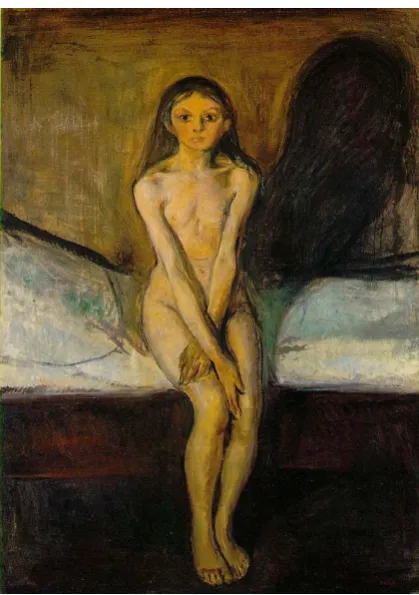
Figure 6: Edvard Munch, Puberty, 1895
Munch‟s depiction of a pale, naked figure within a darkened, gloomy space effectively heightens the emotions and tensions of this image of puberty. One could also interpret the looming shadows attached to the girl‟s naked form as the threatening female sexuality that in other works by Munch is represented as a destructive vampire. It is through these portraits of other family members and later lovers that we come to understand Munch‟s own psychological struggles.
26 Significantly, in every case, the photographs selected to be developed into prints were the ones in which my son‟s pose was less purposeful. These more candid images captured the vulnerability of the individual in transformation. Even though in some of the images he is self-aware and striking a pose, to me there is clumsiness in these poses that expresses the adolescent‟s struggle to express his identity. It is during adolescence when we are sometimes best able to express this struggle and it is later that we learn to masquerade our awkwardness with often imposed social roles. In my work, the process of portrayal legitimises this struggle with self-expression.
I think it is a self consciousness with which we all continue to struggle in varying degrees throughout our lives but at adolescence it is acute. In the artistic process, it is me identifying the individual in transition in the photographs and reproduced in the prints. This process mirrors the familial role of parents who reflect back to their child, acceptance and recognition of their emerging selves.
Expressionism, printmaking and portraiture
28 Figure 7: Rembrandt, The Jewish Bride, 1665
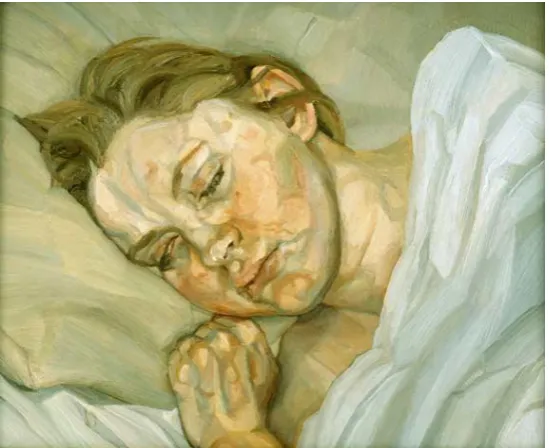
Figure 8: Lucian Freud, Sleeping Head, 1979 - 1980
For the purposes of this research, printmaking processes can replicate the artist‟s gesture in an even more physical and symbolic way than oil painting. There is violence in the action of acid on metal and in gouges on wood that captures some of the pent up anger of motherhood. There is the repetitive motion of wiping the plate of ink in preparation for printing that reciprocates the stroking of a child‟s head to lull them to sleep; the restoration of peace and harmony before laying the plate on the „bed‟ of the press under the „blankets‟. The metaphors are well worn but they resonate at the time of printing. For me this is when the disparate elements come together and I come to terms with the work and what it means to me.
30 possibilities of printmaking processes. His woodcuts in particular have been influential to my understandings of Expressionism (Figure 9).
Figure 9: Jim Dine, The Foreign Plowman, 1988
The coarseness of his cutting, sometimes with a chainsaw, and the looseness of the markmaking, as well as the connection between images and layers suggest a chaotic state of metamorphosis. Positive and negative spaces collide and clumsily attached and patched together bodies, sculptures, trees and animals float in and out of the picture plane. I admire these images that seem on the brink of collapse and yet express a humanistic struggle for greater meaning. I believe it is Dine‟s capacity and confidence to draw with these unrefined cutting tools that gives such raw presence to the work.
fractured relationship with another, Expressionism is the most potent language for emotional experiences.
This process, loosely defined as figurative, expressive portraiture is not original; it is in fact very traditional. However, contemporary critics often view individual self-expression as an outdated and futile attempt to convey psychological depths insofar as it presupposes a conception of the self as fixed and unified. As Berger writes:
We can no longer accept that the identity of a man can be adequately established by preserving and fixing what he looks like from a single viewpoint in one place (Berger 1969, p. 46).
This critique of the authority of the individual artist relates directly to one of my central questions: what place does such an intimate exploration of a lived experience have in contemporary art? I have also asked myself whether this project and indeed whether autobiography is a narcissistic tendency and an attempt at a personal memorial.
Van Alphen takes up this debate in his essay entitled „The Portrait‟s Dispersal‟ (2005). He argues that the portrait has been disparaged because subjectivity has been equated with self, personality or individuality.
32 I find Van Alphen‟s emphasis on the social connections rather than „personality‟ within the tradition of portraiture reassuring and allows for a broader and less exclusively personality based reading of portraiture. As humans living in social groups, we are all engaged in this differential project and as such portraits describe moments we can all experience in the presence of another.
In this research I have utilised the idea of „living with fragmentation‟ (McRobbie, p. 71) and the „reality of inventing the self‟. In this respect I have drawn on McRobbie‟s statement:
It is not so much a question of what is left behind, what fragments of the disassembled self can be picked up and put together again, but rather how might the continual process of putting oneself together again be transformed to produce the empowerment of subordinate groups and social categories. This might mean living with fragmentation, with the reality of inventing the self rather than endlessly searching for the self. (McRobbie 1994, p. 71)
The relationship between fragmentation and artistic processes are important considerations. Walter Benjamin in his influential essay „The Work of Art in the Age of Mechanical Reproduction‟ (1936) discusses the impact of modern technologies such as photography and film on contemporary image making. He compares painters to magicians or general practitioners and the photographer to a surgeon.
The painter maintains in his work a natural distance from reality, the cameraman penetrates deeply into its web. There is a tremendous difference between the pictures they obtain. That of the painter is a total one, that of the cameraman consists of multiple fragments which are assembled under a new law. Thus, for contemporary man the representation of reality by the film is incomparably more significant than that of the painter, since it offers, precisely because of the thorough going permeation of reality with mechanical equipment, an aspect of which is free of all equipment (Benjamin 1936, p. 59).
34 traces of reality that conform more precisely to my experience of living with an adolescent.
I want to utilise both the fragmenting possibilities of technology as well as use the materiality of printmaking in order to capture an embodied tactile experience. I have seen the process of making work about mothering an adolescent, as one in which I have responded to events as they have occurred and on reflection my initial assumptions and interpretations have been revised. For example, it was not until I created and reflected on certain woodcuts and the marks I had made that I realised my own anger and desperation in response to my events beyond my control. The dialogue between my son and myself continues throughout the making process and this concept of a „fragmented communication‟ is important to any reading of the work.
Chapter Two
CONTEXT
This chapter is divided into two sections discussing two different groups of artists who have made work dealing with similar issues to my own work. I have outlined how each artist‟s work has significance to my project, as well as the differences between their approach and my own.
The first group of artists comprises those who have made work in an autobiographical manner focussing on the intimate relationships with their own children. These include Suzanne Valadon, Käthe Kollwitz and Sally Mann. Notably, I have omitted artists such as Mary Kelly, Mierle Laderman Ukeles, Renee Cox and the Mother Art projects of the 1970s discussed in Liss‟s overview of maternity and visual art (2009). Although Kelly was groundbreaking in making work that exposed the maternal experience, her work deals with the stage of early childhood rather than adolescence. The work of Mierle Laderman Ukeles and Renee Cox more overtly challenge the institution of motherhood, domesticity and limiting concepts of family. Therefore artists who have dealt specifically with portraiture have had greater significance to my practice. The relationship to the maternal gaze, the possibility of objectification and the conflicted role of the mother/artist are issues inherent in the production of a portrait of one‟s child and are more closely aligned to my own research.
36 I have been intentionally selective when choosing artists who have used adolescent models as there has been much recent work in this area, particularly in photography. I have selected those who have informed my understandings of the relationship between adolescence and the processes of portraiture and image making. These artists have used adolescent models to make generalisations about this specific time of life as well as engaging the viewer in memories of their own adolescence. They are all photographers and work with models who are not related to them. The artists are Hellen Van Meene, Rineke Dijkstra and Lise Sarfati.
Artists and the intimate portrait
SUZANNE VALADON
The French artist Suzanne Valadon (1865 – 1938) was self-trained and made many drawings, prints and paintings of her close family as well as the female nude. Her son, Maurice Utrillo (1883 – 1955), himself later to become a celebrated painter, was her model for many early drawings. Valadon‟s drawings are original and poignant as they represent a departure from the mutuality and loving care represented within traditional images of the mother and child. I have an affinity with her work for her unsentimental approach to portraiture of the child and the mother.
own processes. At times I have felt uncomfortable with a project that involves the repeated portrayal of one other and the relationship I have to that person but at the same time find it too compelling to ignore. I have in effect been making repeated portraits of my son for over eighteen years and have sought to locate other artists whose focus is similarly reduced to their immediate environment and relationships. In this context I find Patricia Mathew‟s (1998) comments in her essay on the nude in Valadon‟s work interesting, as she sheds light on this impulse to repeat an image from one‟s own life and experience. Mathews discusses how Valadon paints the unmasked body at ease over and over again, suggesting a psychic impulse at work:
The encounter between psychoanalysis and artistic practice draws its strength from… repetition, working like a memory trace of something we have been through before. It gives back to repetition its proper meaning and status: not lack of originality or something merely derived (the commonest reproach to the work of art), nor the more recent practice of appropriating artistic and photographic images in order to undermine their previous status; but repetition as insistence, that is, as the constant pressure of something hidden but not forgotten – something that can only come into focus now by blurring the field of representation where our normal forms of self-recognition take place (Mathews 1998, p. 105)
38
Valadon challenged the myth of these conventions, both morally and psychologically, by presenting children outside the protective care of the family. Their maladjustment and cries for help were unmistakeable (Rosinsky 1994, p. 27).
[image:50.595.209.415.279.517.2]The fact that Valadon allows the viewer access to her personal domestic sphere is also significant. As Mathews argues: “It is unlikely that she consciously chose or constructed these spaces, but rather existed in them; they were the spaces of her experience” (1998, p. 107).
Figure 10: Suzanne Valadon, Grandmere et Infant, 1909
Figure 11: Suzanne Valadon, Nude Girl sitting on a Cushion, 1894
40 Figure 12: Suzanne Valadon, Nude Girl Sitting, 1894
For instance, in the image Nude Girl Sitting (Figure 12) the hands of the sitting girl seem overly large. Rosinsky translates this to describe that the hands:
become the receptacle of her sorrow while the unrealistic length of her legs points to the awkwardness and disproportion of the body of a child growing too fast (Rosinsky 1994, p 36).
Figure 13: Suzanne Valadon, Crouching Nude Holding Grandmother's Skirt, 1909
In the conte drawing Crouching nude holding grandmother’s skirt of 1909 (Figure 13), Valadon depicts the gesture of a child reaching toward the comfort of the maternal represented by the grandmother and the fabric of her skirts. Again, rather than using facial expression as I have in my images, Valadon uses the whole body as a single form to express the tension within the image and between the models. There is awareness in these works of the tensions in the parent-child relationship and the psychological isolation of the child or adolescent. This is particularly significant as it is the mother/artist bearing witness as a keen observer to the child‟s distress.
The gesture resembles that of a sightless person who needs to touch what she cannot see in order to find reassurance. It is this pathetic reaching out, with its unmistakable request for affection, that is infinitely moving. (Rosinsky 1994, pp. 36-37)
42 mother. Rosinsky asserts that Valadon was projecting onto her portraits of children, her own state of mind from that period of her life. This relates back to my discussion of portraiture and the „self‟ that is revealed when painting a portrait of another.
...the youths‟ sorrow and alienation, as well as their occasional deprivation, are the obsessive themes of her early works. For over three decades she drew representations of small boys and girls. They look pensive, often clumsy, but most importantly, lonely. Eventually, they seem to become resigned to their solitude. It is assuredly the estrangement of the artist‟s own early years that surfaces in these stark portraits (Rosinsky 1994, pp25-26).
However, for me, these works also express the loneliness of childhood and adolescence for an only child. Furthermore they speak powerfully about a single mother‟s fear of not being „enough‟. In the case of Valadon, these early images of Maurice, where she depicts him as isolated, are poignant as he was in early adolescence to develop a debilitating mental illness and alcoholism. However ironically it was Valadon‟s artistic passion that was to prove important in his recovery. She not only depicted her son‟s distress but taught him to paint in an attempt to give him some manual therapy during the worst bouts of his alcoholism. In fact she threatened him with being forcefully admitted to a mental institution if he did not paint. (Storm 1958)
KÄTHE KOLLWITZ
The German artist, Käthe Kollwitz (1867 - 1945) is significant for this project as her work deals predominantly with the figure of the mother through the medium of printmaking. I have found that her work informs my practice on both a formal and conceptual level.
Kollwitz utilises the expressive possibilities of printmaking techniques such as lithography, woodcut and etching. Her bold and fluid use of line and tone create a strong impression of depth and three-dimensionality. Dynamic compositions are also prevalent within Kollwitz‟s works and she was skilful in arranging the figurative elements in her images so that they contain subtle yet powerful symbolic meaning. Movement is also something that Kollwitz was able to capture in her graphic works and her figures appear natural and dynamic rather than posed. I have found Kollwitz‟ fluid and expressive compositions and tonal modelling of figures significant for my approach to rendering the figure.
44 I am interested particularly in Kollwitz‟s intimate portraits of mothers and children rather than the images of heroic mothers protecting a group of children or images that are suggestive of political and social ideology. Rosemary Betterton (1996) discusses how Kollwitz‟ work is often interpreted by feminist writers through the lens of her public persona as a socialist activist artist with discussions of the iconography of heroic mothers and resisting workers. However, it is the theme of maternal loss that Betterton views as central to an understanding of Kollwitz‟ artistic oeuvre.
Figure 14: Käthe Kollwitz, Death, Woman and Child, 1910
46 Figure 15: Käthe Kollwitz, Woman with Dead Child, 1903
This theme of maternal loss is developed further in the work Woman with Dead Child of 1903 (Figure 15), in which the mother is almost pulling the child back into herself.
Kollwitz‟s mother bespeaks a terrible loss: the splitting of the maternal body. In Woman with Dead Child we see the violence of separation of the child from the mother in the process of gaining independent identity. In reversal of the passage of birth, the mother absorbs the child into her own body; she possesses and is possessed by it. The intensity with which the mother‟s face is pressed to her son‟s throat and chest suggests she is trying to ingest his body, to reincorporate it back into her own, as well as to breathe life into it (Betterton 1994, p. 42).
aware of the many working class women who came to her husband‟s surgery and who routinely lost children.
Another possible reason is suggested by psychoanalyst, Alice Miller in her essay „The Untouched Key: Tracing Childhood Trauma in Creativity and Destructiveness‟ (1990). She describes how Kollwitz‟ mother lost two older children and was grieving for these dead children during Kollwitz‟s childhood. Her mother would often express that her attachment to the dead children was stronger than what she felt for her surviving children. Miller interprets Kollwitz‟ many repeated drawings of dead children as an attempt to stay in contact with her own mother by placing herself in the position of the grieving mother. Similar to Valadon, repressed emotions surrounding her childhood are seen in this interpretation, as the central influence on her imagery.
48 will and the talent” to be creative visual artists and were better suited to the performing arts. One can imagine how such attitudes would have to be challenged either consciously or subconsciously by women artists of the time.
Betterton finds Kollwitz‟s images of the maternal nude to be the most transgressive of her oeuvre as they do not rely on a traditional notion of motherhood but rather replicate the complexity and ambiguity inherent in the position of the mother at the time. Mastery of the female nude was central to the construction of artistic identity in the nineteenth century and was also symbolic of the gendered relationship between female model and male artist. Kollwitz challenges this, as she equates her visual creativity with her role as a mother. The intensity and power of her artistic vision directly corresponded with the feeling of passionate love for her own children. In her essay, „Käthe Kollwitz‟s Sacrifice‟, Regina Schulte (1996) uses excerpts from Kollwitz‟s diary to elucidate on her self-awareness as an artist and mother as she equated the pain she felt for the loss of her child with her motivation to make art. As the children moved away from her incrementally, as is natural as they grow older and gain independence, Kollwitz became scared of losing her passion for life and therefore her creative drive.
The loss of pain meant a return to the mundaneness of everyday life. Everyday life keeps her away from her 'innermost necessity'. Pain was the medium of the love she was able to feel for the people who shared her everyday life; the pain and in it the 'oneness' with her dead son, appear as the catalysts of all other feelings as well. Her strength had been 'stolen' along with the pain (Schulte 1996, p. 209).
with a dead child can be read as symbolic of Kollwitz‟s fear of loss of identity as an artist. Betterton writes:
the image of a child‟s death stood in this context for Kollwitz‟s continuing fear of loss of her creative identity, in a transference in which she equated the maternal state with artistic productivity (Betterton 1994, p. 44).
Maternal subjectivity is represented as the condition of artistic production rather than its antithesis. This relationship between Kollwitz‟s artistic production and her role as a mother is intriguing as I have also wondered whether there will be „mundaneness‟ to everyday life after my son leaves home that will nullify the grounds for the creation of art.
SALLY MANN
50 Figure 16: Sally Mann, Jesse Bites, 1985
in a possessive gesture to keep her close. The bite mark was in fact created by Mann as the real bite had faded by the time the photo was taken. This is not a candid image but one carefully composed to recreate a moment of tension and complex familial relationships.
Sally Mann‟s photographs suggest the violence simmering at every juncture of the life of the “immediate family,” a violence visible to the maternal photographer – bites, burns, bruises, dead animals, stitches, swollen eyes, sibling rivalries, family battles (Hirsch 1997, p. 168).
52 Figure 17: Sally Mann, Emmett, Jesse and Virginia, 1989
Mann‟s photographic practice has particular relevance to my own practice as I employ the maternal look in my prints. Hirsch writes:
Sally Mann‟s photography is „disturbing‟ precisely because it brings together two equally intense cultural obsessions: the vulnerability of childhood, on the one hand, and the idealisation and fear of maternity, the fantasy of maternal omnipotence, on the other (Hirsch 1997, p. 153).
Figure 18: Sally Mann, The Terrible Picture, 1989
Artists‟ portrayals of adolescence
While the artists in the previous section have a close personal relationship to their subjects, none of them have examined adolescence in any depth. In this respect their work has a different focus to mine. There are however a significant number of artists who have dealt with the theme of adolescence, though, unlike my work, they have used models rather than actual family members. Within this broad field of artists who have dealt with adolescence I have selected those who focus on the aspects of adolescent experience most congruent with my own concerns.
54 the individual. Cherry Hood is an artist who makes large-scale watercolour portraits of adolescents but her work deals with our adult nostalgia about the fragility and beauty of this stage of life rather than an actual lived experience. Bill Henson‟s images of adolescents again are used as a means to convey broader themes about the frailty of human existence rather than focusing on adolescence per se. The three artists whose work is most relevant to my practice are Van Meene, Dijkstra and Sarfati.
HELLEN VAN MEENE
Hellen Van Meene (1972 - ) is a Dutch artist who has been creating images of pubescent girls and androgynous boys since the mid nineties. Van Meene‟s work has been important to my research in that she evokes an embodied experience of the changes of adolescence. In this respect there is a close relationship between her work and the images of Suzanne Valadon as the awkwardness and physicality of adolescence is something both artists focus on; both using the whole body as a metaphor for psychological states.
adolescence brings about. Kate Bush describes Van Meene‟s work as a “striving to make things visually felt” (Bush 2004, p. 93).
Figure 19: Hellen Van Meene, Untitled, 2002
This corresponds with my project, as it is often the physical manifestations of adolescence that have been important to signify psychic changes for my son.
56 adolescent is cut off from the normal interactions of parent and child in some of my images. The devices that Van Meene uses, such as the shallow pictorial space and cropping of the figure within the picture frame which causes the viewer to focus on the interiority of the adolescent, have been instructive to my image making. We are confronted as viewers by the adolescent‟s presence.
Yet Van Meene‟s approach differs to my own as her images are highly constructed and are reflective of her imagination rather than a collaboration between model and artist. Van Meene‟s work is distinctive due to her ability to select models that successfully express a particular psychological tension. When choosing her models, Van Meene selects for a visual „presence‟ and the model‟s ability to efface their own personality. “Too much „expression‟ – or beauty, or ugliness – and the balance tips” (Bush 2004, p. 92). The model is treated as just one element among many being choreographed by the photographer and is the equivalent to the windowsill or chair within the image. During the photographic shoots, Van Meene decides precisely how the models will look and what they will wear right down to the colour of the girl‟s nail polish.
1860s, Claude Cahun and Stanislaw Witkiewicz in the early twentieth century and Ralph Eugene Meatyard and Francesca Woodman in the seventies. Kate Bush writes:
What characterizes this tradition is the delicate equilibrium achieved between actuality and imagination, between the world observed and an emotional, existential, or spiritual world conjured in the mind of the artist. The directorial stamp of the photographer remains light, never devolving into the pure fictions or extravagant fantasies of a Joel-Peter Witkin or a mid-career Cindy Sherman. (Bush 2004, p. 91)
58 Figure 20: Hellen Van Meene, Untitled, 1999
The positions held by the models often look uncomfortable and awkward with body parts often stuck in various objects. In one image, a girl‟s hair is tangled in the branches of a tree. In another, a girl is stuck inside a boy‟s T-shirt, while in another, a boy‟s head lies inert within a wire basket. These images of body parts caught up and movement restricted strongly call to mind an experience of puberty as one of physical and psychological constraint or frustration. This theme is expressed more directly in Van Meene‟s image of a girl with her nipples covered with bandages representing a repression of her growing sexuality.
backdrop whether it is a wall, plants, a curtain or a window pane. These flattened surfaces act as barriers. The window, which is commonly suggestive of an opening onto the world, instead evokes an overriding feeling of isolation and entrapment. The barrier also serves the function of focussing the viewer‟s attention on the sensual experience of the subjects who are self absorbed and isolated within the image.
Figure 21: Hellen Van Meene, Untitled,2000
60 For example, in the image of a boy‟s head trapped in the wire rubbish basket (Figure 21), the bright green grass that suggests childhood play is just beyond the boy‟s head. This image is poignant as the viewer feels sorry for the entrapped individual but there is also humour and a sense of the ridiculous in this unheroic pose. The leprechaun and squirrels on the boy‟s shirt emphasise this seeming dislocation from nature and the natural scheme that adolescence throws up while at the same time the viewer feels complicit in mocking the boy. In this image and others, Van Meene reveals a fascination with the bodies of her models that are actually engaging with the world albeit clumsily.
I believe Van Meene‟s work makes a significant contribution to an understanding of adolescent experience, as her images do not conform to an idealised, romanticised or classical notion of the youthful „nubile‟ body. In this respect, I find these images inspiring and moving. She has identified the position of the adolescent who looks at himself or herself and falls short of perfection or merely no longer recognises the perceived body as their own. Yet rather than treating these imperfect and individual figures as „freaks‟ Van Meene‟s work expresses empathy towards their awkwardness.
RINEKE DIJKSTRA
Dijkstra‟s images are fascinating and important to my research, as there is an unguarded and highly emotive quality that she captures in the faces of her models.
Each of Dijkstra‟s series portrays youths who have undergone transformative experiences such as teenage mothers holding their newborns straight after the birth, recent conscripts to the Israeli army, young toreros fresh from their struggles with the bull or adolescents standing self-consciously on the beach in their swimwear exposing their pubescent bodies. In a monograph on Dijkstra, Hripsimé Visser states:
These are moments when a person enters into a new, different community, but before all else, into a new emotional phase: that of a nourisher and protector, an erotic being, or potential killer (Visser & Stahel 2004, p. 14).
Dijkstra‟s photographic technique focuses on strong compositional devices and particularly dramatic lighting effects, which result in rich colours and tonal values. Her photographs often resemble classical paintings. In an image such as Kolobrzcg, Poland, July 26th, 1992 (Figure 22), we can see evidence of these painterly qualities where the contrapposto pose of the model is reminiscent of Botticelli‟s Venus.
62 Figure 22: Rineke Dijkstra, Kolobrzcg, Poland, July 26th, 1992, 1992
Figure 23: Rineke Dijkstra, Julie, Den Haag, Netherlands, Feb, 29th, 1994, 1994
Similarly, the bare walls in the portraits of the new mothers such as Julie (Figure 23) allow for a shallow pictorial space much like a stage, against which the figures are located. These bare clinical walls of the hospital carry associations for most viewers. When other objects are present in her images they always refer to the figure and are there for a specific purpose. Dijkstra is able to suggest associations with limited detail.
64 Rather, it is through their eyes, their facial expression, how they hold their bodies and the detailing of their clothes, that we read what is their experience on this particular day. These people command a presence within the image that is unusual in our visually saturated times.
Initially the models appear composed, self-possessed and almost restrained. However, it does not take long to start registering the expressive qualities of these figures and faces and vulnerability is the prominent impression. It is vulnerability that is also the paramount emotion in Dijkstra‟s portraits of young mothers and in their expressions one can interpret a potent memory of the pain of childbirth but also pride in their achievement.
The toreros (Figure 24) are photographed in their costumes straight after the struggle with the bull. Rather than focussing on their whole figure, Dijkstra has composed them as busts. Their slightly veiled eyes convey tiredness and collapse and their clothing reveals the effects of battle with ties askew and rips and blood stains that have destroyed their beautiful costumes. As Urs Stahel comments:
Figure 24: Rineke Dijkstra, Forte de Casa, May, 20th, 2000, 2000
The adolescent experience most significant to Dijkstra is the moment of frailty; the acceptance of vulnerability and the consequent process of transformation. Her bullfighters and new mothers and even the exposed swimmers have been through a physical ordeal that has changed them. She captures this through photographing her subjects at this critical moment. Significantly Dijkstra has chosen to show the moment after the event, not the moment leading up to it or the climax of the fight, but the exhaustion after the will is spent. These images are about experience rather than will and reflect the changes that all adolescents confront psychologically even if they do not go into actual physical battle. As Urs Stahel writes:
66
automatic and inevitable act of having their picture taken (Visser & Stahel 2004, p. 152).
The subjects lose control over their representation and they simply exist as human beings not as images. The mask is taken off after physical exhaustion or an intense experience and the subjects are more themselves. Van Alphen writes about Dijkstra‟s work:
[image:78.595.218.407.301.547.2]Dijkstra is often said to succeed in catching, I would say, releasing, the „real‟ inner selves of people whose identity is far from solid (Van Alphen 2005, p. 45)
Figure 25: Rineke Dijkstra, Olivier, The French Foreign Legion Camp Raffalli , Calvi, Corsica, June 18th, 2001, 2001