• No results found

Spatial patterning of prey at reproduction to reduce predation risk: what drives dispersion from groups?

N/A
N/A
Protected

Academic year: 2019

Share "Spatial patterning of prey at reproduction to reduce predation risk: what drives dispersion from groups?"

Copied!
37
0
0

Loading.... (view fulltext now)

Full text

(1)

White Rose Research Online URL for this paper:

http://eprints.whiterose.ac.uk/96762/

Version: Accepted Version

Article:

Demars, C.A., Breed, G.A., Potts, J. et al. (1 more author) (2016) Spatial patterning of prey

at reproduction to reduce predation risk: what drives dispersion from groups? American

Naturalist, 187 (5). pp. 678-687. ISSN 1537-5323

https://doi.org/10.1086/685856

[email protected] https://eprints.whiterose.ac.uk/ Reuse

Unless indicated otherwise, fulltext items are protected by copyright with all rights reserved. The copyright exception in section 29 of the Copyright, Designs and Patents Act 1988 allows the making of a single copy solely for the purpose of non-commercial research or private study within the limits of fair dealing. The publisher or other rights-holder may allow further reproduction and re-use of this version - refer to the White Rose Research Online record for this item. Where records identify the publisher as the copyright holder, users can verify any specific terms of use on the publisher’s website.

Takedown

If you consider content in White Rose Research Online to be in breach of UK law, please notify us by

(2)

Spatial patterning of prey at reproduction to reduce predation risk: what drives dispersion

from groups?

Craig A. DeMars*, Department of Biological Sciences, University of Alberta, Edmonton, AB

T6G 2E9, Canada [current email: [email protected]]

Greg A. Breed, Department of Biological Sciences, University of Alberta, Edmonton, AB T6G

2E9, Canada [current email: [email protected]]

Jonathan R. Potts, Centre for Mathematical Biology, Department of Mathematical and

Statistical Sciences, University of Alberta, Edmonton, AB T6G 1G1, Canada [current

email: [email protected]]

Stan Boutin, Department of Biological Sciences, University of Alberta, Edmonton, AB T6G

2E9, Canada [current email: [email protected]]

*Correspondence author:

Craig DeMars

CW 315 Biological Sciences,

University of Alberta

Edmonton, AB, T6G 2E9, Canada

E-mail: [email protected]

Manuscript Type

: Article

Short running title

: Spatial patterning of prey

Keywords

: group-living, dispersion, predation risk, multiple kills, reproductive behaviour,

spacing out

Word count

: 6682 [main text + figures + literature cited; excludes appendices]

List of Manuscript Elements

:

Main Text (including figures)

Literature Cited

Online Appendix A

Online Appendix B

Online Appendix C

Online Appendix D

Online Appendix E

(3)

Abstract

Group-living is a widespread behaviour thought to be an evolutionary adaptation for reducing

predation risk. Many group-living species, however, spend a portion of their life cycle as

dispersed individuals, suggesting that the costs and benefits of these opposing behaviours vary

temporally. Here, we evaluated mechanistic hypotheses for explaining individual dispersion as a

tactic for reducing predation risk at reproduction (i.e. birthing) in an otherwise group-living

animal. Using simulation analyses parameterized by empirical data, we assessed whether

dispersion increases reproductive success by: (i) increasing predator search time, (ii) reducing

predator encounter rates because individuals are inconspicuous relative to groups, or (iii)

eliminating the risk of multiple kills per encounter. Simulations indicate that dispersion only

becomes favourable when detectability increases with group size and there is risk of multiple

kills per encounter. This latter effect, however, is likely the primary mechanism driving females

to disperse at reproduction because group detectability effects are presumably constant year

round. We suggest that the risk of multiple kills imposed by highly vulnerable offspring may be

an important factor influencing dispersive behaviour in many species and conservation strategies

for such species will require protecting sufficient space to allow dispersion to effectively reduce

(4)

Introduction

Predator-prey interactions can be important drivers in the evolution of social behaviour in

organisms (Hamilton 1971; Alexander 1974). One outcome of such interactions is the adaptation

of sociality, or group-living, a widespread behaviour occurring in birds, mammals, and fish

(Krause and Ruxton 2002; Beauchamp 2014). Functional explanations for this behaviour have

primarily centered on its effects for reducing predation risk (Hamilton 1971; Hart and Freed

2005). For example, sociality may afford early predator detection (Pulliam 1973), decrease each

individual’s capture probability through dilution effects (Bertram 1978; Foster and Treherne

1981), or aid defence (Garay 2009). Sociality may also reduce the probability of predator

encounter if increasing prey aggregation effectively lowers the number of groups available to

predators (Travis and Palmer 2005; Ioannou et al. 2011).

Yet, given these apparent advantages to sociality, many organisms considered to be

group-living spend a portion of their life cycles as dispersed individuals (Alexander 1974). This

behavioural shift suggests that the relative costs and benefits associated with group-living can

vary temporally. While other factors (e.g. access to food; parasite avoidance) may influence

social behaviour in animals (Krause and Ruxton 2002, Beauchamp 2014), here we focus on

temporal trade-offs to sociality in terms of predation risk.

In certain situations, the dispersion of

individuals may be advantageous over group-living: for example, if groups are more detectable

than individuals (Hebblewhite and Pletscher 2002; Ioannou and Krause 2008), if aggregation

leads to area-restricted search behaviour from predators (Tinbergen et al. 1967; Scharf et al.

2011) or if the number of individuals predated per encounter is greater than one (Treisman

(5)

Within this context, we evaluated mechanistic hypotheses for explaining individual

dispersion as a tactic for reducing predation risk at reproduction in an otherwise group-living

animal. Specifically, we assessed the plausibility of these hypotheses for explaining the

dispersive behaviour of female boreal caribou (

Rangifer tarandus caribou

) at calving. For most

of the year, boreal caribou occur in small groups of 5-10 individuals (Rettie and Messier 1998).

During calving, however, parturient females disperse widely on the landscape (Appendix A), a

spatial tactic that differs from barren-ground caribou (

Rangifer tarandus groenlandicus

) which

undergo long-distance migrations and subsequently calve in large aggregations (Bergerud 1996).

Both tactics – the ‘spacing out’ of boreal caribou and the ‘spacing away’ of barren-ground

caribou (

sensu

Bergerud and Page 1987) – are considered to be primarily mechanisms for

reducing predation risk as they do not afford other maternal benefits such as maximizing

nutrition or minimizing parasite harassment (Russell et al. 1993; Bergerud et al. 2008).

For

barren-ground caribou, spacing away reduces predation risk because migration moves females

from winter ranges with relatively high predator density to calving areas with lower predator

density (Heard et al. 1996). For boreal caribou, spacing out may reduce predation risk by

increasing the search time of predators and because solitary females with calves are less

conspicuous than female-calf groups (Bergerud and Page 1987; Bergerud 1996). This latter

point becomes increasingly advantageous in forested environments where the benefits of early

predator detection afforded by groups are minimized. To date, these mechanisms for spacing out

have not been explicitly investigated.

Using simulation analyses, we assessed various hypotheses for explaining dispersion of

boreal caribou at calving. We focused simulations on the interaction between female caribou

(6)

calves. Simulations tracked caribou-wolf encounters from which we calculated the mean

number of calves surviving per female per generation (6.7 years for caribou; Thomas and Gray

2002) as a proxy of lifetime reproductive success (hereafter, long-term offspring survival

[LOS]). Using this framework, we specifically evaluated the two hypotheses suggested by

Bergerud and Page (1987). The first – the search time hypothesis – states that dispersion

increases predator search time (see also Tinbergen et al. 1967) and thus predicts that increasing

dispersion of individuals will correlate with increasing LOS. The second – the group

detectability hypothesis – states that dispersion is driven by the relative inconspicuousness of

individuals compared to groups. Note that this hypothesis runs counter to recent research

suggesting that increasing prey aggregation leads to lowered visual detection by predators due to

increasing distances between predator and prey as prey aggregate into larger, but fewer, groups

(Ioannu et al. 2011). In forested environments, however, vision is limited and predator-prey

encounters may be driven more by olfaction and/or audition, which may result in a positive

relationship between prey group size and detection by predators (Hebblewhite and Pletscher

2002). The group detectability hypothesis predicts that dispersed individuals would have a

higher LOS than grouped caribou and the magnitude of this difference would be driven by

differential detectability based on group size.

We also evaluated a third hypothesis: that female dispersion is favoured when more than

one individual per group is predated per predator encounter (multiple kills hypothesis; Treisman

1975). This hypothesis, in effect, is the opposite of the dilution effect proposed by Bertram

(1978) where per capita predation risk is lower in larger groups (see also Foster and Treherne

1981). Here, the positive individual effect of dilution is negated, and in fact reversed, when high

(7)

on group encounter. Multiple kills on encounter have been documented in many predator-prey

interactions (Kruuk 1972) and for caribou, the killing of multiple calves per wolf encounter has

been observed in the barren-ground subspecies, which congregates at calving (Miller et al. 1985).

Under the multiple kills hypothesis, dispersed females are predicted to have a higher LOS than

those in groups.

Methods

Wolf GPS Data

To model wolf movements, we used location data from GPS radio-collared wolves (

n

=

15) captured within boreal caribou ranges of northeast British Columbia, Canada (~ lat. 58.2500

to 60.0000, long. -120.9000 to -123.5000). Animals were captured by aerial darting from a

helicopter in either March 2012 (

n

= 3) or March 2013 (

n

=12) and fitted with Iridium satellite

GPS collars (Advanced Telemetry Systems; model #2110E). All capture and handling

procedures followed approved institutional animal care protocols (University of Alberta Animal

Use protocol # 748/02/12). GPS collars were programmed to acquire one location (or fix) every

15 minutes during the calving season of caribou (May 1 – June 30) and once per day otherwise.

For all analyses, we used only location data from the calving season (

n

= 2 seasons) and we

screened this data to exclude locations with low precision (< 3-dimensional fixes; Lewis et al.

2007) and/or associated with biologically unrealistic movements (Bjørneraas et al. 2010). We

further excluded locations between 10:00 and 18:00 hrs, an interval coinciding with limited

movement presumably due to animals bedding down to avoid warm daytime temperatures.

Simulation Model Setup and Parameterization

We assessed caribou-wolf encounter rates under varying spatial conditions by creating a

(8)

median range size of caribou herds in northeast British Columbia. We populated the simulated

range with 300 caribou calves and 10 wolves (sensitivity analyses varying the number of caribou

and wolves did not fundamentally alter simulation inferences – see Appendix B). Caribou-wolf

encounters were primarily driven by individual wolves searching for stationary calves. We

considered wolves to be individuals rather than packs as pack cohesion is lower during the spring

denning period with pack members often travelling alone (Fuller et al. 2003; see also

Discussion). Calves were considered to be stationary because of their limited movement during

the neonate period (< 1-km displacement from the calving site; Gustine et al. 2006). In

simulations where calves occurred in groups, we considered all individuals in the group to be

occupying the same grid cell.

Wolf movements were modelled using a correlated random walk (Turchin 1998). Within

this framework, we modelled the distribution of step lengths (distance between successive fixes)

as a Weibull distribution, which is a generalization of the exponential distribution and has the

following form

( ) =

( ⁄ )

(1)

where is the step length, is the shape parameter, and is the scale parameter. To model the

turning angles between successive steps, we used a von Mises distribution

( ) ∝

( )

(2)

where is the turning angle, measures the amount of correlation between the direction of

successive steps, and the constant of proportionality is chosen to ensure

( )

integrates to 1

between 0 and

2

. Maximum likelihood estimation (MLE) was used to determine the values of

, , and for each wolf. For the simulations, we picked a single set of parameters (

a

,

b

,

k

) that

(9)

maximization calculation, we used the Nelder-Mead simplex algorithm (Lagarias et al. 1998), as

implemented in the Python maximize() function from the SciPy library (Jones et al. 2001).

Assuming the wolf stays within the simulated caribou range, we used the following probability

density function for a single step

( |

,

) = (| −

|) (

− )

(3)

where

,

#

, … ,

&

are the successive positions of the wolf and

is the bearing from

to

. Each time step in the simulations modelled 15 minutes of wolf movement, mirroring the

resolution of the GPS data. Successive positions were found by drawing from the probability

distribution in equation (3). Each simulation lasted a total of 1200 steps, which given the 16-hr

day due to excluding 10:00 – 18:00 locations, equates to a time period of 18.75 days.

For the initial simulations, we started with the following assumptions. First, if a wolf

encountered a calf, the calf was killed (i.e. the probability of death given encounter = 1.0). This

assumption is not unreasonable given the small size of neonate calves and their high

vulnerability to predation (Adams et al. 1995). Owing to the calf’s small size, we imposed a one

hour handling time – or pause in wolf movement – to reflect the time required to process

captured prey (Holling 1959). Second, we assumed that wolves could detect a calf at a distance

up to 1-km. This distance is similar to detection distances used in other wolf studies (1.5-km,

Muhly et al. 2010; 1.3-km, Whittington et al. 2011) and within the sensory detection range

reported for wolves (Mech and Boitani 2003). We further note that sensitivity analyses

conducted using different detection radii did not affect overall inferences (i.e. simulation outputs

(10)

Evaluating the Search Time Hypothesis

We assessed the search time hypothesis – which states that dispersion by females

increases predator search time – in two ways. First, we evaluated how the magnitude of

dispersion by individual females affected the mean LOS. For this analysis, we assessed nine

scenarios representing varying degrees of dispersion from highly clumped (scenario 0) to highly

dispersed (scenario 8; Appendix C). We maintained the basic assumptions as outlined above,

specifically that the detection radius of wolves was 1-km and that once a calf was detected, the

wolf killed it. We then evaluated how dispersed calves (scenario 8; hereafter, the reference

scenario) compared against calves that were grouped. We evaluated group sizes ranging from

2-13 – running independent simulations for each group size while maintaining a constant total

population size of 300 – and groups were randomly dispersed within the simulated range prior to

each run. We maintained the 1-km detection radius regardless of group size and when a wolf

encountered a caribou group, only one calf was killed per encounter. After a wolf encounter,

caribou groups were relocated within the simulated range with the distance moved determined by

randomly drawing from an exponential distribution with a mean of 8-km, a value based on

observations of movements made by radio-collared maternal females following apparent

predator or human-mediated disturbance (C. DeMars, unpublished data).

Evaluating the Group Detectability Hypothesis

We assessed the group detectability hypothesis by varying the detection radius of wolves

as a function of group size. For this analysis, we assumed that the primary means of prey

detection by wolves is by olfaction or audition, particularly in forested environments (Mech and

Boitani 2003). We assumed that detection distances for these senses are predominantly

(11)

increases linearly with the number of caribou in a group (Andersson et al. 2013). We therefore

modelled the relationship between group size and detectability using the inverse square law,

which states that the influence of a point source emitting a physical quantity will decay as the

square root of the distance from the point source (Self et al. 2009). For example, where we

assumed that wolves could detect an individual calf at a distance of 1-km, a group of three calves

would have a detection radius of

√3 ≈ 1.73

. Using this relationship, we again evaluated the

effects of grouping on the mean LOS, assessing group sizes ranging from 2-13 independently,

and comparing these effects to the reference scenario where individuals are highly dispersed.

For these simulations, we maintained the rules that only one calf was killed per wolf encounter

and that groups were randomly relocated following each encounter.

Evaluating the Multiple Kills Hypothesis

To assess the multiple kills hypothesis, we varied the number of calves killed per group

encounter while holding the detection radius constant at 1-km regardless of group size and

randomly relocating groups after each encounter. We varied kills per encounter by including a

parameter in the simulation model that specified the number of encounters needed to kill all the

calves in a group. We varied the kills-per-encounter parameter from one kill per encounter to

values where all calves were killed on first encounter and evaluated the multiple kills hypothesis

on group sizes of 3, 7 and 13.

Evaluating Multiple Mechanisms

We further evaluated the effects of multiple mechanisms by combining differential group

detectability with variation in the number of kills per encounter. For these simulations, we

modelled group detectability using the inverse square law as above and varied the number of

(12)

where < 1 individual was killed per encounter by substituting the kills-per-encounter parameter

with a parameter specifying the probability of a calf being killed on encounter. We set this kill

success parameter at 50%, a value close to empirical values of kill success for wolves when

encountering groups of adult caribou (Haber 1977). Thus, this latter scenario provides a specific

assessment of how the effects of grouping might differ between adults and neonate calves.

Simulation Analysis

For each scenario, we ran 250 simulations to generate a distribution of the number of

calves killed per calving season (Appendix D). Note that for analyses assessing group size or

kills-per-encounter effects, we ran 250 simulations for each group size and for each change in the

number of calves killed per encounter. We used the distribution of kills to calculate the mean

LOS for each scenario. For a given female, we randomly drew from the distribution of kills,

used this proportion (

x

/300 calves) as the probability of a binomial draw to determine whether a

calf survived and repeated this seven times (the approximate generation time for caribou),

summing the total to calculate LOS. We repeated this process 50,000 times then calculated the

mean LOS and its associated variance. To evaluate each hypothesis, we assessed for trends in

the mean and variance of LOS and specifically noted how group-living compared to the

reference scenario. We emphasize that calculated LOS rates are for comparative purposes only

and are not estimates of actual offspring survival rates in the wild (see Appendix E for further

discussion). Simulations were coded in the C programming language while LOS calculations

were performed in R, version 3.1.2 (R Core Team 2014). Data used to parameterize simulations

are deposited in the Dryad Digital Repository:

http://dx.doi.org/10.5061/dryad.vr0kc (DeMars et

(13)

Results

Search Time Hypothesis

Under the assumptions that wolves detected caribou at a constant radius of 1-km and

killed one calf per encounter, dispersion appeared to be a favourable tactic when caribou

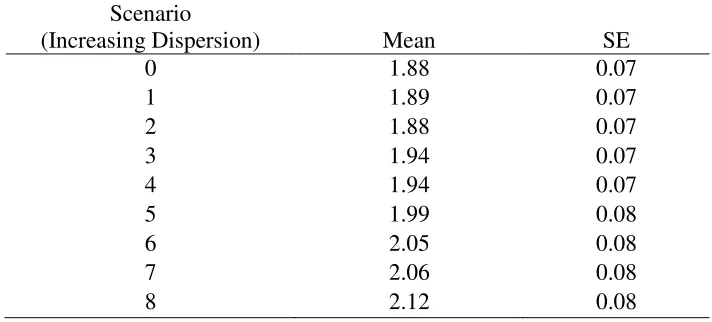
occurred as individuals (Fig. 1A). Increasing dispersion resulted in an increasing trend in mean

LOS (scenario 0 [highly aggregated]

= 1.88; scenario 8 [highly dispersed]

= 2.12; Appendix

E Table E1) and variance tracked the mean trend, albeit at a slower rate, in a Poisson-like

distribution (

σ

2

range: 1.37, 1.49). Dispersing as individuals, however, was not advantageous

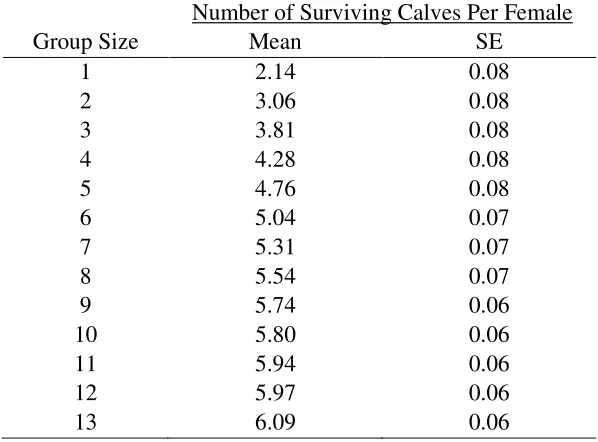
over group-living under these assumptions as dispersed individuals had a lower mean LOS than

grouped caribou. (Fig. 1B, Appendix E Table E2). Moreover, increasing group size led to an

increasing trend in the mean (group size 2:

= 3.06; group size 13:

= 6.09) and a decreasing

trend in variance (group size 2:

σ

2

= 1.72; group size 13:

σ

2

= 0.79) of LOS.

Group Detectability Hypothesis

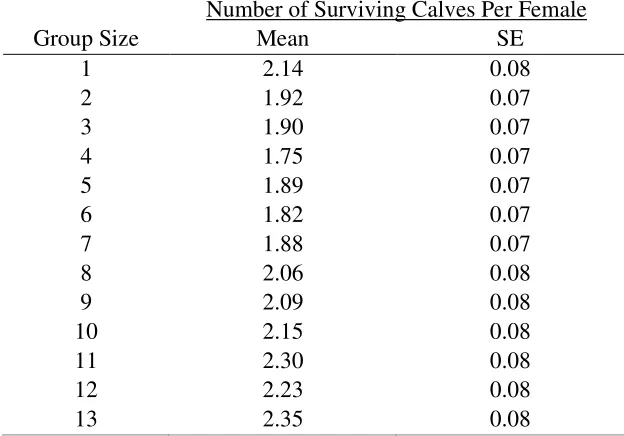
The advantage of group living greatly diminished when the detection radius of wolves

varied as a function of caribou group size (Fig. 2, Appendix E Table E3). Small groups (2

n

4) had a lower mean LOS on average (group size 2:

= 1.92; group size 4:

=1.75) than

dispersed individuals (

= 2.14) and the mean for small groups trended lower with increasing

group size. This trend, however, reversed at intermediate to large group sizes (

5) and, as a

result, when group size was

10, mean LOS was higher than dispersed individuals (group size

10:

= 2.15; group size 13:

= 2.35). Variance in LOS remained relatively constant across

(14)

Multiple Kills Hypothesis

Varying the number of kills per encounter while holding the detection radius constant

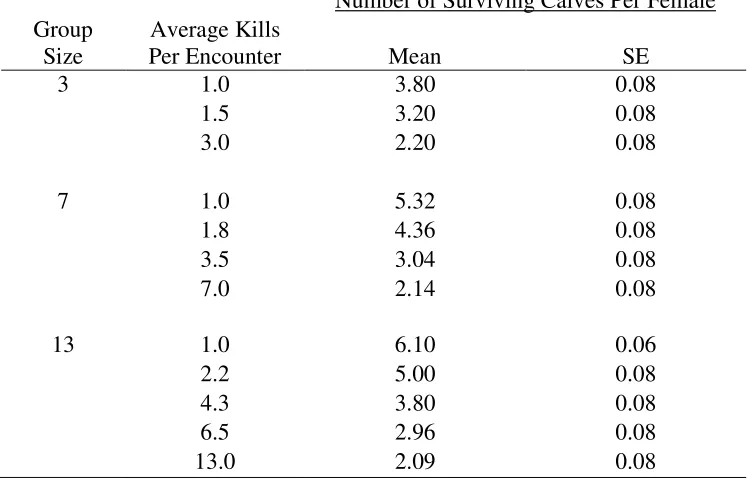
resulted in grouped caribou having a higher mean LOS than dispersed individuals in all

simulations except those where all calves were killed on initial encounter (Fig. 3, Appendix E

Table E4). Variance showed a slight curvilinear effect, being higher at middle values of mean

LOS.

Multiple Mechanisms

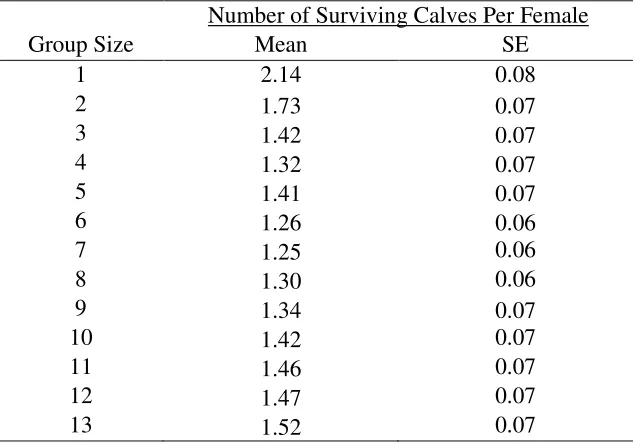
Combining the effects of multiple kills per encounter and differential group detectability

resulted in dispersed individuals having a higher mean LOS than grouped caribou (Fig. 4,

Appendix E Table E5). This outcome was evident even in simulations where only 1.5 calves

were killed on average per encounter (dispersed individuals:

= 2.14; all groups

1.73).

Variance again showed a Poisson-like property, mirroring the trend in mean LOS.

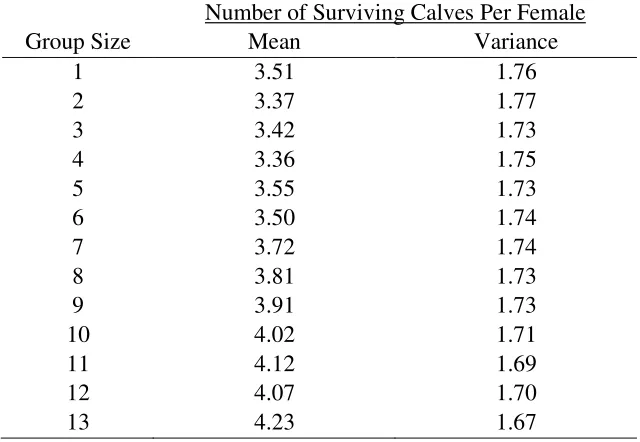
Modelling a lowered rate of kill success (50%) with differential group detectability

resulted in a consistent increase in mean LOS across group sizes (group size 2:

= 3.37; group

size 13:

= 4.23, Fig. 4, Appendix E Table E6). As a consequence, results from this interaction

were similar to the group detectability simulations where dispersed individuals (

= 3.51) had a

higher mean LOS than small groups (here, group sizes of 2 – 4, all

3.42) but not large groups

(> 6 individuals, all

3.72). Notably, the increasing trend in mean LOS associated with group

sizes > 6 was steeper than when the kills-per-encounter is 1.0. Variance in LOS was relatively

(15)

Discussion

Our results suggest that multiple mechanisms interact to selectively favour dispersion as a

tactic for reducing predation risk at reproduction in otherwise group-living prey. Dispersion only

led to the highest number of offspring surviving when detectability increased with group size and

predators killed more than one offspring per encounter. The risk of multiple kills per encounter,

however, may be the primary mechanism causing females to disperse at reproduction as

differential group detectability is likely to remain relatively constant throughout the year for

most species. During reproduction, dispersion is favoured because the vulnerability of neonatal

offspring results in a high risk of multiple kills if offspring are grouped (Miller et al. 1985) and

this risk outweighs the benefits afforded by group living. Outside of reproduction, the risk of

multiple kills is greatly reduced because groups consist of adults and juveniles, individuals that

are much more mobile with a considerably lower probability of capture than neonates. Indeed,

the reforming of groups by caribou later in the summer is likely driven by calves attaining

movement rates similar to adults (DeMars et al. 2013) and thereby lowering their capture

probability. This reduced capture probability lowers the risk of multiple kills and therefore

favours living in larger groups (e.g. > 6 for boreal caribou) – as evidenced by simulations

modelling a kill success of 50% - with the benefits of group living likely due to the increased

search time and lowered predator encounter rates associated with increasing group size (Ioannou

et al. 2011).

Temporal variation in predation vulnerability has been shown to be a driver in the

evolution of other stage-specific behaviours in addition to the potential effect demonstrated here.

In common lizards (

Zootoca vivipara

), gravid females will maintain a static, cryptic behaviour

(16)

pregnancy makes fleeing less effective (Bauwens and Thoen 1981). In bream (

Abramis brama

),

a freshwater fish, migratory behaviour is thought to be a size-dependent response to predation

risk with smaller, high-risk individuals showing a greater propensity to migrate (Skov et al.

2011). In both examples, predation-sensitive behaviours likely evolved because of the positive

effects on individual survival, and therefore fitness. For caribou in forested environments,

dispersion at calving may have become fixed over aggregation because of dispersion’s positive

effect on neonate survival, a contributing factor to overall fitness. This mechanism likely

generalizes beyond caribou in explaining dispersive behaviour at reproduction. For example,

within ungulates – where calving behaviour has been primarily assessed in terms of habitat

selection – offspring vulnerability may be an influencing factor in the dispersive behaviour of

parturient moose (

Alces alces

; Poole et al. 2007) and elk (

Cervus elaphus

; Vore and Schmidt

2001). Within birds, offspring vulnerability could be a contributing mechanism in the dispersion

of pairs at breeding in otherwise flocking species (Lima 2009).

The dominant mechanisms driving spatial distributions of organisms are likely context

specific (Treisman 1975; Taylor 1976; Scharf et al. 2011, Beauchamp 2014). This idea is

exemplified by caribou where the surrounding environment likely plays an important role in

determining whether to disperse (boreal caribou) or aggregate (barren-ground caribou) at

calving. In our simulations, we assumed that wolves primarily detected caribou by olfaction

and/or audition because forest cover limits visual detection. Environmental effects on vision

may also determine the spatial distribution of prey as it directly affects the benefit of early

predator detection provided by groups (Pulliam 1973, Beauchamp 2014). In open environments,

group living is likely maintained during reproduction because early visual detection of predators

(17)

[

Octodon degus

], Ebsenperger and Wallem 2002) or the organization of group defence (e.g.

muskoxen [

Ovibos moschatus

], Tener 1965; bison [

Bison bison

], Carbyn and Trottier 1988) and

these benefits may outweigh the risk of multiple kills when offspring are grouped. Indeed, in a

predator removal experiment Banks (2001) found that female eastern grey kangaroos (

Macropus

giganteus

) foraging in open areas with dependent young were more likely to occur in groups in

areas where predators were present compared to areas where they were removed. For boreal

caribou, the weight of importance is placed on minimizing the risk of multiple kills because early

visual detection of predators is limited by forest vegetation. The importance of vision in

determining grouping patterns has also been demonstrated in other taxa including freshwater fish

(Emery 1973) and dolphins (Scott and Cattanach 1998).

Differential group detectability strongly influenced the relative differences between

dispersion and group-living in our simulations. When detectability was held constant for all

group sizes, group-living was highly advantageous over dispersion regardless of group size (Fig.

1B); conversely, when detectability varied as a function of group size, dispersion was somewhat

advantageous over small to intermediate groups but not large groups (Fig. 2). These results are

similar to empirical findings of encounter rates between wolves and elk groups where

intermediate group sizes of elk had higher encounter rates with wolves than individuals or large

groups (Hebblewhite and Pletscher 2002). Together, these results suggest that at small to

intermediate group sizes, group detectability effects have a stronger influence on encounter rates

than the minimizing effect associated with increasing group size (Ioannou et al. 2011). Note,

however, that the encounter-detectability relationship is dependent on how detectability is

modelled. Because the nature of prey detections in our wolf-caribou system is unknown, we

(18)

al. 2013). This approach is likely not an exact representation of how wolves detect caribou and

may be biologically liberal when group sizes are large (e.g. the detection radius of a group of 13

in our simulations is 3.6 km). If the true detection radius is smaller, then group-living becomes

increasingly advantageous even at small group sizes. These relationships therefore suggest that

while differential group detectability discounts the advantages of group-living relative to

dispersion (Figs. 1B & 2), it is by itself an insufficient explanation for why female caribou

disperse at calving unless detection radii exceed distances that may be biologically implausible.

Of the three

a priori

hypotheses evaluated, the search time hypothesis – which isolated

the effect of simply spacing out – was the least informative for explaining dispersion at

reproduction. In simulations comparing groups to dispersed individuals, group-living was

advantageous over individuals across all group sizes (Fig. 1B). Moreover, group-living becomes

increasingly advantageous as group size increased, an effect caused by the increasing search time

required for wolves to locate the decreasing number of available caribou groups (Travis and

Palmer 2005; Ioannou et al. 2011). Dispersion only became effective when caribou occurred as

individuals (Fig. 1A). In these simulations, increasing dispersion resulted in increasing mean

LOS. While this finding does not directly answer our central question of why organisms

disperse from groups, it does have important ramifications for the management of species that

disperse at reproduction to reduce predation risk. If human-altered landscapes force such species

to become increasingly clumped, an effect that has been shown for boreal caribou (Fortin et al.

2013), then lowered or more variable offspring survival may result, potentially leading to

population declines and increased extinction risk (Boyce et al. 2006). Thus, conservation

strategies for species that disperse at reproduction will require the protection of sufficient space

(19)

Finally, we highlight that our results yields testable predictions of the social behaviour of

prey at reproduction in other predator-prey systems. These predictions are predicated on the

assumptions and inputs of our simulation approach; for example, we restricted our analysis to

forested environments where early predator detection by vision is limited and modelled no group

defence effects. Nevertheless, given these constraints, our results predict that if the probability

of multiple kills is an important driver of dispersive behaviour, then group-living prey that can

dissuade multiple kills should remain in groups at reproduction. Such prey could include those

that emit a noxious substance to deter repeated attacks. Prey with a relatively small-sized

primary predator should also remain in groups because multiple kills are less likely. Conversely,

group-hunting predators should exert a strong influence for prey dispersion. In our simulations,

for example, modelling wolves as packs would increase the probability of multiple kills, further

favouring dispersion of prey (Fig. 4). These examples illustrate the importance of accounting for

the behavioural ecology of both predator and prey – and the environmental context in which their

interactions take place – when testing predictions of social behaviour in novel predator-prey

systems.

Acknowledgements

We thank J-M. Gaillard and three anonymous reviewers whose constructive comments

significantly improved this manuscript. We acknowledge the funding and in-kind support of the

Science and Community Environmental Knowledge Fund, Penn West Exploration, the Alberta

Upstream Petroleum Research Fund, the Canadian Wildlife Federation, and BC Ministry of

Forests, Lands, and Natural Resource Operations. We thank Mark Lewis (ML) and members of

(20)

Natural Sciences and Engineering Research Council (NSERC) of Canada and Nexen, Inc. GAB

was funded through an NSERC Banting postdoctoral fellowship and JRP was partly funded by

an NSERC Discovery and Acceleration grant awarded to ML.

Literature Cited

Adams, L. G., F. J. Singer, and B. W. Dale. 1995. Caribou calf mortality in Denali National

Park, Alaska. The Journal of Wildlife Management 59:584–594.

Alexander, R. D. 1974. The evolution of social behavior. Annual Review of Ecology and

Systematics 5:328–383.

Andersson, P., C. Löfstedt, and P. A. Hambäck. 2013. How insects sense olfactory patches - the

spatial scaling of olfactory information. Oikos 122:1009–1016.

Banks, P. B. 2001. Predation-sensitive grouping and habitat use by eastern grey kangaroos: a

field experiment. Animal Behaviour 61:1013–1021.

Bauwens, D., and C. Thoen. 1981. Escape tactics and vulnerability to predation associated with

reproduction in the lizard

Lacerta vivipara

. Journal of Animal Ecology 50:733.

Beauchamp, G. 2014. Social predation. Academic Press, London, UK.

Berger, J. 1978. Group size, foraging, and antipredator ploys: an analysis of bighorn sheep

decisions. Behavioral Ecology and Sociobiology 4:91–99.

Bergerud, A. T. 1996. Evolving perspectives on caribou population dynamics, have we got it

right yet? Rangifer 16:95–116.

Bergerud, A. T., S. N. Luttich, and L. Camps. 2008. The return of caribou to Ungava.

McGill-Queen’s University Press.

Bergerud, A. T., and R. E. Page. 1987. Displacement and dispersion of parturient caribou at

calving as antipredator tactics. Canadian Journal of Zoology 65:1597–1606.

(21)

Bjørneraas, K., B. Van Moorter, C. M. Rolandsen, and I. Herfindal. 2010. Screening global

positioning system location data for errors using animal movement characteristics. The

Journal of Wildlife Management 74:1361–1366.

Boyce, M., C. Haridas, C. Lee, and the NCEAS Stochastic Demography Working Group. 2006.

Demography in an increasingly variable world. Trends in Ecology & Evolution 21:141–

148.

Carbyn, L. N., and T. Trottier. 1988. Descriptions of wolf attacks on bison calves in Wood

Buffalo National Park. Arctic 41:297–302.

DeMars C., G. Breed, J. Potts, and S. Boutin S. 2015. Data from: Spatial patterning of prey at

reproduction to reduce predation risk: what drives dispersion from groups? Dryad Digital

Repository.

http://dx.doi.org/10.5061/dryad.vr0kc

DeMars, C. A., M. Auger-Méthé, U. E. Schlägel, and S. Boutin. 2013. Inferring parturition and

neonate survival from movement patterns of female ungulates: a case study using

woodland caribou. Ecology and Evolution 3:4149–4160.

Ebsenperger, L. A., and P. K. Wallem. 2002. Grouping increases the ability of the social rodent,

Octodon degus

, to detect predators when using exposed microhabitats. Oikos 98:491–

497.

Emery, A. R. 1973. Preliminary comparisons of day and night habits of freshwater fish in

Ontario lakes. Canadian Journal of Zoology 30:761–774.

Fortin, D., P.-L. Buono, A. Fortin, N. Courbin, C. Tye Gingras, P. R. Moorcroft, R. Courtois, et

al. 2013. Movement responses of caribou to human-induced habitat edges lead to their

aggregation near anthropogenic features. The American Naturalist 181:827–836.

Foster, W. A., and J. E. Treherne. 1981. Evidence for the dilution effect in the selfish herd from

fish predation on a marine insect. Nature 293:466–467.

Fuller, T.K., L.D. Mech, and J.F. Cochrane. 2003. Wolf population dynamics. In: Mech, L. D.,

and L. Boitani. eds. Wolves: behavior, ecology, and conservation. The University of

Chicago Press, Chicago, IL.

Garay, J. 2009. Cooperation in defence against a predator. Journal of Theoretical Biology

257:45–51.

Gustine, D. D., K. L. Parker, R. J. Lay, M. P. Gillingham, and D. C. Heard. 2006. Calf survival

of woodland caribou in a multi-predator ecosystem. Wildlife Monographs 165:1–32.

(22)

Hamilton, W. D. 1971. Geometry for the selfish herd. Journal of Theoretical Biology 31:295–

311.

Hart, P. J., and L. A. Freed. 2005. Predator avoidance as a function of flocking in the sexually

dichromatic Hawaii akepa. Journal of Ethology 23:29–33.

Heard, D. C., T. M. Williams, and D. A. Melton. 1996. The relationship between food intake and

predation risk in migratory caribou and implications to caribou and wolf population

dynamics. Rangifer Special Issue 9:37–44.

Hebblewhite, M., and D. H. Pletscher. 2002. Effects of elk group size on predation by wolves.

Canadian Journal of Zoology 80:800–809.

Holling, C. S. 1959. The components of predation as revealed by a study of small mammal

predation of the European pine sawfly. The Canadian Entomologist 91:293–320.

Ioannou, C. C., F. Bartumeus, J. Krause, and G. D. Ruxton. 2011. Unified effects of aggregation

reveal larger prey groups take longer to find. Proceedings of the Royal Society B:

Biological Sciences 278:2985–2990.

Ioannou, C. C., and J. Krause. 2008. Searching for prey: the effects of group size and number.

Animal Behaviour 75:1383–1388.

Jones, E., T. Oliphant, and P. Peterson, et al. 2001. SciPy: Open source scientific tools for

Python. URL

http://www.scipy.org/

Krause, J., and G. D. Ruxton. 2002. Living in groups. Oxford Series in Ecology and Evolution.

Oxford University Press.

Kruuk, H. 1972. Surplus killing by carnivores. Journal of Zoology 166:233–244.

Lagarias, J. C., J.A. Reeds, M.H. Wright, and P.E. Wright. 1998. Convergence properties of the

Nelder-Mead simplex method in low dimensions. SIAM Journal on Optimization

9:112-147.

Lewis, J. S., J. L. Rachlow, E. O. Garton, and L. A. Vierling. 2007. Effects of habitat on GPS

collar performance: using data screening to reduce location error: GPS collar

performance. Journal of Applied Ecology 44:663–671.

Lima, S. L. 2009. Predators and the breeding bird: behavioral and reproductive flexibility under

the risk of predation. Biological Reviews 84:485–513.

(23)

Miller, F. L., A. Gunn, and E. Broughton. 1985. Surplus killing as exemplified by wolf predation

on newborn caribou. Canadian Journal of Zoology 63:295–300.

Muhly, T. B., M. Alexander, M. S. Boyce, R. Creasey, M. Hebblewhite, D. Paton, J. A. Pitt, et

al. 2010. Differential risk effects of wolves on wild versus domestic prey have

consequences for conservation. Oikos 119:1243–1254.

Poole, K. G., R. Serrouya, and K. Stuart-Smith. 2007. Moose calving strategies in interior

montane ecosystems. Journal of Mammalogy 88:139–150.

Pulliam, H. R. 1973. On the advantages of flocking. Journal of Theoretical Biology 38:419–422.

R Core Team (2014). R: A language and environment for statistical computing. R Foundation for

Statistical Computing, Vienna, Austria. URL

http://www.R-project.org/

.

Rettie, W. J., and F. Messier. 1998. Dynamics of woodland caribou populations at the southern

limit of their range in Saskatchewan. Canadian Journal of Zoology 76:251–259.

Russell, D. E., A. M. Martell, and W. A. Nixon. 1993. Range ecology of the Porcupine caribou

herd in Canada. Rangifer 13:1–168.

Scharf, I., O. Ovadia, and S. Foitzik. 2011. The advantage of alternative tactics of prey and

predators depends on the spatial pattern of prey and social interactions among predators.

Population Ecology 54:187–196.

Scott, M. D., and K. L. Cattanach. 1998. Diel patterns in aggregations of pelagic dolphins and

tunas in the eastern Pacific. Marine Mammal Science 14:401–422.

Self, D., B. Duncan, I. Sinclair, R. Brice, J.L. Hood, A. Singmin, D. Davis, E. Patronis, and J.

Watkinson. 2009. Audio engineering: know it all. Newnes Press, Burlington, MA.

Skov, C., H. Baktoft, J. Brodersen, C. Bronmark, B. B. Chapman, L.-A. Hansson, and P. A.

Nilsson. 2011. Sizing up your enemy: individual predation vulnerability predicts

migratory probability. Proceedings of the Royal Society B: Biological Sciences

278:1414–1418.

Taylor, J. 1976. The advantage of spacing out. Journal of Theoretical Biology 59:485–490.

Tener, J. S. 1965. Muskoxen in Canada: a biological and taxonomic review. Dept. of Northern

Affairs and National Resources, Canadian Wildlife Service, Ottawa, ON.

(24)

Tinbergen, N., M. Impekoven, and D. Franck. 1967. An experiment on spacing-out as a defence

against predation. Behaviour 28:307–321.

Travis, J. M. J., and S. C. F. Palmer. 2005. Spatial processes can determine the relationship

between prey encounter rate and prey density. Biology Letters 1:136–138.

Treisman, M. 1975. Predation and the evolution of gregariousness. I. Models for concealment

and evasion. Animal Behaviour 23:779–800.

Turchin, P. 1998. Quantitative analysis of movement: measuring and modeling population

redistribution in animals and plants (1st ed.). Sinauer Associates, Inc.

Vore, J. M., and E. M. Schmidt. 2001. Movements of female elk during calving season in

northwest Montana. Wildlife Society Bulletin 29:720–725.

(25)

Figure Legends

Main Text

Figure 1: The effect of individual dispersion (search time hypothesis) on the mean number of

surviving calves per female per generation (7 years) during simulations (n = 250 / scenario or

group size; with standard error bars) tracking caribou-wolf encounters during the calving season.

For these simulations, the detection radius of wolves was 1-km regardless of group size and one

calf was killed per encounter. Black circles refer to the values of the reference scenario where

caribou occur as highly dispersed individuals. In (A), the spatial configuration of individual

caribou was varied from highly clumped (scenario 0) to highly dispersed (scenario 8). In (B),

highly dispersed individuals are compared to dispersed caribou groups.

Figure 2: The effect of differential detectability by group size (group detectability hypothesis) on

the mean number of surviving calves per female per generation (7 years) during simulations (n =

250 / scenario or group size; with standard error bars) tracking caribou-wolf encounters during

the calving season. For these simulations, the detection radius of wolves varied as the square

root of caribou group size and only one calf was killed per wolf encounter. The black circle and

dashed line refer to the values of the reference scenario where caribou occur as highly dispersed

individuals.

Figure 3: The effect of multiple kills per encounter (multiple kills hypothesis) on the mean

number of surviving calves per female per generation (7 years) during simulations (n = 250 /

scenario or group size; with standard error bars) tracking caribou-wolf encounters during the

calving season. Here, we show the effects when caribou occur in groups of seven, the mean

group size of caribou during the winter in northeast British Columbia. The dashed line indicates

the mean number of surviving calves in the reference scenario where caribou are dispersed as

individuals.

Figure 4: The effects of multiple mechanisms on the mean number of surviving calves per

female per generation (7 years) during simulations (n = 250 / scenario or group size; with

standard error bars) tracking caribou-wolf encounters during the calving season. Differential

group detectability was separately combined with multiple kills per encounter (black circles) and

a 50% rate of kill success (white triangles). For multiple kills, the average kills per encounter

was 1.5. The results of simulations assessing only differential group detectability (grey squares;

kills-per-encounter = 1.0) are also presented for comparison. Dashed lines represent the value of

the reference scenario where caribou are dispersed as individuals.

Appendices

Figure A1: A female boreal caribou accompanied by a neonate calf in the boreal forests of

northeast British Columbia. During the calving season (mid-May to mid-July) females disperse

from groups to calve in isolation.

(26)

Figure B1: The effects of varying the number of caribou and wolves used in simulation analyses

to test the search time hypothesis, which states that increasing dispersion by females increases

predator search time. The detection radius of wolves was fixed at 1-km for all simulations.

[Note: standard error bars are not shown as all fall within the size of the point symbols].

Figure B2: The effects of varying the number of caribou and wolves used in simulation analyses

to test the group detectability hypothesis, which states that caribou groups are more detectable

than individuals and thus groups should have lower mean number of calves surviving. The

detection radius of wolves varied as a function of caribou group size (see main text). [Note:

standard error bars are not shown as all fall within the size of the symbol].

Figure B3: The effects of varying the number of caribou and wolves used in simulation analyses

to test the multiple kills hypothesis, which states that dispersion of individuals should be

favoured when more than one individual per group is killed per predator encounter. Here we

show the effects on a group size of seven, the mean group size of caribou in northeast British

Columbia. The detection radius of wolves was fixed at 1-km for all simulations. [Note: standard

error bars are not shown as all fall within the size of the symbol].

Figure B4: The effects (with standard error bars) of varying the detection radius of wolves used

in simulation analyses to test the search time hypothesis, which states that increasing dispersion

by females increases predator search time. All simulations were initially populated with 300

caribou and 10 wolves.

Figure B5: The effects (with standard error bars) of varying the detection radius of wolves used

in simulation analyses to test the group detectability hypothesis, which states that caribou groups

are more detectable than individuals and thus groups should have lower mean number of calves

surviving. The detection radius of wolves varied as a function of caribou group size (see main

text). All simulations were initially populated with 300 caribou and 10 wolves.

Figure B6: The effects (with standard error bars) of varying the detection radius of wolves used

in simulation analyses to test the multiple kills hypothesis, which states that dispersion of

individuals should be favoured when more than one individual per group is killed per predator

encounter. Here we show the effects on a group size of seven, the mean group size of caribou in

northeast British Columbia. Note the different scales of the y-axes. Dotted lines indicate the

reference scenario where females occurred as highly dispersed individuals. All simulations were

initially populated with 300 caribou and 10 wolves.

Figure C1: Nine scenarios with varying spatial dispersion of female boreal caribou (

n

= 300)

during the calving season. These scenarios were used to evaluate the search time hypothesis.

(27)

Appendix A: Spatial Behaviour of Boreal Caribou at Calving

The boreal ecotype of woodland caribou (

Rangifer tarandus caribou

) spends its entire

life cycle within the boreal forest biome of Canada. Outside of the calving season, boreal caribou

typically occur in groups of 5-10 individuals (range: 1-36; Stuart-Smith et al. 1997; Rettie and

Messier 1998; Culling and Culling 2013). During calving (mid-May to mid-July), however,

females disperse from groups and distribute themselves widely on the landscape to give birth in

isolation (Fig. A1), a behaviour known as “spacing out” (Bergerud and Page 1987). Here, we

illustrate this behaviour with GPS radio-collar data from five females occurring within the

Maxhamish caribou range of northeast British Columbia (~ lat: 59.2000 to 60.0000, ~ long:

-124.0000 to -122.0000). During the winter of 2011, the average distance between these females

was 2.7 km (range: 0.07 – 4.5; Fig. A2). At calving, the average distance had increased to 41.5

km (range: 5.9 – 79.9). We further note that upon capture for radio-collar deployment earlier in

the winter (February 2011) all females occurred in groups (range: 5 – 12) while aerial surveys

conducted during calving found all females with calves to be in isolation.

Literature Cited

:

Bergerud, A. T., and R. E. Page. 1987. Displacement and dispersion of parturient caribou at

calving as antipredator tactics. Canadian Journal of Zoology 65:1597–1606.

Culling, D. E., and B. A. Culling. 2013.

BC boreal caribou implementation plan: 2012-13 collar

deployment and late winter recruitment survey

. Diversified Environmental Services, Fort

St. John, BC. 66pp.

Rettie, W. J., and F. Messier. 1998. Dynamics of woodland caribou populations at the southern

limit of their range in Saskatchewan. Canadian Journal of Zoology 76:251–259.

(28)

Appendix B: Sensitivity Analyses of Simulation Outputs

We used simulation analyses to evaluate the plausibility of three hypotheses for

explaining individual dispersion as a tactic for reducing predation risk at reproduction in an

otherwise group-living animal, the boreal ecotype of woodland caribou (

Rangifer tarandus

caribou

; see main text for descriptions of each hypothesis). Simulations tracked encounters

between caribou and wolves (

Canis lupus

), a main predator of caribou calves, and we used

simulation outputs to estimate the mean number of neonate calves surviving per female per

generation (7 years) as a proxy of individual fitness (hereafter, long-term offspring survival

[LOS]). We assessed the sensitivity of simulation inferences to variation in the number of

caribou and wolves used within each simulation and to variation in the sensory radius within

which wolves detected caribou (i.e. the detection radius).

Evaluating Sensitivity to Variation in Caribou and Wolf Numbers

In general, simulation inferences were robust to variation in the number of caribou and/or

wolves used (Figs. B1-3). Varying the number of caribou caused little change in mean LOS

across the three hypotheses evaluated. Varying the number of wolves proportionately changed

mean LOS in all simulations but in most instances did not alter simulation inferences (e.g.

increasing dispersion of individuals remained advantageous across the number of wolves

assessed; Fig. B1). Note that we restricted the upper range of wolf numbers assessed to 15 as

increasing wolf numbers above this threshold resulted in a relatively high proportion of

simulations with all calves killed, creating a biologically unrealistic boundary effect that caused

the distribution of calves killed to be left-skewed (see Appendix D) and thus prevented robust

(29)

Evaluating Sensitivity to Variation in Detection Radius

Varying the detection radius also had minimal influence on simulation outputs. For the

search time hypothesis, lowering the detection radius resulted in a higher mean LOS but did not

change the inference that increasing dispersion is favourable when caribou occur as individuals

(Fig. B4). For the group detectability hypothesis, lowering the detection radius resulted in a left

shift of the curvilinear relationship between LOS and group size, causing a few more group sizes

to be advantageous over individuals compared to our original detection radius of 1-km (Fig. B5).

Lowering the detection radius had minimal effect on the multiple kills hypothesis, only

strengthening the advantage of groups over individuals when less than all of the calves were

(30)

Appendix C: Dispersion Scenarios to Test the Search Time Hypothesis

To test the search time hypothesis, which assessed the effectiveness of female caribou

spacing out during calving, we evaluated nine scenarios representing varying degrees of

dispersion ranging from highly clumped (Scenario 0) to highly dispersed (Scenario 8; Fig. C1).

Each scenario was populated with 300 caribou in a simulated caribou range of 4900 km

2

at a grid

(31)

Appendix D: Example Distributions of the Number of Calves Killed from Caribou-Wolf

Encounter Simulations

Simulations of caribou-wolf encounters during the calving season tracked the number of

calves killed (out of 300). For each scenario tested, we ran 250 simulations (i.e. 250 calving

seasons), generating an estimated distribution of the number of calves killed during a calving

season. Below are two example distributions when testing the search time hypothesis: one when

caribou are highly clumped (scenario 0) and one when caribou are highly dispersed (scenario 8;

(32)

Appendix E: Estimates of Long-term Offspring Survival from Simulations Tracking

Caribou-Wolf Encounters during the Calving Season

The following tables list the long-term offspring survival [LOS] values (mean and

standard error [SE] of the number of surviving neonate calves per female per generation)

calculated from simulations evaluating the search time, group detectability and multiple kills

hypotheses as well as their combined effects. We ran 250 simulations for each group size or

scenario tested and each simulation started with 300 caribou calves and 10 wolves.

Note that the calculated LOS rates listed are for comparative purposes only as they are

sensitive to the number of predators specified (see Appendix B) and therefore are not estimates

of actual offspring survival rates in the wild. Nevertheless, simulation outputs (e.g. ~30%

neonate survival for scenario 8; Table E1) are within the relatively wide range of values reported

[image:32.595.119.475.556.717.2]

for boreal caribou populations (e.g. 26-65%, Pinard et al. 2012; see also Thomas and Gray 2002).

Table E1: The effect of individual dispersion (search time hypothesis) on the mean number of

surviving calves per female per generation (7 years) from simulations tracking caribou-wolf

encounters during the calving season. For these simulations, the detection radius of wolves was

1-km and one calf was killed per encounter.

Number of Surviving Calves Per Female

Scenario

(Increasing Dispersion)

Mean

SE

0

1.88

0.07

1

1.89

0.07

2

1.88

0.07

3

1.94

0.07

4

1.94

0.07

5

1.99

0.08

6

2.05

0.08

7

2.06

0.08

(33)
[image:33.595.148.447.185.406.2]

Table E2: The effect of group size (search time hypothesis) on the mean number of surviving

calves per female per generation (7 years) from simulations tracking caribou-wolf encounters

during the calving season. For these simulations, the detection radius of wolves was 1-km

regardless of group size and one calf was killed per encounter.

Number of Surviving Calves Per Female

Group Size

Mean

SE

1

2.14

0.08

2

3.06

0.08

3

3.81

0.08

4

4.28

0.08

5

4.76

0.08

6

5.04

0.07

7

5.31

0.07

8

5.54

0.07

9

5.74

0.06

10

5.80

0.06

11

5.94

0.06

12

5.97

0.06

(34)
[image:34.595.141.453.200.418.2]

Table E3: The effect of differential detectability by group size (group detectability hypothesis)

on the mean number of surviving calves per female per generation (7 years) from simulations

tracking caribou-wolf encounters during the calving season. For these simulations, the detection

radius of wolves varied as the square root of caribou group size and one calf was killed per

encounter.

Number of Surviving Calves Per Female

Group Size

Mean

SE

1

2.14

0.08

2

1.92

0.07

3

1.90

0.07

4

1.75

0.07

5

1.89

0.07

6

1.82

0.07

7

1.88

0.07

8

2.06

0.08

9

2.09

0.08

10

2.15

0.08

11

2.30

0.08

12

2.23

0.08

(35)
[image:35.595.111.485.191.431.2]

Table E4: The effect of multiple kills per encounter (multiple kills hypothesis) on the mean

number of surviving calves per female per generation (7 years) from simulations tracking

caribou-wolf encounters during the calving season. Group sizes of three, seven and thirteen were

evaluated.

Number of Surviving Calves Per Female

Group

Size

Average Kills

Per Encounter

Mean

SE

3

1.0

3.80

0.08

1.5

3.20

0.08

3.0

2.20

0.08

7

1.0

5.32

0.08

1.8

4.36

0.08

3.5

3.04

0.08

7.0

2.14

0.08

13

1.0

6.10

0.06

2.2

5.00

0.08

4.3

3.80

0.08

6.5

2.96

0.08

(36)
[image:36.595.140.457.197.419.2]

Table E5: The combined effects of differential group detectability (group detectability

hypothesis) and multiple kills per encounter (multiple kills hypothesis) on the mean number of

surviving calves per female per generation (7 years) from simulations tracking caribou-wolf

encounters during the calving season. In these simulations, the number of kills per encounter

averaged 1.5 for group sizes

2.

Number of Surviving Calves Per Female

Group Size

Mean

SE

1

2.14

0.08

2

1.73

0.07

3

1.42

0.07

4

1.32

0.07

5

1.41

0.07

6

1.26

0.06

7

1.25

0.06

8

1.30

0.06

9

1.34

0.07

10

1.42

0.07

11

1.46

0.07

12

1.47

0.07

(37)
[image:37.595.138.458.185.406.2]

Table E6: The combined effects of differential group detectability (group detectability

hypothesis) and a kill success rate of 50% on the mean number of surviving calves per female

per generation (7 years) from simulations tracking caribou-wolf encounters during the calving

season.

Number of Surviving Calves Per Female

Group Size

Mean

Variance

1

3.51

1.76

2

3.37

1.77

3

3.42

1.73

4

3.36

1.75

5

3.55

1.73

6

3.50

1.74

7

3.72

1.74

8

3.81

1.73

9

3.91

1.73

10

4.02

1.71

11

4.12

1.69

12

4.07

1.70

13

4.23

1.67

Literature Cited:

Pinard, V., C. Dussault, J-P. Ouellet, D. Fortin and R. Courtois. 2012. Calving rate, calf survival

rate, and habitat selection of forest-dwelling caribou in a highly managed landscape. The

Journal of Wildlife Management 76: 189-199.

Figure

Table E1: The effect of individual dispersion (search time hypothesis) on the mean number of
Table E2: The effect of group size (search time hypothesis) on the mean number of surviving calves per female per generation (7 years) from simulations tracking caribou-wolf encounters during the calving season
Table E3: The effect of differential detectability by group size (group detectability hypothesis)
Table E4: The effect of multiple kills per encounter (multiple kills hypothesis) on the mean
+3

References

Related documents

Keywords: Bacillus subtilis , Superfolder green fluorescent protein (sfGFP), Heterogeneous expression, Global transcriptional regulation, Production level, Single cell

Business policies are the instructions laid by an organization to manage its activities. It identifies the range within which the subordinates can take decisions in an organization.

Keywords: carbon dioxide removal, Paris Agreement, climate change mitigation, mitigation pathways, GHG emission pathways, climate model.. Supplementary material for this article

Grant, O Lord, that we might be strengthened with power through the Spirit in our inner being, that Christ may dwell in our hearts through faith – that, being rooted and grounded

enterprise of each of those States and the four private seabed mining consortia whose components possess the nationality or are effectively controlled by Belgium,

The results showed that several preoperative clinical characteristics (such as chronic kidney disease, female sex, synchronous urothelial carcinoma of the bladder, and tumor

This section provides the results of the proposed self tuning method compared with PID, classical fuzzy, self tuning scheme based on relative rate observer fuzzy

Business placement in France or abroad (9 to 12 months) • Option 1 1 year at a foreign partner university or Business School • Option 2 La Trobe University programme