UNIVERSITI TEKNIKAL MALAYSIA MELAKA
EFFECT OF OIL PALM TRUNK (OPT) AND OIL PALM FROND
(OPF) FIBER TO PHYSICAL AND MECHANICAL
PROPERTIES OF POLYURETHANE (PU)
This report submitted in accordance with requirement of the Universiti
Malaysia Melaka (UTeM) for the Bachelor Degree of Engineering Technology
MUHAMMAD NUR ASYRAF BIN AB RAZAK
FACULTY OF ENGINEERING TECHNOLOGY
UNIVERSITI TEKNIKAL MALAYSIA MELAKA
EFFECT OF OIL PALM TRUNK (OPT) AND OIL PALM FROND
(OPF) FIBER TO PHYSICAL AND MECHANICAL
PROPERTIES OF POLYURETHANE (PU)
This report submitted in accordance with requirement of the Universiti
Malaysia Melaka (UTeM) for the Bachelor Degree of Engineering Technology (Maintenance Technology)(Hons.)
by
MUHAMMAD NUR ASYRAF BIN AB RAZAK B071310276
910616-04-5227
FACULTY OF ENGINEERING TECHNOLOGY 2016
UNIVERSITI TEKNIKAL MALAYSIA MELAKA
EFFECT OF OIL PALM TRUNK (OPT) AND OIL PALM FROND
(OPF) FIBER TO PHYSICAL AND MECHANICAL
PROPERTIES OF POLYURETHANE (PU)
UNIVERSITI TEKNIKAL MALAYSIA MELAKA
BORANG PENGESAHAN STATUS LAPORAN PROJEK SARJANA MUDA
TAJUK: THE EFFECT OF OIL PALM TRUNK (OPT) AND
(OPF) FIBER TO PHYSICAL AND MECHANICAL PROPERTIES O POLYURETHANE
SESI PENGAJIAN: 2016/17
Saya MUHAMMAD NUR ASYRAF B
Mengaku membenarkan
Teknikal Malaysia Melaka (UTeM) dengan
1. Laporan PSM adalah hak milik Universiti Teknikal Malaysia Melaka dan penulis. 2. Perpustakaan Universiti Teknikal Malaysia Melaka dibenarkan membuat salinan
untuk tujuan pengajian sahaja dengan izin penulis.
3. Perpustakaan dibenarkan membuat salinan laporan PSM ini sebagai bahan pertukaran antara institusi pengajian tinggi.
4. **Sila tandakan ( )
SULIT
TERHAD
TIDAK TERHAD
Alamat Tetap:
SU 515 – A Jalan Mawar,
Taman Sungai Baru, 78300 Masjid Tanah, Melaka.
Tarikh: ________________________
**Jika Laporan PSM ini SULIT atau TERHAD, sila berkenaan dengan menyatakan
SULIT atau TERHAD.
UNIVERSITI TEKNIKAL MALAYSIA MELAKA
BORANG PENGESAHAN STATUS LAPORAN PROJEK SARJANA MUDA
THE EFFECT OF OIL PALM TRUNK (OPT) AND OIL
(OPF) FIBER TO PHYSICAL AND MECHANICAL PROPERTIES O
2016/17
UHAMMAD NUR ASYRAF BIN AB RAZAK
membenarkan Laporan PSM ini disimpan di Perpustakaan Teknikal Malaysia Melaka (UTeM) dengan syarat-syarat kegunaan
Laporan PSM adalah hak milik Universiti Teknikal Malaysia Melaka dan penulis. Universiti Teknikal Malaysia Melaka dibenarkan membuat salinan untuk tujuan pengajian sahaja dengan izin penulis.
Perpustakaan dibenarkan membuat salinan laporan PSM ini sebagai bahan pertukaran antara institusi pengajian tinggi.
)
TIDAK TERHAD
(Mengandungi maklumat yang berdarjah
atau kepentingan Malaysia sebagaimana yang termaktub dalam AKTA RAHSIA RASMI 1972)
(Mengandungi maklumat TERHAD yang telah oleh organisasi/badan di mana penyelidikan
n Mawar,
Taman Sungai Baru, 78300
Tarikh: ________________________
Disahkan
Cop Rasmi:
Tarikh: _______________________
Laporan PSM ini SULIT atau TERHAD, sila lampirkan surat daripada pihak menyatakan sekali sebab dan tempoh laporan PSM ini perlu
UNIVERSITI TEKNIKAL MALAYSIA MELAKA
BORANG PENGESAHAN STATUS LAPORAN PROJEK SARJANA MUDA
OIL PALM FROND (OPF) FIBER TO PHYSICAL AND MECHANICAL PROPERTIES OF
disimpan di Perpustakaan Universiti kegunaan seperti berikut:
Laporan PSM adalah hak milik Universiti Teknikal Malaysia Melaka dan penulis. Universiti Teknikal Malaysia Melaka dibenarkan membuat salinan
Perpustakaan dibenarkan membuat salinan laporan PSM ini sebagai bahan
maklumat yang berdarjah keselamatan kepentingan Malaysia sebagaimana yang termaktub
maklumat TERHAD yang telah ditentukan penyelidikan dijalankan)
Disahkan oleh:
Tarikh: _______________________
DECLARATION
I hereby, declared this report entitled “Effect of Oil Palm Trunk (OPT) and Oil Palm Frond (OPF) Fiber to Physical and Mechanical Properties of Polyurethane (PU)” is the results of my
own research except as cited in references.
APPROVAL
This report is submitted to the Faculty of Engineering Technology of UTeM as a partial fulfillment of the requirements for the degree of Bachelor of Mechanical Engineering Technology (Maintenance Technology) with Honours. The member of the supervisory is as follow:
i
ABSTRAK
ii
ABSTRACT
iii
DEDICATION
iv
ACKNOWLEDGEMENT
v
TABLE OF CONTENT
ABSTRAK i
ABSTRACT ii
DEDICATION iii
ACKNOWLEDGEMENT iv
TABLE OF CONTENT v
LIST OF TABLE vii
LIST OF FIGURE ix
LIST ABBEREVIATIONS, SYMBOLS AND NOMENCLATURES xi
CHAPTER 1: INTRODUCTION
1.1 Background of Study 1
1.2 Problem Statement 2
1.3 Objective 3
1.4 Scope 3
CHAPTER 2: LITERARTURE REVIEW
2.1 Introduction of Composite 4
2.2 Classification of Composite Materials by Matrix 5
2.2.1 Metal Matrix Composite 6
2.2.2 Ceramic Matrix Composite 7
2.2.3 Polymer Matrix Composite 8
2.3 Component of Polymer Matrix Composite 9
2.3.1 Matrix 9
2.3.2 Filler 10
2.3.3 Reinforcement 10
2.3.4 Solid Lubricant 12
vi
2.4.1 Thermosetting Polymer 13
2.4.1.1 Epoxy Resin 14
2.4.1.2 Polyurethane 15
2.4.2 Thermoplastic Polymer 16
2.4.2.1 Polypropylene (PP) 17
2.4.2.2Thermoplastic Polyurethane (TPU) 17
2.5 Reinforcement Material Composite 18
2.5.1 Natural Fiber 18
2.5.2 Oil Palm Fiber (OPF) 19
2.6 Polyurethane Matrix Composites 21
CHAPTER 3: METHODOLOGY
3.1 Introduction 22
3.2 Flowchart 22
3.3 Project Plan 23
3.4 Material Selection 23
3.4.1 Reinforcement 24
3.4.2 Matrix 24
3.5 Specimen Preparation 25
3.5.1 Fiber Treatment 26
3.5.2 Fiber Chopping 27
3.5.3 Fiber- Matrix Mixing 27
3.5.4 Crushed Into Pallet Size 29
3.5.5 Compress (Hot & Cold) 30
3.5.6 Cutting the Specimens 31
3.6 Density of Fiber Mix With Matrix 33
3.7 Mechanical Properties Testing 33
3.7.1 Tensile Test 33
3.7.2 Flexural Test 35
vii
CHAPTER 4: RESULT AND DISCUSSION
4.1 Introduction 37
4.2 Effect of Density of OPT&OPF Fiber 37 4.3 Effect of OPT&OPF Fiber on the Tensile Strength 38 4.4 Effect of OPT&OPF Fiber on Flexure Strength 40 4.5 Effect of OPT&OPF Fiber on Impact Strength 42
CHAPTER 5: CONCLUSION AND RECOMMENDATION
5.1 Conclusion 44
5.2 Recommendation 45
REFERENCES 46
APPENDICES
A Project Gantt Chart FYP 1 & FYP 2 B Tensile Test Data
viii
LIST OF TABLES
3.1 Composition Of OPT and OPF Fibers with Thermoplastic Polyurethane (TPU)
28
ix
LIST OF FIGURES
2.1 Classification of Composites 6
2.2 Classification of Reinforcement 11
2.3 Epoxy Resin Chemical Structure 14
2.4 Polyurethane chemical structure 16
2.5 Polypropylene chemical structure 17
2.6 Oil Palm Biomass Fibers from Oil Palm tree 20
3.1 Flow Chart 23
3.2 Oil Palm Trunk (OPT) and Oil Palm Frond Fiber (OPF) 24
3.3 Thermoplastic Polyurethane (TPU) 25
3.4 Flowchart for Specimen Preparation 26
3.5 Crusher Machine 27
3.6 Haake Internal Mixture 29
3.7 Plastic Crusher Machine 30
3.8 Hot and Cold Press Machine 31
3.9 Mold for One Specimen 31
3.10 Specimens 32
3.11 Level Controlled Cutter 32
3.12 Specimens for Tensile and Flexural 32
3.13 Tensile Specimen Testing 34
3.14 Instron 5960 Dual Column 34
3.15 Flexural Specimen Testing 35
3.16 Pendulum Impact Tester 36
4.1 Average Density versus Fiber Content of All Specimens 38 4.2 Average Tensile Stress versus Fiber Content Graph of All
Composition
x 4.3 Average Flexural Stress versus Fiber Content Graph of All
Composition
41
4.4 Average Charpy Impact Energy versus Fiber Content Graph of All Composition
xi
LIST OF ABBREVIATIONS, SYMBOLS AND
NOMENCLATURE
OPT - Oil Palm Trunk OPF - Oil Palm Frond PU - Polyurethane EFB - Empty Fruit Bunch MMCs - Metal Matrix Composites PMCs - Polymer Matrix Composites CMCs - Ceramic Matrix Composites nm - nano meter
FRP - Fiber Reinforced Plastic wt% - Weight Percentage
MDI - Methylene Diphenyl Diisocynate MEKP - Methyl Ethyl Ketone Peroxide CO2 - Carbon Oxide
FYP1 - Final Year Project 1 FYP2 - Final Year Project 2 UTM - Universal Testing Machine
ASTM - American Standard Testing Machine MPa - Mega Pascal
J/m - Joule per Meter
1
CHAPTER 1
INTRODUCTION
1.0 Background of Study
Nowadays, oil palm industry grows up with quickly, almost very little room remains for any significant increase in oil palm plantations in Peninsular Malaysia. As such, all future growth is expected to be in Sabah and Sarawak. Nowadays, is the one biggest oil palm produce and presently creates around 6.5 million metric huge amounts of world palm oil generation, (Law and Jiang, 2001). Currently, a total of 3.5 million hectares of oil palm plantations, while the statistic of oil palms production for the year 2001 was 11.8 million tons (Hussin et al. 2002). Usually the lifespan of a palm tree has about 25 years; it can contribute high amount of agricultural waste in Malaysia. According to Khalid et al. (2008) the oil palm that dispersed all areas they had turned into an essential part in economy of the south east asia. However, oil palm industries produce a large amount of solid waste called biomass. Malaysia has produced about 70 million tons of oil palm biomass, including trunks, fronds and empty fruit bunches in 2006, (Yacob, 2007) and within a year millions of tons of oil palm biomass was produced by Malaysian palm oil industry. (Rozman et al. 2005).
2 Bhowmick et al. (2012) stated that oil palm trunk (OPT) and oil palm frond (OPF) fibre is kind of natural fibres that very lightweight, can absorb a lot of water without congealing, renewable in nature, high modulus and specific strength properties. It also can withstand extremes temperature and moisture condition.
1.1
Problem Statement
3
1.2 Objective
Based on the introduction and problem statement above, the objective of this study are as follows:-
i. To investigate effect of different ratio of OPT/OPF fiber to tensile test properties of Thermoplastic Polyurethane (TPU)
ii. To investigate effect of different ratio of OPT/OPF fiber to flexural test properties of Thermoplastic Polyurethane (TPU).
iii. To investigate effect of different ratio of OPT/OPF fiber to impact test properties of Thermoplastic Polyurethane (TPU).
1.3 Scope
These scopes are determined in order to achieve the objective:-
i. Prepare the sample of oil palm trunk (OPT) and oil palm frond (OPF) fibres reinforced with thermoplastic polyurethane (TPU).
ii. Test the sample by performing the mechanical properties test such as: - Test using tensile testing machine ASTM D638
4
CHAPTER 2
LITERATURE REVIEW
2.1 Introduction of Composite
5 is stiffer and stronger than the continuous matrix phase and serve as the principal load carrying members.
Composites, the wonder materials are becoming an essential part of today’s materials due to the advantages such as low weight, corrosion resistance, high fatigue strength, and faster assembly. They are extensively used as materials in making aircraft structures, transportation, aerospace, automotive industry, sport equipment, electronic packaging to medical equipment, and space vehicle to home building (M.K. Chryssanthopoulo, 2010). This is because the composite material has their own special properties. According F.C Cambell (2010) the main advantages of composite materials are many, including lighter weight, the ability to tailor the layup for optimum strength and stiffness, improved fatigue life, allowing for a weight reduction in the finished part, corrosion resistance, and with good design practice, reduced assembly costs due to fewer detail parts and fasteners. In terms of strength to resistance to heat or some other desirable quality, it is better than either of the components alone or radically different from either of them. According Callister W. D. (2007) stated that, most composites have been created to improve combinations of mechanical characteristics such as stiffness, toughness, and ambient and high-temperature strength.
2.2 Classification of Composite Materials by Matrix
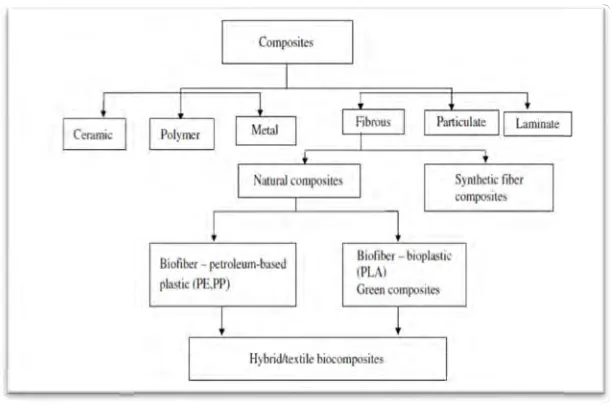
subdivided as hybrid composites and textile composites. Hybrid composites comprise of a combination of two or more types of fibers. Many different combinations of reinforcement and matrix materials are used to produce comp materials. Most composites comprise of a bulk material (matrix) and reinforcement or something to that affect, added basically to expand the quality and increase the strength and stiffness of the matrix. Depending on type of matrix used, the composit may be classified as: -
Figure 2.1: Classification of Composites (Bunsell, A.R. and Harris, B.
2.2.1 Metal Matrix Composite
Metal matrix composite materials have been so intensely researched over the past years that much new high strength to weight materials have been produced. Most of these materials have been developed for the aerospace industries, but some are being used in other applications such as automobile engines.
stated that metal matrix material has their own properties like hardness
fracture toughness and stiffness. Metal matrix can withstand elevated temperature in corrosive environment th
magnesium are the popular matrix metals currently in vogue, which are particularly subdivided as hybrid composites and textile composites. Hybrid composites comprise of a combination of two or more types of fibers. Many different combinations of reinforcement and matrix materials are used to produce comp materials. Most composites comprise of a bulk material (matrix) and reinforcement or something to that affect, added basically to expand the quality and increase the strength and stiffness of the matrix. Depending on type of matrix used, the composit
Classification of Composites (Bunsell, A.R. and Harris, B.
Metal Matrix Composite
Metal matrix composite materials have been so intensely researched over the past years that much new high strength to weight materials have been produced. Most of these materials have been developed for the aerospace industries, but some
other applications such as automobile engines. Pradeep R et stated that metal matrix material has their own properties like hardness
fracture toughness and stiffness. Metal matrix can withstand elevated temperature in corrosive environment than polymer composites. Titanium, aluminium and magnesium are the popular matrix metals currently in vogue, which are particularly
6 subdivided as hybrid composites and textile composites. Hybrid composites comprise of a combination of two or more types of fibers. Many different combinations of reinforcement and matrix materials are used to produce composite materials. Most composites comprise of a bulk material (matrix) and reinforcement or something to that affect, added basically to expand the quality and increase the strength and stiffness of the matrix. Depending on type of matrix used, the composite
Classification of Composites (Bunsell, A.R. and Harris, B. 1974)
7 useful for aircraft applications. Because of these attributes metal matrix composites are under consideration for wide range of applications viz. combustion chamber nozzle (in rocket, space shuttle), housings, tubing, cables, heat exchangers, structural members etc. According D. Verma et al. (2012) metal matrix composites possess some attractive properties, when compared with organic matrices. Example attractive properties are great quality and good strength at higher temperature, higher transverse strength, excellent electrical and superior thermal conductivity, and higher erosion resistance. However, the major disadvantage of metal matrix composites is their higher densities and consequently lower specific mechanical properties compared to polymer matrix composites.
2.2.2 Ceramic Matrix Composite
8
2.2.3 Polymer Matrix Composite
A fibre reinforced polymer is a composite material consisting of a polymer matrix imbedded with high strength fibers, such as glass, aramid, and carbon. Generally, polymers can be classified into two classes, which is thermoplastic and thermosetting. . A very large number of polymeric materials, both thermosetting and thermoplastic, are used as matrix materials for the composites. Most commercially produced composites use a polymer matrix material often called a resin solution. There are many different polymers available depending upon the starting raw ingredients.
9
2.3 Component of Polymer Matrix Composite
There are four major components in polymer composites; which are the matrix, filler, reinforcement and solid lubricant:-
2.3.1 Matrix
Most composites consist of a bulk material (matrix) and a reinforcement of some kind, added primarily to increase the strength and stiffness of the matrix (Verma et al. 2012). The matrix is the substance that available in the composite which the reinforcement embedded or two-phase microstructure in which a second phase is dispersed. In other words, that there is a path through the matrix to any point in the material, unlike two materials sandwiched together. The matrix phase of composite can may be a metal, polymer or ceramic.