The impact of relationship separation on suicidality
and mental health
Dominique Kazan BA (Hons), MPsych (Clin)
Centre for Mental Health Research Research School of Population Health
College of Health and Medicine The Australian National University
A thesis submitted for the degree of Doctor of Philosophy of The Australian National University
iii
Declaration
I declare that this thesis has not been previously submitted for a degree or diploma to
any higher education institution. All material contained in this thesis reports my
original work, except where it is declared below. To the best of my knowledge, this
thesis contains no material previously published or written by another person, except
where due reference is made.
The systematic review reported in Chapter 2 was conducted with assistance from
A/Prof. Philip J Batterham, A/Prof. Alison L. Calear and Dr Daniel Fassnacht, who
assisted in cross-coding included papers for the review. The systematic review
reported in Chapter 5 was conducted with assistance from A/Prof. Philip J
Batterham, A/Prof. Alison L. Calear and Dr Bregje van Spijker, who assisted in
cross-coding included papers for the review. A/Prof. Alison L. Calear and A/Prof.
Philip J Batterham were both instrumental in the overall research design, direction
and final evaluation of chapter data.
The funding for my PhD scholarship was provided by the Centre for Research
v
Acknowledgements
From the very start of my research journey, I would like to thank Dr Lou
Farrer for her enthusiasm and for motivating my curiosity to even consider the
possibility of pursuing a PhD. A big thank you to my supervisor, A/Prof. Alison
Calear, for giving me the opportunity to apply for and receive support to start my
research project, and supporting me in the continuation of my clinical practice
alongside my PhD work. I am also very grateful for the continued support from my
co-supervisor A/Prof. Phil Batterham, thank you for your patience, sage advice and
unbelievable fast feedback.
To the best room-mate and friend, Dr Jacqui Brewer, thank you for your
unwavering support, laughter and visualisation of the floppy PhD hat technique to
help me focus on the finish line. To Kathina Ali, Dr Amelia Gulliver and Dr Daniel
Fassnacht for forming an incredibly strong support base, providing me with guidance
in a foreign research world and always being the positive balance in the face of my
defensive pessimism. A big thank-you to the team at CMHR, especially Fiona
Hurley and Sharon Alberto who just make everything work.
To both sides of my family, Kazan and Kensey, thank you for your
unwavering support, and continued belief in my ability to pursue a PhD. To the inner
onion of my friendship circle, thanks for putting up with the most ridiculous amount
of study! The biggest thank you is reserved for the rock to my balloon, my incredible
husband Jeremy, the one person who has been by my side throughout this entire
journey. Without you this PhD would never have been possible. Thank you for your
unwavering belief that I can accomplish anything I put my mind to, your always
rational advice and your unconditional love. Your energy, stability and capacity to
love has been the driving force in supporting my completion of the PhD journey, and
vi
Abstract
Introduction: Relationship separation is common and can be a significant risk factor for suicidal thoughts and behaviours. However, there exists a paucity of
research that explores the relationship between suicidality and separation, and even
less focusing on accessible interventions for separated individuals.
Methods: A systematic review was conducted to establish the impact of intimate partner relationships on suicidality, specifically how relationship separation
contributes to suicidal thoughts and behaviours. An online cross-sectional survey was
developed to explore potential predictors of suicidality and to identify challenges,
benefits and help-seeking strategies following a relationship separation. A final
systematic review was conducted to assess the impact of existing separation
interventions on mental health, specifically focusing on suicidal thoughts and
behaviours. The results from these studies guided the development of MindCast, a six-session, online podcast program based on Brief Interpersonal Psychotherapy
(IPT-B), designed for people who have separated from a relationship. The
effectiveness of this intervention was evaluated through a randomised controlled trial
of 124 Australian participants who had separated in the last six months.
Results: The results of the systematic reviews highlighted that relationship separation and poor quality relationships are likely to be important risk factors for
suicidal thoughts and behaviours and are a frequent trigger for a suicide attempt.
However, there exists a paucity of trials that adequately assess the effects of
non-marital relationship separation interventions on mental health outcomes and none
that consider suicidal thoughts and/or behaviours. The cross-sectional study
identified greater symptoms of antagonism and disinhibition and less active coping,
decreased positive family support, less negative friends and lower self-esteem as
vii
analyses revealed that males were significantly more likely to report “no benefit” to
the separation, compared with females who were significantly more likely to report
“leaving an abusive and/or negative relationship” and “moving on” as benefits to the
relationship break-up. Although the MindCast intervention did not have a significant effect on depression or suicidal ideation, across time, between group effects sizes
(post, d = 0.50 and follow-up, d = 0.10) indicated that the MindCast intervention may have the potential to decrease depressive symptoms in people who have separated
from a relationship, compared to a control condition. Low post-intervention (n = 30) and follow-up (n = 20) response rates were a primary limitation.
Conclusion: The MindCast podcast represents the first self-directed, online podcast developed for people who have separated from an intimate partner
relationship. It was also the first study of its kind to adapt IPT, of any form, to a
podcast format and to explore the influence of such an intervention on suicidal
ideation and broader psychosocial targets. Although the results did not indicate that
the intervention was effective in terms of targeting primary mental health outcomes,
qualitative feedback suggests that participants were keen to engage in the content.
Further, the small to moderate between group effect sizes were encouraging and
suggest that significant effects may be observed in an adequately powered trial.
Research focusing on suicide prevention and early intervention is needed to continue
viii
Publications and Conference Presentations Arising From
This Thesis
Peer reviewed publications:
Kazan, D., Calear, A. L., Batterham, P. J. (2016). The impact of intimate partner relationships on suicidal thoughts and behaviours: A systematic
review. Journal of Affective Disorders, 190, 585-598.
Kazan, D., Calear, A. L., Batterham, P. J. (2017). A systematic review of controlled trials evaluating interventions following non-marital relationship
separation. Journal of Relationships Research, 8, e6. Conference presentations:
Kazan, D., Calear, A. L., Batterham, P. J. (2017). Oral presentation: “MindCast: A randomised controlled trial of a podcast intervention for relationship separation”. Society of Mental Health Research Conference
(SMHR), Canberra: Australia.
Kazan, D., Calear, A. L., Batterham, P. J. (2017). Poster: “MindCast: A
randomised controlled trial of a podcast intervention for relationship
separation”. International Society for Research on Internet Interventions
(ISRII) 9th Scientific Meeting, Berlin: Germany.
Kazan, D., Calear, A. L., Batterham, P. J. (2016). Oral
presentation:“Separation from intimate partner relationships: Identifying risk
factors for suicidal thoughts and behaviours”. International Association for
Relationships Research (IARR), Toronto: Canada.
Kazan, D., Calear, A. L., Batterham, P. J. (2015). Poster: “Identifying
evidence gaps in interventions to prevent suicide and mental health problems
following relationship separation”. Society of Mental Health Research
Conference (SMHR), Brisbane: Australia.
Submitted manuscripts:
ix
Kazan, D., Calear, A. L., Batterham, P. J., Van Spijker, B. A. J. (2018). An examination of adjustment following a relationship separation and its link to
suicidal ideation (in submission).
Kazan, D., Calear, A. L., Batterham, P. J. (2018). MindCast: A randomised controlled trial of a podcast intervention for relationship separation (in
x
Table of Contents
Declaration ... iii
Acknowledgements... v
Abstract ... vi
Publications and Conference Presentations Arising From This Thesis ... vii
Table of Contents ... x
List of Tables ... xiv
List of Figures ... xvi
Chapter 1. Introduction and rationale ... 1
1.1.Introduction ... 1
1.1.1. Relationship separation and suicidality ... 3
1.1.2. Theoretical and therapeutic frameworks ... 5
1.1.3. Adjustment to a relationship separation ... 8
1.1.4. Online interventions and mental health ... 9
1.2.The present study ... 12
1.2.1. Aims ... 12
1.2.2. Structure of the thesis ... 13
Chapter 2. The impact of intimate partner relationships on suicidal thoughts and behaviours: A systematic review ... 17
2.1. Introduction ... 17
2.1.1. Aims and scope of this study ... 18
2.2. Method ... 19
2.2.1. Search and screening procedures ... 19
2.2.2. Study selection ... 20
2.3. Results ... 21
2.3.1. Quality ... 36
2.3.2. Relationship problems ... 37
2.3.3. Conflict ... 39
2.3.4. Separation ... 41
2.4. Discussion ... 44
2.4.1. Mental health ... 48
2.4.2. Methodological considerations ... 49
2.4.3. Future research ... 50
2.4.4. Clinical implications ... 51
2.4. Conclusion ... 52
Chapter 3. Factors predicting suicidal thoughts and behaviours following a relationship separation ... 54
3.1. Introduction ... 54
3.1.1. Negative life events ... 54
3.1.2. Separation adjustment ... 56
3.1.3. Aims and scope of this study ... 57
3.2. Method ... 57
3.2.1. Participants and procedures ... 57
xi
3.3. Data analysis ... 67
3.4. Results ... 69
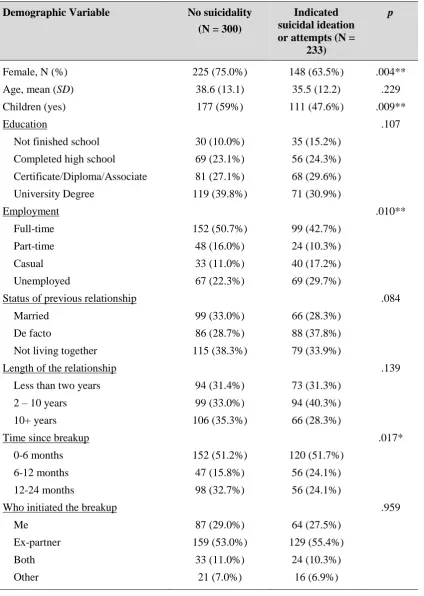
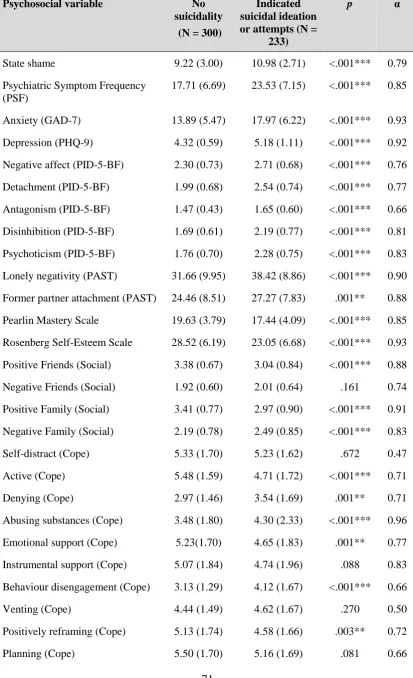
3.4.1. Sample characteristics and univariate associations with suicidal ideation 69 3.4.2. Factors predicting suicidal thoughts ... 71
3.5. Discussion ... 73
3.5.1. Factors associated with suicidal ideation ... 74
3.5.2. Factors associated with progression to suicide attempt ... 76
3.5.3. Implications for intervention ... 77
3.5.4. Clinical implications ... 79
3.5.5. Strength and limitations ... 81
3.6. Conclusion ... 82
Chapter 4. An examination of adjustment following a relationship separation and its link to suicidal ideation ... 84
4.1. Introduction ... 84
4.1.2. Adjustment following a relationship separation ... 84
4.1.3. Suicidality and relationship separation ... 86
4.1.4. Indicators of adjustment ... 87
4.1.5. Aims and scope of the study ... 88
4.2. Method ... 88
4.2.1. Participants ... 88
4.2.2. Procedure ... 89
4.2.3. Measures ... 90
4.2.4. Statistical analyses ... 91
4.3. Results ... 92
4.3.1. Hardest thing to deal with since the relationship separation ... 96
4.3.2. What, if any, have been the benefits since your relationship separation? 97 4.3.3. What information or strategies do you think would help support a person experiencing a relationship separation? ... 99
4.4. Discussion ... 100
4.4.1. Future directions ... 104
4.4.2. Limitations ... 105
4.5. Conclusion ... 106
Chapter 5. A systematic review of controlled trials evaluating interventions following non-marital relationship separation ... 108
5.1. Introduction ... 108
5.1.2. Separation of non-marital relationships ... 108
5.1.3. Previous research ... 109
5.1.4. Aims and scope of this study ... 111
5.2. Method ... 112
5.2.1. Search and screening procedures ... 112
5.3. Results ... 115
5.3.1. Trial and program characteristics ... 118
5.3.2. Intervention efficacy ... 123
5.4. Discussion ... 124
5.4.1. Limitations ... 126
5.4.2. Implications for future research ... 127
5.5. Conclusion ... 128
xii
6.1. Introduction ... 131
6.2. Podcast intervention ... 132
6.3. Interpersonal Psychotherapy and relationship separation ... 138
6.4. Interpersonal Psychotherapy and suicidality ... 140
6.5. Adapting Interpersonal Psychotherapy to an online context ... 144
6.5.1. Interpersonal Counselling (IPC) ... 146
6.5.2. Brief Interpersonal Psychotherapy (IPT-B) ... 148
6.6. Conclusion ... 150
Chapter 7. MindCast: A randomised controlled trial of a podcast intervention for relationship separation ... 153
7.1. Introduction ... 153
7.1.1. Previous intervention research ... 153
7.1.2. Aims and scope of this study ... 155
7.1.3. Theoretical framework for the intervention... 156
7.1.4. Hypotheses... 156
7.2. Method ... 157
7.2.1. Participants ... 157
7.2.2. Recruitment ... 158
7.3. Procedure ... 160
7.3.1. Registration and ethical approval ... 161
7.3.2. Intervention delivery and survey data collection ... 161
7.3.3. MindCast intervention condition ... 164
7.3.4. Control condition ... 170
7.3.5. Internet based surveys ... 170
7.4. Trial outcome measures ... 170
7.4.1. Demographic information... 171
7.4.2. Primary outcome measures ... 173
7.4.3. Secondary outcome measures ... 174
7.4.4. Evaluation outcomes ... 177
7.5. Statistical analysis ... 178
7.5.1. Missingness and pre-intervention comparisons ... 178
7.5.2. Primary and secondary outcomes measures ... 178
7.5.3. Power calculations ... 179
7.5.4. Effect size ... 179
7.6. Results ... 180
7.6.1. Respondent characteristics ... 180
7.6.2. Missingness at post-intervention and follow-up ... 184
7.6.3. Pre-intervention comparisons ... 185
7.6.4. Observed means for primary and secondary outcomes ... 185
7.7. Intervention effects ... 188
7.7.1. Primary outcomes ... 188
7.7.2. Secondary outcomes ... 191
7.7.3. Adherence and satisfaction ... 197
7.8. Discussion ... 200
7.8.1. Summary of findings ... 201
7.8.2. Strengths and limitations ... 209
7.9. Conclusions ... 211
Chapter 8. Summary and conclusions... 214
8.1. Summary of research findings ... 214
xiii
8.3. Limitations of the study ... 218
8.4. Future research ... 219
8.4.1. Direct extensions of the study ... 219
8.4.2. Broader issues for future research ... 221
8.5. Conclusions ... 222
References ... 224
Appendices ... 263
Appendix 1.Recruitment material used in the cross-sectional survey ... 263
Appendix 2.Participant information page and online consent form for the cross-sectional survey... 264
Appendix 3.Ethics approval for the cross-sectional survey ... 268
Appendix 4.Cross-sectional survey ... 269
Appendix 5.Centre for Mental Health Research webpage ... 279
Appendix 6.Facebook community page ... 280
Appendix 7.Facebook advertising ... 281
Appendix 8.Ethics approval for the MindCast intervention ... 284
Appendix 9.Online participant information/consent form – MindCast RCT ... 285
Appendix 10.Redirected page for participants who did not fulfil inclusion criteria ... 290
Appendix 11.Screenshot of internet-based podcast intervention ... 294
Appendix 12.Scripts for the six MindCast podcast episodes... 296
Appendix 13.Measures used after each podcast session... 314
Appendix 14.Intervention invitation/reminder emails ... 317
Appendix 15.Ethics approval for variation request ... 322
xiv
List of Tables
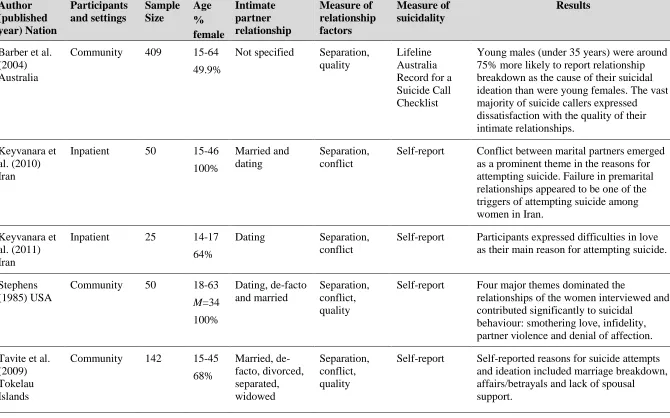
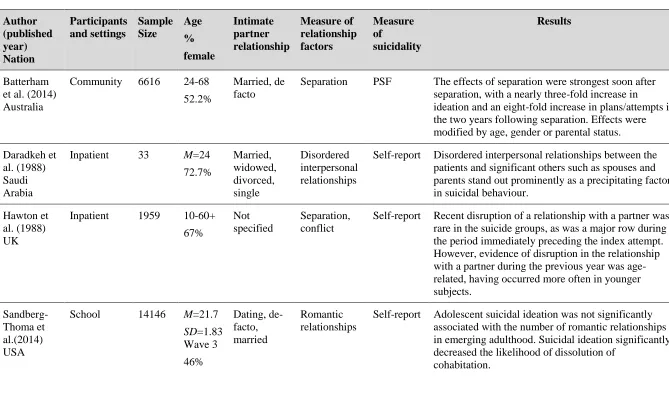
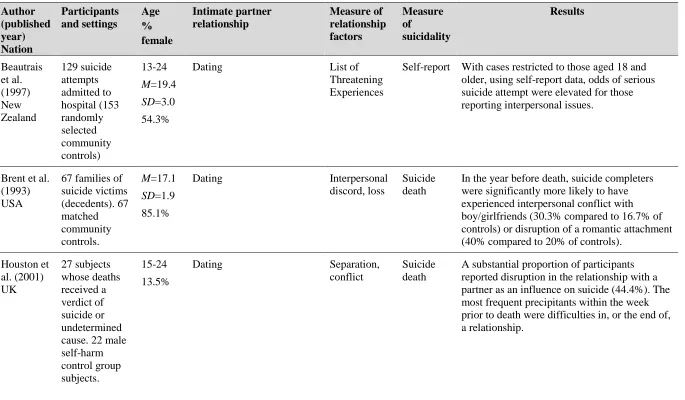
Table 2.1. Retrospective studies of intimate partner relationships and suicidality .. 22
Table 2.2. Cross-sectional studies of intimate partner relationships and suicidality 27
Table 2.3. Qualitative studies of intimate partner relationships and suicidality ... 30
Table 2.4. Longitudinal and prospective studies of intimate partner relationships and suicidality ... 31
Table 2.5. Case-control and case crossover studies of intimate partner relationships and suicidality ... 33
Table 3.1. Demographic characteristics by presence or absence of suicidal thoughts or behaviours ... 58
Table 3.2. Mean and standard deviation of psychosocial variables by presence or absence of suicidal thoughts or behaviours... 70
Table 3.3. Final model as identified in a stepwise logistic regression exploring predictors of suicidal ideation following relationship separation ... 72
Table 3.4. Final model as identified in a stepwise logistic regression exploring predictors of suicidal ideation versus suicide attempt following relationship
separation ... 73
Table 4.1. Demographic characteristics by presence of absence of suicidal thoughts or behaviours ... 89
Table 4.2.Thematic categories representing participant responses regarding the hardest aspect to deal with since the relationship separation ... 93
Table 4.3.Thematic categories representing perceived benefits since the relationship separation ... 94
Table 4.4.Thematic categories representing information or strategies that would help support a person experiencing a relationship separation ... 95
Table 4.5.Hardest aspect of the relationship separation by gender and presence or absence of suicidal thoughts ... 96
Table 4.6.Perceived benefits of the relationship separation by gender and presence or absence of suicidal thoughts ... 98
Table 4.7.Recommended information and strategies following a relationship
separation by gender and presence or absence of suicidal thoughts ... 99
xv
Table 5.2.Quality rating criteria met by each study using the Cochrane effective
practice and organisation of care (EPOC) guidelines ... 122
Table 7.1.Content of the MindCast program ... 168
Table 7.2. Outcome measures employed at each measurement time point ... 171
Table 7.3. Demographic measures in the baseline questionnaire ... 172
Table 7.4. Respondent age and gender ... 180
Table 7.5. Sample characteristics based on presence or absence of suicidal ideation ... 183
Table 7.6.Observed means and standard deviations for depression (PHQ-9) and suicidal ideation (SIDAS) at each measurement occasion as a function of condition ... 186
Table 7.7.Observed means and standard deviations for the secondary outcomes at each measurement occasion as a function of condition ... 187
Table 7.8.Frequency of participants reporting suicidal ideation across conditions and measurement occasions using SIDAS scores ... 191
xvi
List of Figures
Figure 1.1. Assumptions of the Interpersonal Theory of Suicide ... 6
Figure 1.2. Interpersonal Triad... 7
Figure 1.3. Stages of the thesis project ... 15
Figure 2.1. PRISMA flow diagram ... 20
Figure 5.1. PRISMA flow diagram ... 114
Figure 7.1. Flow of participants through the trial ... 160
Figure 7.2. Flow-chart of progression through the trial ... 163
Figure 7.3. Mixed model repeated measure estimates for depression ... 189
Figure 7.4. Mixed model repeated measure estimates for suicidal ideation ... 190
Figure 7.5. Mixed model repeated measure estimates for thwarted belongingness 192 Figure 7.6. Mixed model repeated measure estimates for perceived burdensomeness ... 193
Figure 7.7. Mixed model repeated measure estimates for benefit finding ... 194
Figure 7.8. Mixed model repeated measure estimates for former partner attachment ... 195
Figure 7.9. Mixed model repeated measure estimates for lonely negativity ... 196
1
Chapter 1. Introduction and rationale
1.1. IntroductionSuicide is currently the leading cause of death for Australians aged between 15
and 44 years (Australian Bureau of Statistics [ABS], 2016a), and is the second
leading cause of death globally among 15 to 29-yearolds (World Health Organisation
[WHO], 2015). Australia’s suicide rate (approximately 11 per 100,000) exceeds that
of a number of European countries including the United Kingdom, Spain and the
Netherlands (WHO, 2014), and is more common than deaths from motor vehicle
accidents or skin cancer (Aleman & Denys, 2014). Each year over 3,000 people die
from suicide in Australia and more than 65,000 make an attempt (Christensen, 2016).
In Australia, approximately 13.3% of adults experience suicidal thoughts at some
stage in their lives, 4.0% make a suicide plan, and approximately 3.2% of adults
attempt suicide (Johnston, Pirkis, & Burgess, 2009; van Spijker et al., 2015). The
present value of the economic costs of suicide and non-fatal suicidal behaviour in the
Australian workforce is estimated at $6.73 billion (Kinchin & Doran, 2017). Based
on the estimated number of suicides, and the approximate costs per suicide, the total
direct economic cost (coronial enquiries, police and ambulance services and
counselling) and indirect economic cost (income a person would have received from
the age of death until retirement) was $1.7 billion for 2012, with approximately 90%
of the total economic cost of suicide attributable to male suicide (KPMG Health
Economics, 2013).
The World Health Organisation has found that suicides often occur impulsively
and in reaction to a moment of crisis, resulting in a breakdown in the ability to deal
with life stressors (WHO, 2015). An experience of a recent negative life event (i.e.,
in the last 6 to 12 months) can be perceived as a precipitating event, a risk factor and
2
2014). An experience of a negative life event can be an unexpected change in a
person’s situation, an actual or threatened loss, or failure at home or at work
(Wasserman, 2016). Examples of common negative life events include financial
problems, family/relational discord, unemployment, separation and illness
(Wasserman, 2016). Individuals have reported to experience increased odds of
attempting suicide soon after experiencing a negative life event, driven by the
presence of an interpersonal negative life event, specifically those involving a
romantic partner (Bagge, Glenn, &Lee, 2013).
A relationship breakdown can be classified as a significant negative life event
with relationship separation contributing significantly to suicidal thoughts and
behaviours (Kazan, Calear, & Batterham, 2016). Even though Australia’s divorce
rate (approximately 1.9 per 1,000 estimated resident population) has declined since
the 1980s (approximately 2.7 per 1,000 estimated resident population) (ABS, 2016b),
divorce continues to be a feature of Australian social life with 32% of current
marriages expected to end in divorce, which is predicted to rise to 45% over the next
few decades (Baxter& Hewitt, 2014; Carmichael, Webster, & McDonald, 1997).
There have been significant changes to the characteristics of marriage with most
Australians choosing to cohabit before marriage (80.8%), with the rate of marriage
declining (6.1 marriages per 1,000 people in 1995, to 5.2 in 2014 and 4.9 in 2016)
(ABS, 2016b). Data gathered by The Household, Income and Labour Dynamics in
Australia (HILDA) survey indicated that cohabitating relationships that do not end in
marriage have a higher likelihood of dissolution (69.3%; Baxter & Hewitt, 2014).
Baxter and Hewitt (2014) reason that many of the marriages that may have ended in
the first few years of marriage have been replaced by cohabitating relationships.
Further, research comparing cohabitating relationships across Europe found that
3
Wiik, Keizer, & Lappegård, 2012). Although many people appear to adjust to their
circumstances following a separation, a proportion of the population will experience
mental and physical health difficulties (Baxter & Hewitt, 2014; Halford & Sweeper,
2012). There is significant heterogeneity in individual adjustment following a
separation which provides continued opportunity for researchers to better understand
the process across the population (Amato, 2010; Knöpfli, Morselli, & Perrig-Chiello,
2016).
There is a paucity of research available which details the progression from
relationship separation to suicidality, and no published research exists which
explores psychosocial interventions designed to support individuals who may be at
risk of suicidal thoughts and behaviours following a relationship separation (Kazan,
Calear, & Batterham, 2017). Population-based interventions need to fill the gap
created by low levels of help-seeking for suicidality. Significant barriers to help
seeking by suicidal individuals include stigma, shame, access and recognition of
need (Czyz, Horwitz, Eisenberg, Kramer, & King, 2013; Hom, Stanley, & Joiner,
2015; Reynders, Kerkhof, Molenberghs, & Van Audenhove, 2016). Mental health
service use among individuals with suicidal thoughts and behaviour is low (Hom et
al., 2015). However, research has suggested that increasing low-cost options and
leveraging web-based treatment modalities may improve treatment engagement
among these individuals (Hom et al., 2015). As a relationship separation is a
ubiquitous, cross-cultural experience, online treatment options may serve as socially
acceptable gateways to accessing support designed to reduce the risk of increased
suicidal thoughts or behaviours.
1.1.1. Relationship separation and suicidality
For the purpose of maintaining a consistent definition for primary terms used
4
interpersonal relationship between heterosexual and same-sex spouses, girlfriends or
boyfriends (current and former) that involves physical and emotional intimacy.
Separation involves the dissolution of the intimate partner relationship between non-cohabiting, cohabiting or marital partners. Suicidal ideation is defined as “thinking about, considering, or planning suicide”, suicidal behaviour as “a non-fatal, self-directed, potentially injurious behaviour with intent to die as a result of the
behaviour” and suicide as “death caused by self-directed injurious behaviour with intent to die as a result of the behaviour” (Centers for Disease Control and
Prevention [CDC], 2016).
A link between relationship separation and suicidality has been established in
the literature (Batterham et al., 2014; Fieldsend & Lowenstein, 1981; Heikkinen et
al., 1992a, 1992b; Ide, Wyder, Kõlves, & De Leo, 2010; Kõlves, Ide, & De Leo,
2011, 2012; Wyder, Ward, & De Leo, 2009). A systematic review examining the
possible role of separation on suicidal behaviours (Ide et al., 2010) highlighted the
lack of studies focusing on the impact of relationship separation on the development
of suicidal behaviour, and the interaction between psychosocial factors influencing
suicidality in the context of a marital and cohabitating separation. The review found
that divorce and separation contributed to an increased risk of suicide, particularly in
males (Ide et al., 2010). These findings supported earlier research which reported that
the acute stage of the relationship separation and relationship difficulties in general,
are strong risk factors for suicide (Wyder et al., 2009). There have been no other
studies which have identified factors within intimate partner relationships that
influence suicidal ideation, attempts and deaths, nor have there been any studies
which attempt to predict the factors (demographic and psychosocial) that influence
suicidal thoughts and behaviours following a relationship separation. Considering the
5
research, additional population-based research, and the development and trialling of
interventions designed to provide support for separated individuals are therefore
warranted.
1.1.2. Theoretical and therapeutic frameworks
Risk factors for suicidality can be viewed through a multifaceted perspective;
the idea that a multitude of factors combine to exacerbate vulnerability and limit
choice. Specifically, following a relationship separation, a sense of interpersonal
vulnerability is increased as an individual works to separate from the confines of the
relationship and re-establish equanimity. The increased interpersonal vulnerability
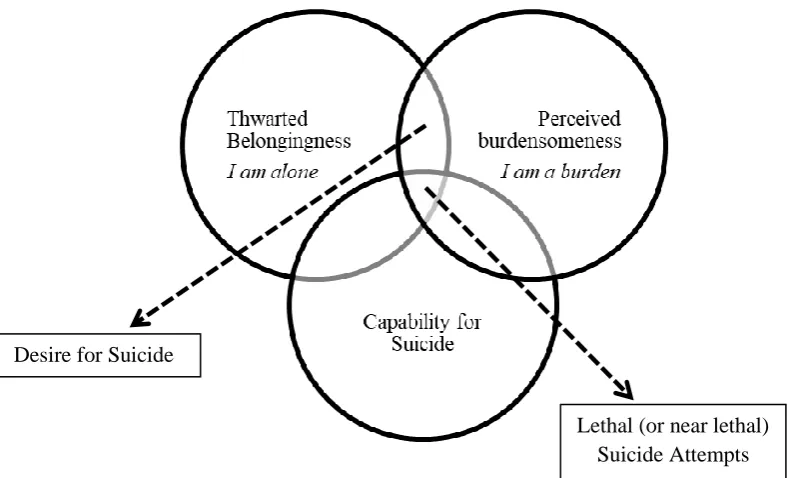
feeds into Joiner’s (2005) Interpersonal Theory of Suicide which proposes that in
order to develop a desire to die by suicide, individuals must hold two simultaneous
psychological mind-states; these two states being perceived burdensomeness and a
sense of thwarted belongingness or social alienation. Further, Joiner asserts that in
order to die by suicide the acquired capability to enact lethal self-injury must be
present (see figure 1.1). This capability allows an individual to overcome a sense of
self-preservation through the repeated experience of painful and otherwise
provocative events. The feeling that one does not belong to valued relationships or
groups (e.g., friends taking sides after a break-up) and the perception that one is a
burden on others (e.g., being the only single person in a friendship group/family), can
be hypothesised to be psychological consequences following a relationship
breakdown. Further, the repeated experience of low quality intimate relationships,
coupled with threats of or actual separation, may qualify as precipitating factors to
repeated events that may enable an individual to overcome a sense of
6
Figure 1.1. Assumptions of the Interpersonal Theory of Suicide
Interpersonal Psychotherapy (IPT) has been suggested as a suitable therapy
modality that can be modified to target the constructs of thwarted belongingness and
perceived burdensomeness (Van Orden, Talbot, & King, 2012). Interpersonal
Psychotherapy is a brief, attachment-focused therapy that centres on resolving
interpersonal problems to provide symptom relief and improve social functioning
within 12 to 16 weeks (Wurm, Robertson, & Rushton, 2008). To target recovery in a
shorter timeframe, Brief Interpersonal Psychotherapy (IPT-B) was developed as an
eight-session brief intervention (Swartz, Grote, & Graham, 2014). The key difference
is in the length of sessions and duration of intervention, with IPT-B reducing the
need for the standard 16 one-hour session framework. The rationale for IPT-B is to
provide an opportunity for time and resource poor individuals to access the benefits
of traditional IPT who may not necessarily be able to commit to a full 16-session
intervention. Both traditional IPT and IPT-B use the same theoretical concepts, with
IPT-B demonstrating therapeutic feasibility (Grote, Bledsoe, Swartz, & Frank, 2004;
Grote et al., 2009; Swartz et al., 2004; Swartz et al., 2008a). Figure 1.2 demonstrates
Desire for Suicide
7
the interconnectivity associated with an individual’s biopsychosocial and attachment
experience, an interpersonal crisis and a lack of social support. An IPT perspective
acknowledges that the interplay between these elements exacerbates individual
distress, and if left untreated, may lead to poor mental health outcomes. The link
between IPT and the Interpersonal Theory of Suicide is the focus on the
interpersonal, connective and social elements of the therapy. IPT focuses on social
problem-solving deficits and difficulties with interpersonal functioning. By
increasing awareness and understanding in these specific areas, it is hypothesised
that perceived burdensomeness and thwarted belongingness may be reduced, leading
to a reduction in suicidal ideation.
Figure 1.2. Interpersonal Triad
A case study illustrated by Van Orden et al. (2012) demonstrated that there is
potential to interweave specific IPT techniques and key constructs of the
Interpersonal Theory of Suicide to reduce suicidal ideation. The study applied IPT,
informed by the Interpersonal Theory of Suicide, to an older adult with elevated
suicide risk (increased suicidal ideation). The result from the individual case study
demonstrated the complete reduction of suicidal thoughts at the end of treatment and
at two-month follow-up(Van Orden, et al., 2012). Heisel, Talbot, King, Tu, and
Duberstein (2015), replicated this result in a pilot intervention adapting a 16-session
Acute Interpersonal Crisis
Attachment and Biopsychosocial Vulnerability
8
course of IPT for older adults at risk for suicide. The authors found that IPT can
feasibly be delivered to this suicidal population and may decrease and/or resolve
their suicidal ideation and depressive symptoms, and increase perceived meaning in
life, social adjustment and perceived social support (Heisel, Duberstein, Talbot,
King, & Tu, 2009; Heisel et al., 2015).
The function of IPT is to focus on interpersonal issues in order to achieve
improved interpersonal functioning and increased social support (Weissman, 2015).
This therapeutic intervention is based on attachment theory and has a strong evidence
base in its treatment of depression (Law, 2011; Wurm et al., 2008). No existing work
has adapted IPT-B for use within relationship separation and suicidal populations.
These populations may benefit from access to a therapy that focuses on interpersonal
functioning, social cohesion and delivers benefits in a time-limited manner (Law,
2011). Inconsistencies in research on separation adjustment likely reflects limitations
within methodologies and requires further study to explore whether psychological
interventions, like IPT-B, can target correlates of distress (e.g., low social support) to
enhance recovery from a relationship separation (Halford & Sweeper, 2013).
1.1.3. Adjustment to a relationship separation
The experience of a relationship separation is not uniform across individual
circumstances. There exists significant variability in how an individual reacts, copes
with and adjusts to the separation. Individuals may experience feeling angry, hurt,
frustrated, resentful, lonely and/or depressed following a relationship separation
(Frazier & Cook, 1993; Sprecher, 1994). However, separation may also be an
opportunity for personal growth with the experience potentially improving the
quality of future romantic relationships (Tashiro & Frazier, 2003). Relationship
separations differ from other distressing events in that most people will be exposed to
9
(Tashiro & Frazier, 2003). As relationship separations may be a primary impetus for
seeking help through more formalised counselling channels, understanding the
correlates of distress following relationship separation has important clinical
implications.
Within the relationship literature, the trajectory of adjustment to separation
suggests that adjustment issues are similar for both formerly married, cohabitating
and dating couples, with low social support and high anxious attachment predicting
continued attachment to the former partner, loneliness and psychological distress
(Davis, Shaver, & Vernon, 2003;Halford & Sweeper, 2013). Research has identified
that most people in the population display a resilient response to a separation
(Perrig-Chiello, Hutchison, & Morselli, 2015; Sbarra, Hasselmo, & Bourassa, 2015),
however, approximately 15% to 20% will experience difficulties in adjustment once
their relationship comes to an end (Mancini, Bonanno, & Clark, 2011). For
approximately 6 out of 10 people with a history of major depressive disorder, a
divorce may trigger a subsequent depressive episode (Sbarra et al., 2015). Further, in
a general population sample, in the two years following separation participants had a
three-fold increase in their odds of suicidal ideation and an eight-fold increase in
their odds of suicide plans/attempts (Batterham et al., 2014).
1.1.4. Online interventions and mental health
The development of an intervention which focuses on a relationship
separation as the rationale for help-seeking is influenced by research showing that
suicidal individuals may not always recognise that they have a problem (Czyz et al.,
2013; Hom et al., 2015), with seeking treatment negatively affected by a low
perceived need of support (Bruffaerts et al., 2011). Further, preference for
10
providers and stigma combine to justify the use of online mental health options (Hom
et al., 2015).
The use of web-based interventions to influence health behaviour change is
not new. There is evidence to suggest that web-based tailored intervention programs
provide differential benefits in improving health outcomes across a variety of
medical conditions and patient populations (Lustria et al., 2013). The efficacy of
web-based interventions for mental health problems has been evidenced by a large
number of trials exploring depression, anxiety, substance use, psychosis and
insomnia(Alvarez-Jimenez et al., 2014; Arnberg, Linton, Hultcrantz, Heintz, &
Jonsson, 2014; Cheng & Dizon, 2012; Christensen, Batterham, & Calear, 2014;
Deady, Mills, Teesson, & Kay-Lambkin, 2016; Tait, Spijkerman, & Riper, 2013).
In the area of suicide prevention, a number of studies have reviewed existing
research suggesting that internet-delivered programs have the potential to produce
positive outcomes for individuals with suicide risk (Christensen, Batterham, &
O'Dea, 2014; Jacob, Scourfield, & Evans, 2014). There is also evidence to suggest
that the specific targeting of suicidal content, rather than the associated symptoms,
may be more effective (Christensenet al., 2014). However, studies have highlighted
the paucity of current evidence for online and mobile interventions for suicide
prevention (Larsen, Nicholas, & Christensen, 2016; Perry et al., 2015). The existing
literature supports the continued development and evaluation of empirical evidence
to determine the effectiveness of online novel approaches to improving suicide
outcomes in the community.
There is limited research on the applicability of adapting IPT to an online
format. Although, internet delivered IPT self-help interventions for depression are
shown to be effective (Cuijpers et al., 2011; Donker et al., 2013), there is a limited
11
applied to broader populations. From the small selection of studies available, a
mobile phone adaptation of IPT was found to demonstrate significant improvements
on a scale of social anxiety (d = 0.43). However, the mobile version of Cognitive Behavioural Therapy (mCBT) performed significantly better (between group d = 0.64) (Dagöö et al., 2014). Although the results are interpreted with caution, the
authors concluded that CBT provides more psychoeducation information regarding
social anxiety when compared with IPT, which may have led to overall improvement
(Dagöö et al., 2014). A randomised controlled trial examining IPT and CBT found
that younger people appeared to prefer IPT to the CBT-based intervention with the
study indicating that internet delivered self-guided IPT is effective in reducing
depressive symptoms (d = 0.76) (Donker et al., 2013). The high responsiveness from a younger age group may be related to a higher level of perceived interpersonal
conflict during adolescence and emerging adulthood, which aligns with the key IPT
treatment modalities (Donker et al., 2013; Tang, Jou, Ko, Huang, & Yen, 2009).
There appears to be an opportunity to demonstrate the potential efficacy of an
IPT-based online intervention for separated individuals that reduces cost and accessibility
barriers and focuses on key areas of adjustment.
There are many advantages to internet interventions, when compared with
face-to-face intervention, including reduction of overall costs, maintenance of
program fidelity through automation, simplification of outcome and progress
monitoring and the fact that interactivity and visual attractiveness may increase
adherence (Calear & Christensen, 2010; Khanna, Aschenbrand, & Kendall, 2007).
However, the lack of portability, restricted delivery and expected levels of high
literacy can be perceived as barriers to facilitating widespread use (Turner-McGrievy
et al., 2009). Further, an issue with adherence to treatment may also stem from the
self-12
directed interventions (Newman, Szkodny, Llera, & Przeworski, 2011). New
technologies including Skype or Voice over Internet Protocol (VoIP) have offered
therapists a wider variety of options for distal contact with clients, but this type of
intervention is difficult to deliver at scale(Newman et al., 2011). A gap in service
delivery exists which suggests that people may prefer a level of engagement and
rapport with a health care provider but also be able to have the time and space to
work through an intervention on their own terms. To further address the gap in terms
of population reach, the use of audio podcasts might offer a novel solution, providing
users with a sense of human contact using a highly scalable format.
1.2. The present study
1.2.1. Aims
The area of relationship separation research, while broad, has tended to focus on
divorce, forgiveness and adjustment, with less emphasis on health outcomes. There
exists a paucity of research that explores the relationship between suicidality and
separation and even less focusing on accessible interventions for separated
individuals. To date, no intervention has explored suicidality as an outcome for a
separation intervention (Kazan et al., 2017). With relationship separation being a
seminal life event for a significant proportion of the population, there exists a need to
develop intervention strategies that will support people who have experienced a
relationship separation and are at risk of developing suicidal thoughts and/or
behaviours. The program of work described in this thesis primarily aimed to:
1. Identify and synthesise existing evidence on the impact and influence of
intimate partner relationships on suicidality, specifically how relationship
13
2. Measure and explore psychosocial and relationship factors that are associated
with suicidal ideation and suicide attempts in a large sample of separated
Australian adults.
3. Examine existing relationship separation interventions, focusing on mental
health and suicide prevention outcomes.
4. Determine the feasibility and effectiveness of a new web-based, audio
podcast intervention based on IPT-B to improve adjustment for adults who
have recently separated from an intimate partner relationship.
The current study will be the first to explore the applicability of a brief
version of IPT in targeting the constructs of thwarted belongingness and
perceived burdensomeness to reduce suicidal ideation in a separated population.
1.2.2. Structure of the thesis
A mixed methods approach was utilised in the compilation of this thesis
including two systematic reviews focusing on existing publications and qualitative
and quantitative primary research. The structure of this thesis is presented in Figure
1.3. Following the introduction (Chapter 1), the thesis explores the impact of intimate
partner relationships on suicidal thoughts and behaviours through a systematic
review of existing literature (Chapter 2). Next, a cross-sectional survey was
developed and implemented, with the following chapter exploring factors predicting
suicidal thoughts and behaviours following a relationship separation (Chapter 3).
Chapter 4 analyses the qualitative data generated by the cross-sectional survey and
examines adjustment following a relationship separation and its link to suicidality.
Considering the findings derived from the initial review and cross-sectional results,
the following chapter uses a systematic approach to highlight the lack of available
interventions for individuals separated from a non-marital relationship (Chapter 5).
14
the rationale behind the development of an online mental health intervention using
IPT-B and podcast audio technology. Chapter 7 investigates the effectiveness of this
web-based, audio podcast intervention to improve adjustment for Australian adults
who have recently separated from an intimate partner relationship. This chapter also
outlines the effects of the intervention on primary outcomes (suicidal ideation and
depression), as well as secondary outcomes (interpersonal needs, benefit finding,
adjustment, and attitudes toward professional help-seeking). The final chapter
(Chapter 8) provides a synthesis of the thesis findings. Limitations and directions for
15
Stage 1:
Chapter 2
Systematic review of the impact of relationships on suicidal thoughts and behaviours
Stage 2:
Chapter 3
Cross-sectional study exploring predictors of suicidal thoughts and behaviours after a separation
Chapter 4
Cross-sectional study exploring qualitative adjustment to separation and link to suicide
Stage 4:
Chapter 6
Rationale for the development of an online audio podcast intervention
Stage 5:
Chapter 7
Randomised controlled trial of online podcast intervention for relationship separation
Stage 3:
Chapter 5
[image:33.595.216.494.65.654.2]Systematic review of trials evaluating intervention following non-marital separation
17
Chapter 2. The impact of intimate partner relationships on
suicidal thoughts and behaviours: A systematic review
2.1. Introduction
Intimate partner relationships are an integral factor in the lives of many
individuals, influencing the dynamic interplay between individual mental health and
overall well-being (Whisman & Baucom, 2012). Just below half (48.1%) of the
Australian population, aged 15 years and older, are married (ABS, 2016b)while the
proportion of persons cohabiting has increased progressively from 6% in 1986 to
16% in 2011 (Australian Institute of Family Studies [AIFS], 2014). For Australian
adults aged 18 and over, 84% have had at least one intimate partner relationship
(ABS, 2009) The United States of America reported a marriage rate of 6.9 per 1000
and a divorce rate of 3.2 per 1000 in 2014(CDC, 2014), with an increase of 14% in
the rate of cohabitation since 1995 to 2010 (Copen, Daniels, Vespa, & Mosher,
2012). In comparison, demographic data for the European Union shows that there
has been a decline in the crude marriage rate, while the number of divorces has
increased (Eurostat, 2014). Further, the proportion of births outside of marriage has
increased across the European Union with an approximate 12% increase in births
since 2000 (Eurostat, 2014). Although it is clear that trends in couple formation have
changed dramatically over the twentieth century, the constant nature of the formation
and dissolution of intimate partner relationships is a perpetual feature in the
community landscape.
The purported association between suicidality and intimate partner
relationships is grounded in empirical research that documents the influence of
relationship factors on suicidality. For instance, studies have shown that low quality
18
1992), interpersonal conflict (Choi et al., 2013) and separation and/or divorce
(Wyder et al., 2009) are common precipitating factors to suicide.
Researchers have increasingly found that spouse or partner negative life
events contribute significantly to suicidality (Bagge et al., 2013). Specifically, the
effect of a relationship separation has been shown to have a significant increase in
suicidal ideation and plans and/or attempts in the two years following separation
(Batterham et al., 2014), with the risk particularly high for males aged 15 to 24 years
(Wyder et al., 2009). These results are significant as the divorce rate in Australia is
highest in the under 30 age group for both men and women (Weston & Qu, 2013),
comparatively the average age for a first divorce in America is 30 years (Copen et
al., 2012).
The influence that a positive intimate partner relationship has on reciprocal
mental health states can be significant. Studies have demonstrated that marital
quality is positively associated with subjective well-being (Carr, Freedman,
Cornman, & Schwarz, 2014), and that positive romantic relationships influence
physical health (Robles & Kiecolt-Glaser, 2003) and can be psychologically
protective (Bookwala & Schulz, 1996; Markey, Markey, & Gray, 2007). However,
relationship discord is associated with the onset or maintenance of mental health
problems, including depression (Whisman & Uebelacker, 2009) and subsequently
poorer treatment outcomes (Whisman, 2013).
2.1.1. Aims and scope of this study
Several systematic reviews have been conducted to investigate specific
elements of intimate partner relationships that are associated with suicidality,
including intimate partner violence and abuse (Devries et al., 2013; McLaughlin,
O'Carroll, & O'Connor, 2012) and separation(Ide et al., 2010). No review, however,
19
suicidality. The current systematic review aims to identify the factors within intimate
partner relationships that influence suicidal ideation, attempts and completion.
Potential differences in gender, age and relationship status will also be explored. This
review aims to assist in identifying gaps in the research literature and isolate
potential targets for suicide prevention research in this area.
For the purpose of this review, a broad definition of intimate partner
relationships was adopted to capture the multifaceted nature of these relationships.
As such, an intimate partner relationship is defined as: An interpersonal relationship
between heterosexual and same-sex spouses, girlfriends or boyfriends (current and
former) which involves physical or emotional intimacy.
2.2. Method
2.2.1. Search and screening procedures
A systematic review of the literature was conducted to identify published
studies that explore intimate partner relationships in the context of suicidality.
Scopus, PubMed and PsycINFO databases were electronically searched, up to
October 2014, with one or more of the following sets of terms: (i) partner
relationship or intimate relationship or personal relationship or romantic relationship
or dating AND suicid*; (ii) marriage or marital or divorce or separt* or relationship
breakup or spouse AND suicid*; (iii) love or relationship disruption or relationship
difficult* or relationship problem* AND suicid*. The titles and abstracts of the 9321
articles initially identified by these searches were screened by the author (DK) to
determine their relevance to the review. Completely irrelevant articles that were
unrelated to the topic of this review (i.e., that did not discuss intimate partner
relationships or suicide) were excluded at this stage, while relevant studies and
20
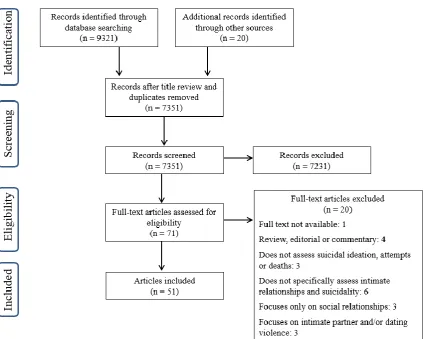
obtained from reference list searches. Figure 2.1 presents a flowchart detailing the
[image:38.595.66.490.119.458.2]review process.
Figure 2.1. PRISMA flow diagram 2.2.2. Study selection
The inclusion criteria for the current review included (i) measurement of
intimate partner relationship factors (i.e., separation, conflict, and/or quality); (ii)
measure of suicidal behaviours (ideation, plan, attempt and/or completion); (iii)
tested the association between intimate partner relationships and suicidality; and (iv)
the article was published in a peer-reviewed English language journal. Articles
exploring intimate partner abuse and violence were excluded from the current review
due to the recency of two systematic reviews (Devries et al., 2013; McLaughlin et
al., 2012) explicitly exploring the relationship between these two factors. Articles
21
other general types of relationships (e.g., family, social or professional). Studies that
fulfilled the inclusion criteria were coded by the author and one of three independent
reviewers, with all relevant data collected and recorded.
2.3. Results
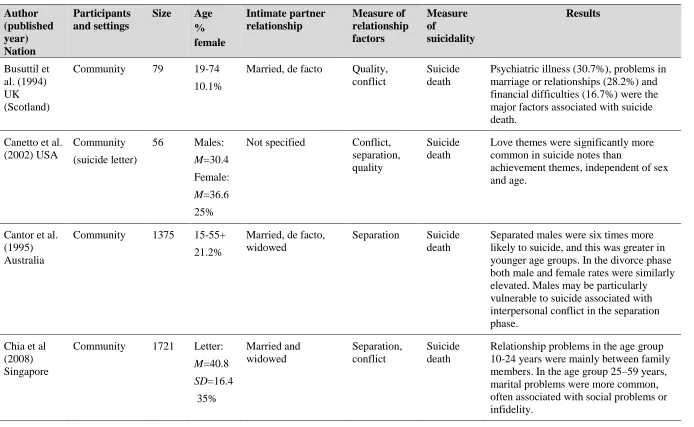
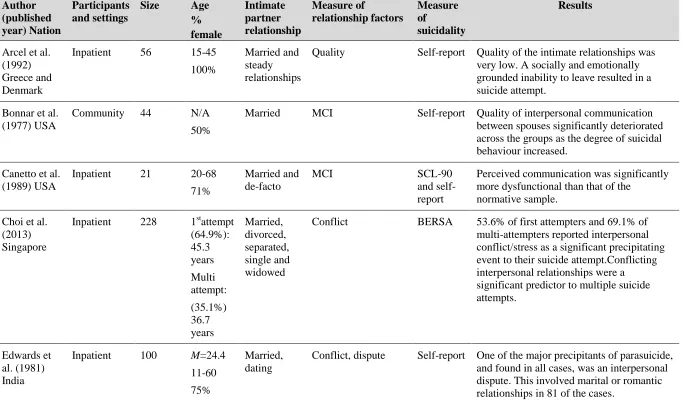
Overall, 51 empirical studies were identified that fulfilled the inclusion
criteria. Of these, 18 (35%) were retrospective studies, 15 (29%) were
cross-sectional, five (10%) were qualitative, five (10%) were longitudinal or prospective
and eight (16%) were case control or case crossover studies (see Tables 2.1, 2.2, 2.3,
2.4, and 2.5). Due to the heterogeneity among the included studies, analysis of the
data was completed in the form of a narrative synthesis. This approach is considered
appropriate for synthesizing the results of studies with disparate study designs and
aims (Hilari, Needle, & Harrison, 2012; Popay et al., 2006). The themes were
extracted according to key words used to describe the measure of relationship factors
located within the reviewed articles. The themes were ordered to depict the
22
Table 2.1. Retrospective studies of intimate partner relationships and suicidality
Author (published year) Nation Participants and settings
Size Age
% female Intimate partner relationship Measure of relationship factors Measure of suicidality Results Busuttil et al. (1994) UK (Scotland)
Community 79 19-74 10.1%
Married, de facto Quality, conflict
Suicide death
Psychiatric illness (30.7%), problems in marriage or relationships (28.2%) and financial difficulties (16.7%) were the major factors associated with suicide death.
Canetto et al. (2002) USA
Community (suicide letter)
56 Males:
M=30.4 Female:
M=36.6 25%
Not specified Conflict, separation, quality
Suicide death
Love themes were significantly more common in suicide notes than
achievement themes, independent of sex and age.
Cantor et al. (1995) Australia
Community 1375 15-55+ 21.2%
Married, de facto, widowed
Separation Suicide death
Separated males were six times more likely to suicide, and this was greater in younger age groups. In the divorce phase both male and female rates were similarly elevated. Males may be particularly vulnerable to suicide associated with interpersonal conflict in the separation phase.
Chia et al (2008) Singapore
Community 1721 Letter:
M=40.8 SD=16.4 35% Married and widowed Separation, conflict Suicide death
23 Author (published year) Nation Participants and settings
Size Age
% female Intimate partner relationship Measure of relationship factors Measure of suicidality Results Cupina (2009) New Zealand Community (retrospective)
70 18-65
M=39.1
SD=12.3 51.4%
Not specified Separation, conflict
Self-report For 86% of women and 85% of men, separation from their partners and relationship conflicts were the main stressors precipitating suicidal behaviours. No gender differences in suicidal behaviours.
Davis et al. (2009) USA Community (suicide letter) 53 (USA) 264 (AUS) Not specified Married, widowed, de facto
Quality Suicide death
Those under age 30 were almost twice as likely to die by suicide in response to perceived relationship inequity, whereas those over 65 seldom mentioned
relationship inequities as a reason for dying by suicide. Relationship based suicides were the highest among those who were either separated or divorced. Heikkinen et
al. (1992)a Finland
Community 400 Not specified 21%
Dating, de facto, married
Separation Suicide death
Separation during the preceding three months was the life event most often perceived as precipitating the suicide. In 68% these cases, the partners also rated it as a precipitant. When death and/or separation were condensed into a broader category of interpersonal loss, men had more often encountered such losses during the last three months. Heikkinen et
al. (1992)b Finland
Community 388 Not specified 21.4%
Dating, de facto, married
Separation, conflict
Suicide death
Interpersonal losses and conflicts were regarded as precipitant stressors during the lifetime of 40% of male and 35% of female suicides. Separation and
24 Author (published year) Nation Participants and settings
Size Age
% female Intimate partner relationship Measure of relationship factors Measure of suicidality Results
stressors for younger men than older men whereas, no significant age differences were found in these stressors among women.
Kaplan et al. (2012) USA
Veterans 8440 18-65+ 0%
Married, single Conflict Suicide death
Nearly one of every two younger veteran suicide decedents (18 - 34 years)
experienced relationship problems shortly before death. By contrast, older veteran decedents were more likely to have had health problems.
Karch et al. (2013) USA
Community 1046 10-17 24.8%
Dating Conflict Suicide death
Intimate partner problems were evident for more than 25% of decedents.
However, intimate partner problems were not significantly associated circumstances of suicide.
Kurtaş et al. (2012) Turkey
Community (suicide letter)
51 16-72
M=29.9
SD=13.6 45.1%
Dating, de facto, married, widowed
Separation, conflict
Suicide death
The most common event was separation from a spouse or a lover, being cheated on or disagreement (25.5%). In letters written by males, suicide was mostly related to financial problems, while for women it related to interpersonal relationship problems with a spouse or boyfriend.
Lester et al. (2004) Australia
Community (suicide letter)
262 M=41.9
SD=17.3 25.2%
Not specified Not specified Suicide death
25 Author (published year) Nation Participants and settings
Size Age
% female Intimate partner relationship Measure of relationship factors Measure of suicidality Results
from pain and less often had love/romantic problems.
Logan et al. (2011) USA
Community 28703 Not specified
Intimate partner Conflict Suicide death
Many decedents had a recent crisis with interpersonal or other relationship
problems in the absence of having known mental health conditions, as indicated by classes 7 (criminal legal crises) and 8 (interpersonal crises). Further, class 7 had the highest proportion of decedents younger than 20 years.
Martin et al. (2013) USA
Community 100 19-59
M=31.6 SD=8.4 6% Married, divorced, single Conflict, separation, infidelity
SDIT In the 24 hours prior to suicide 34% experienced the end of a romantic relationship, 31% an argument with spouse, 17% argument with a significant other, 9% infidelity of a spouse, 5% infidelity of the decedent and 2% physical fight with the spouse. The odds that a decedent had interpersonal conflict in the 24 hours prior to death were over twice as high among married individuals. Séguin et al.
(2014) Canada
Community 214 M=37 15%
Married, de facto, divorced, single
Separation Suicide death
Individuals in one trajectory (high adversity, died earlier) were more likely to have ended a love relationship than those in another trajectory (lower burden of adversity).
Shiner et al. (2009) UK
Community 100 M=46 20%
Married, de facto, divorced, single
Separation Suicide death
26 Author (published year) Nation Participants and settings
Size Age
% female Intimate partner relationship Measure of relationship factors Measure of suicidality Results adults/men. Runyan et al.
(2003) USA
Community 882 15-89
M=41 100%
Married,
separated/divorced, widowed, single
Conflict Suicide death
Being involved in interpersonal conflict was noted in 17.7% of cases overall, and 33.6% of cases among women aged 15– 24 years. In addition, interpersonal conflict was the second most common precursor noted by law enforcement officers (37.8%) for all the cases. Wyder et al.
(2009) Australia
Community 6062 15-65+ Not specified
De facto, married Separation Suicide death
For both males and females’ separation created a risk of suicide at least four times higher than any other marital status. The risk was particularly high for males aged 15 to 24.
27
Table 2.2. Cross-sectional studies of intimate partner relationships and suicidality
Author (published year) Nation
Participants and settings
Size Age
% female Intimate partner relationship Measure of relationship factors Measure of suicidality Results
Arcel et al. (1992) Greece and Denmark
Inpatient 56 15-45 100%
Married and steady relationships
Quality Self-report Quality of the intimate relationships was very low. A socially and emotionally grounded inability to leave resulted in a suicide attempt.
Bonnar et al. (1977) USA
Community 44 N/A 50%
Married MCI Self-report Quality of interpersonal communication between spouses significantly deteriorated across the groups as the degree of suicidal behaviour increased.
Canetto et al. (1989) USA
Inpatient 21 20-68 71%
Married and de-facto
MCI SCL-90
and self-report
Perceived communication was significantly more dysfunctional than that of the
normative sample. Choi et al.
(2013) Singapore
Inpatient 228 1stattempt (64.9%): 45.3 years Multi attempt: (35.1%) 36.7 years Married, divorced, separated, single and widowed
Conflict BERSA 53.6% of first attempters and 69.1% of multi-attempters reported interpersonal conflict/stress as a significant precipitating event to their suicide attempt.Conflicting interpersonal relationships were a significant predictor to multiple suicide attempts.
Edwards et al. (1981) India
Inpatient 100 M=24.4 11-60 75%
Married, dating
28 Author (published year) Nation Participants and settings
Size Age
% female Intimate partner relationship Measure of relationship factors Measure of suicidality Results Fieldsend et al. (1981) UK
Inpatient 103 N/A 81% Married, de-facto, separated divorced, widowed
Separation, quarrels Self-report Quarrels were the most common key person event (35%) with a two-fold frequency difference between men and women (M 20% and F 39%). Separations were less common but were more frequent in men (M 25% and F5%).
Haw et al. (2008)
Inpatient 4391 15-55+ 53%
Not specified
Conflict SIS The most frequent life problem reported was the relationship with spouse or partner.
Hyman et al. (2012) USA
Military (active duty)
Not specified
0% Married, divorced
Separation, divorce Self-report, suicide death
Separation or divorce showed consistent association with suicide across active duty personnel.
Krajnc et al. (1998) Slovenia
Inpatient 374 9 – 18 89.5%
Dating Separation Self-report 21% of all participants ascribed an
attempted suicide to disappointments, such as being abandoned by a boyfriend or falling in love with the wrong person.
Lorensini et al. (2002) Australia
Inpatient 130 N/A 55% Married, de-facto, separated divorced, widowed Separation, conflict and quality
Self-report The threat of or actual separation was the most frequent reason given for their suicide attempt for both men and women (38.4%). The second most frequent reason was partner conflict (24.6%).
Mandal et al. (2012) Poland
Inpatient 35 M=36.2
SD=9.88 100% Married, single, divorced, widowed Attachment Style Test
Self-report The least frequently signalled type of difficulty was conflicts between partners of a strong, but emotionally stormy
relationship (8.57%). Osvath et al.
(2004)
Inpatient 101 17-75 Married, de-facto,
29 Author (published year) Nation Participants and settings
Size Age
% female Intimate partner relationship Measure of relationship factors Measure of suicidality Results
WHO/EURO M=33.4
SD=12.6 62%
separated divorced, widowed
problems and conflicts’ (94. 1%).The majority of adult participants had serious marital conflicts with 61.4% of participants reporting ‘relationship problems’ and 38.6% reporting ‘divorce’ as ‘the most stressful event’.
Soller (2014) USA
Inpatient 5316 M=15.9
SD=1.5 54.6%
Dating Quality and relationship inauthenticity
Self-report Relationship inauthenticity was associated with greater ideation and attempts for females only. Having an ongoing
relationship reduced ideation and attempts in females only.
Whisman et al. (2006) USA
Inpatient 2677 15-54
M=53.9 SD=8.84 53.9% Married, de-facto Quality (relationship discord)
Self-report Participants with relationship discord had significantly higher rates of suicidal ideation. However, the association between discord and suicidal ideation was not significant when controlled for a psychiatric disorder.
Weyrauch et al. (2001) USA
Inpatient 99 16-76
M=33.2 SD=10.7 40% Married, de-facto, dating Life Stressors/Precipitants Score Sheet SIS, The Risk Rescue Rating Scale
Most common type of interpersonal conflict was with a boyfriend, girlfriend, or spouse (47%). Three or more interpersonal losses were associated with less impulsive suicide attempts. The pattern was not gender specific, nor was it associated.