INTCODE
d a cum e n
tat fa n :
henrik andersen
kurt jensen
CONTENTS - ---1.1 1.1 1.2
1.3
1.5
2.1 2.12.3
2.52.9
2.122.13
2.16 2.173.1
3.1
3.13.2
3.3
3.4
4.1
4.1
4.2
4.4
4.5
4.5
INTCODEstore and: registers instruction formats instructioncodes executeoperations
ASSEMBLER
syntax - informal description syntax - formal description structure of assembler
output from assembler workingtables
labeldeclarations and labe1references switch- instruction
errormessages from assembler
LOADER
input
structure of the loader
the use of globals
G.504-5ll
systemerrormessages from loader
EMULATOR
ordre'cycl us
initialization of WA and WE
mainstore
read and 'tV'ri te finish (X22)
INTCODE
STORE AND HEGISTETIS
---The intcode-machine is designed as a tool to help implementing BCPL on a new machine.
The intcode-rnachine has a store consisting of equal sized locations addressed by consecutive integers.
When emulated at a
16
bit machine as RIKKE i t is natural to -use two differentinstructionformats. Long format uses twoconsecutive words, while short format only uses one.
The choice between these format_s is automatically made by the assembler.
The intcode-machine has 6 different
16
bit registers:A accumulator
B. auxiliary
accumulator-C program counter
D address P run-time
stack
G global
This register can be loaded from store.
When A is loaded the old content of A is moved to B.
All operations involving_ two operands are performed with these taken from B: and A
( res ul t in A).
Points to next instruction to be executed.
Keeps the effective (resulting) address.
Points to the -bottom element of run-time stack. Is used to reference elements on this stack (local variables).
Each instruction consits of six fields as follows:
instruction code: J bits giving 8 possibilities
address field:
9
or 16 bit (depending of long or short format). In both cases the field is interpreted as a nonnegative integer.P-bit
G-bit
I-bit
L-bit
i f f set P-register is added to the address.
i f f set G-register is added to the address.
i f f set the address, D, should be replaced by loc(D) (indirect addressing).
This is done after possible adding of P and G.
i f f set long instructionformat is used.
The effective address is calculated in
4
steps:1. D:= addressfield (depending on L-bit)
2. possible adding of P-register
3.
possible adding of G-register4.
possible indirectnessIS III /3 IZ (I 10 '1 a' 0
SHORT:
1
cOdelpi
G\ I\¢\
addressI
LONG:
I
cOdejPIGjIlll garbageaddress
INSTRUCTJONCODES ================
code mnell10nic
-
---000 hoad B:=A; A:=D
001 Store loc(D):= A
010 Add A
.
-
A + Dall Jump C
.
-
D100 jump i f i f A=O then True
101 jump i f i f A:f O then False
110 K lOC~P+D):=
P
loc P+D+l): ==
P--
-
-
P+D C--.
-
AIII e2fecute
C:=D
C:=D
C
comments
-
---This is not a "normal" load-instruction.
It loads the effective ad-dress and not the content of this address.
Unconditional jump to absolute address D.
Conditional jump to ab-solute address D.
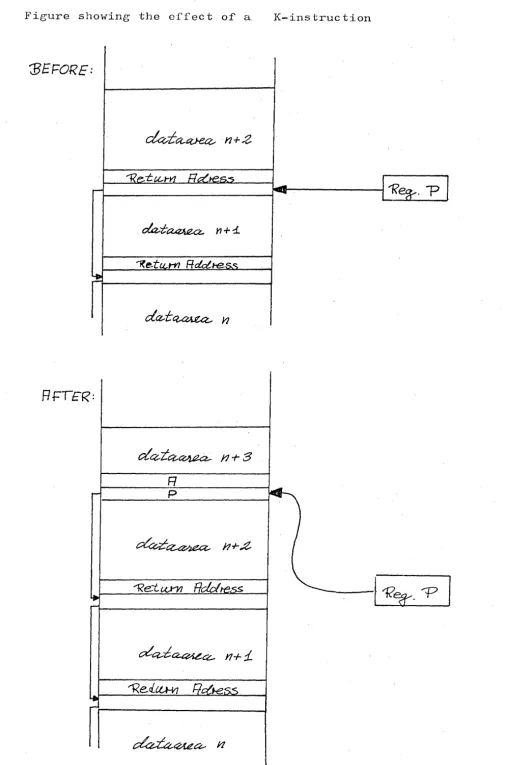
Recursive function call. The current stack frame is specified by D and the entry point; is given in A. The first two cells of the
ne1i stack frame are set to' hold return link information.
Allo1is auxiliary operations to be executed. The operation is specified by D modulu 32'
Figure showing the effect of a K-instruction
:BEFORE:
RFTER
:dcz,t~~
n+3
R
n
r- p
~~
J?-I-,:t,I
~ 'l<e:t.un1 Rdclte~
-da-i~a-
n+i
-1<.eiCl.H1
Rct~S5~...
[image:6.605.47.556.52.817.2]
EXECUTEOPEHATIONS
=================
gg;;
g~~g~~g~~ggXl Ao -0 - loc(A)
X2_ Ao-o - -A
X]
Ao -° - not A x4c
o-0 -lOC?+l)
po_ loco p) 0
-X5 Ao -0 - B ~ A x6
Ao-
o- B/
AX? Ao-° - B rem A
X8
Ao -0 - B+
A.X9 Ao-° - B
-
A XlO Ao-0 - B = AXII
Ao-
0 - Bf
A X12 Ao-0 - B<
A Xl] Ao-0 - B ~ Ax14 Ao-
·
- B ) A Xl5 Ao -0 - B ~ A x16 Ao-·
-
B lshiftXl? Ao-
·
- B rshiftX18
Ao-
·
-
B 1\ AX19 Ao-
·
-
B V AX20 Ao-° - B
¥
AX21 Ao-
·
- B-
AX22 finish
A
A
Return from current routine or function. Result of function is left in A.
Integer division
Rest after integer division.
These operations yields a boolean result (true or false)
B~ is shifted A times logical left
B is shifted A times logical right
X2J switch
X24
selectinputX25 input
x26 selectoutput
X27 output
This operation switches between a set of labels "\vhile i t tests A against a set of conditions.
The data following X23 is used in the follo-wing way.
X23 n
label.default condition.l label.l. condition.2 label.2
•
•
• •
condition.n label.n
n is a nonnegative integer.
Label.default, label.l •••• label.n are
labelvalues.
Condition.l •••••• condition.n are integers.
The above peace of code is equivalent to:
i:f A i f A
= =
•
·
•condition.l goto label.l condition.n goto label.n
i:f A
=
condition.n goto label.n goto. label.def'aul tselects. inputdevice according to A
input data to A from selected inputdevice
selects outputdevice according to A
output data from A to selected outputdevice
ASSEMBLER
SYNTAX INFORMAL DESCRIPTION ===============================
Input to the assembler is a program written in intcode (symbolic intcode using mnemonics)o
A program is a sequence of one ore more segments each consisting of a sequence of intcode-instructions terminated by a special Z-instruction.
Instructions can be of
6
different kinds:normal-instruc. D-instruction: C-instruction;
G-instruction
L-instruction: Z-ins truc tion;
A normal-instruction
executable instructions such as load, store etc. pseudoinstruction places data in dataarea
pseudoinstruction placeschar~cter values in dataarea (packed two and two)
pseudoinstruction initializes the globalvec-tor (only with labelvalues) . pseudoinstruction - list. and nolist
pseudoinstruction terminates a segment
consits of
label
instructioncode IPG-bits
address
where IPG-bits are mnemonics for
I - indirect addressing
P add P-register to address
G - add G-register to address
Address can be either an absolut address (integer) or a label.
b) and d) are always present ,-{hile a) and c) can be omi ted.
D-instruction: places datavalue in memorycell in dataarea.
When an integer is prefixed by D this integer is placed in the next cell in dataarea.
C-instructio.n:
G-instruction:
L-instruction:
Z-instruction:
is used to pack charactervalues in dataarea. Each character value is prefixed by a
Q.
The charactervalues are packed left to right, two in each cell.
If the left half of a cell has been filled and the next instruction is not a C-instruction without a labeldeclaratien the right half will be padded with zeres.
is used to initialize element. of globalvector with the value of a labelnumber.
The format is : G <gloablnumber) L (labelnumber>
is either an
r
er alie
Y (yes) starts listing of cedetext en eutputfile N (no.) steps listing ef cedetext en eutputfile
SYNTAX FOIDIAL DESCHlPTlON
=============================
The syntax is now described in urIF.
Underlined symbols are terminals.
{n,mS menas an integer in the closed interval [n,mJ
Everywhere in the sourcetext
L
can be inserted - then this charac-ter and the following until the next lineshift are skipped.This can be used as comment- or continuation facility.
Each label can only be declared once. Each referenced label must be declared.
<program) <segment) <instruction) <normal-ins truc> <D-instruction> <C-instruction) <G-instruction> <L-instruction) <Z-instruction> <labelpart> <skip> <delim) <label) <lPG-hit> <address) <instruccode>
..
-..
-
<segment>+
<instruction)(Z-instruc>
::= (norrnal-instruc>! <D-instruction)
I
<
C-ins truction./I
<:
G-instruction)I
<L-instruction)
·
.-·
.-·
.-·
.-·
.
-· .
-·
·
.-
.-·
.-·
.-·
.-·
.-·
.-·
.-·
.-·
.-·
.-·
.
-<labelpart><instruccode> (IPG-bi t> <address>
. <labelpart'> D <data>
<labelpart>
£
<charvalue>(skip> G<£lobaJi .1.<labeli
<skip)
(X
I
~~J
<skip> ~ <skip>
*"
<skip> «label; -«del in}> )
C~l~.lm
I
!)~
C~I1!£
I
jJ+
{1,5
00}Cf
I!:
IQJ
~{O,
64K-l} .1. .<label>(.1.121~J~/!/EIKI~)
<data>
·
·
.-
.-
{-3 2K
,
32K~11 L <label> - <charvalue>·
·
.-
.-
{O,255}
STHUCTURE OF ASSEi'lDLER
======================
The program is devided into
J
partsasshead keeps all global and manifest declarations
assproc keeps all procedures
assmain keeps the main program
assproc and assmain uses asshead by a get-directive
For information about the procedures in assproc please see the comments in the BCPL-listing.
assmain has this structure:
declarations and initializations
read ( )
newsegment: more initialization - presentation
----~$(mainloop
sw'itchon ch into
case L:
gato instruction
case X:
case
$,
~n, ;It-S:case D:
goto endcase case
c:
:t:
G: ~ v ~ 'case
0
~
G
case
Y:
"-l V)
case N:
case Z: goto newsegment
defaul t: goto endcase
instruction:
endcase:
If an L,S, •••• , X is recognizod i t is a normal-instruction. After thlS letter has been reco;?;nized these instructions are handled together in Itinstructionu •
tlinstruction" has this structure:
instruction: instrucl:
±
~
~
IJ)
listing on output read ( )
switchon ch into
$(switch2
case I:
case P:
case G:
endcase2:
default: test ch then
=
addres
goto endcase2
goto instrucl
L·
specified as labelvalue
.2£
$(
address specified·as absolute addresscheck i f address is a
an
a X23 instruction (see page 2~16)
$)
$)
s1-li tch2case D: handles D-instructions. The structure is:
case D: read ( )
S ,-[ i t c ho n c h in to
~(switchl
case L: data is specified as a labelvalue
gato endcase (see bottom page
2.5)
default: data specified as an integer value
goto endcase $)switchl
case C: handles C-instructions. The structure is:
case C: read ()
collect first charvalue
collect second charvalue (if any)
pack these together and put them. in dataarea
goto endcase (see bottom of page
2.5)
case Y: and case N: handles L-instructions and is very simple.
case G: handles G-instructions. The structure is:
case G: read()
collect globalnumber
check i f "L" is present.
collect labelnumber
call insertref to update pointerchain
goto endcase (see bottom of page
2.5)
case Z: handles Z-instructions" This signals the end of a segment. The structure is:
case
Z:
check i f any referenced label s t i l l is' undeclaredunless error do dump segmentblock (see page
2.9)
test, "more segments"
then goto newsegment
or'
$(
mark 1-0 mark 1-0 closeall() finish$)
default: handles labeldeclarations (or illegal sourcetext characters). The structure is:
default: 1Vhile ch
=
tal$(
collect labelnwnber (declaration) update dectabarea (see page 2.13)
$)
s\vi tchon ch into
$(SW
case D: case C:
case L:
case X:
} declaration-address in dataarea
}
declaration-address in codearea the chained cells in dectabarea are all set topoint to' the declaration addres~ (see page 2.13)
gato endcase (see bottom of page 2.5)
case
G, Z, Y,
N: illegal labeldeclaration goto endcasedefault:
$)
S1vThe assembler translates each segment as a unit. Listing of , sourcetext and errormessages will be on file output (according to the pseudoinstructions Y and N)~
If one or more segments is correct the assembler will ,deliver a file which will be accepted as input to the intcode-loader.
This file will have the following format.'
segmentblock for first correct segment
.
•
segment block for last correct segment
mark 1-0 mark 1-0
where segmentblock is
mark 1-0 is mark 0-1 is
mark 1-0 mark 0-1
size of codearea size of dataarea
number of globals to initialize number of referenced'labels sumcheck
picture of codearea
picture of dataarea
globaltabe1
label tabe1
Instructions are separated in two areas:
codearea keeps °all normal instructions
dataarea keeps D-instr~ctions and C-instructions
all other instructions are pseudoinstructions which odo not need any space in mainstore.
Sumcheck is the sum of all words in the following four tabels (codearea,dataarea,globaltabel and labeltabel).
Codearea and dataarea is simply a picture of these two areas. For problems about labelreferences and labeldeclarations
please see page
2.1).
Globaltabel keeps information about which elements of the global-vector should be initialized.
The format of globaltabel is:
1. globalno
1. value
2. globalno 2. value
n. globalno
n. value
"'iihere n = unumber of globals to initialize".
Labeltabel keeps information about labeldeclarations and label-references.
The format is:
1. labe1dec 1. labelref 2. labeldec 2. labelref
n. labe1dec n. labelref
n = unumber of referenced labels".
For each referenced label there are two corresponding words in the tabel (i. labeldec and i . labelref) from which all
nescessary information about use of this label can be extracted.
i o1abe1dec gives the place (in dataarea or codearea) where this
label is declared.
i.labelref is head of a one-way l i s t which gives the places (in dataarea, codearea or globa1vector) where this label is referenced. The l i s t is terminated by a special mark
(1111111111111101).
The assembler has
7
tables to keep information about a segment .•Codearea keeps all ,. normal-instructions. Cpointer points to the first empty word.
Dataarea k~eps all D-instructions and C-instructions. Cpointer points to the first empty word.
Globarea keeps informatioh about all initialized globals. The index corresponds to th~ globalnumber.
The value is part of a l i s t connecting all places (in codearea, dataarea and globarea) where this particular label is roferen-cede
Dectabarea and Reftabarea keeps information about declaration and referencing of labels. The index corresponds to the label-number. For detailed information see page •
Decarea and Refarea do exactly the same as Dectabarea and Ref tab-area, but the former (dectabarea and reftabarea) is handling userdefined labels, while decarea and refarea handles assemble~
generated labels '(see p 281~.Lpointer points to the first free labelname in decarea and refarea.
When acorr~ct segment is fineshed the following is dumped:
codearea dataarea cpointer dpointer
as as as as
"picture of codearea" "picture of dataareatt
usize of codeareall IIsize of dataarean
Globare~ is scanned and for each initialized global its number and its value is dumped as·part of Itglobaltabel".
The number of such globals is dumped as initialize u •
unumber of globals to
Dectabarea and reftabarea is scanned and for each referenced label, i , dectabarea.i and reftabarea.i is dumped as part of labeltabel.
The used part of decarea and refarea are dumped as part of
labeltabel in tho same manner as for dectabarea and reftabarea.
LABELDECLAHATIONS Al\D LABELHj~li'i._RNECES ==============================~======
1vhen a labeldeclaration is met i t is nescessary to know ",hether i t is preceding an instruction placed in codearea or an instruc-tion placed in dataarea. Since multiple labels
(many
labels prece-ding the same'instruction can occour) i t is nescessary to chain these declarat~ons together until the instruction is reached.When a label is met i t is placed in a chain starting at the simple variable labelstart (the chain is kept in dectabarea)G
When the type of the instruction (c·odearea or dataarea) is known the as sembI er Harks its ,,,ay t:hrough thi s chain and put s a po in t er to the declarationplace into each element of this chain.
Labelreferences can be met in codearea, dataarea or globarea. Insertref ·inserts the address,where the labeled 'vas referenced, in a one-way-chain starting at reftabarea~labelnurnber and chaining all references to this labelnumber,
The first 2 bi t in the words in this pointerchain indica tes in which area the address is:
bit 15
1 codearea (bit 14-0 determines address)
o
i f f bit 14=
1o
dataarea (bit globarea address) 13-0 determinesThe pointerchain linking the labelreferences is kept in the cells in codearea, dataarea and globalarea where the intcode-loader shall.put the final address (main store address).
As an endmark of such a chain is used mark (1111111111111101). Before start of a segment all cells in dectabarea and reftabarea
are initialized to this mark.
LR-6EL5TRRT
'HI+Rl{
CPOIIJTER. ~I--_ _ _ _ _ _ _ I
(a..,)
L R8EI.--STF/
RT
TJECTRBFl-REF}
--.!
t.;. HFfRL<
C60EFlRER
CPO/~"'r--_ _ ' _ _ ' _ _ _ 1
( b)
LFJBEZSTRRi
I
:;P EC rf1.13 f1 f( Ef:}
~
r-C () D E;;Fl- R. £71
--.4
XLI(c)
This page and the next shows how labels are handled. The corresponding instructions could be:
G206L312 G312L78 DL78 JL78 78 312
x4
TL78 JL78 ••••••a) just before the declaration of label
78
b) both labeldeclaration has been read and chained
c) the instruction type is knovn and pointers from dectabarea to the address of declaration is made.
f4-d) the final picture handed to the loader (including reftabar~a)
J)}:CT
500
olZ 1 - - - 1
78~ _ _ _ _ --r
Ot..-_ _ _ _ ~
3/z.
1 - - - ,
7SL-_ _ _ _ ~
OL-_ _ _ _ ---,
(d)
co
£RREF/o
L - -_ _ _ _ _
em
I}./J~GLDBFlR£
MRRK
fJFlRK
. - OL 78
~ G 81Z L 78
Instruction X23 is a switch instruction. According to the intcode discription i t should be used as follows:
X23
Dn
DL label.default D cond:.l
DL label .• l
D cond.2 DL label.2
.
.
D cond.n DL label.n
For the semantic explanation of this please see at page
1.6.
It is important to know that X23 is a normal-i1:"lstruction and therefore kept in codearea. Its data (Dn .•••••••• DL label.n) is D-instructions and hence kept in dataarea. It. is nescessary to tell the X23-instruction ~here its data is.
Hence the above peace of code by the assembler is altered to:
kept in codearea
kept in dataarea
{
X23DL nn "~I---
__
nn:DnD label '.defaul t
D cond.l
D label.l
D cond.n D label.n
please notice:
this DL-instruction is created by the assembler and kept in codearea
where nn is a new label generated by the assembler.
ADDRESS }IISSING
ADDRESS NEG OR TOO BIG
BAD LADELDECLARATION
BAD LADELREl1'ERENCE C - BAD NUHBER C - MISSING NUMBER
CODEAREA TOO
BIG
DATAAREA TOO BIG
DL- BAD LABELNO
DL- MISSING LABEL~O
DOUBLEDECLARATION
D - MISSING NUMBER
D - NUMBER TOO BIG
ENDOFSTHEA1v1 REACHED
G - BAD GLOBALNO
G - BAD LABELNO
G - L HISSING
G - MISSING GLOBALNO
G - IvIISSING LABELNO
normal-instruction has no address field
normal instruction with address out-s ide 10 , 64K-lJ
labeldeclaration with labelnumber outside {I, 5001
labelreference with labelnurnber outside {1,500}
C-ins truc tion 1vi th charval ue outside {O,2.55j
C-instruction has no charvalue
the segment needs too much codearea
the segment needs too much dataarea
DL-instruction with labelnumber outside {1,500}
DL-instruction with "Ltr but no specified labelnumbcr
labelnumber has been declared twice
D-instruction with no data
D-instruction with specified data outsid~ {-32K, 32K-ll
the end of source-text is reached at illegal point
G-instruction with globalnumber outside {O, 51ll
G-instruction with labelnumber outside {l,SOO]
G-instruction with ilL" missing
G-instruction with no specified globalnumber
G-instruction with no specified labelnumber
ILLEGAL CHARACTER
LABEL PSEUDO INSTRUCTION
LABELNUNBER HISSING
LABEL UNDECLARED: nnn
TOO NANY SWITCHES
illegal character used in sourcetext
label is prefixing instruction which is neither a normal-instruction, D-instruction or C-instruction
address field of normal-instruction has an
"L"
but no specifiedlabel-~1.umber
labelnumber nnn has been referenced but not declared (this errormessage is at the very last of the source-text-listing)
LOADEH
INPUT
---The loader takes ~nput from the assembler.
The syntax ~s descr~bed on pages 2.9 through 2,.11 and page 2.13.
STRUCTUH..8 OF THE LOADER
=======================
The loader has th~s structure:
declarat~ons and in~t~a1~zations
presentat~on
in~t~al~zation of cbase and dbase
newtape:
read unt~l mark 1-0
while nextoninput
=
mark 0-1 do§ (while
read header
read code into mainstore
read data ~nto mainstore
read globa1table and do the specified initializations
read labeltable to initialize the unsolved references
read mark 1-0
sumcheck
§ )1vh~l e
i f more tapes do gato newtape
go ()
To understand "go()" and "initialization of cbase and dbase" you must know that the system uses the globals 504 through 511 for comrnunika tion of the follo1vinginforma tion:
G.5ll G.510 G.509 G.508 G.507 G.506 G.505 G.504
1Vlimi t }
PeO -variable (program's limits and entrypoint)
"tvlimi t }
pO -constant (system's limits and
e .
entrypoint)e
-loader's entrypoint C -assembler's entrypointINITIALIZATION Oli' CBASE M\fD DBASE takes G.508 as cbase(base of codearea) and G.507 as dbase (base of ctataarea).
QQil
initializes G.5ll, G.5l0 and G.509 "tvith the loaded program's wlimit (cbase-l), pO (dtop) and C (entrypoint).SYSTEM
---Tho system includes the assembler, the loader, the error-routine and a error-routine "systemU to switch between loader and
assembler.
ERROR (uritten in intcode - entrypoint=limit) is called from
lIe r ror 1-5u in the emulator (see the last page in the
emula-torlisting) to dump mainstore.O to mainstore.15.
This pictures the registers (wa: 0-15) at the moment the error arose (except wa.3=errorno).
"SYSTEM" is 1-1ritten in intcode according to this algoritme:
select(consoletable)
again:
1 .... rites(It*N assembler:a or loader:l
1")
help.: = inputtest help='A' then goto G.504
.test help='L' then goto G.505
~ goto again
ERRORNESSAGES FHON LOADEH ---_.
---01iERFL01>1
HISSING ENDMARK
BAD CHECKSUM
code- and dataarea too big·
the mark 1-0 expected· after the segment is missing
EMULATOR
Emulating one intcode-instruction the emulator goes round once in the below mentioned cy~le:
1. Ask whether the surrounding system wants control (has issued an interrupt).
2. Read next instruction from mainstore to DS "(doubleshifter).
3. Read address to AS (acumulatorshifter) and D. Iff L-bit i t set the address is found in the next
word in mainstore; else i t is found in the last
9
bits of the present word.4.
Iff P-bit is set add P to D and keep the result in AS and D.5.
Iff G-bit is set add G to D and keep the result in AS and D.'6.
Iff I-bit is set read the mainstore address D and put the content of this in AS and D.7.
Increment C (programcounter)8.
Decode instructioncode9.
According to this decoding jump to one of8
possible labels in the emulator~10. Perform the desired operation
11. goto 1.
There is one exception from this scheme. The X23 (switch-instruc-tion) is so long that i t must be partioned into smaller sections. Between each section the surrounding system h~s the possibility to interrupt.
"Flagtt is used to indicate whether a s\vitch-instruction is
INITIALIZATION OF WA AND WB ===========================
The first 1vB-group is initialized to:
0, 1, 2, 3,
4,5, 6, 7, 8,- 9,
10, 11, 12, 13,14,
-1The second HB-group is initialized to,keep.a table used by the emulator l,fhen s1fi tching bet1feen the 32 possible X-instruc-tions.
0:
1 :
2:
13:
14:
15:
ERROR
address
address
address
EH.ROR
ERROR
address Xl
X2 address X3
x4
address X5x26
addressX27
ERROR
ERROR
The addresses (controlstoreaddresses) are packed two and two.
The first W'A-group keeps the itltcode-machines six registers and other vital information such as flags, limits etc.
0: BASE
1 : 1>J"L II-I IT 2: PO
3:
ERROR4:
FLAG5:
B6:
A7 :
C 8: D9:
P 10: G11:
12: INPUT
13: OUTPUT 14: CS
l"S :
LIMITBASE is the basisaddress in mains tore. All other addresses is relative to BASE.
WLIMIT is the last word in mainstore where writting is permitted.
PO is the first word in the runtimestack (local variables).
FLA~ indicates whether a X23-instruction was interrupted
(see page 4.1).
A, B, C, Dr P and G are the intcode-machines six registers.
INPUT and OUTPUT keeps the selected input- and outputdevice.
CS is baseaddress in controlstore for the emulatorcode.
LIMIT is the last 1vord in mainstorewhere'access (reading) is permitted.
ERROR is a mailbox indicating where the errorroutine was called
BASE, PO, WLIMIT, LIMIT and C are initialized by the intcode-loader.
INPUT and OUTPUT has standard initializations (see microcode lis ting) •
CS is initialiZGd by the system (at present i t ' s a11"rays 0).
Any things else is initialized to O.
When n segments are loaded the picture is:
BASE
codearea segment 1
codearea segment 2
codearea segment n
LIMIT
1~~~~~~~--lvLIMIT
runtime stack
dataarea segment n
dataarea segment 2
dataarea segment 1
global vector
dump areal
PO
G
0
READ AND \\TRITE
---The emulator uses two subroutines: read and write.
These routines simply initialize the reading (wr~ting). Then i t returns control to the calling address without waiting for the read (write) to finish.
Read tests:, base '!f:: read-address ~ limit 11 r i t e t est s : base ~ write-address ~ wlimit
If these conditions are not met theerrorroutine is called.
X22 looks at G.511 to see i f a program has been loaded (see page 3.2).
If so then i t in~tializes wlimit,pO and C from G,5ll, G.510 and G.509 and starts programexecution.
Else i t initializes wlimit, pO and C from G.508, G.507 and G.506 and so leaves control to "system".