Abstract: 21st century learning involves mastering the 4 C’s,
namely Critical Thinking, Communication, Collaboration, and Creativity. One pedagogical application that potentially capitalis-es thcapitalis-ese elements is game-based language learning in Multi-User Virtual Environments (MUVEs), such as massively multiplayer online role-playing games MMORPGs for learning English for Specific Purposes (ESP). This paper presents a conceptual analy-sis of how critical thinking and meta cognition are represented and interact with each other in game-based learning frameworks. We begin with an overview of game-based learning, a review of critical thinking in game-based language learning, followed by an analysis of the role of meta cognition in game-based language learning. Finally, a discussion on 4 game-based learning frame-works will be presented. By studying the interplay between criti-cal thinking, meta cognition and game-based language learning, we argue for the need to develop a holistic framework that ex-plains how these relate with each other, in order to further devel-op the pedagogical potential of using game-based language learning.
Keywords: critical thinking, meta cognition, game-based lan-guage learning
I. INTRODUCTION
Critical thinking remains sine qua non for progressive human capital development, with the World Economic Fo-rum declaring critical thinking as one of the vital 21st centu-ry skills vital for navigating in an innovation- economy (New Vision for Education : Unlocking the Potential of Technology, 2015). In an era of job uncertainty resulting from labor market changes due to shifting demands and also automation and digitization of manual labor, workers of tomorrow will have to perform in fast-paced work environ-ments. The skill sets of the future now revolve around prob-lem-solving, persistence, initiative, curiosity and critical thinking (World Economic Forum, 2015), and employees must be capable of analytical thinking, assessing available options, seeking solutions to problems and yet, in an as-sessment for Adult Competencies, the OECD reported that merely an average of 6% of adults displayed problem-solving ability in technology-based environments (Organisa-tion for Economic Co-opera(Organisa-tion and Development, 2013).
Revised Manuscript Received on May 28, 2019.
Nadya Supian, Universiti Tunku Abdul Rahman
Ratnawati bt Mohd Asraf, International Islamic University Malaysia
Wan Irma Sabrina bt Idris, Universiti Tunku Abdul Rahman
Hasleena bt Hamzah, Universiti Tunku Abdul Rahman
In our current interlinked global economy, the need for critical thinking skills and communicative competency transcends not only work boundaries, but cultural bounda-ries as well.
Unfortunately, not all countries comparable competency in critical thinking. This is a cause for concern for countries that lag behind as a nation’s economy and well-being hinges on the capabilities of its future manpower. Thus, efforts have commenced to develop manpower with critical think-ing in institutions of higher learnthink-ing, with the aim of closthink-ing the competency gap between developed and developing countries. In institutions of higher learning, L2 courses are specifically designed to develop students' communication skills to meet both academic and industry requirements and are known as English for Specific Purposes (ESP). These courses normally incorporate critical thinking as a core competency of the reading and writing component (Mu-hammad & Mohd Asraf, 2008). Critical thinking in reading and writing involves higher-order thinking skills such as analyzing, interpreting, inferring, and evaluating and is a vital part of an ESP syllabus. However, due to logistical constraints and fixed learning materials that may not cater for very weak L2 learners, the learning gains attained may not reach the targeted outcomes, resulting in inadequacies of both critical thinking and communication skills; heralding a grim economic future if the new generation of workers are continually unable to compete on a global scale due to inad-equate training.
Cognizant of this, the efforts taken to simultaneously in-crease both students’ motivation and avenues for learning language include game-based language learning, both within classroom settings and also outside the classroom (Hamari, Shernoff, Rowe, Coller, Asbell-Clarke, & Edwards, 2016; Harvard University, 2016; University of Washington, 2016). Various policies, such as the Australian government’s ‘ Digi-tal Education Revolution’, Singapore’s ‘Intelligent Nation 2015’ project and New Zealand’s ‘Digital Strategy Initia-tive’ (Thomas, 2012) have been initiated, underscoring the value of incorporating technologies to harness the already existing digital landscape inhabited by today’s youth. How-ever, although it believed that game-based learning has the potential to improve critical thinking, there is still a gap in the literature that directly addresses this (Cicchino, 2015).
Ready Player One? A Conceptual Analysis
on the Dynamics of Critical Thinking and
Meta cognition in Game-Based Language
Learning
Based Language Learning
Despite the hype surrounding game-based learning’s po-tential for developing critical thinking skills, there is still a lack of comprehensive frameworks that capture and explain this process from a language learning perspective. This paper uses a conceptual analysis to examine the dynamics between critical thinking and metacognition withincurrent game-based learning frameworks, and argues for the need for the development of an updated framework that adequate-ly captures this multifaceted, fluid process.
Methodology
Conceptual analysis entails the study of scutinising con-cepts in order to establish greater clarity on the “philosophi-cal issue which the concept is involved” (Beaney, 2009; in Boston-Kemple, 2012, p. 41). A close examination of acon-cept can potentially enable further information to be discov-ered through reinterpretation(Machado& Silva, 2007) and indeed can contribute to critical inquiry. Petocz& Newbery (2010) even go on to state that conceptual analysis is to be considered as the primary method of scientific inquiry. This paper presents a conceptual analysis of how critical thinking and metacognition are represented and interact with each other in game-based learning frameworks. We begin with a overview of game-based learning, a review of critical think-ing in game-based language learnthink-ing, followed by an analy-sis of the role of metacognition in game-based language learning. Finally, a discussion on 4 game-based learning frameworks will be presented.
II.LITERATURE REVIEW Game-based learning
Game-based learning refers to any learning environment that combines game content and gameplay for the acquisi-tion of new content and upgrading skills (Qian, 2016) to accomplish specific educational objectives, most frequently through the use of video games (Idris, Hamzah, Ahmad, & Zaki, 2016). It is more than merely play-to-win, where the objective of the game is to beat opponents by racking up scores, conquests and/or completion of tasks; but rather
play-and-learn, where the learner uses the game play as a
means to an end, rather than the end itself. This can be achieved by establishing an equilibrium between the subject matter to be learned and the elements of the game itself (Plass, Homer, & Kinzer, 2015). Game-based learning in-corporates cognitive elements inherent in playing games, such as critical thinking, problem solving and metacognitive strategies of designing and executing various tactics into the learningprocess. Essentially, the students will learn-through-play to reach their educational goals.
However, it must be emphasized here that game-based learning is more than just adding a video game to the lesson. The game must fit coherently within the instructional design framework, with clear pedagogical objectives, focused con-tent-related activities and guidelines for assessment. At its most basic level, a game can be used for intervention, en-richment and reinforcement (Guido, 2016), which needs to be determined by the instructor prior to embarking upon game-based learning. Games for intervention, based on principles of adaptive learning technology (eg: adaptive hypermedia, intelligent tutoring systems, computerized
adaptive testing, and computer-based pedagogical agents) are to assist struggling learners who have difficulty with content and therefore, must be scalable to address the needs and levels of the learner. Enrichment games, on the other hand, are for learners who have already mastered the basics and are capable of more challenges, so the games would feature content-based challenges presented in different me-dia, where learners would need to use higher levels of to complete the tasks. Games for reinforcement are best suited for consolidating content knowledge through a class activity where learners compete with each other (Guido, 2016) and simultaneously assess their own learning performance. In the earlier stages of game-based learning, educational games played an ancillary, rather than primary pedagogical role, as it had great potential for learning vocabulary (Neville, Shel-ton, & McInnis, 2009; Wu, & Huang, 2017; Zheng, Young, Wagner, & Brewer, 2009).However, educational games such as these were limited in functionalities and scope, and, while engaging enough to present a different medium for learning content, they lacked the thrill of commercial off-the-shelf games (COTS). Game developers took note of this and soon the designs of massively multiplayer online role-playing games (MMORPGs) started blurring the lines be-tween educational elements and entertainment value, boost-ing its potential for meanboost-ingful learnboost-ing (Peterson, 2012; Qian, 2016).
MMORPGs are simulations of real worlds, and for gam-ers or playgam-ers, these synthetic worlds offer a situated context for experiential learning (Shaffer, Squire, Halverson, & Gee, 2005) that transcends the classroom learning experience. It wasn’t long before MMORPGs were tapped for their peda-gogical potential on a larger scale, with some games - Sec-ond Life, World of Warcraft, The Sims, among others, used in actual formal language learning contexts (Ranalli, 2008; Thorne, 2008), as well as enabling autonomous game-based language learning in informal settings.
Game-based language learning
Game-based language learning is rooted in social con-structivism (Vygotsky, 1978; Cicchino, 2015; Hamari et al., 2016, Qian, 2016), as the very nature of the social learning experience in a game environment takes place both within the players’ interaction with each other and through the collaborative nature of game play (Wu, Hsiao, Wu, Lin, & Huang, 2012). Ang, Avni & Zaphiris (2008) posit that learning can occur at two distinct levels – player-player and player-game. At player-game level, the player ‘interacts with the game’ to ultimately improve his or her game play, which relates to both behaviorist and cognitive constructivist learning theories; while at the player-player level the players interact with other players, constructing meaning and knowledge through interactions, in accordance with social constructivist learning theories (2008). When engaged in collaborative play, especially with players with varying degrees of experiences, strategies are designed to solve game world problems, resulting in a deeper understanding of the dynamics of the game narrative, from how small quests can lead to an ultimate
This understanding has far reaching consequences, as Dickey explains, “the narrative of small quests provides a cognitive framework for problem-solving and fosters meta-cognitive skills while simultaneously supporting intrinsic motivation by providing opportunities for choice, control, collaboration and achievement.” (2007, p. 266). Thus, the social collaboration in games offer structural support for critical thinking via problem-solving and application of metacognitive skills.
The learning experience from MMORPGs is also conso-nant with flow theory (Csikszentmihalyi, 1990) - which describes a state of intense focus and utter absorption - plac-ing gamers in an almost trance-like state as they surmount increasingly complex tasks to attain higher levels. The fact that the concomitant learning taking place is almost at an unconscious level is hardly, if ever, noticed, as indeed the learning process has become part of the gaming experience.
Achieving a state of flow requires firstly that the activity must be sufficiently challenging to require adequate focus, as well as being both active and engaging to keep the gamer intrinsically motivated to continue, known as the challenge-skill dynamic (Hamari et al., 2016). A player achieves flow when his or her abilities are tested to the limit, and the thrill of pursuit often culminates in total immersion and engage-ment. The activity should also have clear indicators of suc-cess, with delineated thresholds of performance that separate the winners from the losers.
Early studies on game-based language learning were fo-cused on supporting and enhancing vocabulary acquisition among ESL/EFL learners (Hui-Chan & Chen, 2012). Inci-dental and informal vocabulary learning was reported to occur though the use of in-games text (Sylvén and Sundqvist, 2012) and it was also discovered that despite available classroom learning, students who engaged in ‘ ex-tramural English activities’ were found to have a better vocabulary than those who did not, meaning that students who spent time on leisure activities in the target language had more gains in language proficiency. Yudintseva report-ed that since gameplay utilises a range of learning strategies, such as language repetitions, figuring out contextual clues, interaction with native speakers and peers, and imagery which enables learners to practice and authentically use second language vocabulary, deeper and more meaningful vocabulary acquisition is attained (2015). The manipulation of linguistic knowledge in “situated meanings” (Gee, 2008, p. 36), which refers to how vocabulary knowledge ismediat-ed and consolidatismediat-ed through use in action and problem-solving contexts in interactional dialogue, results in word meanings that come alive in situated dialogue, image, expe-rience, and action (Gee, 2008).
Online games that present a multi-user virtual environ-ment (MUVE) such as World of Warcraft, Quest Atlantis, Second Life, The Sims, Sim City and Active Life have been studied for their potential in nurturing language learning (Chen, 2016) and one obvious benefit MUVEs have over traditional classroom learning is that it extends the learning space to enable the learner to engage in task-based commu-nication independently. In a study by Chen (2016), it was reported that the game Second Life provides emotional sup-port for language learning by reducing, and even removing entirely for some, the learner anxiety that often precludes
students from attempting to use the target language in real-life settings. The game itself involves selection of an avatar whereupon the direction of the gameplay is then based en-tirely upon the player’s wishes – buying/renting property, engaging in social connections with members from other locations, attending university and even developing relation-ships. Communication is enabled via text chat, instant mes-saging, voice chat and notecards within the game (Hunds-berger, 2009).
MMORPGs in real time strategy games incorporate social interactions via multiple synchronous text channels and other platforms within the game, such as a “whisper” chan-nel for private chats, built-in mail-style tools and even voice communication features. Additionally, these virtual envi-ronments include guildsthat offer gaming support and dis-cuss gameplay-related issues, and when the competitive instinct to develop one’s skills arise, any effort in gameplay improvements is often supported by engaging with online communities for support, gaming walkthroughs and strategy discussion forums (Chik, 2014). Exchanges in these forums are unrehearsed and unscripted, offering opportunities to practice vocabulary and language structures with native speakers from various backgrounds in online gaming com-munities. In Thorne’s study on World of Warcraft (WoW) in-game chat, social action tasks for gameplay in online role-playing games are mediated in L2 (Thorne, 2008), since online gaming worlds consist of a multilingual community, which can feature communicative functions such as negotia-tion, repair sequences, explicit corrective feedback, and requests for assistance, all in the target language.
Based Language Learning
The features of Runaway, which emphasises mental im-ages of word meanings was found to facilitate vocabulary acquisition, further lending more evidence on the effective-ness of imagery strategy through games. Since gameplay itself involves steps of identifying scenarios, analyzing pos-sible outcomes and determining tasks to execute, the process of maintaining flow is mediated by critical thinking, which shall be discussed further in the following section.
Critical thinking in game-based language learning While studies have pointed to how game-based learning has a potentially positive effect on the development of criti-cal thinking, the available literature on this is still develop-ing (Cicchino, 2015, Kiili, 2005; Qian, 2016). The link betweengame-based learning and the cultivation of critical thinking that includes scientific reasoning, systems thinking, computational thinking, decision making and problem solv-ing (Binkley, Erstad, Herman, Raizen, Ripley, & Runmble, 2014) is still being explored. One of the earlier studies was by Malone (1980, 1981), who established the link between playing games and sustaining intrinsic motivation, which positively impacted the thinking process. The link between gaming and critical thinking emerged through the work of Prensky, who posited that digital game-based learning had the potential to incorporate both reflection and critical think-ing into both the learnthink-ing process as well as game elements, yet retain its fun vibe (Prensky, 2001). Critical thinking is necessary to active learning and meta-level thinking, espe-cially in the interpretation of semiotic domains during gam-ing (Gee, 2003), where learners must interpret meangam-ings from verbal and visual mediums.
There are many definitions of critical thinking but each definition relates to specific contexts and domains (Moon, 2008), where the outcome of the thinking process would determine the structure of the thinking needed. Willingham describes it as “seeing both sides of an issue, being open to new evidence that disconfirms your ideas, reasoning dispas-sionately, demanding that claims be backed by evidence, deducing and inferring conclusions from available facts, solving problems, and so forth” (Willingham, 2007, p. 8). Halpern, meanwhile views critical thinking as “the use of those cognitive skills or strategies that increase the probabil-ity of a desirable outcome” (Halpern, 1998, p. 450). Norris and Ennis (1989) defines critical thinking as “reasonable and reflective thinking that isfocused upon deciding what to believe or do”, while Sternberg claims that critical thinking refers to “the mental processes, strategies, and representa-tions people use to solve problems, make decisions, and learn new concepts” (Sternberg, 1986, p. 3). The APA Del-phi study in 1990, defined critical thinking as “a process of reflective judgment which manifests itself in reasoned con-sideration of evidence, context, methods, standards, and conceptualizations for the purpose of deciding what to be-lieve or what to do” (Facione & Facione, 2013, p. 10). The study identified 6 core critical thinking skills, namely inter-pretation, analysis, evaluation, inference, explanation, and self-regulation. Facione’s study also identified critical think-ing dispositions, which should work in tandem with critical thinking skills - Truthseeking, Open-mindedness, Analytici-ty, SystematiciAnalytici-ty, Confidence in Reasoning, Inquisitiveness, and Maturity of Judgment. Halpern’s ideas on disposition
can be seen as a continuous series of objectives, consciously interlinked, beginning with establishing a desire to remain focused on the task at hand, devising a plan of execution and remaining committed to seeing it through, and ultimately taking responsibility of monitoring progress, keeping op-tions open and seeking out support should the need ever arise (Halpern, 1998). Dispositions should also complement critical thinking, as it would be futile to merely possess critical thinking skills but lack the disposition to act upon them (Halpern, 1998), especially in the workforce. Thus, in the training of critical thinking skills for real-world applica-tions, it would be imperative to develop not only the think-ing skill, but place equal, if not greater emphasis, on the fostering of dispositions to ensure efficacious transferability of both.
The ultimate goal of critical thinking is transferability in solving real-life problems and improving situations (Halpern, 1998) guided by sound decision-making (Halpern, 2007), and as such, game-based learning and problem-solving are analogous in that they both require the player “to use cognitive processes to resolve real, cross-disciplinary situations where the solution path is not immediately obvi-ous” (OECD, 2003, p. 156). Games provide situation-based learning environments that compel the player to solve com-plex problems (Squire, Giovenetto, Devane, & Shree, 2005).
Game-based learning adds a dimension to language learn-ing in that it offers the power and freedom for the learner to navigate “problem-solving spaces” where the language learning is an outcome of the problem-solving inherent in gameplay (Gee, 2007, p. 26). These problem-solving spaces in video games are scaled from easy to difficult; thus simul-taneously providing built-in checkpoints for monitoring one’s language learning progress. Problems are usually presented in a narrative form, and games start off with a setting that is clearly detailed and described, linking the present state of affairs to a past event, thus providing a con-textual foundation for the player in character/avatar selec-tion, among others. The game’s objectives are usually ex-plicit, and require commitment from the player to focus on the gameplay as much as possible. When the tasks/problems, which usually start out as relatively easy then progressively upscale in complexity, the learner then must engage in “hypothesizing, probing and reflecting” (Hamari, Shernoff, Rowe, Coller, Asbell-Clarke, & Ed-wards, 2016, p. 170) on actions/options/strategies in order to remainin the game. Ultimately, the act of analyzing and interpreting choices/options and solving problems/achieving tasks, is mediated by metacognition.
Metacognition
Metacognition, often referred to as self-regulation, is viewed as a vital part of the critical thinking process, (Dwyer, 2014; Facione, 1990; Halpern, 1998, Kuhn, 1999). Metacognition refers to executive control of cognitive pro-cesses, and is a crucial element in successful learning.
It involves planning, monitoring and evaluating one’s per-formance, and employing
metacogni-tive strategies used during gaming form the basis for prob-lem-solving, and indeed, the game environment takes the monitoring phase to the next level by incorporating features that enhance metacognitive awareness and metacognitive control during self-explanation practice such as a pop-up transition feature that “provides indirect support for meta-cognitive monitoring of reading comprehension by present-ing students with information on the performance that pro-motes self-reflection”(Snow, McNamara, Jacovina, Allen, Johnson, Perret, & Weston, 2015) According to Kickmeier-Rust, Steiner and Albert (2011), there are four types of in-game interventions which have the potential for improving metacognition, namely player forethought, performance, self-reflection, and affirmation questions (in Baron, Heath, & Amresh, 2016, p. 35).Player forethought involves think-ing ahead and envisionthink-ing the strategies and moves one is about to make in the game, while performance refers to the metacognitive interventions that compel the learner to keep track of his or her own performance through self-monitoring. Tasks or questions that elicit self-reflection of the player’s content knowledge in turn leads to affirmative questions, where solutions to problems reviewed for confir-mation.
However, it must be emphasized here that the learning ob-jectives of game-based learning language should encompass a broader scope. Since 21st century skills dictate that critical thinking should also be reflected in communicative compe-tency, game-based language learning should also include game elements that enable learners to include communi-cating with awareness of cultural sensitivities, norms of politeness and etiquette. One example of this is Tactical Iraqi, a 3-D game platform developed for military training of US Iraq-bound Marines that uses “automated speech recognition, spoken dialogue, animated agents and learner modelling” (Johnson & Wu, 2008, p. 520). Considered to be a successful military language training program that “greatly increased operational capability” in the field (Johnson & Wu, 2008, p. 520), the 3rd Battalion of the 7th US Marine Regiment reported zero combat casualties during its tour of duty, a success that was attributed to the language training program. Tactical Iraqi was developed to train not only “what to say, but also how to say it and when to say it”, covering Iraqi norms of politeness and etiquette. Language learning took place in immersive 3-D videogames simulat-ing social interactions featursimulat-ing spoken dialogues and cul-tural protocols, where the objective of the game is not to “shoot and kill”, but to win trust and cooperation from the characters by “correctly speaking to and behaving with
animated Iraqi characters”
(https://www.isi.edu/news/story/155). This type of game play underscored how communicative competence and transfer of critical thinking can make a difference between life and death in combat situations. Other examples of games which combined role-playing in simulated real-life situations within a training framework include Combat Med-ic (Virtual Heroes, 2014), where medMed-ical students role-play as doctors in a simulated battlefield to save injured patients, while simultaneously learning vocabulary and language structures for these situations (in Casañ-Pitarch, 2018). In Hilton Ultimate Team Play (Virtual Heroes, 2007), hotel frontline staff engage in conversations with virtual
custom-ers to improve their customer service skills. These games not only serve to develop the language skills needed by students of ESP, but also heighten the learning experience by throwing them into a simulated work environment which challenges them to use their critical thinking skills to solve problems collaboratively, and communicate their ideas and opinions to their team. Once faced with stumbling blocks, be it in problem solving, or in communication, the learners then would review their game play, and devise ways to re-strategise. Thus, learners would need to continuously en-gage their metacognitive strategies in order to be able to successfully stay in the game.
Up to this point, we have established that critical think-ing and metacognition are vital elements in game-based learning environments. The following section shall discuss the extent to which these elements are accounted for in ex-isting frameworks, and how are they represented.
Frameworks of game-based learning
Based Language Learning
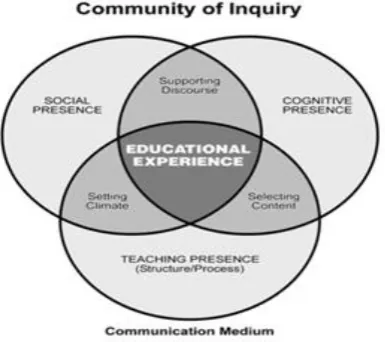
Fig. 1 Model of Community of Inquiry (Garrison, An-derson and Archer, 1999)
The Input-Process-Outcome Model (in Figure 2) features a game cycle comprising of user judgements, user behavior
and a systems feedback to induce engagement in the game-play and to ensure that the learner “actively constructs knowledge from experience” (Garris et al., 2002, p. 446). Garris et al (2002) emphasises the importance of debriefing, - a review and analysis of in-game events that enables play-ers to draw parallels between game events and real-world applications.
In contrast to the cognitive presence within the Model of Community of Inquiry, The Input-Process-Outcome Model highlights both critical thinking and metacognition, as “learning by doing must be coupled with the opportunity to reflect and abstract relevant information” to effectuate real-world applications (2002, p.455). This is also a nod to the notion of “transfer”, which is essential to the application of metacognition that is trained within the game, although the it is stated that having an instructor to guide and scaffold learners is critical to learning success.
Fig. 2 Input-Process-Outcome Model (Garris, Ahlers & Driskell, 2002)
Meanwhile, Kiili’s experiential gaming model (Figure 3), based on both constructivist and pragmatist views on learn-ing, builds upon the flow theory, a critical element to main-taining task engagement and motivation to complete the game (Kiili, 2005).Consisting of an ideation loop, an experi-ence loop and a challenge bank, which serves the as the central point of the model, the main thrust behind Kiili’s experiential gaming model is that narrativised challenges, defined by learning objectives, are to be solved using idea generationat both preinvative level and idea level. Preinva-tive idea generation is freeform and unencumbered by
[image:6.595.328.523.92.244.2]con-straints, but at the post-idea generation stage, the player must be more selective in generating effective solutions.
Fig. 3 Experiential Gaming Model (Killi, 2005) Although the model does not specifically mention critical thinking, it does refer to reflective observation, which can be seen as relating to both critical thinking, that is concerned with knowledge construction through critical reflection, which is a form of metacognition.
Meanwhile, the Educational Games Design Model put forward by Ibrahim & Jaafar (2009) attempted to address critical thinking in its framework, but since their research focused on students’ learning with integrated self-assessment modules; only addressed the lower levels of thinking in Bloom’s Taxonomy, namely knowledge, com-prehension and application. The higher order thinking skills, they claimed, were to be developed through problem-solving via content and game design. The nature of the games design mentioned was more general in nature, as it could be adapted to suit the content syllabus. Metacognition is addressed in the self-learning subdomain.
Fig. 4 Educational Games Design Model
These frameworks have attempted to capture the peda-gogy of game-based instruction as a tool for engaging learn-ers. All the frameworks mentioned have identified critical thinking as a component, emphasizing its important role in the teaching/learning process,
[image:6.595.320.530.489.640.2] [image:6.595.56.279.508.614.2]within the thinking process of game-play. However, as can be seen, all these models refer to pedagogy that is general in nature. Thus, there is still a lack of a framework that ad-dresses critical thinking and metacognition specifically for game-based languagelearning.
Conclusion and implications for future research/practice This paper has presented an overview of game-based lan-guage learning, with emphasis on critical thinking and meta-cognition and how they interact in a gameworld environ-ment. As previously mentioned, critical thinking is repre-sented as a vital component in these frameworks, emphasiz-ing its important role in the teachemphasiz-ing/learnemphasiz-ing process, while metacognition is seen as implicit and embedded within the thinking process of game-play.
There are many games available that develop language in ESP environments, both in universities and training sessions conducted by companies, underscoring the increasing ac-ceptance and popularity of these non-traditional methods of language learning. In role-playing games within a dynamic environment such as MUVEs, critical thinking and meta-cognition play out differently, if compared to more linear pedagogical platforms, as there are many avenues for feed-back in these games,which encourage learners to analyse their errors and develop better strategies, which fosters deeper and more meaningful learning (Gee, 2008). Research has shown that playing games can increase learners’ en-gagement in the learning process, present more adaptive challenges that stimulate not just language learning that is industry-specific, but enhance the use of higher-order think-ing skills when solvthink-ing problems, as well as negotiatthink-ing with other players on gameplay strategies.
Thus, it is imperative to have a framework that incorpo-rates critical thinking and metacognition in game-based language learning as critical thinking is the cornerstone to the learning process, and metacognition is what both pro-cesses and organises critical thinking. The time has come for a new framework to be developed that accurately captures how language learning can be developed through metacog-nition and criticalthinking in gameplay. The implications of a comprehensive framework are indeed, far-reaching and would potentially contribute significantly to the current knowledge base, as well as expanding the domains of the existing gameworld. Ultimately, the new framework would (1) serve as a guide for language instructors when incorpo-rating games into their lessons, (2) provide an alternative learning platform for language learners with social anxiety issues and/or logistical difficulties, (3) contribute conceptu-al/theoretical foundations for language researchers when designing future research, and finally, (4) stimulate new ideas for game developers who could design new games specific for language learning in different industries, all of which would be of benefit to learners and workers in devel-oping their skills in the 21st century.
ACKNOWLEDGMENTS
The authors wish to thank the Ministry of Education for their support for this research through the Fundamental Research Grant Scheme (FRGS/1/2017/SSI09/UTAR/02/1) and the International Islamic University Malaysia for their support through the Post-Doctoral Fellowship Grant.
REFERENCES
1. Ang C.S., Avni E. & Zaphiris P. (2008). Linking pedagogical theory of computer games to their usability. International Journal on E-Learning 7, 533–558ccreditation Commission for Programs in Hospitality Ad-ministration. (n.d.). Handbook of accreditation. Retrieved from http://www.acpha-cahm.org/forms/acpha/acphahandbook04.pdf 2. Baron, T., Heath, C., & Amresh, A. (2016). Towards a Context
Agnos-tic Platform for Design and Assessment of Educational Games. In European Conference on Games Based Learning. Academic Con-ferences International Limited.
3. Binkley, M., Erstad, O., Herman, J., Raizen, S., Ripley, M., & Run-mble, M. (2014). Partnership for 21st century skills. Retrieved from http://www.p21.org/
4. Beaney, M. (2009). Conceptions of analysis in analytic philoso-phy. Stanford Encyclopedia of Philosophy.
5. Boston-Kemple, T. E. (2012). "A conceptual analysis of key concepts in inclusive education." PhD (Doctor of Philosophy) thesis, University of Iowa.
6. Casañ-Pitarch, R. (2018). Smartphone Serious Games as a Motivating Resource in the LSP Classroom. Journal of Foreign Language Educa-tion and Technology, 3 (2).
7. Chang, C. C., Liang, C., Yan, C. F., & Tseng, J. S. (2013). The Impact of college students’ intrinsic and extrinsic motivation on con-tinuance intention to use English mobile learning systems. Springer Heidelberg, 22 (2), 181-192.
8. Chang, C. C., Tseng, K. H., Liang, C., & Yan, C. F. (2013). The Influ-ence of perceived conveniInflu-ence and curiosity on continuance intention in mobile English learning for high school students using PDAs. Tech-nology, Pedagogy and Education, 22 (3), 373386
9. Chen, C. M., & Li, Y. L. (2009). Personalized context-aware ubiqui-tous learning system for supporting effective English vocabulary learn-ing. Interactive Learning Environments, 18 (4), 341-364.
10. Chen, J. C. (2016). The crossroads of English language learners, task-based instruction, and 3D multi-user virtual learning in Second Life. Computers & Education, 102, 152-171
11. Chik, A. (2014). Digital gaming and language learning: Autonomy and community. Language Learning & Technology 18 (2), 85–100. Re-trieved from http://llt.msu.edu/issues/june2014/chik.pdf
12. Csikszentmihalyi, M. (1990). The psychology of optimal experience New York.
13. Cicchino M. I. (2015). Using game-based learning to foster critical thinking in student discourse. Interdisciplinary Journal of Problem-Based Learning, 9 (2). doi:10.7771/1541-5015.1481.
14. Dickey, M. D. (2007). Game design and learning: A conjectural analy-sis of how massively multiple online role-playing games (MMORPGs) foster intrinsic motivation. Educational Technology Research and De-velopment, 55 (3), 253-273
15. Garris, R., Ahlers, R., & Driskell, J. E. (2002). Games, motivation, and learning: A research and practice model. Simulation & gaming, 33 (4), 441-467.
16. Garrison, D. R., Anderson, T., & Archer, W. (1999). Critical inquiry in a text-based environment: Computer conferencing in higher education. The internet and higher education, 2 (2), 87-105.
17. Garrison, D. R., Anderson, T., & Archer, W. (2010). The first decade of the community of inquiry framework: A retrospective. The internet and higher education, 13(1-2), 5-9.
18. Gee, J. P. (2003). What video games have to teach us about learning and literacy. New York: Palgrave Macmillan.
19. Gee, J. P. (2008). Learning and Games. In The Ecology of Games: Connecting Youth, Games, and Learning. Edited by Katie Salen. The John D. and Catherine T. MacArthur Foundation Series on Digital Me-dia and Learning. Cambridge, MA: The MIT Press, 2008. a. doi:10.1162/dmal.9780262693646.021
20. Guido, M. (2016). 5 Steps to Implementing Game-Based Learning in the Classroom. a. Retrieved from
https://www.prodigygame.com/blog/implementing-game-based-learning-in-the-classroom-examples/
21. Facione, P. (1990). Critical thinking: A statement of expert consensus for purposes of educational assessment and instruction (The Delphi Report).
22. Facione, P. A., & Facione, N. C. (2013). Critical thinking for life: Valuing, measuring, and
Based Language Learning
(1), 5-25.
23. Halpern, D. F. (1998). Teaching critical thinking for transfer across domains: Disposition, skills, structure training, and metacognitive mon-itoring. American Psychologist, 53 (4), 449 - 455.
24. Halpern, D. F. (2007). The nature and nurture of critical thinking. In R. J. Sternberg, H. L. I. Roediger, & D. F. Halpern (Eds.), Critical think-ing in psychology (pp. 1−14). New York:Cambridge University Press 25. Hamari, J., Shernoff, D. J., Rowe, E., Coller, B., Asbell-Clarke, J., &
Edwards, T. (2016). Challenging games help students learn: An empir-ical study on engagement, flow and immersion in game-based learning. Computers in Human Behavior, 54, 170-179.
26. Hui-Chan, L., & Chen, M. (2012). Effects of vocabulary games on lexical growth and retention of low-motivated EFL learners in Taiwan. Asia-Pacific Education Researcher (De LaSalle University Manila), 21 (3), 564-575. Retrieved from http://link.springer.com/journal/40 27. Hundsberger, S. (2009). Foreign Language learning in Second Life and
the implications for resource provision in academic libraries.
Re-trieved from http://arcadiaproject.lib.cam.ac.uk/
docs/second_life.pdf
28. Ibrahim, R., & Jaafar, A. (2009). Educational games (EG) design framework: Combination of game design, pedagogy and content mod-eling. In Electrical Engineering and Informatics, 2009. (ICEEI'09). In-ternational Conference on Electrical Engineering and Informatics 5-7 August 2009, Selangor, Malaysia (Vol. 1, pp. 293-298). IEEE. 29. Idris, W. I. S., Hamzah, H., Ahmad, A. M., & Zaki, S. (2016).
Teach-ing Complex Theoretical Subjects UsTeach-ing Digital Game-Based LearnTeach-ing in the Faculty of Creative Industries, UTAR. In 7th Interna-tional Conference on University Learning and Teaching (InCULT 2014) Proceedings (pp. 141-148). Springer, Singapore.
30. Johnson, W. L., & Wu, S. (2008). Assessing aptitude for learning with a serious game for foreign language and culture. In International Con-ference on Intelligent Tutoring Systems (pp. 520-529).Springer, Berlin, Heidelberg.
31. Kickmeier-Rust, M.D., Steiner, C.M. and Albert, D. (2011). Apt to adapt: Micro-and macro-level adaptation in educational games. In Technology-enhanced systems and tools for collaborative learning scaffolding (pp. 221-238). Springer Berlin Heidelberg.
32. Kiili, K. (2005). Digital game-based learning: Towards an experiential gaming model. The Internet and higher education, 8 (1), 13-24. 33. Kuhn, D. (1999). A developmental model of critical thinking.
Educa-tional researcher, 28 (2), 16-46.
34. Machado, A., & Silva, F. J. (2007). Toward a richer view of the scien-tific method. The role of conceptual analysis. American Psychologist, 62(7) 671–681
35. Neville, D. O., Shelton, B. E., & McInnis, B. (2009). Cybertext redux: Using digital game-based learning to teach L2 vocabulary, reading, and culture. Computer Assisted Language Learning, 22 (5), 409-424. 36. New Vision for Education : Unlocking the Potential of Technology,
(2015). World Economic Forum.
37. OECD Skills Outlook 2013: First Results from the Survey of Adult Skills.” Programme for the International Assessment of Adult Compe-tencies (PIAAC).Organisation for Economic Co-operation and Devel-opment. 2013 (http://www.oecd.org/site/piaac/surveyofadultskills.htm) 38. Plass, J. L., Homer, B. D., & Kinzer, C. K. (2015). Foundations of
game-based learning. Educational Psychologist, 50 (4), 258-283. 39. Peterson, M. (2012). Learner interaction in a massively multiplayer
online role playing game (MMORPG): A sociocultural discourse anal-ysis. ReCALL, 24 (3), 361-380.
40. Petocz, A., & Newbery, G. (2010). On conceptual analysis as the primary qualitative approach to statistics education research in psy-chology. Statistics Education Research Journal, 9(2), 123-145.
Re-trieved
fromhttps://iase-web.org/documents/SERJ/SERJ9(2)_Petocz_Newbery.pdf
41. Qian, M., & Clark, K. R. (2016). Game-based Learning and 21st century skills: A review of recent research. Computers in Human Be-havior, 63, 50-58.
42. Ranalli, J. (2008). Learning English with The Sims: exploiting authen-tic computer simulation games for L2 learning. Computer Assisted Language Learning, 21 (5), 441-455.
43. Shaffer, D. W., Squire, K. R., Halverson, R., & Gee, J. P. (2005). Video games and the future of learning. Phi delta kappan, 87 (2), 105-111.
44. Schleicher, A. (2010). The case for 21st-century learning. Retrieved
from a.
http://www.oecd.org/docment/2/0,3746,en_21571361_44315115_4684 6594_1_1_1_1,00.html
45. Sternberg, R. J. (1986). Critical thinking: Its nature, measurement, and improvement National Institute of Education. Retrieved from http://eric.ed.gov/PDFS/ED272882.pdf
46. Sylvén, L. K., & Sundqvist, P. (2012). Gaming as extramural English L2 learning and L2 proficiency among young learners. ReCALL, 24 (3), 302-321.
47. Squire, K., Giovenetto, L., Devane, B., & Shree, D. (2005). From users to Designers : Building a self-organizing game-based learning envi-ronment. Techtrends , 49 (5), 34-42.
48. Thomas, M. (2012). Contextualizing digital game-based language learning: Transformational paradigm shift or business as usual? In H. Reinders (Ed.), Digital Games in Language Learning and Teaching
(pp. 11–31). Basingstoke, UK: Palgrave
Macmil-lan.10.1057/9781137005267
49. Thorne, S. L. (2008). Transcultural communication in open internet environments and massively multiplayer online games. In Mediating discourse online, ed. Sally Magnan, 305-327. Amsterdam: John Ben-jamins.
50. Virtual Heroes (2007), Hilton Ultimate Team Play. Raleigh, NC: Applied Research Associates.
51. Virtual Heroes (2014), Combat Medic Raleigh, NC: Applied Research Associates.Woodford, Darryl (2012), ‘Hanging out is hard: Methodol-ogy in non-avatarenvironments’, Journal of Gaming and Virtual Worlds, 4:3, pp. 275-288
52. Vygotsky, L. S. (1978). Mind in society: The development of higher mental processes. Cambridge, MA: Harvard University Press. 53. Wu, T. T., Sung, T. W., Huang, Y. M., Yang, C. S., & Yang J. T.
(2011). Ubiquitous English learning system with dynamic personalized guidance of learning portfolio. Educational Technology & Society, 14 (4), 164-180.
54. Wu, T.-T., & Huang, Y.-M. (2017). A Mobile Game-Based English Vocabulary Practice System Based on Portfolio Analysis. Educational Technology & Society, 20 (2), 265–277.
55. Wu, W. H., Hsiao, H. C., Wu, P. L., Lin, C. H., & Huang, S. H. (2012). Investigating the learning‐theory foundations of game‐based learning: a meta‐analysis. Journal of Computer Assisted Learning, 28 (3), 265-279.
56. Yudintseva, A. (2015). Game-enhanced second language vocabulary acquisition strategies: a systematic review. Open Journal of Social Sciences, 3 (10), 101 - 109.