Runtime Support for Scable Programming in
Java
Sang Boem Lim1
, Bryan Carpenter2
, Geoffrey Fox3 and Han-Ku Lee4
1
Korea Institute of Science and Technology Information (KISTI) Daejeon, Korea
OMII, University of Southampton Southampton SO17 1BJ, UK
Pervasive Technology Labs at Indiana University Bloomington, IN 47404-3730
School of Internet and Multimedia Engineering, Konkuk University Seoul, Korea
Abstract. The paper research is concerned with enabling parallel, high-performance computation—in particular development of scientific soft-ware in the network-asoft-ware programming language, Java. Traditionally, this kind of computing was done in Fortran. Arguably, Fortran is becom-ing a marginalized language, with limited economic incentive for vendors to produce modern development environments, optimizing compilers for new hardware, or other kinds of associated software expected of by to-day’s programmers. Hence, Java looks like a very promising alternative for the future.
The paper will discuss in detail a particular environment calledHPJava. HPJava is the environment for parallel programming—especially data-parallel scientific programming–in Java. Our HPJava is based around a small set of language extensions designed to support parallel compu-tation with distributed arrays, plus a set of communication libraries. A high-level communication API,Adlib, is developed as an application level communication library suitable for our HPJava. This communication li-brary supports collective operations on distributed arrays. We include JavaObjectas one of the Adlib communication data types. So we fully support communication of intrinsic Java types, including primitive types, and Java object types.
1
Introduction
the Internet. Java today goes well beyond its original role of enhancing the func-tionality of HTML documents. Few Java developers today are concerned with applets. Instead it is used to develop large-scale enterprise applications, to en-hance the functionality of World Wide Web servers, to provide applications for consumer device such as cell phones, pagers and personal digital assistants.
Amongstcomputationalscientists Java may well become a very attractive lan-guage to create new programming environments that combine powerful object-oriented technology with potentially high performance computing. The popu-larity of Java has led to it being seriously considered as a good language to develop scientific and engineering applications, and in particular for parallel computing [2] [3] [4]. Sun’s claims on behalf of Java, that is simple, efficient and platform-natural—a natural language for network programming—make it attractive to scientific programmers who wish to harness the collective compu-tational power of parallel platforms as well as networks of workstations or PCs, with interconnections ranging from LANs to the Internet. This role for Java is being encouraged by bodies like Java Grande [9].
Over the last few years supporters of the Java Grande Forum have been working actively to address some of the issues involved in using Java for tech-nical computation. The goal of the forum is to develop consensus and recom-mendations on possible enhancements to the Java language and associated Java standards, for large-scale (“Grande”) applications. Through a series of ACM-supported workshops and conferences the forum has helped stimulate research on Java compilers and programming environments.
Our HPJava is an environment for parallel programming, especially suitable for data parallel scientific programming. HPJava is an implementation of a pro-gramming model we call the HPspmd nodel. It is a strict extension of its base language, Java, adding some predefined classes and some extra syntax for dealing with distributed arrays.
2
Related Works
UC Berkeley is developing Titanium [13] to add a comprehensive set of parallel extensions to the Java language. Support for a shared address space and compile-time analysis of patterns of synchronization is supported.
The Timber [1] project is developed from Delft University of Technology. It extends Java with the Spar primitives for scientific programming, which include multidimensional arrays and tuples. It also adds task parallel constructs like a foreach construct.
Jade [8] from University of Illinois at Urbana-Champaign focuses on message-driven parallelism extracted from interactions between a special kind of dis-tributed object called a Chare. It introduces a kind of parallel array called a ChareArray. Jade also supports code migration.
Procs2 p = new Procs2(P, P) ; on(p) {
Range x = new BlockRange(M, p.dim(0)) ; Range y = new BlockRange(N, p.dim(1)) ;
float [[-,-]] a = new float [[x, y]], b = new float [[x, y]], c = new float [[x, y]] ;
... initialize values in ‘a’, ‘b’
overall(i = x for :) overall(j = y for :)
c [i, j] = a [i, j] + b [i, j] ; }
Fig. 1.A parallel matrix addition.
the other systems mentioned above is that HPJava translates to Java byte codes, relying on clusters of conventional JVMs for execution. The systems mentioned above typically translate to C or C++. While HPJava may pay some price in performance for this approach, it tends to be more fully compliant with the standard Java platform.
3
Features of HPJava
HPJava is a strict extension of its base language, Java, adding some predefined classes and some extra syntax for dealing with distributed arrays. HPJava is thus an environment for parallel programming, especially suitable for data parallel scientific programming. An HPJava program can freely invoke any existing Java classes without restrictions because it incorporates all of Java as a subset.
Figure 1 is a simple HPJava program. It illustrates creation of distributed arrays, and access to their elements. An HPJava program is started concurrently in some set of processes that are named throughgridsobjects. The classProcs2 is a standard library class, and represents a two dimensional grid of processes. During the creation ofp,P byP processes are selected from theactive process group. TheProcs2class extends the special base classGroupwhich represents a group of processes and has a privileged status in the HPJava language. An object that inherits this class can be used in various special places. For example, it can be used to parameterize anon construct. The on(p)construct is a new control construct specifying that the enclosed actions are performed only by processes in groupp.
involves double brackets surroundingrcomma-separated slots. A hyphen in one of these slots indicates the dimension is distributed. Asterisks are also allowed in these slots, specifying that some dimensions of the array are not to be distributed, i.e. they are “sequential” dimensions (ifalldimensions have asterisks, the array is actually an ordinary, non-distributed, Fortran-like, multidimensional array—a valuable addition to Java in its own right, as many people have noted [11, 12]).
In HPJava the subscripts in distributed array element references must nor-mally be distributed indexes (the only exceptions to this rule are subscripts in sequential dimensions, and subscripts in arrays with ghost regions, discussed later). The indexes must be in the distributed range associated with the array dimension. This strict requirement ensures that referenced array elements are held by the process that references them.
The variables a, b, and c are all distributed array variables. The creation expressions on the right hand side of the initializers specify that the arrays here all have rangesxandy—they are allMbyNarrays, block-distributed overp. We see that mapping of distributed arrays in HPJava is described in terms of the two special classes GroupandRange.
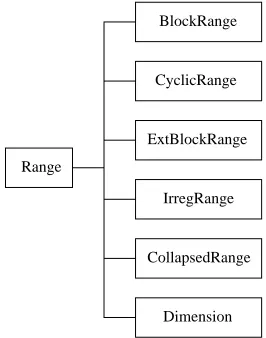
The Range is another special class with privileged status. It represents an integer interval 0,..., N - 1, distributed somehow over a process dimension (a dimension or axis of a grid likep).BlockRangeis a particular subclass ofRange. The arguments in the constructor ofBlockRange represent the total size of the range and the target process dimension. Thus,xhasMelements distributed over first dimension of pandy hasNelements distributed over second dimension of p.
BlockRange
CyclicRange
Range
IrregRange ExtBlockRange
CollapsedRange
[image:4.612.241.374.376.545.2]Dimension
Fig. 2.The HPJava Range hierarchy
dimension. The simplest distribution format iscollapsed (sequential) format in which the whole of the array dimension is mapped to the local process. Other distribution formats (motivated by High Performance Fortran) include regular block decomposition, and simple cyclicdecomposition. In these cases the index range (thus array dimension) is distributed over one of the dimensions of the process grid defined by the group object. All ranges must be distributed over different dimensions of this grid, and if a particular dimension of the grid is targeted by none of the ranges, the array is said to bereplicatedin that dimen-sion5
. Some of the range classes allowghost extensionsto support stencil-based computations.
A second new control construct,overall, implements a distributed parallel loop. It shares some characteristics of theforallconstruct of HPF. The symbols i and jscoped by these constructs are called distributed indexes. The indexes iterate over all locations (selected here by the degenerate interval “:”) of ranges xandy.
HPJava also supports Fortran-like array sections. Anarray section expression
has a similar syntax to a distributed array element reference, but uses double brackets. It yields a reference to a new array containing a subset of the elements of the parent array. Those elements can be accessed either through the parent array or through the array section—HPJava sections behave something like array pointers in Fortran, which can reference an arbitrary regular section of a target array. As in Fortran, subscripts in section expressions can be index triplets. HPJava also has built-in ideas ofsubrangesandrestricted groups. These describe the range and distribution group of sections, and can be also used in array constructors on the same footing as the ranges and grids introduced earlier. They allow HPJava arrays to reproduce any mapping allowed by the ALIGN directive of HPF.
4
Usage of high-level communication library
In this section we discuss extra syntax and usage of high-level communication library in HPJava programs. Two characteristic collective communication meth-odsremap()andwriteHalo()are described as examples.
The general purpose matrix multiplication routine (Figure 3) has two tem-porary arraysta, tbwith the desired distributed format. This program is also using information which is defined for any distributed array:grp() to fetch the distribution group andrng()to fetch the index ranges.
This example relies on a high-level Adlib communication schedule that deals explicitly with distributed arrays; theremap()method. Theremap()operation can be applied to various ranks and type of array. Any section of an array with any allowed distribution format can be used. Supported element types include
5
public void matmul(float [[-,-]] c, float [[-,-]] a, float [[-,-]] b) { Group2 p = c.grp();
Range x = c.rng(0); Range y = c.rng(1);
int N = a.rng(1).size();
float [[-,*]] ta = new float [[x, N]] on p; float [[*,-]] tb = new float [[N, y]] on p;
Adlib.remap(ta, a); Adlib.remap(tb, b);
on(p)
overall(i = x for : ) overall(j = y for : ) {
float sum = 0;
for(int k = 0; k < N ; k++) sum += ta [i, k] * tb [k, j];
c[i, j] = sum; }
}
Fig. 3.A general Matrix multiplication in HPJava.
Java primitive andObjecttype. A general API for theremap function is
void remap (T [[]] dst, T [[]] src) ; void remap (T [[-]] dst, T [[-]] src) ; void remap (T [[-,-]] dst, T [[-,-]] src) ; ...
where T is a Java primitive or Object type. The arguments here are zero-dimensional, one-zero-dimensional, two-zero-dimensional, and so on. We will often sum-marize these in the shorthand interface:
void remap (T # dst, T # src) ;
where the signature T # means any distributed array with elements of type T (Thissyntax is not supported by the current HPJava compiler, but it supports method signatures of this generic kind in externally implemented libraries—ie. libraries implemented in standard Java. This more concise signature does not incorporate the constraint that dst and srchave the same rank—that has to be tested at run-time.)
Procs2 p = new Procs2(P, P) ; on(p) {
Range x = new ExtBlockRange(M, p.dim(0), 1) ; Range y = new ExtBlockRange(N, p.dim(1), 1) ;
float [[-,-]] a = new float [[x, y]] ;
... initialize edge values in ’a’
float [[-,-]] b = new float [[x, y]], r = new float [[x, y]] ;
do {
Adlib.writeHalo(a) ;
overall(i = x for 1 : N - 2) overall(j = y for 1 : N - 2) {
float newA = 0.25 * (a[i - 1, j] + a[i + 1, j] + a[i, j - 1] + a[i, j + 1]);
r[i,j] = Math.abs(newA - a[i,j]); b[i,j] = newA ;
}
HPutil.copy(a,b) ; // Jacobi relaxation. } while(Adlib.maxval(r) > EPS);
}
Fig. 4.Solution of Laplace equation by Jacobi relaxation.
From the point of view of this paper the most important feature of this ex-ample is the appearance of the functionAdlib.writeHalo(). This is acollective communication operation. This particular one is used to fill the ghost cells or
overlap regions surrounding the “physical segment” of a distributed array. A call to a collective operation must be invoked simultaneously by all members of some active process group (which may or may not be the entire set of processes executing the program). The effect ofwriteHalois to overwrite the ghost region with values from processes holding the corresponding elements in their physical segments. Figure 6 illustrates the effect of executing the writeHalo function. More general forms ofwriteHalomay specify that only a subset of the available ghost area is to be updated, or may select cyclic wraparound for updating ghost cells at the extreme ends of the array.
a[0,0] a[0,1] a[0,2] a[1,0] a[1,1] a[1,2] a[2,0] a[2,1] a[2,2]
a[2,0] a[2,1] a[2,2]
a[3,0] a[3,1] a[3,2] a[4,0] a[4,1] a[4,2] a[3,0] a[3,1] a[3,2]
a[0,1] a[0,2] a[0,3] a[1,1] a[1,2] a[1,3]
a[3,1] a[3,2] a[3,3] a[2,1] a[2,2] a[2,3]
a[5,0] a[5,1] a[5,2]
a[2,1] a[2,2] a[2,3]
a[3,1] a[3,2] a[3,3] a[4,1] a[4,2] a[4,3] a[5,1] a[5,2] a[5,3]
0 1
0
[image:8.612.206.411.101.252.2]1
Fig. 5.Example of a distributed array with ghost regions.
Physical segment of array 00000000 00000000 00000000 11111111 11111111 11111111 00000000 00000000 00000000 11111111 11111111 11111111 000 000 000 000 000 111 111 111 111 111 000 000 000 000 000 000 000 000 000 000 000 000 111 111 111 111 111 111 111 111 111 111 111 111 000 000 000 000 000 111 111 111 111 111 000 000 000 000 000 000 000 000 000 000 000 000 111 111 111 111 111 111 111 111 111 111 111 111 000000 000000 000000 000000 000000 000000 111111 111111 111111 111111 111111 111111 00000 11111 by WriteHalo Ghost area written
[image:8.612.236.375.341.556.2]We will discuss implementation issues of high-level communication libraries in following section.
5
Implementation of Collectives
In this section we will discuss Java implementation of the Adlib collective op-erations. For illustration we concentrate on the importantRemap operation. Al-though it is a powerful and general operation, it is actually one of the more simple collectives to implement in the HPJava framework.
General algorithms for this primitive have been described by other authors in the past. For example it is essentially equivalent to the operation called Regu-lar Section Copy Schedin [5]. In this section we want to illustrate how this kind of operation can be implemented in term of the particular Range and Group classes of HPJava, complemented by suitable set of messaging primitives.
All collective operations in the library are based on communicationschedule
objects. Each kind of operation has an associated class of schedules. Particular instances of these schedules, involving particular data arrays and other param-eters, are created by the class constructors. Executing a schedule initiates the communications required to effect the operation. A single schedule may be ex-ecuted many times, repeating the same communication pattern. In this way, especially for iterative programs, the cost of computations and negotiations in-volved in constructing a schedule can often be amortized over many executions. This pattern was pioneered in the CHAOS/PARTI libraries [7]. If a communi-cation pattern is to be executed only once, simple wrapper functions are made available to construct a schedule, execute it, then destroy it. The overhead of creating the schedule is essentially unavoidable, because even in the single-use case individual data movements generally have to be sorted and aggregated, for efficiency. The data structures for this are just those associated with schedule construction.
Constructor and public method of theremapschedule for distributed arrays of float element can be summarized as follows:
class RemapFloat extends Remap {
public RemapFloat (float # dst, float # src) {...}
public void execute() {...} . . .
}
The#notation was explained in previous section.
public abstract class BlockMessSchedule {
BlockMessSchedule(int rank, int elementLen,boolean isObject) { ... }
void sendReq(int offset, int[] strs, int[] exts, int dstId) { ... }
void recvReq(int offset, int[] strs, int[] exts, int srcId) { ... }
void build() { ... }
void gather() { ... }
void scatter() { ... }
... }
Fig. 7.API of the classBlockMessSchedule
During construction of aRemapSkeletonschedule, all send messages, receive messages, and internal copy operations implied by execution of the schedule are enumerated and stored in light-weight data structures. These messages have to be sorted before sending, for possible message agglomeration, and to ensure a deadlock-free communication schedule. These algorithms, and maintenance of the associated data structures, are dealt with in a base class ofRemapSkeleton called BlockMessSchedule. The API for the superclass is outlined in Figure 7. To set-up such a low-level schedule, one makes a series of calls to sendReqand recvReqto define the required messages. Messages are characterized by an offset in some local array segment, and a set of strides and extents parameterizing a multi-dimensional patch of the (flat Java) array. Finally thebuild()operation does any necessary processing of the message lists. The schedule is executed in a “forward” or “backward” direction by invokinggather()orscatter().
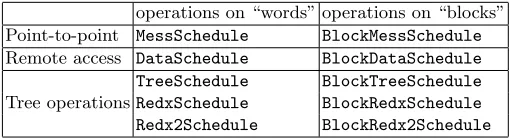
Table 1.Low-level Adlib schedules
operations on “words” operations on “blocks” Point-to-point MessSchedule BlockMessSchedule Remote access DataSchedule BlockDataSchedule TreeSchedule BlockTreeSchedule Tree operationsRedxSchedule BlockRedxSchedule Redx2Schedule BlockRedx2Schedule
time. Irregular communication operations such as collectiveGatherandScatter are implemented on these schedules. The tree schedules are used for various sorts of broadcast, multicast, synchronization, and reduction.
We will describe in more detail the implementation of the higher-levelRemapSkeleton schedule on top of BlockMessSchedule. This provides some insight into the structure HPJava distributed arrays, and the underlying role of the specialRange andGroupclasses.
To produce an implementation of theRemapSkeleton class that works in-dependently of the detailed distribution format of the arrays we rely on virtual functions of theRangeclass to enumerate the blocks of index values held on each processor. These virtual functions, implemented differently for different distribu-tion formats, encode all important informadistribu-tion about those formats. To a large extent the communication code itself is distribution format independent.
The range hierarchy of HPJava was illustrated in Figure 2, and some of the relevant virtual functions are displayed in the API of Figure 8. Most methods optionally take arguments that allow one to specify a contiguous or strided subrange of interest. TheTripletandBlockinstances represent simple struct-like objects holding a fewintfields. Those integer files are describing respectively a “triplet” interval, and the strided interval of “global” and “local” subscripts that the distribution format maps to a particular process. In the examples here Tripletis used only to describe a range of process coordinatesthat a range or subrange is distributed over.
public abstract class Range { public int size() {...} public int format() {...} ...
public Block localBlock() {...}
public Block localBlock(int lo, int hi) {...}
public Block localBlock(int lo, int hi, int stp) {...}
public Triplet crds() {...} public Block block(int crd) {...}
public Triplet crds(int lo, int hi) {...}
public Block block(int crd, int lo, int hi) {...}
public Triplet crds(int lo, int hi, int stp) {...}
public Block block(int crd, int lo, int hi, int stp) {...} . . .
}
Fig. 8.Partial API of the classRange
Not all the schedules of Adlib are as “pure” asRemap. A few, likeWriteHalo have built-in dependency on the distribution format of the arrays (the existence of ghost regions in the case ofWriteHalo). But they all rely heavily on the meth-ods and inquiries of theRangeandGroupclasses, which abstract the distribution format of arrays. The API of these classes has evolved through C++ and Java versions of Adlib over a long period.
In the HPJava version, the lower-level, underlying schedules like BlockMessS-chedule(which are not dependent on higher-level ideas like distributed ranges and distributed arrays) are in turn implemented on top of a messaging API, called
mpjdev. To deal with preparation of the data and to perform the actual com-munication, it uses methods of the mpjdev likeread(),write(),strGather(), strScatter(),isend(), and irecv().
private void sendLoop(int offset, Group remGrp, int r){
if(r == rank) {
sendReq(offset, steps, exts, world.leadId(remGrp)); } else {
Block loc = src.rng(r).localBlock();
int offsetElem = offset + src.str(r) * loc.sub_bas; int step = src.str(r) * loc.sub_stp;
Range rng = dst.rng(r);
Triplet crds = rng.crds(loc.glb_lo, loc.glb_hi, loc.glb_stp);
for (int i = 0, crd = crds.lo; i < crds.count; i++, crd += crds.stp){
Block rem = rng.block3(crd, loc.glb_lo, loc.glb_hi, loc.glb_stp);
exts[r] = rem.count;
steps[r] = step * rem.glb_stp;
sendLoop(offsetElem + step * rem.glb_lo, remGrp.restrict(rng.dim(), crd), r + 1) ;
} } }
Fig. 9.sendLoopmethod forRemap
6
Collective Communications
In the previous section we described the Adlib communication implementation issues with a characteristic collective operation example,remap(). In this section we will overview functionalities of all collective operations in Adlib. The Adlib has three main families of collective operation: regular communications, reduc-tion operareduc-tions, and irregular communicareduc-tions. We discuss usage and high-level API overview of Adlib methods.
6.1 Regular Collective Communications
We already described two characteristic example of the regular communications, remap() and writeHalo(), in depth. In this section we describe other regular collective communications.
000000 000000 000000 000000
111111 111111 111111 111111
000 000 000 000
111 111 111 111
rem.glb_lo rem.glb_hi loc.glb_hi
crd
0 N − 1
0 N − 1
dst
src
loc.glb_lo
loc.glb_lorem.glb_lo loc.glb_hi
[image:14.612.189.428.69.193.2]rem.glb_hi
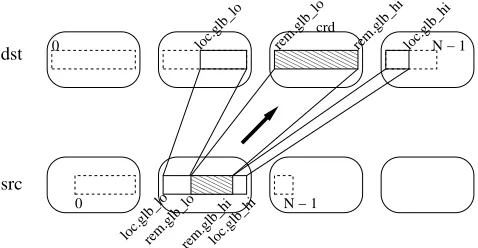
Fig. 10.Illustration ofsendLoopoperation forremap
array. In general we have the signatures:
void shift(T [[-]] destination, T [[-]] source, int shiftAmount)
and
void shift(T # destination, T # source, int shiftAmount, int dimension)
where the variableT runs over all primitive types and Object, and the notation T # means a multiarray of arbitrary rank, with elements of typeT. The first form applies only for one dimensional multiarrays. The second form applies to multiarrays of any rank. The shiftAmount argument, which may be negative, specifies the amount and direction of the shift. In the second form thedimension argument is in the range 0, . . . , R−1 whereRis the rank of the arrays: it selects the array dimension in which the shift occurs. The source and destination arrays must have the same shape, and they must also beidentically aligned. By design, shift()implements a simpler pattern of communication than generalremap(). The alignment relation allows for a more efficient implementation. The library incorporates runtime checks on alignment relations between arguments, where these are required.
The shift() operation does not copy values from source that would go past the edge ofdestination, and at the other extreme of the range elements ofdestinationthat are not targetted by elements fromsourceare unchanged from their input value. The related operation cshift()is essentially identical toshift()except that it implements a circular shift, rather than an “edge-off” shift.
6.2 Reductions
Adlib provides a large set of reduction operations, supporting the many kinds of reduction available as “intrinsic functions” in Fortran. Here we mention only a few of the simplest reductions. One difference between reduction operations and other collective operations is reduction operations do not support Java Object type.
Themaxval()operation simply returns the maximum of all elements of an array. It has prototypes
t maxval (t # a)
where tnow runs over all Java numeric types—that is, all Java primitive types exceptboolean. The result is broadcast to the active process group, and returned by the function. Other reduction operations with similar interfaces areminval(), sum() and product(). Of these minval() is minimum value, sum() adds the elements ofain an unspecified order, andproduct()multiplies them.
The boolean reductions:
boolean any (boolean # a) boolean all (boolean # a) int count (boolean # a)
behave in a similar way. The method any()returns true if any element of ais true. The method all()returns true if all elements of aare true. The method count()returns a count of the number of true elements ina.
6.3 Irregular Collective Communications
Adlib has some support for irregular communications in the form of collective gather()andscatter()operations. The simplest form of the gather operation for one-dimensional arrays has prototypes
void gather(T [[-]] destination, T [[-]] source, int [[-]] subscripts) ;
Thesubscriptsarray should have the same shape as, and be aligned with, the destinationarray. In pseudocode, the gatheroperation is equivalent to
for all i in {0, . . . , N−1} in parallel do destination [i] = source [subscripts [i]] ;
where N is the size of the destination (and subscripts) array. If we are implementing a parallel algorithm that involves a stage like
for all i in {0, . . . , N−1} in parallel do a [i] = b [fun(i)] ;
wherefunis an arbitrary function, it can be expressed in HPJava as
int [[-]] tmp = new int [[x]] on p ; on(p)
overall(i = x for :) tmp [i] = fun(i);
wherepandxare the distribution group and range ofa. The source array may have a completely unrelated mapping.
7
Application of HPJava
The multigrid method [6] is a fast algorithm for solution of linear and nonlinear problems. It uses a hierarchy or stack of grids of different granularity (typically with a geometric progression of grid-spacings, increasing by a factor of two up from finest to coarsest grid). Applied to a basic relaxation method, for example, multigrid hugely accelerates elimination of the residual by restricting a smoothed version of the error term to a coarser grid, computing a correction term on the coarse grid, then interpolating this term back to the original fine grid. Because computation of the correction term on the fine grid can itself be handled as a relaxation problem, the strategy can be applied recursively all the way up the stack of grids.
The experiments were performed on the SP3 installation at Florida State University. The system environment for SP3 runs were as follows:
– System: IBM SP3 supercomputing system with AIX 4.3.3 operating system and 42 nodes.
– CPU: A node has Four processors (Power3 375 MHz) and 2 gigabytes of shared memory.
– Network MPI Settings: Shared “css0” adapter with User Space(US) commu-nication mode.
– Java VM: IBM ’s JIT
– Java Compiler: IBM J2RE 1.3.1
For best performance, all sequential and parallel Fortran and Java codes were compiled using -O5 or -O3 with -qhot or -O (i.e. maximum optimization) flag.
First we present some results for the computational kernel of the multigrid code, namely unaccelerated red-black relaxation algorithm. Figure 11 gives our results for this kernel on a 512 by 512 matrix. The results are encouraging. The HPJava version scales well, and eventually comes quite close to the HPF code (absolute megaflop performances are modest, but this feature was observed for all our codes, and seems to be a property of the hardware).
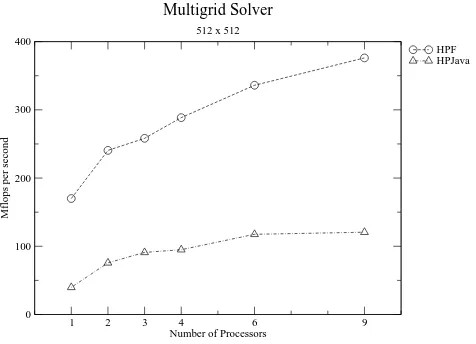
The flat lines at the bottom of the graph give the sequential Java and Fortran performances, for orientation. We did not use any auto parallelization feature here. Corresponding results for the complete multigrid code are given in Figure 12. The results here are not as good as for simple red-black relaxation-both HPJava speed relative to HPF, and the parallel speedup of HPF and HPJava are less satisfactory.
1 4 9 16 25 36 Number of Processors
0 250 500 750 1000 1250 1500
Mflops per second
HPF HPJava Fortran Java
apacequa t
onusnge
aceaxa
t
on
[image:17.612.190.426.105.273.2]512 x 512
Fig. 11.Laplace Equation with Size of 5122 .
1 2 3 4 6 9
Number of Processors 0
100 200 300 400
Mflops per second
HPF HPJava
Multigrid Solver
512 x 512
[image:17.612.189.427.381.553.2]optimization strategies which, however, are not yet incorporated in our source-to-source translator.
The modest parallel speedup of both HPJava and HPF is due to communi-cation overheads. The fact that HPJava and HPF have similar scaling behavior, while absolute performance of HPJava is lower, suggests the communication li-brary of HPJava is slower than the communications of the native SP3 HPF (otherwise the performance gap would close for larger numbers of processors). This is not too surprising because Adlib is built on top of a portability layer called mpjdev, which is in turn layered on MPI. We assume the SP3 HPF is more carefully optimized for the hardware. Of course the lower layers of Adlib could be ported to exploit low-level features of the hardware.
8
HPJava with GUI
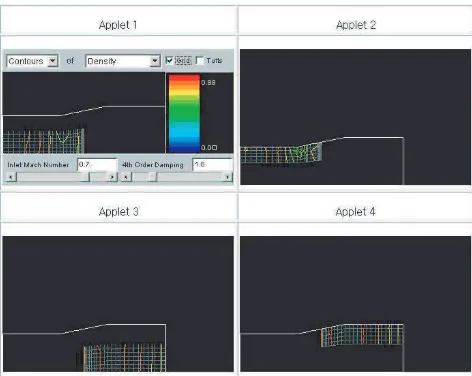
[image:18.612.189.425.401.589.2]In this section we will illustrate how our HPJava can be used with a Java graph-ical user interface. The Java multithreaded implementation of mpjdev makes it possible for HPJava to cooperate with Java AWT. We ported the mpjdev layer to communicate between the threads of a single Java Virtual Machine . The threads cooperate in solving a problem by communicating through our commu-nication library, Adlib, with pure Java version of the mpjdev. By adding pure Java version of the mpjdev to the Adlib communication library, it gives us the possibility to use the Java AWT and other Java graphical packages to support a GUI and visualize graphical output of the parallel application. Visualization of the collected data is a critical element in providing developers or educators with the needed insight into the system under study.
For test and demonstration of multithreaded version of mpjdev, we imple-mented computational fluid dynamics (CFD) code using HPJava which simulates 2 dimensional inviscid flow through an axisymmetric nozzle(Figure 13). The sim-ulation yields contour plots of all flow variables, including velocity components, pressure, Mach number, density and entropy, and temperature. The plots show the location of any shock wave that would reside in the nozzle. Also, the code finds the steady state solution to the 2 dimensional Euler equations, seen below.
∂U ∂t +
∂E ∂x +
∂F
∂y =αH (1)
HereU =
ρ ρu ρv et
,E=
ρu ρu2 +p ρuv (et+p)u
, andF =
ρv ρuv ρv2 +p (et+p)v
.
The source vectorH is zero for this case.
The demo consists of 4 independent Java applets communicating through the Adlib communication library which is layered on top of mpjdev. Applet 1 is handling all events and broadcasting control variables to other applets. Each applet has the responsibility to draw its own portion of the data set into the screen, as we can see in the figure. That this demo also illustrates usage of Java object in our communication library. We are using writeHalo() method to communicate Java class object between threads.
This unusual interpretation of parallel computing, in which several applets in a single Web browser cooperate on a scientific computation, is for demonstration purpose only. The HPJava simulation code can also be run on a collection of virtual machines distributed across heterogeneous platforms like the native MPI of MPICH, SunHPC-MPI, and IBM POE.
You can view this demonstration and source code at
http://www.hpjava.org/demo.html
9
Conclusions and Future Work
We have explored enabling parallel, high-performance computation-in particular development of scientific software in the network-aware programming language, Java. Traditionally, this kind of computing was done in Fortran. Arguably, For-tran is becoming a marginalized language, with limited economic incentive for vendors to produce modern development environments, optimizing compilers for new hardware, or other kinds of associated software expected by today’s pro-grammers. Java looks like a promising alternative for the future.
data types. We discussed implementation issues of collective communications in depth. The API and usage of other types of collective communications were also presented.
References
1. Timber Compiler Home Page. http://pds.twi.tudelft.nl/timber.
2. Java for Computational Science and Engineering–Simulation and Modelling. Con-currency: Practice and Experience, 9(6), June 1997.
3. Java for Computational Science and Engineering–Simulation and Modelling II.
Concurrency: Practice and Experience, 9(11):1001–1002, November 1997.
4. ACM 1998 Workshop on Java for high-performance network computing. Concur-rency: Practice and Experience, 10(11-13):821–824, September 1998.
5. A. Agrawal, A. Sussman, and J. Saltz. An integrated runtime and compiletime approach for parallelizing structured and block structured applications. IEEE Transactions on Parallel and Distributed Systems, 6, 1995.
6. William L. Briggs, Van Emden Henson, and Steve F. McCormick. A Multigrid Tutorial. The Society for Industrial and Applied Mathematics (SIAM), 2000. 7. R. Das, M. Uysal, J.H. Salz, and Y.-S. Hwang. Communication optimizations for
irregular scientific computations on distributed memory architectures. Journal of Parallel and Distributed Computing, 22(3):462–479, September 1994.
8. Jayant DeSouza and L. V. Kale. Jade: A parallel message-driven java. In Proceedings of the 2003 Workshop on Java in Com-putational Science, Melbourne, Australia, 2003. Available from http://charm.cs.uiuc.edu/papers/ParJavaWJCS03.shtml.
9. Java Grande Forum home page. http://www.javagrande.org.
10. Han-Ku Lee. Towards Efficient Compilation of the HPJava Language for High Performance Computing. PhD thesis, Florida State University, June 2003. 11. J. E. Moreira, S. P. Midkiff, M. Gupta, and R. Lawrence. High Performance
Computing with the Array Package for Java: A Case Study using Data Mining. In
Supercomputing 99, November 1999.
12. J.E. Moreira, S.P. Midkiff, and M. Gupta. A comparision of three approaches to language, compiler and library support for multidimensional arrays in Java. In
ACM 2001 Java Grande/ISCOPE Conference. ACM Press, June 2001.