This is a repository copy of Unfolding Kernel Embeddings of Graphs : Enhancing Class Separation through Manifold Learning.
White Rose Research Online URL for this paper: http://eprints.whiterose.ac.uk/84841/
Version: Accepted Version
Article:
Rossi, Luca, Torsello, Andrea and Hancock, Edwin R orcid.org/0000-0003-4496-2028 (2015) Unfolding Kernel Embeddings of Graphs : Enhancing Class Separation through Manifold Learning. Pattern Recognition. pp. 3357-3370. ISSN 0031-3203
https://doi.org/10.1016/j.patcog.2015.03.018
[email protected] Reuse
Items deposited in White Rose Research Online are protected by copyright, with all rights reserved unless indicated otherwise. They may be downloaded and/or printed for private study, or other acts as permitted by national copyright laws. The publisher or other rights holders may allow further reproduction and re-use of the full text version. This is indicated by the licence information on the White Rose Research Online record for the item.
Takedown
If you consider content in White Rose Research Online to be in breach of UK law, please notify us by
Unfolding Kernel Embeddings of Graphs:
Enhancing Class Separation through Manifold Learning
Luca Rossi 1∗, Andrea Torsello2, Edwin R. Hancock3 1
School of Computer Science, University of Birmingham, UK 2
Department of Environmental Science, Informatics, and Statistics, Ca’ Foscari University of Venice, Italy
3
Department of Computer Science, The University of York, York YO10 5DD, UK
Abstract
In this paper, we investigate the use of manifold learning techniques to enhance the
separa-tion properties of standard graph kernels. The idea stems from the observasepara-tion that when
we perform multidimensional scaling on the distance matrices extracted from the kernels,
the resulting data tends to be clustered along a curve that wraps around the embedding
space, a behaviour that suggests that long range distances are not estimated accurately,
resulting in an increased curvature of the embedding space. Hence, we propose to use a
number of manifold learning techniques to compute a low-dimensional embedding of the
graphs in an attempt to unfold the embedding manifold, and increase the class separation.
We perform an extensive experimental evaluation on a number of standard graph datasets
using the shortest-path [1], graphlet [2], random walk [3] and Weisfeiler-Lehman [4] kernels.
We observe the most significant improvement in the case of the graphlet kernel, which fits
with the observation that neglecting the locational information of the substructures leads to
a stronger curvature of the embedding manifold. On the other hand, the Weisfeiler-Lehman
kernel partially mitigates the locality problem by using the node labels information, and
thus does not clearly benefit from the manifold learning. Interestingly, our experiments also
show that the unfolding of the space seems to reduce the performance gap between the
examined kernels.
Keywords: Kernel Learning, Kernel Unfolding, Graph Kernels, Manifold Learning
1. Introduction
Graph-based representations have become increasingly popular due to their ability to
characterize in a natural way a large number of systems which are best described in terms
parts and binary relations. Concrete examples include the use of graphs to represent
shapes [5], metabolic networks [6], protein structure [7], and road maps [8]. However, the
rich expressiveness and versatility of graphs comes at the cost of added complexity and
a reduced toolset of available pattern analysis algorithms. In fact, our ability to analyse
data abstracted in terms of graphs is severely limited by the restrictions posed by standard
pattern recognition techniques, which require data to be representable in a vectorial form.
There are two reasons why graphs are not easily reduced to a vectorial form: First, there is
no canonical ordering for the nodes in a graph, unlike the components of a vector. Hence,
correspondences to a reference structure must be established as a prerequisite. Second, the
variation in the graphs of a particular class may manifest itself as subtle changes in structure.
Hence, even if the nodes or the edges of a graph could be encoded in a vectorial manner,
the vectors would be of variable length, thus residing in different spaces.
The first 30 years of research in structural pattern recognition have been mostly
con-cerned with the solution of the correspondence problem as the fundamental means of
assess-ing structural similarity [9]. With the similarity at hand, similarity-based pattern recognition
techniques such as the nearest neighbour rule can be used to perform recognition and
classi-fication tasks, or graphs may be embedded in a low-dimensional pattern space using either
multidimensional scaling or alternative non-linear manifold leaning techniques.
Another alternative is to extract feature vectors from the graphs providing a
pattern-space representation. There are a number of ways in which this can be done: One approach
is to extract structural or topological features from the graphs under study. Graph
spec-tral features extracted from the eigenvalues and eigenvectors of the adjacency or Laplacian
matrices have been shown to be effective here [10, 11]. Again, manifold learning techniques
have been used in the literature to provide a way to unfold the pattern space and map the
data onto low-dimensional spaces where the structural classes are well separated.
The famous kernel trick [12] has shifted the problem from the vectorial representation of
data, which now becomes implicit, to a similarity representation. This has allowed standard
learning techniques to be applied to data for which no easy vectorial representation exists.
More formally, once we define a positive semi-definite kernel k : X×X → R on a set X,
there exists a mapφ:X → H into a Hilbert space H, such that k(x, y) =φ(x)⊤φ(y) for all x, y ∈ X. Also, given the kernel value between φ(x) and φ(y) one can easily compute the
distance between them by noting that||φ(x), φ(y)||2 =φ(x)⊤φ(x)+φ(y)⊤φ(y)−2φ(x)⊤φ(y). Thus, any algorithm that can be formulated in terms of dot products between the input
vectors can be applied to the implicitly mapped data points through the direct substitution
of the kernel for the dot product. For this reason, in recent years pattern recognition has
witnessed an increasing interest in structural learning using graph kernels. However, due to
the rich expressiveness of graphs, this task has also proven to be difficult, with the problem
of definingcompletekernels, i.e., ones where the implicit mapφ is injective, sharing the same
computational complexity of the graph isomorphism problem [13].
While the graph kernels proposed in the literature provide effective ways to generate
implicit embeddings, there is no guarantee that the data in the Hilbert space will exhibit
better class separation. This is of course a consequence of the complexity of the structural
embedding problem and the limits for efficient kernel computations already analysed by
G¨artner et al. [13]. One evidence of this is the fact that the multidimensional scaling
embeddings of several graph kernels show the so-called horseshoe effect [14] (see Figure 1),
i.e., the data tends to cluster tightly along a curve that wraps around the embedding space.
This particular behaviour is typically produced by a consistent underestimation of the real
distances of the problem, i.e., the geodesic distances on the manifold, and it implies that
the data gets placed onto a highly non-linear manifold embedded in the Hilbert space. The
horseshoe is in fact the locus of intersection between the manifold and the plane used to
visualise the data, and the high curvature is a result of the dimensionality compression on
the data, which reduces the degrees of freedom of the points and forces them to cluster
−100 0 100 200 300 −20
−10 0 10 20 30
1st Leading Dimension
2nd Leading Dimension
(a) Shortest-path
−0.5 0 0.5 1
−0.4 −0.2 0 0.2 0.4 0.6
1st Leading Dimension
2nd Leading Dimension
(b) Graphlet
−20 −10 0 10 20 30
−1 −0.5 0 0.5 1 1.5
1st Leading Dimension
2nd Leading Dimension
(c) Random walk
−5 0 5 10 15
−4 −2 0 2 4 6
1st Leading Dimension
2nd Leading Dimension
(d) W L1
−5 0 5 10 15
−4 −2 0 2 4 6 8
1st Leading Dimension
2nd Leading Dimension
(e) W L2
−5 0 5 10 15
−4 −2 0 2 4 6 8
1st Leading Dimension
2nd Leading Dimension
[image:5.595.71.526.107.397.2](f) W L3
Figure 1: The MDS embeddings of the shortest-path [1], graphlet [2], random walk [3] and
Weisfeiler-Lehman [4] kernels (withh= 1,2,3) on the COIL dataset.
of kernel normalization, a common procedure through which the data points are projected
from the Hilbert space onto the unit sphere. This in turn creates an artificial curvature of
the space that can create or exacerbate the observed horseshoe effect. Note, however, that
while in general the non-linearity of the mapping is used to improve local class separability,
a large global curvature can result in a folding of the manifold that can reduce long range
separability.
For this reason, it is natural to investigate the impact of the locality of distance
infor-mation on the performance of these kinds of kernels. To this end, given a set of graphs, we
investigate the use of several manifold learning techniques to embed the graphs onto a
low-dimensional vectorial space, in an attempt to unfold the embedding manifold, and increase
class separation. More specifically, we investigate the use of four popular non-linear
mani-fold learning techniques, namely Isomap [15], Laplacian Eigenmaps [16], Diffusion Maps [17]
learn-(a) Linear embedding (b) Low-curvature embedding (c) High-curvature embedding
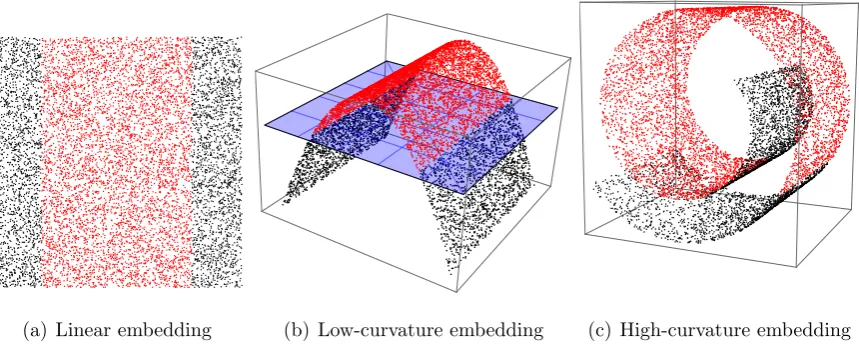
Figure 2: Example of reduced linear separability due to high curvature of the embedding. In the linear
embedding case the data is not separable, introducing a non-linear mapping to a low-curvature manifold
renders the data linearly separable. However, mapping to a high global curvature manifold (e.g. the famous
swissroll manifold) results in a reduced linear separability of the data. Furthermore, the higher the curvature
the less separable the data is.
ing problem from radically different angles, with Isomap attempting to preserve the global
distances and LLE trying to maintain the local neighbourhood geometry.
Experiments on several standard datasets demonstrate that, as expected, the
improve-ment is kernel and dataset dependent, with some kernels and datasets generally gaining very
significant improvements in performance, while other not exhibiting significant variation or
even modest reduction. Most importantly, the unfolding of the manifold invariably reduces
the performance gap between the kernels examined. This suggests that the instances of
ker-nels in the literature do not differ by any intrinsic difference in descriptive power, but in the
level of warping of the embedding space. See Figure 2 for an example where the non-linear
mapping to a high-curvature manifold reduces the linear separability of data.
The remainder of this paper is organized as follows: Section 2 introduces some related
work in graph kernels and manifold learning, while Section 3 illustrates the unwrapping idea
and provide a more in-depth description of the kernels and manifold learning techniques
used in this study. Section 4 illustrates the experimental results, while Section 5 discusses
2. Related Works
Many different graph kernels have been proposed in the literature, and they are generally
instances of the family of R-convolution kernels first introduced by Haussler [22]. The
fundamental idea is that of decomposing two discrete objects and comparing some simpler
substructures. Generally speaking, most R-convolution kernels simply count the number of
isomorphic substructures in the two graphs being compared, and differ mainly by the type
of substructures used in the deconvolution and the algorithms used to count them efficiently.
For example, Kashima et al. [3] propose to count the number of common random walks
between two graphs. This kernel, however, is subject totottering. That is, a walk is allowed
to go back and forth along a single edge multiple times, thus reducing the discriminative
power of the kernel. A solution to this is proposed by Mahe et al. [47], who modify the
standard random walk model by preventing the walk from returning to a vertex that has
just been visited. Borgwardt and Kriegel [1] measure the similarity by counting the numbers
of pairs of shortest paths of the same length in the graphs. Shervashidze et al. [2], on the
other hand, count the number of graphlets, i.e. subgraphs with k ={13,4,5} nodes. More
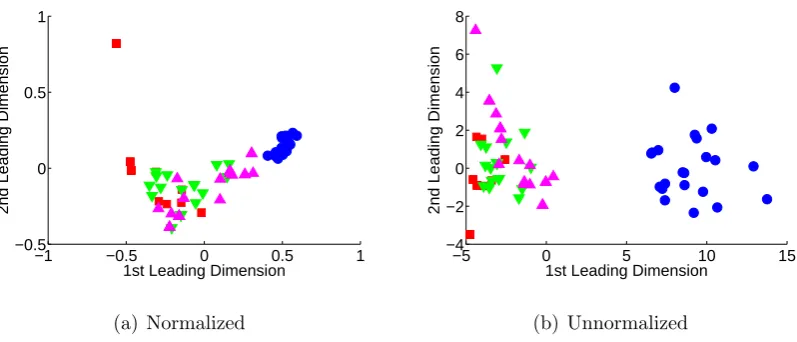
recently, Shervashidze et al. [4] have developed a subtree kernel on subtrees of limited size.
They compute the number of subtrees shared between two graphs using the
Weisfeiler-Lehman graph invariant. Another kernel based on subtrees enumeration is that of Ga¨uzere
et al.[48]. More specifically, Ga¨uzere et al. define the similarity between two graphs in terms
by decomposing them in bags of treelets, i.e., acyclic and unlabeled trees whose maximal
size is equal to 6. Ralaivola et al. [49], on the other hand, develop a series of kernels by
exploiting specific structural properties of graphs arising in the domain of organic chemistry.
Aziz et al. [23] have defined a backtrackless kernel on cycles of limited length. They compute
the kernel value by counting the numbers of pairs of cycles of the same length in a pair of
graphs. Costa and Grave [24] have defined a so-called neighbourhood subgraph pairwise
distance kernel by counting the number of pairs of isomorphic neighbourhood subgraphs.
Recently, Kriege et al [25] counted the number of isomorphisms between pairs of subgraphs,
partially labelled graphs through the use of continuous-valued node attributes.
One drawback of these kernels is that they neglect locational information for the
sub-structures in a graph. In other words, the similarity does not depend on the relationship
between substructures. As a consequence, these kernels cannot establish reliable structural
correspondences between the substructures in a pair of graphs. This limits the precision
of the resulting similarity measure. To overcome this problem, Fr¨ohlich et al. [27]
intro-duced alternative optimal assignment kernels. Here each pair of structures is aligned before
comparison. However, the introduction of the alignment step results in a kernel that is not
positive definite in general [28]. The problem results from the fact that alignments are not
in general transitive. In other words, ifσ is the node-alignment between graphA and graph
B, and π is the alignment between graph B and graph C, in general we cannot guarantee
that the alignment between graph A and graph C is π◦σ. On the other hand, when the
alignments are transitive, there is a common simultaneous alignment of all the graphs.
Un-der this alignment, the optimal assignment kernel is simply the sum over all the node/edge
kernels, and this is positive definite since it is the sum of separated positive definite kernels.
While lacking positive definiteness the optimal assignment kernels cannot be guaranteed to
represent an implicit embedding into a Hilbert space, they have nonetheless been proven to
be very effective in classifying structures. Another example of alignment-based kernels are
the edit-distance-based kernels introduced by Neuhaus and Bunke [29]. Here the alignments
obtained from graph-edit distance are used to guide random walks on the structures. More
recently, a number of quantum walk graph kernels have been proposed in the literature,
where the locational information problem is solved by pre-aligning the graph structures [30]
or by letting the quantum walk evolve on a suitably defined composite graph structure [31].
Manifold learning is an approach to non-linear dimensionality reduction based on the
idea that the dimensionality of many data sets is only artificially high as a consequence of
the choice of observables or features. In fact, the data actually resides in a low-dimensional
manifold embedded in the high-dimensional feature space, and the manifold may fold or
wrap in the feature space so much that the natural feature-space parametrization does not
uncover a non-linear parametrization for the data manifold in order to find a low-dimensional
representation of the data that effectively unfolds the manifold and reveals the underlying
data structure.
Multidimensional scaling (MDS) [32] is a standard approach for linear dimensionality
reduction which aims at findings the rank m projection that best preserves the interpoint
distances given by a distance matrix D. To this end, the matrix M = −1
2HDH is first
computed, where H = I − 1
n11
⊤ is the centering matrix, 1 denotes the m-dimensional vector of all ones and n is the number of points to embed. Let M = ΦΛΦT, Φ, where
Φ is the n ×n matrix Φ = (φ1|φ2|...|φn) with the ordered eigenvectors as columns and
Λ = diag(λ1, λ2, ..., λn) is then×ndiagonal matrix with the ordered eigenvalues as elements.
The coordinates of the newly embedded points in m dimensions are then given by the
columns of the matrix X = Φm(Λm) 1
2, where Φ
m (Λm) denotes the submatrix of Φ (Λ)
corresponding to the firstm columns.
Isomap [15], short for Isometric Feature Mapping, has been one of the first algorithms
introduced for manifold learning and has gained significant popularity due to its conceptual
simplicity and efficient implementation. In its essence Isomap can be seen as a direct
gen-eralization of Multidimensional Scaling (MDS) where the distances are taken to be geodesic
distances on the manifold, thus preserving global isometries. The geodesic distances are
approximated as the length of the minimal path on a neighbourhood graph. Despite its
popularity, the use of geodesic distances make Isomap strongly dependent to the topology
of the neighbourhood graph, suffering from short-cutting and other distortion effects.
Dif-fusion Maps [33] attempt to mitigate this problem by substituting geodesic distances with
a more robust distance based on the heat diffusion on the graph. The Laplacian
Eigen-map draws ideas from spectral graph theory to perform a low-dimensional embedding, and
uses the eigenfunctions of the LaplaceBeltrami operator on the manifold as the embedding
dimensions.
Locally Linear Embedding (LLE) [18] was introduced at about the same time as Isomap,
but is based on a substantially different intuition. Here the manifold is seen as a collection of
manifold, the local local geometry of the patches can be considered approximately linear.
The idea, then, is to characterize the local geometry of each neighbourhood as a linear
function and to find a mapping to a lower dimensional Euclidean space that preserves the
linear relationship between a point and its neighbours. Though LLE is based on a different
intuition than Laplacian Eigenmap, Belkin and Niyogi [34] were able to show that that the
algorithms were equivalent under some conditions.
Maximum Variance Unfolding (MVU) [35], also referred as Semi-Definite Embedding
(SDE), attempts to explicitly unfold the manifold by maximizing the variance of the
em-bedded points while keeping fixed the local distances, and thus the manifold topology. The
resulting optimization problem is solved through semi-definite programming, which makes
it computationally demanding when applied to large sets of points.
Generally speaking, the above techniques can be classified as either global or local
ap-proaches, according to the nature of the geometrical information that they attempt to
pre-serve. As an example, Isomap attempts to minimise the embedding distortion, and as such
it tries to maintain the global distances between the points, eventually causing local
dis-tortions. LLE and Laplacian Eigenmap, on the other hand, attempt to preserve the local
geometry of the data, essentially trying to compute a conformal map between the original
manifold and the embedding space. Finally, MVU takes into account both local and global
geometry preservation, by maximizing the distances between the non-neighbouring points
while keeping the distances between neighbours fixed.
The most closely related works to the present paper are [19, 21]. In [19] Ham et al. study
the relationship between Isomap, Laplacian Eigenmaps and Local Linear Embedding and
their link to kernel PCA [20]. However, while Ham et al. point out a connection between
manifold learning and kernel methods, our work is significantly different from theirs as our
inputs are (dis)similarities, i.e., kernel values, as opposed to vectorial data. Moreover, our
aim is that of using manifold learning to smooth the implicit underlying space to increase
the performance of the original kernels. In Riesen et al. [21] the authors apply Isomap on
a set of graphs given the edit distance between them, and a graph kernel is constructed by
that we use manifold learning to smooth the graph embedding space. However, our work
differs from that of Riesen et al. [21] since we focus on the distances induced by standard
graph kernels, rather than the graph edit distance. Additionally, we propose a simple yet
effective framework to select the optimal embedding parameters for the manifold learning
techniques.
3. Graph Kernels and Manifold Learning
As stated in the Introduction, the application of multidimensional scaling to the
dis-tances in the implicit Hilbert space, obtained from the kernel matrix of the most widely
used R-convolution type graph kernels in the literature, often exhibits the so-called
horse-shoe effect, i.e., a data distribution concentrated along a highly curved line or manifold. This
is an indication of a consistent underestimation of the long-range distances consistent with
the properties of these kernels. In fact, R-convolution kernels typically count the number
of isomorphic substructures in the decomposition of the two graphs, without taking into
consideration locational information for the substructures in a graph. In other words,
sub-structures are similar regardless of their relative position in the graphs. When the graphs
are very similar, the similar substructures that are locationally consistent dominate the
con-volution. However, when the graphs are very dissimilar, several similar small substructures
can appear all over the two graphs simply due to the statistics of random graphs, and the
smaller and simpler the substructures in the decomposition, the more likely we are to find
them in various locations of the two structures. This is a typical aperture problem, where
the smaller the probing size, the more uniform the world appears, and the more likely we
are to find similarities due to random fluctuations.
Note that this does not mean that there are more common small substructures than
common large substructures. Indeed the combinatorial expansion of the possible
correspon-dences will result in an increase of the number of matches with the size of the probing
structure. Instead, it is the proportion of correct matches over the total number of possible
correspondences of the same size that reduces as the size increases. In other words, the
of the structure does indeed increase with size. As an example, a single node can have n
possible correspondences, but 100% of them will be a match. On the other hand there are
3 possible graphs with 3 nodes; one with zero arcs, one with one arc, one with two arcs and
the complete graph. There are 6 possible permutations from any of these structures to any
group of three nodes in a graph. In all cases a permutation can be a match only if it maps to
a substructure with the same number of arcs. Each of the permutations mapping the
struc-tures with zero or 3 arcs to a similar structure will be an exact match. On the other hand,
in the case of the structures with one or two arcs, only two of the six possible permutations
will result in an exact match. In other words, only 2/3 of the possible permutations give
an exact match. Hence, the structure with 3 nodes gives fewer ambiguous matches than a
single node, and also results in a smaller proportion of incorrect matches.
Further, the lack of a locality condition and the consequent summation over the entire
structure amplifies the effect of these random similarities. This gives rise to a lower bound
on the kernel value that is a function only of the random graph statistics. The effect of
this non-negligible lower bound due to random fluctuations is a consistent reduction in the
estimated distances for dissimilar graphs. This does not affect the metric properties of the
kernel distances, as the triangle inequality is not violated by a reduction of the length of
the sides of a triangle, nor does it affect embeddability, since it does not affect the positive
definiteness of the kernel, but it does add a strong curvature to the embedding manifold,
which can effectively fold on itself, and it does increase the effective dimensionality of the
embedding.
Note that the added locational constraints in correspondence kernels [27, 29] can
effec-tively reduce this phenomenon since the contribution of random similarities is not summed
over all the structures, but it comes at the cost of positive definiteness and it still relies on
correspondences that are not reliable for very dissimilar graphs, resulting in distortions that
are not guaranteed to be only contractions, and that can affect also the metric properties by
breaking the triangle inequality. To this effect, it is worth noting that the Weisfeiler-Lehman
kernels make use of node labels, thus improving node localization in the evaluation of the
though we have used a very non-specific descriptor such as the node degree. More generally,
we should stress that taking node labels into account can help to reduce the locational
prob-lem. This in turn has the effect of increasing the discriminative power of the kernel and of
reducing the observed horseshoe effect. However, node labels may not always be available.
Finally, kernel normalization, which is a common kernel preprocessing technique where the
data is projected from the Hilbert space onto the unit sphere, can artificially increase the
curvature of the space, thus leading to the observation of a stronger horseshoe effect.
In this paper, we intend to study the use of a number of manifold learning techniques on
R-convolution type graph kernels. Note that while graphs can indeed reside in highly
non-smooth spaces, here we assume that it is the kernel embeddings that reside in a manifold.
Thus, given this setting, we try to increase class separation by embedding the graphs onto
a low-dimensional vectorial space, in an attempt to unfold the embedding manifold. To this
end, in the next section we illustrate an approach to select the embedding parameters that
optimally unfold the kernel which is based on a cross-validation approach maximizing linear
separability of data, then we introduce the graph kernels and manifold learning techniques
used in our investigation.
3.1. Enhancing Graph Kernels through Manifold Learning
We propose to unfold the manifold and increase the class separation by applying an
optimal manifold learning process to the distance matrix. Given a set of n graphs G =
{G1,· · ·, Gn}and their kernel matrix K = (kij) we compute the distance matrix D= (dij)
with dij = p
kii+kjj −2kij. Then we apply the selected manifold learning algorithm and
learn a C-SVM classifier with a linear kernel. Finally we select the optimal set of parameters
by selecting in cross validation for the ν-tuple of parameters which maximises
arg max
p1,...,pν−1
max
C α (1)
where α is the 10-fold cross validation accuracy of the C-SVM, C is the regularizer
con-stant, andp1, ..., pν−1 are the parameters of the chosen manifold learning technique.
The parameters p1, . . . , pν−1 are dependent on the manifold learning techniques, however
there is a recurring parameter shared by every approach that requires a discrete
neigh-bourhood specification: In these cases we construct a k-nearest neighbourhood graph from
the distances dij, then we render the neighbourhood graph connected through a minimum
spanning tree among the connected components. More precisely, let Ci and Cj denote two
connected components, whose elements encode the graphs inG. Then, the length of the edge
betweenCi and Cj is the minimum length over the edges connecting elements ofCi and Cj,
i.e., lCiCj = mini∈Ci,j∈Cjlij. Finally, where the algorithm requires an undirected
neighbour-hood graph, the neighbourneighbour-hood relation is symmetrized by placing an undirected edge every
time there is a directed one in either direction, i.e., (i, j)∈N˜ ⇐⇒ (i, j)∈N ∨(j, i)∈N,
where N is the directed neighbourhood relation and ˜N is the undirected one. With this
construction the only neighbourhood parameter is k.
Finally, given the set of optimal parameters {popt1 , ..., poptν−1, Copt}, we compute the
em-bedding of the test graphs using the selected manifold learning technique and we evaluate
the class separation on the embedded data using a binary C-SVM with a linear kernel and
C =Copt.
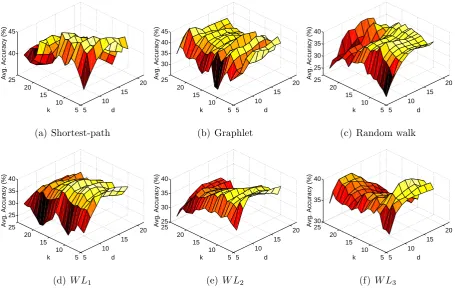
Figure 3 shows a sample of the 10-fold cross validation accuracy (with C =Copt) for the
Laplacian Eigenmap embeddings of the graph kernels on the Shock dataset (see Section 4 for
a description of the dataset), as the number of the nearest neighbours k and the embedding
dimension d vary. While the value of k seems to have a limited impact on the average
classification accuracy, we observe that the optimal performance is achieved for values of d
between 10 and 15. Moreover, note that the optimal value ofd is mostly independent from
both the neighborhood construction and the kernel used. Finally, we should stress that the
selection of an optimal neighborhood size k is a central issue in manifold learning [37]. As
a consequence, the limited impact of k in our framework can be seen as an advantage.
3.2. Graph Kernels
We focus our analysis on four standard graph kernels, namely the shortest-path
ker-5 10 15 20 5 10 15 20 25 40 45 d k
Avg. Accuracy (%)
(a) Shortest-path 5 10 15 20 5 10 15 20 25 30 35 40 45 d k
Avg. Accuracy (%)
(b) Graphlet 5 10 15 20 5 10 15 20 25 25 30 35 40 d k
Avg. Accuracy (%)
(c) Random walk
5 10 15 20 5 10 15 20 25 25 30 35 40 d k
Avg. Accuracy (%)
(d) W L1
5 10 15 20 5 10 15 20 25 25 30 35 40 d k
Avg. Accuracy (%)
(e) W L2
5 10 15 20 5 10 15 20 25 30 35 40 d k
Avg. Accuracy (%)
[image:15.595.72.528.109.399.2](f) W L3
Figure 3: 3D plot of the 10-fold cross validation accuracy (withC=Copt) of the graph kernels on the Shock
dataset as the number of the nearest neighboursk and the embedding dimension dvary. The embedding
was computed using Laplacian Eigenmap.
nel [4]. These are all instances of R-convolution kernels, where the common idea is that of
decomposing two discrete objects and to compare some simpler substructures.
3.2.1. Shortest-path Kernel
LetG= (V, E) be an undirected graph and letS be its shortest-path graph, i.e., a graph
defined over the same set of nodesV where there exist an edge between two nodes if these are
connected by a walk inG. The path kernel counts the numbers of common
shortest-path in two graphs G1 and G2. To this end, the two original graphs are first transformed
into the corresponding shortest-path graphs S1 = (V1, E1) and S2 = (V2, E2). Then, the
shortest-path kernel is defined as
ksp(S1, S2) =
X
e1∈E1 X
e2∈E2
wherek is a positive definite kernel that measures the similarity between the shortest paths
corresponding to the edges e1 and e2. Moreover, the kernel k can be modified to handle
node labels. In that case, two shortest-path are matched if the sequence of labels along the
two paths are the same.
In their original implementation Borgwardt et al. [1] propose to use the Floyd-Warshall [36]
to compute the shortest-path, yielding a O(|V|4) computational complexity.
3.2.2. Graphlet Kernel
The graphlet kernel measures the similarity between a pair of unlabelled graphs by
counting the number of common graphlets of sizek ={13,4,5} in the two graphs. LetNk
denote the number of graphlets of size k. Given a graphG= (V, E), letfG be the vector of
length Nk where the ith component is the frequency of occurrence of the graphlet gi inG.
For a pair of graphs G1 and G2, the k-graphlet kernel is defined as
kgr(G1, G2) = fG1⊤fG2 (3)
Note that since there are |Vk|
subgraphs of size k in a graph with n nodes, for each graph
the of size |V| the computation of fG has complexity O(|V|k). However, in the case of
graphs with bounded degree d, i.e., graphs where no vertex has more than d neighbours,
the complexity can be shown to be O(|V|dk−1). Finally, unlike the shortest-path kernel, the
graphlet kernel does not take node labels into account.
3.2.3. Random Walk Kernel
The random walk kernel is based on the idea of counting the number of matching walks
between a pair of graphs G1 = (V1, E1) and G2 = (V2, E2). Similarly to the shortest-path
kernel, the random walk kernel can handle node labels. In this work we use the kernel as
defined by G¨artner et al. [13]. To this end, we first introduce the direct product graph
G× = (V×, E×), where V× = {(v1, v2) : v1 ∈ V1, v2 ∈ V2} and E× = {((v1, v2),(w1, w2)) :
walk kernel betweenG1 and G2 is defined as
krw(G1, G2) =
|V1|
X
i=1
|V2|
X
j=1
∞
X
k=0
µk
Ak
×
ij (4)
where µ is a fixed decay factor that has the effect of reducing the contribution of longer
walks, in addition to allowing the summation to converge. Note that performing a walk
on G× is equivalent to performing simultaneous walks on G1 and G2 [38]. Therefore, the
entries of Ak
× can be seen as the enumerating the simultaneous random walks of length k on G1 and G2. In its original formulation the random walk kernel has computational
complexity O(max(|V1|,|V2|)6), however in [39] a more efficient implementation is proposed
which reduces the complexity toO(max(|V1|,|V2|)3).
One drawback of the random walk kernel is that it is known to be subject totottering [47].
That is, the walker can follow a redundant path h = v1,· · · , vn with vi = vi+2, which can
decrease the ability of the random walk kernel to characterise the graph structure and can
result in an artificially high similarity. For example, the existence of a walk of length 2 can
indicate the presence of a path connecting 3 vertices as well as a walk back and forth along a
single edge. A number of works have proposed to solve the tottering problem by forbidding
repeated visits of the same two nodes [47, 23].
3.2.4. Weisfeiler-Lehman Kernel
The Weisfeiler-Lehman kernel is a state-of-the-art graph kernel introduced by
Sher-vashidze et al. [4]. The kernel enumerates the common subtrees between two graphs by
using the Weisfeiler-Lehman test of graph isomorphism. Given two attributed graphs
G1 = (V1, E1, l1) and G2 = (V2, E2, l2), where li denote the set of labels of Vi, the idea
is that of associating with each vertex v a multiset label based on the labels of the
neigh-bours ofv. This procedure is iterated a fixed number of times, and at each step the resulting
multisets are sorted and compressed to generate new vertex labels. LetGi
1 andGi2 denote the
graphsG1 and G2 afterhiterations of vertices relabeling procedure. The Weisfeiler-Lehman
is then defined as
kh
wl(G1, G2) =
h X
i=0
wherekδ(Gi1, Gi2) is a positive definite kernel which enumerates the pairs of vertices inGi1 and
Gi
2 that share the same label. The computation of the Weisfeiler-Lehman with h iterations
has complexityO(hm), where m is the number of edges of the graph.
3.3. Manifold Learning
In this paper we investigate the use of four standard non-linear manifold learning
tech-niques, namely Isomap [15], Laplacian Eigenmap [16], Diffusion Maps [17] and Local Linear
Embedding [18]. In the following subsection we assume that we want to embed n points
xi onto an m-dimensional space, with m < n. Note that these techniques can be easily
extended to the case where the input is a pairwise distance matrix rather than a vectorial
representation of the data points. Thus, although graphs are not easily reduced to a
vecto-rial form, it is possible to apply manifold learning to a set of graphs by first computing a
kernel (distance) matrix over the dataset.
3.3.1. Isomap
Isomap can be viewed as an extension of MDS where the original distance between the
points is replaced with their geodesic distance [15]. Isomap assumes that only the pairwise
distances between neighbouring point are known, and uses the shortest-path distance to
estimate the distances between all the other point. More specifically, Isomap starts by
looking for the k-nearest neighbours of each point in the dataset. Then, the k-neigbhours
graph is constructed, where each point is connected with its k-nearest neigbhours. The
geodesic distance between two points is estimated as the shortest-path distance between the
corresponding nodes in the graph. Finally, a low-dimensional projection is generated by
applying MDS on the matrix of geodesic distances.
Despite its popularity, Isomap suffers from a number of drawbacks. In fact, the use of
geodesic distances makes Isomap strongly dependent on the topology of the neighbourhood
3.3.2. Diffusion Maps
Diffusion Maps attempt to mitigate the shortcomings of Isomap by replacing the geodesic
distances with a more robust distance based on the heat diffusion on the graph [17]. The
first stage requires computing the distance matrix
Mij =e− ||xi−xj||
2σ2 (6)
The matrix M is then normalised to obtain the transition matrix P, such that Pij is the
probability of transitioning fromxi toxj in one time step. The coordinates of theith point
can then be obtained from the eigendecomposition of P as ˜xi = {λ1φi1, λ2φi2, ..., λmφim},
whereP = ΦΛΦT, Φ is the n×n matrix Φ = (φ
1|φ2|...|φn) with the ordered eigenvectors as
columns and Λ = diag(λ1, λ2, ..., λn) is then×ndiagonal matrix with the ordered eigenvalues
as elements.
Note that the matrix P depends on the choice of the time parametert, which until now
we assumed to be equal to 1. However, the diffusion process can be stopped at any a generic
timet ≥1. In this case, Pt
ij gives the probability of transitioning fromi toj int time steps.
In a sense, the Diffusion Map at timet takes into account all the paths of length t between
each pair of points, and for this reason it is extremely robust to noise, as opposed to the
geodesic distance of Isomap.
3.3.3. Laplacian Eigenmap
Similarly to Isomap, the Laplacian Eigenmap method starts by constructing a weighted
graph over the points, where the set of edges connects neighbouring nodes. However, while
Isomap tries to preserve the structure by preserving the geodesic distance, i.e., it tries to
preserve the global structure of the data, Laplacian Eigenmap ensures that points which are
close to each other on the manifold are mapped close to each other in the low-dimensional
embedding space, i.e., it tries to preserve local distances.
LetM denote then×n neighborhood (similarity) matrix for the original points. In
par-ticular, in [16] M is defined as either the Gaussian kernel or the matrix whose element (i, j)
preserves the distances between neighbouring points is equivalent to solving the generalised
eigenproblem
(∆−M)φi =λiSφi (7)
with eigenvalues λi, eigenvectors φi and ∆ a diagonal matrix whose ith diagonal entry is
∆ii = Pnj=1Mij. Then, the m dimensional embedding is given by the first m eigenvectors
φi, where the eigenvector corresponding to the zero eigenvalues is left out.
3.3.4. Local Linear Embedding
Like Laplacian Eigenmap, Local Linear Embedding is also a local approach that attempts
to preserve the local geometry of each point. The underlying assumption of LLE is that a
point and its neighbours in the original space should lie on or close to a locally linear patch
of the manifold. Hence, it is possible to reconstruct each point as a linear combination
of its neighbours. In particular, the optimal coefficients wij are found by minimising the
reconstruction error
E(W) =
n X
i=1
xi−
X
j∈N(i)
wijxj
!2
(8)
whereN(i) denotes the neighbourhood ofxi.
For each point xi a low-dimensional embedding x˜i is then computed such that the
coor-dinates of each point are still described by the same linear combination of its neighbours.
That is, given the matrix of optimal coefficients W, we look for the set of points x˜i that
minimise the cost function
C(W) =
n X
i=1
˜ xi−
X
j∈N(i)
wij˜xj
!2
(9)
The optimal m-dimensional embedding is then obtained from the m eigenvectors of M =
(I−W)⊤(I −W) corresponding to the m lowest eigenvalues, where I denotes the identity matrix of size n, and the eigenvalues λ0 = 0 and its corresponding eigenvector φ0 are not
Datasets MUTAG PPIs COIL Shock Reeb
Max # vertices 28 232 35 33 220
Min # vertices 10 3 3 4 41
Avg # vertices 17.93 109.60 12.43 13.16 95.43
# graphs 188 86 84 150 300
[image:21.595.157.438.110.203.2]# classes 2 2 4 10 15
Table 1: Information on the graph datasets
4. Experimental Results
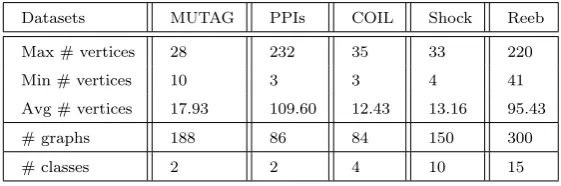
We perform extensive experiments on 5 different graph datasets (see Table. 1). For
each of the kernels of Subsection 3.2 and the manifold learning techniques reviewed in
Subsection 3.3, we evaluate the class separation before and after computing the embedding
as described in Subection 3.1. More specifically, we first divide the data into a training and
test set. In particular, we assign 80% of the data to the training set and the remaining 20%
to the test set. We repeat the whole procedure 100 times and we report the results in terms
of average classification accuracy,± standard error.
Note that in these experiments we do not include the node labels. In other words, the
kernels consider only the structural information of the graphs. In the case of the
Weisfeiler-Lehman, however, each node is labelled with its degree. Finally, the implementation of the
graphlet kernel used in this paper counts instances of graphlets of size 3.
4.1. Datasets
MUTAG: The MUTAG is a dataset of 188 mutagenic aromatic and heteroaromatic
compounds labelled according to whether or not they have a mutagenic effect on the
Gram-negative bacterium Salmonella typhimurium [40].
PPIs: The PPI dataset consists of protein-protein interaction (PPIs) networks related
to histidine kinase [41]. Histidine kinase is a key protein in the development of signal
transduction. If two proteins have direct (physical) or indirect (functional) association, they
are connected by an edge. Here we consider the PPIs from two different groups: 40 PPIs
COIL: The COIL dataset consists of 4 objects from the COIL-20 [44] dataset. For each
object, we consider 21 views obtained from equally spaced viewing directions over 105◦. For each image, a graph is obtained as the Delaunay triangulation of the Harris corner points.
Each vertex is used as the seed of a Voronoi region, which expands radially with a constant
speed. The linear collision fronts of the regions delineate the image plane into polygons, and
the Delaunay graph is the region adjacency graph for the Voronoi polygons.
Shock: The Shock dataset consists of graphs from a database of 2D shapes [42]. Each
graph is a skeletal-based representation of the differential structure of the boundary of a 2D
shape. There are 150 graphs divided into 10 classes, each containing 15 graphs.
Reeb: The Reeb dataset consists of a set of adjacency matrices associated to the
com-putation of reeb graphs of 3D shapes [43]. The original 3D shapes dataset comes from the
SHREC database, and consists of 15 classes with 20 shapes each, for a total of 300 objects.
4.2. Experimental Results
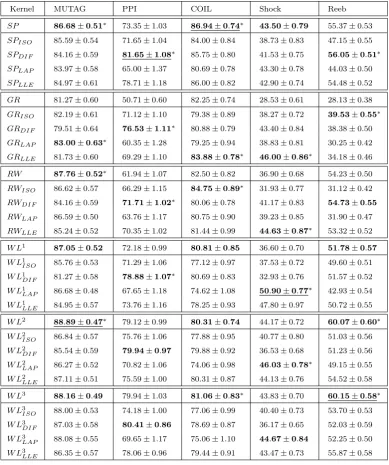
Table 2 and Fig. 4 show the average classification accuracy for our approach in the case
where the embedding parameters are chosen so as to maximise the 10-fold cross validation
accuracy on the training set, as explained in Section 3.1. In Fig. 4 the data is displayed as a
series of histograms of the average accuracy. Each individual histogram shows the average
accuracy for the different embedding methods used. The columns of the figure repeat the
histograms for the different kernels studied, and the different rows repeat the histograms
for the different datasets. In Table 2 SP is the shortest-path kernel [1], RW is the random
walk kernel [13], GR is the graphlet kernel [2], while W Lh denotes the Weisfeiler-Lehman
kernel with h iterations [4]. For each kernel and dataset, the best performing manifold
learning technique is highlighted in bold, and the best performing method over the dataset
is underlined. Moreover, for each dataset and each kernel combination, whenever manifold
learning leads to a statistically significant increase or decrease of the performance with
respect to the original kernel the result is highlighted with a∗ symbol.
Our first observation is that the accuracy of the graphlet kernel is consistently higher
Kernel MUTAG PPI COIL Shock Reeb
SP 86.68±0.51∗ 73.35±1.03 86.94±0.74∗ 43.50±0.79 55.37±0.53 SPISO 85.59±0.54 71.65±1.04 84.00±0.84 38.73±0.83 47.15±0.55
SPDIF 84.16±0.59 81.65±1.08∗ 85.75±0.80 41.53±0.75 56.05±0.51∗
SPLAP 83.97±0.58 65.00±1.37 80.69±0.78 43.30±0.78 44.03±0.50
SPLLE 84.97±0.61 78.71±1.18 86.00±0.82 42.90±0.74 54.48±0.52
GR 81.27±0.60 50.71±0.60 82.25±0.74 28.53±0.61 28.13±0.38
GRISO 82.19±0.61 71.12±1.10 79.38±0.89 38.27±0.72 39.53±0.55∗ GRDIF 79.51±0.64 76.53±1.11∗ 80.88±0.79 43.40±0.84 38.38±0.50
GRLAP 83.00±0.63∗ 60.35±1.28 79.25±0.94 38.83±0.81 30.25±0.42
GRLLE 81.73±0.60 69.29±1.10 83.88±0.78∗ 46.00±0.86∗ 34.18±0.46 RW 87.76±0.52∗ 61.94±1.07 82.50±0.82 36.90±0.68 54.23±0.50
RWISO 86.62±0.57 66.29±1.15 84.75±0.89∗ 31.93±0.77 31.12±0.42
RWDIF 84.16±0.59 71.71±1.02∗ 80.06±0.78 41.17±0.83 54.73±0.55
RWLAP 86.59±0.50 63.76±1.17 80.75±0.90 39.23±0.85 31.90±0.47
RWLLE 85.24±0.52 70.35±1.02 81.44±0.99 44.63±0.87∗ 53.32±0.52 W L1
87.05±0.52 72.18±0.99 80.81±0.85 36.60±0.70 51.78±0.57
W L1
ISO 85.76±0.53 71.29±1.06 77.12±0.97 37.53±0.72 49.60±0.51
W L1
DIF 81.27±0.58 78.88±1.07∗ 80.69±0.83 32.93±0.76 51.57±0.52
W L1
LAP 86.68±0.48 67.65±1.18 74.62±1.08 50.90±0.77∗ 42.93±0.54
W L1
LLE 84.95±0.57 73.76±1.16 78.25±0.93 47.80±0.97 50.72±0.55
W L2
88.89±0.47∗ 79.12±0.99 80.31±0.74 44.17±0.72 60.07±0.60∗ W L2
ISO 86.84±0.57 75.76±1.06 77.88±0.95 40.77±0.80 51.03±0.56
W L2
DIF 85.54±0.59 79.94±0.97 79.88±0.92 36.53±0.68 51.23±0.56
W L2
LAP 86.27±0.52 70.82±1.06 74.06±0.98 46.03±0.78∗ 49.15±0.55
W L2
LLE 87.11±0.51 75.59±1.00 80.31±0.87 44.13±0.76 54.52±0.58
W L3
88.16±0.49 79.94±1.03 81.06±0.83∗ 43.83±0.70 60.15±0.58∗
W L3
ISO 88.00±0.53 74.18±1.00 77.06±0.99 40.40±0.73 53.70±0.53
W L3
DIF 87.03±0.58 80.41±0.86 78.69±0.87 36.17±0.65 52.03±0.59
W L3
LAP 88.08±0.55 69.65±1.17 75.06±1.10 44.67±0.84 52.25±0.50
W L3
[image:23.595.103.493.110.576.2]LLE 86.35±0.57 78.06±0.96 79.44±0.91 43.47±0.73 55.87±0.58
Table 2: Maximum classification accuracy (±standard error) for the kernels on the graph datasets. For
each kernel and dataset, the best performing manifold learning technique is highlighted in bold, the best
performing method over the dataset is underlined and statistically significant results are marked by a∗.
kernel is significantly higher or equal to that of the original kernel after manifold learning.
Over all the 5 datasets the highest accuracy for this kernel is achieved with the application
of manifold learning. Moreover, the increase in classification accuracy outweighs the loss in
Sh o rt e st − Pa th G ra p h le t R a n d o m W a lk W − L (h = 1 ) W − L (h = 2 ) W − L (h = 3 ) 7
0 75 80 85 90
NO ML NO ML NO ML NO ML NO ML NO ML ISO ISO ISO ISO ISO ISO DIF DIF DIF DIF DIF DIF LAP LAP LAP LAP LAP LAP LLE LLE LLE LLE LLE MU T AG
Avg. Accuracy (%)
Sh o rt e st − Pa th G ra p h le t R a n d o m W a lk W − L (h = 1 ) W − L (h = 2 ) W − L (h = 3 ) 4
0 50 60 70 80
NO ML NO ML NO ML NO ML NO ML NO ML ISO ISO ISO ISO ISO ISO DIF DIF DIF DIF DIF DIF LAP LAP LAP LAP LAP LAP LLE LLE LLE LLE LLE PPI
Avg. Accuracy (%)
Sh o rt e st − Pa th G ra p h le t R a n d o m W a lk W − L (h = 1 ) W − L (h = 2 ) W − L (h = 3 ) 6
5 70 75 80 85
NO ML NO ML NO ML NO ML NO ML NO ML ISO ISO ISO ISO ISO ISO DIF DIF DIF DIF DIF DIF LAP LAP LAP LAP LAP LAP LLE LLE LLE LLE LLE C O IL
Avg. Accuracy (%)
Sh o rt e st − Pa th G ra p h le t R a n d o m W a lk W − L (h = 1 ) W − L (h = 2 ) W − L (h = 3 ) 2
0 25 30 35 40 45 50
NO ML NO ML NO ML NO ML NO ML NO ML ISO ISO ISO ISO ISO ISO DIF DIF DIF DIF DIF DIF LAP LAP LAP LAP LAP LAP LLE LLE LLE LLE LLE SH O C K
Avg. Accuracy (%)
Sh o rt e st − Pa th G ra p h le t R a n d o m W a lk W − L (h = 1 ) W − L (h = 2 ) W − L (h = 3 ) 2
0 30 40 50 60
NO ML NO ML NO ML NO ML NO ML NO ML ISO ISO ISO ISO ISO ISO DIF DIF DIF DIF DIF DIF LAP LAP LAP LAP LAP LAP LLE LLE LLE LLE LLE R EEB
Avg. Accuracy (%)
[image:24.595.170.735.65.534.2]−50 0 50 100 −20
−10 0 10 20 30
1st Leading Dimension
2nd Leading Dimension
(a) Shortest-path
−0.2 −0.1 0 0.1 0.2 0.3
−0.02 −0.01 0 0.01 0.02
1st Leading Dimension
2nd Leading Dimension
(b) Graphlet
−20 −10 0 10 20 30
−4 −2 0 2 4 6
1st Leading Dimension
2nd Leading Dimension
(c) Random walk
−10 −5 0 5 10
−5 0 5 10
1st Leading Dimension
2nd Leading Dimension
(d) W L1
−10 −5 0 5 10
−10 −5 0 5 10 15
1st Leading Dimension
2nd Leading Dimension
(e) W L2
−10 −5 0 5 10 15
−10 −5 0 5 10 15
1st Leading Dimension
2nd Leading Dimension
[image:25.595.67.528.107.397.2](f) W L3
Figure 5: The MDS embeddings of the shortest-path [1], graphlet [2], random walk [3] and
Weisfeiler-Lehman [4] kernels (withh= 1,2,3) on the MUTAG dataset.
the original kernel. Thus, although it is not clear which manifold learning technique should
be preferred, i.e., the optimal technique varies across the 5 datasets, the experimental results
suggest that it is generally a good idea to apply our approach when using a graphlet kernel.
The random walk kernel also seems to benefit from manifold learning, albeit to a lesser
extent. In particular, we observe the best improvement on the PPI and Shock datasets.
However, in contrast to the graphlet kernel, our approach can sometimes lead to a marked
decrease in accuracy, as in the case of the Reeb dataset. The shortest-path kernel and
the Weisfeiler-Lehman kernels show a similar trend, with limited but sometimes significant
improvements. This is the case for the shortest-path kernel on the PPI dataset and the
Weisfeiler-Lehman kernel (h = 1) on the Shock dataset. In general, none of these kernels
shows consistent results in terms of which manifold learning technique to use to enhance
class separation. Interestingly, however, we see that on the PPI datasets each of the kernels
The above observations seem to support the intuition that those kernels which are based
on the enumeration of small and simple substructures, such as graphlets, are more likely to
suffer from locality problems. The shortest-path and random walk kernels, on the other hand,
utilise larger and more complex structures. The Weisfeiler-Lehman kernel, instead, partially
mitigates the problem by making use of the node labels, which improves node localization
and disambiguation in the evaluation of the kernel. Moreover, to further support our claims,
note that as we increase the value ofhthe benefit of manifold learning becomes less evident.
In fact, by increasing h we are considering subtrees of increasing depth h, thus reducing
locality problems.
Table 2 also shows that the improvement is dataset dependent. We have already noted
that the on the PPI dataset all the kernels benefit from manifold learning, although to
dif-ferent extents. Similarly, we observe statistically significant improvements for the graphlet,
random walk, WL (h = 1,2) kernels on the Shock dataset. By contrast, datasets such as
COIL and MUTAG show little or no improvement. In the case of the COIL dataset, it
is important to note that the structure of the graph is that of a Delaunay graph. Here
the topological information is essentially given by very local structures, i.e., the Delaunay
triangles. As a consequence, the graph structure can be efficiently captured by small and
simple substructures. Hence, we do not observe a substantial improvement or decrease in
performance when manifold learning is applied. More generally, whether or not our
frame-work leads to an increased accuracy ultimately depends on the manifold nature of the data.
Finally, we note that the only kernel that benefits from manifold learning on the MUTAG
dataset is again the graphlet kernel. In fact, as shown in Fig.5, this is the only kernel for
which the MDS embedding shows a clear horseshoe shape.
Table 2 also shows that by unfolding the space through manifold learning we are levelling
to some extent the performances of the examined kernels. This in turn suggests that the
difference between the kernels mainly depends on the level of warping of the embedding
space. This is particularly evident in the PPI and the Shock datasets, where we observe
a marked decrease of the performance gap between the different kernels when manifold
−1 −0.5 0 0.5 1 −0.5
0 0.5 1
1st Leading Dimension
2nd Leading Dimension
(a) Normalized
−5 0 5 10 15
−4 −2 0 2 4 6 8
1st Leading Dimension
2nd Leading Dimension
[image:27.595.100.499.108.279.2](b) Unnormalized
Figure 6: The projection of the data from the Hilbert space onto the unit sphere (kernel normalization),
can lead to the formation of horseshoe shaped artifacts.
Finally, we should stress that the gain in accuracy that can be achieved with the proposed
method comes at the cost of an increased computational time. This is due to the need of
exploring the parameter space of Eq. 1 to determine the optimal embedding of the input
graphs. However, note that in general the learning phase is performed only once. Given the
optimal embedding parameters, the classification of the test graphs is straightforward, and
it requires mapping the test graphs to the embedding space, where the classification itself is
performed using a linear kernel.
4.3. Kernel Normalization
A common practice in machine learning is that of normalizing the kernels before the
classification process takes place. More specifically, the kernels are normalized by projecting
the data from the Hilbert space onto the unit sphere. However, note that this can potentially
lead to the formation of horseshoe shaped artifacts, as Fig. 6 shows.
Table 3 and Fig. 7 show the average classification accuracy for our approach in the case
where the kernels are normalized, where in Fig. 7 the data is displayed as a series of
his-tograms of the average accuracy, for eac dataset. If we compare the results in Table 2 with
those in Table 3, we see that the normalized kernels seem to derive more benefits from
manifold learning, when compared to the unnormalized kernels. Note, however, that the
Kernel MUTAG PPI COIL Shock Reeb
SP 85.08±0.49 69.18±1.00 85.25±0.74 41.03±0.78 55.70±0.50
SPISO 81.95±0.59 75.29±1.15 84.18±0.83 41.80±083 49.30±0.53
SPDIF 84.22±0.57 81.53±1.08∗ 85.87±0.80 41.53±0.75 56.05±0.54
SPLAP 80.35±0.59 69.18±1.12 86.06±0.83 44.40±0.75∗ 47.93±0.82
SPLLE 85.05±0.51 80.00±1.14 83.81±0.85 44.30±0.76 53.50±0.56
GR 82.05±0.56 52.35±0.77 83.81±0.62 31.53±0.62 27.23±0.42
GRISO 82.65±0.57 70.82±1.13 79.63±0.90 40.53±0.74 38.40±0.54
GRDIF 80.51±0.63 76.82±1.12∗ 80.87±0.79 45.03±0.87 38.98±0.50∗
GRLAP 83.81±0.55∗ 64.47±1.17 79.25±0.90 41.07±0.85 29.98±0.52
GRLLE 81.46±0.56 71.52±1.07 83.31±0.78 45.13±0.87∗ 34.62±0.48
RW 83.86±0.52 64.41±1.00 78.66±0.85 33.90±0.71 25.92±0.41
RWISO 82.76±0.57 70.47±1.08 80.88±0.86 37.80±0.73 29.32±1.79
RWDIF 84.30±0.58 72.29±1.04 80.19±0.77 41.13±0.83 54.75±0.55∗
RWLAP 82.35±0.59 72.05±1.01 75.88±0.96 39.00±0.85 39.47±0.70
RWLLE 82.65±0.57 76.94±1.05∗ 81.12±0.86∗ 43.17±0.84∗ 46.80±0.65 W L1
81.27±0.60 76.76±0.98 79.75±0.91 34.97±0.0.68 33.92±0.42
W L1
ISO 82.51±0.62 71.2±1.03 77.16±1.01 34.76±0.65 44.12±0.54
W L1
DIF 80.84±0.61 78.88±1.07∗ 80.62±0.84 32.93±0.76 51.55±0.52∗
W L1
LAP 83.00±0.61 66.41±1.22 67.56±1.06 44.06±0.86∗ 40.72±0.72
W L1
LLE 84.00±0.58∗ 75.65±1.02 80.56±0.85 43.57±0.77 51.30±0.47
W L2
87.84±0.51∗ 83.53±0.83∗ 79.12±0.80 39.10±0.72 50.60±0.57 W L2
ISO 84.46±0.51 78.71±1.14 76.25±0.97 34.16±0.78 44.85±0.57
W L2
DIF 85.46±0.59 79.94±0.96 79.88±0.92 36.53±0.68 51.25±0.56
W L2
LAP 82.81±0.74 71.59±1.08 73.36±0.97 39.30±0.78 43.03±0.77
W L2
LLE 86.24±0.53 78.35±0.95 77.69±0.89 39.17±0.86 51.83±0.59∗
W L3
86.62±0.55 84.06±0.93∗ 79.01±0.83 40.17±0.70 55.32±0.58∗
W L3
ISO 85.70±0.56 77.47±1.00 74.00±1.00 36.03±0.71 46.5±0.61
W L3
DIF 87.16±0.57∗ 80.41±0.86 78.69±0.87 36.13±0.65 52.03±0.59
W L3
LAP 82.81±0.65 76.59±1.05 71.00±0.98 38.30±0.78 48.87±0.78
W L3
[image:28.595.103.493.109.576.2]LLE 85.40±0.63 82.30±0.88 79.25±0.96 40.07±0.74 50.57±0.53
Table 3: Maximum classification accuracy (± standard error) for the normalized kernels on the graph
datasets. For each kernel and dataset, the best performing manifold learning technique is highlighted in
bold, the best performing method over the dataset is underlined and statistically significant results are
marked by a∗.
the random walk kernel on the PPI dataset, the accuracy for the normalized kernel with
LLE is significantly higher than any other combination of methods for the unnormalized
Sh o rt e st − Pa th G ra p h le t R a n d o m W a lk W − L (h = 1 ) W − L (h = 2 ) W − L (h = 3 ) 7
0 75 80 85 90
NO ML NO ML NO ML NO ML NO ML NO ML ISO ISO ISO ISO ISO ISO DIF DIF DIF DIF DIF DIF LAP LAP LAP LAP LAP LAP LLE LLE LLE LLE LLE MU T AG
Avg. Accuracy (%)
Sh o rt e st − Pa th G ra p h le t R a n d o m W a lk W − L (h = 1 ) W − L (h = 2 ) W − L (h = 3 ) 5
0 60 70 80
NO ML NO ML NO ML NO ML NO ML NO ML ISO ISO ISO ISO ISO ISO DIF DIF DIF DIF DIF DIF LAP LAP LAP LAP LAP LAP LLE LLE LLE LLE LLE PPI
Avg. Accuracy (%)
Sh o rt e st − Pa th G ra p h le t R a n d o m W a lk W − L (h = 1 ) W − L (h = 2 ) W − L (h = 3 ) 6
0 65 70 75 80 85
NO ML NO ML NO ML NO ML NO ML NO ML ISO ISO ISO ISO ISO ISO DIF DIF DIF DIF DIF DIF LAP LAP LAP LAP LAP LAP LLE LLE LLE LLE LLE C O IL
Avg. Accuracy (%)
Sh o rt e st − Pa th G ra p h le t R a n d o m W a lk W − L (h = 1 ) W − L (h = 2 ) W − L (h = 3 ) 2
5 30 35 40 45
NO ML NO ML NO ML NO ML NO ML NO ML ISO ISO ISO ISO ISO ISO DIF DIF DIF DIF DIF DIF LAP LAP LAP LAP LAP LAP LLE LLE LLE LLE LLE SH O C K
Avg. Accuracy (%)
Sh o rt e st − Pa th G ra p h le t R a n d o m W a lk W − L (h = 1 ) W − L (h = 2 ) W − L (h = 3 ) 2
0 30 40 50
NO ML NO ML NO ML NO ML NO ML NO ML ISO ISO ISO ISO ISO ISO DIF DIF DIF DIF DIF DIF LAP LAP LAP LAP LAP LAP LLE LLE LLE LLE LLE R EEB
Avg. Accuracy (%)
[image:29.595.160.735.66.534.2]the normalization, in some cases applying manifold learning on the normalized kernels
com-pensates for this loss in accuracy. A striking example is that of the random walk and the
Weisfeiler-Lehman (h = 1) kernels on the Reeb dataset, and also to a lesser extent for the
shortest path kernel on PPI. By contrast, in some cases the normalization of the kernel leads
to a better performance, but the accuracy of the kernel remains unaltered when manifold
learning is applied. For example, this is the case of the Weisfeiler-Lehman (h = 1) kernel,
where regardless of the normalization the best accuracy is achieved with diffusion maps.
5. Discussion
Although our experimental evaluation shows that applying manifold learning on the
kernels can enhance class separation, it is not clear which combination of kernel and manifold
learning algorithm leads to the best improvement on a given dataset. In this sense, the
only exception is that of the graphlet kernel, which shows a consistent improvement of the
classification accuracy regardless of the chosen manifold learning technique. In fact, this is
in line with the observation that R-convolution kernels based on the enumeration of small
and simple substructures are more likely to suffer from the locality or ambiguity problems.
This in turn leads to the underestimation of the distances for dissimilar graphs. The result
is to induce a strong curvature on the embedding manifold, which can lead to the manifold
folding over on itself, thus increasing the effective dimensionality of the embedding.
This, in turn, suggests a potential heuristic that can be used to decide when to apply
the proposed approach. Specifically, one may decide to apply manifold learning to a given
dataset and kernel combination after estimating the curvature of the embedding space.
However, this is not a trivial task, since the embedding induced by the kernel is not explicit.
Moreover, one should estimate the local rather than the global curvature. In fact, in our
case measures based on the negative eigenvalues of the distance or dissimilarity matrix such
as the negative eigenratio or the negative eigenfraction [45] commonly used for analysing
the structure of the manifold resulting from the embedding of similarity data fail to detect
any curvature. This is a consequence of the fact that kernels are guaranteed to be positive
points of high local curvature would be a potential indicator of the type of degeneracies of
the manifold that would benefit from the proposed approach.
Wu, Wilson and Hancock [46] have taken some steps in this direction and have recently
proposed a way to estimate the curvature of a local patch of the manifold, using pairwise
distances between points. Unfortunately, this method works under the assumption that the
neighbours of the point where the curvature is being estimated are uniformly distributed.
This requirement that may not hold on real data, potentially leading to inaccurate
estima-tions. An alternative approach may be to consider the neighborhood of a point and construct
a local kernel. A rapid decay of the eigenvalues of this local kernel would suggest a flat and
low-dimensional embedding space. Conversely, a slow decay of the eigenvalues may suggest
that the point and its neighborhood lie on a subspace of high curvature.
6. Conclusions
In this paper, we have investigated the use of manifold learning techniques on graph
kernels to compute a low-dimensional embedding where the separation of the different classes
is enhanced. We observed that when we perform multidimensional scaling on the distance
matrices extracted from the kernels, the resulting data tends to be clustered along a curve
that wraps around the embedding space, a behaviour that is known to arise when the data
lies on a non-linear manifold. Hence, we proposed to unfold the embedding manifold using
non-linear dimensionality reduction techniques, in an attempt to increase the separation
of the classes. Interestingly, we observed that the unfolding of the space seems level the
performances of the different kernels, suggesting that the existing kernels in the literature
differ mostly in the level of warping of the embedding space. More in general, we observed
that in most of the cases the separation of the data was increased after applying manifold
learning on the original kernels.
Acknowledgments
References
[1] K. Borgwardt, H. Kriegel, Shortest-path kernels on graphs, in: Proceedings of the Fifth IEEE
Interna-tional Conference on Data Mining, IEEE Computer Society, 2005, pp. 74–81.
[2] N. Shervashidze, S. Vishwanathan, T. Petri, K. Mehlhorn, K. Borgwardt, Efficient graphlet kernels for
large graph comparison, in: Proceedings of the International Workshop on Artificial Intelligence and
Statistics, 2009, pp. 488–495.
[3] H. Kashima, K. Tsuda, A. Inokuchi, in: Proceedings of the 20th International Conference on Machine
Learning, in: ICML, 2003, pp. 321–328.
[4] N. Shervashidze, P. Schweitzer, E. J. van Leeuwen, K. Mehlhorn, K. M. Borgwardt, Weisfeiler-lehman
graph kernels, Journal of Machine Learning Research 12 (2011), pp. 2539–2561.
[5] K. Siddiqi, A. Shokoufandeh, S. Dickinson, S. Zucker, Shock graphs and shape matching, International
Journal of Computer Vision 35 (1) (1999), pp. 13–32.
[6] H. Jeong, B. Tombor, R. Albert, Z. Oltvai, A. Barab´asi, The large-scale organization of metabolic
networks, Nature 407 (6804) (2000), pp. 651–654.
[7] T. Ito, T. Chiba, R. Ozawa, M. Yoshida, M. Hattori, Y. Sakaki, A comprehensive two-hybrid analysis to
explore the yeast protein interactome, Proceedings of the National Academy of Sciences 98 (8) (2001),
pp. 4569.
[8] V. Kalapala, V. Sanwalani, A. Clauset, C. Moore, Scale invariance in road networks. Physical Review
E 73(2) (2006), 026130.
[9] D. Conte, P. Foggia, C. Sansone, M. Vento, Thirty years of graph matching in pattern recognition,
International Journal of Pattern Recognition and Artificial Intelligence 18 (3) (2004), pp. 265–298.
[10] B. Luo, R. C. Wilson, E. R. Hancock, Spectral embedding of graphs, Pattern Recognition 36 (10)
(2003), pp. 2213–2230.
[11] R. C. Wilson, E. R. Hancock, B. Luo, Pattern vectors from algebraic graph theory, IEEE Trans. Pattern
Anal. Mach. Intell. 27 (7) (2005), pp. 1112–1124.
[12] B. Scholkopf, A. J. Smola, Learning with Kernels: Support Vector Machines, Regularization,
Opti-mization, and Beyond, MIT Press, Cambridge, MA, USA, 2001.
[13] T. Gaertner, P. Flach, S. Wrobel, On graph kernels: Hardness results and efficient alternatives, in:
Pro-ceedings of the 16th Annual Conference on Computational Learning Theory and 7th Kernel Workshop,
Springer-Verlag, 2003, pp. 129–143.
[14] D. G. Kendall, Abundance matrices and seriation in archaeology, Probability Theory and Related Fields
17 (2) (1971), pp. 104–112.
[15] J. B. Tenenbaum, V. De Silva, J. C. Langford, A global geometric framework for nonlinear
![Figure 1: The MDS embeddings of the shortest-path [1], graphlet [2], random walk [3] and Weisfeiler-Lehman [4] kernels (with h = 1, 2, 3) on the COIL dataset.](https://thumb-us.123doks.com/thumbv2/123dok_us/7908979.189528/5.595.71.526.107.397/figure-embeddings-shortest-graphlet-weisfeiler-lehman-kernels-dataset.webp)

![Figure 5: The MDS embeddings of the shortest-path [1], graphlet [2], random walk [3] and Weisfeiler-Lehman [4] kernels (with h = 1, 2, 3) on the MUTAG dataset.](https://thumb-us.123doks.com/thumbv2/123dok_us/7908979.189528/25.595.67.528.107.397/figure-embeddings-shortest-graphlet-weisfeiler-lehman-kernels-dataset.webp)