Guidance Paper 5: Reporting guidelines for qualitative, implementation and process evaluation evidence syntheses.
White Rose Research Online URL for this paper: http://eprints.whiterose.ac.uk/125099/
Version: Accepted Version
Article:
Flemming, K., Booth, A. orcid.org/0000-0003-4808-3880, Hannes, K. et al. (2 more authors) (2017) Cochrane Qualitative and Implementation Methods Group Guidance Paper 5: Reporting guidelines for qualitative, implementation and process evaluation evidence syntheses. Journal of Clinical Epidemiology. ISSN 0895-4356
https://doi.org/10.1016/j.jclinepi.2017.10.022
[email protected] https://eprints.whiterose.ac.uk/ Reuse
This article is distributed under the terms of the Creative Commons Attribution-NonCommercial-NoDerivs (CC BY-NC-ND) licence. This licence only allows you to download this work and share it with others as long as you credit the authors, but you can’t change the article in any way or use it commercially. More
information and the full terms of the licence here: https://creativecommons.org/licenses/
Takedown
If you consider content in White Rose Research Online to be in breach of UK law, please notify us by
Accepted Manuscript
Cochrane Qualitative and Implementation Methods Group Guidance Paper 5: Reporting guidelines for qualitative, implementation and process evaluation evidence syntheses
Dr Kate Flemming, Dr Andrew Booth, Dr Karin Hannes, Dr Margaret Cargo, Prof Jane Noyes
PII: S0895-4356(17)31327-6 DOI: 10.1016/j.jclinepi.2017.10.022 Reference: JCE 9544
To appear in: Journal of Clinical Epidemiology
Received Date: 7 May 2016 Revised Date: 3 October 2017 Accepted Date: 4 October 2017
Please cite this article as: Flemming K, Booth A, Hannes K, Cargo M, Noyes J, Cochrane Qualitative and Implementation Methods Group Guidance Paper 5: Reporting guidelines for qualitative,
implementation and process evaluation evidence syntheses, Journal of Clinical Epidemiology (2018), doi: 10.1016/j.jclinepi.2017.10.022.
M
A
N
U
S
C
R
IP
T
A
C
C
E
P
T
E
D
ACCEPTED MANUSCRIPT
1 1
Title.
Cochrane Qualitative and Implementation Methods Group Guidance Paper 5: Reporting guidelines for qualitative, implementation and process evaluation evidence syntheses
Author names and affiliations
Dr Kate Flemming1 (Corresponding author), Dr Andrew Booth2, Dr Karin Hannes3, Dr Margaret Cargo4, Prof Jane Noyes5
1Department of Health Sciences,
Faculty of Science University of York
Seebohm Rowntree Building Heslington
York YO10 5DD UK
Email: [email protected] Tel +44 1904 321345
2 School of Health and Related Research (ScHARR)
Regent Court, 30 Regent Street Sheffield S1 4DA
UK
Email: [email protected]
3Social Research Methodology Group,
Centre for Sociological Research, Faculty of Social Sciences,
KU Leuven, Leuven, Belgium.
Email: [email protected]
4Spatial Epidemiology & Evaluation Research Group/Centre for Population Health Research
University of South Australia 8th Floor Office 310,
South Australia Health & Medical Research Insitute North Terrace
Adelaide SA 510 Australia
M
A
N
U
S
C
R
IP
T
A
C
C
E
P
T
E
D
2 2
5 School of Social Sciences,
Bangor University, Bangor,
Gwynedd, LL57 2DG, UK UK
M
A
N
U
S
C
R
IP
T
A
C
C
E
P
T
E
D
3 3
Abstract
Objective
To outline contemporary and novel developments for presentation andreporting of syntheses of qualitative, implementation and processevaluation evidence, and provide recommendations for use of reportingguidelines.
Study Design and Setting
An overview of reporting guidelines for qualitative, implementation andprocess evaluation evidence syntheses drawing on current internationalliterature and the collective expert knowledge of the CochraneQualitative and Implementation Methods Group.
Results and Conclusion
Several reporting guidelines exist that can be used or adapted to report syntheses of qualitative, implementation and process evaluation evidence. Methods to develop individual guidance varied. The use of a relevant reporting guideline can enhance the transparency, consistency and quality of reporting. Guidelines exist that are: generic; method specific; and for particular aspects of the reviewing process eg searching.
Caution is expressed over the potential for reporting guidelines to produce a mechanistic approach moving the focus away from the content and towards the procedural aspects of the review. The use of a reporting guideline is recommended and a five-step decision flowchart to guide the choice of reporting guideline is provided. Gaps remain in method specific reporting guidelines such as mixed-study, implementation and process
evaluation evidence syntheses.
Keywords
Qualitative evidence synthesis, reporting guidelines, implementation
Running Title
Reporting guidelines for qualitative, implementation and process evaluation evidence syntheses – guidance from the Cochrane Qualitative and Implementation Methods Group
Word count 3190
Funding sources
M
A
N
U
S
C
R
IP
T
A
C
C
E
P
T
E
D
4 4
What is new?
The paper outlines contemporary developments around the presentation and reporting syntheses of qualitative, implementation and process evaluation evidence
Key findings
Existing guidelines can be used or adapted for reporting syntheses of qualitative, implementation and process evaluation evidence. The use of a guideline can enhance the transparency, consistency and quality of reporting. Gaps remain in method-specific reporting guidelines such as mixed-study, implementation and process evaluation evidence syntheses.
What this adds to what was known?
The paper highlights that much work has been undertaken to raise the standards of reporting and projects in progress will further enhance this work. The paper emphasises the benefits of standardisation and the possible unintended consequences that may result.
What is the implication and what should change now?
M
A
N
U
S
C
R
IP
T
A
C
C
E
P
T
E
D
5 5
1. Introduction
It is now almost twenty years since the appearance of the first formally developed guideline to improve the presentation, quality and reliability of published research. What began with the publication of the CONSORT Statement to enhance the reporting of randomised controlled trials (RCTs) and its subsequent updates, led to sustained growth in development of other guidelines to enhance the reporting of other research
methods.1,2,3 This expansive response acknowledged the problems that arise through inadequate reporting including, lack of transparency, clarity and completeness associated with the research itself alongside the subsequent ethical and moral consequences of inadequately reported research.3
Such prodigious growth required focused and collaborative co-ordination of the
development of reporting guidelines, particularly to reduce the then-wide variation in the methods being used to develop guidelines. From this realisation grew the
development of the EQUATOR Network, (Enhancing the Quality and Transparency of Health Research; http://www.equatornetwork.org/) funded initially by the National Knowledge Service of the UK’s National Health Service.4 The aim of the international EQUATOR network is to improve the quality of scientific publications by assisting in the development,
dissemination, and implementation of robust reporting guidelines through the provision of resources and training.5 The EQUATOR network offers a focus for the development of reporting guidelines and provides an invaluable repository of reporting guidelines for all research methods. It also provides a facility to register intent to develop a new reporting guideline or an extension to an existing guideline.
From these early days, development of reporting guidelines sought to improve the utility of primary research to be included within systematic reviews, which at the time were
predominantly quantitative in nature. Within a decade, however, qualitative researchers also began to engage with the development of consolidated guidance for reporting qualitative methods. This effort resulted in the publication of the Consolidated criteria for reporting
qualitative research (COREQ) guidance.6 This guidance focused on the reporting of key elements of qualitative research for example; study methods, context of the study, findings, analysis and interpretations as well as the research team. More recently a Standards for Reporting Qualitative Research (SRQR) tool has been developing consisting of 21 items aiming to improve the
transparency of all aspects of qualitative research.7 A scoping review of emerging qualitative and mixed methods evidence synthesis approaches highlighted both poor operalization of the steps of such syntheses and the need for further empirical work to enhance this.8,9
The development of reporting guidance for systematic reviews was contemporaneous to, and mirrors the efforts channeled into primary research. The initial focus was firstly the QUOROM statement and subsequently followed by the guidance for reporting of systematic reviews of effectiveness through the publication of the PRISMA statement (Preferred
Reporting Items for Systematic Reviews and Meta-Analyses).10 Subsequent work has led to extensions to the original PRISMA statement, in order that reporting of systematic reviews of other research methods and foci meet the same standards as those for reviews of RCTs. These are detailed on the EQUATOR Network website (http://www.equatornetwork.org/).
M
A
N
U
S
C
R
IP
T
A
C
C
E
P
T
E
D
6 6 developed methodological guidance for systematic reviews of qualitative, implementation and process evaluation evidence. The purpose and methodology of such reviews is detailed in earlier papers in this series. The aim of this final paper is to outline both contemporary and novel developments for the presentation and reporting of syntheses of qualitative, implementation and process evaluation evidence. This includes a brief outline of the methodology for developing reporting guidelines and a description of current guidelines and reporting tools available. Finally, the paper outlines new
developments in presentation and reporting and their associated challenges and provides recommendations for use of reporting guidelines.
2. Methodologies for development of a reporting guideline
Increasing recognition of the importance of reporting guidelines has been accompanied by the evolution of more rigorous methods for their development. Well established
approaches now exist for development of new reporting guidelines. These approaches are documented, both through the EQUATOR network and elsewhere; although it is agreed that these must accommodate a plurality of valid approaches.11 We will not replicate the
excellent advice available elsewhere, other than to highlight the importance of the use of accepted
What guidelines are available for reporting syntheses of qualitative, implementation and process evaluation evidence?
3.1 Reporting of aspects of synthesis methodology e.g. STARLITE Given the challenges of coordinating a robust guideline for the entire qualitative, implementation or process evaluation synthesis product, some authors have focused on reporting of individual aspects of the synthesis. In 2007 Dixon-Woods and colleagues12 reviewed 42 published syntheses of qualitative research in health and health care. Many of these syntheses lacked
explicitness about methods associated with systematic reviewing including lack of
transparency about searching with little evidence of emerging consensus on many issues. Specifically, in connection with searching methods, they observed that many papers ‘offered no defense of their lack of explicitness in describing their techniques of searching; nearly 40 percent did not describe how the studies were identified at all’. One of the authors used essentially the same data set to further investigate specific characteristics of reporting of search strategies. The fulfilment, or otherwise, of many search criteria were documented and from this the mnemonic STARLITE was devised as a prompt for those aspects to be reported: Sampling strategy, Type of study, Approaches (e.g. Handsearching, Citation Tracking), Range of years, Limits, Inclusion and exclusions, Terms used, Electronic sources.13
M
A
N
U
S
C
R
IP
T
A
C
C
E
P
T
E
D
7 7 An update of the Dixon-Woods review for the period 2005-2008 determined that not
only had the number of qualitative evidence syntheses doubled but also that the reporting of both searching and critical appraisal methods have become more
transparent. There continues to be however a lack of clarity between what authors claim to use as a method of synthesis and what they actually do in practice.14 Adoption of an
appropriate reporting guideline should help mitigate against this.
3.2 Reporting a complete review
One of the first guidelines written specifically for reporting qualitative evidence syntheses is the Enhancing Transparency in the Reporting of Syntheses of Qualitative Research (ENTREQ) tool.15 Its development occurred at a point when qualitative evidence syntheses were being regularly published in mainstream journals, albeit mostly by researchers with an interest in methodological development. As other researchers adopted the methods associated with qualitative evidence syntheses, it was recognised that issues regarding the reporting of qualitative evidence syntheses were becoming more apparent.
Development of ENTREQ involved initial identification of criteria from published texts on the conduct of qualitative evidence syntheses, guides to synthesis, key methodological papers and works, and the authors’ collective experience of conducting qualitative syntheses. The items were compiled and grouped into five categories: introduction; methods and methodology; literature search and selection; appraisal; and synthesis of findings.15 Forty published qualitative evidence syntheses were identified and the initial framework was pilot tested against 32 syntheses by members of the research team. Through discussion during the pilot testing duplicate items were removed and items were rephrased to remove ambiguity. The revised guideline was then tested against the eight remaining reviews without further changes. The final ENTREQ statement consists of 21 items within the five overarching categories.15 As a generic tool, the ENTREQ tool documents the most frequently used methods for qualitative evidence synthesis to which the it might apply, acknowledging that the approaches and methodology for synthesis are usually driven by the research question posed.
Whilst ENTREQ currently occupies a position as the only reporting guideline written for qualitative evidence synthesis, its development fulfilled only the first criterion for guideline development.5 Consequently, ENTREQ still requires validation through a Delphi exercise. It should therefore be used with this limitation in mind. ENTREQ is however listed by the EQUATOR network and is well cited. ENTREQ can therefore be recommended for the reporting of qualitative evidence synthesis except when a method specific guideline is more appropriate.
3.3 Methodologically specific reviews
An exemplification of reporting for a particular type of systematic review is demonstrated by the by the Realist and Meta-narrative Evidence Syntheses: Evolving Standards guidance (RAMESES) project. As the title suggests, this constitutes paired guidance for the reporting of realist syntheses16 and meta-narrative reviews.17 They are included here as methods of both illuminating a
M
A
N
U
S
C
R
IP
T
A
C
C
E
P
T
E
D
8 8 published reviews.19 A multi-faceted approach to development led to consensus on 20 key items for reporting for meta-narrative reviews.17 A parallel process for realist syntheses16 drew upon
experience from 35 published realist syntheses and 9 on-going syntheses leading to consensus for 19 key publication standards. The two guidance documents were published simultaneously and are supported by training materials and can be recommended for the reporting of meta-narrative and realist reviews.
The RAMESES guidance is perhaps untypical in that the team developed both sets of guidance while the methodologies themselves were still undergoing development. It is anticipated that as experience of using the methodology evolves the guidance will be adapted to reflect these developments.16,17 As each guideline focuses on a particular type of review, RAMESES includes specific items on the rationale for choosing that type of review and why it was considered appropriate to the subject under investigation. This augments the reporting of the step-by-step processes involved in the conduct of the review typically included in most guidelines.16,17
3.4 Reporting of synthesised evidence to explain intervention implementation
Assessing implementation is a crucial component in the systematic review of health and social care interventions. Lack of information on implementation weakens internal validity and inhibits the translation and uptake of evidence by decision-makers. Core aspects of
implementation such as intervention dose, fidelity and reach can be quantitatively assessed in: (1) efficacy studies, whose purpose is to determine whether interventions demonstrate benefit or harm to the population they are intended for when tested in very controlled or 'ideal' conditions; (2) effectiveness studies, whose purpose is to determine whether
interventions provide benefit or harm to the population they are intended for in 'real world' conditions; (3) dissemination studies, which evaluate how to successfully implement health information interventions with a specific audience in order to enhance the impact of and knowledge about an evidence based intervention; (4) implementation studies which evaluate how a specific set of activities and designed strategies are used within targeted settings to enable the successful integration of an evidence based intervention; and (5) scale-up studies, whose purpose is to evaluate the effectiveness of approaches to increase the impact of an evidence based intervention to benefit more people and to foster policy and program development on a lasting basis.20
In addition, it is increasingly common that some studies include qualitative research alongside a trial, which can be synthesised to better understand implementation. A synthesis of
qualitative studies that are unrelated to trials can also be helpful in understanding the factors that affect intervention implementation.21
There is no standard guidance for reporting on implementation in systematic reviews. In some circumstances review authors will need to consult more than one reporting standard and supplement with an implementation checklist or index, preferably as early as the protocol design stage.
M
A
N
U
S
C
R
IP
T
A
C
C
E
P
T
E
D
9 (PRISMA-CI), similarly does not particularly address qualitative methods. Consequently, we recommend that review authors consider using existing implementation checklists and indexes to identify relevant implementation constructs to extract, synthesise and report in their review.
Process Evaluation’ or ‘Implementation Assessment’ sub-headings in systematic reviews may be useful for highlighting the procedures and/or measures used to extract and synthesise evidence on implementation. Use of such headings may facilitate data interpretation and knowledge translation by end-users.
Table 1: Reporting guidelines and supplementary resources of relevance to the assessment of implementation in systematic reviews.
Study Type or Approach
Primary Study Systematic Review
Efficacy CONSORT1
, SPIRIT24, TIDieR25 PRISMA10
Effectiveness TREND26, TIDieR25 PRISMA10
Dissemination StaRI22, Hales23* PRISMA10
Implementation StaRI22, Hales23* PRISMA10
Scale-up StaRI22, Hales23* PRISMA10
Qualitative COREQ6
ENTREQ15, SRQR7
Meta- ethnography
eMERGe27 – under development
Realist Review Under development RAMESES (Realist Review)16*
Meta-narrative Review
- RAMESES (Meta-Narrative
review)16*
M
A
N
U
S
C
R
IP
T
A
C
C
E
P
T
E
D
10 10
4. What is currently in development?
4.1 eMERGe meta-ethnography reporting guideline
One approach to qualitative evidence synthesis meta-ethnography, is consistently the most commonly applied and complex qualitative evidence synthesis approach, however the methodology is frequently poorly reported.28 A group led by
researchers at Stirling University, has obtained funding to develop a meta-ethnography reporting guideline with a specific focus on the complex synthesis process (http://www.stir.ac.uk/emerge/). A review of 32 reports of meta-ethnography published between 2012 and 2013 found that the analytical and synthesis processes were poorly reported overall with little reference to standard methodological texts.28 Cochrane Qualitative and Implementation Methods Group convenors are contributing to its development.
The aims of the eMERGe project27 are to:
• Undertake a methodological systematic review to identify current guidance on conducting and reporting meta-ethnography (PROSPERO registration: CRD42015024709);
• Undertake a review and audit of published meta-ethnographies to identify good practice principles and develop standards in conduct and reporting, and
• Facilitate an online workshop and Delphi study to agree guideline content.
The guideline and reporting template is due to be published in 2017.
5. Discussion
Producing consolidated guidance across qualitative evidence synthesis approaches is challenging; largely because of the broad variety of paradigms, schools of thought, designs and techniques that are currently promoted within the qualitative research community. Such richness offers good grounds for methodological debate and
consequently, methodological progress. Review authors continue to differ in opinions about when reporting guidelines are appropriate in the context of qualitative and implementation syntheses, for which particular stages of a synthesis guidance is most useful, what should be included, the potential advantages and disadvantages of reporting standards and the level of consensus required to identify reporting guidance as
‘consolidated’.
The methodological richness surrounding both primary qualitative research and syntheses complicates the search for common ground in developing standards for reporting many aspects of qualitative inquiry. Reports of qualitative evidence syntheses reveal substantive agreement on how to extract descriptive data from a set of primary research articles.
Developers have produced guidance on how to conduct
M
A
N
U
S
C
R
IP
T
A
C
C
E
P
T
E
D
11 Available29, but guidelines at the synthesis level are still awaited. Nevertheless, many authors choose to deviate from, or to adapt guidelines.14 This wish to deviate suggests that review authors either ‘require’ some methodological flexibility in approaching their review topic or ‘request’ a certain degree of freedom to adapt methods to better fit their purpose. Review authors may ‘require’ methodological flexibility because it allows them to bring together different perspectives and strategies. The act of ‘requesting’ the freedom to develop a style of reporting that fits the review project is probably linked to the idea that reporting guidelines risk becoming too rigid or too narrow, restrict creativity and prevent review authors from borrowing emerging or innovative approaches when analysing or disseminating their findings.30
Whilst QIMG recommends that reporting guidelines should be embraced for increasing the level of transparency and clarity in reporting styles, it is worth remembering that perversely they may introduce insufficient reporting. In novice reviewers in particular,
may initiate a rather mechanistic approach to synthesizing evidence, moving the focus away from the content and towards the procedural aspects of the review. This may create a false sense of security in reviewers. Simply ‘ticking boxes’ on a
does not contribute to a standard of reporting that facilitates understanding of a review topic. Using a set of criteria to assist in reporting without appropriate training in qualitative methods is to be avoided. There is no guarantee that reporting guidelines improve the quality of qualitative reasoning in review authors or produce a more thoughtful and reflective written account of the inferences drawn from the analytical and interpretation process.
The development of reporting guidelines may be construed as an attempt to standardise practice. Standardisation contributes to the establishment of a language that facilitates communication between different stakeholders, offering a basis for comparison of reviews and review proposals. Such comparison is particularly useful for peer reviewers, funders and end-users. However, it is worth bearing in mind that the idea that reporting guidelines are useful in stimulating debates on what constitutes ‘good’ practice is opposed by many stakeholders in the qualitative research community.30 In amongst the
development and debate surrounding the of reporting syntheses of qualitative,
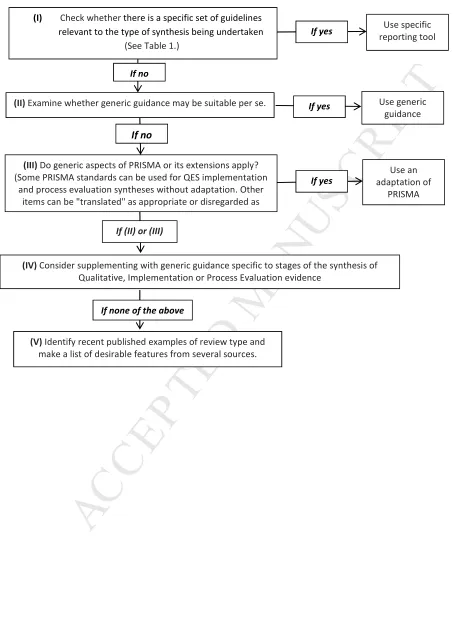
implementation and process evaluation evidence, we considered it would be helpful to provide a five-point ‘decision flowchart’ to help support review authors in their
approach to reporting (Figure 1). The flowchart outlines a five-point approach to decision making and reporting dependent: on whether a specific set of reporting
M
A
N
U
S
C
R
IP
T
A
C
C
E
P
T
E
D
[image:14.595.58.512.114.757.2]12
Figure 1 – Decision flowchart for choice of reporting approach for syntheses of qualitative, implementation or process evaluation evidence
(I) Check whether there is a specific set of guidelines relevant to the type of synthesis being undertaken
(See Table 1.)
(II) Examine whether generic guidance may be suitable per se.
(III) Do generic aspects of PRISMA or its extensions apply? (Some PRISMA standards can be used for QES implementation
and process evaluation syntheses without adaptation. Other items can be "translated" as appropriate or disregarded as
(IV) Consider supplementing with generic guidance specific to stages of the synthesis of Qualitative, Implementation or Process Evaluation evidence
(V) Identify recent published examples of review type and make a list of desirable features from several sources.
If no
If none of the above If no
If (II) or (III)
If yes Use specific
reporting tool
If yes Use generic
guidance
If yes
Use an adaptation of
M
A
N
U
S
C
R
IP
T
A
C
C
E
P
T
E
D
13 13
6. Conclusion
This paper draws together contemporary thinking on existing and new methodological
developments in reporting guidelines for syntheses of qualitative, implementation and process evaluation evidence. It highlights that whilst meaningful work has been undertaken to raise the standards of reporting, projects in progress offer much needed enhancement of this work. There are also some obvious gaps, such as reporting standards for mixed study reviews and reviews of implementation and process evaluation evidence. It highlights the benefits of standardisation and transparency, and the possible unintended consequences that may result. In particular, standardisation may shift attention from the quality of the review itself to more mechanistic compliance with a checklist. Furthermore, standards have been found to liberate those with the experience and confidence to apply them flexibly but to enslave those who feel forced to adhere rigidly to their detail. Most positively the increased rigour of methodologies for the development of reporting standards, with its focus on evidence based review and researcher consensus, offers a flexible way forward in ensuring that standards continue to meet the needs of their
stakeholders.
Acknowledgements
The authors would like to thank their fellow convenors of the Cochrane Qualitative and
M
A
N
U
S
C
R
IP
T
A
C
C
E
P
T
E
D
14
References
1. Begg C, Cho M, Eastwood S, Horton R, Moher D, Olkin I, Pitkin R, Rennie D, Schulz KF, Simel D, Stroup DF. (1996) Improving the quality of reporting of randomized controlled trials. The CONSORT statement. JAMA 276(8):637-9.
2. Moher D, Schulz KF, Altman DG; CONSORT GROUP (Consolidated Standards of Reporting Trials) (2001) The CONSORT statement: revised recommendations for improvingthe quality of reports of parallel-group randomized trials. Annals of Internal Medicine 134(8):657-62.
3. Schulz KF, Altman DG, Moher D, for the CONSORT Group (2010) CONSORT 2010 Statement: updated guidelines for reporting parallel group randomised trials. Annals of Internal Medicine 152(11):726-32.
4. Simera I, Altman DG, Moher D, Schultz KF, Hoey J. (2008) Guidelines for reporting health research: The EQUATOR Network’s survey of guideline authors. PLoS Medicine
5;6e139
5. Altman DG, Simera I, Hoey J, Moher D, Schulz K. (2008) EQUATOR Reporting guidelines for health research. Lancet 31:1149-1150
6. Tong A, Sainsbury P, Craig J. (2007) Consolidated criteria for reporting qualitative research (COREQ): a 32-item checklist for interviews and focus groups. International Journal for Quality in Health Care.19(6):349–357
7. O’Brien BC, Harris IB, Beckman TJ, Reed DA, Cook DA. (2014) Standards for reporting qualitative research a synthesis of recommendations. Academic Medicine
89(9):1245-1251
8. Tricco AC, Soobiah C, Antony J, Cogo E, MacDonald H, Lillie E, Tran J, D'Souza J, Hui W, Perrier L, Welch V. (2016) A scoping review identifies multiple emerging
knowledge synthesis methods, but few studies operationalize the method. Journal of Clinical Epidemiology 73:19-28.
9. Tricco AC, Antony J, Soobiah C, Kastner M, MacDonald H, Cogo E, Lillie E, Tran J, Strua SE. (2016) Knowledge synthesis methods for integrating qualitative and quantitative data: a scoping review reveals poor operationalization of the methodological steps Journal of Clinical Epidemiology 73:29–35
10. Moher D, Liberati A, Tetzlaff J, Altman DG, The PRISMA Group (2009) Preferred Reporting Items for Systematic Reviews and Meta-Analyses: The PRISMA Statement.
M
A
N
U
S
C
R
IP
T
A
C
C
E
P
T
E
D
15 11. Moher D, Schulz KF, Simera I, Altman DG. (2010) Guidance for developers of health research reporting guidelines. PLoS Medicine 7;2e1000217
12. Dixon-Woods M, Booth A, & Sutton AJ. (2007). Synthesizing qualitative research: a review of published reports. Qualitative Research, 7(3):375-422.
13. Booth, A. (2006). “Brimful of STARLITE”: toward standards for reporting literature searches. Journal of the Medical Library Association 94(4):421.
14. Hannes K, Macaitis K. (2012). A move to more transparent and systematic approaches of qualitative evidence synthesis: update of a review on published papers. Qualitative Research 12(4):402-442.
15. Tong A, Flemming K, McInnes E, Oliver S, Craig J. (2012) Enhancing
transparency in reporting the synthesis of qualitative research: ENTREQ. BMC Medical Research Methodology 12(1):181.
16. Wong G, Greenhalgh T, Westhorp G, Buckingham J, Pawson R. (2013a). RAMESES publication standards: realist syntheses. BMC Medicine 11:21 DOI:
10.1186/1741- 7015-11-21
17. Wong G, Greenhalgh T, Westhorp G, Buckingham J, Pawson R (2013b) RAMESES publication standards: meta-narrative reviews BMC Medicine 11:20
DOI: 10.1186/1741-7015-11-20
18. Rycroft-Malone, J., McCormack, B., Hutchinson, A.M., DeCorby, K., Bucknall, T.K., Kent, B., Schultz, A., Snelgrove-Clarke, E., Stetler, C.B., Titler, M. and Wallin, L., 2012. Realist synthesis: illustrating the method for implementation
research. Implementation Science, 7(1), p.33.
19. Greenhalgh T, Wong G, Westhorp G, Pawson R. (2011) Protocol - realist and meta-narrative evidence synthesis: evolving standards (RAMESES). BMC Medical Research Methodology 11:115.
20. Schillinger D (2010) An introduction to effectiveness, dissemination and
implementation research. A resource manual for community-engaged research. In Fleisher PG (Ed): University of California San Francisco Clinical and Translational Science Institute (CTSI) Community Engagement Program.
21. Noyes J, Hendry M, Lewin S, Glenton C, Chandler J, Rashidian A. (2016)
Qualitative “trial-sibling” studies and “unrelated” qualitative studies contributed to complex intervention reviews. Journal of Clinical Epidemiology. pii:
S0895-4356(16)00040-8. doi: 10.1016/j.jclinepi.2016.01.009. [Epub ahead of print]
M
A
N
U
S
C
R
IP
T
A
C
C
E
P
T
E
D
16
15 23. Hales S, Lesher-Trevino A, Ford N, Maher D, Ramsay A, Tran N. (2016) Reporting guidelines for implementation and operational research. Bulletin of the World Health Organization 94(1):58-64.
24. Chan A-W, Tetzlaff JM, Altman DG, Laupacis A, Gøtzsche PC, Krleža-Jerić K, Hróbjartsson A, Mann H, Dickersin K, Berlin JA et al. (2013) SPIRIT 2013
Statement:Defining Standard Protocol Items for Clinical Trials. Annals Internal Medicine 158(3):200-207.
25. Hoffmann T, Glasziou P, Boutron I, Milne R, Perera R, Moher D, Altman D, Barbour V, Macdonald H, Johnston M, Lamb S, Dixon-Woods M, McCulloch P, Wyatt J, Chan A, Michie S. (2014) Better reporting of interventions: template for
intervention description and replication (TIDieR) checklist and guide. British Medical Journal 348:g1687.
26. Des Jarlais DC, Lyles, C, Crepaz, N. (2004) The TREND group: Improving the reporting quality of nonrandomized evaluations of behavioral and public health interventions: The TREND statement. American Journal of Public Health 94:361-366. 27. France EF, Ring N, Noyes J. et al (2015) Protocol-developing meta-ethnography reporting guidelines (eMERGe). BMC Medical Research Methodology. 15(1):103. DOI: 10.1186/s12874-015-0068-0.
28. France EF, Ring N, Thomas R, Noyes J, Maxwell M, Jepson RA (2014) Methodological systematic review of what's wrong with meta-ethnography
reporting. BMC Medical Research Methodology 14:119. DOI: 10.1186/1471-2288-14-119.
29. Moore GF, Audrey S, Barker M, Bond L, Bonell C, Hardeman W, Moore L,
O’Cathain A, Tinati T, Wight D, Baird J. Process evaluation of complex interventions: Medical Research Council guidance British Medical Journal 350:h1258.