R E S E A R C H
Open Access
Computational modeling of the obstructive lung
diseases asthma and COPD
Kelly Suzanne Burrowes
1*, Tom Doel
1, Chris Brightling
2Abstract
Asthma and chronic obstructive pulmonary disease (COPD) are characterized by airway obstruction and airflow limitation and pose a huge burden to society. These obstructive lung diseases impact the lung physiology across multiple biological scales. Environmental stimuli are introduced via inhalation at the organ scale, and consequently impact upon the tissue, cellular and sub-cellular scale by triggering signaling pathways. These changes are
propagated upwards to the organ level again and vice versa. In order to understand the pathophysiology behind these diseases we need to integrate and understand changes occurring across these scales and this is the driving force for multiscale computational modeling.
There is an urgent need for improved diagnosis and assessment of obstructive lung diseases. Standard clinical measures are based on global function tests which ignore the highly heterogeneous regional changes that are characteristic of obstructive lung disease pathophysiology. Advances in scanning technology such as
hyperpolarized gas MRI has led to new regional measurements of ventilation, perfusion and gas diffusion in the lungs, while new image processing techniques allow these measures to be combined with information from structural imaging such as Computed Tomography (CT). However, it is not yet known how to derive clinical measures for obstructive diseases from this wealth of new data. Computational modeling offers a powerful approach for investigating this relationship between imaging measurements and disease severity, and
understanding the effects of different disease subtypes, which is key to developing improved diagnostic methods. Gaining an understanding of a system as complex as the respiratory system is difficult if not impossible via experimental methods alone. Computational models offer a complementary method to unravel the structure-function relationships occurring within a multiscale, multiphysics system such as this. Here we review the current state-of-the-art in techniques developed for pulmonary image analysis, development of structural models of the respiratory system and predictions of function within these models. We discuss application of modeling techniques to obstructive lung diseases, namely asthma and emphysema and the use of models to predict response to therapy. Finally we introduce a large European project, AirPROM that is developing multiscale models to investigate structure-function relationships in asthma and COPD.
Introduction
Chronic obstructive lung diseases, the most prominent being that of asthma and chronic obstructive pulmonary disease (COPD), are common and exert a large burden on society [1]. These diseases affect over 500 million people worldwide [2] with related costs exceeding€56 billion per year in the European Union. These diseases are character-ized by an underlying inflammatory response that encom-pass pathophysiological changes across a range of biological - spatial and time - scales: from gene to cell,
tissue to whole organ. The diminished lung function in obstructive lung diseases is characterized by an underlying inflammatory response that induces airway remodeling, airflow limitation and increased ventilation-perfusion (V/ Q) mismatch. Whilst the hallmark of asthma is variable airflow obstruction and airway hyper-responsiveness of the airway smooth muscle (ASM), COPD is characterized by permanent and irreversible airflow obstruction. Captur-ing the physics of this system requires detailed structural models as well as models predicting alterations in mechan-ical properties of the tissue during disease and the dynamics of fluid flows. It has been realized that the emer-gent function of the lung cannot necessarily be predicted
* Correspondence: [email protected]
1Department of Computer Science, University of Oxford, Oxford, UK
Full list of author information is available at the end of the article
using a reductionist approach [3]: that is, resulting func-tion may not be predicted realistically by considering the component parts in isolation. It is the nonlinear interac-tion between the parts that leads to unexpected properties; hence the need for the development of multiscale models.
The Physiome project (http://physiomeproject.org) started in 1997 with the aim of developing a framework for modeling the entire human body. The Virtual Physiological Human initiative (http://www.vph-institute.org) followed not long after with similar goals but with a particular emphasis on personalized medicine. These initiatives ulti-mately aim to bridge the gaps in physiology - bringing together data from disparate scales of biology and provid-ing a means of interpretprovid-ing or inferrprovid-ing alterations in regio-nal properties across the biological scales from molecule to organ. Technical areas being addressed around the world as part of these initiatives include data handling, markup languages, model repositories, ontologies, computational tools as well as development of grid, middleware, and workflows [4]. Probably the most developed Physiome/ VPH-type model is that of the heart. For example, cardiac electrophysiology models have been used to computation-ally assess drug-induced effects on the electrocardiogram; with models linking right from ion-channels to predictions of body surface potential [5]. Models of the respiratory sys-tem are following closely behind developments such as this with, for example, personalized models of airflow used to predict the response to therapy [6-9] and multiscale models of ventilation in the asthmatic lung [3,10,11].
The diagnosis and severity classifications of obstructive lung diseases are largely based on global lung measure-ments from pulmonary function tests (PFTs). However these measures are insufficient for current diagnostic needs because, although they can be used to attribute future risk of disease progression, future exacerbations and mortality in populations, they are poor predictors of patient outcomes for individuals [12]. PFTs provide mea-surements only of global lung function and cannot detect the regional functional changes characteristic of lung dis-eases. It is these heterogeneities that we need to character-ize on a patient-specific basis in order to advance healthcare. For this reason medical imaging is increasingly being used in the diagnosis of lung disease, however small airways are not visible with current imaging modalities. For this reason a combined imaging and modeling approach is required to obtain novel information about the respiratory system. Imaging and image processing techniques are critical in the construction, parameteriza-tion and validaparameteriza-tion of patient-specific computaparameteriza-tional mod-els. In this review, we begin by outlining current state-of-the-art tools and techniques related to computational modeling of the lung and pulmonary image analysis. We describe how models have so far been applied to under-standing or improving analysis related to obstructive lung
diseases and in providing more sensitive measures of response to therapy. We finish by outlining the work in an exemplar lung modeling project, AirPROM.
Computational modeling of the lung
Structural models of the lung
Early models of the lung utilized generic representations of the structure - for example, using symmetrically branching networks to represent airways and vessels [13]. Rapid advancement in imaging and image proces-sing techniques, described below, has enabled the rela-tively straightforward generation of anatomically based patient-specific models possible. This is important as both experimental and simulation studies have demon-strated the influence of geometric structure on func-tional outcomes [14].
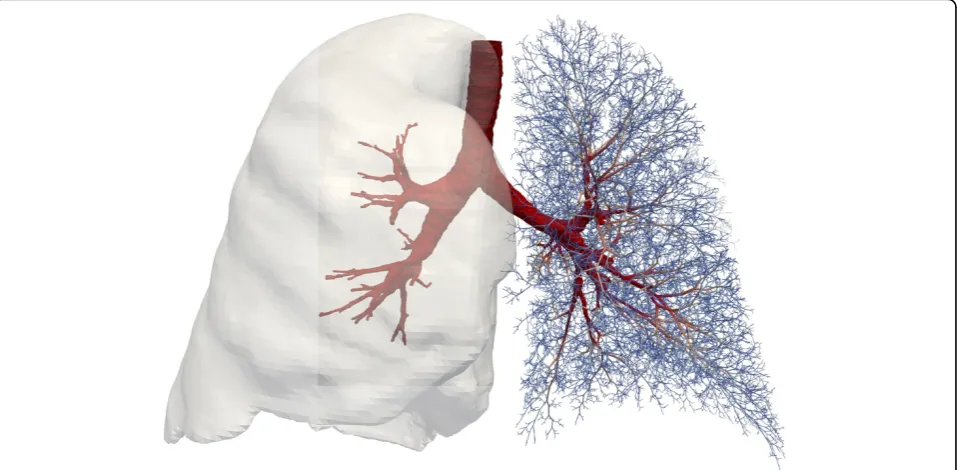
State-of-the-art structural models used for 3D CFD are now fully patient specific consisting of high-resolution computational meshes of the central airways (typically including 7-9 generations of branching) containing in the order of millions of computational elements [15,16]. Smal-ler airways however are not currently represented in these types of models due to computational and time restric-tions on the size of the meshes. A simplified 1D approach is necessary to represent the structure of the full airway and vascular networks. Tawhai et al. [17] developed a volume-filling branching (VFB) algorithm, which has pro-vided a morphometrically-realistic method to generate patient-specific network models, used in several modeling studies [11,18-24]. This method generates branches from the end points of airways/vessels derived from high-resolu-tion images (typically CT images at full inspirahigh-resolu-tion) and grows a branching tree into the lobar volumes also derived from imaging. Note that the central airways and lobar volumes and shapes are patient-specific while the addi-tional 1D branches are only an estimation of the structure (but are realistic according to published branching statis-tics) of the distal airway tree. 1D models require informa-tion regarding branch diameter to be allocated and this is normally derived from the visible CT branches plus mor-phometric information published in the literature.
Parameterizing models from imaging
Airway segmentation is commonly performed using threshold-based region-growing methods to detect the air-way lumen [25]. The centerline can be determined using local properties of the image or skeletonization. The com-putational mesh of the airway segmentation may be used directly in 3D CFD simulations, while the centerline and radius information are used in the development of perso-nalized 1D functional models. The wall thickness can be extracted and used to assess inflammation effects of disease. Vessel segmentation has been performed using Hessian-based approaches such as the vesselness filter [26].
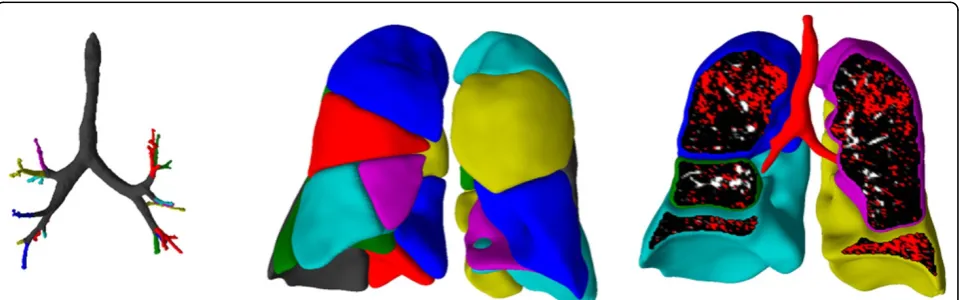
Lobe segmentation is typically performed by dividing the segmented lung volume through detection of the pulmon-ary fissures using various methods (see review by [25]). Some authors extend lobar segmentation ideas to extract the pulmonary segments (see review by [25]). However, validation is more difficult as the segment boundaries are not generally identifiable on CT scans. A novel technique combining imaging and modeling (via the VFB) has been used to extract pulmonary segments within the Synergy-COPD project (Figure 1, Doel, 2014, unpublished informa-tion). High resolution CT data used here was provided with permission by Hospital Clinic, IDIBAPS, University of Barcelona using a multislice spiral CT scanner (Soma-tom Sensation 64) as part of the Synergy-COPD project.
The regional assessment of obstructive disease can also be used to parameterize or validate computational models. A great deal of research has been carried out into auto-mated assessment of COPD from CT images [27]. The amount of emphysema, bronchial wall thickening and air-trapping can all by quantified using CT. Emphysema is typically quantified by computing the percentage of voxels which fall below a simple threshold such as−950 HU.
Functional imaging offers a wealth of regional data for model parameterization and validation. In recent years,
one of the biggest areas of development for functional imaging of the lung has been in hyperpolarized gas MR imaging (HP MRI) [28]. Measures of both static and dynamic ventilation are possible, providing information on the distribution of disease attributes such as ventilation defects and gas trapping [29,30]. Diffusion-weighted ima-ging measures the apparent diffusion coefficient (ADC) of the gas and provides a measure of the alveolar structure [31]. Increased ADC values indicate emphysema and a increased regional heterogeneity in ADC values have been found in both COPD and asthmatic subjects [32].
Functional models of the lung
Models of several different aspects of respiratory function have been developed including models of ventilation [15,18,19,33], perfusion [20,23,34], gas exchange [35], forced expiration [36,37], gas washout [24,38], impedance [21,22], particle transport and deposition [16,39,40] and tissue mechanics [41,42]. Nearly all of these modeling studies have only investigated function in a normal healthy lung, with relatively few studies investigating obstructive lung diseases. In this section we focus our discussion on models representing disease and in particu-lar multiscale models and studies that have combined imaging and modeling methodologies.
Applications of models to bronchoconstriction/asthma
[image:3.595.59.540.528.678.2]There is a paucity of truly multiscale respiratory models. An excellent example of a multiscale model investigating lung disease is that of Donovan et al. [10,11]. This work has investigated the impact of bronchoconstriction on lung function and links together events at the cellular and mole-cular level to function in the whole organ. This model includes patient-specific lobes and central airways and includes distal airways created using the VFB method. The
airway model is embedded within a‘breathing’mechanics model. The tissue model for each airway is linked to a model of the cross bridge mechanics in the ASM and their control by calcium dynamics. This provides a link right across the scales and has most recently been used to demonstrate insight into the synergistic interaction between deep inspirations and ASM cell fluidization in reversing airway closure (linking organ level motion to cell and tissue level function) [11].
Another example is the model developed by Venegas et al. which incorporated an airway network, the distri-bution of airflow, airway wall mechanics and ASM beha-vior [3]. Only minimal heterogeneity was required in the model (in airway wall thickness) to cause a vicious cycle that produced a so-called catastrophic shift in airway structure producing the self-organized patchy ventilation observed in functional images of asthmatics. This beha-vior would not have been observed by the simple sum-mation of model components, the system required interdependence between the parts to produce this emergent outcome, highlighting the necessity of having a fully integrated model to predict realistic outcomes.
Various other modeling studies have presented novel out-comes through a combined imaging and modeling approach [21,22]. These models incorporate patient-specific airway branching geometry and in addition prescribe func-tional defects from images. In general the structure of the models are manipulated in order to replicate the function observed in the images. This provides a way to infer struc-tural properties of the small airways which cannot be mea-sured via imaging. These studies have typically shown that ventilation defects observed in asthmatics must be caused by fairly severe constriction of small airways (less than 2 mm in diameter).
Applications of models to COPD/emphysema
There have been far fewer modeling studies focusing on COPD, with most studies considering only emphysema. Models of emphysema have predominantly focused on the alterations occurring in the parenchymal tissue and the resultant change in tissue mechanical properties. The most common approach uses a network of springs to represent the lung parenchymal tissue [43,44], with individual springs representing alveolar walls. These modeling studies have highlighted the redistribution of forces within the tissue during the progression of emphysema. To initiate emphy-sema a random percentage of springs were removed. Additional springs under the highest tension were prefer-entially removed to mimic mechanical failure and emphy-sema progression. This method of progression has been found to produce patterns of emphysema observed experi-mentally [44] and provide important evidence for the role of mechanical forces in emphysema progression. This approach was extended to a larger network and revealed
sudden changes in the macroscopic stiffness of the tissue when‘failed’springs connected in a continuous pathway across the network [43]. A similar study applied a 3D model, using cuboidal cells to represent alveoli, to investi-gate the relationship between the pattern of alveolar wall destruction and the emergent mechanical properties of the tissue [45]. This study demonstrated that the distribution of emphysematous lesions plays a vital role in the resultant organ level function. These types of studies - linking micro-scopic changes to macromicro-scopic outcomes - are excellent examples of the added knowledge computational modeling can provide.
Functional respiratory imaging to predict the response to therapy
Functional Respiratory Imaging (FRI) combines the com-putational modeling technique of 3D CFD with imaging to create patient-specific models of lung function. Pioneering studies by FLUIDDA, a small company based in Belgium, have applied this technique to provide a novel tool for phenotyping patients and monitoring the efficacy of novel respiratory drugs [7-9]. Results from over 20 clinical trials involving a total of 750 patients have demonstrated the higher sensitivity of FRI outcomes, in comparison with standard diagnostic measures such as spirometry, through its use of regional FRI biomarkers.
CT images at full inspiration and full expiration are required for this technique. Segmentation techniques are applied to extract the lobar volumes and central airway geometry. Patient-specific geometric models are created of the central airways and the patient-specific change in lobar volume from expiration to inspiration are applied in the CFD flow boundary conditions [15]. FRI is able to produce clinically relevant patient specific biomarkers such as the lobar and airway volumes, internal airflow distribution, airway resistance, lobar perfusion and regio-nal aerosol deposition (see Figure 2).
Multiscale models of asthma and COPD: the AirPROM approach
significant assets of AirPROM are the large amounts of well-characterized clinical data and the truly multidiscipli-narity of the consortium with expertise in clinical medicine, physiology, radiology, image analysis, bioengineering, data handling, computational modeling and systems biology. The concept behind this work is to move away from the typical‘one size fits all’treatment of respiratory disease towards patient stratification and personalized medicine.
The clinical data consists of both asthmatic and COPD patients from aligned consortia EvA [48], UBIOPRED [49] and BTS Severe Asthma network [50]. These data include extensive genomic, transcriptomic and proteomic profiles, detailed lung function with novel small airway physiologi-cal measures [51], bronchial challenge studies, CT [52] and HP MRI imaging data, and patient-reported out-comes. The data provides both cross-sectional and longi-tudinal follow-up data including some clinical intervention studies. These data have been integrated into a data man-agement platform that will feed into the computational modeling framework [53]. This is the same knowledge management framework developed and used within the Synergy-COPD project.
The main focus of the modeling within AirPROM is pre-dicting ventilation and the impact of pathophysiological changes on resultant ventilation and lung function. The AirPROM workflow (Figure 3) includes data and models for both the large and small airways. State-of-the-art soft-ware (Mimics®, Materialise NV, Belgium; Airways, Institut Telecom, France) is being developed to enable automatic extraction of the morphological properties of central air-ways and lobes from patient CT data. High-resolution com-putational meshes of the central airways and lung surface are generated for use in 3D CFD (FRI) simulation studies using the ANSYS software. 1D airway models are generated down to the gas exchange level using the VFB algorithm
(see Figure 4). Functional models that predict ventilation and impedance within the 1D networks have been devel-oped. Correlation of model predictions with imaging and measures at the mouth will be used for model validation. At least 70 patient specific models will be analyzed in this pipeline. So far 24 patients within the AirPROM database have been analyzed using FRI, results have shown a good correlation with PFT measurements [54].
A combined HP MRI measurement and modeling approach is being used to assess the structure and func-tion of the small airways [55]. In addifunc-tion measurements of impedance and gas washout are being extracted from the AirPROM patients to provide information about the small airways. A micro-airway model is being developed, in parallel with anex vivotissue model, that incorporates tissue level mechanical models and cell level modeling techniques (using agent-based modeling). Statistical mod-els are being used to capture the structure and function of the lung as a whole. All of these models - large and small airways, macro and micro scale - will be linked together to provide a multiscale modeling framework to predict the evolution of disease and response to clinical interventions [46].
The challenges in moving forward
[image:5.595.60.539.87.273.2]These types of modeling approaches suffer from several limitations. The process of modeling requires several sim-plifying assumptions of the system being modeled to enable feasibility of solution; models will never replicate the com-plexity of reality. However, a model need only be as compli-cated as required to answer a specific question. It is paramount that implications of the simplifying assumptions used are carefully considered when analyzing outcomes and applying models. A large part of the Physiome/VPH-related modeling drive aims towards creating‘patient-specific’
models. However, only parts of a model can be persona-lized to a given patient with many unknowns remaining (such as tissue properties, structure of smaller airways/ves-sels, exact values of boundary conditions to use to name a few). In addition, the link between genetics and environ-ment for an individual seems a near impossible feat to include in models. Current models typically predict func-tion at a narrow time point of life. Predicfunc-tions of the longer time scale evolution of disease will be a very difficult prop-erty to integrate into a modeling framework. At this stage,
the power of modeling is predominantly in generating new hypotheses that can be tested experimentally. As new knowledge emerges models and modeling techniques improve models will hopefully move forward in the areas described above.
[image:6.595.59.540.88.281.2]There is a pressing need for modelers and clinicians to work ever more closely to achieve the shared goal of patient-specific clinically relevant multiscale models. One of the major hurdles standing in the way of compu-tational modeling and its clinical use is lack of model
Figure 3Schematic diagram illustrating the workflow structure within the AirPROM project. Figure courtesy of [46].
[image:6.595.60.539.454.689.2]validation. Models need to be thoroughly tested to check the accuracy and reliability of the predictions before they will be accepted into the clinical environment. A recent paper by Pathmanathan and Gray [56] discusses the field of verification, validation and uncertainty quantification (VVUQ) and the need for this analysis to be applied to physiological models. This technique provides a methodi-cal way of quantifying the accuracy (and therefore the uncertainty) in a model and will be vital in the clinical acceptance and usage of models.
Conclusions
Here we have presented the current state-of-the-art tech-niques in image processing and computational modeling of the lung. A combined approach using imaging and modeling together provides an extremely powerful tool to assess features of lung (dys)function unable to be mea-sured in the clinic. The AirPROM project aims to develop multiscale models of the lung. In comparison, the Synergy-COPD project aims at a systems approach - inte-grating models across different organ systems in the body. The work being conducted within the AirPROM project will complement Synergy-COPD by contributing models and knowledge of the function within the lung in health and during asthma and COPD.
Competing interests
CB has received grant income and consultancy from GSK, AZ/MedImmune, Novartis, Chiesi, Roche/Genentech and BI. KSB and TD have no competing interests.
Authors’contributions
KSB developed the plan for the manuscript and provided expertise and text on computational modeling aspects within the paper and the AirPROM project. TD provided expertise and text on image-based techniques. CB provided expertise in respiratory medicine and the AirPROM project. All authors were involved in editing the final manuscript.,’
Declarations
Publication of this article has been funded by the European Union Seventh Framework Programme FP7/2007-2013 under grant agreement numbers 270086 (Synergy-COPD, http://www.synergy-copd.eu) and 270194 (AirPROM, http://www.airprom.eu). Data was provided with permission by Hospital Clinic, IDIBAPS, University of Barcelona.
This article has been published as part ofJournal of Translational Medicine Volume 12 Supplement 2, 2014: Systems medicine in chronic diseases: COPD as a use case. The full contents of the supplement are available online at http://www.translational-medicine.com/supplements/12/S2.
Authors’details
1Department of Computer Science, University of Oxford, Oxford, UK. 2
Institute for Lung Health, Department of Infection, Immunity and Inflammation, University Hospitals of Leicester, Leicester, UK.
Published: 28 November 2014
References
1. Decramer M, Janssens W, Miravitlles M:Chronic obstructive lung disease. Lancet2012,379(9823):1341-1351.
2. World Health Organization. World Health StatisticsGeneva, Switzerland; 2008.
3. Venegas JG, Winkler T, Musch G, Vidal Melo MF, Layfield D, Tgavalekos N, Fischman AJ, Callahan RJ, Bellani G, Harris RS:Self-organized patchiness in asthma as a prelude to catastrophic shifts.Nature2005,434:777-782. 4. Garny A, Cooper J, Hunter PJ:Toward a VPH/Physiome ToolKit.Wiley
Interdiscip Rev Syst Biol Med2010,2(2):134-47.
5. Zemzemi N, Bernabeu MO, Saiz J, Cooper J, Pathmanathan P, Mirams GR, Pitt-Francis J, Rodriguez B:Computational assessment of drug-induced effects on the electrocardiogram: from ion channel to body surface potentials.Br J Pharmacol2013,168(3):718-33.
6. De Backer L, Vos W, Salgado R, De Backer J, Devolder A, Verhulst S, Claes R, Germonpré P, De Backer W:Functional imaging using computer methods to compare the effect of salbutamol and ipratropium bromide in patient-specific airway models of COPD.Int J Chron Obstruct Pulmon Dis 2011,6:637-646.
7. De Backer LA, Vos W, De Backer J, Van Holsbeke C, Vinchurkar S, De Backer W:The acute effect of budesonide/formoterol in COPD: a multi-slice computed tomography and lung function study.The European respiratory journal: official journal of the European Society for Clinical Respiratory Physiology2012,40(2):305.
8. De Backer J, Vos W, Van Holsbeke C, Vinchurkar S, Claes R, Parizel PM, De Backer W:Effect of high-dose N-acetylcysteine on airway geometry, inflammation, and oxidative stress in COPD patients.Int J Chron Obstruct Pulmon Dis2013,8:569-79.
9. Vos W, De Backer J, Poli G, De Volder A, Ghys L, Van Holsbeke C, Vinchurkar S, De Backer L, De Backer W:Novel functional imaging of changes in small airways of patients treated with extrafine beclomethasone/formoterol.Respiration2013,86(5):393-401. 10. Politi AZ, Donovan GM, Tawhai MH, Sanderson MJ, Lauzon A, Bates JHT,
Sneyd J:A multiscale, spatially distributed model of asthmatic airway hyper-responsiveness.Journal of Theoretical Biology2010,266:614-624. 11. Donovan GM, Sneyd J, Tawhai MH:The importance of synergy between
deep inspirations and fluidization in reversing airway closure.PLoS One 2012,7(11):e48552.
12. Pinto-Plata VM, Cote C, Cabral H, Taylor J, Celli BR:The 6-min walk distance: change over time and value as a predictor of survival in severe COPD.Eur Respir J2004,23(1):28-33.
13. Spencer RM, Schroeter JD, Martonen TB:Computer simulations of lung airway structures using data-driven surface modeling techniques. Comput Biol Med2001,31(6):499-511.
14. Galvin I, Drummond GB, Nirmalan M:Distribution of blood flow and ventilation in the lung: gravity is not the only factor.British Journal of Anaesthesia2007,98(4):420-428.
15. De Backer JW, Vos WG, Gorlé CD, Germonpré P, Partoens B, Wuyts FL, Parizel PM, De Backer W:Flow analyses in the lower airways: patient-specific model and boundary conditions.Medical Engineering and Physics 2008,30(7):872-879.
16. Lin CL, Tawhai MH, Hoffman EA:Multiscale image-based modeling and simulation of gas flow and particle transport in the human lungs.Wiley Interdiscip Rev Syst Biol Med2013,5(5):643-55.
17. Tawhai MH, Hunter PJ, Tschirren J, Reinhardt JM, McLennan G, Hoffman EA: CT-based geometry analysis and finite element models of the human and ovine bronchial tree.Journal of Applied Physiology2004,97(6):2310-2321. 18. Yin Y, Choi J, Hoffman EA, Tawhai MH, Lin CL:A multiscale MDCT
image-based breathing lung model with time-varying regional ventilation.J Comput Phys2013,244:168-192.
19. Swan AJ, Clark AR, Tawhai MH:A computational model of the topographic distribution of ventilation in healthy human lungs.Journal of Theoretical Biology2012,300:222-231.
20. Burrowes KS, Clark AR, Tawhai MH:Blood flow redistribution and ventilation-perfusion mismatch during embolic pulmonary arterial occlusion.Pulmonary Circulation2011,1(3):365-376.
21. Tgavalekos N, Tawhai MH, Harris RS, Venegas J, Lutchen KR:Identifying airways responsible for heterogeneous ventilation and mechanical dysfunction in asthma: an image-functional modeling approach.Journal of Applied Physiology2005,99(6):2388-2397.
22. Campana L, Kenyon J, Zhalehdoust-Sani S, Tzeng YS, Sun Y, Albert MS, Lutchen K:Probing airway conditions governing ventilation defects in asthma via hyperpolarized MRI image functional modeling.Journal of Applied Physiology2009,106(4):1293-3000.
pulmonary perfusion in a multi-scale model of the pulmonary circulation.Journal of Applied Physiology2011,110(4):943-55. 24. Mitchell JH, Hoffman EA, Tawhai MH:Relating indices of inert gas
washout to localised bronchoconstriction.Respir Physiol Neurobiol2012, 183(3):224-33.
25. van Rikxoort EM, van Ginneken B:Automated segmentation of pulmonary structures in thoracic computed tomography scans: a review.Phys Med Biol2013,58(17):R187-220.
26. Frangi A, Niessen W, Vincken K, Viergever M:Multiscale vessel enhancement filtering.Medical Image Computing and Computer-assisted Intervention1998,1496:130-137.
27. Sverzellati N, Molinari F, Pirronti T, Bonomo L, Spagnolo P, Zompatori M: New insights on COPD imaging via CT and MRI.Int J Chron Obstruct Pulmon Dis2007,2(3):301-312.
28. Fain SB, Korosec FR, Holmes JH, O’Halloran RL, Sorkness RL, Grist TM: Functional lung imaging using hyperpolarized gas MRI.J Magn Reson Imaging2007,25(5):910-923.
29. Horn FC, Deppe MH, Marshall H, Parra-Robles J, Wild JM:Quantification of regional fractional ventilation in human subjects by measurement of hyperpolarized 3He washout with 2D and 3D MRI.J Appl Physiol (1985) 2014,116(2):129-39.
30. Fain S, Schiebler ML, McCormack DG, Parraga G:Imaging of lung function using hyperpolarized helium-3 magnetic resonance imaging: Review of current and emerging translational methods and applications.J Magn Reson Imaging2010,32(6):1398-408.
31. Schreiber WG, Morbach AE, Stavngaard T, Gast KK, Herweling A, Sogaard LV, Windirsch M, Schmiedeskamp J, Heussel CP, Kauczor HU:Assessment of lung microstructure with magnetic resonance imaging of hyperpolarized Helium-3.Respir Physiol Neurobiol2005,148(1-2):23-42.
32. Wang C, Altes TA, Mugler JP, Miller GW, Ruppert K, Mata JF, Cates GD, Borish L, de Lange EE:Assessment of the lung microstructure in patients with asthma using hyperpolarized 3He diffusion MRI at two time scales: comparison with healthy subjects and patients with COPD.J Magn Reson Imaging2008,28(1):80-88.
33. Ismail M, Comerford A, Wall WA:Coupled and reduced dimensional modeling of respiratory mechanics during spontaneous breathing.Int j numer method biomed eng2013.
34. Tang BT, Fonte TA, Chan FP, Tsao PS, Feinstein JA, Taylor CA: Three-dimensional hemodynamics in the human pulmonary arteries under resting and exercise conditions.Annals of Biomedical Engineering2011, 39(1):347-58.
35. Swan AJ, Tawhai MH:Evidence for minimal oxygen heterogeneity in the healthy human pulmonary acinus.J Appl Physiol2011,110(2):528-37. 36. Lambert RK, Wilson TA, Hyatt RE, Rodarte JR:A computational model for
expiratory flow.Journal of Applied Physiology1982,52:44-56.
37. Polak AG, Lutchen KR:Computational model for forced expiration from asymmetric normal lungs.Ann Biomed Eng2003,31(8):891-907. 38. Verbanck S, Paiva M:Model simulations of gas mixing and ventilation
distribution in the human lung.J Appl Physiol1990,69(6):2269-79, (1985). 39. Lambert AR, O’Shaughnessy P, Tawhai MH, Hoffman EA, Lin CL:Regional
deposition of particles in an image-based airway model: large-eddy simulation and left-right lung ventilation asymmetry.Aerosol Sci Technol 2011,45(1):11-25.
40. Darquenne C, van Ertbruggen C, Prisk GK:Convective flow dominates aerosol delivery to the lung segments.J Appl Physiol2011,111(1):48-54, (1985).
41. Tawhai M, Nash N, Lin C, Hoffman E:Supine and prone differences in regional lung density and pleural pressure gradients in the human lung with constant shape.Journal of Applied Physiology2009,107(3):912-20. 42. Rausch SM, Martin C, Bornemann PB, Uhlig S, Wall WA:Material model of
lung parenchyma based on living precision-cut lung slice testing.J Mech Behav Biomed Mater2011,4(4):583-92.
43. Bates JH, Davis GS, Majumdar A, Butnor KJ, Suki B:Linking parenchymal disease progression to changes in lung mechanical function by percolation.Am J Respir Crit Care Med2007,176(6):617-23. 44. Suki B, Lutchen KR, Ingenito EP:On the progressive nature of
emphysema: roles of proteases, inflammation, and mechanical forces. Am J Respir Crit Care Med2003,168(5):516-21.
45. Parameswaran H, Majumdar A, Suki B:Linking microscopic spatial patterns of tissue destruction in emphysema to macroscopic decline in stiffness using a 3D computational model.PLos Comput Biol2011,7(4):1-9.
46. Burrowes K, De Backer J, Smallwood R, Sterk P, Gut I, Wirix-Speetjens R, Siddiqui S, Owers-Bradley J, Wild J, Maier D, Brightling C,
AirPROM consortium:Computational models of the airways to unravel the pathophysiological mechanisms in asthma and COPD (AirPROM). Interface Focus2013,3(2):20120057.
47. Gomez-Cabrero D:Synergy-COPD: a systems approach for understanding and managing chronic diseases.Journal of Translation Medicine2014, 12(Suppl 2):S2.
48. Ziegler-Heitbrock L, Frankenberger M, Heimbeck I, Burggraf D, Wjst M, Häussinger K, Brightling C, Gupta S, Parr D, Subramanian D, Singh D, Kolsum U, Boschetto P, Potena A, Gorecka D, Nowinksi A, Barta I, Döme B, Strausz J, Greulich T, Vogelmeier C, Bals R, Hohlfeld J, Welte T, Venge P, Gut I, Boland A, Olaso R, Hager J, Hiemstra P,et al:The EvA study: aims and strategy.European Respiratory Journal2012,40(4):823-9.
49. Bel E, Sousa A, Fleming L, Bush A, Chung KF, Versnel J, Wagener AH, Wagers S, Sterk P, Compton C, U-BIOPRED Consortium, Consensus Generation:Diagnosis and definition of severe refractory asthma: an international consensus statement from the Innovative Medicine Initiative (IMI).Thorax2011,66(10):910-917.
50. Heaney L, Brightling C, Menzies-Gow A, Stevenson M, Niven R:British Thoracic Society Difficult Asthma Network. Refractory asthma in the UK: cross-sectional findings from a UK multicentre registry.Thorax2010, 65(9):787-94.
51. Gonem S, Natarajan S, Desai D, Corkill S, Singapuri A, Bradding P, Gustafsson P, Costanza R, Kajekar R, Parmar H, Brightling CE, Siddiqui S: Clinical significance of small airway obstruction markers in patients with asthma.Clin Exp Allergy2013, [Epub ahead of print].
52. Gupta S, Hartley R, Khan UT, Singapuri A, Hargadon B, Monteiro W, Pavord ID, Sousa AR, Marshall RP, Subramanian D, Parr D, Entwisle JJ, Siddiqui S, Raj V, Brightling CE:Quantitative computed tomography-derived clusters: Redefining airway remodeling in asthmatic patients.J Allergy Clin Immunol2013, [Epub ahead of print].
53. Losko S, Heumann K:Semantic data integration and knowledge management to represent biological network associations.Methods Mol Biol2009,563:241-258.
54. Vos W, De Backer J, Hartley R, Gupta S, Siddiqui S, Brightling C:Correlation Between Functional Respiratory Imaging And Pulmonary Function Tests In Health And Different Degrees Of Asthma Severity.American Thoracic Society international conferencePhiladelphia, USA; 2013.
55. Parra-Robles J, Wild JM:The influence of lung airways branching structure and diffusion time on measurements and models of short-range 3He gas MR diffusion.J Magn Reson2012,225:102-13. 56. Pathmanathan P, Gray RA:Ensuring reliability of safety-critical clinical
applications of computational cardiac models.Front Physiol2013,4:358. 57. FLUIDDA nv: 2014 [http://www.fluidda.com].
doi:10.1186/1479-5876-12-S2-S5
Cite this article as:Burroweset al.:Computational modeling of the obstructive lung diseases asthma and COPD.Journal of Translational Medicine201412(Suppl 2):S5.
Submit your next manuscript to BioMed Central and take full advantage of:
• Convenient online submission
• Thorough peer review
• No space constraints or color figure charges
• Immediate publication on acceptance
• Inclusion in PubMed, CAS, Scopus and Google Scholar
• Research which is freely available for redistribution
![Figure 2 Illustration of the typical biomarkers extracted by FLUIDDA’s work which combines computational modeling with medicalimaging to produce an approach termed Functional Respiratory Imaging (FRI) [57]Reproduced with permission from FluidDA.](https://thumb-us.123doks.com/thumbv2/123dok_us/8322614.297952/5.595.60.539.87.273/illustration-biomarkers-computational-medicalimaging-functional-respiratory-reproduced-permission.webp)