Separating the manual and cognitive element of the secondary task
.
White Rose Research Online URL for this paper:
http://eprints.whiterose.ac.uk/93191/
Version: Accepted Version
Proceedings Paper:
Merat, N, Kountouriotis, G, Carsten, O et al. (1 more author) (2015) Performance on the
Detection Response Task during driving: Separating the manual and cognitive element of
the secondary task. In: 4th International Driver Distraction and Inattention Conference. 4th
International Driver Distraction and Inattention Conference, 9-11 November 2015, Sydney,
Australia. .
[email protected] https://eprints.whiterose.ac.uk/
Reuse
Unless indicated otherwise, fulltext items are protected by copyright with all rights reserved. The copyright exception in section 29 of the Copyright, Designs and Patents Act 1988 allows the making of a single copy solely for the purpose of non-commercial research or private study within the limits of fair dealing. The publisher or other rights-holder may allow further reproduction and re-use of this version - refer to the White Rose Research Online record for this item. Where records identify the publisher as the copyright holder, users can verify any specific terms of use on the publisher’s website.
Takedown
If you consider content in White Rose Research Online to be in breach of UK law, please notify us by
© ARRB Group Ltd and Authors 2015 1
Performance on the Detection Response Task
during driving: Separating the manual and
cognitive element of the secondary task
Natasha Merat1*, Georgios Kountouriotis1, Andrew Tomlinson1, Oliver Carsten1, and Johan Engström2
1Institute for Transport Studies, University of Leeds, Leeds, U.K. 2Volvo Group Trucks Technology, Gothenburg, Sweden
ABSTRACT
The Detection Response Task (DRT) is designed to measure driver distraction from secondary
tasks. T
version of the DRT during dual task conditions (DRT + driving) with performance in a tertiary task setting (DRT + driving + secondary task). Three secondary tasks were used, requiring: nonvisual, visual, or visuomanual resources. The 1-back (Easy) and countback in 7s (Difficult) tasks were used as two levels of a nonvisual task. For the visual and visuomanual task, a visual search display was presented on the simulator screen, which overlapped with the back of a lead car. Response to this task was either verbal (visual) or via buttons on the steering wheel (visuomanual). Results showed DRT to be sensitive to the different difficulty levels of the nonvisual task. DRT performance did not distinguish between different perceptual demands of the visual task, but was affected by the manual load of the visuomanual task. Understanding the role of task pace in these studies is thought to be an important factor and further work using different visual tasks is also required to appreciate the value of the DRT in evaluating the distracting effects of in-vehicle HMI.
INTRODUCTION
A continued growth in the use of in-vehicle and nomadic technologies such as smart phones and navigation systems in the last 15 years or so has meant that the complex task of driving is now increasingly accompanied by other, competing, tasks, which can lead to driver distraction and inattention (Lee, Young, & Regan, 2008). Although a number of existing and draft ISO standards have been developed to address driver distraction from visual and visuomanual in-vehicle tasks (e.g. ISO 16673: Occlusion method to assess visual distraction), a standard does not currently exist for assessing the effect of nonvisual, cognitively demanding activities, such as those imposed, for example, by demanding hands-free mobile phone conversations.
A tangible methodology for measuring the true distraction from such cognitively loading tasks is therefore both necessary and valuable. The Detection Response Task (DRT) is an example of such a method currently subject to standardisation within the International Standard
© ARRB Group Ltd and Authors 2015 2 secondary task) is measured in terms of the number of times the visual or tactile stimulus is
detected (hit rate) and also response time to this detection (RT).
In order to support the development of the standard, since around 2008, a number of
coordinated studies have been conducted by members of the ISO DRT task force. During these studies, performance on one of three versions of the DRT has been measured within a series of experimental settings, across different laboratories in Europe, Japan, Malaysia, and North America. The general goal of these studies has been to assess the reliability of the DRT across stimulus presentation methods and experimental set-ups. Two secondary tasks are normally deployed for these studies, one nonvisual and one visuomanual. The nonvisual (auditory-vocal) task used is the n-back task (Mehler, Reimer, & Dusek, 2011; Kirchner, 1958), where participants hear a sequence of digits and are required to repeat the previous nth digit (for
example, in the 0-Back task they repeat the number they just heard whilst in the 1-Back task the number before the number they just heard is recalled). Results have consistently
demonstrated that DRT RT increases from baseline to secondary/tertiary task performance and can also reliably distinguish between the different levels of difficulty of the n-back task (Bruyas et al., 2013; Engström et al., 2013; Harbluk et al., 2013; Young, 2013). Although absolute RTs were somewhat different across stimulus presentation modalities and
experimental setups, the effects of the n-back task on DRT performance are generally similar. These results are also consistent with earlier DRT/PDT studies (Merat & Jamson, 2008; Engström et al., 2005; Engström 2010). It is assumed that the cognitive/central executive resources required to complete the n-back task are akin to those required during hands-free mobile phone conversations, and that the DRT is therefore a good technique for measuring the workload required by a nonvisual, cognitively distracting, task.
The visuomanual task used in the ISO coordinated studies was the Surrogate Reference Task (SuRT). This self-paced visual search task requires identification of a target circle presented amongst a set of distractor circles and has an Easy and Difficult version with the target circle being larger and therefore easier to spot in the Easy version of SuRT. Participants use a keypad to move a cursor to the left and right of a display screen and select the target circle in the
In addition to identifying a target circle reduced in size (and therefore more difficult to spot amongst similar sized distractors) in the Difficult
version of SuRT, part thus
also increasing the manual complexity of the task.
By contrast to the results for the purely cognitive n-back task, where DRT reliably discriminates between the Easy and Difficult versions of the task, results from the ISO task force studies has generally not found a difference in DRT RT for the two versions of the SuRT task. This absence of a difference in DRT performance during Easy and Difficult SuRT raises important questions about what the DRT actually measures. There are a number of possible considerations, each with somewhat different implications for the DRT as an HMI evaluation tool.
One possible explanation, in line with theoretical W M ‘ ces Theory (Wickens, 2002) is that a manual response is required for both the DRT and SuRT, and that this overlap in response modality causes an increase in DRT RT (see Engström, 2013). Since the target circle in the display is easy to find amongst the
© ARRB Group Ltd and Authors 2015 3 time and an equal or even higher frequency of button presses during this self-paced task.
According to this rationale, the more frequent button presses for the Easy SuRT impose a higher manual demand, which then leads to an overall higher visuomanual demand, effectively abolishing the low level of visual demand imposed by this task. This overall demand would therefore be quite similar to that of the Difficult version of SuRT, resulting in a similar performance decrement (higher RTs) for the DRT. If this is the case, it implies that the DRT would be particularly sensitive to secondary tasks involving button presses. In the context of HMI evaluation, this would be problematic since HMIs involving frequent button presses would
enalised D‘T HMI
imposing a higher cognitive load when performed without the DRT.
However, an alternative possibility is that the DRT high sensitivity to the Easy SuRT is not due to specific interference between button-presses for each task, but rather due to a more general (amodal) conflict in response selection. In this case, the DRT would not be over-sensitive to HMIs involving button presses, but should be over-sensitive to any secondary task with a high response frequency, regardless of response modality/code. On the other hand,
regardless of the potential for response interference, it is also possible that the DRT is simply not sensitive to different levels of visual perceptual demand from tasks, for instance, as imposed by tasks such as the SuRT.
It is currently difficult to distinguish between these alternative hypotheses based solely on the results from studies employing the SuRT task. One reason is that the SuRT manipulates visual and manual demand simultaneously. Moreover, since the SuRT is typically mounted on the car dashboard, DRT responses may be influenced both by visual perceptual demand (the intended display manipulation) and also visual eccentricity of the screen (the need to look away). While this issue is probably most severe for the remote version of the DRT (where the DRT
eccentricity is determined by head and eye movements), eccentricity may still vary somewhat for the head mounted DRT, due to the need for eye movements. Also, the position of the SuRT screen creates the need for visual time sharing between the SuRT and driving screens, which may influence the overall demand required, thus making it difficult to identify the specific components that influence DRT performance.
In order to address these issues, we used a visual search task which could either be completed by pressing buttons on the steering wheel, or using a verbal response, thus disentangling the visual and manual demand components. Moreover, in order to minimise effects of visual eccentricity, the visual search display was presented on the simulator screen, which overlapped with the back of a lead car.
© ARRB Group Ltd and Authors 2015 4
METHODS
Participants
A total of 18 participants took part in this study. One participant withdrew from the study which left 17 participants in total (11 males) with a mean age of 30.8 years (SD = 8.9). Participants were experienced drivers holding a valid UK driving license, for an average of 11 years. All testing adhered to the ethical guidelines as laid out by the University of Leeds Research Ethics Committee.
Design and Procedure
Materials
The experiment was conducted in the motion-based University of Leeds Driving Simulator which consists of a Jaguar S-type cab with all driver controls operational. The vehicle is housed within a 4 m spherical projection dome and has a 300° field-of-view projection system. The head mounted version of the DRT (HDRT) was used.
Driving Environment
Participants drove along a rural, two lane road. Two different road layouts were used, a straight road segment (Straight) and a curved road segment (Curve). The Curve segment consisted of a series of bends with a 750m radius alternating left and right. In all drives there was a lead car positioned at a constant distance of 25 meters in front of the participant. The lead car would always stay in the centre of the lane and duplicate the speed profile of the participant, therefore maintaining a uniform headway.
Secondary Tasks and HDRT
Three types of secondary task were used, each with two levels of difficulty. A visual task was used with no manual element (visual task), a visual task which required manual responses from the participants (visuomanual task) and a nonvisual cognitive task which had neither a visual nor a manual element (nonvisual task).
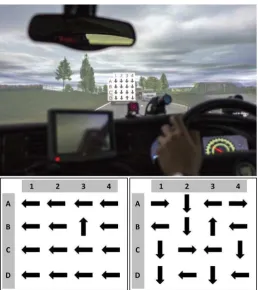
Visual task: The visual search Arrows task developed as part of the European HASTE project
© ARRB Group Ltd and Authors 2015 5
Figure 1 The visual version of the Arrows grid (a similar display was used for the visuomanual version). Bottom panel left shows the Visual Easy arrows and the Visual Difficult is shown on the right. In both cases the correct answer is 3B.
Visuomanual task: That task was similar to the Difficult level of the visual task (i.e. with the
[image:6.595.85.344.57.348.2]target arrow in a mixture of arrows) but instead of providing a verbal response, participants used two buttons located on the steering wheel to move a cursor (a highlighted red square not shown here) around the grid until they reached the target arrow. The buttons would move the cursor either to the left or the right; so if the cursor was presented at square 1A and the target was at 3B, it would have to move through 2A, 3A, 4A, 1B, 2B before it reached 3B. For this task, manual interference was manipulated by the number of button presses required to reach the target arrow. In the Low Manual Interference condition, the cursor appeared one or two positions away from the target (requiring less manual input) while in the High Manual Interference version the cursor appeared 6 to 7 squares away from the target arrow (requiring more manual input from the participants). Grid presentation was participant paced, where each response initiated the next grid of Arrows. See Table 1 for the visual and manual demands of the visual and visuomanual tasks.
Table 1. Differences in difficulty between the visual and the visuomanual tasks
VISUAL Difficulty MANUAL Interference
VISUAL TASK Difficult/Easy None
VISUOMANUAL TASK Difficult Low/High
Nonvisual task: That task consisted of the 1-Back task (Easy, see Mehler, Reimer, & Dusek,
2011) and a counting backwards in sevens task (Difficult) where participants heard a 3-digit
© ARRB Group Ltd and Authors 2015 6 commonly used in DRT experiments as a non-visual task (e.g., Bruyas et al., 2013; Engström et al., 2013; Harbluk et al., 2013; Young, 2013), while the Count back in 7s task was chosen as another type of task which does not rely on visual resources and has been used regularly in our laboratories as a secondary task to driving to emulate high cognitive load (e.g., Merat & Jamson, 2008).
Each of these secondary tasks lasted around 48 seconds. During each of the tasks, conducted during driving, participants also had to complete the HDRT which was also completed on its own (Baseline condition). In each task trial there were approximately 12 HDRT stimuli, and each condition was repeated three times, giving a total of 36 HDRT trials per condition.
Experimental Design
A repeated measures design was used, with a total of four runs per participant and a blocked design with counterbalanced blocks in terms of secondary task and road geometry (Arrows Straight, Arrows Curve, Non Visual Straight, Non Visual Curve). Thirteen conditions were presented in total (2 Road × 3 Task × 2 Difficulty + 1 Baseline); each repeated three times (trials). For each measure, the average of the three trials per condition per participant was taken.
RESULTS
HDRT reaction time
Due to the unbalanced design used in this experiment (the three secondary task conditions have two levels of Difficulty, while the Baseline does not) analysis was conducted in two steps. Firstly, we looked at the three secondary tasks along with the Baseline and the Road condition (averaged across Difficulty level) and then at the three secondary Tasks, the Difficulty level, and the Road. The effect of Road in the second analysis is not reported twice, unless it interacted with Difficulty.
A 2 (Road: Straight, Curve) × 4 (Task: Baseline, Visual, Visuomanual, Non Visual) repeated measures ANOVA was carried out on the reaction times for the DRT task. There was a
significant main effect of Road (F(1, 16) = 8.16, p = .011, p2 = .34) and Task (F(3, 48) = 38.56, p
< .001, p2 = .707), but no significant interaction between these two factors.
© ARRB Group Ltd and Authors 2015 7
Figure 2. Interaction between the three Tasks and their Difficulty level (Baseline shown for comparison) on HDRT Reaction Times. Error bars = SEM.
In addition, a 3 (Task: Visual, Visuomanual, Non Visual) × 2 (Difficulty: Easy, Difficult) × 2 (Road: Straight, Curve) repeated-measures ANOVA was run on the HDRT Reaction Times. There was a significant main effect of Task (F(2, 32) = 4.06, p = .027, p2 = .20) with the visuomanual task
producing significantly higher RTs compared to the visual task, (p = .010) and a significant interaction between Task and Difficulty (F(2, 32) = 5.83, p = .016, p2 = .27). The interaction
between Task and Difficulty is shown in Figure 2. Simple main effects analysis revealed that although there was no significant difference between the two Difficulty levels in the visual condition (p = .494), in both the visuomanual and the nonvisual tasks there were significant differences between the two levels (p = .022 and p = .028 respectively). There was no
significant interactions involving the Road (Road × Task: F(2, 32) < 1, Road × Difficulty: F(1, 16) = 1.51, p = .237, and Road × Task × Difficulty: F(2, 32) = 2.96, p = .066).
Secondary Task Performance
Percent Correct
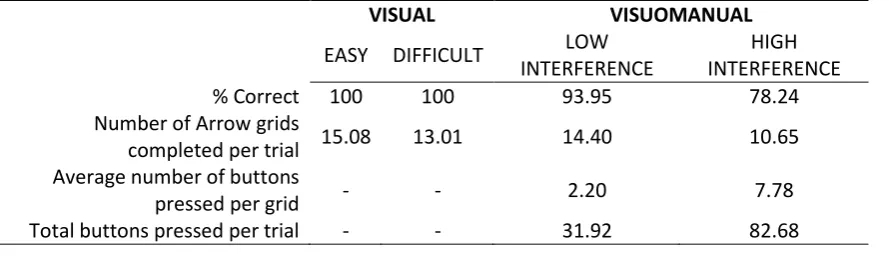
The performance metrics for the visual and visuomanual tasks are shown in Table 2. A t-test between the Low and High interference levels of the visuomanual task revealed a significant difference (t(16) = 8.41, p < .001), with participants achieving significantly more correct answers in the Low Interference condition ( = 93.95, SEM = 6.74) compared to the High Interference condition ( = 78.24, SEM = 5.93). Response to the visual task was recorded at 100% by the experimenter.
Table 2. Performance metrics for the visual/visuomanual tasks
VISUAL VISUOMANUAL
EASY DIFFICULT LOW INTERFERENCE
HIGH INTERFERENCE
% Correct 100 100 93.95 78.24
Number of Arrow grids
completed per trial 15.08 13.01 14.40 10.65 Average number of buttons
pressed per grid - - 2.20 7.78
[image:8.595.81.526.635.763.2]© ARRB Group Ltd and Authors 2015 8
DISCUSSION
Driver distraction by on road, in-vehicle, and nomadic devices is continuously on the increase, with a great degree of research effort applied to understanding its contribution to crashes and near misses. Although measuring the effect of distraction from visual and visuomanual in-vehicle systems is relatively well understood, a concrete methodology for assessing how nonvisual, cognitively demanding tasks with an audio-vocal element affect driving is not yet fully established. In a number of studies conducted by an ISO task force, the Detection Response Task has been found to be sensitive to distinguishing between different levels of the audio-vocal version of the n-back task, which requires cognitive resources and is therefore thought to place the same sorts of demands on drivers as a hands-free phone conversation.
However, these studies have not shown a distinction in DRT performance by different levels of a concurrent visuomanual task (SuRT) with high DRT RTs for both the Easy and Difficult
versions of SuRT. Since both DRT and SuRT rely heavily on a manual response, the main aim of the current study was to establish further precisely what aspects of a visuomanual task
contribute to such high DRT RTs. A driving simulator study was therefore designed, whereby DRT performance with two versions of the same visual task (Arrows) was compared, but response to the task was either via button presses (visuomanual version) or vocal (visual version). Furthermore, to understand how DRT performance was affected by visual and visuomanual tasks which did not take rom the driving scene (as is for instance required by SuRT) the Arrows task was presented on the simulated driving scene itself, rather than on a separate screen. To continue the work on whether DRT is particularly sensitive to nonvisual tasks alone, RT performance with two levels of difficulty of the Arrows task was also compared to that of concurrent performance with two different nonvisual (cognitive) tasks.
Results showed an overall higher RT for the HDRT during all secondary tasks, when compared to baseline. Reaction times were also found to be higher, overall, when drivers were
negotiating the more difficult curved road sections, suggesting that DRT performance may generally be sensitive to more difficult driving conditions.
Comparison of performance between the three secondary tasks themselves showed similar RTs for the visual and nonvisual tasks, but higher DRT RT was seen for the visuomanual task, compared to the visual task, which required a verbal response. Therefore, inclusion of the manual response element in the visuomanual task seems to have increased response time for the DRT.
© ARRB Group Ltd and Authors 2015 9 was kept constant (by using a verbal reply), DRT performance failed to distinguish between the two perceptually different levels of the visual display.
Taken together, these results suggest that the DRT is particularly sensitive to distinguishing between different levels of nonvisual cognitive tasks, but that more caution is required when interpreting the difficulty of tasks that impose mainly visual or visuomanual loads. Since DRT was not able to distinguish between different difficulty levels of the (non-manual) visual task, further work is required to examine how DRT interacts with other visual tasks of this nature which can be performed with a verbal response.
More consideration is also needed to account for the diverse results on the interaction
between HDRT and visuomanual tasks such as those used in this study and the ISO coordinated studies on SuRT. It is argued that difficulty in drawing firm conclusions may be partly based on the self-paced nature of the SuRT and Arrows tasks, and also based on how participants manage to coordinate the high manual demand required for these tasks, when conducted with the DRT. If, as suggested in ISO (2015), the DRT essentially measures the demand for cognitive control imposed by a secondary task, it might be argued that due to the limited degree of cognitive resources, participants (consciously or not) are more comfortable in managing and prioritising the low interference visuomanaul tasks, at the expense of the DRT. As the manual interference level of the visuomanual task increases, there is a speed accuracy trade-off to consider, causing participants to reduce their pace for completion of the difficult task, which then allows release of some resources for response to the DRT. Some support for this argument is provided by results which show a higher number of grids completed for the Easy version of the task (14 vs 10).
In conclusion, this study suggests that the DRT is clearly sensitive to secondary tasks with a purely cognitive nonvisual element, but that the sensitivity of the DRT needs to be further investigated for tasks involving visual and manual elements. In particular, the role of self-pacing in relation to DRT performance needs further attention. . Since the n-back task, which has served as the main basis for validating the DRT, is system-paced, the pacing issue also needs to be further investigated for purely cognitive tasks, because for example, most naturalistic tasks conducted in vehicles such as speech interaction or phone conversation, are self-paced.
REFERENCES
Angell, L. S. (2014). An Opportunity for Convergence? Understanding the Prevalence and Risk of Distracted Driving Through the Use of Crash Databases, Crash Investigations, and Other Approaches. Annals of Advances in Automotive Medicine, 58, 40 59.
© ARRB Group Ltd and Authors 2015 10
E J T T D T
load. In G.L.Rupp (Ed.). Performance Methods for Assessing Driver Distraction: The Quest for Improved Road Safety. (pp. 90-103). Warrendale, PA: SAE International.
Engström, J., Åberg, N., Johansson, E., & Hammarbäck, J. (2005). Comparison between visual and tactile signal detection tasks applied to the safety assessment of in-vehicle information systems. In Third International Driving Symposium on Human Factors in Driver Assessment, Training and Vehicle Design (pp. 232 239). Iowa City, USA: University of Iowa.
Engström, J., Larsson, P., & Larsson, C. (2013). Comparison of static and driving simulator venues for the tactile detection response task. In Proceedings of the Seventh International Driving Symposium on Human Factors in Driver Assessment, Training, and Vehicle Design (pp. 369 375). Iowa City, USA: University of Iowa.
Harbluk, J.L., Burns, P.C., Hernandez, S., Tam, J. & Glazduri, V. (2013). Detection response tasks: Using remote, headmounted and Tactile signals to assess cognitive demand while driving. In Proceedings of the Seventh International Driving Symposium on Human Factors in Driver Assessment, Training, and Vehicle Design (pp. 78 84). Iowa City, USA: University of Iowa.
Hsieh, L., Young, R., & Seaman, S. (2012). Development of the Enhanced Peripheral Detection Task: A Surrogate Test for Driver Distraction. SAE Int. J. Passeng. Cars - Electron. Electr. Syst. 5(1):317-325.
ISO 16673. Road vehicles - Ergonomic aspects of transport information and control systems - Occlusion method to assess visual demand due to the use of in-vehicle systems. Geneva Switzerland: 2007.
ISO/DIS 17488: Road vehicles - Transport information and control systems Detection- Response Task (DRT) for assessing attentional effects of cognitive load in driving, 2015-04, International Organization for Standardization, Geneva, Switzerland.
Jamson, A.H. & Merat, N. (2005). Surrogate in-vehicle information systems and driver behaviour: Effects of visual and cognitive load in simulated rural driving. Transportation Research Part F: Traffic Psychology and Behaviour, 8, 79-96.
Kirchner, W. K. (1958), Age differences in short-term retention of rapidly changing information. Journal of Experimental Psychology, 55(4), 352-358
Lee, J.D., Young, K.L., & Regan, M.A. (2008). Defining driver distraction. In M.A. Regan, J.D. Lee, & K.L. Young (Eds), Driver Distraction: Theory, Effects, and Mitigation, CRC Press, (pp. 31-40).
Martens, M.H. & W. van Winsum (2000). Measuring distraction: the Peripheral Detection Task. Proceedings NHTSA Internet Forum on the safety impact of driver distraction when using in-vehicles technology. Washington, D.C.: NHTSA.
© ARRB Group Ltd and Authors 2015 11 Mehler, B., Reimer, B., & Dusek, J. (2011). MIT AgeLab delayed digit recall cask (n-back).
Retrieved from http://agelab.mit.edu/system/files/Mehler_et_al_n-back-white-paper_2011_B.pdf
Merat, N. & Jamson, A.H. (2008). The effect of stimulus modality on signal detection: Implications for assessing the safety of in-vehicle technology. Human Factors, 50, 145-158.
Wickens, C.D., (2002). Multiple resources and performance prediction Theoretical issues in ergonomics science 3(2): 159-177.