RESEARCH NOTE
Quadratically convergent algorithm
for computing real root of non-linear
transcendental equations
Srinivasarao Thota
1*and Vivek Kumar Srivastav
2Abstract
Objectives: The present paper describes a new algorithm to find a root of non-linear transcendental equations. It is found that Regula-Falsi method always gives guaranteed result but slow convergence. However, Newton–Raphson method does not give guaranteed result but faster than Regula-Falsi method. Therefore, the present paper used these two ideas and developed a new algorithm which has better convergence than Regula-Falsi and guaranteed result. One of the major issue in Newton–Raphson method is, it fails when first derivative is zero or approximately zero.
Results: The proposed method implemented the failure condition of Newton–Raphson method with better conver-gence. Error calculation has been discussed for certain real life examples using Bisection, Regula-Falsi, Newton–Raph-son method and new proposed method. The computed results show that the new proposed quadratically conver-gent method provides better convergence than other methods.
Keywords: Root of transcendental equations, Regula-Falsi method, Newton–Raphson method, Quadratic convergence
Mathematics Subject Classification: 65Hxx, 65H04
© The Author(s) 2018. This article is distributed under the terms of the Creative Commons Attribution 4.0 International License (http://creat iveco mmons .org/licen ses/by/4.0/), which permits unrestricted use, distribution, and reproduction in any medium, provided you give appropriate credit to the original author(s) and the source, provide a link to the Creative Commons license, and indicate if changes were made. The Creative Commons Public Domain Dedication waiver (http://creat iveco mmons .org/ publi cdoma in/zero/1.0/) applies to the data made available in this article, unless otherwise stated.
Introduction
Most of the real life-problems are non-linear in nature therefore it is a challenging task for the mathematician and engineer to find the exact solution of such problems [1, 2]. In this reference, a number of methods have been proposed/implemented in the last two decades [1, 3–8]. Analytical solutions of such non-linear equations are very difficult, therefore only numerical method based iterative techniques are the way to find approximate solution. In the literature, there are some numerical methods such as Bisection, Secant, Regula-Falsi, Newton–Raphson, Mul-lers methods, etc., to calculate an approximate root of the non-linear transcendental equations. It is well known [1, 3–11, 14] that all the iterative methods require one or more initial guesses for the initial approximations.
In Regula-Falsi method, two initial guesses are taken in such a way that the corresponding function values have opposite signs. Then these two points are connected through the straight line and next approximation is the point where this line intersect the x-axis. This method gives guaranteed result but slow convergence therefore several researchers have improved this standard Regula-Falsi method into different hybrid models to speed up the convergence [1, 3–5, 7, 10, 11, 15, 16]. Thus previously published works have revised/implemented Regula-Falsi method in several ways to obtain better convergence. However, it is found that modified form of Regual-Falsi method becomes more complicated from computational point of view. Therefore, in the present work Regual-Falsi method has been used as its standard form with New-ton–Raphson method and found better convergence. Newton–Raphson method is generally used to improve the result obtained by one of the above methods. This method uses the concept of tangent at the initial approxi-mation point. The next approximate root is taken those
Open Access
*Correspondence: [email protected]; [email protected]
1 Department of Applied Mathematics, School of Applied Natural
Sciences, Adama Science and Technology University, Post Box No. 1888, Adama, Ethiopia
value where the tangent intersect the x-axis. So this method fails where tangent is parallel to x-axis, i.e. the derivative of the function is zero or approximately zero. The order of convergence of Newton–Raphson method is two, therefore it converges very rapidly than other meth-ods (Bisection, Regula-Falsi, etc.). However it does not always give guaranteed root. Many scientists and engi-neers have been proposed different hybrid models on Newton–Raphson method [8, 9, 12–14, 17–22].
It is clear from the survey [1–22], that the most of new algorithms are either based on three classical methods namely Bisection, Regula-Falsi and Newton–Raphson or created by hybrid processes. In the present work, the proposed new algorithm is based on standard Regula-Falsi and Newton–Raphson methods, which provides guaranteed results and higher order convergence over Regula-Falsi method. The new proposed algorithm will work even the first derivative equals to zero where New-ton–Raphson method fails.
Main text
Consider a continuous function f(x) between a and b such that f(a) and f(b) having opposite signs, consequently
f(a)·f(b) <0 . Without loss of generality, assume that f(a) is negative and f(b) is positive, and |f(a)|<|f(b)| ,
hence at least one root lies between a and b. From Reg-ula-Falsi method, the first approximate root can be calcu-lated by using the formula
and, the first approximate root by using Newton–Raph-son method is
where f′(a) indicates the derivative of f(x) at x=a. Now, in the present proposed algorithm, we take the average of the iterations in Eqs. (1) and (2) as our first approximate root x and follow the conditions given
below for further iterations:
• Choose two values a and b where the root exists as in
Regula-Falsi method.
• Select the value such that the corresponding
func-tion is closer to zero as a and the other one as b, i.e.
|f(a)|<|f(b)|.
• If first derivative at a is zero (i.e., f′(a)=0 ) then
interchange the values of a and b i.e., interchange (a,
b) to (b, a).
(1)
x= af(b)−bf(a)
f(b)−f(a) ,
(2)
x=a− f(a) f′(a),
The generalization of this process is described in the fol-lowing section.
Formulation of proposed algorithm
Recall the Eqs. (1) and (2) in terms of iteration formu-lae by replacing a, b, x by xn−1,xn+1,xn respectively, as
follows
and
where n is the iteration number and |f(xn−1)|<|f(xn+1)| . Now the average of Eqs. (3) and (4) is
After simplification of (5), we get
The value xn in Eq. (6) gives the iterative formula with |f(xn−1)|<|f(xn+1)| . If f′(xn−1)=0 , then Eq. (6) gives undefined value, then we have to interchange the values xn−1 and xn+1.
The following Theorem gives the generalization of above formulation.
Lemma 1 Letf(x) be a continuous function and (a, b) be a sufficiently small interval such that f(a)f(b) <0, and
f′(x) exists on [a, b]. Then the approximation of a root of f(x) can be find using the iterative formula given in Eq. (6).
Steps for calculating a root
I. Select two initial approximations xn−1 and xn+1
such that product of the corresponding function
values must be negative, i.e. f(xn−1)f(xn+1) <0.
II. Now calculate xn using the formula given in Eq. (6).
Check f(xn)=0 , if so, then xn is required root and
process stop. Otherwise we check the following possible conditions.
(i) For f(xn)f(xn−1) <0 , suppose |f(xn−1)|<
|f(xn)| then xn replace by xn−1 and xn−1 replace
by xn.
(3)
xn=
xn−1f(xn+1)−xn+1f(xn−1) f(xn+1)−f(xn+1)
(4)
xn=xn−1−
f(xn−1) f′(x
n−1)
,
(5)
xn=1 2
x
n−1f(xn+1)−xn+1f(xn−1)
f(xn+1)−f(xn−1)
+
xn−1−
f(xn−1)
f′(xn
−1)
(6) xn=xn−1−
f(xn−1)
2f′(x n−1)
f(xn−1)−f(xn+1)+(xn−1−xn+1)(f′(xn−1)) f(xn−1)−f(xn+1)
(ii) For f(xn)f(xn+1) <0 , suppose |f(xn)|<
|f(xn+1)| then xn+1 replace by xn.
III. If f′(x
n−1)≈0 then interchange xn−1 and xn+1.
IV. Repeat steps I, II and III until we get required approximate solution.
The implementation of the proposed algorithm in Mat-lab is also discussed (See, Additional file 1). This algo-rithm would help to implement the manual calculations in commercial packages such as Maple, Mathematica, SCILab, Singular,etc.
Order of convergence
The order of converges of any iterative method is defined as
where p is the order of convergence and c is a positive finite constant. The following Theorem shows the order of convergence of the proposed algorithm is quadratic.
Theorem 2 Letβ be a exact root of a continuous
func-tionf(x) and [a, b] be a sufficiently small neighbourhood ofβ. Then the sequence{xn} generated by the iterative for-mula (6) is at least quadratically convergent.
Proof If xn is an approximate value of β and en is the
error of the xn then
In the similar way, xn+1=β+en+1 and xn+2=β+en+2 . By proposed algorithm,
putting values of xn,xn+1 and xn+2 in above equation, we get
After simplification of above equation using Taylor’s series, we get
(7)
|en+1| ≤c|en|p,
xn=β+en.
xn+2=xn− f(xn)
2f′(x
n)
f(xn)−f(xn+1)+(xn−xn+1)(f′(xn)) f(xn)−f(xn+1)
,
β+en+2=β+en−
f(β+en)
2f′(β+en)
f(β+en)−f(β+en+1)+(β+en−β−en+1)(f′(β+en)) f(β+en)−f(β+en+1)
.
en+2=
enen+1
f′′(β) 2f′(β)+e
2
n f′′(β) 2f′(β)
= f
′′(β)
2f′(β)
enen+1+e2n
,
Putting f′′(β)
2f′(β) =A (constant), then
We have, |en+2| =c|en+1|p , c>0 ; |en+1| =c|en|p ; and |en| =c−1/p|en+1|1/p . Substituting in Eq. (8) and after
simplification, we get
If p=1 , then
where c∗=c∗
1+c∗2 . From Eq. (7), it shows that the
itera-tive formula (6) has quadratic convergent.
Results
This section provides three examples to discuss the algo-rithm presented in “Main text” section and comparisons are taken into account to conform that the algorithm is more efficient than other existing methods. Moreover, it is also observed that the proposed method takes less time in comparison of Regula Falsi method but takes more convergence time in comparison of Newton–Raphson method.
Example 3 Consider a transcendental equation of the form
We compute a root of Eq. (9) in the interval (0,1) using Bisection, Regula-Falsi, Newton–Raphson and proposed algorithm.
Table 1 shows that the comparison between Bisection,
Regula-Falsi, Newton–Raphson and proposed method. The errors given in table are indicating the difference between two consecutive iterations. It is clear that the proposed method rapid convergence towards exact root than bisection and Regula-fasi method. It is not as speed (8)
en+2=A
enen+1+e2n
=Aenen+1+Ae2n.
c1epn+1=c2e1+1/n+1p+c3e2n
=c′
2epn+1+c3en2, where c′2=c1c |en+1|p≤c1∗|en|p+1+c∗2|en|2, where c∗1=c2′c−11 ,c
∗ 2=c3c1−1
|en+1| ≤c∗|en|2,
convergent as Newton–Raphson method, but provide guaranteed result.
It is found that bisection and Regula-Falsi methods con-verged after 22 and 14 iterations respectively (Table 1), while the proposed algorithm converged in 7th itera-tion. Thus proposed method is efficient over bisection and Regula-Falsi methods. It is also clear that both of the methods (proposed and Newton–Raphson) are con-verged in 7th iteration. But one of the main advantage of proposed method is that it gives guaranteed result over the Newton–Raphson method. Therefore, the proposed method is not only reduce the computational affords but also provide the guaranteed result for solving the real life problem.
The error estimation after the 3rd iteration (Table 1), show that the proposed method having 5.4% error in
comparison to Bisection ( 20% ), Regula-Falsi ( 9.57% ) and Newton–Raphson ( 22.91% ) methods. Thus, the proposed method is also efficient for error estimation.
Most of the real life problems take too much computa-tional time for convergence because of the complex flow physics and higher degree polynomial equations. There-fore, the proposed method is useful also for solving such the real life problem.
Example 4 Consider a transcendental equation of the form
We compute a root of above equation in the interval (1,3) using Bisection, Regula-Falsi, Newton–Raphson and pro-posed algorithm.
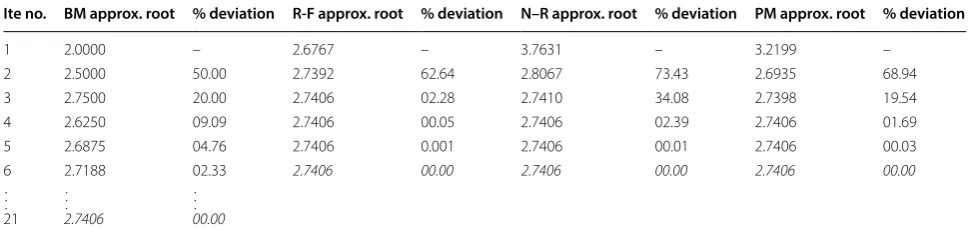
Table 2 shows that bisection method converged in 21st iteration however the remaining three methods (Regula-Falsi, Newton–Raphson, proposed) converged after 3rd iteration. Thus, as similar to the Example 3, proposed method is efficient to solve this logarithmic problem. Example 5 Consider the real root of f(x)=1−x2 in
the interval (0, 2).
(10)
xlog10(x)−1.2=0.
Table 1 Comparison between different methods with errors for Example 3
Italic values indicate the approximate root at 00.00 % of the deviation using the various methods
Ite no. BM approx. root % deviation R-F approx. root % deviation N–R approx. root % deviation PM approx. root % deviation
1 0.5000 – 0.3147 – 1.0000 – 0.6573 –
2 0.7500 100 0.4467 100 0.6531 100 0.4886 100
3 0.6250 33.33 0.4940 29.56 0.5313 53.12 0.5165 34.52
4 0.5625 20.00 0.5099 09.57 0.5179 22.91 0.5176 05.40
5 0.5313 11.11 0.5152 03.12 0.5178 02.59 0.5177 00.23
6 0.5156 05.88 0.5169 01.02 0.5178 00.03 0.5177 00.01
7 0.5234 03.03 0.5177 00.10 0.5178 00.00 0.5178 00.00
. . .
. . .
. . .
. . .
. . .
14 .. .
. .
. 0.5178 00.00 .
. .
. . .
. . .
22 0.5178 00.00
Table 2 Comparison between different methods with errors for Example 4
Italic values indicate the approximate root at 00.00% of the deviation using the various methods
Ite no. BM approx. root % deviation R-F approx. root % deviation N–R approx. root % deviation PM approx. root % deviation
1 2.0000 – 2.6767 – 3.7631 – 3.2199 –
2 2.5000 50.00 2.7392 62.64 2.8067 73.43 2.6935 68.94
3 2.7500 20.00 2.7406 02.28 2.7410 34.08 2.7398 19.54
4 2.6250 09.09 2.7406 00.05 2.7406 02.39 2.7406 01.69
5 2.6875 04.76 2.7406 0.001 2.7406 00.01 2.7406 00.03
6 2.7188 02.33 2.7406 00.00 2.7406 00.00 2.7406 00.00
. . .
. . .
. . .
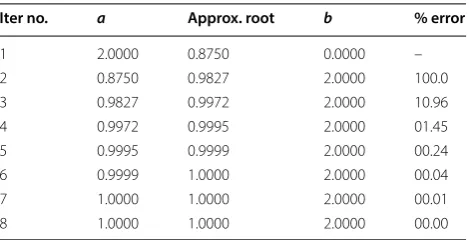
[image:4.595.56.539.101.255.2] [image:4.595.55.545.597.714.2]In this example, Newton–Raphson method unable to find the real root because of f′(x) is zero at initial approxima-tion x=0 as in Eq. (2). However, the proposed method
give approximate root with any range of initial approxi-mation as given in Table 3. Thus, the proposed method is also applicable to such equation where f′(x) is zero with any one of the initial approximations. Since f′(x)=0 at
a=0 , therefore according to the proposed method, the
initial approximations automatically interchange i.e.,
a=2 and b=0 as shown in Table 3.
Limitations
The order of the presented method is quadratic. Even though there are methods with a higher order of conver-gence, the proposed method is simple and efficient quad-ratic convergence method.
Additional file
Additional file 1. Implementation of the proposed method in Matlab. In the Additional file, we provide the implementation of the proposed method inMatlab code similar to Regula-Falsi method in [23] by creating a data type NewAlgorithm (f, a, b, esp, n),as given in Additional file, where f is a given transcendental equation, a, b are the initial approximationof the root, esp is the relative error and n is the number of iterations required.
Abbreviations
BM: Bisection method; R-F: Regula-Falsi; N–R: Newton–Raphson; PM: proposed method.
Authors’ contributions
ST is involved in creating the proposed algorithm and implementation of the algorithm in Matlab. VKS is participated in modifications, corrections and writ-ing of the manuscript. Both authors read and approved the final manuscript.
Author details
1 Department of Applied Mathematics, School of Applied Natural Sciences,
Adama Science and Technology University, Post Box No. 1888, Adama, Ethio-pia. 2 Department of Mathematics, Motihari College of Engineering Motihari,
Furshatpur Bariyarpur, Motihari, Bihar 845401, India.
Acknowledgements
The author is thankful to the editor for providing valuable inputs to improve the present format of manuscript.
Competing interests
The authors declare that they have no competing interests.
Availability of data and materials
The datasets generated and analyzed during the current study are available from the corresponding author on reasonable request.
Consent to publish Not applicable.
Ethics approval and consent to participate Not applicable.
Funding Not applicable.
Publisher’s Note
Springer Nature remains neutral with regard to jurisdictional claims in pub-lished maps and institutional affiliations.
Received: 9 October 2018 Accepted: 10 December 2018
References
1. Sharma JR, Goyal RK. Fourth order derivative methods for solving non-linear equations. Int J Comput Math. 2006;83(1):101–6.
2. Gottlieb RG, Thompson BF. Bisected direct quadratic Regula-Falsi. Appl Math Sci. 2010;4(15):709–18.
3. Wu W, Wu H. On a class of quadratic convergence iteration formula without derivatives. Appl Math Comput. 2000;107:77–80.
4. Wu X, Shen Z, Jianlin X. An improved Regula Falsi method with quadratic convergence of both diameter and point for enclosing simple zeros of non-linear equations. Appl Math Comput. 2003;144:381–8.
5. Mamta VK, Kukreja VK, Singh S. On some third-order iterative methods for solving nonlinear equations. Appl Math Comput. 2005;171:272–80. 6. Noor MA, Ahmad F. Numerical comparison of iterative methods for
solv-ing nonlinear equations. Appl Math Comput. 2006;180:167–72. 7. Noor MA, Noor KI, Khan WA, Ahmad F. On iterative methods for nonlinear
equations. Appl Math Comput. 2006;183:128–33.
8. Thota S, Srivastav VK. Interpolation based hybrid algorithm for computing real root of non-linear transcendental functions. Int J Math Comput Res. 2014;2(11):729–35.
9. Hussain S, Srivastav VK, Thota S. Assessment of interpolation methods for solving the real life problem. Int J Math Sci Appl. 2015;5(1):91–5. 10. Chen J, Li W. An exponential Regula Falsi method for solving nonlinear
equations. Numer Algorithms. 2006;41:327–38.
11. Chen J, Li W. An improved exponential Regula Falsi methods with quadratic convergence of both diameter and point for solving nonlinear equations. Appl Numer Math. 2007;57:80–8.
12. Johan, Ronald. The Newton–Raphson method. Int J Math Educ Sci Tech-nol. 1995;26(2):177–93.
13. Wu XY, Fu D. New high-order convergence iteration methods without employing derivatives for solving nonlinear equations. Comput Math Appl. 2001;41:489–95.
14. Frontini M, Sormani E. Modified Newton’s method with third-order con-vergence and multiple roots. J Comput Appl Math. 2003;156:345–54. 15. Dowell M, Jarratt P. A modified Regula-Falsi method for computing the
real root of an equation. BIT Numer Math. 1971;11:168–74.
16. Gottlieb RG, Thompson BF. Bisected direct quadratic Regula-Falsi. Appl Math Sci. 2010;4(15):709–18.
17. Wu XY, Xia JL, Shao R. Quadratically convergent multiple roots finding method without derivatives. Comput Math Appl. 2001;42:115–9. 18. Amata S, Busquiera S, Gutierrezb JM. Geometric constructions of
iterative functions to solve nonlinear equations. J Comput Appl Math. 2003;157:197–205.
19. Kou J, Li Y, Wang X. A variant of super-Halley method with accelerated fourth-order convergence. Appl Math Comput. 2007;186:535–9. Table 3 Numerical results for Example 5
Iter no. a Approx. root b % error
1 2.0000 0.8750 0.0000 –
2 0.8750 0.9827 2.0000 100.0
3 0.9827 0.9972 2.0000 10.96
4 0.9972 0.9995 2.0000 01.45
5 0.9995 0.9999 2.0000 00.24
6 0.9999 1.0000 2.0000 00.04
7 1.0000 1.0000 2.0000 00.01
[image:5.595.57.292.100.220.2]•fast, convenient online submission •
thorough peer review by experienced researchers in your field • rapid publication on acceptance
• support for research data, including large and complex data types •
gold Open Access which fosters wider collaboration and increased citations maximum visibility for your research: over 100M website views per year •
At BMC, research is always in progress.
Learn more biomedcentral.com/submissions
Ready to submit your research? Choose BMC and benefit from:
20. Mamta VK, Kukreja VK, Singh S. On a class of quadratically convergent iteration formulae. Appl Math Comput. 2005;166:633–7.
21. Sagraloff M. Computing real roots of real polynomials. 2015. arXiv :1308.4088v 2 [cs.SC].
22. Abbott J. Quadratic interval refinement for real roots. ACM Commun Comput Algebra. 2014;48(1):3–12.