eurostat
GASPREISE
GAS PRICES
PRIX DU GAZ
eurostat
STATISTISCHES AMT DER EUROPÄISCHEN GEMEINSCHAFTEN STATISTICAL OFFICE OF THE EUROPEAN COMMUNITIES OFFICE STATISTIQUE DES COMMUNAUTÉS EUROPÉENNES
L-2920 Luxembourg - Tél. 43 01-1 - Télex: Comeur Lu 3423
B-1049 Bruxelles, bâtiment Berlaymont, rue de la Loi 200 (bureau de liaison) — Tél. 235 1 1 1 1
Eurostat hat die Aufgabe, den Informa-tionsbedarf der Kommission und aller am Aufbau des Binnenmarktes Beteilig-ten mit Hilfe des europäischen statisti-schen Systems zu decken.
Um der Öffentlichkeit die große Menge an verfügbaren Daten zugänglich zu machen und Benutzern die Orientierung zu erleichtern, werden zwei Arten von Publikationen angeboten: Statistische Dokumente und Veröffentlichungen. Statistische Dokumente sind für den Fachmann konzipiert und enthalten das ausführliche Datenmaterial: Bezugsda-ten, bei denen die Konzepte allgemein bekannt, standardisiert und wissen-schaftlich fundiert sind. Diese Daten werden in einer sehr tiefen Gliederung dargeboten. Die Statistischen Doku-mente wenden sich an Fachleute, die in der Lage sind, selbständig die benötig-ten Dabenötig-ten aus der Fülle des dargebote-nen Materials auszuwählen. Diese Daten sind in gedruckter Form und/oder auf Diskette, Magnetband, CD-ROM verfüg-bar. Statistische Dokumente unterschei-den sich auch optisch von anderen Veröffentlichungen durch den mit einer stilisierten Graphik versehenen weißen Einband.
Die zweite Publikationsart, die Veröffent-lichungen, wenden sich an eine ganz bestimmte Zielgruppe, wie zum Beispiel an den Bildungsbereich oder an Ent-scheidungsträger in Politik und Verwal-tung. Sie enthalten ausgewählte und auf die Bedürfnisse einer Zielgruppe abge-stellte und kommentierte Informationen. Eurostat übernimmt hier also eine Art Beraterrolle.
Für einen breiteren Benutzerkreis gibt Eurostat Jahrbücher und periodische Veröffentlichungen heraus. Diese enthal-ten statistische Ergebnisse für eine erste Analyse sowie Hinweise auf weiteres Datenmaterial für vertiefende Untersu-chungen. Diese Veröffentlichungen werden in gedruckter Form und in Datenbanken angeboten, die in Menü-technik zugänglich sind.
Um Benutzern die Datensuche zu erleichtern, hat Eurostat Themenkreise, d. h. eine Untergliederung nach Sachge-bieten, eingeführt. Daneben sind sowohl die Statistischen Dokumente als auch die Veröffentlichungen in bestimmte Reihen, wie zum Beispiel „Jahrbücher",
It is Eurostat's responsibility to use the European statistical system to meet the requirements of the Commission and all parties involved in the development of the single market.
To ensure that the vast quantity of accessible data is made widely avail-able, and to help each user make proper use of this information, Eurostat has set up two main categories of document: statistical documents and publications. The statistical document is aimed at specialists and provides the most com-plete sets of data: reference data where the methodology is well established, standardized, uniform and scientific. These data are presented in great detail. The statistical document is intended for experts who are capable of using their own means to seek out what they re-quire. The information is provided on paper and/or on diskette, magnetic tape, CD-ROM. The white cover sheet bears a stylized motif which distinguishes the statistical document from other publica-tions.
The publications proper tend to be com-piled for a well-defined and targeted public, such as educational circles or political and administrative decision-makers. The information in these docu-ments is selected, sorted and annotated to suit the target public. In this instance, therefore, Eurostat works in an advisory capacity.
Where the readership is wider and less well defined, Eurostat provides the infor-' mation required for an initial analysis,
such as yearbooks and periodicals which contain data permitting more in-depth studies. These publications are available on paper or in Videotext data-bases.
To help the user focus his research, Eurostat has created 'themes', i.e. a subject classification. The statistical documents and publications are listed by series: e.g. yearbooks, short-term trends or methodology in order to facili-tate access to the statistical data.
Y. Franchet Director-General
Pour établir, évaluer ou apprécier les différentes politiques communautaires, la Commission des Communautés euro-péennes a besoin d'informations. Eurostat a pour mission, à travers le système statistique européen, de répon-dre aux besoins de la Commission et de l'ensemble des personnes impliquées dans le développement du marché unique.
Pour mettre à la disposition de tous l'importante quantité de données acces-sibles et faire en sorte que chacun puisse s'orienter correctement dans cet ensemble, deux grandes catégories de documents ont été créées: les docu-ments statistiques et les publications. Le document statistique s'adresse aux spécialistes. Il fournit les données les plus complètes: données de référence où la méthodologie est bien connue, standardisée, normalisée et scientifique. Ces données sont présentées à un niveau très détaillé. Le document statis-tique est destiné aux experts capables de rechercher, par leurs propres moyens, les données requises. Les informations sont alors disponibles sur papier et/ou sur disquette, bande magnétique, CD-ROM. La couverture blanche ornée d'un graphisme stylisé démarque le document statistique des autres publications.
Les publications proprement dites peu-vent, elles, être réalisées pour un public bien déterminé, ciblé, par exemple l'en-seignement ou les décideurs politiques ou administratifs. Des informations sélectionnées, triées et commentées en fonction de ce public lui sont apportées. Eurostat joue, dès lors, le rôle de con-seiller.
Dans le cas d'un public plus large, moins défini, Eurostat procure des éléments nécessaires à une première analyse, les annuaires et les périodiques, dans les-quels figurent les renseignements adé-quats pour approfondir l'étude. Ces publications sont présentées sur papier ou dans des banques de données de type vidéotex.
GASPREISE
GAS PRICES
PRIX DU GAZ
1985-1991
Bibliographische Daten befinden sich am Ende der Veröffentlichung Cataloguing data can be found at the end of this publication Une fiche bibliographique figure à la fin de l'ouvrage
Manuskript abgeschlossen im Juni 1991 Manuscript completed in June 1991 Manuscrit achevé en juin 1991
Für alle Informationen über diese Veröffentlichung wenden Sie sich bitte an :
For all information concerning this publication, contact :
Pour toute information concernant cette publication, s'adresser à : EUROSTAT, Tel.: Luxembourg 43011 ext. 2565 ou 4919
Nachdruck - ausgenommen zu kommerziellen Zwecken - mit Quellenangabe gestattet
Reproduction is authorised, except for commercial purposes provided the source is mentioned
Reproduction autorisée, sauf à des fins commerciales, moyennant mention de la source
INHALT / CONTENTS / SOMMAIRE
I. EINLEITUNG 9
INTRODUCTION 27
INTRODUCTION 45
II. BEDINGUNGEN UND METHODEN 11
CONDITIONS AND METHODS 29
CONDITIONS ET METHODES 47
III. WERTEINHEITEN 19
UNITS OF VALUE 37
UNITES DE VALEUR 55
IV. STEUERLICHE BELASTUNG 23
TAXES 41
FISCALITE 59
V. GASPREISE IN JEWEILIGER LANDESWÄHRUNG, ECU und KKS NACH LÄNDERN
GAS PRICES IN NATIONAL CURRENCIES, ECU and PPS BY COUNTRY
PRIX DU GAZ EN MONNAIES NATIONALES, ECU et SPA PAR PAYS
1. Haushalte / Households / Usages domestiques
a) Naturgas / Natural gas / Gaz naturel
Belgique - Bruxelles 63
Deutschland - Düsseldorf 64
Deutschland - Hamburg 65
Deutschland - Dortmund 67 Deutschland - Frankfurt/M 68 Deutschland - Stuttgart 69 Deutschland - München 70 Deutschland - Weser Ems 71
España - Madrid 72 España - Barcelona 73 España - Valencia 74 France - Paris 75 France - Strasbourg 76 Ireland - Dublin 77 Italia - Milano 78 Italia - Torino 79 Italia - Genova 80 Italia - Roma 81 Italia - Napoli 82 G.D. Luxembourg - Luxembourg 83
Nederland - Rotterdam 84 United-Kingdom - London 85 United-Kingdom - Leeds 86 United-Kingdom - Birmingham 87
b) Ortsgas / Gasworks gas / Gaz d'usine
Danmark - København , 88
2. Industrie / Industry / Usages industriels
a) Naturgas / Natural gas / Gaz naturel
Belgique - ene - Ο , Ρ - 0 . 9 92
Belgique - ene - 0.5, Ρ - 1 94
Belgique - ene - 1, Ρ - 1 96
Belgique - ene - 1, Ρ - 1.1 98
Deutschland - Düsseldorf 100
Deutschland - Hamburg 102
Deutschland - Hannover 104
Deutschland - Dortmund 106
Deutschland - Frankfurt/M 108
Deutschland - Stuttgart 110
Deutschland - München 112
Deutschland - Weser Ems 114
España - Madrid 116
España - Barcelona 117
España - Valencia 118
España - Norte & Este 119
France - Paris 121
France - Lille 123
France - Strasbourg 125
France - Lyon 126
France - Marseille 128
France - Toulouse 130
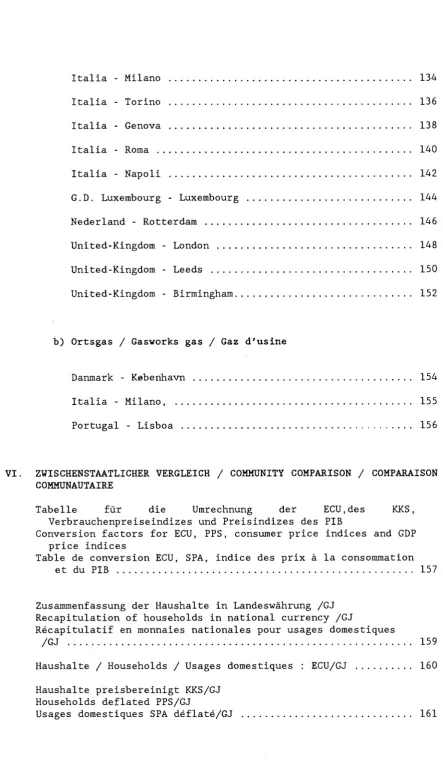
Italia - Milano 134 Italia - Torino 136 Italia - Genova 138 Italia - Roma 140 Italia - Napoli 142 G.D. Luxembourg - Luxembourg 144
Nederland - Rotterdam 146 United-Kingdom - London 148 United-Kingdom - Leeds 150 United-Kingdom - Birmingham 152
b) Ortsgas / Gasworks gas / Gaz d'usine
Danmark - København 154 Italia - Milano 155 Portugal - Lisboa 156
VI. ZWISCHENSTAATLICHER VERGLEICH / COMMUNITY COMPARISON / COMPARAISON
COMMUNAUTAIRE
Tabelle für die Umrechnung der ECU,des KKS, Verbrauchenpreiseindizes und Preisindizes des PIB
[image:8.595.107.551.29.809.2]Conversion factors for ECU, PPS, consumer price indices and GDP price indices
Table de conversion ECU, SPA, indice des prix à la consommation
et du PIB 157
Zusammenfassung der Haushalte in Landeswährung /GJ Recapitulation of households in national currency /GJ
Récapitulatif en monnaies nationales pour usages domestiques
/GJ 159 Haushalte / Households / Usages domestiques : ECU/GJ 160
Zusammenfassung der Industrie in Landeswahrung /GJ Recapitulation of industry in national currency /GJ
Récapitulatif en monnaies nationales pour usages industriels
/GJ 162
Industrie / Industry / usages industriels : ECU/GJ 163
Industrie preisbereinigt KKS/GJ Industry deflated PPS/GJ
EINLEITUNG
Die vorliegende Veröffentlichung enthält die neuesten, 1991 geltenden Preise sowie Preise für 1985 (Basisjahr für Vergleiche) und ab 1988 .
Es wurden dieselben Definitionen und Methoden wie in früheren Studien verwendet, so daß die Entwicklung der Gaspreise über eine sehr lange Zeitreihe verfolgt werden kann.
In anderen Veröffentlichungen derselben Reihe werden zusatzlich zu den im vorliegenden Band aufgeführten Preisinformationen die Struktur der Gasindustrie nach Ländern beschrieben, die angewandten Tarife behandelt und die Ergebnisse analysiert.
Diese Studie zeigt für die 3 betreffenden Preisniveaus die Preise in Landeswährung, in Ecus (mittlerer Wert für Januar) und in KKS (jährlicher Wert, geschätzt für 1991).
Die vorliegende Veröffentlichung ist in drei Sprachen (Englisch, Französisch und Deutsch) verfügbar.
ZEICHEN UND ABKÜRZUNGEN
- / Nichts
Kein Nachweis vorhanden 1985 = 100 Basisjahr
0 jährlicher durchschnittlicher prozentualer Anstieg
o
m Kubikmeter kWh Kilowattstunden GWh Gigawattstunde (10 kWh) h S tunde
MJ Megaj ouie
GJ Gigajoule (IO3 MJ)
n Anzahl Ho oberer Heizwert Hu unterer Heizwert
BFR Belgischer Franc DKR Dänische Krone DM Deutsche Mark
FF Französischer Franc IRE Irisches Pfund LIT Italienische Lira LFR Luxemburgischer Franc HFL Holländischer Gulden ESC Portugiesischer Eskudo PTA Spanische Peseta
UK£ Pfund Sterling
KKS Kaufkraftstandard ECU Europäische Währungseinheit
II. BEDINGUNGEN UND METHODEN
ERHEBUNGSBEREICH
Die vorliegende Studie dient der Erfassung der von den Verbrauchern in den Mitgliedstaaten der Europäischen Gemeinschaft gezahlten realen Gaspreise. Dabei geht es um zwei Gasarten:
- Naturgas (Methan), - Industriegas.
Im Gegensatz zum Naturgas, das eine aus Lagerstätten in der Natur gewonnene Primärenergie ist, handelt es sich bei Industriegas um eine abgeleitete Energie, die aus Kohle, Mineralölerzeugnissen oder auch gekracktem, reformiertem oder gemischtem Naturgas hergestellt wird.
Die vorliegende Studie erstreckt sich nicht auf LPG (Butan, Propan), Kokereigas und Hochofengas.
Nur die Verteilung über Leitungen ist hier berücksichtigt worden.
Die Preise wurden an 32 Plätzen erhoben, die das Gebiet der Gemeinschaft abdecken:
Belgien: Dänemark :
Bundesrepublik Deutschland:
- Frankreich:
- Irland: - Italien: - Luxemburg: - Niederlande : - Portugal :
Brüssel; Kopenhagen;
Hamburg, Weser-Ems, München, Hannover, Dortmund,Düsseldorf, Frankfurt/Main, Stuttgart;
Lille, Paris, Strassburg, Marseille, Lyon, Toulouse;
Dublin;
Mailand, Turin, Genua, Rom, Neapel; Luxemburg-Stadt ;
- Spanien: Madrid, Barcelona, Valencia, Norden und Osten;
- Vereinigtes Königreich: London, Leeds, Birmingham. In Griechenland erfolgt die Lieferung von Gas nicht über Leitungen.
Die ausgewählten Plätze decken verschieden grosse Gebiete ab. Entsprechende Hinweise sind in den jeweiligen Kapiteln enthalten.
Die Preise wurden zu Beginn eines jeden Jahres erhoben und ergeben sich aus den jeweils geltenden Tarifen, Verträgen, Bedingungen und Vorschriften. Es handelt sich um von den Gasverbrauchern gezahlte reale Preise, was der Fakturierung frei Verbraucher zu Beginn eines jeden Jahres entspricht, einschliesslich eventueller Preisnachlässe und Subventionen. Unter Verbraucher sind hier die Abnehmer zu verstehen, die das Gas zum eigenen Verbrauch kaufen, was die Wiederverkäufer ausschliesst. Es sind also nicht die Beschaffungspreise der Versorgungsbetriebe erhoben worden.
2. ENERGIEMASSEINHEITEN
Im Anschluss an die internationalen Resolutionen der Generalkonferenz für Mass und Gewicht, die zur Einführung des "Internationalen Einheitensystems"
führten, wurden die Regeln mehrerer Richtlinien des Ministerrates der Gemeinschaft (71/354, 76/770 und 80/181) festgelegt, die insbesondere auf dem Gebiet der Energiemasseinheiten einzuhalten sind.
Danach ist die Verwendung der Einheit Kalorie und der davon abgeleiteten Einheiten verboten. Es sind ausschliesslich zwei Energiemasseinheiten zu verwenden: Joule und Kilowattstunde. Diese beiden Einheiten basieren übrigens auf ein und derselben Grunddefinition, da 1 Joule = 1 Watt/Sekunde
ist. Dem Vereinigten Königreich und Irland wurde jedoch gestattet, während einer Übergangszeit noch die Einheit "Therm" zu verwenden.
Bei der derzeitigen Gastarifgestaltung werden somit noch vier Energiemasseinheiten verwendet:
Joule (Belgien)
Kilowattstunde (BR Deutschland, Frankreich)
Kubikmeter (Italien, Niederlande, Luxemburg, Dänemark) Therm (Vereinigtes Königreich, Irland)
(wobei der Kubikmeter wiederum durch einen in Joule oder kWh ausgedrückten Energiegehalt näher bestimmt wird).
In dem Bemühen um Vereinheitlichung und Vereinfachung hat Eurostat das Joule (oder seine gebräuchlichen Zehnerpotenzen) als gemeinsame Masseinheit gewählt.
Gebräuchliche Zehnerpotenzen der Einheit Joule sind: Kilojoule (kJ) - 1 000 Joules Megajoule (MJ) - 1 000 000 Joules Gigajoule (GJ) - 1 000 000 000 Joules Terajoule (TJ) - 1 000 000 000 000 Joules
In der vorliegenden Studie sind die Gaspreise in Währungseinheiten je Gigajoule ausgedrückt.
Die folgende Umrechnungstabelle ermöglicht den Übergang von einer Masseinheit zur anderen:
GJ GWh Therm
1 Gigajoule 1 Gigawattstunde 1 Therm
1
3 600 0,1055
0,0002777
1
0,0000293
9,4781 34 120
1
Ausserdem kann man zur besseren Orientierung sagen, dass 1 GJ Gas etwa 35 kg Handelskohle und 25 kg Leicht- oder Heizöl entspricht.
Die in der vorliegenden Studie in GJ (Ho) ausgedrückten Gaspreise können somit durch Anwendung des Faktors 1,1 in GJ (Hu) umgerechnet werden.
3. TYPISCHE ABNEHMER
Die Erhebung basiert auf dem System der typischen Abnehmer, das heisst, die Gaspreise werden für bestimmte Gasabnahmemengen und Lieferbedingungen erhoben, die repräsentativ für die Gesamtheit der Gasabnehmer sind. Die typischen Abnehmer bleiben für alle Länder von einem Jahr zum anderen gleich, was eine der wichtigsten Voraussetzungen für räumliche und zeitliche Preisvergleiche ist. Ein typischer Abnehmer entspricht de facto einem Zähler, für den ein Tarif oder ein Vertrag gilt. Verfügt ein Abnehmer über zwei getrennte Zähler mit zwei verschiedenen Tarifen, zum Beispiel einem für die Heizung der Räume und einem für gewerbliche Zwecke, so wird keine Gesamtberechnung vorgenommen, sondern er wird als zwei verschiedene typische Abnehmer betrachtet, die getrennt zu behandeln sind.
Es wird zwischen zwei Gruppen von typischen Abnehmern unterschieden: Haushaltsabnehmer und Industrieabnehmer.
Zu den Haushaltsabnehmern gehören die Kleinabnehmer (Haushalte, Handel, Handwerk, Büros usw.).
Die typischen Abnehmer für den Haushaltsverbrauch zeichnen sich im wesentlichen durch das jährliche Verbrauchsvolumen aus.
Es werden fünf typische Haushaltsabnehmer mit der Kodierung D-· bis D, berücksichtigt:
Dl
D^1)
D3
D3b D4
Jahresverbrauch
1
8,37 16,74 83,7 125,6 047
GJ GJ GJ GJ GJ
(das (das (das (das (das
sind sind sind sind sind
2 4 23 34 290
326 kWh) 652 kWh) 260 kWh) 890 kWh) 750 kWh)
Haushaltsausstattung )
) Kochen und Warmwasser )
) Kochen, Warmwasser ) und
) Zentralheizung Kollektive
Zentralheizung für mindestens 10 Wohnungen
TO Im (9
Zu den Industrieabnehmern gehören die mittleren und grossen Abnehmer (Industrie, grosse Handels- oder Verwaltungsgebäude usw.).
Für die Industrieabnehmer wirkt sich neben der jährlich verbrauchten Menge die Gleichmassigkeit der Gasentnahme aus dem Netz aus. Wir haben es hier mit dem Begriff der Benutzungsdauer zu tun.
Die Benutzungsdauer in Tagen gibt die Zahl der Tage an, die erforderlich wäre, um den Jahresverbrauch bei maximaler Tagesmenge zu entnehmen.
Die Benutzungsdauer in Stunden gibt die Stundenzahl an, die erforderlich wäre, um den Jahresverbrauch bei maximaler Stundenmenge zu entnehmen.
Diese Begriffe bezeichnen also die von dem Verbraucher im Laufe eines Tages oder einer Stunde erreichten Spitzen oder Höchstmengen.
die allgemeine Formel lautet:
Benutzungsdauer in Tagen nj
-Qa Qj max
Qa Benutzungsdauer in Stunden nh
-Qh max
dabei ist Qa - verbrauchtes Jahresvolumen Qj max - maximale Tagesmenge
Qh max - maximale Stundenmenge.
Zum Beispiel bedeutet eine Benutzungsdauer von 200 Tagen für einen Abnehmer, der 41 860 GJ pro Jahr verbraucht, dass die maximale Tagesmenge
209 GJ (41 860/200) beträgt, und eine Benutzungsdauer von 1 600 Stunden, dass die maximale Stundenmenge bei 26 GJ (41 860/1 600) liegt.
h
τ2
h-1
I3.2
X4-l X4-2 X5
418,
4 186 41 860 41 860 418 600 418 600 4 186 000
Jahre
60 GJ
GJ GJ GJ GJ GJ GJ
sverbrauch
116 300 kWh
1 163 000 kWh 11,63 GWh 11,63 GWh 116,3 GWh 116,3 GWh 1 163 GWh
Benutzungsdauer
Keine Benutzungsdauer vorgeschrieben (1) 200
200 250 330 330 330
Tage Tage Tage Tage Tage Tage
1 4 4 8 8
600 h 000 h 000 h 000 h 000 h
(1) Eventuell <= 200 Tage aber >= 115 Tage
Die anderen Merkmale, die bei der Preisfestsetzung ebenfalls eine Rolle spielen könnten, werden von Fall zu Fall ermittelt, wobei stets die in der Praxis häufigste Lösung verwendet wird. Diese Merkmale werden jeweils angegeben.
Bei einigen typischen Abnehmern ist für verschiedene Abnahmemengen die gleiche Benutzungsdauer angeführt, oder umgekehrt ergeben sich verschiedene Werte der Benutzungsdauer für die Abnahmemenge, woran die Auswirkungen der Lieferbedingungen auf die Preise zu erkennen sind. Je länger die Benutzungsdauer (in Tagen oder Stunden), desto gleichmässiger ist die zeitliche Verteilung der Gasentnahme und desto günstiger sind auch die Preise für den Abnehmer.
Im übrigen vermittelt die Benutzungsdauer eine Vorstellung vom Betrieb der gasverbrauchenden Geräte und Anlagen. Eine sehr lange Benutzungsdauer von beispielsweise 8 000 Stunden deutet zweifellos auf einen fast ununterbrochenen Betrieb (Tag und Nacht) im Verlauf der 8 760 Stunden eines Jahres hin.
In einigen Fällen bestehen Verträge, die Unterbrechungen vorsehen, d.h. dem Gasverkäufer ist es erlaubt, zu bestimmten Spitzenzeiten, in denen das Netz voll ausgelastet ist, die an den betreffenden Abnehmer zu liefernde Menge zu verringern. Als Gegenleistung dafür erhält der Abnehmer einen Preisabschlag. Diese Fälle werden angegeben, wenn es sich um einen nicht unbeträchtlichen Teil der Lieferungen handelt.
Schliesslich sei daran erinnert, dass sich unter den in dieser Studie erfassten typischen Industrieabnehmern weder Kraftwerke noch Abnehmer befinden, die das Gas nicht als Energiequelle verwenden, wie beispielsweise die chemische Industrie.
4. DEFINITION DER ERFASSTEN PREISE
Alle Preise werden in verkauften Gaseinheiten angegeben, d.h. in Gigajoule (Ho). Die Ergebnisse stellen die zu Beginn eines jeden Jahres angewandten Preise je Einheit unter Berücksichtigung der am 1. Januar in Kraft getretenen Tarif-, Parameter- und Indexänderungen usw. dar. Sofern für die Tarife oder Verträge kurzfristige Indizes (monatlich, vierteljährlich) gelten, wird der im Januar gültige Index verwendet. Die Preise beinhalten die Zählermiete, den Grundpreis und den Arbeitspreis. Die Kosten für den Neuanschluss eines Abnehmers sind nicht in ihnen enthalten.
Besteht die Möglichkeit, mehrere Tarife anzuwenden, so wird nach Ausschaltung der in der Praxis nicht oder nur auf eine untypische oder unerhebliche Zahl von Abnehmern angewandten Tarife der für den Abnehmer vorteilhafteste Tarif berücksichtigt.
Bestehen nur Quasitarife, Einzelverträge oder frei ausgehandelte Preise, so wurde das Preisniveau erfasst, das dem für die in Frage kommenden Lieferbedingungen repräsentativen Mittelwert entsprach (häufigster Preis). Bei frei ausgehandelten Preisen oder bei Einzelverträgen beziehen sich die erhobenen Daten auf die im Januar bezahlten Rechnungen bzw. auf die Preise, die in den in diesem Monat am häufigsten geltenden Verträgen vorkommen. Diese Fälle werden im Hauptteil der Studie angegeben und erläutert.
Es werden drei Preisarten angegeben: - Preise ohne Steuern,
- Preise ohne Mehrwertsteuer (MwSt.), - Verkaufspreise einschliesslich Steuern.
Der Preis ohne Mehrwertsteuer enthält gegebenenfalls die sonstigen spezifischen Steuern; er ist dann interessant, wenn die Mehrwertsteuer abzugsfähig ist.
Der Preis einschliesslich Steuern entspricht dem vom Abnehmer ausgegebenen Betrag.
Unter "Steuern" sind hier die steuerlichen und steuerähnlichen Abgaben zu verstehen, die beim Verkauf an den Verbraucher direkt auf das Gas erhoben werden. Die Einziehung dieser Steuern kann auf nationaler, regionaler,
lokaler und kommunaler Ebene usw. zugunsten des Staates, der regionalen oder lokalen Behörden, von Fachverbänden usw. erfolgen. Darin inbegriffen sind beispielsweise die auf die Gasverkäufe zu zahlenden Umweltabgaben. Dagegen werden die vor dem Verkauf des Gases erhobenen Steuern, wie Körperschaft-Steuer, Einkommensteuer, Lohnsteuer usw., nicht getrennt ausgewiesen. Sie verbleiben global in dem Preis ohne Steuern.
Die Ergebnisse werden nach Einzelstaaten in jeweiliger Landeswährung (nicht preisbereinigt) ausgewiesen. Es handelt sich also um Nominalwerte.
III. WERTEINHEITEN
Um Vergleiche zwischen Staaten zu ermöglichen, müssen die in Landeswährung ausgedrückten Preise in eine gemeinsame Einheit umgerechnet werden. In der vorliegenden Studie werden folgende zwei gemeinsame Einheiten verwendet:
- die Europäische Währungseinheit (ECU); - der Kaufkraftstandard (KKS).
1. DIE EUROPÄISCHE WÄHRUNGSEINHEIT (ECU)
Bei der ECU handelt es sich um einen "Währungskorb", der sich auf die zu den auf dem Devisenmarkt notierten Wechselkurse für gewisse Beträge der einzelnen Landeswährungen der Gemeinschaft stützt, wobei eine Gewichtung erfolgt, bei der das Bruttoinlandsprodukt und der innergemeinschaftliche Handel jedes Mitgliedstaates berücksichtigt werden.
Die neue Zusammensetzung des Währungskorbs der ECU stellt sich wie folgt dar:
151.8
1.393
Die Umrechnungsfaktoren zwischen ECU und Landeswährungen im Januar jeden Jahres sind in einer Tabelle im statistischen Anhang aufgeführt.
Nach ihrer Definition spiegelt der ECU durchaus die Wechselkursschwankungen wider und ist daher zur Messung der Preise und Werte der internationalen Waren- und Dienstleistungsströme geeignet. Die in ECU ausgedrückten Daten ermöglichen infolgedessen einen Vergleich zwischen den Preisen nach Umtausch von Devisen bei der Bank. Dieser Währungsumtausch zu den auf dem Devisenmarkt notierten Wechselkursen hat jedoch den Nachteil, dass mit der Zeit unter der Einwirkung zahlreicher Faktoren, die von den Bewegungen der Inlandspreise unabhängig sind, Fluktuationen auftreten:
- Kapitaltransfers,
- politische Entscheidungen, - Reglementierungen,
0.6242 DM LIT
0.1976 DKR ESC
1.332 FF 0.2198 HFL 3.301 BFR
0.008552 IRL 0.08784 UKL 1.44 DR
0.13 LFR
- Spekulation,
- psychologische Faktoren, - Zinssätze.
So kann eine Landeswährung im Vergleich zu ihrer wirklichen Kaufkraft unter- oder überbewertet werden.
Ausserdem existieren grosse Unterschiede zwischen bestimmten Ländern beim BIP je Einwohner, die nicht nur auf ein grösseres Volumen der Verwendung von Waren & Dienstleistungen, sondern daneben auch auf ein höheres allgemeines Preisniveau zurückzuführen sind.
Um diese Differenzen auf dem allgemeinen Preisniveau auszuschalten, ist es notwendig, die Kaufkraftparitäten zu berechnen.
Ausserdem ändert sich die Definition des ECU bei der Aufnahme einer neuen Währung, wie es im Fall des Beitritts Griechenlands, Spaniens und Portugals der Fall war; zudem fehlt eine Kohärenz mit den Preisindizes des Bruttoinlandsprodukts, so dass Deflationsschwierigkeiten auftreten.
Um diesen Nachteilen zu begegnen, ist die tatsächliche Kaufkraft jeder Landeswährung zu berechnen, wodurch man zu dem Begriff des Kaufkraftstandards gelangt.
2. KAUFKRAFTSTANDARD (KKS)
Der KKS ist eine Bezugseinheit, die in der Art und Weise berechnet wird, dass ihre Relationen zu den verschiedenen Landeswährungen sich proportional zu den Kaufkraftparitäten (KKP) der genannten Währungen verhalten.
Derartige Paritäten würden ausreichend sein, um alle Daten preisbereinigt in der Landeswährung jedes beliebigen Staates auszudrücken. Das Verfahren gewährleistet, dass sie transitiv und unabhängig von dem als Bezugsgrösse gewählten Staat sind. De facto wird für die Gemeinschaftsberechnungen eine andere Werteinheit - genannt KKS - verwendet. Sie wird definiert, indem die Preisrelationen auf das BIP in Landeswährung der Staaten angewandt und die Paritäten in der Art und Weise bemessen werden, dass der Wert des BIP der Gemeinschaft (EUR 12) im Jahre 1975 (Retropolation im Jahre 1975 der Ergebnisse der Untersuchung von 1985) unabhängig davon, ob es in ECU oder in KKP ausgedrückt wird, übereinstimmt. Nur seine Aufteilung auf die Staaten wird geändert.
Wenn die Preise mit Hilfe der BIP-Parität in KKS umgerechnet werden, so lässt sich folgende Aussage machen:
Wenn 1 Gigajoule Energie im Lande A 10 KKS und im Lande Β 5 KKS kostet, so bedeutet dies, dass - abgesehen von dem allgemeinen Preisniveau der beiden Länder - 1 Gigajoule Energie in dem Land A doppelt so teuer ist wie in dem Land B.
Diese Bewertung ist unabhängig von den Wechselkursen, deren Werte noch von anderen Faktoren als dem Preisniveau beeinflusst werden (Kapitalbewegungen, Spekulation, Zinssätze, politische Entscheidungen usw.).
Die Umrechnungsfaktoren für die in dieser Studie erfassten Berichtsjahre sind in einer Tabelle im Anhang enthalten. Sie sind bei der Änderung des Basisjahres revidiert worden.
3. PREISE IN NICHT PREISBEREINIGTEN KKS UND IN KONSTANTEN KKS
Die Preiserhebungen zur Erstellung der Kaufkraftparitäten werden nicht jedes Jahr durchgeführt. Die letzte zur Verfügung stehende Erhebung stammt aus dem Jahre 1985 und die vorhergehende von 1980. Da es sich bei den Paritäten aber um Preisrelationen handelt, kann ihr Wert für andere Jahre geschätzt werden, indem sie entsprechend den relativen Schwankungen der Indizes der Preise für die einzelnen Länder im Vergleich zu dem Gemeinschaftsmittel extrapoliert werden: Das Ergebnis sind die sogenannten preisbereinigten Paritäten.
Die, wie oben beschrieben, berechneten Daten können ebenfalls zwischen Ländern verglichen werden. Die Ergebnisse dieses Vergleichs werden relativ gesehen - mit den Ergebnissen übereinstimmen, die bei Verwendung der nicht inflationsbereinigten Preise und der nicht inflationsbereinigten KKS erzielt werden, weil die letztgenannten, ausgehend von den gleichen Indikatoren, nämlich den Preisindizes des BIP für jedes Land und dem mittleren Gemeinschaftsindex, extrapoliert werden.
Die Berechnung in deflationierten KKS wird somit wie folgt durchgeführt:
1) Die Preise der Zeitreihe in nicht inflationsbereinigten Landeswährungen werden durch ein Hundertstel des Preisindex des BIP für jedes der berücksichtigten Jahre dividiert;
2) Diese deflationierte Reihe wird mit dem Umrechnungsfaktor des Basis-jahres 1985 in KKS umgerechnet.
4. PREISREIHEN
Aufgrund der obigen Beschreibung werden die Ergebnisse der vorliegenden Preiserhebung in der Gemeinschaft in drei Formen dargestellt, und zwar:
1) Als Reihen mit nicht inflationsbereinigten Preisen für jedes Land, in Landeswährung, Ecu und KKS.
2) Als Tabelle mit zusammenfassender Wiederholung für eine Region pro Land :
a) mit Preisen im laufender Landeswährung
b) mit Preisen in laufenden Ecus
IV. STEUERLICHE BELASTUNG
Der Einfachheit halber und um eine Übereinstimmung zwischen den in den Tabellen ausgewiesenen verschiedenen Preisniveaus herbeizuführen, wird unterschieden zwischen der Mehrwertsteuer, einer allgemeinen indirekten Steuer, und den sonstigen spezifischen Abgaben.
1. MEHRWERTSTEUER
Während des in der Studie erfaßten Zeitraums wurde die MwSt. (proportionale Abgabe) auf den Preis ohne MwSt.. im allgemeinen einschließlich der etwaigen spezifischen Abgaben, die in die Bemessungsgrundlage fallen, berechnet und angewandt. Die spezifischen Steuern können proportional oder fest sein. In der nachstehenden Tabelle werden die während des Untersuchungszeitraums geltenden Mehrwertsteuersätze zusammengefaßt.
Auf den Verkauf (die Abgabe) von Gas erhobene Mehrwertsteuer (MwSt.)
(in % des Preises vor MwSt) Januar
Belgien Dänemark
BR Deutschland Spanien
Frankreich Irland Italien (Haushalte)
1980 6 20,25 13
-17,6 0
6
1988 17 22 14 12 18,6 10
9
18
9-1989 17 22 14 12
,6<D
10
19(2)
18
9-1990 17 22 14 12
.6<D
10
19(2)
18
9-1991 17 22 14 12 , 6 ^
12,5
19(2) Italien (andere Abnehmer
als Haushalte) Luxemburg Niederlande Portugal
Vereinigtes Königreich
14 5 18
9-18(3)
6 20 8 0
9-18(3)
6 18,5 8 0
9-19<3)
6 18,5 8 0
9-19(3)
6 18,5 8 15 (1) außer auf die Grundgebühren der Haushalte : 5,52
(2) 9% für Dx - D2; 19X für D3 - D4
(3) 9X für I3 - I5; 18 X für 1 ^ I2 von 1986 bis 1988 und 19 X seit 1989
Die MwSt. ist für die Verbraucher in Industrie und Handel, die dem allgemeinen Steuersystem unterliegen, abzugsfähig.
2. SPEZIFISCHE ABGABEN
a) Dänemark
Zwischen dem 1. August 1979 und dem 31. Dezember 1983 wurde eine Sonderverbrauchssteuer auf Gas erhoben, das über Rohrleitungen verteilt wird und einen Heizwert (Ho) von weniger als 23 MJ/m aufweist, wie es im allgemeinen bei Industriegas der Fall ist; dabei wurden bis 29.3.1980 20 øre/m und danach 16 ere/m erhoben. Die genannte Steuer war Teil der Bernessungsgrundlage für die MwSt. und ebenso wie die MwSt. abzugsfähig; d.h. sie wurde nur einmal - im Falle des Wiederverkaufs - erhoben.
b) BR Deutschland
Am 1. Januar 1989 wurde eine Verbrauchssteuer in Höhe von 0,26DM/100 kWh, d.h. 72 Pf/GJ eingeführt, die bis 31. Dezember 1992 gelten soll. Dieser Teil wurde im Kontext der Steuerharmonisierung für die Verwirklichung des großen Binnenmarktes festgelegt.
c) Spanien
Seit dem 22.2.1982 wird auf den Preis vor Steuer eine städtische Abgabe (Arbitrio) in Höhe von 1,50% erhoben. Diese Abgabe ist in der Bemessungsgrundlage für die MwSt. enthalten.
d) Frankreich
Am 1. Januar 1986 wurde eine spezielle Steuer (T.I.C.G.N. : Inlandssteuer auf dem Naturgasverbrauch) für die Verbrauchskategorie von mehr als 18.000 GJ/Jahr in Höhe von 2,694 FF/GJ eingeführt. Sie wurde am 1. Januar 1987 auf 1,694 FF/GJ und am 1. Januar 1988 auf 1,56 FF/GJ reduziert. Am 7. Januar 1989 wurde die Abgabe dann auf 1,58 FF/GJ erhöht. Seit 1. Januar 1990 lautet die Abgabe 1,60 FF/GJ. Die ersten 17.280 GJ sind davon ausgenommen.
e) Italien
(im Zeitraum wurde am Seit Februar 1977 unterliegt die Abgabe von Erdgas für den Haushaltsverbrauch einer Verbrauchssteuer (imposta di consumo) in Höhe von 30 LIT/m
September 1979 bis Februar 1980 : 36,50 LIT/m3). Der Steuersatz
Süditalien (Gebiet der "Cassa per il Mezzogiorno") von dieser Steuer befreit. Die Steuer ist in der Bemessungsgrundlage für die MwSt. enthalten.
Die Verbrauchersteuer ist im Land seit Januar 1991 nicht mehr einheitlich und es gibt eine Regionalsteuer von 10 Lit/m in der Mehrheit der untersuchten Plätze. Diese beiden Steuern sind wie folgt verteilt :
Turin Rom Neapel Genua(1) Mailand
Di, D2 und die 250 ersten mJ von Do und Diu
Di Consumo
77 7 10 77 77
Regional
10 10 10 10
DA und der Rest des
Verbrauchs von Do und Dou
Di Consumo
206 206 122 206 206
Regional
10 10 10 10
I-i und
Di Consumo
206 206 20 206 20
l2
Regional
10 10 10
(1) In Genova werden die ersten 250 m von D2 mit 77 Lit/m3 und die folgenden mit 206 Lit/m besteuert.
Eine Steuer von 525 Lit pro GJ wird für alle italienischen industriellen Verbraucher von Io bis Ic berechnet.
f) Niederlande
Auf den Gasverbrauch wird eine spezielle Umweltsschmutzabgabe erhoben, die bis 1981 0,85 Cent/GJ, danach 1,42 Cent/GJ betrug. Sie ist in der Bemessungsgrundlage für die MwSt. enthalten. Seit dem 1.1.86 wird sie auf alle Abnehmer angewandt; zuvor war sie im Faktor Ρ für Industrie-Großabnehmer enthalten.
Seit dem 1. Januar 1989 wird nach zwei Verbrauchskategorien unterschieden. Ab 1. Februar 1990 wendet man folgende Raten an :
0,456 Cent/m3, d.h. 13,09 Cent/GJ : 0 - 170.000 m3/Jahr
0,571 Cent/m3, d.h. 16,31 Cent/GJ : 170.000 - 50.000.000 m3/Jahr. Im Januar 1991 wurde diese Steuer wie folgt vermindert :
o
auf 0,424 Cent/m (11.78 Cent/GJ) für die Gruppen mit einem Verbrauch unter 170 000 m3/Jahr
auf 0,542 Cent/m3 (15,06 Cent/GJ) für die anderen Verbraucher.
I. INTRODUCTION
The present publication contains the most recent prices, valid in 1991 together with prices for 1985 (base year for comparisons) from 1988. The definitions and methods remain the same as those used in previous studies, so that the development of gas prices can be observed over a very long time series.
Other publications in this series have, in addition to giving the same range of price information as seen here, described the structure of the gas industry by country, detailed the tariffs applied and analysed the results.
This study gives for the 3 price levels concerned prices in national currencies, Ecu (average value for January) and PPS (annual value, estimated for 1991, as available on 10 June 1991).
This publication is available in three languages : English, French and German.
SYMBOLS AND ABBREVIATIONS
- / NIL
No data available 1985=100 Reference year
Annual average percentage increase 0
3
m Cubic metre
kWh Kilowatthour GWh Gigawatthour (106 kWh) h Hour
M J Megajoule G J Gigajoule (IO3 M J ) n Number
GCV Gross calorific value NCV N e t calorific value
BFR Belgian franc DKR Danish crown DM German mark PTA Peseta FF French franc IR£ Irish pound LIT Italian lira LFR Luxembourg franc HFL Dutch guilder ESC Escudo UK£ Pound sterling
PPS Purchasing power standard ECU European currency unit
II. CONDITIONS AND METHODS
1. SCOPE AND LOCATIONS
The present study aims to show the actual price of gas paid by the consumer in the member countries of the European Economic Community. Two types of gas are concerned :
(I) Natural gas (methane); (ii) Gasworks gas.
Contrary to natural gas, which is a primary energy source extracted from naturally occuring gasfields, gasworks gas is a derived energy source manufactured from coal,'petroleum products or from cracked, reformed or mixed natural gas.
The present study is not concerned with liquified petroleum gas (butane, propane) cokeoven, or blast-furnace gas.
Only piped distribution is considered.
The prices were recorded in 32 towns or regions within the Community : Belgium :
Denmark :
FR of Germany :
Spain : France : Ireland : Italy : Luxembourg : Netherlands : Portugal : United Kingdom
Brussels; Copenhagen ;
Hamburg, Hannover, Weser-Ems, Dortmund, Düsseldorf, Frankfurt/Main, Stuttgart, Munich;
Madrid, Barcelona, Valencia, North & East;
Lille, Paris, Strasbourg, Marseille, Lyon, Toulouse; Dublin;
Milan, Turin, Genova, Rome, Naples; Luxembourg city;
Rotterdam; Lisbon.
Certain towns selected are representative of larger regions. This is indicated in the chapter concerning each country.
The prices are recorded at the beginning of each year based on the tariffs, contracts, conditions and rules in force at that time.
It is concerned with the actual price paid by the gas consumer, corresponding to the invoiced delivery price at the beginning of each year including any eventual rebates and subsidies. Our consumers are defined as those who purchase gas for their own use and exclude those who offer it for re-sale. We have not considered the bulk price paid by
the gas distributors.
2. UNITS OF MEASUREMENT OF ENERGY
Following international resolutions adopted by the General Conference on Weights and Measures, which resulted in the "International System of Units of Measurement" (SI), a number of Council of Ministers' Directives
(71/354, 76/770 and 80/181) laid down the rules to be followed with regard specifically to units of measurement of energy.
The use of the calorie and its dérivâtes is now prohibited. Only two units of energy may be used, namely the joule and the kilowatthour. These two units are derived from the same basic definition, since 1 joule = 1 watt/second = 1 newton metre. However, a concession was granted to the United Kingdom and Ireland, who may continue to use the therm for a transitional period.
Four units of measurement are therefore still found in the current gas tariffs, i.e. :
the joule (Belgium);
the kilowatthour (FR of Germany, France); 3
the m (Italy, Netherlands, Luxembourg, Denmark);
the therm (United Kingdom, Ireland); 3
(the m is in turn defined by an energy content expressed in joules or in kWh) . With a view to standardisation and simplification, the joule (or its decimal multiples) was chosen by EUROSTAT as the common unit of measurement.
The decimal multiples of the joule are as follows :
kilojoule (KJ) = 1 000 joules;
megajoule (MJ) = 1 000 000 joules;
gigajoule (GJ) = 1 000 000 000 joules;
In the present study, gas prices are expressed in terms of monetary units per gigajoule.
The table below can be used for conversion from one unit of measurement to another :
GJ GWh Therm
1 gigajoule 1 1 gigawatt/hour 3 600
1 therm 0.1055
0.0002777
1
0.0000293
9.4781 34 120
1
In addition, as a guide, one gigajoule of gas may be said to be approximately equivalent to 35 kg of saleable coal and 25 kg of light fuel oil or heating oil.
Finally, the unit of energy used in this study is measured on the basis of the gross calorific value (GCV), as is the practice in the gas Industry and gas tariffs, i.e. the latent energy necessary for the evaporation of the water produced during the combustion of the gas, is taken into account. This method of measurement departs from that used in energy statistics and for other sources of energy, where the net calorific value (NCV), which is closer to the energy that can actually be used by the consumer, is always used.
For gas, the difference between gross and net calorific value is around 10%. The gas price shown in this study in GJ (GCV) can thus be converted into GJ (NCV) by applying a factor of 1.1.
However certain recent condensation gas heaters permit a better use of the gross calorific value by re-using some of the latent energy of evaporation.
STANDARD CONSUMERS
A standard consumer corresponds in fact to a meter to which a tariff or contract is applied. Where a consumer has two separate meters corresponding to two different tariffs, for example one for space heating, the other for professional use an average is not calculated but
it is considered that there are two separate standard consumers.
Two families of standard consumers are taken : domestic uses and industrial uses. The domestic consumers cover small users (households, commercial, crafts, offices, etc.). The standard consumers are characterized principally by the annual volume of consumption.
Five domestic standard consumers coded Di to D¿ have been taken :
Annual consumption Equipment
8.37 GJ (i.e.
D2 ( a ) 16.74 GJ (i.e. 4 652 kWh) )
2 326 kWh) )
) cooking and water heating
83.7 GJ (i.e. 23 260 kWh) )3 b 125.6 GJ (i.e. 34 890 kWh)
1 047 GJ (i.e. 290 750 kWh) )
) cooking, water heating and ) central heating
block central heating for at least 10 dwellings
(a) For the United Kingdom there is an additional standard consumer, i.e. 33.49 GJ (9 300 kWh or 8 Gcal).
Industrial uses cover medium and large users (industries, large commercial or administrative buildings, etc.).
For industrial uses, apart from the annual quantity consumed, the regularity with which the user takes gas from the network is also considered. This involves the concept of modulation (or load factor). The daily load factor is the number of days which would be required to take the entire annual consumption at the maximum daily offtake rate. The hourly load factor is the number of hours which would be required to take the entire annual consumption at the maximum hourly offtake rate. These terms therefore determine the peaks or offtake ceilings reached by the consumer in the course of one day or one hour over the year.
The general formula is :
hourly load factor nh Qa Qh max
where Qa - annual volume consumed, Qd max - maximum daily offtake, Qh max - maximum hourly offtake.
For example, in the case of a user who consumes 41 860 GJ a year, a load factor of 200 days means that the maximum daily offtake is 209 GJ (41 860 divided by 200), and a load factor of 1 600 hours means that the maximum hourly offtake is 26 GJ (41 860 divided by 1 600).
Taking account of these characteristics, seven industrial standard consumers, coded li to Ic, have been chosen :
Annual consumption Equipment
Tl τ2
*3-l I3-2
X4-l X4-2 X5
1 T-P ~
4 41 41 418 418 4 186
418. 186 860 860 600 600 000
60
on
GJ GJ GJ GJ GJ GJ GJ
"I A. or
or 1 or or or or or
...„ \
116 300 163 000 11.63 11.63 116.3 116.3 1 163
kWh kWh GWh GWh GWh GWh GWh
ς -J-,..
no load factor laid down 200 days
200 days 1 250 days 4 250 days 4 330 days 8 330 days 8
600 h 000 h 000 h 000 h 000 h
The other characteristics which could play a part in establishing the price will be determined on a case-by-case basis, always adopting the solution which is most frequent in practice, these characteristics are mentioned where applicable.
Moreover, the load factor gives some idea of the use made by installations consuming gas. Thus, a very high load factor, e.g. of 8 000 hours, is obviously equivalent of an installation functioning practically non-stop, day and night, throughout the 8 760 hours in the year.
All the prices recorded in this study for standard industrial consumers normally relate to non-interruptible supplies, i.e. the seller of gas must supply the quantities demanded by the consumer (whose peaks are determined by the load factor laid down for standard consumers). In some cases there are interruptible contracts, under which the seller of gas can reduce the quantities supplied to the consumer at certain peak times when the network is overloaded. In return for the interruption of supply, the consumer pays a reduced price. Such cases are mentioned where they represent a sizeable part of deliveries.
It should be noted finally that the standard industrial consumers referred to in this study include neither power stations nor industries using gas for non-energy purposes, e.g. the chemical industry.
4. DEFINITION OF THE PRICE LEVELS RECORDED
All prices are shown per unit of gas sold, that is per gigajoule (GCV). The results represent the unit price at the beginning of each year and take account of the relevant tariff, parameter, index, etc. applicable as from the 1st January. In the case of tariffs or contracts with short term indices (month, quarter) it is the index which is in force during January which is applied. The prices include meter rental, the standing charge and the commodity rate. They do not include the initial installation charge to the consumer.
If there are several possible tariffs, it is the tariff which is most advantageous to the consumer that is taken into account, after the elimination of the tariffs which are not used in practice or which apply only to a marginal or negligible number of users.
When there are only quasi-tariffs, special contracts, or freely negotiated prices, the most commonly found price (most representative) for the given supply conditions has been recorded.
There price levels are shown : (I) the price net of tax;
(ii) the price excluding VAT but including all other taxes; (iii) the selling price (inclusive of all taxes).
The price excluding tax is obtained directly from the tariffs or contracts.
The price excluding VAT includes, where payable, other specific taxes which is interesting in cases where VAT is deductible.
The price inclusive of all taxes corresponds to the sum paid by the consumer.
"Taxes" is used here to mean fiscal and parafiscal levies applying directly to gas at the stage of sale to the consumer. These taxes may be levied at the national, regional, local or municipal level, etc. by the State, regional or local administrations, professional associations, etc. Anti-pollution charges levied on gas sales are therefore included. On the other hand, the taxes levied before the sale of the gas, such as taxes on companies profits, wages etc., are not calculated separately. They remain an integral part of the price excluding tax.
The results for each country are shown in national currencies at current prices, i.e. at face value.
For the purpose of international comparison, it was necessary to use a representative common monetary unit which would create a minimum of distortion in both space and time. Accordingly, the present study uses the purchasing power standard (PPS). The comparative tables are also shown in European currency units (ECU).
III. UNITS OF VALUE
To permit comparisons between countries, prices expressed in national currencies need to be converted to a common unit. In this study two common units are used :
(i) the European currency unit (ECU); (ii) the purchasing power standard (PPS).
1. THE EUROPEAN CURRENCY UNIT (ECU)
The ECU is a basket-type currency unit based on the market exchange rates of a certain amount of each of the Community currencies, weighted according to the gross national product and intra-Community trade of each Member State.
The new composition of the ECU basket is as follows:
0.6242 DM 1.332 FF 0.2198 HFL 3.301 BFR 0.13 LFR 151.8 LIT 0.1976 DKR 0.008552 IRL 0.08784 UK£ 1.44 DR 6.885 PTA 1.393 ESC The conversion rates for the ECU against the national currencies in January of each year are given in a table in the Statistical Annex.
The definition of the ECU is such that it reflects fluctuations in exchange rates and is suitable for measuring the prices and values of international flows of goods and services. Data expressed in ECU therefore permit the comparison of prices in terms of money changed at a bank. Such currency conversion at the market exchange rates, however, has the disadvantage that it fluctuates in time under the influence of many factors which are independent of internal price movements :
(i) capital transfers; (ii) political decisions; (iii) regulations;
(iv) speculation; (v) interest rates.
Thus, a national currency can be over - or underevaluated in comparison with its real purhasing power.
It is necessary to calculate the purchasing power parities in order to chimiste these differences on the general price level.
The ECU also has the inconvenience that its definition changes when a new currency is introduced, as was the case with the inclusion of Greece, Spain and Portugal, and that it is possibly not coherent with the gross domestic product price index, which makes it difficult to deflate.
2. THE PURCHASING POWER STANDARD (PPS)
The PPS is a reference unit so calculated that its value in relation to the various national currencies is proportional to the purchasing power parities (PPP) between these currencies.
The PPP, which are calculated for all the uses of the GDP, reflect the ratios between price levels in the different countries ; they indicate the amount of a national currency required to buy in each country the same basket of goods and services which are included in the uses of the GDP. In this present publication only the PPP at GDP level are used. Such parities would be adequate to express all the data in real terms in the currency of any one of the countries considered. The method ensures that they are transitive and unaffected by the country chosen as a basis of reference. For Community calculations another reference unit known as the PPS is used. It is defined by applying the price ratios to the GDP of the various countries expressed in national currency and adjusting the parities so that the value of the GDP of the Community (EUR12) in 1975 (retropolation in 1975 of the results of the survey in 1985) is identical whether expressed in ECU or PPS. Only the proportion accounted for by each country will be different.
When prices are converted to PPS using the GDP parity, the result may be interpreted as follows :
If one gigajoule of energy costs 10 PPS in country A and 5 PPS in country B, this means that after allowance has been made for the differences between the general level of prices in the two countries, this gigajoule of energy is twice as expensive in country A as in country Β.
This conclusion is independent of market exchange rates, which are influenced by factors other than the level of prices (movements of capital, speculation, interest rates, political decisions, etc.).
3. PRICES IN CURRENT PPS AND CONSTANT PPS
The price surveys required to calculate purchasing power parities are not carried out every year. The most recent available is that for 1985 and the one before for 1980. Since the parities are price ratios, however, their value for the other years may be estimated by extrapolation using the relative movement of the indices of the prices in each country compared with the Community average. These are known as "current parities".
The data can also be converted into base year PPS. If price series deflated by the GDP price index for each country are expressed in base year PPS, one obtains an indication of the change in prices for the product in question in relation to the general level of prices in the country. The data so calculated can also be compared between countries, giving the same results in relative terms as will be obtained using current prices and current PPP, since the latter are extrapolated using the same indices, namely, the GDP price indices for each country and the average Community index.
Calculation using deflated PPS is thus carried out as follows :
1) The prices of the time series in current national currency are divided by one hundredth of the GDP price index of each of the years concerned;
2) This deflated series is converted to PPS using the conversion factor of the base year 1985.
PRICE SERIES
In the light of the foregoeing, the results of this survey of Community prices are given in four forms :
1) A series of current prices for each country in national currency, Ecus and PPS.
2) Summary tables giving for one region per country : a) Current prices in national currencies
b) Prices in current Ecus
IV. TAXES
For convenience sake and in keeping with the different price levels shown in the tables a distinction is made between value added tax, which is a general indirect tax and other specific taxes.
1. VALUE-ADDED TAX
During the period studied VAT (proportional tax) was levied on the price net of VAT generally comprising any specific tax included in the basis of assessment. The specific taxes can be proportional or fixed. The following table summarizes VAT rates in force during the period studied.
Value-added t-ax (VAT) yates on gas sales
(% of price before VAT)
January 1980 1988 1989 1990 1991
Belgium Denmark
FR of Germany Spain
France Ireland Italy (domestic) Italy (non-domestic) Luxembourg Netherlands Portugal
United Kingdom 6 20, 13
-17, 0
6 14
5 18
-0 25
6
17 22 14 12 18,6 10
9 9-18(3)
6 20 8 0
17 22 14 12 18,6(χ) 10
9-19-(2) 9-19(3)
6 18,5
8 0
17 22 14 12 18,e'1) 10
9-19(2) 9_19(3)
6 18,5
8 0
17 22 14 12 18,6Í1) 12,5
9-19(2) 9-19(3)
6 18,5
8 15
(1) with the exception on domestic standing charges : 5,5% (2) 9% for D p D2, 19% for D3-D4
The VAT was introduced in the U.K. on 1/7/91, excluded from VAT are the households.
VAT is deductible for industrial and commercial consumers registered for general tax purposes.
2. SPECIFIC TAXES
a) Denmark
Between 1 August 1979 and 31 December 1983 a specil consumption tax was levied on piped gas with a calorific value (GCV) of less than 23 MJ per m , as is generally the case with gasworks gas at the rate of 20 ere/m until 29.6.1980 and 16 øre/m thereafter. This tax is included in the basis of VAT assessment and is deductible when VAT is deductible, that is to say it is only levied once, in the case of re-sale.
b) F.R. Germany
An excise tax amounting to 0,26 DM/100 kWh i.e. 72 Pf/GJ was introduced on 1 January 1989 and will continue in operation until the 31st December 1992. This limit was fixed within the framework of tax harmonisation in the lead up to the Single Market.
c) Spain
A municipal tax (Arbitrio) has been levied since 22.2.1982 at the rate of 1.50 % of the tax excl. price. This tax is included in the basis of assessment to VAT.
d) France
A specific tax (T.I.C.G.N.), applies to consumers whose annual consumption is above 18 000 GJ/year was introduced on 1 January 1986 at the rate of 2.694 FF/GJ. This was reduced to 1.694 FF/GJ from 1 January 1987. January 1988 saw the rate fall to 1.56 FF/GJ. This was increased to 1.58 FF/GJ from 7 January 1989. On 1 January 1990 the rate was changed to 1,60 FF/GJ. The first 17 280 GJ are excluded from it.
e) Italy
Since February 1977 sales of natural gas for household uses have been subject to a consumption tax (imposta di consumo) at the rate of 30 LIT/m3 (except from September 1979 to February 1980 when it was 36.50 LIT/m3). The rate was increased to 40 LIT/πΓ on 16 January 1988 and further increased during 1988 to stand at 77 Lit/m on 1 January 1989.For natural gas LIT 77 per m3 is approximately LIT 2020 per GJ
This tax is also applied to town gas in proportion to the percentage of natural gas used in its manufacture. Since November 1980 (Law N" 784) domestic consumers in the south of Italy (Cassa per il Mezzogiorno zone) are exempt from this tax, which is included in the basis of VAT assessment.
Since January 1991 the tax of consumption is no more uniform in the country, and there exist a regional tax of 10 Lit/m in most of the places which were investigated. These two taxes are distributed as follows :
Turin Rome Naples Genova(l) Milan
Di, D2 and the
first 250 πΓ of D3 and D3k
Di Consumo
77 7 10 77 77
Regional
■ 10 10
10 10
D/ and the rest of the consumption of
D3 and DOL
Di Consumo
206 206 122 206 206
Regional
10 10
10 10
11 et
Di Consumo
206 206 20 206 20
τ2
Regional
10 10
10
(1) A tax of 66 Lit/m3 applied to the first 250/m3 and a tax of 206
Lit/m to the following in Genova.
A tax of 525 Lit/GJ is intended for italian industrial users from In to
f) Netherlands
A special antipollution levy is applied directly to gas sales at the rate of 0,85 cents/GJ until 1981, 1,42 cents/GJ thereafter. It is included in the basis of VAT assessment. Since 1.1.86 this applies to all consumers, previously included in the factor Ρ for large industrial consumers.
From 1 January 1989 a two tiered system was introduced.
After February 1, 1990 the rates have changed to :
0.456 cents/m3 i.e. 13.09 cents/GJ : 0 - 170 000 m3/year
0.571 cents/m3 i.e. 16.31 cents/GJ : 170 000 - 50 000 000 m3/year.
.ows In January 1991, this tax was decreased as folic
0,424 cents/m (11,78 cents/GJ) for consumption below
170 000 m3/year.
0,542 cents/m (15,06 cents/GJ) for consumption above
Since January 1991, the gas compagnies are authorized to levy a special tax of compensation for environment.
3
I. INTRODUCTION
La présente publication contient les prix les plus récents, valables pour 1988 à 1991 ainsi que ceux de 1985 (année de base pour les comparaisons). Les définitions et méthodes sont les mêmes que celles utilisées dans les études précédentes, de sorte que l'évolution des prix du gaz peut être observée sur une très longue série chronologique.
D'autres publications dans ces séries ont non seulement fourni le même type d'informations sur les prix comme ici, mais également décrit la structure de l'industrie du gaz par pays, expliqué les tarifs appliqués et analysé les résultats.
Cette étude précise pour les 3 niveaux de prix concernés les prix en monnaies nationales, en Ecus (valeur moyenne de janvier) et SPA (valeur annuelle, estimée pour 1991, connue au 10 juin 1991).
Cette publication est disponible en trois langues : anglais, français et allemand.
SIGNES ET ABBREVIATIONS
- / Néant
Donnée non disponible 1985=100 Année de base
0 Pourcentage moyen d'évolution annuel
3
m Mètre cube
kWh Kilowattheure GWh Gigawattheure (106 kWh) h Heure
MJ Megaj ouïe
GJ Gigajoule (IO3 MJ) n Nombre
PCS Pouvoir calorifique supérieur PCI Pouvoir calorifique inférieur
BFR Franc belge DKR Couronne danoise DM Deutsche Mark PTA Peseta FF Franc français IR£ Livre irlandaise LIT Lire italienne
LFR Franc luxembourgeois HFL Florin néerlandais ESC Escudo
UK£ Livre sterling
SPA Standard de pouvoir d'achat ECU Unité monétaire européenne
EUR 12 Ensemble des Etats membres des Communautés européennes
II. CONDITIONS ET METHODES
1. CHAMP COUVERT
La présente étude vise à saisir les prix réels du gaz, payés par les consommateurs, dans les Etats membres de la Communauté économique européenne.
Deux types de gaz sont concernés : - le gaz naturel (méthane), - le gaz d'usine.
Contrairement au gaz naturel, qui est une énergie primaire tirée de gisements dans la nature, le gaz d'usine est une énergie dérivée, manufacturée à partir de charbon, de produits pétroliers ou encore de gaz naturel craqué, réformé ou mélangé.
La présente étude ne concerne ni le gaz de pétrole liquéfié (butane, propane), ni le gaz de cokeries, ni le gaz de hauts fourneaux.
Seule la distribution par conduite est prise en considération ici. Les prix ont été relevés sur 32 places, qui couvrent le territoire de la Communauté :
- Belgique - Danemark
- Allemagne (RF)
- Espagne - France
- Irlande - Italie
- Luxembourg (G-D) - Pays-Bas
- Portugal
Bruxelles ; Copenhague ;
Hambourg, Hanovre, Weser-Ems, Dortmund,
Düsseldorf, Francfort/Main, Stuttgart, Munich Madrid, Barcelone, Valence, Nord & Est;
Lille, Paris, Strasbourg, Marseille, Lyon, Toulouse ;
Dublin ;
Milan, Turin, Gênes, Rome, Naples ; Luxembourg-ville ;
- Royaume-Uni : Londres, Leeds, Birmingham ; En Grèce, il n'y a pas de gaz livré par conduite.
Certaines des places sélectionnées couvrent des régions plus ou moins vastes. Cela est signalé dans les chapitres relatifs à chaque pays. Les prix sont relevés au début de chaque année et découlent des tarifs, contrats, conditions et règles en vigueur au début de celle-ci.
Il s'agit de prix réels payés par le consommateur de gaz, ce qui correspond à la facturation franco consommateur au début de chaque année, y compris les ristournes et subventions éventuelles. Par consommateur, on entend ici les abonnés qui achètent le gaz pour leur propre consommation, ce qui exclut les revendeurs. Les prix à la source n'ont pas été pris en considération.
2. UNITES DE MESURE DE L'ENERGIE
A la suite des résolutions internationales prises par la conférence générale des poids et mesures, qui ont donné naissance au "Système international d'unité de mesure" (SI), plusieurs directives du Conseil de ministres de la Communauté (71/354, 76/770 et 80/181) édictent les règles à suivre, notamment en matière d'unités de mesure de l'énergie. Désormais, la calorie et ses dérivés sont proscrits. Seules deux unités d'énergie peuvent être employées : le joule et le kilowatt/heure. Ces deux unités dérivent d'ailleurs d'une même définition de base, puisque 1 joule - 1 watt/seconde = 1 Newton/mètre. Toutefois, une tolérance a été accordée au Royaume-Uni et à l'Irlande, qui peuvent encore utiliser le "therm", pendant une période transitoire.
Dans les tarifications gazières actuelles, il existe donc encore quatre unités de mesure :
le joule (Belgique),
le kilowatt/heure (Allemagne (RF), France), 3
le m (Italie, Luxembourg, Danemark), le therm (Royaume-Uni, Irlande).
3
(Le m est à son tour défini par un contenu énergétique exprimé en joules ou en kWh).
Les multiples décimaux du joule sont :
kilojoule (kJ) - 1 000 joules, mégajoule (MJ) - 1 000 000 joules, gigajoule (GJ) - 1 000 000 000 joules, térajoule (TJ) - 1 000 000 000 000 joules.
Dans la présente étude, les prix du gaz sont exprimés en unité monétaire nationale par gigajoule.
Le tableau de conversion suivant donne la correspondance entre unités de mesure :
GJ GWh Therm
1 gigajoule 1 gigawatt/heure 1 therm
1 3 600 0,1055
0,0002777 1 0,0000293
9,4781 34 120
1
De plus, à titre indicatif, on peut dire qu'un gigajoule de gaz correspond approximativement à 35 kg de houille marchande et à 25 kg de fuel-oil ou de gas-oil de chauffage.
3. CONSOMMATEURS -TYPES
L'enquête est basée sur le système des consommateurs - types, c'est-à-dire que les prix sont relevés pour certains niveaux de consommation de gaz et sous certaines conditions de fourniture, qui ont été choisis en raison de leur représentativité de la population des consommateurs de gaz. Ces consommations-types restent fixes d'une année à l'autre et pour tous les pays, ce qui est une des conditions premières de comparabilité des prix dans l'espace et dans le temps. Un consommateur-type correspond en fait à un compteur avec l'application d'un tarif ou d'un contrat. Lorsqu'un usager dispose de deux compteurs séparés, correspondant à deux tarifs différents, par exemple l'un pour le chauffage des locaux, l'autre pour des usages professionnels, aucun calcul de synthèse n'est opéré mais il est alors considéré qu'il existe deux consommateurs-types distincts à traiter séparément.
Deux familles de consommateurs-types
domestiques et industriels. sont distinguées usages Les usages domestiques couvrent les petits usagers (ménages, commerce, artisanat, bureaux, etc.)
Les consommateurs-types domestiques sont caractérisés par le volume annuel de consommation.
Cinq consommateurs - types
retenus : domestiques. codifiés Di à D- , sont
Consommation annuelle Equipement
D2
'3b
8,37 GJ (soit 2 326 kWh) (1) 16,74 GJ (soit 4 652 kWh) 83,7 GJ (soit 23 260 kWh) 125,6 GJ (soit 34 890 kWh) 1047 GJ (soit 290 750 kWh)
)
) cuisine et eau chaude )
)
) cuisine, eau chaude ) et chauffage central
chauffage central collectif pour 10 logements au moins
Les usages industriels couvrent les moyens et gros usagers (industries, grands bâtiments commerciaux ou administratifs, etc.)
Pour les usages industriels, outre la quantité annuelle consommée, intervient la régularité avec laquelle l'utilisateur se procure le gaz sur le réseau; c'est la notion de modulation.
La modulation journalière indique le nombre de jours qu'il faudrait pour utiliser toute la consommation annuelle, au débit maximum quotidien.
La modulation horaire indique le nombre d'heures qu'il faudrait pour utiliser toute la consommation annuelle, au débit maximum horaire. Ces termes déterminent donc les pointe ou débit maximum atteints par le consommateur au cours d'une journée ou d'une heure.
La formule générale s'écrit :
modulation journalière mj - Qa Qj max modulation horaire mh - Qa_
Qh max où Qa - volume annuel consommé,
Qj max - débit maximum journalier, Qh max - débit maximum horaire.