of
Statistical
Natural
Language
Processing
E0123734
Christopher D. Manning Hinrich Schiitze
Second printing with corrections, 2000
All rights reserved. No part of this book may be reproduced in any form by any electronic or mechanical means (including photocopying, recording, or informa-tion storage and retrieval) without permission in writing from the publisher. Typeset in lo/13 Lucida Bright by the authors using ETPX2E.
Printed and bound in the United States of America. Library of Congress Cataloging-in-Publication Information Manning, Christopher D.
Foundations of statistical natural language processing / Christopher D. Manning, Hinrich Schutze.
p. cm.
Includes bibliographical references (p. ) and index. ISBN 0-262-13360-l
1. Computational linguistics-Statistical methods. I. Schutze, Hinrich. II. Title.
P98.5.S83M36 1999
410’.285-dc21 99-21137
I Preliminaries 1
1 Introduction 3
2 Mathematical Foundations 39 3 Linguistic Essentials 81 4 Corpus-Based Work 117
II W o r d s 1 4 9
5 Collocations 151
6 Statistical Inference: n-gram Models over Sparse Data 191 7 Word Sense Disambiguation 229
8 Lexical Acquisition 265
III Grammar 315
9 Markov Models 317
10 Part-of-Speech Tagging 341 11 Probabilistic Context Free Grammars 12 Probabilistic Parsing 407
381
I v
Applications and Techniques
461
13 Statistical Alignment and Machine Translation 14 Clustering 495
15 Topics in Information Retrieval 529 16 Text Categorization 575
List of Tables xv List of Figures xxi Table of Notations xxv P r e f a c e rodx
R o a d M a p mxv
I Preliminaries 1
1 Introduction 3
1.1 Rationalist and Empiricist Approaches to Language 4 1.2 Scientific Content 7
1.2.1 Questions that linguistics should answer 8 1.2.2 Non-categorical phenomena in language 11 1.2.3 Language and cognition as probabilistic
p h e n o m e n a 1 5
1.3 The Ambiguity of Language: Why NLP Is Difficult 17 1.4 Dirty Hands 19
1.6 Exercises 35
2 Mathematical Foundations 39
2.1 Elementary Probability Theory 40 2.1.1 Probability spaces 40
2.1.2 Conditional probability and independence 2.1.3 Bayes’ theorem 43
2.1.4 Random variables 4 5 2.1.5 Expectation and variance 46 2.1.6 Notation 4 7
2.1.7 Joint and conditional distributions 48 2.1.8 D e t e r m i n i n g P 48
2.1.9 Standard distributions 50 2.1.10 Bayesian statistics 54 2.1.11 E x e r c i s e s 5 9
42
2.2 Essential Information Theory 60 2.2.1 Entropy 61
2.2.2 Joint entropy and conditional entropy 63 2.2.3 Mutual information 66
2.2.4 The noisy channel model 68
2.2.5 Relative entropy or Kullback-Leibler divergence 2.2.6 The relation to language: Cross entropy 73 2.2.7 The entropy of English 76
2 . 2 . 8 P e r p l e x i t y 7 8 2 . 2 . 9 E x e r c i s e s 7 8 2.3 Further Reading 79
3 Linguistic Essentials 8 1
3.1 Parts of Speech and Morphology 8 1 3.1.1 Nouns and 83pronouns
3.1.2 Words that accompany nouns: Determiners and a d j e c t i v e s 8 7
3.1.3 Verbs 88
3.1.4 Other parts of speech 91 3.2 Phrase Structure 93
3.2.1 Phrase structure 96grammars 3.2.2 Dependency: Arguments and adjuncts 3.2.3 X’ theory 106
3.2.4 Phrase structure ambiguity 107
101
3.3 Semantics and Pragmatics 1 0 9 3 . 4 O t h e r A r e a s 1 1 2
3.5 Further Reading 113 3 . 6 E x e r c i s e s 1 1 4
4 Corpus-Based Work 117 4.1 Getting Set Up 118
4 . 1 . 1 C o m p u t e r s 1 1 8 4 . 1 . 2 C o r p o r a 1 1 8 4 . 1 . 3 S o f t w a r e 1 2 0 4.2 Looking at Text 123
4.2.1 Low-level formatting issues 123 4.2.2 Tokenization: What is a word? 124 4 . 2 . 3 M o r p h o l o g y 1 3 1
4 . 2 . 4 S e n t e n c e s 1 3 4 4.3 Marked-up Data 136
4.3.1 Markup schemes 137 4.3.2 Grammatical tagging 139
4.4 Further Reading 4 . 5 E x e r c i s e s 1 4 7
II Words 149 5 Collocations 151
5 . 1 F r e q u e n c y 1 5 3 5.2 Mean and Variance 5.3 Hypothesis Testing 5.3.1 The t test
145
157 162 163
5.3.2 Hypothesis testing of differences 166 5.3.3 Pearson’s chi-square test 169
5.3.4 Likelihood ratios 172 5.4 Mutual Information 178 5.5 The Notion of Collocation 183 5.6 Further Reading 187
6 Statistical Inference: n -gram Models over Sparse Data 191 6.1 Bins: Forming Equivalence Classes 192
6.1.3 Building modelsn-gram 195 6.2 Statistical Estimators 196
6.2.1 Maximum Likelihood Estimation (MLE) 6.2.2 Laplace’s law, Lidstone’s law and the
Jeffreys-Perks law 202 6.2.3 Held out estimation 205
6.2.4 Cross-validation (deleted estimation) 6.2.5 Good-Turing estimation 212 6.2.6 Briefly noted 216
6.3 Combining Estimators 217 6.3.1 Simple linear interpolation 6.3.2 Katz’s backing-off 219 6.3.3 General linear interpolation 6.3.4 Briefly noted 222
6.3.5 Language models for Austen 6 . 4 C o n c l u s i o n s 2 2 4
6.5 Further Reading 225 6 . 6 E x e r c i s e s 2 2 5
7 Word Sense Disambiguation 229
7.1 Methodological Preliminaries 232 218
220
223
7.1.1 Supervised and unsupervised learning 7.1.2 Pseudowords 233
197
210
232
7.1.3 Upper and lower bounds on performance 233 7.2 Supervised Disambiguation 235
7.2.1 Bayesian classification 235
7.2.2 An information-theoretic approach 239 7.3 Dictionary-Based Disambiguation 241
7.3.1 Disambiguation based on sense definitions 242 7.3.2 Thesaurus-based disambiguation 244
7.3.3 Disambiguation based on translations in a second-language corpus 247
7.3.4 One sense per discourse, one sense per c o l l o c a t i o n 2 4 9
7.4 Unsupervised Disambiguation 252 7.5 What Is a Word Sense? 256
8 Lexical Acquisition 265 8.1 Evaluation Measures 267 8.2 Verb Subcategorization 271 8.3 Attachment Ambiguity 278
8.3.1 Hindle and Rooth (1993) 280
8.3.2 General remarks on PP attachment 284 8.4 Selectional Preferences 288
8.5 Semantic Similarity 294
8.5.1 Vector measures 296space 8.5.2 Probabilistic measures 303
8.6 The Role of Lexical Acquisition in Statistical NLP 308 8.7 Further Reading 312
III Grammar 315
9 Markov Models 317 9.1 Markov Models 318
9.2 Hidden Markov Models 320 9.2.1 Why use HMMs? 322
9.2.2 General form of an HMM 324
9.3 The Three Fundamental Questions for HMMs 325 9.3.1 Finding the probability of an observation 326 9.3.2 Finding the best state sequence 331
9.3.3 The third problem: Parameter estimation 333 9.4 HMMs: Implementation, Properties, and Variants 336
9.4.1 Implementation 336 9.4.2 Variants 337
9.4.3 Multiple input observations 338 9.4.4 Initialization of parameter values 339 9.5 Further Reading 339
10Part-of-Speech Tagging 341
10.1 The Information Sources in Tagging 343 10.2 Markov Model Taggers 345
10.2.1 The probabilistic model 345 10.2.2 The Viterbi algorithm 349 10.2.3 Variations 351
10.3.1 Applying HMMs to POS tagging 357 10.32 The effect of initialization on HMM training 10.4 Transformation-Based Learning of Tags 361
10.4.1 Transformations 362 10.4.2 The learning algorithm 364 10.4.3 Relation to other models 365 1 0 . 4 . 4 A u t o m a t a 3 6 7
10.4.5 Summary 369
10.5 Other Methods, Other Languages 370 10.5.1 Other approaches to tagging 370 10.5.2 Languages other than English 371 10.6 Tagging Accuracy and Uses of Taggers 371
10.6.1 Tagging 371accuracy 10.6.2 Applications of tagging 374 10.7 Further Reading 377
10.8 E x e r c i s e s 3 7 9
359
11 Probabilistic Context Free Grammars 381
11.1 Some Features of PCFGs 3 8 6 11.2 Questions for PCFGs 388 11.3 The Probability of a String 392
11.3.1 Using inside probabilities 392 11.3.2 Using outside probabilities 394
11.3.3 Finding the most likely parse for a sentence 396 11.3.4 Training a PCFG 3 9 8
11.4 Problems with the Inside-Outside Algorithm 401 11.5 Further Reading 402
11.6 Exercises 404
12 Probabilistic Parsing 407
12.1 Some Concepts 408
12.1.1 Parsing for disambiguation 408 1 2 . 1 . 2 T r e e b a n k s 4 1 2
12.1.3 Parsing models vs. language models 414 12.1.4 Weakening the independence assumptions of
P C F G s 4 1 6
121.7 Phrase structure grammars and dependency g r a m m a r s 4 2 8
12.1.8 Evaluation 431
12.1.9 Equivalent models 437
1 2 . 1 . 1 0 B u i l d i n g S e a r c h m e t h o d s 4 3 9parsers: 12.1.11 Use of the geometric mean 442 12.2 Some Approaches 443
12.2.1 Non-lexicalized treebank 443grammars
12.2.2 Lexicalized models using derivational histories 448 12.2.3 Dependency-based models 451
12.2.4 Discussion 454 12.3 Further Reading 456 12.4 E x e r c i s e s 4 5 8
IV Applications and Techniques
461
13 Statistical Alignment and Machine Translation 463 13.1 Text Alignment 466
13.1.1 Aligning sentences and paragraphs 467 13.1.2 Length-based methods 471
13.1.3 Offset alignment by signal processing t e c h n i q u e s 4 7 5
13.1.4 Lexical methods of sentence alignment 478 13.1.5 Summary 484
13.1.6 Exercises 484 13.2 Word Alignment 484
13.3 Statistical Machine Translation 486 13.4 Further Reading 492
14 Clustering 495
14.1 Hierarchical Clustering 500
14.1.1 Single-link and complete-link clustering 503 14.1.2 Group-average agglomerative clustering 507 14.1.3 An application: Improving a language model 509 14.1.4 Top-down clustering 512
14.2 Non-Hierarchical Clustering 514 14.2.1 K-means 515
14.4 Exercises 528
15 Topics in Information Retrieval 529
15.1 Some Background on Information Retrieval 530 15.1.1 Common design features of IR systems 532 15.1.2 Evaluation measures 534
15.1.3 The probability ranking principle (PRP) 538 15.2 The Vector Space Model 539
15.2.1 Vector similarity 540 15.2.2 Term weighting 541 15.3 Term Distribution Models 544
15.3.1 The Poisson distribution 545 15.3.2 The two-Poisson model 548 15.3.3 The K mixture 549
15.3.4 Inverse document frequency 551
15.3.5 Residual inverse document frequency 553 15.3.6 Usage of term distribution models 554 15.4 Latent Semantic Indexing 554
15.4.1 Least-squares methods 557 15.4.2 Singular Value Decomposition 558 15.4.3 Latent Semantic Indexing in IR 564 15.5 Discourse Segmentation 566
1 5 . 5 . 1 TextTiling 5 6 7 15.6 Further Reading 570 15.7 Exercises 573
16 Text Categorization 575
16.1 Decision Trees 578
16.2 Maximum Entropy Modeling 589
16.2.1 Generalized iterative scaling 591 16.2.2 Application to text categorization 594 16.3 Perceptrons 597
16.4 k Nearest Neighbor Classification 604 16.5 Further Reading 607
Tiny Statistical Tables 609
Bibliography 611
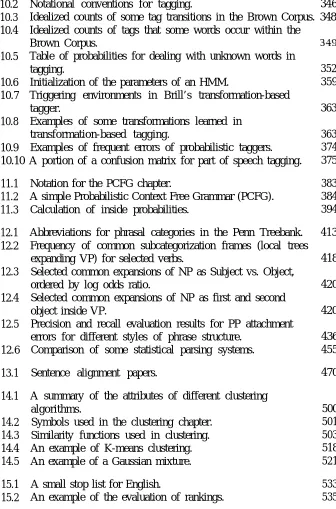
1.1 Common words in Tom Sawyer. 21 1.2 Frequency of frequencies of word types in Tom Sawyer. 22 1.3 Empirical evaluation of Zipf’s law on Tom Sawyer. 24 1.4 Commonest bigram collocations in the New York Times. 30
1.5 Frequent bigrams after filtering. 32
2.1 Likelihood ratios between two theories. 58
2.2 Statistical NLP problems as decoding problems. 71
3.1 Common inflections of nouns. 84
3.2 Pronoun forms in English. 86
3.3 Features commonly marked on verbs. 90
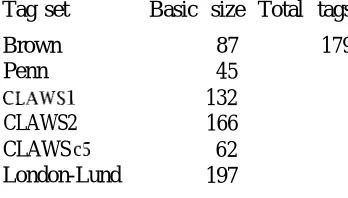
4.1 4.2
Major suppliers of electronic corpora with contact URLs. Different formats for telephone numbers appearing in an issue of The Economist.
119
4.3 4.4 4.5
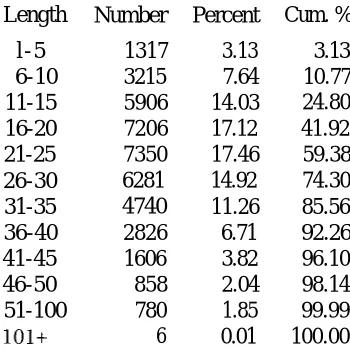
Sentence lengths in newswire text. Sizes of various tag sets.
131 137 140
4.6
Comparison of different tag sets: adjective, adverb, conjunction, determiner, noun, and pronoun tags. Comparison of different tag sets: Verb, preposition, punctuation and symbol tags.
141
142
5.1 5.2 5.3
Finding Collocations: Raw Frequency. 154
5.4 5.5 5.6 5.7 5.8 5.9 5.10 5.11 5.12 5.13 5.14 5.15 5.16 5.17 5.18 6.1 6.2 6.3 6.4 6.5 6.6 6.7
The nouns w occurring most often in the patterns
‘strong w’ and ‘powerful w.’
Finding collocations based on mean and variance.
Finding collocations: The t test applied to 10 bigrams that occur with frequency 20.
Words that occur significantly more often with powerful (the first ten words) and strong (the last ten words). A 2-by-2 table showing the dependence of occurrences of
new and companies.
Correspondence of vache and cow in an aligned corpus. Testing for the independence of words in different corpora using x2.
How to compute Dunning’s likelihood ratio test.
Bigrams of powerful with the highest scores according to Dunning’s likelihood ratio test.
Damerau’s frequency ratio test.
Finding collocations: Ten bigrams that occur with frequency 20, ranked according to mutual information. Correspondence of chambre and house and communeS and
house in the aligned Hansard corpus.
Problems for Mutual Information from data sparseness. Different definitions of mutual information in (Cover and Thomas 1991) and (Fano 1961).
Collocations in the BBI Combinatory Dictionary of English
for the words strength and power.
Growth in number of parameters for n-gram models. Notation for the statistical estimation chapter.
Probabilities of each successive word for a clause from
Persuasion.
Estimated frequencies for the AP data from Church and Gale (1991a).
Expected Likelihood Estimation estimates for the word following was.
Using the t test for comparing the performance of two systems.
Extracts from the frequencies of frequencies distribution for bigrams and trigrams in the Austen corpus.
6.8 6.9 6.10 6.11 7.1 7.2 7.3 7.4 7.5 7.6 7.7 7.8 7.9 8.1 8.2 8.3 8.4 8.5 8.6 8.7 8.8 8.9 8.10 9.1 9.2 10.1
Good-Turing estimates for bigrams: Adjusted frequencies
and probabilities. 215
Good-Turing bigram frequency estimates for the clause
from Persuasion. 215
Back-off language models with Good-Turing estimation
tested on Persuasion. 223
Probability estimates of the test clause according to various
language models. 224
Notational conventions used in this chapter. 235 Clues for two senses of drug used by a Bayesian classifier. 238 Highly informative indicators for three ambiguous French
words. 239
Two senses of ash. 243
Disambiguation of ash with Lesk’s algorithm. 243 Some results of thesaurus-based disambiguation. 247 How to disambiguate interest using a second-language corpus. 248 Examples of the one sense per discourse constraint. 250 Some results of unsupervised disambiguation. 256
The F measure and accuracy are different objective functions. 270 Some subcategorization frames with example verbs and
sentences. 271
Some subcategorization frames learned by Manning’s system. 276 An example where the simple model for resolving PP
attachment ambiguity fails. 280
Selectional Preference Strength (SPS). 290
Association strength distinguishes a verb’s plausible and
implausible objects. 292
Similarity measures for binary vectors. 299
The cosine as a measure of semantic similarity. 302 Measures of (dis-)similarity between probability distributions. 304 Types of words occurring in the LOB corpus that were not
covered by the OALD dictionary. 310
Notation used in the HMM chapter. 324
Variable calculations for 0 = (lem, ice-t, cola). 330
10.2 10.3 10.4 10.5 10.6 10.7 10.8 10.9
Notational conventions for tagging. 346
Idealized counts of some tag transitions in the Brown Corpus. 348 Idealized counts of tags that some words occur within the
[image:15.551.171.507.78.587.2]Brown Corpus.
Table of probabilities for dealing with unknown words in tagging.
Initialization of the parameters of an HMM.
Triggering environments in Brill’s transformation-based tagger.
Examples of some transformations learned in transformation-based tagging.
Examples of frequent errors of probabilistic taggers. 10.10 A portion of a confusion matrix for part of speech tagging.
11.1 11.2 11.3
12.1 12.2
Notation for the PCFG chapter.
A simple Probabilistic Context Free Grammar (PCFG). Calculation of inside probabilities.
12.3
12.4
12.5
12.6
Abbreviations for phrasal categories in the Penn Treebank. Frequency of common subcategorization frames (local trees expanding VP) for selected verbs.
Selected common expansions of NP as Subject vs. Object, ordered by log odds ratio.
Selected common expansions of NP as first and second object inside VP.
Precision and recall evaluation results for PP attachment errors for different styles of phrase structure.
Comparison of some statistical parsing systems.
13.1 Sentence alignment papers.
14.1 A summary of the attributes of different clustering algorithms.
14.2 Symbols used in the clustering chapter. 14.3 Similarity functions used in clustering. 14.4 An example of K-means clustering. 14.5 An example of a Gaussian mixture.
15.1 15.2
A small stop list for English. 533
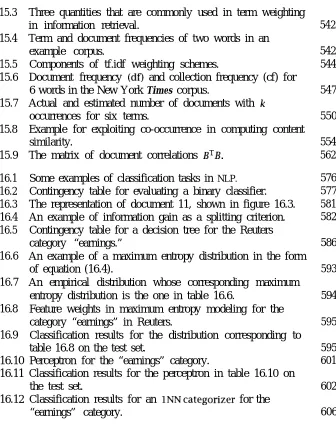
15.3 15.4 15.5 15.6 15.7 15.8 15.9 16.1 16.2 16.3 16.4 16.5 16.6 16.7 16.8 16.9
Three quantities that are commonly used in term weighting in information retrieval.
Term and document frequencies of two words in an example corpus.
Components of tf.idf weighting schemes.
Document frequency (df) and collection frequency (cf) for 6 words in the New York Times corpus.
Actual and estimated number of documents with k occurrences for six terms.
Example for exploiting co-occurrence in computing content similarity.
The matrix of document correlations BTB.
Some examples of classification tasks in NLP. Contingency table for evaluating a binary classifier. The representation of document 11, shown in figure 16.3. An example of information gain as a splitting criterion. Contingency table for a decision tree for the Reuters category “earnings.”
An example of a maximum entropy distribution in the form of equation (16.4).
An empirical distribution whose corresponding maximum entropy distribution is the one in table 16.6.
Feature weights in maximum entropy modeling for the category “earnings” in Reuters.
[image:16.550.149.485.70.500.2]Classification results for the distribution corresponding to table 16.8 on the test set.
16.10 Perceptron for the “earnings” category.
16.11 Classification results for the perceptron in table 16.10 on the test set.
1.1 1.2
1.3 1.4
2.1
2.2 2.3
2.4
2.5 2.6
2.7 The noisy channel model.
2.8 A binary symmetric channel.
2.9 The noisy channel model in linguistics.
3.1 An example of recursive phrase structure expansion. 99
3.2 An example of a prepositional phrase attachment ambiguity. 108
4.1 Heuristic sentence boundary detection algorithm.
4.2 A sentence as tagged according to several different tag sets.
5.1
Zipf’s law.
Mandelbrot’s formula.
Key Word In Context (KWIC) display for the word showed. Syntactic frames for showed in Tom Sawyer.
A diagram illustrating the calculation of conditional probability P(AJB).
A random variable X for the sum of two dice.
Two examples of binomial distributions: b(r; 10,0.7) and b(r; 10,O.l).
Example normal distribution curves: n(x; 0,l) and n(x; 1.5,2).
The entropy of a weighted coin.
The relationship between mutual information I and entropy H.
Using a three word collocational window to capture bigrams at a distance.
26 27 32 33
42 45
52
53 63
67 69 69 70
135 140
5.2 Histograms of the position of strong relative to three words. 160
7.1 7.2
Bayesian disambiguation.
The Flip-Flop algorithm applied to finding indicators for disambiguation.
Lesk’s dictionary-based disambiguation algorithm. Thesaurus-based disambiguation.
Adaptive thesaurus-based disambiguation.
Disambiguation based on a second-language corpus. Disambiguation based on “one sense per collocation” and “one sense per discourse.”
An EM algorithm for learning a word sense clustering.
238 7.3 7.4 7.5 7.6 7.7 240 243 245 246 249 7.8 252 254
8.1 A diagram motivating the measures of precision and recall. 268
8.2 Attachments in a complex sentence. 285
8.3 A document-by-word matrix A. 297
8.4 A word-by-word matrix B. 297
8.5 A modifier-by-head matrix C. 297
9.1 9.2
A Markov model. 319
321 9.3
The crazy soft drink machine, showing the states of the machine and the state transition probabilities.
A section of an HMM for a linearly interpolated language model.
9.4 9.5 9.6
A program for a Markov process. Trellis algorithms.
323 325 328 Trellis algorithms: Closeup of the computation of forward
probabilities at one node. 9.7 10.1 10.2 10.3 11.1 11.2 11.3
The probability of traversing an arc.
329 334
Algorithm for training a Visible Markov Model Tagger. 348 Algorithm for tagging with a Visible Markov Model Tagger. 350 The learning algorithm for transformation-based tagging. 364
The two parse trees, their probabilities, and the sentence probability.
A Probabilistic Regular Grammar (PRG). Inside and outside probabilities in PCFGs.
385 390 391
12.2 12.3 12.4 12.5 12.6 12.7 12.8 13.1 13.2 13.3 13.4 13.5 13.6 14.1 14.2 14.3 14.4 14.5 14.6 14.7 14.8 14.9 14.10 15.1 15.2 15.3 15.4 15.5 15.6 15.7 15.8 15.9
A Penn Treebank tree.
Two CFG derivations of the same tree. An LC stack parser.
Decomposing a local tree into dependencies. An example of the PARSEVAL measures. The idea of crossing brackets.
Penn trees versus other trees.
Different strategies for Machine Translation. Alignment and correspondence.
Calculating the cost of alignments. A sample dot plot.
The pillow-shaped envelope that is searched. The noisy channel model in machine translation.
A single-link clustering of 22 frequent English words represented as a dendrogram.
Bottom-up hierarchical clustering. Top-down hierarchical clustering. A cloud of points in a plane.
Intermediate clustering of the points in figure 14.4. Single-link clustering of the points in figure 14.4. Complete-link clustering of the points in figure 14.4. The K-means clustering algorithm.
One iteration of the K-means algorithm.
An example of using the EM algorithm for soft clustering.
Results of the search ‘ “glass pyramid” Pei Louvre’ on an internet search engine.
Two examples of precision-recall curves. A vector space with two dimensions. The Poisson distribution.
An example of a term-by-document matrix A. Dimensionality reduction.
An example of linear regression.
The matrix T of the SVD decomposition of the matrix in figure 15.5.
The matrix of singular values of the SVD decomposition of the matrix in figure 15.5.
15.10 The matrix D of the SVD decomposition of the matrix in figure 15.5.
15.11 The matrix J3 = S2x2D2xn of documents after resealing with singular values and reduction to two dimensions.
15.12 Three constellations of cohesion scores in topic boundary
16.1 16.2 16.3
A decision tree.
16.4 16.5
Geometric interpretation of part of the tree in figure 16.1. An example of a Reuters news story in the topic category “earnings.”
Pruning a decision tree.
Classification accuracy depends on the amount of training data available.
16.6
16.7 16.8
An example of how decision trees use data inefficiently from the domain of phonological rule learning.
The Perceptron Learning Algorithm.
One error-correcting step of the perceptron learning algorithm.
16.9 Geometric interpretation of a perceptron. identification.
561
562
569
578 579
580 585
587
588 598
U n
A-B, A\B A
0 ZA, 2’(A) IAl c rI Pa4 PO4 g u%
Union of sets
Intersection of sets
Set difference
The complement of set A
The empty set
The power set of A
Cardinality of a set
Sum
Product
p implies q (logical inference) p and q are logically equivalent
Defined to be equal to (only used if “=” is ambiguous)
The set of real numbers
N The set of natural numbers n! The factorial of n
ca Infinity
1x1 Absolute value of a number << Much smaller than
>> Much greater than
f : A - B A function f from values in A to B
minf The minimum value of
f
arg max
f
The argument for whichf
has its maximum valuearg min
f
The argument for whichf
has its minimum valuelim,,,f(x) The limit of
f
as x tends to infinityfms
a
s
log aexp(x), ex [al 2 Ix’1 2.9 cos(x’, y’, Cij CT 22 E(X) Var(X) p u x s2 P(AIB)
X - P(X)
b(r; n,p) n 0r
nk F, o1
H(X)
f is proportional to g
Partial derivative
Integral
The logarithm of a
The exponential function
The smallest integer i s.t. i 2 a
A real-valued vector: 2 E 08”
Euclidean length of 2
The dot product of x’ and y’
The cosine of the angle between 2 and y’
Element in row i and column j of matrix C
Transpose of matrix C
Estimate of X
Expectation of X
Variance of X
Mean
Standard deviation
Sample mean
Sample variance
The probability of A conditional on B
Random variable X is distributed according to p
The binomial distribution
Combination or binomial coefficient (the number of ways of choosing r objects from n)
The normal distribution
1(X; Y)
D(P II 9) ct.1
fu
Wij, W(i)(j)
Wi,j Wi,...,Wj
O(n) 4
?
Mutual information
Kullback-Leibler (KL) divergence
Count of the entity in parentheses
The relative frequency of u.
The words Wi, wi+i, . . . , Wj
The same as wij
The same as wij
Time complexity of an algorithm
Ungrammatical sentence or phrase or ill-formed word
Marginally grammatical sentence or marginally acceptable phrase
THE NEED for a thorough textbook for Statistical Natural Language
Pro-cessing hardly needs to be argued for in the age of on-line information, electronic communication and the World Wide Web. Increasingly, busi-nesses, government agencies and individuals are confronted with large amounts of text that are critical for working and living, but not well enough understood to get the enormous value out of them that they po-tentially hide.
At the same time, the availability of large text corpora has changed the scientific approach to language in linguistics and cognitive science. Phenomena that were not detectable or seemed uninteresting in studying toy domains and individual sentences have moved into the center field of what is considered important to explain. Whereas as recently as the early 1990s quantitative methods were seen as so inadequate for linguistics that an important textbook for mathematical linguistics did not cover them in any way, they are now increasingly seen as crucial for linguistic theory.
that students are grounded in the advances that have been made and, having understood the special problems that language poses, can move the field forward.
When we designed the basic structure of the book, we had to make a number of decisions about what to include and how to organize the material. A key criterion was to keep the book to a manageable size. (We didn’t entirely succeed!) Thus the book is not a complete introduction to probability theory, information theory, statistics, and the many other areas of mathematics that are used in Statistical NLP. We have tried to cover those topics that seem most important in the field, but there will be many occasions when those teaching from the book will need to use supplementary materials for a more in-depth coverage of mathematical foundations that are of particular interest.
We also decided against attempting to present Statistical NLP as homo-geneous in terms of the mathematical tools and theories that are used. It is true that a unified underlying mathematical theory would be desir-able, but such a theory simply does not exist at this point. This has led to an eclectic mix in some places, but we believe that it is too early to mandate that a particular approach to NLP is right and should be given
preference to others.
acoustic modeling which would not generally be of interest or accessible to someone from a computer science or NLP background, while in the reverse direction, most people studying speech would be uninterested in many of the NLP topics on which we focus.
Other related areas that have a somewhat fuzzy boundary with Statis-tical NLP are machine learning, text categorization, information retrieval, and cognitive science. For all of these areas, one can find examples of work that is not covered and which would fit very well into the book. It was simply a matter of space that we did not include important con-cepts, methods and problems like minimum description length, back-propagation, the Rocchio algorithm, and the psychological and cognitive-science literature on frequency effects on language processing.
The decisions that were most difficult for us to make are those that concern the boundary between statistical and non-statistical NLP. We believe that, when we started the book, there was a clear dividing line between the two, but this line has become much more fuzzy recently. An increasing number of non-statistical researchers use corpus evidence and incorporate quantitative methods. And it is now generally accepted in Statistical NLP that one needs to start with all the scientific knowledge that is available about a phenomenon when building a probabilistic or other model, rather than closing one’s eyes and taking a clean-slate ap-proach.
Many NLP researchers will therefore question the wisdom of writing a separate textbook for the statistical side. And the last thing we would want to do with this textbook is to promote the unfortunate view in some quarters that linguistic theory and symbolic computational work are not relevant to Statistical NLP. However, we believe that there is so much quite complex foundational material to cover that one simply cannot write a textbook of a manageable size that is a satisfactory and comprehensive introduction to all of NLP. Again, other good texts al-ready exist, and we recommend using supplementary material if a more balanced coverage of statistical and non-statistical methods is desired.
A final remark is in order on the title we have chosen for this book.
STATISTICALNATURAL Calling the field Statistical Nuturd Language Processing might seem
ques-LA N G U A G E tionable to someone who takes their definition of a statistical method
PROCESSING
While probability theory is the foundation for formal statistical reason-ing, we take the basic meaning of the term ‘statistics’ as being broader, encompassing all quantitative approaches to data (a definition which one can quickly confirm in almost any dictionary). Although there is thus some potential for ambiguity, Statistical NLP has been the most widely used term to refer to non-symbolic and non-logical work on NLP over the past decade, and we have decided to keep with this term.
Acknowledgments. Over the course of the three years that we were working on this book, a number of colleagues and friends have made comments and suggestions on earlier drafts. We would like to express our gratitude to all of them, in particular, Einat Amitay, Chris Brew, Thorsten Brants, Andreas Eisele, Michael Ernst, Oren Etzioni, Marc Fried-man, Eric Gaussier, Eli Hagen, Marti Hearst, Nitin Indurkhya, Michael Inman, Mark Johnson, Rosie Jones, Tom Kalt, Andy Kehler, Julian Ku-piec, Michael Littman, Arman Maghbouleh, Amir Najmi, Kris Popat, Fred Popowich, Geoffrey Sampson, Hadar Shemtov, Scott Stoness, David Yarowsky, and Jakub Zavrel. We are particularly indebted to Bob Car-penter, Eugene Charniak, Raymond Mooney, and an anonymous reviewer for MIT Press, who suggested a large number of improvements, both in content and exposition, that we feel have greatly increased the overall quality and usability of the book. We hope that they will sense our grat-itude when they notice ideas which we have taken from their comments without proper acknowledgement.
We would like to also thank: Francine Chen, Kris Halvorsen, and Xe-rox PARC for supporting the second author while writing this book, Jane Manning for her love and support of the first author, Robert Dale and Dikran Karagueuzian for advice on book design, and Amy Brand for her regular help and assistance as our editor.
Feedback. While we have tried hard to make the contents of this book understandable, comprehensive, and correct, there are doubtless many places where we could have done better. We welcome feedback to the authors via email to [email protected] or [email protected].
in an accessible fashion will create excitement in potential students, and help ensure continued rapid progress in the field.
IN GENERAL, this book is ,written to be suitable for a graduate-level semester-long course focusing on Statistical NLP. There is actually rather more material than one could hope to cover in a semester, but that rich-ness gives ample room for the teacher to pick and choose. It is assumed that the student has prior programming experience, and has some famil-iarity with formal languages and symbolic parsing methods. It is also assumed that the student has a basic grounding in such mathematical concepts as set theory, logarithms, vectors and matrices, summations, and integration - we hope nothing more than an adequate high school education! The student may have already taken a course on symbolic NLP
methods, but a lot of background is not assumed. In the directions of probability and statistics, and linguistics, we try to briefly summarize all the necessary background, since in our experience many people wanting to learn about Statistical NLP methods have no prior knowledge in these areas (perhaps this will change over time!). Nevertheless, study of sup-plementary material in these areas is probably necessary for a student to have an adequate foundation from which to build, and can only be of value to the prospective researcher.
What is the best way to read this book and teach from it? The book is organized into four parts: Preliminaries (part I), Words (part II), Grammar (part III), and Applications and Techniques (part IV).
Part I lays out the mathematical and linguistic foundation that the other parts build on. Concepts and techniques introduced here are referred to throughout the book.
chapters on collocations, n-gram models, word sense disambiguation, and lexical acquisition, but each chapter can also be read on its own.
The four chapters in part III, Markov Models, tagging, probabilistic con-text free grammars, and probabilistic parsing, build on each other, and so they are best presented in sequence. However, the tagging chapter can be read separately with occasional references to the Markov Model chapter.
The topics of part IV are four applications and techniques: statisti-cal alignment and machine translation, clustering, information retrieval, and text categorization. Again, these chapters can be treated separately according to interests and time available, with the few dependencies be-tween them marked appropriately.
probabilistic models on their own), and good methods for assessing the performance of systems.
In general, we have attempted to provide ample cross-references so that, if desired, an instructor can present most chapters independently with incorporation of prior material where appropriate. In particular, this is the case for the chapters on collocations, lexical acquisition, tagging, and information retrieval.
Exercises. There are exercises scattered through or at the end of every chapter. They vary enormously in difficulty and scope. We have tried to provide an elementary classification as follows:
* Simple problems that range from text comprehension through to such things as mathematical manipulations, simple proofs, and thinking of examples of something.
* * More substantial problems, many of which involve either program-ming or corpus investigations. Many would be suitable as an as-signment to be done over two weeks.
* * * Large, difficult, or open-ended problems. Many would be suitable as a term project.
(Lyons 1968: 98)
“One’s ability to produce and recognize grammatical utterances is not based on notions ofstatistical approximation and the
like” (Chomsky 1957: 16)
“You say: the point isn’t the word, but its meaning, and you think of the meaning as a thing of the same kind as the word, though also different from the word. Here the word, there the meaning. The money, and the cow that you can buy with it. (But contrast: money, and its use.)”
(Wittgenstein 1968, Philosophical Investigations, Jj120)
“For a large class of cases-though not for all-in which we employ the word ‘meaning’ it can be defined thus: the meaning of a word is its use in the language. ” (Wittgenstein 1968, 943)
“Now isn‘t it queer that I say that the word ‘is’ is used with two different meanings (as the copula and as the sign of equality), and should not care to say that its meaning is its use; its use, that is, as the copula and the sign of equality?”
1
Introduction
THE AIM of a linguistic science is to be able to characterize and explain
the multitude of linguistic observations circling around us, in conversa-tions, writing, and other media. Part of that has to do with the cognitive side of how humans acquire, produce, and understand language, part of it has to do with understanding the relationship between linguistic utterances and the world, and part of it has to do with understanding the linguistic structures by which language communicates. In order to
RULES approach the last problem, people have proposed that there are rules
which are used to structure linguistic expressions. This basic approach
has a long history that extends back at least 2000 years, but in this
cen-tury the approach became increasingly formal and rigorous as linguists explored detailed grammars that attempted to describe what were well-formed versus ill-well-formed utterances of a language.
This book explores an approach that addresses this problem head on. Rather than starting off by dividing sentences into grammatical and un-grammatical ones, we instead ask, “What are the common patterns that occur in language use?” The major tool which we use to identify these patterns is counting things, otherwise known as statistics, and so the sci-entific foundation of the book is found in probability theory. Moreover, we are not merely going to approach this issue as a scientific question, but rather we wish to show how statistical models of language are built and successfully used for many natural language processing (NLP) tasks. While practical utility is something different from the validity of a the-ory, the usefulness of statistical models of language tends to confirm that there is something right about the basic approach.
Adopting a Statistical NLP approach requires mastering a fair number of theoretical tools, but before we delve into a lot of theory, this chapter spends a bit of time attempting to situate the approach to natural lan-guage processing that we pursue in this book within a broader context. One should first have some idea about why many people are adopting a statistical approach to natural language processing and of how one should go about this enterprise. So, in this first chapter, we examine some of the philosophical themes and leading ideas that motivate a statistical approach to linguistics and NLP, and then proceed to get our hands dirty by beginning an exploration of what one can learn by looking at statistics over texts.
1.1
Rationalist and Empiricist Approaches to Language
Some language researchers and many NLP practitioners are perfectly happy to just work on text without thinking much about the relationship between the mental representation of language and its manifestation in written form. Readers sympathetic with this approach may feel like skip-ping to the practical sections, but even practically-minded people have to confront the issue of what prior knowledge to try to build into their model, even if this prior knowledge might be clearly different from what might be plausibly hypothesized for the brain. This section briefly dis-cusses the philosophical issues that underlie this question.
i_ i-!d
by the belief that a significant part of the knowledge in the human mind is not derived by the senses but is fixed in advance, presumably by genetic inheritance. Within linguistics, this rationalist position has come to dom-inate the field due to the widespread acceptance of arguments by Noam Chomsky for an innate language faculty. Within artificial intelligence, rationalist beliefs can be seen as supporting the attempt to create intel-ligent systems by handcoding into them a lot of starting knowledge and reasoning mechanisms, so as to duplicate what the human brain begins with.
Chomsky argues for this innate structure because of what he perceives POVERTY OF THE as a problem of the poverty of the stimulus (e.g., Chomsky 1986: 7). He STIMULUS suggests that it is difficult to see how children can learn something as
complex as a natural language from the limited input (of variable quality and interpretability) that they hear during their early years. The rational-ist approach attempts to dodge this difficult problem by postulating that the key parts of language are innate - hardwired in the brain at birth as part of the human genetic inheritance.
EMPIRICIST An empiricist approach also begins by postulating some cognitive abil-ities as present in the brain. The difference between the approaches is therefore not absolute but one of degree. One has to assume some initial structure in the brain which causes it to prefer certain ways of organiz-ing and generalizorganiz-ing from sensory inputs to others, as no learnorganiz-ing is possible from a completely blank slate, a tub& rum. But the thrust of empiricist approaches is to assume that the mind does not begin with detailed sets of principles and procedures specific to the various com-ponents of language and other cognitive domains (for instance, theories of morphological structure, case marking, and the like). Rather, it is as-sumed that a baby’s brain begins with general operations for association, pattern recognition, and generalization, and that these can be applied to the rich sensory input available to the child to learn the detailed structure of natural language. Empiricism was dominant in most of the fields men-tioned above (at least the ones then existing!) between 1920 and 1960, and is now seeing a resurgence. An empiricist approach to NLIJ suggests that we can learn the complicated and extensive structure of language by specifying an appropriate general language model, and then inducing the values of parameters by applying statistical, pattern recognition, and machine learning methods to a large amount of language use.
CORPUS CORPORA
AM E R I C A N STRUCTURALISTS
GENERATIVE LINGUISTICS
LINGUISTIC COMPETENCE
LINGUISTIC PERFORMANCE
world. So, instead, people simply use texts, and regard the textual context as a surrogate for situating language in a real world context. A body of texts is called a corpus - corpus is simply Latin for ‘body,’ and when you have several such collections of texts, you have corpora. Adopting such a corpus-based approach, people have pointed to the earlier advocacy of empiricist ideas by the British linguist J.R. Firth, who coined the slogan “You shall know a word by the company it keeps” (Firth 1957: 11). How-ever an empiricist corpus-based approach is perhaps even more clearly seen in the work of American structuralists (the ‘post-Bloomfieldians’), particularly Zellig Harris. For example, (Harris 1951) is an attempt to find discovery procedures by which a language’s structure can be discovered automatically. While this work had no thoughts to computer implemen-tation, and is perhaps somewhat computationally naive, we find here also the idea that a good grammatical description is one that provides a com-pact representation of a corpus of texts.
It is not appropriate to provide a detailed philosophical treatment of scientific approaches to language here, but let us note a few more dif-ferences between rationalist and empiricist approaches. Rationalists and empiricists are attempting to describe different things. Chomskyan (or generative) linguistics seeks to describe the language module of the hu-man mind (the I-language) for which data such as texts (the E-language) provide only indirect evidence, which can be supplemented by native speaker intuitions. Empiricist approaches are interested in describing the E-language as it actually occurs. Chomsky (1965: 3-4) thus makes a crucial distinction between linguistic competence, which reflects the knowledge of language structure that is assumed to be in the mind of a native speaker, and linguistic performance in the world, which is af-fected by all sorts of things such as memory limitations and distracting noises in the environment. Generative linguistics has argued that one can isolate linguistic competence and describe it in isolation, while empiricist approaches generally reject this notion and want to describe actual use of language.
I ,
I t :
L-If l-1s
Y. re
still with us today, but the work can be criticized on the grounds that it dealt only with very small (often pejoratively called ‘toy’) problems, and often did not provide any sort of objective evaluation of the general ef-ficacy of the methods employed. Recently, people have placed greater emphasis on engineering practical solutions. Principally, they seek meth-ods that can work on raw text as it exists in the real world, and objective comparative evaluations of how well different methods work. This new emphasis is sometimes reflected in naming the field ‘Language Technol-ogy’ or ‘Language Engineering’ instead of NLP. As we will discuss below, such goals have tended to favor Statistical NLP approaches, because they INDUCTION are better at automatic learning (knowledge induction), better at
disam-biguation, and also have a role in the science of linguistics.
Finally, Chomskyan linguistics, while recognizing certain notions of CATEGORICAL competition between principles, depends on categoricd principles, which sentences either do or do not satisfy. In general, the same was true of American structuralism. But the approach we will pursue in Statistical NLP draws from the work of Shannon, where the aim is to assign proba-bilities to linguistic events, so that we can say which sentences are ‘usual’ and ‘unusual’. An upshot of this is that while Chomskyan linguists tend to concentrate on categorical judgements about very rare types of sen-tences, Statistical NLP practitioners are interested in good descriptions
of the associations and preferences that occur in the totality of language use. Indeed, they often find that one can get good real world performance by concentrating on common types of sentences.
1.2 Scientific Content
* 1.2.1
COMPETENCE GRAMMAR
GRAMMATICALITY
with which linguistic forms are used, in other words, statistics, as one approaches the study of language.
Questions that linguistics should answer
What questions does the study of language concern itself with? As a start we would like to answer two basic questions:
n What kinds of things do people say?
n What do these things say/ask/request about the world?
From these two basic questions, attention quickly spreads to issues about how knowledge of language is acquired by humans, and how they actu-ally go about generating and understanding sentences in real time. But let us just concentrate on these two basic questions for now. The first covers all aspects of the structure of language, while the second deals with semantics, pragmatics, and discourse - how to connect utterances with the world. The first question is the bread and butter of corpus lin-guistics, but the patterns of use of a word can act as a surrogate for deep understanding, and hence can let us also address the second question using corpus-based techniques. Nevertheless patterns in corpora more easily reveal the syntactic structure of a language, and so the majority of work in Statistical NLP has dealt with the first question of what kinds of things people say, and so let us begin with it here.
al-though semantically strange and not the kind of thing you would expect people to say. Syntactic grammaticality is a categorical binary ch0ice.l
Now, initially, a distinction between grammatical and ungrammatical sentences does not seem so bad. We immediately notice when a non-native speaker says something really wrong - something ungrammatical - and we are able to correct such sentences to grammatical ones. In con-trast, except when there are bad speech errors, a native speaker normally produces grammatical sentences. But there are at least two reasons why we should seek more. Firstly, while maintaining a binary split between grammatical and ungrammatical sentences may seem plausible in simple cases, it becomes increasingly far-fetched as we extend our investiga-tion. Secondly, regardless of this, there are many reasons to be interested in the frequency with which different sentences and sentence types are used, and simply dividing sentences into grammatical and ungrammati-cal sentences gives no information about this. For instance, very often non-native speakers say or write things that are not in any way syntac-tically ungrammatical, but just somehow subtly odd. Here’s an example from a student essay:
(1.1) In addition to this, she insisted that women were regarded as a different existence from men unfairly.
We might respond to this passage by saying that we can understand the message, but it would sound better expressed slightly differently. This CONVENTIONALITY is a statement about the conventionnliry of certain modes of expression. But a convention is simply a way in which people frequently express or do something, even though other ways are in principle possible.
The fact that sentences do not divide neatly into two sets - grammat-ical and ungrammatgrammat-ical ones - is well known to anyone who has been in linguistics for a while. For many of the complicated sentences of in-terest to theoretical linguistics, it is difficult for human beings to decide whether they are grammatical or not. For example, try your hand at judg-ing the grammaticality of the followjudg-ing sentences drawn (not at random)
from (van Riemsdijk and Williams 1986) - a textbook, not even a research paper - before peeking at the answers in the footnote.2
(1.2) a.
b.
C.
d.
John I believe Sally said Bill believed Sue saw.
What did Sally whisper that she had secretly read?
John wants very much for himself to win.
(Those are) the books you should read before it becomes difficult to talk about.
e. (Those are) the books you should read before talking about becomes difficult.
f.
g.
Who did Jo think said John saw him?
That a serious discussion could arise here of this topic was quite un-expected.
h. The boys read Mary’s stories about each other.
We find that most people disagree with more than one of van Riemsdijk and Williams’s claims about which sentences are grammatical. This re-sult raises real questions about what, if anything, generative linguistics is describing.
This difficulty has led to many statements in the linguistics literature about judgements being difficult, or the facts quite obscure, as if some-how there is a categorical answer to whether each sentence is grammati-cal, but it is hard for human beings to work out what that answer is. Yet, despite these manifest difficulties, most of theoretical linguistics contin-ues to work in a framework that defines such observations to be out of the realm of interest (relegating them to performance effects). We be-lieve that this is unsustainable. On the other hand, it must be noticed that most simple sentences are either clearly acceptable or unacceptable and we would want our theory to be able to account for this observation. Perhaps the right approach is to notice the parallel with other cases of CATEGORICAL categorical perception that have been described in the psychological liter-PERCEPTION ature. For instance, although the timing of voicing onset which
differenti-ates a /p/ sound from a /b/ sound is a continuous variable (and its typical
value varies between languages), human beings perceive the results cat-egorically, and this is why a theory of phonology based on categorical phonemes is largely viable, despite all the movements and variations in phonological production occurring in a continuous space. Similarly for syntax, a categorical theory may suffice for certain purposes. Neverthe-less, we would argue that the difficulties in giving grammaticality judge-ments to complex and convoluted sentences show the implausibility of extending a binary distinction between grammatical and ungrammatical strings to all areas of language use.
1.2.2 Non-categorical phenomena in language
But beyond the above difficulties in giving grammaticality judgements, if we peek into the corners of language, we see clear evidence of failures of categorical assumptions, and circumstances where considerations of fre-quency of use are essential to understanding language. This suggests that
CATEGORICAL VIEW OF while a categorical view
of
language may be sufficient for many purposes,LANGUAGE we must see it as an approximation that also has its limitations (just as
Newtonian physics is good for many purposes but has its limits).3 One source of data on non-categorical phenomena in language is to look at the history of language change (others are looking at sociolin-guistic variation and competing hypotheses during language acquisition). Over time, the words and syntax of a language change. Words will change their meaning and their part of speech. For instance, English while used to be exclusively a noun meaning ‘time,’ a usage that survives mainly in a few fixed phrases such as to take a while, but changed to be mainly used as a complementizer introducing subordinate clauses (While you were out, . . . ). It doesn’t make sense to say that categorically until some day in 1742 while was only a noun and then it became a complementizer - even if this claim is only being made for certain speakers rather than the speech community as a whole. Rather, one would expect a gradual change. One hypothesis is that if the frequency of use of a word in vari-ous contexts gradually changes so that it departs from the typical profile of use of words in the category to which it formerly belonged, and rather its profile of use comes to more resemble words of another category, then
it will come to be reanalyzed as a word of that different category. During the period of change, one would expect to see evidence of noncategorical behavior.
Blending of parts of speech: neur
At first blush it appears that the word neur can be used either as an adjective as in (1.3a) or as a preposition (1.3b):
(1.3) a. We will review that decision in the near future.
b. He lives near the station.
Evidence for neur as an adjective includes its position between a deter-miner and noun as in (1.3a) - a classic adjective position - and the fact that it can form an adverb by adding -ly: We nearly lost. Evidence for near as a preposition includes that it can head the locative phrase com-plements of verbs like live as in (1.3b) - a classic role for prepositions, and that such a phrase can be modified by right, which is normally restricted to modifying prepositional phrases: He lives right new the starion (cf. He SWUM right across the lake vs. ??Thut’s u right red cur). So far, though, this data is not that surprising: many words in English seem to have multiple parts of speech. For example, many words are both nouns and verbs, such as play: They saw a play vs. They play lacrosse on Thursdays. But the interesting thing is that near can simultaneously show adjective properties and preposition properties, and thus appears to behave as a category blend. This happens in sentences like:
(1.4) a. He has never been nearer the center of the financial establishment.
b. We live nearer the water than you thought.
Realization in the comparative form (nearer) is a hallmark of adjectives (and adverbs). Other categories do not form comparatives and superla-tives.4 On the other hand, grammatical theory tells us that adjectives and nouns do not take direct objects, hence we have to insert prepositions
after adjectives and say unsure of his beliefs or convenient for people who work long hours. In this sense nearer is behaving like a preposition by heading a locative phrase and taking a direct object. Thus in these sentences nearer is simultaneously showing properties of adjectives and prepositions that are not available to the other category. Hence it is ex-hibiting a blended status somewhere between these two parts of speech, which are normally taken as categorically distinct.
Language change: kind of and serf of
New uses for the word sequences kind of and sort of present a convincing example of how different frequencies of use in certain constructions can lead to what is apparently categorical change. In modern English, the expressions sort of and kind of have at least two distinct uses. In one, sort or kind functions as a noun with of as a following preposition introducing a prepositional phrase, as in sentences such as What sort of animal made these trucks? But there is another usage in which these expressions can best be thought of as degree modifiers, akin to somewhat or slightly: (1.5) a. We are kind of hungry.
b. He sort of understood what was going on.
We can tell that kind/sort of is not behaving as a normal noun preposition sequence here because it is appearing in contexts - such as between the subject noun phrase and the verb - where normally one cannot insert a noun-preposition sequence (for example, one cannot say *He variety of understood what was going on).
Historically, kind and sort were clearly nouns. Among other things, they could be preceded by a determiner and followed by a PP:
(1.6) a. A nette sent in to the see, and of alle kind of fishis gedrynge. [1382]
b. I knowe that sorte of men ryght well. [ 15601
Unambiguous degree modifier uses did not appear until the nineteenth century:
(1.7) a. I kind of love you, Sal-I vow. [ 18041
(1.8)
(1.9)
It does not appear that this new construction was borrowed from another language. Rather it appears to be a language internal development. How could this innovation have come about?
A plausible hypothesis is to notice that when we have kind/sort of pre-ceding an adjective, then it is actually ambiguous between these two read-ings:
a. [Np a [kind] [pp of [NpdenSe rock]]]
b. [up a [up [MOD kind of] dense] rock]
And what one finds is that between the sixteenth and the nineteenth century, there was a significant rise in the use of kind/sort of in this [Det {sort/kind} of AdjP N] frame:
a. Their finest and best, is a kind of course red cloth. [c. 16001
b. But in such questions as the present, a hundred contradictory views may preserve a kind of imperfect analogy. [1743]
(Note that course is here a variant spelling of coarse.) In this environment, sort/kind of fills a slot that could be occupied by a noun head followed by a preposition, but it also fills a slot that could be occupied by a de-gree modifier (with a different syntactic structure). As this usage became more common, kind/sort of was more commonly being used in a typical degree modifier slot; in other words, it grew to look syntactically more like a degree modifier. Moreover, the semantics of these particular nouns was such that they could easily be thought of as degree modifiers. This frequency change seems to have driven a change in syntactic category, and in time the use of kind/sort of was extended to other contexts such as modifying verb phrases.
The general point here is that while language change can be sudden (due to either external or internal factors), it is generally gradual. The details of gradual change can only be made sense of by examining fre-quencies of use and being sensitive to varying strengths of relationships, and this type of modeling requires statistical, as opposed to categorical, observations.
things such as non-categorical phenomena and language change much better than anything existing today.
1.2.3 Language and cognition as probabilistic phenomena
A more radical argument for probability as part of a scientific under-standing of language is that human cognition is probabilistic and that language must therefore be probabilistic too since it is an integral part of cognition. A frequent response to our previous examples of non-categorical phenomena in language is that they are marginal and rare. Most sentences are either clearly grammatical or clearly ungrammatical. And most of the time, words are used in only one part of speech, without blending. But if language and cognition as a whole are best explained probabilistically, then probability theory must be a central part of an ex-planatory theory of language.
The argument for a probabilistic approach to cognition is that we live in a world filled with uncertainty and incomplete information. To be able to interact successfully with the world, we need to be able to deal with this type of information. Suppose you want to determine whether it is safe to wade through a river. You see that the water is flowing slowly, so probably it won’t drag you away. You are pretty certain that no piranhas or alligators live in this area. You integrate all this information in eval-uating how safe it is to cross the river. Now, if someone tells you, “the water is only knee-deep if you walk towards that tall tree over there”, then this linguistic information will be just one more source of information to incorporate. Processing the words, forming an idea of the overall mean-ing of the sentence, and weighmean-ing it in makmean-ing a decision is no different in principle from looking at the current, forming an idea of the speed of the water, and taking this sensory information into account. So the gist of this argument is that the cognitive processes used for language are identical or at least very similar to those used for processing other forms of sensory input and other forms of knowledge. These cognitive processes are best formalized as probabilistic processes or at least by means of some quantitative framework that can handle uncertainty and incomplete information.
The facts of language often look quite different depending on whether or not one is sympathetic to an important role for quantitative meth-ods in linguistics. A famous example is Chomsky’s dictum that
He argued that computing the probability of sentences from a corpus of utterances would assign the same low probability to all unattested sentences, grammatical and ungrammatical ones alike, and hence not ac-count for linguistic productivity (Chomsky 195 7: 16). This argument only makes sense if one has a bias against probabilistic representation of con-cepts in general. Consider the cognitive representation of the concept tall. Suppose you see a man who is seven feet tall and it is the first per-son you’ve ever seen of that height. You will easily recognize this perper-son as a tall man, not as an uncategorizable man. Similarly, it will be easy for you to recognize a person of another unattested height, say four feet, as definitely not tall. In this book, we will look at probabilistic models that can easily learn and represent this type of regularity and make the right judgement for unattested examples. Indeed, a major part of Statis-tical NLP is deriving good probability estimates for unseen events. The premise that all unattested instances will be treated alike in a probabilis-tic framework does not hold.
We believe that much of the skepticism towards probabilistic mod-els for language (and for cognition in general) stems from the fact that the well-known early probabilistic models (developed in the 1940s and 1950s) are extremely simplistic. Because these simplistic models clearly do not do justice to the complexity of human language, it is easy to view probabilistic models in general as inadequate. One of the insights we hope to promote in this book is that complex probabilistic models can be as explanatory as complex non-probabilistic models - but with the added advantage that they can explain phenomena that involve the type of un-certainty and incompleteness that is so pervasive in cognition in general and in language in particular.
Philosophically, this brings us close to the position adopted in the later writings of Wittgenstein (that is, Wittgenstein 1968), where the mean-USETHEORYOF ing of a word is defined by the circumstances of its use (a use theory of
MEANING meaning) - see the quotations at the beginning of the chapter. Under this conception, much of Statistical NLP research directly tackles questions of meaning.
1.3
The Ambiguity of Language: Why NLP Is Difficult
An NLP system needs to determine something of the structure of text -normally at least enough that it can answer “Who did what to whom?” Conventional parsing systems try to answer this question only in terms of possible structures that could be deemed grammatical for some choice of words of a certain category. For example, given a reasonable grammar, a standard NLP system will say that sentence (1.10) has 3 syntactic anal-yses, often called parses:
(1.10) Our company is training workers.
The three differing parses might be represented as in (1.11):
( 1 . 1 1 ) a .
A
_,_“-‘,_A Our company Aux
I A
is V
I 2L
training workers
b.
A
2A
Our company V NP
is
V
I A
(1.12)
SELECTIONAL RESTRICTIONS
C.
A_“_‘_
Our company V
I A
is AdjP N
A I
training workers
There is (a), the one humans perceive, where is truining is the verb group, and two others with is as the main verb: in (b) the rest is a gerund (cf. Our problem is training workers), while in (c) training modifies workers (cf. Those are training wheels). The last two parses are semantically anoma-lous, but in most current systems semantic analysis is done only after syntactic analysis (if at all). This means that, as sentences get longer and grammars get more comprehensive, such ambiguities lead to a terrible multiplication of parses. For instance, Martin et al. (1987) report their system giving 455 parses for the sentence in (1.12):j
List the sales of the products produced in 1973 with the products pro-duced in 1972.
Therefore, a practical NLP system must be good at making disambigua-tion decisions of word sense, word category, syntactic structure, and semantic scope. But the goal of maximizing coverage while minimiz-ing resultant ambiguity is fundamentally inconsistent with symbolic NLP systems, where extending the coverage of the grammar to obscure con-structions simply increases the number of undesired parses for common sentences and vice versa. Furthermore, experience with AI approaches to parsing and disambiguation, which seek models with deep understand-ing, has shown that hand-coded syntactic constraints and preference rules are time consuming to build, do not scale up well, and are brit-tle in the face of the extensive use of metaphor in language (Lakoff 1987). For instance a traditional approach is to use selectional restrictions, and say, for example, that a verb like swallow requires an animate being as its subject and a physical object as its object. But such a restriction would disallow common and straightforward metaphorical extensions of the us-age of swallow such as these: