AN EVALUATION OF THE LANDCARE FOR TEACHERS PROGRAM IN THE CONTEXT OF ENVIRONMENTAL EDUCATION
by
Cheng-li Chen, B. Sc. Chinese Culture University, Taipei
Submitted in partial fulfilment of the requirements for the degree of Master of Environmental Studies
Centre for Environmental Studies
Department of Geography and Environmental Studies University of Tasmania, Australia
DECLARATION
■
This Thesis contains no material which has been accepted for the award of any other higher degree or graduate diploma in any tertiary institution and, to the best of the candidate's knowledge and belief, contains no material previously published or written by another person, except when due reference is made.
ABSTRACT
Landcare education is part of environmental education and unique to Australia. This paper examines Landcare as an approach to Australian environmental education experience and looks at the practice of environmental education in Australia from the perspective of a Chinese student from Taiwan. This study should therefore benefit both Australia and the Republic of China (Taiwan).
The study focuses on the Landcare for Teachers Program which is a promising teacher training course which will help educators to start or enhance their teaching in Landcare. The skills acquired by participants are also applicable to other subject areas and non-teaching activities.
Evaluation is necessary before the program can successfully be extended from Tasmania to other Australian States and Territories, and be considered for use in other countries. An evaluation of the Landcare for Teachers Program was made using a questionnaire survey along with interviews of some of the participants and key persons including seminar leaders.
Findings are based upon the questionnaire, interviews, and related documentary and statistical analysis. The results of the evaluation have allowed recommendations to be made for the Landcare for Teachers program and the potential for developing a similar program in the Republic of China to be assessed.
ACKNOWLEDGMENTS
I would like to thank my supervisors Dr. John Todd and Dr. Tania Stadler for their ongoing inspiration, tuition and empathy during the preparation of this thesis. Thanks also to the English Language Service for International Students tutors - Mrs. Louise Oxley, Mr. Chris Rees and Ms. Clare Fuller, for their writing assistance, and to Mr. David Johns and Dr. John Davidson for their help with the computer.
Special thanks to Mrs. Georgina Beekmeijer, and also to my family and Dr. Pei-Jen Chen in Taipei for their support and encouragement, and for their assistance with the research. Much appreciation is felt for the people who shared with me their experience and ideas, and for the staff and students of the Centre for Environmental Studies who provided an atmosphere of friendship and inquiry.
FOREWORD
While working as a National Park ranger and interpreter in Taipei, the author contacted a number of primary and secondary school teachers who were interested in environmental education and were demanding more training in the field. At the same time, the author attended seminars relating to environmental education held by different government organisations such as the Ministry of Education and the Taipei Municipal Department of Environment Protection, and joined workshops organised by non-government organisations such as the National Geology Education Association and the Baha'i Office of the Environment for Taiwan.
In addition, working with a public kindergarten for six months, the author participated in a joint pilot project which is an environmental education correspondence course developed by the Council of Agriculture and the Baha'i Office of the Environment for Taiwan. Out of this experience grew the realisation that there is an urgent requirement for an efficient teacher training program on environmental education for teachers in the Republic of China (Taiwan).
In-service teacher training is an important way of providing teachers with a systematic training in the environmental education area while they are working (Loubser and Ferreira, 1992:33; UNESCO, 1983a:20). Thus the author came to Australia to seek a good teacher training program on which to model an effective program for teachers in Taiwan. The author found the Tasmanian Landcare for Teachers Program worthy of further investigation. This program is the first and only program of its type at the time of writing. The study focuses on participants of the Landcare for Teachers Program and key people in the program.
During the research period, the author faced the great difficulty of communicating with Taiwan's agencies about relevant aspects of environmental education.
TABLE OF CONTENTS
ABSTRACT II
ACKNOWLEDGMENTS III
FOREWORD IV
CHAPTER 1: INTRODUCTION 1
1.1 Environmental Education - What is it? 1 1.2 Environmental Education in Australia 2
1.2.1 Background 2
1.2.2 General environmental education community 4 1.2.3 Formal education system 5 1.2.4 Problems of environmental education 6
1.2.5 Outdoor education 6
1.3 Environmental Education in the Republic of China (Taiwan) 7 1.3.1 The education system in the Republic of China
(Taiwan) 7
1.3.2 Student population up to senior secondary level in
the Republic of China (Taiwan) 8 1.3.3 Profile of environmental education in the Republic
of China (Taiwan) 8
1.4 Landcare 9
1.4.1 Development of Landcare 9 1.4.2 Decade of Landcare Plan 11 1.4.3 Environmental education through Landcare 12 1.4.4 Elements of Landcare education 14 1.4.5 The role of teachers in Landcare education 15 1.4.6 Landcare training for student teachers in Australia 15 CHAPTER 2: THE LANDCARE FOR TEACHERS PROGRAM 17
2.1 Introduction 17
2.4 Course Development 20
• 2.5 Some Difficulties Faced in the Program 21
2.6 Future of the Program 21
2.7 Content of the Landcare for Teachers Program 21
2.7.1 Researcher participation and observation 23
2.7.2 Record of 1994 Summer School 23
2.7.3 Data of Summer School survey 27
CHAPTER 3: POSTAL QUESTIONNAIRE SURVEY 30
3.1 Aims of the Postal Questionnaire 30
3.2 The Postal Questionnaire Method 30
3.3 The Postal Questionnaire Results •32
3.3.1 Respondent profile 32
3.3.2 Respondent motives for attending the course 34 3.3.3 Respondent satisfaction with the course 35
3.3.4 Classroom Application 39
3.3.5 Respondent suggestions 41
3.3.6 Respondent attitudes towards Landcare 44
3.3.7 Additional Comments 45
3.3.8 Survey of non-respondents 46
CHAPTER 4: DISCUSSION 48
4.1 Age Group Factor 48
4.2 Work Place Factor 50
4.3 Subject Factor 52
4.4 Gender Factor • 55
CHAPTER 5: KEY PEOPLE INTERVIEWS - RESULTS AND
DISCUSSION • 56
5.1 Interview Questions • 56
5.2 Results and Discussion 57
5.2.3 Excursion leader 59 5.2.4 'Theory' seminar and practical activity leader (ex-
participant) 59
5.2.5 Participant from the questionnaire survey. 60
5.3 Summary 61
CHAPTER 6: RECOMMENDATIONS 62
6.1 Tasmania and Elsewhere in Australia 62 6.2 The Republic of China (Taiwan) 63
CHAPTER 7: CONCLUSION 65
REFERENCES 66
APPENDIXES
Appendix 1. 1994 Landcare for Teachers Summer School Time Table
Appendix 2. Questionnaire survey ii
Appendix 2a. Questionnaire ii
Appendix 2b. Covering letter vi Appendix 2c. Survey reminder vii Appendix 2d. Survey advertisement viii Appendix 3. Summer School questionnaire data ix Appendix 4. Postal questionnaire data xi
CHAPTER 1: INTRODUCTION
1.1 Environmental Education - What is it?
The Australian Association for Environmental Education (AAEE) defines environmental education as follows:
Environmental education is an across-the-curriculum approach to learning which helps individuals and groups to understand the environment with the ultimate aim of developing caring and committed attitudes that will foster the desire and ability to act responsibly in the environment. Environmental education is concerned not only with knowledge, but also with feelings attitudes, skills and social action (Fien, 1993a:1.12).
Howe and Disinger (1991) indicate that the basic purpose of environmental education is, in the view of most of its supporters and many of its practitioners, the development of responsible individual and societal environmental behaviour (Howe and Disinger, 1991:5). Baines (1986) states that the ultimate purpose of environmental education is to give people a proper environmental ethic (Baines, 1986:12).
Some writers (Calder and Wildy, 1990:188; Dyer, 1994:6; Greenall, 1988:55; Radbone, 1990:148; Spork, 1992:147; Wals, 1992:46) argue that environmental education should involve three aspects: the first, teaching knowledge about the environment; the second, teaching 'real life' in the environment; and the third, teaching an ethic for the environment so that students can live an environmentally responsible lifestyle. Most educators (Baines, 1986:10; Greenall, 1988:55,57; Hunwick, 1990:134; Tilbury, 1994:17; Traynor, 1990:174) emphasise the importance of educating for the environment.
People perhaps need to learn this old wisdom through environmental education. The Aboriginal land ethic and experience, for example, can be found in the South Australian educational package called 'Kids for Landcare' (Golding, 1990:159).
1.2 Environmental Education in Australia 1.2.1 Background
Fien (1993b) considers Australian environmental education can be traced back over the 40,000 years of Aboriginal history. He argues that the Aboriginal people developed systems for their knowledge of the land, its cycles, the need to respect it, and the management practices that would allow them to use the land as a resource in a sustainable way. This knowledge was passed down through the generations by means of stories, dance, ceremonies and the establishment of a network of sacred places. An Australian Aborigine, Nelson (1983), says in a video Through Aboriginal Eyes:
"Land means more than just possession to Aboriginal people. In fact we never ever possess the land, in actual fact the land owned Aboriginal people and it doesn't make any difference from what part of Australia, where the Aboriginal people come from or where they live, the land that they live in is so important to them ... and the reason why it is so important because the land was given to them by the spiritual ancestors. They taught Aboriginal people how to survive and live on the land, how to ensure when that live in it, you will realise that Aboriginal people and the land are one" (Nelson, 1983).
The Aboriginal system of environmental education continues today through family relationships and through special programs in Aboriginal community schools and even in some progressive non-Aboriginal schools (Fien, 1993b:2). Mainstream school education still does not employ the Aboriginal environmental view. There is still a long way to go.
Science Conference on Education and the Environmental Crisis held in Canberra (Greenall, 1988:59).
Five years later in 1975, a conference was held in Melbourne as part of the lead-up to the UNESCO Inter Governmental Conference on Environmental Education in Tbilisi in 1977. Fien (1993b) considers those two conferences were catalysts for the modern environmental education movement in Australia since those conferences, and the curriculum and professional development programs that followed them, led to an acceptance by the Departments of Education in all states of the definitions and prescriptions for environmental education developed by the UNESCO-UNEP International Environmental Education Program (Fien, 1993b:4). Parry (1987) indicates that the Curriculum Development Centre (CDC) played a very important role in supporting school based curriculum projects in addition to developing a limited range of curriculum materials in environmental education at the national level in Australia from 1973 to 1983 (Parry, 1987:10).
Greenall (1988) believes that the release of the World Conservation Strategy in 1980 provided a new focus, a new phase and a new challenge for environmental education to foster or reinforce attitudes and behaviour compatible with a new conservation ethic. She also concludes that the subsequent development and endorsement of the National Conservation Strategy for Australia (NCSA) provided a new direction and a hope for a 'new beginning' for environmental education in Australia (Greenall, 1988:59).
Within the NCSA, Greenall (1988) explains, education and training are identified as the first-priority national action for improving the capacity to manage the environment for sustainable development. Education is given the task of promoting an awareness of the interrelationships between the elements of the life support systems and of encouraging the practice of living resource conservation for sustainable development. The role of environmental education is thus the accomplishment of the objectives of the NCSA which has provided a new stimulus for environmental education in Australia (Greenall, 1988:59). In 1980, the Curriculum Development Centre circulated to all Australian schools information about the aims of environmental education:
To help students acquire an awareness of and sensitivity to the total environment.
• To help students develop the skills necessary for investigating the total environment and for identifying and solving environmental problems. • To help students acquire social values and strong feelings of concern for
the environment.
• To help students acquire the motivation for actively participating in environmental improvement and protection.
• To help students identify alternative approaches and make informed decisions about the environment based on ecological, political, economic, social and aesthetic factors.
• To provide students with opportunities to be actively involved at all levels in working towards the resolution of environmental problems.
(Greenall, 1980:4).
In 1987 the Third National Environmental Education Seminar, 'Environmental Education - Past, Present and Future' was organised by the Department of Arts, Heritage and Environment primarily to review the 1980s status of environmental education in Australia as part of an Australian report to the UNESCO-UNEP International Congress on Environmental Education and Training which was held in Moscow in August 1987 (Greenall, 1988:55).
The Australian Education Council (AEC) met in Hobart in 1989, and agreed on national goals for schooling in Australia, which have come to be known as the Hobart Declaration (Fien, 1993b:5). In the same year, the Commonwealth, State and Territory Ministers for Education agreed on the Hobart Declaration of ten "Common and Agreed National Goals for Schooling in Australia". Goal 6 includes "the need to develop in students an understanding of, and concern for, balanced development and the global environment" (Fien, 1993b:8).
In 1992, all states endorsed the National Strategy for Ecologically Sustainable Development. Fien (1993b) uses Queensland as an example of the key role that the Education Department has been assigned in its implementation. An objective of particular relevance in Queensland proposes the incorporation of the principles of ecologically sustainable development into curriculum, assessment and teaching programs of schools and higher education (Fien, 1993b:5).
1.2.2 General environmental education community
column comment), radio (environmental events broadcasts) and television (environmental programs and drama), which are more conscious about environmental message (even commercial advertisements emphasise environmentally friendly products), government agencies, voluntary conservation organisations, environment centres, community groups e.g. guides and scouts, professional organisations, industry groups, local councils, informal groups, and families who are or can be involved in environmental education. This shows environmental education happens within both formal and non-formal education in Australia (Commonwealth of Australia, 1987:1; Greenall, 1988:55).
In the course of research on a wider environmental education training program, the author attended a Ranger Naturalist training course for the 1994 Summer Program which was held by the Parks and Wildlife Service of Tasmania, and investigated the public environmental education activities around different National Parks in Tasmania. It is worth noting that the training course invited two representatives from the Tasmanian Aboriginal Land Council to provide Aboriginal views on the environment. The Landcare for Teachers Program or other teacher training programs could also include a similar session in the training course.
Environmental education helps to raise public awareness of environmental issues and ways of finding solutions to environmental problems through both formal and non-formal education (Greenall, 1988:55). Of these, formal education is likely to be more effective and more structured, although both are probably equally important.
1.2.3 Formal education system
Due to the diversity of the formal education system in Australia, and the strong tradition of school-based curriculum development in which schools and teachers are responsible for student learning, the position of environmental education in Australian schools varies from state to state, school to school, and from teacher to teacher. This makes it difficult to provide a detailed picture of environmental education in Australia (Fien, 1993b:4; Greenall, 1988:56).
language studies, music, media studies, history and social education may also have objectives relating to environmental education (Greenall, 1988:57).
1.2.4 Problems of environmental education
Despite the fact that environmental education is beginning to permeate the curriculum in Australian schools, problems still remain. Hickey (1987) reports on a 'Conference for Earth Education' held by the Institute of Earth Education at Scotts Creek Field Centre, South Australia on August 22-24th, 1986. The Conference pointed out that one of the problems of environmental education programs was "lack of focussed, sequential, instructional programs as a regular, integral part of the whole curriculum" (Hickey, 1987:3).
Cooper and Smith (1989:76) point out that the failure of environmental education today is the insufficiency of urban-based environmental education programs. As nearly 80% of our population lives in urban areas and global society is becoming increasingly urban, the starting point should be urban environmental issues (Baines; 1986:10; UNESCO, 1983b:5). Urban growth and land use, transportation, air and water quality, noise and energy problems ' should be investigated (UNESCO, 1983b:i-ii).
Hickey (1987) mentions that environmental education has largely failed due to the fact that educators do not help learners understand the processes of the environment but focus on knowledge. She also indicates that a successful environmental education program should offer a "carefully crafted, focussed, sequential, cumulative series of learning experiences designed with specific outcomes in mind" (Hickey, 1987:3). The Landcare for Teachers Program provides a most efficient tool for the realisation of the objectives mentioned above.
1.2.5 Outdoor education
Eagles and Richardson (1992:11) define outdoor education as the practice of teaching students in and about the natural environment. Furthermore, outdoor education provides first-hand experience of the environment and this is important in education on the environment (Baines, 1986:10).
human influenced environments such as farms, parks, field study centres and so on.
James (1987) notes that outdoor education has been a growth activity over the past decade or so. Principals, teachers and parents are increasingly appreciating the value of outdoor education in enhancing classroom learning and in providing the skills which are not possible to acquire in the classroom. He points out that the need for detailed planning, the importance of supervision over extended hours and the concern for the safety of students are critical areas of responsibility for the teachers; thus, thorough organisation, strict adherence to guidelines, careful instruction of students and carefully considered decisions on matters such as the organisation of outdoor program are important (James, 1987:10). However, the lack of flexibility of school programs due to their timetabling and the shortage of funds are problems which still need to be addressed (UNESCO, 1983a:5).
James (1987) believes that although outdoor education makes added demands on teachers, it is worthwhile because the students and teachers both profit. This is not simply from cognitive benefits such as the blend of theory with practice and the "realism" which enters the curriculum, but the student-teacher relationship frequently enjoys a new domain of understanding and trust, and often results in growth in confidence, resourcefulness and self esteem (James, 1987:10-11). Thus the excursions and field trips are very important in environmental education as well as valuable in self development (Fensham, 1986:235).
1.3 Environmental Education in the Republic of China (Taiwan) 1.3.1 The education system in the Republic of China (Taiwan)
The formal educational system in the Republic of China (ROC) is very centralised, with all decisions on curriculum and the allocation of resources to individual schools being taken by the Ministry of Education which Brady suggests is very similar to the Irish education system (Brady, 1991:78-79).
Primary and secondary levels are the core of general education (UNESCO, 1983a:14). This study researches an initiative in Australian teacher environmental education at both the primary and secondary school levels only; it excludes tertiary education teachers. The following section indicates the student population of schools to senior secondary level in the ROC.
1.3.2 Student population up to senior secondary level in the Republic of China (Taiwan)
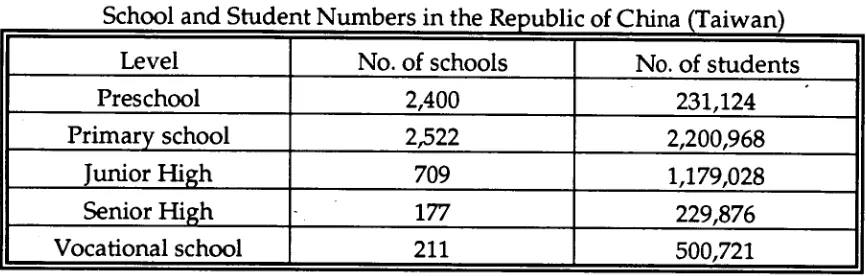
[image:17.565.89.522.283.421.2]Table 1.1 is compiled from statistics provided by the Ministry of Education in the ROC (GI, 1993:320-323).
Table 1.1
School and Student Numbers in the Republic of China Taiwan
Level No. of schools
, No. of students
Preschool 2,400 231,124 '
Primary school 2,522 2,200,968
Junior High 709 1,179,028
Senior High 177 229,876
Vocational school 211 500,721
As is evident from the above, environmental education up to secondary level in the Republic of China (Taiwan) potentially involves a large number of students (in total 4,341,717). Therefore, environmental education faces an enormous challenge.
1.3.3 Profile of environmental education in the Republic of China (Taiwan) Chen (1993) indicates that there are four major environmental education programs in Taiwan. They are: recycling education, outdoor education, enrichment reading materials for pupils, and the infusion model (i.e. environmental education across the curriculum). However lack of environmental education curriculum planning and inadequate teacher training in environmental education results in an inefficient outcome and may lead to conflicting practices within environmental education in Taiwan (Chen, 1993:1, 6-10).
the Baha'i Office of the Environment for Taiwan has launched joint projects with the Council of Agriculture to promote environmental education amongst kindergarten and primary school teachers around the country. Baha'i environmental education teams visit schools all over Taiwan, organising simulation games designed to teach basic environmental principles. The Baha'i community has also produced about 30 radio programs on environmental issues and published a book on environmental education in collaboration with a non government organisation, the Home Makers Union, which is a union for people occupied in the home (GI, 1993:493).
Insufficient teacher training is one of the most obvious problems of environmental education in the world (UNESCO, 1983a:36). In Taiwan, only student teachers of science have some environmental education content in their course. In the past four years more than 5000 teachers and administrators have received limited in-service training in environmental education through a variety of very short activities such as one day seminars (Chen, 1993:4).
1.4 Landcare
Teacher professional development is a continuing need in environmental education (Commonwealth of Australia, 1987:149), therefore there is a great need for a more comprehensive teacher training program in environmental education. The Landcare for Teachers Program provides a model for other teacher environmental education training programs and this will be examined later, but first the author reviews the development of Landcare in Australia. There are many definitions of Landcare used by different needs and interest groups. The Department of Primary Industry and Fisheries, Tasmania (1992) uses the following definition: "Landcare is about people working together to ensure that the use and management of the land resource is sustainable, both ecologically and socio-economically" (Department of Primary Industry and Fisheries, 1992:1).
1.4.1 Development of Landcare
Roberts (1989) points out that when the first European settlers arrived, they immediately reduced the ground cover by clearing, grazing and cultivation. Compared with the Aborigines, Europeans have made many mistakes in land use which has caused a large scale land degradation. After 200 years of European development, Australians are still coming to terms with the environment (Roberts, R., 1989:13).
From the mid-1940s the Australians became aware of serious environmental problems. Since 1945, South Australia has operated Soil Boards in several regions. Other states developed various forms of advisory groups in the 1960s in response to the more serious land degradation. In Victoria, a group of farmers tackling local land degradation and management problems through an integrated approach formed the beginning of 'Landcare', and community support for the popular farmer-led organisation has been building since the 1970s (Department of Primary Industry and Fisheries, 1992:3).
In the late 1970s, as signatory to an international agreement through the United Nations Organisation, the Federal Government adopted a National Conservation Strategy (NCS). This was followed by a Soil Conservation Strategy (SCS) in the mid-1980s plus State Conservation Strategies (SCS). The National Soil Conservation Program (NSCP) was established by the Federal Government in 1983 and in 1985 the Soil Conservation Act allowed the Federal government to grant funds to each state government for land conservation (Roberts, B., 1991a:2; 1991b:1).
Victoria first registered 'Landcare' as a government program to assist voluntary community land conservation groups in 1986. In the same year, the rural communities of many other states began informally establishing groups to tackle their local land degradation problems. The term 'Landcare' 'came to be used to describe these groups and the land conservation activities they undertook (Commonwealth of Australia, 1993:5).
• In 1989, the Australian Soil Conservation Council with the endorsement of the
for Landcare and associated conservation programs (Commonwealth of Australia, 1993:5).
According to the Federal Government, the main objective of the Decade of Landcare was to achieve ecologically sustainable use of Australia's lands by the year 2000. The former Soil Conservation Advisory Committee (SCAC) recommended to the Commonwealth Minister in early 1990 that the Federal Government should develop a plan for the Decade of Landcare to coordinate action by the community and all levels of government, to combat land degradation across Australia (Commonwealth of Australia, 1993:5-6).
1.4.2 Decade of Landcare Plan
In 1990, the Australian Soil Conservation Ministerial Council directed that all government agencies - the Commonwealth, States, and Territories prepare plans for the Decade of Landcare. These plans were to be based on consultation with all persons responsible for land management including individual land holders, community groups, States, Territory and Commonwealth agencies, local government and peak national bodies. Draft plans were submitted for community consultation. Late 1991 and early 1992 saw the release of plans for the Decade of Landcare (Commonwealth of Australia, 1993:6).
A National Overview was also prepared in which National Goals were to: • raise the awareness of the whole community about the problem of land
degradation and the benefits of sustainable land use;
• continue the development and implementation of sustainable land use principles and practices;
• allow all Australians to work together in partnership for sustainable land use; and
• put into place effective and appropriate economic, legislative and policy mechanisms to facilitate the achievement of sustainable land use (Commonwealth of Australia, 1993:6).
In 1993 Prime Minister Mr. P. Keating indicated that there had been a dramatic increase in the participation rate of people in Landcare groups, from 600 Landcare groups in 1990 to approximately 1600 in 1993. He recommended that the whole community make the sustainable use of natural resources a reality. The Federal Government has increased and diversified its support of Landcare programs in order to complement the Commonwealth commitment to ecologically sustainable policy (Commonwealth of Australia, 1993:foreword). Since 1993 The National Landcare Program (NLP) has been the Commonwealth's main natural resource management program to encourage a 'whole systems' approach. This approach is evident in the variety of Commonwealth agencies now involved in Landcare. The Landcare and Environment Action Program (LEAP) was established as a labour market program aimed• at supporting -Landcare related activities (Commonwealth of Australia, 1993:foreword).
In December 1992, Prime Minister Keating announced in his Statement on the Environment several initiatives to complement the Landcare effort including: * $2.9 million for a nationally coordinated program of water quality
monitoring activities designed to raise community awareness of total catchment management;
• an additional $7.6 million to enhance the Save the Bush program and to support a Corridors of Green project along the River Murray;
• an additional $46 million over 4 years for improved water management in rural and urban catchments to tackle the key sources of nutrients, such as sewage plants, that contribute to algal blooms in the Murray Darling Basin; and
• $15 million over the next four years for the control of feral animals and weeds, including $5 million for the control of Mimosa pigra, $2 million for a program to address the nature conservation threat posed by cane toads, and $8 million for programs to reduce the impact of feral animals and to encourage greater community involvement in their control (Commonwealth of Australia, 1993:foreword).
The national importance of Landcare was recognised with the issue of the Landcare series of 45 cent stamps on 11th of June, 1992, and a 1993 commemorative one-dollar coin.
1.4.3 Environmental education through Landcare
of Landcare education is to guide students through three phases of awareness, understanding and action but not necessarily in a linear sequence. They are also committed to the positive and holistic approach that Landcare education takes in its presentation.
"One major approach can be characterised as (being) based on appreciation rather than apprehension. A second approach focuses on systems not symptoms. Both of these approaches contribute to the third major thrust of Landcare education, the concept of 'land literacy'. This involves teaching students how to learn to 'read' the land, that is, to understand the processes and interactions between various elements" (Hobson and Stadler, 1992:76)2
Clacherty also refers to this concept, which he calls 'environmental literacy' (Clacherty, 1993:177).
Buxton (1989) considers that the inclusion of Landcare in the school curriculum reflects current educational principles, as listed below:
• relevance • access for all
• participation in community processes • learning in a variety of ways
• relating learning to action
• developing confidence and self-esteem • developing a sense of purpose
• developing cooperation and team work
• developing decision-making and problem-solving abilities • developing respect for different viewpoints
• involvement in real (rather than solely theoretical) experiences • developing creativity
• developing adaptability
understanding connections between subject areas • relating school subjects to society
• developing strategies and skills for conflict resolution
• developing environmentally responsible attitudes (Buxton, 1989:43).
Buxton, in writing of Landcare programs for upper primary schools, has identified many of the ideas common to the Landcare for Teachers Program. This suggests some common goals in Landcare, spanning primary to in-service teacher education.
Hobson and Stadler (1991) describe Australian Landcare education as incorporating the concepts and principles outlined above and being underpinned by major educational processes, as follows:
• Infusion into Existing Curricula • Experiential Learning
* Action Research
(Hobson and Stadler, 1992:76-77).
Throughout Australia many different types of Landcare education programs are being developed and implemented with a number of agencies involved, and the underlying concepts and principles of all Landcare education programs are similar (Hobson and Stadler, 1992:77), as illustrated by the example of Buxton's ideas above.
1.4.4 Elements of Landcare education
In the paper Landcare: Educating the Caretakers of Tomorrow's World, Hobson and Stadler (1992:88-90) identify several issues as being of national importance, particularly to those involved in the development and delivery of Landcare education. The "Five C's" of Landcare Education are concluded as:
1)Communication
Students, teachers, Landcare educators, facilitators and agencies should have communication networks.
2) Cooperation
One of the major themes of Landcare education is the concept of "links". Links are very important at the grass-roots level as there is a real need for complementary government departments to work together within a state, between people.
3) Continuity
Any form of education is a long term process. The following factors contributing to the maintenance of momentum of Landcare have been identified as:
* the continuity of the recently established network of Landcare educators at the natural level
* the development of mechanisms to ensure that successful and effective programs continue after the first flush of funding
4) Community
Lubczenko (1991) claims that the whole community should benefit from the inclusion of Landcare into school curriculum as it:
* promotes a conservation ethic
* integrates the principles of conservation and sustainable development * promotes and strengthens education programs
* provides a range of teaching and learning experiences : a)the solving of real problems
b)the clarification of values c)direct experience
d)cooperative learning experiences e)worldng together in groups f)the opportunity for success
* provides opportunities for hands-on activities and development of skills ( problem solving, manual, social)
* increases community awareness and involvement
* encourages the adoption of environmentally responsible attitudes and behaviours
* relates learning to the immediate real life environment (Lubczenko, 1991:98).
5) Commitment
All of the above points are very important, but the most essential element of Landcare is the visible commitment of everybody involved, without which it will not succeed (Hobson and Stadler, 1992:88-90).
1.4.5 The role of teachers in Landcare education
Teachers are in a special position to pass an understanding of the Landcare ethic to their students while putting positive steps or approaches to remedy Landcare problems into practice. Teachers also have a multiplier effect in terms of the number of students with whom they come into contact (Hobson and Stadler, 1992:84).
1.4.6 Landcare training for student teachers in Australia
CHAPTER 2: THE LANDCARE FOR TEACHERS PROGRAM
In all countries teachers play a critical role in the actual implementation of environmental education in the school system (Ballantyne and Tooth-Aston, 1989:3; UNESCO, 1988:preface). Through environmental education, teachers help students to understand the interrelationship of all parts of the environment. Students can gain this understanding by learning about the environment, by learning the skills involved in investigating questions and issues in the environment and by acquiring attitudes of care and concern for the environment which should be a holistic concept (Fensham, 1986:244). The Landcare for Teachers Program purports to be a potentially good example of a holistic approach to environmental education.
2.1 Introduction
The Landcare for Teachers Program is a teacher training program which has been developed by Stadler in 1990 at the Centre for Environmental Studies, University of Tasmania. It was the first University-accredited Landcare course aimed specifically for the Bachelor of Education (in-service) teacher education program where it comprises one unit in the subject 'Topics in Science'. The unit 'Soil Conservation', otherwise known as 'Landcare for Teachers', also represents 5% of the full Diploma of Education in the pre-service teacher education program at the University of Tasmania (Stadler, 1991:4).
Participants have to pay the Higher Education Contribution Scheme (HECS) fees if they want accreditation, but the course is free for participants who take it out of interest (Stadler, 1993:3).
Importantly, the program uses an integrated approach to Landcare Education which enables teachers to help their students move from an awareness of Landcare issues to take action for the environment in a very practical way (Traynor, 1990:175).
a positive attitude is a key feature of the course and teachers can follow up by introducing Landcare into their teaching curriculum in a practical way.
Reference to the course coordinator reveals that the thirty six hour course includes a series of seminars, practical activities and field trips to farms, school and other places of Landcare interest (Stadler, T., 1994; personal communication). The emphasis of the course is on linking all the separate elements of Landcare together into a holistic framework and is intended to be an enjoyable, accessible and an interesting way to learn, especially for teachers without a science background (Robottom, Markowitz and Wright, 1985:37; Simmons, 1989:17).
The coordinator of the course indicates that the seminar and excursion leaders are specialists in their own field of Landcare (such as soils, vegetation, catchment management and recycling) who transmit knowledge of their subject in a non-technical way to teachers, many of whom do not have a background in science. The enthusiasm of the leaders and their commitment to Landcare education are major factors in making the program a success (Stadler, T., 1994; personal communication).
Landcare education is a good example of environmental education because Landcare is suited to the curriculum at all age levels and it can be integrated into all subject areas from language and art to social studies and the sciences. It is important that school students can become involved in diverse Landcare activities including (for example) the rehabilitation of degraded bush areas in their school, planning their school grounds or organising Junior Landcare conferences (Traynor, 1990:174; UNESCO, 1983c:8).
Reference to the course coordinator shows that the program aims to make teachers who have completed the course better equipped at incorporating Landcare as school adaptable elements into their teaching. It provides them with greater knowledge and skills as well as confidence in teaching about Landcare which is very important for a good environmental education program (Traynor, 1990:175).
The participants also make contact with a number of additional resource people who can visit them at their schools and help get a Landcare program working. The ultimate goal of the program is to get school students involved in doing something positive and practical for the environment.
2.3 Formation of the Landcare for Teachers Program
Stadler, the program coordinator was trained as a secondary language teacher before she studied environmental studies. While finishing her PhD research, she began to recognise the need for teachers to understand and teach about soil conservation. In 1988 ground work started, including talks to the Education Department and the Centre for Environmental Studies at the University of Tasmania, the Tasmanian Agriculture Department (now the Department of Primary Industry and Fisheries), and the Education Department to discuss the possibility of setting up a course for teachers (Stadler, T., 1994; personal communication).
The replies from different departments were very supportive and Stadler made a grant application in 1989-1990 to the National Soil Conservation Program to develop the Landcare for Teachers Program at the University of Tasmania (Stadler, T., 1994; personal communication).
Topics for the course and the type of course to be offered were decided by talking to teachers and finding out what their needs were. Finding leaders was the next important step. Characteristics considered when employing leaders were: a passion for their subject, a willingness to lead sessions, and the ability to pass on their knowledge in an easy way making it as accessible and practical as possible. The ability to communicate was considered more important than formal qualifications since it is not always the most highly qualified person who is good at passing on their experience (Stadler, T., 1994; personal communication).
2.4 Course Development
According to Stadler, the course must be accessible and the knowledge assimilable so that teachers with a non-science background can also enjoy and understand the course and obtain a comprehensive grasp of Landcare. The course was intended to be available to any teacher regardless of whether they have a science background or not (Robottom, Markowitz and Wright, 1985:37). The basic topics for the course are soil, vegetation and water. Other related topics were added as leaders become available. The topics change from time to time depending on new demand or local needs and the availability of leaders. The Landcare for Teachers Program was initially funded by the National Soil Conservation Program (NSCP) but it is now funded under the National Landcare Program (NLP) and annual applications to continue funding are necessary. Total NLP funding for the four years of the project was AUS$ 203,000. This covered the operating costs of the project as well as the salary and travel costs of the coordinator whose primary task was the development of the Landcare for Teachers Program in Tasmania and other states. The position of coordinator also included other tasks related to the promotion of Landcare education in Tasmania and elsewhere. The contribution to the project by State government agencies, such as the Department of Primary Industry and Fisheries, included the provision of technical expertise and seminar leadership (Stadler, T., 1994; personal communication).
trips. They also included expenses incurred in course promotion and publicity. A number of shorter Landcare education seminars and workshops were also organised but they do not fall within the parameters of the present research (Stadler, T., 1994; personal communication).
2.5 Some Difficulties Faced in the Program
According to the program coordinator, publicity is sometimes difficult, as some early courses were not very successful due to low numbers. It was especially difficult to start courses at the Launceston Campus, University of Tasmania. This may have been caused by lack of an equivalent information centre such as the Tasmanian Environment Centre in Hobart. This shows that creating networks is very crucial for passing on information. Also it is sometimes difficult to find suitable leaders.
2.6 Future of the Program
The coordinator of the Landcare for Teachers Program, Dr. Stadler, says that she would like to see the course continue as part of the teacher education system and for the course to reach interested teachers all over Tasmania as well as other States and Territories. She estimates that more than twenty percent of all schools in Tasmania are involved in Landcare and this could be boosted in the future.
Ongoing work on the Landcare teaching scheme is critical as it should not stop half way. More teachers need Landcare education training and they need to be able to build on previously learned skills. There is a concern that before the end of the Decade of Landcare, program funding from the Federal Government will be stopped. Marketing the course as a teacher professional development program might allow it to become self-funding rather• than relying on government funding.
2.7 Content of the Landcare for Teachers Program
2.7.1 Researcher participation and observation
Most social research begins with a period of informal observation - generally participant observation (Wadsworth, 1984:40). The author has sat in on term time courses in 1992 and 1993 on such topics as 'The Living Soil - Earthworms', and 'Landcare from a Global Perspective', and has taken part in the 'Whole Farm Planning Excursion' and 'An Erosion Example - Green Valley' field trips to observe the term time courses in progress.
In addition, the author participated in the Landcare for Teachers Summer School 1994 at Hytten Hall, University of Tasmania, 10-14 January, which included a follow-up day excursion on 14th May to Bangor on the Forestier Peninsula, Tasmania.
2.7.2 Record of 1994 Summer School
Part of the Summer School course was recorded by means of video, slides and photographs with the agreement of seminar leaders and all participants. This technique was considered to be the most appropriate first-hand record for demonstration in other places such as Taiwan. In addition, using video and photography cameras as the media for recording the course directly generates material that stands as evidence in itself (Wadsworth, 1984:41).
The structure of the course is the result of refining past courses. For example, the balance between theory and practical activities, and the variety of topics and resources have been taken into consideration (see Appendix 1 - 1994 Summer School Time Table). What follows are some brief notes on the topics covered.
Each seminar contained comprehensive information about the topic. For example, the topic Introduction to Soils' began with four reasons to conserve soil and then explained soil formation, followed by soil components and horizon development, along with some soil properties important to plant growth.
To understand soil behaviour when disturbed, a hands-on demonstration was held outside the classroom to show how to conduct soil activities suitable for students such as soil absorption and the importance of soil cover.
The topic 'Water Cycle' started with a catchment model in which water was poured on sloping ground outside the classroom. This was followed by a lecture, using the overhead projector and slides to show the interaction between rocks, soil and water in shaping the land.
This included the relationship between soils and water, water on Earth, and the hydrological cycle. A video tape Fresh Water produced by the 'Stream Watch'
program of Water Board, New South Wales, 1991, was also used as an example of a water-related resource.
The topic 'Landcare in the Curriculum' opened with a discussion of Landcare and school with teachers and the leader's own experience with developing school-based Landcare activities such as local area historical research and the Worm Watch program with school children. This was followed by taking the whole class outside the classroom, the nearby university yard, to demonstrate two activities: 'My Patch - A story based on shared discoveries of the land' and 'The Story of the Great Brown Land'.
In the first activity a rope was placed around a square metre patch of ground by each participant who then had to:
* think about why they chose one area and not another;
* get to know their "patch" and discover how their "patch" fitted into the surrounding catchment;
* think about the most interesting elements about their "patch";
* sit in their "patch" and write non-stop about their "patch" for two minutes; * describe their "patch" to other people in the class; and
The second activity was designed to be interactive, to encourage children to relate to the problem of Landcare in Australia. The story, The Great Brown Land
(Smit, 1933), is told about the Australian land use history using cloth (shape of Australia and ocean), natural materials such as seeds, leaves, grass (vegetation), and toys such as aeroplane, sheep and cattle models (human influence). This illustrated abstract concepts, such as what is wrong with our environment and what can we do about it, making them visible and easy to understand.
After the activities, the whole class went back to the classroom to discuss the practicalities of improving school grounds, and watched a British video tape
Learning Through Landscapes. The use of school grounds is more effective and
easier than excursions as the form of education in the environment (Baines, 1986:10). The class then divided into primary and secondary school groups to discuss their different needs in the school curriculum.
Finally the leader showed participants how to make a "soil sundae" to increase their awareness of the different types, textures and colours of soils in a given area. Participants were shown how to use a tall clear container or parfait glass, plastic bags to collect different soil samples , and large spoons or trowels to collect soil to make layers with different colours and textures of soil.
The leader of the topic 'Greening Australia' provided "Tree Growing Kit Instructions" and demonstrated actual techniques such as filling punnets with soil and sowing the seeds, preparing the germination mix and special treatments, pricking out and preparing the potting mix, and looking after the seedlings.
The topic 'Weeds' started by discussing definitions of weeds with some reinforcement of plant biochemistry. The group also discussed the usage and control of weeds. This session ended by showing how teachers could collect and press their own samples of weeds.
The topic 'Earthworms/Composting' was led by an organic gardener who brought different earthworms and a worm farming kit to show how to breed and identify earthworms. The leader also demonstrated how to make one's own compost bin effective and economical.
The leader of the topic 'Endangered Species' started by giving definitions and detailing the importance of endangered species. This was followed by slides and some examples. The Endangered Species Network in Tasmania was also introduced.
The excursion 'Everyone lives in a Catchment' was led by the Soils Officer at the Department of Primary Industry and Fisheries, and a geologist formerly from the Mines Department. A university bus was used to transport the class to a stream of Mt. Wellington to look at soil profiles. The trip travelled through South Hobart to see the different landforms and geology of two catchments. The field trip 'Waverley Flora Park: a Landcare education resource' was led by a botanist who is a trained secondary school biology teacher. Participants were shown different vegetation types and asked to collect leaves of different shapes as an observation activity. Fire management in the park was also discussed. This trip required own transportation and some participants were absent. The excursion 'Visit to a successful Landcare School at Sore11' was led by a teacher. A University bus was used to transport participants to the location. The session started by discussing Landcare teaching at school and the recycling project link with the community in a "recycling and Landcare centre" which is located in Sore11 District High School. This was followed by visiting the school farm and viewing the school ground as concrete examples of Landcare education in school.
A visit to the Tasmanian Environment Centre was a great experience for teachers who were not aware of the rich collection of environmental education materials and particularly those Landcare resources available, including books, video tapes, audio tapes, slides and human resources.
About four months after the five-day intensive course, a follow-up day excursion which took participants to Bangor was held to complete the 1994 Landcare Summer School on Saturday, 14th of May. A University bus was used to transport the group to a private farm at Bangor on the Forestier Peninsula. Some participants were absent due to various reasons but some participants attended from Launceston and other distant areas.
• This session was started with a introduction by the owner of the property who had funds from the National Landcare Program to develop the Landcare project "Sustainable Agriculture at Bangor, Dunalley".
This was followed by the project educator (a person employed at Bangor as an educational officer), who was also one of the Summer School participants, to show other participants the Landcare Education Programs she had developed for schools. Those included, for example, vegetation, animals, landform and history. Because this was the first year, the guide on information and activities for both students and teachers were not yet finished and will be expanded so that they are more specific and detailed.
After the tour of different areas of the farm with regard to possible Landcare excursions for classes, a brief discussion about every participant's work in Landcare teaching was held to exchange their own experience and to share their ideas. Due to time constraints all participants expressed the need for another follow-up meeting at the end of the year.
2.7.3 Data of Summer School survey
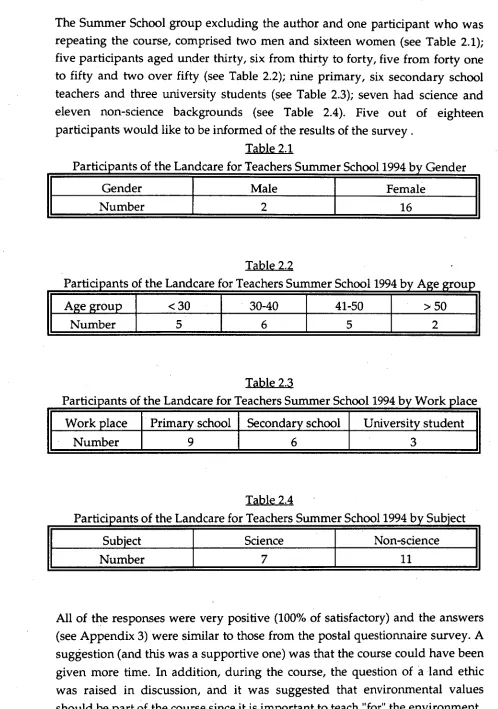
The Summer School group excluding the author and one participant who was repeating the course, comprised two men and sixteen women (see Table 2.1); five participants aged under thirty, six from thirty to forty, five from forty one to fifty and two over fifty (see Table 2.2); nine primary, six secondary school teachers and three university students (see Table 2.3); seven had science and eleven non-science backgrounds (see Table 2.4). Five out of eighteen participants would like to be informed of the results of the survey.
Table 2.1
Participants of the Landcare for Teachers Summer School 1994 by Gender
Gender Male
_ Female
[image:37.568.43.541.59.768.2]Number 2 16
Table 2.2
Participants of the Landcare for Teachers Summer School 1994 by A e rou
Age group <30 30-40 41-50 >50
Number 5 6 5 2
Table 2.3
Participants of the Landcare for Teachers Summer School 1994 by Work place Work place Primary school Secondary school University student
Number 9 6 3
Table 2.4
Participants of the Landcare for Teachers Summer School 1994 by Subject
Subject Science Non-science
Number 7 11
CHAPTER 3: POSTAL QUESTIONNAIRE SURVEY
Over an approximate one month period from 29th October to 23rd November 1993, a questionnaire with a covering letter (see Appendices 2a, 2b), and a survey reminder (see Appendix 2c) was sent to all participants (132) of the Landcare for Teachers program between 1990 to 1993. These included primary and secondary school teachers and other educators in the environmental education field, such as government Landcare officers and non-government organisation instructors.
3.1 Aims of the Postal Questionnaire
The purpose was to evaluate the program for its educational outcomes for teachers and for school practices. The aims of the questionnaire were:
1. to ascertain the participants' motivations for undertaking the course and to assess the degree to which their expectations were satisfied (cf. UNESCO, 1983c:9);
2. to find out which aspects of the program were most helpful and particularly which topics were most useful for developing the teachers' skills and knowledge and for classroom use (cf. Niedermeyer, 1992:48; UNESCO, 1983a:36);
3. to compare differences due to participants' personal background;
4. to investigate the attitudes and opinions of educators about Landcare teaching and identify possible obstacles to the implementation of Landcare activities (as part of environmental education) in schools;
5. to recommend improvements to the program in Tasmania and similar programs elsewhere in Australia; and
6. to examine the potential to introduce such a course to the Republic of China (Taiwan).
3.2 The Postal Questionnaire Method
On 29th October, 1993, the participants' addresses were updated and the participants were sent the questionnaire with a covering letter (see Appendices 2a, 2b), and a prepaid self-addressed envelope.
Three weeks later, a survey reminder (see Appendix 2c) was sent to stimulate the response rate. The author found that this improved the level of responses. Four envelopes were sent back marked "unknown at this address", and the author had to delete these participants from the files for the purposes of this survey.
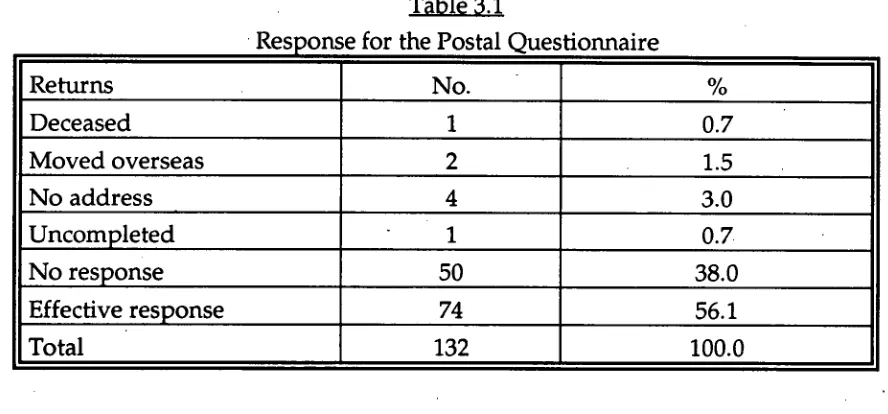
[image:40.565.82.526.366.573.2]A small number of others had to be excluded from the survey for the reasons set out in table 3.1 below. Ultimately 74 completed questionnaires were received, which represents 56.1% of all the course participants. Included in this total were returns received from persons who are now working interstate or who have changed their addresses. A summary of the returns is presented in Table 3.1 below, and the representativeness of these is discussed later.
Table 3.1
Response for the Postal Ouestionnaire
Returns No. ok
Deceased 1 0.7
Moved overseas 2 1.5
No address 4 3.0
Uncompleted 1 0.7
No response 50 38.0
Effective response 74 56.1
Total 132 100.0
The data were entered into an IBM microcomputer using the package Microsoft Excel Version 4.0 for Windowslm Series (see Appendix 4) and the data later was transferred onto a Macintosh Apple computer and StatView 512+ statistic package software was used in the analysis.
All those who were non respondents for whatever reasons including those with no current address have been grouped together, and telephone interviews were conducted in an attempt to clarify positions held by non-responding participants.
3.3 The Postal Questionnaire Results 3.3.1 Respondent profile
A higher proportion of respondents (64%) were females than males (36%), which reflects the ratio of females to males who did the course. There are 49 (37%) male and 83 (63%) female participants in this survey, thus the distribution is closely representative of the whole sample (see Table 3.2).
Table 3.2
Postal Questionnaire Responses by Gender
Gender Male
_
Female
Response rate 36% 64%
Table 3.3 shows that the highest response rate came from the age group 41-50 (42%), followed by age group 31-40 (30%), 30 or younger (16%) and lastly over 50 (12%).
Table 3.3
Postal Questionnaire Responses by Age grou
Age group <30 30-40 41-50 > 50
Response rate 16% 30% 42% 12%
Forty five percent of respondents were primary school teachers, 34% were secondary school teachers and 17% were non teachers. 4% did not reveal their work place (see Table 3.4).
Table 3.4
Postal Questionnaire Responses by Work place
Work place Primary school Secondary school Other No answer
Table 3.5 shows that respondents who taught science subjects made up 46% of the group, 31% did not teach science subjects and 23% did not indicate whether they taught science or not.
Table 3.5
Postal Questionnaire Response by Subject
Subject Science
,
Non-science No answer
Response rate 46% 31% 23%
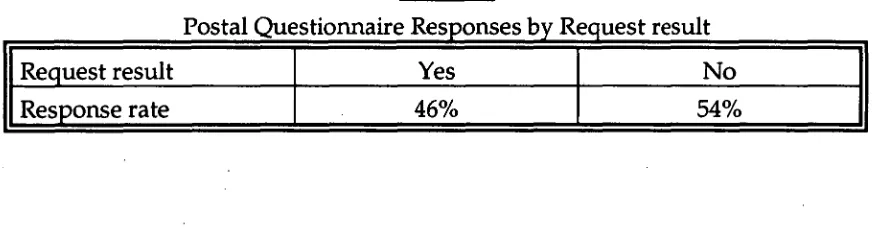
[image:42.565.85.521.331.446.2]Forty six percent respondents requested the results of this survey and 54% did not request results of this survey (see Table 3.6).
Table 3.6
Postal Questionnaire Responses by Request result
Request result Yes No
Response rate 46% 54%
Question 1. When did you participate in the Landcare for Teachers program?
There are two courses available in the Landcare for Teachers program. Forty five percent of responses were from summer school participants and 54% responses were from school term participants, 1% of responses did not specify which course the person attended (see Table 3.7).
Table 3.7
Postal Questionnaire Res onses by Course
Course Summer school School term No answer
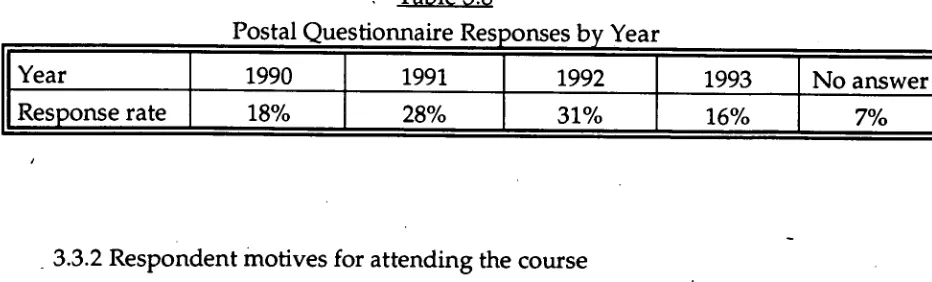
Responses were gathered from people who attended the course over a range of years 1990 (18%), 1991 (28%), 1992 (31%), 1993 (16%), 7% of respondents did not indicate which year they attended the course (see Table 3.8).
Table 3.8
Postal Questionnaire Responses by Year
Year 1990 1991 1992 1993 No answer
Response rate 18% 28% 31% 16% 7%
_ 3.3.2 Respondent motives for attending the course
Question 2. What made you decide to participate in the Landcare for Teachers program?
Participants were able to give more than one reason for participating in the course, thus the results add up to more than 100%.
89% wanted to find out more about Landcare, 73% were concerned about the environment,
64% wanted to increase their confidence in teaching Landcare issues, 41% wanted to update their scientific knowledge,
36% wanted to develop their teaching skills,
34% wanted to include more science teaching in their classes, 20% wanted to gain qualifications / accreditation (e.g. Dip.Ed.), 5% gave other reasons, such as:
"personal interest only",
"To link with an Environmental recycling program and to link with a green house set up in school over years",
"I have a particular interest in the land",
"To establish a new course of study for Red Cross Youth nationally and internationally",
3.3.3 Respondent satisfaction with the course
Question 3. Were your expectations realised?
Ninety three percent gave a positive response whilst for 7% the course did not fulfil their expectations. Many participants gave extra information. Fifty four respondents provided a comment in the open ended component of this question. For the purpose of analysing these open responses, nine broad categories were adopted with the number of answers shown in brackets:
Those who answered yes, 1. (21) Informative
2. (14) Learning experience
3. (12) Increased knowledge of Landcare 4. ( 3) Practical use in teaching
Those who answered no,
5. ( 3) Need more hands-on practical activities
6. ( 1) Further development of topics would be useful 7. ( 1) Not enough to enhance teaching skills
8. ( 1) Forced to close the course early due to lack of takers 9. ( 1) Had no expectations
The need expressed for hands-on practical activities indicates that environmental education should include more reality-based and action-based approaches (UNESCO, 1983a:13).
Obviously the categorisation of these written comments is somewhat subjective. The total of the number in brackets exceeds 54 because some mentioned more than one reason.
Of those who felt their expectations were realised most felt this was because the course was informative. For example, some comments were :
"Very informative at a personal and teaching level", "It helped with my environmental knowledge",
"It increased my knowledge and continued my interest",
"My increased knowledge and the information to find help in the essential places certainly helped",
"I felt I learnt a great deal about aspects of the environment and felt qualified enough to teach young students about some important issues",
"It was a very informative, practical course",
"1. Access to suitable aids and other materials, books etc. 2. Access to specialist people.
3. Access to program already in operation",
"The course was comprehensive and practical both in personal information and in teaching curriculum".
The second reason respondents' expectations were realised was because of its value as a learning experience. For example, some comments were:
"A good range of environmental topics",
"A balanced view point was given which was a pleasant change from other environmental seminars",
"The course provided a broad spectrum of issues which gave impetus to further inquiry and investigation on an individual basis",
"A practical approach : enthusiastic tutors",
"A well planned unit which gave lots of inspiration for classroom activities", "A well organised broad based overview of the problems and some indication of remedies",
"Varied topics covered, excellent activities trialed", "Most interesting And varied course",
"Provided a structure to develop Landcare in school within science curriculum",
'Well qualified people taking course, length of course gave time to learn a lot", "Applied nature of course was excellent",
"Good lectures, really good and stimulating fellow students",
"There was a good tie of practical and expertise from people working in related fields",
Question 4. Were there any unexpected benefits?
Sixty one percent of responses indicated that unexpected benefits were gained from the program, 38% did not get any unexpected benefits and 1% did not answer. Forty seven respondents gave extra information. As in question 3, nine broad categories were adopted with the number of answers shown in brackets: 1. (15) Sharing ideas professionally
2. ( 8) Resource materials available 3. ( 7) Enthusiasm for course 4. ( 6) Knowledge gained and used 5. ( 4) Learnt a lot about practical skills 6. ( 3) Optimism for the future
7. ( 2) Field trip benefits
8. ( 1) Landcare group values realised 9. ( 1) Follow up support available
The most commonly reported benefit was sharing ideas professionally. For example:
"Friendships; professional networking", "Networking with other interested people",
"Opportunity to contact other teachers in similar situations", "Professional contact/interchange",
"Good to make contacts with other Landcare professionals and teachers associated with Landcare",
"Contact with teacher in similar position. I learnt as much from the other participants as from the lecturers",
"Getting to meet with like-minded teachers and hearing about what others have done in their schools has certainly spurred me on",
"Networking other schools"
The second unexpected benefit was availability of resource material. For example:
"Some teaching aids (e.g. slide kits) which I was not aware or, "The availability of other resources and resources centres", "Materials to use at school",
Question 5. What aspects of the course were most helpful in developing your own skills and knowledge?
Sixty-five respondents provided a comment in the open ended component of this question. Eight broad categories were adopted with the number of answers shown in brackets:
1. (17) Field trips and excursions 2. (15) Practical sessions
3. (14) Resource materials available 4. ( 9) Other aspects of course e.g. theory 5. ( 7) Contacts
6. ( 7) Diverse approaches to subject 7. ( 6) Lecturers in different areas 8. ( 2) Visit to other schools
Of these answers, field trips and excursions were cited as most helpful in developing their own skills and knowledge. For example:
"Greening Australia Program, actual trips e.g. Liffey Valley scheme, soil testing - field work and links back at TSIT (Tasmanian State Institute of Technology).", "Seeing real life examples of damage",
"Theory session followed by excursions which demonstrated knowledge learnt",
"Field trips",
'Whole farm planning",
"Slides of land erosion and trip to Midlands property to view solutions", "Demonstrations and soil identification excursion",
"Field work",
"a) Excursion e.g. to roadside revegetation and soil profile; b) Practice soil tests",
"Field trips - hands on and first hand experience of what had been discussed in lectures"