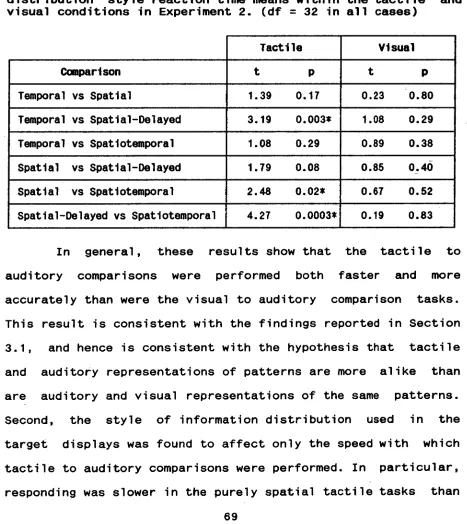
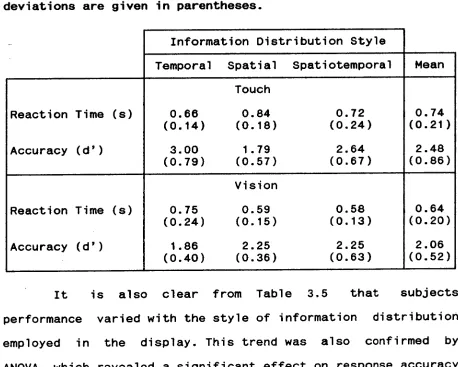
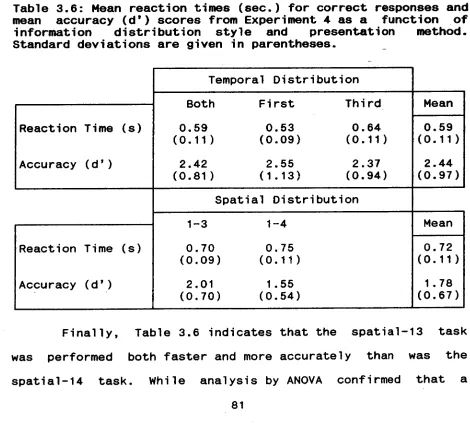
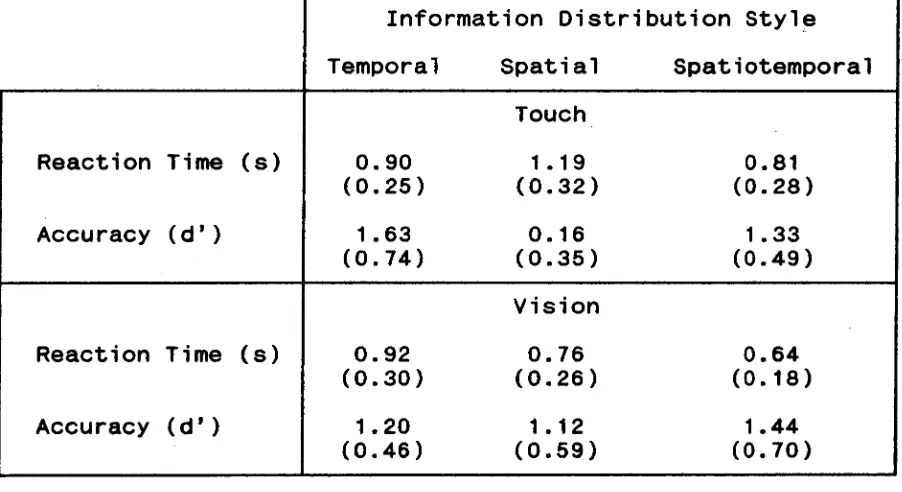
‘C
vo,
Douglas P. Mahar BA(Hons)
Department of Psychology
Submitted in fulfillment of the requirements for the degree of Doctor of Philosophy
I hereby declare that the research reported here is my own original work which has not been submitted for any other degree or diploma. To the best of my knowledge all contributions to the body of this work which are not my own have been appropriately cited and acknowledged.
OF TASMANIA LIBRARY
Abstract
The research reported in this thesis took as its starting point the question of whether touch has the information processing characteristics required to deal with speech transforms. A review of the current status of tactile speech prostheses and of the range of potential limitations to touch's ability to deal with speech transforms, lead to the identification of two specific research foci.
First, it was argued that an appropriate strategy for tactile aid development is to establish where tactile and auditory processes overlap and where they differ, then to take advantage of any similarities, or compensate for any differences, between these modalities in the design of the prosthesis. In line with this argument, a series of experiments was undertaken to test previous suggestions that there is an underlying similarity between auditory and tactile representations of stimuli. In support of these claims, it was found that auditory and tactile versions of patterns are easier to compare than are auditory and visual versions of those patterns. Subsequent research revealed that one aspect of this processing affinity between touch and hearing is that both modalities, unlike vision, process temporally distributed
information more efficiently than spatially distributed information. This finding has broader theoretical significance in view of the current controversy regarding the division of senses according to a spatial vs temporal criterion.
speech transforms. It was argued that the limiting factors in tactile spatial and temporal acuity were more likely to occur at the higher level of touch's ability to deal with the strong
interactive effects between pattern elements, rather than at the lower level of two-point thresholds in time and space. As masking is a primary interactive force between tactile pattern elements, an attempt was made to resolve the ongoing debate regarding the extent to which tactile masking effects either limit the perception of complex tactile patterns by obscuring the identity of pattern elements or facilitate this task via a process of perceptual integration.
This question was investigated by measuring the discriminability of three-element tactile patterns as the spatial and temporal separation, and hence the level of masking, between pattern elements was varied. It was expected that performance would De best at closer element spacings, due
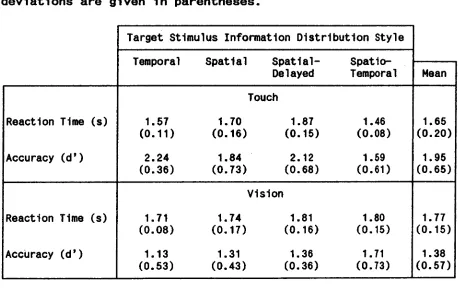
to the greater opportunity for perceptual integration to occur. Contrary to this prediction, it was found that the increasing levels of masking induced by decreasing the spatial and temporal separation between pattern elements caused a decrease in the discriminability of the patterns.
subjects from the previous experiment. After brief experience with closely spaced tactile patterns, the subjects were able to discriminate these stimuli at least as well as widely spaced tactile patterns.
While failing to demonstrate the proposed beneficial effects of integration, these results did indicate that close spatial and temporal proximity between tactile pattern elements may not adversely affect the discriminability of those patterns. If subsequent research confirms this tentative finding, then the implication for tactile speech prostheses is that the display employed need not avoid the strong masking effects induced by close spatial and temporal proximity between speech pattern elements.
OF TASMANIA . LIBRARY
Acknowledgement
Thanks to my supervisor of the past three years, Dr. Brian Mackenzie, to my initial supervisor, Professor Don McNicol, and to my associate supervisor, Dr. George Wilson, whose encouragement and assistance underlie this research. Thanks also to Mr. Peter Tattam for his assistance in the development of the computer software used in this research, - as
Page
Chapter 1: A Review of the Current Status of Tactile
Speech Prostheses 1
1.1: The principles behind tactile aids 3 1.2: Varieties of tactile prostheses 5 1.3: The utility of tactile prostheses 8 1.3.1: Sound detection and identification 8 1.3.2: Perceiving speech features 9 1.3.3: Perceiving words and sentences 13 1.4: Optimizing multichannel prostheses 17
Chapter 2: A Review of Tactile Processing Abilities in
the Context of Tactile Speech Prostheses 24
2.1: Is the speech code special? 25
2.2: The resolution of the skin 29
2.2.1: Frequency specific tactile processing
channels 30
2.2.2: Tactile frequency resolution 33 2.2.3: Tactile spatial resolution 35 2.2.4: Tactile temporal resolution 39 2.2.5: Tactile amplitude acuity 40
2.2.6: Conclusions 43
2.3: Similarities between touch and hearing 44 2.3.1: Auditory and tactile responses to vibrations 45 2.3.2: Perceptual similarities between hearing and
touch 47
of Spoken Words 50 3.1: Comparisons between auditory, visual, and tactile
representations of spoken words 51 3.2: Experiment 1: Discriminability of the tactile and
visual displays used in Mahar's (1985) study 57
3.2.1: Method 57
3.2.2: Results and discussion 58
3.3: Experiment 2: Cross-modal comparisons and
information distribution style 61
3.3.1: Method 62
3.3.2: Results and discussion 66
3.4: Experiment 3: Display discriminability and
information distribution style 70
3.4.1: Method 70
3.4.2: Results and discussion 71
3.5: Experiment 4: A confirmation and extension of the
tactile data from Experiment 3 77
3.5.1: Method 78
3.5.2: Results and discussion 89
3.6: Summary and Conclusions 82
Chapter 4: The Processing of Spatially and Temporally
Distributed Information in Different Modalities 85 4.1: The Space:Time::Vision:Audition analogy 86 4.2: Spatial and temporal processing in hearing and
vision 88
4.3: The tactile modality 93
4.4: Experiment 5: A replication and extension of
Experiment 3 94
4.4.1: Method 95
4.5.1: Method 100 4.5.2: Results and discussion 101
4.6: General discussion 102
Chapter 5: The Role of Masking and Integration in the
Processing of Tactile Patterns 107
5.1: What is masking? 109
5.2: Tactile masking phenomena 111
5.2.1: Temporal characteristics of tactile masking 112 5.2.2: Spatial characteristics of tactile masking 116 5.2.3: Other factors in tactile masking 119 5.3: Masking and pattern perception: Competing views 121 5.4: The case for the Isolation and Integration
Hypotheses 124
5.4.1: Masking and integration 125 5.4.2: Testing whether integration is beneficial 129 5.4.3: Integration and tactile transforms of speech 137 5.4.4: Masking in other modalities 140 5.4.5: Learning to deal with masking 143
5.5: Conclusions 146
Chapter 6: Testing the Integration Hypothesis 149 6.1: Experiment 7: Element proximity and pattern
recognition 151
6.1.1: Method 151
6.1.2: Results 158
6.2.1: Method 167
6.2.2: Results 169
6.2.3: Discussion 174
6.3: Conclusions 175
Chapter 7: Summary and Prospectus 178
7.1: Tactile processing abilities 179 7.2: Comparisons between hearing and touch 180 7.3: Masking and perceptual integration 185
7.4: Conclusions 191
References 193
Appendices 208
Appendix A: Signal Detection Theory 209 Appendix 81: Mean accuracy scores for each subject in
Experiment 1 215
Appendix B2: Mean accuracy and reaction time scores for
each subject in Experiment 2 216 Appendix 83: Mean accuracy and reaction time scores for
each subject in Experiment 3 217 Appendix B4: Mean accuracy and reaction time scores for
each subject in Experiment 4 218 Appendix B5: Mean accuracy and reaction time scores for
each subject in Experiment 5 219 Appendix B6: Mean accuracy and reaction time scores for
each subject in Experiment 6 220 Appendix B7: Mean accuracy scores for each subject in
Experiment 7 221
Appendix 88: Mean accuracy scores for each subject in
Experiment 8 222
The research reported here addresses several issues in the field of tactile information processing which are relevant to the development of tactile speech prostheses for the profoundly deaf. While the emphasis upon tactile prostheses guides the choice of research problems, this research maintains strong links with broader issues in the field of tactile perception.
This first chapter provides an overview of the rationale underlying tactile speech prostheses and a review of their current status. This review is intentionally selective, focusing on several of the most successful recent devices which characterize the various strategies which have been adopted. Following this review, several possible areas for further research are considered, with the conclusion that most emphasis should be placed on establishing whether touch has the
information processing properties required to deal with transforms of speech stimuli.
Chapter 2 reviews this question at length, identifying two aspects of tactile information processing which must be examined on the path to the development of optimal tactile transforms of speech. The first of these is the extent to which auditory and tactile perceptual processes are alike or compatible, while the second is the capacity of touch to deal with the very complex patterns of stimulation associated with speech transforms.
representations of speech-like stimuli are alike, along with the related possibility that fundamental differences exist between these modalities in terms of the relative efficiency with which each processes spatially and temporally distributed information. Chapters 5 and 6 address the second aspect of tactile information processing raised in Chapter 2, that is the ability of touch to deal with complex patterns of stimulation. This issue is addressed with particular reference to the extent to which masking and integrative effects between tactile pattern elements either impede or facilitate the perception of those patterns.
1.1: The Principles Behind Tactile Aids.
Individuals with hearing losses greater than 90 dB effectively have no access to acoustic information. As a result, they have difficulties in the areas of speech perception, speech production, and the perception of acoustic events in the environment. Ideally, a remedial strategy should address all of these consequences of profound hearing loss.
while lipreading provides information about the place of articulation of segmental speech features, it does not allow either prosodic features, voicing, or the manner of articulation to be identified (Risberg and Lubker, 1978; Woodward and Barber, 1960 ). Further, lipreading provides no cues to aid in either speech production or the perception of acoustic events in the environment. Finally, although
sign-language allows relatively rapid rates of both receptive and expressive communication, it is only of use amongst the small population of trained users and does not assist the perception of acoustic environmental events.
normal function of the ear on the surface of the skinl. Although the current generation of devices present this information through different types of transducers (for example either mechanical vibrators or electrodes), to different sites on the skin (for example to the fingers or forearm), most share this style of coding strategy and differ primarily in terms of the range of acoustic features encoded.
1.2: Varieties of Tactile Prostheses
In their review of tactile communication systems Weisenberger and Miller (1987) categorized auditory perceptual tasks along a continuum based upon the cumulative level of
information required to perform each task. Their scale ranged from the simple_ detection of sounds, which requires only information about the presence or absence of acoustic energy, through the identification of environmental sounds and prosodic features of speech, which can be achieved with the addition of amplitude envelope information, to the complex tasks of word and connected discourse identification, which also require the addition of information about fine spectral characteristics of the signal. As there are marked differences amongst tactile aids in terms of the range of acoustic features encoded by the particular device, this hierarchy of perceptual tasks provides a useful framework from which to compare the current range of tactile communication systems.
The simplest tactile devices only present information about the amplitude envelope of the acoustic signal via a single vibrator. These include devices such as the commercially available Minivib (AB Special Instruments) and Tactaid I (Audiological Engineering Corporation). Further up the scale of complexity are devices like the Minifonator (Siemens Hearing Instruments), Grant's electrotactile aid (Grant, Ardell, Kukl, and Sparks, 1986), and Plant's Sentiphone based aid (Plant, 1986). These intermediate level devices present either fundamental frequency information alone, or both amplitude envelope and fundamental frequency information, to the user. For example, Plant's (1986) Sentiphone based device modulates the amplitude and frequency of the signal presented to a single vibrator, while Grant's electrotactile aid (Grant et al.,
1985, 1986) presents fundamental frequency information as the site of stimulation along a 10 element array of electrodes.
Attempts to present more complete speech-transforms to the skin have extended the strategy used in these simple aids so that information about each of a number of discrete bandwidths within the acoustic signal is presented to a specific transducer within a spatial array of transducers. In a sense, these multi-channel displays can be viewed as simple models of the basilar membrane, with particular frequency components being presented at specific sites on the skin.
an array of 1/3 octave band-pass filters to partition the acoustic signal into 18 channels with center frequencies ranging from 160 to 8000 Hz. The output of these channels is presented as an amplitude modulated 100 Hz signal to one of 16 vibrators (two of the 18 filter channels are combined) mounted along the forearm. These vibrators are arranged so that the output of low frequency channels is presented towards the wrist and that of high frequency channels towards the elbow.
The Tickle Talker differs from the Vocoder in that it employs electrotactile, rather than vibrotactile, transducers. These are affixed to the digital nerve bundles on the side of each finger of one hand. The coding strategy used with this device is derived from that successfully used with the Nucleus Ltd. multi-channel cochlear implant (Tong et al., 1983). The fundamental frequency of the signal is represented as the pulse rate of the electrical pulses presented to the 8 electrodes, the amplitude envelope of the signal is represented as the pulse width, while the frequency of the second formant is indicated by the particular electrode stimulated.
matrix of pins by, for example, using each row of pins to represent a particular frequency bandwidth, with the number of pins activated within that row representing the amplitude of that bandwidth.
1.3: The Utility of Tactile Prostheses
As might be expected, the success which has been achieved on Weisenberger and Miller's (1987) hierarchy of auditory tasks with these various tactile aids correlates with the hierarchical level of information presented in each display. The following sub-sections review the performance achieved with some current prostheses at each level along this continuum.
1.3.1: Sound Detection and Identification
subject reached an overall criterion level of 80% correct.
Subjects using only the amplitude-envelope information available via the Minivib have succeeded in identifying the stressed syllable within two-syllable words at well above chance levels (Mahar, 1985). More recently, Bernstein, Eberhardt, and Demorest (1989) have also demonstrated high levels of stress and intonation identification performance using a fundamental frequency coding single channel device. Similarly, subjects using intermediate level devices have achieved accuracy scores in the 90% correct range on monosyllable, spondee, and trochee discrimination tests (Plant, 1983; Weisenberger, 1989), and have learnt to identify rhythmic changes within simple sentences (Grant et al., 1986).
The high levels of performance achieved on environmental sound identification and syllabic structure tasks with relatively simple amplitude envelope plus fundamental frequency displays suggests that these devices are adequate for the communication of information at this level. Further, it does not appear that the additional information available in multi-channel displays significantly improves performance on this type of task.
1.3.2: Perceiving Speech Features
to support the performance of these tasks in their own right. As was mentioned in Section 1.1, lipreading only provides information about the place of articulation of segmental speech features, while failing to distinguish either prosodic features, voicing, or manner of articulation. Clearly, in the case of prosodic speech features, even the low level amplitude envelope information provided by simple tactile devices could facilitate connected discourse perception via lipreading. However, this level of facility is far below that required of a stand-alone tactile communication system.
Current results with intermediate level devices confirm the utility of this level of device as a supplement to lipreading. Profoundly deaf subjects using Plant's Sentiphone based aid improved their consonant perception performance from an average of 47% correct using lipreading alone (L) to over 66% QoFrect using both lipreading and the tactile aid (LT) (Plant, 1986). This improvement primarily resulted from improvements in the perception of manner and voicing features, characteristics not available via lipreading.
mean tracking rate from 49.9 words per minute (L) to 63.9 words per minute (LT).
Although the results achieved on segmental feature identification tasks with the intermediate level devices discussed above are impressive, even better results have been recorded with more complex multi-channel tactile aids. Profoundly deaf users of the Vocoder can, without the use of lipreading, classify CV and VC pairs into their phonemic category at accuracy levels of around 85% correct (Brooks, Frost, Mason, and Gibson, 1987). Further, one profoundly deaf user of this device has learnt to identify phonemes without the use of lipreading, reaching a criterion level of 80% correct with minimal training (Brooks and Frost, 1986). Promising results have also been achieved with other multi-channel devices, with high levels of vowel identification performance, though somewhat lower levels of consonant identification performance, being recorded by users of both the Tickle Talker (Blarney, Cowan, Alcantara, and Clark, 1988) and Optacon (Green, Craig, and Pisoni, 1983; Green, Craig, Wilson, and Pisoni, 1983).
when used in conjunction with lipreading. For example, subjects using the Tickle Talker in conjunction with lipreading recorded vowel and consonant identification performances approaching
100% correct (Cowan, Alcantara, Blarney, and Clark, 1988)
It should be noted that not all attempts to present phonemes via multichannel prostheses have met with this level of. success. Carney (1988) presented phonemes via both single and multichannel prostheses under both T and LT conditions. He found that vowel identification performance peaked at about 40% correct in the T condition using either the single or multichannel device, with somewhat lower levels of consonant identification performance being recorded with both devices. Further, when used in conjunction with lipreading neither_ device facilitated performance above that observed in the lipreading condition.
Verrillo, and Checkosky, 1988; Verrillo, 1985).
The most significant outcome of these studies with multi-feature tactile aids is that users appear to be able to
identify many of the phonemic building blocks from which spoken words are constructed without recourse to lipreading, and thus may be able to learn to identify this type of material via these devices. This suggestion has received at least partial support in subsequent studies of word and connected discourse identification.
1.3.3: Perceiving Words and Sentences
Users of the Vocoder have been trained to identify up to 250 closed set words to a criterion level of 80% correct with 80.5 hours of training (Brooks and Frost, 1983; Brooks, Frost, Mason, and Chung, 1985; Brooks, Frost, Mason, and Gibson,
1987). In subsequent tests with randomly presented open set words the subject achieved an accuracy level of only 8.8% correct (Brooks, Frost, Mason, and Gibson, 1986a). This result
is not as discouraging as it may appear because the errors made were often minor with the general form of the words being correctly identified (e.g. responding "cancel" to the target word "council").
errors recorded were minor. Similar results have been achieved with the Tickle Talker. Cowan (Cowan et al., 1987, 1988) tested both hearing and hearing impaired subjects on an open set word identification task using either lipreading alone or lipreading plus the Tickle Talker. Average accuracy levels increased from 53.3% (L) to 69.2% (LT) correct. More recent work using the Tickle Talker in conjunction with both lipreading and limited auditory information yielded HG word identification scores as high as 83% correct (Cowan, Alcantara, Whitford, Blarney, and Clark, 1989).
Granted the levels of success achieved on segmental feature and word identification tasks with these multi-channel devices, it might be expected that they would be even more effective than intermediate level devices in facilitating the perception of connected discourse. Surprisingly, this expectation is not unambiguously supported by the results obtained.
In terms of the absolute speech tracking rates achieved, these results are no better than those obtained with Plant's (1986) intermediate level device, and are actually worse than those achieved with Grant's electrotactile device (Grant et al., 1986). Of course, comparisons like this are confounded by variables such as the amount and type of training received with each device, the degree of difficulty of the test material used, and the level of lipreading proficiency of the subjects.
While there were marked differences in the extent of training received by participants in these studies, those studies which involved the most training did not always achieve the best results. For example, the subject in Brooks et al.'s
(1986b) study had almost 200 hours experience with the vocoder, yet achieved a lower LT tracking rate (49.3) than did the subjects using Grant's electrotactile aid (Grant et al., 1986) after only 20 hours of training (63.9). As many of the studies cited failed to list the tracking rate test materials used, it is not possible to determine whether this also affected the results.
studies.
One way to counter these differences in lipreading proficiency between subjects is to the view the data in terms of the degree of improvement in tracking rate between the L and LT conditions. On this basis, the multi-channel devices appear superior to their less complex cousins, with mean improvements of 222.2% for the Vocoder (Brooks et al., 1986b) and 53.5% for the Tickle Talker (Cowan et al., 1987, 1988 ) compared with only 37.2% for Plant's Sentiphone (Plant, 1986) device and 28.0% for Grant's electrotactile aid (Grant et al., 1986). Of course, this type of correction ignores the possibility of a ceiling effect limiting the extent to which those subjects with superior lipreading alone tracking rates could benefit from the addition of tactile cues.
capable of supporting the perception of spoken words without recourse to lipreading assistance.
1.4 : Optimizing multi-channel prostheses
There is no evidence to suggest that the levels of performance currently being achieved with multi-channel tactile aids reflect the optimum level which can be achieved. For example, there was no indication that subjects' rate of word learning was approaching an asymptote at the end of the 85 hours of training undertaken (Brooks et al., 1985). Further, the high levels of performance achieved with direct haptic communication strategies like Tadoma (Norton et al., 1977, Reed, Doherty, Braida, and Durlach, 1982; Reed, et al., 1985) and Plant's "laryngeal vibration" method (Plant and Spens, 1986) also suggests that the tactile sense may have an even greater capacity than that exploited by the current generation of multi-channel tactile aids. These two methods involve the user placing their hands and fingers about the face and throat of the speaker in order to sense the patterns of articulation associated with the words spoken.
In his extensive review and analysis of tactile aid research, Sherrick (1984) identified seven issues which must be addressed on the path to an efficient tactile aid for the hearing impaired;
"(a) What are the processing capacities of the skin?
(b) What form of transducer system will provide a reliable and efficient display to the skin?
(c) Which dimensions of tactile experience can be mapped to the acoustic stream of events in order to "match" hearing and touch?
channel, which are the important ones to emphasize?
(e) How should the target population be defined? What characteristics of the target population will determine how the aid will be used: eg., as a speech or sound reception aid, as a speech training aid, as a supplementary aid, etc.?
(f) What are the acceptable educational designs for promoting the acquisition of user skills and for showing a true
information gain with the aid?
(g) What form of testing procedures would demonstrate the gains in aid use, while considering the issues posed by the two preceding questions?" (p.1327).
While this thesis directly addresses only the first three of these questions, it is not possible to clearly specify the goals of this research without first giving brief consideration to Sherrick's (1984) questions of the target population and functional role for a tactile prosthesis (Questions D and E). Questions F and G will not be discussed as they only become relevant once a viable tactile prosthesis has been developed. In spite of the favorable results obtained to date, all but the simplest current devices are primarily research tools, rather than fully functional prostheses.
handled by the sense of hearing. The critical question then becomes which of these tasks the tactile aid designer should attempt to facilitate.
The data reviewed here indicates that current multi-channel aids can substantially facilitate the user's level of
lipreading performance. While it would be a worthy goal to attempt to optimize tactile aids for this use, the results achieved on word and sentence identification tasks using only the tactile information provided by the Vocoder (Brooks et al., 1986a, 1986b) suggest that tactile aids may be capable of providing more than just a supplement to lipreading. If a tactile aid capable of allowing the perception of connected discourse were developed, there seems no reason why this device would not serve equally well as an aid in both environmental sound identification and speech production monitoring and control tasks. In effect, such a device would provide a replacement for the dysfunctional auditory system.
Thus, in answer to Sherrick's (1984) questions concerning the target population and functional goals (Questions E and D) for tactile prostheses, this thesis adopts the optimistic position that most effort should be directed towards establishing the viability of a complete tactile substitute for the dysfunctional hearing system of the profoundly deaf. Of course this stance does not imply that other roles for tactile prostheses should be ignored, nor that touch will inevitably prove suitable for this purpose.
whether touch can serve this role as a replacement for hearing, and if so, how to implement such a prosthesis. Sherrick's
(1984) first four questions reduce these general issues to specific questions concerning the perceptual capacities of the skin, the type of coding strategy most suited for presenting speech transforms to the skin, and the physical specifications of. the tactile transducers employed. The remainder of this chapter looks briefly at some of the issues arising from these four questions.
1985). The rationale of this approach is to present the speech features of interest to subjects as auditory signals. The accuracy with which these stimuli are identified then provides an index of the amount of information conveyed by that particular coding strategy.
This emphasis on spectral coding strategies does not imply that alternate, that is non-spectral, coding strategies should not be pursued. Indeed, the high levels of performance achieved with naturalistic articulatory based methods of communication like Tadoma reveal the promise of this type of strategy. Attempts to generate synthetic articulatory aids have not yet fulfilled this promise. Green et al. (1983) investigated one alternative strategy in which the momentary cross-sectional areas of various sites along the vocal tract were presented via an Optacon transducer. In theory, this information is sufficient to identify the majority of speech features. Although this "vocal tract location" scheme proved less efficient than its spectral alternatives, the results of a single experiment using a single example of this type of coding strategy are not sufficient to assess this family of coding methods.
received empirical support through the demonstration of an additivity in tactile information transfer rates as the number of stimulus dimensions increases (Rabinowitz, Houstma, Durlach, and Delhorne, 1987) . Indeed, as Cowan et al. (1989) have shown that users of tactile prostheses can beneficially integrate tactile information with that provided by lipreading and residual hearing, perhaps we should not focus just on the richness of the tactile display, but on the richness of the complete perceptual environment of the hearing impaired individual.
An over-riding issue in the future of multi-channel aids is the provision of suitable transducers. Current technology allows the construction of pocket-sized speech processors, but has yet to provide suitable vibrators for use in multi- transducer systems. As Sherrick (1984) noted, the ideal transducer should offer compact dimensions, low power consumption, low radiation of acoustic energy, and high levels of fidelity. Indeed it was the lack of such a device which, in part, motivated the choice of an electrotactile transducer for the Tickle Talker (Blarney and Clark, 1987). This is not to say that electrotactile devices inevitably provide the only answer. As in the case of coding strategies, at this point in the development of tactile communication systems, as many diverse approaches as possible should be encouraged.
(1984) Question C, which asks how we can best match the perceptual capacities of the skin with the information transfer requirements for an accurate transform of speech. This question provides the foundation of the research reported here.
This chapter examines the extent to which the processing capacities of the tactile modality are compatible with the presentation of speech transforms. The suitability of touch for this purpose has been questioned on two grounds. First, it has been claimed that the tactile sense lacks the general processing capacities necessary to deal with such complex stimuli. Second, some theorists have maintained that the perception of speech stimuli requires the agency of a specialized decoder which is unique to the auditory modality, and consequently is unavailable to tactile input. These two issues are discussed in the following sections.
2.1: Is the Speech Code Special?
A longstanding argument against the _presentation of transforms of speech via either touch or vision stems from Liberman's theory of speech perception (Liberman, 1970; Liberman et al., 1967; Liberman et al., 1968), which maintains that the complexity of speech stimuli demands the operation of a special decoder which is only available within the auditory modality. Briefly, Liberman argued that speech processing must
involve a complex code, rather than a simple alphabet based on the phoneme, because the auditory system lacks the temporal resolution to process the number phonemes per unit time which our observed rate of speech perception demands.
single acoustic cue, for example the second-formant transition, can carry information relating to more than one phoneme
(Liberman et al., 1968), again suggesting that speech perception does not proceed on the basis of a phonemic alphabet, but on a complex code in which phonemic units are processed in parallel. Liberman believed that it is the lack of a one-to-one correspondence between the acoustic event and its phonemic content which necessitates the agency of a specialized decoder within the auditory system. Liberman (Liberman et al., 1968) explained the relative failure of (then) current tactile and visual direct transforms of speech as resulting from the lack of this special speech decoder within the tactile and visual modalities. In his view, the only practical way to present speech information via other modalities is to present that information in a "decoded" form, thus avoiding the need for this special decoder.
Aside from this apparent circularity, Liberman's basic observation that non-auditory speech spectrum transforms are hard to read may now be questioned granted the considerable success recently achieved in identifying words using tactile spectral prostheses alone. Indeed, although far from being fully functional speech prostheses, there is growing evidence that we can learn to read visual representations of the speech spectrum (Cole, Radniky, Zue, and Reddy, 1979; Green, Pisoni, and Carrell, 1982). Finally, the high levels of phoneme identification performance achieved by users of a range of tactile prostheses described in Chapter 1 suggests that Liberman's specialized speech decoder either is available to modalities other than hearing, or that such a decoder is not essential for processing speech information.
These suggestions have received support from other sources. First, it has been demonstrated that variations in the spectral composition of auditory and tactile representations of vowels and consonants lead to equivalent changes in the identification and discrimination of those phonemes in either modality (Eilers, Ozdamar, Oiler, Miskiel, and Urbano, 1988). In contrast to Liberman's model, Eilers et al. (1988) concluded that important aspects of speech perception appear to proceed on the basis of specific acoustic information contained in the speech signal which is not uniquely available to the auditory modality.
grounds. First, he refutes Liberman's claim that speech perception could not proceed on the basis of directly identifying a very large number of extended units of information such as syllables, on the grounds that other senses, like vision, appear capable of identifying similarly large numbers of complex patterns holistically. Second, Kirman argued that phonemes, rather than being the primary unit of speech perception, are only identified after the perception of larger speech units, a position supported by the finding that it takes longer to identify phonemes within a syllable than to identify that syllable (Massaro, 1972; Savin and Bever, 1970; Warren, 1971). More recently, Warren (1976) has argued that the phonemic restoration effect, where-by listeners perceive illusory phonemes in words when the actual phonemes are either artificially removed and replaced by noise or masked by environmental noise, demonstrates that phonemes are not the basic unit of speech perception. Finally, Kirman rejected the notion that the inherently complex relationship between an acoustic speech event and its phonemic elements entails the operation of some unique decoder on the Gibsonian (Gibson, 1966) grounds that all perceptual processes involve a similar process of extracting higher order invariances from varying proximal stimuli.
in Sherrick, 1984) argued that any spectral transform of speech can be interpreted provided only that the stimuli are presented in a well organized manner with adequate levels of training being given.
What is entailed in ensuring that a spectral display is well organized? In the broadest terms, and in line with Kirman's (1973) claims about the extraction of higher level invariances from complex patterns of stimulation, it means that features which identify the original speech stimulus must be available in the perceptual representation of that stimulus processed by the receiving modality. Two criteria must be met in order for this to occur. First, that information must be preserved in the process of transduction from the acoustic signal to a tactile one. This issue is, of course, Sherrick's
(1984) question of the appropriate coding strategy for a tactile prosthesis which was discussed in Chapter 1. Second, this information must be preserved both at the point of sensory encoding on the skin, and also in the subsequent higher level processing of that information by the tactile system. Whether this is possible granted the perceptual properties of the tactile system is the question posed at the end of Chapter 1, and pursued in the remainder of this thesis.
2.2: The Resolution of the Skin
Pickett and Pickett (1963) contended that; "It is probable though, that the pattern-resolving power of the skin, in terms of spatial locus, intensity, and frequency, will prove to have severe limitations that cannot be overcome by intensive training." (p.219)
A sensible way to assess this criticism is to compare the resolving powers of the skin with the demands imposed by the information content of the speech signal. The auditory properties of spoken words are defined by rapid changes in the frequency, amplitude and phase of the spectral components of the acoustic signal. This section reviews the processing capacities of the skin in this context (see Geldard, 1960; Kirman, 1973; Loomis, 1981; Richardson & Frost, 1977 for other reviews).
2.2.1: Frequency Specific Tactile Processing Channels
The initial evidence of differences in the way various tactile receptors deal with mechanical vibrations came from thresholds studies, which revealed a bimodality in the shape of the threshold function depending upon the frequency of the stimulus. Verrillo (1963, 1985) found that below 100Hz thresholds were relatively low and insensitive to changes in frequency, while above that frequency thresholds varied with frequency in accordance with a U-shaped function centered about 300Hz.
This duplex model of mechanoreception received further support from studies of the effects of changes in the spatial and temporal characteristics of the stimulus. Briefly, above about 100Hz thresholds decrease with increasing stimulus size (Craig, 1968; Verrillo, 1963) and duration (Verrillo, 1965), while these manipulations have minimal effect on thresholds below this frequency. Thus it appears that only the high-frequency channel is capable of either spatial or temporal summation.
Subsequent studies have revealed that, although perceptual phenomena like adaptation, masking, and enhancement can be observed within each of these two frequency ranges, these effects do not occur when the respective stimulus frequencies lie on opposite sides of the 100Hz boundary (Hamer, Verrillo, and Zwislocki, 1983; Verrillo, 1985; Verrill° and Gescheider, 1977). Again, these results are consistent with a duplex model of tactile vibratory perception.
responsible for activity in the high-frequency tactile channel, with activity in the low-frequency channel resulting from stimulation of a number of receptors generically labeled the Non-Pacinian system (Verrillo, 1966a, 1966b). More recently, Bolanowski et al. (1988) have presented psychophysical data showing that this Non-Pacinian system consists of three separate channels, each responsible for different, but overlapping, components of the tactile threshold function. As with the general distinction between the Pacinian and Non-Pacinian systems, these three channels are characterized by the shape of the threshold function within the range of frequencies encoded by the channel, the presence or absence of summation phenomena within the channel, and the differential effects on thresholds of changes in skin temperature. Bolanowski et al. - (1988) identified that these three Non-Pacinian channels (NP I, NP II, and NP III) are each served by separate types of neural fibers. Particularly, the NP I channel is associated with rapidly adapting (RA) fibers, the NP II channel with type II slow adapting (SA II) fibers, and the NP III channel with type I slow adapting (SA I) fibers.
independence of these various tactile processing systems in terms of masking interactions between frequencies which fall within the domain of alternate channels suggest that it may be useful to investigate the extent to which this emphasis on stimulating only the Pacinian system is desirable. This suggestion is of particular significance considering the divergent views available on the effects of masking upon the perception of complex tactile patternsl.
2.2.2: Tactile Frequency Resolution
Typically, the acoustic energy in the speech signal is contained within the 200 to 8000Hz frequency range. As the skin is responsive to frequencies in the range 0.4Hz to about 800Hz2, and an even narrower range of 100 to 800Hz in the case of the high-sensitivity Pacinian channel (Goff, 1967), it is clear that a direct mapping of acoustic frequency to tactile frequency is not possible. This problem is compounded by the poor frequency discrimination powers of the skin (Goff, 1967) which further limits the number of discrete frequency intervals available within the tactile sense.
This is not as severe a limitation to the feasibility of tactile prostheses as it may at first appear. The critical-bands masking effect shows that the peripheral auditory system
1. See Chapter 5 for an review of this issue.
appears to act as a series of overlapping band-pass filters having relatively wide bandwidths (Hawkins and Stevens, 1950; Scharf and Meiselman, 1977; Zwicker and Fastl, 1972).
Briefly, if the bandwidth of a noise masker whose center frequency is the same as that of the target is progressively increased then the extent of masking increases in turn. However, beyond some critical mask bandwidth no additional masking is observed as the mask bandwidth is widened further. The width of the critical band varies with the frequency of the target, with higher frequency targets requiring wider bandwidth masks before maximum masking is observed. It has been argued that the existence of these critical bands demonstrates that the auditory system functions as a series of overlapping bandpass filters. These critical bands seem to correlate with small (1-2 mm) linear segment along the basilar membrane (Scharf, 1970), each responsive to the particular range of frequencies included within that critical band. This implies that auditory stimuli, including speech, can be characterized in terms of the amplitude envelope of each of these discrete bandwidths. Indeed, it has been demonstrated that subjects can accurately identify spoken material presented as the output of a series of bandpass filters mimicking this bandpass frequency analyzing action of the inner ear (Lebedev and Zagoruiko, 1985; Pols, 1975).
Even before these basic processing characteristics of the ear were understood, Gault devised a tactile prosthesis which implemented many of the features of this multiple
bandpass filter model of hearing. His "Teletactor" partitioned the speech signal into 5 bandwidths with the amplitude of each band being presented to a different fingertip (Gault and Crane, 1928). As was noted in Chapter 1, this technique of transposing auditory frequency to place of stimulation on the skin underlies the majority of current multichannel tactile prostheses. It overcomes the limited frequency resolution of the skin by removing the need to vary the frequency of the presented stimuli, and benefits from the fact that only a relatively small number of loci need be stimulated in order to cover the range of frequency bandwidths that appear necessary in order to preserve the identity of spoken words.
2.2.3: Tactile Spatial Resolution
with the two-point limen (Bekesy, 1959, Kenshalo, 1978).
What does this data tell us about the implementation of auditory frequency to locus on the skin transformation schemes? First, it seems reasonable to assume that the number of stimulated loci in the tactile display should be at least equal to the number of critical bands in the auditory system which are responsive to speech frequencies. Pols' (1975) data suggests that approximately 17 1/3 octave bandwidths are necessary to convey the speech signal, not surprisingly a number similar to the 18 channel analysis performed by the Vocoder, the most complex current multichannel tactile device
(Brooks and Frost, 1983, 1986).
If the two-point threshold is taken as the limiting factor, then several restrictions apply to the spatial configuration of a tactile display of speech. First, a linear array of transducers, as foreshadowed in Bekesy's (1959) vision of a model of the basilar membrane on the skin, cannot be placed on any reasonably contiguous body site (for example the forearm, thigh, or back) without adjoining vibrators lying within the two-point limen of that region. If necessary, this
limitation can be overcome either by employing a two dimensional matrix of transducers, or by placing the transducers at diverse points about the skin surface. Second, compact two dimensional displays like that of the Optacon, regardless of their placement, inevitably stimulate sites within the two-point limen of the skin region used.
a tactile display of speech? Sherrick observed that, "..the cutaneous system cannot be characterized by a set of values on dimensions that are independent of one another" (1984, p. 1328), noting, in this context, that the two-point limen varies both with the temporal relationship between the presented stimuli and with the measurement method used. For example, Johnson and Phillips (1981) reported that two stimuli presented to the fingertip could be differentiated using a forced choice task even when both sites lay within 1mm, a value less than half the minimum fingertip two-point limen obtained by Weinstein (1968). Similarly, Guyot, Johnson, and Weaver (1981) found two-point limens as small as 2mm on the forearm using a two-point versus one-point of stimulation judgment task within a signal detection design, a value much below Weinstein's (1968) 38mm.
Likewise, the introduction of temporal and amplitude variations between stimuli may induce changes in the perceived spatial relationships between those stimuli, and can even lead to the generation of phantom percepts (Bekesy, 1967; Geldard and Sherrick, 1972; Sherrick and Rogers, 1966). Clearly, the perceptual effects of stimulating multiple sites on the skin are more complex than can be predicted from a simple analysis of two-point limens, which are themselves largely determined by the type of task used to obtain them.
Loomis & Collins, 1978). He has described an example of "tactile hyperacuity" whereby the threshold for detecting a shift in the site of stimulation is 10 to 30 times less than the two-point threshold (Loomis & Collins, 1978). This apparent paradox has been explained in terms of differences in the way in which the neural responses of adjoining mechanoreceptors are analyzed when performing either two-point and shift-in-locus tasks (Loomis & Collins, 1978). More recently, Richardson and Wuillemin (1981) have reported tactile hyperacuity in the perception of orientation changes between stimuli. They also explained their effect in terms of response patterns of adjoining mechanoreceptors. As detecting changes in the location of stimulation is the primary spatial task when working under a frequency-to-locus scheme, Loomis and Collins
(1978) data suggests that the two-point limen is not the limiting factor in the design of this type of tactile display.
conclusion, if tactile spatial acuity is as limited as is suggested by two-point thresholds, then display configurations are available which overcome this limitation. On the other hand, if, as it appears, touch has finer spatial acuity than this, more diverse display designs may be possible.
2.2.4: Tactile Temporal Resolution
As speech is characterized by rapid changes in stimulus parameters, an obvious question is whether touch has the temporal acuity necessary to deal with speech transforms. One measure of temporal acuity is the interval between two stimuli required before both are detected as discrete stimuli (delta-t). Gescheider (1966, 1967) found that in both the auditory and tactile modalities delta-t decreases as a function of stimulus amplitude. However, delta-t in the tactile modality was at best 10ms, five times longer than in hearing.
demonstrated that the tactile limen for sequential recognition does vary with stimulus spacing, reporting an increase in temporal resolution as stimulus separation was decreased. Hence the invariance of Hirsh and Sherrick's (1961) 20ms temporal resolution constant must be questioned. The fact still remains that this more ecologically valid measure of temporal resolution shows that touch and hearing do not differ greatly in 'terms of their temporal acuity.
Even if the temporal resolution of touch is worse than that of hearing, the ability of touch to deal with rapid variations in speech derived stimuli may not be fully predicted by this index. At the very brief stimulus onset asynchronies (SOA) tested by Gescheider (1966, 1967) the limiting factors on both tactile and auditory temporal resolution are the strong masking effects which occur between successive stimuli. As is shown in Chapter 5, the perceptual consequences of these masking effects are currently unclear. Hence, as in the case of tactile spatial resolution, a simple analysis of tactile temporal resolution may not provide an accurate reflection of the skin's capacity to deal with brief temporal variations within a spectral representation of speech. Indeed, as is argued in Chapter 5, it may prove that speech perception does not require events on this time-scale to be perceived as discrete events.
2.2.5: Tactile Amplitude Acuity
modality's ability to detect changes in stimulus amplitude. As with the other parameters discussed here, there are two main aspects of tactile amplitude perception worthy of consideration. First, the range of amplitudes to which the skin is responsive, and second, the ability of touch to discriminate between increments within this range.
The skin is not as sensitive to stimulation as are hearing and vision. Geldard (1972) concluded that the absolute threshold of the skin may be 107-109 times that of hearing and vision. Obviously this shows that speech stimuli must be amplified before presentation to the skin.
As with spatial acuity, the sensitivity of the skin varies across its surface, in this case by several orders of magnitude. In general those sites with small two-point limens, high densities of mechanoreceptors and large cortical projection areas are the most sensitive (Bekesy, 1959). However, the sensitivity ranking of regions does seem to vary depending upon the measure of sensitivity adopted. For example, Weinstein (1968) found that facial sites like the nose were most sensitive to static force, while Wilska (1954) found that finger and hand sites were most sensitive to vibration.
vibrations were presented to 3 sites within a 10cm region on the forearm. It was necessary to adjust the amplitude of these vibrations by up to 5dBm before the point of subjective equality was reached, a value similar to that previously reported for this forearm region (BOkesy, 1959).
In the present context the most important characteristic of tactile amplitude coding is the extent to which we can discriminate changes in vibratory amplitude. Spector (cited in Geldard, 1957) found that the just noticeable difference (JND) on the chest ranged from 10pm at low amplitudes to 60mm at high amplitudes. Although Geldard (1957, 1960) detected up to 17 JND steps across a wide range of stimulus amplitudes, he claimed that the actual number of discrete amplitude steps that can be discriminated on an absolute recognition basis, rather than a JND basis, may be as low as three. Although three amplitude levels is insufficient for the purposes of perceiving tactile speech transforms, Geldard (1957, 1960) did note that this ability may improve with training. Indeed, it may also be that sites more sensitive than the chest allow a larger number of discrete steps to be recognized.
changes across other display parameters. 2.2.5: Conclusions
This section reviewed potential limitations to the use of touch for the presentation of speech transforms. First, it was shown that there is little support for claims that only the auditory modality can deal effectively with the speech signal. Second, although touch was found to lack the fine frequency discrimination capacities necessary to deal directly with the speech spectrum, a frequency-to-locus strategy seems capable of compensating for this limitation. Finally, while it may ultimately be found that touch lacks the spatial and temporal acuity to deal with speech transforms, the diverse and highly interactive nature of the tactile response to variations in stimulus dimensions suggests that this limitation will not be revealed by simple analyses of two-point thresholds in time and space.
Chapter 5. In conclusion, no clearly insurmountable limitations to the development of tactile speech prostheses have yet been identified.
2.3 : Similarities Between Touch and Hearing
The previous section compared the processing capacities of touch with those required to deal with tactile transforms of the speech spectrum. This process frequently involved comparing the processing capacities of touch and hearing. When differences in the processing abilities of these two modalities were identified, it was often found that strategies to compensate for these differences are available. An example of compensatory changes in the design of tactile prostheses flowing from this process of contrasting the capabilities of touch with those of hearing, is the "frequency-to-locus" coding strategy which accommodates differences in the frequency resolving powers of the two modalities. On the other hand, Eilers et al.'s. (1988) demonstration that changes in the spectral composition of acoustic stimuli lead to similar perceptual effects in both modalities is an example of a comparison which shows an area where minimal compensation in the design of the tactile prosthesis is required. Particularly, their data suggests that touch may respond well to a direct representation of acoustic spectral characteristics within its processing range.
section examines the extent to which tactile and auditory representations of stimuli are similar with the intention of clarifying the extent to which direct transformations between these two modalities are likely to yield similar percepts.
2.3.1: Auditory and Tactile Responses to Vibrations
Both the skin and the ear respond to mechanical vibrations. As vibratory stimuli are primarily characterized by their amplitude and frequency, an obvious question is whether touch and hearing deal with changes in these parameters of vibratory stimuli in perceptually and neurologically similar ways. •This sub-section briefly reviews this question.
Bekesy (1955,1959) has shown that the presentation of vibrations to either the skin or the ear leads to the generation of traveling waves across the respective sensory surfaces (the basilar membrane in the case of the ear). In spite of this spread of the stimulation, Bekesy (1955, 1959) found that the perceived locus of stimulation was small in both modalities. He argued that in both cases a process of lateral inhibition between adjoining mechanoreceptors was responsible for this dampening of the spread of stimulation.
membrane is the primary cue to auditory pitch, with neural firing rates playing only a minor role.
One perceptual consequence of this difference in frequency coding mechanisms is the frequency bandwidth of each modality. Due to the limited rate at which tactile receptors can discharge, only frequencies below about 800Hz can be readily detected by the skin (Goff, 1967). On the other hand, the dual frequency coding mechanisms of the ear (place of stimulation and rate of neural discharge) allow the aural perception of frequencies between about 20Hz and 15kHz3
(Licklider, 1951).
Current models propose that the rate of neural discharge is the main mechanism of aural pitch perception at frequencies below about 100Hz (Bekesy, 1956; Gulick, 1971). Granted that the rate of neural discharge is the only mechanism of pitch perception in touch, it is not surprising that it is only at frequencies below this level that tactile and auditory frequency acuity is comparable. For example, Goff (1967) found that while the tactile threshold for detecting changes in frequency is generally much worse than that of the ear, thresholds were similar for both senses below about 50Hz.
As with frequency, both the ear and the skin respond to changes in the amplitude of vibrations. Bekesy (1958) found that increasing the amplitude of vibrations presented to the ear or the skin not only leads to a growth of in the magnitude
of the resulting percept in each case, but also that the rate of growth is similar in both modalities. He found the greatest level of similarity to occur in the case of skin regions with high densities of innervation. At other skin sites, the rate of growth in sensation magnitude with amplitude has been found to be steeper than for the ear (Bekesy, 1958; Stevens, 1959a). Perhaps, as Stevens (1959a) has suggested, this effect is comparable to the loudness recruitment phenomena (Sanders, 1984) observed in patients suffering hearing loss due to atrophy of auditory receptors.
Finally, Stevens (1959b) demonstrated that subjects could readily match the amplitudes of vibrations presented to the ear and the skin. Indeed, he found that the cross modal equal-sensation function was linear and a grew with stimulus amplitude in direct proportion to the ratio of the slopes of the amplitude-sensation level functions in each modality.
2.3.2: Perceptual Similarities Between Hearing and Touch
auditory, the subjects learnt to identify the pattern more rapidly than when the respective elements were auditory and tactile. This difference was independent of subjects' ability to learn similar patterns presented to each modality alone.
This finding indicates that the subjects had difficulty differentiating between auditory and tactile modes of stimulation, but not between either auditory and visual or tactile and visual inputs. Indeed, the subjects reported a sensation of "snapping back and forth between modalities" (Handel & Buffardi, 1968, p. 1028) in the latter cases, but not when auditory and tactile stimuli were paired. Subjects in our
laboratory consistently report a similar effect. When presented with a vibrotactile stimulus, whose associated acoustic signal is completely masked by aurally presented white noise, most subjects report that the tactile stimulus "feels like a sound".
While these observations do show that some vibrotactile and auditory stimuli yield similar percepts, which differ from those arising from some visual stimuli, the generality of this observation is not clear. For example, would Handel and Buffardi (1968) have achieved the same pattern of results if both the visual and tactile stimuli were geometric shapes, rather than coloured lights and vibrations respectively? Perhaps these conditions would show the tactile and visual representations of
the
stimuli to be most alike.equivalent perceptual changes in either modality in response to changes in spectral characteristics of speech stimuli does suggest that such perceptual similarities do exist. The following chapter describes a series of experiment which took as their starting point this question of the perceptual equivalence of auditory and tactile representations of speech stimuli.
2.4: Summary
The tactile modality is not the only one through which transforms of speech may be presented. A number of attempts have also been made to develop visual transforms of speech, most notably by Potter and his associates at the Bell Laboratories, who devised a system in which the speech spectrum was presented on a phosphorescent display (Potter, 1945; Potter, Kopp, and Green, 1947). Mahar (1985) asked whether there was any reason to favour tactile prostheses over these visual alternatives. He argued that if, as Handel and Buffardi
(1968) claimed, there are greater similarities between the auditory and tactile perceptual representations of patterns than between these and visual representations, then this similarity in the way touch and hearing process patterns might make tactile speech transforms easier to interpret than their visual alternatives. The following section describes an experiment he undertook to confirm and extend Handel and Buffardi's (1968) findings.
3.1: Comparisons Between Auditory, Visual, and Tactile Representation of Spoken Words.
Mahar (1985) set out to clarify this issue by measuring the degree of similarity between both auditory and tactile and auditory and visual representations of spoken words. Subjects compared the pattern of stress in an auditory representation of a two-syllable word with that in subsequently presented tactile or visual transforms of a two-syllable spoken word. The rationale behind this task was that comparisons between similar types of perceptual representation should be performed both faster and more accurately than comparisons between less similar representations. Support for this design comes from cross-modal and intra-modal matching studies which show that the process of translation from one modality to the other imposes a penalty in terms of speed and accuracy (Bjorkman, 1967; Ittyerah & Broota, 1983). If auditory and tactile representations of speech derived stimuli are more alike than auditory and visual ones then the process of translation between auditory and tactile representations should impose a smaller performance penalty than applies in the case of auditory to visual translations.
aid with the transducer affixed to the wrist of the subjects' preferred arm. The acoustic output of the transducer was controlled by placing the subject's arm in an acoustically damped box.
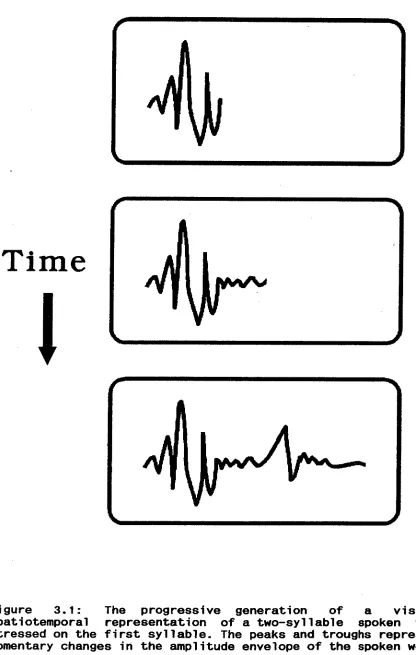
Two types of visual transform were used. The visual-spatiotemporal display displayed a graphical representation of amplitude changes within the spoken word on a cathode ray oscilloscope. These stimuli were generated in real-time across the screen so that by the end of each trial the entire representation of the word was visible. A schematic representation of the formation of this stimulus across time is presented in Figure 3.1. The visual-temporal display consisted of a row of LED's which were illuminated to represent momentary changes in stimulus amplitude. As stimulus amplitude increased, so too did the number of LED's illuminated.
The rationale behind the selection of these two modes of visual display was as follows. The visual spatiotemporal display was intended to reflect a simple version of the type of display used in previous attempts to convey speech transforms visually (eg. Potter, 1946; Potter et al., 1947). The visual temporal display was included in an attempt to prevent any effect due to modality being confounded with effects due to
Time
[image:65.545.59.475.111.766.2]stimuli with temporal arrays of auditory stimuli, in which case any cross-modal effects are confounded with cross-information distribution style effects (Friedes, 1974; Sawada & Jarman,
1982; Sterritt & Rudnick, 1966). Bryden (1972) found that comparisons across both modality and information distribution style are more difficult to perform than are across modality but within information distribution style ones. As the auditory and tactile stimuli used here were distributed purely across time, while the visual spatiotemporal stimuli varied across both time and space, it was hoped that inclusion of the visual temporal display would help clarify the cause of any differences in performance between the auditory to tactile and auditory to visual comparison tasks.
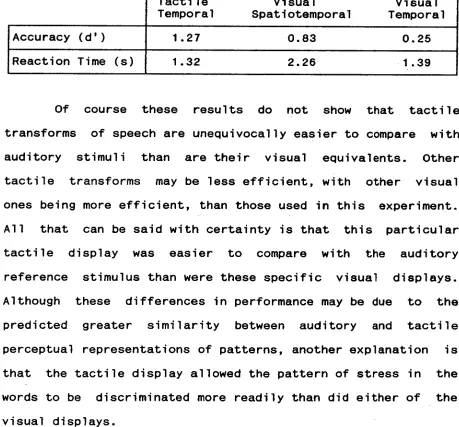
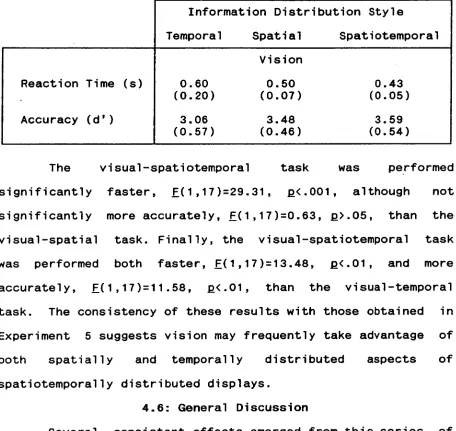
The results of this experiment are summarized in Table 3.1, which presents mean reactions times for correct responses and mean dprimesl for each type of transform. As can be seen,
the auditory to vibrotactile comparisons were performed both faster and more accurately than were the auditory to spatiotemporal comparisons. Although the auditory to visual-temporal comparison task was performed as rapidly as the auditory to tactile-temporal task, the near chance dprime scores recorded in the visual-temporal condition show that the subjects were effectively unable to compare the pattern of stress in the words presented in this way. In this case, it can only be concluded that the visual-spatiotemporal task,
although performed more slowly than the visual-temporal comparison task, was performed more efficiently than its visual-temporal equivalent.
Table 3.1: Mean reaction time (sec.) for correct responses and mean accuracy (d') levels from Mahar (1985) as a function of transform modality and information distribution style.
Tactile Temporal
Visual
Spatiotemporal
Visual Temporal
Accuracy (d') 1.27 0.83 0.25
Reaction Time (s) 1.32 2.26 1.39
3.2: Experiment 1: Discriminability of the Tactile and Visual Displays used in Mahar's (1985) Study
If the visual displays used in Mahar's (1985) cross-modal comparison experiment did not readily provide the subjects with the information needed to perform those comparisons then his results would tell us nothing about the relative ease with which tactile or visual representations of spoken words can be compared with auditory representations of words. On the other hand, if the visual displays were at least as discriminable as the tactile ones then the difference in the ease with which auditory to tactile and auditory to visual•
comparisons were made may be attributed to differences in the degree of compatibility between auditory, tactile, and visual representations of spoken words. This section describes an experiment conducted to test these alternative explanations by measuring the ease with which the stress patterns of words could be extracted from the various tactile and visual transforms of spoken words used in Mahar's (1985) experiment 2.
3.2.1: Method
Fifteen university undergraduates with normal or corrected to normal vision participated in this experiment. They were presented with transforms of two-syllable spoken words via the tactile, spatiotemporal, and visual-temporal displays described in Section 3.1. Half the test words were stressed on the first syllable, while the other half were stressed on the second syllable. The subjects task was to
identify the stressed syllable in each word via two-choice button-press. Each subject undertook 12 practice and 48 experimental trials in one of the three conditions. As the intention of this experiment was to establish whether subjects could determine the stressed syllable in the words presented, only accuracy data was gathered in this case.
3.2.2: Results and Discussion
Mean dprime scores from this display discrimination experiment are presented in Table 3.23. Dprimes were calculated by counting words stressed on the first syllable which were correctly identified as hits, and words stressed on the second syllable which were incorrectly classified as false alarms. Table 3.2 shows that subjects could identify the stressed syllable in each word most accurately when the visual- spatiotemporal display was used. Accuracy levels in the tactile-temporal and visual-temporal conditions were similar. A series of planned comparisons confirmed these descriptive observations, revealing a significant difference in performance between the visual-spatiotemporal scores and those recorded in either the tactile-temporal, F(1,12)=21.58, p<.001, or visual-temporal, F(1,12)=35.24, 2<.001, conditions. Accuracy levels in the tactile-temporal and visual-temporal conditions did not differ significantly, F(1,12)=1.67, p>.05.
As the two visual displays were at least as