City, University of London Institutional Repository
Citation
:
Wang, J., Otgaar, H., Bisback, A., Smeets, T. and Howe, M. L. ORCID: 0000-0002-5747-5571 (2019). The Consequences of Implicit and Explicit Beliefs on Food Preferences. Psychology of Consciousness: Theory Research, and Practice, doi: 10.1037/cns0000203This is the accepted version of the paper.
This version of the publication may differ from the final published
version.
Permanent repository link: http://openaccess.city.ac.uk/id/eprint/22889/
Link to published version
:
http://dx.doi.org/10.1037/cns0000203Copyright and reuse:
City Research Online aims to make research
outputs of City, University of London available to a wider audience.
Copyright and Moral Rights remain with the author(s) and/or copyright
holders. URLs from City Research Online may be freely distributed and
linked to.
City Research Online: http://openaccess.city.ac.uk/ [email protected]
Running Head: BELIEF, RECOLLECTION & FOOD PREFERENCE
The Consequences of Implicit and Explicit Beliefs on Food Preferences
Jianqin Wang1,2, Henry Otgaar1,3, Athina Bisback1, Tom Smeets1,4, and Mark L. Howe1,3.
1Maastricht University, The Netherlands 2Catholic University of Leuven, Belgium
3City, University of London, UK 4Tilburg University, The Netherlands
IN PRESS:
Psychology of Consciousness: Theory, Research, and Practice
(Accepted July 15, 2019)
Correspondence to Jianqin Wang, Clinical Psychological Science, Faculty of Psychology and
Neuroscience, Maastricht University, PO Box 616, 6200 MD, Maastricht, the Netherlands,
Tel.: +31-43-3884536, Fax: +3143-3884196. E-mail address:
3 Abstract
Memories can have consequences on people’s eating behavior. In the current experiment, we examined the effect of belief versus recollection on food preferences and then investigated whether explicit belief (i.e., self- reported) or implicit belief (i.e., measured by an autobiographical implicit association test; aIAT) had a similar effect on food preferences. Participants (N = 163) were falsely told that they got sick after eating egg salad in their childhood and then received guided imagery to induce false beliefs/recollections concerning the food- aversive event. Half of the participants with false memories were debriefed and told that the event was false in order to reduce their belief in the event. Belief, not recollection regarding the food-aversive event, impacted participants’ food preferences. Furthermore, we found that explicit, but not implicit, belief predicted participants’ food preferences. The current results suggest that explicit judgments of belief in a memory may explain the consequences resulting from memories.
4
The Consequences of Implicit and Explicit Beliefs on Food Preferences
False memories can exert significant consequences on people’s attitudes and behavior. For example, false memories of being sexually abused in childhood could lead to a lawsuit against a family member (Loftus, 1993). When people recall those false memories with vivid sensory details, they often also believe that the recalled event really happened and thus act consequently upon their memory. However, the question arises regarding which aspect of memory is more likely to contribute to behavioral consequences: the vivid recollections of the experience or a mere belief in the occurrence of the event? For example, when people do not believe in the occurrence of an event but still hold a vivid recollection, do they still behave in a manner consistent with their nonbelieved memory? In the current experiment, we were interested in the effect of belief on behavior and whether this effect is similar at both an implicit and explicit level.
Belief versus Recollection
The relevance of the issue concerning the effect of belief on behavior becomes evident when we consider the fact that autobiographical recollection and belief are two independent aspects that contribute to the experience of autobiographical memory (Mazzoni, Loftus, & Kirsch, 2001; Scoboria, Jackson, Talarico, Hanczakowski, Wysman, & Mazzoni, 2014; Scoboria, Talarico, & Pascal, 2015). Recollection is the feeling that we are re-experiencing the event accompanied by mental images of a memory that can include sensory details and references to vividness and context.
Belief in occurrence1 is regarded as the truth value of the event; that is, whether it
happened or not (Rubin, 2006; Scoboria et al., 2014). We have recollections and beliefs for most of our memories, but for some events, we only have autobiographical beliefs with no recollections as, for example, when we believe that we were born but cannot recall it; or we have only recollections
5 but no beliefs which have been referred to as nonbelieved memories (NBMs; Mazzoni, Scoboria, & Harvey, 2010, Otgaar, Scoboria, & Mazzoni, 2014).
Over the past decade, many studies have demonstrated that false beliefs for a particular food can change food preferences and eating behavior (e.g., Bernstein, Laney, Morris, & Loftus, 2005; Bernstein & Loftus, 2009; Geraerts, Bernstein, Merckelbach, Linders, Raymaekers, & Loftus, 2008; Scoboria, Mazzoni, Jarry, & Bernstein, 2012). The typical procedure in this line of research is that participants receive false feedback that they had been ill after eating a particular food (e.g., peach yogurt, egg salad, pickles), and those participants who falsely believe the suggested event occurred exhibit reduced preference for that food and eat less of that particular food even weeks or months later (Geraerts et al., 2008; Scoboria, Mazzoni, & Jarry, 2008).
6 More recently, studies have attempted to study the unique contribution of false memories and false beliefs to food preferences. Scoboria, Mazzoni, Jarry, and Bernstein (2012) found that participants who reported a false memory about the suggested food-aversive event for peach yogurt ate less peach yogurt afterward than participants in both the false beliefs only group and the control group, and the latter two groups of participants did not differ. However, Bernstein, Scoboria, and Arnold (2015) conducted a mega-analysis on eight studies published from 2005 to 2008 and found that participants who remembered the suggested event were indistinguishable from those who had only beliefs regarding food preferences, suggesting false beliefs are as important as memories in impacting people’s attitudes and behavior. More recently, Howe, Anderson, and Dewhurst (2017) investigated whether false beliefs and false memories about a food-aversive event would impact people’s implicit preferences of the particular food. The researchers found that although false beliefs
changed explicit food preferences, false memories changed implicit food preferences. Mixed findings across studies may be due to one important limitation in these studies: They did not experimentally dissociate belief from recollection in order to evaluate the independent effects of belief and recollection on food preferences.
Research has shown that when participants are debriefed by telling them that they had false memories, participants will often reduce belief in their false
7 but no belief), and a control group (no recollection and no belief). The primary aim of the current experiment was to address the methodological limitation in previous studies by creating these four groups and examining their effects on food
preferences.
Explicit versus Implicit Belief
Besides measuring people’s explicit belief with self-reported questionnaires, researchers have also successfully measured people’s implicit belief (or implicit truth value) of an event using the autobiographical Implicit Association Test (aIAT; Agosta & Sartori, 2013; Sartori, Agosta, Zogmaister, Ferrara, & Castiello, 2008; Shidlovski, Schul, & Mayo, 2014). The aIAT is a variant of the Implicit Association Test (IAT) that was first developed by Greenwald, McGhee, and Schwartz (1998). The IAT was intended to measure people’s implicit attitudes towards stimuli, such as particular objects or people. Sartori et al. (2008) adapted it to the aIAT in order to measure the truth value of autobiographical memoires and events, i.e., whether an
autobiographical event is true or false for the respondent. The truth value of an event is termed as belief by current memory theories (Rubin, 2006; Scoboria et al., 2014); thus, the aIAT has actually been used to measure the implicit truth value or implicit belief of an event (see Shidlovski, Schul, & Mayo, 2014).
Technically, the aIAT measures participants’ reaction times towards contrasting autobiographical events. For example, in one study, “guilty” individuals participated in a mock crime where they were instructed to steal a CD containing an upcoming exam, whereas innocent participants did not do so. Later, guilty and innocent participants reacted to statements such as “I stole the CD” and “I did not steal the CD”. Guilty participants responded faster when true statements were associated with “I stole the CD” than when true statements were associated with “I did not steal the CD” (Sartori et al., 2008). Agosta and Sartori (2013) reviewed recent studies and found that the
8 Galdi, Zogmaister, & Amadori, 2008; McConnell & Leibold (2001) .
However, there is a recent debate regarding the predictive power of the IAT. Greenwald, Poehlman, Uhlmann, and Banaji (2009) conducted a meta-analysis on the predictive validity of the IAT on actual behavior and found an average r = .27 for the correlations between IAT and behavioral and physiological measures. They also found an average r = .36 for the prediction of behavior by explicit self-reported measures. However, Oswald, Mitchell, Blanton, Jaccard, and Tetlock (2013) examined the reviewed studies more closely and they found that the average
correlation between IAT and behavior was r = .15, much lower than Greenwald et al. (2009) found. Oswald and colleagues found that IATs were poor predictors of every criterion of discriminatory behavior and IATs were no better predictors than explicit measures. So far, no consensus has been reached regarding the predictive power of IATs (see Greenwald, Banaji, & Nosek, 2014 and Oswald, Mitchell, Blanton, & Jaccard, 2015 for more discussion).
Since aIAT is a variant of IAT (i.e., by measuring congruent and incongruent reaction times), the concern about predictive power may apply to aIAT as well. As the predictive power of aIAT has not been investigated, it is unclear whether implicit belief measured by aIAT would predict people’s behaviors, such as food preferences. For example, if a participant implicitly holds a belief that she had been sick after eating egg salad, will she exhibit low preference for egg salad?
In the experiment reported here, we suggested to participants that they had been sick after eating egg salad in their childhood, which has been shown to effectively induce explicit beliefs and memories in that autobiographical event (Bernstein et al., 2015). We were also used the autobiographical IAT to measure the implicit belief of the suggested event in different belief and recollection groups. Although previous studies on IAT usually focused on the relationship between people’s implicit attitudes
9 implicit belief can impact behavior directly. Howe et al. (2017) was the only study that used the IAT in relation to food preferences, but they measured implicit food preferences (i.e., the dependent variable) rather than implicit beliefs (i.e., the
independent factor). In our research we used the aIAT (Sartori et al., 2008) to measure participants’ implicit belief in the suggested event of being sick after eating egg salad and to examine whether implicit belief impacted (explicit) food preferences for egg salad.
The Current Experiment
We used an adapted false feedback paradigm (Bernstein et al., 2005; Scoboria et al., 2008) to induce false recollections and beliefs for a suggested food event that the subject became sick after eating egg salad in their childhood. Participants first completed questionnaires online to obtain baseline data such as autobiographical memories, food history, and food preferences. Two weeks later, they came to the lab and were falsely told that they had been sick after eating egg salad in their childhood, after which they engaged in guided imagery to retrieve memories of the suggested event, which is known to induce rich false memories (Garry & Wade, 2005; Scoboria et al., 2012).
10 Bernstein, Scoboria, and Arnold’s (2015) mega-analysis revealed that belief is more important than recollection in impacting people’s behavior such as food preferences. Recently, Wang et al. (2017) also found that belief in memories is crucial in terms of changing problem-solving efficiency. We predicted that, if autobiographical belief is more important than recollection, we would find an effect of belief but no effect of recollection in impacting participants’ food preferences.
Method Participants
Participants were screened via a Food History Inventory (FHI) that measured experiences with different foods. To participate, individuals were required to not report a history of being sick on egg-salad as measured by the FHI. One hundred and sixty-three participants passed the screening and were tested. Two participants were excluded because they indicated they definitely remembered or believed the sick-on-egg salad event in the online Autobiographical Memory and Belief Questionnaire. The final sample consisted of 36 males and 125 females (range 18 to 39 years old;
M=22.24, SD= 3.49). After manipulation, there were 45 participants with both belief and recollection, 26 participants with belief but no recollection, 21 with recollection but no belief, and 69 with no belief and no recollection of the suggested event.
Participants received course credits or 7.5 euros shopping vouchers. The study was approved by the ethical review committee of the Faculty of Psychology and Neuroscience, Maastricht University.
Materials
11
after eating egg salad.
Belief and Recollection Ratings. To measure belief and recollection, we used part of the Autobiographical Belief and Memory Questionnaire (ABMQ; Scoboria et al., 2004). Specifically, we measured participants’ autobiographical belief and memory for five past events that included lost while shopping, sick on egg salad, enjoyed egg salad, broke a window with a hand, and sick on peach yogurt. The belief and
recollection items for the event sick on egg salad were of main interest. Participants rated each item for each event on a 1-8 point Likert-like scale. For the belief item, participants were asked “How likely is it that you personally, before the age of 7, were sick after eating egg salad?” (1= definitely did not happen, 8= definitely did happen). For the recollection item, participants were asked “Do you actually remember being sick on eating egg salad before you were the age of 7?” (1= no memory of event at all, 8 = clear and complete memory).
Memory Characteristic Questionnaire (MCQ; Johnson, Foley, Suengas, & Raye, 1988). The questionnaire measures phenomenal characteristics associated with memory on 1 to 7 scales, including visual details, smell, taste, occurred setting, time and negative emotions associated with the critical event.
Memory/Belief Form (MvB). The MvB was adapted from the Memory/Belief form in Bernstein, Laney, Morris, and Loftus (2005). We asked participants to indicate whether they had a memory (i.e., recollection; yes or no) and whether they had a belief (yes or no) that they had got sick after eating egg salad in childhood (see also Otgaar, Scoboria, Howe, Moldoveanu, & Smeets, 2016).
Food Preferences Inventory (FPI; Bernstein et al., 2005). Participants rated 62 foods on 1–7 point scales (1= definitely don’t like; 7= definitely like). We included the target food – egg salad, and several related items (other varieties of salads, yogurts, etc.) to assess participants’ preferences for foods.
12 restaurant targeting student consumers in Maastricht was conducting some simple marketing research. Participants rated 25 foods on a Likert-like scale from 1 (definitely no) to 8 (definitely yes) to indicate willingness to order various foods at that restaurant, including the critical item toasted bread with egg salad.
Autobiographical Implicit Association Test (aIAT). The aIAT was
programmed using Inquisit 3. Participants completed five blocks of categorization trials. There were two types of sentences to be categorized: Sentences that were definitely true or false at the time of the experiment and sentences regarding the critical egg salad event. Participants were asked to categorize the sentence as fast as possible. The sentences are included in Supplementary Materials.
13
Table 1. Blocks of the Autobiographical Implicit Association Test.
Response key
Block 1: logical discrimination
Block 2: Initial autobiographical discrimination
Block 3: Initial double categorization
Block 4: reversed autobiographical discrimination Block 5: reversed double categorization “A” key “L” key True sentences False sentences
“sick on egg-salad” sentences
“not sick on egg-salad” sentences
True and “sick” sentences
False and “not sick” sentences
“not sick on egg-salad” sentences
“sick on egg-salad” sentences
True and “not sick” sentences
False and “sick” sentences
Note: The order of Blocks 3 and 5, and of Blocks 2 and 4, were reversed for half of the participants. Sentences in each block were presented in a randomized order.
Procedure Session 1
Participants completed an online questionnaire via Qualtrics (15 to 20 minutes to complete). In the questionnaire, they were informed that people tend to forget what happened to them between the age of 3 and 7 years old. The cover story was that researchers were examining whether it was possible to recover memories before the age of 7. Participants were told that their data would be analyzed to identify events that very likely occurred in their childhood. Participants completed demographic data, the FHI, the ABMQ and the FPI. The FHI was used to screen participants who had no history of being sick after eating egg salad in childhood. The ABMQ measured participants’ baseline data about memory and belief ratings on the critical event (sick on egg salad in childhood). The FPI measured participants’ baseline data about their preference concerning different foods including the critical food egg salad. Eligible participants were invited to take part in session 2 two weeks later.
Session 2
14 online questionnaire in Session 1 measured by the FHI and FPI. The key information in the profile was a page that listed possible personal childhood events and being sick after eating egg salad was listed with highest probability (7 out of 8 on a 1-8 scale). We asked participants to think about clues that would support the critical event for several seconds, and we would try to recover their memories regarding this event.
Next, individuals participated in guided imagery in an attempt to recall the event in detail. The script for guided imagery was similar to Scoboria et al. (2012). During the guided imagery, participants were first asked to close their eyes, relax, and mentally go back to the time when they were little by imagining for instance how they looked like, with whom they played, and where they went to school. Next, they were asked to focus on the details of the critical event. Specifically, they were guided to focus on the environment, the food, the smell, the taste and finally the feelings they might experience of being sick on egg salad.
Participants were provided with suggestions that several symptoms such as cramps in the stomach and nausea might have occurred during this event, and they were free to report any feelings or anything that popped up to their imagery. The guided imagery session was audiotaped. The duration of guided imagery including preparation was around 8 minutes.
15
false memories. The event that you were sick after eating egg-salad actually never happened—this is indicated in the answers of your online survey.” Other participants did not receive the debriefing but were just asked to confirm whether they had memories or not. Then all participants completed the belief questions in terms of whether they had a belief and their belief strength on a 1-8 scale.
After the MvB and MCQ, all participants completed the aIATfor about 10 minutes followed by the Food Preferences Inventory and the Restaurant
Questionnaire, which was presented as an extra market research survey.
Results Recollection and Belief
All data can be accessed at https://osf.io/g6wms/.Participants were classified as having recollection versus no recollection and belief versus no belief primarily based on self-reported responses in the MvB. Notably, participants were told that they needed to recall specific details and report those details to the experimenter if they had any specific recollections. Forty-one percent of the participants (n = 66) reported having vivid recollections and the majority 59% (n= 95) reported no memory. This false memory formation rate (i.e., 41%) is close to the average number (i.e., 46%) that was calculated in eight previous false memory implantation studies (Scoboria, Wade, Lindsay, Azad, Strange, Ost, & Hyman, 2017). The false details reported were relatively rich in details. For instance, one participant reported that “I was at a
16 The experimenter recorded participants’ recollections, and half of those with recollections (n=33) were debriefed by the experimenter that their memories were false. After debriefing, 17 participants indicated “no” belief and another 4 participants with memories indicated “no” belief spontaneously (without debriefing). Thus, a total of 21 participants had NBMs. Table 2 shows the number of participants who circled “yes” or “no” on the recollection and belief questions of MvB in the end. For
[image:16.595.93.520.337.432.2]participants with no recollections after receiving the false suggestion, 26 participants believed the critical event happened and 69 indicated no belief in the occurrence of the critical event.
Table 2. Number of participants with/without recollection or belief in the critical event after debriefing.
Recollection
Yes No Total
Belief Yes 45 (28%) 26 (16%) 71 (44%)
No 21 (13%) 69 (43%) 90 (56%)
Total 66 (41%) 95 (59%) 161
We also examined the recollection and belief strength (1-8 scales) of the critical event pre- and post- suggestion. Note that in the online questionnaire of Session 1, belief was measured twice, and we averaged them as the baseline belief scores. Table 3 reveals the mean recollection and belief ratings with 95% CIs pre- and post-suggestion in each group. As we can see from the table, for the
Recollection/Belief group, recollection and belief ratings were both high (above 6) in Session 2, and the mean belief rating did not differ from the mean recollection rating,
t(44) = 0.71, p = .48. For the Recollection/No Belief group, recollection ratings were statistically higher than belief ratings after the manipulation in Session 2, t(20) = 2.43,
p = .03, d= 0.53. The mean difference between recollection and belief ratings was 1.62, which also satisfied the criterion of NBMs based on rating differences (Scoboria & Talarico, 2013). For the No Recollection/Belief group, belief ratings were
17
Table 3. Mean Recollection and Belief ratings in Session 1 (pre-suggestion) and Session 2 (post-suggestion) in different groups (CI: confidence interval).
No Recollection/
No Belief No RecollectionBelief / Recollection/ No Belief Recollection/ Belief (n=69) (n=26) (n=21) (n=45) Recollection Session 1 1.17 1.50 1.71 1.98
Rating [1.02, 1.33] [0.89, 2.11] [1.07, 2.36] [1.42, 2.53] (M, 95%CI) Session 2 1.94 3.12 5.29 6.02
[1.68, 2.21] [2.44, 3.79] [4.52, 6.05] [5.60, 6.45] Belief Session 1 2.08 3.01 2.55 2.61 Rating [1.84, 2.32] [2.21, 3.82] [1.92, 3.18] [2.24, 2.98] (M, 95%CI) Session 2 2.72 5.35 3.67 6.16
[2.43, 3.02] [4.82, 5.87] [2.86, 4.47] [5.76, 6.56]
Food Preferences
We were most interested in examining whether recollection or belief impacted food preferences. Since participants were categorized in 2 (Recollection: yes vs. no) × 2 (Belief: yes vs. no) by the MvB in the end, we conducted a 2 (Recollection) × 2 (Belief) between-subjects ANCOVA to analyze preferences on egg salad, controlling for baseline preference scores for egg salad in Session 1. Levene’s test indicated equal variance across groups, F(3, 157) = 0.01, p > .99, and the criteria for ANCOVA were also met. There was no significant interaction effect between Recollection and Belief, F(1, 156) = 1.10, p = .30. We found a statistically significant main effect of Belief2, F(1, 156) = 6.76, p = .01, partial η2 = .04, Cohen’s d = 0.58, suggesting that
belief in being sick on egg salad lowered food preference for egg salad (see Figure 1a). However, no main effect of Recollection was found, F(1, 156) = 0.55, p = .46, implying recollection of the critical food event did not impact preference for egg salad.
2 Although we had unequal sample sizes in different conditions, the variance is equal across groups. To
18
Figure 1. Food preferences for (a) Egg salad, (b) Boiled eggs, (c) Salad, and (d) Pasta in different Recollection (yes vs. no) and Belief (yes vs. no) groups. (Error bars indicate 95%CIs)
Participants’ food preference ratings on other foods were measured as well (e.g., boiled eggs, salad, watermelon, etc.). We conducted 2(Recollection) × 2(Belief) between-subjects ANCOVAs to test participants’ preferences for other foods
(controlling for baseline preference scores). Interestingly, participants’ preferences for boiled eggs were impacted in a similar way as preference for egg salads. We found a statistically significant main effect of Belief, F(1, 142) = 10.32, p = .002, partial η2 = .07, Cohen’s d = 0.65, but no statistically significant main effect of
Recollection, F(1, 142) = 0.37, p = .54, and no statistically significant interaction effect, F(1, 142) = 0.20, p = .66. Furthermore, neither Recollection nor Belief in theegg salad event impacted participants’ preferences for other irrelevant foods such as salad in general, watermelon, and pasta (see Figure 1c and 1d).
(a) (b)
19
Eating Intention
Participants’ behavioral intention regarding eating egg-salad in a restaurant was measured by asking how likely they would like to order toasted bread with egg- salad in a restaurant on a 1-8 scale. Since the restaurant questionnaire was only administered in Session 2, no baseline data in Session 1 was recorded. Levene’s test showed equal variance across groups, F(3, 157) = 0.23, p = .88. We conducted a (Recollection: yes vs. no) × 2 (Belief: yes vs. no) ANOVA on intention to eat egg salad, but did not detect any significant main effect of Belief, F(1, 157) = 2.09, p
= .15, main effect of Recollection, F(1, 157) = 0.24, p = .62, or interaction effect,
F(1, 157) = 2.21, p = .14.
aIAT
Figure 2 shows the reaction times in congruent and incongruent blocks and the mean converted D scores in each condition. We compared the RTs between congruent and incongruent blocks in each recollection/belief combination group. Incongruent blocks had statistically longer RTs than congruent blocks in every group, the corresponding Cohen’s ds and p-values in each group are as follows: for the
Recollection/Belief group, d = 1.27, p < .001; for the Recollection/No belief group, d
= 1.18, p < .001; for the No Recollection/Belief group, d = 0.82, p < .001; and for the No Recollection/No Belief group, d = 0.40, p = .002. D score was calculated by subtracting the mean RT for the block associating “sick” and true sentences (Block 3, the congruent block) from mean RT for the block associating “not sick” and true sentences (Block 5, the incongruent block) and then dividing the
20
Figure 2. Mean reaction times of congruent/incongruent blocks and mean D scores in different recollection and belief groups (“Rec” stands for “Recollection”; error bars indicate 95%CI).
Implicit/explicit Belief and Food Preferences
Participants were categorized in the “Yes” or “No” Implicit Belief categories based on their D scores. For participants who had positive D values, they were considered to hold an implicit belief in the event of sick on egg salad, and for
participants who had negative values, they were considered as not having an implicit belief of the critical event (Agosta & Sartori, 2013). In total, there were 36
21 significant correlation between D scores and preferences for boiled eggs, r(160) = -.06, p = .46.
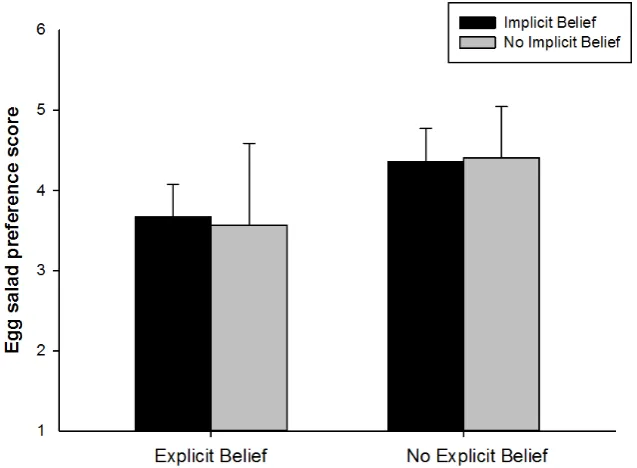
Since explicit belief was known to impact food preferences in the above results, we specifically conducted a 2 (Explicit belief: yes vs. no) × 2 (Implicit belief: yes vs. no) ANCOVA (controlling for egg salad preferences in Session 1) to test whether implicit belief interacted with explicit belief in influencing egg salad preferences. No statistically significant interaction effect was detected, F(1, 157) = 0.05, p = .83. There was only a statistically significant main effect of explicit belief,
F(1, 157) = 5.03, p = .03, and no statistically significant main effect of implicit belief, F(1, 157) = 0.01, p = .94. The results overall suggest that implicit belief in the event of being sick on egg salad does not lead to decreased preferences in egg salad.
[image:21.595.159.478.359.593.2]
Figure 3. Preference scores for egg salad in different explicit belief (yes vs. no) and implicit belief (yes vs. no) groups. Error bars indicate 95%CI.
22
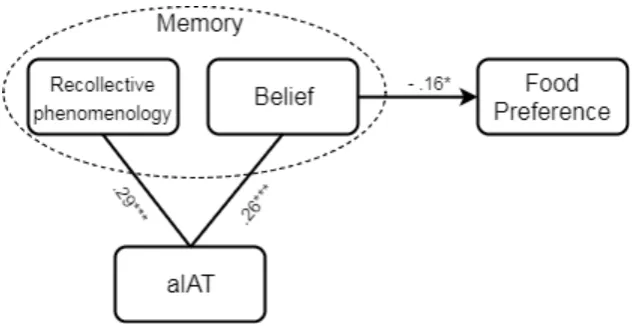
Figure 4. Summarized correlations among memory phenomenology, belief, aIAT and food preference in our study (* < .05; *** < .001).
Discussion
Memories usually consist of vivid mental representations of a past experience as well as a belief in the event that it did actually occur. In the current study, we reported whether it is recollection or belief of a food aversive event that impacts food preferences. We found that belief in the occurrence of the food aversive event, rather than recollective memory traces of the food aversive event, decreased people’s food preferences. We also reported on the first study whether implicit belief
measured by aIAT would impact food preferences like explicitly self-reported belief did, and we found that implicit belief did not impact food preferences. We found that aIAT performance was associated with both recollections and beliefs (see Figure 4).
23 aspects of a past experience, while belief is strongly predicted by event plausibility. When a person has a belief in the occurrence of the event, then the event is seen as highly plausible and that it may happen again. In our case, when participants
believed that they had been sick after eating egg salad in childhood, participants can naturally reason that they would probably get sick again after eating egg salad. Thus, their preferences for egg salad were lower than those who did not have a belief.
If recollection in general cannot impact food behavior, what is the function of recollection? Based on our data, we speculate that recollection can perhaps facilitate information processing efficiency or fluency. The results showed that recollection of the event was closely related to the implicit measurement (i.e., reaction times) of the event. The more vivid and detailed of the recollection, the higher D score or faster reaction time to the statements describing the true status of the event. The mental representation of the event may have made the processing of related information (e.g., an imagery depicting the event or in our study, the statement that “I have been sick after eating egg salad”) more fluent than the no recollective representation condition. Recollection has also been shown to contribute to simulating a future event, which can help people plan and cope with the future (Schacter, 2012).
Our results demonstrate an interesting alignment between the model of (explicit) autobiographical memory constructs (Scoboria et al., 2014) and implicit measurement of autobiographical events (Agosta & Sartori, 2013). In the two- dimensional model of explicit memory, recollection and autobiographical belief are two distinct constructs. The current study managed to produce all possible
recollection (yes vs. no) and belief (yes vs. no) combinations and then their relationship with the aIAT was tested. We found that the aIAT was sensitive to detect both recollection and belief change. Correlational analyses consistently
showed that the stronger recollection people had, the higher D score of aIAT, and the stronger belief people had, the higher the D score (see Figure 4).
24 belief, why would it not predict food preferences since belief impacts food
preferences? The answer may lie in the different contribution of recollection and belief in explaining the variance of aIAT D scores. We found that memory phenomenological characteristics contributed the most to D scores, explaining around 9.4% of the variance, and by adding belief in the regression model, the overall R2 increased slightly to 10.6% (see Supplementary Materials). Thus, the
aIAT is much more sensitive to recollective aspects of memory than to belief judgments of a memory. And since recollection does not predict food
preferences, as a result, aIAT probably cannot predict food preferences. So in situations where implicit measurements have strong correlations with explicit measurements, implicit measurements might be correlated with behavior as well. This can explain results from previous studies where implicit attitude to black people were found to be correlated with discriminatory behavior since IATs were also correlated with explicit attitude towards black people (e.g., McConnell & Leibold, 2001; Greenwald et al., 2009).
Marini, Agosta, Mazzoni, Barba, and Sartori (2012) investigated aIATs of true and false memories of words using the Deese/Roediger-McDermott (DRM) paradigm. They found that the aIAT detected greater D scores for true memories than false memories. However, average D scores for both true and false memories for words were positive (0.98 and 0.86 respectively) in their study. Our study obtained similar results in that the average D scores for all (false) recollection and belief groups were positive (0.23~0.56), suggesting that the aIAT is limited in differentiating true from false events when recollections or beliefs for the false event have developed. We also found a very high false positive rate (around 70%) for participants who had neither false beliefs nor false recollections. We could not find an explanation, however, in terms of methodology, because the sentences in our study were constructed in a very similar way with previous research (Sartori et al., 2008; see Supplementary
25 There are certain limitations of the current research. First, the categorization of participants into different groups was based on self-reported recollections and beliefs instead of being randomly assigned. Participants were naturally assigned to different recollection and belief groups based on their self-reports at the end of Session 2, because we could not control which participants to develop a false belief/recollection and which not. Thus, the groups in ANOVA analyses of the current study were not based on manipulations but rather on the output of our manipulations. Thus, the sample size of the groups varied to some extent. For example, in the nonbelieved memory group, there were 21 participants while in the believed memory group, there were 69 participants. Again, this is because we could not control which participants would relinquish their beliefs after the debriefing manipulation. Further research may try to increase the number of nonbelieved memories by providing more persuasive feedback, in order to even the number of participants. To overcome this limitation to some extent, we conducted a regression analysis with dummy variables of recollection (yes vs. no) and belief (yes vs. no), and the results were similar.
The other limitation is that the memories studied here are false memories. Participants produced false recollections and false beliefs of the egg salad event after a suggestion session. One might suspect that, because those memories were
essentially false, it is relatively easy for participants to reduce beliefs in their recollections. The role that belief plays in false memories might be different from what it plays in true memories. However previous studies showed that
autobiographical belief in true memories, such as performing actions and studying words, is retracted as easily as belief in false memories via social feedback (Mazzoni, Clark, & Nash, 2014; Wang et al., 2017). Nonetheless, further research is needed to study whether the conclusion that only autobiographical belief impacts food
preferences can be generalized to true memories. Further research is also needed to study the consequences of recollection and belief with other behavioral
26 Our study has theoretical implications regarding the dissociation theory of memory. Our study managed to create all possible dichotomous recollection and belief combinations, which supported the dissociation model of these two components in memory. Nonbelieved memories are relatively rare in real life (3 ~ 6.4 %, Scoboria & Talarico, 2013), but in lab settings, a relatively higher rate (13%) of NBMs can be created. Thus, the different roles of recollection and belief could be tested in our study, and the current study found dissociations in the behavioral consequences of recollection and belief. We have provided evidence that autobiographical belief is important in impacting food behavior while recollection impacts the processing of event-related information.
27 References
Agosta, S., & Sartori, G. (2013). The autobiographical IAT: a review. Frontiers in
Psychology, 4, 519.
Arcuri, L., Castelli, L., Galdi, S., Zogmaister, C., & Amadori, A. (2008). Predicting
the vote: Implicit attitudes as predictors of the future behavior of decided and
undecided voters. Political Psychology, 29(3), 369-387.
Berkowitz, S. R., Laney, C., Morris, E. K., Garry, M., & Loftus, E. F. (2008). Pluto
behaving badly: False beliefs and their consequences. The American Journal
of Psychology, 121, 643-660.
Bernstein, D. M., & Loftus, E. F. (2009). The consequences of false memories for
food preferences and choices. Perspectives on Psychological Science, 4(2),
135-139.
Bernstein, D. M., Laney, C., Morris, E. K., & Loftus, E. F. (2005). False beliefs about
fattening foods can have healthy consequences. Proceedings of the National
Academy of Sciences of the United States of America, 102(39), 13724-13731.
Bernstein, D. M., Scoboria, A., & Arnold, R. (2015). The consequences of suggesting
false childhood food events. Acta Psychologica, 156, 1-7.
Clark, A., Nash, R. A., Fincham, G., & Mazzoni, G. (2012). Creating non-believed memories for recent autobiographical events. PLOS One, 7, 1-7.
Fazio, L. K., Barber, S. J., Rajaram, S., Ornstein, P. A., & Marsh, E. J. (2013).
Creating illusions of knowledge: Learning errors that contradict prior
knowledge. Journal of Experimental Psychology: General, 142(1), 1-5.
Garry, M., & Wade, K. A. (2005). Actually, a picture is worth less than 45 words:
Narratives produce more false memories than photographs do. Psychonomic
28
Geraerts, E., Bernstein, D. M., Merckelbach, H., Linders, C., Raymaekers, L., &
Loftus, E. F. (2008). Lasting false beliefs and their behavioral
consequences. Psychological Science, 19(8), 749-753.
Greenwald, A. G., Banaji, M. R. & Nosek, B. A. (2015) Statistically small effects of the Implicit Association Test can have societally large effects. Journal of Personality and Social Psychology, 108, 553–61.
Greenwald, A. G., McGhee, D. E., & Schwartz, J. L. (1998). Measuring individual differences in implicit cognition: The implicit association test. Journal of Personality and Social Psychology, 74, 1464-1480.
Greenwald, A. G., Nosek, B. A., & Banaji, M. R. (2003). Understanding and using the
implicit association test: I. An improved scoring algorithm. Journal of
Personality and Social Psychology, 85(2), 197-216.
Greenwald, A. G., Poehlman, T. A., Uhlmann, E. L., & Banaji, M. R. (2009).
Understanding and using the implicit association test. Journal of Personality
and Social Psychology, 97(1), 17-41.
Howe, D., Anderson, R. J., & Dewhurst, S. A. (2017). False memories, but not false
beliefs, affect implicit attitudes for food preferences. Acta Psychologica, 179,
14-22.
Johnson, M. K., Foley, M. A., Suengas, A. G., & Raye, C. L. (1988). Phenomenal
characteristics of memories for perceived and imagined autobiographical
events. Journal of Experimental Psychology: General, 117(4), 371-376.
Laney, C., Morris, E. K., Bernstein, D. M., Wakefield, B. M., & Loftus, E. F. (2008).
Asparagus, a love story: Healthier eating could be just a false memory
29
Lewandowsky, S., Ecker, U. K., Seifert, C. M., Schwarz, N., & Cook, J. (2012).
Misinformation and its correction: Continued influence and successful
debiasing. Psychological Science in the Public Interest, 13(3), 106-131.
Loftus, E. F. (1993). The reality of repressed memories. American psychologist, 48(5),
518-537
Mantonakis, A., Wudarzewski, A., Bernstein, D. M., Clifasefi, S. L., & Loftus, E. F.
(2013). False beliefs can shape current consumption. Psychology, 4, 302-308.
Marini, M., Agosta, S., Mazzoni, G., Dalla Barba, G., & Sartori, G. (2012). True and
false DRM memories: differences detected with an implicit task. Frontiers in
psychology, 3, 310.
Mazzoni, G. A., Clark, A., & Nash, R. A. (2014). Disowned recollections: Denying
true experiences undermines belief in occurrence but not judgments of
remembering. Acta Psychologica, 145, 139-146.
Mazzoni, G. A., Loftus, E. F., & Kirsch, I. (2001). Changing beliefs about implausible
autobiographical events: A little plausibility goes a long way. Journal of
Experimental Psychology: Applied, 7(1), 51-59.
Mazzoni, G. A., Scoboria, A., & Harvey, L. (2010). Nonbelieved memories.
Psychological Science, 21, 1334–1340.
McConnell, A. R., & Leibold, J. M. (2001). Relations among the Implicit Association
Test, discriminatory behavior, and explicit measures of racial
attitudes. Journal of Experimental Social Psychology, 37(5), 435-442.
Oswald, F. L., Mitchell, G., Blanton, H., Jaccard, J., & Tetlock, P. E. (2013).
Predicting ethnic and racial discrimination: A meta-analysis of IAT criterion
30 Oswald, F. L., Mitchell, G., Blanton, H., Jaccard, J., & Tetlock, P. E. (2015). Using
the IAT to predict ethnic and racial discrimination: Small effect sizes of unknown societal significance. Journal of Personality and Social Psychology, 108, 562–571.
Otgaar, H., Scoboria, A., & Mazzoni, G. (2014). On the existence and implications of
nonbelieved memories. Current Directions in Psychological Science, 23, 349-
354.
Otgaar, H., Scoboria, A., & Smeets, T. (2013). Experimentally evoking nonbelieved memories for childhood events. Journal of Experimental Psychology:
Learning, Memory, and Cognition, 39, 717-730.
Otgaar, H., Scoboria, A., Howe, M. L., Moldoveanu, G., & Smeets, T. (2016).
Challenging memories in children and adults using an imagination inflation
procedure. Psychology of Consciousness: Theory, Research, and
Practice, 3(3), 270-283.
Rapp, D. N. (2016). The consequences of reading inaccurate information. Current
Directions in Psychological Science, 25(4), 281-285.
Rubin, D. C. (2006). The basic-systems model of episodic memory. Perspectives on Psychological Science, 1, 277-311.
Sartori, G., Agosta, S., Zogmaister, C., Ferrara, S. D., & Castiello, U. (2008). How to
accurately detect autobiographical events. Psychological Science, 19(8), 772-
780.
Schacter, D. L. (2012). Adaptive constructive processes and the future of memory.
American Psychologist, 67, 603-613.
31 Scoboria, A., Jackson, D., Talarico, J., Hanczakowski, M., Wysman, L., & Mazzoni, G. (2014). The role of belief in occurrence within autobiographical memory.
Journal of Experimental Psychology: General, 143, 1242-1258.
Scoboria, A., Mazzoni , G. , Jarry, J. , & Bernstein, D. (2012). Personalized and not general suggestion produces false autobiographical memories and suggestion-consistent behavior . Acta Psychologica, 139, 225–232 .
Scoboria, A., Mazzoni, G., & Jarry, J. L. (2008). Suggesting childhood food illness
results in reduced eating behavior. Acta Psychologica, 128(2), 304-309.
Scoboria, A., Wade, K. A., Lindsay, D. S., Azad, T., Strange, D., Ost, J., & Hyman, I.
E. (2017). A mega-analysis of memory reports from eight peer-reviewed false
memory implantation studies. Memory, 25, 146-163.
Scoboria, A., Talarico, J. M., & Pascal, L. (2015). Metamemory appraisals in autobiographical event recall. Cognition, 136, 337-349.
Shidlovski, D., Schul, Y., & Mayo, R. (2014). If I imagine it, then it happened: the
implicit truth value of imaginary representations. Cognition, 133(3), 517-529.
Smeets, T., Telgen, S., Ost, J., Jelicic, M., & Merckelbach, H. (2009). What's behind
crashing memories? Plausibility, belief and memory in reports of having seen
non‐existent images. Applied Cognitive Psychology, 23(9), 1333-1341.
Takarangi, M. K., Strange, D., Shortland, A. E., & James, H. E. (2013). Source confusion influences the effectiveness of the autobiographical IAT.
Psychonomic Bulletin & Review, 20(6), 1232-1238.